Sunday, March 10, 2013

How Disney Bought Lucasfilm—and Its Plans for 'Star Wars'


One weekend last October, Robert Iger, chief executive officer of Walt Disney (DIS), sat through all six Star Wars films. He’d seen them before, of course. This time, he took notes. Disney was in secret negotiations to acquire Lucasfilm, the company founded by Star Wars creator George Lucas, and Iger needed to do some due diligence.
The movies reacquainted Iger with Luke Skywalker, the questing Jedi Knight, and his nemesis Darth Vader, the Sith Lord who turns out to be (three-decade-old spoiler alert) his father. Beyond the movies, Iger needed to know Lucasfilm had a stockpile of similarly rich material—aka intellectual property—for more Star Wars installments. As any serious aficionado knows, there were always supposed to be nine. But how would Disney assess the value of an imaginary galaxy? What, for example, was its population?
As it turned out, Lucas had already done the cataloging. His company maintained a database called the Holocron, named after a crystal cube powered by the Force. The real-world Holocron lists 17,000 characters in the Star Wars universe inhabiting several thousand planets over a span of more than 20,000 years. It was quite a bit for Disney to process. So Lucas also provided the company with a guide, Pablo Hidalgo. A founding member of the Star Wars Fan Boy Association, Hidalgo is now a “brand communication manager” at Lucasfilm. “The Holocron can be a little overwhelming,” says Hidalgo, who obsesses over canonical matters such as the correct spelling of Wookiee and the definitive list of individuals who met with Yoda while he was hiding in the swamps of Dagobah.
The clandestine talks eventually led to the announcement last October that Disney would pay $4 billion for Lucasfilm, thus putting the Star Wars heroes and villains into the same trove of iconic characters as Iron Man, Buzz Lightyear, and Mickey Mouse. Disney sent excitable Star Wars fans into a frenzy by unveiling a plan to release the long-promised final trilogy starting in 2015. Their enthusiasm reached a crescendo in January when J.J. Abrams, director of the acclaimed 2009 rebooting of Star Trek, signed on to oversee the first film. “It’s like a dream come true,” gushes Jason Swank, co-host of RebelForce Radio, a weekly podcast.
The deal fit perfectly into Iger’s plan for Disney. He wants to secure the company’s creative and competitive future at a time when consumers are inundated with choices, thanks to a proliferation of cable television networks and the ubiquity of the Internet. “It’s a less forgiving world than it’s ever been,” he says. “Things have to be really great to do well.” Part of Iger’s strategy is to acquire companies that could be described as mini-Disneys such as Pixar and Marvel—reservoirs of franchise-worthy characters that can drive all of Disney’s businesses, from movies and television shows to theme parks, toys, and beyond. Lucas’s needs were more emotional. At 68, he was ready to retire and escape from the imaginary world he created—but he didn’t want anybody to desecrate it.


“I’ve never been that much of a money guy,” Lucas says. “I’m more of a film guy, and most of the money I’ve made is in defense of trying to keep creative control of my movies.” Lucas is speaking by phone, giving a reluctant interview about the sale of Lucasfilm. He tells the familiar story about how he didn’t set out to be rich and powerful. He just wanted to make experimental movies like THX-1138, set in a futuristic world where sex is illegal, drug taking is mandatory, and brutal androids make sure people comply with the rules.
Lucas had a searing experience with THX-1138. Warner Bros. took the movie out of his hands and recut it before it was released in 1971. Universal did the same thing with his next film, American Graffiti, set in his hometown of Modesto, Calif. But unlike THX-1138, American Graffiti was a hit.
Lucas, still smarting from the way the studios treated his previous movies, decided to take a different approach with his next project, Star Wars Episode IV: A New Hope. He turned down a $500,000 fee to direct his own script, instead asking for $50,000 and the rights to all sequels. Episode IV, which opened in 1977, and the following two movies have grossed a combined $1.8 billion, including rereleases. After that first trilogy, Lucas was wealthy enough to do whatever he pleased. He could produce director Paul Schrader’s Mishima: A Life in Four Chapters, a brooding art film with a Philip Glass score that made only $500,000 at the box office. Or he could produce a television series about the early years of Indiana Jones, the swashbuckling archaeologist he created with Steven Spielberg. Unlike Raiders of the Lost Ark, The Young Indiana Jones Chronicles were intended to be history lessons. In one episode, Young Indiana would befriend Sidney Bechet, the seminal New Orleans saxophonist, and learn to play jazz.
In the early 1990s, Lucas pitched the show to Iger, who’d risen from TV weatherman in upstate New York to chairman of ABC. They met at Skywalker Ranch, Lucas’s 6,100-acre property in Marin County, Calif. Iger had misgivings, but Indiana Jones was one of the most popular movie characters of all time. “I wanted it to work very badly,” Iger says. “It was George Lucas, come on.” Iger green-lighted the series and kept it on ABC for two seasons even as it failed to find an audience and solidify creatively. “It struggled,” Lucas says of Chronicles. “But he was very supportive of the whole thing.”
Photograph by Jeff Minton for Bloomberg BusinessweekLucas released Star Wars Episode I: The Phantom Menace in 1999. Combined, the three films in the second trilogy would gross $2.5 billion, but many fans thought they were a mess. They were particularly appalled by the bumbling Jar Jar Binks from the planet Naboo, a creature with an inexplicable Jamaican accent who became the butt of jokes on South Park and The Simpsons.
The criticism got to Lucas. He found it difficult to be creative when people were calling him a jerk. “It was fine before the Internet,” he says. “But now with the Internet, it’s gotten very vicious and very personal. You just say, ‘Why do I need to do this?’ ” At the same time, Lucas was reluctant to entrust his universe to anyone else. “I think he felt like he was a prisoner of Star Wars, and that only intensified over the years,” says Dale Pollock, author of Skywalking: The Life and Films of George Lucas.
Meanwhile, Iger continued to rise at ABC. After Disney bought the network in 1996, Iger became Disney Chairman Michael Eisner’s heir apparent. For nearly a decade, Iger remained in the shadow of his overbearing mentor. But, by 2005, Disney was in trouble. Its once-powerful animation department hadn’t had a hit in years, and the combative Eisner had alienated many shareholders. Disney’s board asked Iger to take over. He was widely underestimated at the time—including by this magazine, which described him as a “bland, scripted CEO” whom no one would call “a big strategic thinker.”
Iger, however, proved to have a very clear vision. He understood that Disney’s success rested on developing enduring characters. This was a strategy Walt Disney pioneered with Mickey Mouse and Grimm’s Fairy Tales heroines Snow White and Cinderella. More recently, Disney translated The Lion King, a hit animated movie, into a long-running Broadway show. Pirates of the Caribbean, a theme park ride, became a movie series and drove sales of related books and video games.
Can Disney do for Lucasfilm's 'Star Wars’ what it did for Pixar's 'Toy Story’?Can Disney do for Lucasfilm's 'Star Wars’ what it did for Pixar's 'Toy Story’?Iger accelerated that process by making acquisitions. The first was the $7.4 billion purchase of Pixar Animation Studios in 2006. Iger personally negotiated the deal with Steve Jobs, who was then Pixar’s CEO. As part of the deal, Iger kept the creative team, led by John Lasseter, in place and allowed them to continue to operate with a minimum of interference in their headquarters near San Francisco. “Steve and I spent more time negotiating the social issues than we did the economic issues,” Iger says. “He thought maintaining the culture of Pixar was a major ingredient of their creative success. He was right.”
The transaction gave Disney a new source of hit movies. Jobs also became a Disney board member and its largest shareholder. Periodically he would call Iger to say, “Hey, Bob, I saw the movie you just released last night, and it sucked,” Iger recalls. Nevertheless, the Disney CEO says that having Jobs as a friend and adviser was “additive rather than the other way around.”
In 2009, Iger negotiated a similar deal for Disney to buy Marvel Entertainment for $4 billion. Once again, Iger kept the leadership intact: Marvel CEO Isaac Perlmutter and Marvel studio chief Kevin Feige. He thought Disney would profit from their deep knowledge of the superhero movie genre. While the Marvel acquisition didn’t involve a celebrity like Jobs or Lucas, it’s paid off handsomely. Last year, Disney released The Avengers, the first Marvel film it distributed and marketed. The movie grossed $1.5 billion globally, making it the third-most lucrative movie in history. “It was successful beyond belief,” says Jessica Reif Cohen, a media analyst at Bank of America Merrill Lynch (BAC).
Disney may have a light touch with the moviemaking at Pixar and Marvel, but it happily uses their characters and worlds to bolster its other businesses. In June it opened Carsland, a ride based on the popular Pixar films, which rejuvenated the once-moribund Disney California Adventure Park in Anaheim. Iger is now considering Marvel theme park attractions in California and overseas. ABC is also developing S.H.I.E.L.D., a prime-time television show about the counterintelligence agency in The Avengers.
Not everything Disney’s done recently has worked. Last year’s John Carter was a box office catastrophe, and there will inevitably be more flops to come. It’s still the movie business. But Disney’s array of character-driven franchises, combined with its non-movie profit centers such as ESPN, have made it into something unusual in the blockbuster/flop economy of Hollywood: a diversified company producing reliable growth. In the last three years the company’s revenue and operating income have risen steadily, and the stock has doubled since Iger was named CEO in March 2005. What’s more, the success of the Pixar and Marvel acquisitions made it possible for Iger to hunt for more mini-Disneys. Lucasfilm was at the top of his list.


In May 2011, Iger flew to Walt Disney World Resort in Florida for the opening of Star Tours: The Adventures Continue, an upgraded Star Wars ride offering patrons the illusion of traveling through space to visit planets like Tatooine. Lucas was deeply involved in the attraction, personally reviewing its progress every two weeks for several years.
On the morning of the Star Tours opening, Iger met Lucas for breakfast at the Hollywood Brown Derby, one of Disney World’s restaurants. It was closed for the occasion so the two men could speak freely. Fresh from his daily workout, Iger ordered a yogurt parfait. Lucas treated himself to one of the Brown Derby’s larger omelets. The two exchanged pleasantries. Then Iger inquired whether Lucas would ever consider selling his company.
Lucas replied that he’d recently celebrated his 67th birthday and was starting to think seriously about retiring. So perhaps the sale of his company was inevitable. “I’m not ready to pursue that now,” he told Iger. “But when I am, I’d love to talk.”
Iger did his best to conceal his excitement and told him to “call me when you’re ready.” Then it was time for the two to arm themselves for a mock light saber battle to open the attraction. They joined an actor in a Darth Vader costume on a stage before several hundred cheering Star Wars fans. Iger was impressed by Lucas’s skills. “He just has this way of carrying that light saber,” Iger recalls. “He was more adept at using it than me.”
Lucas had paid close attention to how Disney had handled Pixar, which he still refers to as “my company.” He founded it as the Lucasfilm Computer Division in 1979, and sold it to Jobs six years later. He calls Disney’s decision not to meddle with Pixar “brilliant.” If he sold Lucasfilm to Disney, he figured there might still be a way to retain some influence over his fictitious universe. Much would depend on who ran Lucasfilm after he retired.
He invited Kathleen Kennedy to lunch in New York. She was one of the founders of Amblin Entertainment, which produced a long line of hits including Steven Spielberg’s Jurassic Park and Schindler’s List, and had been Lucas’s close friend for more than two decades. “I suppose you’ve heard that I’m moving forward fairly aggressively to retire,” Lucas told her.
“Actually, no,” she said.
Lucas asked if she was interested in taking over Lucasfilm. Kennedy may have been blindsided by the news, but she happily accepted the position. “When Kathy came on, we started talking about starting up the whole franchise again,” he says. “I was pulling away, and I said, ‘Well, I’ve got to build this company up so it functions without me, and we need to do something to make it attractive.’ So I said, ‘Well, let’s just do these movies.’ ”
Lucas and Kennedy hired screenwriter Michael Arndt, who won an Oscar for Little Miss Sunshine, to begin work on the script for Episode VII. They enlisted Lawrence Kasdan, who wrote the screenplays for The Empire Strikes Back and Return of the Jedi, to act as a consultant. Lucas started talking to members of the original Star Wars cast, such as Mark Hamill, Carrie Fisher, and Harrison Ford, about appearing in the films. In June 2012, he called Iger.
In the five months of negotiations that followed, Lucas argued that the best people to make the next Star Wars trilogy would be his longtime Lucasfilm executives. “I had a group of very, very talented people that had worked for the company for many, many years and really knew how to market Star Wars, how to do the licensing and make the movies,” Lucas explains. “I said, ‘I think it would be wise to keep some of this intact. We need a few people to oversee the property, you know, who are just dedicated to doing that, so we’re sure we get this right.’”
From left, Lucasfilm President Kathleen Kennedy, R2-D2, Disney Chairman and CEO Robert Iger, and Mickey MousePhotograph by Jeff Minton for Bloomberg BusinessweekFrom left, Lucasfilm President Kathleen Kennedy, R2-D2, Disney Chairman and CEO Robert Iger, and Mickey MouseIger understood Lucas’s concerns. “George said to me once that when he dies, it’s going to say ‘Star Wars creator George Lucas,’ ” he says. Still, Iger wanted to make sure that Lucas, who was used to controlling every aspect of Star Wars, from set design to lunchboxes, understood that Disney, not Lucasfilm, would have final say over any future movies. “We needed to have an understanding that if we acquire the company, despite tons of collegial conversations and collaboration, at the end of the day, we have to be the ones who sign off on whatever the plans are,” says Alan Horn, chairman of Walt Disney Studios.
Lucas agreed, in theory. The reality of giving up control weighed on him, though. At the end of every week before she flew home to Los Angeles, Kennedy says, she asked Lucas how he was feeling. Sometimes he seemed at peace. Other times, not. “I’m sure he paused periodically to question whether he was really ready to walk away,” she says.
At first Lucas wouldn’t even turn over his rough sketches of the next three Star Wars films. When Disney executives asked to see them, he assured them they would be great and said they should just trust him. “Ultimately you have to say, ‘Look, I know what I’m doing. Buying my stories is part of what the deal is.’ I’ve worked at this for 40 years, and I’ve been pretty successful,” Lucas says. “I mean, I could have said, ‘Fine, well, I’ll just sell the company to somebody else.’ ”
Once Lucas got assurances from Disney in writing about the broad outlines of the deal, he agreed to turn over the treatments—but insisted they could only be read by Iger, Horn, and Kevin Mayer, Disney’s executive vice president for corporate strategy. “We promised,” says Iger. “We had to sign an agreement.”
When Iger finally got a look at the treatments, he was elated. “We thought from a storytelling perspective they had a lot of potential,” he says.
At the end of October, Iger arranged for Lucas to fly down to Disney’s Burbank headquarters and sign the papers. He thought Lucas seemed melancholy. “When he put that pen to the piece of paper, I didn’t detect a hesitation,” Iger says. “But I did detect there was a lot of emotion. He was saying goodbye.”
Iger, on the other hand, was giddy. The day after the deal closed he went trick-or-treating with his family. “I was Darth Vader,” he says.


“I felt a disturbance in the Force, as if millions of geeks were shocked in an instant,” tweeted one ecstatic fan boy the day the news broke. It was a common refrain. The fans, too, had watched what happened when Disney bought Pixar and Marvel and many felt that the company could be trusted with R2-D2 and Princess Leia. “Their handling of the Marvel properties has given them a lot of geek cred,” says Swank, the RebelForce Radio co-host.
Iger’s willingness to let Lucasfilm remain intact with Kennedy at the helm paid off almost immediately. Before the deal closed in late December, she reached out to J.J. Abrams’s agent to see if he would direct Episode VII. “He was very quick to say, ‘No, I don’t think I want to step into that,’ ” she says. “He was immersed in finishing [Star Trek Into Darkness, the sequel to his first Star Trek movie]. He felt that he might be exploring territories that were too similar.”
Kennedy persisted. She visited Abrams at the Santa Monica headquarters of Bad Robot, his production company, with Arndt and Kasdan. “By the time we finished, which was a couple of hours later, he had really gone 180 degrees,” she says.
“To be involved in this next iteration of the Star Wars series is more exciting than I can talk about,” says Abrams.
Lucas announced in January that he was engaged to Mellody Hobson, a Chicago money manager, and he has been spending much of his time in her hometown. Even so, he’s attended story meetings for the new film, adjudicating the physical laws and attributes of the Star Wars universe. “I mostly say, ‘You can’t do this. You can do that,’ ” Lucas says. “You know, ‘The cars don’t have wheels. They fly with antigravity.’ There’s a million little pieces. Or I can say, ‘He doesn’t have the power to do that, or he has to do this.’ I know all that stuff.”
Asked whether members of the original Star Wars cast will appear in Episode VII and if he called them before the deal closed to keep them informed, Lucas says, “We had already signed Mark and Carrie and Harrison—or we were pretty much in final stages of negotiation. So I called them to say, ‘Look, this is what’s going on.’ ” He pauses. “Maybe I’m not supposed to say that. I think they want to announce that with some big whoop-de-do, but we were negotiating with them.” Then he adds: “I won’t say whether the negotiations were successful or not.”
Iger is busy readying the machinery that will crank out Star Wars-related toys and theme park attractions and whatever Disney deems as appropriate franchise exploitation. He says he’s looking to expand sales of Star Wars merchandise overseas and that ABC and Lucasfilm are discussing a live-action TV series. At the same time, Iger says he doesn’t want to do anything that might detract from the upcoming movies. “I don’t want to overcommercialize or overhype this,” he says. “It’s my job to prevent that.”
The Lucasfilm acquisition could turn out to be Iger’s last big move at Disney. He plans to step down as CEO in 2015, although he’ll remain chairman for another year. Merrill Lynch’s Cohen doesn’t expect Disney to do any large deals between now and then. “I think it’s going to be a period of reaping the benefits of the deals Bob has already done,” she says.
Iger seems to be doing just that. There’s a table in his office decorated with Disney artifacts, including two light sabers. “People have been sending me lots of these,” he chuckles. He picks one up and waves it at an imaginary foe. “I’m getting better at this.”

Skype's Been Hijacked in China, and Microsoft Is O.K. With It

Jeffrey Knockel is an unlikely candidate to expose the inner workings of Skype’s role in China’s online surveillance apparatus. The 27-year-old computer-science graduate student at the University of New Mexico, Albuquerque doesn’t speak Chinese, let alone follow Chinese politics. “I don’t really keep up with news in China that much,” he says. But he loves solving puzzles. So when a professor pulled Knockel aside after class two years ago and suggested a long-shot project—to figure out how the Chinese version of Microsoft’s (MSFT) Skype secretly monitors users—he hunkered down in his bedroom with his Dell (DELL) laptop and did it.
Since then, Knockel, a bearded, yoga-practicing son of a retired U.S. Air Force officer, has repeatedly beaten the ever-changing encryption that cloaks Skype’s Chinese service. This has allowed him to compile for the first time the thousands of terms—such as “Amnesty International” and “Tiananmen”—that prompt Skype in China to intercept typed messages and send copies to its computer servers in the country. Some messages are blocked altogether. The lists—which are the subject of a presentation Knockel will make on Friday, March 8, at Boston University, as well as a paper he’s writing with researchers from the University of Toronto’s Citizen Lab—shed light on the monitoring of Internet communications in China. Skype’s videophone-and-texting service there, with nearly 96 million users, is known as TOM-Skype, a joint venture formed in 2005 with majority owner Tom Online, a Chinese wireless Internet company.
The words that are subject to being monitored, which Knockel updates almost daily on his department’s website, range from references to pornography and drugs to politically sensitive terms, including “Human Rights Watch,” “Reporters Without Borders,” “BBC News,” and the locations of planned protests. (The system he traced does not involve voice calls.) Knockel says his findings expose a conflict between Microsoft’s advocacy of privacy rights and its role in surveillance. Microsoft, which bought Skype in 2011, is a founding member of the Global Network Initiative, a group that promotes corporate responsibility in online freedom of expression. “I would hope for more,” Knockel says of Microsoft. “I would like to get a statement out of them on their social policy regarding whether they approve of what TOM-Skype is doing on surveillance.”Click on the image for an interactive graphicIllustration by 731Click on the image for an interactive graphic
On Jan. 24, an international group of activists and rights groups published an open letter to Skype, calling on it to disclose its security and privacy practices. Microsoft, when asked for comment on Knockel’s findings and activists’ concerns, issued a statement it attributed to an unnamed spokesperson for its Skype unit. “Skype’s mission is to break down barriers to communications and enable conversations worldwide,” the statement said. “Skype is committed to continued improvement of end user transparency wherever our software is used.” Microsoft’s statement also said that “in China, the Skype software is made available through a joint venture with TOM Online. As majority partner in the joint venture, TOM has established procedures to meet its obligations under local laws.” Hong Kong-based Tom Group (2383), the parent of Tom Online, didn’t respond to e-mailed requests for comment for this story. In an October 2008 statement addressing TOM-Skype censorship, it said: “As a Chinese company, we adhere to rules and regulations in China where we operate our businesses.” China’s Ministry of Foreign Affairs didn’t immediately respond to faxed questions seeking comment.
When Internet users in China try to access Skype.com, they’re diverted to the TOM-Skype site. While the Chinese version bears the blue Skype logo—and provides services for online phone calls and text chats—it’s a modified version of the program found elsewhere in the world. The surveillance feature in TOM-Skype conducts the monitoring directly on a user’s computer, scanning messages for specific words and phrases, Knockel says. When the program finds a match, it sends a copy of the offending missive to a TOM-Skype computer server, along with the account’s username, time and date of transmission, and whether the message was sent or received by the user, his research shows. Whether that information is then shared with the Chinese government wasn’t explored by Knockel—and couldn’t be learned from TOM-Skype.
Knockel’s project began in April 2011, when one of his advisers at the University of New Mexico, computer science professor Jedidiah Crandall, referred him to a 2008 paper by Nart Villeneuve, a Canadian security researcher. Villeneuve had identified Chinese servers that stored TOM-Skype’s flagged messages, yet he couldn’t tell for certain which terms had triggered the surveillance. “He didn’t know what the keyword list was,” says Masashi Crete-Nishihata, research manager at Citizen Lab in Toronto and an author of the upcoming paper on Knockel’s findings. “What was interesting about what Jeff did was grab the keyword list.” To get the words, Knockel downloaded TOM-Skype onto his computer and watched how the monitoring worked. Every time he went online, servers in China would silently send his machine an updated blacklist that would serve as the surveillance filter on his laptop.
Yet there was a hitch: The lists were in code. Each term appeared as a random-looking series of numbers and letters. To crack the code, Knockel focused on one word Villeneuve had identified as being routinely blocked: the common obscenity known as the f-word. Knockel’s plan was to create a single-word Rosetta stone by figuring out which string of code corresponded to “f—.” If he succeeded, he could eventually decipher other codes and identify the associated words that set off the surveillance.
First, he needed to take control of the list on his own computer, instead of letting the Chinese servers send the list to him.
Once he accomplished this, Knockel analyzed the coding with a technique known as a binary search. He chopped the list in half, and then sent the f-word in a TOM-Skype instant message. If it got blocked, he knew the banned term was in a slice of the list under examination. He’d then chop it again. “We would delete half the list. A half. A half,” he says. “By repeatedly halving the list like this, we were able to eventually find the exact line that contained the word.” From there, he played with it. Why not change the “f” and see what “duck” looked like? The whole process took about a week, he says. On later versions of the software, he also poked around and found encryption keys, or passwords that the program itself uses to understand the garble. “I reverse-engineered the software,” he says. “From there it just exploded.”
Crandall, his adviser, gave him an A+ for the class. “These things were major feats,” he says of Knockel’s work. “He comes across as shy at first, but once you get to know him, he’s very much an iconoclast who likes to get into trouble and speak truth to power.”
The terms Knockel discovered yield a rare view of the faceless actors behind Chinese surveillance. “Some keywords are highly targeted—specific locations, going down to exact address details of where a protest is going to happen,” Citizen Lab’s Crete-Nishihata says.
These included lines from demonstration organizers’ instructions during 2011′s Jasmine Revolution pro-democracy gatherings, such as “McDonald’s in front of Chunxi Road in Chengdu,” Knockel found. The data posted on Knockel’s university department website show that the lists have changed over time to keep up with events. In all, more than 2,000 terms have come and gone from the lists since April 2011, says Crete-Nishihata, who helped analyze the data.
Recent additions include phrases with the word “Ferrari,” a reference to the March 2012 car-crash death of a Communist Party leader’s son, and “723,” a reference to the July 23, 2011, date of a train crash that killed 40 people. Knockel says one of the most surprising findings is that the latest enhancement to TOM-Skype sends information about both sender and recipient to the Chinese computer servers. That means that even users of the standard Skype program outside China are subject to monitoring if they communicate with users of the Chinese version, he says. “If you are talking to someone using TOM-Skype, you yourself are being surveilled,” he says.

The Great Internet Firewall of China

The Great Internet Firewall of China

This time it’s the New York Times that has Chinese Internet censors raising the digital gates. Shortly after the publication of a lengthy article on Oct. 26 asserting that Chinese Premier Wen Jiabao’s family members “have controlled assets worth at least $2.7 billion,” the media company’s English and Chinese websites were blocked within China. Then came the official government condemnation. “Some reports smear China and have ulterior motives,” foreign ministry spokesman Hong Lei said at a regular press briefing when asked about the censorship of the story. China’s Internet is managed “in accordance with laws,” the spokesman said.
This follows an earlier online clampdown on Bloomberg LP, which owns this website and Bloomberg Businessweek magazine. Both its website and that of Bloomberg Businessweek have been blocked since Bloomberg News published a report on June 29 detailing how the extended family of Vice President Xi Jinping came to control assets worth $376 million. Xi is expected to take over from Hu Jintao as China’s next top leader at a once-every-five year Party Congress, opening Nov. 8.
Censorship of foreign and Chinese media is nothing new in China. News reports that deal with everything from the Dalai Lama to the banned cult Falun Gong are regularly blocked from circulation, whether they appear in print, broadcast, or online. And the wealth of China’s top leaders has become a particularly sensitive topic, as the gap between China’s rich and poor grows more extreme and reports of officials or their families benefiting from their positions keep appearing.
For print publications, the censors have long tore out offending articles or stopped the distribution of whole publications. (Foreign print publications are distributed only in five-star hotels anyway.) News broadcasts that are deemed sensitive are often blocked too: The screen of a CNN or BBC broadcast (also usually available only in top-tier hotels and special housing compounds with large numbers of foreign residents) will go black for however long the report lasts. Then service is usually restored.
The rise of the vibrant Chinese net—with 538 million Chinese Internet users and 274 million individual weibo or microblog accounts—has certainly complicated things for China’s censors, however. That has led to something of a game of cat and mouse between Chinese who post comments and link to articles that have been blocked elsewhere, and censors who quickly scrub them from the Internet after finding them. With the publication of the latest New York Times article on the premier’s family wealth, the censors seem to be winning: All Weibo posts related to the piece are quickly being removed from the Web.
For now, the big question is whether the censorship will loosen up following the leadership transition that begins at the upcoming Party Congress. Censorship in China tends to increase close to big events, such as meetings between China’s heads of state and their U.S. counterparts, the 2008 Beijing Olympics, or a big political confab such as the Party Congress. But a more relaxed approach to media is unlikely as long as China’s officials and their families keep enriching themselves—even while insisting that is inappropriate. On Oct. 24, China’s Ministry of Supervision announced that more than 15,000 civil servants have been investigated for corruption, involving $3.6 billion, over the past five years.
“The frequent eruption of officials [in] scandals should not be seen in isolation, but can be better understood in terms of general social moral decay,” wrote Shanghai Daily commentator Wan Lixin on Oct. 26, not referring to the Wen family report. “In a society where money has become almost the only criterion for judging respectability, the meaning of life cannot but be defined by advertisements, glamour of celebrities and stars, LV bags, cars, and real estate. These aspirations fit nicely with tacit official exhortations for growth, almost at any cost.”
Roberts is Bloomberg Businessweek's Asia News Editor and China bureau chief.

Billions in Hidden Riches for Family of Chinese Leader


But now 90, the prime minister’s mother, Yang Zhiyun, not only left poverty behind, she became outright rich, at least on paper, according to corporate and regulatory records. Just one investment in her name, in a large Chinese financial services company, had a value of $120 million five years ago, the records show.
The details of how Ms. Yang, a widow, accumulated such wealth are not known, or even if she was aware of the holdings in her name. But it happened after her son was elevated to China’s ruling elite, first in 1998 as vice prime minister and then five years later as prime minister.
Many relatives of Wen Jiabao, including his son, daughter, younger brother and brother-in-law, have become extraordinarily wealthy during his leadership, an investigation by The New York Times shows. A review of corporate and regulatory records indicates that the prime minister’s relatives — some of whom, including his wife, have a knack for aggressive deal making — have controlled assets worth at least $2.7 billion.
In many cases, the names of the relatives have been hidden behind layers of partnerships and investment vehicles involving friends, work colleagues and business partners. Untangling their financial holdings provides an unusually detailed look at how politically connected people have profited from being at the intersection of government and business as state influence and private wealth converge in China’s fast-growing economy.
Unlike most new businesses in China, the family’s ventures sometimes received financial backing from state-owned companies, including China Mobile, one of the country’s biggest phone operators, the documents show. At other times, the ventures won support from some of Asia’s richest tycoons. The Times found that Mr. Wen’s relatives accumulated shares in banks, jewelers, tourist resorts, telecommunications companies and infrastructure projects, sometimes by using offshore entities.
The holdings include a villa development project in Beijing; a tire factory in northern China; a company that helped build some of Beijing’s Olympic stadiums, including the well-known “Bird’s Nest”; and Ping An Insurance, one of the world’s biggest financial services companies.
As prime minister in an economy that remains heavily state-driven, Mr. Wen, who is best known for his simple ways and common touch, more importantly has broad authority over the major industries where his relatives have made their fortunes. Chinese companies cannot list their shares on a stock exchange without approval from agencies overseen by Mr. Wen, for example. He also has the power to influence investments in strategic sectors like energy and telecommunications.
Because the Chinese government rarely makes its deliberations public, it is not known what role — if any — Mr. Wen, who is 70, has played in most policy or regulatory decisions. But in some cases, his relatives have sought to profit from opportunities made possible by those decisions.
The prime minister’s younger brother, for example, has a company that was awarded more than $30 million in government contracts and subsidies to handle wastewater treatment and medical waste disposal for some of China’s biggest cities, according to estimates based on government records. The contracts were announced after Mr. Wen ordered tougher regulations on medical waste disposal in 2003 after the SARS outbreak.
In 2004, after the State Council, a government body Mr. Wen presides over, exempted Ping An Insurance and other companies from rules that limited their scope, Ping An went on to raise $1.8 billion in an initial public offering of stock. Partnerships controlled by Mr. Wen’s relatives — along with their friends and colleagues — made a fortune by investing in the company before the public offering.

(Page 2 of 7)
In 2007, the last year the stock holdings were disclosed in public documents, those partnerships held as much as $2.2 billion worth of Ping An stock, according to an accounting of the investments by The Times that was verified by outside auditors. Ping An’s overall market value is now nearly $60 billion.
Ping An said in a statement that the company did “not know the background of the entities behind our shareholders.” The statement said, “Ping An has no means to know the intentions behind shareholders when they buy and sell our shares.”
While Communist Party regulations call for top officials to disclose their wealth and that of their immediate family members, no law or regulation prohibits relatives of even the most senior officials from becoming deal-makers or major investors — a loophole that effectively allows them to trade on their family name. Some Chinese argue that permitting the families of Communist Party leaders to profit from the country’s long economic boom has been important to ensuring elite support for market-oriented reforms.
Even so, the business dealings of Mr. Wen’s relatives have sometimes been hidden in ways that suggest the relatives are eager to avoid public scrutiny, the records filed with Chinese regulatory authorities show. Their ownership stakes are often veiled by an intricate web of holdings as many as five steps removed from the operating companies, according to the review.
In the case of Mr. Wen’s mother, The Times calculated her stake in Ping An — valued at $120 million in 2007 — by examining public records and government-issued identity cards, and by following the ownership trail to three Chinese investment entities. The name recorded on his mother’s shares was Taihong, a holding company registered in Tianjin, the prime minister’s hometown.
The apparent efforts to conceal the wealth reflect the highly charged politics surrounding the country’s ruling elite, many of whom are also enormously wealthy but reluctant to draw attention to their riches. When Bloomberg News reported in June that the extended family of Vice President Xi Jinping, set to become China’s next president, had amassed hundreds of millions of dollars in assets, the Chinese government blocked access inside the country to the Bloomberg Web site.
“In the senior leadership, there’s no family that doesn’t have these problems,” said a former government colleague of Wen Jiabao who has known him for more than 20 years and who spoke on the condition of anonymity. “His enemies are intentionally trying to smear him by letting this leak out.”
The Times presented its findings to the Chinese government for comment. The Foreign Ministry declined to respond to questions about the investments, the prime minister or his relatives. Members of Mr. Wen’s family also declined to comment or did not respond to requests for comment.
Duan Weihong, a wealthy businesswoman whose company, Taihong, was the investment vehicle for the Ping An shares held by the prime minister’s mother and other relatives, said the investments were actually her own. Ms. Duan, who comes from the prime minister’s hometown and is a close friend of his wife, said ownership of the shares was listed in the names of Mr. Wen’s relatives in an effort to conceal the size of Ms. Duan’s own holdings.
“When I invested in Ping An I didn’t want to be written about,” Ms. Duan said, “so I had my relatives find some other people to hold these shares for me.”
But it was an “accident,” she said, that her company chose the relatives of the prime minister as the listed shareholders — a process that required registering their official ID numbers and obtaining their signatures. Until presented with the names of the investors by The Times, she said, she had no idea that they had selected the relatives of Wen Jiabao.
The review of the corporate and regulatory records, which covers 1992 to 2012, found no holdings in Mr. Wen’s name. And it was not possible to determine from the documents whether he recused himself from any decisions that might have affected his relatives’ holdings, or whether they received preferential treatment on investments.

(Page 3 of 7)
For much of his tenure, Wen Jiabao has been at the center of rumors and conjecture about efforts by his relatives to profit from his position. Yet until the review by The Times, there has been no detailed accounting of the family’s riches.
His wife, Zhang Beili, is one of the country’s leading authorities on jewelry and gemstones and is an accomplished businesswoman in her own right. By managing state diamond companies that were later privatized, The Times found, she helped her relatives parlay their minority stakes into a billion-dollar portfolio of insurance, technology and real estate ventures.
The couple’s only son sold a technology company he started to the family of Hong Kong’s richest man, Li Ka-shing, for $10 million, and used another investment vehicle to establish New Horizon Capital, now one of China’s biggest private equity firms, with partners like the government of Singapore, according to records and interviews with bankers.
The prime minister’s younger brother, Wen Jiahong, controls $200 million in assets, including wastewater treatment plants and recycling businesses, the records show.
As prime minister, Mr. Wen has staked out a position as a populist and a reformer, someone whom the state-run media has nicknamed “the People’s Premier” and “Grandpa Wen” because of his frequent outings to meet ordinary people, especially in moments of crisis like natural disasters.
While it is unclear how much the prime minister knows about his family’s wealth, State Department documents released by the WikiLeaks organization in 2010 included a cable that suggested Mr. Wen was aware of his relatives’ business dealings and unhappy about them.
“Wen is disgusted with his family’s activities, but is either unable or unwilling to curtail them,” a Chinese-born executive working at an American company in Shanghai told American diplomats, according to the 2007 cable.
China’s ‘Diamond Queen’
It is no secret in China’s elite circles that the prime minister’s wife, Zhang Beili, is rich, and that she has helped control the nation’s jewelry and gem trade. But her lucrative diamond businesses became an off-the-charts success only as her husband moved into the country’s top leadership ranks, the review of corporate and regulatory records by The Times found.
A geologist with an expertise in gemstones, Ms. Zhang is largely unknown among ordinary Chinese. She rarely travels with the prime minister or appears with him, and there are few official photographs of the couple together. And while people who have worked with her say she has a taste for jade and fine diamonds, they say she usually dresses modestly, does not exude glamour and prefers to wield influence behind the scenes, much like the relatives of other senior leaders.
The State Department documents released by WikiLeaks included a suggestion that Mr. Wen had once considered divorcing Ms. Zhang because she had exploited their relationship in her diamond trades. Taiwanese television reported in 2007 that Ms. Zhang had bought a pair of jade earrings worth about $275,000 at a Beijing trade show, though the source — a Taiwanese trader — later backed off the claim and Chinese government censors moved swiftly to block coverage of the subject in China, according to news reports at the time.
“Her business activities are known to everyone in the leadership,” said one banker who worked with relatives of Wen Jiabao. The banker said it was not unusual for her office to call upon businesspeople. “And if you get that call, how can you say no?”
Zhang Beili first gained influence in the 1990s, while working as a regulator at the Ministry of Geology. At the time, China’s jewelry market was still in its infancy.
While her husband was serving in China’s main leadership compound, known as Zhongnanhai, Ms. Zhang was setting industry standards in the jewelry and gem trade. She helped create the National Gemstone Testing Center in Beijing, and the Shanghai Diamond Exchange, two of the industry’s most powerful institutions.

(Page 4 of 7)
In a country where the state has long dominated the marketplace, jewelry regulators often decided which companies could set up diamond-processing factories, and which would gain entry to the retail jewelry market. State regulators even formulated rules that required diamond sellers to buy certificates of authenticity for any diamond sold in China, from the government-run testing center in Beijing, which Ms. Zhang managed.
As a result, when executives from Cartier or De Beers visited China with hopes of selling diamonds and jewelry here, they often went to visit Ms. Zhang, who became known as China’s “diamond queen.”
“She’s the most important person there,” said Gaetano Cavalieri, president of the World Jewelry Confederation in Switzerland. “She was bridging relations between partners — Chinese and foreign partners.”
As early as 1992, people who worked with Ms. Zhang said, she had begun to blur the line between government official and businesswoman. As head of the state-owned China Mineral and Gem Corporation, she began investing the state company’s money in start-ups. And by the time her husband was named vice premier, in 1998, she was busy setting up business ventures with friends and relatives.
The state company she ran invested in a group of affiliated diamond companies, according to public records. Many of them were run by Ms. Zhang’s relatives — or colleagues who had worked with her at the National Gemstone Testing Center.
In 1993, for instance, the state company Ms. Zhang ran helped found Beijing Diamond, a big jewelry retailer. A year later, one of her younger brothers, Zhang Jianming, and two of her government colleagues personally acquired 80 percent of the company, according to shareholder registers. Beijing Diamond invested in Shenzhen Diamond, which was controlled by her brother-in-law, Wen Jiahong, the prime minister’s younger brother.
Among the successful undertakings was Sino-Diamond, a venture financed by the state-owned China Mineral and Gem Corporation, which she headed. The company had business ties with a state-owned company managed by another brother, Zhang Jiankun, who worked as an official in Jiaxing, Ms. Zhang’s hometown, in Zhejiang Province.
In the summer of 1999, after securing agreements to import diamonds from Russia and South Africa, Sino-Diamond went public, raising $50 million on the Shanghai Stock Exchange. The offering netted Ms. Zhang’s family about $8 million, according to corporate filings.
Although she was never listed as a shareholder, former colleagues and business partners say Ms. Zhang’s early diamond partnerships were the nucleus of a larger portfolio of companies she would later help her family and colleagues gain a stake in.
The Times found no indication that Wen Jiabao used his political clout to influence the diamond companies his relatives invested in. But former business partners said that the family’s success in diamonds, and beyond, was often bolstered with financial backing from wealthy businessmen who sought to curry favor with the prime minister’s family.
“After Wen became prime minister, his wife sold off some of her diamond investments and moved into new things,” said a Chinese executive who did business with the family. He asked not to be named because of fear of government retaliation. Corporate records show that beginning in the late 1990s, a series of rich businessmen took turns buying up large stakes in the diamond companies, often from relatives of Mr. Wen, and then helped them reinvest in other lucrative ventures, like real estate and finance.
According to corporate records and interviews, the businessmen often supplied accountants and office space to investment partnerships partly controlled by the relatives.
“When they formed companies,” said one businessman who set up a company with members of the Wen family, “Ms. Zhang stayed in the background. That’s how it worked.”
The Only Son

(Page 5 of 7)
Late one evening early this year, the prime minister’s only son, Wen Yunsong, was in the cigar lounge at Xiu, an upscale bar and lounge at the Park Hyatt in Beijing. He was having cocktails as Beijing’s nouveau riche gathered around, clutching designer bags and wearing expensive business suits, according to two guests who were present.
In China, the children of senior leaders are widely believed to be in a class of their own. Known as “princelings,” they often hold Ivy League degrees, get V.I.P. treatment, and are even offered preferred pricing on shares in hot stock offerings.
They are also known as people who can get things done in China’s heavily regulated marketplace, where the state controls access. And in recent years, few princelings have been as bold as the younger Mr. Wen, who goes by the English name Winston and is about 40 years old.
A Times review of Winston Wen’s investments, and interviews with people who have known him for years, show that his deal-making has been extensive and lucrative, even by the standards of his princeling peers.
State-run giants like China Mobile have formed start-ups with him. In recent years, Winston Wen has been in talks with Hollywood studios about a financing deal.
Concerned that China does not have an elite boarding school for Chinese students, he recently hired the headmasters of Choate and Hotchkiss in Connecticut to oversee the creation of a $150 million private school now being built in the Beijing suburbs.
Winston Wen and his wife, moreover, have stakes in the technology industry and an electric company, as well as an indirect stake in Union Mobile Pay, the government-backed online payment platform — all while living in the prime minister’s residence, in central Beijing, according to corporate records and people familiar with the family’s investments.
“He’s not shy about using his influence to get things done,” said one venture capitalist who regularly meets with Winston Wen.
The younger Mr. Wen declined to comment. But in a telephone interview, his wife, Yang Xiaomeng, said her husband had been unfairly criticized for his business dealings.
“Everything that has been written about him has been wrong,” she said. “He’s really not doing that much business anymore.”
Winston Wen was educated in Beijing and then earned an engineering degree from the Beijing Institute of Technology. He went abroad and earned a master’s degree in engineering materials from the University of Windsor, in Canada, and an M.B.A. from the Kellogg School of Business at Northwestern University in Evanston, Ill., just outside Chicago.
When he returned to China in 2000, he helped set up three successful technology companies in five years, according to people familiar with those deals. Two of them were sold to Hong Kong businessmen, one to the family of Li Ka-shing, one of the wealthiest men in Asia.
Winston Wen’s earliest venture, an Internet data services provider called Unihub Global, was founded in 2000 with $2 million in start-up capital, according to Hong Kong and Beijing corporate filings. Financing came from a tight-knit group of relatives and his mother’s former colleagues from government and the diamond trade, as well as an associate of Cheng Yu-tung, patriarch of Hong Kong’s second-wealthiest family. The firm’s earliest customers were state-owned brokerage houses and Ping An, in which the Wen family has held a large financial stake.
He made an even bolder move in 2005, by pushing into private equity when he formed New Horizon Capital with a group of Chinese-born classmates from Northwestern. The firm quickly raised $100 million from investors, including SBI Holdings, a division of the Japanese group SoftBank, and Temasek, the Singapore government investment fund.
(Page 6 of 7)
Under Mr. Wen, New Horizon established itself as a leading private equity firm, investing in biotech, solar, wind and construction equipment makers. Since it began operations, the firm has returned about $430 million to investors, a fourfold profit, according to SBI Holdings.
“Their first fund was dynamite,” said Kathleen Ng, editor of Asia Private Equity Review, an industry publication in Hong Kong. “And that allowed them to raise a lot more money.”
Today, New Horizon has more than $2.5 billion under management.
Some of Winston Wen’s deal-making, though, has attracted unwanted attention for the prime minister.
In 2010, when New Horizon acquired a 9 percent stake in a company called Sihuan Pharmaceuticals just two months before its public offering, the Hong Kong Stock Exchange said the late-stage investment violated its rules and forced the firm to return the stake. Still, New Horizon made a $46.5 million profit on the sale.
Soon after, New Horizon announced that Winston Wen had handed over day-to-day operations and taken up a position at the China Satellite Communications Corporation, a state-owned company that has ties to the Chinese space program. He has since been named chairman.
The Tycoons
In the late 1990s, Duan Weihong was managing an office building and several other properties in Tianjin, the prime minister’s hometown in northern China, through her property company, Taihong. She was in her 20s and had studied at the Nanjing University of Science and Technology.
Around 2002, Ms. Duan went into business with several relatives of Wen Jiabao, transforming her property company into an investment vehicle of the same name. The company helped make Ms. Duan very wealthy.
It is not known whether Ms. Duan, now 43, is related to the prime minister. In a series of interviews, she first said she did not know any members of the Wen family, but later described herself as a friend of the family and particularly close to Zhang Beili, the prime minister’s wife. As happened to a handful of other Chinese entrepreneurs, Ms. Duan’s fortunes soared as she teamed up with the relatives and their network of friends and colleagues, though she described her relationship with them involving the shares in Ping An as existing on paper only and having no financial component.
Ms. Duan and other wealthy businesspeople — among them, six billionaires from across China — have been instrumental in getting multimillion-dollar ventures off the ground and, at crucial times, helping members of the Wen family set up investment vehicles to profit from them, according to investment bankers who have worked with all parties.
Established in Tianjin, Taihong had spectacular returns. In 2002, the company paid about $65 million to acquire a 3 percent stake in Ping An before its initial public offering, according to corporate records and Ms. Duan’s graduate school thesis. Five years later, those shares were worth $3.7 billion
The company’s Hong Kong affiliate, Great Ocean, also run by Ms. Duan, later formed a joint venture with the Beijing government and acquired a huge tract of land adjacent to Capital International Airport. Today, the site is home to a sprawling cargo and logistics center. Last year, Great Ocean sold its 53 percent stake in the project to a Singapore company for nearly $400 million.
That deal and several other investments, in luxury hotels, Beijing villa developments and the Hong Kong-listed BBMG, one of China’s largest building materials companies, have been instrumental to Ms. Duan’s accumulation of riches, according to The Times’s review of corporate records.
The review also showed that over the past decade there have been nearly three dozen individual shareholders of Taihong, many of whom are either relatives of Wen Jiabao or former colleagues of his wife.
(Page 7 of 7)
The other wealthy entrepreneurs who have worked with the prime minister’s relatives declined to comment for this article. Ms. Duan strongly denied having financial ties to the prime minister or his relatives and said she was only trying to avoid publicity by listing others as owning Ping An shares. “The money I invested in Ping An was completely my own,” said Ms. Duan, who has served as a member of the Ping An board of supervisors. “Everything I did was legal.”
Another wealthy partner of the Wen relatives has been Cheng Yu-tung, who controls the Hong Kong conglomerate New World Development and is one of the richest men in Asia, worth about $15 billion, according to Forbes.
In the 1990s, New World was seeking a foothold in mainland China for a sister company that specializes in high-end retail jewelry. The retail chain, Chow Tai Fook, opened its first store in China in 1998.
Mr. Cheng and his associates invested in a diamond venture backed by the relatives of Mr. Wen and co-invested with them in an array of corporate entities, including Sino-Life, National Trust and Ping An, according to records and interviews with some of those involved. Those investments by Mr. Cheng are now worth at least $5 billion, according to the corporate filings. Chow Tai Fook, the jewelry chain, has also flourished. Today, China accounts for 60 percent of the chain’s $4.2 billion in annual revenue.
Mr. Cheng, 87, could not be reached for comment. Calls to New World Development were not returned.
Fallout for Premier
In the winter of 2007, just before he began his second term as prime minister, Wen Jiabao called for new measures to fight corruption, particularly among high-ranking officials.
“Leaders at all levels of government should take the lead in the antigraft drive,” he told a gathering of high-level party members in Beijing. “They should strictly ensure that their family members, friends and close subordinates do not abuse government influence.”
The speech was consistent with the prime minister’s earlier drive to toughen disclosure rules for public servants, and to require senior officials to reveal their family assets.
Whether Mr. Wen has made such disclosures for his own family is unclear, since the Communist Party does not release such information. Even so, many of the holdings found by The Times would not need to be disclosed under the rules since they are not held in the name of the prime minister’s immediate family — his wife, son and daughter.
Eighty percent of the $2.7 billion in assets identified in The Times’s investigation and verified by the outside auditors were held by, among others, the prime minister’s mother, his younger brother, two brothers-in-law, a sister-in-law, daughter-in-law and the parents of his son’s wife, none of whom is subject to party disclosure rules. The total value of the relatives’ stake in Ping An is based on calculations by The Times that were confirmed by the auditors. The total includes shares held by the relatives that were sold between 2004 and 2006, and the value of the remaining shares in late 2007, the last time the holdings were publicly disclosed.
Legal experts said that determining the precise value of holdings in China could be difficult because there might be undisclosed side agreements about the true beneficiaries.
“Complex corporate structures are not necessarily insidious,” said Curtis J. Milhaupt, a Columbia University Law School professor who has studied China’s corporate group structures. “But in a system like China’s, where corporate ownership and political power are closely intertwined, shell companies magnify questions about who owns what and where the money came from.”
Among the investors in the Wen family ventures are longtime business associates, former colleagues and college classmates, including Yu Jianming, who attended Northwestern with Winston Wen, and Zhang Yuhong, a longtime colleague of Wen Jiahong, the prime minister’s younger brother. The associates did not return telephone calls seeking comment.
Revelations about the Wen family’s wealth could weaken him politically.
Next month, at the 18th Party Congress in Beijing, the Communist Party is expected to announce a new generation of leaders. But the selection process has already been marred by one of the worst political scandals in decades, the downfall of Bo Xilai, the Chongqing party boss, who was vying for a top position.
In Beijing, Wen Jiabao is expected to step down as prime minister in March at the end of his second term. Political analysts say that even after leaving office he could remain a strong backstage political force. But documents showing that his relatives amassed a fortune during his tenure could diminish his standing, the analysts said.
“This will affect whatever residual power Wen has,” said Minxin Pei, an expert on Chinese leadership and a professor of government at Claremont McKenna College in California.
The prime minister’s supporters say he has not personally benefited from his extended family’s business dealings, and may not even be knowledgeable about the extent of them.
Last March, the prime minister hinted that he was at least aware of the persistent rumors about his relatives. During a nationally televised news conference in Beijing, he insisted that he had “never pursued personal gain” in public office.
“I have the courage to face the people and to face history,” he said in an emotional session. “There are people who will appreciate what I have done, but there are also people who will criticize me. Ultimately, history will have the final say.”

Revenge porn site founder loses $250k defamation suit

IsAnyoneUp's Hunter Moore ran up against a guy he couldn't bully.

Attorney Marc Randazza hasn't been quiet about his hatred for so-called revenge porn sites. The copyright and First Amendment lawyer blogged last year that entities like IsAnybodyDown (or the now defunct IsAnyoneUp) frustrated him to the point where he'd represent victims pro bono. "I want to hurt them bad," he wrote. "If anyone out there has been scammed by these crooks, contact me."
The larger battle is still ongoing, but Randazza scored a small, initial victory this weekend. In a Friday decision [PDF] at the Clark County, Nevada district court, Randazza Legal Group secured a $250,000 defamation judgment against IsAnyoneUp site founder, Hunter Moore. This particular defamation case was not related to Moore's revenge porn activities, but it instead focused on statements Moore issued about James McGibney, the CEO of Bullyville.com.
Moore might be the Internet's most famous bully. And while he has intimidated many, McGibney did not take Moore's typical tactics lying down. Bullyville is an online forum against cyberbullying, so McGibney originally got involved with Moore when he convinced the revenge porn founder to shut down isanyoneup.com for a nominal fee in April 2012. Afterwards, Moore eventually focused one of his infamous online Twitter rants at McGibney, accusing him of pedophilia and child pornography possession (while also threatening to rape McGibney's wife). In August, McGibney calmly retaliated with a defamation lawsuit and restraining orders against Moore in two states. (A longer summary of the situation is available on McGibney's site.)
Randazza typically defends defamation cases, but was glad to take the plaintiff's side here as the cause was "just." In an e-mailed statement, he summed up the court's decision. "In this case, Hunter Moore falsely accused our client of possessing child pornography and engaging in child abuse. As you can see in the judgment, this was not just a situation where the plaintiff was merely upset by the defendant's words. We were required to put on evidence of damages, which we did. The court agreed that we proved up $250,000 in damages, which is everything we asked for on the client's behalf."
Nathan Mattise / Nathan is a San Francisco-based Staff Editor at Ars Technica. He contributes to posts on a variety of topics and writes the Weekend Ar(t)s column.

Meet the men who spy on women through their webcams

The Remote Administration Tool is the revolver of the Internet's Wild West.

"See! That shit keeps popping up on my fucking computer!" says a blond woman as she leans back on a couch, bottle-feeding a baby on her lap.
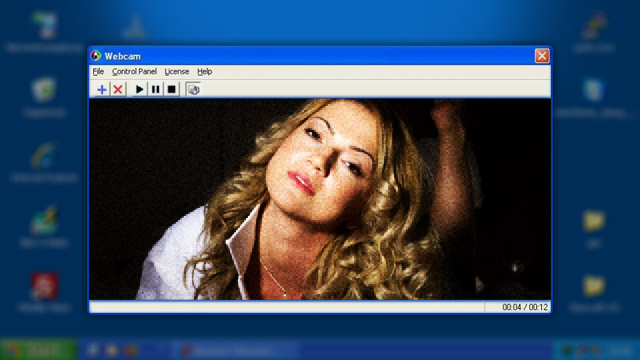
The woman is visible from thousands of miles away on a hacker's computer. The hacker has infected her machine with a remote administration tool (RAT) that gives him access to the woman's screen, to her webcam, to her files, to her microphone. He watches her and the baby through a small control window open on his Windows PC, then he decides to have a little fun. He enters a series of shock and pornographic websites and watches them appear on the woman's computer.
The woman is startled. "Did it scare you?" she asks someone off camera. A young man steps into the webcam frame. "Yes," he says. Both stare at the computer in horrified fascination. A picture of old naked men appears in their Web browser, then vanishes as a McAfee security product blocks a "dangerous site."
"I think someone hacked into our computer," says the young man.
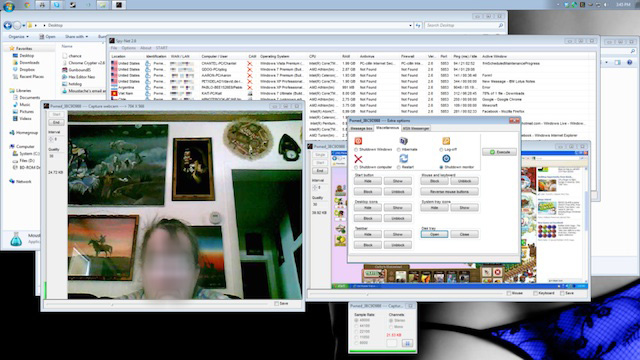
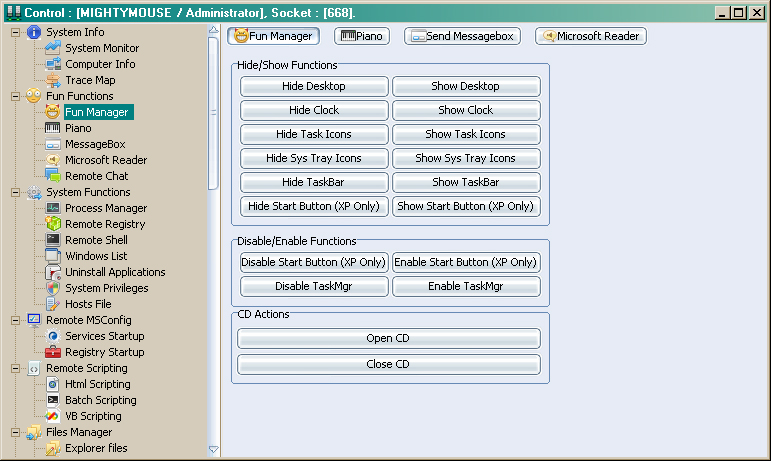
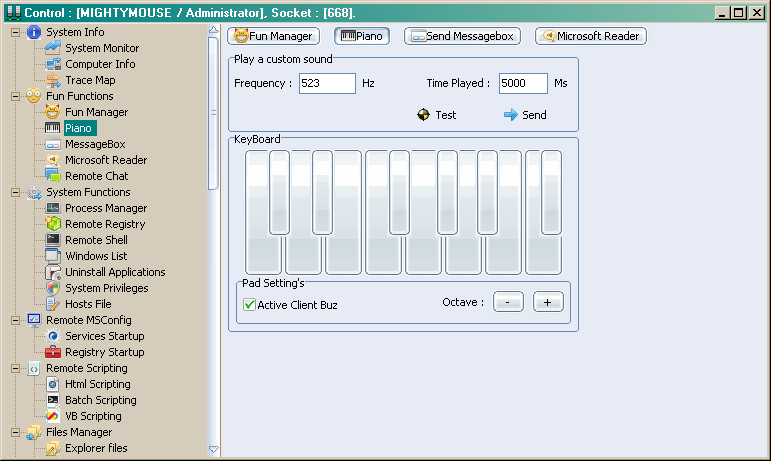
Far away, the hacker opens his "Fun Manager" control panel, which provides a host of tools for messing with his RAT victims. He can hide their Windows "Start" button or the taskbar or the clock or the desktop, badly confusing many casual Windows users. He can have their computer speak to them. Instead, he settles for popping open the remote computer's optical drive.
Even over the webcam, the sound of shock is clear. "Stay right here," says the woman.
"Whoa!... the DVD thing just opened," says the young man.
The hacker sends the pair a message that reads "achoo!" and the young man laughs in astonishment. "Disconnect from the Internet," he says. "Your laptop's going to go kaboom next."
The video freezes, the mayhem lasting for slightly more than one minute. Copies of the incident aren't hard to find. They're on YouTube, along with thousands of other videos showing RAT controller (or "ratters," as they will be called here) taunting, pranking, or toying with victims. But, of course, the kinds of people who watch others through their own webcams aren't likely to limit themselves to these sorts of mere hijinks—not when computers store and webcams record far more intimate material.
Using a RAT to scare victims.

“i enjoy messing with my girl slaves”

"Man I feel dirty looking at these pics," wrote one forum poster at Hack Forums, one of the top "aboveground" hacking discussion sites on the Internet (it now has more than 23 million total posts). The poster was referencing a 134+ page thread filled with the images of female "slaves" surreptitiously snapped by hackers using the women's own webcams. "Poor people think they are alone in their private homes, but have no idea they are the laughing stock on HackForums," he continued. "It would be funny if one of these slaves venture into learning how to hack and comes across this thread."
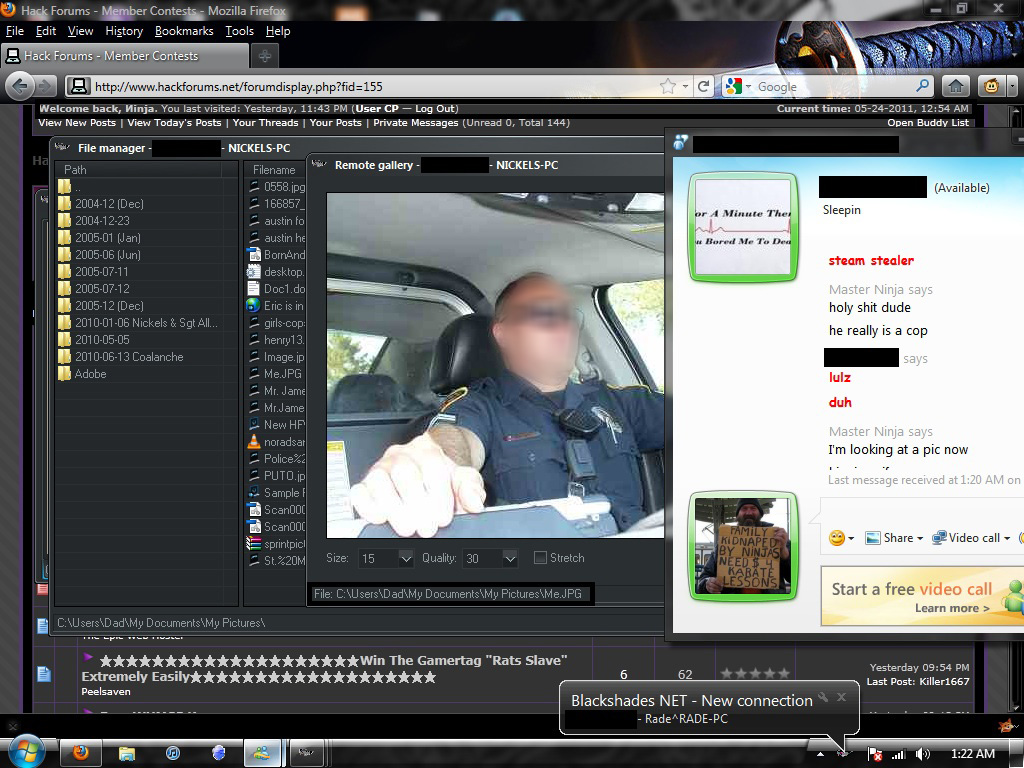
Whether this would in fact be "funny" is unlikely. RAT operators have nearly complete control over the computers they infect; they can (and do) browse people's private pictures in search of erotic images to share with each other online. They even have strategies for watching where women store the photos most likely to be compromising.
"I just use the file manager feature of my RAT in whatever one im using and in [a RAT called] cybergate I use the search feature to find those jpgs [JPEG image files] that are 'hidden' unless u dig and dig and dig," wrote one poster. "A lot of times the slave will download pics from their phone or digital camera and I watch on the remote desktop to see where they save em to and that's usually where you'll find the jackpot!"
Women who have this done to them, especially when the spying escalates into blackmail, report feeling paranoia. One woman targeted by the California "sextortionist" Luis Mijangos wouldn't leave her dorm room for a week after Mijangos turned her laptop into a sophisticated bugging device. Mijangos began taunting her with information gleaned from offline conversations.
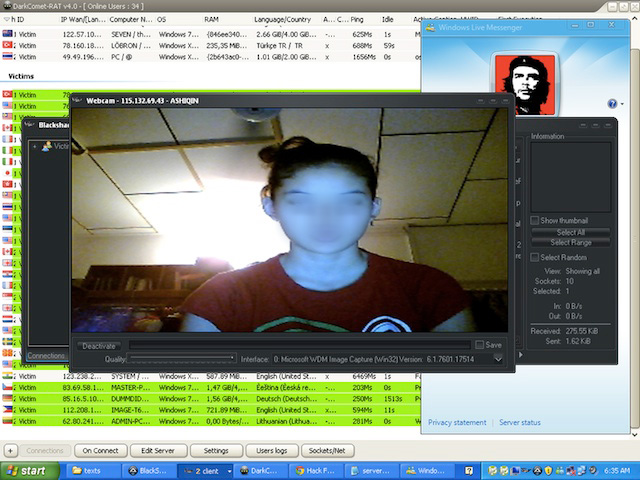
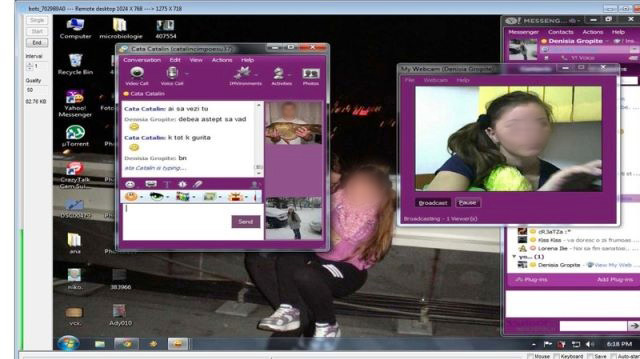
Watching a young girl in Malaysia. Note RAT control center running in background.
For many ratters, though, the spying remains little more than a game. It might be an odd hobby, but it's apparently no big deal to invade someone's machine, rifle through the personal files, and watch them silently from behind their own screens. "Most of my slaves are boring," wrote one aspiring ratter. "Wish I could get some more girls with webcams. It makes it more exciting when you can literally spy on someone. Even if they aren't getting undressed!"
One poster said he had already archived 200GB of webcam material from his slaves. "Mostly I pick up the best bits (funny parts, the 'good' [sexual] stuff) and categorize them (name, address, passwords etc.), just for funsake," he wrote. "For me I don't have the feeling of doing something perverted, it's more or less a game, cat and mouse game, with all the bonuses included. The weirdest thing is, when I see the person you've been spying on in real life, I've had that a couple of times, it just makes me giggle, especially if it's someone with an uber-weird-nasty habit."
By finding their way to forums filled with other ratters, these men—and they appear to be almost exclusively men—gain community validation for their actions. "lol I have some good news for u guys we will all die sometime, really glad to know that there are other people like me who do this shit," one poster wrote. "Always thought it was some kind of wierd sick fetish because i enjoy messing with my girl slaves."
As another poster put it in a thread called ☆ ShowCase ☆ Girl Slaves On Your RAT, "We are all going to hell for this..." But he followed it with a smiley face.
Welcome to the weird world of the ratters. They operate quite openly online, sharing the best techniques for picking up new female slaves (and avoiding that most unwanted of creatures, "old perverted men") in public forums. Even when their activities trip a victim's webcam light and the unsettled victim reaches forward to put a piece of tape over the webcam, the basic attitude is humorous—Ha! You got us! On to the next slave!
And there are plenty of slaves.
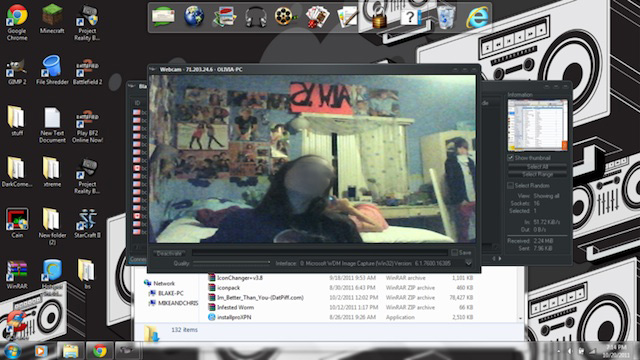
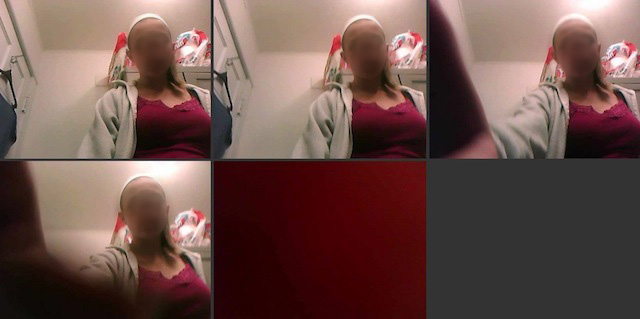
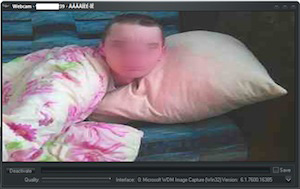
A woman unknowingly captured by her own webcam.

How it’s done

RAT tools aren't new; the hacker group Cult of the Dead Cow famously released an early one called BackOrifice at the Defcon hacker convention in 1998. The lead author, who went by the alias Sir Dystic, called BackOrifice a tool designed for "remote tech support aid and employee monitoring and administering [of a Windows network]." But the Cult of the Dead Cow press release made clear that BackOrifice was meant to expose "Microsoft's Swiss cheese approach to security." Compared to today's tools, BackOrifice was primitive. It could handle the basics, though: logging keystrokes, restarting the target machine, transferring files between computers, and snapping screenshots of the target computer.
Today, a cottage industry exists to build sophisticated RAT tools with names like DarkComet and BlackShades and to install and administer them on dozens or even hundreds of remote computers. When anti-malware vendors began to detect and clean these programs from infected computers, the RAT community built "crypters" to disguise the target code further. Today, serious ratters seek software that is currently "FUD"—fully undetectable.
Building an army of slaves isn't particularly complicated; ratters simply need to trick their targets into running a file. This is commonly done by seeding file-sharing networks with infected files and naming them after popular songs or movies, or through even more creative methods. "I seem to get a lot of female slaves by spreading Sims 3 with a [RAT] server on torrent sites," wrote one poster. Another turned to social media, where "I've been able to message random hot girls on facebook (0 mutual friends) and infect (usually become friends with them too); with the right words anything is possible."
For those who can't even manage this on their own, RAT experts hawk their slave-infecting expertise in e-books such as Rusty_v's Spreading Guide v 7.0, a 22-page tome that goes for $14.95 (and which claims to be the best-selling book on Hack Forums). "Ever faced a situation where you have FUD server but cannot get victims?" goes the sales pitch. "Or maybe you're getting a lot less installs compared to the amount of work you are putting in?" Followers of Rusty_v's methods are told they can pick up 500-3,000 slaves per day. The book is "noob friendly" and features "many screenshots."
And if even this handholding isn't enough, more successful ratters sometimes rent out slaves they have already infected. In other cases, they simply hand them off to others in a "Free Girl Slave Giveaway."
Calling most of these guys "hackers" does a real disservice to hackers everywhere; only minimal technical skill is now required to deploy a RAT and acquire slaves. Once infected, all the common RAT software provides a control panel view in which one can see all current slaves, their locations, and the status of their machines. With a few clicks, the operator can start watching the screen or webcam of any slave currently online.
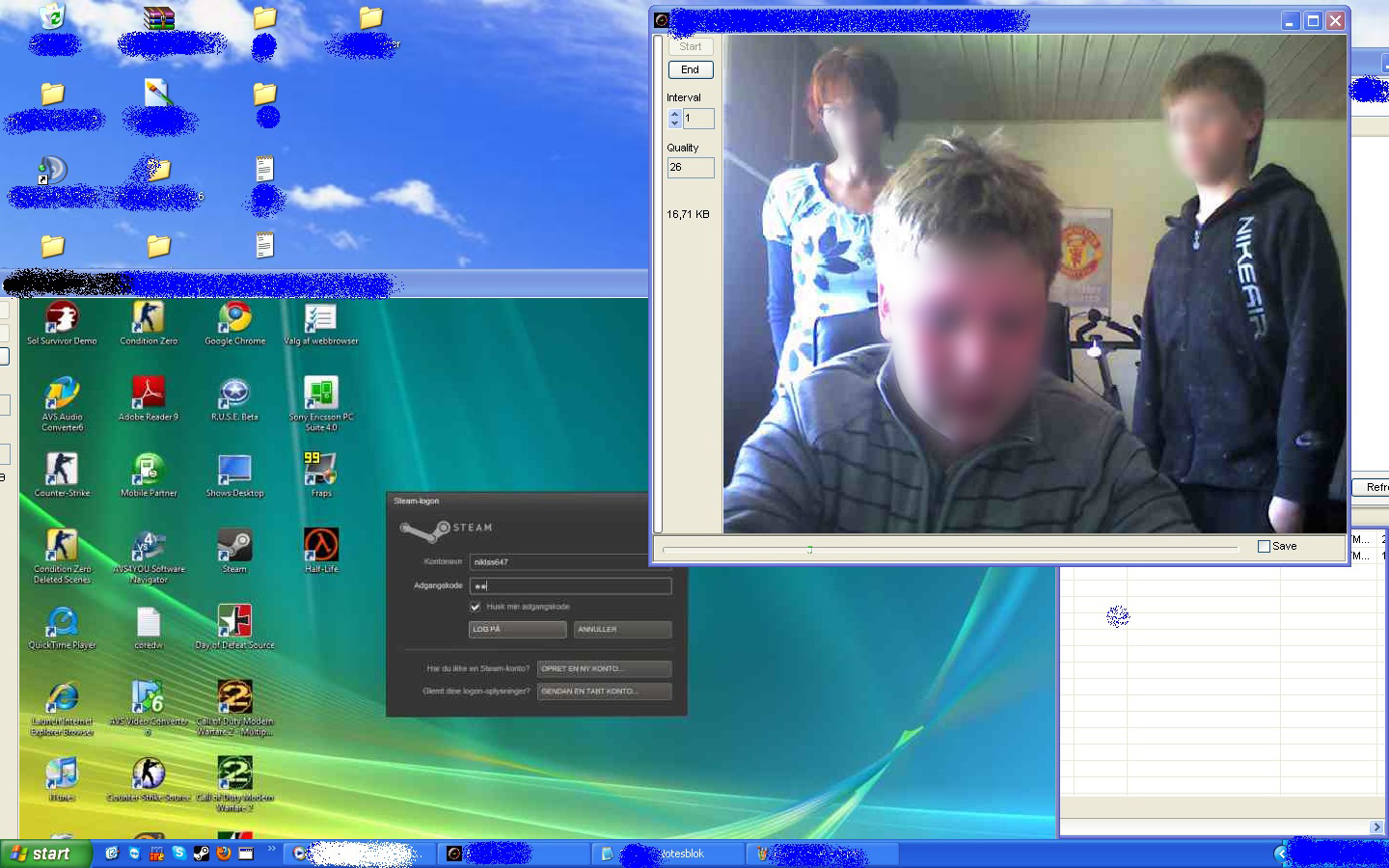
The process is now simple enough that some ratters engage in it without knowing how RATs really work or even how vulnerable they are to being caught. Back in 2010, one Hack Forums member entered the RAT subforum worried about going to jail. He had hacked a Danish family's computer in order to get a child's Steam account credentials, but the Danish kid realized that something was wrong and called in his mother and older brother. The hacker included a picture of all three of them looking down at the computer, the younger kid crying, the mother stern.
"They told me they would call the cops, etc and im going to jail?!" said the hacker. "WHAT DO I DO!? DO I GIVE THEM THE SHIT BACK OR UNINSTALL THEM FROM MY RAT!?"
Then, a few minutes later, when the hacker saw the mother with a phone in her hand, he returned to say, "im shaking irl [in real life]... I hope I won't get caught... hes mom & dad was at the phone calling the cops, while him & his brother was MAD crying, i already laughed for 30mins+ until it got serious about his mom & dad."
"LOL, don't worry you ain't going to jail," another member responded.
This is probably true; few such ratters are ever found.
Enlarge / One unhappy Danish mother about to call the police.

That pesky light

One of the biggest problems ratters face is the increasing prevalence of webcam lights that indicate when the camera is in use. Entire threads are devoted to bypassing the lights, which routinely worry RAT victims and often lead to the loss of slaves.
"Unfortunately she asked her boyfriend why the light on her cam kept coming on," one RAT controller wrote. "And he knew, she never came back :)"
Another described testing DarkComet on a male slave and activating the man's webcam. "A man came up and saw that his webcam was on, he then put the middle finger up to me lmao [laughing my ass off]," wrote the hacker. "I then went to remote desktop and he had lots of pr0nz [pornography] up, but he was also freaking out and scanning his computer with two different anti-virus [programs]. It was pretty funny, but he actually managed to remove the infected server from his PC, he used some 'ad-ware' software which managed to remove it."
Others trade pictures of victims taking action to secure their computers. "ive had this girl since i started ratting but she has a light on her cam," wrote one RAT user, "shame coz shes really pretty with her hair down. see her busting me lol."
To combat detection, the RAT controllers have devised various workarounds. One involves compiling lists of laptop models which don't have webcam lights and then taking special pains to verify the make and model of slave laptops to see if they are on the list.
"You may need to do some remote desktop action when you're pretty certain they're not looking and find an OEM tag in system properties but the surest way is to look for OEM bloatware like wireless utilities and such," wrote one RAT users. "Once you figure that out, if it's an Acer, you're golden. Some other laptops are good too and using specs and some other information you can often determine a model."
Others rely on a little bit of social engineering. "The first time I use a slaves cam tho I send a fake message saying something like the cams software is updating and the light may come on and go off periodicially ," wrote a RAT user, "but obviously in a more windows-like way of saying it!"
But no solution has been foolproof—and not for lack of a market. As one eager user wrote, "If someone release[s] soft[ware] which will disable the led cam light he will be the richest man in HF [Hack Forums]!!!"
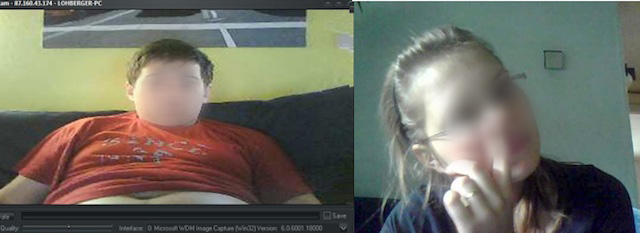
A young woman covers her webcam as someone watches her with a RAT.

“Damn morals”

RAT forum denizens aren't wholly lacking in moral reflection, though most is of a peculiar kind. "Imagine your sister is being posted right here, how would you feel?" wrote one poster, which sounds like an exhortation to stop ratting. But the poster immediately concluded that the only real rule is not to hack "nice gurls." And even if one does hack "nice gurls," just "dont post them online, Keep em for yourself."
Posters do show up once in a while to rage against the fairly shocking privacy violations casually shared in these forums. "Everyone who is spying on girls does deserve the jail!" one wrote. "Most of you have no girlfriend or are perverts or are 12 years old. Man get older and don't do this.... I hope all of you die... It is the worst thing a Hacker could do ! THE WORST ! Learn something more complictaed then Ratting."
But to the regulars this is just the talk of "some jelous peeps out there who probably cant find any girls to take there servers. its nothing compared to people stealing accounts and shit like that and its doing no harm as long as there not aware of it what the problem? if you dont like dont look."
The actual moral discussions in the forums tend to accept ratting as a bit of legitimate fun, but one that may have its own rules of "fair play." These rules are few, however, and even bringing them up irritates those who just want to see pictures of female slaves. "Here is not an ethical forum... and everyone does what he wants," wrote one poster. More often, the concerns are simply pragmatic ones about jail, lawsuits, and retaliation. Consider the following bizarre exchange:
POSTER 1:
Can't wait to get my RAT setup, some pretty hot chicks in here ;) Also, do you all think it would be wrong to RAT chicks you know? I know some VERY hot ones that would be easy as shit to infect. Damn morals.
POSTER 2:
well the moral part is one thing
but infecting a known person can be a risk
if they found out you infected them, you can loose the friendship, be marked as a pervert in your friendships and even worse she could sue you
i did it once and found some lucky things (so i want to du it again like the perv am i ^^ )
I rat one of the hottest classmate i had and was lucky
i found some topless pics and even some blowjob picture ;)
too bad the girl died by an illness :'(
i'm sad for 2 reasons
first i liked her, she was not a best friend, but a classmate i often speak with...
second, i did not get all the stuff she had, her damn internet was slow like hell .... i get about a dozen pictures from her external harddrive (well hidden)
i saw her online in the RAT a couple of times, but never with the external harddrive and i never found something on her desktop...
Then i never saw her online again, i throught : shit i loose her, need to find a way to install a new FUD version ...
but about 2-3 month later i learned she died by a illness :(
Other ratters have a soft spot for certain scenarios. Taking over other people's computers might not be bad, spying on them might be OK, but making young children cry might cross a line. "Give him back his account," wrote one poster in reference to the Danish kid who had his Steam account hacked (see above). "Christ the kid is in tears."
But morals generally take a back seat to mockery. One popular thread, running for more than a year, with 59 pages of comments, asks people to "Post your ugly slaves here." One of the most popular responses involves people caught picking their noses.

All Most information is good information

Regardless of legality—and online forums are strongly protected by Section 230 of the Communications Decency Act for all manner of offensive user-posted material—why would anyone want to host such content? I put the question to Jesse LaBrocca, the Las Vegas-based creator and operator of Hack Forums.
He responded with a strong defense of the idea that information should be open to all and he pointed to the Wikipedia entry on keyloggers to illustrate his point. "It's a fair amount of information including functions in Windows you would hook into to use a keylogger," he told me by e-mail. "At what point does Wikipedia and the Internet community decide it's too much information? And is there actually such a thing as 'too much information?'"
Possibly not, but my question wasn't about the existence of a forum devoted to RATs or to technical discussion about them. It was about the fact that the RAT subforum is filled with posts in which people explicitly show that they have illegally invaded other people's computers, that they are spying on them—sometimes while naked—and that they buy, sell, and trade slaves openly.
Enlarge / No doubt this is intended for entirely lawful purposes.
"My personal morals and ethics I try not to ram down the throats of members," LaBrocca responded when I followed up. "No doubt I've seen and read some very appalling posts over the years. Things I would never participate in or encourage. But I'm not the moral compass for complete strangers and I won't put myself into that position."
And yet he has, with remarkable specificity. Hack Forums is one of the largest public hacker-focused sites anywhere. (Serious criminals, of course, prefer private forums that require vetting to enter—which is one reason that law enforcement creates such sites when it wants to catch them.) It has its own 18-point code of behavior that prohibits even discussion of remarkably specific "blackhat hacking activities" like phishing, eBay partnerships, e-mail dumps, credit card fraud, identity theft, conversations about two specific botnets (Zeus and SpyEye), extortion, the "deepweb" (sites available only through services like Tor), keygens, warez, the sale of Apple products—even unauthorized movie torrents.
But the list is quite idiosyncratic. Hack Forums warns that members are often hack targets themselves, "whether by an outsider or a rogue member." A member who hacks another member will be "warned or banned" from the site. On the other hand, members who sell botnet access or who buy slaves or who "need an e-mail account hacked" can apparently remain in good standing.
Which brought me back to my original question. The site enforces all sorts of behavior codes, so why is apparently illegal and invasive conduct—not simply "information" or "discussion"—accepted? LaBrocca politely declined to respond further. Instead, he pointed me to a site statement announcing, "We don't explain the logic behind each forbidden activity, but it's somewhere between morality, ethics, and legality for each one."
Too often, he said, those with questions about the site "find a thread you don't like and use it to throw the site under the bus. I can give you countless examples how HF has positively changed people's lives."

I fought the law

Enlarge / On finding a photo called "me.jpg," one ratter discovers that he has infected a cop's computer.
RATs can be entirely legitimate. Security companies have used them to help find and retrieve stolen laptops, for instance, and no one objects to similar remote login software such as LogMeIn. The developers behind RAT software generally describe their products as nothing more than tools which can be used for good and ill. And yet some tools have features that make them look a lot like they're built with lawlessness in mind.
Adam Kujawa, a researcher at security firm MalwareBytes, compiled a list last summer of everything that popular RAT DarkComet could do. It included:
  • Find out all system information, including hardware being used and the exact version of your operating system, including security patches
  • Control all the processes currently running on your system
  • View and modify your registry
  • Modify your Hosts file
  • Control your computer from a remote shell
  • Modify your startup processes and services, including adding a few of its own
  • Execute various types of scripts on your system
  • Modify/View/Steal your files
  • Put files of its own on your system
  • Steal your stored password
  • Listen to your microphone
  • Log your keystrokes (duh)
  • Scan your network
  • View your network shares
  • Mess with your MSN Messenger / Steal your contacts / Add new contacts!
  • Steal from your clipboard (things you’ve copied)
  • Control your printer
  • Lock/Restart/Shutdown your computer
  • Update the implant with a new address to beacon to or new functionality
  • Watch your webcam
  • Use your computer in a denial of service (DOS) attack
And that's not all. DarkComet includes a "Fun Manager" that can perform all sorts of tricks on the target system, including:
  • Hiding the Desktop—Hiding all the icons and making it impossible to right click on the desktop.
  • Hide the Clock—Self Explanatory
  • Hide Task Icons—In the little box on the right side of your start bar
  • Hide Sys Tray Icons—Hide icons and open application buttons on the taskbar
  • Hide Taskbar—Self Explanatory
  • Hide the Start Button—Only works in Win XP
  • Disable the Start Button (XP Only)—Gray out the start button, disabling it.
  • Disable TaskMgr—Disables the Windows Task Manager (When you hit Ctrl+Alt+Del)
  • Open/Close CD Tray—Self Explanatory
Even that isn't all. The RAT can also activate Microsoft's text-to-speech software on the remote system so that it reads strings of text out loud—an effective startle tactic. It can open a chat window. And it can play notes from a piano or a specific frequency for as long as desired. (As Kujawa notes, "The purpose of this feature [as far as I can tell] is just to annoy people.")
Enlarge / The DarkComet "Fun Manager."
Enlarge / DarkComet's piano player.
Does such software cross the line into illegality? Perhaps. In June 2012, the FBI arrested Michael "xVisceral" Hogue at his home in Tucson, Arizona and charged him with selling "malware that allows cybercriminals to take over and control, remotely, the operations of an infected computer." Hogue had created Blackshades, which the government described as "a sophisticated piece of malware."
Blackshades went beyond DarkComet in its support for features that were likely to result in illegality, such as the "File Hijacker" that could encrypt a victim's key files and then pop up a "ransomware" message demanding payment into a remote bank account in order to free the files. (A note attached to this feature said: "However, one thing to put in mind: This feature was made for educational purposes only.")
In June 2010, Hogue allegedly joined a private "carder" website catering to online criminals dealing in the theft, sale, and malicious use of credit card numbers. The site was actually a honeypot run by the FBI, however; the government says that Hogue sought admin approval to sell Blackshades there and ended up chatting with an FBI Special Agent. According to the complaint against Hogue, he then showed the FBI his personal RAT dashboard. An agent described the moment this way:
When I logged into the Blackshades Net service (that is, the interface that is a component of the RAT), I was able to see the names of nine computers that had been infected with the malware component of the RAT. Those computers were located in Germany, the United States, Denmark, Poland, and Canada. (The FBI has taken steps to identify and locate these victims.) By clicking on the name of an infected computer, I was presented with a menu of options including the ability to initiate key logging on the infected computer—that is, I was able to remotely turn on a service that would record every keystroke of the user of the infected computer. So, for instance, if the victim visited a banking website and entered his or her username and password, the key logging program could record that information, which could then be used to access the victim's bank account.
In further MSN chats with the FBI, the person alleged to be Hogue answered a question about whether the Blackshades software would automatically conduct key logging or whether it had to be initiated manually. "It auto does, and you can download from all at once, or scan for keywords or digits," came the reply. "And if it detects a credit card is being entered, it can send screenshots to FTP and you can scan for digits that are 16 in a row :P"
A man awakened by the sounds of "screaming" porn a ratter has played through his computer.
This isn't the sort of thing that legitimate security firms generally tell potential clients, and the description of the software on the Blackshades website didn't help matters. It advertised the program's ability to "automatically map your ports, seed your torrent for you, and spread through AIM, MSN, ICQ, and USB devices." The software, sold for $50 per copy, does not appear to have netted its creator that much cash. According to a court filing from January 2013, the government is seeking forfeiture of only about $40,000 from Hogue. (The Blackshades software remains available for sale, the codebase apparently administered by at least one other person. The sales site currently suggests that Blackshades be used by those who have "ever questioned what your spouse, kids or employees have been doing on the computer" or anyone who want to know, "Are your employees mailing your business data to your competitors?")
A few weeks after Hogue's arrest, another prominent RAT author announced his retirement from such work. Jean-Pierre Lesueur shut down DarkComet with a message blaming his users. "I have devoted years with a nonprofit philosophy for you to enjoy without asking anything in return other than respect of the rules, unfortunately some of you couldn't respect the terms," he wrote. "Why did I take such a decision? Like it was said above because of the misuse of the tool, and unlike so many of you seem to believe, I can be held responsible of your actions, and if there is something I will not tolerate it is having to pay the consequences for your mistakes and I will not cover for you." He then added, "Without mentioning what happened in Syria..."
The last line is a reference to the fact that the Syrian government used tools like Blackshades and DarkComet in 2012 as part of its war with Syrian rebels. The conclusion drawn by the researchers at Malwarebytes was that RAT creators had unwittingly become low-cost arms dealers to repressive regimes that couldn't afford to develop such tools themselves.
"Over the past few weeks," Malwarebytes concluded in mid-2012, "we have seen the most intricate piece of spy malware ever developed (Flame) and being used for cyber espionage purposes against the infrastructure of developed countries, and then we look at the poverty stricken government of Syria and see over-the-counter RATs being used. It is clear that even in cyber war, the more developed countries have better weapons while the poorer countries use whatever they can get their hands on."

RAT control

RATs aren't going away, despite the occasional intervention of the authorities. Too many exist, plenty of them are entirely legal, and source code is in the wild (a version of the Blackshades source leaked in 2010). Those who don't want to end up being toyed with in a YouTube video are advised to take the same precautions that apply to most malware: use a solid anti-malware program, keep your operating system updated, and make sure plugins (especially Flash and Java) aren't out of date. Don't visit dodgy forums or buy dodgy items, don't click dodgy attachments in e-mail, and don't download dodgy torrents. Such steps won't stop every attack, but they will foil many casual users looking to add a few more slaves to their collections.
If you are unlucky enough to have your computer infected with a RAT, prepare to be sold or traded to the kind of person who enters forums to ask, "Can I get some slaves for my rat please? I got 2 bucks lol I will give it to you :b" At that point, the indignities you will suffer—and the horrific website images you may see—will be limited only by the imagination of that most terrifying person: a 14-year-old boy with an unsupervised Internet connection.
Nate Anderson / Nate is the deputy editor at Ars Technica, where he oversees long-form feature content and writes about technology law and policy. He's currently at work on a book about Internet policing.