Sunday, April 14, 2013

Why Bitcoin Is Poised To Change Society Much More Than The Internet Did

            Larsen Ice Shelf, symbolizing drastic change                                                          http://falkvinge.net/2013/04/03/why-bitcoin-is-poised-to-change-society-much-more-than-the-internet-did/                                                                                                                                                     
There is a bitcoin craze at the moment, with prices of bitcoin skyrocketing. Bitcoin is still far from ready for prime time, but as it matures, it will change society’s fundamental operations much more than the Internet did. The net, after all, only allowed people to talk and shop more efficiently. By comparison, bitcoin eradicates the government’s ability to operate.
Let’s begin by looking at what a bitcoin is. It is money. It is a new form of money that isn’t issued by a government. Governments don’t have a monopoly on coming up with things you can trade and barter with, and bitcoin is one such non-governmental barter instrument. The difference between bitcoin and all other such tokens of value that have been invented over the years is that nobody is in control of the money supply, and nobody is in control of the money flow. This means that nobody can start the printing presses to eradicate your savings, and nobody can seize or see your wealth or income. You can think of it as an open-source currency compared to proprietary, state-issued currencies.
There is no central bank. This is a revolutionary concept. People can trade cash at a distance without going through an intermediary. The first time you send the value of a cup of coffee to a friend in India on a Sunday, without any transaction fees, and they have the money instantly, without anybody but you knowing of the transaction, your jaw drops.
This would have been but a curiosity, if it weren’t for the ridiculously strong business case to cut banks and credit card processors out of the sales loop for corporations, which could roughly double the profits in retail sales. This means that there’s a very strong force for universal uptake of this new currency.
As nobody is in control of the money supply (it is set to grow predictably at a slowing rate until 2140), and demand increases with a limited supply, the price for each bitcoin increases. This is what we’re seeing now, as more and more people realize bitcoin’s business potential. Also, there is value in the concept that you don’t have to trust any single person to store or to transfer bitcoin – not your government, not your bank, not Western Union – is something completely new.
Erik Voorhees writes, “Bitcoin is thus the only currency and money system in the world which has no counter-party risk to hold and to transfer. This is absolutely revolutionary and you should read the preceding sentence again. [...] Never in the history of the world has an individual had this ability. It is unprecedented.”
So why does bitcoin have value? How is it, strictly speaking, money? People who ask this tend to be stuck in the idea that only states and governments can issue money, but that’s not the case. What we see as money has changed many times, and when Marco Polo came back to Europe from China in the 13th century, people were mocking him for bringing home banknotes. “This is not money”, they would say, and burn the Chinese banknotes. Money was coins. If you dismiss bitcoin just because you’re not used to seeing sequences of rare prime numbers as money, make sure you’re not scoffing at banknotes as people were in the 13th century. If people use it as money to trade, it’s money.
Jon Matonis has an excellent piece over at Forbes where he challenges the notion that money must be state-issued, and explains that a transactional currency can compete on its own merits and its own market.
It is important to realize that while the Internet has changed life in the IT industry tremendously, from a government standpoint, the net hasn’t changed much at all. If anything, it has reinforced existing structures: consumers spend their state-issued money more efficiently, credit is borrowed more and better from state-regulated banks which expands the money supply and keeps people happy, and it has created new industries that can fuel the economy. Oh, and it also lets citizens submit governmental forms more efficiently.
The only flip side to the net, from a government angle, would be that some people use the Internet to violate state-issued monopolies on entertainment distribution, which has been seen as a problem that needs to be dealt with swiftly and harshly, but other than that, the internet really isn’t much new from a government standpoint. Think about that the next time you see a politician who doesn’t appear to get the net: for them, if they’ve been in government too long, there is nothing much to get.
So we essentially have four different types of players that keep the economy going, and by extension, the government funded and operational. One, there is the government itself, which issues money and regulates banks. (For this exercise, I include the central bank in “government”.) Two, there are commercial banks which are in complete control of the money flow, in exchange for sharing that insight with the government and letting it siphon off as much as it likes to operate itself. Also, commercial banks expand the money supply when people ask for credit, so credit is good as the economy is measured today (“growth”). At the bottom of the food chain are, three, corporations which are tasked with using this system, running all its operations through these banks, and four, the ordinary citizen, who is supposed to be doing actual work and actually produce something that fuels the entire ecosystem.
What bitcoin does is cut the banks out of the loop, and by extension, the government’s ability to operate.
Those wars you have seen on TV? They are all fueled by this mechanism – the ability for banks to keep people happy in letting them spend imaginary money, while simultaneously giving the nation-state the ability to control as much of the money flow as it likes (and siphon as much as it likes off for itself).
Now, bitcoin isn’t going to drive its adoption just because it is impervious to state control and insight. Rather, its adoption is going to be driven by the strong business case for corporations to cut banks out of the loop – more specifically, cut bank profits out of their own profits.
The normal reaction for a government would be to use its entire arsenal of force against any phenomenon that threatens the government’s ability to function to this degree. But bitcoin is resilient to that. There is no central point to shut down. You can’t point a gun at a prime number and expect things to change. And we all know how effective governmental attempts to shut down peer-to-peer networks have been (even if it has been a low-priority issue so far that they haven’t really cared about).
A while back, I wrote that bitcoin is “The Napster of banking”. Perhaps there is a better analogy – perhaps it is the Skynet of banking. There is no central mainframe to shut down, and the intelligence in bitcoin is completely distributed with the single goal of obsoleting central banking.
In this regard, people at Business Insider who compare the bitcoin trade and its current price spike with the bubble around Beanie Babies in the early century come across as dangerously shortsighted and ignorant. Bitcoin is not a plush toy, it is not a commodity. It is an economic agreement, and as such, has value like any other contract that improves your business. This particular contract improves every business except banks.
So is bitcoin ready to take over the world? Far from it.
There are many problems with bitcoin today, but they are becoming less severe than the problems that plagued it one, two, and three years ago. In short, we’re seeing kinks being worked out, scratches being polished, and dents being straightened. But there are many reasons why bitcoin couldn’t take the place of state-issued money today, even if it is on a strong trajectory to do so in the next decade or decades.
The liquidity to state-issued money is one thing that strikes me immediately. In any economy, you need bridges between payment systems that are in use. Today, the vast majority of such bridging is handled by a Japanese bitcoin exchange known as MtGox. This is an unacceptable single point of failure in an ecosystem (proven by two hours of outage today). Further, lags of 10 minutes are common with MtGox’s trading engine (I’m seeing 400 seconds of lag right as I type this), which is just ridiculous when the financial world at large is dealing with micro- and nanosecond trading.
Bitcoin is getting there. But it’s not there yet. When it gets there, expect governments to panic and society to be reshaped into something where governments cannot rely on taxing income nor wealth for running their operations.
That is a bigger change to society’s fundamental structure than the ability to seek and share culture and knowledge we got with the net.
                                    

Moon Base Over Asteroid? Lawmakers Push for Lunar Landing by 2022


While NASA's proposed budget for 2014 unveiled this week reaffirms the space agency's ambitious plan to send astronauts to an asteroid, some members of Congress are pushing for a more familiar goal: a moon base by 2022.
President Barack Obama's federal budget request for 2014, released Wednesday (April 10), gives NASA $105 million to jump-start a bold plan to park an asteroid near the moon. Astronauts would then explore the space rock using the agency's Space Launch System rocket and Orion capsule, with the first visit perhaps coming as early as 2021. 
The proposed "Asteroid Initiative" lines up with the manned spaceflight priorities of the Obama Administration, which three years ago cancelled NASA's moon-oriented Constellation program and directed the agency to get astronauts to an asteroid by 2025, then on to the vicinity of Mars by the mid-2030s. [How it Works; NASA's Asteroid-Capture Mission in Pictures]
But some lawmakers contend that the moon should still be NASA's immediate human spaceflight target. They have reintroduced a 2011 bill called the RE-asserting American Leadership in Space Act (or REAL Space Act for short), which asks NASA to send astronauts to the moon by 2022 with the goal of establishing a long-term settlement there.
"The moon is our nearest celestial body, taking only a matter of days to reach," Rep. Bill Posey (R-Fla.) said in a statement Wednesday. "In order to explore deeper into space — to Mars and beyond — a moon presence offers us the ability to develop and test technologies to cope with the realities of operating on an extraterrestrial surface."
The bill would also give NASA's manned spaceflight efforts more direction, its sponsors say.

"This legislation is not just about landing another human on the moon. It is about restoring our nation’s now-defunct human spaceflight program and setting clear and achievable goals that will lead to advancements in science and technology," said Rep. Rob Bishop (R-Utah). "This legislation restores and clarifies NASA’s role in human spaceflight and sets the US back on course to lead exploration of the cosmos."
Astronauts have not walked on the surface of the moon since NASA's Apollo 17 mission in 1972, which marked the final lunar landing mission of the Apollo program.
In 2004, NASA unveiled its Constellation program that aimed to return astronauts to the moon by 2020 using a new family of rockets, the Ares I and Ares V, as well as new Orion space capsules and moon landers. In 2010, however, the Obama Administration replaced that program with the asteroid-oriented spaceflight goal NASA is currently pursuing.

The current space vision still includes the Orion capsules, but replaces the Ares rockets with a single mega-rocket called the Space Launch System. The first manned flight of the complete Orion-Space Launch System is expected in 2021.
NASA's focus on getting humans to a near-Earth asteroid and Mars makes an American-led manned moon mission unlikely anytime soon, agency chief Charles Bolden reportedly said earlier this month.
"NASA will not take the lead on a human lunar mission," Bolden said during a joint meeting of the Space Studies Board and the Aeronautics and Space Engineering Board on Thursday (April 4), according to a SpacePolitics.com report by Jeff Foust. "NASA is not going to the moon with a human as a primary project probably in my lifetime. And the reason is, we can only do so many things."

‘Some of the slaughtered were so much like babies that should be taken home’: Gosnell Grand Jury

The murder trial of abortionist Kermit Gosnell was postponed Monday because Gosnell’s attorney was sick. Perhaps he’d read some of the Grand Jury report, from which we are excerpting every single day the trial goes on.
In Section IV, titled, “The Intentional Killing of Viable Babies,” the Grand Jury reports on babies who were aborted alive and then killed who were so big that (as one Gosnell employee said of one boy) “he was nearly the size of her own six pound, six ounce, newborn daughter.”

_______________________
Gosnell left dozens of damaged women in his wake. His reckless treatment left them infected, sterilized, permanently maimed, close to death, and, in at least two cases, dead. Their injuries and deaths resulted directly from Gosnell’s utter disregard for their health and safety. However, if their fate was entirely foreseeable, it was not necessarily the product of specific intent to kill.
The same cannot be said of untold numbers of babies – not fetuses in the womb, but live babies, born outside their mothers – whose brief lives ended in Gosnell’s filthy facility. The doctor, or his employees acting at his direction, deliberately killed them as part of the normal course of business.
Gosnell and his staff severed the spinal cords of viable, moving, breathing babies  who were born alive.
Surgical abortions in Pennsylvania, performed up to 24 weeks of gestational age, are legal. Killing living babies outside the womb is not. The neonatologist who testified before the Grand Jury defined “born alive.” According to this expert witness, the federal Born-Alive Infants Protection Act defines a human as “somebody who’s been completely expelled from the mother and has either a heartbeat, pulsating cord, or is moving.”
Pennsylvania’s Abortion Control Act defines “born alive” similarly, but adds breathing and brain wave activity as indicators of life. 18 Pa.C.S. §3203.
Gosnell’s staff testified about scores of gruesome killings of such born-alive infants carried out mainly by Gosnell, but also by employees Steve Massof, Lynda Williams, and Adrienne Moton. These killings became so routine that no one could put an exact number on them. They were considered “standard procedure.” Yet some of the slaughtered were so fully formed, so much like babies that should be dressed and taken home, that even clinic employees who were accustomed to the practice were shocked.
Baby Boy A
One such baby was a boy born in July 2008 to 17-year-old we will call “Sue.” Sue first met Gosnell at the Atlantic Women’s Medical Services, an abortion clinic in Wilmington, Delaware, where Gosnell worked one day a week. The girl was accompanied by her great aunt, who had agreed to pay for the procedure, and who testified before the Grand Jury. After an ultrasound was performed on Sue, Gosnell told the aunt that the girl’s pregnancy was further along than she had originally told him, and that, therefore, the procedure would cost more than the $1,500 that had been agreed upon; it would now cost $2,500. (Gosnell normally charged $1,625 for 23-24 week abortions.) The aunt paid Gosnell in cash at the Delaware clinic. He inserted laminaria, gave Sue pills to begin labor, and instructed her to be at the Women’s Medical Center in Philadelphia at 9:00 the next morning.
Sue arrived with her aunt at 9:00 a.m. and did not leave the clinic until almost 11:00 that night. An ultrasound conducted by Kareema Cross recorded a gestational age of 29.4 weeks. Cross testified that the girl appeared to be seven or eight months pregnant. Cross said that, during 13-plus hours, the girl was given a large amount of Cytotec to induce labor and delivery. Sue complained of pain and was heavily sedated. According to Cross, the girl was left to labor for hours and hours. Eventually, she gave birth to a large baby boy. Cross estimated that the baby was 18 to 19 inches long. She said he was nearly the size of her own six pound, six ounce, newborn daughter.
After the baby was expelled, Cross noticed that he was breathing, though not for long. After about 10 to 20 seconds, while the mother was asleep, “the doctor just slit the neck,” said Cross. Gosnell put the boy’s body in a shoebox. Cross described the baby as so big that his feet and arms hung out over the sides of the container. Cross said that she saw the baby move after his neck was cut, and after the doctor placed it in the shoebox. Gosnell told her, “it’s the baby’s reflexes. It’s not really moving.”
The neonatologist testified that what Gosnell told his people was absolutely false. If a baby moves, it is alive. Equally troubling, it feels a “tremendous amount of pain” when its spinal cord is severed. So, the fact that Baby Boy A. continued to move after his spinal cord was cut with scissors means that he did not die instantly. Maybe the cord was not completely severed. In any case, his few moments of life were spent in excruciating pain.
Cross was not the only one startled by the size and maturity of Baby Boy A.
Adrienne Moton and Ashley Baldwin, along with Cross, took photographs because they knew this was a baby that could and should have lived. Cross explained:
Q. Why did you all take a photograph of this baby?
A. Because it was big and it was wrong and we knew it.  We knew something was wrong.
I’m not sure who took the picture first, but when we seen this baby, it was – it was a shock to us because I never seen a baby that big that he had done. So it was – I knew something was wrong because everything, like you can see everything, the hair, eyes, everything. And I never seen for any other procedure that he did, I never seen any like that.
The neonatologist viewed a photograph of Baby Boy A. Based on the baby’s size, hairline, muscle mass, subcutaneous tissue, well-developed scrotum, and other characteristics, the doctor opined that the boy was at least 32 weeks, if not more, in gestational age.
Gosnell simply noted the baby boy’s size by joking, as he often did after delivering a large baby. According to Cross, the doctor said: “This baby is big enough to walk around with me or walk me to the bus stop.” The doctor released Sue to go home 13 or 14 hours after she arrived. Her aunt described her condition: “She was moaning. She was standing up. She was like holding her stomach, doubled over.” She remained in pain for days and could barely eat. When she developed a fever, her aunt called Gosnell. He instructed the aunt to take her temperature and asked if she was taking pain medicine he had given her – which she was.
But he did not have her come in to be checked out. And he did not suggest that she go to a hospital. When Sue started throwing up a few days later, her grandmother contacted a different doctor, who told her to get to a hospital right away. Sue was admitted to Crozier-Chester Hospital. Doctors there found that she had a severe infection and blood clots that had travelled to her lungs. According to Kareema Cross, who spoke to the aunt, Sue almost died. The teen stayed at the hospital for a week and a half. She became extremely thin and took months to recover, according to her aunt.
Reprinted from National Right to Life News.

Philly Abortion Horrors: What Matters Is How and Not When an Abortion Is Done, Says Expert


Philly Abortion Horrors: What Matters Is How and Not When an Abortion Is Done, Says Expert


307_abortiondoc
Associated Press
Warren Hern, likely the last U.S. doctor to openly specialize in abortions performed late in pregnancy, authored a textbook on how to properly do abortions. In it, he quotes a colleague, Robert Crist, who had experience with abortions late in pregnancy: “Abortion is a simple procedure except for the uterus’ complete intolerance for bad technique.”
Bad technique — that’s what it comes down to when speaking of what transpired in a filthy Philadelphia abortion clinic where blood-stained blankets and fetal body parts in milk jugs were found. Its proprietor, Dr. Kermit Gosnell, was charged Wednesday with performing illegal late-term abortions. (More on Time.com: Why the Pa. Abortion Doc’s Case Is About Poverty, Not Roe v. Wade)
Hern makes the case that it’s really not about when an abortion is performed. What’s more important is how it’s performed.
Hern emphasized that while he has no personal knowledge of how Gosnell operated at the Women’s Medical Society, his clinic in a low-income neighborhood of West Philadelphia, he chalks it up to incompetence.
“It’s horrifying,” says Hern. “It’s a question of applying good principles of surgery and medical practice to whatever you’re doing and doing the safest thing you can for the patient.”
Colorado, where Hern practices, does not restrict when abortions can be performed. Pennsylvania, like most states, does; it bans them after 24 weeks. (More on Time.com: Late-Term Abortions: Q&A With the Last Remaining Doctor Who Performs Them)
For sure, late abortions have the potential to be more dangerous than first-trimester abortions. The fetus is larger, the uterus is larger, and there is a greater chance of serious complications. But early abortions can be deadly too if they’re not done properly.
Hern declined to make a direct association between Gosnell’s clinic and laws curtailing abortion, but he did allow himself to speak in generalities. “As a rule, any law restricting abortion is almost automatically going to make abortion more dangerous for women,” he says.
And more dangerous for the doctors who perform them. Hern has watched colleagues die — George Tiller, who was shot in his Kansas church in 2009, was a friend — and he has endured plenty of threats of his own. Two years ago, not long after Tiller’s death, a man from Spokane, Wash., called Hern’s Boulder, Colo., office to warn that two men were on their way to harm his family. Donald Hertz, who made the threat, was recently sentenced to five years of probation for threatening Hern’s family. (More on Time.com: The Grass-Roots Abortion War).
When abortion is restricted, Hern notes, only the well-off have access to the procedure. In his eyes, it ends up being not so much about whether abortion is permitted but about who can pay to have one.
At least one woman died after undergoing treatment at Gosnell’s clinic. Karnamaya Mongar, 41, isn’t here to say whether she would have gone elsewhere if she could have. But what seems pretty clear is that she didn’t have too many choices.
“You can have a safe abortion if you can afford it,” says Hern. “You can get good medical care if you can afford it. If you can’t, you die.”

Abortion Doctor’s Murder Trial Sparks Media Debate


Abortion Doctor’s Murder Trial Sparks Media Debate


Kermit Gosnell
AP
FILE - In this undated photo provided by the Philadelphia District Attorney's office, Dr. Kermit Gosnell is shown. Eight former employees of a run-down West Philadelphia abortion clinic now face prison time for the work they did for Gosnell. Three have pleaded guilty to third-degree murder. And Gosnell, 72, is on trial in the deaths of a patient and seven babies allegedly born alive. (AP Photo/Philadelphia Police Department via Philadelphia District Attorney's Office, File)
Some journalists are asking why the murder trial of a Philadelphia abortion doctor isn’t receiving more coverage.

In 2010, police raided Dr. Kermit Gosnell’s abortion clinic, called the Women’s Medical Society, in a low-income neighborhood of West Philadelphia and found what a grand jury report called a “baby charnel house” where illegal and late term abortions were performed under dangerous conditions. Now on trial, Gosnell is charged with the deaths of one patient and seven babies allegedly born alive during abortion procedures; eight former employees–none of whom were certified doctors–may also face prison time.

A 2011 grand jury report detailed the illegal and late-term abortions Gosnell performed, as well as the disturbing conditions at Gosnell’s clinic — including blood-stained furniture, a heavy stench of urine and scattered feces from roaming cats. Some abortions were done so late, according to the report, that Gosnell allegedly snipped the babies’ spinal chords after they were born and still breathing.
The grand jury also estimated that Gosnell’s abortion practice took in about $1.8 million a year, mostly in cash, assuming he conducted only three procedures a night. And that did not include the additional income he received from allegedly writing illegal prescriptions. Read the full report of charges here [PDF]. (Please note: the document contains graphic descriptions).
TIME covered the charges here in a 2011 story.
While Gosnell’s trial began on March 18, media controversy is now mounting after USA Today contributor Kirsten Powers wrote a column chastising the media for the lack of trial coverage, arguing that bias obstructed the story from making headlines. She writes:
Let me state the obvious. This should be front page news. When Rush Limbaugh attacked Sandra Fluke, there was non-stop media hysteria. The venerable NBC Nightly News’ Brian Williams intoned, “A firestorm of outrage from women after a crude tirade from Rush Limbaugh,” as he teased a segment on the brouhaha. Yet, accusations of babies having their heads severed — a major human rights story if there ever was one — doesn’t make the cut.
You don’t have to oppose abortion rights to find late-term abortion abhorrent or to find the Gosnell trial eminently newsworthy. This is not about being “pro-choice” or “pro-life.” It’s about basic human rights.
Other outlets and columnists have since weighed in as well. The Atlantic’s Conor Friedersdorf called the news value of the story “undeniable,” and Megan McArdle, a special correspondent for The Daily Beast wrote a commentary, “Why I Didn’t Write About Gosnell’s Trial–And Why I Should Have,” saying, “I wish I had followed it more closely, even though I’d rather not.”
The Daily Beast does point out that in 2011, reporters covered the charges against Gosnell :
The Gosnell story wasn’t blacked out. Here’s an NPR story from a year ago, a Slate story, one from Time, CNN, the Associated Press, and The Daily Beast.
Still, it’s undeniable that media coverage, including our own, has picked up again after Powers’ brought the gruesome trial back to into the spotlight.

Anti-abortion advocates are using the case as a call for new restrictions; meanwhile, pro-choice supporters are calling it an example of what happens when women are denied access to safe and cost-friendly care. In 2011, when Dr. Gosnell was formally charged, TIME’s Belinda Luscombe wrote that although both sides were making arguments for how the case proves their opponents are wrong, the situation is really most related to poverty. She wrote:
Gosnell’s techniques — using untrained staff, operating the business day and night, not maintaining equipment and not keep up with modern medical techniques (using Demerol is frowned upon these days) — are typical of those in any business trying to cut corners to keep costs low. It’s likely that he was the cheapest abortion provider around in a community that’s not accustomed to the highest health-care standards anyway.
Dr. Gosnell is currently facing both first and third-degree murder charges. Three of his eight employees are pleading guilty to third-degree murder. The Associated Press reports that Dr. Gosnell’s defense lawyer is arguing that no babies were born alive, and that “unforeseen complications” caused the death of the 41-year-old woman he was performing an abortion on. The trial will resume on Monday.

Grand Jury Report: Kermit Gosnell Tried to Hide Abortion Death

by Dave Andrusko | Washington, DC | LifeNews.com | 4/12/13 4:51 PM
Today ends the fourth week of the murder trial of abortionist Kermit Gosnell.
In today’s post we complete excerpts from the Grand Jury report that alleged horrific neglect on the part of Gosnell and his untrained staff resulting in the death of a 41-year old woman in 2009–and then tried to cover it up. The following comes from Section V which is titled, “The Death of Karnamaya Mongar.”
__________________
Gosnell and his staff tried to cover up what drugs were administered, who administered them, when, and how.
Page1re-216x300The evidence indicates that Sherry West made false entries on Mrs. Mongar’s file before handing it over to the Hospital of the University of Pennsylvania. Ashley Baldwin testified that the paramedics asked for Mrs. Mongar’s file so they could take it with them.
Williams, West, and Gosnell all contradicted themselves and each other about how much medication Mrs. Mongar received, who gave it to her, when, and even how. The file notations indicated that Mrs. Mongar received 10 mg. Demerol, 0.6 cc (cubic centimeters) promethazine, and 1 cc. diazepam at 8:14 p.m., followed by another dose of 10 mg. Demerol, 0.6 cc promethazine, and 2 cc diazepam at 10:45 p.m. An entry made by West in the clinic logbook, however, indicated that Mrs. Mongar was given a much larger dose: 75 mg. Demerol, 12.5 mg. promethazine, and 10 mg. diazepam.
Lynda Williams was interviewed by law enforcement on the night of the February 2010 raid. At first, she told her interviewers that she did not put IVs in patients, that Gosnell administered the medication, and that she thought he gave a “heavy” dose (50 mg. Demerol, 12.5 mg. promethazine, and 5mg. diazepam). When pressed to tell the truth, Williams changed her story, admitting that she had administered the anesthesia. She insisted, however, that she had called Gosnell before administering 10 mg. Demerol and 12.5 mg. promethazine at 6:00 p.m., and an additional “custom” dose (75 mg. Demerol, 12.5 mg. promethazine, and 10 mg. diazepam) when the “local anesthesia” wore off. She said that she injected these medications into the patient’s arm.
Dr. Herlich, the University of Pittsburgh Medical Center anesthesiologist, testified that the first dose of Demerol described by Williams made no sense –that there is no such thing as a 10 mg. dose of Demerol. He further explained that a 10 mg. dose of Demerol, if it existed, “would be barely noticeable in terms of pain control” in the average adult. The dosage Williams claimed had been administered would not, in any case, have had the effect witnessed by Mrs. Mongar’s daughter. She said that her mother had been in a lot of pain in the recovery room before the procedure, but that the medicine administered intravenously by Williams and West put her mother “to sleep.”
It is notable that Williams’s story was different from the one given by Gosnell when he was interviewed by Detective James Wood, the FBI, and the DEA on the night of the raid. According to Detective Woods’s notes, Gosnell first told his interviewers that medication was given by “one of his nurses or by a medical assistant, he wasn’t sure who …” –even though no nurses were employed in the clinic. He then said that during the “evening,” before the procedure, “one of the nursing staff” administered an unspecified dose of Demerol and diazepam (not promethazine) intramuscularly (meaning an injection into a muscle rather than a vein – which would be intravenous). He said that he then administered a dose of Demerol intravenously when he did the abortion procedure.
He also told the DEA that he had performed a “successful and uneventful . .. suction and curette procedure”–even though Mrs. Mongar’s 19-week-old fetus was found in the clinic’s freezer completely intact. Gosnell’s statements to law enforcement contradicted what he had earlier reported to the Department of Health shortly after Mrs. Mongar’s death. On November 26, 2009, Gosnell wrote a letter to health department officials advising them of his patient’s death.
At that time, he reported that Mrs. Mongar had been given two doses of sedation intravenously, each containing 50 mg. of Demerol and 5 mg. of diazepam. He did not say who had administered this mix of drugs, which he called “customary.” All the evidence is to the contrary: This combination of drugs was nowhere listed on the clinic’s medication chart, and every other staff member stated that the final dose given to every second trimester patient was 75 mg. Demerol, 12.5 mg. promethazine, and 10 mg. diazepam.
Kareema Cross explained to the Grand Jury why it was significant that Williams, as opposed to the doctor, had given Mrs. Mongar the lethal drugs. Cross said that Williams had confided in her that Gosnell was willing to say that he had administered the drugs. Cross testified that “Dr. Gosnell told her that she’s not going to be in trouble. He’s going to say that he gave the patient the medication.” Asked why this mattered, Cross said:
A. Because she’s not certified, none of us are certified to do it.
* * *
Q. But if he gave the medicine, was it your understanding that no one would get in any trouble because he’s a doctor?
A. Right.
Q. And it would just be malpractice; is that right?
A. Yes
Q. And not criminal; is that right?
A. Yes.
Q. Is that how it was told to you?
A. Yes.
Q. Is that how Lynda [Williams] explained it to you?
A. Yes
In fact, according to Cross, Gosnell rarely gave medication; he almost always left this task to his untrained and uncertified workers.
The toxicology expert’s testimony flatly contradicted these self-serving statements. Dr. Rohrig, the toxicology expert, explained to the Grand Jury that all of Gosnell’s, Williams’s, and West’s shifting accounts of the drugs given to Mrs. Mongar were inconsistent with the levels of medications found in Mrs. Mongar’s blood post mortem. Those levels were consistent, however, with what Kareema Cross said was the clinic’s standard practice – to give multiple doses of 75 mg. Demerol, along with promethazine and diazepam, throughout the afternoon and evening before the procedure.
The expert explained that Demerol has a “half-life” of about three hours, meaning that it takes about that long for the concentration of the drug in the body to be reduced by half. It then takes another three hours for the remaining concentration to be reduced by 50 percent, and this pattern continues until all of the drug has dissipated. Demerol is thus “fairly quickly removed from the body.” At least 18 hours after the drugs were administered, Mrs. Mongar still had a Demerol concentration of 750 micrograms per liter in her blood.
While Dr. Rohrig was unable to determine precisely how much Demerol Mrs. Mongar had been given, he testified that, based on the high concentration still in her blood, it was far more than Gosnell, Williams, and West claimed. The expert explained that if Mrs. Mongar had been given 100 mg. of Demerol (as Gosnell told the Department of Health), the peak drug concentration would have been about 300 micrograms per liter. Mrs. Mongar’s level – over 700 micrograms a day later – was totally inconsistent with  Gosnell’s, Williams’s, and West’s stories. “You just can’t have that high concentration 18 hours later… That’s enough [time] to cause the normal therapeutic doses to go to zero.” Mrs. Mongar had to have been given multiple 75-mg. doses of Demerol, or the doses she was given had to have contained well over 75 mg. of Demerol.
What Gosnell and others reported to the hospital, to the Health Department, and to law enforcement about the amount of medication they gave to Mrs. Mongar was demonstrably false.

Predictably, Gosnell and his staff also tried to avoid responsibility by blaming the victim. The day after Mrs. Mongar died, West said to Ashley Baldwin that one of the family members had told her that Mrs. Mongar “took some pills, because she was trying to get rid of it at home.” Similarly, Liz Hampton in her testimony before the Grand Jury claimed that she had had a discussion with Mrs. Mongar’s “husband and two daughters” upstairs at the clinic. Hampton insisted, under oath, that they had said to her: “we told her not to take the drugs.” But the only family members to enter the clinic were Mrs. Mongar’s daughter and the daughter’s mother-in-law, and neither of them spoke English.
Mrs. Mongar’s husband was in Virginia and Mr. Ghalley was waiting outside in the car. Mrs. Mongar’s daughter flatly denied that anyone in her group ever said any such thing. Her mother, she testified with the help of a translator, had taken nothing other than the medication given to her at the clinic the night before. Ashley Baldwin testified that she did not believe West and Hampton’s claims, because it seemed odd to be hearing about them only after the patient had to be transported to the hospital. In any event, expert testimony established that Mrs. Mongar died from an overdose of Demerol, the drug administered in Gosnell’s clinic, and not some mystery pill.
LifeNews.com Note: Dave Andrusko is the editor of National Right to Life News and an author and editor of several books on abortion topics. He writes NRL News Today — an online column on pro-life issues.

How the CIA Helped Disney Conquer Florida

With advice from former CIA operatives and lawyers, Disney bought up the land for Florida’s Disney World and orchestrated a unique legal situation—and set up an unconstitutional form of government. An excerpt from TD Allman’s Finding Florida.

Starting in the mid-1960s when Disney set out to establish the Disney World Theme Park, they were determined to get land at below market prices and Disney operatives engaged in a far-ranging conspiracy to make sure sellers had no idea who was buying their Central Florida property. By resorting to such tactics Disney acquired more than 40 square miles of land for less than $200 an acre, but how to maintain control once Disney's empire had been acquired? The solution turned out to be cartoon-simple, thanks to the CIA.
Statue of Walt Disney and Mickey Mouse
Finding Florida By TD Allman 528 pages. Atlantic Monthly Press. $27.50. (Guido Cozzi/Atlantide Phototravel, via Corbis)
Disney's key contact was the consummate cloak-and-dagger operator, William "Wild Bill" Donovan. Sometimes called the "Father of the C.I.A," he was also the founding partner of Donovan, Leisure, Newton & Irvine, a New York law firm whose attorneys included future C.I.A. director William Casey. Donovan’s attorneys provided fake identities for Disney agents; they also set up a secret communications center, and orchestrated a disinformation campaign. In order to maintain "control over the overall development," Disney and his advisers realized, “the company would have to find a way to limit the voting power of the private residents" even though, they acknowledged, their efforts "violated the Equal Protection Clause" of the U.S. Constitution. Here again the CIA was there to help. Disney's principal legal strategist for Florida was a senior clandestine operative named Paul Helliwell. Having helped launch the C.I.A. secret war in Indochina, Helliwell relocated to Miami in 1960 in order to coordinate dirty tricks against Castro. At a secret "seminar" Disney convened in May 1965 Helliwell came up with the approach that to this day allows the Disney organization to avoid taxation and environmental regulation as well as maintain immunity from the U.S. Constitution. It was the same strategy the C.I.A. pursued in the foreign countries. Set up a puppet government; then use that regime to do your bidding.
Though no one lived there, Helliwell advised Disney to establish at least two phantom "cities,” then use these fake governments to control land use and make sure the public monies the theme park generated stayed in Disney's private hands. On paper Disney World's "cities" would be regular American home towns—except their only official residents would be the handful of hand-picked Disney loyalists who periodically "elected" the officials who, in turn, ceded complete control to Disney executives.
In early 1967, the Florida legislature created Hallowell’s two "cities,” both named for the artificial reservoirs Disney engineers created by obstructing the area's natural water flow. When you visit Disney's Magic Kingdom, you are visiting the City of Bay Lake, Florida. The other was the City of Lake Buena Vista. In both “cities,” in violation of both the U.S. and Florida Constitutions the Disney-engineered legislation established a property qualification for holding elective office, requiring that each candidate for office there "must be the owner, either directly or as a trustee, of real property situated in the City" in order "to be eligible to hold the office of councilman."
Though enacted by the legislature, this and other crucial pieces of Disney-enabling legislation, which would reshape central Florida and affect the lives of tens of millions of people, was written by teams of Disney lawyers working in New York at the Donovan firm, and in Miami at Helliwell's offices. Disney lawyers in California signed off on the text before it was flown to Tallahassee where, without changing a word, Florida’s compliant legislators enacted it into law. “No one thought of reading it,” one ex-lawmaker later remarked. Later, after  the houses there were sold, compliant legislatures excluded all the residents of Celebration from Disney’s domain, to prevent them from voting.
Those who were there never forgot the day Disney inaugurated what truly would be a magic kingdom in Florida – magically above the law. The Governor and his Cabinet came down from Tallahassee. TV crews were in attendance, along with Florida's most eminent civic leaders. Right on schedule, the curtains parted. On the screen, Walt Disney gave his much beloved, self-deprecating smile, then announced that in Florida he was going to create a new kind of America, not just a theme park.
There would "be no landowners, and therefore no voter control," Disney responded, when asked how he planned to maintain control.
If Florida, among all the many melodramas of the last 500 years, could be said to have had only one defining moment, this was it because in this place, at this particular time, the distinction between reality and fantasy—nature and names—vanished entirely. Walt Disney was dead when he made this presentation. A chronic smoker, he had died of lung cancer seven weeks earlier. As the lips of the dead Disney moved, people in the audience murmured their agreement. As his hands gestured, they nodded their approval. The posthumous Walt Disney, like the mechanical Andrew Jackson in the Hall of the Presidents, had joined Mickey, Donald, and the Sorcerer's Apprentice in that special world where it doesn't matter whether you're real or not.
Conor Friedersdorf and Megan McArdle write about this at The Atlantic and The Daily Beast, respectively; an excerpt from Friedersdorf’s item:
The grand jury report in the case of Kermit Gosnell, 72, is among the most horrifying I’ve read. “This case is about a doctor who killed babies and endangered women. What we mean is that he regularly and illegally delivered live, viable babies in the third trimester of pregnancy — and then murdered these newborns by severing their spinal cords with scissors,” it states. “The medical practice by which he carried out this business was a filthy fraud in which he overdosed his patients with dangerous drugs, spread venereal disease among them with infected instruments, perforated their wombs and bowels — and, on at least two occasions, caused their deaths.” ...
Until Thursday, I wasn’t aware of this story. It has generated sparse coverage in the national media, and while it’s been mentioned in RSS feeds to which I subscribe, I skip past most news items. I still consume a tremendous amount of journalism. Yet had I been asked at a trivia night about the identity of Kermit Gosnell, I would’ve been stumped and helplessly guessed a green Muppet. Then I saw Kirsten Power’s USA Today column. She makes a powerful, persuasive case that the Gosnell trial ought to be getting a lot more attention in the national press than it is getting.
The media criticism angle interests me. But I agree that the story has been undercovered, and I happen to be a working journalist, so I’ll begin by telling the rest of the story for its own sake. Only then will I explain why I think it deserves more coverage than it has gotten, although it ought to be self-evident by the time I’m done distilling the grand jury’s allegations. Grand juries aren’t infallible. This version of events hasn’t been proven in a court of law. But journalists routinely treat accounts given by police, prosecutors and grand juries as at least plausible if not proven. Try to decide, as you hear the state’s side of the case, whether you think it is credible, and if so, whether the possibility that some or all this happened demands massive journalistic scrutiny....
Here is the grand jury on oversight failures:
Pennsylvania is not a third-world country. There were several oversight agencies that stumbled upon and should have shut down Kermit Gosnell long ago. But none of them did...
The first line of defense was the Pennsylvania Department of Health. The department’s job is to audit hospitals and outpatient medical facilities, like Gosnell’s, to make sure that they follow the rules and provide safe care. The department had contact with the Women’s Medical Society dating back to 1979, when it first issued approval to open an abortion clinic. It did not conduct another site review until 1989, ten years later. Numerous violations were already apparent, but Gosnell got a pass when he promised to fix them. Site reviews in 1992 and 1993 also noted various violations, but again failed to ensure they were corrected.
But at least the department had been doing something up to that point, however ineffectual. After 1993, even that pro form a effort came to an end. Not because of administrative ennui, although there had been plenty. Instead, the Pennsylvania Department of Health abruptly decided, for political reasons, to stop inspecting abortion clinics at all... The only exception to this live-and-let-die policy was supposed to be for complaints dumped directly on the department’s doorstep. Those, at least, would be investigated. Except that there were complaints about Gosnell, repeatedly.

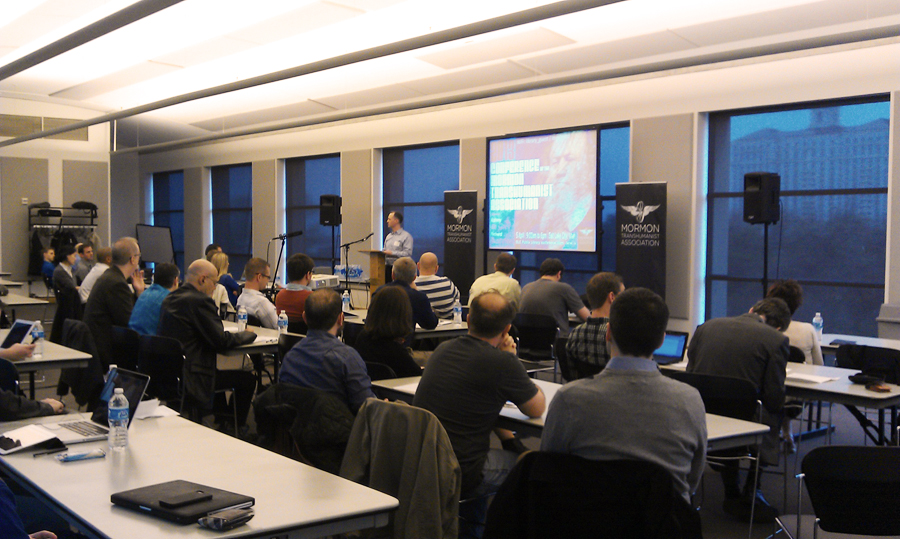
Man will become like God, say Mormons and transhumanists in Salt Lake City

hehe  these kooks! ..as soon as Herr Dr. Frankenstein's  MONSTER   stops chasing His fucking ass ALL over "the frozen"  land LOL  ...we will ask the Good Herr Dr.   ...how'd  that work out fer ya?   :o

Man will become like God, say Mormons and transhumanists in Salt Lake City

April 10, 2013 by Giulio Prisco
Like every year, I attended the yearly conference of the Mormon Transhumanist Association (MTA), on April 6 in Salt Lake City.
It is no mystery that I am very fond of the MTA. I think it represents the best example of successful integration of transhumanist ideas in a mainstream religion, and one of the best transhumanist communities.
Man becoming godlike: belief or heresy?
The Church of Jesus Christ of Latter-Day Saints (LDS), aka Mormon Church, has a concept of boundless elevation and exaltation of Man, through all means including science and technology, until he becomes like God.
Conversely, God was once like Man before attaining an exalted status. “[Mormonism] allows for humans to ascend to a higher, more godlike level,” writes Max More in his introduction to The Transhumanist Reader, “rather than sharply dividing God from Man.”
Mormon transhumanists are persuaded that we will become like God — through science and technology — in a progression without end, and this seems a more faithful interpretation of the teachings of Joseph Smith and a return to the roots of the Mormon religion.
Not all Mormons agree with this transhumanist formulation of their faith but, according to MTA president Lincoln Cannon, it is a correct interpretation of the writings of Joseph Smith, the founder of the Mormon Church, close to the historic and philosophical roots of the LDS doctrine, as shown by the King Follet discourse and the quotes of Smith and other Mormon authorities collected here.
All Mormons are familiar with this aspect of their faith, but many modern Mormons seem to sweep these concepts to the back of their mind, as they do for other controversial issues such as polygamy, promoted (and practiced) by Smith and the founding fathers but frowned upon in modern times.
The tension between the progressive approach of the MTA and the more conservative approach of the Mormon Church at large was especially evident in Brad Carmack’s talk on the rights of LGBT and transgendered persons.
In the first keynote, longevity researcher Aubrey De Grey said that medical Strategies for Engineered Negligible Senescence (SENS) may soon permit eliminating aging, and that failing to do so would be a “sin.” He countered many frequent “ethical” objections to extreme longevity research, showing that life extension is inseparable from healthy aging.
Computational theology?
In the more visionary part of this visionary conference, Alcor’s Mike Perry, author of Forever for All, presented his thoughts on far-future sciences and technologies able to resurrect the dead. In my own talk, I showed how the Problem of Evil — why a benevolent and omnipotent God permits evil and suffering — can be framed and “solved” in terms of the computational physics of a simulated universe.
In the second keynote, renowned historian Richard Bushman, the author of Rough Stone Rolling, a biography of Joseph Smith, put the ideas of the MTA in a Mormon historical perspective. He could hardly be expected to fully endorse the openly transhumanist vision of the MTA, but he departed holding a copy of Ray Kurzweil’s latest book.
As in Max More’s observation, the Mormon Church may be an especially fertile ground for the emergence of a transhumanist religion. But according to musician Micah Redding, similar openings can also be found in mainstream Christianity, albeit in a less explicit form.
Not all speakers were transhumanist-religion-friendly. Carl Teichrib, editor of Forcing Change, criticized transhumanist spirituality from a Christian perspective (see his review of the 2010 conference on Transhumanism and Spirituality), and Peter Wicks criticized the introduction of religious elements in transhumanism.
Giulio Prisco is transhumanism editor for KurzweilAI. He is a science writer, technology expert, futurist, and transhumanist.

Do Cells Have an IP Address Yet?

Do Cells Have an IP Address Yet?


2013-04-11-AliAnsary_1.jpg

In the future, implanted chips will have the ability to stop food absorption when caloric intake reaches 2,200. Cells in our forearm will be able to monitor our glucose levels and adjust our insulin appropriately. These implantable cells or "chips" have their own IP address with their own circuitry that is connected to a network 24/7. Through this network, cells communicate with real-time supercomputers to synthesize the next step for an individual's body. If Dr. Anthony Atala can utilize 3D printers to create a new kidney, then it is only a matter of time before we can incorporate the circuitry within an organ necessary to monitor its function wirelessly.
This was the future I was challenged to paint in my talk at TEDMED 2012 at the Kennedy Center for the Performing Arts in Washington, D.C. As TEDMED 2013 commences, I ask myself: Where are we one year later?
A caveat: The following are simple overviews on novel technologies I had been tracking over the past year and does no justice to the many amazing leaps we have made in innovative science and medicine during this time.
Implantable Sensors
Thomas Goetz beautifully discusses in The Atlantic that diabetics, although "loath" it, have been self-monitoring for years. Goetz goes on to say that the "distaste falls into three categories: self monitoring for diabetes is an unremitting and unforgiving labor; the tools themselves are awkward and sterile; and the combination of these creates a constant sense of anxiety and failure."
However, what if we had an implantable sensor that simply monitors an individual's glucose? In 2010, Dr. David Gough from the University of California, San Diego demonstrated that you could potentially monitor an individual's glucose by wireless telemetry. A patient can be in San Francisco with his or her physician having access to the data in Los Angeles.
And what if the immune system renders the chip incapable of functioning? Dr. Melissa Grunlan at the University of Texas A&M has been working to develop a self-cleaning mechanism that prevents implantable glucose sensors from being "shielded" by the body's immune system.
Dr. Giovanni de Micheli and Dr. Sandro Carrara at the École polytechnique fédérale de Lausanne in Switzerland have developed a 1.4 cm implantable device that can measure proteins and organic acids in real time. Imagine a signal being sent to your cell phone, and your doctor's phone, indicating an increase in cardiac enzymes -- potentially a heart attack. This device functions on a battery-less system that connects to a patch resting on the surface of the skin.
Natural anatomy acts as a barrier to implantable batteries. Yet, Dr. Ada Poon and her team at Stanford University have developed a medical device that can be powered wirelessly using electromagnetic radio waves. Now, the tiny devices we envisioned can circulate into the depths of our vascular system without fear of losing power. Reminds me of the The Magic School Bus episode when Ms. Frizzle takes her class on a field trip through the human body.
A personal favorite of mine: At the Massachusetts Institute of Technology, Dr. Konstantina Stankovic has demonstrated the ability to use the natural electric potential from electrolytes in the inner ear to power devices that can monitor biological activity in people with auditory and balance issues.

Early detection is fundamental in many of these devices, especially for cancer patients who have aggressive diseases prone to metastasis. Take, for example, patients with malignant melanoma, one of the deadliest cancers and one that has seen little progress in its treatment. Dr. Shuang Hou and his team at UCLA have demonstrated a proof of concept of a "nanovelcro" chip that can capture highly specific and isolated circulating tumor cells.
And what about regulating food intake and nutrient absorption? Intrapace has created Abiliti, an implantable gastric stimulator and food detection system that is implanted into the stomach. As soon as food is detected, it stimulates the stomach to create a sense of fullness. I can see eventually a system that can monitor an individual's caloric input over, say, 24 hours. This would allow us to eat normally without overindulging.
Wearable Sensors
A quick mention on a hot topic. As popular discussions emphasize trends like the Nike+ FuelBand, one step closer to wearable sensors are what Dr. John Rogers at the University of Illinois at Urbana-Champaign has developed: An electronic sensor that can be directly printed onto your skin using a rubber stamp and last for up to two weeks, as highlighted in MIT's Technology Review. The potential for this goes beyond saying.
The Fine Line
This is just a short list of exciting new innovations. Of course, many people may be taken aback by such technologies, which is fine. The purpose of my talk was to create discussion while painting a potential future that may be upon us soon. It is important for all of us to be active in our own healthcare. If we aren't, then someone else will be.
Knowledge about our glucose or hemoglobin and hematocrit in our time is just as important as knowing whether or not to fuel our cars with unleaded or diesel. But we still need an expert mechanic's help. Let me explain. I do believe that growth in this field, like anything else in medicine in the 21st century, will need to be not only through adoption by the empowered and informed patient, but also via health care providers.
Old mechanics would drive a problematic car themselves to assess damage. Simple things such as hearing a funny sound or seeing the car pull to the left would give them enough information to diagnose the problem. Today, the engineering of a car is so sophisticated that sensors continuously monitoring the "health" of the engine alert the driver when something is wrong. That unwelcome signal -- a picture of a wrench, perhaps, or a flat tire -- notifies the driver and the mechanic what part has gone wrong, what's wrong with it, and what needs to be done.
So the mechanic had to evolve the way he (or she) fixed a car. The physician today is much like that mechanic. While the human body is far more sophisticated than even a brand new Mercedes Benz, newly-trained physicians need to adjust how they care for their patients' health.
Growth in this field, like anything else in medicine in the 21st century, will need to be not only through adoption by the e-patient, but also via tech-savvy health care providers.
Original presentation at TEDMED 2012.

Global Governance and the “New World Order Religion”

The Role of the Baha'i. In the Wake of the Newtown School Massacre

Region:

religion
The Sandy Hook School massacre of December 14 has no doubt been seized upon by the present police state as a raison d’être for heightened gun control measures. Yet a more subtle element of the event is the promotion of a political worldview under the cloak of psychiatry and an increasingly prominent notion of “community building.”[1]
Stepping into the emotional fallout of December’s mass shooting is Dr. John Woodall. The former Harvard psychiatrist was almost immediately making the rounds in Newtown, consoling the grief stricken and advocating a seemingly unique communitarian creed. Woodall’s presence was unsurprising for locals since he resides in Sandy Hook, where his “Unity Project” non-profit is also based. What is more, the event was eerily appropriate for the “teaching children resilience” mission Woodall’s organization was already undertaking in Newtown area schools. Unity Project had already contributed to such exercises following major crises including 9/11 and Hurricane Katrina.
At first glance the Unity Project appears to be yet another new agey, “let go of the hate” platform for Woodall’s pop-humanist psychology. We must learn to overcome our ordeals and look beyond our differences on the way to one big group hug. The organization has created such a program for the youth of Newtown’s high school where students have been encouraged to fill out a psychological survey and  negotiate with administrators and teachers to lessen the homework load.[2]
On its face the prospect of developing well-rounded and engaged citizens sounds desirable. Who wants to be considered a holdout against local cooperation, peaceful coexistence, even global trade harmonization? The consequence these days includes running the risk of being deemed a grouchy extremist. Perhaps this is why groups are actively espousing and disseminating Unity Project precepts in schools and communities throughout the world.
“As we move more deeply into a national and global climate fraught with complex and nuanced problems,” Woodall explains,
young people need to become masters of working with this complexity and diversity in cooperative and constructive ways. Our democracy and the happiness of our lives depend upon it. Young people need to know how to recognize bias, see the big picture and resist and problem solve cooperatively and to resist the human tendency to allow fear and anger to pull us to simplistic and extremist solutions that only create division and conflict and end up worsening the problems we face.[3]
This exact doctrine was articulated in Woodall’s December 14 remarks to the Associated Press.        
I do this for a living—I do trauma work for a living. I ran programs overseas for the State Department. I’ve worked in school shootings before. But all that—none of that counts. All that counts at that moment is that another human being is there for you … It’s a strong community. It’s a resilient community. The task now is for the community to give this a meaning. It’s like in New York City after 9/11. The lesson of 9/11 wasn’t that we should be afraid or angry, or bitter or blame or point fingers. The lesson of 9/11 is that we’re all in this together and we need to show compassion for each other to give meaning to the loss.
In Woodall’s evaluation the death and horror from such events constitute a sort of nightmarish martyrdom from which a greater good will arise. Indeed, many of the Sandy Hook victims’ families publicly exhibit this very ability to unemotionally cope with profound loss, an ostensible response and mindset that does not go unnoticed by the broader public.[4] The wide exposure of this apparent struggle suggests a mass conditioning toward the community resilience that is a foremost element of what contemporary social engineers have termed the “Newtown transition.”
Along these lines and throughout the bulk of Woodall’s writings and pronouncements there is a clear resemblance to the precepts of the Bahá’í faith, to which Woodall is a devotee. Even though his professional training and pedigree suggest a “scientific” (qua psychiatry) approach to personal and community problems, Woodall’s writings are essentially those espoused by the Bahá’ís. He just seldom declares such affiliations or beliefs publicly.[5] An exception was when Woodall and his spouse Margo Woodall recited Bahá’í passages at the December 16, 2012 interfaith gathering for Sandy Hook victims attended by President Obama. 
From its headquarters in Haifa Israel and under the authority of the Universal House of Justice, Bahá’í is overseen country-to-country by National and Local Spiritual Assemblies. The religion is an international phenomenon, with its spiritual founder prophesying a global socio-political transformation under the Bahá’í order’s aegis. “The Bahá’í Faith is the youngest of the world’s independent religions,” the International Bahá’í Community website notes.
Its founder, Bahá’u'lláh (1817-1892), is regarded by Bahá’ís as the most recent in the line of Messengers of God that stretches back beyond recorded time and that includes Abraham, Moses, Buddha, Krishna, Zoroaster, Christ and Muhammad. The central theme of Bahá’u'lláh’s message is that humanity is one single race and that the day has come for its unification in one global society. God, Bahá’u'lláh said, has set in motion historical forces that are breaking down traditional barriers of race, class, creed, and nation and that will, in time, give birth to a universal civilization.[6]
In 1982 the Bahá’í faith unambiguously professed before the United Nations “the goal of a new World Order, Divine in origin, all-embracing in scope, equitable in principle, challenging in its features — that a harassed humanity must strive.”[7]
Toward this end Bahá’ís’ guiding philosophy and goals include:
All humanity is one family.
Women and men are equal.
All prejudice—racial, religious, national, or economic—is destructive and must be overcome.
We must investigate truth for ourselves, without preconceptions.
Science and religion are in harmony.
Our economic problems are linked to spiritual problems.
All major religions come from God.
World peace is the crying need of our time.
If this is indeed the basis of a global religion, before which all other beliefs and denominations must yield, there are a number of obvious concerns. For example, how does one define national or economic “prejudice”? Will one’s economic wherewithal be contingent upon converting to a new, state-mandated religion/spirituality? And along these lines, if science and religion are conflated, what entities will help determine the moral parameters of the many scientific pursuits that run counter to and endanger life on earth? Under such a scheme will psychiatrists and bioethicists make up a new clergy? Many of the Bahá’í tenets would fit well in a technocratic order where the state is the foremost authority.
According to the Center for Media and Democracy’s Sourcewatch database [8] the Bahá’í faith’s ambitious vision is a forthrightly political project calling for the creation of
A World Super State
A World Legislator
Unification of all the world’s religions under the umbrella of the Bahá’í faith
A World Parliament
A World Police Force
A Supreme Tribunal
A Single World Currency
A World Taxation System
A Single Universal Auxiliary Language
Implementation of Agenda 21 and the Earth Charter
Establishment of a World Free Trade Area
Along with the institutionalized secular faith of carbon-centric environmentalism that figures centrally in the Bahá’ís’ undertakings, the Unity Project’s understated transnationalism is likewise making inroads at public schools and in communities throughout the world. As in his previous endeavors, the Sandy Hook tragedy has provided the backdrop for Woodall’s evangelizing that seeks to realign the traumatized individual and group toward certain ideals and norms. What is arguably of concern is that Woodall proceeds under the cover of mental health professional while espousing an ardent globalist ideology that runs counter to the traditional political beliefs and religious faiths that, for better or worse, are espoused by a majority of the world’s population.
In the broader scheme of things the impulses and goals of the anti-individualistic Bahá’í faith’s and Dr. Woodall’s Unity Project provide clear glimpses of what may soon become a prevalent if not compulsory worldview–the elements of which are already being employed to ease the world’s population into a heightened tempo of violent and traumatic mediated events en route to the digitally-enforced feudalism of the twenty-first century.
Notes
[1] See “Baha’i Presence in Sandy Hook and How It May Influence Our Future,” Sandy Hook Truth, February 13, 2013.
[2] “[S]ample student strengths that might be helpful in completing the Unity Project Survey” include “Considerate,” “Doesn’t hold a grudge,” “Good at heart,” “Peaceful,” “Spiritual,” “Thinks before acting,” “Reverent.” Davis Dunavin, “Meet the Student Who Helped Give Newtown High School a True Vacation,” Newtown Patch, April 5, 2013.
[3] John Woodall, “A Summary of the Unity Project,” JohnWoodall.net, February 19, 2010.
[4] Jon Rappoport, “How the Newtown Massacre Became a Mind Control Television Event,” jonrappoport.wordpress.com, December 18, 2012.
[5] A search of Woodall’s blog http://www.johnwoodall.net on March 31, 2013 for “Baha’i” or “Haifa” yields no results.
[6] “The Bahá’í Faith,” Bahá’í Topics, n.d., bahai.org
[7] “The Promise of Disarmament and Peace,” Baha’I International Community Statement Library, June 1982.
[8] “The Bahá’í Faith,” Sourcewatch, Center for Media and Democracy, August 5, 2012.