& hows that work~in 4 US , huh hows that going hum
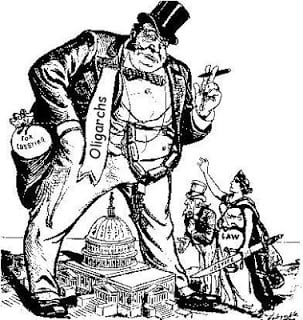
Today’s world is ruled by a myriad of multinational corporations
and financial institutions that belong to a network of private round
table organisations that stretch across the planet. There exists an
international ruling elite that has been building an economic-corporate
empire for over a century, which oppresses any dissent to their agenda.
A recent
study conducted
by Northwestern and Princeton University on America’s political system
supports the thesis that political systems are not directed by the
people of the country, but rather by a network of “economic elites” and
“business interests”. The study concluded that the US political system
is an oligarchy, where the “wishes of corporations and business and
professional associations” are the driving forces behind policy
decisions within the government.
“The central point that emerges from our research is that economic
elites and organised groups representing business interests have
substantial independent impacts on US government policy, while
mass-based interest groups and average citizens have little or no
independent influence” (
Gilens and Page, 2014, p.3).
This study illustrates the influence that trans-national corporations
along with international financiers can have on a population if they
are given the conditions to flourish. The Council on Foreign Relations
(CFR) epitomises the economic-corporate governance that exists in most
countries of the world today, with democratic political systems often
corrupted by lobbying groups and special interests. A self titled
“independent, nonpartisan membership organisation, think tank and
publisher”, the CFR is a private organisation which holds the real power
in American politics. It has a membership which is made up from the top
echelons of the political, academic, media, corporate, and banking
fields.
Hilary Clinton revealed
the nature of her (along with the US State Department’s) relationship
with the CFR when she addressed the council at their newly opened
outpost in Washington D.C in 2009:
“I have been often to the mother ship in New York City, but it’s good
to have an outpost of the Council right here down the street from the
State Department. We get a lot of advice from the Council, so this will
mean I won’t have as far to go to be told what we should be doing and
how we should think about the future.”
A look at the
corporate membership of
the council reveals the level of power vested in such a small amount of
hands, with approximately 200 of the most influential corporate players
on the planet members of the council, including: Exxon Mobil
Corporation, Goldman Sachs Group Inc, BP plc, Barclays, Google Inc,
Lockheed Martin, Deutsche Bank AG, Shell Oil Company and Soros Fund
Management.
The CFR is part of a shadowy network of private organisations that
stretches across the globe to influence policy of most nation states.
Professor Carroll Quigley was an insider at the CFR and knew “of the
operations of this network because” he “studied it for twenty years and
was permitted for two years, in the early 1960’s, to examine its papers
and secret records” (Quigley, 1966, p. 950). He wrote two books about
the activities of the network, the first titled Tragedy and Hope: A
History of the World in our Time published in 1966, and the second was
The Anglo-American Establishment published in 1981.
The father of the CFR is the British based Royal Institute of
International Affairs (RIIA) which is headquartered at Chatham House in
St James’s Square, London. Growing out of the Cecil Rhodes Secret
Society and the Lord Alfred Milner Group, the RIIA was formed in 1919 by
Lionel Curtis and fellow members of the Milner Group:
“In 1919 they founded the Royal Institute of
International Affairs (Chatham House) for which the chief financial
supporters were Sir Abe Bailey and the Astor family (owners of The
Times). Similar Institutes of International Affairs were established in
the chief British dominions and in the United States (where it was known
as the Council on Foreign Relations) in the period 1919-1927” (Quigley,
1966, p. 132).
These organisations are composed of inner circles and outer circles,
with the larger institutes serving as a front organisation for the inner
circle who direct the group. This has been the case since RIIA was
established as a front organisation for the Milner Group in 1919:
“The Milner Group controls the Institute. Once that is established,
the picture changes. The influence of Chatham House appears in its true
perspective, not as the influence of an autonomous body but as merely
one of the many instruments in the arsenal of another power” (Quigley,
P.197, 1981).
Lord Alfred Milner and Cecil Rhodes both shared an ethos that British
expansionism would lay the foundation for a world system that was to
come in the future:
“The goals which Rhodes and Milner sought and the methods
by which they hoped to achieve them were so similar by 1902 that the
two are almost indistinguishable. Both sought to unite the world, and
above all the English-speaking world, in a federal structure around
Britain. Both felt that this goal could best be achieved by a secret
band of men united to one another by devotion to the common cause and by
personal loyalty to one another. Both felt that this band should pursue
its goal by secret political and economic influence behind the scenes
and by the control of journalistic, educational, and propaganda
agencies” (Quigley, 1981, P.49).
Quigley was honest at admitting the dangers of a small oligarchical group having such a concentration of power vested in it:
“No country that values its safety should allow what the
Milner Group accomplished in Britain – that is, that a small number of
men should be able to wield such power in administration and politics,
should be given almost complete control over the publication of the
documents relating to their actions, should be able to exercise such
influence over the avenues of information that create public opinion,
and should be able to monopolise so completely the writing and teaching
of the history of their own period” (Quigley, 1981, p. 197).
Today, Chatham House is one of the world’s pre-eminent organisations
on world affairs, which conducts its activities under a veil of secrecy.
Very little mainstream media spotlight is put on the organisation which
has been at the centre of British policy for close to a century –
perhaps due to the fact that the BBC, Thomas Reuters, Bloomberg, the
Telegraph Media Group, the Daily Mail and General Trust plc, the
Guardian and the Economist are all
corporate members of
the RIIA. Raytheon, the Ministry of Defence, the British Army, the
Foreign & Commonwealth Office UK, BAE Systems plc, Chevron, the
Royal Bank of Scotland, HSBC Holdings plc, the Scottish Government and
the European Commission, are just a handful of organisations that also
belong to the Institute.
Chatham House is one of the most influential organisations relating
to western imperial policy, with the creation of an
Anglo-American-European world empire the core objective of the
institute. The Director of Chatham House has recently been announced as
the
chair of a new North Atlantic Treaty Organisation (NATO) policy group,
which will advise and recommend future NATO policy. The Director Dr
Robin Niblett revealed the intimate relationship between the RIIA and
NATO since its formation in a speech about the new initiative last
month, stating: “Chatham House has been involved in debates around the
role of NATO since its inception”. The European branch of this
organisation (the European Council on Foreign Relations (ECFR)) has also
had a strong affiliation with NATO, as 3 of the former Secretary
Generals are individual members of the council: including the previous
leader
Jaap De Hoop Scheffer (Jan 2004 – Aug 2009), along with
George Robertson (Oct 1999 – Dec 2003) and
Javier Solana(Dec 1995 – Oct 1999).
A further example of the network of economic and corporate elites is the annual
Bilderberg conference
that took place in Copenhagen between the 29th May and 1st June, where a
percentage of the world’s elite meet to discuss geopolitical, social
and economic affairs. Founded in 1954 by Prince Bernard of the
Netherlands, the group is a mix of corporate and banking giants meeting
with military heavyweights, media moguls, politicians and royalty from
North America and Europe. This year’s meeting was an especially high
level affair with the Managing Director of the IMF Christine Lagarde,
the Secretary General of NATO Andres Fogh Rasmussen, the former head of
the National Security Agency (NSA) Keith Alexander, the Executive
chairman of Google Inc Eric Schmidt, the Chancellor of the Exchequer
George Osborne and H.M the Queen of Spain, all amongst this year’s
participants.
Back in 2009, the Belgian Minister of State and former chairman of
the Bilderberg Group Étienne Davignon revealed that the group ‘
helped create the Euro in 1990’s’,
demonstrating the power of the group in making major decisions
regarding Europe’s economic affairs. The President of the European
Central Bank (ECB) Mario Draghi has also attended the conference in
2009 when he was Governor of the Bank of Italy, two years before taking office at the ECB.
The elite will remain in control as long as people allow themselves
to be Balkanised by the media and the political establishment along the
lines of race, class and status, whilst the true enemy to a free world
continues to roll on unabated.
Additional Sources:
Carroll Quigley, Tragedy and Hope: A History of the World in our Time, 1966.
Carroll Quigley, The Anglo-American Establishment, 1981.
www.globalresearch.ca/the-economic-corporate-oligarchy-of-the-world/5386794"
data-title="The Economic-Corporate Oligarchy of the World">

 Posts
Posts