Posts
Posts


NSA Spying and Search Engine “Tracking Technologies”
It’s not Okay if the NSA Spies on us, but it’s okay when Google does…

One of the defining stories
of 2013 was, without doubt, Edward Snowden’s revelations of the mass
spying conducted by the NSA, GCHQ and various other government
intelligence agencies from around the world.
Aside from justifiable outrage, the revelations very rightly sparked
intense debate over the appropriate role of government in the lives of
everyday citizens, certainly at least in the United States, if not to the same extent in Britain. A large part of the issue surrounded the interception of personal data held by internet companies such as Google, Yahoo and Facebook by the American NSA and British GCHQ agencies both overtly through PRISM and covertly from fibre-optic cables,
and the logic behind the indiscriminate collection of personal data
under the alibi of “national security” and “counter-terrorism” is flimsy
at best. Yet the key question that we have failed to ask ourselves, and
indeed
that government spying itself has distracted us from, is how we handed
over our own data to the internet companies whose services we use in the
first place.
such as Google, Yahoo and Facebook by the American NSA and British GCHQ agencies both overtly through PRISM and covertly from fibre-optic cables,
and the logic behind the indiscriminate collection of personal data
under the alibi of “national security” and “counter-terrorism” is flimsy
at best. Yet the key question that we have failed to ask ourselves, and
indeed
that government spying itself has distracted us from, is how we handed
over our own data to the internet companies whose services we use in the
first place.The search engine DuckDuckGo (which I use and strongly recommend) describes the process more succinctly than I could, but I’ll put it into words anyway: Google records your searches and sends your search term, browser and computer information to any site whose link you click on, allowing them to identify you and track you. This data is then used to build a profile of you for the purpose of targeted ads, which can also be used to charge you higher prices. That, in a nutshell, is what the NSA and GCHQ have been obtaining from Google. Facebook operates in a similar way and, incidentally, is facing a class action lawsuit as a result: it tracks the links you click on, the posts you “like” and even the contents of your private messages to profile you, before selling this data to data aggregators and advertisers.
Mind you, DuckDuckGo was
launched in 2008, five years before we learned all about government
spying. The tracking and profiling carried out by internet companies
such as Google and Facebook have been known since these websites were
first launched, yet it was only when we learned from Edward Snowden that
our governments were using this information to spy on us that we became
upset.
Why the double standard that we hold corporations and governments to?
What gives corporations the divine right to collect and sell our data
in the interests of profit while governments have no such right? Such is
the absurdity of our concept of liberty: only government can pose any
conceivable threat to our freedoms, we think, and so we quietly accept
the terms and conditions that allow Google and Facebook to spam us with
targeted ads and subject us to price discrimination, but we squeal
whenever the government gets its hands on our data, whatever it does with it. Or is it because the NSA never gave us a list of “terms and conditions”?
such as Google and Facebook have been known since these websites were
first launched, yet it was only when we learned from Edward Snowden that
our governments were using this information to spy on us that we became
upset.It’s important that we remember in the age of mass government online surveillance that it is not simply the NSA and GCHQ, but also Google, Facebook and the various other companies that track and profile us and mine and sell our data that have brought about “the end of online privacy”. The sad reality we have today is that the business model of the websites many of us use today is such that, while providing their services without charging us a fee (I refrain here from using the word “free”), they mine and sell our information to maximize revenue and hence profits. Corporations like Google are, in the words of Yasha Levine, specialists in “for-profit intelligence“. As a recent Observer editorial summed it up:
Let’s not allow the spectre of government surveillance to distract us from that fact.“Lured by “free” services on the internet, we click through to a digital emporium where we sacrifice our privacy. Every click, message and electronic trail is mined for profit. Every digital stroke makes money for them. The more time that you spend, the more money they make. There is little they don’t know, almost nowhere they can’t follow and nothing they can’t tell about your digital life.”
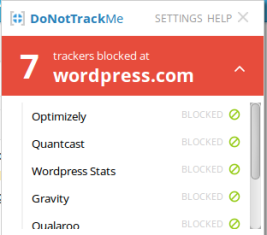
On a closing note, DuckDuckGo offers a toolkit for blocking trackers. Whether it’s Google, the tracking companies or the NSA we’re concerned about, it might be just what we need.
Ming Chun Tang is a freelance writer and student at Hamilton College (New York). He blogs at http://clearingtherubble.wordpress.com/.







 By Michael Snyder, on January 20th, 2014

 By Michael Snyder, on January 20th, 2014