The American Deep State, Deep Events, and Off-the-Books Financing
I have been writing about deep politics
since 1993, when I gave the example of how the United States after
World War sent American mafia figures to fight communism in Italy,
thereby creating a corrupted politics that was soon out of control – as
bad as the influence the mafia once possessed in cities like Marseille,
or Chicago.1
Since then I have written about deep events, by which I mean
mysterious events, like the JFK assassination, the Watergate break-in,
or 9/11, which repeatedly involve law-breaking or violence, and are
embedded in fact in deep politics. Some of these may be low-level, as
when data is filched from a personal computer, or mid-level, like the
murder of Karen Silkwood. But what I have called structural deep events
are large enough to affect the whole fabric of society, with
“consequences that enlarge covert government, and are subsequently
covered up by systematic falsifications in media and internal government
records.” We still live in the official state of emergency imposed
after the last great deep event – 9/11; and this has left us in a
deconstitutionalized era of warrantless surveillance, warrantless
detentions, and militarized homeland security.
2 In the remainder of this essay, the deep events I refer to will all be structural deep events.
I have come to believe that most structural deep events (or SDEs) are
interrelated, and that the study of any one of them helps understand
others. Their interrelationship leads to two levels of history in
America, and two levels of historical narrative: official or archival
history, which ignores or marginalizes deep events, and a second level –
called deep history by its practitioners or “conspiracy theory” by its
critics – which incorporates them. As an example of an officially
ignored or distorted deep event, I like to give the example of the Royal
Canadian Mounted Policy (RCMP) detention in 1993 of a major al Qaeda
figure, Ali Mohamed. In 1993 Ali Mohamed was ordered released by the
FBI, freeing him to fly to Kenya where (as the 9/11/ commission report
notes) he began the planning of the 1998 US Embassy bombing. This rather
significant event was given a good account in Canada’s leading
newspaper, the Toronto
Globe and Mail; but it has never been properly reported in any American mainstream newspaper.
3
Ali Mohamed
My study of the interrelationship between deep events has itself
deepened over four decades. It began on a superficial level by noticing
the overlap of apparently marginal personnel between the deep events of
the John F. Kennedy assassination and Watergate; and again between
Watergate and Iran-Contra.
I will never forget the
New York Times
front-page story on June 18, 1972, the day after the Watergate
break-in. There were photographs of the Watergate burglars, including
one of Frank Sturgis alias Fiorini, whom I had already written about two
years earlier in my unpublished book manuscript about the JFK
assassination, “The Dallas Conspiracy.”
4 Sturgis was
in fact no nonentity: well connected to the mob-linked former casino
owners in Havana, he had maintained frequent contacts with the U.S. Air
Attaché’s office in Havana after penetrating Castro’s July 26 Movement
in the Sierra Maestra.
5
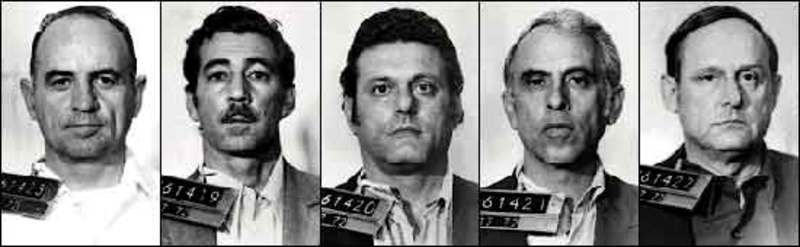 The Watergate Burglars – Frank Sturgis in the Center. Source The Watergate Burglars – Frank Sturgis in the Center. Source |
It is alleged that some of the bail money that released Sturgis and
the other Watergate burglars was drug money from the CIA asset turned
drug trafficker, Manuel Artime, and delivered by Artime’s
money-launderer, Ramón Milián Rodríguez. After the Iran-Contra scandal
went public, Milián Rodríguez was investigated by a congressional
committee – not for Watergate, but because, in
support of the Contras, he had managed two Costa Rican seafood
companies, Frigorificos and Ocean Hunter, that laundered drug money.
6
A more recent example would be that of Ali Mohamed, the man detained
and then released by the RCMP. In the 1980s Mohamed trained the
CIA-backed mujahedin in Afghanistan. He then trained some of those who
bombed the World Trade Center in 1993, before arranging for the 1998
bombing of the US Embassy in Kenya.
Since 9/11 my study of structural deep events has progressed from
such overlaps of personnel to three deeper levels, which I call the
operational, by which I mean a common
modus operandi, the
institutional, by which I mean a shared agency of implementation, and the
financial, by which I mean a common source of funding.
I was myself startled to recognize more than a dozen common
operational modalities between two outwardly dissimilar events: the JFK
assassination and 9/11. Among the most striking are
1) the almost instant identification of what I call the
designated culprits, Lee Harvey Oswald and the nineteen alleged
hijackers,
2) the hidden intelligence backgrounds of the designated culprits, and
3) the protection by the FBI and CIA of the designated culprits in
the weeks before the events, to ensure that they would not be placed
under surveillance or taken off the streets.7
I have written at some length about this in my 2008 book
The War Conspiracy, and also elsewhere. But I will repeat a passage here about the last item — protection.
Both the JFK assassination and 9/11 were facilitated by
the way the CIA and FBI manipulated their files about [designated
culprits in] each event (the alleged hijackers Khalid al-Mihdhar and
Nawaf al-Hazmi in the case of 9/11). Part of this facilitation was the
decision on October 9, 1963 of an FBI agent, Marvin Gheesling, to remove
Oswald from the FBI watch list for surveillance. This was shortly after
Oswald’s arrest in New Orleans in August and his reported travel to
Mexico in September. …. Gheesling’s behavior fits very neatly with the
CIA’s culpable withholding from the FBI, in the same month of October,
information that Oswald had allegedly met in Mexico City with a
suspected KGB agent, Valeriy Kostikov. This also helped ensure that
Oswald would not be placed under surveillance. Indeed, former FBI
Director Clarence Kelley in his memoir later complained that the CIA’s
withholding of information was the major reason why Oswald was not put
under surveillance on November 22, 1963….
Before 9/11 the CIA, in 2000-2001, again flagrantly withheld crucial
evidence from the FBI: evidence that, if shared, would have led the FBI
to surveil two of the alleged hijackers, Khalid al-Mihdhar and Nawaz
al-Hazmi. This sustained withholding of evidence provoked an FBI agent
to predict accurately in August, 2001, [three weeks before 9/11] that
“someday someone will die.”… The CIA’s withholding of relevant evidence
before 9/11 (which it was required by its own rules to supply) was
matched in this case by the NSA.8
On the
institutional level, it is striking that in every
structural deep event since the JFK assassination we find some role
played by the National Communications System (NCS), the shadow network
created to ensure continuity of government (COG) in the event of an
atomic attack. The NCS was formally established by a JFK Presidential
Memorandum on August 21, 1963. By 1969 at least $175 million had been
spent “to increase the survivability of national communications
resources” in a nuclear attack.
9 In June 1979 the
system was tested under Carter, in the first known instance of the COG
exercise GLOBAL SHIELD. By the Reagan era the NCS had mushroomed into an
$8 billion communications and logistics program for an alternative
emergency communications network.
10
This alternative network played a central role in Iran-Contra, when
Oliver North, arranging for the arms shipments to Iran that eventually
cost him his job, used the nation’s top secret COG communications
network. North’s network, known as Flashboard, “excluded other
bureaucrats with opposing viewpoints…[and] had its own special worldwide
antiterrorist computer network, … by which members could communicate
exclusively with each other and their collaborators abroad.”
11 North was also actively developing plans, which originated with Hoover, for emergency detentions on a large scale.
12
So, before him, was James McCord, famous for having participated in the burglary that precipitated the 1972 Watergate crisis.
McCord was a member of a small Air Force Reserve unit in
Washington attached to the Office of Emergency Preparedness (OEP);
assigned “to draw up lists of radicals and to develop contingency plans
for censorship of the news media and U.S. mail in time of war.”His unit
was part of the Wartime Information Security Program (WISP), which had
responsibility for activating “contingency plans for imposing censorship
on the press, the mails and all telecommunications (including
government communications) [and] preventive detention of civilian
‘security risks,’ who would be placed in military ‘camps.’”13
(Since I first advanced the hypothesis that the COG communications
network was involved in all our structural deep events, I have found
further corroborations for it. For example, John Dean, perhaps the
central Watergate figure, had participated in COG activities when
serving as the associate deputy attorney general.
14
And an army reserve officer, Norman Katz, revealed in October 2013
that, because of his work in COG communications, he was summoned to
Washington in November 1963, in connection with President Kennedy’s trip
to Dallas.
15)
But 9/11 is the deep event in which the COG network played a most central role. In
The Road to 9/11
I advance reasons to believe that Cheney and Rumsfeld, during the short
period that morning when they were inexplicably not in their command
posts, were instead using the COG network to finalize emergency
measures, soon to include the first ever implementation that same
morning of COG measures.
16
This is the more remarkable because, for two decades before 9/11,
Rumsfeld and Cheney had both been part of a small secret committee
planning with the assistance of Oliver North – even in the 1990s when
neither man was in the government – for extreme COG measures, including,
allegedly, “suspension of the constitution.” In the Iran-Contra
Hearings North was asked about planning to suspend the constitution, but
the Chairman would not allow discussion in an open session.
17
The American Deep State
In the last chapter, I described an ambiguous symbiosis between two different aspects of the American deep state:
1) the Beltway agencies of the shadow government, like
the CIA and NSA, which have been instituted by the public state and now
overshadow it, (but also including private corporations like Booz Allen
Hamilton (Edward Snowden’s employers) and SAIC, Seventy percent of
intelligence budgets are now outsourced to private companies like Booz
Allen Hamilton (owned by the Carlyle Group) and SAIC, the company that,
as I wrote in American War Machine, helped get the US to fight in Iraq)
2) the much older power of Wall Street, referring chiefly to the
powerful banks and law firms located there, but also to the cartels and
other corporate alliances established there, and also Wall Street’s
think tank, the Council on Foreign Relations.
In the 1950s Wall Street was a dominating complex. It included not
just banks and other financial institutions but also the oil majors
whose cartel arrangements were successfully defended against the U.S.
Government by the Wall Street law firm Sullivan and Cromwell, home to
the Dulles brothers.
The inclusion of Wall Street conforms with Franklin Roosevelt’s
observation in 1933 to his friend Col. E.M. House that “The real truth …
is, as you and I know, that a financial element in the larger centers
has owned the Government ever since the days of Andrew Jackson.”
18
FDR’s insight is well illustrated by the efficiency with which a
group of Wall Street bankers (including Nelson Rockefeller’s grandfather
Nelson Aldrich) were able in a highly secret meeting in 1910 to
establish the Federal Reserve System – a system which in effect reserved
oversight of the nation’s currency supply and of all America’s banks in
the not impartial hands of its largest.
19 The
political clout of the quasi-governmental Federal Reserve Board was
clearly demonstrated in 2008, when Fed leadership secured instant
support from two successive administrations for public money to rescue
the reckless management of Wall Street banks: banks Too Big To Fail, and
of course far Too Big To Jail, but not Too Big To Bail.
20
The international lawyers of Wall Street did not hide from each other
their shared belief that they understood better than Washington the
requirements for running the world. As John Foster Dulles wrote in the
1930s to a British colleague,
The word “cartel” has here assumed the stigma of a
bogeyman which the politicians are constantly attacking. The fact of the
matter is that most of these politicians are highly insular and
nationalistic and because the political organization of the world has
under such influence been so backward, business people who have had to
cope realistically with international problems have had to find ways for
getting through and around stupid political barriers.21
This same mentality also explains why Allen Dulles as an OSS officer
in 1945 simply evaded orders from Washington forbidding him to negotiate
with SS General Karl Wolff about a conditional surrender of German
forces in Italy – an important breach of Roosevelt’s agreement with
Stalin at Yalta for unconditional surrender, a breach that is regarded
by many as helping lead to the Cold War.
22
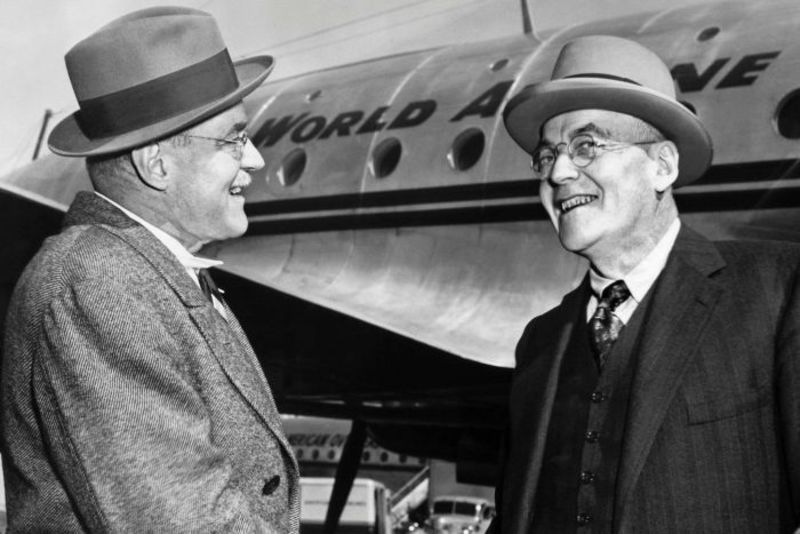 The Dulles Brothers (John Foster, right) The Dulles Brothers (John Foster, right) |
The seven major oil companies or Seven Sisters – five American and
two British – still operated as a cartel after World War Two. Thus when
Premier Mossadeq of Iran took steps in 1951-52 to nationalize the
Anglo-Iranian Oil Company (now BP), the oil majors were able to organize
a largely successful boycott of Iranian oil exports. They could not
however persuade Truman to use the CIA against Mossadeq, and had to wait
until Truman was succeeded by Eisenhower in 1953. With the Dulles
brothers installed as heads of State and CIA, CIA planning for a coup to
restore the shah began immediately, with Eisenhower approving in June.
Mossadeq’s removal from power is remembered as a CIA operation, with
the oil cartel (when mentioned at all) playing a subservient role.
However the chronology suggests that it was CIA that came belatedly in
1953 to assist an earlier oil cartel operation, rather than vice versa.
In terms of the deep state, the oil cartel or deep state initiated in
1951 a process that the American public state only authorized two years
later.
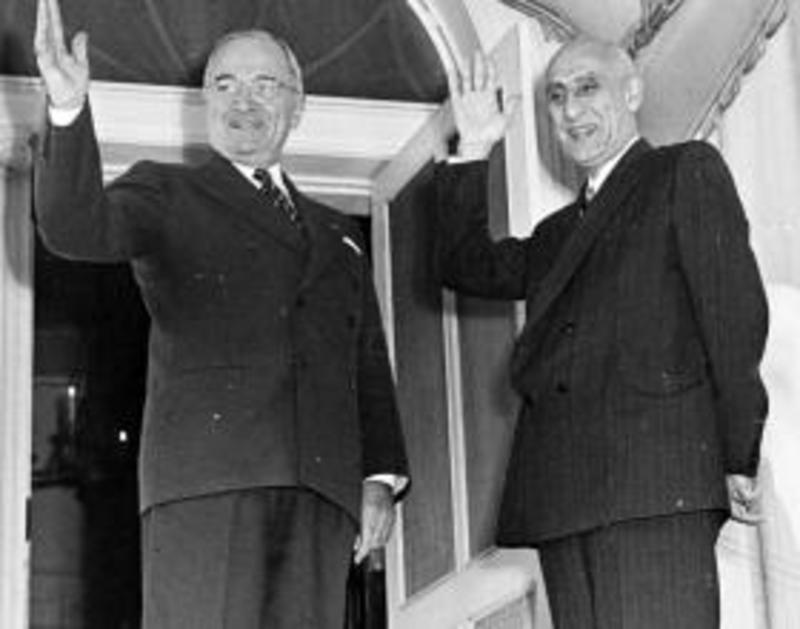 Truman and Mossadeq (right) Truman and Mossadeq (right) |
This shows how the deep state and its overworld are, and to some
degree always have been, supranational. In the 1950s, for example, if
Allen Dulles as CIA Director wanted to fly a U-2 over Russia on a
certain day, and Eisenhower said no, Dulles would simply turn to his
British counterparts in MI6 to get permission from Macmillan, and Dulles
would get his way.
23
The CIA and the Power of the Purse
Conventional political analysis claims that the CIA is limited by the
constitutional system of checks and balances in which Congress controls
by its power of the purse. Note Lauren Fox’s important caveat:
Congress maintains the power of the purse, which gives
lawmakers the ability to defund specific programs the federal agency
holds dear, but the CIA maintains the documents and information Congress
needs to see to effectively conduct oversight in the first place.24
Fox, however, ignores the fact that, since its outset, the CIA has
always had access to large amounts of off-the books or offshore funds to
support its activities. Indeed, the power of the purse has usually
worked in an opposite sense, since those in control of deep state
offshore funds supporting CIA activities have for decades also funded
members of Congress and of the executive – not vice versa. The last six
decades provide a coherent and continuous picture of historical
direction being provided by this deep state power of the purse, trumping
and sometimes reversing the conventional state.
Let us resume some of the CIA’s sources of offshore and off-the-books
funding for its activities. The CIA’s first covert operation was the
use of “over $10 million in captured Axis funds to influence the
[Italian] election [of 1948].”
25 (The fundraising had
begun at the wealthy Brook Club in New York; but Allen Dulles, then
still a Wall Street lawyer, persuaded Washington, which at first had
preferred a private funding campaign, to authorize the operation through
the National Security Council and the CIA.)
26
Dulles, together with George Kennan and James Forrestal, then found a
way to provide a legal source for off-the-books CIA funding, under the
cover of the Marshall Plan. The three men “helped devise a secret
codicil [to the Marshall Plan] that gave the CIA the capability to
conduct political warfare. It let the agency skim millions of dollars
from the plan.”
27
At the time of the Marshall Plan slush fund in Europe, the CIA also
took steps which resulted in drug money to support anti-communist armies
in the Far East. In my book
American War Machine I tell how
the CIA, using former OSS operative Paul Helliwell, created two
proprietary firms as infrastructure for a KMT army in Burma, an army
which quickly became involved in managing and developing the opium
traffic there. The two firms were SEA Supply Inc. in Bangkok and CAT
Inc. (later Air America) in Taiwan. Significantly, the CIA split
ownership of CAT Inc.’s plane with KMT bankers in Taiwan – this allowed
the CIA to deny responsibility for the flights when CAT planes, having
delivered arms from Sea Supply to the opium-growing army, then returned
to Taiwan with opium for the KMT. Even after the CIA officially severed
its connection to the KMT Army in 1953, its proprietary firm Sea Supply
Inc. supplied arms for a CIA-led paramilitary force, PARU, that also was
financed, at least in part, by the drug traffic.
28
Profits from Thailand filtered back, in part through the same Paul
Helliwell, as donations to members from both parties in Congress. Thai
dictator Phao Sriyanon, a drug trafficker who was then alleged to be the
richest man in the world,
hired lawyer Paul Helliwell…as a lobbyist in addition to
[former OSS chief William] Donovan [who in 1953-55 was US Ambassador to
Thailand]. Donovan and Helliwell divided the Congress between them, with
Donovan assuming responsibility for the Republicans and Helliwell
taking the Democrats.29
The most dramatic use of off-the-books drug profits to finance
foreign armies was seen in the 1960s CIA-led campaign in Laos. There the
CIA supplied airstrips and planes to support a 30,000-man drug-financed
Hmong army. At one point Laotian CIA station chief Theodore Shackley
even called in CIA aircraft in support of a ground battle to seize a
huge opium caravan on behalf of the larger Royal Laotian Army.
30
Funds from arms contracts
In the 1960s and especially the 1970s America began to import more
and more oil from the Middle East. But the negative effect on the U.S.
balance of payments was offset by increasing arms and aviation sales to
Iran and Saudi Arabia. Contracts with companies like Northrop and
especially Lockheed (the builder of the CIA’s U-2) included kickbacks to
arms brokers, like Kodama Yoshio in Japan and Adnan Khashoggi in Saudi
Arabia, who were also important CIA agents. Lockheed alone later
admitted to the Church Committee that it had provided $106 million in
commissions to Khashoggi between 1970 and 1975, more than ten times what
it had paid to the next most important connection, Kodama.
31
These funds were then used by Khashoggi and Kodama to purchase
pro-Western influence. But Khashoggi, advised by a team of ex-CIA
Americans like Miles Copeland and Edward Moss, distributed cash, and
sometimes provided women, not just in Saudi Arabia but around the world –
including cash to congressmen and President Nixon in the United States.
32
Khashoggi in effect served as a “cutout,” or representative, in a
number of operations forbidden to the CIA and the companies he worked
with. Lockheed, for one, was conspicuously absent from the list of
military contractors who contributed illicitly to Nixon’s 1972 election
campaign. But there was no law prohibiting, and nothing else to prevent
their official representative, Khashoggi, from cycling $200 million
through the bank of Nixon’s friend Bebe Rebozo.
33
Moss, Khashoggi, the Safari Club, and the International Overworld
The power exerted by Khashoggi was not limited to his access to funds
and women. By the 1970s, Khashoggi and his aide Edward Moss owned the
elite Safari Club in Kenya.
34 The exclusive club
became the first venue for another and more important Safari Club: an
alliance between Saudi and other intelligence agencies that wished to
compensate for the CIA’s retrenchment in the wake of President Carter’s
election and Senator Church’s post-Watergate reforms.
35
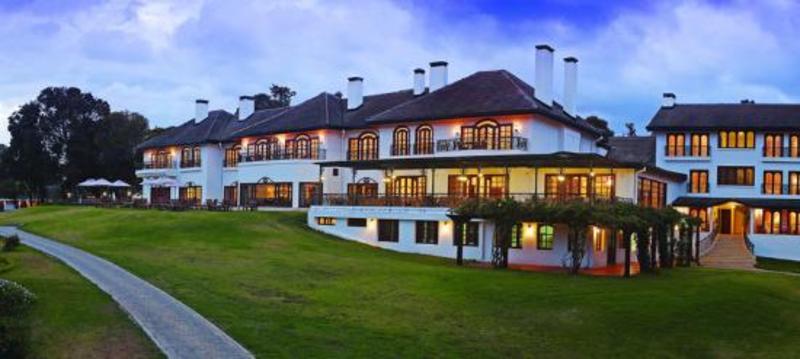 The Safari Club The Safari Club |
As former Saudi intelligence chief Prince Turki bin Faisal once told Georgetown University alumni,
In 1976, after the Watergate matters took place here,
your intelligence community was literally tied up by Congress. It could
not do anything. It could not send spies, it could not write reports,
and it could not pay money. In order to compensate for that, a group of
countries got together in the hope of fighting Communism and established
what was called the Safari Club. The Safari Club included France,
Egypt, Saudi Arabia, Morocco, and Iran.36
Prince Turki’s candid remarks– “your intelligence community was
literally tied up by Congress. …. In order to compensate for that, a
group of countries got together … and established what was called the
Safari Club.” – made it clear that the Safari Club, operating at the
level of the deep state, was expressly created to overcome restraints
established by political decisions of the public state in Washington
(decisions not only of Congress but also of President Carter).
Specifically Khashoggi’s activities involving corruption by sex and
money, after they too were somewhat curtailed by Senator Church’s
post-Watergate reforms, appear to have been taken up quickly by the Bank
of Credit and Commerce International (BCCI), a Muslim-owned bank where
Khashoggi’s friend and business partner Kamal Adham, the Saudi
intelligence chief and a principal Safari Club member, was a part-owner.
37
In the 1980s BCCI, and its allied shipping empire owned by the
Pakistani Gokal brothers, supplied financing and infrastructure for the
CIA’s (and Saudi Arabia’s) biggest covert operation of the decade,
support for the Afghan mujahedin.
To quote from a British book excerpted in the Senate BCCI Report:
“BCCI’s role in assisting the U.S. to fund the Mujaheddin
guerrillas fighting the Soviet occupation is drawing increasing
attention. The bank’s role began to surface in the mid-1980′s when
stories appeared in the New York Times showing how American security
operatives used Oman as a staging post for Arab funds. This was
confirmed in the Wall Street Journal of 23 October 1991 which quotes a
member of the late General Zia’s cabinet as saying ‘It was Arab money
that was pouring through BCCI.’ The Bank which carried the money on from
Oman to Pakistan and into Afghanistan was National Bank of Oman, where
BCCI owned 29%.”38
It is reported in two books that the BCCI money flow through the Bank
of Oman was handled in part by the international financier Bruce
Rappaport, who for a decade, like Khashoggi, kept a former CIA officer
on his staff.
39 Rappaport’s partner in his Inter
Maritime Bank, which interlocked with BCCI, was E.P. Barry, who earlier
had been a partner in the Florida money-laundering banks of Paul
Helliwell.
40
Secret clauses in arms contracts
The activities of the Safari Club were exposed after Iranians in 1979
seized the records of the US Embassy in Tehran. But BCCI support for
covert CIA operations, including Iran-Contra, continued until BCCI’s
criminality was exposed at the end of the decade.
Meanwhile, with the election of Ronald Reagan in 1980, Washington
resumed off-budget funding for CIA covert operations under cover of arms
contracts to Saudi Arabia. But this was no longer achieved through
kickbacks to CIA assets like Khashoggi, after Congress in 1977 made it
illegal for American corporations to make payments to foreign officials.
Instead arrangements were made for payments to be returned, through
either informal agreements or secret codicils in the contracts, by the
Saudi Arabian government itself. Two successive arms deals, the AWACS
deal of 1981 and the al-Yamamah deal of 1985, considerably escalated the
amount of available slush funds.
a) the AWACS deal
In 1981 Vice-president Bush and Saudi Prince Bandar, working
together, won congressional approval for massive new arms sales of AWACS
(airborne warning and control system) aircraft to Saudi Arabia. In the
$5.5 billion package, only ten percent covered the cost of the planes.
Most of the rest was an initial installment on what was ultimately a
$200 billion program for military infrastructure through Saudi Arabia.
41
It also supplied a slush fund for secret ops, one administered for
over a decade in Washington by Prince Bandar, after he became the Saudi
Ambassador (and a close friend of the Bush family, nicknamed “Bandar
Bush”). In the words of researcher Scott Armstrong, the fund was “the
ultimate government-off-the-books.”
Not long after the AWACS sale was approved, Prince Bandar
thanked the Reagan administration for the vote by honoring a request by
William Casey that he deposit $10 million in a Vatican bank to be used
in a campaign against the Italian Communist Party. Implicit in the AWACS
deal was a pledge by the Saudis to fund anticommunist guerrilla groups
in Afghanistan, Angola, and elsewhere that were supported by the Reagan
Administration.42
The Vatican contribution, “for the CIA’s long-time clients, the
Christian Democratic Party,” of course continued a CIA tradition dating
back to 1948.
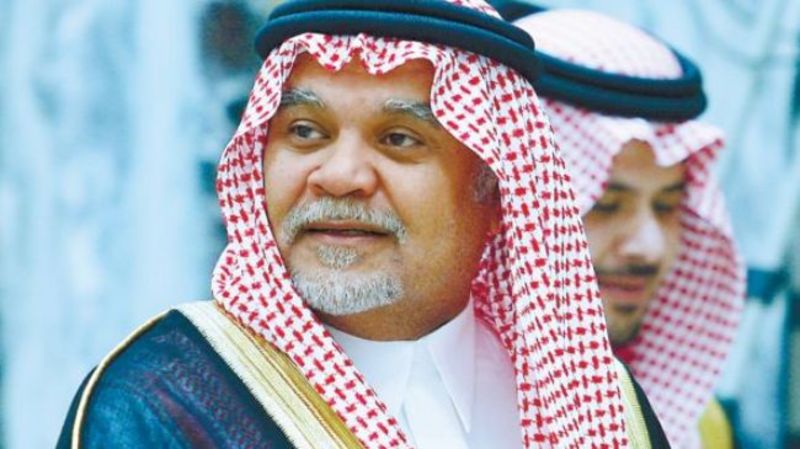 Prince Bandar bin Sultan, Also Known as “Bandar Bush.” Source. Prince Bandar bin Sultan, Also Known as “Bandar Bush.” Source. |
b. The al-Yamamah deal
After a second proposed major U.S. arms sale met enhanced opposition
in Congress in 1985 from the Israeli lobby, Saudi Arabia negotiated
instead a multi-billion pound long-term contract with the United Kingdom
– the so-called al-Yamamah deal. Once again overpayments for the
purchased weapons were siphoned off into a huge slush fund for political
payoffs, including “hundreds of millions of pounds to the ex-Saudi
ambassador to the US, Prince Bandar bin Sultan.”
43 According to Robert Lacey, the payments to Prince Bandar were said to total one billion pounds over more than a decade.
44
The money went through a Saudi Embassy account in the Riggs Bank,
Washington; according to Trento, the Embassy’s use of the Riggs Bank
dated back to the mid-1970s, when, in his words, “the Saudi royal family
had taken over intelligence financing for the United States.”
45 More accurately, the financing was not for the United States, but for the American deep state.
Offshore Funding and the Continuity of Deep Events
This leads me to the most original and important thing I have to say.
I believe that these secret funds from BCCI and Saudi arms deals –
first Khashoggi’s from Lockheed and then Prince Bandar’s from the AWACS
and al-Yamamah deals – are the common denominator in all of the major
structural deep events (SDEs) that have afflicted America since the
supranational Safari Club was created in l976.
I am referring specifically to
1) the covert US intervention in Afghanistan (which
started about 1978 as a Safari Club intervention, more than a year
before the Russian invasion),
2) the 1980 October Surprise, which together with an increase in
Saudi oil prices helped assure Reagan’s election and thus give us the
Reagan Revolution,
3) Iran-Contra in 1984-86,
4) and – last but by no means least – 9/11.
That is why I believe it is important to analyze these events at the level of the supranational deep state.
Let me just cite a few details.
1) the 1980 October Surprise.
According to Robert Parry, Alexandre de Marenches, the principal founder
of the Safari Club, arranged for William Casey (a fellow Knight of
Malta) to meet with Iranian and Israeli representatives in Paris in July
and October 1980, where Casey promised delivery to Iran of needed U.S.
armaments, in exchange for a delay in the return of the U.S. hostages in
Iran until Reagan was in power. Parry suspects a role of BCCI in both
the funding of payoffs for the secret deal and the subsequent flow of
Israeli armaments to Iran.
46 In addition, John Cooley
considers de Marenches to be “the Safari Club player who probably did
most to draw the US into the Afghan adventure.”
47
2) the Iran-Contra scandal (including the funding of the
Contras, the illegal Iran arms sales, and support for the Afghan
mujahideen
There were two stages to Iran-Contra. For twelve months in 1984-85,
after meeting with Casey, King Fahd of Saudi Arabia, in the spirit of
the AWACS deal, supported the Nicaraguan Contras via Prince Bandar
through a BCCI bank account in Miami. But in April 1985, after the
second proposed arms sale fell through, McFarlane, fearing AIPAC
opposition, terminated this direct Saudi role. Then Khashoggi, with the
help of Miles Copeland, devised a new scheme in which Iranian arms sales
involving Israel would fund the contras. The first stage of Iran-Contra
was handled by Prince Bandar through a BCCI account in Miami; the
second channel was handled by Khashoggi through a different BCCI account
in Montecarlo.
The Kerry-Brown Senate Report on BCCI also transmitted allegations
from a Palestinian-American businessman, Sam Bamieh, that Khashoggi’s
funds from BCCI for arms sales to Iran came ultimately from King Fahd of
Saudi Arabia, who “was hoping to gain favor with Ayatollah Ruhollah
Khomeini.”
48
3) 9/11
When the two previously noted alleged hijackers or designated
culprits, al-Mihdhar and al-Hazmi, arrived in San Diego, a Saudi named
Omar al-Bayoumi both housed them and opened bank accounts for them. Soon
afterwards Bayoumi’s wife began receiving monthly payments from a Riggs
bank account held by Prince Bandar’s wife, Princess Haifa bint Faisal.
49
In addition, Princess Haifa sent regular monthly payments of between
$2,000 and $3,500 to the wife of Osama Basnan, believed by various
investigators to be a spy for the Saudi government. In all, “between
1998 and 2002, up to US $73,000 in cashier cheques was funneled by
Bandar’s wife Haifa … – to two Californian families known to have
bankrolled al-Midhar and al-Hazmi.”
50
Although these sums in themselves are not large, they may have been
part of a more general pattern. Author Paul Sperry claims there was
possible Saudi government contact with at least four other of the
alleged hijackers in Virginia and Florida. For example, “9/11 ringleader
Mohamed Atta and other hijackers visited s home owned by Esam Ghazzawi,
a Saudi adviser to the nephew of King Fahd.”
51
But it is wrong to think of Bandar’s accounts in the Riggs Bank as
uniquely Saudi. Recall that Prince Bandar’s payments were said to have
included “a suitcase containing more than $10 million” that went to a
Vatican priest for the CIA’s long-time clients, the Christian Democratic
Party.
52 In 2004, the
Wall Street Journal
reported that the Riggs Bank, which was by then under investigation by
the Justice Department for money laundering, “has had a longstanding
relationship with the Central Intelligence Agency, according to people
familiar with Riggs operations and U.S. government officials.”
53
Meanwhile President Obiang of Equatorial Guinea “siphoned millions
from his country’s treasury with the help of Riggs Bank in Washington,
D.C.”
54 For this a Riggs account executive, Simon
Kareri, was indicted. But Obiang enjoyed State Department approval for a
contract with the private U.S. military firm M.P.R.I., with an eye to
defending offshore oil platforms owned by ExxonMobil, Marathon, and
Hess.
55
Behind the CIA relationship with the Riggs Bank was the role played
by the bank’s overseas clients in protecting U.S. investments, and
particularly (in the case of Saudi Arabia and Equatorial Guinea), the
nation’s biggest oil companies.
Conclusion: the American Deep State Today
The issue of Saudi Embassy funding of at least two (and possibly
more) of the alleged 9/11 hijackers (or designated culprits) is so
sensitive that, in the 800-page Joint Congressional Inquiry Report on
9/11, the entire 28-page section dealing with Saudi financing was very
heavily redacted.
56 A similar censorship occurred with
the 9/11 Commission Report: According to Philip Shenon, several staff
members felt strongly that they had demonstrated a close Saudi
government connection to the hijackers, but a senior staff member purged
almost all of the most serious allegations against the Saudi
government, and moved the explosive supporting evidence to the report’s
footnotes.
57
It is probable that this cover-up was not designed for the protection
of the Saudi government itself, so much as of the supranational deep
state connection described in this essay, a milieu where American,
Saudi, and Israeli elements all interact covertly. One sign of this is
that Prince Bandar himself, sensitive to the anti-Saudi sentiment that
9/11 caused, has been among those calling for the U.S. government to
make the redacted 28 pages public.
58
This limited exposure of the nefarious use of funds generated from
Saudi arms contracts has not created a desire in Washington to limit
these contracts. On the contrary, in 2010, the second year of the Obama
administration,
The Defense Department … notified Congress that it wants
to sell $60 billion worth of advanced aircraft and weapons to Saudi
Arabia. The proposed sale, which includes helicopters, fighter jets,
radar equipment and satellite-guided bombs, would be the largest arms
deal to another country in U.S. history if the sale goes through and all
purchases are made.59
The sale did go through; only a few congressmen objected.
60 The deep state, it would appear, is alive and well, and impervious to exposures of it.
It is clear that for some decades the bottom-upwards processes of
democracy have been increasingly supplanted by the top-downwards
processes of the deep state.
But the deeper strain in history, I would like to believe, is in the
opposite direction: the ultimate diminution of violent top-down forces
by the bottom-up forces of an increasingly integrated civil society.
61
In the last months we have had Wikileaks, then Edward Snowden, and
now the fight between the CIA and its long-time champion in Congress,
Dianne Feinstein. It may be time to see a systemic correction, much as
we did after Daniel Ellsberg’s release of the Pentagon Papers, which was
followed by Watergate and the Church Committee reforms. I believe that
to achieve this correction there must be a better understanding of deep
events and of the deep state.
Ultimately, however, whether we see a correction or not will depend, at least in part, on how much people care.
Peter Dale Scott, a former Canadian diplomat and English Professor at the University of California, Berkeley, is the author of
Drugs Oil and War,
The Road to 9/11, and
The War Conspiracy: JFK, 9/11, and the Deep Politics of War. His most recent book is
American War Machine: Deep Politics, the CIA Global Drug Connection and the Road to Afghanistan. His website, which contains a wealth of his writings, is
here.
Notes
1 Peter Dale Scott, Deep Politics and the Death of JFK (Berkeley: University of California Press, 1993), 6-8.
2 Cf. The Doomsday Project, Deep Events, and the Shrinking of American Democracy,” Asia-Pacific Journal: Japan Focus, January 21, 2011.
3 Toronto Globe and Mail, November 22, 2001; discussion in Peter Dale Scott, “The Falsified War on Terror: How the US Has Protected Some of Its Enemies,” Asia-Pacific Journal: Japan Focus, October 8, 2013.
4 This work
circulated as a manuscript, but was never published. However I learn
from the Internet that “Southeast Louisiana University has two copies of
Peter Dale Scott’s THE DALLAS CONSPIRACY listed in their JFK papers
archive”; cf. See here and here, Folders 20 and 21.
5 Peter Dale Scott, “The Doomsday Project and Deep Events: JFK, Watergate, Iran-Contra, and 9/11,” Asia-Pacific Journal: Japan Focus.
6 Jack Colhoun, Gangsterismo: The US, Cuba and the Mafia: 1933 to 1966 (New York: OR Books, 2013), 57-60; quoted in Bill Kelly, “Frank Sturgis – Run By US Military not CIA,” JFK Countercoup2, April 15, 2013.
7 Peter Dale Scott, The War Conspiracy: JFK, 9/11, and the Deep Politics of War (New York: Sky Horse Publishing, 2013), 341-96. There I listed thirteen similarities; I have since thought of another dozen.
8 Peter Dale Scott, “The Doomsday Project and Deep Events: JFK, Watergate, Iran-Contra, and 9/11,” Asia-Pacific Journal: Japan Focus.
9 “Emergency
Preparedness for Telecommunications,” attachment to memo of November 5,
1969, to Clay Whitehead [director of the White House Office of Telecommunications Policy under Nixon], from Charlie Joyce; reproduced here.
10 Tim Shorrock, Spies for hire: the secret world of intelligence outsourcing (New York: Simon & Schuster, 2008),72-75; Peter Dale Scott, “Continuity of Government: Is the State of Emergency Superseding our Constitution?” Asia-Pacific Journal: Japan Focus, November 29, 2010.
11 Peter Dale Scott, “North, Iran-Contra, and the Doomsday Project: The Original Congressional Cover Up of Continuity-of-Government Planning,” Asia-Pacific Journal: Japan Focus, February 21, 2011.
12 Ben Bradlee, Jr., Guts and Glory: The Rise and Fall of Oliver North (New York: D.I. Fine, 1988), 132.
13 Scott, “The Doomsday Project and Deep Events;” citing Bob Woodward and Carl Bernstein, All the President’s Men (New York: Simon and Schuster, 1974), 23; Jim Hougan, Secret Agenda (New York: Random House, 1984), 16. For more on WISP, see David Wise, The Politics of Lying: Government Deception, Secrecy, and Power (New York: Random House, 1973), 134-37.
14 John Dean, Worse Than Watergate: The Secret Presidency of George W. Bush (New York: Little Brown, 2004), 120.
15 “Former White House attache to talk about JFK assassination.” See here.
16 Scott, Road to 9/11, 197-235.
17 Scott, Road to 9/11, 183-90.
18 Quoted in Scott, The Road to 9/11, 1. The situation appears not to have changed. “When Barack Obama ran for president in 2008, no major U.S. corporation did more to finance his campaign than Goldman Sachs Group Inc.” (Wall Street Journal, October 10, 2012).
19 Forbes
magazine founder Bertie Charles Forbes wrote six years later: “Picture a
party of the nation’s greatest bankers stealing out of New York on a
private railroad car under cover of darkness, stealthily riding
hundred[s] of miles South, embarking on a mysterious launch, sneaking
onto an island [the appropriately named Jekyll Island] deserted by all
but a few servants, living there a full week under such rigid secrecy
that the names of not one of them was once mentioned, lest the servants
learn the identity and disclose to the world this strangest, most secret
expedition in the history of American finance. I am not romancing; I am
giving to the world, for the first time, the real story of how the
famous Aldrich currency report, the foundation of our new currency
system, was written (B.C. Forbes, Leslie’s Weekly, October 19, 1916; in T. Cushing Daniel, Real money versus false money-bank credits; the most important factor in civilization and least understood by the people Washington, D.C., The Monetary educational bureau, 1924], 169; cf. B.C. Forbes, Men who are making America [New York: Forbes Publishing Co., 1922], 398; cf. G. Edward Griffin, The Creature from Jekyll Island: A Second Look at the Federal Reserve [Westlake Village, CA: American Media, 1994]).
20 Congress was
persuaded to provide perfunctory support of the bailout, under an
alleged mysterious threat of martial law. See Peter Dale Scott, “Martial Law, the Financial Bailout, and War,” Global Research, January 8, 2009; reprinted in Michel Chossudovsky and Andrew Gavin Marshall, eds., The Global Economic Crisis: The Great Depression of the XXI Century (Montreal, Global Research Publishers. Centre for Research on Globalization, 2010), 219-40; Llewellyn H. Rockwell, Jr., “Sen.
Inhofe: [Henry] Paulsen [Secretary of the Treasury and former Chief
Executive Officer of Goldman Sachs] Threatened Martial Law To Pass
Bailout,” LewRockwell.com, November 20, 2008.
21 John Foster Dulles to Lord McGowan, Chairman of Imperial Chemical Industries; in Nancy Lisagor and Frank Lipsius, A law unto itself: the untold story of the law firm of Sullivan & Cromwell (New York: Morrow, 1988), 127.
22 Charles T. O’Reilly, Forgotten Battles: Italy’s War of Liberation, 1943-1945 (Lanham, MD: Lexington Books, 2001), 288; Peter Dale Scott, “How Allen Dulles and the SS Preserved Each Other,” Covert Action Information Bulletin,
25 (Winter 1986), 4-14. Dulles’s plans to use SS resources in post-war
Germany can be seen as part of a successful plan to frustrate the
implementation of Roosevelt’s so-called Morgenthau Plan to
deindustrialize Germany.
23 Stephen Dorril, MI6 (New York: Free Press, 2000), 659-660.
24 Lauren Fox, “Spy Game: Why Congress Is Limited in Its CIA Oversight,” U.S. News & World Report, March 12, 2014.
25 Amy B. Zegart, Flawed by Design: The Evolution of the CIA, JCS, and NSC (Stanford: Stanford UP, 1999), 189; citing Christopher Andrew, For the President’s Eyes Only (New York: HarperCollins, 1995), 172; see also Church Committee, Final Report, Book 4, 28-29.
26 David Wise and Thomas B. Ross, The Espionage Establishment (New York: Random House, 1967), 166; Scott, Road to 9/11, 13.
27 Tim Weiner, Legacy of ashes: the history of the CIA (New York: Doubleday, 2007), 28. An analogous funding source for the CIA developed in the Far East: the so-called
“M-Fund,” a secret fund of money of
enormous size that has existed in Japan [in 1991] for more than forty
years. The Fund was established by the United States in the immediate
postwar era for essentially the same reasons that later gave rise to the
Marshall Plan of assistance by the U.S. to Western Europe, including
the Federal Republic of Germany….. The M-Fund was used not only for the
building of a democratic political system in Japan but, in addition, for
all of the purposes for which Marshall Plan funds were used in
Europe.[27
28 Peter Dale Scott, American War Machine: Deep Politics, the CIA Global Drug Connection, and the Road to Afghanistan (Berkeley: University of California Press, 2007), 68-96.
29 Fineman, A Special Relationship, 214-15; cf. 206.
30 Scott, American War Machine, 101-16.
31 William D. Hartung, Prophets of war: Lockheed Martin and the making of the military-industrial complex (New York: Nation Books, 2011), 126.
32 Anthony Summers with Robbyn Swan, The Arrogance of Power: The Secret World of Richard Nixon (New York: Viking, 2000), 283. Cf. Kessler, The Richest Man in the World, 171: Khashoggi told the prosecutors “that he churned millions through the tiny [Rebozo] bank to win favor with the president.”
33 Cf. Jim Hougan, Spooks: the haunting of America: the private use of secret (New York: Morrow, 1978), 457–58.
34 Kessler, Richest Man in the World, 238-41; Scott, American War Machine, 161-62.
35 The operation kept the name “Safari Club” even after moving from Khashoggi’s Club to a permanent headquarters in Cairo.
36 Ibrahim Warde, The price of fear: the truth behind the financial war on terror (Berkeley: University of California Press, 2007), 133. Cf. Robert Lacey, Inside the Kingdom: Kings, Clerics, Modernists, Terrorists, and the Struggle for Saudi Arabia (New York: Penguin Books, 2009), 66, 72, 76.
37 Christopher Byron, “The Senate look at BCCI,” New York Magazine, October 28, 1991, 20–21.
38 Nick Kochan and Bob Whittington, Bankrupt: the BCCI Fraud (London: Gollancz, 1991), 220; quoted in The BCCI affair: a report to the Committee on Foreign Relations, United States Senate, Section 11.
39 Jonathan Beaty and S. C. Gwynne, The Outlaw Bank: A Wild Ride Into the Secret Heart of BCCI (New
York: Random House, 1993.), 311: “Rappaport and the Bank of Oman’s
managing director maintained key contacts with the Saudis, who were
pumping money through the bank for the Afghan rebels, at Casey’s
request.” Cf. Alan A. Block and Constance A. Weaver, All is clouded by desire: global banking, money laundering, and international organized crime (Westport, CT: Praeger, 2004), 27-28; Scott, American War Machine, 163; Scott, Road to 9/11, 325n94.
40 Block and Weaver, All is clouded by desire, 36-37.
41 Craig Unger, House of Bush, House of Saud: the secret relationship between the world’s two most powerful dynasties (New York: Scribner, 2004), 59-61.
The opposition of Israel and its supporters was mitigated in 1983, when
Reagan agreed to preserve Israel’s “qualitative edge” by supplying
comparable weapons. See Stephen C. Pelletière, Iraq and the International Oil System [Westport, CT: Praeger, 2001], 169-70), ZZ; Jonathan Marshall, Peter Dale Scott, and Jane Hunter, The Iran-Contra Connection: Secret Teams and Covert Operations in the Reagan Era (Boston: South End Press, 1987), 93-95.
42 Unger, House of Bush, House of Saud, 61; citing Robert Baer, Atlantic Monthly, May 2003, 60; cf. New York Times, 10/22/01, A1.
43 “Saudi prince ‘received arms cash’,”
BBC, June 7, 2007. It is unclear whether payments continued after 2001,
when the UK signed the OECD’s Anti-Bribery Convention, making such
overpayments illegal.
44 Lacey, Inside the Kingdom, 108.
45 Joseph J. Trento, Prelude to terror: the rogue CIA and the legacy of America’s private intelligence network (New York: Carroll & Graf, 2005), 102.
46 Robert Parry, Secrecy and Privilege: Rise of the Bush Dynasty from Watergate to Iraq (Arlington, VA: Media Consortium, 2004), 112–38; Scott, The Road to 9/11, 99–107.
47 John K. Cooley, Unholy Wars: Afghanistan, America, and International Terrorism
(London: Pluto Press, 1999), 26. De Marenches, through a shadowy Pinay
Circle, was also accused of interfering in the domestic politics of
France, England, and other European countries. See Robin Ramsey, “Brian
Crozier, the Pinay Circle and James Goldsmith”, Lobster 17, UK,
November 1988; David Teacher, “The Pinay Circle and Destabilization in
Europe,” Lobster 18, UK, October 1989). A more extreme argument is that
of David G. Guyatt, “The Pinay Circle: An Invisible Power Network,” Nexus Magazine, August-September 1996.
48 “Khashoggi, a
Saudi Arabian who investigators have found played a significant role in
financing the early US arms shipments to Iran, was serving as Fahd’s
emissary in the deals, Bamieh said…. ” (The BCCI Affair, Part
19). This remarkable claim was corroborated by two Khashoggi associates
and Farid Ghadry, a Saudi dissident in Washington (New York Times, January 17, 1987, 6). Cf. also Washington Post, March 7, 1987, A4.
49 In his recent book, The Commission: The Uncensored History of the 9/11 Investigation (New York: Twelve, 2009), New York Times
reporter Phillip Shenon discusses at length the questions surrounding
Bayoumi and his ties to the Saudi government. Cf. David Ray Griffin, The New Pearl Harbor Revisited: 9/11, the Cover-Up, and the Exposé (Northampton, MA: Olive Branch Press, 2008), 224-27.
50 Anthony Summers and Robbyn Swan, The eleventh day: the full story of 9/11 and Osama bin Laden (New York: Ballantine Books, 2011), 410-15, 559-62; cf. David B. Ottaway, The king’s messenger: Prince Bandar bin Sultan and America’s tangled relationship with Saudi Arabia (New York: Walker & Company, 2008), 198-99.
51 Paul Sperry, “Inside the Saudi 9/11 Coverup,” New York Post,
December 15, 2013: “FBI agents investigating the connection in 2002
found that visitor logs for the gated community and photos of license
tags matched vehicles driven by the hijackers. Just two weeks before the
9/11 attacks, the Saudi luxury home was abandoned. Three cars,
including a new Chrysler PT Cruiser, were left in the driveway. Inside,
opulent furniture was untouched.”
52 Lacey, Inside the Kingdom, 108.
53 Glenn R. Simpson, “Riggs Bank Had Longstanding Link To the CIA,” Wall Street Journal, December 31. 2004. The Journal added that the former Chilean chief of secret police under Pinochet, Manuel Contreras, also banked at Riggs.
54 Peter Maass, “A Touch of Crude,” Mother Jones, January/February 2005, http://www.motherjones.com/politics/2005/01/obiang-equatorial-guinea-oil-riggs.
55 Steve Coll, Private empire: ExxonMobil and American power (New York: Penguin Press, 2012), 283, 290.
56 Discussion in Ottaway, The King’s Messenger, 198-99.
57 Philip Shenon, The Commission, pp. 398-399.
58 Ottaway, The king’s messenger, 198-99. Cf. Arab News, July 26, 2003, http://www.arabnews.com/node/234848:
“What has been produced is nothing less than a charter for
Saudi-bashing, all the more so because of the 28 pages supposedly
dealing with Saudi links to the hijackers, blocked on White House
orders. Anyone who thinks that President Bush is doing us a favor can
forget it. Whatever the intention, this is an invitation to the US and
other media to speculate. It would be far better if the section were
published.” This financial involvement from the supranational deep state
is a dimension overlooked by those who describe 9/11 as a conspiracy,
or “State Crime Against Democracy” (SCAD), to be blamed on the U.S.
Government. See Lance deHaven-Smith, “Beyond Conspiracy Theory: Patterns
of High Crime in American Government,” American Behavioral Scientist, 53, 796; and my discussion in “Systemic
Destabilization in Recent American History: 9/11, the JFK
Assassination, and the Oklahoma City Bombing as a Strategy of Tension,” The Asia-Pacific Journal: Japan Focus, September 23, 2012, http://japanfocus.org/-Peter_Dale-Scott/3835.
59 Dana Hedgpeth, “Pentagon plans $60 billion weapons sale to Saudi Arabia,” Washington Post, October 21, 2010.
60 The leader of
the congressional opposition was Rep. Anthony Weiner of New York. Less
than a year later, in 2011, he was forced to resign, after exposure of
sexually provocative pictures that he had sent to female admirers on the
Internet.
61 Cf. Jonathan Schell, The Unconquerable World: Power, Nonviolence, and the Will of the People [New York: Metropolitan Books/Henry Holt, 2003], 227-31.
www.globalresearch.ca/the-american-deep-state-deep-events-and-off-the-books-financing/5376904"
data-title="The American Deep State, Deep Events, and Off-the-Books
Financing">

 Posts
Posts