Tuesday, May 6, 2014

How Monsanto Created Over 60 Million Acres of Superweeds That Have Wrecked The Environment

by .//http://www.collective-evolution.com/2014/05/06/how-monsanto-created-over-60-million-acres-of-superweeds-thatve-wrecked-the-environment/
Below is a quick and informative video that documents the rise of superweeds, which have now spread to over 60 million acres of farmland in the United States alone. In the 1990s, Monsanto introduced a new line of seeds called “Roundup Ready,” which were genetically engineered to be immune to glyphosate, which is the active (and highly toxic, for more information on that click HERE) main ingredient in the company’s herbicide, Roundup. As a result of these seeds that were genetically modified to be resistant to herbicide, farmers used mass amounts of it.
Roundup Ready seeds were excepted pretty fast, because weeds were detrimental to farming. Monsanto played the “superhero,” jumping in to save the day. Their Roundup herbicide seemed to be great, until weeds developed genes to resist it, becoming superweeds. The more Monsanto’s Roundup Ready system was used, the stronger the resistance genes became in the weeds, developing into a super weed crisis.

Monsanto Supersizes Farmers' Weed Problem--but Science Can Solve It https://www.youtube.com/watch?v=DWI8xR0FsOk

Again, Monsanto stepped in, playing the “super hero again”  to genetically modify seeds to resist these herbicides (as mentioned earlier).  Today, we have multiple countries around the world banning these GM products and the herbicides that go with them. This is due to the fact that there is an enormous about of information that suggests they are not safe to consume. You can find out more about that HERE.
“It sounds like a bad sic-fi movie or something out of The Twilight Zone. But ‘superweeds’ are real and they’re infesting America’s croplands. Overuse of Monsanto’s ‘Roundup Ready’ seeds and herbicides in our industrial farming system is largely to blame. And if we’re not careful the industry proposed ‘solutions’ could make this epidemic much worse. Monsanto and other agribusiness companies are now touting herbicide resistant crops engineered to withstand older, more toxic herbicides as the solution. These new herbicides will certainly exacerbate the problem, but in crewse the companies’ bottom lines. It’s a highly risky move. Increased herbicides use on the new engineered crops will speed up weed resistance, leaving no viable herbicide alternatives. This is a dangerous chemical cocktail, that when combined with the current farming systems, is a recipe for disaster” Doug Gurian-Sherman, senior scientist with the UCS Food & Environment
Sources:
http://www.ucsusa.org/news/press_release/superweeds-overrun-farmlands-0384.html

The Death Cross Of American Business

 so...still "think" we's go~in good ...huh ?

Tyler Durden's picture
// http://www.zerohedge.com/news/2014-05-06/death-cross-american-business


So much for the recovery... As WaPo reports, the American economy is less entrepreneurial now than at any point in the last three decades. A rather damning new Brookings Institution report shows that US businesses are being destroyed faster than they're being created. As the authors of the report ominously explain: If the decline persists, "it implies a continuation of slow growth for the indefinite future," as new business creation has been cut in half since 1978.

This is the death cross of American Business!!


And the bottom line from Hathaway and Litan:
Overall, the message here is clear. Business dynamism and entrepreneurship are experiencing a troubling secular decline in the United States. Existing research and a cursory review of broad data aggregates show that the decline in dynamism hasn’t been isolated to particular industrial sectors and firm sizes.

Here we demonstrated that the decline in entrepreneurship and business dynamism has been nearly universal geographically the last three decades—reaching all fifty states and all but a few metropolitan areas.

Doing so requires a more complete knowledge about what drives dynamism, and especially entrepreneurship, than currently exists. But it is clear that these trends fit into a larger narrative of business consolidation occurring in the U.S. economy—whatever the reason, older and larger businesses are doing better relative to younger and smaller ones. Firms and individuals appear to be more risk averse too—businesses are hanging on to cash, fewer people are launching firms, and workers are less likely to switch jobs or move.

Where the *Bleep* Is Germany’s Gold?

 hehe i'll say it , where the fuck is it lol  hey germany !   the same thin "happened" 2 it  ??  as when u's "stole" it during the "war"  ya know "it's"  just gone ....miss~in lol

Germany's goldYou may have heard something about this story, but I think it’s important to take a few minutes to restate the facts clearly. In the modern news environment, stories come and go so fast – and in so many parts – that it’s very easy to get lost along the way.
So, here’s what we know so far:
  • In 2012, the Bundesbank (the central bank of Germany) asked to visit the vault of the Federal Reserve in New York, to view the 1,536 tons of gold they have stored there.
  • The Federal Reserve told them no. They were not allowed to see their gold.
  • In response, Germany said that they wanted 300 tons of their gold back.
  • The Federal Reserve said that they’d need seven years to get the gold back to Germany. (Something that should take them seven weeks, tops.)
  • One year later, the Fed has returned only 5 tons of gold to Germany. At this rate, it will take 60 years for the Germans to get less than one fifth of their gold back.
Though I don’t know precisely what, it is very clear that something strange is going on here… something that the prestigious central bankers want to keep away from the light of day.
Shipping 300 tons of metal is hardly a new and difficult technical challenge. Companies involved in metal trading do this all the time. Sure, gold requires extra security, but security is also something that lots of people know how to provide.
Give me half a percent as a premium, and I’ll have it arranged by next week!

The German Responses

The initial German response was the one mentioned above: Give us back our gold. But that happened over a year ago, after they weren’t allowed to see their gold. There have been further responses, following the very lame delivery of five tons.
These responses have come in just the past month or so:
The president of Germany’s top financial regulations group said that manipulation of gold and silver “is worse than the Libor-rigging scandal.” (The Libor scandal was and is a big deal, and lots of lawsuits are underway over it.) That’s a big accusation.
Then, Deutsche Bank, the biggest German bank, dropped out of the London gold fixing pool; the group of bankers that set the official price of gold. This is also related to the investigations by European regulators into the suspected manipulation of precious metals prices by banks. Again, this is a very significant event.
Germany does not seem happy about what the Fed is doing to them. These responses may seem timid, compared to what you or I might do if someone refused to give us back our gold, but they very clearly show that the German banks are objecting. (What’s going on behind the scenes remains unknown to us.)
In addition to this, the Financial Times ran an article advising investors to demand physical delivery of their gold. Bloomberg published an article on gold price manipulation. Whether they were pushed to do this by the Germans remains an open question.

What’s Really Going On?

So, given what we know, the obvious question becomes, “What’s really going on?”
The first answer is that we simply do not know, but even that deserves a short comment:
We don’t know because central banks are above scrutiny. They operate in secret, insulated by governments.
In any honest business, we could learn something about what’s going on, but central banking is different. Its operators not only control the world’s money, but they do it secretly.
So, we can only guess as to what’s happening.
Most likely, however, is that all of Germany’s gold has been lent out and/or used as loan collateral multiple times and that the Fed is having a very hard time unwinding all those loans. If they just give the gold back, the collateral for hundreds (maybe thousands) of international loans goes away.
And when I say “lent out multiple times,” I am not speaking loosely. There is a financial trick called rehypothecation that allows bankers to use the same stack of gold as the collateral for simultaneous loans… over and over and over.
So, in order to pull Germany’s gold out of the lending game (and central banks do loan out gold), lots and lots of loans would have to be rehypothecated to other piles of gold, and that requires a lot of office work. Each bar of Germany’s gold could be involved in a dozen loans, each of which must be re-arranged.
This would account for the slowness of the Fed returning the gold back to where it belongs.
Of course, there are other possibilities. Maybe the Fed is just trying to punish Germany for some reason (they’ve messed with them in the past), or that the gold is simply no longer there – that the Fed or its friends sold it.

The Bottom Line

It would be wonderful to figure out what will happen next, but we’d have to base that on what’s really going on now, and we don’t know even that. As mentioned, central banks never have to tell.
The one thing we can be sure of is that the Federal Reserve and the Bundesbank are at odds. What will come from that is unknown, but this is a very significant problem between giants, and it is already producing consequences.
Maybe this problem will go away. But if it doesn’t, it could become very, very significant.
And how that will affect each of us – well, that’s a very good question.
Paul Rosenberg
FreemansPerspective.com

Yes, You Are Being Manipulated by Your Government

governments manipulateThe truth that government agents are influencing people online has been visible for some time to those who were looking. For example, in 2011, we got proof that military contractors and the US Air Force were doing this. (See here and here.) There were other facts as well, including the publicly-stated wishes of Cass Sunstein.
Most people didn’t see those stories, of course, and those who mentioned them were thought to be crazy. “If it was true, we’d have heard about it!”
In early February, however, we got serious proof, courtesy of Edward Snowden and Glen Greenwald. Honestly, I expected this to be a big story, like many of the previous Snowden leaks. Instead, the story went almost nowhere. The “news” simply refused to cover it. And while the story did run on a few websites, I don’t know of it running in any major newspaper or on any TV news, except perhaps RT, the Russian 24/7 English-language news channel. (NBC did run a prior and less troubling story.)
But, we have the slides, and we now know what the NSA and its British partner, GCHQ, are doing to us.

The Manipulations You Pay For

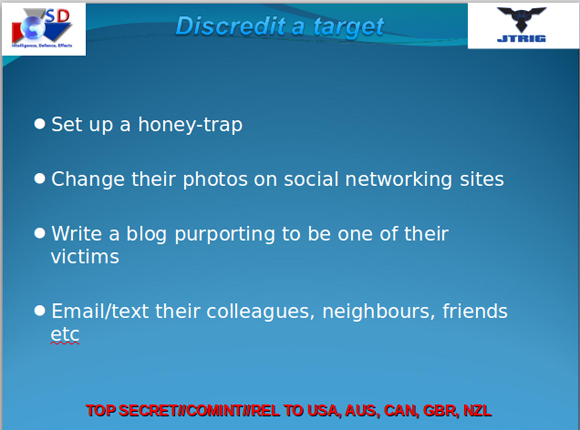
Let’s start with this direct quote from the GCHQ on two tactics of their JTRIG (Joint Threat Research Intelligence Group) program:
(1)  to inject all sorts of false material onto the Internet in order to destroy the reputation of its targets; and
(2)  to use social sciences and other techniques to manipulate online discourse and activism to generate outcomes it considers desirable.
Here’s their slide for training agents how to discredit people:
governments manipulate
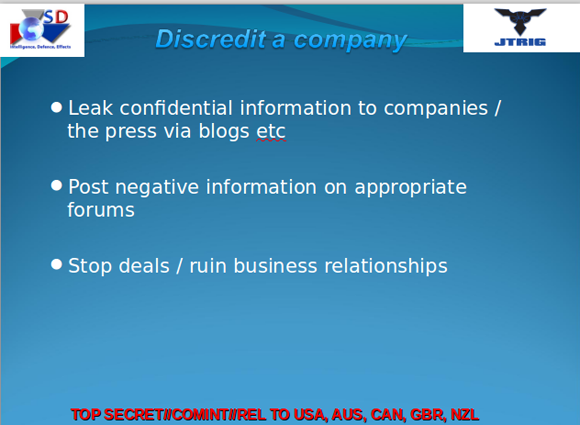
These are their tactics for discrediting companies:
governments manipulate
Here’s just one more, listing the tricks they use to manipulate people:
governments manipulate

So…

So, this is where we are. All the Anglosphere governments are – RIGHT NOW – building systems to manipulate us 24/7.
Please understand that it is far, far easier and cheaper for computers to do this work than to have actual humans at keyboards. And thousands of amoral engineers and psychologists are currently selling us out for mere paychecks, by programming computers to do just that.
If there is one message that I’d like to get across on this subject, it is this:
Your rulers are immoral, rapacious, and unrestrained. They are building a hell for you and your children right now.
I’m sorry if that seems strong, but speaking the truth leaves me no option.
Big Brother did not come with elections and clear choices; it came riding on the usual human weaknesses: fear, greed, and servility.
Paul Rosenberg
FreemansPerspective.com

The GMO Biotech Sector’s Contempt For Democracy: Don’t Be Fooled By The Propaganda


gmofood
The majority of the British public who hold a view on genetically modified (GM) crops are against them (1). Yet the push to get them into the country and onto plates is in full swing. Strategically placed politicians like Secretary of State for Rural and Environmental Affairs Owen Paterson and scientists such as Professor Jim Dunwell and Sir David Baulcombe are conveying the message that GM food is both safe and necessary.
Although such politicians and scientists have links to the GM sector (2), which highlights serious conflicts of interest, certain news outlets report their views uncritically (3). And it doesn’t help matters that part of the pro-GM public relations assault on the British public is also being facilitated under the guise of ‘objectivity’ by the Science Media Centre (SMC). As with politicians and scientists who give the impression of being independent, the SMC veneer of independence serves to mask where its real interests lie.
The PRWatch website provides some interesting details about the SMC. It was conceived in 2002 and enjoys close links with the British government. It is now based at the Wellcome Trust, one of the world’s largest non-profit foundations. The Trust was founded on the fortune of American-born pharmaceutical magnate Sir Henry Wellcome, whose drug company has since evolved to become GlaxoSmithKline. The Wellcome Trust gives the SMC more than the five percent of annual income at which other institutional funding is capped.
PRWatch goes on to state that the SMC received 34 percent of its nearly £600,000 in funding from corporations and trade groups for the fiscal year that ended March 2013. These figures are based on information provided the SMC’s own website. Its current funders include BASF, Bayer, and Syngenta, three of the world’s biggest pesticide and GMO corporations, as well as a number of agrichemical trade groups like CropLife International.
Given these powerful backers, should we be surprised that the SMC spearheaded attacks on French scientist Gilles-Éric Séralini in 2012 after his research team found serious health problems in rats fed Roundup Ready Monsanto GM corn, as well as in rats fed low doses of the herbicide Roundup itself without the GMO corn (4)? His findings struck at the heart of the GM sector.
According to PRWatch, the SMC fed journalists quotes from other scientists attacking the study. Its director Fiona Fox told Times Higher Education that she was proud that SMC’s emphatic thumbs down had largely been acknowledged throughout UK newsrooms. A PR job well done! The publishing journal eventually retracted the study, and a Reuters article on the retraction used two quotes from an SMC ‘expert reaction.’
Later, however, over 150 scientists sent a letter to the journal calling the retraction an “attack on scientific integrity.”
 According to Connie St. Louis, the president of the Association of British Science Writers, since the SMC’s opening in 2002, the SMC
“… has cast biased press briefings such as one on GMOs, funded by Monsanto and invited unwitting and time-starved journalists… The quality of science reporting and the integrity of information available to the public have both suffered, distorting the ability of the public to make decisions about risk. The result is a diet of unbalanced cheerleading and the production of science information as entertainment.” (5)
Sociologist David Miller, co-founder of Public Interest Investigations/Spinwatch and editor of Powerbase, says:
“The problem is that SMC pretends it’s promoting the best science, but in fact it promotes a certain kind of science; those kinds of science that corporations and governments stand by in the area of science policy and want to see developed in terms of markets, like cloning, GMOs and to some extent pharmaceuticals as well. These are areas where there’s a huge amount of potential profit to be made. Once it steps from supporting science to supporting science policy, SMC becomes political, even though it pretends not to be.” (6)
Claire Robinson, co-editor of GMWatch has called the SMC
“Extremely dangerous because it manages to convince the public and the mainstream media that it is an independent voice of science, whereas actually it is a small selection of industry-friendly scientists who are hand-picked.” (6)
Jack Heinemann from the University of Canterbury in New Zealand noted that various SMCs in different countries do not publish conflicts of interest, listing scientists’ public university positions but not their industry ties. For example, an SMC criticism of a peer-reviewed study he published quoted Professor Peter Langridge, a University of Melbourne senior lecturer in food technology and microbiology. It did not note what local newspaper The Press later found out: that his research centre receives significant funding from global GM product developer DuPont, amounting to between A$3 million (NZ$3.66 million) and A$5 million a year. (6)
Heinemann goes on to state that scientists know they have conflicts of interest when they receive large monetary gifts or research contracts from developing technology or have an entrepreneurial stake in technology. He said that if various SMCs can’t find scientists who don’t have conflicts of interest, what is their point, apart from being some kind of propaganda channel?
Through the SMC, the Agricultural Biotechnology Council and strategically placed scientists or officials whose pro-GM comments fly in the face of research findings (like those of Owen Paterson and Anne Glover, Chief Scientific Advisor of the European Commission (7)), the GM sector is attempting to control ‘news’ by attempting to confuse commercial self-interest with scientific fact in the minds of the population and to distort the nature of scientific discourse in the both public and academic realms.
Colonising strategic sectors by setting up seemingly ‘neutral’ institutions or funding existing bodies and co-opting figures to do the bidding of powerful corporations is a well-worn strategy used to achieve cultural hegemony and secure material outcomes. This has been true within the area of agriculture (8,9) and throughout all other areas of society too (10).
While mouthing platitudes about democracy and democratic institutions, this type of corporate colonisation demonstrates a sneering contempt for democracy and by implication for ordinary people.
Don’t be fooled – be informed and take action:
http://indiagminfo.org/?page_id=175
Notes

Eyes Over Compton: How Police Spied on a Whole City

A sergeant in the L.A. County Sheriff's Department compared the experiment to Big Brother, even though he went ahead with it willingly. Is your city next?

Reuters
This is the future if nothing is done to stop it.
In a secret test of mass surveillance technology, the Los Angeles County Sheriff's Department sent a civilian aircraft* over Compton, California, capturing high-resolution video of everything that happened inside that 10-square-mile municipality.
Compton residents weren't told about the spying, which happened in 2012. "We literally watched all of Compton during the times that we were flying, so we could zoom in anywhere within the city of Compton and follow cars and see people," Ross McNutt of Persistence Surveillance Systems told the Center for Investigative Reporting, which unearthed and did the first reporting on this important story. The technology he's trying to sell to police departments all over America can stay aloft for up to six hours. Like Google Earth, it enables police to zoom in on certain areas. And like TiVo, it permits them to rewind, so that they can look back and see what happened anywhere they weren't watching in real time.
If it's adopted, Americans can be policed like Iraqis and Afghanis under occupation–and at bargain prices:
McNutt, who holds a doctorate in rapid product development, helped build wide-area surveillance to hunt down bombing suspects in Iraq and Afghanistan. He decided that clusters of high-powered surveillance cameras attached to the belly of small civilian aircraft could be a game-changer in U.S. law enforcement.
“Our whole system costs less than the price of a single police helicopter and costs less for an hour to operate than a police helicopter,” McNutt said. “But at the same time, it watches 10,000 times the area that a police helicopter could watch.”
A sargeant in the L.A. County Sheriff's office compared the technology to Big Brother, which didn't stop him from deploying it over a string of necklace snatchings.
Sgt. Douglas Iketani acknowledges that his agency hid the experiment to avoid public opposition. "This system was kind of kept confidential from everybody in the public,"he said. "A lot of people do have a problem with the eye in the sky, the Big Brother, so to mitigate those kinds of complaints we basically kept it pretty hush hush." That attitude ought to get a public employee summarily terminated.

State of Surveillance: Police, Privacy and Technology

He also gave this incredible quote:
"Our first initial thought was, oh, Big Brother, we're going to have a camera flying over us. But with the wide area surveillance you would have the ability to solve a lot of the unsolvable crimes with no witnesses, no videotape surveillance, no fingerprints."
Notice that he didn't conclude that the "wide area surveillance" wouldn't be like Big Brother after all, just that Big Brother capabilities would help to solve more crimes.
So why not try them out?
He later explains that while the public may think its against this, we'll get used to it:
I'm sure that once people find out this experiment went on they might be a little upset. But knowing that we can't see into their bedroom windows, we can't see into their pools, we can't see into their showers. You know, I'm sure they'll be okay with it. With the amount of technology out in today's age, with cameras in ATMs, at every 7/11, at every supermarket, pretty much every light poll, all the license plate cameras, the red light cameras, people have just gotten used to being watched. 
The CIR story reports that no police department has yet purchased this technology, not because the law enforcement community is unwilling to conduct mass surveillance of their fellow citizens without first gaining the public's consent, but because the cameras aren't yet good enough to identify the faces of individuals. It's hard to imagine that next technological barrier won't be broken soon.
I'd be against mass surveillance of innocents in any case.
But it's especially galling to see law enforcement professionals betray the spirit of democracy by foisting these tools on what they know to be a reluctant public because they deem it to be prudent based on a perspective that is obviously biased.
Many Americans elect their own sheriffs. This is the future if nothing is done to stop them.
*An earlier version of this article erroneously called the aircraft a drone.

Five US Internet Providers Are Slowing Down Access Until They Get More Cash

If you’re the customer of a major American internet provider, you might have been noticing it’s not very reliable lately. If so, there’s a pretty good chance that a graph like this is the reason:
Route_info_1-1024x202
These graphs comes from Level 3, one of the world’s largest providers of “transit,” or long-distance internet connectivity. The graph on the left shows the level of congestion between Level 3 and a large American ISP in the Dallas area. In the middle of the night, the connection is less than half-full and everything works fine. But during peak hours, the connection is saturated. That produces the graph on the right, which shows the packet loss rate. When the loss rate is high, thousands of Dallas-area consumers are having difficulty using bandwidth-heavy applications like Netflix, Skype, or YouTube (though to be clear, Level 3 doesn’t say what specific kind of traffic was being carried over this link).
This isn’t how these graphs are supposed to look. Level 3 swaps traffic with 51 other large networks, known as peers. For 45 of those networks, the utilization graph looks more like this:
Route_info_2-1024x158
The graph on the left shows that there is enough capacity to handle demand even during peak hours.  As a result, you get the graph at the right, which shows no problems with dropped packets.
So what’s going on? Level 3 says the six bandwidth providers with congested links are all “large Broadband consumer networks with a dominant or exclusive market share in their local market.” One of them is in Europe, and the other five are in the United States.
Level 3 says its links to these customers suffer from “congestion that is permanent, has been in place for well over a year and where our peer refuses to augment capacity. They are deliberately harming the service they deliver to their paying customers. They are not allowing us to fulfill the requests their customers make for content.”
The basic problem is those six broadband providers want Level 3 to pay them to deliver traffic. Level 3 believes that’s unreasonable. After all, the ISPs’ own customers have already paid these ISPs to deliver the traffic to them. And the long-standing norm on the internet is that endpoint ISPs pay intermediaries, not the other way around. Level 3 notes that “in countries or markets where consumers have multiple broadband choices (like the UK) there are no congested peers.” In short, broadband providers that face serious competition don’t engage in this kind of brinksmanship.
Unfortunately, most parts of the US suffer from a severe lack of broadband competition. And the leading ISPs in some of these markets appear to view network congestion not as a technical problem to be solved so much as an opportunity to gain leverage in negotiations with other networks.
Card 13 of 17 Launch cards

Netflix has been forced to cut private deals with ISPs. Is that undermining net neutrality?

In February, Netflix agreed to pay Comcast to ensure that its videos would play smoothly for Comcast customers. The company signed a similar deal with Verizon in April. Netflix signed these deals because its customers had been experiencing declining speeds for several months beforehand. Netflix realized it would be at a competitive disadvantage if it didn’t pay for speedier service. After its payment to Comcast, Netflix’s customers experienced a 67 percent improvement in their average connection speed.
Netflix has accused Comcast of deliberately provoking the crisis by refusing to upgrade its network to accommodate Netflix traffic, leaving Netflix with little choice but to pay a “toll.” That might sound like a classic network neutrality violation. But surprisingly, leading network neutrality proposals wouldn’t affect this kind of agreement at all.
That’s because Comcast wasn’t technically offering Netflix a “fast lane” on an existing connection. Instead, Netflix paid Comcast to accept a whole new connection. The terms of these agreements, known as “peering,” have always been negotiated in an unregulated market, and network neutrality regulations don’t apply to them.
In theory, Netflix’s deal with Comcast doesn’t violate network neutrality because everyone on this new pipe (e.g. only Netflix) is treated the same, just as everyone on the old, overloaded pipe gets equal treatment. But it’s hard to see any practical difference between the kind of “fast lane” agreement network neutrality supporters have campaigned against and Netflix paying Comcast for a faster connection.
So why hasn’t interconnection been a bigger part of the network neutrality debate? Until recently, it was unheard of for a residential broadband provider like Comcast to demand payment to deliver traffic to its own customers. Traditionally, residential broadband companies would accept traffic from the largest global “backbone” networks such as Level 3 for free. So anyone could reach Comcast customers by routing their traffic through a third network. That limited Comcast’s leverage.
But recently, the negotiating position of backbone providers has weakened while the position of the largest residential ISPs — especially Comcast, Verizon, and AT&T — has gotten stronger. As a consequence, the network neutrality debate will be increasingly linked to the debate over interconnection. Refusing to upgrade a slow link to a company is functionally equivalent to configuring an Internet router to put the company’s packets in a virtual slow lane. Regulations that try to protect net neutrality without regulating the terms of interconnection are going to be increasingly ineffective.

Spain to become major logistics platform for southern Europe and northern Africa

Spain to become major logistics platform for southern Europe and northern AfricaThe Spanish Secretary of State for Infrastructure, Transport and Housing, Rafael Catalá, said that, “Spain aims to become the major logistics platform for southern Europe and northern Africa, serving the global east-west trade routes, as well as the emerging north-south.”
To achieve this goal, which is part of the Logistics Strategy, Spain can offer “its geostrategic position and its credentials in infrastructure and transportation systems,” stressed Catalá.
The official also said that Spain has the largest motorway network in Europe and the world’s fifth best rail infrastructure, as well as the second most extended high-speed network in the world and a port system characterised by its excellent management and results.
According to the Ministry of Development, the logistics strategy that aims to turn Spain into “an international logistics platform of the highest order, connecting Europe, America, Africa and Asia,” will require an investment of around 8,000 million Euro.
The project could be completed by 2024, providing the Iberian country with “the most favourable conditions, both infrastructural (integrated and intelligent) and regulatory, to allow the market to function in the most efficient way possible,” assured Catala.
It should be noted that the Logistics Strategy was implemented in 2013, mainly with the purpose of promoting the logistics industry as one the engines for Spain’s economy.
The Secretary also said that to “improve the efficiency and sustainability of the transport system through intermodality, it will be necessary to develop an intermodal network and promote Spain’s role as a gateway, hub and treatment centre for intercontinental goods shipped to Europe.”
Moreover, Catalá said that the Mediterranean Corridor is one of the core projects in the Logistics Strategy, as its area of influence affects 47.8% of the Spanish population and 44.8% of the country’s GDP, which generates almost half of the total freight traffic.
 The official noted that “so far, contracts worth 570 million Euro have already been tendered and others worth 388 million have been awarded.”
Read More @ Source

The Number Of Working Age Americans Without A Job Has Risen By 27 MILLION Since 2000

we's head~in the right way , huh ?

Arrow Going UpDid you know that there are nearly 102 million working age Americans that do not have a job right now?  And 20 percent of all families in the United States do not have a single member that is employed.  So how in the world can the government claim that the unemployment rate has "dropped" to "6.3 percent"?  Well, it all comes down to how you define who is "unemployed".  For example, last month the government moved another 988,000 Americans into the "not in the labor force" category.  According to the government, at this moment there are 9.75 million Americans that are "unemployed" and there are 92.02 million Americans that are "not in the labor force" for a grand total of 101.77 million working age Americans that do not have a job.  Back in April 2000, only 5.48 million Americans were unemployed and only 69.27 million Americans were "not in the labor force" for a grand total of 74.75 million Americans without a job.  That means that the number of working age Americans without a job has risen by 27 million since the year 2000.  Any way that you want to slice that, it is bad news.
Well, what about as a percentage of the population?
Has the percentage of working age Americans that have a job been increasing or decreasing?
As you can see from the chart posted below, the percentage of working age Americans with a job has been in a long-term downward trend.  As the year 2000 began, we were sitting at 64.6 percent.  By the time the great financial crisis of 2008 struck, we were hovering around 63 percent.  During the last recession, we fell dramatically to under 59 percent and we have stayed there ever since...
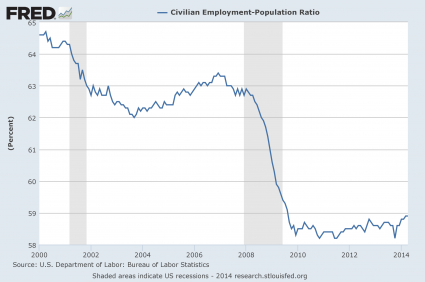
Employment Population Ratio April 2014
And the numbers behind this chart also show that employment in America did not increase last month.
In March, 58.9 percent of all working age Americans had a job.
In April, 58.9 percent of all working age Americans had a job.
Things are not getting worse (at least for the moment), but things are also definitely not getting better.
The month that Barack Obama entered the White House, we were in the midst of the worst economic downturn since the Great Depression and only 60.6 percent of all working age Americans had a job.
Since only 58.9 percent of all working age Americans have a job now, that means that the employment situation in America is still significantly worse than it was the day Barack Obama took office.
So don't let anyone fool you with talk of an "employment recovery".  It simply is not happening.  The official unemployment rate bears so little relation to economic reality at this point that it has essentially become meaningless.
Look, how in the world can we have an "unemployment rate" of just "6.3 percent" when 20 percent of all American families do n0t have a single member that is working?
Here is how that 20 percent figure was arrived at...
A family, as defined by the BLS, is a group of two or more people who live together and who are related by birth, adoption or marriage. In 2013, there were 80,445,000 families in the United States and in 16,127,000—or 20 percent–no one had a job.
So if one out of every five families is completely unemployed, then why is the official government unemployment rate not up at Great Depression era levels?
Could it be that the government is manipulating the numbers to make them look much better than they actually are?
Why don't they just go ahead and get it over with?  They can just define every American that is not working as "not in the labor force" and then we can have "0.0 percent unemployment".  Then we can all have a giant party and celebrate how wonderful the U.S. economy is.
And don't be fooled by the "288,000 jobs" that were added to the U.S. economy last month.  For workers under the age of 55, the number of jobs actually dropped by a whopping 259,000.
If we were using honest numbers, the official unemployment rate would look a lot scarier.  John Williams of shadowstats.com has calculated that the unemployment rate should be about 23 percent.  I don't think that is too far off.
Meanwhile, the quality of the jobs in our economy continues to go down.  The House Ways and Means Committee says that seven out of every eight jobs that have been "added" to the economy under Barack Obama have been part-time jobs.  But you can't raise a family or plan a career around a part-time job.  To be honest, it is very hard for a single person to even survive on a part-time wage in this economic environment.
As the quality of our jobs goes down, so do our incomes.  The median household income has declined for five years in a row, and the middle class is falling apart.
Without middle class incomes, you can't have a middle class.  Considering what we have been watching happen, it should be no surprise that the homeownership rate in the United States has dropped to the lowest level in 19 years or that the number of Americans receiving money from the government each month exceeds the number of full-time workers in the private sector by more than 60 million.
For many more statistics like this, please see my previous article entitled "17 Facts To Show To Anyone That Believes That The U.S. Economy Is Just Fine".
At a gut level, most Americans understand that things are much worse than they used to be.
The Pew Research Center recently asked people what "class" they consider themselves to be.  The results were shocking.
Back in 2008, only 25 percent of all Americans considered themselves to be "lower middle class" or "poor".
Earlier this year, an astounding 40 percent of all Americans chose one of those designations.
We are in the midst of a long-term economic decline, and no amount of propaganda is going to change that.
But based on the "happy numbers" being trumpeted by the mainstream media, the Federal Reserve is slowly bringing their quantitative easing program to an end.
When quantitative easing is finally totally cut off, we shall see how the financial markets and the U.S. economy perform without artificial life support.
Personally, I don't think that it is going to be pretty.