Wednesday, March 13, 2013

Gun Ownership vs. Homicides

Untitled attachment 00025

Denial Is Not Just A River In Egypt: 10 Hilarious Examples Of How Clueless Our Leaders Are About The Economy

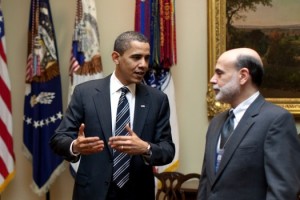
Barack Obama And Ben BernankeThey didn't see it coming last time either.  Back in 2007, President Bush, Federal Reserve Chairman Ben Bernanke and just about every prominent voice in the financial world were all predicting that we would experience tremendous economic prosperity well into the future.  In fact, as late as January 2008 Bernanke boldly declared that "the Federal Reserve is not currently forecasting a recession."  At the time, only the "doom and gloomers" were warning that everything was about to fall apart.  And of course we all know what happened.  But just a few short years later, history seems to be repeating itself.  Barack Obama, Federal Reserve Chairman Ben Bernanke and almost every prominent voice in the financial world are all promising that the U.S. "economic recovery" is going to continue even though Europe is coming apart like a 20 dollar suit.  But the economic fundamentals tell a different story.  Our national debt is more than $6,000,000,000,000 larger than it was back in 2008, the number of Americans on food stamps just hit another brand new all-time record, and the bankers up on Wall Street are selling gigantic mountains of the exact same kind of toxic derivatives that caused so much trouble the last time around.  But all of our "leaders" swear that everything is going to be okay.  You can believe them if you want, but denial is not just a river in Egypt, and another crash is inevitably coming.
Sadly, many Americans are not even going to see the crash coming because they still have faith in the "experts".  They haven't figured out that the "experts" really do not know what they are doing.
The blind are leading the blind, and in the end the results are going to be absolutely tragic.
The following are 10 hilarious examples of how clueless our leaders are about the economy...
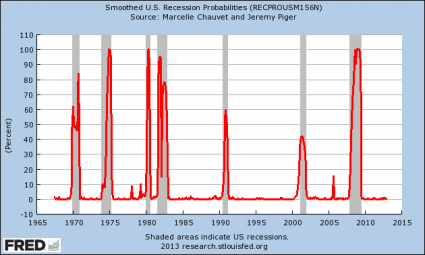
#1 When I first came across the following chart the other day, it made me chuckle.  It is a chart that supposedly tells us the "probability" of a recession, and it was taken from the website of the Federal Reserve Bank of St. Louis.  According to the chart, right now there is a 0.16% chance of a recession...
Smoothed U.S. Recession Probabilities
#2 Federal Reserve Chairman Ben Bernanke has also been proclaiming his belief that the U.S. economy will continue to grow.  The following is an excerpt from his recent remarks to Congress...
The pause in real GDP growth last quarter does not appear to reflect a stalling-out of the recovery. Rather, economic activity was temporarily restrained by weather-related disruptions and by transitory declines in a few volatile categories of spending, even as demand by U.S. households and businesses continued to expand. Available information suggests that economic growth has picked up again this year.
And Bernanke also insists that the labor market is "improving"...
Consistent with the moderate pace of economic growth, conditions in the labor market have been improving gradually.
Of course the labor market is not actually improving.  I showed this using the Fed's own numbers the other day.
And you can put stock in Bernanke's forecasting ability if you like, but considering his track record of failure in the past, that might not be too wise.  Just check out what he was saying before the last financial crisis: "30 Ben Bernanke Quotes That Are So Stupid That You Won’t Know Whether To Laugh Or Cry".
#3 Although Bernanke has such a nightmarish track record of failure, Warren Buffett still has faith in him.  In fact, Buffett loves all of the money printing that Bernanke has been doing...
The U.S. economy might be “dead in the water” without the stimulus provided by the Federal Reserve under Chairman Ben Bernanke, according to Warren Buffett, CEO of Berkshire Hathaway.
“I think very cheap money makes things happen, it makes asset values higher. When asset values are higher, people do have a greater propensity to spend,” Buffett told CNBC.
“I think Bernanke has sort of carried the load himself during this period.”
If Buffett thinks the wild money printing that the Fed has been doing is so wonderful, then he probably would have absolutely loved living in the Weimar Republic.
#4 Barack Obama continues to insist that we do not have a debt crisis, but that we will not be able to balance the budget any time in the foreseeable future either.
Even though the national debt has grown by more than 6 trillion dollars under his leadership and our debt to GDP ratio is now well over 100%, Obama does not believe that it is a significant problem...
"We don’t have an immediate crisis in terms of debt"
And Obama certainly does not plan to even come close to balancing the budget during his second term.  In fact, he openly admits that we won't see a balanced budget at any point within the next decade...
"We're not gonna balance the budget in 10 years"
Sadly, the truth is that the U.S. will never have a balanced budget ever again under our current system, but most of our politicians are not willing to go that far and admit that sad fact to the American people just yet.
#5 But of course it would certainly help if the U.S. government would stop wasting so much money.  For example, did you know that the federal government is helping dead people get free cell phones?  The following is from a recent article in the New York Post...
Dead people don’t need cell phones.
That’s the message Rep. Tim Griffin of Arkansas wants to send Congress, after he says a controversial government-backed program that helps provide phones to low-income Americans ended up sending mobiles to the dead relatives of his constituents. Griffin has introduced a bill that targets the phone hand-out program, which has ballooned into a fiscal headache for the government.
And of course a lot of living people are abusing the free cell phone program as well.  Rep. Griffin says that he has heard of some people getting as many as 10 free cell phones from the government...
"I’ve also gotten calls from people who say their employees were bragging about having 10 phones."
#6 Meanwhile, the most prominent economic journalist in the United States, Paul Krugman of the New York Times, continues to insist that it is a good thing for the government to be running up so much debt...
First of all... that trillion-dollar deficit is overwhelmingly the result of a depressed economy. And when the economy's depressed it's good to run a deficit. You don't want the government to try and balance its budget right now.
Krugman is also operating under the delusion that the federal government "can't run out of cash", that it can just print money whenever it wants and that printing giant piles of money would not hurt anything.
The United States is a country that has its own currency--can’t run out of cash because we print the money. If you even try to think what would happen--suppose that investors get down on the United States. Even so, that would weaken the dollar, not send interest rates soaring, and that would be good. That would help our exports
It is frightening that the top economic journalist in America has such little understanding of how our system actually works.  I would encourage Krugman to read a couple of my previous articles so that he won't be so ignorant in the future...
-"Where Does Money Come From? The Giant Federal Reserve Scam That Most Americans Do Not Understand"
-"10 Things That Every American Should Know About The Federal Reserve"
#7 Many Americans have wondered why the federal government never seems to go after the big Wall Street banks.  Well, now we know why.  The other day, the Attorney General of the United States admitted that the federal government is very hesitant to prosecute anyone from the big banks because of what it might do to the global economy...
"I am concerned that the size of some of these institutions becomes so large that it does become difficult for us to prosecute them when we are hit with indications that if you do prosecute, if you do bring a criminal charge, it will have a negative impact on the national economy, perhaps even the world economy"
So I guess we now live in a world where there is a different set of rules for the big banks, eh?
Most of us already knew that this was the case, but it is quite chilling to hear the Attorney General of the United States publicly admit this.
#8 Many of the big Wall Street banks are absolutely giddy that the Dow keeps setting new all-time highs, and many of them are projecting wonderful things ahead for the U.S. economy.  For example, here is one forecast from Morgan Stanley's Vincent Reinhart ...
"In the Morgan Stanley forecast for the US, the trajectory of economic activity marks an inflection point midway through 2013. The severe financial crisis of 2008-09 necessitated significant downward adjustments by the private sector to the levels of aggregate demand and efficient supply. As the event recedes further into history, however, the drag on growth from these ongoing level adjustments plays out.
In our forecast, the expansion of real GDP steps up to around 2-3/4 percent in the second half of this year and beyond."
#9 Vice-President Joe Biden is pushing economic optimism to ridiculous levels.  Apparently he believes that most Americans are "no longer worried" that a major economic crisis is coming...
But all kidding aside, I think the American people have moved -- Democrats, Republicans, independents.  They know that the possibilities for this country are immense.  They're no longer traumatized by what was a traumatizing event, the great collapse in 2008.  They're no longer worried, I think, about our economy being overwhelmed either by Europe writ large, the EU, or China somehow swallowing up every bit of innovation that exists in the world.  They're no longer, I think, worried about our economy being overwhelmed beyond our shores.
And I don't think they're any more -- there’s no -- there’s very little doubt in any circles out there about America’s ability to be in position to lead the world in the 21st century, not only in terms of our foreign policy, our incredible defense establishment, but economically.
#10 Right now, many in the financial world are projecting that this will be a year to remember for the stock market.  During a recent interview with Fox Business, Wharton School of Business Finance Professor Jeremy Siegel declared that the Dow will cross the 16,000 mark by the end of this year...
"I think by the end of this year, we’ll be in the 16,000 to 17,000 range."
Of course it is true that other analysts have a much different view of things.  Many of them are absolutely amazed that the U.S. economy has become so disconnected from economic reality.  For example, just check out what Steve Russell and Hamish Baillie, fund managers at the Ruffer Investment Company, recently had to say...
"If this was explained to a recently arrived Martian he would no doubt be puzzled – US unemployment has almost doubled since 2007, GDP [gross domestic product] growth is a third lower and debt as a percentage of GDP is within a whisker of doubling. The market is forward looking but this is extreme"
So who is right and who is wrong?
Time will tell.
Fortunately, it appears that the American people are getting fed up with the constant stream of lies that they have been told.
According to a new Pew Research survey, just 26 percent of all Americans trust the government to do the right thing.
So what about you?
Do you trust what the government and the "experts" are telling you?
Do you trust them to do the right thing?
Feel free to post a comment with your thoughts below...
LOLCat - Photo by Koruko
Be Sociable, Share!

Private Prisons: The More Americans They Put Behind Bars The More Money They Make

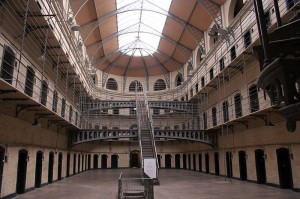
Private Prisons: The More Americans They Put Behind Bars The More Money They Make - Photo by Tony HisgettHow would you describe an industry that wants to put more Americans in prison and keep them there longer so that it can make more money?  In America today, approximately 130,000 people are locked up in private prisons that are being run by for-profit companies, and that number is growing very rapidly.  Overall, the U.S. has approximately 25 percent of the entire global prison population even though it only has 5 percent of the total global population.  The United States has the highest incarceration rate on the entire globe by far, and no nation in the history of the world has ever locked up more of its own citizens than we have.  Are we really such a cesspool of filth and decay that we need to lock up so many of our own people?  Or are there some other factors at work?  Could part of the problem be that we have allowed companies to lock up men and women in cages for profit?  The two largest private prison companies combined to bring in close to $3,000,000,000 in revenue in 2010, and the largest private prison companies have spent tens of millions of dollars on lobbying and campaign contributions over the past decade.  Putting Americans behind bars has become very big business, and those companies have been given a perverse incentive to push for even more Americans to be locked up.  It is a system that is absolutely teeming with corruption, and it is going to get a lot worse unless someone does something about it.
One of the keys to success in the private prison business it to get politicians to vote your way.  That is why the big private prison companies spend so much money on lobbying and campaign contributions.  The following is an excerpt from a report put out by the Justice Policy Institute entitled "Gaming the System: How the Political Strategies of Private Prison Companies Promote Ineffective Incarceration Policies"...
For-profit private prison companies primarily use three strategies to influence policy: lobbying, direct campaign contributions, and building relationships, networks, and associations.
Over the years, these political strategies have allowed private prison companies to promote policies that lead to higher rates of incarceration and thus greater profit margins for their company. In particular, private prison companies have had either influence over or helped to draft model legislation such as "three-strikes" and "truth-in-sentencing" laws, both of which have driven up incarceration rates and ultimately created more opportunities for private prison companies to bid on contracts to increase revenues.
If you can believe it, three of the largest private prison companies have spent approximately $45,000,000 combined on lobbying and campaign contributions over the past decade.
Would they be spending so much money if those companies did not believe that it was getting results?
Just look at what has happened to the U.S. prison population over the past several decades.  Prior to 1980, there were virtually no private prisons in the United States.  But since that time, we have seen the overall prison population and the private prison population absolutely explode.
For example, between 1990 and 2009 the number of Americans in private prisons grew by about 1600 percent.
Overall, the U.S. prison population more than quadrupled between 1980 and 2007.
So something has definitely changed.
Not that it is wrong to put people in prison when they commit crimes.  Of course not.  And right now violent crime is rapidly rising in many of our largest cities.  When people commit violent crimes they need to be removed from the streets.
But when you put those criminals into the hands of private companies that are just in it to make a buck, the potential for abuse is enormous.
For example, when auditors visited one private prison in Texas, they "got so much fecal matter on their shoes they had to wipe their feet on the grass outside."
The prisoners were literally living in their own manure.
How would you feel if a member of your own family was locked up in such a facility?
And the truth is that there seem to be endless stories of abuse in private prisons.  One private prison company reportedly charges inmates $5.00 a minute to make phone calls but only pays them $1.00 a day to work...
Last year the Corrections Corporation of America (CCA), the nation’s largest private prison company, received $74 million of taxpayers’ money to run immigration detention centers. Their largest facility in Lumpkin, Georgia, receives $200 a night for each of the 2,000 detainees it holds, and rakes in yearly profits between $35 million and $50 million.
Prisoners held in this remote facility depend on the prison’s phones to communicate with their lawyers and loved ones. Exploiting inmates’ need, CCA charges detainees here $5 per minute to make phone calls. Yet the prison only pays inmates who work at the facility $1 a day. At that rate, it would take five days to pay for just one minute.
Speaking of work, private prisons have found that exploiting their inmates as a source of slave labor can be extraordinarily profitable.  Today, private prisons are stealing jobs from ordinary American workers in a whole host of industries.  The following is from an article by Vicky Pelaez...
According to the Left Business Observer, the federal prison industry produces 100% of all military helmets, ammunition belts, bullet-proof vests, ID tags, shirts, pants, tents, bags, and canteens. Along with war supplies, prison workers supply 98% of the entire market for equipment assembly services; 93% of paints and paintbrushes; 92% of stove assembly; 46% of body armor; 36% of home appliances; 30% of headphones/microphones/speakers; and 21% of office furniture. Airplane parts, medical supplies, and much more: prisoners are even raising seeing-eye dogs for blind people.
And many of the largest corporations in America have rushed in to take advantage of this pool of very cheap slave labor.  Just check out some of the big names that have been exploiting prison labor...
At least 37 states have legalized the contracting of prison labor by private corporations that mount their operations inside state prisons. The list of such companies contains the cream of U.S. corporate society: IBM, Boeing, Motorola, Microsoft, AT&T, Wireless, Texas Instrument, Dell, Compaq, Honeywell, Hewlett-Packard, Nortel, Lucent Technologies, 3Com, Intel, Northern Telecom, TWA, Nordstrom’s, Revlon, Macy’s, Pierre Cardin, Target Stores, and many more. All of these businesses are excited about the economic boom generation by prison labor. Just between 1980 and 1994, profits went up from $392 million to $1.31 billion. Inmates in state penitentiaries generally receive the minimum wage for their work, but not all; in Colorado, they get about $2 per hour, well under the minimum. And in privately-run prisons, they receive as little as 17 cents per hour for a maximum of six hours a day, the equivalent of $20 per month. The highest-paying private prison is CCA in Tennessee, where prisoners receive 50 cents per hour for what they call “highly skilled positions.” At those rates, it is no surprise that inmates find the pay in federal prisons to be very generous. There, they can earn $1.25 an hour and work eight hours a day, and sometimes overtime. They can send home $200-$300 per month.
But of course some of the biggest profits for private prisons come from detaining young people.  Today, private prison companies operate more than 50 percent of all "youth correctional facilities" in the United States.
And sometimes judges have even been bribed by these companies to sentence kids to very harsh sentences and to send them to their facilities.  The following is from a report about two judges in Pennsylvania that were recently convicted for taking money to send kids to private prisons...
Michael Conahan, a former jurist in Luzerne County, was sentenced on Friday to 210 months in custody by Senior U.S. District Court Judge Edwin M. Kosik II. Conahan was also ordered to pay $874,000 in restitution. [...] As Main Justice reported in August, Ciavarella, former president judge of the Court of Common Pleas and former judge of the Juvenile Court for Luzerne County, was sentenced to 28 years in prison and ordered to make restitution of $965,930. [...]
Conahan’s role in the “cash for kids” scheme was to order the closing of a county-run detention center, clearing the way for Ciavarella, once known as a strict “law and order” judge, to send young offenders to private facilities. This arrangement worked out well for Ciavarella and Conahan, as well as the builder of the facilities and a developer, who pleaded guilty to lesser charges.
The arrangement didn’t work out so well for the young offenders, some of them sent away for offenses that were little more than pranks and would have merited probation, or perhaps just scoldings, if the judges had tried to live up to their oaths.
Are you starting to see why private prisons are such a problem?
Hundreds of kids had their lives permanently altered by those corrupt judges.
When you allow people to make money by locking other people up in cages, you are just asking for trouble.
The more Americans they put behind bars, the more money these private prisons make.  It is a system that needs to be brought to an end.
So what do you think?
Do you believe that private prisons are a good idea or a bad idea?
Please feel free to post a comment with your thoughts below...
They Will Lock You Up Too If They Get The Chance - Photo by Barnellbe
Be Sociable, Share!

One-Child Policy: Law Still in Effect, But Police, Judges Fired

ChineseChildren (Copy)
Wall Street Journal
March 13, 2013
China’s government told reporters Monday that it will maintain its family planning regime and hold steadfast to the one-child policy because the country faces mounting resource pressures from the high demands of its 1.34 billion citizens. 
Yet the  announcement came just a day after leaders said they plan to strip power from the agency that oversees its one-child policy, a move some observers say signals a phase-out of the much-criticized population control.
What does it all mean? China Real Time talked to Wang Feng, a population expert and director of the Brookings-Tsinghua Center for Public Policy in Beijing, to break down the issues.
What’s driving the mixed messages from the government?
Saying that there is no change is a measure to save face and a recognition that they can’t announce all the change in one day. The National Population and Family Planning Commission was created for a single mandate of controlling population growth and now they no longer have that, those powers have been dissolved.
What the government is doing is a major political move and they cannot make or announce all the policy changes that go along with it in one day. They know they can’t dismantle everything all at once. It’s going to take some time.
It will not take long, however, for change to come. Leaders are aware of the changing demographics. The one-child policy has taken a toll on the labor force and has jeopardized the future economy.
READ ENTIRE ARTICLE HERE

The Mantra: Practical Tips for Resisting the Police State

Eric Peters
March 12th, 2013
Eric Peters Autos

Sun Tzu counseled that it is madness – because pointless – to directly confront a superior foe. A costumed goon with a badge and a gun, for instance. You will lose (cue Dolph Lundgren voice from Rocky IV).
But that doesn’t mean you must cooperate with said goon.
cops-lead-300x199
In that spirit, here are some practical tips and things to keep in mind the next time you’re compelled to interact with one of America’s Swinest:
  • Never forget: Cops are not your friend; they are not there to “help” you. They are there to bust you. Don’t make it easier for them. Make it harder for them.
  • Never forget that cops are legally permitted to lie to you. Take nothing they tell you at face value. Assume their intentions are malignant.
  • Never forget that a cop is a law enforcer. He is there to enforce the law – any law, every law. It doesn’t matter whether the law is reasonable – or whether you’re a nice guy who doesn’t “deserve” to be hassled. Cops are paid to enforce the law. Period.
  • If stopped, keep your window rolled up almost all the way; leave just enough of a gap to allow you to hand the cop your license/documents. If he “asks” you to roll it down, politely decline. Whenever a cop “asks,” it means you do not have to comply. If they order you to do something, then you must do it. But force them to make it clear you are being ordered to comply – “Is that an order?” – and are only complying under duress and not of your own free will.
  • Be civil – not slavish. A cop is not “sir.” By so addressing him, you feed his inner bully and Rule Number One for dealing effectively with bullies is to not let them think you are a pussy. Simple – and curt – “yes” and “no” answers will get the point across without being directly confrontational.
  • Never make the mistake of responding directly to a cop’s purposefully leading questions – which means, all of his questions. If the cop says, “Do you know why I stopped you?” You tell him, “I suppose you will tell me your reason.” If he says, “Do you know how fast you were going?” You say, “I’m sure you have an opinion.” If he asks whether you’ve been drinking, you remain silent.
  • Never concede anything that could be construed – will be construed in court – as evidence in support of whatever charges are leveled at you.
  • Never admit to anything – ever.
  • Never attempt to excuse anything you may have done. Be silent. Shrug. But do not make excuses. Do not offer an explanation. If you do, you’ve just handed the cop exactly what he wants most – a tacit admission of guilt, which in court will become the basis for establishing your legal guilt.
  • You have to give them your ID and insurance info – if you are operating a motor vehicle on “public” roads.  It is “the law.” But you do not – yet – have to tell them where you’re going, where you’ve been – or anything else. If asked, shrug.  State – politely, calmly – that you won’t be answering any questions.
  • Ask – repeatedly – whether you are free to go. It’s an excellent stock answer to cop questions.
  • If you have a concealed carry permit, the cop probably already knows – having run your license plate info through the computer in his car. Still, it is good policy to tell him, even if you are not legally obligated to do so (it varies, state to state). This is a psychological tactic which shows you (in the cop’s eyes) to be “cooperative” without your actually having complied with anything that’s against your interests. It may help defuse the situation – important when guns are involved.
  • Never consent to a search. If a cop asks for permission, he is asking permission. It means he hasn’t got legal probable cause – yet. Do not give it to him. Politely tell him, “I do not consent to any searches.” Repeat as necessary.  If he searches you/your vehicle anyway, you may have a legal basis for challenging the admissibility of anything found. But if you gave your consent to the search – and not objecting is the same as consenting – then anything found as a result of that search can and will be used against you in court.
  • Record the interaction. Higher courts have consistently ruled it is legal to do so, irrespective of what the cop tells you (see point made above about cops lying). There is no expectation of privacy in public. He can record you – you can record him. Use audio and video. If the cop “asks” you to turn off the equipment, politely decline. Merely state you are recording the interaction in the interests of everyone’s safety.
Just like they do to us.

Eric Peters is an automotive columnist and author who has written for the Detroit News and Free PressInvestors Business DailyThe American SpectatorNational Review, The Chicago Tribune and Wall Street Journal. His books include Road Hogs (2011) and  Automotive Atrocities (2004). His next book, “The Politics of Driving,” is scheduled for release soon. Visit his web site at Eric Peters Autos.

Nervous Russian elite wary as Putin transforms his political edifice

Source: UKG
President Vladimir Putin‘s steady and seemingly solid political structure, under pressure from within and without, is undergoing a renovation that could remake the whole edifice, if it doesn’t crack open first. Few seem to understand how this will turn out, or what their places will be in it when it’s done.
Ever since street protests broke out in December 2011, rattling the ruling United Russia party just as Putin was preparing to retake the presidency, there have been widespread expectations that the system here would have to change. Now it’s happening, most obviously with almost daily public exposures of corruption, which for years was ignored.
The highly publicised investigations may be mostly for show, but they have left the political top rung nervously trying to discern the message. Coupled with this is a sharp turn inward, away from the west, that promises to force some hard choices among an up-to-now comfortable cohort. That suggests risks for Putin, as well – depending on how the people around him eventually make those choices.
Broadly speaking, the Kremlin appears to be dropping the most egregious offenders over the side, like so much excess ballast. An Olympic official whose own construction company was over budget by 900% on building a ski jump, and way behind schedule, was exposed by Putin himself on national television. A member of the state Duma, Vladimir Pekhtin, was let go when he couldn’t come up with a satisfactory explanation for the undeclared Miami properties in his name.
Pekhtin, according to Dozhd TV, resigned his seat only after a meeting inside the Kremlin that lasted until 2am. His departure – soon followed by those of three others, including a member of the upper house – appeared to send an especially strong signal: that the nationalist fervour Putin is stirring up comes with teeth, and it’s time for those who want to keep in his favour to remember the motherland, and bring that one foot that’s been out the door back inside.
With the most recent Levada Centre poll showing 54% of the public disapproving of the government’s performance, Putin is demanding loyalty from those around him.
One way to ensure this loyalty is to cut off their access to financial security in the west, Tatyana Stanovaya, head of the analysis department at the Centre for Political Technologies here, wrote in an essay for the group’s website.
But this changes the deal that for a decade has guided the upper echelon, said Gleb Pavlovsky, a prominent political consultant who was ousted from the Kremlin nearly two years ago. Obeisance to Putin meant his loyalists could have their pickings. In fact, he said, “our ruling class is loyal to the extent that it is stealing”.
There was protection for those who went along, but now that protection has been drawn back for some, and the rest, feeling the heat from above, don’t know where the red lines are anymore.
In November, a criminal investigation that involved the defence minister – unpopular with the generals but a longtime close associate of Putin’s – suddenly burst into the open. Putin let the probe evolve – and the minister, Anatoly Serdyukov, lost his job – and then it bogged down. Serdyukov had powerful opponents inside the Kremlin, among the siloviki, or those with a background in the security services. Putin may be keeping Serdyukov free from indictment, Pavlovsky said, so as to be sure that the siloviki don’t entirely surround him.
Serdyukov, implicated along with his mistress, has been called in for repeated questioning, but dangles without charges. This doesn’t entirely reassure those at a similar level.
Naturally, the self-preserving instinct kicks in. “Every day,” Pavlovsky said of Putin, “he gets these terrible revelations. If he believed them all, he’d have to fire everyone or imprison them. They’re all accusing each other not only of theft but of espionage, of being American spies. He suspects them all, but he doesn’t understand the degree of rot.”
This sums up one of the main challenges facing Putin. His grip is not absolute. Factions within the Kremlin vie for supremacy, while Russia’s vast bureaucracy looks out, primarily, for itself. He has his own minefields to deal with.
Another unpopular former minister, Yelena Skrynnik, who was the agriculture chief until last year, has also been named in a corruption investigation. But in her case, too, prosecutors have been moving slowly, said Lilia Shevtsova, of the Carnegie Moscow Centre, as if waiting for a signal from on high that hasn’t yet come.
Yet while these graft cases remain open and unresolved, two members of a presidential human rights council, appointed by then president Dmitry Medvedev, have also come under official harassment, by police in one instance. Their apparent offence was to prepare a report last year, at Medvedev’s request, which found that no crimes had been committed in the notorious Yukos case. This was the 2003 crackdown that sent the oil baron Mikhail Khodorkovsky to prison and cemented Putin’s grip on power.
The message now, said Kirill Rogov, who studies politics at the Gaidar Institute, is that there will be no turning back, no re-examination, no question of Putin’s control stemming from the case that was crucial to the creation of his “vertical of power” political system.
Plenty of people who prospered under the previous set-up won’t be eager to follow Putin into new territory, with its fundamentalism and xenophobia. Shevtsova, who has been sharply critical of Putin for years, said that the country’s leading business tycoons will tire of his leadership and eventually find a way to replace him.
But Putin may be betting that he can benefit from stirring up a new contentiousness in Russian politics. (This is a widely held belief, most forcefully put forward in an essay by Alexander Rubtsov, head of the Centre for the Study of Ideological Processes, under the Russian Academy of Sciences.)
The president is not afraid of “catastrophes”, Pavlovsky said. He believes he came to power because of the catastrophe of the Boris Yeltsin years. Some stormy drama, of his own devising, may be beckoning.

Government ammunition stockpiling story breaks through media censorship and goes mainstream

naturalnews.com printable article

Originally published March 13 2013

Government ammunition stockpiling story breaks through media censorship and goes mainstream

by Mike Adams, the Health Ranger, NaturalNews Editor

(NaturalNews) In yet another stunning victory for the alternative media (InfoWars, Drudge Report, Natural News, WND, etc.), the story of the U.S. government stockpiling huge quantities of ammunition (1.6 billion rounds and counting) has finally broken through media censorship and gone mainstream.

Forbes.com contributor Ralph Benko recently wrote a piece calling for a "national conversation" on why the U.S. federal government would need to stockpile enough ammunition to wage a 20-year domestic war against the American people.

Remember, until this piece was published, the entire leftist media (NPR, MSNBC, CNN and countless leftist websites) all pretended these 1.6 billion bullets were imaginary and didn't exist. It was all a grand "conspiracy theory," we were told, and anyone who reported the truth on the government's ammo purchases was labeled a fringe lunatic.

As it turned out, the leftist media was delusional, because the numbers don't lie: The Department of Homeland Security really has purchased over 1.6 billion rounds of ammunition, thousands of full-auto assault rifles, and thousands of armored assault vehicles -- all for use inside the United States, on the streets of America.

Why is the federal government arming up domestically?

The hardware build-up has been called a "domestic arms race," and it's starting to make even mainstream media journalists nervous. Benko writes that the 1.6 billion rounds of ammo being purchased by DHS represents "...a stockpile that would last DHS over a century. To claim that it's to "get a low price" for a ridiculously wasteful amount is an argument that could only fool a career civil servant."

He also points out that this huge arms race of weapons, ammo and armored vehicles by the federal government is taking place right in the middle of the claimed "sequester" which the government claims has sharply curtailed its ability to spend money. So while Janet Napolitano threatens to release criminals onto the streets of America, behind the scenes the government is actually building up an ammo stockpile so huge that it could wage a 20-year war against the American people.

World Net Daily has also covered the story, saying, "the federal government's extraordinary buildup of ammunition looks even more ominous than critics already have portrayed it."

In 1997, WND exposed the fact that 60,000 federal agents were enforcing more than 3,000 criminal laws. In 1999, Joseph Farah warned there were more than 80,000 armed federal law enforcement agents, constituting "the virtual standing army over which the founding fathers had nightmares." Today, that number has nearly doubled.

In 2008, WND reported on proposed rules to expand the military's use inside U.S. borders to prevent "environmental damage" or respond to "special events" and to establish policies for "military support for civilian law enforcement."

It's time that government-worshipping leftists stopped behaving as if they were delusional children in a make-believe fairy land and started facing reality. It's time we all asked the question loudly and repeatedly: Why is the federal government arming up against the American people? Who gave the order and what is the purpose of it all?

And at what point do Alex Jones, Sarah Palin, Joseph Farah and others get their long-deserved apology for accurately and courageously warning the public about all this, even in the face of being labeled lunatics for telling the truth?

Finally, what has become of journalism in America when people who ask real questions are attacked and marginalized while those who parrot government lies are looked upon as "authoritative" sources?

Ancient Pyramid In Alaska Is Real Says Linda Moulton Howe

Tuesday, March 12, 2013 7:11


Some say the pyramid in Alaska is a hoax while others maintain it is real. 
 
 Linda Moulton Howe first reported on a high strangeness finding in Alaska: an apparent buried pyramid about 50 miles from Mt. McKinley, according to Whitley Strieber at Unknown Country. He reports that 'the object is apparently very old, both built and buried by unknown parties" and is larger than the Pyramid of Cheops
 
The pyramid is reportedly located in what is called the Alaskan Bermuda Triangle.  

 
The existence of the pyramid might still be a ‘secret’ if it wasn’t for a television news broadcast from ‘channel 13 out of Anchorage’ in 1992, which had a segment concerning the ‘discovery’ by ‘geologists’ and other ‘scientists’ of an underground Pyramid many times the size of Cheops. The discovery was made due to a scheduled Chinese underground nuclear test and the decision by these scientists to set up a whole bunch of equipment and use the seismic information to ‘map’ a certain area in Alaska.  As a result they discovered the said underground pyramid. 
 
 The reason we in 2012 know about this is  because a retired military person was in Alaska at the same time as the broadcast and saw it (along with all his buddies at his base). He waited for 20 years and then told Linda Moulton Howe of Earthfiles.com website.  According to Howe, the latitude/longitude is 63°17'51.40"N 152°31'24.49"W  about fifty miles southwest of Mount McKinley is: Google Earth Lat/Long: . The elevation there is 1,150 feet
 
 
Ancient Underground Alaska Dark Pyramid inside Alaska Bermuda Triangle that powers Pentagon exposed
Credit: nc2freeman
 
Linda Mouton Howe:  The Alaska Pyramid Is Real
 

"The Alaska Bermuda Triangle slices through four of the state's regions, from the southeastern wilderness and fjords to the interior tundra and up to the arctic mountain ranges. Its points include the large swath of land from Juneau and Yakutat in the southeast, the Barrow mountain range in the north, and Anchorage in the center of the state," according to Cristen Coger on HowStuffWorks.
"Even the native Alaska Tlingit Indians that live near Juneau have integrated this peculiar mystery into their religious culture. They believe an evil spirit named Kushtaka, a cross between a man and an otter, captures people who have drowned or gotten lost, whisking them away to his realm never to be seen again," writes Conger

Google starts looking for allies in patent “self-help”

The search giant considers an industry-wide defensive licensing scheme.

Google has been vocal about the "patent troll" problem for years now. It's an issue that has started to get serious attention from the government, and for good reason. Newest statistics show 61 percent of patent lawsuits are now filed by entities with no business outside patent-licensing, costing an estimated $29 billion each year in direct legal costs.
While many tech companies continue to push for a legislative fix to the problem, Google has decided to engage in some patent "self-help," as well. A new company initiative has synthesized some ideas that have been kicking around legal conferences for several months now about things that victims of patent trolls could do to help themselves.
One serious, and relatively new problem: many operating companies tend to keep "feeding the trolls," by selling off patents that end up in the hands of non-practicing entities.
"In a growing trend, companies are selling patents to trolls that then use those patents to attack other companies," writes Google lawyer Eric Schulman in a blog post on the new patent initiative. "In some cases, those companies arrange to get a cut of revenue generated from the trolls’ suits."
Google has faced that issue itself. British Telecom, for example, not only sued Google over patents directly, it handed off patents to Suffolk Technologies, a patent-holding company. That behavior caused Google to file its first patent infringement suit last month. In December, a holding company called MobileMedia Ideas won a jury trial, wielding patents from Sony and Nokia.
A new company website introduces four kinds of royalty-free patent licenses it suggests companies might use to combat the problem.
  • License On Transfer Agreement: Under this agreement, every participating company would agree that when they sell their patents, they become licensed to the entire group. Companies could use their own original patents to fight each other, while they own them, but couldn't hand them off to anyone else.
  • Non-Sticky Defensive Patent License (Non-Sticky DPL): This would simply stop companies from asserting their own patents against each other while they're participating in the license. Companies would be allowed to withdraw, and could then use their patents offensively; however, damages would not be available for the period in which they were in the pact. It includes a transfer provision, so if one company handed off a patent to a troll or other aggressor, the patent must first be licensed to all the DPL participants.
  • Sticky Defensive Patent License (Sticky DPL): This is a permanent version of the defensive patent license, based on a proposal by Jason Schultz and Jennifer Urban, law professors at UC Berkeley. Once a company is in, all its patents are licensed permanently.
  • Field-of-Use Agreement: Similar to the Open Invention Network, which provides free patent licenses to companies that agree not to assert any patents against the Linux system. One danger of using a license like this is that patent claims could be drafted to avoid whatever field of use is defined in an industry agreement. Certainly, the OIN's agreement hasn't stopped Linux-using companies from being attacked by trolls.
As a first step, Google is asking operating companies of any size to take a survey about which of these licenses, if any, appeals to them. It's gathering the responses by April 9. A lot of companies are thinking about the issue right now already, especially since the nation's antitrust regulators, the Federal Trade Commission and the Department of Justice, have asked for public comment to be submitted about what they call "patent assertion entities" by April 5.
Even if one of these agreements were widely adopted, it wouldn't affect some parts of the patent troll problem. Plenty of non-practicing companies use patents that originate with independent inventors, not big companies; some companies get into the patent-trolling business and then acquire their own patents, from their own research.
Still, a defensive patent license could hamper the ability to throw more and more intellectual property into a growing marketplace of patent "ammunition." Once-successful companies that are now struggling, or simply have expired patents or business lines, currently have a strong incentive to hand their patents off into the open market, where they can cause problems for competitors.
We're still a long way from a world in which companies give up the ideology of patents-as-swords and simply compete "on the merits of their products or services," but more companies and reformers are getting interested in taking some first steps.

Nielsen Finally Realizes That TV Viewers Are Cord Cutting, Calls It 'Interesting Consumer Behavior'

from the we-want-to-keep-an-eye-on-it dept

For many years we've written stories about the TV industry being in complete denial over cord cutting (i.e., getting rid of pay TV). The industry has denied that anyone was doing this, claimed that it was just a minor blip during a recession, suggested that when kids "grew up" they'd go back to subscribing to cable, and used a variety of other means of perpetuating their denial. Instrumental in this has been Nielsen, the TV rankings people, who is closely aligned with the industry in propping up the facade. So it's pretty hilarious to watch Nielsen start to finally acknowledge that cord cutting is real, but to do so (1) so late into the game and (2) in such a condescending manner, that's clearly designed to blast out the message to TV execs (i.e., Nielsen's clients): "DON'T WORRY, EVERYTHING WILL BE FINE. REALLY."
It's true. Most people watch TV in their living rooms using traditional cable or satellite options. In fact, more than 95 percent of Americans get their information and entertainment that way. But as we explored what the other 5 percent are doing, we found some interesting consumer behaviors that we want to keep an eye on.
They treat it like they've discovered a brand new species, Contentus Withoutus, and it exhibits "interesting behaviors" which "we want to keep an eye on." Interesting behaviors like... not paying $100+ per month for pay TV just so they can watch two channels? Perhaps.
This small group of video enthusiasts is tuning out traditional TV — and the trend is growing. This "Zero-TV" group, which makes up less than 5 percent of U.S. households, has bucked tradition by opting to get the information they need and want from non-traditional TV devices and services.
And there, right there, is the actual admission that those of us who have cut the cord and have no intention of going back are not a myth and are actually "growing" in numbers. Still, they describe us as having "bucked the tradition" rather than being part of a larger trend that is accelerating rapidly.

From there, the focus is on how those of us who cut the cord, still watch TV (i.e., "breathe, Mr. TV exec, they don't all just hang out on Reddit talking to each other each day").
According to Nielsen's Fourth-Quarter 2012 Cross-Platform Report, the U.S. had more than five million Zero-TV households in 2013, up from just over 2 million in 2007. These households don't fit Nielsen's traditional definition of a TV household, but they still view video content. The television itself isn't obsolete, however, as more than 75 percent of these homes still have at least one TV set, which they use to watch DVDs, play games or surf the Net. When it comes to video content, a growing amount of these households are using other devices.
All in all it's a small admission, done in a condescending way in which they pretend this is some strange abnormal behavior, which needs to be observed but shouldn't worry TV execs yet. This, by the way, is classic bad advice for those facing disruptive changing markets. "Oh, don't worry about those people who have found something better and who are dropping your service in six figure chunks each quarter. We'll just observe them and be ready to act later."

TIDBIT: FLASH! JORGE MARIA CARDINAL BERGOGLIO OF ARGENTINA ELECTED: CHOOSES THE NAME FRANCESCO (FRANCIS)

another END -TIME ???   pufff !!!                        

TIDBIT: FLASH! JORGE MARIA CARDINAL BERGOGLIO OF ARGENTINA ELECTED: CHOOSES THE NAME FRANCESCO (FRANCIS)

March 13, 2013 By Argentine Cardinal Bergoglio elected pope. Chooses the name Francesco I (Francis I).  So much for all those who have prognosticated the Apocalypse Pope Petrus Romanus (will be interesting to see how they spin it now).

Read more: TIDBIT: FLASH! JORGE MARIA CARDINAL BERGOGLIO OF ARGENTINA ELECTED: CHOOSES THE NAME FRANCESCO (FRANCIS)
- Giza Death Star Community

Why CISPA Could Actually Lead To More Hacking Attacks

from the unintended-consequences dept

One thing we've talked about for years is that lawmakers are notoriously bad at thinking through the unintended consequences of legislation they put forth. They seem to think that whatever they set the law to be will work perfectly, and that there won't be any other consequences. This is one reason why we're so wary of simple "fixes" even when the idea or purpose sound good up front. "Protecting artists" sounds good... unless it destroys the kinds of services artists need. Cybersecurity sounds good, unless it actually makes it easier to violate your privacy. And, now, people are realizing that not only may cybersecurity rules like CISPA be awful for privacy, but they could potentially lead to more "cyber" attacks, as companies look to "hack back" against those who attack them. As Politico describes:
The idea is known as "active defense" to some, "strike-back" capability to others and "counter measures" to still more experts in the burgeoning cybersecurity field. Whatever the name, the idea is this: Don't just erect walls to prevent cyberattacks, make it more difficult for hackers to climb into your systems — and pursue aggressively those who do.
So, how would cybersecurity rules create more hacking? Well, possibly by encouraging this kind of behavior by providing some amount of cover for it. The Cybersecurity bill in the Senate last year included an undefined allowance for "counter measures." CISPA doesn't explicitly mention that, but some in the security field are interpreting the bill to provide some amount of cover for such "counter measures" in which they could "perform hacks against threats." But, if you're trying to discourage online attacks, that seems like a problem. The likelihood of someone attacking the wrong target is quite high, and it could create quite a mess.

Thankfully, the folks behind CISPA suggest that they're willing to change the bill to make it more explicit that such countermeasures are not allowed, but until that's in place, it's a serious concern:
Some of those fears have reached Rep. Mike Rogers (R-Mich.), chairman of the chamber's Intelligence Committee and one of CISPA's lead authors. In fact, panel aides told POLITICO they're open to revising the relevant definitions in the bill. And Rogers himself this year has railed on the idea of an aggressive active defense, describing it as a "disaster for us" at a time when the country's digital defenses remain subpar.
Even if they fix this particular hole, it's these kinds of things that should worry all of us about broad laws that provide things like blanket immunity over ill-defined concepts like "cybersecurity" and "cyberattacks." The likelihood of it being abused is quite high, especially in an ever changing technology world. Just look at computer laws like the CFAA and ECPA, which cover various computer crimes and privacy today. Both are ridiculously outdated, with concepts that are laughable by any rational view today. And thus, there are massive unintended consequences associated with both laws. Before we rush into creating new laws with big broad vague terms, perhaps we should focus on fixing the old laws and proceeding with caution on any new ones.
Cyberattacks: The complexities of attacking back
By: Tony Romm       http://dyn.politico.com/printstory.cfm?uuid=80C79EFF-0198-4063-8F05-42A224EC54E1
March 12, 2013 04:48 AM EDT
As digital malefactors continue raiding U.S. businesses for their most valuable corporate secrets, some in Washington are wondering whether companies should test the limits and cyberattack their cyberattackers.
The private sector already can police its own computers and networks, but an uptick in serious intrusions from China and elsewhere is catalyzing a market for tools that might deceive or disrupt hackers and spies — a controversial development that has important limits under federal law.
“I think it’s pretty obvious companies should [be] able to detect what’s coming into their network, block it, monitor it, fix it, remediate it, mitigate it,” said Michael Chertoff, former secretary of the Department of Homeland Security and now a leader of the Chertoff Group, which consults clients on cyberissues.
“Where we’re getting into controversy is the idea that when you think you’ve detected a server that’s launched an attack, to go and attack back, and either recover your data or take down the server. It’s a very risky thing to do, and it needs to be carefully considered.”
The idea is known as “active defense” to some, “strike-back” capability to others and “counter measures” to still more experts in the burgeoning cybersecurity field. Whatever the name, the idea is this: Don’t just erect walls to prevent cyberattacks, make it more difficult for hackers to climb into your systems — and pursue aggressively those who do.
It’s a controversial strategy, partly because of the potential legal and political implications. The Computer Fraud and Abuse Act — the very statute making headlines as a result of the Aaron Swartz hacking case — prohibits companies from accessing another computer or network without authorization, even if only to stop cyberthieves. The law, however, generally does allow businesses to kick out hackers and spies from servers they do own.
A patchwork of international laws further complicates the picture. And then there are normative, legal and diplomatic considerations: What might happen if a company pursuing its attacker finds itself at odds with a foreign government? What if an obscured digital trail leads a firm to an unrelated, sensitive system, perhaps one used by a hospital, which a hacker has used to disguise his or her real location or intentions?
Those considerations are resonating again in Washington, amid the reports of attacks from China and incidents affecting Apple, Facebook, The New York Times and countless others. A return to cybersecurity reform this year could ultimately elevate the active-defense debate right to Capitol Hill.
The main Senate cybersecurity reform measure in 2012 drew criticism precisely because consumer groups felt it granted the private sector new, broad and vague authority to deploy “counter measures.”
The House’s controversial information-sharing bill, known by its acronym CISPA, doesn’t include specific mention of “active defense” or any related tools. Still, there’s a sense the measure as introduced this year “gives the power to companies to launch countermeasures and to perform hacks against threats,” said Mark Jaycox, a policy analyst at the Electronic Frontier Foundation, which has long opposed the bill.
Some of those fears have reached Rep. Mike Rogers (R-Mich.), chairman of the chamber’s Intelligence Committee and one of CISPA’s lead authors. In fact, panel aides told POLITICO they’re open to revising the relevant definitions in the bill. And Rogers himself this year has railed on the idea of an aggressive active defense, describing it as a “disaster for us” at a time when the country’s digital defenses remain subpar.
“What if you don’t get the [threat] signature right?” the congressman said in little-noticed comments at a late January cybersecurity event. Rogers added he does “see a day where you can be proactive, but I do think we better be cautious before we get there.”
For now, there’s still plenty of gray area that might allow companies to bait and chase their attackers. It’s generally accepted that businesses can set beacons, for example, in fake documents on their servers. If stolen, the ploy would radio some information about the incident or the perpetrator back to its corporate victim.
There’s far more legal controversy, however, as to whether companies should have an independent ability to search for — and possibly destroy — data stolen by hackers and stored on a compromised server.
Still, the market leaders in active defense say their capabilities are increasingly attractive to businesses that are tired of being on the losing end of the existential cyberwar. It’s part of the premise behind new technology revealed by CrowdStrike.
Dmitri Alperovitch, a founder of the firm, told POLITICO in an interview the idea is to “identify who is attacking you and [find] a way to raise their costs” of attacking in the first place.
Alperovitch emphasized his firm isn’t preaching private-sector “vigilantism” in staving off attacks from China and beyond. Indeed, its demonstration recently at the RSA Conference — a live-action takedown of a notorious botnet — had the blessings of federal law enforcement. CrowdStrike didn’t snoop on another system or try to corrupt data stolen by hackers.
Still, Alperovitch said it’s time for a more robust conversation on active defense. “We do need to have this debate,” he said, adding that “we need to empower the private sector to be more than just victims.”
Most companies aren’t willing to talk about what, if any, cybersecurity countermeasures they might implement. In fact, many contacted by POLITICO cited a fear that openness could inform the very hackers they’re trying to deter.
The strategy, though, certainly has its public defenders — including Stewart Baker, a partner at Steptoe & Johnson and former assistant secretary for policy at DHS. Baker has long argued for beaconing, or the honeypot approach, to lure and deceive attackers, which he said fits under federal law.
Baker noted there is renewed interest in the field “because people are really pissed.”
“They don’t think any of the things we’re currently doing are going to work,” he added, “and they see the appeal of making this more painful for the attacker.”
Still, others urge more caution, in part because of the international implications. Jim Lewis, director of the Technology and Public Policy Program at CSIS, told POLITICO that overly aggressive active defenses “undercut all of our negotiating plans” with China, Iran and others. That’s on top of the general risk of “collateral damage” to unrelated computer systems. Ultimately, Lewis emphasized most companies’ top lawyers are keeping their boardrooms in check, ensuring companies’ cyberfrustrations don’t result in rash, illegal decision making.
At the very least, the law now allows private companies to work with the operators of other computer networks and systems when they discover a hacker. And there’s always a way for companies to work directly with law enforcement to bring down malicious networks. Microsoft and Symantec, for example, have worked closely with the FBI to disable a number of botnets. Microsoft declined to make available a company representative to discuss its cybersecurity work.
The feds on their own have disrupted a string of cybercriminals, including a major FBI takedown of the Coreflood botnet in 2011. That effort won plaudits last Wednesday on Capitol Hill, though lawmakers led by Sen. Sheldon Whitehouse (D-R.I.) pressed Attorney General Eric Holder at a hearing on why the Justice Department hadn’t pursued similar cases against other hackers and their resources. The senator later promised a hearing focused squarely on the FBI and its cybercrime resources.
© 2013 POLITICO LLC

Stabilizing the electric grid by keeping generators in sync

notice how  TESLA  is NEVER mentioned ?    hum !              wonder ,wonder  Y ?

Stabilizing the electric grid by keeping generators in sync

Better grid design should keep generators from fluctuating in phase.


http://arstechnica.com/science/2013/03/stabilizing-the-electric-grid-by-keeping-generators-out-of-synch/
When the lights go out, it affects everyone. It's not only the inconvenience of having the TV shut off unexpectedly—a lot of heavy equipment really dislikes having the power disappear suddenly. For the most part, the power grid is very stable. But sometimes random events and seemingly small operator errors can cascade to create massive power outages.
Underlying the stability of a power grid is the need to keep multiple generators operating in a synchronized manner. New research shows (in an annoyingly abstract way) that good network design can take advantage of the tendency for generators to self-synchronize.

Counting the beat

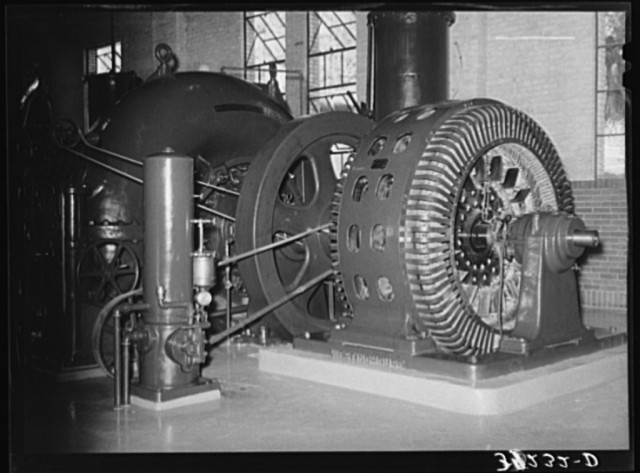
Depending on where you happen to be in the world, your power outlet supplies alternating current at either 50 or 60 Hz. The precise value doesn't really matter as long as it stays within a narrow limit. Essentially, this means that the generator supplying the power needs to rotate at a rate that produces this frequency.
Maintaining the frequency is not quite as simple as it seems. Imagine that your house is hooked up to a diesel generator. When everything is switched off, the engine only has to overcome the internal resistance of the generator, so it idles along nicely at a rotational speed that corresponds to a 50Hz alternating current. Then you turn on the stove, the microwave, the vacuum cleaner, and the washing machine at the same time. Suddenly, the generator is trying to produce about 10kW of power. That increases the internal resistance of the generator and the engine slows down. The slowing rotational speed kicks the governor on the engine into action, which revs the hell out of the diesel. The diesel speeds up, overshoots the correct rotation rate, and then settles back to the correct speed.
At the moment when the load on the generator changed, the frequency of the alternating current produced by the generator first dropped, then increased as it spun up, and finally dropped back to the correct value again. The governor actively stabilizes the rotational speed of the generator to the correct value, and it operates in what is called the critically damped regime. That is, the governor tries to minimize the number of times it overshoots and undershoots, rather than just the speed with which it makes any particular correction.
Now, imagine that the governor wasn't set correctly, so that the overshoot was larger and the oscillations above and below the correct frequency persisted for longer. Some of the electrical appliances in your house will respond to that by changing their power draw. That means the load demanded by the appliances starts oscillating in response to the oscillating frequency of the generator. Under some conditions, the two can reinforce each other, and the oscillations get larger and larger until either the load blows or the diesel engine tears itself to pieces.
That's just a single generator with a single load. Imagine a power grid that consists of multiple power stations, each with multiple generators, and a distributed load that changes all the time. If the grid finds itself in the case where the changes in frequency of each generator are not damped out, you get the oscillations described above on an epic scale. Then many people are in for a dark and cold night.

Doing the 50Hz dance

Network operators are well aware of the potential for disaster, so they actively stabilize their generators to keep them all synchronized with one another. But given that some relatively large power outages have been due to relatively small operator errors, researchers have been wondering if it's possible to set up a network that maintains synchronization through more passive means.
To achieve this, the researchers have looked at a well-known characteristic of power networks: under stable operating conditions, the generators will stay synchronized with each other without active stabilization. Essentially, if the load on a generator increases and it slows, the other generators "pull" it back. This occurs because, in the brief time it's slowed, the generator appears as a load to the other generators, which speed up to compensate. As long as the slowing and speeding of the various generators don't reinforce each other—that is, the changes of all generators are damped out—then the network will remain stable.
Looked at from the opposite perspective, the researchers observed that instabilities occurred when a generator appeared as a distinctive type of load on the network. That would occur when a generator got so far behind the other generators that the power supplied to it by the other generators would drive it further out of sync, while that generator would simultaneously drive others out of sync.
The probability of reaching this point is all related to the phase—the phase is the relative timing between the peaks and troughs in the alternating current from two generators. For a larger system like a power grid, the phase depends on all the different driving voltages—the other generators that respond to one going out of phase.
But the key insight of the analysis is that the phase of a single generator can also be changed by switching in and out local banks of capacitors and inductors. When a generator has fallen behind, the capacitors and inductors can change the phase of the driving current to bring the generator smoothly back into line with the others, without the others ever seeing it as much of a draw. This keeps the other generators from acting to compensate and limits the chances of a growing instability.
So instead of having a complicated active stabilization on the mechanical drive that is turning the generator, you measure the internal electrical properties of the generator and switch capacitors and inductors in and out of the circuit to stabilize it. This operation is very fast—the mechanical drive cannot respond quickly, while electronic components can be switched in and out every ten milliseconds or so.
On long time scales, the researchers reach a conclusion that seems to be blindingly obvious: a network should remain stable if each generator on it was strongly damped. The inertia of the generator and other factors play a role, but when all is said and done, network designers can't do a lot about most of the factors except the damping.

So what?

The first thing to note is that this will probably work. The researchers tried it out on models of real power systems from Northern Italy, Poland, and Guatemala. In simulations, they show that they could stabilize the system through simply switching capacitors and inductors in and out at generator locations. I expect that some of this will find its way into the grid.
The researchers also hit a key buzzword: "smart grids." If you ever wondered what that meant, you're not alone. However, it may be that this is what they're talking about. The current grid is too sensitive to allow a huge amount of flexibility, so we're forced to operate relatively inefficiently in order to maintain stability. Perhaps with better stabilization techniques, this will change.
Nature Physics, 2013. DOI: 10.1038/nphys2535  (About DOIs).

Director Of National Intelligence Admits That There's Little Risk Of A 'Cyber Pearl Harbor'

from the so-why-are-we-rushing? dept

We've been pointing out for years that all the talk about "cyberattacks" and "cybersecurity" appear to be FUD, mostly designed to scare up money for "defense" contractors looking for a new digital angle. And yet, we keep seeing fear-mongering report after fear mongering report insisting that we're facing imminent threats of such a dire nature that multiple people keep referring to this ridiculous concept of the "cyber Pearl Harbor" which is going to happen any day now if we don't pass vaguely worded bills that will surely ramp up huge contracts. And yet, every time we'd hear these cinematic scare stories, we'd point out that no one has yet died from a "cyber attack" and ask: where was the actual evidence of real harm? Yes, we've seen hack attacks that are disruptive or really about espionage. But that "big threat" coming down to get us all? There's been nothing to support it.

And perhaps that's because it doesn't exist. Amazingly, the Director of National Intelligence, James Clapper, actually admitted in a Senate hearing that there's little risk of any "cyber Pearl Harbor" in the foreseeable future:
“We judge that there is a remote chance of a major cyber attack against U.S. critical infrastructure systems during the next two years that would result in long-term, wide-scale disruption of services, such as a regional power outage,” Clapper said in his statement to the committee. “The level of technical expertise and operational sophistication required for such an attack — including the ability to create physical damage or overcome mitigation factors like manual overrides — will be out of reach for most actors during this time frame. Advanced cyber actors — such as Russia and China — are unlikely to launch such a devastating attack against the United States outside of a military conflict or crisis that they believe threatens their vital interests.”
He later admitted that some others -- who weren't as knowledgeable -- might be able to sneak in some attacks here or there, but that the impact would likely be minimal:
“These less advanced but highly motivated actors could access some poorly protected US networks that control core functions, such as power generation, during the next two years, although their ability to leverage that access to cause high-impact, systemic disruptions will probably be limited. At the same time, there is a risk that unsophisticated attacks would have significant outcomes due to unexpected system configurations and mistakes, or that vulnerability at one node might spill over and contaminate other parts of a networked system,” he said.
Of course, at the very same hearing, the NSA's General Keith Alexander kept up the propaganda about threats. Alexander has been among those who have been spreading FUD about the "threats" -- including ridiculous claims about Anonymous shutting down the power grid -- so sticking to that line is hardly much of a surprise. This time around he focused on an increasing rate of attacks on Wall Street banks.

He also pulled out the old "the Chinese are stealing our business secrets!" claim. That always sounds good for Congress, but it is unclear how much real impact it has had.
But the Cyber Command chief stressed that the U.S. needs to clamp down on this intellectual property theft, warning it will ultimately "hurt our nation significantly."

"For the nation as a whole, this is our future. This intellectual property, from an economic perspective, represents future wealth and we're losing that," Alexander said.
It doesn't appear he has any real basis for saying that. There are all sorts of ways to compete and to innovate, and falling back on relying intellectual property laws may be the least useful and least efficient manner for doing so.

It would be nice if we could stop all the blatant fear mongering and focus on any actual problems, such as highlighting what important information isn't being shared today, since we keep getting told that it's our lack of information sharing that will lead to a cyber pearl harbor. Now that we know the threat isn't imminent, can we sit back and look at the actual evidence, understand what the real problem is, and see if there's a way to solve it that doesn't involve giving up everyone's privacy rights?