Friday, May 23, 2014

A Durham, North Carolina restaurant with a sign on its front door reading, "No Weapons, No Concealed Firearms," was robbed at gunpoint on May 19.

the crims R smarter than the BANNER  KOOKS  nit wit fucked in the heads

Gunsnfreedom.com published a photograph of the sign on May 21, making "The Pit" restaurant a self-declared gun free zone--the same kind of zone Michael Bloomberg and Moms Demand Action for Gun Sense in America pressure other restaurants into becoming.
According to Durham's ABC 11, around 9 PM "three men wearing hoodies entered the restaurant through the back doors with pistols, and forced several staff members to lie on the floor." The armed men "also assaulted two employees during the crime."
The suspects are still on the loose.
When Chipotle announced their intended gun ban by saying the sight of law-abiding citizens carrying guns caused customers "anxiety and discomfort," Breitbart News responded with a simple question:
If law-abiding citizens caused customers "anxiety and discomfort," what will those customers feel like when a criminal enters Chipotle, now confident that no victim in the restaurant is allowed to have a gun which which to fight back?
Perhaps the armed attack on "The Pit" can be of some help in answering this question.

Symbiosis

Symbiosis

SYMBIOSIS

In the television series ‘Mad Men’ there is a commotion about the advertising office getting a computer and there is worry about how many people it will replace. The year that ‘Mad Men’ is now set in is 1969 and little do they know that the computer isn’t going to replace workers it is going give them more work to do.
In the episode called “The Monolith”, the main character Don Draper, confronts the computer tech and says “I know you told me your name is Lloyd, but I know your real name.” This left a lot of people stunned. What was Draper saying? He knew the guys real name?
I figure it out immediately. It was found somewhere in the words of a Rolling Stones song “Please to meet you, hope you guess my name.” The deal with technology in 1969 seemed to be a deal with the devil. It was a soulless machine that when given the opportunity would enslave us, out-think us, and eventually kill us.
The visions of the doom prophets were coming true and our symbiotic relationship with the machine would bring a us cashless society and a a society of chipped drones being tracked and placed into a category that can be as inhuman as Fritz Lang’s dystopian ‘Metropolis‘.
As the Sydney Morning Herald just reported, we now live in times where, “Thousands of technology enthusiasts use…the ultimate app, enabling them to lock and unlock their homes, cars, computers and mobile phones with a simple wave of a hand.
And this is only the first step in the plan. The next step is the human microchip.
The Sydney Morning Herald continues:
The idea may seem weird, and painful, but human microchipping appears to appeal not only to amateurs, who call themselves biohackers, but also to governments, police forces, medical authorities and security companies.
It involves using a hypodermic needle to inject an RFID (radio-frequency identification) microchip, the size of a grain of rice, usually into the person’s hand or wrist. The same kind of chip is used for tracking lost pets.
The implants send a unique ID number that can be used to activate devices such as phones and locks, and can link to databases containing limitless information, including personal details such as names, addresses and health records.
The writers of ‘Mad Men’ knew a little something about the loss of humanity even to the point of having a main character lose his mind, believing that frequencies were entering into him through his chest and in a strange act (that could be compared to van Gogh) severed a body part that he felt had some sort of device imbedded in it.
I am sure that back in 1969 there was a lot of concerned banter about the computer and there was really no real talk about home computer, only hints of a chipped society and our loss of humanity. Now here we are in the 21st century, wondering what is going to happen with the home computer, the Internet and the plans for the military to introduce robot soldiers and programmable drones.
In the meantime, technology now has given rise to a new form of entertainment and that is hologram concerts where deceased singers can literally make a comeback performance from the dead because of hologram technology.
Michael Jackson made posthumous performance at the Billboard Music Awards. After a year of planning and choreography, a hologram was created using what appeared to be a Michael Jackson look-alike.
While you will hear in the mainstream media that there were teary eyes and that the audience was all bending over backwards to cheer on the holographic resurrection, there were many that disapproved of the performance.
Some critics tweeted that it was confusing and uncomfortable to watch. Some had said it was scary and weird, the equivalent of digital formaldehyde, animating a corpse using technology.
As CNN reported: “Though the Jackson hologram was new, the debate over whether or not deceased celebs should be brought back is not. The Billboard “performance” also resurrected the discussion on whether fans even want to see their favorite artists as holograms.
In 2012 a hologram of the late rapper Tupac Shakur stunned audiences at the Coachella music festival. Frank Sinatra and Elvis Presley have also been reanimated…” There’s also the threat of a Marilyn Monroe hologram for a Broadway show.
Is technology preserving the memory of the artist by using it in a live performance – or does it exploit the memory of an artist?
Michael Jackson was not there to sign-off on that performance – a performance that was not supposed to happen, a performance that the courts tried to rule against and a performance that most fans say was sub-par and could never live up to the real Michael Jackson.
Think about what we can do with this technology: It can go beyond that of mere performing. We could create a hologram of John F. Kennedy supporting Hillary Clinton for president, or even Dr. Martin Luther King on stage supporting Obama, would that be ethical and prudent? Or would this be unfair and unwise to do?
As BreitBart.com reported back in April, “During his visit to Tokyo, President Obama had a chance to meet ASIMO, a Japanese humanoid robot. ASIMO, an acronym for Advanced Step in Innovative Mobility, exchanged bows with the president before demonstrating that it could kick a soccer ball.
The AP said: “Obama also witnessed demonstrations by other robots, including one designed by Japanese technicians and partially financed by the U.S. Defense Advanced Research Projects Agency that was developed to help with disaster response. “I have to say the robots were a little scary,” he said afterward. “They were too life-like.”
Another group that is afraid of the potential of life-like killer robots is the United Nations.
As RT.com reported last week:
The first multinational discussions on the rising specter of ‘autonomous killer robots’ is being hosted by the United Nations to consider whether the global community should ban the new technology – before it’s too late.
Acting Director-General of the UN Office in Geneva Michael Møller said the time to take action against killer robots is now.
“All too often international law only responds to atrocities and suffering once it has happened,” he said. “You have the opportunity to take pre-emptive action and ensure that the ultimate decision to end life remains firmly under human control.”
The Campaign to Stop Killer Robots, an international coalition of non-governmental organizations, successfully petitioned the UN to consider the question of ‘autonomous weapons systems’ in a Convention on Conventional Weapons (CCW) meeting.
One of the founders of the NGO, Nobel Peace Laureate Jody Williams, is urging a ban on “autonomous robots,” which the US Pentagon defines as weapons that “once activated, can select and engage targets without further intervention by a human operator.”
The Department of Defense will tell you that the reason they want these killer robots is to save lives of young men who go out and fight wars. The real reason they want these killing machines is because they do not question orders. There is a movement afoot where soldiers are now questioning the totalitarian movements of the United States and so the Department of Defense is well-aware that a robot soldier would not defect or question orders.
Humanity is facing the extermination of its liberty. Now there is a way to enforce the tyranny and take out those who rebel.
OpposingViews.com writes:
Retired military generals warn that U.S. kids need to slim down and shape up or we won’t have enough young people to fight in years to come. More than three-fourths of Americans ages 17 to 24 aren’t eligible to join the military because they are overweight or don’t meet other basic requirements, like literacy or a high school diploma.
Health and educating should start as early as pre-kindergarten, according to military officials. Otherwise, I am sure that these robotic soldiers would be an alternative if things do not change.
Of course, there will be killer robots and “kinder, gentler” robots that will be programmed to carry out actions with moral decisions built in, as well.
ExtremeTech.com notes:
The US Department of Defense, working with top computer scientists, philosophers, and roboticists from a number of US universities, has finally begun a project that will tackle the tricky topic of moral and ethical robots. This multidisciplinary project will first try to pin down exactly what human morality is, and then try to devise computer algorithms that will imbue autonomous robots with moral competence — the ability to choose right from wrong. As we move steadily towards a military force that is populated by autonomous robots — mules, foot soldiers, drones — it is becoming increasingly important that we give these machines — these artificial intelligences — the ability to make the right decision.
The question is: What kind of morality will be taught to robots? Is there a military morality, instead of the morality of the common person?
After all, the US and Israel are developing drone insects that are able to inject poison in humans. Poisoned people creates infertility on wide population ranges. The question here is how moral is it to depopulate one region with drones than can secretly inject a disease into people to make them infertile?
Military brass is suggesting that the moral decisions are to be based on several criteria.
For example, let’s look at the moral dilemma for a tech soldier. Should the robot help the wounded soldier, or should it continue with its primary mission of delivering vital ammo and supplies to the frontline where other soldiers are at risk?
I ask you to look into the eyes of congressmen when they are presented with the idea of killer robots and robots with ethics. It would be similar to looking into the eyes of cows as they are presented with a Webster’s Unabridged Dictionary for perusal.
Almost all Congressmen are of the mindset that the best armies are those that consist of high school dropouts and poor minorities.
Just bring up automation and they have this stupefied look and, without flinching, they most certainly do not want to wind up looking unhip or not aware of the technology available to turn an enemy into a cloud of warm pink mist.
Many of them presented with the term ‘ethics’ will dance around a party line wondering if a tech soldier can be given the ethics of a Republican or a Democrat.
Is it gay or is it straight? Is it pro-life or pro-choice?
Does it handle policy like John Kerry or John McCain?
One thing is for sure, the Department of Defense will have to study Asimov’s Three Laws of Robotics, the first of which is: “A robot may not injure a human being or, through inaction, allow a human being to come to harm.
Keeping this in mind as it is one of the chief reasons not to let robots on the battlefield at all – and if they are – only in the capacity of servitor and not warrior.

Killer apps, literally: Wearable and smartphone tech on the battlefield

Google Glass, smartphone tech could give soldiers an augmented view of the world.

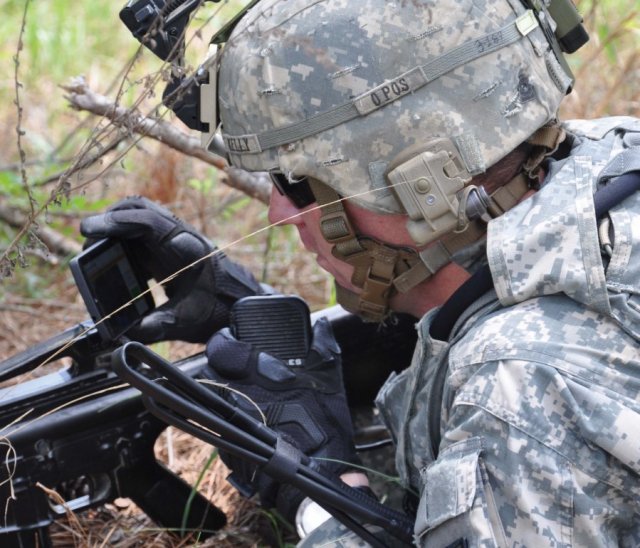
Staff Sgt. Vincent Kelly, of A Company, 1st Battalion, 29th Infantry Regiment, receives real-time imagery using the Small Unit Leader Situational Awareness Tool during a Maneuver Battle Lab demonstration on May 13, 2014, at McKenna Military Operations on Urban Terrain training area at Fort Benning, Georgia.
If you’ve played first-person shooters like Halo or Titanfall, you’ve seen a little bit of the potential future for troops and law enforcement on the ground. Those games give the player a virtual “heads-up” display of the game world around their avatar, with maps that show enemies and other essential data without having to look away from whatever’s down the barrel of their weapon.
The US military has been experimenting with heads-up data displays for years, but now the services are looking to cheaper alternatives to custom-built systems in the consumer electronics realm. In the not-too-distant future, when an Army squad leader wants to know what’s up ahead, he or she may reach for a smartphone or a Google Glass device instead of binoculars.
The US Army’s Maneuver Battle Lab at Fort Benning, Georgia, recently demonstrated one example of this adoption of off-the-shelf mobile and wearable tech. The Army is evaluating the use of off-the-shelf smartphone technology as a handheld “situational awareness tool” by using an app to connect to video feeds from robots on the ground and in the air.

Drones for eyes

The Small Unit Leader Situational Awareness Tool (SULSAT), an experiment of the Army’s Concepts Experimentation Program, got its first field demonstration at Fort Benning’s McKenna Military Operations Center on the Urban Terrain training area on May 13. Using a wireless connection to a tactical robot's or a small drone’s control system, SULSAT pulls video to a squad or platoon commander where they are—instead of them having to look over the shoulder of the operator or having to pass requests for instructions over a radio.
The $1 million SULSAT program, according to Army research and development budget documents, is part of an effort to better integrate robotics systems at the lowest level within the Army’s command structure—giving sergeants a pocketable tool that allows them to get a handle on what’s over the hill or around the corner. It can be used to clear routes for a squad or platoon, to identify potential improvised explosive devices, or just to get a handle on unfamiliar surroundings.
The main drawback of the current prototype is the limited range of its wireless connection. First Lieutenant Brandon Slusher, an officer with A Company, 1st Battalion, 29th Infantry Regiment, praised the tool, but told the Army News Service that the platoon commander still has to stay close to the tactical robotic control operator to get the video feeds.
Other goals of the program, beyond the live video feeds, include 3D virtual reality views built from air and ground sensors. In March, the Army posted a request for a system that can take in LiDAR and other sensor data from ground robots and drones to build a visualization of terrain, internal and external structures of buildings, and of potential threats—including automatic recognition of moving targets. This data would be pushed out to soldiers on their handheld devices.

Ok, Glass—bombs away

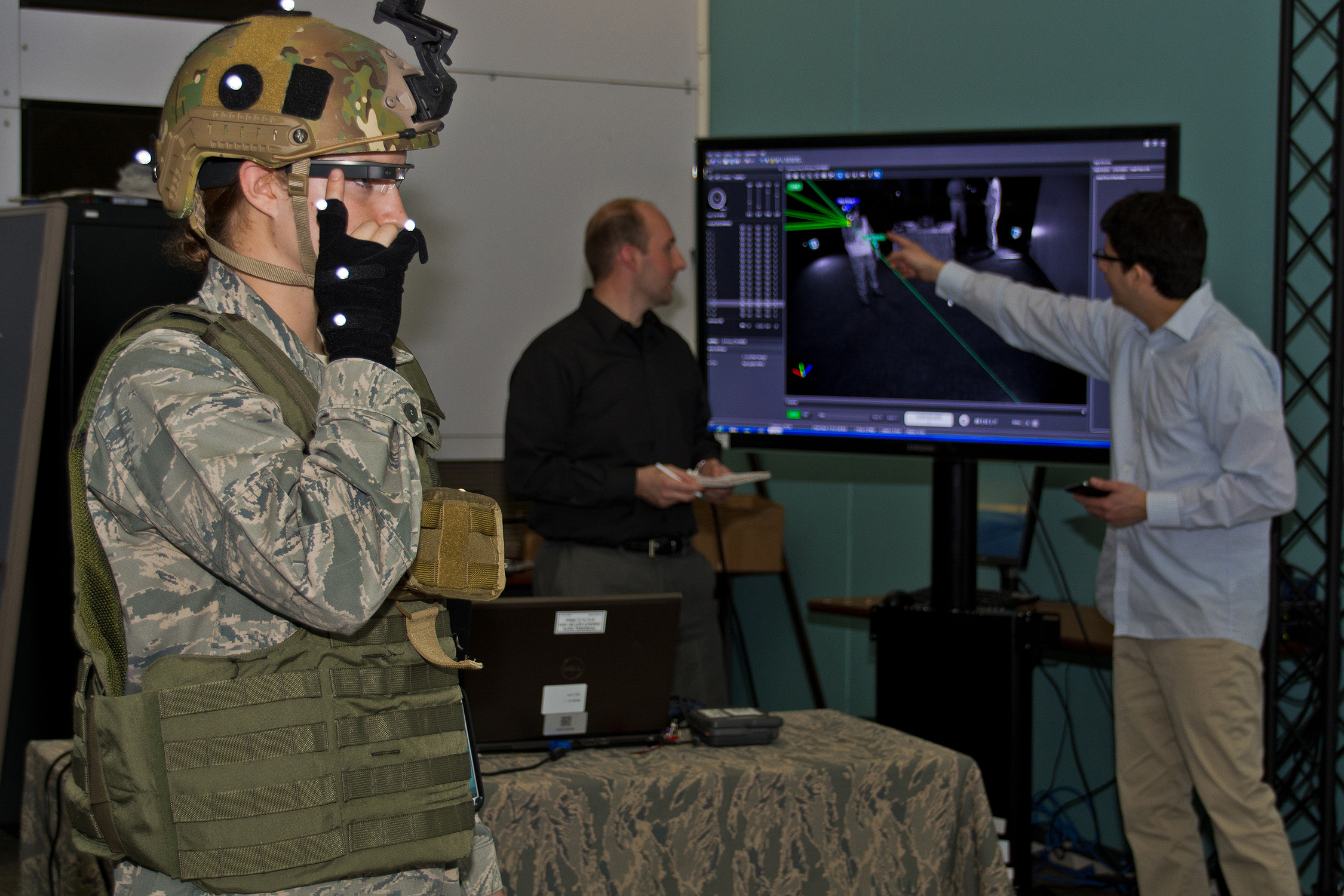
Enlarge / A test of the Google Glass-based BATMAN II at the Air Force Research Lab (AFRL) at Wright-Patterson Air Force Base.
Wright Patterson Air Force Base
The Army isn’t the only service looking to give troops in the field a digitally augmented view of the world. The Air Force Research Laboratory’s 711th Human Performance Wing is testing a Google Glass-based system as part of a program with the improbable (and slightly forced) acronym BATMAN II—Battlefield Air Targeting Man Aided kNowledge (sic). AFRL obtained the Google Glass devices through Google’s Glass Explorer program. There are two current target user populations for the BATMAN Glasses: the Air Force’s Pararescue jumpers (special forces operators with emergency medical training); and joint terminal air/attack controllers, the people on the ground who talk to attack aircraft and point to where the bombs should be dropped and hell otherwise unleashed.
Enlarge / The logo of the Air Force's BATMAN program.
Wright Patterson Air Force Base
AFRL is looking at how to use the sensors on Google Glass and its interface to help with tasks ranging from passing medical information back and forth to giving the look that kills—using where a person is looking to designate an air target. The original BATMAN platform was a ruggedized wearable computer system with a display monocle that jutted from a full headset. The AFRL has adopted Google Glass for the next phase of development both because of the reduction in weight of the device and its wealth of built-in sensors—as well as its dramatically lower price tag.
Google Glass is also being picked up on by DOD contractors for other potential uses. At the Special Operations Forces Industry Conference on May 20 in Tampa, Florida, the Battelle Memorial Institute—which operates the National Biodefense Analysis and Countermeasure Center and a number of other national labs—demonstrated Google Glass as part of a chemical-biological-radiological detection suite. The Glass apps, called Tactical Augmented Reality Applications (TARA), use video recognition and a wireless interface with chemical, biological, and radiological/nuclear sensors to give soldiers and other first responders a form of augmented reality—a heads-up display that presents information based on video analysis and sensor data.
In an interview with Ars, Darren Wolfe, of Battelle, said that the wireless interface to Glass could allow someone testing an area for potential hazards to quickly assess if there were hazardous agents present. “Instead of having to look at a readout, it gives them a simple color indicator to tell them if the instrument tests positive for an agent,” he said. “It will flash up red on the Glass if there’s a hazard.” This allows the person on scene to continue to focus on the task of containing or disposing of contaminated objects.
Another feature of TARA, useful on both the battlefield and in possible hazardous materials incidents, is its video recognition capability. The video from the Glass camera can be used with facial recognition software to alert soldiers or law enforcement officers when a person of interest is spotted, and to identify improvised explosive devices, hazardous chemical placards, and equipment potentially used for the construction of weapons of mass destruction. The Glass display can then provide a checklist of how to deal with the IED, or other items, based on visual analysis.
TARA can be used in combination with another application built with consumer-targeted hardware—the Oculus Rift virtual reality headset—as part of the Battelle Immersive Training Environment (BITE). Using Oculus’ built-in head sensors and a pair of handheld sensors, a user can interact with virtual objects in HAZMAT, IED, and WMD training scenarios and get simulated data from the Google Glass display.

The Fall Of Atlantis: What We Can Learn From Our Ancient Past May 23, 2014 by Laura Jane

 atlantis Whether you believe there was a lost civilization known as Atlantis or not, there is a profound message from ancient societies contemporary to the supposed Atlantis.
Not only that, humans are much older than we previously thought (and are still being taught), and there is solid evidence for large-scale hyper advanced societies existing at least 10,000 years ago (and probably earlier). For more information, I direct you to works by Graham Hancock and Micheal Cremo.
However, what I have always found to be truly relevant about Atlantis in terms of our society is that Atlantis, or more specifically, its demise, reveals something extremely important about our current predicament:
To put it simply: As spiritually decreases, war, strife, greed and subversive power increases. This can be seen both in the archeological record and in Plato’s account of the fall of Atlantis.
First of all, Atlantis was an empire and its influence was spread beyond the main continent or land mass known as “Atlantis.” Modern researchers and Atlantis chasers know this and are aware of archeological evidence existing on continents currently above sea level in sites dated as old as 15,000 to 10,000 years BCE that were most certainly under Atlantic influence. I won’t go into the details of the exact proofs here but interested individuals can refer to this book and this one too.
Basically what these sites tell us: In the earliest periods a great value was placed on spirituality. During the earliest times people seemed to live longer, peaceful lives. No evidence of any weapons or conflict is apparent.
This is also where the cave paintings are the most stunning and technically adept.
Looking at how these societies evolved over time: As spiritually became de-emphasized, the production of weapons increased. During this phase, individuals seemed to live shorter lives, often dying as a result of conflict/murder/war etc. The cave art reflects a degradation in artistic skill (comparatively to older examples) and the subject matter is often shown to glorify war, death and power won with violence.
So, it seems there is a relationship between power/greed/violence and spirituality -> as one increases, the other decreases.
Plato sums this up nicely in Critias when he discusses the state of Atlantis right before its demise:
 ”…but when the divine portion began to fade away, … and the human nature got the upper hand, they then, being unable to bear their fortune, behaved unseemly, and to him who had an eye to see grew visibly debased, for they were losing the fairest of their precious gifts; but to those who had no eye to see the true happiness, they appeared glorious and blessed at the very time when they were full of avarice and unrighteous power.” (Plato, Critias)
This quote seems to imply that to the untrained eye, or to the unaware/asleep, Atlantis right before it fell seemed like it was at the top of its game, gaining more and more power and material wealth. However, to the awakened individual, the inevitable downfall was completely apparent, for it would be obvious they had lost sight of what is truly important.
Here we are today experiencing, what I hope, is the pendulum about to swing the other way: power/greed/violence etc. may be heightening, but more and more people are becoming awake and aware. There is also a resurgence of spiritual growth and a quest for enlightenment/higher consciousness.
So I think the answer to the our current predicament is pretty clear here, the way history (or the subverted/forbidden history I should say) teaches us to combat greed/violence/war is by questing for spiritual growth and empowerment.
SOURCES
Mary Settegast’s Plato Prehistorian:10,000 To 5000 B.C. Myth, Religion, Archaeology (1987).
Phillip Coppens’ The Lost Civilization Enigma: A New Inquiry Into the Existence of Ancient Cities, Cultures, and Peoples Who Pre-Date Recorded History (2012). ~http://www.collective-evolution.com/2014/05/23/the-fall-of-atlantis-what-we-can-learn-from-our-ancient-past/

As Goes Walmart, So Goes America: “Major Holes Are Starting to Form In Its Business”

hows them 10.50hr welcome 2 wal~mart motherfuckers ...jobs !     huh America !! hows THAT work~in fer U.S. hummm

Mac Slavo
May 23rd, 2014
SHTFplan.com

walmart-going-underIf there’s one indicator of the state of the global economy it’s consumer purchasing on the retail level. And if there’s one retail company to watch as a prelude to what comes next it’s always been Walmart. Known for low prices, low wages, and multi-billion dollar profits, the world’s largest retailer is struggling.
According to a recent report from Motley Fool, the behemoth’s same stores sales in the U.S. have dropped precipitously and internationally they have outright collapsed, signalling serious trouble ahead.
Wal-Mart has begun to lose its cache with consumers and major holes are starting to form in its business.
Interestingly, Wal-Mart has hidden its financial problems from the headlines because challenges are different around the world, masking themselves in the overall picture.
But when you dig between the headlines you can see a company in serious trouble and could be the latest in a long line of leading retailers to go from boom to bust in the blink of an eye.

The problem for Wal-Mart goes far further than just cyclical swings in retail or a weak economy. Wal-Mart has long been able to lure customers with one-stop shopping and low prices, but consumer trends are now working against that core strategy. For cost conscious shoppers, lower prices can often be found online and more affluent consumers are choosing style and quality products over one-stop shopping.

Here’s where Wal-Mart’s story gets really interesting. Sales in the U.S. are beginning to struggle, but overseas the company’s profitability is in downright freefall.
In an earlier report we noted that economist John Williams says a deep recession will likely become official by Summer of this year, when the government releases it latest economic growth numbers.
According to Williams, consumers in America are strapped because of stagnant incomes and rising costs for food, energy and health care, leaving little money in consumers’ pockets for other purchases. “The consumer doesn’t have the liquidity to fuel the growth in consumption,” Williams says, a serious implication that is a key reason for why Walmart is seeing same store sales collapse and return on investment shrink across the board.
In June of 2009 trend forecaster Gerald Celente, in an interview on Infowars with Alex Jones, discussed the parallels between Walmart and the United States of America, suggesting that as goes Walmart, so goes America.
When you hear these advertisements where Walmart brags about everyday low prices, well sure, we’re turning into a Walmart economy.
With everyday low prices comes everyday low paying jobs. With everyday low paying jobs, comes everyday low quality. So every day America is sinking lower and lower.
Since then we’ve learned that a large percentage of Walmart employees make so little money that they have to depend on the government for nutritional assistance, joining nearly 48 million other Americans in the process. Morale at the company has always been low, as evidenced by the often sullen faces seen when being “greeted” upon entering a local store. This mirrors the general sentiment in many parts of America as the financial and economic destruction of the last five years takes it toll.
For many, Walmart has become the soup kitchen of the modern day bread line. One could even argue that the only reason Walmart hasn’t yet gone bankrupt is because of the surge of monthly customers who receive Electronic Benefits Transfers from the government and head straight to the low-cost retailer to spend their taxpayer subsidized income on food, clothing and other knick-knacks they offer.
Just as Walmart has been sinking over the last several years, so too has America.
Our national debt has skyrocketed, Americans dependent on monthly disbursements just to survive have hit historic highs, and there are more people out of the labor force today than there are working.
Taken in this context Walmart’s success or failure certainly seems to mirror that of the United States as a whole.
Like Walmert, iconic retailers Montgomery Ward, Sears, and K-Mart were once believed to be immune from the busts normally associated with economic downturns and new competition. The United States, another super power in its sphere of influence, also seems indestructible for these reasons.
Reality is catching up with both of them.

The British Royal Family Supported Hitler and the Nazis

Prince Charles Compares Putin to Hitler - Remark ironic considering Saxe-Coburg-Gotha royals loved Hitler and the Nazis


hitlergeorge
In 1937 the Duke and Duchess of Windsor visited Germany and met Adolf Hitler.
Prince Charles’ “well-intentioned” remark comparing Russian President Vladimir Putin to Hitler is ironic considering the well-established fact the British royal family was cozy with the real Hitler back in the day.
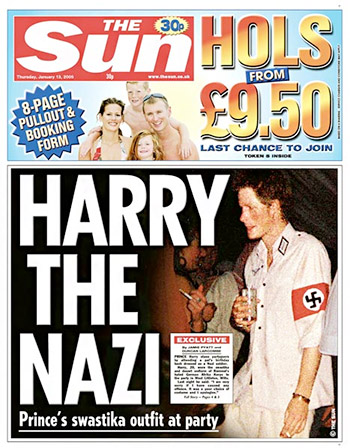
Prince Harry’s Nazi uniform, explained away as an unfortunate wardrobe malfunction in 2005, revisited a public relations disaster the royal family spent decades patching up.
Following the First World War, the royal family changed its name from Saxe-Coburg-Gotha to Windsor to distract attention from its German heritage.
Family members of Prince Philip, who is from the house of Schleswig-Holstein-Sonderburg-Glucksburg, were unabashed supporters of Hitler and the Nazis.
Brother-in-law, Prince Christoph of Hesse, was a member of the SS. He piloted fighters that attacked allied troops in Italy.
Several weeks before Germany invaded Poland King George VI and his wife, the late Queen Mother, sent Hitler a birthday greeting.
“I never thought Hitler was such a bad chap,” said George’s brother, the former King Edward VIII, who became the Duke of Windsor after abdicating in 1936. Edward made this remark in 1970 when it was widely known that Hitler and the Nazis had directly and indirectly killed more than 40 million civilians and soldiers.
The Nazis planned to install the Duke as leader after a successful conquest of Britain. The former head of British naval intelligence said Hitler “would soon be in this country, but that there was no reason to worry about it because he would bring the Duke of Windsor over as king.”
Other royals were also connected to the Nazis. Baron Gunther von Reibnitz, the father of Princess Michael of Kent, was a party member and an honorary member of the SS. The brother of Princess Alice was a Nazi who claimed Hitler had done a “wonderful job.” Charles Edward was placed under house arrest after the war for his Nazi sympathies. He was sentenced by a denazification court, heavily fined and almost bankrupted.
Much of the British gentry also held a fondness for Hitler and the Nazis. Lord Halifax was infatuated with Hitler and Sir Oswald Mosely served as the leader of the British Black Shirts.
Montagu Norman, 1st Baron Norman, the Governor of the Bank of England from 1920 to 1944, was a close friend of the German Central Bank President Hjalmar Schacht. Schacht was an ardent supporter of Adolf Hitler and the Nazi Party and served in the Nazi government as President of the Reichsbank and Minister of Economics. Norman played a key role in transferring Czechoslovakian gold to the Nazis in March 1939.

The Sinister Monsanto Group: ‘Agent Orange’ to Genetically Modified Corn

The Americans do not only spy on governments, authorities and private individuals across the world with the help of their secret services;  they also understand how to push forward the global interests of their companies with full force. An impressive example of this is the agriculture giant Monsanto, the leading manufacturer of genetically modified seeds in the world. A glimpse into the world of Monsanto shows that companies which delivered the pesticide ‘Agent Orange’ to the US military in the Vietnam war had close connections with the central power in Washington, with tough people from the field of the US secret services and with private security companies.
SZ
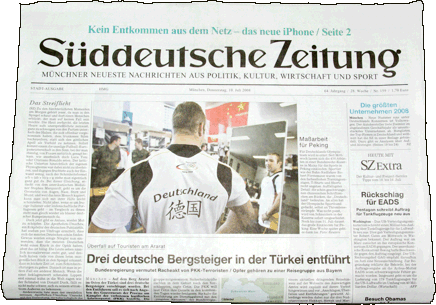
Source: Süddeutsche Zeitung
By MARIANNE FALCK, HANS LEYENDECKER AND SILVIA LIEBRICH
Translated by New Europe Translations for Sustainable Pulse (Original in German)
“Imagine the internet as a weapon”
In the global fight against genetic engineering, the US group draws on dubious methods, strange helpers – and the power of Washington. Critics of the group feel they are being spied upon.
The US group Monsanto is a giant in the agriculture business: and number one in the controversial field of plant genetic engineering. For its opponents, many of whom live in Europe, Monsanto is a sinister enemy. Time and again mysterious things happen, which make the enemy seem yet more sinister.
In the previous month, the European environmental organisation ‘Friends of the Earth’ and the German Environmental and Nature Protection Association (BUND) wanted to present a study on the pesticide glyphosate in the human body. Weed killers containing glyphosate are the big seller for Monsanto. The company aims for more than two billion dollars turnover for the Roundup product alone.  ‘Roundup herbicide’ has a “long history of safe use in more than 100 countries”, Monsanto emphasises.
As viruses attack their computers, the eco-activists ask themselves: “could we be seeing ghosts?”
However, there are studies which show that the product may damage plants and animals and the latest study shows that many large city inhabitants now have the field poison in their bodies, without knowing it.  Exactly what the spray can trigger in an organism is, as with so many things in this field, disputed.
Two days before the study across 18 countries was set to be published, a virus disabled the computer of the main organiser, Adrian Bepp. There was a threat that press conferences in Vienna, Brussels and Berlin would be cancelled. “We panicked”, remembers Heike Moldenhauer from BUND. The environmental activists were under extreme time pressure.
Moldenhauer and her colleagues have widely speculated about the motives and identity of the mysterious attacker.  The genetic engineering expert at BUND believes the unknown virus suppliers wanted in particular to “generate confusion”.  Nothing is worse for a study than a cancelled press conference: “we did ask ourselves at the time if we were seeing ghosts”, said Moldenhauer.
There is no evidence that Monsanto was the ghost or had anything to do with the virus. The company does not do things like that. It takes pride in operating “responsibly”: “Today, it is very easy to make and spread all kinds of allegations,” Monsanto claims. They say that “over and over there are also dubious and popular allegations spread, which disparage our work and products and are in no way based on science.”
Critics of the group see things differently. This is due to the wide network Monsanto has developed across the world. There are ties with the US secret services, the US military, with very hard operating private security companies and of course, with the US government.
A conspicuously large number of Monsanto critics report regular attacks by professional hackers.  The secret services and military also like to employ hackers and programmers. These specialise in developing Trojans and viruses in order to penetrate foreign computer networks. Whistle-blower Edward Snowden has indicated the connection between intelligence services actions and economic drive. However, this sinister connection has been overshadowed by other monstrosities.
Some powerful Monsanto supporters know a lot about how to carry out a cyber war. “Imagine the internet as a weapon, sitting on the table. Either you use it or your opponent does, but somebody’s going to get killed” said Jay Byrne, the former head of public relations at Monsanto, back in 2001.
Companies regularly fight with dubious methods to uphold what they see as their right: but friend or foe, him or me – that is fighting talk and in a war, you need allies. Preferably professionals. Such as those from the secret service milieu, for example.
Monsanto contacts are known to the notorious former secret service agent Joseph Cofer Black, who helped formulate the law of the jungle in the fight against terrorists and other enemies. He is a specialist on dirty work, a total hardliner. He worked for the CIA for almost three decades, among other things as the head of anti-terroism. He later became vice president of the private security company Blackwater, which sent tens of thousands of soldiers to Iraq and Afghanistan under US government orders.
Investigations show how closely connected the management and the central government in Washington are, as well as with diplomatic representatives of the USA across the world.  In many instances, Monsanto has operationally powerful assistants.  Former Monsanto employees occupy high offices in the USA in government authorities and ministries, industrial associations and in universities; sometimes in almost symbiotic relationships. According to information from the American Anti-Lobby-Organisation, Open Secrets Org, in the past year, 16 Monsanto lobbyists have taken up sometimes high ranking posts in the US administration and even in regulatory authorities.
For the company, it is all about new markets and feeding a rapidly growing world population. Genetic engineering and patents on plants play a big role here. Over 90 % of corn and soya in the USA is genetically modified. In some parts of the rest of the world the percentage is also growing constantly.
Only the European markets are at a standstill. Several EU countries have many reservations about the Monsanto future, which clearly displeases the US government administration. In 2009, the German CSU politician, Ilse Aigner, Federal Minister for Food, Agriculture and Consumer Protection, also banned the corn type MON810 from German fields. When she travelled to the USA shortly afterwards, she was approached by her US colleague, Tom Vilsack about Monsanto. The democrat was once governor in the agricultural state of Iowa and distinguished himself early on as a supporter of genetic engineering. The genetic engineering industry elected him as ‘governor of the year’ in 2001.
Unfortunately, there is no recording of the discussion between Vislack and Aigner. It was said to be controversial.  A representative for the Federal Government described the tone: there were “huge efforts to force a change in direction of the German government regarding genetic policy.” The source preferred not to mention details the type of “huge efforts” and the attempt “to force” something. That is not appropriate between friends and partners.
Thanks to Snowden and Wikileaks, the world has a new idea of how these friends and partners operate where power and money are concerned. The whistle-blowing platform published embassy dispatches two years ago, which also included details about Monsanto and genetic engineering.
For example, in 2007, the former US ambassador in Paris, Craig Stapleton, suggested the US government should create a penalties list for EU states which wanted to forbid the cultivation of genetically engineered plants from American companies. The wording of the secret dispatch: “Country team Paris recommends that we calibrate a target retaliation list that causes some pain across the EU.” Pain, retaliation: not exactly the language of diplomacy.
Monsanto led the fight to allow the famous genetically engineered corn plant MON810 in Europe with lots of lobbying – the group completely lost the fight. It was even beaten out of the prestigious French and German markets. An alliance of politicians, farmers and clergy rejected genetic engineering in the fields and the consumers do not want it on their plates. But the battle is not over.  The USA is hoping that negotiations started this week for a free-trade agreement between the USA and the EU will also open the markets for genetic engineering.
Lobbying for your own company is a civic duty in the USA. Even the important of the 16 US intelligence services have always understood their work as being a support for American economic interests on the world markets.  They spy on not only governments, authorities and citizens in other countries under the name of the fight against terror, they also support American economic interests, in their own special way.
A few examples?
Monsanto denies the accusations and emphasises that it operates “responsibly”
More than two decades ago, when Japan was not yet a major economic power, the study ‘Japan 2000’ appeared in the USA, created by the employees of the Rochester Institute of Technology (RIT). Japan, the study read, was planning a kind of world takeover with a ‘reckless trade policy’. The USA would be the losers, stated the study. The national security of the USA was at threat, it continued and the CIA gave the call to war.
America’s economy must be protected from the European’s “dirty tricks”, explained former head of the CIA James Woolsey. This, he maintained, is why the “continental European friends” were spied upon. A clean America.
The whistle-blower Snowden was once in Switzerland for the CIA and during this time, he reported on which tricks the company was said to have tried in order to win over a Swiss banker to spy on account data. The EU allowed the American services to take a close look at its citizens’ financial business. Allegedly, this was to dry up money sources for terror. The method and purpose are highly dubious.
In Switzerland, the scene of many earlier espionage novels now plays one of these episodes that make Monsanto especially mysterious and enigmatic: In January 2008, the former CIA agent Cofer Black travelled to Zurich and met Kevin Wilson, at the time Monsanto’s safety officer for global issues. About what did the two men talk? Probably the usual: Opponents, business, mortal enemies.
The investigative journalist Jeremy Scahill, who wrote the reference work about Blackwater, the company specializing in mercenaries, wrote in the American weekly The Nation in 2010 about the reported strange meeting in Zurich. He had received leaked documents once again. These show: Monsanto wanted to put up a fight. Against activists who destroyed the fields. Against critics, who influenced the mood against the genetic modification company. Cofer Black is the right man for all seasons: “We’ll take off the kid gloves”, he declared after the 11 September terrorist attacks, and tasked his CIA agents in Afghanistan to take out Osama bin Laden: “Get him, I want his head in a box.” However, he also understands a lot about the other secret service business, which operates with publicly available sources. When he meets with the Monsanto safety officer Wilson, Cofer Black is still the Vice (President) at Blackwater, who has the Pentagon, the State Department, the CIA and, of course private companies as customers. However, there was a lot of anxiety in January 2008, because the mercenaries of the security company had shot 17 civilians in Iraq and some Blackwater employees had drawn attention by bribing Iraqi government employees. It just so happened that Cofer Black was at the same time head of the security company Total Intelligence Solutions (TIS), which was a subsidiary of Blackwater, not saddled with the same devastating reputation, however staffed with some excellent and versatile experts.
According to their own statements, Monsanto was conducting business with TIS at the time and not with Blackwater. It is without doubt that Monsanto received reports from TIS about the activities of critics. The activities in question were those that would have presented a risk for the company, its employees or its operating business. The information collected ranged from terrorist attacks in Asia to the scanning of websites and blogs. Monsanto emphasizes that TIS only used publicly accessible material when preventing said risk.
This matched Black’s modus operandus. No shady dealings.
There used to be rumors that Monsanto wanted to take over TIS to mitigate their risk – and there are new rumors these days that the group allegedly is considering a takeover of the company Academi that emerged after a few transformations from the former Blackwater Company. Is anything correct about these rumors? “As a rule we are not disclosing details about our relations with service providers, unless that information is already available to the public,” is the only commentary from Monsanto.
Every company has its own history, and the history of Monsanto includes a substance, which the turned the company into a demon not only not only for the aging 1968ers: Monsanto was one of the leading manufacturers of the pesticide Agent Orange, which was used until January 1971 by the US military in the Vietnam War. Forests were defoliated by constant chemical bombardment to make the enemy visible. Arable land was poisoned, so that the Vietcong had nothing to eat. In the sprayed areas, the teratogenic effects increased more than ten times. Children were born without noses, without eyes, with hydrocephalus, with facial clefts and the US military stated that the Monsanto agent was as harmless as aspirin.
Is everything allowed in war? Especially in the new fangled cyber war?
It is already obvious that somebody makes life difficult for Monsanto critics and an invisible hand ends careers. However, who is this somebody? The targets of these attacks are scientists, such as the Australian Judy Carman. Among other things, she has made a name for herself with studies of genetically modified plants. Her publications were questioned by the same professors which also attacked the the studies of other Monsanto critics.
It does not stop at skirmishes in the scientific community. Hackers regularly target various web pages where Carman publishes her studies and the sites are also systematically observed, at least that is the impression Carman has. Evaluations of IP log files show that not only Monsanto visits the pages regularly, but also various organizations of the U.S. government, including the military. These include the Navy Network Information Center, the Federal Aviation Administration and the United States Army Intelligence Center, an institution of the US Army, which trains soldiers with information gathering. Monsanto’s interest in the studies is understandable, even for Carman. “But I do not understand why the U.S. government and the military are having me observed,” she says.
The organization GM Watch, known to be critical of gene technology, also experiences strange events. Editor Claire Robinson reports continued hacker attacks on the homepage since 2007. “Every time we increase the page security just a bit, the opposite side increases their tenacity and following are new, worse attacks”, she says. She also cannot believe the coincidences that occur. When the French scientist Gilles Eric Seralini published a controversial study on the health risks of genetically modified maize and glyphosate in 2012, the web site of GM Watch was hacked and blocked. The same repeats when the opinion of the European food inspectorate (EFSA) is added to the site. The timing was skilfully selected in both cases. The attacks took place exactly when the editors wanted to publish their opinion.
It has not yet been determined who is behind the attacks.
Monsanto itself, as stated, emphasizes that the company operates “responsibly”.
The fact is, however, that much is at stake for the group. It is about an upcoming bill. Especially about the current negotiations on the free trade agreement. Particularly sensitive is the subject of the agricultural and food industry. The Americans want to open the European markets for previously prohibited products. In addition to genetically engineered plants controversial feed additives and hormone-treated beef are subject of the negotiations. The negotiations will probably extend over several years.
The Americans want to use the Free Trade Agreement to open the European GMO Market.
The negotiations will be detailed. Toughness will rule the day. US President Barack Obama has therefore appointed Islam Siddiqui as chief negotiator for agriculture. He has worked for many years for the US ministry of agriculture as an expert. However, hardly anyone in Europe knows: From 2001 to 2008, he represented CropLife America as a registered lobbyist. CropLife America is an important industry association in the United States, representing the interests of pesticide and gene technology manufacturers – including of course Monsanto. “Actually, the EU cannot accept such a chief negotiator because of bias”, says Manfred Hausling, who represents the Green Party in the EU parliament.
Eigentlich (In fact). The word Eigentlich (in fact) meant in the Middle High German according to the relevant dictionaries “indentured”, which is not a bad description of the current situation, in particular as the European and German politicians have surprisingly much understanding for the US services who regularly spy on them.

Groundbreaking Investigation Reveals Monsanto Teaming Up With US Military to Target GMO Activists


gmoroundup
A hard-hitting investigative report recently published by a prominent German newspaper has uncovered some shocking details about the tactics being used by chemical giant Monsanto in assuming control of global agriculture. According to this thorough analysis, Monsanto appears to be aggressively targeting independent researchers, scientists, activists, and others opposed to genetically-modified organisms (GMOs) by utilizing the vast resources and manpower of both the United States federal government and the American military-industrial complex.
The report, which recently appeared in the July 13 print edition of Suddeutsche Zeitung (SZ), explains in rigorous detail how both individuals and groups opposed to GMOs and other chemical-based crop technologies have been threatened, hacked, slandered and terrorized for daring to digress from the pro-GMO status quo. On numerous documented occasions, pertinent information about the dangers of GMOs or lack of GMO safety data has been effectively blocked from timely release by mysterious forces that many say are the chemical industry in disguise.
“A conspicuously large number of Monsanto critics report regular attacks by professional hackers,” explains an English-translated snippet from the SZ report. “There are (Monsanto) ties with the U.S. secret services, the U.S. military, with very hard operating private security companies and of course, with the U.S. government.”
A telling example of this was when the European environmental group Friends of the Earth (FOTE), together with the German Environmental and Nature Protection Association (BUND), was targeted prior to releasing a damning study on the health-damaging effects of glyphosate, the primary active ingredient in Monsanto’s Roundup herbicide. A mysterious virus infected the computer of the study’s main organizer just days before publishing, which threatened to delay several important press releases.
The distinguished GMO truth website GMWatch.org has also been relentlessly targeted with “cyber attacks” since at least 2007, a disturbing trend that the site’s main editor is convinced originates from the biotechnology industry. As we reported back in 2012, some of the strongest attacks against the site came just weeks and days before the historic Proposition 37 vote in California, which would have mandated GMO labeling at the retail level.
Monsanto’s targeting activities made possible through corporate takeover of federal government
As it turns out, Monsanto has many close friends within the ranks of the U.S. federal government these days. Scores of key government positions, in fact, are now held by former Monsanto executives, a strategic move that has given the multinational corporation exclusive access to the types of resources necessary to carry out cyber attacks against its opponents on a massive scale.
Monsanto’s own executives have even admitted in years past that so-called cyber “warfare” is necessary for the purpose of protecting its own economic interests both domestically and abroad.
“Imagine the internet as a weapon, sitting on a table,” former Monsanto Head of Public Relations Jay Byrne is quoted as saying back in 2001. “Either you use it or your opponent does, but somebody’s going to get killed.”
These are powerful words, and ones that ring increasingly true as reports continue to emerge about Monsanto’s intimidatory tactics against foreign governments that refuse its offerings. Confidential documents recently made public through Wikileaks, for instance, revealed a plan by government officials to “retaliate” against nations that refused to accept GMOs, even when the people of those nations wanted nothing to do with the technology.
All the sordid details of the U.S. government’s collusion activities with the biotechnology industry are available in the full, English-translated SZ report, which you can read here:
http://sustainablepulse.com

A SUBTLE BUT DISTURBING SIGN: THE ELITE IS RUDDERLESS?

I’ve been avoiding commenting much directly about the Ukraine and the recent sanctions business, seeking to place the whole problem in a much larger context of Western geopolitical stupidity. As regular readers here will recall, I’ve also voiced and advanced the idea over the years since the bailouts, that the Western oligarchs appear to be in some sort of “anxiety” or “panic” mode, and that they are also showing all the signs of some deep fissures and cracks within their world views, and what, as a consequence, should be done about it.
Now, consider, for a moment, if, say, a Henry Kissinger and a Zbgnw Brzznsk (for those new to this site, that’s Zbigniew Brzezinski, whose nearly vowel-less name we have reduced to its consonantal basics for ease of pronunciation and spelling) were suddenly to find themselves at opposite poles of a clear geopolitical issue, say, over the Ukraine, the USA’s handling of it, and its current demonization of Mr. Putin. Both are shills to the Rockefailure interest, and therefore, if they were to have publicly stated disagreements on fundamentals, that should be news, right?
Well, believe it or not, they do have publicly stated disagreements, fundamental ones, on the Ukraine, but I’ll bet you didn’t see Mr. Kissinger’s views being reflected on the lamestream media lately. Here’s Alex Jones’ Infowars version of Mr. Brzznsk’s ideas:
Brzezinski Calls for Sending Weapons to Regime in the Ukraine
Nothing new here: Zbg’s basic playbook hasn’t changed in so long that we wonder if there were ever any other pages in it to begin with. Today, weapons in the Ukraine. Tomorrow, covert ops and regime change and nation-building in Russia itself. Yea….we get it, thanks Zbg. Don’t be concerned by Russia’s hydrogen bombs and ICBMs you say? They’d never really use them? But Zbg, what if the Russians never bought into MAD, and what if they don’t believe the doctrine that a nuclear war is unwinnable? Couldn’t poking a stick constantly into the bear’s cage be sorta dangerous? Just askin…
But now Mr. Kissinger weighs in, and it’s almost shocking to see the fundamental gap between his views – subtly expressed to be sure – and Mr. Brzznsk’s:
Claims that Putin initiated conflict in Ukraine after Sochi Olympics make no sense – Kissinger
For once, Mr. Kissinger has it right:
“The demonization of Putin is not a policy; it is an alibi for the absence of one,” Kissinger wrote.
What is of major concern here however is that two such scions, both so highly placed within the power oligarchy of the USA, should differ so fundamentally on such a major issue… and that, perhaps, is an indicator that that policy, so long in the grip of the patriarch of that prominent American family, is losing its grip and direction even as he ages and fades. It’s also a sign or indicator that there is a real struggle between factions, one – we’ll call it the “crazy” faction – that wants to continue poking sticks into the bear’s cage, and the other, that wants to ratchet down the rhetoric and reengage in a more responsible and adult manner.
That the two are represented by Mr. Brzznsk and Mr. Kissinger, however, should give everyone pause, because their open disagreement is a sign of just how bad the factional infighting may have become.

Why Elites And Psychopaths Are Useless To Society


The ultimate and final goal of evil is to obscure and destroy our very conception of evil itself, to change the inherent moral fiber of all humanity until people can no longer recognize what is right and what is wrong. Evil is not a wisp of theological myth or a simplistic explanation for the aberrant behaviors of the criminal underbelly; rather, it is a tangible and ever present force in our world. It exists in each and every one of us. All men do battle with this force for the entirety of our lives in the hope that when we leave this Earth, we will leave it better and not worse.
When evil manifests among organized groups of people in the halls of power, power by itself is not always considered the greatest prize. The true prize is to mold society until it reflects the psychopathy that rots at the core of their being. That is to say, the elites, the oligarchy, the mad philosopher kings want to make us just like they are: proudly soulless. Only then can they rule, because only then will they be totally unopposed.
The problem is humanity is not only hardwired with a dark side; we are also hardwired with a conscience — at least, most of us are.
The vast studies of psychiatrist Carl Gustav Jung prove an in-depth and intricate inborn set of principles common to every person, regardless of time or place of birth and regardless of environmental circumstances. In some circles we refer to this as “natural law.” All people are born with a shared moral compass that is often expressed in various religious works throughout the ages. It is a universal voice, or guide, that we can choose to listen to or to ignore. Organized psychopaths have struggled with the existence of this inborn compass for centuries.
They have tried using force and fear. They have tried abusing our natural inclinations toward family and tribalism. They have tried corrupting the very religious institutions that are supposed to reinforce our consciences and teach us nobility. They have tried psychotropic substances and medications to paralyze our emotional center and make us malleable. They have tried everything, and they have failed so far. How do I know they have failed? Because you are able to read this article today.
Two methods remain prominent in the arsenal of elites.
Convince Good People To Do Evil In The Name Of ‘Good’
This strategy is still effective, depending on the scenario encountered. Elitists are very fond of presenting mind games to the public (in TV, cinema, books, etc.), which I call “no-win scenarios.” These games are hypothetical dilemmas that require the participant or viewer to make a forced choice with only two options: The participant can strictly follow his conscience, which usually means assured destruction for himself and others; or he can bend or break the rules of conscience in order to save lives and achieve a “greater good.”
Watch the propaganda tsunami in the show “24,” for example, and tally how many times the hero is faced with a no-win scenario. Then tally how many times he ignores his moral imperative in order to succeed. The message being sent is clear: Solid morality is not logical. Morality is a luxury for those who do not have to concern themselves with immediate survival. In other words, the world needs bad men to fight other bad men.
Of course, real life is not television; and there has never been nor will there ever be a legitimate example of a no-win scenario. There are no dilemmas that require good people to knowingly sacrifice conscience or destroy innocent lives in order to succeed. There are no dilemmas with only two available solutions. All social dilemmas are fluid, which means that solutions are shifting, but infinite. Just because you cannot see the way out does not mean the way out does not exist. To fight monsters, we do not need to become monsters. Survival is meaningless unless we can prove ourselves worthy of life. This does not mean one should not fight back against evil. On the contrary, one should always fight back. But if we fight without a code of principles and honor, then we will have lost before the battle begins.
Convince Good People That There Is No Such Thing As ‘Evil’ People
Any action, no matter how horrifying, can be rationalized by the intellectual mind or the mathematical mind. This is why we are born with an emotional and empathic side to our natures. Those who embrace evil often seek to soften their image through the use of cold rationalization. They appeal to our desire to feel logically responsible and to boost our intelligent self-image.
Some people might argue that the machinations of evil are self-evident, and that philosophical examinations such as this are unnecessary.  They would say that there is no need to reassert that the works of psychopathy and elitism are fundamentally destructive, but they would be wrong.  I was recently sifting through some mainstream articles when I came across this jewel entitled “Why Psychopaths Are More Successful.”
The article summarizes the theories behind a new “science self-help book” entitled The Good Psychopath’s Guide To Success. Co-author and Oxford psychology professor, Kevin Dutton, states that he “wanted to debunk the myth that all psychopaths are bad.” He wrote:
"I’d done research with the special forces, with surgeons, with top hedge fund managers and barristers. Almost all of them had psychopathic traits, but they’d harnessed them in ways to make them better at what they do."
Now, three important questions need to be asked of Dutton. First, what exactly is his definition of success? Second, if such people are “better” at what they do because of their psychopathic traits, who exactly are they “better” than? Is he suggesting that a non-psychopath could not be just as good a surgeon? Wouldn’t it be preferable to be good surgeon without psychopathy, one who still cares about the well-being of his patients rather than just his own success? And third, if a person can be accomplished in a field without abandoning his conscience as a psychopath does, what good is psychopathy to anyone?
You see, elitist academics like Dutton are not interested in answering such questions in an honest way because their goal is not necessarily to outline a legitimate argument for the usefulness of psychopaths. What they really want is to make psychopathy a morally acceptable ideal in the mainstream.
Dutton does this by asserting the false notion that there are such things as good psychopaths and bad psychopaths, thereby creating a superficial dichotomy he essentially pulled from thin air. Dutton cites several character traits he defines as being common to good psychopaths.
Psychopath Volume Control: Dutton argues that a good psychopath has the ability to turn up or turn down his level of perceived empathy in order to avoid burning bridges with those around him. What Dutton fails to mention (or just doesn’t understand) is that this “volume control” is very common to the average psychopath. In fact, psychopaths tend to be quite adept at reading the emotional states of others and adapting to their moods to appear more human. This is how psychopaths end up in marriages, with families and in positions of respect in a community. This is how psychopaths become leaders. Catastrophes arise, however, when the psychopath decides he is comfortable enough that he no longer needs to hide his inability to feel conscience or remorse. There is nothing special or good about a morally bankrupt person who happens to be good at disguise.
Fearlessness: Dutton’s claim that psychopaths are fearless is simply absurd and is not based in any practical psychology that I know of. Psychopaths are afraid all of the time. What they fear most is losing what they believe belongs to them. This could be money, power or even unlucky people caught in their web. This fear might drive them to take risks in order to accomplish certain goals. But let’s be clear: Only those who take risks because they love what they do have truly overcome fear. Psychopaths are incapable of true love.
Lack Of Empathy: This is the root of the movement toward rationalized moral relativism — the argument that empathy gets in the way of success and sometimes gets in the way of the “greater good.” Dutton claims that lack of empathy gives the psychopath focus, making him skilled in high-pressure situations. In a hostage situation, he says, he would much rather have a psychopath as his negotiator. Of course, he does not consider that his captors would likely be the same kinds of psychopaths he so praises in his book.
One would conclude by reading Dutton’s position that high-pressure jobs require a lack of empathy. And of course, the jobs with the highest pressure are those in political and military leadership. The philosophy of applying positive assumptions to psychopathic qualities is the highest dream of the elite. If you and I could be convinced to see their gruesome behavior as fully necessary to the greater good, then they will have ascended to a place beyond accountability. They become like the old gods of Olympus, dealing death and destruction above the judgment of mere mortals; and we will have handed them that godhood.
Self-Confidence: I think Dutton is confused over the difference between confidence and narcissism. The average psychopath is often self-obsessed, which means he is willing to do anything to get what he wants. This drive might be impressive, but it is not a product of the kind of self-awareness required to gain real self-confidence. A parasitic tick is not necessarily self-confident when he digs into the flesh of a dog; all he knows is that he desperately wants the blood underneath.
A Kingdom Of Psychopaths
In his collected writings entitled “The Undiscovered Self,” Jung theorized according to his work with hundreds of patients that some 10 percent of the human population at any given time has latent psychopathic characteristics, with a much smaller percentage living as full-fledged psychopaths. He surmised that this latent psychopathy will often stay hidden or unconscious for most people, unless their social environment becomes unstable enough to bring out their darker side.
The purges in the early days of communist Russia and Stalinism, for example, brought out the very worst in many normally harmless citizens. Neighbor turned against neighbor, and betrayal for personal gain became the norm. The collectivist hive became an incubator for psychopaths. What Dutton’s psychopathic success theory does not take into account is the fact that America, and much of the world today, is becoming a breeding ground for morally bankrupt people. That is to say, our society is now designed by psychopaths for psychopaths, and only psychopaths could succeed in such an environment. We are all being encouraged to become more psychopathic, more evil, in order to survive and thrive.
The destruction unleashed by the psychopathy of elitism far outweighs any potential benefits that might arise from their uncompromising brand of ingenuity. Anything these freaks of the psyche might accomplish can be accomplished with far less physical and moral cost by those with self-discipline and a love of their fellow man. I would be willing to wager any power monger that if he and his miscreant organizations were to disappear, humanity would leap forward in strides never before seen. Ultimately, those who embrace evil and those who elevate psychopathy are not the key to the betterment of the world; they are obstacles to the betterment of the world.