---BREAKAWAY CIVILIZATION ---ALTERNATIVE HISTORY---NEW BUSINESS MODELS--- ROCK & ROLL 'S STRANGE BEGINNINGS---SERIAL KILLERS---YEA AND THAT BAD WORD "CONSPIRACY"--- AMERICANS DON'T EXPLORE ANYTHING ANYMORE.WE JUST CONSUME AND DIE.---
folks as "our" world leaders play "their shit~nan~a ~gins"(killing us) ...don't U think it is time 2 just fucking get rid of the WHOLE fucking bunch of um ! hows "their" rule work~in fer US huh... hows that go~in ? folks we's got an ass pipe prob~lum
On August 8, Ukraine, the Netherlands, Australia and
Belgium signed a non-disclosure agreement pertaining to data obtained
during the investigation into the causes of the crash of Malaysian
Airlines MH17
Результаты следствия гибели Боинга-777 засекретили.
It may be common for
psychiatric patients who are Muslim to attribute their hallucinations or
other symptoms to "jinn," the invisible, devilish creatures in Islamic
mythology, researchers in the Netherlands have found.
The findings
demonstrate one way in which culture may influence how people perceive
their psychotic symptoms, and could help Western psychiatrists better
understand patients who have an Islamic background.
Moreover, in
today's connected world, patients may fuse the symbols from their own
backgrounds with those of other cultures to explain their symptoms,
study leader Dr. Jan Dirk Blom, an assistant professor of psychiatry at
the University of Groningen, told Live Science.
In Islamic
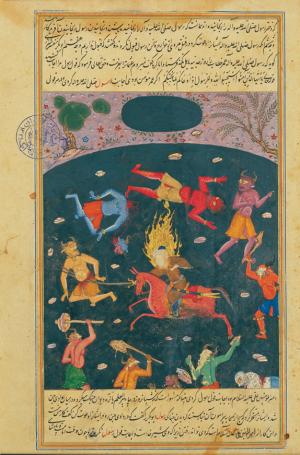
mythology, Jinn, or djinn, are supernatural creatures made of smokeless
fire. They are frequently found in Islamic folklore and are mentioned in
the Quran, the religious text of Islam. Historically, they are
portrayed as menacing creatures that can harm humans, or drive them mad.
People in Muslim societies have traditionally seen jinn as the cause of
mental illness and neurological diseases, especially epilepsy. [Senses and Non-Sense: 7 Odd Hallucinations]
To get a better idea of how commonly Muslim psychiatric patients
consider jinn in the course of their diseases, the researchers looked
into the scientific literature. They found 105 articles about jinn and
their relationship with mental disorders, including 47 case reports.
About 66 percent of those reports included a medical diagnosis. Nearly
half of the cases involved a person with schizophrenia or a related disorder, while the rest of the patients had mood disorders, epilepsy or obsessive-compulsive disorder.
"The available literature suggests that the attribution of psychiatric
symptoms to jinn is common in some Muslimpopulations," the researchers
wrote in their review, published July 30 in the journal Transcultural Psychiatry.
"Since Western health professionals tend to be unfamiliar with this
attribution style, diagnosis may prove quite challenging — especially
when the patient-physician encounter is already impeded by language
problems and cultural differences or biases," the researchers said.
Moreover, findings from several case reports suggested that the
attribution of psychiatric symptoms to jinn also affects the treatment
and course of patients' mental disorders, the researchers said.
Jinn are supernatural creatures, frequently found in Islamic folklore. This image by an unknown arti …
What are jinn?
Like any supernatural
creatures, Jinn have accumulated a rich world through years of folklore
and cultural experiences. They are thought to share many characteristics
with humans: Jinn are born, fall in love, get married and die, but also
have some superhuman abilities, such as flying, moving mountains,
becoming visible only when they wish and appearing as animals. Jinn are
described as having hooves like a goat's, and a black tail. [Our 10
Favorite Monsters]
A belief
in jinns seems to have persisted despite recent cultural and political
changes within Islamic cultures, the researchers said. For example, two
recent surveys done in Bangladesh and the United Kingdom in 2011 and
2012 found that many Muslims believe firmly in the existence of jinn,
black magic and the "evil eye."
But belief in such supernatural beings may prevent people from seeking
help from medical professionals, researchers said. Because patients may
seek help from a religious leader, the researchers recommend
collaboration between medical practitioners and religious health care
workers. "In our practice in The Hague, an imam [a religious leader in
Islam] in the service of our psychiatric hospital is available for
consultation and advice," they wrote in their review.
Cultures and the mind
Across societies, beliefs in the supernatural as well as other aspects
of culture may influence how mental disorders manifest, the study said.
Previous research has found that people with schizophrenia may
experience different delusions depending on their cultures. For example,
fears about technology and surveillance play a large part in the
delusions of people with schizophrenia in the United States. Meanwhile,
in Japan, which has an honor-oriented culture, patients' delusions more
commonly involve fears about public humiliation.
In a recent study
published in the British Journal of Psychiatry, U.S. patients with
schizophrenia reported hallucinations that involved hearing voices with a
negative tone, whereas in Ghana and India, patients reported voices
with a generally positive tone.
However, culture is not the only factor that influences psychiatric
patients. Blom and his colleagues previously treated a young Muslim
patient who had schizophrenia, and who, contrary to the doctors'
expectations, didn't attribute his hallucinations to jinn. Instead, the
patient had searched the Internet for cases similar to his experience,
and had concluded that he was a werewolf.
"He could not be persuaded to accept any other explanation," Blom wrote
in an article describing the case that was published in March in the
journal History of Psychiatry.
As that case shows, the fusing of cultures and easy access to
information online today means that people may incorporate other
cultures into their own explanations of their mental health symptoms,
Blom said.
Darknet drug markets kept alive by great customer service
Because they live on the fringes, these sites are remarkably innovative. ~~ gee actually giving /providing GOOD service 2 your customers huh ..who 'd ah fucking thunk it !!! lol :0 Oops think any 1 of "our" so~called gov. ass facials in ANY LEVEL could've thought this up ? ...nope ! :O or corp's .....nope lol
In 1972, long before eBay or Amazon, students from Stanford
University in California and MIT in Massachusetts conducted the first
ever e-commerce transaction. Using the "Arpa-net" account at their
artificial intelligence lab, the Stanford students sold their
counterparts a small amount of marijuana. Ever since, the 'Net has
turned over a steady but small trade in illicit narcotics. But last year
approximately 20 per cent of UK drug users scored online. The majority
of them went to one place: the darknet markets.
You can't access darknet markets using a normal browser. They sit on
an encrypted part of internet called "Tor Hidden Services," where URLs
are a string of meaningless numbers and letters that end in .onion, and
are accessed using a special browser called "Tor". Tor's clever traffic
encryption system makes it very difficult for the police to know where
these sites—and the people who use them—are located. It's a natural
place for an uncensored drugs marketplace, as it is for whistleblower
websites and political dissidents, which also use the same techniques to
keep their visitors hidden.
The most infamous of these darknet markets was called the Silk Road. In October 2013, following a lengthy investigation, the Silk Road was closed down
(the trial of 29-year-old Ross Ulbricht, who the FBI allege ran the
site, is ongoing—Ulbricht denies all charges). But as soon as it was
knocked offline, copycat sites were launched
by anonymous operators to fill the gap. In November 2013 there were a
small handful of these marketplaces: there are now around 30. Pandora,
Outlaw Market, 1776 Market Place—and most of them are doing a decent
trade. Between January and April 2014, "Silk Road 2.0"—set
up within a month of the original being busted—processed well over
100,000 sales. But the most shocking thing about these sites is not how
many there are, but how they are changing the drugs industry. They work
exceptionally well.
1/5: this seller is a fucking
scammer, i payed for hashish and now i have 40 grams of fucking
paraffin! DON'T BUY FROM THIS C*** (20 gram of maroc hashish)
The first thing that strikes you when signing up for Silk Road 2.0 is
the choice. There are almost 900 vendors to choose from, selling more
drugs than I'd thought possible. Heroin, opium, cocaine, acid, and
prescription drugs are all readily available. Technically speaking, Silk
Road 2.0 is an anonymous market for anything (with some exceptions,
such as child pornography), which means there are also sections for
alcohol, art, counterfeit items, and even books. Listings included a
complete box set of The Sopranos; a hundred-dollar Marine Depot
Aquarium Supplies voucher, and fake UK birth certificates. Each with a
product description, photograph, and price.
But most people are here for the drugs. When you buy drugs from
street dealers, your choice is limited by geography and who you know.
But this is an international market. Although around one-third of
vendors are based in the US, ten per cent are in the UK, and most
promise to ship to every country in the world. Darknet markets provide a
tried and tested solution to this abundance of choice. Every site has
review options—usually a score out of five plus written feedback—and
reviewing your purchase accurately and carefully is an obligation for
all buyers. And they do. As I browsed through the marijuana offers, I
found 3,000 different options advertised by over 200 different vendors.
So, as comes naturally to someone who buys online, I began to scour
through reviews of different vendors, trying to spot those that others
had found to be reliable and trustworthy: "1/5: this seller is a fucking
scammer, i payed for hashish and now i have 40 grams of fucking
paraffin! DON'T BUY FROM THIS C*** (20 gram of maroc hashish)" wrote one
clearly frustrated customer.
Although all the vendors use pseudonyms for fairly obvious reasons,
they keep the same fake name to build up a reputation. They work hard to
build a positive, consistent (but fake) name for themselves because it
is the only way to secure custom. That's why they are all so
unflinchingly polite. I got in touch with one prospective vendor on the
site's internal e-mail system. "Drugsheaven" was based overseas, but his
vendor page advertised "excellent and consistent top quality weed &
hash for a fair price." He had a refund policy, detailed terms and
conditions, and close to 2,000 pieces of feedback over the last four
months, averaging around 4.8 out of 5. (And, importantly, the occasional
negative review). "I'm new here," I said. "Do you think I could just
buy a tiny amount of marijuana?" He replied almost immediately: "Hi
there! Thanks for the mail. My advice is that starting small is the
smart thing to do, so no problem if you want to start with 1 gram. I
would too if I were you. I hope we can do some business! Kind regards."
With so much money floating around these sites—dealers can make good
money without leaving home—some vendors try to game the review system.
Common tricks include creating fake accounts from which to post positive
feedback, writing bad reviews of competitors, and even paying others to
give favourable write-ups. But there is an impressive amount of
self-policing and monitoring by a motivated and active community of
users: most scammers are quickly ousted, reputation in tatters.
Because they live on the fringes, these sites are remarkably
innovative. The currency of choice here is Bitcoin, the digital
cryptocurrency, which can be exchanged easily enough for real world
currency, and offers its users a high degree of anonymity. When a flaw
was spotted in the payment system (site administrators would hold on to
buyers' money until the transaction was complete, but were running off
with it) the community developed an even more secure payment method
called "multi-sig escrow," where the money is only transferred if two of
the three parties sign off on the transaction. To help keep buyers
anonymous, other developers have created "tumbling" services, which are a
sort of micro-laundering system that obscures who is sending Bitcoins
to whom. Then, in April 2014, a search engine for these drugs sites
called "Grams" was launched and included "trending" searches and
advertising space.
Law enforcement agencies around the world—but especially in the
US—have started to take a keen interest in what takes place in this
strange encrypted Internet and are certainly getting better at
infiltrating and shutting down these sites. Periodically, one disappears
following a police raid, sparking panic and worry among the community
of users. But the darknet markets learn from each mistake and are
becoming more secure and more decentralized, making them incrementally
more difficult to combat.
Drug dealing has traditionally been characterized by local monopolies
and cartels. But the darknet markets create a new dynamic. By
introducing clever payment mechanisms, feedback systems, and real
competition, power is shifting away from dealers and to the consumers.
There is no clearer indication of who rules than one of the last posts
on the original Silk Road discussion forum by one of the hard-headed
administrators who ran the site, just before the FBI shut it down last
year: "My apologies to all of you experiencing slow Customer Support
response times... We are implementing changes to ensure that messages
cannot be missed in future, and again, I apologize for any inconvenience
that any delays in responding to your tickets may have caused."
This does precisely what economics textbooks predict: it creates a
better deal for consumers. The most surprising statistics about the Silk
Road 2.0 is not the volumes of available drugs (although that is truly
staggering); it's the satisfaction scores. When I analysed 120,000
customer reviews made on the site, over 95 percent scored 5/5.
True, price is more variable. As of October 2013, cocaine on Silk
Road cost an average of $92.20 per gram compared to an average global
street price of $174.20 per gram. On the other hand, its average
marijuana price—$12.10 per gram—was higher than the global average of
$9.50 per gram, and its heroin is particularly expensive, at over twice
the US street price. But drug users tend to be willing to pay a slightly
higher price because with it comes a consumer-led system of regulation,
which provides a degree of quality assurance. On the streets, drug
purity is wildly variable and tends to be decreasing: the average purity
of street cocaine is 25 percent (but has been found as low as 2
percent), typically cut with mixing substances such as Benzocaine. Not
knowing what you're putting in your body can have tragic consequences.
In 2009-10 a contaminated product led to 47 heroin users in Scotland
being infected with anthrax. Fourteen died.
Perhaps it won't be Silk Road 2.0, or even Tor Hidden Services that
transform the drugs trade. But now that consumers are in charge, it will
never be the same again. What this means for drugs policy is not clear.
Darknet markets make drugs more available more easily, and that's
nothing to celebrate. It will, I suspect, tend toward higher levels of
use, which—legal or illegal—creates misery. There is violence and
corruption at every point in the supply chain as drugs move from
producers to users. It might shorten the length of the chain, but as
demand goes up, supply usually follows.
History suggests that those who want drugs will usually find a way to
get them. And here they can get a better product with fewer negative
risks associated with buying drugs on the street. It even bears down on
the street crime associated with drug turf wars as street pushers become
redundant. These marketplaces are transforming the dirty and dangerous
business of buying drugs in dark alleyways into a simple transaction
between empowered consumers and responsive vendors. It's not online
anonymity, Bitcoins, or clever encryption that keeps the darknet markets
thriving. The real secret is good customer service. Jamie Bartlett is author of The Dark Net, out now. This story originally appeared on Wired UK.
CFR ARTICLE: THE
WEST TO BLAME FOR THE UKRAINE, MUST RETHINK ITS POLICY TOWARD THE
RUSSIAN FEDERATION (OR: THE REAL WEAK LINK IN THE BRICSA BLOC: RUSSIA)
This
article was shared with me by former Assistant Secretary of Housing and
Urban Development, Catherine Austin Fitts, and it’s so
important that not to share it and comment upon it would simply be a
kind of dereliction and irrationality, especially with the geopolitical
mess into which the West has positioned itself with respect to the
Ukraine, and especially given the more recent moves by Russia to block
western agribusiness in expanding GMO usage into that country, as we’ve
been noting for the past few weeks. This article comes from the Council
on Foreign Relations, notorious centerpiece of many a conspiracy theory,
and bellwether for the direction of western foreign policy. It’s a
signal that there are those within the policy-formation elite that are
themselves questioning the counter-intuitive insanity that seems to have
gripped western foreign policy vis-vis Russia and the Ukraine: Why the Ukraine Crisis Is the West’s Fault The Liberal Delusions That Provoked Putin
As Mr. Mearsheimer makes clear in this thoughful article, there seems
to be a kind of utopian-liberal delusion that has seized some elements
within the American elite, a delusion that ignores the realities of
Great Power Realpolitik. Imagine, he asks, what the American
response to, say, China forging alliances with Mexico or Canada and
basing troops there would be. (Well, in fact, China, you’ll recall, does
appear to be ready to do business with disgruntled Canadian provincial
premiers, bypassing the Canadian federal level entirely, as your recall
the premier of British Columbia wants to make that province the first in
Canada to open an exchange trading in the Chinese yuan).
The real news here, as you’ll have immediately gathered, is that the
CFR, through this article, is “voicing concern” over the direction of
American foreign policy, and if you’re one of those who thinks the CFR
sits at the center of a web of conspiracy, or exercises a great deal of
influence in American policy-making circles (and it does), then this
article might be taken as a message from “the elite” to Washington:
you’re headed in the wrong direction. In my opinion, however, it’s more
of a message from one faction of that elite, to another,, we’ll call
them “the old guard” and “the Young Turks”. In which case, the Old Guard
is sending a clear message to the Sublime Porte in Washington and its
current sultan: we see what you’re doing, it’s insane, and we’ve served
notice.
That message, if one is familiar with the murky and dark
undercurrents of America’s “deep politics” (to use Professor Peter Dale
Scott’s term), is a clear message: change course, and soon, otherwise
the long term costs will be extreme.
With respect to those long term costs, there’s an interesting suggestion in the article:
“But most realists opposed expansion, in the belief that a
declining great power with an aging population and a one-dimensional
economy did not in fact need to be contained. And they feared that
enlargement would only give Moscow an incentive to cause trouble in
eastern Europe. The U.S. diplomat George Kennan articulated this
perspective in a 1998 interview, shortly after the U.S. Senate approved
the first round of NATO expansion. ‘I think the Russians will gradually
react quite adversely and it will affect their policies,’ he said. ‘I
think it is a tragic mistake. There was no reason for this whatsoever.
No one was threatening anyone else.’
And later:
“Other analysts allege, more plausibly, that Putin regrets
the demise of the Soviet Union and is determined to reverse it by
expanding Russia’s borders. According to this interpretation, Putin,
having taken Crimea, is now testing the waters to see if the time is
right to conquer Ukraine, or at least its eastern part, and he will
eventually behave aggressively toward other countries in Russia’s
neighborhood. For some in this camp, Putin represents a modern-day Adolf
Hitler, and striking any kind of deal with him would repeat the mistake
of Munich. Thus, NATO must admit Georgia and Ukraine to contain Russia
before it dominates its neighbors and threatens western Europe.
“This argument falls apart on close inspection. If Putin
were committed to creating a greater Russia, signs of his intentions
would almost certainly have arisen before February 22. But there is
virtually no evidence that he was bent on taking Crimea, much less any
other territory in Ukraine, before that date. Even Western leaders who
supported NATO expansion were not doing so out of a fear that Russia was
about to use military force. Putin’s actions in Crimea took them by
complete surprise and appear to have been a spontaneous reaction to
Yanukovych’s ouster. Right afterward, even Putin said he opposed Crimean
secession, before quickly changing his mind.”
And so Mearsheimer comes to his recommendation (a rather obvious one):
“There is a solution to the crisis in Ukraine, however —
although it would require the West to think about the country in a
fundamentally new way. The United States and its allies should abandon
their plan to westernize Ukraine and instead aim to make it a neutral
buffer between NATO and Russia, akin to Austria’s position during the
Cold War. Western leaders should acknowledge that Ukraine matters so
much to Putin that they cannot support an anti-Russian regime there.
This would not mean that a future Ukrainian government would have to be
pro-Russian or anti-NATO. On the contrary, the goal should be a
sovereign Ukraine that falls in neither the Russian nor the Western
camp.
“To achieve this end, the United States and its allies
should publicly rule out NATO’s expansion into both Georgia and Ukraine.
The West should also help fashion an economic rescue plan for Ukraine
funded jointly by the EU, the International Monetary Fund, Russia, and
the United States — a proposal that Moscow should welcome, given its
interest in having a prosperous and stable Ukraine on its western flank.
And the West should considerably limit its social-engineering efforts
inside Ukraine. It is time to put an end to Western support for another
Orange Revolution. Nevertheless, U.S. and European leaders should
encourage Ukraine to respect minority rights, especially the language
rights of its Russian speakers.”
The reason for this obvious course of action?
Mr.Mearsheimer’s analysis suggests the real long term goal: Russia is
needed as a partner, not an adversary, in the “pivot to the Pacific”:
“The United States will also someday need
Russia’s help containing a rising China. Current U.S. policy, however,
is only driving Moscow and Beijing closer together.
“The United States and its European allies now face a
choice on Ukraine. They can continue their current policy, which will
exacerbate hostilities with Russia and devastate Ukraine in the process —
a scenario in which everyone would come out a loser. Or they can switch
gears and work to create a prosperous but neutral Ukraine, one that
does not threaten Russia and allows the West to repair its relations
with Moscow. With that approach, all sides would win.”
Perhaps all sides would win, and I myself have argued that
it makes much more sense for the West to have Russia as a friend, not
an adversary. But there’s a problem, and that problem is history. It was
the West that helped to impose the shackles of Communism on Russia, and
the whole thrust of Anglo-American foreign policy has been, all along,
somehow to contain the eastern colossus. The Russians – and particularly
the Russian leadership nomenklatura - know this history well. Regaining trust in such an atmosphere, already poisoned by the Ukrainian fiasco, will be difficult…
…but rest assured, the mandarins of the CFR are probably already hard at work brainstorming ideas on that too.
Marine Vet Nick Powers to ISIS: “we are more than ready to send you to your ‘prophet’ Mohamed”
To all you ignorant Islamic extremist f***s.
As I sit here watching you execute women, children and men in the Middle
East I chuckle. Why do I chuckle you may ask? Well let me explain
something to you idiots who think you are so tough. You are scaring a
population that doesn’t know how to fight, you’re bullying the weak.
What did Saddam’s troops do when we came to town? Surrendered, twice…
All your threats of coming to America
and raising your flag over the White House amuse me more than you could
ever understand. In 2012 there were 21.2 million veterans in the United
States. Do you understand what that means? That means there are
millions of pissed off veterans who have been dealing with years of abuse from their government stabbing them in the backs and having to watch
friends die because you Islamic idiots can’t seem to act like human
beings and stop terrorism and violence. It’s one thing to take over an
Islamic state, pretty sure we plowed through Fallujah in 4 days, do you
really think you stand a chance on US soil? Do you really think it would
be smart to poke that bear? Remember we are armed in the US and I can
promise you that the Geneva Conventions will not apply
to you. You attack us and there is no mercy. The ball is in your court
Islam, we are more than ready to send you to your “prophet” Mohamed…. UPDATE: To all who read this and
assume this is against all Muslims, I am sorry you are too blind to
read, this isn’t against Muslims in general. If you feel otherwise I
suggest you look at yourself in the mirror and ask yourself one
question, am I an extremist? You say Islam is the religion of peace,
since when does terrorizing the innocent (beheading women and children,
wtf?) mean peace? This is directed at all extremist, if this
offends/makes you angry or think I am racist you are are probably an
extremist…
Powers later accepted an invite to appear on Fox News and share his thoughts.
As tensions continue to mount, on both sides, it is becoming more and more apparent that America has not heard the last of ISIS. You must understand that whether you support air strikes against the Islamic State, or not, the war could come to your back yard.
This is their threat. Terrorism preys on the weak, just as Powers notes in his message.
Intimidation is a big part of the game. We need people who will stand strong where our government may not. Arm yourselves America. Should terror happen here you can not count on anyone to defend you and your loved ones other than yourself. This is why we have the Second Amendment in this country.
If threatened, stand tall and send them to their black-eyed virgins.

 Posts
Posts





 Marine Corps veteran Nick Powers is pulling no punches regarding