Tuesday, December 30, 2014

The Future Is Local, The Future Is Not Monsanto


Monsanto-2.0
The US as a nation consumes more than anyone else, virtually at the expense of everyone else. The petrodollar system has ensured that imports into the US have been cheap and readily available. Post 1945, Washington has been able to take full advantage of the labour and the material resources of poor countries.
Consider that ‘developing’ nations account for more than 80 percent of world population but consume only about a third of the world’s energy. Also bear in mind that US citizens constitute 5 percent of the world’s population but consume 24 percent of the world’s energy. On average, one American consumes as much energy as two Japanese, six Mexicans, 13 Chinese, 31 Indians, 128 Bangladeshis, 307 Tanzanians and 370 Ethiopians [1].
The US is able to consume the way it does because of high demand for the US dollar: it is the world reserve currency. This demand for the dollar is guaranteed as most international trade is carried out using it. The international monetary system that emerged from the Bretton Woods Conference near the end of the Second World War was based on the US being the dominant economic power and the main creditor nation, with institutions like the World Bank and International Monetary Fund eventually being created to serve US interests.
Ever since, the US has been able to lever the trade and financial system to its advantage. For example, in the seventies the spike in the price of oil allowed a huge flow of Saudi Arabia’s oil profits to Washington through that country purchasing US treasury bonds. At the same time, countries that were attempting to escape from the yolk of European colonialism in Africa were hit hard by the rising cost of oil. It was a win-win situation for Washington. The US could lend the Saudi-invested oil profits to these cash-strapped nations and thus ensure their continued servitude (especially when interest rates increased), this time to Washington [2].
Despite the ongoing emergence of the BRICS and both Russia and China conducting bilateral trade and energy deals in their own currencies, the dollar retains a hold over the global monetary system, at least for the time being. Once the dollar loses this role, the US economy will experience a sharp decline and the cost of its imports will increase markedly.
How does the US try to avoid this? We can witness the answer to that question all around. From Syria and Iraq to Ukraine and current attempts to devastate the Russian economy, the powerful families and oligarchs that control the US are trying to destroy their rivals, including any attempt to move off the dollar. As a result, the prospect of nuclear war involving the US and Russia (and China) is a real and immediate concern.
The only real alternative is to move away from militarism and resource-driven conflicts by reorganising economies so that nations live within their economic and environmental means. Key to this involves a major reorientation regarding agriculture and food production.
However, Monsanto and the agribusiness cartel it belongs to continues to colonise areas of agriculture and offer ‘more of the same’ in terms of being tied to a military-industrial complex that fuels an imperialist US foreign policy. The ‘green revolution’ was exported courtesy of the oil-rich Rockefeller family, and poorer nations adopted petrochemical-dependent agriculture that required loans for inputs and infrastructure such as dam building. This was underpinned by the propaganda that these countries would earn dollars to repay the loans by adopting mono-crop, export-oriented policies. It entailed uprooting traditional agriculture and trapping nations into a globalised system of debt bondage, structural adjustment of economies and rigged markets. It ensured the dollar remained king.
Although this system is responsible for producing poverty, dependency and food insecurity [3], we are constantly informed that we must have more of the same if we are to feed an increasing global population. We are told that the solutions for feeding a projected world population of nine billion are more technical fixes: more petrochemical-dependent agriculture, more GMOs and more unnecessary shifting of food across the planet. Of course, throw in a heavy dose of ‘family planning’ (depopulation) for the ‘third world’ and we will be just fine.
Such solutions are based on the notion that we can just continue as we are, with an endless supply of oil, endless supplies of meat and the endless assault on soil, human and environmental well-being that intensive petrochemical agriculture entails. This short sightedness ignores the fact that oil will not last forever. Peak oil is on the immediate horizon, resource-driven conflicts are increasing, water is becoming scarcer, humans are becoming more ill due to the food production process and soil is dying.
The genuine answer is to adopt more organic and ecological farming systems that are locally based and less reliant on mechanisation and petrochemicals. This could also mean a shift away from an emphasis on producing meat that places a massive burden on the environment and is highly land, water and energy-input intensive [4].
Visit any supermarket in the US or Europe and there is an abundance of meat and exotic fruits from around the globe. Western consumers have been conditioned to expect this as the norm. What were once regarded as luxuries before are now seen as necessities. People and nations must return to being more self sufficient and not expect others in poorer countries to produce their food: farmers who are robbed of their capacity (their lands, seeds, markets, practices, food security, etc) to properly feed themselves and their local communities. What we see on those burgeoning supermarket shelves is often the result of structural violence arising from neoliberal economic policies in food exporting nations or outright violence arising from the forcible eviction of people from their lands. What we also see is tampered with items pumped with chemicals and hormones to boost profits. Consumers are also victims in the modern food chain.
Self-appointed purveyors of moral rectitude in politics and the corporate media are often all too keen to castigate welfare recipients within their own societies for being ‘spongers’ or ‘scroungers’, yet their moralistic bleating fails to obscure the fact that foodstuffs in their cupboards come courtesy of them sponging off the world’s poor and destitute who receive a pittance for their agricultural labour or who have now been forced to resort to rummaging on rubbish tips or begging for a living [5].
The current exploitative economic system and the imperialist model of globalisation and development suits the interests of Western oil and banking oligarchs, land and commodity speculators, global agribusiness and other power holders. People want solutions for hunger, poverty and conflict but are too often told there is no alternative to what exists.
There is. According to Daniel Maingi of Growth Partners for Africa, the solution ultimately lies in taking capitalism and business out of farming and investing in indigenous knowledge, agroecology, education and infrastructure and standing in solidarity with the food sovereignty movement [6]. In turn, this is based onrejecting big agritech’s current agenda and resisting the US strategy of using agriculture as a geopolitical tool. As is the case with Navdanya in India, it involves challenging the corporate takeover of agriculture and embracing sustainable agriculture that is locally owned and rooted in the needs of communities [7].
(See hereherehere and here for some background information concerning the issues raised in this article.)
Notes:

Biopiracy: Monsanto Tries Patenting Natural Tomatoes


gmo_tomatoes_toxic_735_460-735x350
Many individuals are aware that biotech has developed a seed monopoly largely by patenting genetically modified organisms, but not everyone realizes that Monsanto tried to patent a tomato that had no biotech traits. Now, the European Patent Office (EPO), with help from an international coalition, No Patents on Seeds!, has revoked Monsanto’s fraudulent patent and claim to tomatoes that are naturally resistant to a fungal disease called botrytis.
These natural, non-GMO tomatoes, like many healthy plants, have a natural resistance to certain pests. In this case, a fungal disease, but this is not a novel phenomenon. Why Monsanto would try to claim they created it is about as believable as Syngenta or Dow saying they invented the sun.
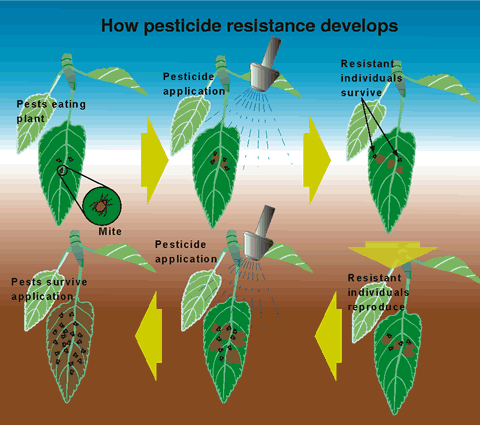
Though plant breeders can help plants develop this natural pest resistance, much of it is innate – the same as our own immune systems. When individual plants reproduce, they pass along exceptional combinations of genes to their offspring. Varying environments (such as cold, or dry, moist or breezy) favor individuals with different physical and behavioral traits. Individual plants with genes that improve their survival will be more likely to pass along these genes compared to the rest of the population.

There is no genetic manipulation via biotech technologies. None is needed. Mother Nature is pretty smart like that.
Of course, if the soil is replete with organic, non-industrial nutrients, the plants develop an even better immune system, and more resilient, and then pass these traits on to their progeny.
Though Monsanto has nothing at all to do with this process for a specific breed of tomato, they were able to get Patent EP1812575 – which has now been revoked. The tomatoes used to obtain their ‘monopoly’ on another seed were obtained from a gene bank in Gatersleben, Germany, and it was already common knowledge that these plants had a desirable resistance to botrytis.
Monsanto’s clever lawyers created wording in their patent application to give the impression that the seed was genetically engineered to produce this quality. They made the tomato look their “invention.” This is essentially biopiracy.
The revoking of this patent is important because it tells Monsanto and other biotech companies that the world will not stand down to its abuse of patent laws. It will also allow plant breeders and home gardeners access to a larger variety of naturally resistant plants.
Christoph Then, a coordinator of No Patents on Seeds!, states:
“The intended resistance is based on complex genetic conditions, which are not known in detail. So genetic engineering is clearly not an option in this case.”
The coalition of No Patents on Seeds! has filed further oppositions against patents held by the US company covering broccoli which can be harvested mechanically (EP 1597965), melons that are resistant to plant viruses (EP1962578), and a selection of plants for breeding soybeans (EP 2134870) adapted to climate change.
Activists are calling on the European government to review the way patents are obtained by biotech, and to make certain that existing prohibitions on plant patents is observed. This, in turn, should make those who grow our food less dependant on biotech creations, and more self-reliant, as more diverse seed becomes available for planting.
Hundreds of plant and animal varieties that are the result of a biological process and not GMO tinkering have been given patents by the EPO, and over 2400 patents for genetically modified seeds have been given to Monsanto alone. This single company controls more than 25 percent of the world seed supply, and they aim to control more. We simply cannot let that happen.
Additional Sources:
No Patents on Seeds

Is Russia Anti-illuminati?

by Vladimir Putin
“It is a riddle, wrapped in a mystery, inside an enigma.” That memorable phrase came from the mouth of Winston Churchill, during a speech he gave to the British Parliament in 1939, when trying to describe Russian action.
Today, the characterization of Russia holds no cloud of mystery and its motives are clear. Prince Charles and Hilary Clinton have compared Russia’s President, Vladimir Putin, to Adolf Hitler. President Obama has declared Russia one of the three major threats that face the world today, along with the terrorist group ISIS and the Ebola disease. And one only has to look to NATO’s twitter page to find their animosity towards Russia. But is this hostility warranted? An obvious “yes” would be said by anyone who accepts Western media as honest, unbiased journalism when they report on Russia’s actions in Ukraine and its involvement in that crisis.
But if one were to look beyond the Western propaganda, and straight to the facts, one could reasonably conclude that Russia, in a very sticky situation, has acted prudently and sensibly. If this is the case, then why the hostility? Why the propaganda? If one believes the illuminati is real — that this cult has a long-term plan for the world, and has considerable influence over Western governments, media and military organizations for which to advance that agenda — then it’s likely that the true motive behind the condemnation of Russia is because of Russia’s independence from this group and their unwillingness to cooperate.

Ukraine Crisis

Like the majority of revolts and revolutions throughout history, the crisis in Ukraine came about due to poor economic conditions. Just before all hell broke loose, the Ukrainian parliament held an important vote deciding whether to sign a trade agreement with the European Union or the Russian Federation. They ended up voting for Russia and this result angered many of the citizens in the capital of Kiev and they took to the streets to protest. The protest quickly escalated, as protestors begin clashing with police. This uprising fed momentum to the opposition party, a right-wing nationalist party who’s minions, a neo-fascist militant group called ‘Right Sector’, were the main instigators in clashing with the police. (1)
As the uprising worsened, the President at the time, Viktor Yanukovych, conceded to the demands of the opposition party and agreed to sign the trade agreement with the European Union. But this wasn’t enough to satisfy the Right Sector group, as they stormed the parliament building and overthrew the government, with Yanukovych fleeing to Russia. (2) There has always been tension between the Ukraine nationalists and ethnic Russians living in Ukraine. The country used to be part of Russia, under the old Soviet Union, so there are still many ethnic Russians living in Ukraine. Seeing the government toppled by extreme nationalists, the southernmost territory of the country, Crimea, began their paperwork to legally separate from Ukraine and join Russia. The large majority of people living in Crimea are ethnic Russians, who speak Russian and identify themselves as Russian. So when the government of Crimea held a referendum on whether to succeed to Russia or stay with Ukraine, the citizens of Crimea overwhelmingly voted to join Russia, with over 96% voting to do so. (3) This vote and result enraged much of the Western world, as their leaders united in opposition against Russia, accusing it of violating international law and threatening the territorial integrity of Ukraine.
The issue whether Crimea should be allowed to succeed from Ukraine comes down to property rights. Who owns property and land? Is it the government or the people? Those who believe in liberty, human rights and the right to property would argue that the citizens of Crimea have the right to self-determination, and that the referendum that the Crimean government held was absolutely legal under law. The fact that there were Russian troops in Crimea was not a breach of international law, considering that years before, Ukraine and Russia had signed a treaty allowing Russian troops to be stationed in Crimea in exchange for discounted gas. (4) Also, Yanukovych, the legitimate leader of Ukraine, asked Russia for military support in protecting the citizens after the coup. (5) And with violent, neo-fascists — fashioning Nazi-like symbols on their uniforms, and having ultranationalist, anti-Russian views — now in control of the capital, how could Russia refuse to protect their brothers and sisters in Crimea?
After witnessing the success of Crimea’s referendum, territories in east Ukraine, such as Donesk and Luhansk, started discussing plans to join Russia as well. (6) But this was too much for the Ukrainian government to stomach, and so with support from the West, they launched a war against the pro-Russian separatists. Since day one, America has come out in support of the coup that occurred in Ukraine and hailed it a success for freedom. Since the beginning of the civil war with the Russian rebels, the U.S has supplied Ukraine’s military and supported its newly found government in taking decisive action against the rebels. And when the new president, Poroshenko, immediately allowed foreigners to hold positions of office, an American, Georgian and Lithuanian received positions in the Ukraine government. (7) American Natalie Jaresko, former employee of the U.S State Department and head of the Horizon Capital Investment Fund, is now the new finance minister of Ukraine. (8)

The Attack On Russia

The hypocrisy America is showing by condemning the actions of Russia has to be eroding what little credibility America has left in the world. Here is a country that has over 1000 military bases, in 130 countries and is directly involved in the internal conflicts of 74 nations. (9) America’s imperialistic foreign policy is incredibly ruthless and destructive all around the world, but as soon as Russia gets involved with a conflict occurring in its neighbouring country, America objects, and denounces Russia for violating international law. Russia hasn’t violated international law, but in a world where America is the loudest voice, it acts as both accuser and judge.
Currently, the more prominent countries that have placed sanctions on Russia are: the U.S, Canada, the Europe Union, Japan, Australia and Switzerland. These sanctions on capital and trade have hurt the Russian economy. By putting embargoes on Russia, it has blocked Russians from exporting their goods to some of their closest trading partners in Europe and the sanctions on their banks have prevented them from accessing the credit markets of the West. Due to the sanctions, the Russian rouble has steadily declined in value against the dollar, raising the cost of imports, and thus raising consumer prices.
But what turned the situation into a full blown crises has been the recent, dramatic drop in the price of oil. Russia’s major export is oil and gas, but with a barrel of oil dropping below $60, this has cut into Russia’s revenue and because of that, has hurt Russia’s economic viability. Due to the drop in oil prices, speculation in the currency markets has the Russian rouble tanking, losing 20% against the dollar in one day — its biggest single day drop since Russia’s currency crisis of 1998 — and losing 60% on the year. (10) This devaluation has led the Central Bank of Russia to raise its interest rates to 17%, hoping to prevent more money from leaving Russia. The substantial drop in the price of the most important economic commodity doesn’t make much sense in a world where the majority of governments are printing money. Some have suggested that the U.S and Saudi Arabia are working together to drive down the price of oil to hurt their respective adversaries, Russia and Iran. (11) Saudi Arabia has come out and said that they are prepared for $20, $30 or $40 prices. (12) And thanks to investigative journalist, Matt Taibbi of Rolling Stone, we know that any market can be subject to manipulation, by the colluding of the major banks. (13) It wouldn’t be a stretch to suggest that this recent drop is not the result of natural market forces but of market manipulation, with the purpose of hurting Russia more severely than the sanctions.
Recently, Russia’s foreign minister has come out and said that the West’s goal, with regards to Russia, is regime change. (14) The recent sanctions bill signed by President Obama has in it the authorization to spend $20 million in each of the next three years to promote democracy, independent news media, uncensored internet access and anti-corruption efforts in Russia. (15) This provision has all the makings of a strategy to change Russia from within, which has been a strategy America has employed in other countries. (16) With the current economic crisis in Russia, the time is ripe for America to meddle in Russia’s domestic affairs and stir up protests with its people to try and oust the current regime. But most threatening to Russia is NATO and their military buildup on the boarders of Russia. With anti-ballistic missile systems, troops on the ground and warships in the water, in the eastern European countries that surround Russia, NATO is just waiting for an excuse to attack Russia. (17) Each NATO country, such as Norway, Poland and Latvia, is in essence, NATO itself.

Russia’s Geopolitical Positions

Russia, on different occasions, has been directly opposed to many of the West’s military action around the world. Back in March of 2003, Russia declared it would use its veto power, given to all member nations of the UN security council, to block a U.S sponsored resolution that gave Saddam Hussein a March 17th deadline to disarm before they took action. (18) Then a couple weeks later, after the fighting began, President Putin warned the West that they were making a grave mistake by “shaking the foundations of global stability and international law.” (19) But in Libya, Russia took a different approach and refrained from voting on the resolution to create a no-fly zone in Libya. By not vetoing the UN Security Council’s resolution, it was allowed to pass. A public dispute over this decision broke out in Russia between, then President Dmitri Medvedev and then Prime Minister Vladimir Putin, when Putin called the resolution “deficient and flawed” and compared it to a medieval crusade. (20) But since the President of Russia is the Commander-In-Chief, Medvedev, at the time, was able to override Putin. But Putin’s anger came to a boiling point after Gaddafi was killed. In a official visit to Denmark, when asked about the situation in Libya he said:
“The coalition said destroying Gaddafi was not their goal. Then why bomb his palaces? Now some officials have claim that eliminating him, was in fact, their goal. Who gave them that right? Did he have a fair trial? Returning to the no-fly zone, the bombings are destroying the country’s entire infrastructure. When the so called ‘civilized world’ uses all its military power against a small country, destroying what’s been created by generations, I don’t know if that’s good.” (21)
Putin returned to the presidency in 2012, and a year later, when the U.S and Britain were calling for airstrikes against Syria, he made sure Russia didn’t make the same mistake twice, and the country strongly came out against the airstrikes, and this time, together with China, vetoed the resolution. Putin even wrote an op-ed piece in the New York Times, taking his case directly to the American people as for why the airstrikes were a bad idea. (22)

Russia Today

Russia Today is the state sponsored news network that has gained a loyal following based on the networks ability to broadcast the real news to English, Spanish and Arabic audiences around the globe. The stories that are covered are the critical events happening in our world, but also other important subjects that aren’t covered by the mainstream media. Covering stories relating to scandal, corruption and conspiracy, revealing true motives of the people or institutions involved, has led the network to gain its credibility. Subjects on financial corruption, power abuses, corporate misconduct, environmental concerns, and many others that are seen as too sensitive to the special interests that own traditional networks, to be broadcast on Western media.

Edward Snowden

The famous NSA contractor turned whistleblower, Edward Snowden, would face the full wrath of the U.S government, if given the chance, for his role in revealing to the world the U.S government’s capacity for spying and exactly who they are spying on. What’s preventing  this from happening is that Snowden is currently being protected by Russia, where he has been given a 3-year residency after his initial temporary asylum had expired after his first year staying in Russia. The Russians are refusing to give him up to the U.S government after being asked to do so multiple times. Snowden never planned on staying in Russia. His original plan was to stay in Hong Kong until they gave him up, and then he decided he would go to Latin America. But after the U.S government revoked his passport, while he was in Russia, and seeing how the plane of the Bolivian President was forced to land due to the U.S government’s suspicion that Snowden was on it, he decided staying in Russia was his best option. (23)

Winter Olympics

The Winter Olympic games that were held in Sochi this year were very important to Russia. The Soviet Union collapsed in 1991 and since then Russia has had to rebuild its country from the ground up. In the early years, it was very bleak for Russians, as living standards dropped for many and inflation rose substantially, and corruption and lawlessness spread throughout the country. But in 2000, when Putin became President, he was able to bring order and stability to Russia, and their economy grew 9 straight years, which raised living standards for Russians. (24) Today, Russia has regained its role on the world stage, and these Olympics were a chance to show the world a new Russia, in hopes of promoting a more positive image, and encourage the business class to invest there. But leading up the games, there was much paranoia and propaganda with regards to terrorism. Many Western countries told their athletes not to bring their families to Russia. As a result, the world was scared off and the turnout of spectators and foreign visitors to Russia was greatly diminished.

Putin Quotes

Vladimir Putin is currently enjoying an approval rating that is unparalleled compared to leaders in the West. He is beloved in Russia but also has support from all over the world. The reason is simple: He’s straight forward and speaks honestly, with no reservation for calling it like it is. Below are just a few of the many refreshing quotes Putin has said:
“In Syria, as in the past, the United States and its allies started directly financing and arming rebels and allowing them to fill their ranks with mercenaries from various countries. Let me ask where do these rebels get their money, arms and military specialists? Where does all this come from? How did the notorious ISIS manage to become such a powerful group, essentially a real armed force? As for financing sources, today, the money is coming not just from drugs, production of which has increased not just by a few percentage points but many-fold, since the international coalition forces have been present in Afghanistan. You are aware of this. The terrorists are getting money from selling oil too. Oil is produced in territory controlled by the terrorists, who sell it at dumping prices, produce it and transport it. But someone buys this oil, resells it, and makes a profit from it, not thinking about the fact that they are thus financing terrorists who could come sooner or later to their own soil and sow destruction in their own countries.” (25)
“Let’s ask ourselves, how comfortable are we with this, how safe are we, how happy living in this world, and how fair and rational has it become? Maybe, we have no real reasons to worry, argue and ask awkward questions? Maybe the United States’ exceptional position and the way they are carrying out their leadership really is a blessing for us all, and their meddling in events all around the world is bringing peace, prosperity, progress, growth and democracy, and we should maybe just relax and enjoy it all? Let me say that this is absolutely not the case.” (25)
“They say we are violating norms of international law.  Firstly, it’s a good thing that they at least remember that there exists such a thing as international law – better late than never.”(26)
“Our western partners, led by the United States of America, prefer not to be guided by international law in their practical policies, but by the rule of the gun. They have come to believe in their exclusivity and exceptionalism, that they can decide the destinies of the world, that only they can ever be right. They act as they please: here and there, they use force against sovereign states, building coalitions based on the principle “If you are not with us, you are against us.” To make this aggression look legitimate, they force the necessary resolutions from international organisations, and if for some reason this does not work, they simply ignore the UN Security Council and the UN overall.” (26)

A World Of Unknowns

In the eyes of the awakened and aware observer of the world, the U.S government is at the head of global tyranny. Yet its difficult to find criticism of America’s actions from other major powers of the world, especially in the West. The reason being, these puppet governments are controlled by the same influence that uses America as its leading force. But Russia, a massive country that can’t be easily conquered, has been a voice of criticism and because of that, has had to face the consequences of being that opposing force. Now whether the Georgian War of 2008, the downing of Malaysian flight MH17, or that mysterious flash of light that lit up the Russian sky, are the covert, indirect actions taken by this group against Russia, we don’t know. Or whether both opposing sides, the U.S and Russia, are just being used for a greater agenda, we don’t know. All we can do is look at the evidence we are privy to and base our own conclusions accordingly.
Sources
1 – http://www.channel4.com/news/kiev-svoboda-far-right-protests-right-sector-riot-police
2 – http://www.dailymail.co.uk/news/article-2591624/Fears-neo-fascist-uprising-Ukraine-far-right-group-storms-Kiev-parliament-ex-president-calls-independence-vote.html
3 – http://www.washingtonpost.com/world/crimeas-parliament-votes-to-join-russia/2014/03/17/5c3b96ca-adba-11e3-9627-c65021d6d572_story.html
4 – http://en.wikipedia.org/wiki/Kharkiv_Pact#Effects
5- http://www.upi.com/Top_News/World-News/2014/03/04/Ousted-Ukrainian-president-asks-Putin-to-send-Russian-forces-to-Ukraine/1661393915423/
6 – http://www.theguardian.com/world/2014/may/12/ukraine-crisis-donetsk-region-asks-join-russia
7 – http://rt.com/news/210883-ukraine-foreigners-government-poroshenko/
8 – http://en.wikipedia.org/wiki/Natalie_Jaresko
9 – http://www.washingtonsblog.com/2013/05/u-s-currently-fighting-74-different-wars-that-it-publicly-admits.html
10 – https://uk.news.yahoo.com/ruble-loses-20-crashes-100-132519440.html#Ed4veBM
11 – http://oilprice.com/Energy/Oil-Prices/Did-The-Saudis-And-The-US-Collude-In-Dropping-Oil-Prices.html
12-  http://oilprice.com/Energy/Oil-Prices/Saudi-Arabia-Ready-For-20-30-40-Oil.html
13 – http://www.rollingstone.com/politics/news/everything-is-rigged-the-biggest-financial-scandal-yet-20130425
14 – http://www.reuters.com/article/2014/11/22/us-ukraine-crisis-idUSKCN0J609G20141122
15 – http://www.nytimes.com/2014/12/17/world/europe/obama-signing-russia-ukraine-sanctions-bill.html?_r=0
16 – http://en.wikipedia.org/wiki/Covert_United_States_foreign_regime_change_actions
17 – http://www.bbc.com/news/world-europe-26866989
18 – http://www.cnn.com/2003/WORLD/europe/03/10/sprj.irq.russia.vote/index.html
19 – http://www.cnn.com/2003/WORLD/europe/03/28/sprj.irq.putin/index.html
20 – http://www.cnn.com/2011/WORLD/europe/03/21/russia.leaders.libya/index.html
21 – https://www.youtube.com/watch?v=Iw5Ij_RFJ1Q
22 – http://www.nytimes.com/2013/09/12/opinion/putin-plea-for-caution-from-russia-on-syria.html?pagewanted=all
23 – http://en.wikipedia.org/wiki/Edward_Snowden
24 – http://english.cntv.cn/program/newsupdate/20120507/111359.shtml
25 – http://www.lewrockwell.com/2014/10/paul-craig-roberts/why-is-putin-hated/
26- http://eng.kremlin.ru/transcripts/6889
How America is being mind-controlled with chemical alterations designed by Big Pharma 2014-12-29
By Jennifer Lilley | naturalnews.com


While Big Pharma tries to instill the promise that they have patients' best interests at heart, most people beg to differ. Missing data (remember Merck's Gardasil, an HPV drug tested and approved for both men and women, when in actuality, there was information pertaining only to its impact on male subjects?), greed, a hodgepodge of toxic chemicals and suppression of symptoms rather than truly addressing (and ideally, ridding) them are often all part of the dance.

It's not any surprise, then, that researchers have discovered that a popular class of psychiatric drugs designed to treat depression can alter the brain's architecture in just a few short hours. Such alteration isn't to the person's advantage either; in addition to changes in the brain, experts found that most patients experience improvements in mood not in hours or days thereafter, but weeks.

Findings show how brain connectivity is altered when exposed to antidepressants

Researchers from the Max Planck Institute in Leipzig, Germany, used a magnetic resonance imaging (MRI) machine to compare the brain connectivity in people who take such drugs and those who don't. To most accurately assess their observations, they specifically focused on changes in the brain when participants daydreamed, as experts have found that such a way of thinking is a strong indication of properly functioning brain connectivity.

The findings, published in the journal Current Biology, showed that serotonin decreased functional connectivity. Drugs referred to as selective serotonin reuptake inhibitors (SSRIs) are used to help treat depression and are most commonly known by names such as Prozac, Zoloft, Lexapro, Paxil and Celexa.

The study, titled "Serotonergic Modulation of Intrinsic Functional Connectivity," notes the following:

Here, we show evidence that a single dose of a serotonin reuptake inhibitor dramatically alters functional connectivity throughout the whole brain in healthy subjects (n = 22). Our network-centrality analysis reveals a widespread decrease in connectivity in most cortical and subcortical areas.

Interestingly, there was also the finding that some areas of the brain appeared to behave to the contrary, as was the case of the cerebellum and thalamus, which play a role in motor function and even performing higher-level cognitive tasks.

"It was interesting to see two patterns that seemed to go in the opposite direction," said neuroscientist Dr. Julia Sacher, who also co-authored the study. "What was really surprising was that the entire brain would light up after only three hours. We didn't expect that."

The overall disruptions in the brain are concerning, especially considering that people don't typically feel improvements in mood for up to two weeks after taking depression drugs. This fluctuation in brain architecture that involves an ebb and flow of connectivity and alterations in synapses don't necessarily translate to SSRI success -- as much more needs to be studied in this area -- and for many, may raise questions about the fact that it could be doing more harm than good.

Expert says that "in a perfect world" non-pharmacological methods would receive more attention

"In a perfect world, you would look not only at SSRIs, but all sorts of medications and non-pharmacological interventions," said Sacher. "That would really help to tailor individual therapy for someone in the midst of a depressive episode."

Natural, non-pharmacological ways to help manage depression include maintaining a balanced diet that involves consumption of more protein (which helps produce serotonin) and vegetables, exercising and speaking with a therapist. Foods rich in antioxidants and omega-3 fatty acids are most beneficial; flax seeds, spinach, beets, walnuts and sunflower seeds have been found to be particularly beneficial. Lentils, beans and green tea also help the brain regulate mood, which is essential for those suffering from depression.

[...]

Read the rest: naturalnews.com

The Dominant Life Form in the Cosmos Is Probably Superintelligent Robots ~ Dr.Joseph P.Farrell wrote an VERY INTERESTING "white paper" on His Site, Called "Artificial Intelligence and the Fall of Lucifer " (gotta be an member to read) ... ya should read it ,folks :o & maybe ya wont B so quick ta jam that elect~trode up yer ass Lol  Oops


Written by

Maddie Stone


If and when we finally encounter aliens, they probably won’t look like little green men, or spiny insectoids. It’s likely they won’t be biological creatures at all, but rather, advanced robots that outstrip our intelligence in every conceivable way. While scores of philosophers, scientists and futurists have prophesied the rise of artificial intelligence and the impending singularity, most have restricted their predictions to Earth. Fewer thinkers—outside the realm of science fiction, that is—have considered the notion that artificial intelligence is already out there, and has been for eons.
Susan Schneider, a professor of philosophy at the University of Connecticut, is one who has. She joins a handful of astronomers, including Seth Shostak, director of NASA’s Search for Extraterrestrial Intelligence, or SETI, program, NASA Astrobiologist Paul Davies, and Library of Congress Chair in Astrobiology Stephen Dick in espousing the view that the dominant intelligence in the cosmos is probably artificial. In her paper “Alien Minds," written for a forthcoming NASA publication, Schneider describes why alien life forms are likely to be synthetic, and how such creatures might think.
“Most people have an iconic idea of aliens as these biological creatures, but that doesn’t make any sense from a timescale argument,” Shostak told me. “I’ve bet dozens of astronomers coffee that if we pick up an alien signal, it’ll be artificial life.”
With the latest updates from NASA’s Kepler mission showing potentially habitable worlds strewn across the galaxy, it’s becoming harder and harder to assert that we’re alone in the universe. And if and when we do encounter intelligent life forms, we’ll want to communicate with them, which means we’ll need some basis for understanding their cognition. But for the vast majority of astrobiologists who study single-celled life, alien intelligence isn’t on the radar.
“If you asked me to bring together a panel of folks who have given the subject much thought, I would be hard pressed,” said Shostak. “Some think about communication strategies, of course. But few consider the nature of alien intelligence.”
Schneider’s paper is among the first to tackle the subject.

I’m not saying that we’re going to be running into IBM processors in outer space. In all likelihood, this intelligence will be way more sophisticated than anything humans can understand.

“Everything about their cognition—how their brains receive and process information, what their goals and incentives are—could be vastly different from our own,” Schneider told me. “Astrobiologists need to start thinking about the possibility of very different modes of cognition.”
To wit, the case of artificial superintelligence.
“There’s an important distinction here from just ‘artificial intelligence’,” Schneider told me. “I’m not saying that we’re going to be running into IBM processors in outer space. In all likelihood, this intelligence will be way more sophisticated than anything humans can understand.”
The reason for all this has to do, primarily, with timescales. For starters, when it comes to alien intelligence, there’s what Schneider calls the “short window observation”—the notion that, by the time any society learns to transmit radio signals, they’re probably a hop-skip away from upgrading their own biology. It’s a twist on the belief popularized by Ray Kurzweil that humanity’s own post-biological future is near at hand.
“As soon as a civilization invents radio, they’re within fifty years of computers, then, probably, only another fifty to a hundred years from inventing AI,” Shostak said. “At that point, soft, squishy brains become an outdated model.”
Schneider points to the nascent but rapidly expanding world of brain computer interface technology, including DARPA’s latest ElectRX neural implant program, as evidence that our own singularity is close. Eventually, Schneider predicts, we’ll not only upgrade our minds with technology, we’ll make a wholesale switch to synthetic hardware.
Image: YouTube screenshot
“It could be that by the time we actually encounter other intelligences, most humans will have substantially enhanced their brains,” Schneider said.
Which speaks to Schneider’s second line of reasoning for superintelligent AI: Most of the radio-hot civilizations out there are probably thousands to millions of years older than us. That’s according to the astronomers who ruminate on such matters.
“The way you reach this conclusion is very straightforward,” said Shostak. “Consider the fact that any signal we pick up has to come from a civilization at least as advanced as we are. Now, let’s say, conservatively, the average civilization will use radio for 10,000 years. From a purely probabilistic point of view, the chance of encountering a society far older than ourselves is quite high.”
It’s certainly humbling to consider that we may be galactic infants of beetle-like intelligence compared with our cosmic brethren. But despite their superior processing power, there’s a fundamental aspect of cognition our interstellar neighbors may lack: Consciousness.
It sounds bizarre, but, Schneider writes, the jury’s still out on whether any artificial intelligence is capable of self-awareness. Simply put, we know so little about the neurological basis for consciousness; it’s almost impossible to predict what ingredients might go into replicating it artificially.
“I don’t see any good reason to believe an artificial superintelligence couldn’t possess consciousness, but it’s important to identify the possibility,” said Schneider.
Still, Schneider feels the assertion that artificial life simply can’t possess consciousness is losing ground.
“I believe the brain is inherently computational—we already have computational theories that describe aspects of consciousness, including working memory and attention,” Schneider said. “Given a computational brain, I don’t see any good argument that silicon, instead of carbon, can’t be a excellent medium for experience.”

You don’t spend a whole lot of time hanging out reading books with your goldfish. On the other hand, you don’t really want to kill the goldfish, either.”

I hope she’s right. Somehow, the notion of a galaxy teeming with soulless supercomputers is way creepier than introspective, WALL-E-like beings, or dry, sardonic Qs.
“It’s super creepy,” Schneider agrees. Indeed, Schneider, who has written extensively on the subject of brain uploading, urges that humans should reflect deeply on this potential consequence of cognitive enhancement.
The concept of superintelligent alien AI still sounds very speculative. And it is. But that doesn’t mean it’s not worth consideration. Indeed, expanding our purview of alien intelligence may help us identify life’s fingerprints in the cosmos. “So far, we’ve pointed antennas at stars that might have planets that might have breathable atmospheres and oceans and so forth,” Shostak told me. “But if we’re correct that the dominant intelligence in the cosmos is artificial, then does it have to live on a planet with an ocean?”
It’s a bit of a mind-bender to think that habitable worlds may hold false promise when it comes to advanced alien life, but that seems to be Shostak’s conclusion.
“All artificial life forms would need is raw materials,” he said. “They might be in deep space, hovering around a star, or feeding off a black hole’s energy at the center of the galaxy.” (That last idea has seen its way into a number of science fiction novels, including works by Greg Bear and Gregory Benford).
Which is to say, they could be, essentially, anywhere.
Begging a final question: How might superintelligent aliens view us? Will our cosmic cousins see us as nothing more than convenient biofuel, a la the Matrix? Or do they study us quietly from afar, abiding by a Star Trek-esque maxim of non-interference? Schneider doubts either. In fact, she reckons superintelligent aliens couldn’t really care less about us.
“If they were interested in us, we probably wouldn’t be here,” said Schneider. “My gut feeling is their goals and incentives are so different from ours, they’re not going to want to contact us.”
That’s a welcome divergence from Steven Hawking’s claim that advanced aliens might be nomads, looking to strip resources from whatever planets they can, and that all efforts to contact said aliens may end in our own demise.
“I’d have to agree with Susan on them not being interested in us at all,” Shostak said. We're just too simplistic, too irrelevant. “You don’t spend a whole lot of time hanging out reading books with your goldfish. On the other hand, you don’t really want to kill the goldfish, either.”
So, if we want to meet our galactic peers, it looks like we’ll probably have to keep seeking them out. That may take thousands or millions of years, but in the meanwhile, perhaps we’ll upgrade our own intelligence enough to level the playing field. And as an early Christmas present, it seems we can all tick alien robots juicing us for energy off the list of likely apocalypses.

Did Giants Exist? Part 1: Legends and America’s Giant Skeletons  ~ hehe could it be someone has been feeding us a bunch of shit bout "our" History     & don't U ever ,Ever wonder .....y ?    never ?


The universe is full of mysteries that challenge our current knowledge. In "Beyond Science" Epoch Times collects stories about these strange phenomena to stimulate the imagination and open up previously undreamed of possibilities. Are they true? You decide.
So much knowledge has been lost throughout the ages—destroyed by war, natural disasters, human ignorance, or simply by the erosion of time. However, with all that has been lost, much remains buried. Perhaps the clues to solving age-old mysteries are right beneath our feet.
In the search for evidence that giant existed, some have looked to the large mounds of the American Midwest, some to the massive and mysterious structures of the Middle East.
Abraham Lincoln stated, inspired by viewing Niagara Falls: “The eyes of that species of extinct giants, whose bones fill the mounds of America, have gazed on Niagara, as ours do now. Contemporary with the whole race of men, and older than the first man, Niagara is strong, and fresh today as 10,000 years ago.”
Giants-quotes-1
Monk's Mound at Cahokia, Ill. (Ethajek/Wikimedia Commons)
Monk’s Mound at Cahokia, Ill. (Ethajek/Wikimedia Commons)
The shadows of real giants loom large, some say, in the legends of many cultures. The controversial discoveries of skeletons measuring 7 feet to more than 9 feet tall, along with other artifacts, have suggested to some that truth inspired these legends.
Researchers who explore these possibilities, and often face ridicule from more conventional scientists, say that in the remote past giants with a median height of 7 feet or taller occupied the Earth alongside humans of roughly our size. Moreover, these giants may have had their own culture, civilization, and perhaps even several nations or races of giants may have existed at different times and in different places.

Giants Ubiquitous in Legend

The Bible references giants several times and in many sections. Genesis 6:4 in the King James Bible states: “There were giants in the Earth in those days; and also after that, when the sons of God came in unto the daughters of men, and they bore children to them, the same became mighty men which were of old, men of renown.” In other versions of the Bible, the “giants” are referred to as “Nephilim.”
Goliath, of the famous battle of David and Goliath (Samuel 1:17), was said to be approximately 9 feet and 9 inches tall, according to Bible Gateway. Goliath was the champion of the Philistine army; the young David stunned him with only a sling and stone, slaying Goliath moments later with his own sword.
MORE: Did Giants Exist? Part 2: Where Are the Skeletons Now?
Ancient Greek mythology tells of titans, the giants of prehistory. The primordial goddess Gaea gave birth to the titans, giants who walked the earth before the Olympians and man. Unfortunately for the titans, the Olympians would eventually overthrow them, banishing them to oblivion or eternally torturous tasks.
The Titans and giants imprisoned in Hell. An illustration by Gustave Doré's to Dante's Inferno, Plate LXV: Canto XXXI: The titans and giants. (Wikimedia Commons)
The Titans and giants imprisoned in Hell. An illustration by Gustave Doré’s to Dante’s Inferno, Plate LXV: Canto XXXI: The titans and giants. (Wikimedia Commons)
Pliny the Elder wrote in his famous “Naturalis Historica,” completed in 77 A.D., that giant skeletons had been found. He cited ancient sources, as did the 1st century Roman historian Titus Flavius Josephus, who mentioned multiple times the existence of giants in an earlier age.
The Mayans also have a giant story. Cabrakan, last of the Earth-giants of Guatemala, was so mighty he could throw mountains. But, alas, he was eventually tricked and poisoned by the Hero Twins, ending his prideful earthquake-causing ways, according to “The Myths of Mexico and Peru,” by Lewis Spence of Ball State University.

Did Early Explorers Find Giants in the New World?

In 1608, explorer John Smith wrote: “The Sasquesahanougs are a Gyant-like people.” He described them: “They measured the calf of the largest man’s leg, and found it three quarters of a yard about, and all the rest of his limbs were in proportion; so that he seemed the stateliest and most goodly personage they had ever beheld. His arrows were five quarters yard long, headed with the splinters of a white chrystal-like stone …”
Captain John Smith, painted from an earlier portrait by Simon de Passe, 18th century. (Wikimedia Commons)

John Smith's 1608 Map showing a male of the giant race he described.
John Smith’s 1608 Map showing in the top right a male of the giant race he described.
Hernando de Soto, a 16th century Spanish explorer who delved deep into the territory of what is today the United States, also described men half a yard taller than his tallest men.
Legends of giants are found among the Iroquois, the Osage, the Tuscaroras, the Hurons, the Omahas, and many other Native American peoples.

Giant Skeletons Found?

The mounds of the American Midwest, often related to Native American tribes and cultures, are believed by some to be the sacred burial mounds of giants. A plethora of newspaper clippings and journal articles documenting the discovery of skeletons anywhere from 7 feet to more than 9 feet tall permeate the 19th-century Midwest.
The Smithsonian has said measurements of such skeletons during this time period must have simply been mistaken. Douglas Ross Hamilton contacted the National Museum of Natural History, administered by the Smithsonian Institution, for comment before publishing his book, “A Tradition of Giants.” He wrote: “An example, contained in a personal communication from a Smithsonian staff member just prior to publication of this book, shows the ongoing denial plaguing the National Museum. The individual’s name is withheld by request, and I paraphrase: As it was in the early days of archaeological excavations, skeletons were sometimes measured as they were found. With the possibility of shifting bones, the re-location of the skull and the feet, an individual could (without doubt) be measured many inches (or even feet) longer than they would have been in life …”
Giants-quotes-2
Hamilton argued that not all the skeletons had shifted as such and even “by measuring the long bones of the leg coupled with the measure of the shoulder sockets and the size of the skull, there was little doubt of the stature in life.”
In the Sarasota Herald-Tribune, Jun 28, 1933, an article announced that more than a dozen skeletons, all more than 7 feet tall had been found in Catahoula parish, Louisiana, and the site had been examined by Smithsonian researchers. The report stated that the find “was regarded as contributing to the theory that the prehistoric mound-builder lived there.”
A clipping from the Sarasota Herald-Tribune, Jun 28, 1933.
A clipping from the Sarasota Herald-Tribune, June 28, 1933.
Hamilton cited “A History of Muskingum County,” written in 1884, which gave an account of giant remains found, apparently cremated after death, in Ohio: “Immediately behind, or west of the altar, were found three skeletons, deeply charred, and covered with ashes, lying faces upward, heads toward the south, measuring, respectively: 8 feet 10 [inches], 9 feet 2 [inches], and 9 feet 4 inches in length. In another grave a female skeleton 8 feet long, and a male skeleton 9 feet 4 inches long.”
In 1879, a 9-foot-8-inch skeleton was purportedly uncovered in a mound in Brewersville, Ind. These remains, however, were destroyed when a flood swept through the area in 1937, destroying the building in which the bones were being stored, according to a presentation by Larry Zimmerman of the Department of Anthropology and Museum Studies at Indiana University, titled “Lost Tribes, Sunken Continents, and Ancient Astronauts: On the Wild Side of Midwestern Archaeology.”
In 1871, in the township of Cayuga, Ontario, Canada, it is said that some 200 giant skeletons were uncovered, many of which were as tall as 9 feet and few of which were shorter than 6 feet. The site was open to any who wanted to take a look, and many flocked there. A comment sent by a reader who identified himself as a medical doctor, J.N. Johnstone, to the local newspaper the Hamilton Spectator, was republished by the New York Times on Sept. 10, 1871 reads: “Hearing of the curiosities found in a grave or pit near Cayuga, and being somewhat of a curiosity seeker, I paid it a visit, and deem myself well repaid for any trouble by what I saw. … The size of some of the bones is truly wonderful, indicating a race of giants in the past.”
A 1936 bulletin, written by G.I. Groves of the North American Indian Relic Collectors’ Association and cited by Hamilton, tells of an interesting excavation at the Spiro Mounds of Oklahoma: “Of the skeletal material, only four or five good specimens were found. One remarkable mummy was 8-1/2 feet in length. He had been cremated to such an extent that the flesh was charred,and remained in that condition throughout the ages.”
The bulletin describes the lack of attention paid to this discovery, stating that the remains were moved to a tent where some locals came to take a peek, “but no museum authorities or archaeologists were interested enough to investigate. After occupying for several weeks the only shelter available, it was moved to the rear of the tent to make room for more valuable relics, and left to the ravages of the elements. In a few weeks, it had disappeared.”
So, if all these bones were found, where are they now? Does the evidence only exist in old newspaper clippings?
Continue reading: “Did Giants Exist? Part 2: Where Are the Skeletons Now?”

How to Prepare for the Super Convergence: the Bio-Info-Nano Singularity? ~  Lol all this "stuff" is kinda neat/cool ? ..but these kooks never factor in EVIL ..nope never,never never til "their" monster starts chas~in "their" ass's hehe

Politics / Technology Dec 23, 2014 
By: DK_Matai
Politics
More than a century ago, in 1900, Lord Kelvin famously stated, "There is nothing new to be discovered in physics now. All that remains is more and more precise measurement." Five years later, Albert Einstein published his paper on special relativity, which challenged the very simple set of rules laid down by Newtonian mechanics, which had been used to describe force and motion for more than two hundred years.

Asymmetric Opportunities and Risks
Information and communication technologies -- of all kinds -- double their power measured in terms of price performance, capacity and bandwidth almost every year. As a result, we are witnessing accelerating trends of exponential growth in the Bio-Info-Nano (BIN) revolution unfolding all around us. Just as soon as we have grasped the relevance of some new BIN innovation, we are challenged by yet more extraordinary discoveries and inventions that completely overwhelm our expectations and understanding. The paradigm shifts, taken together, present asymmetric opportunities for unparalleled growth as well as rising asymmetric risks for humankind's globalised structure, its sustainability and longevity. This phenomenon of constant acceleration in new technologies is referred to as the Bio-Info-Nano Singularity by ATCA 5000 and Quantum Innovation Labs seeks to leverage this opportunity from an investment perspective.
Super Convergence of The Bio-Info-Nano (BIN) Singularity
The rise of the BIN Singularity suggests that technological progress is reaching such an extremely high, near infinite, value at a point in the near future that it will be impossible to predict what happens next based on extrapolations of past experience. In fact, that experience may be an obstacle to grasping the paradigm shift, which is forcing a multi-generational change. A Singularity is a point at which an otherwise continuous mathematical progression becomes infinite, implying that all continuous extrapolation breaks down beyond that point.
Known and Unknown Unknowns Multiply
Dramatic changes in the rate of world economic growth have occurred in the past because of technological advancement. Based on population growth, the global economy doubled every 250,000 years from the Palaeolithic era until the Neolithic Revolution. This new agricultural economy began to double every 900 years, a significant increase. In the current era, beginning with the Industrial Revolution, the world’s economic output has doubled as an average, every fifteen years, sixty times faster than during the agricultural era. As the rise of the Bio-Info-Nano (BIN) Singularity causes a similar revolution one could expect economic output to double much faster with the requirement for remarkably little human labour or intervention, and this may challenge our assumptions for future global economic growth and stability. It may not be business as usual because the resources of the planet to sustain humanity are finite.
Reverse Engineering The Human Brain
The human capacity for information processing is limited, yet there is an accelerating change in the development and deployment of new technology. This relentless wave upon wave of new information and technology causes an overload on the human mind by eventually flooding it. The resulting acopia -- inability to cope -- has to be solved by the use of ever more sophisticated information intelligence which reverse engineers the human brain. Extrapolating these capabilities suggests the near-term emergence and visibility of self-improving neural networks, sophisticated artificial intelligence, quantum algorithms, quantum computing and super-intelligence. This metamorphosis is so much beyond present human capabilities that it becomes impossible to understand it with the pre-conceptions and conditioning of the present mindset, societal make-up and existing technology.
Thinking In New Ways
At some point in the not too distant future, non-biological intelligence will combine the subtlety and pattern recognition strength of human intelligence, with the speed, memory, and knowledge sharing of machine intelligence. This new generation of human-like and transhuman machines capable of performing mental and physical tasks as capably as humans and better are likely to cause a rise in wages for a few extraordinary jobs at which humans can still outperform machines. However, a proliferation of human-like machines is likely to cause a net drop in ordinary wages, as humans compete with robots and soft-bots for jobs. Also, the wealth of the technological singularity may be concentrated in the hands of a few who own the means of mass producing the intelligent robot and soft-bot workforce. The Bio-Info-Nano Singularity is a transcendence to a wholly new regime of mind, society and technology, in which we have to learn to think in a new way in order to survive as a species. Why? Non-biological intelligence will continue to evolve exponentially whereas biological intelligence is effectively limited and fixed in terms of physical boundary conditions unless it begins to explore its connectivity with the infinite.
Intelligence Explosion
I J Good, in 1965, first wrote of an "intelligence explosion", suggesting that if machines could even slightly surpass human intellect, they could improve their own designs in ways unforeseen by their designers, and thus recursively augment themselves into far greater intelligences. The first such improvements might be small, but as the machines become more intelligent they would self-innovate, which could lead to a cascade of self-improvements and a sudden surge towards super-intelligence. This could now happen via the Bio-Info-Nano Singularity.
Modelling The Future
Vernor Vinge, in 1982, proposed that the creation of smarter-than-human intelligence represented a breakdown in humans' ability to model their future. The argument was that authors cannot write realistic characters who are smarter than humans. If humans could visualise smarter-than-human intelligence, we would be that smart ourselves. Vinge named this event "the Singularity". He compared it to the breakdown of the prevalent model of physics when it was used to model the gravitational Singularity beyond the event horizon of a black hole.
Sudden Growth
Ray Kurzweil, in 1999, generalised the Singularity to apply it to the sudden growth of any technology -- in a similar way to ATCA 5000's Bio-Info-Nano Singularity Super Convergence -- not just intelligence. He argued that Singularity is inevitably implied by a long-term pattern of accelerating change that generalises Moore's law to technologies predating the integrated circuit, and includes material technology especially as applied to nanotech, medical technology and other disciplines.
Methuselarity
Aubrey de Grey, in 2000, applied the term "Methuselarity" to the point at which medical technology improves so fast that expected human lifespan increases by more than one year per year.
Quantum Jumps in Economic Growth
Robin Hanson, in 2008, taking the term "Singularity" as opposed to "Paradigm Shift" to refer to sharp increases in the exponent of economic growth, lists the agricultural and industrial revolutions as past singularities. Although, his use of the term Singularity may be disputed. Extrapolating from such past events, Hanson suggests that the next economic Singularity should increase economic growth between 60 and 250 times. He conveniently ignores the resource constraints. Innovations, manifest as a result of the Bio-Info-Nano Singularity's approach, that allow for the replacement of virtually all human labour and material resources, could supposedly trigger such an event.
Redundancy & Irrelevance
The key question: What is globalised human society going to do with the mass of under-employed or unemployed human beings that are rendered irrelevant or redundant by the fast approaching Super Convergence of the Bio-Info-Nano Singularity?
Conclusion
We continue to strive to understand and to facilitate the ethical research, development and deployment of exponentially advancing Bio-Info-Nano (BIN) technologies for the benefit of the environment and humankind. We seek to work together both within the ATCA 5000 and beyond to apply, to focus and to guide these neo-renaissance Bio-Info-Nano tools to address humanity’s collective grand challenges in the 21st century. Much remains to be done to communicate the critical ethics, risks, effects and potential benefits of Bio-Info-Nano (BIN) technologies to the world at large. Promoting BIN advances through the creation of new businesses, new research directions and new collaborations remains central to our vision.
What are your thoughts, observations and views? We are hosting an Expert roundtable on this issue at ATCA 24/7 on Yammer.
By DK Matai
www.mi2g.net
Asymmetric Threats Contingency Alliance (ATCA) & The Philanthropia
We welcome your participation in this Socratic dialogue. Please access by clicking here.
ATCA: The Asymmetric Threats Contingency Alliance is a philanthropic expert initiative founded in 2001 to resolve complex global challenges through collective Socratic dialogue and joint executive action to build a wisdom based global economy. Adhering to the doctrine of non-violence, ATCA addresses asymmetric threats and social opportunities arising from climate chaos and the environment; radical poverty and microfinance; geo-politics and energy; organised crime & extremism; advanced technologies -- bio, info, nano, robo & AI; demographic skews and resource shortages; pandemics; financial systems and systemic risk; as well as transhumanism and ethics. Present membership of ATCA is by invitation only and has over 5,000 distinguished members from over 120 countries: including 1,000 Parliamentarians; 1,500 Chairmen and CEOs of corporations; 1,000 Heads of NGOs; 750 Directors at Academic Centres of Excellence; 500 Inventors and Original thinkers; as well as 250 Editors-in-Chief of major media.
The Philanthropia, founded in 2005, brings together over 1,000 leading individual and private philanthropists, family offices, foundations, private banks, non-governmental organisations and specialist advisors to address complex global challenges such as countering climate chaos, reducing radical poverty and developing global leadership for the younger generation through the appliance of science and technology, leveraging acumen and finance, as well as encouraging collaboration with a strong commitment to ethics. Philanthropia emphasises multi-faith spiritual values: introspection, healthy living and ecology. Philanthropia Targets: Countering climate chaos and carbon neutrality; Eliminating radical poverty -- through micro-credit schemes, empowerment of women and more responsible capitalism; Leadership for the Younger Generation; and Corporate and social responsibility.
© 2014 Copyright DK Matai - All Rights Reserved Disclaimer: The above is a matter of opinion provided for general information purposes only and is not intended as investment advice. Information and analysis above are derived from sources and utilising methods believed to be reliable, but we cannot accept responsibility for any losses you may incur as a result of this analysis. Individuals should consult with their personal financial advisors.