---BREAKAWAY CIVILIZATION ---ALTERNATIVE HISTORY---NEW BUSINESS MODELS--- ROCK & ROLL 'S STRANGE BEGINNINGS---SERIAL KILLERS---YEA AND THAT BAD WORD "CONSPIRACY"--- AMERICANS DON'T EXPLORE ANYTHING ANYMORE.WE JUST CONSUME AND DIE.---
There is no doubt that the U.S. military has the ability to
engage any foreign enemy and leave it dismantled or utterly destroyed.
This is one of the key reasons for why Russia and China have thus far
remained on the sidelines as it relates to direct military conflict.
But according to one intelligence insider, though our country is
unmatched on the traditional battlefield, a strike on the United States
could come in the form of coordinated asymmetric attacks that would
significantly level the playing field and lay waste to life as we know
it in modern-day America.
Jim Rickards, author of The Death of Money, knows a thing or
two about how foreign governments are approaching the question of
America’s global hegemony. He has worked closely with U.S. intelligence
agencies for decades and in 2007 was the operational director of the
country’s first ever financial war games. According to Rickards, don’t
expect our foreign enemies to be firing missiles at major cities any
time soon. If an attack is to come to our shores it won’t come in the
form of bombs and bullets. At least not at first.
In this absolutely must-watch interview with Future Money Trends,
Jim Rickards delves into scenarios that will change the very face of
our world over the next decade. He explains the complexities involving
the various geo-strategies currently at play and provides a realistic
view of the escalations we can expect to occur going forward as East and
West face off on the globally inter-connected battlefield of the early
21st century.
The Death of Money: The Coming Collapse of the International Monetary System - James Rickards
There’s not a country in the world that can stand up to
the United States in what’s called kinetic military warfare. So kinetic
just means things that shoot or explode. So missiles, bombs, submarines,
airplanes, etc., nobody can go toe to toe with the United States. We
can sink any navy, ground any force, disrupt any control communications
system anywhere in the world. So nobody wants to confront the U.S. in that space. But when you move over to what we call asymmetric warfare, or
unrestricted warfare, what is that? That includes things like cyber
warfare, financial warfare, weapons of mass destruction, chemical,
biological, radiological weapons, those types of things. It’s a much
more level playing field. Now the U.S is very good at it, don’t get me wrong, but so are others. And there it’s much more evenly matched. I say the Russians could use their hackers to shut down the
New York Stock Exchange, which they could. And one rebuttal I’ve heard
as well, is that U.S hackers could shut down the Moscow Stock Exchange.
And my answer is of course they could, but who wins? In other words, we
have a lot more to lose than they do. They shut down our stock exchange,
we shut down their stock exchange, they win because we have a much more
important exchange there. Who cares about the Moscow Stock Exchange?
So this is how you have to think about escalation and end games, and
what technically what we would call the game theoretic context within
which this is playing out. I’m not sure the U.S is very good at that. I
mean the U.S is very good at these kinds of financial warfare. I’m not
sure they’re very good at the kind of geo-strategic and theoretic
thinking that I’m describing to your listeners.
Right now the United States is actively conducting financial warfare
against Russia. As Jim notes in the above interview, we have begun
seizing the assets of Russian officials and are working to implement
sanctions on the global level. Vladimir Putin may not be planning to
launch nuclear strikes at U.S. cities as a result, but what if the Obama
administration crosses a line that shouldn’t be crossed? Could Putin
launch a counter attack in the cyber world? Perhaps, as noted by
Rickards, he would give the order to take down our stock exchanges, a
move that would wreak havoc across the entire world.
Former Homeland Security secretary Janet Napolitano has warned that a
cyber attack on the U.S. power grid or utility infrastructure is
inevitable. Sure, it could be instigated by rogue hackers, but for
widespread success in such a scenario it will likely come in the form of
a state sponsored asymmetric attack that may also involve other
non-kinetic means.
The fall out would be disastrous. But more frightening than that is
the question of how our country would respond. What would be the next
level of escalation?
During the cold war there existed a principle of Mutually Assured
Destruction (MAD). The idea was that if they fired their missiles, we
would fire our missiles. The threat of widespread destruction kept
thermo-nuclear warfare at bay for three decades. There were most
assuredly escalations even then. We came close to all out war with the
Soviet Union on at least two occasions, but everyone understood what it
meant.
As Rickards explains, today we have a similar principle but it seems
that Obama administration officials haven’t yet grasped its
implications:
Today what we have is mutually-assured financial
destruction. So the U.S. can absolutely use financial weapons against
Russia, there’s a lot of things we can do. But if we do anything beyond
tokens, a token would be some Oligarch doesn’t get to go to the Super
bowl, or you freeze the assets of some minor, mid-level guy who doesn’t
have any assets, those are token sanctions.
But if you deliver these serious sanctions, you can expect Russia to
escalate. Now initially, I thought the U.S. would understand this
construct, this theoretic construct, of escalation, further escalation,
ultimate mutually-assured financial destruction, and not go very far.
But this morning, as we speak, the U.S. has announced sanctions against
Igor Sechin.
That’s serious, he’s the real deal. So now my expectation, using the
frame-work I described, is that Russia will strike back in some way.
Within the framework described by Jim Rickards we can expect this
back and forth to continue. We’re seeing it play out in real time.
The United States was deeply involved in the Ukrainian revolution
from the outset. Moscow, not one to take things lying down as the west
moved in on a former Soviet Satellite, responded by deploying over
100,000 troops to the border and annexing Crimea. The U.S. subsequently
moved to implement financial sanctions against Russia’s top political
leaders and are reportedly looking into the personal assets of President
Putin himself. The Chinese jumped into the fray by voicing their
support for Russia through coming monetary changes
and warned that these sanctions could well backfire against the United
States. A few days later, President Obama deployed US troops to Poland
and other NATO allies. Now, as we learned this week, Russian strategic
bombers are making fly-by’s along our West Coast.
Slowly but surely this conflict is escalating.
What comes next is anybody’s guess, but we’re hardpressed to find any
scenario in which the United States or Russia de-escalate the tension.
Over coming weeks, months and years we should fully expect a continued escalation, eventually culminating in physical warfare. Also from Future Money Trends: Hyperinflation and Unsustainable Debt Obligations
Help Me Out Here: The Economics and Math of Sending Checks to the Unemployed
Editor’s Note: If anyone can make 1+1=3, it’s our benevolent government bureaucrats. Jim Quinn of The Burning Platform
gets into the nitty gritty of the economics, math, and statistics being
used to justify separating hard working Americans from their money.
You’ll be amazed at the sheer insanity of it and you’ll likely realize
(if you haven’t already) that the fiscal crises plaguing America can
only end with a total collapse of our way of life. Help me out here…
“Extending aid to the unemployed is not
only the right thing to do, it is also one of the best ways to stimulate
economic growth.”
That has become a frequent talking point whenever the subject of unemployment compensation is discussed.
New Hampshire Senator Jeanne Shaheen used that argument during an MSNBC interview.
“This is one of the best things we can do
to help stimulate the economy, because for every dollar we put in
unemployment, it pays back about $1.60. And we know that people who are
on unemployment are going to go out, and they’re going to spend that
money, they’re going to pay for groceries at their local grocery store,
they’re going to buy gas in their car.” —-from an article posted by
PolitiFact.com
PolitiFact.com rated Senator Shaheen’s statement as “Half True.”
Well, if it’s half true, that means it is also half false. So I sent
Senator Shaheen a simple math test. I was surprised when she replied,
and this is one of her answers. Her strong suit is not math.
Help me out here. I’m simply incapable of following the economics and
math of sending checks to the unemployed. It may be due to a case of
being terminally feeble-minded, but I don’t understand how an unemployed
person spending a tax dollar drawn out of a state or federal treasury
can magically produce a $1.60 return to the economy. In other words, the
taxes YOU paid out of your labor were worth only a dollar, but somehow
your tax dollar was suddenly worth $1.60 if the government takes it from
you and sends it to someone who is unemployed and spent it.
Think about that. Your taxed labor is
worth $1.00, while someone else’s non-labor is worth $1.60. One might
say, “Well, you didn’t spend it.” Of course you didn’t. The government
took it from you. But if the government lets you keep it and you spent
it, is THAT suddenly worth $1.60? I have yet to find anyone who says it
is. Oh, one more thing. Are there overhead expenses in handling your tax
dollar, such as the salaries of hundreds or thousands of state and
federal employess who take dollars out of the tax pile and process them
over to the unemployment compensation pile? Yes. Are these overhead
expenses part of the magic $1.60 equation? I’ll bet they aren’t. Here’s
the new math, and it’s pretty damn close to what Senator Shaheen is
claiming.
It gets worse. If you go to some websites, you’ll discover that
spending unemployment dollars actually DECREASES THE NUMBER OF PEOPLE IN
POVERTY AND CREATES JOBS, MILLIONS OF JOBS. Don’t believe me? Here’s
some quotes from the website of Center for American Progress (CAP) (Footnote 1), and its logic is being used by many high-level federal elected leaders, including Senator Shaheen.
“Over the past few years, unemployment benefits have
played a key role in helping unemployed workers pay their bills while
they search for a new job. (Ok, I’m with you so far.) There are fewer
people living in poverty in the United States because of these benefits.
The Census Bureau has reported that unemployment benefits pulled 3.2
million people out of poverty in 2010, on top of 3.3 million in 2009.”
Yikes! These statements peg the WTF meter. Then explain how
the number of people in poverty has increased from 11% to 14% of the
total population over that same time period, according to that same
Census Bureau, which I quote as follows.
“The annual poverty rate rose to a rate of 11.3 percent
in 2007 and increased from 11.3 percent in 2007 to 13.2 percent in 2009.
The 2011 annual poverty rate of 14.0 percent was higher than the 2009
annual poverty rate of 13.2 percent.”
So, how could over 6.5 million people be pulled out of
poverty by unemployment compensation when nearly 10 million MORE people
went into poverty in 2009-2011? Here’s the math that CAP used.
Back to more from these geniuses from CAP.
“Unemployment benefits also boost the economy. They
provide the biggest bang for the buck of the various kinds of government
spending. Over the Great Recession, for every $1 spent on unemployment
insurance benefits, the economy grew by $2, since recipients typically
spend—not save—those dollars. That spending helps boost local economies
as the unemployed can continue to pay their mortgage or rent and put
food on the table.”
Wow, this one tops Senator Shaheen’s claim of $1.60. And even more from CAP.
“The boost that benefits provide leads to job creation. According to a 2010 analysis by Wayne Vroman (Footnote 2),
an economist and senior fellow at the Urban Institute for the
Department of Labor, unemployment benefits increased employment on
average by 1.6 million jobs each quarter from mid-2008 through mid-2010.
Of that increase, nearly 900,000 more jobs existed because of regular
unemployment benefits, while two federally financed programs—Emergency
Unemployment Compensation and Extended Benefits, which provide
additional weeks of benefits after workers have exhausted the standard
26 weeks—were responsible for increasing employment on average by
slightly more than 700,000 each quarter.”
Yumping Yiminy, am I going mad? This gibberish says, “The longer you
don’t work and continue to draw and spend unemployment compensation, the
more jobs you create.” Did you do the math on that statement? I did.
There are 8 quarters from mid-2008 through mid-2010. So 8 x 1.6 million
jobs created per quarter equals 12.8 million jobs created. FROM
UNEMPLOYMENT COMPENSATION, for Pete’s sake. Yet the Federal Reserve
states that the total number of people employed in the U.S. during that
exact same time period went DOWN by 8.7 million.
I just know that there is someone out there in the cyber world who
can straighten me out on this. Am I incapable of critical thinking? Were
the math and econ teachers in my caveman K-12 and higher education
experience all fools? Is this where I’m headed? Some might say I’m
already there.
Footnotes.
(1) The Center for American Progress (CAP) is no fly-by-night
organization. It is a powerful, well-connected and partisan liberal
public policy research and advocacy organization. Its website states
that the organization is “dedicated to improving the lives of Americans
through progressive ideas and action”. CAP presents a liberal viewpoint
on economic issues and has its headquarters in D.C. Its president and
chief executive officer is Neera Tanden who worked for the Obama and
Clinton administrations and for Hillary Clinton’s campaigns. Its first
president and chief executive officer was John Podesta, who served as
chief of staff to President Bill Clinton. Podesta remains with the
organization as chairman of the board and currently serves as a
counselor to President Obama. He was born in Chicago.
(2) “According to a 2010 analysis by Wayne Vroman, an economist and
senior fellow at the Urban Institute for the Department of Labor” Did
that quote from the article, made by the Center for American Progress,
lead you to believe that Vroman works for the USG, specifically the
Department of Labor? He does not. He is an employee of the Urban
Institute, a so-called “non-partisan think tank” established in 1968
under the Lyndon Johnson administration. It receives 55% of its income
from the federal government for “studies.” 100% of the Urban Institute’s
employees political contributions went to Democrats, as reported by
U.S. News and World Report in 2013. Uh, that’s my definition of
non-partisan.
Russian Strategic Bombers On West Coast: Did They Take Down LAX Air Traffic Control Systems?
What’s even more alarming is that Russia is
making it clear that any attack on the Motherland would likely lead to
widespread bombardment of western interests. Nuclear capable Russian
bombers have been spotted all over the world as of late including in
Guam, Japan, South Korea and Europe.
Gen. Herbert Carlisle, Commander of United States Air Forces in the Pacific, acknowledged a significant increase in the activities by Russian long-range strategic aircraft flying along the California coast.
There was no comment about whether the aircraft were nuclear capable, but it has not been since the Cold War ended in the early 1990s that Russian patrols have skirted the West Coast and California.
Other than fleets of Russian bombers making passes in close proximity to U.S. interests, the military hasn’t reported anything else out of the ordinary.
But last week something weird happened in Los Angeles and it likely involved a high altitude fly over.
Air traffic controllers at Los Angeles LAX
airport reported that their computer systems were overwhelmed and
crashed, leading to hundreds of flight delays and cancellations across
the country. According to an NBC News investigation the outage was caused by the flyover of a U-2 spy plane. Apparently the 1950′s class spy plane entered LAX airspace at about 60,000 feet and its jamming systems crashed not only the primary air traffic control systems used to monitor and direct commercial airlines, but the back up systems as well.
A U-2 spy plane is being blamed for a software glitch at a Californian air traffic control center which led to delays earlier this week.
…
According to NBC News, the U-2 was flying at 60,000 feet, but air traffic control computers were attempting to keep it from colliding with planes that were actually miles beneath it.
The computers at the L.A. Center are programmed to keep commercial airliners and other aircraft from colliding with each other.
The spy plane’s altitude and route apparently overloaded a computer
system called ERAM, which generates display data for air-traffic
controllers. Back-up computer systems also failed
But within days of the original report, disseminated across broadcast networks all over America, the Air Forceofficially denied that it was a U-2 spy plane, claiming they found the glitch but provided no reason for what caused it:
It’s still not clear why the U-2
flew into the L.A. Center’s airspace, or why it didn’t give advance
warning of the flight, as per usual. According to NBC News, the nearby
Edwards Air Force Base and NASA’s Neil A. Armstrong Flight Research
Center (located at Edwards) “have been known to host U-2s.”
But an Edwards rep said no such planes are assigned to Edwards, and a NASA rep said that none of their U-2 planes were flying on Wednesday. The U.S. Air Force, on the other hand, confirmed that it had sent out a U-2 plane that day — but denied to that the spy plane caused the airport confusion. The Air Force Times has more:
Pentagon
spokesman Army Col. Steve Warren confirmed that there was a U-2
operating in the area. The Air Force “filed all the proper flight plan
paperwork … in accordance with all FAA regulations” and was conducting a
routine training operation,
Warren said. The FAA has issued a statement saying technicians have
“resolved the specific issue that triggered the problem,” but the agency did not say what the problem was. FAA
spokeswoman Laura Brown declined to comment about whether the U-2 was
connected to the computer problems at the control center.
With the revelation this week that Russia has deployed strategic
bomber fleets for fly-by’s along our West Coast to gather intelligence
and test their capabilities, is it possible that someone flipped a
switch to see what would happen?
The Air Force likely knows what caused the
outage but refuses to share details, which suggests that either the
United States was engaged in a military exercise and they want to keep
it under wraps, or, it was the Russians and going public could further
inflame the already heated geo-political climate.
Both the United States and Russia have
advanced stealth and jamming systems, either of which may have been
responsible for the LAX outage. But one particular technology stands
out, especially considering that Air Force technicians had to step in to
resolve the issue.
The United States, Russia and China have been testing non-nuclear capable electro-magnetic pulse technology
that can be deployed either via a missile or a attached to an airplane
while it travels in proximity to a particular target. Unlike the
nuclear-trigger Super EMP Weapons capable
of taking down the electrical infrastructure of an entire country if
detonated about 200 miles above the earth’s surface, non-nuclear EMP
technology is a line-of-sight weapon that can be directed at a specific
city, building or computer system.
In the United States a similar weapon is
called CHAMP (High Power Microwave Advanced Missile Project ) and is
manufactured by Boeing.
Boeing's "CHAMP" - Non-nuclear EMP weapon
We hit every target we wanted to. We prosecuted everyone. Today we made science fiction into science fact. We took out everything.
Granted, no missile was detected over the
United States within the time frame that LAX computers were taken out of
service, it’s important to keep in mind that CHAMP, while advanced, is
known to everyone and the technology is already at least half a decade
old.
It’s certainly possible, and probably likely,
that Russia has similar technologies and ones that do not necessarily
require a missile to deliver its “payload.”
With bombers flying right along our coast,
did Russia take the opportunity to utilize a new advanced technology to
target specific components of the air traffic control system, sending it into a frenzy?
I’ve
been concerned lately, watching the developing news about
exo-geopolitical competition, the emergence of the BRICSA entente, and
post-9/11 US “unipolarism,” that we are watching the emergence of Cold
War, Act Two. From the point of view of Realpolitik, the “war
on terror” has been, in a certain sense, a fizzle. People aren’t buying
it, and a more powerful “adversary” is needed in the Hegelian
dialectical scheme of things, and what better “rival” than a “resurgent
Russia”(with all the appropriate demonizations of the Russian leadership
in the Western press), a “threatening China”, and a BRICSA bloc intent
upon challenging western post-war international financial structure? In a
certain sense, the moves by the BRICSA nations are predictable blowback
against what I and others have been calling post-9/11 “unipolarism,” so
aptly announced by former president G.W. Bush: “if you’re not with us,
then you’re against us.”
To that end, it appears that RT (Russia Today), is picking up on the
meme, and either that Russia is “playing its scripted roll,” or that it
is reacting quite reasonably to a geopolitical situation, or both: US pushes to complete ‘project for military domination of entire planet’
The article is correct: the USA is the only nation on earth
whose military has divided up the globe into area commands. (For those
of you into the military symbolism, that would be the equivalent of
putting seven “x’s” over your headquarters units, with eight reserved
for the Pentagram in Washington. In other words, we’re way beyond army
groups and theater commands even of World War Two.)
But there have been curious setbacks along the way: Russia has not
rolled over and played dead. In fact, it has vigorously opposed American
interventionism, first in South Ossetia in 2008, more recently in the
Crimean peninsula, and, if the Russian version of the story is to be
believed, in the USS Donald Cook incident, where a Russian Sukhoi-24
bomber apparently quite convincingly demonstrated Russia’s ability to
jam our most sophisticated missile defense system radars.
More recently, there was a grounding of civilizan airliners in the American southwest, and we now have three different versions of that
story(sort of like all the versions of what really happened to Malaysia
Air Flight 370). We were told, first, that the grounding occurred
because of a computer glitch in a regional air traffic control
facility. Then we were told a second story, that the
system was affected by the overflight of an American U-2 spy plane. This
story didn’t really have wings, since U-2s fly all the time without
apparent affect on the air traffic control system(if they fly any more
at all).
Now there’s a third possibility making the rounds on the internet, and it made me sit up and take notice: Russian Strategic Bombers On West Coast: Did They Take Down LAX Air Traffic Control Systems?
Of all the stories floating out there about the grounding of flights
in the Southwestern USA, this is the one that makes the most sense to
me, and, following as it does the USS Donald Cook incident, it makes
sense: if true, then it would mean a further demonstration of Russian
capabilities, which, in the light of the equally mysterious take-downs
of the Russian GLONASS satellites (Russia’s equivalent system of GPS
satellites), suggests two things: (1) America is not the “sole
superpower,” and (2) the two countries are once again in Cold War mode,
poking sticks into each other’s cages to see what the other side is
capable of.
So what’s the bottom line?
I think the answer is simple: we’re watching the curtain being raised
on Cold War, Act Two. But there’s a difference this time, and it should
give everyone pause: this time, in the eyes of world opinion,
and even in the eyes of many Americans, it is the US power oligarchs,
and not the power oligarchs in Moscow, who are “the bad guys.” This time
it is not “the evil empire”, but the Pentagram empire, that is at
fault, and the usual tricks of the trade – television programs extolling
American heroism and military prowess and technology – are simply not
working. At best, they are holding actions to maintain the intellectual
grip on that portion of the American population that still believes in
the Warren Report, and that there’s nothing wrong with the system, while
the protection racket expands even as popular support rapidly
diminishes.
It’s a recipe, as the Soviet Communists discovered, that is counter to their own long term interests.
US Solitary Confinement: The World’s Largest Prison Population Increasingly Comprised of the Mentally Ill
As of late receiving much needed publicity and attention is the topic
of solitary confinement, especially mentally ill offenders serving time
in prisons throughout America. Similar to this unsettling trend, many
inmates waiting on death row have been found innocent through DNA
evidence that has prompted more states to suspend capital punishment –
18 now and growing. And the long needed reform of how the US justice
system has clogged up and weighed down both courts and prisons across
the nation with so many drug offenders comprising half the federal
prison population with an increase of thirteen fold in state prisons
since the 1980’s. Or the disproportionate racial inequality of how
America’s court system treats those accused of crimes with African
Americans constituting just 13% of the US population but making up half
the country’s prison population. Or the US as the world’s most blatant
human rights violator when it comes to incarcerating so many of its own
citizens – upwards of 2.3 million currently behind bars, well over ten
times the next nation and one quarter of the planet’s entire prison population despite comprising only 5% of all humans on earth.
All of these glaring facts reflect a very broken, shameful and
inhumane track record of unfairly meting out both justice as well as
punishment in America. And though many among us who are not in prison or
do not know anyone in prison may take a myopic, “out of sight, out of
mind” view of such unpleasant and unsettling prison statistics, it is
high time for major reform and fundamental change. As fellow human
beings, we need to take an honest hard look at the way our justice
system treats those who commit crimes. Something is terribly wrong when
those committing the most egregious and extensive crimes against
humanity on a massive global scale continue getting away with it due to
money and power that buys immunity while those poorest and generally
darker skinned amongst us continue forever getting the proverbial shaft.
For US leaders in a so called democracy (oops, I mean oligarchy) to
constantly boast such highfalutin principles as justice and equality for
all, it is long past time they finally start putting their money where
their mouth is instead of spouting off pious platitudes of lies and
hypocrisy everyone in the world knows to be pure bullshit.
Turning to some encouraging news for
a change, last Thursday Congressman Cedric Richmond (D-LA) brought
before the US House of Representatives a bill he is sponsoring called
the Solitary Confinement Study and Reform Act. Incarcerating an inmate
in a single cell for 23 or 24 hours a day with only an hour spent
outside the cell daily without contact with the fellow prison population
is simply inhumane and unjustified.
Human beings are social animals, needing others in order to both
thrive and survive. Depriving people of the opportunity to interact with
others for at least brief periods of time is highly detrimental to both
physical as well as psychological heath. Yet solitary confinement has
been a standard punitive weapon historically used in the United States
for many years, perhaps even centuries, against this nation’s civilian
as well as military prison populations. Over the last several years both
human rights activists as well as professional mental health advocates
have applied increasing pressure on the prison system to change its
policies toward this abusive practice that has never been governed with
any oversight or accountability. With alarming rates of teenagers as
well as adults killing themselves after being kept in prolonged
isolation that demonstrate excessive use of solitary confinement, the
first steps toward positive change appears to be finally underway.
Louisiana Congressman Richmond believes that for too many years
long-term solitary confinement has been used as an abusive form of
“cruel and unusual punishment” arbitrarily inflicted on prison
populations throughout America.
In recent years Angola State Prison in Louisiana has come under
intense criticism for its mishandling of “the Angola Three” who have
spent decades in solitary confinement. Two of the three inmates were
convicted in 1972 of allegedly killing a prison guard and were
subsequently placed in isolation cells ever since. They have maintained
their innocence throughout
claiming they were blamed because they had opened a chapter of the
Black Panthers inside the prison. The third member who had his
conviction for allegedly murdering a fellow inmate overturned was
released in 2001 after 29 years in solitary confinement. Last year
Herman Wallace just three days prior to his death was freed after four
straight decades. Only Albert Woodfox now in his early 70’s remains
still serving his last 42 years locked away in solitary confinement.
Angola prison officials have feebly attempted to justify retaining
the trio in special confinement for many decades on the grounds that
these senior citizens posed a dangerous threat to younger inmates. Such
blatant injustice has attracted a firestorm of criticism with several
documentaries, Amnesty International and South African religious leader
Desmond Tutu all speaking out against such excessively harsh and
deplorable punishment. United Nations Special Rapporteur on Torture Juan Mendez called the Louisiana prison’s treatment toward the Angola Three outright torture. The human rights expert on torture stated: “The circumstances of the incarceration of the so-called
Angola Three clearly show that the use of solitary confinement in the
U.S. penitentiary system goes far beyond what is acceptable under
international human rights law.”The UN defines torture as:
“any act by which severe pain or suffering, whether physical
or mental, is intentionally inflicted on a person for such purposes as
obtaining from him or a third person information or a confession,
punishing him for an act he or a third person has committed or is
suspected of having committed, or intimidating or coercing him or a
third person, or for any reason based on discrimination of any kind,
when such pain or suffering is inflicted by or at the instigation of or
with the consent or acquiescence of a public official or other person
acting in an official capacity.”Accordingly, the common US prison
practice of imposing solitary confinement on any inmate constitutes
torture that is internationally recognized and defined as another
extremely serious human rights violation of the first order. Not only is
the US the biggest worldwide offender with millions of humans
incarcerated, but it also ranks globally at or near the top as a
systematic and pervasive violator torturing thousands upon thousands at
any given moment presently sitting in solitary confinement behind bars
isolated from all contact with other human beings. And this is only
considering what the US is doing to its own citizens, much less the
thousands of foreign nationals being systematically and unlawfully
detained and tortured in secret locations throughout the world.
Obviously America ranks number one in that human rights violation as
well.
Representing the Angola Congressional district, Cedric Richmond
became involved in the plight of the Angola Three, feeling it was
incumbent upon him to make every effort to correct this longtime wrong
being committed in his own backyard.
Richmond’s bill co-sponsored by six other Democrats calls for a
commission to be established to arrive at federal guidelines of
uniformly applied specifications that warrant brief use of solitary
confinement throughout the prison system. Any states with prisons
violating the federal policy would lose 15% of their annual prison funding from the federal government.
Though critics favor complete abolishment of solitary confinement,
Amnesty International’s Jasmine Heiss concedes that Richmond’s bill is
at least a good first step in the right direction.
Few can argue the benefit of isolating a human being away from all
contact with other human beings. Imposing solitary confinement on any
individual is clearly a sadistic and inhumane practice that only causes a
person’s psychological condition to degenerate over time with full
blown psychosis invariably the end result in most cases.
In another positive recent development, three weeks ago New York City Mayor Bill de Blasio appointed prison reformer Joseph Ponte as
Department of Corrections Commissioner. Ponte is credited with reducing
solitary confinement in the state of Maine’s prisons by 60%. The
average length of time in Maine confinement dropped from 90 days to two
weeks, and any instances lasting longer than 72 hours needed his
personal approval. In view of the notorious rise in use of isolation for
prisoners at Rikers Island, the correctional officers union has already
made it known that Ponte’s authority over the Rikers prison guards is
not welcomed. But human rights, mental health and prison advocacy groups
are very encouraged by this latest change.
Back in February UC Santa Cruz Psychology Professor Craig Haney testified
in Sacramento warning the state government of the dire perils of
solitary confinement used so extensively in the California state prison
system, faulting the state for both the magnitude of prisoner numbers in
isolation as well as length of time in isolation. Haney has been
studying the effects of isolation on inmate populations for forty years.
He described to the legislators his observations: “Many inmates become deeply and unshakably paranoid, and are
profoundly anxious around and afraid of people (on those rare occasions
when they are allowed any contact with them). Some begin to lose their
grasp on their sanity and many others report struggling with it on a
daily basis.” Haney added, “Nearly a hundred have been there [in solitary confinement] for 20 years and over 500 for 10 years or more.”
Many of the estimated 20,000 to 80,000 US inmates currently serving
extended time in solitary confinement are either juveniles and/or
mentally ill. According to the National Alliance for the Mentally Ill,
approximately 25% of
the inmate population in America suffers from some form of mental
illness including such severe disorders as Schizophrenia, Major
Depression and Bipolar Disorder as well as such personality disorders as
antisocial, borderline, and intermittent explosive disorder.
Additionally, estimates that half the prison population in America have
substance abuse disorder, a serious mental or emotional disorder or
dually diagnosed with both. Since prison guards have little to no
understanding of mental illness and mental health issues, inmates
afflicted with often undiagnosed and untreated mental and emotional
disorders are particularly vulnerable to being singled out and placed in
solitary confinement, typically in response to their bizarre,
antisocial and/or unpredictable behavior symptomatically displayed.
As the United States moves into hardcore economic austerity with
rapidly declining, disappearing, under-funded social services offered
this nation’s mounting poor and needy population, prisons are
increasingly becoming de facto psychiatric facilities for a swelling
disenfranchised underclass. Yet prisons severely lack the needed mental
health services to even adequately address this mushrooming disaster of a
problem.
But in recent years with the proliferation of the prison industrial
complex that includes privatization of newly built prisons for profit
and refurbished prison labor camps, Homeland Security, FEMA and the US
military already have an ambitiously demonic plan for relocating andresettling thousands
upon thousands of Americans. Last week’s Supreme Court decision to
endorse Obama’s 2012 National Defense Authorization Act assures that the
government will utilize the vast resources of US military personnel to
execute FEMA roundups to imprison a portion of the US population.
A federal judge ruled last month that California’s excessive use of
pepper spray and solitary confinement on mentally ill inmates violates
their constitutional rights against cruel and unusual punishment. US
District Court Judge Lawrence Karlton ordered
the Department of Corrections to stop its current policy that
systematically uses chemical grenades and pumping an inordinate amount
of pepper spray on the 33,000 mentally ill inmates that comprise 28% of
the California inmate population in the major state prisons. After
viewing leaked videos of mentally debilitated prisoners in solitary
being horribly abused, the Sacramento judge gave the mandatory order to
revise its inhumane policies within a reasonable 60-day timeline.
Many prisons that systematically engage in segregating prisoners do
so for the sole purpose of making it conveniently less difficult to
manage their inmate populations often in overcrowded conditions that in
itself cause violence. If an inmate is prone to violently acting out,
unstable or unpredictable behavior, prison guards will arbitrarily
misuse their authority to punish those prisoners they view as
troublemakers, those perceived as challenging their authority, or simply
inmates with whom they tend to clash and have personality conflict. The
disparate hierarchical power structure between prison official and
inmate populations within the punitive milieu inherently lends itself
toward a proclivity for potential abuse. Convincing prison
administrators to regularly approve requests for targeted prisoners to
be punished in solitary is simply business as usual in most prison
settings. Yet the debilitating effects of prolonged isolation only
confirm that inmates already predisposed to impulse control and
aggression problems are propelled toward further bouts of unmanageable,
out of control behavior, making only for an escalating vicious cycle. It
is time to change prison policies to prevent torture amounting to cruel
and unusual punishment for thousands of individuals in the name of
honoring universal human rights for every human being. Joachim Hagopian is a West Point graduate and
former Army officer. His written manuscript based on his military
experience examines leadership and national security issues and can be
consulted at http://www.redredsea.net/westpointhagopian/. After the military, Joachim earned a masters degree in psychology and became a licensed therapist working in the mental health field for more than a quarter century. He now focuses on writing.
If Economic Cycle Theorists Are Correct, 2015 To 2020 Will Be Pure Hell For The United States
By Michael Snyder, on May 12th, 2014
Does
the economy move in predictable waves, cycles or patterns? There are
many economists that believe that it does, and if their projections are
correct, the rest of this decade is going to be pure hell for the United
States. Many mainstream economists want nothing to do with economic
cycle theorists, but it should be noted that economic cycle theories
have enabled some analysts to correctly predict the timing of
recessions, stock market peaks and stock market crashes over the past
couple of decades. Of course none of the theories discussed below is
perfect, but it is very interesting to note that all of them seem to
indicate that the U.S. economy is about to enter a major downturn. So
will the period of 2015 to 2020 turn out to be pure hell for the United
States? We will just have to wait and see.
One of the most prominent economic cycle theories is known as "the
Kondratieff wave". It was developed by a Russian economist named
Nikolai Kondratiev, and as Wikipedia
has noted, his economic theories got him into so much trouble with the
Russian government that he was eventually executed because of them...
The Soviet economist Nikolai Kondratiev (also written
Kondratieff) was the first to bring these observations to international
attention in his book The Major Economic Cycles (1925) alongside other
works written in the same decade. Two Dutch economists, Jacob van
Gelderen and Samuel de Wolff, had previously argued for the existence of
50 to 60 year cycles in 1913. However, the work of de Wolff and van
Gelderen has only recently been translated from Dutch to reach a wider
audience.
Kondratiev's ideas were not supported by the Soviet government. Subsequently he was sent to the gulag and was executed in 1938.
In 1939, Joseph Schumpeter suggested naming the cycles "Kondratieff waves" in his honor.
In recent years, there has been a resurgence of interest in the Kondratieff wave. The following is an excerpt from an article by Christopher Quigley that discussed how this theory works...
Kondratiev's analysis described how international
capitalism had gone through many such "great depressions" and as such
were a normal part of the international mercantile credit system. The
long term business cycles that he identified through meticulous research
are now called "Kondratieff" cycles or "K" waves.
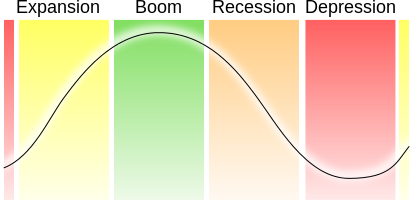
The K wave is a 60 year cycle (+/- a year or so) with internal phases
that are sometimes characterized as seasons: spring, summer, autumn and
winter:
Spring phase: a new factor of production, good economic times, rising inflation
Summer: hubristic 'peak' war followed by societal doubts and double digit inflation
Autumn: the financial fix of inflation leads to a
credit boom which creates a false plateau of prosperity that ends in a
speculative bubble
Winter: excess capacity worked off by massive debt
repudiation, commodity deflation & economic depression. A 'trough'
war breaks psychology of doom.
Increasingly economic academia has come to realize the brilliant
insight of Nikolai Kondratiev and accordingly there have been many
reports, articles, theses and books written on the subject of this
"cyclical" phenomenon. An influential essay, written by Professor W.
Thompson of Indiana University, has indicated that K waves have
influenced world technological development since the 900's. His thesis
states that "modern" economic development commenced in 930AD in the Sung
province of China and he propounds that since this date there have been
18 K waves lasting on average 60 years.
So what does the Kondratieff wave theory suggest is coming next for us?
Well, according to work done by Professor W. Thompson of Indiana
University, we are heading into an economic depression that should last until about the year 2020...
Based on Professor Thompson's analysis long K cycles have
nearly a thousand years of supporting evidence. If we accept the fact
that most winters in K cycles last 20 years (as outlined in the chart
above) this would indicate that we are about halfway through the
Kondratieff winter that commenced in the year 2000. Thus in all
probability we will be moving from a "recession" to a "depression" phase
in the cycle about the year 2013 and it should last until approximately
2017-2020.
But of course the Kondratieff wave is far from the only economic
cycle theory that indicates that we are heading for an economic
depression.
The economic cycle theories of author Harry Dent also predict that we
are on the verge of massive economic problems. He mainly focuses on
demographics, and the fact that our population is rapidly getting older
is a major issue for him. The following is an excerpt from a Business Insider article that summarizes the major points that Dent makes in his new book...
Young people cause inflation because they "cost everything and
produce nothing." But young people eventually "begin to pay off when
they enter the workforce and become productive new workers (supply) and
higher-spending consumers (demand)."
Unfortunately, the U.S. reached its demographic "peak spending" from
2003-2007 and is headed for the "demographic cliff." Germany, England,
Switzerland are all headed there too. Then China will be the first
emerging market to fall off the cliff, albeit in a few decades. The
world is getting older.
The U.S. stock market will crash. "Our best long-term and
intermediate cycles suggest another slowdown and stock crash
accelerating between very early 2014 and early 2015, and possibly
lasting well into 2015 or even 2016. The worst economic trends due to
demographics will hit between 2014 and 2019. The U.S. economy is likely
to suffer a minor or major crash by early 2015 and another between late
2017 and late 2019 or early 2020 at the latest."
"The everyday consumer never came out of the last recession." The
rich are the ones feeling great and spending money, as asset prices (not
wages) are aided by monetary stimulus.
The U.S. and Europe are headed in the same direction as Japan, a
country still in a "coma economy precisely because it never let its debt
bubble deleverage," Dent argues. "The only way we will not follow in
Japan's footsteps is if the Federal Reserve stops printing new money."
"The reality is stark, when dyers start to outweigh buyers, the
market changes." It all comes down to an aging population, Dent writes.
"Fewer spenders, borrowers, and investors will be around to participate
in the next boom."
The U.S. has a crazy amount of debt and "economists and politicians
have acted like we can just wave a magic wand of endless monetary
injections and bailouts and get over what they see as a short-term
crisis." But the problem, Dent says, is long-term and structural —
demographics.
Businesses can "dominate the years to come" by focusing on cash and
cash flow, being "lean and mean," deferring major capital expenditures,
selling nonstrategic real estate, and firing weak employees now.
The big four challenges in the years ahead will be 1) private and
public debt 2) health care and retirement entitlements 3) authoritarian
governance around the globe and 4) environmental pollution that
threatens the global economy.
According to Dent, "You need to prepare for that crisis, which will
occur between 2014 and 2023, with the worst likely starting in 2014 and
continuing off and on into late 2019."
So just like the Kondratieff wave, Dent's work indicates that we are
going to experience a major economic crisis by the end of this decade.
Another economic cycle theory that people are paying more attention
to these days is the relationship between sun spot cycles and the stock
market. It turns out that market peaks often line up very closely with
peaks in sun spot activity. This is a theory that was first popularized
by an English economist named William Stanley Jevons.
Sun spot activity appears to have peaked in early 2014 and is
projected to decline for the rest of the decade. If historical trends
hold up, that is a very troubling sign for the stock market.
And of course there are many, many other economic cycle theories that
seem to indicate that trouble is ahead for the United States as well.
The following is a summary of some of them from an article by GE Christenson and Taki Tsaklanos...
Charles Nenner Research (source)
Stocks should peak in mid-2013 and fall until about 2020. Similarly,
bonds should peak in the summer of 2013 and fall thereafter for 20
years. He bases his conclusions entirely on cycle research. He expects
the Dow to fall to around 5,000 by 2018 – 2020. Kress Cycles (Clif Droke) (source)
The major 120 year cycle plus all minor cycles trend down into late 2014. The stock market should decline hard into late 2014. Elliott Wave (Robert Prechter) (source)
He believes that the stock market has peaked and has entered a
generational bear-market. He anticipates a crash low in the market
around 2016 – 2017. Market Energy Waves (source)
He sees a 36 year cycle in stock markets that is peaking in mid-2013 and
will cycle down for 2013 – 2016. “… the controlling energy wave is
scheduled to flip back to negative on July 19 of this year.” Equity
markets should drop 25 – 50%. Armstrong Economics (source)
His economic confidence model projects a peak in confidence in August
2013, a bottom in September 2014, and another peak in October 2015. The decline into January 2020 should be severe. He expects a world-wide crash and contraction in economies from 2015 – 2020. Cycles per Charles Hugh Smith (source)
He discusses four long-term cycles that bottom in the 2010 – 2020
period. They are: Credit expansion/contraction cycle, Price
inflation/wage cycle, Generational cycle, and Peak oil extraction cycle.
So does history repeat itself?
Well, it should be disconcerting to a lot of people that 2014 is turning out to be eerily similar to 2007.
But we never learned the lessons that we should have learned from the
last major economic crisis, and most Americans are way too apathetic to
notice that we are making many of the very same mistakes all over again.
And in recent months there have been a whole host of indications that
the next major economic downturn is just around the corner. For
example, just this week we learned that manufacturing job openings have
declined for four months in a row. For many more indicators like this, please see my previous article entitled "17 Facts To Show To Anyone That Believes That The U.S. Economy Is Just Fine".
Let's hope that all of the economic cycle theories discussed above
are wrong this time, but we would be quite foolish to ignore their
warnings.
Everything indicates that a great economic storm is rapidly
approaching, and we should use this time of relative calm to get
prepared while we still can.
To understand how people look for movies, the video service
created 76,897 micro-genres. We took the genre descriptions, broke them
down to their key words, … and built our own new-genre generator.
If you use Netflix, you've probably wondered about the specific genres that it suggests to you. Some of them just seem so specific that
it's absurd. Emotional Fight-the-System Documentaries? Period Pieces
About Royalty Based on Real Life? Foreign Satanic Stories from the
1980s?
If Netflix can show such tiny slices of cinema to any given user, and
they have 40 million users, how vast did their set of "personalized
genres" need to be to describe the entire Hollywood universe?
This idle wonder turned to rabid fascination when I realized that I
could capture each and every microgenre that Netflix's algorithm has
ever created.
Through a combination of elbow grease and spam-level repetition, we
discovered that Netflix possesses not several hundred genres, or even
several thousand, but 76,897 unique ways to describe types of movies.
There are so many that just loading, copying, and pasting all of them took the little script I wrote more than 20 hours.
We've now spent several weeks understanding, analyzing, and
reverse-engineering how Netflix's vocabulary and grammar work. We've
broken down its most popular descriptions, and counted its most popular
actors and directors.
To my (and Netflix's) knowledge, no one outside the company has ever assembled this data before.
What emerged from the work is this conclusion: Netflix has
meticulously analyzed and tagged every movie and TV show imaginable.
They possess a stockpile of data about Hollywood entertainment that is
absolutely unprecedented. The genres that I scraped and that we
caricature above are just the surface manifestation of this deeper
database.
Netflix cooperated with my quest to understand what they internally
call "altgenres," and made VP of product innovation Todd Yellin, the man
who conceived of the system, available for an in-depth interview.
Georgia Tech professor and Atlantic contributing editor, Ian Bogost, worked closely with me recreating the Netflix grammar, and he programmed the magical genre generator above.
If
we reverse engineered Yellin's system, it was Yellin himself who
imagined a much more ambitious reverse-engineering process. Using large
teams of people specially trained to watch movies, Netflix deconstructed
Hollywood. They paid people to watch films and tag them with all kinds
of metadata. This process is so sophisticated and precise that taggers
receive a 36-page training document that teaches them how to rate movies
on their sexually suggestive content, goriness, romance levels, and
even narrative elements like plot conclusiveness.
They capture dozens of different movie attributes. They even rate the
moral status of characters. When these tags are combined with millions
of users viewing habits, they become Netflix's competitive advantage.
The company's main goal as a business is to gain and retain subscribers.
And the genres that it displays to people are a key part of that
strategy. "Members connect with these [genre] rows so well that we
measure an increase in member retention by placing the most tailored
rows higher on the page instead of lower," the company revealed in a 2012 blog post. The better Netflix shows that it knows you, the likelier you are to stick around.
And now, they have a terrific advantage in their efforts to produce
their own content: Netflix has created a database of American cinematic
predilections. The data can't tell them how to make a TV show, but it can tell them what they should be making. When they create a show like House of Cards, they aren't guessing at what people want.
Imaginary movies for an imaginary genre. Illustration by Darth.
Operation Scrape All the Data
This journey began when I decided I wanted a comprehensive list of
Netflix microgenres. It seemed like a fun story, though one that would
require some fresh thinking, as manyotherpeoplehaddoneversions of it.
I started on Twitter, asking my followers to submit the categories that showed up for them on Netflix to a shared document. "To my knowledge, no such list exists, but obviously one should," I wrote. "And then we can see what Netflix is really doing to us."
That call for help yielded about 150 genres, which seemed like a lot, relative to your average Blockbuster (RIP).
But it was at that point that Sarah Pavis, a writer and engineer,
pointed out to me that Netflix's genre URLs were sequentially numbered. One could pull up more and more genres by simply changing the number at the end of the web address.
That is to say, http://movies.netflix.com/WiAltGenre?agid=1 linked to "African-American Crime Documentaries" and then http://movies.netflix.com/WiAltGenre?agid=2 linked to" Scary Cult Movies from the 1980s." And so on.
After
walking through a few dozen URLs, I began to try out what seemed like
arbitrarily high numbers. 1000: Movies directed by Otto Preminger. 3000:
Dramas Starring Sylvester Stallone. 5000! Critically-Acclaimed Crime
Movies from the 1940s. 20000! Mother-Son Movies from the 1970s. There
were a lot of blanks in the data, but the entries extended into the
90,000s.
This database probing told me three things: 1) Netflix had an
absurdly large number of genres, an order of magnitude or two more than I
had thought, 2) it was organized in a way that I didn't understand, and
3) there was no way I could go through all those genres by hand.
But I also realized there was a way to scrape all this data. I'd been
playing with an expensive piece of software called UBot Studio that
lets you easily write scripts for automating things on the web. Mostly,
it seems to be deployed by low-level spammers and scammers, but I
decided to use it to incrementally go through each of the Netflix genres
and copy them to a file.
After some troubleshooting and help from Bogost, the bot got up and
running and simply copied and pasted from URL after URL, essentially
replicating a human doing the work. It took nearly a day of constantly
running a little Asus laptop in the corner of our kitchen to grab it
all.
Imaginary movies for an imaginary genre. Illustration by Darth.
As the software ran, I began to familiarize myself with the data. I
randomly selected a snippet, so you can see what the raw genre data
looks like:
Emotional Independent Sports Movies
Spy Action & Adventure from the 1930s
Cult Evil Kid Horror Movies
Cult Sports Movies
Sentimental set in Europe Dramas from the 1970s
Visually-striking Foreign Nostalgic Dramas
Japanese Sports Movies
Gritty Discovery Channel Reality TV
Romantic Chinese Crime Movies
Mind-bending Cult Horror Movies from the 1980s
Dark Suspenseful Sci-Fi Horror Movies
Gritty Suspenseful Revenge Westerns
Violent Suspenseful Action & Adventure from the 1980s
Time Travel Movies starring William Hartnell
Romantic Indian Crime Dramas
Evil Kid Horror Movies
Visually-striking Goofy Action & Adventure
British set in Europe Sci-Fi & Fantasy from the 1960s
Dark Suspenseful Gangster Dramas
Critically-acclaimed Emotional Underdog Movies
The first thing that I noticed was that not every genre had streaming
movies attached to it. The reason for that is the streaming catalog
rotates and the genres that I was looking at represented the total
possible universe of different genres, not just the ones that people
were being shown on that particular day in this particular geography
(the United States). So, right now, category 91,300, "Feel-good Romantic
Spanish-Language TV Shows" doesn't show me anything I can stream. But
category 91,307, "Visually Striking Latin American Comedies" has two
movies and category 6,307, "Visually Striking Romantic Dramas" has 20.
So
this is the main caveat to keep in mind as we go through this data: The
existence of a genre in the database doesn't precisely correspond to
the number of movies that Netflix has in its vaults. All the genre's
existence means is that, based on an algorithm we'll get into later,
there are some movies out there that fit the description.
As the thousands of genres flicked by on my little netbook, I began
to see other patterns in the data: Netflix had a defined vocabulary. The
same adjectives appeared over and over. Countries of origin also showed
up, as did a larger-than-expected number of noun descriptions like
Westerns and Slashers. There were ways of saying where the idea for the
movie came from ("Based on Real Life" "Based on Classic Literature") and
where the movies were set ("Set in Edwardian Era"). Of course, there
were the various time periods, as well—from the 1980s, and so on—and
references to children ("For Ages 8 to 10").
Most intriguingly, there were the subjects, a complete list of which form a window unto the American soul:
As the hours ticked by, the Netflix grammar—how it pieced together
the words to form comprehensible genres—began to become apparent as
well.
If a movie was both romantic and Oscar-winning, Oscar-winning always went to the left: Oscar-winning Romantic Dramas. Time periods always went at the end of the genre: Oscar-winning Romantic Dramas from the 1950s.
The single-word adjectives (such as romantic) could basically just pile up, though, at least to a point: Oscar-winning Romantic Forbidden-Love Movies.
And the content-area categories were generally tacked onto the end: Oscar-winning Romantic Movies about Marriage.
In fact, there was a hierarchy for each category of descriptor.
Generally speaking, a genre would be formed out of a subset of these
components:
Region + Adjectives + Noun Genre + Based On... + Set In... + From the... + About... + For Age X to Y
There were a few wildcards, too, like everyone's favorite, "With a Strong Female Lead" and "For Hopeless Romantics."
And, of course, there were all the genres that are for movies or TV shows starring or directed by certain individuals.
But that was it. All 76,897 genres that my bot eventually returned,
were formed from these basic components. While I couldn't understand
that mass of genres, the atoms and logic that were used to create them
were comprehensible. I could fully wrap my head around the Netflix
system.
I should note that the success of my bot had made me giddy by this
point. A few Netflix categories put together are funny and intriguing.
What could we do with 76,897 of them?!
And it was then that Ian Bogost, my colleague, suggested that we build the generator you see at the top of this article.
Imaginary movies for an imaginary genre. Illustration by Darth.
Decoding Netflix's Grammar
To build a generator, however, our understanding of the grammar
needed to get precise. I turned to another piece of software called AntConc, a freeware program maintained by a professor in Japan.
It's generally used by linguists, digital humanities scholars, and
librarians for dealing with corpuses, large amounts of text. If you've
ever played with Google's Ngram tool, then you've seen at least one of
the capabilities of AntConc.
What AntConc can do, essentially, is turn a bunch of text into data
that can be manipulated. It can count the number of times each word
appears in the mass of text that forms Netflix's database, for example.
So, it becomes trivial to create a list of the top 10 ways that Netflix likes to describe movies in their personalized genres.
Or you can have it count the appearance of all 3-word phrases that
begin with "from" and that would output the top decades in Netflix
genres, with the 1980s rightfully and expectedly on top. When you're
looking for an '80s movie, nothing else will do, you know?
By searching for phrases beginning with "Set in" I found all the locations mentioned in genres:
By searching for phrases beginning with "For," I created a list of
the age-specific genre descriptions. Netflix has content "for kids"
generally, as well as for ages 0 to 2, 0 to 4, 2 to 4, 5 to 7, 8 to 10, 8
to 12, and 11 to 12.
I took all of this data about Netflix's vocabulary and I created one large spreadsheet. Separately, I calculated the top actors, directors, and creators, and stashed those in a separate file.
Ian then took these spreadsheets and created several different
grammars. The first and easiest method just lets lots of adjectives pile
up and throws all the different descriptors into the mix very often.
That's the GONZO setting in the generator. It outputs amazing stuff that you immediately want to copy and paste to your friends like:
Deep Sea Father-and-Son Period Pieces Based on Real Life Set in the Middle East For Kids
Assassination Bounty-Hunter Secret Society Dramas Based on Books Set in Europe About Fame For Ages 8 to 10
Post-Apocalyptic Comedies About Friendship
Gosh, those are good, no? The second you read one, don't
you just want that movie to exist? Can't you just imagine it? All that
to say, Gonzo, for me, is films that should exist but won't. Or at least pitches that should exist and might soon.
Then, we scaled back the fun stuff, allowing only a few
adjectives into the titles. Suddenly, we found ourselves staring at the
extant movie-production logic of the Hollywood studios. Basically:
endless recombination of the same few themes.
Classic Action Movies
Family-Friendly Westerns
Buddy Period Pieces
That's the Hollywood button. (And that's Hollywood.)
Finally, we played and played around with different grammatical
structures until we started to see Netflix's trademark level of
specificity.
Raunchy Absurd Slashers
Fight-the-System Political Love Triangle Mysteries
Chilling Action Movies About Royalty
As we worked on the generator, I could tell someone had gone
down this road before. A single human brain had had to make the
decisions that we had. How many adjectives? How long should they be? And
even more basic: what should the adjectives be? Why cerebral and not
brainy? Why differentiate between gory and violent?
As a writer, I kept asking myself: why are the adjectives just right?
Mind-bending and sandal-and-sword (you know, Conan!) and Twisty Tale
and Rogue-Cop and Mad Scientist and Underdog and Feel-Good and
Understated.
The words themselves were carefully chosen. By whom?
There were questions we still had, too. From a Los Angeles Times article, we knew the basics of tagging.
But how did the tags relate to Netflix's "personalized genres"? What
algorithm converted this mass of tags into precisely 76,897 genres?
If most people attempting to understand Netflix's genres were like
the classic blind man trying to comprehend an elephant, I felt like I
could see the front half of the beast, perhaps, but not the whole thing.
I needed someone to explain the back end.
So, after I'd secured my data, I called up Netflix's PR liaison, a
Dutch guy named Joris Evers who keeps a miniature windmill on his desk. I
told him we had to talk.
After I filled him in on what we'd done, I waited to hear his
reaction, wondering if I was about to have my Netflix account
permanently canceled. Instead, he said, "And now you want to come in and
talk to Todd Yellin, I guess?"
Yellin is Netflix's VP of Product and the man responsible for the
creation of Netflix's system. Tagging all the movies was his idea. How
to tag them began with a 24-page document he wrote himself. He tagged
the early movies and guided the creation of all the systems.
Yes, of course I wanted to meet Yellin. He had become my Wizard of
Oz, the man who made the machine, the human whose intelligence and
sensibility I'd been tracking through the data.
At our interview, Yellin turned to me and said, "I've been waiting for someone to bubble up like this for years."
* * *
On the day I visited Netflix in Los Gatos, California, a lesser-known Silicon Valley town, there was a recycling center fire
spewing toxins all across the Bay Area. The sky turned strange colors
and the smell of burning plastic crept into one's nostrils.
Netflix is housed in a huge Italianate building that looks like a
converted spa: yellow stucco, fountains, sky bridges. People live in
apartments directly behind their headquarters, and the residents there
share a gym with the Netflix folks.
It
feels oddly like a movie set, except everybody is doing the wrong
thing, like if you showed up at a Universal Studios backlot and it
turned out to be a branch office of Charles Schwab. They should be
lounging by a pool, eating olives and drinking rose, but instead they're
typing in vast and admirably adult rows of cubicles.
Yellin had some of the misplaced Hollywood feel, too. Intelligent,
quick, and energetic, he feels like a producer, which makes sense as
he's been, by his own accounting, "on all sides of the movie industry."
Physically, he bears a remarkable resemblance to the actor Michael Kelly, who plays Doug Stamper, chief of staff to Frank Underwood (Kevin Spacey) in Netflix's original series House of Cards.
He seems like a guy who can make things work.
As we sit down in a conference room, I pull out my computer and begin
to show off the genre generator we built. I walk him through my
spreadsheets and show him all the text analysis we've done.
Though he seems impressed at our nerdiness, he patiently explains
that we've merely skimmed one end-product of the entire Netflix data
infrastructure. There is so much more data and a whole lot more intelligence baked into the system than we've captured.
Here's how he told me all the pieces fit together.
"My first goal was: tear apart content!" he said.
Todd Yellin at Netflix headquarters.
How do you systematically dismember thousands of movies using a bunch
of different people who all need to have the same understanding of what
a given microtag means? In 2006, Yellin holed up with a couple of
engineers and spent months developing a document called "Netflix Quantum
Theory," which Yellin now derides as "our pretentious name." The name
refers to what Yellin used to call "quanta," the little "packets of
energy" that compose each movie. He now prefers the term "microtag."
The Netflix Quantum Theory doc spelled out ways of tagging movie
endings, the "social acceptability" of lead characters, and dozens of
other facets of a movie. Many values are "scalar," that is to say, they
go from 1 to 5. So, every movie gets a romance rating, not just the ones
labeled "romantic" in the personalized genres. Every movie's ending is
rated from happy to sad, passing through ambiguous. Every plot is
tagged. Lead characters' jobs are tagged. Movie locations are tagged.
Everything. Everyone.
That's the data at the base of the pyramid. It is the basis for
creating all the altgenres that I scraped. Netflix's engineers took the
microtags and created a syntax for the genres, much of which we were
able to reproduce in our generator.
To
me, that's the key step: It's where the human intelligence of the
taggers gets combined with the machine intelligence of the algorithms.
There's something in the Netflix personalized genres that I think we can
tell is not fully human, but is revealing in a way that humans alone might not be.
For example, the adjective "feel good" gets attached to movies that
have a certain set of features, most importantly a happy ending. It's
not a direct tag that people attach so much as a computed movie category
based on an underlying set of tags.
The only semi-similar project that I could think of is Pandora's once-lauded Music Genome Project,
but what's amazing about Netflix is that its descriptions of movies are
foregrounded. It's not just that Netflix can show you things you might
like, but that it can tell you what kinds of things those are. It is, in its own weird way, a tool for introspection.
That distinguishes it from Netflix's old way of recommending movies
to you, too. The company used to trumpet the fact that it could kind of
predict how many stars you might give a movie. And so, the company
encouraged its users to rate movie after movie, so that it could take
those numeric values and develop a taste profile for you.
They even offered a $1 million prize to the team that could design an
algorithm that would improve the company's ability to predict how many
stars users would give movies. It took years to improve the algorithm by a mere 10 percent.
The prize was awarded in 2009, but Netflix never actually
incorporated the new models. That's in part because of the work
required, but also because Netflix had decided to "go beyond the 5 stars," which is where the personalized genres come in.
The human language of the genres helps people identify with the
recommendations. "Predicting something is 3.2 stars is kind of fun if
you have an engineering sensibility, but it would be more useful to talk
about dysfunctional families and viral plagues. We wanted to put in
more language," Yellin said. "We wanted to highlight our personalization
because we pride ourselves on putting the right title in front of the
right person at the right time."
And nothing highlights their personalization like throwing you a very, very specific altgenre.
So why aren't they ultraspecific, which is to say, super long, like the gonzo genres that our play generator can create?
Yellin said that the genres were limited by three main factors: 1)
they only want to display 50 characters for various UI reasons, which
eliminates most long genres; 2) there had to be a "critical mass" of
content that fit the description of the genre, at least in Netflix's
extended DVD catalog; and 3) they only wanted genres that made syntactic
sense.
We ignore all of these constraints and
that's precisely why our generator is hilarious. In Netflix's real
world, there are no genres that have more than five descriptors. Four
descriptors are rare, but they do show up for users: Scary Cult Mad-Scientist Movies from the 1970s. Three descriptors are more common: Feel-good Foreign Comedies for Hopeless Romantics. Two are widely used: Steamy Mind Game Movies. And, of course, there are many ones: Quirky Movies.
A fascinating thing I learned from Yellin is that the underlying
tagging data isn't just used to create genres, but also to increase the
level of personalization in all the movies a user is shown. So, if
Netflix knows you love Action Adventure movies with high romantic
ratings (on their 1-5 scale), it might show you that kind of movie,
without ever saying, "Romantic Action Adventure Movies."
"We're gonna tag how much romance is in a movie. We're not gonna tell
you how much romance is in it, but we're gonna recommend it," Yellin
said. "You're gonna get an action row and it may have more or less
romance in it based on what we know about you."
As Yellin talked, it occurred to me that Netflix has built a system
that really only has one analog in the tech world: Facebook's NewsFeed.
But instead of serving you up the pieces of web content that the
algorithm thinks you'll like, Netflix is serving you up filmed
entertainment.
Which makes its hybrid human and machine intelligence approach that
much more impressive. They could have purely used computation. For
example, looking at people with similar viewing habits and recommending
movies based on what they watched. (And Netflix does use this kind of
data, too.) But they went beyond that approach to look at the content itself.
"It's a real combination: machine-learned, algorithms, algorithmic
syntax," Yellin said, "and also a bunch of geeks who love this stuff
going deep."
As a thought experiment: Imagine if Facebook broke down individual
websites according to a 36-page tagging document that let the company
truly understand what it was people liked about Atlantic or Popular Science or 4chan or ViralNova?
It might be impossible with web content. But if Netflix's system
didn't already exist, most people would probably say that it couldn't
exist either.
The Perry Mason Mystery
Raymond Burr in Please Murder Me.
As our interview concluded, I pulled my computer back out and showed
Yellin this one last chart. Take a good look at it. Something should
stand out.
Sitting atop the list of mostly expected Hollywood stars is Raymond Burr, who starred in the 1950s television series Perry Mason. Then, at number seven, we find Barbara Hale, who starred opposite Burr in the show.
How can Hale and Burr outrank Meryl Streep and Doris Day, not to
mention Samuel L. Jackson, Nicholas Cage, Fred Astaire, Sean Connery,
and all these other actors in the top few dozen?
Raymond Burr
Bruce Willis
George Carlin
Jackie Chan
Andy Lau
Robert De Niro
Barbara Hale
Clint Eastwood
Gene Autry
Yun-Fat Chow
Anthony Hopkins
Bob Hope
Cary Grant
Elvis Presley
Fred Astaire
John Wayne
Michael Caine
Roy Rogers
Sean Connery
Burt Reynolds
Charles Bronson
Dolph Lundgren
Harrison Ford
John Cusack
Ken Shamrock
Lance Henriksen
Meryl Streep
Nicolas Cage
Rutger Hauer
Samuel L. Jackson
Steven Seagal
Sylvester Stallone
Tommy Lee Jones
Val Kilmer
Anderson Silva
Buster Keaton
Eric Roberts
Fred Williamson
Jean-Claude Van Damme
Michael Madsen
Mickey Rourke
Quinton Jackson
Robert Mitchum
Smiley Burnette
Tom Berenger
Wesley Snipes
It's not that the list is nonsensical. That
would be easy. We'd simply say: Netflix's actor-based genre-creation
doesn't make much sense. But that's not the case at all. The rest of the
actors at the top of the list make a lot of sense, even if it does not
precisely reflect the top box-office earners.
Take a look at this list of the top 15 directors, too. Since you
probably don't recognize his name, Christian I. Nyby II directed several
Perry Mason made-for-TV movies in the 1980s. (His father, Christian I. Nyby, directed episodes of the original series, too!)
Christian I. Nyby II
Manny Rodriguez
Takashi Miike
Woody Allen
Ernst Lubitsch
Jim Wynorski
John Woo
Joseph Kane
Norman Taurog
Peter Jackson
Akira Kurosawa
Ingmar Bergman
R.G. Springsteen
Ridley Scott
Roger Corman
No, the strange thing is that these lists seem pretty spot-on, except for this weird Perry Mason thing.
Granted, the existence of all these Raymond Burr and Barbara Hale
altgenres doesn't mean that Netflix users are having these movies pop up
all the time. They are much more likely to get Action Movies Starring
Bruce Willis.
But, then, why have all these genres?
Mysteries starring Raymond Burr
Movies starring Raymond Burr
Dramas starring Raymond Burr
Thrillers starring Raymond Burr
Suspenseful Movies starring Raymond Burr
Suspenseful Dramas starring Raymond Burr
Cerebral Thrillers starring Raymond Burr
Cerebral Dramas starring Raymond Burr
Cerebral Suspenseful Dramas starring Raymond Burr
Cerebral Mysteries starring Raymond Burr
Cerebral Suspenseful Movies starring Raymond Burr
Cerebral Movies starring Raymond Burr
Murder Mysteries starring Raymond Burr
Understated Movies starring Raymond Burr
Understated Suspenseful Dramas starring Raymond Burr
Understated Suspenseful Movies starring Raymond Burr
Understated Mysteries starring Raymond Burr
Understated Thrillers starring Raymond Burr
Understated Dramas starring Raymond Burr
What was the deal? I asked Yellin.
Actually, I had a theory, which I told him. "In the DVD days, Perry
Mason fans ordered a ton of Perry Mason, one after the other after the
other," I said. "It created sufficient demand that you guys thought
there should be categories."
That is not an accurate theory, Yellin told me. That's just not how it worked.
On the other hand, no one — not even Yellin — is quite sure why there
are so many altgenres that feature Raymond Burr and Barbara Hale. It's
inexplicable with human logic. It's just something that happened.
I tried on a bunch of different names for the Perry Mason thing:
ghost, gremlin, not-quite-a-bug. What do you call the
something-in-the-code-and-data which led to the existence of these
microgenres?
The vexing, remarkable conclusion is that when companies combine
human intelligence and machine intelligence, some things happen that we
cannot understand.
"Let me get philosophical for a minute. In a human world, life is
made interesting by serendipity," Yellin told me. "The more complexity
you add to a machine world, you're adding serendipity that you couldn't
imagine. Perry Mason is going to happen. These ghosts in the machine are
always going to be a by-product of the complexity. And sometimes we
call it a bug and sometimes we call it a feature."
Perry Mason episodes were famous for the reveal, the pivotal moment
in a trial when Mason would reveal the crucial piece of evidence that
makes it all makes sense and wins the day.
Now, reality gets coded into data for the machines, and then decoded
back into descriptions for humans. Along the way, humans ability to
understand what's happening gets thinned out. When we go looking for
answers and causes, we rarely find that aha! evidence or have the Perry Mason moment. Because it all doesn't actually make sense.
Netflix may have solved the mystery of what to watch next, but that generated its own smaller mysteries.
And sometimes we call that a bug and sometimes we call it a feature.

 Posts
Posts