Posts
Posts


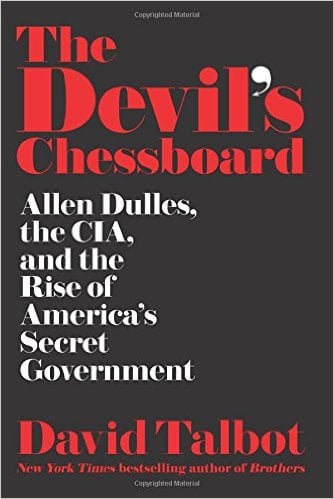
The Devil’s Chessboard: Allen Dulles, the CIA, and the Rise of America’s Secret Government
Review of David Talbot’s book
The psychopathic Allen Dulles was the enforcer for this group, called “the power elite” by C. Wright Mills in the 1950s. In recent years, especially since September 11, 2001, as its power has expanded, it has been given different names – the deep state, the national security state, deep politics,etc. – but that has not diminished its power one jot. Like a patient who goes to a doctor seeking a label for vague yet disturbing symptoms, people may feel relief from the naming, but the dis-ease continues until the root cause is eliminated. Aye, there’s the rub!
 Dulles
is dead, but the structure he created lives on and flourishes under new
operatives.Because of his intrepid examination of these forces, David
Talbot can expect to be ignored and attacked by disinformation
specialists of various stripes, who will use specious reasoning,
lies, and any small weaknesses in his style or sourcing to dismiss the
essential truths of his well-documented and beautifully written
thesis. First ignore, and if that doesn’t work, then attack,
is the modus operandi of these propagandists who populate the
mainstream media, the people Dulles had in his pocket and whom Talbot
excoriates throughout the book.
Dulles
is dead, but the structure he created lives on and flourishes under new
operatives.Because of his intrepid examination of these forces, David
Talbot can expect to be ignored and attacked by disinformation
specialists of various stripes, who will use specious reasoning,
lies, and any small weaknesses in his style or sourcing to dismiss the
essential truths of his well-documented and beautifully written
thesis. First ignore, and if that doesn’t work, then attack,
is the modus operandi of these propagandists who populate the
mainstream media, the people Dulles had in his pocket and whom Talbot
excoriates throughout the book.When an author has the guts to accuse America’s longest-reigning CIA Director of “a reign of treason,” hecan expect blowback from media and academic spokesmen of the deep-state.
Talbot is a gifted writer whose narrative style quickly engrosses the reader. Two chapters into The Devil’s Chessboard, one can’t help being nauseated by his account of Allen Dulles’s blood-chilling betrayal of large numbers of European Jews targeted by Hitler. “Dulles,” Talbot writes, “was more in step with many Nazi leaders than he was with President Roosevelt.”
Together with his brother John Foster Dulles, who would become Secretary of State under Eisenhower, Allen Dulles had long-standing business ties to German industrial giants such as I G Farben (manufacturers of Zyklon B used in the gas chambers) and Krupp steel. Their law firm, Sullivan and Cromwell, “was at the center of an intricate network of banks,investment firms, and industrial conglomerates that rebuilt Germany after World War I.” Slow to publicly break with Hitler and his allies, the Dulles brothers, especially Allen, reserved a place in his hear and a place at the table for his Nazi friends. When he was recruited into the Office of Strategic Services (OSS) in 1941 and slipped into neutral Switzerland in late 1942, he was there not so much to support Roosevelt’s war efforts as to protect the interests of his law firm’s German clients. In doing so, he betrayed personal friends and anonymous Jews to Hitler’s killers in a heartless manner hard to fathom.
Whenever Dulles had a chance to publicize the plight of the Jews, he buried the reports. For example,when a German cable reported that 120,000 Hungarian Jews, including children, were to be taken for work in the “labor services” – a euphemism for a trip to Auschwitz – “Dulles’s communiques to OSS headquarters used the same banal language as the Nazis, referring blandly to the ‘conscription’ of Hungary’s Jews.” While noting that academic researchers decades later remain hesitant to condemn Dulles for this, Talbot will have none of it. It is for good reason that he entitles his book The Devil’s Chessboard. He thinks Dulles was satanic.
In addition to his chilling indifference to the slaughter of the Jews, Dulles worked overtime to undermine FDR’s adamant insistence that he would accept nothing less than an “unconditional surrender” and that Nazi war criminals would face justice. Dulles worked his wiles at saving many Nazi war criminals and returning them to power in post-war West-Germany. Among them was Reinhard Gehlen, Hitler’s notorious chief of intelligence. In a talk to the Council of Foreign Relations on December 3, 1945, as the first Nuremburg trial was underway, he told the meeting, “Most men of the caliber required to [run thenew Germany] suffer a political taint.
We have already found out that you can’t run the railroads without taking in some [Nazi] party members.” Couching this in anti-Soviet rhetoric for an audience of like-minded power brokers, many of whom were no doubt as ant-Semitic as he was, Dulles made sure it happened. He worked hard to save the neck of Himmler’s former chief of staff and commander of the security forces in Italy, SS general Karl Wolff. Called the “Bureaucrat of Death,” this killer was one of many Dulles saved under his separate peace pact, Operation Sunrise, a traitorous circumvention of Roosevelt’s insistence on justice. SS colonel Eugen Dollman was another. In this operation, he worked closely with James Jesus Angleton, the future CIA head of counterintelligence who saw Dulles as his maestro. Working together they helped many notorious Nazi war criminals escape to the United States,Latin America, and other countries via the “Nazi ratlines.”
 In
Part II of the book, Talbot buttresses these historical and
well-sourced facts with a detour into Dulles’s personal life and
relationships. It is not a reassuring portrait. We learn that his wife
Clover and one of his mistresses, Mary Bancroft, called him “the
Shark.” (Bancroft was the best friend of Ruth Paine’s mother-in-law; it
was at Ruth Paine’s house that Marina and Lee Harvey Oswald lived at
the time of JFK’s assassination. More on the Paine’s below.)
In
Part II of the book, Talbot buttresses these historical and
well-sourced facts with a detour into Dulles’s personal life and
relationships. It is not a reassuring portrait. We learn that his wife
Clover and one of his mistresses, Mary Bancroft, called him “the
Shark.” (Bancroft was the best friend of Ruth Paine’s mother-in-law; it
was at Ruth Paine’s house that Marina and Lee Harvey Oswald lived at
the time of JFK’s assassination. More on the Paine’s below.)Bancroft refers to “those cold blue eyes of his” and his“peculiar mirthless laugh.” Carl Jung, who treated both women, said Dulles was “quite a tough nut.”Talbot notes that there was “an impenetrable blankness that made him hard to read.” This description approximates Jung’s take on Hitler that Talbot juxtaposes on the same page – that Hitler seemed like “a mask, like a robot, or a mask of a robot.” Mary Bancroft recalled that the emotionally dead Dulles’s favorite word was “useful.” People were only good to him if they were useful. His daughter Joan told Talbot that her father was “clearly not interested in us.” A grinning Dulles once told Mary that his feigned bonhomie, his avuncular demeanor, and trusting attitude toward people were an act. He said, “I like to watch the little mice sniffing at the cheese just before they venture into the little trap. I like to see their expressions when it snaps shut, breaking their little necks.”
After his WW II work assisting Nazis, Dulles turned his attention to stirring the cauldron in Eastern Europe. This time he betrayed many thousands to Stalin’s thugs in a make-believe plot called Operation Splinter Factor that was meant to panic Stalin. It achieved its goal and once again the victims were “useful” to him.
His ideological obsession in countering the Soviet Union in the Cold War knew no bounds. Talbot reports that private citizen Dulles funded espionage activities with treasure looted from Jewish families; that he set up, together with Frank Wisner and others, his own espionage unit deep within the State Department – the Office of Policy Coordination; that he was instrumental in the rise of Richard Nixon to political prominence. Throughout the late 1940s and early 1950s he was hard at work constructing the infrastructure of the CIA and a powerful secret government that would outlast him.
Once he finagled his way into the position of CIA Director under Eisenhower, “the CIA would become avast kingdom, the most powerful and least supervised agency in government …. More in keeping with an expanding empire than with a vibrant democracy.”
Talbot closely chronicles the rise of Senator Joseph McCarthy, the bullying Red hunter, and Dulles’s dirty battles with him. Secret dossiers, sexual blackmail,every trick imaginable – these were the methods Dulles used in his winning battle with McCarthy. This victory gave him cachet with Washington liberals, who celebrated Dulles’s CIA as a safe place for the liberal intelligentsia. This was a fateful turn of events; “it established a dangerous precedent,” Talbot notes, for Dulles now had a freer hand to grow the CIA and expand its secret powers with liberal support against the “real” communist threat, not the hyped up sort McCarthy stood for.
“In truth,” he writes, “the CIA became an effective killing machine under Dulles.” Assassination had always been one of his favorite methods, and now it had found an institutional home. Today its home is also in the Obama White House, a development well-documented, and a sign of Dulles’s expanded and enduring influence.
Talbot has two excellent sections on what Dulles felt were two of his greatest successes: the CIA led 1953coup in Iran and the 1954 coup in Guatemala, both of which ousted democratically elected leaders and installed dictators for the benefit of multinational corporations’ foreign investments. Hundreds of thousands of innocent people were eventually killed and tortured as a result, and we are dealing with the consequences today.
Throughout his narrative Talbot mentions many of Dulles’s protégés who will figure prominently in future events, including assassinations of American and foreign leaders: Howard Hunt, James Angleton, David Atlee Philips, Richard Helms, William Harvey, David Morales, to name but a few. As one reads through his excellent chronicle of the CIA’s coups, its MKULTRA mind control project, its cultural engineering that captivated artists and intellectuals, one can’t help feeling that Dulles’s machinations are leading to adefining culmination.
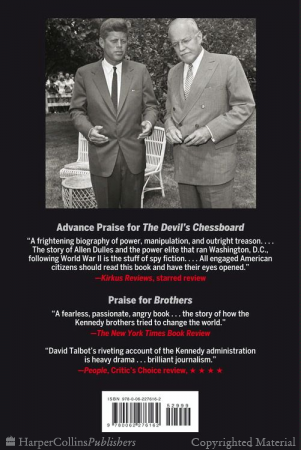
Enter Senator John F. Kennedy and an explosive speech he delivered on the Senate floor on July 2, 1957. Talbot correctly notes this speech’s significance when he writes, “Breaking from the Cold War orthodoxy that prevailed in the Democratic as well as Republican parties, JFK suggested that Soviet expansionism was not the only enemy of world freedom; so, too, were the forces of western imperialism that crushed the legitimate aspirations of people throughout the Third World.”
This speech set the stage for the CIA’s future war with Kennedy that ended in his assassination on November22, 1963. JFK was challenging the entire worldview of the Eisenhower / Dulles / Republican/ Democratic establishment. He had crossed the Rubicon. Talbot updates it aptly:
“Even today, no nationally prominent leader in the United States today would dare question the imperialistic policies that have led our country into one military nightmare after another.”If one could imagine a leader doing so, and that politician was then elected president, what would be his fate? Talbot’s implication is sobering, and a reader can’t help thinking of those prominent leaders who dared to question imperialist agenda –JFK, Malcolm X, Martin Luther King, and Robert Kennedy. Former CIA analyst Raymond McGovern has suggested that American presidents since Kennedy are acutely aware of the message sent from the streets of Dallas.
In the last section of the book Talbot covers a lot of familiar territory regarding the Bay of Pigs, Dulles’s firing by Kennedy, and Kennedy’s assassination. He accurately claims that the Bay of Pigs was a setup of Kennedy by Dulles that “was meant to fail” so as to force Kennedy to launch a full-scale invasion of Cuba.
“The wily CIA chief set a trap for Kennedy, allowing the president to believe that his ‘immaculate invasion’ could succeed, even though Dulles knew that only U.S. soldiers and planes could ensure that.”What he doesn’t mention, but would buttress his argument further, is that classified documents uncovered in 2000 revealed that the CIA had discovered that the Soviets had learned of the date of the invasion more than a week in advance, had informed Castro, but never told Kennedy. This treasonous with holding was not lost on Kennedy who knew that “Dulles had lied to his face in the Oval Office about the chances for the operation’s success.” When JFK refused the bait and courageously avoided the trap Dulles had set for him – “to break his little neck” – Dulles and his followers were enraged. “That little Kennedy … he thought he was a god,” Dulles let slip in 1965 on a stroll with the writer Willie Morris.
Talbot’s section on the attempted coup d’état against French President Charles de Gaulle is terrific. This CIA backed event, launched in the same month as the Bay of Pigs, was also clearly meant to embarrass Kennedy and to send the message that it was the CIA, not Kennedy, who was in charge. The July 1962assassination attempt on de Gaulle emphasized the message: those who dare to recognize the independence of Third World countries, as JFK had proposed in 1957 and de Gaulle was in the process of doing with Algeria, would be eliminated.
Talbot convincingly shows that although he was out as CIA Director, Dulles was still very much in power,avidly conferring and plotting with his CIA acolytes, his moles in the Kennedy administration, and hismilitary allies led by the Joint Chief’s chairman Lemnitzer, who hated Kennedy.
“Like the Time-Life building in Manhattan, Dulles’s brick house on Q Street was a boiling center of anti-Kennedy opposition.The actively ‘retired’ spymaster maintained a busy appointments calendar, meeting not only with CIA old boys like Frank Wisner and Charles Cabell [the brother of the mayor of Dallas on the day Kennedy was murdered], but with a steady stream of top-rank, active- duty agency officials such as Angleton, Helms,Cord Meyer, and Desmond Fitzgerald. More surprisingly, Dulles also conferred with mid-level officials and operational officers such as Howard Hunt, James Hunt (a key deputy of Angleton, and no relation toHoward), and Thomas Karamessines (Helm’s right-hand man).”In October 1963 Dulles gave a speech ridiculing the Kennedy administration’s “yearning to be loved” by the rest of the world. His best-selling book, The Craft of Intelligence, also appeared that fall and was sycophantically praised by his media allies at The New York Times and Washington Post, papers that would give their seal of approval to the Warren Commission report that Dulles would control and which has been called the Dulles Commission. Talbot correctly notes throughout the book that Dulles always had the backing of the powerful mainstream media such as The New York Times, The Washington Post,Time-Life, etc. Their owners and executives were a key part of his network of friends and insiders who worked in tandem to support their mutual interests at home and abroad.
He has a revelatory section on Dulles’s retreat on the weekend of JFK’s assassination to the top-secret“Farm,” a CIA command facility, officially known as Camp Peary. From Friday, November 22, the day of the assassination, through Sunday, the 24th, the day Ruby shot Oswald, Dulles hunkered down at this training center for assassins, as described by former CIA agents Philip Agee and Victor Marchetti. It was also a “black site” where extreme interrogation methods were used on suspected enemies. What he was doing there is unknown, though highly suspicious.
The weakest part of Talbot’s final section, where he marshals plenty of circumstantial evidence that strongly suggests but doesn’t prove Dulles’s part in the assassination, is his analysis of Ruth and Michael Paine. Talbot interviewed them in their retirement community and came away a bit starry-eyed. Ruth Paine was the Dallas housewife who had befriended Marina Oswald and taken her – and Lee Harvey on weekends – to live with her. She was the key witness for the Warren Commission. It was at her home where incriminating evidence against Oswald was found. The Paine’s connection to the CIA, Dulles’ network, and other CIA operations, confirmed by excellent researchers in great detail, escapes him,although he does note their connection to Mary Bancroft, Dulles’s former mistress. Of the Paines he writes, “In their immaculate innocence, the Paines played right into the hands of those who were manipulating Oswald.” I’m afraid Talbot is the innocent here. The Paines are very important figures in the assassination and seeing them clearly would add to his powerful thesis. Perhaps he was tired at this point in his pursuit of the satanic Dulles.
He does raise three interesting issues in his last hundred or so pages. (I should note that The Devil’sChessboard is a very long – 661 pages – and heavily documented book.) They are: the aforementionedaccount of Dulles at “the Farm,” the connections to the attempted coup and assassination against deGaulle, and the very real possibility of CIA operative William Harvey being involved in the killing ofKennedy. Otherwise, there is not much new about the assassination, though he does do an excellent jobof marshalling the available recent research on the subject and sprinkling his text with intriguingsuggestions.
One of the most interesting new details he offers is from a book by de Gaulle’s information minister Alain Peyrefitte, C’etait de Gaulle, which was never translated into English. In it the French president, just home from JFK’s funeral, confides to Peyrefitte that he knew that the CIA was behind the assassination.“What happened to Kennedy is what nearly happened to me. His story is the same as mine …. The security forces were in cahoots with the extremists …. But you’ll see. All of them together will observe the law of silence. They will close ranks. They’ll do everything to stifle any scandal. They will throw Noah’s cloak over these shameful deeds. In order not to lose face in front of the whole world. In order to not risk unleashing riots in the United States. In order to preserve the union and to avoid a new civilwar. In order to not ask themselves questions. They don’t want to know. They don’t want to find out.They won’t allow themselves to find out.”
Thus the “unspeakable,” although an open secret, was born. But JFK’s assassination isn’t a mystery. As Dr. Martin Schotz said twenty years ago, “Any citizen who is willing to look can see clearly who killed President Kennedy and why.” The basic facts are long known that he was killed by a CIA led operation to eliminate him for his intention to end the Vietnam War, for his support of Third-World independence, for his opposition to the military-corporate-industrial complex, and for his efforts to end the Cold War.Talbot knows all this. He knows that JFK’s American University address of June 11, 1963 sealed his fate.He knows and says that Robert Kennedy was also killed as a result of a conspiracy, and he needed to be stopped before he became president and reopened the killing of his brother. Talbot’s valiant effort to put faces on the conspirators is laudatory. But while being also highly suggestive, it may not be necessary.
The Devil’s Chessboard is a very important book. David Talbot has exposed the face of evil incarnate in Allen Dulles, the hit-man for the power elite. He has documented the rise of the secret state that holds the ignorant in its grip today, is waging war around the globe, and spying on the American people. He has warned us that evil often wears the mask of civility and high society. Satan, he suggests, wears many masks, and he continues to move the pawns with a smile.
“Dead for nearly half a century,” he concludes,” Dulles’s shadow still darkens the land.” And although he is reticent to name today’s names who carry on his legacy, and refers to them as “faceless security bureaucrats,” they do have faces, and names, as Allen Dulles did – so it’s time to call them out and name them. Otherwise we are playing Dulles’s mind-control games, and we will have to wait another fifty years to read a comparably excellent study showing future readers who Dulles’s clones are today.
Like Arthur Schlesinger, Kennedy’s craven assistant, who, when asked to watch the Zapruder film’s infamous frame 313 kill shot, turned his head and walked away saying, “I can’t look and won’t look,” we will become accomplices by neglect in the ongoing hijacking of the country by the secret state.
David Talbot is a true patriot for giving us this extraordinary book.
Edward Curtin is Professor of Sociology at the Massachusetts College of Liberal Arts, North Adams, MA