Tuesday, April 21, 2015


FBI: Hanging By A Hair

April 21, 2015 by
Categories: Threats to Democracy
 A recent internal investigation found that FBI agents wrongly testified in 95 percent of criminal cases in which they’ve participated over the past two decades.
A recent internal investigation found that FBI agents wrongly testified in 95 percent of criminal cases in which they’ve participated over the past two decades.
Turns out the FBI has been placing a heavy thumb on the scales of justice for over two decades.
The Bureau’s website claims its laboratory uses “cutting-edge science to solve cases and prevent acts of crime and terror.” But now the Department of Justice has admitted that the FBI “microscopic hair comparison unit” regularly overstated forensic matches when testifying against criminal defendants. This may have led to wrongful convictions in hundreds of cases.
An internal DOJ and FBI investigation, triggered by a Washington Post story from 2012 that first reported on the flawed forensics work, formally acknowledged that FBI experts had given incorrect testimony in nearly all cases in which they testified for more than 20 years prior to 2000.
WhoWhatWhy has covered a number of other instances of even more questionable FBI behavior that are known to but have been ignored by the Post—among them the Boston Marathon Bombing case and the investigation of Saudi connections to 9/11 in South Florida. So our readers are already aware that the FBI’s much-hyped reputation of near-infallibility in crime-fighting is mostly based on self-serving propaganda.
But this new revelation, coming from an establishment media icon like the Post, should open up the Bureau to a long-overdue probe by independent investigators.
The Post’s Spencer S. Hsu, who has been following the FBI for years, was the first to report on the initial results of the review, and the resulting admission by the DOJ and FBI that there was indeed a serious problem.
Tendentious—and Deadly—Errors
Of the 257 times FBI experts gave flawed forensics testimony, 32 were death penalty cases.
Specifically, of 268 trials reviewed so far in which hair analysis was used against the defendants, FBI experts provided flawed forensics testimony 257 times, including in 32 death penalty cases. That’s 95 percent. In virtually every case, the FBI “errors” bolstered the prosecution’s efforts to convict defendants. At least 1,200 additional cases will be reviewed.
The findings will be welcome news for hundreds of convicted felons who may now get another chance to appeal their verdicts. The chances of winning such appeals will vary, since in many cases the convictions were based on more evidence than the testimony of FBI witnesses alone.
In a joint statement, the FBI and DOJ said they were “committed to ensuring that affected defendants are notified of past errors and that justice is done in every instance.” Unfortunately, that will not include the 14 individuals who have been executed already or who died in prison after having been convicted at least partly on the basis of flawed analyses.
Appalling and Chilling”
Peter Neufeld, a co-founder of the Innocence Project, which assisted the Bureau and the Justice Department in the review, summed up the work of the ostensibly professional forensics lab to the Post: “The FBI’s three-decade use of microscopic hair analysis to incriminate defendants was a complete disaster.”
Democratic Senator Richard Blumenthal, a former prosecutor, was even more damning. “These findings are appalling and chilling in their indictment of our criminal justice system, not only for potentially innocent defendants who have been wrongly imprisoned and even executed, but for prosecutors who have relied on fabricated and false evidence despite their intentions to faithfully enforce the law,” Blumenthal said.
The ineptitude—or worse—of the Bureau’s forensics experts has managed to achieve something rare in today’s Washington: unite Republicans and Democrats.
Senate Judiciary Committee Chairman Charles Grassley, a Republican from Iowa, and Patrick Leahy from Vermont, the panel’s ranking Democrat, have asked for a thorough examination of when the lab began failing in its mission and how that failure could have persisted for so long.
Sen. Grassley has long cast a skeptical eye on the FBI. This year alone, he has called the behavior of the Bureau into question over charges of nepotism and favoritism in its Mobile Surveillance Team; over how the FBI spends fees from its fingerprint-based Criminal History Record Information checks; and for obstructing an investigation of the Office of the Inspector General. The senator has also been instrumental in forming the bipartisan Whistleblower Protection Caucus, launched on February 25 of this year.
When Incompetence is an Emergency
The expressed intention of the DOJ and FBI to rectify this particular mess merits the faint praise of “better late than never.” But the far larger issue of a federal police force operating without clear oversight in matters that affect both national security and individual liberties clearly deserves immediate attention.

Hollywood producer Nathan Folks Blows The Whistle On Boston Bombing FALSE FLAG

Hollywood producer Nathan Folks Blows The Whistle On Boston Bombing FALSE FLAG
nathan-folks
Nathan (Nathaniel) Folks is a film producer and talent manager who has been in the entertainment industry since 1997 when he worked at Paramount Pictures marketing the blockbuster motion picture, Titanic, starring Leonardo DiCaprio.
In an interview with the Voice of Russia’s John Robles, Folks says that back in April 2013 as he was watching the events of the Boston Marathon bombings unfold, based on his experience and expertise as a movie producer, he thought that some things just “didn’t add up” and became convinced that the bombings were a false flag designed to instill “the fear factor” in us, “to keep us scared for as long as they can.” The Boston bombing wasn’t real but a “hyper-reality film-making.” It was  a “terrorism that never happened.”
Folks says that he knows some of the people “who were involved” in the Boston “hyper-reality filmmaking.” He defines “hyper-reality film-making” as a “very common thing you do in the military” where filmmakers create a “hyper reality scene” that is made as real as possible so that the military “can be well adjusted to a real scene in Iraq or any other kind of war zone.” In a hyper-reality scene, people can see and feel and help what appears to be a real injured person, but the “injured person” is actually an amputee crisis actor, with help from a makeup artist. (See )
As Folks was watching the “hyper reality scene” unfold in the streets of Boston, he was thinking “they were able to get away with this!” As he watched the “supposedly live television broadcasting,” he knew it wasn’t live at all, but edited, because:
  • In live footage, “you don’t cut from one scene to another.”
  • The supposedly live TV footage was using an older technology that’s “grainy” instead of the HD (high definition) available in 2013.
Asked about Jeff Bauman, who supposedly had both of his legs blown off at the marathon:
1. Folks (and others) observed that the pic below is staged. Notice the red paint: Blood is never such a bright red. Bauman is the man with a stick attached to one of his amputated legs. No blood in area where his leg was apparently severed and what is supposed to be a bone is much too thin and straight to be a lower leg bone. The expression on his face is entirely inconsistent with someone who just had both of his legs blown off.
bauman2. Paramedics and doctors know that someone who’s lost both of his legs must not be moved, and “certainly” not be put in a wheelchair and carted down the road. But that’s exactly what they did to Bauman.
boston-bombing
3. Someone who lost both legs would spend at least a year recuperating. Instead,Bauman was at a Bruins hockey game on May 4, 2013 (see pic below), which was exactly 19 days after he had both legs blown off. That’s some miraculous recovery!
Jeff Bauman at Bruins game May 2013“Jeff Bauman” at the Bruins game, May 4, 2013.
Folks thinks it’s “comical” that “they” actually did that with Bauman and “think we all buy this.” He insists “The truth has to  come out, people are not going to sit there and be made a mockery.”
Asked about green screens being used at the bombing, Folks says “they” used “a second screen in order to reenact the scene over and over to get it right, and by using the green screen they were able to show the buildings that were actually on Boylston Street.” (The two bombings took place, seconds apart, on Boylston St.)
________
Note: Green screen or chroma key compositing is commonly used for weather forecast broadcasts, wherein the meteorologist is usually seen standing in front of a large CGI map during live television newscasts, though in actuality it is a large blue or green background.
________
Folks compares the Boston bombing to the movie Titanic, where we see the boat sink and people drowning but, of course, all of that weren’t actually happening. We, the moviegoers, are watching it on green screen with a digital layer of real-action people and the boat “sinking” in the background. Folks says “That’s what they did” in Boston but “they did it on television,” where the street scene is real, but when “they reenact the people that were hurt, they had to add the blood and the amputees and the makeup.”
Folks says “you can see the person who put on the makeup on these people,” and refers in particular to a “woman in pink” with a make-up bag who “goes to each victim. She’s not helping them! She’s putting their makeup on.”
Folks: “I’m not fooled and I’m not going to let everyone else be fooled. Someone has to speak out against it and they can follow me, they can do whatever they want, but at the end of day, the truth has to come out sometime.”
Folks says he began speaking out right after the bombings. Then strange things started happening to him. He became very sick although he’s “never been sick” in his life. He “couldn’t hold water, couldn’t hold food,” and was hospitalized for a total of 22 days in the course of 3 months. Folks suspects it was some kind of poison but the doctors “couldn’t determine what it was.” It nearly killed him. It took him 3 to 6 months of rehabilitation to get back on his feet.
Folks says other people who had spoken out about the Boston bombing hoax at the same time as he was, e.g., “the guy who runs [the website] Natural News,” also were poisoned. Some “disappeared.”
Lastly, Folks says whoever put together the Boston bombing hoax was not very good at it. Tongue in cheek, he recommends that “they” should have hired the real pros — Hollywood producers.

UPDATE (May 26, 2014):

I found the following information on traumatic amputation (loss of limbs) from WebMD:
  1. WebMD: First aid to someone experiencing traumatic amputation should include “Have the injured person lie down and elevate the site that is bleeding.” Instead of transporting Jeff Bauman on a stretcher with his leg-stumps elevated, he was seated and trundled away in a wheelchair.
  2. WebMD: “The trauma of the accident or severe blood loss can cause the person to go into physiologic shock. Signs of physiologic shock include:
    • Passing out (losing consciousness).
    • Feeling very dizzy or lightheaded, like the person may pass out.
    • Feeling very weak or having trouble standing up.
    • Being less alert. The person may suddenly be unable to respond to questions, or he or she may be confused, restless, or fearful.”
    Jeff Bauman not only did not pass out (as you can see in the pic of him being carted away in a wheelchair), he was so alert and retained such presence-of-mind, despite having both legs blown off (just imagine that happening to you), that “Bauman was later able to provide detailed descriptions to the authorities of a suspect who was seen placing a backpack beside him at the bombing scene two and a half minutes before it exploded, enabling the photo to be identified and circulated quickly.” (Wikipedia)
  3. WebMD: Ideally, the wound [from the surgical amputation of all or part of a limb or extremity such as an arm, leg, foot, hand, toe, or finger] should fully heal in about four to eight weeks.” But Jeff Bauman managed to be fully healed as to attend a Bruins hockey game a mere 19 days after having both legs blown off — which is 9 days BEFORE the minimum ideal healing period of four weeks.

Update (Dec. 27, 2014):

Dr. Lorraine Day, an orthopedic trauma surgeon who for 25 years was Chief of Orthopedic Surgery at St. Francisco General Hospital, confirms many of Folks’ observations (read her article in PDF here):
1. In the pictures taken immediately after the blast, there was no blood on the ground. That could never be. The bomb blast instantaneously would have spread blood from the injured everywhere.
2. When “blood” does eventually appear on the sidewalk at ground zero, it clearly is some kind of bright orange-red paint, not blood. Real blood is dark maroon in color.
3. In the initial pictures after the (smoke) bomb exploded, the “victims” are holding themselves up on one elbow or are sitting up. No one is in severe pain or in any pain at all. Severely injured people don’t prop themselves up on one elbow; they would have their head on the sidewalk.
4. In the early pictures, many “handlers” can be seen positioning “victims” and assisting in the set-up of the hoax scene.
5. There are no EMTs (Emergency Medical Technicians) at the scene, no ambulances, and no fire engines. Where are they? The people helping the “victims” are also crisis actors.
6. Wheel chairs may be available along a marathon route but they are NEVER found in ambulances, and wheelchairs are NEVER used to transport severely injured victims. When a victim has lost a lot of blood [as in the case of Jeff Bauman], he or she is always kept flat and transported on a gurney. To do otherwise would put the life of the victim at severe risk.
7. In Bauman’s case, if a person has both legs blown off, his blood loss would be so severe that if someone sat him up [as Bauman did], he would lose consciousness because his heart could not pump enough blood to supply his brain when he was in the upright position, and he would die.
8. Bauman’s gory “blown-off leg” was nothing but a prosthesis that is a very poor replica of a real amputated limb. The “injuries” and “blood spatter” are so poorly done, they are almost comical to a trauma surgeon “such as myself.”
9. 4 or 5 days after Bauman had his legs blown off, he was photographed in the hospital giving a thumbs-up, happy-faced smile. “This is ludicrous.” When a person loses even one limb, there is a “grieving” process that goes on for weeks.
10. The glass from the “blown-out” windows from the “bombing” is all on the sidewalk. If the glass had been broken from a real bomb blast, the glass would be inside the stores and offices, not outside on the sidewalk.

Training & Simulation Journal Article

________________________________________
Lights, camera, action!
Training goes to the next level with Hollywood and virtual reality

By Michael Peck
June 12, 2011
Is it combat or is it Hollywood? The answer is that it’s both and neither. Live training seasoned with Hollywood-style special effects is giving troops a taste of the sights, sounds, smells and chaos of battle.
Sometimes the training is intensely physical, with plenty of pyrotechnics and role-players who could have stepped off the set of “The Hurt Locker.” Sometimes it includes virtual reality and digital gunmen. Strategic Operations Inc., whose president is a Hollywood producer, trademarked the term “hyper-realistic training,” defined as, “such a high degree of fidelity in the replication of battlefield conditions in a training environment that participants so willingly suspend disbelief that they become totally immersed and eventually stress inoculated.”
Strategic Operations, or STOPS, has trained 500,000 personnel since 2002, either by providing support at military bases or by training soldiers at its San Diego facility, which includes an urban combat range and a real Boeing 727 airliner equipped with lighting, sound and smoke.
The company is developing new gear to further enhance the realism of hyper-realistic training, said STOPS Executive Vice President Kit Lavell. One is the “Cut Suit,” an apt name for what is essentially a prosthetic human body worn by a live person over his torso like a surgeon’s gown. Weighing just more than 30 pounds, the suit has fake skin and organs, as well as reservoirs of fake blood. Soldiers practicing combat casualty care cut into the suit or treat a cut that is already made into the suit, while the actor wearing it moans and screams without suffering so much as a scratch.
With interchangeable organs, and a mechanical heart and blood flow that can be adjusted to beat at different rates, the Cut Suit can be used for numerous procedures, including tourniquet application, hemorrhage control, surgical incisions and suturing. The suit, which costs about $25,000, is reusable and can be restored to its original state in a few hours.
For vehicle checkpoint training, STOPS has also developed the BUGV-Target, a robotic truck that allows soldiers at checkpoints to practice their rules of engagement and escalation of force procedures. The device consists of a WiFi-controlled vehicle chassis, sheathed in a half-inch-thick shell of AR500 ballistic steel, which in turn is covered by a foam body that can be shaped to resemble any vehicle from a taxi to a truck. Trainees can blast away at the vehicle, which has armor that can withstand up to a .50-caliber round, and a foam case that can be easily reassembled.
With tighter funding, the trend is toward home station training. That is why STOPS has developed the Re-locatable Habitat Unit (RHU), which Lavell describes as “built like Lego kits.” Weighing less than 100 pounds, the RHU breaks down into 4-foot x 8-foot panels. “You can build a multistory building of thousands of square feet with one nine-millimeter hex tool,” Lavell said. The RHU can be quickly configured to create a variety of structures for a given scenario. “We can make something that looks like mud over brick for Afghanistan, cinder block for Iraq, bamboo for Southeast Asia, straw and wood buildings for Africa and so on,” Lavell said.
Hollywood-esque special effects are a cutting-edge concept, but there are still plenty of old-fashioned ways to enhance immersive live training. One is simply to add real equipment. At the U.S. Joint Readiness Training Center (JRTC), live exercises include biometric equipment, said Bill David, program manager for the JRTC mission support contract at Cubic Corp., which provides the center everything from pyrotechnics to logistics and after-action review capability. At the JRTC, soldiers have the opportunity to use iris scans, digital fingerprinting and photographs.
“There is a huge database of biometric taken from in-theater, and that’s the haystack,” David said. “Mixed into the haystack are the needles, the biometric data of about 200 live role-players that are here. So we may have a role-player that’s playing a bomb maker or a financier. The rotational unit finds or captures that guy and takes his biometric data. If they are smart enough, they’ll get a match.”
If there is a match, the suspect will be handed over to the civil authorities, which is another recent change at JRTC, David said. “The U.S. forces don’t do as much knocking down doors or barging into houses and capturing people,” he said. There is more emphasis on planning and coordinating operations with the JRTC elements that are playing Afghan or Iraqi soldiers.
ENTER BOEING
Strategic Operations is part of a team led by Game Production Services, headquartered in Albuquerque, N.M., which developed the Infantry Immersive Trainer (IIT). The IIT is a Marine infantry training facility at Camp Pendleton, Calif., that essentially combines mock Iraqi and Afghan villages, Strategic Operations’ elaborate system of pyrotechnics and role-players, and a little bit of virtual reality through avatars of village elders projected on walls.
While STOPS may be the most well-known contractor for this kind of hyper-immersive training, Boeing is joining the hyper-realism game. Better known for its aviation expertise, the company stood up its ground forces training division in 2009. Boeing has developed the Integrated Immersive Training Environment (I2TE), an internal research project that was recently demonstrated for a squad-level exercise at Fort Leonard Wood, Mo.
I2TE is similar to the IIT as both environments combine physical effects and virtual reality to create a mixed reality training system.
However, I2TE is designed to be transportable and brought to the customer’s home station, rather than built in a permanent location. This makes cost the key difference between the two concepts, said David Irwin, Boeing’s director of ground forces training. With fixed sites, the user doesn’t have to pay for building the infrastructure but does bear transportation costs. With I2TE, the user pays to outfit his home station, but once done, will be spared transportation costs.
I2TE may not be economical for a user that does very sporadic training, Irwin said, but it would be especially useful for National Guard and reserve units whose members would appreciate immersive combat training near their homes. For the Fort Leonard Wood demo, Boeing temporarily wired the base’s military operations on urban terrain range with sound, cameras, radio frequency identification trackers and other gear.
I2TE uses compressed air explosions, sophisticated audio effects and role-players, as well as a virtual mission board, an iPad-like device about the size of an average flat-screen television, which allows controllers to track students and control the props. AVATARS IN THE MIX I2TE also uses virtual reality, though in a limited way. Avatars appear on big-screen displays but only at a distance. “We found that if you put virtual characters up close, it doesn’t look very real in a face-to-face setting,” Irwin said. “But if your virtual characters are in the windows of buildings, that works fine because at a distance they look more real.”
Students get only glimpses of the avatars, so they are less likely to discern that their foes are digital. “Instead of a role-player in a balcony 200 meters away, we flash this virtual character for 10 or 15 seconds, to provide the visual cue that a soldier is looking for,” said John Chicolo, Boeing’s program manager for ground forces training.
A few simple props can hide the virtual nature of the role-players, at least enough to fool anyone at a distance. “What you do is camouflage them very well,” Irwin said. “So if I’m putting a big-screen in the window, I’ll put curtains there.”
Controllers can also change the avatars on the spot, depending on how well the students are performing. “[The avatar] could be a lady hanging laundry one moment, and a guy with a weapon the next,” Irwin said. “If an exercise controller sees they are not paying attention, he can take away the woman hanging laundry and replace it with a guy with the weapon. So it forces the folks walking through the areas to pay attention and use their situational awareness.”
Boeing touts I2TE as a lower-cost approach for training. One cost-saver is to slash the number of live role-players by casting them in multiple roles and enabling them to do quick costume changes, like cast members do in theme parks. “We had three role-players playing 12 different people in an under-30-minute exercise,” Chicolo said. “One minute a role-player can be a town elder, but if he is not needed, he can go into or behind a building, change his wardrobe and become someone else.”
Sophisticated audio effects are also a key component of I2TE, said James Korris, president of Creative Technologies Inc., which partnered with Boeing on the project. Research shows that on the battlefield, soldiers who can register the time interval between the sound of a bullet passing overhead and the subsequent crack of the weapon being fired, as well as the direction that the fire is coming from, can effectively respond to the threat, Korris said. “Detonating firecrackers or playing sounds over a loudspeaker isn’t going to do that. So I2TE used a highly directional audio field that simulated weapons sounds from various directions and at various distances.” Another component was accurately simulating the sound of particular weapons. Strategic Operations’ Lavell estimated that hosting a battalion of Marines at the company’s San Diego facility for 12 days would cost about $35 per day per Marine. When asked for the price of I2TE, Irwin could not elaborate beyond saying the cost of the Leonard Wood demonstration was less than $1 million.

MPAA Pirated Clips From Google Commercials To Make Its Own MPAA Propaganda Videos

from the can't-make-this-stuff-up dept   ...no shit  :o   ...prof ???

And here's another one from the Sony archives, this time noticed by Parker Higgins. It involves an email thread between Sony TV's Chief Marketing Officer Sheraton Kalouria and the company's top intellectual property lawyer Leah Weil (with top TV exec Steve Mosko included in the cc: field). In the email, they're discussing a new "reputational initiative" by the MPAA. From other emails, it appears that the MPAA finally realized that its reputation was toxic, and figured that rather than, maybe, figuring out why that is, it would put together a marketing campaign to improve the public's view of the MPAA. Here were the four goals of the campaign:
  • Fill the knowledge gap about our industry
  • Change consumer perceptions
  • Claim our rightful position as innovators
  • Reframe our consumer message in a positive tone
I note that "stop suing our customers and biggest fans" and "stop trying to censor parts of the web or destroy innovations that challenge our business model" didn't make the list. That's too bad, as either of those steps might actually, you know, help improve the MPAA's reputation.

But the really amazing thing about the campaign? Apparently at least some of the video involved unauthroized copying of content from... Google. The same Google that the MPAA and studios had dubbed "Goliath" and who they were hell bent on destroying because of the misleading belief that Google helped people infringe on their copyrights. Here was Kalouria's email to Weil:
Also, I was somewhat horrified that their creative shop used footage from Google commercials in their “Swipe-o-matic”. I kid you not…some of those scenes of people being “moved” by movies are from a current Google campaign...!
Weil only responded with a single word:
Yikes!!!
Yes. If you've been following along with the home game, you know that the MPAA is really, really against copyright infringement (or at least that's what it would have you believe). And it believes that Google is the single-biggest problem in the copyright world these days. And yet, when it's time for the MPAA to put together some of its own propaganda to put some spit and polish on its down in the dumps reputation, what does it do? Make use of Google's footage and pretend that the people being "moved" are actually being moved by the MPAA's movies.

Apparently, infringing on the works of others is okay for the MPAA when it does it itself. And that's leaving out the extreme irony of using Google's ad footage as well. It's unclear if this MPAA film ever saw the light of day, but it would be fascinating to see if anyone has it...

How a big US bank laundered billions from Mexico's murderous drug gangs   ~ hey mr. & mrs. America try "push~in"10 grand thru yer bank acct. / down payment on a car/house  etc etc etc ?? & C how fucking fast "bond" in a black hell~e~cop~ter swoops down on yer ass ! Lol ... guess "billlllion's" is OK  Huh  ...fuck me who r the REAL crim's  again  :o ?    ah oh yea the American People    Oops

As the violence spread, billions of dollars of cartel cash began to seep into the global financial system. But a special investigation by the Observer reveals how the increasingly frantic warnings of one London whistleblower were ignored

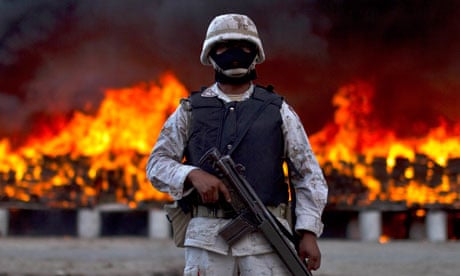
A soldier guards marijuana that is being incinerated in Tijuana, Mexico
A soldier guards marijuana that is being incinerated in Tijuana, Mexico. Photograph: Guillermo Arias/AP

On 10 April 2006, a DC-9 jet landed in the port city of Ciudad del Carmen, on the Gulf of Mexico, as the sun was setting. Mexican soldiers, waiting to intercept it, found 128 cases packed with 5.7 tons of cocaine, valued at $100m. But something else – more important and far-reaching – was discovered in the paper trail behind the purchase of the plane by the Sinaloa narco-trafficking cartel.
During a 22-month investigation by agents from the US Drug Enforcement Administration, the Internal Revenue Service and others, it emerged that the cocaine smugglers had bought the plane with money they had laundered through one of the biggest banks in the United States: Wachovia, now part of the giant Wells Fargo.
The authorities uncovered billions of dollars in wire transfers, traveller's cheques and cash shipments through Mexican exchanges into Wachovia accounts. Wachovia was put under immediate investigation for failing to maintain an effective anti-money laundering programme. Of special significance was that the period concerned began in 2004, which coincided with the first escalation of violence along the US-Mexico border that ignited the current drugs war.
Criminal proceedings were brought against Wachovia, though not against any individual, but the case never came to court. In March 2010, Wachovia settled the biggest action brought under the US bank secrecy act, through the US district court in Miami. Now that the year's "deferred prosecution" has expired, the bank is in effect in the clear. It paid federal authorities $110m in forfeiture, for allowing transactions later proved to be connected to drug smuggling, and incurred a $50m fine for failing to monitor cash used to ship 22 tons of cocaine.
More shocking, and more important, the bank was sanctioned for failing to apply the proper anti-laundering strictures to the transfer of $378.4bn – a sum equivalent to one-third of Mexico's gross national product – into dollar accounts from so-called casas de cambio (CDCs) in Mexico, currency exchange houses with which the bank did business.
Advertisement
"Wachovia's blatant disregard for our banking laws gave international cocaine cartels a virtual carte blanche to finance their operations," said Jeffrey Sloman, the federal prosecutor. Yet the total fine was less than 2% of the bank's $12.3bn profit for 2009. On 24 March 2010, Wells Fargo stock traded at $30.86 – up 1% on the week of the court settlement.
The conclusion to the case was only the tip of an iceberg, demonstrating the role of the "legal" banking sector in swilling hundreds of billions of dollars – the blood money from the murderous drug trade in Mexico and other places in the world – around their global operations, now bailed out by the taxpayer.
At the height of the 2008 banking crisis, Antonio Maria Costa, then head of the United Nations office on drugs and crime, said he had evidence to suggest the proceeds from drugs and crime were "the only liquid investment capital" available to banks on the brink of collapse. "Inter-bank loans were funded by money that originated from the drugs trade," he said. "There were signs that some banks were rescued that way."
Wachovia was acquired by Wells Fargo during the 2008 crash, just as Wells Fargo became a beneficiary of $25bn in taxpayers' money. Wachovia's prosecutors were clear, however, that there was no suggestion Wells Fargo had behaved improperly; it had co-operated fully with the investigation. Mexico is the US's third largest international trading partner and Wachovia was understandably interested in this volume of legitimate trade.
José Luis Marmolejo, who prosecuted those running one of the casas de cambio at the Mexican end, said: "Wachovia handled all the transfers. They never reported any as suspicious."
"As early as 2004, Wachovia understood the risk," the bank admitted in the statement of settlement with the federal government, but, "despite these warnings, Wachovia remained in the business". There is, of course, the legitimate use of CDCs as a way into the Hispanic market. In 2005 the World Bank said that Mexico was receiving $8.1bn in remittances.
During research into the Wachovia Mexican case, the Observer obtained documents previously provided to financial regulators. It emerged that the alarm that was ignored came from, among other places, London, as a result of the diligence of one of the most important whistleblowers of our time. A man who, in a series of interviews with the Observer, adds detail to the documents, laying bare the story of how Wachovia was at the centre of one of the world's biggest money-laundering operations.
Martin Woods, a Liverpudlian in his mid-40s, joined the London office of Wachovia Bank in February 2005 as a senior anti-money laundering officer. He had previously served with the Metropolitan police drug squad. As a detective he joined the money-laundering investigation team of the National Crime Squad, where he worked on the British end of the Bank of New York money-laundering scandal in the late 1990s.
Woods talks like a police officer – in the best sense of the word: punctilious, exact, with a roguish humour, but moral at the core. He was an ideal appointment for any bank eager to operate a diligent and effective risk management policy against the lucrative scourge of high finance: laundering, knowing or otherwise, the vast proceeds of criminality, tax-evasion, and dealing in arms and drugs.
Woods had a police officer's eye and a police officer's instincts – not those of a banker. And this influenced not only his methods, but his mentality. "I think that a lot of things matter more than money – and that marks you out in a culture which appears to prevail in many of the banks in the world," he says.
Woods was set apart by his modus operandi. His speciality, he explains, was his application of a "know your client", or KYC, policing strategy to identifying dirty money. "KYC is a fundamental approach to anti-money laundering, going after tax evasion or counter-terrorist financing. Who are your clients? Is the documentation right? Good, responsible banking involved always knowing your customer and it still does."
When he looked at Wachovia, the first thing Woods noticed was a deficiency in KYC information. And among his first reports to his superiors at the bank's headquarters in Charlotte, North Carolina, were observations on a shortfall in KYC at Wachovia's operation in London, which he set about correcting, while at the same time implementing what was known as an enhanced transaction monitoring programme, gathering more information on clients whose money came through the bank's offices in the City, in sterling or euros. By August 2006, Woods had identified a number of suspicious transactions relating to casas de cambio customers in Mexico.
Primarily, these involved deposits of traveller's cheques in euros. They had sequential numbers and deposited larger amounts of money than any innocent travelling person would need, with inadequate or no KYC information on them and what seemed to a trained eye to be dubious signatures. "It was basic work," he says. "They didn't answer the obvious questions: 'Is the transaction real, or does it look synthetic? Does the traveller's cheque meet the protocols? Is it all there, and if not, why not?'"
Woods discussed the matter with Wachovia's global head of anti-money laundering for correspondent banking, who believed the cheques could signify tax evasion. He then undertook what banks call a "look back" at previous transactions and saw fit to submit a series of SARs, or suspicious activity reports, to the authorities in the UK and his superiors in Charlotte, urging the blocking of named parties and large series of sequentially numbered traveller's cheques from Mexico. He issued a number of SARs in 2006, of which 50 related to the casas de cambio in Mexico. To his amazement, the response from Wachovia's Miami office, the centre for Latin American business, was anything but supportive – he felt it was quite the reverse.
As it turned out, however, Woods was on the right track. Wachovia's business in Mexico was coming under closer and closer scrutiny by US federal law enforcement. Wachovia was issued with a number of subpoenas for information on its Mexican operation. Woods has subsequently been informed that Wachovia had six or seven thousand subpoenas. He says this was "An absurd number. So at what point does someone at the highest level not get the feeling that something is very, very wrong?"
In April and May 2007, Wachovia – as a result of increasing interest and pressure from the US attorney's office – began to close its relationship with some of the casas de cambio. But rather than launch an internal investigation into Woods's alerts over Mexico, Woods claims Wachovia hung its own money-laundering expert out to dry. The records show that during 2007 Woods "continued to submit more SARs related to the casas de cambio".
In July 2007, all of Wachovia's remaining 10 Mexican casa de cambio clients operating through London suddenly stopped doing so. Later in 2007, after the investigation of Wachovia was reported in the US financial media, the bank decided to end its remaining relationships with the Mexican casas de cambio globally. By this time, Woods says, he found his personal situation within the bank untenable; while the bank acted on one level to protect itself from the federal investigation into its shortcomings, on another, it rounded on the man who had been among the first to spot them.
On 16 June Woods was told by Wachovia's head of compliance that his latest SAR need not have been filed, that he had no legal requirement to investigate an overseas case and no right of access to documents held overseas from Britain, even if they were held by Wachovia.
Woods's life went into freefall. He went to hospital with a prolapsed disc, reported sick and was told by the bank that he not done so in the appropriate manner, as directed by the employees' handbook. He was off work for three weeks, returning in August 2007 to find a letter from the bank's compliance managing director, which was unrelenting in its tone and words of warning.
The letter addressed itself to what the manager called "specific examples of your failure to perform at an acceptable standard". Woods, on the edge of a breakdown, was put on sick leave by his GP; he was later given psychiatric treatment, enrolled on a stress management course and put on medication.
Late in 2007, Woods attended a function at Scotland Yard where colleagues from the US were being entertained. There, he sought out a representative of the Drug Enforcement Administration and told him about the casas de cambio, the SARs and his employer's reaction. The Federal Reserve and officials of the office of comptroller of currency in Washington DC then "spent a lot of time examining the SARs" that had been sent by Woods to Charlotte from London.
"They got back in touch with me a while afterwards and we began to put the pieces of the jigsaw together," says Woods. What they found was – as Costa says – the tip of the iceberg of what was happening to drug money in the banking industry, but at least it was visible and it had a name: Wachovia.
In June 2005, the DEA, the criminal division of the Internal Revenue Service and the US attorney's office in southern Florida began investigating wire transfers from Mexico to the US. They were traced back to correspondent bank accounts held by casas de cambio at Wachovia. The CDC accounts were supervised and managed by a business unit of Wachovia in the bank's Miami offices.
"Through CDCs," said the court document, "persons in Mexico can use hard currency and … wire transfer the value of that currency to US bank accounts to purchase items in the United States or other countries. The nature of the CDC business allows money launderers the opportunity to move drug dollars that are in Mexico into CDCs and ultimately into the US banking system.
"On numerous occasions," say the court papers, "monies were deposited into a CDC by a drug-trafficking organisation. Using false identities, the CDC then wired that money through its Wachovia correspondent bank accounts for the purchase of airplanes for drug-trafficking organisations." The court settlement of 2010 would detail that "nearly $13m went through correspondent bank accounts at Wachovia for the purchase of aircraft to be used in the illegal narcotics trade. From these aircraft, more than 20,000kg of cocaine were seized."
All this occurred despite the fact that Wachovia's office was in Miami, designated by the US government as a "high-intensity money laundering and related financial crime area", and a "high-intensity drug trafficking area". Since the drug cartel war began in 2005, Mexico had been designated a high-risk source of money laundering.
"As early as 2004," the court settlement would read, "Wachovia understood the risk that was associated with doing business with the Mexican CDCs. Wachovia was aware of the general industry warnings. As early as July 2005, Wachovia was aware that other large US banks were exiting the CDC business based on [anti-money laundering] concerns … despite these warnings, Wachovia remained in business."
On 16 March 2010, Douglas Edwards, senior vice-president of Wachovia Bank, put his signature to page 10 of a 25-page settlement, in which the bank admitted its role as outlined by the prosecutors. On page 11, he signed again, as senior vice-president of Wells Fargo. The documents show Wachovia providing three services to 22 CDCs in Mexico: wire transfers, a "bulk cash service" and a "pouch deposit service", to accept "deposit items drawn on US banks, eg cheques and traveller's cheques", as spotted by Woods.
"For the time period of 1 May 2004 through 31 May 2007, Wachovia processed at least $$373.6bn in CDCs, $4.7bn in bulk cash" – a total of more than $378.3bn, a sum that dwarfs the budgets debated by US state and UK local authorities to provide services to citizens.
The document gives a fascinating insight into how the laundering of drug money works. It details how investigators "found readily identifiable evidence of red flags of large-scale money laundering". There were "structured wire transfers" whereby "it was commonplace in the CDC accounts for round-number wire transfers to be made on the same day or in close succession, by the same wire senders, for the … same account".
Over two days, 10 wire transfers by four individuals "went though Wachovia for deposit into an aircraft broker's account. All of the transfers were in round numbers. None of the individuals of business that wired money had any connection to the aircraft or the entity that allegedly owned the aircraft. The investigation has further revealed that the identities of the individuals who sent the money were false and that the business was a shell entity. That plane was subsequently seized with approximately 2,000kg of cocaine on board."
Many of the sequentially numbered traveller's cheques, of the kind dealt with by Woods, contained "unusual markings" or "lacked any legible signature". Also, "many of the CDCs that used Wachovia's bulk cash service sent significantly more cash to Wachovia than what Wachovia had expected. More specifically, many of the CDCs exceeded their monthly activity by at least 50%."
Recognising these "red flags", the US attorney's office in Miami, the IRS and the DEA began investigating Wachovia, later joined by FinCEN, one of the US Treasury's agencies to fight money laundering, while the office of the comptroller of the currency carried out a parallel investigation. The violations they found were, says the document, "serious and systemic and allowed certain Wachovia customers to launder millions of dollars of proceeds from the sale of illegal narcotics through Wachovia accounts over an extended time period. The investigation has identified that at least $110m in drug proceeds were funnelled through the CDC accounts held at Wachovia."
The settlement concludes by discussing Wachovia's "considerable co-operation and remedial actions" since the prosecution was initiated, after the bank was bought by Wells Fargo. "In consideration of Wachovia's remedial actions," concludes the prosecutor, "the United States shall recommend to the court … that prosecution of Wachovia on the information filed … be deferred for a period of 12 months."
But while the federal prosecution proceeded, Woods had remained out in the cold. On Christmas Eve 2008, his lawyers filed tribunal proceedings against Wachovia for bullying and detrimental treatment of a whistleblower. The case was settled in May 2009, by which time Woods felt as though he was "the most toxic person in the bank". Wachovia agreed to pay an undisclosed amount, in return for which Woods left the bank and said he would not make public the terms of the settlement.
After years of tribulation, Woods was finally formally vindicated, though not by Wachovia: a letter arrived from John Dugan, the comptroller of the currency in Washington DC, dated 19 March 2010 – three days after the settlement in Miami. Dugan said he was "writing to personally recognise and express my appreciation for the role you played in the actions brought against Wachovia Bank for violations of the bank secrecy act … Not only did the information that you provided facilitate our investigation, but you demonstrated great personal courage and integrity by speaking up. Without the efforts of individuals like you, actions such as the one taken against Wachovia would not be possible."
The so-called "deferred prosecution" detailed in the Miami document is a form of probation whereby if the bank abides by the law for a year, charges are dropped. So this March the bank was in the clear. The week that the deferred prosecution expired, a spokeswoman for Wells Fargo said the parent bank had no comment to make on the documentation pertaining to Woods's case, or his allegations. She added that there was no comment on Sloman's remarks to the court; a provision in the settlement stipulated Wachovia was not allowed to issue public statements that contradicted it.
But the settlement leaves a sour taste in many mouths – and certainly in Woods's. The deferred prosecution is part of this "cop-out all round", he says. "The regulatory authorities do not have to spend any more time on it, and they don't have to push it as far as a criminal trial. They just issue criminal proceedings, and settle. The law enforcement people do what they are supposed to do, but what's the point? All those people dealing with all that money from drug-trafficking and murder, and no one goes to jail?"
One of the foremost figures in the training of anti-money laundering officers is Robert Mazur, lead infiltrator for US law enforcement of the Colombian Medellín cartel during the epic prosecution and collapse of the BCCI banking business in 1991 (his story was made famous by his memoir, The Infiltrator, which became a movie).
Mazur, whose firm Chase and Associates works closely with law enforcement agencies and trains officers for bank anti-money laundering, cast a keen eye over the case against Wachovia, and he says now that "the only thing that will make the banks properly vigilant to what is happening is when they hear the rattle of handcuffs in the boardroom".
Mazur said that "a lot of the law enforcement people were disappointed to see a settlement" between the administration and Wachovia. "But I know there were external circumstances that worked to Wachovia's benefit, not least that the US banking system was on the edge of collapse."
What concerns Mazur is that what law enforcement agencies and politicians hope to achieve against the cartels is limited, and falls short of the obvious attack the US could make in its war on drugs: go after the money. "We're thinking way too small," Mazur says. "I train law enforcement officers, thousands of them every year, and they say to me that if they tried to do half of what I did, they'd be arrested. But I tell them: 'You got to think big. The headlines you will be reading in seven years' time will be the result of the work you begin now.' With BCCI, we had to spend two years setting it up, two years doing undercover work, and another two years getting it to trial. If they want to do something big, like go after the money, that's how long it takes."
But Mazur warns: "If you look at the career ladders of law enforcement, there's no incentive to go after the big money. People move every two to three years. The DEA is focused on drug trafficking rather than money laundering. You get a quicker result that way – they want to get the traffickers and seize their assets. But this is like treating a sick plant by cutting off a few branches – it just grows new ones. Going after the big money is cutting down the plant – it's a harder door to knock on, it's a longer haul, and it won't get you the short-term riches."

The office of the comptroller of the currency is still examining whether individuals in Wachovia are criminally liable. Sources at FinCEN say that a so-called "look-back" is in process, as directed by the settlement and agreed to by Wachovia, into the $378.4bn that was not directly associated with the aircraft purchases and cocaine hauls, but neither was it subject to the proper anti-laundering checks. A FinCEN source says that $20bn already examined appears to have "suspicious origins". But this is just the beginning.
Antonio Maria Costa, who was executive director of the UN's office on drugs and crime from May 2002 to August 2010, charts the history of the contamination of the global banking industry by drug and criminal money since his first initiatives to try to curb it from the European commission during the 1990s. "The connection between organised crime and financial institutions started in the late 1970s, early 1980s," he says, "when the mafia became globalised."
Until then, criminal money had circulated largely in cash, with the authorities making the occasional, spectacular "sting" or haul. During Costa's time as director for economics and finance at the EC in Brussels, from 1987, inroads were made against penetration of banks by criminal laundering, and "criminal money started moving back to cash, out of the financial institutions and banks. Then two things happened: the financial crisis in Russia, after the emergence of the Russian mafia, and the crises of 2003 and 2007-08.
"With these crises," says Costa, "the banking sector was short of liquidity, the banks exposed themselves to the criminal syndicates, who had cash in hand."
Costa questions the readiness of governments and their regulatory structures to challenge this large-scale corruption of the global economy: "Government regulators showed what they were capable of when the issue suddenly changed to laundering money for terrorism – on that, they suddenly became serious and changed their attitude."
Hardly surprising, then, that Wachovia does not appear to be the end of the line. In August 2010, it emerged in quarterly disclosures by HSBC that the US justice department was seeking to fine it for anti-money laundering compliance problems reported to include dealings with Mexico.

"Wachovia had my résumé, they knew who I was," says Woods. "But they did not want to know – their attitude was, 'Why are you doing this?' They should have been on my side, because they were compliance people, not commercial people. But really they were commercial people all along. We're talking about hundreds of millions of dollars. This is the biggest money-laundering scandal of our time.
"These are the proceeds of murder and misery in Mexico, and of drugs sold around the world," he says. "All the law enforcement people wanted to see this come to trial. But no one goes to jail. "What does the settlement do to fight the cartels? Nothing – it doesn't make the job of law enforcement easier and it encourages the cartels and anyone who wants to make money by laundering their blood dollars. Where's the risk? There is none.
"Is it in the interest of the American people to encourage both the drug cartels and the banks in this way? Is it in the interest of the Mexican people? It's simple: if you don't see the correlation between the money laundering by banks and the 30,000 people killed in Mexico, you're missing the point."
Woods feels unable to rest on his laurels. He tours the world for a consultancy he now runs, Hermes Forensic Solutions, counselling and speaking to banks on the dangers of laundering criminal money, and how to spot and stop it. "New York and London," says Woods, "have become the world's two biggest laundries of criminal and drug money, and offshore tax havens. Not the Cayman Islands, not the Isle of Man or Jersey. The big laundering is right through the City of London and Wall Street.
"After the Wachovia case, no one in the regulatory community has sat down with me and asked, 'What happened?' or 'What can we do to avoid this happening to other banks?' They are not interested. They are the same people who attack the whistleblowers and this is a position the [British] Financial Services Authority at least has adopted on legal advice: it has been advised that the confidentiality of banking and bankers takes primacy over the public information disclosure act. That is how the priorities work: secrecy first, public interest second.
"Meanwhile, the drug industry has two products: money and suffering. On one hand, you have massive profits and enrichment. On the other, you have massive suffering, misery and death. You cannot separate one from the other.
"What happened at Wachovia was symptomatic of the failure of the entire regulatory system to apply the kind of proper governance and adequate risk management which would have prevented not just the laundering of blood money, but the global crisis."

The Astonishing Predictive Programming in ‘Alias’

The many faces of Sydney Bristow.
The many faces of mind controlled assassin, Sydney Bristow.
By: Jay
It’s as if we have entered some kind of time rift, with Twin Peaks, X Files, and now possibly Alias making a comeback to TV.   On top of that, The Prodigy has a new album, so I wonder if I should be heading to first period class tomorrow, as if it’s 1996.  Although Alias isn’t 90s, it seems to fit roughly in that era for me.
Reviewing the series recently, I was struck by how much real-life, predictive programming conspirana was present in the series, and should it get a reboot, we can expect a good deal more.  With that in mind, it is time for an analysis of the über conspiracy-laced J.J. Abrams classic, Alias.
Early on, as Sydney Bristow is recruited into a secretive section of what she believes is the CIA, her unit, SD-6, operates under the cover of a bank, Credit Dauphine.  This interesting cover may have some basis in reality, since according to Stephen Dorril’s massive MI6, the Bank of England, “had a considerable intelligence staff of its own and was ready to use Thompson’s information [Joint Intelligence] information but was unwilling to pool its own.  The JIO also had a coordinating role in respect of the work of its own security and intelligence agencies” (pg. 727).  Dorril continues in regard to the Royal Bank of Scotland, according to Richard Tomlinson:
“MI6 passes on such sensitive intelligence to several clearing and merchant banks, including Midland, alleged by Tomlinson to be a ‘complete MI6 bank,’ the Royal Bank of Scotland and Kleinwort Benson.  Tomlinson adds that ‘the primary intelligence requirement against Germany…is economic intelligence,’ and such spying is ‘accorded the same level of secrecy and need-to-know indoctrination as highly sensitive Russian casework” (pg. 779)
We can think as well of the BCCI scandal from the 80s, which functioned as a CIA shell bank that diverted funding to cartels and terror networks.  It also recalls scandals involving Credit Suisse, which recently plead guilty to tax evasion and appeared in the midst of a ‘dark pool’ trading scandal.  Sydney Bristow’s cover operation Credit Dauphine thus mimics reality far more than most would assume.  While Alias is full of assassinations and shell companies that result in numerous deaths, the real global banking world has seen a plethora of suspicious banker deaths in the last couple years that defies belief. (See my analysis of Tykwer’s film The International as possibly foreshadowing this phenomenon).
The mysterious Meuller Device in Alias, developed by an alchemist that alters the structure of objects near it.
The mysterious Meuller Device in Alias, developed by an alchemist that alters the structure of objects near it.  Note the similarity to the “red matter” in Abrams’ 2009 Star Trek. Hints at secret technology?
Years prior to mainstream knowledge of ECHELON and the NSA, the early episodes of Alias make specific reference to these programs, demonstrating their vast capabilities.  While James Bamford had written about the abilities of the NSA back in 1983 in his Puzzle Palace, few and far between were the movies that made explicit mention of them.
Films such as Sneakers, Enemy of the State and a handful of others had given mention to these programs, but with Alias we have a tremendous revelation of the scope of these programs and integration with other technological surveillance, as well as the cooperation of intelligence agencies trafficking in this data back in 2001, immediately following the 9/11 events.
While those revelations are striking, the most intriguing is the series’ focus on MKULTRA and mind control.  Numerous episodes feature Sydney being subjected to various types of mind control programming that prepared her for her various field operation roles, all the way back to her youth.
The child of intelligence agents, Sydney showed exceptional abilities that resulted in her placement in special intelligence-run schools that would prepare her for everything from sexual swallow operations, to assassination missions.  While these aspects of the show are certainly hyped and glamorized in Hollywood fashion, the degree of reality behind these is also stunning.  MKULTRA was actually a name for numerous subprojects that involved every conceivable experimentation in wiping and programming prospective agents.
More alternate personae.
John Marks’ classic, The CIA and the Search for the Manchurian Candidate details these various projects, including ULTRA, NAOMI, ARTICHOKE, SERCH and DELTA.  These projects involved drugging, experimentation, sensory deprivation, brainwashing and imprinting, the creation of alternate personalities, assassination programming, technological surveillance and RF manipulation, as well as much more.  The scope of these projects is frightening, and involved major pharmaceutical companies, high level banking agents and military intelligence, United States universities, as well as cooperation with British intelligence and Canadian psychiatric institutions.
In regard to Alias, we see several episodes where Sydney is abducted, experiences time loss, demonstrates a number of alternate personas, is wiped and drugged, and engages in swallow operations. “Sydney” also calls to mind “cid,” or acid, or LSD, as well as Dr. Sidney Gottlieb, another major doctor involved in administering LSD to MKULTRA subjectsMarks gives an illustrative discussion of Lauren G., an early test subject of Dr. Ewan Cameron, a major figure in the MKULTRA program:
“When Lauren G.’s husband delivered her to Cameron, the psychiatrist told him she would receive some electroshock, a standard treatment at the time. Besides that, states her husband, “Cameron was not very communicative, but I didn’t think she was getting anything out of the ordinary.” The husband had no way of knowing that Cameron would use an unproved experimental technique on his wife—much less that the psychiatrist intended to “depattern” her. Nor did he realize that the CIA was supporting this work with about $19,000 a year in secret funds.
Cameron defined “depatterning” as breaking up existing patterns of behavior, both the normal and the schizophrenic, by means of particularly intensive electroshocks, usually combined with prolonged, drug-induced sleep. Here was a psychiatrist willing—indeed, eager—to wipe the human mind totally clean. Back in 1951, ARTICHOKE’s Morse Allen had likened the process to “creation of a vegetable.” Cameron justified this tabula rasa approach because he had a theory of “differential amnesia,” for which he provided no statistical evidence when he published it. He postulated that after he produced “complete amnesia” in a subject, the person would eventually recover memory of his normal but not his schizophrenic behavior. Thus, Cameron claimed he could generate “differential amnesia.” Creating such a state in which a man who knew too much could be made to forget had long been a prime objective of the ARTICHOKE and MKULTRA programs.” (pg. 133)
The striking discovery Sydney makes after a few seasons is that the various operations she has been infiltrating and exposing are part of a global power structure ruled by 12 elites who control black markets, technology and banking.   A vague reference to the top bloodlines of the so-called “Illuminati,” the various fronts of SD-6, the Alliance, the Covenant and Prophet 5 are revealed to be an international, SPECTRE-style organization with its octopus tentacles in every major field.   Transcending an initial Cold War dialectic where Sydney believed she was being manipulated by Russian agents, the Alliance and Prophet 5 are actually a secretive transnational organization interested in life extension and immortality through the occult secrets of nature.
Esoteric and alchemical technology from Rambaldi sketches.
The enigmatic Italian Renaissance figure in the series known as  Milo Rambaldi (a kind of Leonardo Da Vinci) had discovered the secrets of nature, and the series finale concludes with antagonist Arvin Sloane discovering this occult secret, “this is the end of nature.”  Sydney is also the prophesied “rose” of Rambaldi, which hearkens again to alchemical ideas found in the Rosicrucians.
In reality, this is the great game of the transhumanists and the elite families who are busy seeking to end nature, and attain life extension and immortality through technology.  On the website of transhumanist Dimitry Itskov, we find just this plan revealed, with the goal set for 2045Transhumanism developed out of the older eugenics movement, and with Arvin Sloane, the series even reveals his NGO plan to vaccinate third world populations to sterilize them – something that has emerged in real life with the United Nations.
The shadowy, SPECTRE-like Alliance.
Alias ends with a massive L.A. subway bombing organized by Sloane, who has staged a coup to take over Prophet 5 (the Illuminati, for simplicity’s sake), before an attempt to provoke international war by releasing Russian ICBMs.  The provoked war between Russia and the West by an international faction is something we’ve seen in fiction all the way back to From Russia with Love, where SPECTRE plans to do the same.
And just like the Bond film, Alias portrays the international syndicate with Sloane planning a staged nuclear crisis, preceded by terror attacks.  Worth mentioning here in terms of post-dictive programming that recalls 9/11, the series finale subway bombing in Alias that aired in 2006 hints at the 7/7 subway bombings in London a year earlier, which bears all the signatures of a false flag event.
To top it all off, in blending the realms of fact and fiction I’ve highlighted so often, Jennifer Garner had a close connect to the CIA on set, afterwards being recruited by the CIA to be a kind of PR face.  In one article, we even read the CIA noting that Garner was a perfect image of a recruit, suggesting that the agency may have had much more to do with the show than appearances suggest.  Indeed, Garner’s former hubby, Ben Affleck has also mentioned the fact that Hollywood is “probably” full of CIA agents, according to the Guardian (ya think?).
Image from Garner's CIA recruitment video.
Image from Garner’s CIA recruitment video.
I’ve detailed this in the past, in regard to Angelina Jolie and the cast of the 2003 Al Pacino film, The Recruit.  Regular readers of JaysAnalysis will not be surprised by any of this, but for newcomers, the patterns in Alias are astounding, and Garner’s public relation to the CIA is a striking example of the entire thesis of this site – that fiction is a primary mode of revelation for the deep state’s real cloak and dagger operations.
All Seeing Eye of the Order of Rambaldi.
All Seeing Eye of the Order of Rambaldi

Scorcese’s The Aviator – Howard Hughes, Hollywood & the CIA

Film poster for The Aviator. Image: Wikipedia.com
By: Jay
I thought we’d take a rest from the usual sci fi/transhumanist series of films I generally focus on and do something a bit different – Martin Scorcese’s 2004 The Aviator.  While most viewers probably found the Howard Hughes story a captivating dramatic portrayal, reviewing this film I was reminded of a lot of background dot connecting I had done in the ten years since it premiered related to Hughes.  As readers can probably imagine, the rabbit holes around Hughes that Scorcese only hints at are in fact much deeper and darker than Martin’s meta-narrative production revealed.
The Aviator was nominated for 11 academy awards, won five, and is undeniably a well-made film, yet in my estimation leaves out many key details in relation to the real story of Hughes.  Thus, in considering the nexus of intelligence, Hollywood and the occult, The Aviator and Hughes are key intersects for JaysAnalysis style material.  With that in mind, this analysis will not solely focus on the film, but aspects of Scorcese’s film and Hughes’ secrets in relation to the deep state shadow government.
In this regard, we can posit that Scorcese, being a longtime Hollywood insider, may have even chosen the meta aspects of The Aviator with Hughes’ film directing period to mirror the control of Hollywood by the establishment.  In other words, directors themselves are “directed,” as I’ve highlighted many times.  If that sounds outlandish, consider that Scorcese’s 2011 Hugo contains the theme of old Hollywood and the freedom and creativity director’s had in the silent era contrasted with the elite controlled, cookie-cutter simulacra that would come to characterize modern Hollywood.
Hugo is, in part, about the loss of creativity and the demise of Hollywood, so we can speculate that Scorcese is conveying that message earlier in The Aviator, as the film opens with Hughes filming his 1930 war (propaganda) epic, Hell’s Angles (the most expensive film of its day).  Hughes was a Hollywood outsider who filmed his work largely form his own pockets, and as a result, the military picked up on his skills for propaganda much like the establishment did with Kubrick and his collaboration with NASA.  The dark marriage comes to the fore once again!
Hughes’ engineering work also contributed to his contracts with the Air Force, as well as deals with Lockheed-Martin, leading to his rise in the formation of TWA.  Hughes would prove instrumental in the airline companies becoming global, but his rise also makes more sense given his intelligence connections he acquired, as we shall see.   Buddying up with the military industrial complex and working on a number of covert engineering and spy plane projects, Hughes became a source of danger for the establishment, given his knowledge.
Hughes' 1930 war propaganda film, Hell's Angels.
Hughes’ 1930 war propaganda film, Hell’s Angels.
His eccentric behavior and extreme obsessive-compulsive tendencies combined with extreme paranoia didn’t help, either, with the CIA encircling Hughes in the form of Mormon bodyguards.  The Mormon mafia connections with Hughes would become evident in his death, bequeathing a billion and a half dollars to Mormon institutions.  Consider as well that the Mormon Church has a large CIA contingent, deriving many of its rituals from Freemasonry.
While all of this can be teased out from Wikipedia links, still deeper connections remain.  The CIA’s Robert Bennett had lucrative ties to Hughes through his front company (for the Agency), The Mullen Company, which included many connections to later Watergate figures, such as Chuck Colson.  Another crucial player was a former Mullen Company man and former boss of Bennett, the infamous E. Howard Hunt, who confessed on his death to a role in plotting the JFK assassination.
Thus with Bennett and Hunt, the Hughes circles were peopled by major elements of the deep state apparatus, and to make things even creepier, the Mullen Company was intimately connected to the J. Walter Thompson advertising agency, which would be instrumental in utilizing Bernay’s Pentagon psychological warfare tactics in their ad strategies.  We can also see a window into the hidden history of the CIA’s connections and relations to the airlines, which I have written about here, as well as when we consider Air America or Evergreen.
Hughes and Hepburn
Hughes and Hepburn
Scorcese’s film also highlights Hughes’ intimate period with Hollywood starlet Katherine Hepburn.  While Hepburn was known for her outspoken feminism and decision to don masculine clothing, it is not widely known that Hepburn’s mother, Mrs. Thomas Hepburn, was a crusader for Margaret Sanger.  To this day, Planned Parenthood honors Hepburn for her promotion of women’s “rights” and abortion.  The reason I highlight this is the fact that The Aviator and Hughes’ circles of establishment figures give the impression of an outsider who was not fully aware of what he stumbled into.  Being brought on board with the establishment’s grand goals includes preeminently the implementation of mass dysgenics/eugenics strategies, and his pairing with Hepburn was yet another sign of his collusion with the military industrial complex’s plans.  The crucial point to grasp here is that the WW2 and Cold War buildup of “national defense,” of which Hughes was a central part, was much, much more.
The military industrial complex’s Cold War defense apparatus was the means by which the transition to the future technocracy would come about.  In this regard, the Atlanticist establishment’s goals of mass depopulation, mouthed through operations like Planned Parenthood, are part of the same agenda as the Cold War tech and arms race.  Thus, with families like the Rockefellers, entities like Hollywood, the CIA, Hughes Corporation and Planned Parenthood all find common ground and interconnect.
This is why at the end of the film, a paranoid Hughes fears intelligence agents have infiltrated his company, and Scorcese leaves us with the open interpretation of whether these agents were real or a figment of Hughes’ imagination.  Given Hughes’ mysterious 1970 “disappearance,” some have concluded he was kidnapped by the Agency due to fears of his psychological issues resulting in leaks.
I was reminded of A Beautiful Mind, where the figure of John Nash is portrayed as a paranoid schizophrenic working in some capacity for this same establishment.  However, in Nash’s case, he too had deep state connections that may have justified his paranoia.  Perhaps Hughes was justified in his paranoia, given the intimately details of secret plans he had, but the curiosities do not end there.  The occult comes into play with the figure of Crowleyan figure Jack Parsons, who worked for Hughes.  Parsons is famous for inventing the jet-propulsion engine, which Scorcese has Hughes reference towards the close of the film, deeming rockets the “future.”  Hughes was thus intimately aware of the esoteric and occultic principles Parsons based his rockets on, including a desert ritual attempting to invoke the Antichrist known as the Babalon Working.
Another neat tidbit worth considering is that Orson Welles’ Citizen Kane was originally intended to center around Hughes, and not William Randolph Hearst.  Welles, however, did include a section of his masterful F for Fake on the hoaxed biography of Hughes by Clifford Irving, adding more mystery to the mix.  For readers interested in more details about Hughes and his deep state connections, my primary source was Levenda’s Sinister Forces, Volume II, pages 74-80, but I’m sure much more could be dug up.
Regardless, Hughes is emblematic of the intelligent, hard-working driven country guy who fell into the ranks of the establishment, only to find his life ruined.  This is not to say he was a pure victim, but the contradictions and paradoxes around Howard Hughes are like the contradictions and paradoxes of America itself – like a sincere child that signs onto a dark establishment with nefarious ends, and signing on to evil always results in self-destruction.  Scorcese’s film is an accurate depiction of that paradox, and hints at all the connections I’ve outlined above.