Sanders/Austin Fitts: The Negative Return Economy
Thursday, 26 August 2004, 11:53 am
Opinion: www.UnansweredQuestions.org
EMAIL RECIPIENTS PLEASE NOTE: This item is being
distributed on the
UnansweredQuestions.Org UQ Wire and the Scoop.co.nz
Eco-Economy and Real
Deal email lists.
http://www.sandersresearch.com - Sanders Research
Associates
Fascinating and lucrative patriotism,
[i]
The negative return economy: a
discourse on America’s black budget*
By
Chris Sanders and Catherine Austin Fitts
*(Also
published
World Affairs, Journal of International Issues
)
Keep the people
frightened
Of things they cannot know
Is the secret of
the Tomb
If they knew what you and I know
They would
know it is just men
Who rob them, cheat them, kill
them
Then start it all again
- Orville X
*********
Introduction
The United States government has operated
a secret budgeting and spending program for decades outside
the framework of the American Constitution. The
institutional and political roots of this system of
clandestine finance reach back to at least a century. The
turn of the 19th and 20th centuries saw the consolidation of
American industry and banking under the control of a
restrictive cartel that for all practical purposes assumed
control of the economy. The great magnates of American
industry and finance in the late nineteenth century were
superb practitioners of covert operations. Witness to this
fact are the institutions set up during the twentieth
century through which their descendants maintain
control.
This paper is a summary of the structure of the
American political economy which fits the facts better than
the official model. Officially, American capitalism is
characterised by democracy, opportunity, self-improvement,
open and free markets, and constructive regulation for the
public good, in short, happiness. Under this construct
America has never fought a war of aggression and harbours no
designs to do so. Its leaders have the nation’s interests at
heart, and its politicians listen to their constituencies.
The truth is different. Why the United States is so widely
misunderstood is due in part to a controlled educational
system and media. As the system evolved over the decades,
time lent it legitimacy spanning the political spectrum.
Gustavus Meyers, author of the seminal work
History of
the Great American Fortunes and no panegyrist, believed
– following Marx as did many on the left – that the
consolidation of American industry was inevitable and that
the men who accomplished it were acting their part in a
predetermined historical evolution. Once monopoly control
had been achieved, the proletariat would rise and its
dictatorship would begin. We shy away from such determinism;
nothing happens but as a consequence of what men do and
choose to do. If Meyers were alive today, he would still be
waiting.
***********
Black Budget?
What Black Budget?
At the time of the attack on the
World Trade Center and the Pentagon in September 2001
according to the Government Accounting Office (GAO),
Pentagon had incurred $3.4 trillion of “undocumentable
transactions,” that is to say that there were $3.4 trillion
worth of financial transactions for which there was no
discernible purpose. The day before the attack, Secretary of
Defense Donald Rumsfeld warned that the lack of control over
its budget was a greater danger to the national security of
the United States than terrorism. After the attacks, the
government stopped publicly disclosing information about
“undocumentable transactions”.
Blame the
Bookkeeper
The problem is not restricted to the
Pentagon but affects the entire spectrum of government
agencies and departments from the Bureau of Indian Affairs
to the Defense Department. For a number of years the GAO has
compiled a parallel set of books for the Federal Government
called the
Financial Report of the United States.
This report attempts to impose “Generally Accepted
Accounting Principles” to the government’s financial
reporting process in order to give a clearer picture of the
government’s actual assets and liabilities and thereby
enable better planning. Neither the Pentagon nor the
Department of Housing and Urban Development (HUD), to name
just two, have ever been able to pass a GAO audit on this
basis.
Significantly, the government does not employ
double entry bookkeeping in the preparation of its accounts.
This has been standard accounting practice since the
seventeenth century, which classifies and tracks sources and
uses of funds to create an accurate picture of a business
(or public) enterprise. Today the Pentagon utilises no
accountable means of tracking money authorised by Congress
from its initial authorisation to its use, say in developing
a fighter plane. Running a 21st century military machine
using antique accounting methods is an anomalous situation
with interesting implications, not least of which is that
government agencies cannot, or will not, explain what they
are doing with the money that is appropriated for their
operations by Congress.
A similar state of affairs
prevails at the Department of Housing and Urban Development
(HUD). It exists primarily, at least in law, to ensure that
low income Americans have access to affordable housing,
which HUD provides as well as both credit and credit
insurance on a nationwide scale. Yet HUD has never compiled
information on its activities so that it or anyone else can
see, by place, whether or not its activities in that place
make money, lose money, or are simply irrelevant.
Conflict of Interests
Few Americans are probably aware
that Lockheed Martin, builder of the F22 air superiority
fighter, is also a major outside contractor supplying
financial control and accounting systems to the Pentagon.
The Pentagon for its part is Lockheed Martin’s biggest
customer. This example is by no means unique. Lockheed also
has a subsidiary employed by HUD to administer housing in
American cities, an unusual diversification for a
corporation the majority of whose business is done with the
military and intelligence agencies.
[ii]
Similarly Dyncorp (recently acquired by Computer Sciences
Corporation) is another contractor that, like Lockheed,
derives almost all its revenue from government security and
military contracts. It is also a contractor supplying
information technology to a variety of government agencies
including the Pentagon, HUD, the Securities and Exchange
Commission (SEC) and the Department of Justice. At the
Department of Justice it manages the case management
software used by DOJ lawyers to manage investigations.
[iii]
A prime example of overlapping
interests is Herbert “Pug” Winokur. Not only was he on
Dyncorp’s board of directors but he is also the Enron
director in charge of that company’s risk management
committee, and a long-standing board member of the Harvard
Management Corporation, which invests in HUD projects.
AMS
Inc., a computer software firm hired by HUD in 1996 to take
over the management of its internal software for accounting
and financial control, presided in two short years over an
explosion in undocumentable transactions of nearly $76
billion. AMS violated fiduciary and control practices by
installing its own equipment and software with no parallel
runs against the legacy software and accounting system. In
those same two years, HUD’s management more than tripled the
volume of loan and insurance business being pushed through
the system. Anyone familiar with running such systems in a
bank or an insurance company immediately understands that a
decision such as this (for it had to be a decision) would
result in huge losses.
[iv] Is this
incompetence or design? Only the credulous would believe
accident: the reward for Charles Rossotti, president of AMS,
was to be named Internal Revenue Service (IRS) Commissioner
at the Department of the Treasury, from which position he
oversaw significant Treasury contract amendments to AMS. He
was a direct beneficiary of this as a special White House
waiver permitted Rossotti and his wife to retain their AMS
stock.
Government’s response to criticism
The
reaction of many people to the sorts of facts related above
is to dismiss them as no more than evidence of incompetence
and accident. The government does little to resist this sort
of interpretation; on the contrary, it encourages it. For
example, in response to calls for an investigation of its
financial control, the Pentagon countered with an offer to
investigate credit card abuse. Complaints about the
performance of outside contractors such as AMS have been
answered by a government-wide contract award to IBM for the
standardisation of IT systems and practices. IBM, in turn,
has awarded subcontracts to AMS, Lockheed, Dyncorp, SAIC and
Accenture (formerly spun out from Arthur Andersen of Enron
fame). It is these firms that have failed to provide systems
that can pass a GAO audit. This manoeuvring and the
government’s justifications affront common sense and are
unethical. As private sector firms, they have to pass audits
before their own accounts can be approved and reported to
shareholders. Yet they routinely fail to meet the same
standard for the government.
Often the government blames
the previous, outgoing administration. However, consider
that the incoming Bush administration replaced all the
senior Clinton political appointees
except: the
Comptroller of the Currency, John D. Hawke; IRS commissioner
Charles Rossotti (formerly of AMS); Comptroller General
David Walker (Formerly of Arthur Andersen
[v] – see
http://www.npr.org/programs/npc/2001/010423.dwalker.html)
and CIA director George Tenet. In short, the key positions
necessary for the control of the federal credit, financial
control, audit and intelligence.
Comptroller of
the Currency, John D. Hawke ---->control of the federal
credit
IRS commissioner Charles Rossotti ----> financial
control
Comptroller General David Walker ---->
audit
CIA director George Tenet ---->
intelligence
This undisturbed transition from
Democratic to Republican administrations represents a
remarkable cross-party consensus, and highlights the real
positions of power. With the exception of Rossotti, all
these men are still in place in 2004. And Rossotti? He left
the IRS to become a senior adviser to the Carlyle Group for
information technology. A more richly symbolic and
meaningful job move could scarcely be imagined. Carlyle’s
business is global venture venture capital, which is to say
it invests in corporate acquisitions all over the world with
a speciality in arms manufacturers and technology. The large
levels of undocumentable transactions at HUD and the
Department of Defense inevitably inspire curiosity. Where is
the money associated with those transactions? It is no great
leap of imagination to wonder equally where the Carlyle
Group raises the money with which to finance its
acquisitions.
[vi]
***********
The trusts are dead.
Long live the trusts
The cartelisation of the American
economy was for all intents and purposes completed by the
end of the first decade of the twentieth century.
[vii] In 1889, America’s leading banker JP
Morgan held a meeting at his 5th Avenue mansion in New York.
Its purpose was to reach a consensus whereby the owners of
America’s railroads merged their competing interests.
[viii] This was no mere group of
transportation executives agreeing to fix prices. The
railroads also controlled the nation’s coalfields and oil
supplies, and were tightly bound to the nation’s largest
banks. The creation of the Federal Reserve in 1914 completed
this process of consolidation. In effect, Congress ceded
control of the US currency system and the federal credit to
the banks, thereby officially recognizing the cartel. This
placed a relatively small number of men in a position to set
prices across the economy with a degree of control
heretofore unknown in US history.
The banking cartel’s
interest in war
American foreign policy and the wars
that America has fought over the course of the twentieth
century (including the Spanish American War in 1898
[ix] and the present War on Terror) have
successfully extended the cartel’s control over the world
economy. The American Civil War was fought to determine
control of the US economy.
[x] Most
Americans would explain the last 150 years of warfare as
sadly necessary for reasons beyond America’s control. The
implication is that America has accumulated its preponderant
international position by some providential accident and not
by design. Arguments for a contrary view elicit derisive
accusations of falling victim to “conspiracy theory.”
Reassuringly, they believe that self-interested individuals
and organisations are incapable of collaboration to achieve
common ends. When JP Morgan sat the owners of America’s
railroads around a table and hammered out a non-compete
agreement, it was no accident. Similarly, neither have
America’s wars been accidents; they have been far more
profitable than is widely understood. The US confiscated
billions of dollars worth of German and Japanese war
treasure at the end of World War Two. President Truman made
a conscious decision to not reveal this to the public or
repatriate it. Instead, it was used to finance covert
operations.
[xi]
***********
Command
economy
Popular myth has it that the trusts were
broken up in the first decade of the twentieth century
thanks to the crusade of Theodore Roosevelt on behalf of the
middle class. Roosevelt certainly used his public stance
against “big business” to successfully bid for campaign
money from the very businessmen whom he was attacking. This
perhaps explains why he subsequently signed legislation
repealing criminal penalties for those same businessmen.
This is a common trait of “liberal” or “progressive”
presidents. The second Roosevelt, Franklin, is remembered as
the champion of the downtrodden, who put an end to the Great
Depression. It was he who established the nation’s social
security system which in reality was (and is) funded by a
highly regressive tax on its beneficiaries. Matching
contributions from business were allowed to be deducted as a
business expense before tax which simply extended the
regressive nature of the program by financing business’
share out of foregone tax revenue. Roosevelt, a superb
politician, won a landslide victory on a platform of reform
which he adroitly sidestepped fulfilling. Instead, he
declared a national economic emergency, short-circuiting any
constitutional challenge to his power in the court. He
promptly defaulted on the gold clause in the government’s
bond contracts, and established the Exchange Stabilisation
Fund (ESF) in 1934. Ostensibly meant to promote dollar
stability in the foreign exchanges, the Fund in practice was
and is something quite different. It is exempt from
reporting to Congress and is answerable only to the
President and Secretary of the Treasury. It is, in short, an
undisclosed fund that can tap federal credit.
Apparatus of a Command Economy
The establishment of
the ESF was an extension of the same logic behind the
creation of the Federal Reserve in 1914. The latter, the
Fed, was also created in response to a crisis: the crash of
1907. The Wall Street legend credits JP Morgan’s genius and
patriotism with saving the Nation. In reality, the crash and
resulting depression enabled Morgan to destroy his
competitors, buy up their assets and in the process revealed
to the nation and the world just how powerful the banks and
Morgan were. Not all were grateful, and some demanded
legislative action to bring the federal credit and national
monetary system under public oversight and control. In a
campaign of masterful political legerdemain, the Federal
Reserve was created in 1912 by an act of Congress to do just
this. But by creating it as a private corporation owned by
the banks, Congress effectively ceded to the banks a
position even stronger than they had occupied before. Even
today it is not widely understood that the Fed is a
privately held business owned by the very interests that it
nominally regulates. Thus the control of federal credit and
the US monetary system and the rich flow of insider
information that results from that control are veiled from
public view and are privately controlled in secret which
rather explains the Delphic nature of the Fed’s
chairman.
The extension of secret control was not limited
to finance. The National Security Act of 1947 created the
Central Intelligence Agency (CIA) and the National Security
Council (NSC) and consolidated control of the three armed
services under one roof at the Pentagon. This merely served
to extend this principle of secrecy to the field of
“national security.” Like the Fed, the CIA was exempted from
public disclosure of its budget and was given budgetary
control over the entire intelligence community, while the
National Security Council was set up as a policy-making body
separate from the existing organs of state policy such as
the State Department and the military commands reporting
directly to the president.
The CIA Act of 1949 created a
budget mechanism that allowed the CIA to spend as much money
as it wanted “without regard to the provisions of law and
regulations relating to the expenditure of government
funds.” In short, the CIA has a way to fund anything –legal
or illegal – behind the protection of national security law.
[xii]
Implementation
Having
created the bureaucratic means to conceive and make policy
in secret, the next development was to create the means to
implement it. The main issue was how to control money flows
in the national economy. The government’s solution was to
assume a commanding position in the credit markets. To that
end, it created first the Federal Housing Authority in 1934
(forerunner of HUD and now part of HUD)
[xiii] and subsequently Ginnie Mae and
then Fannie Mae and Freddie Mac, which are government
sponsored enterprises (GSEs) to supply mortgage finance and
insurance for homebuyers. The underlying political purpose
is more subtle. Combined with the power of the Federal
Reserve (i.e. the cartel) to set the price of money, the
ESF, the GSEs, and latterly the Department of Housing and
Urban Development (HUD), have proven to be a powerful force
for regulating money flows and demand in the US
economy.
The military, too, was reformed with the adoption
for the first time in American history of a wartime military
budget and force structure in peacetime. In the early 60s
this was fine tuned with the adoption of an explicit
cost-plus acquisition process. The justification for this
was, as usual, national security. This military budget has
proven as effective in regulating the industrial sector as
control over home finance has proven in regulating credit.
Together they confer virtual control over the economy as
conventionally measured in terms of money
GDP.
***********
Credit, credit,
and more credit
A few moments reflection on the
institutional structure briefly outlined above makes clear
the central importance of the federal credit in underwriting
it. The federal government underwrites the GSEs by extending
to them a subsidised line of credit from the Treasury. An
additional indirect subsidy in the form of lower borrowing
costs flows from the belief in the marketplace that this
constitutes an implicit government guarantee of their
solvency. While this subject from time to time excites
controversy, the truth is that the GSEs are not the only
corporate entities benefiting from government support. Since
the failure of Continental Illinois in the early 80s, the
government has informally made it clear that it stands
behind the banking system. This was made even more explicit
with the bailout of Citibank in the early 90s and the
implicit subsidy that the entire banking industry received
as a result. Nor are financial institutions the only ones to
enjoy this kind of support. Both Lockheed Martin and
Chrysler have been effectively saved from insolvency by the
taxpayer in the past, presumably due to their status as
major defence contractors.
Such a system places a
significant value premium on sheer size, if for no other
reason than what the banking system cheerfully and
disingenuously refers to as the “too-big-to-fail” doctrine.
But for industrial firms, too, there is significant value in
having a contracting relationship with the Pentagon. Not
only is there the economic nirvana of cost-plus contracting
but, if you are big enough, your fundamental business risk
is underwritten for national security reasons. Thus, there
is a tendency for firms to migrate their businesses to
military rather than purely civilian markets; today the
Boeing Company is a perfect case study of this in action.
And a result is that civilian business in sector after
sector has been driven into insolvency or into acquisition
by the very national security industry that is ostensibly
protecting them.
[xiv]
The dynamics
of cost-plus contracting are such that profits rise as costs
rise.
[xv] This explains a great deal
about the size of American military budgets, which have
risen inexorably over the years even as military
preparedness has fallen.
[xvi] But as
we have seen, the losses in terms of lower productivity are
felt across wide swaths of the economy as non-military
contracting competition is squeezed out or acquired.
Obviously these losses in the real economy have to be
financed, producing a higher demand for credit than would
otherwise be the case. Given declining productivity and a
narrowing production base, it was inevitable that at some
point net exports would become negative, a condition that
the US entered in 1982 and which has intensified since.
Today the US net foreign debt
[xvii] is
on the order of $3,000 billion (30% of GDP) and is
increasing at a rate of some $500 billion per year (5% of
GDP).
[xviii]
***********
Concentrating
capital
To finance such a large foreign borrowing
requirement without currency depreciation requires both the
ability to control as much of the national cash flow as
possible as well as the collaboration of at least a few key
foreign countries to achieve the same sort of control over
international cash flows. In the latter case, this
takes the form, in part, of ever larger amounts of
intervention on the part of those countries running dollar
surpluses and strong net export positions to prevent the
markets from driving the dollar lower. In practice this
means that they accumulate more and more dollars, which they
in turn invest in US Treasury securities. Foreigners now own
some 45% of US Treasury debt outstanding. In January this
year the Bank of Japan intervened in the currency markets on
behalf of Japan’s Ministry of Finance, purchasing a whopping
$69 billion in that month alone, or more than 30% of its
total intervention in 2003 which was itself a record year.
Current trends
All of this may seem to have
little to do with the black budget, which most people
associate with intelligence covert “black” operations. The
truth, however, is that the black budget cannot be
understood in isolation without understanding the political,
historical and economic context from which it springs. One
way of understanding this is by comparing trends. For
example, in 1950 the Dow Jones Industrials stood at 200, and
today the Dow is at 10,600. In 1950 narcotics trafficking
was a relatively unknown crime in the United States. Today
it is endemic, and not only in cities but in smaller towns
and rural communities as well. In 1950 the US possessed most
of the world’s gold and was the world’s biggest creditor.
Today it is the world’s biggest debtor. In 1950 the US was a
major exporter of industrial goods to the rest of the world.
On current trends the US is not self-sufficient in
manufactured goods and will not even have a manufacturing
industry worth the name by 2020.
Then And
Now
| 1950 Dow Jones
Industrials at 200 | 2004 Dow Jones
Industrials 10,600 |
| 1950 Drug trafficking
virtually unknown | 2004 Drug trafficking
endemic |
| 1950 US had the
largest gold reserves | 2004 Gold reserves
… |
| 1950 US world’s biggest
creditor | 2004 US world’s biggest
debtor |
| 1950 US industrial
giant | 2004 US no longer
self-sufficient |
Narcotics trafficking and the stock
market
Is there a connection between these trends or
are they random? It may seem strange to think of a positive
correlation between narcotics trafficking and the stock
market, but consider: in the late 90s the US Department of
Justice estimated that the proceeds of such trade entering
the US banking system were between $500 and $1.000 billion
annually, or more than 5-10% of GDP. Now the proceeds of
crime need to find a way into legitimate, that is legal,
channels or they are worthless to the holders. If one
further imagines that the banking system earns a fee of 1%
for handling this flow (rather low considering that money
laundering is a seller’s market) then the profits for the
banks from this activity are on the order of $5 to $10
billion. Applying Citigroup’s current stock market multiple
of 15 or so to this yields a market capitalisation of
anywhere from $65 to $115 billion. One can thus readily see
the importance of the illegal drug trade to the financial
services industry. As it happens, this trade in illegal
profits is concentrated in four states: Texas, New York,
Florida and California, or four Federal Reserve districts:
Dallas, New York, Atlanta and San Francisco. Can anyone
seriously suppose that the Fed is unaware of this if the
Department of Justice is? It, after all, handles the
flows.
Narcotics trafficking and the National
Interest
One reason for the Fed’s silence is that
agencies of the government itself have been involved in drug
trafficking for sixty years or more.
[xix] For the purposes of understanding
the black budget, one needs to be aware of the American
practice of opening the American consumer market for drugs
to foreign exporters in order to pursue strategic objectives
abroad. The portability of narcotics and the huge price mark
up from production to point of sale makes them a
particularly useful source of financing for covert
operations. Even more important is that the proceeds from
narcotics sales fall completely outside conventional,
constitutional channels of funding. This helps explain the
ubiquitous presence of narcotics trafficking in zones of
conflict around the world, from Columbia to Afghanistan.
[xx]
Little examined, however, is the
impact of narcotics trafficking on communities and economies
at the point of sale. Consider, for example, the impact on
real estate markets and financial services. Real estate is
an attractive area in which to employ the cash surplus
resulting from narcotics sales because it is, as an
industry, entirely unregulated with respect to money
laundering. Because cash is an acceptable and in some places
familiar method of payment, large sums can be disposed of
easily and with little comment. This can and does result in
considerable distortion to local demand, and in turn provide
fuel for real estate speculation and increased credit demand
to finance it along with considerable opportunities for
speculation and fraud.
[xxi] The Iran
Contra episode during the 1980s contained all these
elements; although many are familiar with the sale of arms
to Iran to provide cash to finance CIA backed guerrillas in
Nicaragua and death squads in El Salvador, less well-known
is the systematic looting of local financial institutions
and narcotics sales in the US. Banking allows the
application of leverage to the cash that is generated by
“illegal” activity while simultaneously making it possible
to launder the funds. And when a bank fails, it is the
shareholders, uninsured depositors and the taxpayer who pick
up the bill. The point here us that narcotics trafficking
creates a milieu in which the incentives to engage in
uneconomic activity are greater than those to engage in
economic activity. In a word, the profits from stealing are
higher than the profits from playing by the
rules.
What counts from a
public policy point of view in the cartelised economy is the
ability to control and concentrate cash flows of any kind.
To this end, it is less important that a bank fails than
that the federal credit is available to make good the
losses. In doing so, the cash cost of losses is shifted, or
socialised, to the national taxpayer base. As long,
therefore, as there are willing lenders to the Federal
Government, the game can go
on.
***********
Technology gives an
edge
Government’s power combined with advancing
computer technology has over the last thirty years vastly
simplified the task of managing the national--and by
extension the international--cash flow. Politically, the
American victory in the Second World War meant that the
entire West and its dependencies were co-opted into the
International Monetary Fund (IMF) negotiated at Bretton
Woods in 1944. Forty-five years later, the collapse of the
Soviet Union in 1989 meant that for the first time in
history there was no alternative monetary or political
choice in the international arena. The British Empire had
surrendered to the Americans precisely because America,
represented an alternative to sterling, namely the
dollar.
Today the US presides over a more or less fully
closed global monetary system centred on the dollar. In
practice this means that those countries within the system
must exchange real value in the form of manufactures and
commodities with the US cartel in exchange for dollars,
which are no more than an accounting entry created out of
thin air. This is analogous to a company with no assets
exchanging watered stock for cash, and indeed this is no
accident. It was a favoured technique by which the JP
Morgans of the nineteenth century successfully financed the
consolidation of American industry and finance. Today their
heirs are busily dong the same thing, but on a global
scale.

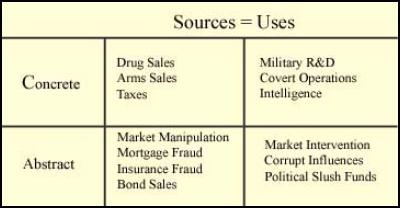
The diagram is a
stylized representation of the relationship between the
cartel and its allies outside the United States. Flows are
both concrete and abstract. Concrete flows are manufactures,
narcotics and commodities (mainly oil) inwards and arms
outwards. Abstract flows are money outwards in payment for
concrete flows inwards, which profits are recycled inwards
where they both finance the inflation of the Federal Credit
as well as buying political
influence.
Technology has transformed the
possibilities for creative management in banking. Its sheer
number-crunching power has rendered the cost of iterative
calculations to more or less zero. This has enabled the
creation of a new sector in the industry, the derivatives
business, which is nothing more than the breaking down of
financial instruments such as stocks and bonds into their
constitutive parts. This has increased the power of the
banks many-fold, thanks to the cooperation of the Federal
Reserve and Congress, who have allowed the banks to not only
self-regulate their derivatives portfolios and businesses
but have enacted rules to force other banks to use
derivatives to “control” risk. In practice this has meant
that the most profitable business of the banks has been
moved off balance sheet, in effect creating a high level of
secrecy in their business. It also confers a huge advantage
on the largest banks to whom the others have to come for
their derivatives. This has, in part, fuelled the manic
consolidation in banking over the last twenty five years and
has been applied with tremendous success internationally
thanks to the imposition of the Basel Accords on money and
banking which have forced other country’s financial
institutions to either cooperate, which in practice has
largely meant be acquired, or go out of business.
The
banks’ tactics have been copied and refined by industry. An
excellent example of this is the case of Enron, nominally an
industrial company engaged in the production and transport
of petroleum and natural gas, but which was transformed into
a highly leveraged financial operation with a huge off
balance sheet business trading derivatives. It secured a
release from regulatory oversight by the time-tested method
of purchasing lawmakers and by suborning its auditors. This
gave it the power to restate earnings, virtually at will,
simply by changing the assumptions on future interest rates
embedded in the options, swaps and futures contracts
constituting its unregulated derivatives book. Enron is a
model also of the increasingly blurred distinction between
the public and private sector. It employed as many as twenty
CIA officers. One of its senior executives, Thomas White,
was an army general before joining Enron and then left Enron
to become Secretary of the Army. Enron executives were
intimately involved with Vice President Richard Cheney’s
energy task force. It is difficult to avoid concluding that
Enron was anything other than a money-laundering operation
employed in the interest of “National Security” on behalf of
the cartel.
[xxii]
The US has
embarked on a costly global military adventure the outcome
of which is anything but certain. This marks the culmination
of more than fifty years of nearly continuous overt and
covert warfare. In this it is supported by the most
sophisticated financing apparatus in history, capable of
mobilising the cash generated from a wide variety of
activities both open and covert. The price has been the
progressive hollowing out of the American economy itself,
and the progressive erosion of civil liberties and the rule
of law. The black budget is not the cause of this but the
means.
***********
About the authors
Catherine Austin Fitts - http://www.solari.com
is the founder of Solari. Ms. Fitts is a former
managing director and member of the board of directors of
Dillon Read & Co, Inc, a former Assistant Secretary of
Housing-Federal Housing Commissioner in the first Bush
Administration, and President of The Hamilton Securities
Group, Inc. She is a graduate of the University of
Pennsylvania and The Wharton School.
Chris Sanders -
http://www.sandersresearch.com is a principle of
Sanders Research Associates in London. Mr. Sanders has been
a banker and asset manager for 21 years, and is a visiting
professor in international finance at the School of Public
Administration at the University of Göteburg in Sweden. He
has degrees from in political science from Duke University
and Arabic literature from the University of Michigan. He
began his financial career as a private banker with Citibank
in Saudi Arabia in 1979. Since 1984, he has lived in London
and worked in the international investment management
industry. He founded Sanders Research Associates in
1997.
Sanders Research Associates Ltd. provides
international strategic planning and risk management
services to both corporate and private clients. SRA also
publishes a webzine available by subscription. Visit http://www.sandersresearch.com
to get a good feel for the real
deal.
***********
FOOTNOTES:
[i] Remark
attributed to a Wall Street broker in 1895 describing J.P.
Morgan. Gustavus Meyers (2002). History of the Great
American Fortunes. University Press of the Pacific,
Volume 3, p.225. Morgan, regularly portrayed as a patriot,
was at the time deeply engrossed in relieving the government
of its gold reserve.
[ii] Lockheed’s contract was recently
terminated by HUD--an action that the company is
contesting.
[iii] Dyncorp was appointed as well to run the
Department of Justice’s asset forfeiture program in 1993,
winning a $60 million five year contract to do so.
[iv]
For an insider’s account of the problems at HUD, see
Catherine Austin Fitts, The Myth of the Rule of Law at www.sandersresearch.com.
[v]
See http://www.npr.org/programs/npc/2001/010423.dwalker.html
[vi]
See Dan Briody (2003), The Iron Triangle, Inside the
Secret World of the Carlyle Group. John Wiley & Sons:
Hoboken. ISBN 0-471-28108-5. Carlyle’s phenomenal success as
an investment firm owes a great deal to its ability to lure
former political figures and senior industry executives onto
its executive team and advisory board. Examples are former
US President George H.W. Bush and former British Prime
Minister John Major; Frank Carlucci, former deputy director
of the CIA and former Secretary of Defense; James Baker III,
former Secretary of State; Richard Darman former director of
the Office of Management and Budget; Colin Powell, former
Chairman of the Joint Chiefs of Staff and present Secretary
of State (a Carlucci protégé); William Kennard, former head
of the Federal Communications Commission; Arthur Levitt,
former chairman of the Securities and Exchange Commission;
Park Tae Joon, former Prime Minister of the Republic of
Korea, and Louis Gerstner, former chairman of IBM. Of some
interest as well has been the involvement of the Bin Laden
family as major private investors in the Carlyle Group,
represented by Shafiq Bin Laden, a brother of Osama Bin
Laden.
[vii] For a brilliant history of the rise of
America’s elite and its disenchantment with democracy and
free markets, see Sven Beckert (2001). The Monied
Metropolis. Cambridge University Press: Cambridge. ISBN
0521790395.
[viii] Gustavus Meyers (2002). History of
the Great American Fortunes, Volume 3. University Press
of the Pacific: Honolulu. (Reprint of the 1910 edition),
p.225.
[ix] See Walter Karp ((1979). The Politics of
War. Harper & Row: New York) for an analysis of the move
to war in the case of both the war with Spain and WWI. Of
particular interest here is Woodrow Wilson’s extension of a
domestic security apparatus ostensibly to deal with a
supposed foreign threat during war time. In fact, the
draconian legislation and executive orders that created the
FBI as a new appendage of the Department of Justice was
hardly used during wartime, but were deployed after the war
against domestic political opponents in the labour unions
and the Progressive Movement.
[x] See Beckert, op.
cit.
[xi] See Tim Weiner ((1990) Blank Check: The
Pentagon’s Black Budget, Warner Publishing) and Sterling
and Peggy Seagrave ((2003) Gold Warriors, Verso
Press: New York). There is ample evidence that these funds
were invested and have grown substantially in the years
since, and are still used to further political and personal
agendas.
[xii] Seagrave, Sterling and Peggy, op. cit., pp
119-120. The use of National Security as a rationale for
acts that would otherwise be considered unconstitutional and
illegal has become embedded in the America legal system, a
curious inversion of original intent. Franklin Roosevelt
declared a national economic emergency in the 30s which was
used to justify extraordinary measures by the executive,
including the abrogation of the government’s obligations to
redeem government debt I gold. The Supreme Court refused to
hear a case contesting the administration’s action. More
recently, the government intervened in a labour dispute
between the International Longshoremen Workers Union and the
Pacific Maritime Association, citing the Patriot Act of 2001
and equating the union’s position to economic “terrorism”.
In fact, rather than the union striking, the PMA locked the
union out of the ports. Government intervention was in the
form of the direct intercession of Tom Ridge, head of the
Department of Homeland Security to force the union to accede
to PMA demands.
[xiii] Notably, this is the same year in
which the Exchange Stabilisation Fund was set up.
[xiv] In
a similar fashion, manufacturing firms have migrated into
finance, finding it easier to make money by arbitrage than
by competition. Thus General Motors manufactures cars as
collateral for its leasing business; similarly GE or Boeing
make as much or more money out of financing the purchase of
their products than from making them.
[xv] This is to say
nothing of the wholesale transfer gratis of research
undertaken at the taxpayer’s expense; for example nuclear
technology transferred to the power industry.
[xvi] See
Franklin Spinney, The Defense Death Spiral, www.d-n-i.net for an in depth
analysis of the micro economics of military procurement and
its impact on force readiness.
[xvii] This is the
cumulative borrowing from abroad to finance net exports (or
the trade deficit if you prefer).
[xviii] The annual rate
of increase is the current account deficit.
[xix] See
Alfred McCoy (1991). The Politics of Heroin in South
East Asia. 2nd ed. Lawrence Hill Books: Brooklyn. ISBN
1556521251. McCoy documents thoroughly the genesis of US
wartime cooperation with the mafia in Italy during WWII and
its post-war toleration of narcotics trafficking in the US
as a quid pro quo for the cooperation of Corsican
and Italian organised crime in its covert war against the
Communist Party in France and Italy. In Asia, it supported
the opium and heroin business of a Chinese nationalist army
in Burma after the Chinese Revolution in 1948. In Indochina
the US supplanted French colonial rule after the French
defeat at Dien Bien Phu, inheriting in the process French
covert ties to opium production amongst the Hmong hill
tribes. With overt American intervention in 1965 the
importance of this traffic grew enormously, financing an
escalation of the ground war in Laos.
See also Seagrave,
Sterling and Peggy, op. cit. There is ample international
precedent for American involvement in narcotics trafficking,
beginning with the British organisation of opium production
in Bengal two centuries ago and of its illegal distribution
into China. For that matter, Japan turned Manchuria under
its occupation into the biggest producer of opium and
refined opiates in the world, the cash flow from which
proved to be immensely useful to the operations of Japan’s
Manchurian Army and intelligence services.
[xx] Peter Dale
Scott (2003). Drugs, Oil and War: the United States in
Afghanistan, Columbia and Indochina. Rowman &
Littlefield Pub: Oxford. ISBN 0742525228.
[xxi] See Roger
Morris ((1999) Partners in Power: The Clintons and Their
America, Regnery Publishing) for a case study of the
interaction of covert operations, narcotics trafficking,
financial markets and politics in Arkansas during the
governorship of Bill Clinton.
[xxii] See Catherine Austin
Fitts and Daniel Armstrong, The
Real Deal About Enron at www.sandersresearch.com.
****ENDS****
© Scoop Media

 Posts
Posts


 In
the event that a major crisis or emergency strikes the United States,
you are not going to be able to eat your gold and silver. If we get
into a situation where supermarkets get cleaned out and food supplies
get very tight, you are going to wish that you had stored some things
away for your family. Now don’t get me wrong – I actually love gold and
silver. I believe that they are both going to multiply in price during
the years ahead. I particularly love silver for a couple of reasons.
Unlike gold, silver is used in thousands upon thousands of different
consumer products, so the physical supply is constantly diminishing.
And historically, silver comes out of the ground at about a 10 to 1
ratio compared to gold, but right now the price of gold is about 65
times the price of silver. At some point there is going to be a massive
adjustment there. But if you just rely on accumulating gold and silver
and you never store up any food, you could end up deeply regretting
that choice someday.
In
the event that a major crisis or emergency strikes the United States,
you are not going to be able to eat your gold and silver. If we get
into a situation where supermarkets get cleaned out and food supplies
get very tight, you are going to wish that you had stored some things
away for your family. Now don’t get me wrong – I actually love gold and
silver. I believe that they are both going to multiply in price during
the years ahead. I particularly love silver for a couple of reasons.
Unlike gold, silver is used in thousands upon thousands of different
consumer products, so the physical supply is constantly diminishing.
And historically, silver comes out of the ground at about a 10 to 1
ratio compared to gold, but right now the price of gold is about 65
times the price of silver. At some point there is going to be a massive
adjustment there. But if you just rely on accumulating gold and silver
and you never store up any food, you could end up deeply regretting
that choice someday.