Sunday, January 13, 2013

Why Sales on Social Media Will Be Huge By 2015 [INFOGRAPHIC]

http://contently.com/blog/2012/11/15/why-sales-on-social-media-will-be-huge-by-2015-infographic/?_c=blog&_sc=disqus     

Why Sales on Social Media Will Be Huge By 2015 [INFOGRAPHIC]

By , under Infographics, Social Media. Kylie Jane Wakefield is a Los Angeles based freelance writer and publicist.

Shopping on social media may not be big right now, but by 2015, it’s expected to explode.
A new infographic by  has found that “social commerce sales are expected to bring in $30 billion each year by 2015, with half of web sales to occur
through social media,” writes Samantha Murphy of Mashable. Currently, one in three small businesses use Facebook, while there are over 42 million fan pages on Facebook. Seventeen percent of those sell products on the pages.
Facebook fans are 79 percent more likely than a non-fan to purchase a product, and 74 percent of fans are more likely to recommend a company or product. The social media site also drives 26 percent of referral traffic to company websites. Right now ”20 percent of shoppers prefer to purchase products via Facebook than the brand’s website”— and that number is expected to climb.
Facebook isn’t the only social platform where shoppers are turning to buy products. There’s also Chirpify, an in-stream commerce service on Instagram and Twitter. When Chirpify announced its expansion, fans flocked to the site to become members.
Pinterest is virtually an online store for some businesses. It allows brands to pin items that they wish to sell and drive traffic to their online stores. Just like Instagram, a visual photo of merchandise may be all that’s necessary to boost online sales.
An infographic by Symphony Teleca reveals that 167 million people will have shopped online in 2012. Forty percent of Twitter users reported that they search for products on the site, while 60 percent of Facebook users would talk about a product or service if a discount was presented to them.
Shopping on social media may not be big right now, but by 2015, it’s expected to explode.
A new infographic by Vocus has found that “social commerce sales are expected to bring in $30 billion each year by 2015, with half of web sales to occur through social media,” writes Samantha Murphy of Mashable. Currently, one in three small businesses use Facebook, while there are over 42 million fan pages on Facebook. Seventeen percent of those sell products on the pages.
Facebook fans are 79 percent more likely than a non-fan to purchase a product, and 74 percent of fans are more likely to recommend a company or product. The social media site also drives 26 percent of referral traffic to company websites. Right now ”20 percent of shoppers prefer to purchase products via Facebook than the brand’s website”— and that number is expected to climb.
Facebook isn’t the only social platform where shoppers are turning to buy products. There’s also Chirpify, an in-stream commerce service on Instagram and Twitter. When Chirpify announced its expansion, fans flocked to the site to become members.
Pinterest is virtually an online store for some businesses. It allows brands to pin items that they wish to sell and drive traffic to their online stores. Just like Instagram, a visual photo of merchandise may be all that’s necessary to boost online sales.
An infographic by Symphony Teleca reveals that 167 million people will have shopped online in 2012. Forty percent of Twitter users reported that they search for products on the site, while 60 percent of Facebook users would talk about a product or service if a discount was presented to them.
Image courtesy of kexino

Don’t Let Your Family Find Your Porn Stash After You Die, Let “Keepers” Do It For You!

http://en.rocketnews24.com/2013/01/14/dont-let-your-family-find-your-porn-stash-after-you-die-let-keepers-do-it-for-you/           

Don’t Let Your Family Find Your Porn Stash After You Die, Let “Keepers” Do It For You!

Take a look around your room right now.  If you were to drop dead this instant would you be okay with having family members go through all of your stuff?
A lot of people have skeletons in their closet or on their hard drives that may be best left hidden even after death. It’s bad enough to have your friends and family mourn your passing but do they need the stress of learning you were into Japanese mud porn too?
So for the terminally ill, elderly, people wanting to maintain their double lives in perpetuity, and people living under constant fear of death, making arrangements with an experienced and independent 3rd party to come in and clean your space might be the way to go.

Making arrangements before departing this mortal coil has become something of a fad in Japan, especially since the release of the critically acclaimed documentary Ending Note (English title: Death of a Japanese Salesman) in 2011.
An ending note is an informal type of last will and testament but not legally binding. Their purpose is for people whose end is near to easily make the necessary preparations so that their family doesn’t have to deal with needless burdens.
Major stationery companies like Kokuyo even produce ending note kits to help facilitate the process.
Keepers is a private company run by Taichi Yoshida which started Japan’s first “Deceased Belongings Clean-Up Service” in 2000. In an interview with News Post Seven he tells some cautionary tales of his experiences with post-mortem secrets revealed.
“A lot of cosmetics and women’s underwear seems to come out of the rooms of estranged fathers.”
He also tells of men with mistresses and illegitimate children who were only discovered after death. As heavy as those cases are, even something not so serious but very unbecoming of your public persona might be best left hidden.
“There was a former elementary school teacher who was found to have over 1,000 adult videos in his home. His family was speechless.”
Unless you’re Larry Flint, no one wants to be remembered that way. So you could throw out your sexy lady chop sticks and Christmas masturbation devices right now.
Or you could whip up an ending note to have some professionals who’ve seen it all come in and chuck them out when you’re truly done with them.
Source: Keepers, News Post Seven via Itai News (Japanese)
Keepers offers a range of services such as arranging all of the deceased’s belongings for memorial services.

Young blood really is the key to youth

Blood Sack? Vamp's drinking blood 2 stay immortal ?, Kernal  of truth  way back in very , very ,very ,very ,very  LONGGGGGGGGGGGGGGGGGGG   time ago?   NEED    young blood ???      ;0               http://www.newscientist.com/article/mg21628874.000-young-blood-really-is-the-key-to-youth.html                                        

Young blood really is the key to youth

HUMANS are constantly searching for an elixir of youth - could it be that an infusion of young blood holds the key?
This seems to be true for mice, at least. According to research presented this week at the Society for Neuroscience conference in New Orleans, Louisiana, giving young blood to old mice can reverse some of the effects of age-related cognitive decline.
Last year, Saul Villeda, then at Stanford University in California, and colleagues showed they could boost the growth of new cells in the brains of old mice by giving them a blood infusion from young mice (Nature, doi.org/c9jwvm).
"We know that blood has this huge effect on brain cells, but we didn't know if its effects extended beyond cell regeneration," he says.
Now the team has tested for changes in cognition by linking the circulatory systems of young and old mice. Once the blood of each conjoined mouse had fully mixed with the other, the researchers analysed their brains.
Tissue from the hippocampus of old mice given young blood showed changes in the expression of 200 to 300 genes, particularly in those involved in synaptic plasticity, which underpins learning and memory. They also found changes in some proteins involved in nerve growth.
The infusion of young blood also boosted the number and strength of neuronal connections in an area of the brain where new cells do not grow. This didn't happen when old mice received old blood.
To find out whether these changes improved cognition, the team gave 12 old mice eight intravenous shots of blood plasma either from a young or an old mouse, over the course of one month. They used plasma rather than whole blood to exclude any effect produced by blood cells.
The mice then took part in a standard memory task to locate a hidden platform in water. The old mice that had received young blood plasma remembered where to find the platform much quicker than the mice on the old plasma.
To find out which brain area was involved in this reversal of cognitive decline, the team performed fear conditioning tests. Mice that had been given young blood were better at remembering fear associated with tasks that activated the hippocampus, suggesting that young blood has a specific effect on this area of the brain.
But the mystery remains: what exactly is it about young blood that old blood doesn't have? "We have not identified any individual factors responsible for the rejuvenating effects of young plasma yet," says Tony Wyss-Coray, also at Stanford. His team is now trying to identify possible candidates such as lipids and hormones.
Villeda is hopeful the results might one day translate to humans since the components of blood that change with age in mice mirror those in humans.
While "it's plausible that similar mechanisms operate in humans," says Joseph Quinn at Oregon Health and Science University in Portland, there is no evidence yet to support this.

The ageing systemic milieu negatively regulates neurogenesis and cognitive function


 http://www.nature.com/nature/journal/v477/n7362/full/nature10357.html

The ageing systemic milieu negatively regulates neurogenesis and cognitive function

YouTube's Dirty Little Secret

http://www.musicthinktank.com/blog/youtubes-dirty-little-secret.html        January 11, 2013

YouTube's Dirty Little Secret

Ever spotted a terrible video on YouTube with an inconceivably high view count? Of course you have. Would it make you feel better knowing that most of those “views” were completely automated and only lasted 30 seconds with the sound turned off?
Vagex (referral link), a hugely popular YouTube exchange platform, is largely to blame. Credits are so cheap that members sell 2000 views for $5 on eBay and Fiverr and still turn a profit. As countless “buy YouTube views” sites testify, the views are by real people, mostly in the US. Not the sort of people who actually watch the videos, much less pay for music, but they tend to leave that bit out.
If $5 is too rich for your blood, you can earn credits by downloading one of their free viewers and letting it “watch” videos for you in the background.
Firefox Viewer
If you don’t have any videos of your own to promote, you can sell your credits back to Vagex directly. The current exchange rate is 26,730 credits for $1. That doesn’t cover the electricity cost of generating those credits, but clearly people are willing to do it, or the exchange rate would be more favorable.
Since the videos aren’t actually watched, the views themselves won’t generate new fans, but…
Could Vagex still be useful as part of a larger promotional campaign?
 Their FAQ lists these benefits:
  • Greater perception of popularity
  • Your video will show up as suggested/related more often
  • Higher search rankings on Google and YouTube
  • In search results, people tend to choose videos with more views
Sounds reasonable to me, but does it actually work?
To find out, I paid $30 to allocate 100,000 credits to a new video, immediately after uploading it to YouTube.
Vagex Setup
For the purposes of this experiment, I left the view length at 30 seconds, selected 100 likes, and left the other options unchecked (subscribers, favorites, comments).
Vagex Start
I also announced the video on Twitter and via a $30 Promoted Post on Facebook. Despite the latter reaching 15,540 people, it only generated 71 plays on Facebook.
Status - Facebook
I could’ve taken the promotion further with an email blast and multiple announcements on multiple networks, but I didn’t want to draw attention to the phony view count. After nearly a month, I’ve still got credits left, but enough data to draw useful conclusions.
Vagex Results
YouTube Results
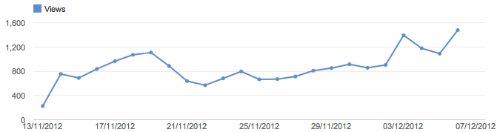
84,438 credits generated 21,545 views, minus whatever legitimate views occurred. The video averaged 900 views per day:
YouTube Views
In other words, it cost me 4 credits ($0.0012) per view. That’s 862 views for $1! That sounds like a lot, but Vagex explains in their FAQ that it typically costs 3-4 credits per view, so my results are typical.
What they don’t explain is why multiple credits are required to generate a single view. Maybe YouTube identifies and compensates for Vagex-generated traffic.
How many comments did those 21,545 views generate? Not a single one! Nor did the needle move on any other metric that I can track.
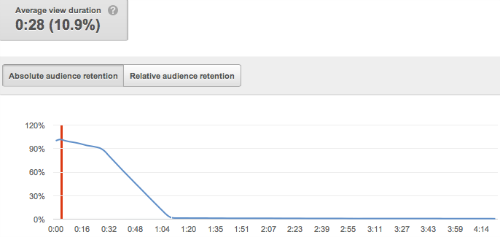
Viewer Retention
Viewer retention was dismal. Nobody made it past the first minute? One would hope that the fans watching on Facebook did, but their data is lost in a sea of fake views.
Which brings up another important point: Vagex hoses YouTube’s analytics, which could otherwise help you target further marketing efforts.
Conclusion: Vagex didn’t enhance my promotion at all, beyond the unmeasurable benefits of a higher view count.
To truly go viral, a video requires:
  • higher retention times
  • high quality backlinks
  • likes, favorites, subscriptions
  • comments from strong accounts
The video itself doesn’t have the necessary ingredients to go viral anyway, but it serves as a nice backdrop for the remix, while reinforcing the lyric.
You may argue that my particular formula (30 second views, 100 likes, no subscribers/favorites/comments) is to blame, and you may be right! I’m sure there are more effective combinations. Maybe if I had selected 300 second plays at 10 credits a pop, I would’ve dominated YouTube and won a Grammy.
As an epilogue, I just allocated 5 comments to the video in my Vagex control panel, so the page wouldn’t look so desolate. Instead of 5, I got 42 comments within the hour! Most were generic and spammy, and in no way applied to my video. Like all things Vagex, commenting appears to be completely automated.
Where do you stand? Is Vagex a deadly sin or a necessary evil? Are you going to try it? Would you admit it if you did? Let me know in the comments!
Brian Hazard is a recording artist with eighteen years of experience promoting his ten Color Theory albums. His Passive Promotion blog emphasizes “set it and forget it” methods of music promotion. Brian is also the head mastering engineer and owner of Resonance Mastering in Huntington Beach, California.

Prophetic Pillars on St. John the Divine Cathedral?

http://vigilantcitizen.com/sinistersites/prophetic-pillars-on-st-john-the-divine-cathedral/
LOOK ,LOOK , !!!                OPEN your Eyes .............. ??

Prophetic Pillars on St. John the Divine Cathedral?

Apr 13th, 2011 | Category: Sinister Sites |138 Comments

One of the first articles published on this site was Sinister Sites – St. John the Divine Cathedral, where I’ve described the building’s occult symbolism and its role in the United Nations’ efforts to push a single world religion. Probably the most shocking part of that article was the pictures of the columns, conceived in 1997,  depicting the destruction of New York city (including the Twin Towers). The Church was named after St. John the Divine, the author of the Book of Revelation.
The original article showed only two of these columns (the others were not visible at the time I took the pics). Since then however, the other pillars are visible and their symbolism is as esoteric and mysterious as those originally posted. Here they are (in no particular order).
The columns are placed next to the Cathedral’s entrance, under saintly figures.
Posted in the original article on St. John the Divine, this pillar depicts an apocalyptic New York city being engulfed by enormous waves.
Also posted in the original article, this column depicts the destruction of the Brooklyn Bridge. Underneath is the New York stock market and people trading goods. Is this a reference to the Babylon of the Revelation?
Horsemen of the Apocalypse?
A scene depicting a birth from some kind of flower, surrounded by mummies and above a lamb with its legs tied. Who is being born? Is the Anti-Christ who is said by the Book of Revelation to the beast “coming up out of the earth; and had two horns like a lamb“? Underneath is a spiral vortex (symbolizing change of consciousness?) and people apparently praising or worshipping the figure.
Pillar symbolizing death with the “wheel within a wheel, full of eyes all around” from the vision in the beginning of the book of Ezekiel.
Pillar with the Kabbalistic Tree of Life. The Book of Revelation is said to be encoded with Kabbalistic numerology to reveal its esoteric meaning.
The man above the Tree of Life is also uncharacteristic for a Cathedral. It is one-eyed (see the Eye of Horus) and wears a huge clear quartz amulet, which is said to have magical and metaphysical properties.
Little to no documentation exists about the meaning of the pillars and the rest of the Cathedral contains a lot of art with strange symbolism alluding to catastrophe and a new era. Strange place.

Innocents Betrayed - The History of Gun Control - FULL LENGTH

Innocents Betrayed - The History of Gun Control - FULL LENGTH       https://www.youtube.com/watch?v=nUmKT43j4Tc

Covert War on Terror - the Data Obama 2012 Pakistan strikes

CNN's Piers Morgan to be taken off air? Immigration group targets cable-network anchor

hum maybe so long sweetty  ;0   http://www.wnd.com/2013/01/cnns-piers-morgan-to-be-taken-off-air/#5widZTvfbI5sZJSS.99               

CNN's Piers Morgan to be taken off air?

Immigration group targets cable-network anchor


WASHINGTON – Officials with the conservative group Americans for Legal Immigration are challenging CNN to take Piers Morgan off the air after a controversial debate on gun control with InfoWars.com’s Alex Jones.
Jones has been just one of those Morgan has brought on the air over gun control in recent days.
Following the debate with Jones, which sparked a media firestorm, Morgan featured a panel on his program including Daily Beast sports columnist Buzz Bissinger, and commentator Abby Huntsman, daughter of presidential candidate Jon Huntsman, in which Buzz joked about how someone should “pop” Jones with an “assault rifle.”
To which Abby Huntsman laughingly responded, “I’d love to see that, in uniform!”
William Gheen, president of ALIPAC, called Morgan’s segment one of the worst he’s seen in his career.
“Monitoring the media is something I have done professionally for two decades now, and in that entire time I have never seen anything as outrageous as the Piers Morgan segment joking about killing one of their guests with an ‘assault rifle’,” Gheen told WND.
Morgan and Jones engaged in a heated debate over Americans’ rights to be armed, despite Morgan being British. The ever-controversial Jones discussed a New World Order and mentioned his fear of political assassination. Morgan’s decision to feature Jones as the face of the right wing gun control position outraged many conservatives including Glenn Beck and Erick Erickson who feared he would delegitimize their case.
The gun control debate has been put back on the forefront of American politics following the Aurora, Colo., theater shooting and Newtown, Conn., school tragedy.
Those representing Second Amendment advocacy including Wayne LaPierre, executive vice president of the National Rifle Association, and current NRA President David Keene, have received death threats – ironically involving guns – over social media.
ALIPAC also has launched a social media effort that has gained them 65,000 Facebook followers and has clogged up lines at CNN calling for Morgan to be taken off air.
“Please call CNN to demand that Piers Morgan be fired for advocating political murder with assault rifles on last night’s show. Free speech is one thing, but we cannot allow the liberal media to take things this far against those that oppose amnesty or support gun rights etc.. Call 404.827.1500 and wait for a human operator,” Gheen encouraged.
ALIPAC has posted a video clip online.
The Washington Post reported that Morgan also interviewed gun-rights advocate John Lott and dismissed him by “scoffing at him.
Morgan then interviewed gun-rights advocate Larry Pratt and dismissed him by “insulting” him.
The report said Morgan was unable to control all of the interviews over guns. When Ben Shapiro, editor-at-large of Breitbart.com was on the show, Morgan brought out Ronald Reagan.
He said, according to the Post, “One of the great right-wing presidents of modern times agreed with me.”
“Shapiro’s priceless retort: ‘So?’” the paper reported.
Morgan then said, “You genuinely believe your own government is going to turn on you in a way that you require an AR-15 to challenge them? You really believe that will happen in modern-day America? Is that what you think?”
Said Shapiro, “”They may not turn on me. They may not turn on my children. But the fact is this, history is replete with democracies going tyrannical. It has happened. It happened in France in the 19th century. It happened in Spain in the last century. It happened in Germany. It happened in Italy. It happened in Japan.”
Read more at http://www.wnd.com/2013/01/cnns-piers-morgan-to-be-taken-off-air/#cgGgopjqs3mS5v9z.99

The Kill List, Everything You Need To Know

http://beforeitsnews.com/international/2013/01/the-kill-list-everything-you-need-to-know-2450380.html?currentSplittedPage=0      
The Kill List, Everything You Need To Know
Friday, January 11, 2013 12:27


By Cora CurrierProPublica   You might have heard about the “kill list.” You’ve certainly heard about drones. But the details of the U.S. campaign against militants in Pakistan, Yemen, and Somalia — a centerpiece of the Obama administration’s national security approach – remain shrouded in secrecy. Here’s our guide to what we know—and what we don’t know.
A MQ-9 Reaper during a training mission
File:MQ-9 Reaper - 090609-F-0000M-777.JPG
Credit: Wikipedia
Where is the drone war? Who carries it out?

Drones have been the Obama administration’s tool of choice for taking out militants outside of Iraq and Afghanistan. Drones aren’t the exclusive weapon – traditional airstrikes and other attacks have also been reported. But by one estimate, 95 percent of targeted killings since 9/11 have been conducted by drones. Among the benefits of drones: they don’t put American troops in harm’s way. The first reported drone strike against Al Qaeda happened in Yemen in 2002. The CIAramped up secret drone strikes in Pakistan under President George W. Bush in 2008. Under Obama, they have expanded drastically there and in Yemen in 2011.
The CIA isn’t alone in conducting drone strikes. The military has acknowledged “direct action” in Yemen and Somalia. Strikes in those countries are reportedly carried out by the secretive, elite Joint Special Operations Command. Since 9/11, JSOC has grown more than tenfold, taking on intelligence-gathering as well as combat roles. (For example, JSOC was responsible for the operation that killed Osama Bin Laden.)
The drone war is carried out remotely, from the U.S. and a network of secret basesaround the world. The Washington Post got a glimpse – through examining construction contracts and showing up uninvited – at the base in the tiny African nation of Djibouti from which many of the strikes on Yemen and Somalia are carried out. Earlier this year, Wired pieced together an account of the war against Somalia’s al-Shabaab militant group and the U.S.’s expanded military presence throughout Africa.
The number of strikes in Pakistan has ebbed in recent years, from a peak of more than 100 in 2008, to an estimated 46 last year. Meanwhile, the pace in Yemen picked up, with more than 40 last year. But therehave been seven strikes in Pakistan in the first ten days of 2013.
BAE Taranis model one of the largest designs of all of the concepts
File:TaranisModel.JPG
Credit: Wikipedia

How are targets chosen? A series of articles based largely on anonymous comments from administration officials have given partial picture of how the U.S. picks targets and carries out strikes. Two recent reports – from researchers atColumbia Law School and from theCouncil on Foreign Relations– also give detailed overviews of what’s known about the process.
The CIA and the military have reportedly longmaintained overlapping “kill lists.” According to news reports last spring, the military’s list was hashed out in Pentagon-run interagency meetings, with the White House approving proposed targets. Obama would authorize particularly sensitive missions himself.
This year, the process reportedly changed, to concentrate the review of individuals and targeting criteria in the White House. According to the Washington Post, the reviews now happen at regular interagency meetings at the National Counterterrorism Center. Recommendations are sent to a panel of National Security Council officials. Final revisions go through White House counterterror adviser John Brennan to the president. Several profiles have highlightedBrennan’s powerful and controversial role in shaping the trajectory of the targeted killing program. This week, Obama nominated Brennan to head the CIA.
At least some CIA strikes don’t have to get White House signoff. The director of the CIA can reportedlygreen-light strikes in Pakistan. In a 2011 interview, John Rizzo, previously the CIA’s top lawyer, said agency attorneys did an exhaustive review of each target.
Doesn’t the U.S. sometimes target people whose names they don’t know?
Yes. While administration officials often have frequently framed drone strikes as going after “high-level al Qaeda leaders who are planning attacks” against the U.S., many strikes go after apparent militants whose identities the U.S. doesn’t know. The so-called “signature strikes”began under Bush in early 2008 and were expanded by Obama. Exactly what portion of strikes are signature strikes isn’t clear.
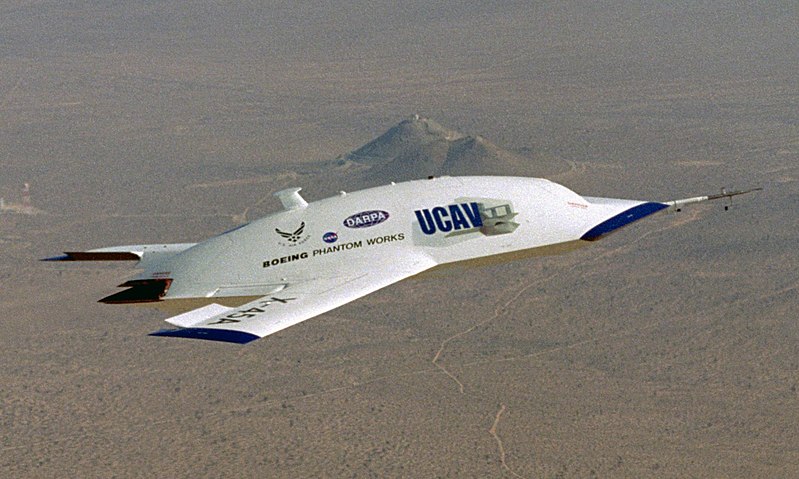
J-UCAS Boeing X-45A UCAV technology demonstrator
File:Boeing X-45A UCAV.jpg
Credit: Wikipedia
At various points the CIA’s use of signature strikes in Pakistan in particular have caused tensions with the White House and State Department. One official told the New York Times about a joke that for the CIA, “three guys doing jumping jacks,” was a terrorist training camp.
In Yemen and Somalia, there is debate about whether the militants targeted by the U.S. are in fact plotting against the U.S. or instead fighting against their own country. Micah Zenko, a fellow at the Council on Foreign Relations who has been critical of the drone program, toldProPublica that the U.S. is essentially running “a counterinsurgency air force” for allied countries. At times, strikes have relied on local intelligence that later proves faulty. The Los Angeles Times recently examined the case of a Yemeni man killed by a U.S. drone and the complex web of allegiances and politics surrounding his death.
How many people have been killed in strikes?
The precise number isn’t known, but some estimates peg the total around 3,000.
A number of groups are tracking strikes and estimating casualties:
· The Long War Journal covers Pakistan and Yemen.
· The New America Foundation covers Pakistan.
· The London Bureau of Investigative Journalism covers YemenSomalia, andPakistan, as well as statisticsfrom on drone strikes carried out in Afghanistan.
How many of those killed are have been civilians?
It’s impossible to know.
There has been considerable back-and-forth about the tally of civilian casualties. For instance, the New America Foundation estimates between 261 and 305 civilians have been killed in Pakistan; The Bureau of Investigative Journalism gives a range of 475 – 891. All of the counts are much higher than the very low numbers of deaths the administration claims. (We’ve detailed inconsistencies even within those low estimates.) Some analyses show that civilian deaths have dropped proportionally in recent years.
The estimates are largely compiled by interpreting news reports relying on anonymous officials or accounts from local media, whose credibility may vary. (For example, the Washington Post reported last month that the Yemeni government often tries to conceal the U.S.’ role in airstrikes that kill civilians.)
The controversy has been compounded by the fact that the U.S. reportedly counts any military-age male killed in a drone strike as a militant. An administration official told ProPublica, “If a group of fighting age males are in a home where we know they are constructing explosives or plotting an attack, it’s assumed that all of them are in on that effort.” It’s not clear what if any investigation occurs after the fact.
Columbia Law School conducted an in-depth analysis of what we know about the U.S.’s efforts to mitigate and calculate civilian casualties. It concluded that the drone war’s covert nature hampered accountability measures taken in traditional military actions.Another report from Stanford and NYU documented “anxiety and psychological trauma” among Pakistani villagers.
This fall, the U.N. announced an investigation into the civilian impact – in particular, allegations of “double-tap” strikes, in which a second strike targets rescuers.
Why just kill? What about capture?
Administration officials have said in speeches that militants are targeted for killing when they pose an imminent threat to the U.S. and capture isn’t feasible. But killing appears to be is far more common than capture, and accounts of strikes don’t generally shed light on “imminent” or “feasible.” Cases involvingsecret, overseas captures under Obama show the political and diplomatic quandaries in deciding how and where a suspect could be picked up.
This fall, the Washington Post described something called the “disposition matrix” – a process that has contingency plans for what to do with terrorists depending where they are. The Atlantic mapped out how that decision-making might happen in the case of a U.S. citizen, based on known examples. But of course, the details of the disposition matrix, like the “kill lists” it reportedly supplants, aren’t known.
What’s the legal rationale for all this?
Obama administration officials have given a series of speeches broadly outlining the legal underpinning for strikes, but they never talk about specific cases. In fact, they don’t officially acknowledge the drone war at all.
The White House argues that Congress’ 2001 Authorization for Use of Military Force as well as international law on nations’ right to self-defense provides sound legal basis for targeting individuals affiliated with Al Qaeda or “associated forces,” even outside Afghanistan. That can include U.S. citizens.
“Due process,” said Attorney General Eric Holder said in a speech last March, “takes into account the realities of combat.”
What form that “due process” takes hasn’t been detailed. And, as we’ve reported, the government frequently clams up when it comes to specific questions – like civilian casualties, or the reasons specific individuals were killed.
Just last week, a federal judge ruled that the government did not have to release a secret legal memomaking the case for the killing of Anwar al-Awlaki, a U.S. citizen. The judge also ruled the government did not have to respond to other requests seeking more information about targeted killing in general. (In making the ruling, the judge acknowledged a “Catch-22,” saying that the government claimed “as perfectly lawful certain actions that seem on their face incompatible with our Constitution and laws while keeping the reasons for their conclusion a secret.”)
The U.S. has also sought to dismiss a lawsuit brought by family members over Awlaki’s death and that of his 16-year-old son – also a U.S. citizen — who was killed in a drone strike.
When does the drone war end?
The administration has reportedly discussed scaling back the drone war, but by other accounts, it is formalizing the targeted killing program for the long haul. The U.S.estimates there Al Qaeda in the Arabian Peninsula has a “few thousand” members; but officials have also said the U.S. cannot “capture of kill every last terrorist who claims an affiliation with al Qaeda.”
The State Department’s legal counsel Harold Koh gave a speech last month entitled, “The Conflict Against Al Qaeda and its Affiliates: How Will It End?” He didn’t give a date.
John Brennan has reportedly said the CIA should return to its focus on intelligence-gathering. But Brennan’s key role in running the drone war from the White House has led to debate about how much he would actually curtail the agency’s involvement if he is confirmed as CIA chief.
What about backlash abroad?
There appears to be plenty of it. Drone strikes are deeply unpopular in the countries where they occur, sparking frequent protests. Despite that, Brennan said last August that the U.S. saw,“little evidence that these actions are generating widespread anti-American sentiment or recruits.”
General Stanley McChrystal, who led the military in Afghanistan, recently contradicted that, saying, “The resentment created by American use of unmanned strikes … is much greater than the average American appreciates. They are hated on a visceral level, even by people who’ve never seen one or seen the effects of one.” The New York Times recently reported that Pakistani militants have carried out a campaign of brutal reprisals against locals, accusing them of spying for the U.S.
As for international governments: Top U.S. allies have mostly kept silent. A 2010 U.N. report raised concerns about the precedent of a covert, boundary-less war. The President of Yemen, Abdu Hadi,supports the U.S. campaign, while Pakistan maintains an uneasy combination of public protest andapparent acquiescence.
Drone War Jargon
AUMF The Authorization for Use of Military Force, an act of Congresspassed days after the 9/11 attacks, giving the president authority to take “all necessary and appropriate force” against anyone involved in the attack or harboring those who were. Both Bush and Obama have claimed broad authorities to detain and kill terror suspects based on the AUMF.
AQAP Al Qaeda in the Arabian Peninsula is the Yemen-based al Qaeda affiliate tied to the attempted Christmas Day airplane bombing in 2009. Over the past year, the U.S. has ramped up strikes against AQAP, targeting leaders as well as unspecified militants.
DISPOSITION MATRIX A system for tracking terror targets and assessing when – and where – they could be killed or captured. The Washington Postreported this fall that the Disposition Matrix is an attempt to codify for the long haul the administration’s “kill lists.”
GLOMAR A response rejecting a request for information on a classified program asserting that the information’s mere existence can neither be confirmed nor denied. The name comes from 1968, when the CIA told journalists it could neither “confirm nor deny” the existence of a ship called the Glomar Explorer. The CIA has responded to information requests about its drone program with Glomar responses.
JSOC Joint Special Operations Command is a secretive, elite segment of the military. JSOC squads carried out the Bin Laden raid and run the military’s drone programs in Yemen and Somalia and also conduct intelligence gathering.
PERSONALITY STRIKE A targeted attack on a particular individual identified as a terrorist leader.
SIGNATURE STRIKE A strike against someone believed to be a militant whose identity isn’t necessarily known. Such strikes are reportedly based on a “pattern of life” analysis – intelligence on their behavior suggesting that an individual is a militant. The policy, reportedly begun by Bush in Pakistan in 2008, is now allowed in Yemen.
TADS Terror Attack Disruption Strikes, sometimes used to refer to some strikes when the identity of the target is not known. Administration officials have said that the criteria for TADS are different from signature strikes, but it is not clear how.
Who to Follow
For reporting and commentary on the drone war on Twitter:
@drones collects op-eds and news on well, drones. (Run by members of the Electronic Frontiers Foundation, which has been outspoken about privacy concerns in the use of domestic drones, but it also covers national security.)
@natlsecuritycnn has breaking news.
@Dangerroom from Wired covers national security and technology, including a lot on drones.
@lawfareblog covers the drone war’s legal dimensions.
@gregorydjohnsen is an expert on Yemen, who is closely following the war there.
@AfPakChannel from the New America Foundation and Foreign Policy tweets news and commentary on Afghanistan and Pakistan.
Contacts and sources:
Cora CurrierProPublica

Professor's Questions About Sandy Hook Shooting Recall Columbine Massacre

http://www.thedailybell.com/28573/Professors-Questions-About-Sandy-Hook-Shooting-Recall-Columbine-Massacre          

Professor's Questions About Sandy Hook Shooting Recall Columbine Massacre

By Staff Report
         

Anderson Cooper Tackles 'Sickening,' 'Ignorant' Newtown Conspiracy Theories https://www.youtube.com/watch?feature=player_embedded&v=rZxL4U-8r2Y


Believe it or not, there are actually people out there who are convinced that last month's horrific shooting in Newtown, Connecticut was staged. Anderson Cooper opened his show tonight taking on these conspiracy theorists. He said that ordinarily, he wouldn't give much thought to insane conspiracies, but one of the people pushing them is a Florida professor who raises doubts as to whether the shooting "ever took place" in the way that the media described, and the whole thing was just a huge conspiracy to get the country behind gun control. And as if that wasn't unbelievable enough, he also suspects that some of the parents of the children were really actors. – Mediaite.com
Dominant Social Theme: Sandy Hook conspiracy theories are appalling and outrageous.
Free-Market Analysis: A recent CNN/Anderson Cooper "Keeping Them Honest" segment focused on a media professor, James Tracy, who has publicly claimed that the Sandy Hook shootings "may not have happened at all, at least ... the way they have been described."
An article by the Sun Sentinel describes the Tracy controversy as follows:
FAU prof stirs controversy by disputing Newtown massacre ... A communication professor known for conspiracy theories has stirred controversy at Florida Atlantic University with claims that last month's Newtown, Conn., school shootings did not happen as reported — or may not have happened at all.
Moreover, James Tracy asserts in radio interviews and on his memoryholeblog.com, that trained "crisis actors" may have been employed by the Obama administration in an effort to shape public opinion in favor of the event's true purpose: gun control.
... In one of his blog posts, "The Sandy Hook School Massacre: Unanswered Questions and Missing Information," Tracy cites several sources for his skepticism, including lack of surveillance video or still images from the scene, the halting performance of the medical examiner at a news conference, timeline confusion, and how the accused shooter was able to fire so many shots in just minutes ...
Tracy said also has doubts about the official version of the Kennedy assassination, the Oklahoma City bombing, the 9-11 terror attacks and the Aurora, Colo., theater murders.
"I describe myself as a scholar and public intellectual," he said, "interested in going more deeply into controversial public events. Although some may see [my theories] as beyond the pale, I am doing what we should be doing as academics."
Cooper is at his silky best in this segment, blasting away at the professor's theories and even implying that he ought to be fired for voicing such an opinion.
The program made attempts to get Tracy on air but the professor (perhaps wisely) declined. He did issue a nuanced apology in which he voiced regret that he had added to any family's pain with his views but he didn't retract his opinion that there was more to the Sandy Hook shootings than had been reported.
And while Anderson Cooper and CNN (and others) may find it "outrageous" for someone to state that professional reporting was inadequate in such cases, the case of the Columbine High School shootings provides us with a stubborn rebuttal to the idea that the mainstream press always reports adequately in such situations.
Two individuals – Eric Harris, 18, and Dylan Klebold, 17 – were said to be responsible for the horrible shootings at Columbine High School outside Littleton, Colorado, on April 20, 1999, leaving 15 dead and 23 wounded. But as we've reported before, there are at least 100 reports of eyewitnesses claiming to see more shooters and others generally beyond the two young suspects that later supposedly committed suicide at the scene.
You can see a summary of these reports at Whatreallyhappened.com.
These summaries are cited in hundreds if not thousands of posts on the Internet and on such alternative media Web sites at Infowars. Below is a sampling; while the provenance of these reports is not always clear, the sheer number of them and the detail certainly warrant further investigation.
But that's not going to come from CNN or Anderson Cooper. He's too busy "debunking" the idea that mainstream reporting ever gets it wrong or that such massacres might not have been adequately explained.
Columbine: 101 witnesses can't be wrong
According to the final report of the investigation, only two people--Eric Harris, 18, and Dylan Klebold, 17--planned and executed the mass shooting at Columbine High School outside Littleton, Colorado, on April 20, 1999, leaving 15 dead and 23 wounded. But at least 101 eye- and ear- witnesses remembered it differently:
1) Chris Wisher, sophomore (1261) He turned and saw two guys carrying shotguns, and wearing black trench coats. A 3rd guy wearing a white T-shirt and jeans was seen throwing bombs onto the roof.
2) Jake Apodaca, sophomore (653) He was at the soccer field, heard firecrackers. He turned and saw two guys carrying shotguns, wearing black trench coats and black T-shirts. A 3rd guy wearing a white T-shirt and jeans was seen throwing bombs onto the roof.
3) Jonathan Cole, freshman (749) He noticed two tall guys in black trench coats. He then saw a third male, wearing a white T-shirt and blue jeans. This person looked over to the other two suspect, and yelled "GO!! GO!!".
4) William Arapkiles, freshman (660) He states that he was at the soccer field, and heard firecrackers. He turned and saw 3 people near the West entrance. Two were wearing black trench coats, and carrying guns. The third was wearing a white T-shirt, and no visible gun. The person in the white T-shirt was pacing back and forth about 5' away from the two gunmen.
5) Channel 7 News at 12pm(noon) on 4-20 (EP 21-244) "Reporter said that numerous witnesses he spoke to who were not named said they saw 3 gunmen."
6) Lindsay Elmore, junior (332)"I believe there were 3 gunmen." (340) "...there was so much movement that Elmore thought there was more than two people."
7) ACSO Nelson (8810) "... a list of 3 names that the 12 witnesses ID'd from a yearbook were turned over to ACSO investigators to forward."
8) Jason Baer, sophomore (1759) Hid in greenroom off science hall "I heard more than two people yelling to each other saying 'over here' and stuff."
9) Anthony Sammauro, freshman (5071) "Tony stated that two suspects came in the front door and one came in the side door."
10) Erik Sunde, freshman (4576) Saw two gunmen downstairs near cafeteria, runs upstairs and sees another person in trenchcoat in front of library doors.
(Video from Buzz Sourse's YouTube user channel.)

Fastest Wi-Fi ever is almost ready for real-world use

http://arstechnica.com/information-technology/2013/01/fastest-wi-fi-ever-is-almost-ready-for-real-world-use/ 

Fastest Wi-Fi ever is almost ready for real-world use

WiGig routers, docking stations, laptop, and tablet shown at CES.

Wilocity's wireless chips allow 4.6Gbps transmission over the 60GHz band.
In a quiet suite removed from the insanity of the Consumer Electronics Show expo floor, a company aiming to build the fastest Wi-Fi chips in the world demonstrated its vision of wireless technology's future.
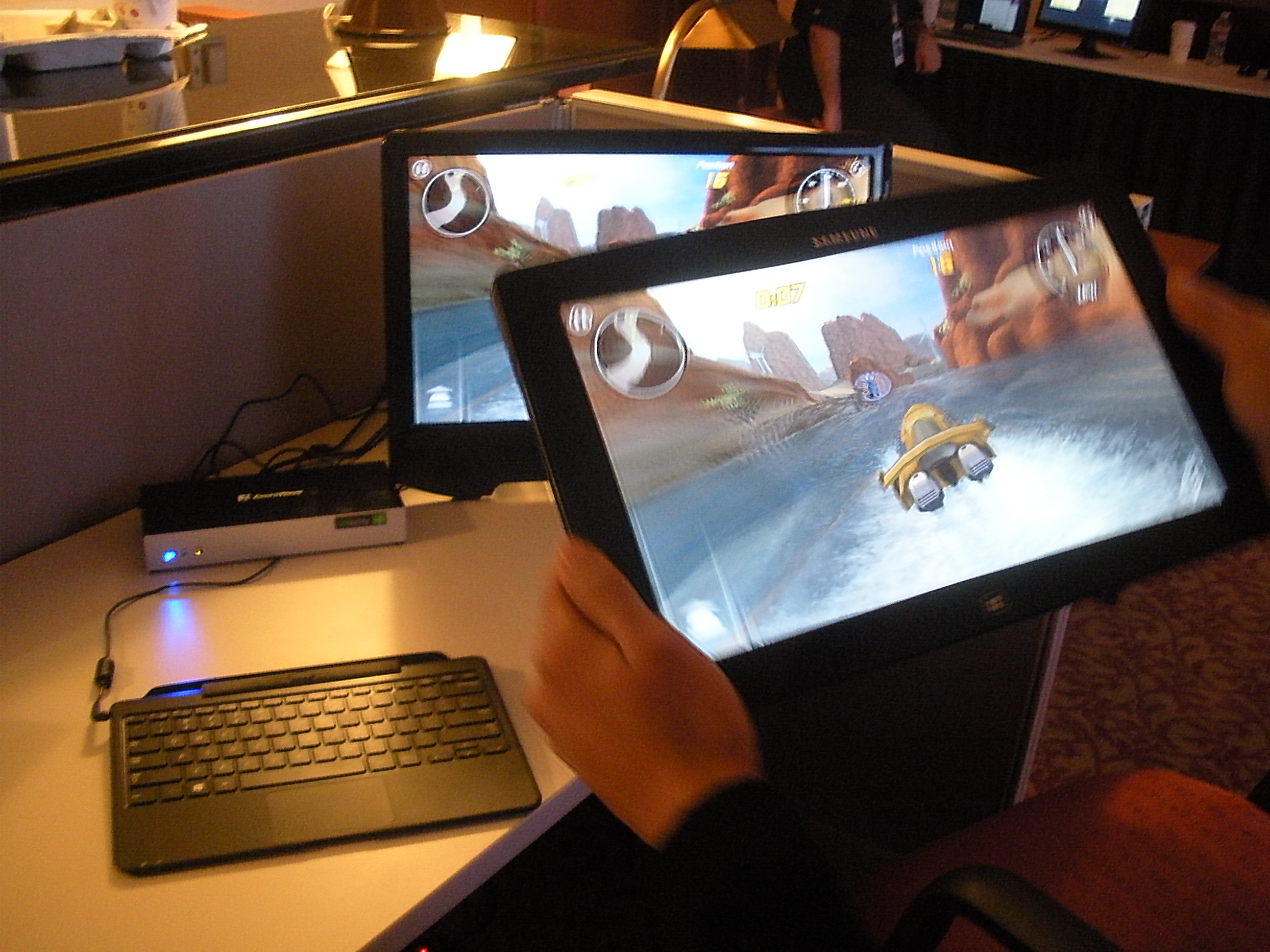
On one desk, a laptop powered a two-monitor setup without any wires. At another, a tablet playing an accelerometer-based racing game mirrors its screen in high definition to another monitor. Across the room, a computer quickly transfers a 3GB file from a wireless router with built-in storage.
The suite was set up in the Las Vegas Hotel by Wilocity, a chip company specializing in wireless products using 60GHz transmissions, which are far faster than traditional Wi-Fi. Avoiding the show floor is a good idea if you're worried about Internet connectivity, because thousands of vendors are clogging the pipes. But that's not why Wilocity was here—they'd be able to perform the demo even in the busiest parts of CES without interference because they're not relying on the congested bands used by regular Wi-Fi.
"I don't think we'd have an issue with air congestion," said director of product marketing Teresa Liou. "We're just here because it's quieter and less hectic than being on the show floor."

Faster than a speeding bullet, too weak to pass through walls

Traditional Wi-Fi using the 2.4GHz and 5GHz bands is crossing the gigabit per second mark with the 802.11ac standard. Wilocity is one of the main proponents of the even faster WiGig (or "wireless gigabit"), which can theoretically hit speeds of up to 7Gbps, with the downside of using frequencies that are easily blocked by walls. Even thin cubicle walls may block signals, Wilocity acknowledged. (See: 7Gbps wireless transfers and streaming, no router required.)
It's possible the next wireless router you buy will use the 60GHz frequency as well as the lower ones typically used in Wi-Fi, allowing for incredibly fast performance when you're within the same room as the router and normal performance when you're in a different room.
Wilocity's current chips hit a maximum throughput of 4.6Gbps, putting wireless speeds roughly on par with USB 3.0. Tri-band routers, wireless storage devices, and docking stations that facilitate wireless connections between mobile devices and monitors were all showcased in the Wilocity suite. These were just prototype devices, since shipping products have mostly not yet hit the market.
A Dell Latitude 6430u Ultrabook is thus far the only product using a Wilocity chip that you can buy. But WiGig isn't really a selling point for this laptop today, because there's no way to take advantage of it until there are companion products like docking stations or routers. Liou said Dell is planning a bundle to pair the Ultrabook with another WiGig-enabled product, but otherwise Wilocity couldn't say when further products will hit the market.
WiGig builds on top of the just-completed 802.11ad wireless standard. Wilocity's first-generation chip with 802.11ad can be used in computers and docking stations that connect devices to monitors, keyboards, and mice, but the chip can't be used in wireless routers. A second-generation chip with router support was announced by Wilocity and Qualcomm at CES this week. The chip combines 802.11ad with 802.11ac, the successor to 11n. That way, when WiGig products have to fall back to 2.4GHz or 5GHz transmissions, they'll at least be getting the best speeds that regular Wi-Fi offers. The chip will be sampled to vendors within a few months, and Wilocity is working with Marvell on tri-band chips as well, Liou noted.
Since no tablets with a WiGig chip are commercially available, Wilocity installed one of its chips into a Samsung Windows 8 tablet for purposes of the demo. The routers, wireless storage devices, and docking stations shown off by Wilocity were also prototypes made in conjunction with original design manufacturers like AzureWave.
Wilocity wanted to dispel any notion that WiGig requires users to keep devices stationary them because of the limitations in 60GHz frequencies. To do that, they demonstrated streaming video from a laptop to a monitor while spinning the laptop around in circles. WiGig compensates for the movement with beamforming technology, which helps direct wireless signals.
"It finds the best path every time. It reflects off the walls," Wilocity hardware engineer Vineeth Alva said.
Enlarge / An Ultrabook powering two monitors, wirelessly through WiGig.
Enlarge / Wilocity's Teresa Liou plays a game on a tablet, which is mirrored onto the monitor through the docking station on the left.
At the same time, walls are real obstacles to those 60GHz waves. When devices are in range, WiGig can enable every type of use case that regular Wi-Fi can, including connecting to the Internet, but falls back to slower 2.4GHz or 5GHz transmissions when the 60GHz connection is broken.
Wilocity had routers with network-attached storage placed strategically on the ceiling to allow a good path to WiGig-enabled devices. In one demo, a Wilocity engineer transferred a 3GB file from the NAS to a computer at rates of 1.2Gbps. That's slower than the theoretical peak of Wilocity chips—Alva blamed the application layer and perhaps hardware bottlenecks unrelated to the chip itself. Still, it's fast, and the file transfer zoomed ceaselessly toward completion when in range of the router. But when the engineer stepped around a corner, the transfer fell back to normal Wi-Fi and slowed to a crawl.

With wireless docking, tablets become PCs

Wilocity isn't alone in pitching WiGig. Back on the CES expo floor, Ars spoke with Ali Sadri, president and chairmen of the Wireless Gigabit Alliance industry group. Sadri's job there may soon come to an end, as the consortium is in the process of merging with the Wi-Fi Alliance, bringing WiGig into the same group that handles all the general Wi-Fi certification programs. The merger helps legitimize WiGig, so Sadri says if his role does come to an end he'll count it as a victory. In any case, he has a day job at Intel as director of millimeter wave standards (anything above 30GHz).
Sadri couldn't reveal anything about Intel's plans for WiGig chips, saying only "If Intel is behind something normally they are involved in some development as well." One of the top use cases for WiGig will be turning tablets into full-fledged PCs, Sadri argued. Touch-optimized devices can now run a full PC operating system (aka Windows 8) but are limited in both storage and the ability to dock with a mouse, keyboard, and monitor, he noted. WiGig-enabled storage devices and docking stations solve both of those problems. The tablet connects to a docking station, and the docking station is connected to a monitor and peripherals via HDMI.
"In a couple of years I don't think there will be a difference between a tablet and a PC with WiGig," he said.
WiGig can "replace practically any cable and connector," performing every type of Wi-Fi use case even while multiplying the speed of Wi-Fi, he said. "It's almost like a Switzerland that, you know, here's a technology and see what you can do. … I cannot imagine in two years what is going to be out there. I wish I could extrapolate."
WiGig is based on two specifications. The 802.11ad standard developed at the IEEE standards group forms the base of it, while the WiGig spec itself adds protocol adaptation layers (PALs) to interface with audio-visual and input/output systems. The Wireless Gigabit Alliance is finishing up version 1.2 of the WiGig spec, and then will hand over development to the Wi-Fi Alliance.
Success will depend on hardware makers, of course. USB adapters could extend WiGig capability to laptops or even tablets with a USB port, but to achieve the truly mobile use cases Sadri described the chips will need to be pre-installed in tablets by manufacturers.

Don't forget Miracast and 802.11ac

Even though WiGig isn't yet widely available, Wi-Fi is marching on with new capabilities. 802.11ac routers were introduced by several companies at CES, and a new streaming technology called Miracast was demoed by various companies including AMD, Broadcom, Cavium, Netgear, and Qualcomm.
Miracast, as we've written, lets phones, tablets, or laptops stream to monitors over the 5GHz band. Today it runs over 802.11n but is being adapted to run over 802.11ac as well. Miracast, which is much like Apple's AirPlay, is already built into such phones as the LG Optimus and Samsung Galaxy S3. At CES, Wi-Fi Alliance Marketing Director Kelly Davis-Felner showed me a demo of the LG phone streaming to a TV through a Netgear Push2TV adapter, which can bring Miracast capability even to TVs without built-in Wi-Fi. If you want to play Angry Birds on a large monitor, this is the way to do it:
Enlarge / The Wi-Fi Alliance uses an LG Optimus to demonstrate Miracast, a standard that lets mobile devices stream to TVs.
The Wi-Fi Alliance has certified about 260 devices to run Miracast, 60 of which have been publicly announced. Nearly half of those are TVs, the rest split between phones, tablets, and adapters, Davis-Felner said.
802.11ac routers you can buy today have not yet been certified to ensure interoperability with other devices, because the Wi-Fi Alliance will only begin certifying 802.11ac devices around April. Still, the spec is stable and well-known enough that incompatibility between devices probably won't be a problem. Certification of 802.11ad products will probably start at the end of 2013, she said.
Miracast is definitely useful and has the advantage of actually being available to consumers today, but Sadri said it can't replace what WiGig is trying to do with the 60GHz band. "If I'm streaming a video if I have even a second delay, who cares," he said. "But when I'm in front of a computer and I'm typing a Word document or doing some drawings, any small artifact is going to show."
The Miracast demo Davis-Felner showed me worked fine on the crowded show floor. There's a small amount of lag that can be detected in the above Angry Birds photo, but I didn't notice it in real time. Sadri, though, scoffs at today's Wi-Fi technology, saying only WiGig will provide "cable-equivalent quality of service."
"Good luck getting any Wi-Fi network operating at CES," he said.

Who’s Pirating Game of Thrones, And Why?

http://torrentfreak.com/whos-pirating-game-of-thrones-and-why-120520/           

Who’s Pirating Game of Thrones, And Why?

With over 3 million downloads per episode, the HBO hit series Game of Thrones is without doubt the most pirated TV-show of the season. Data gathered by TorrentFreak shows that most of the pirates come from Australia, while London tops the list of pirate cities. But why have these people turned to BitTorrent?
thronesIn a few hours a new episode of Game of Thrones will appear on BitTorrent, and a few days later between 3 and 4 million people will download this unofficial release.
Statistics gathered by TorrentFreak reveal that more people are downloading the show compared to last year, when it came in as the second most downloaded TV-show of 2011. The number of weekly downloads worldwide is about equal to the estimated viewers on HBO in the U.S., but why?
One of the prime reasons for the popularity among pirates is the international delay in airing. In Australia, for example, fans of the show have to wait a week before they can see the latest episode. So it’s hardly a surprise that some people are turning to BitTorrent instead.
And indeed, if we look at the top countries where Game of Thrones is downloaded, Australia comes out on top with 10.1% of all downloads (based on one episode).
But delays are just part of the problem. The fact that the show is only available to those who pay for an HBO subscription doesn’t help either. This explains why hundreds of thousands of people from the U.S. prefer to use BitTorrent.
The same is true for Canada and the United Kingdom, placed third and fourth in the list of pirate kings. If we look at the ranking of cities, London takes the lead followed by Sydney, Melbourne and Amsterdam.
To a certain degree one could claim that HBO is to blame for Game of Throne’s success on BitTorrent. They want to keep access to the show “exclusive” and even Netflix wasn’t able to buy the rights no matter what they offered.
Whether this is the best decision in terms of revenue is hard to tell, but it’s clear that HBO prefers more exclusiveness over less piracy. And who knows, maybe they even sell HBO subscriptions to BitTorrent downloaders in the long run.
The reasons above are not exhaustive of course, there are many more reasons why people turn to BitTorrent. For some it’s become a matter of habit that will be hard to break, no matter where they live and how good the legal alternative is.
If there are any Game of Thrones pirates reading this, let us know what drives you in the comments.
Spring 2012
# Country % City %
torrentfreak.com
1 Australia 10.1% London 3.0%
2 United States 9.7% Sydney 3.0%
3 Canada 7.7% Melbourne 2.9%
4 United Kingdom 7.6% Amsterdam 2.2%
5 The Netherlands 4.4% Athens 2.2%
6 Norway 3.7% Perth 1.8%
7 Spain 3.2% Istanbul 1.6%
8 Poland 3.0% Brisbane 1.5%
9 Greece 2.8% Budapest 1.3%
10 Philippines 2.7% Madrid 1.3%