Sunday, July 28, 2013

‘Affordable Solution for Better Living’?: You Won’t Believe What IKEA Did After Woman Reportedly Vomited in Store Then Fell Asleep on Display Bed

hehe  here in America the cops would've beat the shit out~ta her , fucking 'tased' her ass & shot her dog !  & mayor ass~berg  (NY)  ..would BAN all sleeping & throwing up  in 'any' pub~lick 'stores'   lol     

‘Affordable Solution for Better Living’?: You Won’t Believe What IKEA Did After Woman Reportedly Vomited in Store Then Fell Asleep on Display Bed

IKEA may be known for giving customers amenities beyond the average shopping experience, but one of its stores reportedly went well above and beyond the call of duty.
Shoppers at an IKEA store in central Israel had quite the sensory experience after a woman allegedly vomited on one of the store’s couches and then proceeded to the bedroom display.
Once there, she picked a bed she liked, took off her flip flops, and fell asleep.
The Israeli news site Walla posted photos of the sleeping woman, whom the site did not identify, and reports that customers believed she was drunk.
IKEA Lets Woman, Who Allegedly Threw Up on Store Couch, Sleep on Display Bed Until Closing
The Israeli news site Walla reported a woman fell asleep on a display bed after throwing up on a couch at IKEA in Netanya, Israel. (Photo: Newsil via Walla)
But eyewitnesses told Walla that neither the IKEA sales staff nor other customers disturbed the woman.
“Customers simply didn’t come to try that bed,” one eyewitness told Walla.
The woman apparently was permitted to remain sleeping on the display bed and sheets until closing time Wednesday. At that time, a store security guard woke her, and she went on her way.
“I never saw anything like it,” another eyewitness told the Hebrew news site.
In a statement to Walla, IKEA said the woman “felt unwell when she arrived at the store, and our people therefore permitted her to rest until she felt better. We wish her the best of health.”

What Would You Do If A Bank Stole Everything You Owned?

What Would You Do If A Bank Stole Everything You Owned?

Empowering Citizens and Deterring Crime, One Free Shotgun At a Time

Empowering Citizens and Deterring Crime, One Free Shotgun At a Time
Cassini Images Bizarre Hexagon on Saturn
03.27.07
Pasadena, Calif. -- An odd, six-sided, honeycomb-shaped feature circling the entire north pole of Saturn has captured the interest of scientists with NASA's Cassini mission.

NASA's Voyager 1 and 2 spacecraft imaged the feature over two decades ago. The fact that it has appeared in Cassini images indicates that it is a long-lived feature. A second hexagon, significantly darker than the brighter historical feature, is also visible in the Cassini pictures. The spacecraft's visual and infrared mapping spectrometer is the first instrument to capture the entire hexagon feature in one image.

six-sided feature at Saturn's north pole Image right: This nighttime view of Saturn's north pole shows a bizarre six-sided hexagon feature encircling the entire north pole. The red color indicates the amount of 5-micron wavelength radiation, or heat, generated in the warm interior of Saturn that escapes the planet. Image credit: NASA/JPL/University of Arizona
+ Full image and caption
+ Related image

"This is a very strange feature, lying in a precise geometric fashion with six nearly equally straight sides," said Kevin Baines, atmospheric expert and member of Cassini's visual and infrared mapping spectrometer team at NASA's Jet Propulsion Laboratory, Pasadena, Calif. "We've never seen anything like this on any other planet. Indeed, Saturn's thick atmosphere where circularly-shaped waves and convective cells dominate is perhaps the last place you'd expect to see such a six-sided geometric figure, yet there it is."

The hexagon is similar to Earth's polar vortex, which has winds blowing in a circular pattern around the polar region.  On Saturn, the vortex has a hexagonal rather than circular shape. The hexagon is nearly 25,000 kilometers (15,000 miles) across. Nearly four Earths could fit inside it.

The new images taken in thermal-infrared light show the hexagon extends much deeper down into the atmosphere than previously expected, some 100 kilometers (60 miles) below the cloud tops. A system of clouds lies within the hexagon. The clouds appear to be whipping around the hexagon like cars on a racetrack.

"It's amazing to see such striking differences on opposite ends of Saturn's poles," said Bob Brown, team leader of the Cassini visual and infrared mapping spectrometer, University of Arizona, Tucson. "At the south pole we have what appears to be a hurricane with a giant eye, and at the north pole of Saturn we have this geometric feature, which is completely different."

Spinning Saturn Image left: This nighttime movie of the depths of the north pole of Saturn reveals a dynamic, active planet lurking underneath the ubiquitous cover of upper-level hazes. Image credit: NASA/JPL/University of Arizona
+ Full movie and caption

The Saturn north pole hexagon has not been visible to Cassini's visual cameras, because it's winter in that area, so the hexagon is under the cover of the long polar night, which lasts about 15 years. The infrared mapping spectrometer can image Saturn in both daytime and nighttime conditions and see deep inside. It imaged the feature with thermal wavelengths near 5 microns (seven times the wavelength visible to the human eye) during a 12-day period beginning on Oct. 30, 2006. As winter wanes over the next two years, the feature may become visible to the visual cameras.

Based on the new images and more information on the depth of the feature, scientists think it is not linked to Saturn's radio emissions or to auroral activity, as once contemplated, even though Saturn's northern aurora lies nearly overhead.

six-sided feature encircling the north pole of SaturnImage right: Another view of the bizarre six-sided feature encircling the north pole of Saturn. Image credit: NASA/JPL/University of Arizona
+ Full image and caption

The hexagon appears to have remained fixed with Saturn's rotation rate and axis since first glimpsed by Voyager 26 years ago. The actual rotation rate of Saturn is still uncertain.

"Once we understand its dynamical nature, this long-lived, deep-seated polar hexagon may give us a clue to the true rotation rate of the deep atmosphere and perhaps the interior," added Baines.

The hexagon images and movie, including the north polar auroras are available at: http://www.nasa.gov/cassini and http://saturn.jpl.nasa.gov and http://wwwvims.lpl.arizona.edu .

The Cassini-Huygens mission is a cooperative project of NASA, the European Space Agency and the Italian Space Agency. The Jet Propulsion Laboratory, a division of the California Institute of Technology in Pasadena, manages the Cassini-Huygens mission for NASA's Science Mission Directorate, Washington. The Cassini orbiter was designed, developed and assembled at JPL. The Visual and Infrared Mapping Spectrometer team is based at the University of Arizona.


Media contact: Carolina Martinez 818-354-9382
Jet Propulsion Laboratory, Pasadena, Calif.


2007-034

Mysterious NASA video of Saturn reveals impossible hexagon-shaped cloud pattern larger than planet Earth

NYC allows doctors to prescribe fresh fruit and vegetables as treatment for obesity; FDA declares veggies 'unapproved drugs'

NYC allows doctors to prescribe fresh fruit and vegetables as treatment for obesity; FDA declares veggies 'unapproved drugs'

‘Big Data’ Dynamo: How Giant Tech Firms Help the Government to Spy on Americans


cyber2
As the secret state continues trawling the electronic communications of hundreds of millions of Americans, lusting after what securocrats euphemistically call “actionable intelligence,” a notional tipping point that transforms a “good” citizen into a “criminal” suspect, the role played by telecommunications and technology firms cannot be emphasized enough.
Ever since former NSA contractor Edward Snowden began leaking secrets to media outlets about government surveillance programs, one fact stands out: The zero probability these privacy-killing projects would be practical without close (and very profitable) “arrangements” made with phone companies, internet service providers and other technology giants.

Indeed, a top secret NSA Inspector General’s report published by The Guardian, revealed that the agency “maintains relationships with over 100 US companies,” adding that the US has the “home field advantage as the primary hub for worldwide telecommunications.”
Similarly, the British fiber optic cable tapping program, TEMPORA, referred to telcos and ISPs involved in the spying as “intercept partners.” The names of the firms were considered so sensitive that GCHQ “went to great lengths” to keep their identities hidden, fearing exposure “would cause ‘high-level political fallout’.”
With new privacy threats looming on the horizon, including what CNET described as ongoing efforts by the FBI and NSA “to obtain the master encryption keys that Internet companies use to shield millions of users’ private Web communications from eavesdropping,” along with new government demands that ISPs and cell phone carriers “divulge users’ stored passwords,” can we trust these firms?
And with Microsoft and other tech giants, collaborating closely with “US intelligence services to allow users’ communications to be intercepted, including helping the National Security Agency to circumvent the company’s own encryption,” can we afford to?
Hiding in Plain Sight
Ever since retired union technician Mark Klein blew the lid off AT&T’s secret surveillance pact with the US government in 2006, we know user privacy is not part of that firm’s business model.
The technical source for the Electronic Frontier Foundation’s lawsuit, Hepting v. AT&T and the author of Wiring Up the Big Brother Machine, Klein was the first to publicly expose how NSA was “vacuuming up everything flowing in the Internet stream: e-mail, web browsing, Voice-Over-Internet phone calls, pictures, streaming video, you name it.”
We also know from reporting by USA Today, that the agency “has been secretly collecting the phone call records of tens of millions of Americans” and had amassed “the largest database ever assembled in the world.”
Three of those data-slurping programs, UPSTREAM, PRISM and X-KEYSCORE, shunt domestic and global communications collected from fiber optic cables, the servers of Apple, Google, Microsoft and Yahoo, along with telephone data (including metadata, call content and location) grabbed from AT&T, Sprint and Verizon into NSA-controlled databases.
But however large, a database is only useful to an organization, whether its a corporation or a spy agency, if the oceans of data collected can be searched and extracted in meaningful ways.
To the growing list of spooky acronyms and code-named black programs revealed by Edward Snowden, what other projects, including those in the public domain, are hiding in plain sight?
Add Google’s BigTable and Yahoo’s Hadoop to that list. Both are massive storage and retrieval systems designed to crunch ultra-large data sets and were developed as a practical means to overcome “big data” conundrums.
According to the Mountain View behemoth, “BigTable is a distributed storage system for managing structured data that is designed to scale to a very large size: petabytes of data across thousands of commodity servers.” Along with web indexing, Google Earth and Google Finance, BigTable performs “bulk processing” for “real-time data serving.”
Down the road in Sunnyvale, Yahoo developed Hadoop as “an open source Java framework for processing and querying vast amounts of data on large clusters of commodity hardware.” According to Yahoo, Hadoop has become “the industry de facto framework for big data processing.” Like Google’s offering, Hadoop enable applications to work with thousands of computers and petabytes of data simultaneously.
Prominent corporate clients using these applications include Amazon, AOL, eBay, Facebook, IBM, Microsoft and Twitter, among many others.
‘Big Data’ Dynamo
Who might also have a compelling interest in cataloging and searching through very large data sets, away from prying eyes, and at granular levels to boot? It should be clear following Snowden’s disclosures, what’s good for commerce is also a highly-prized commodity among global eavesdroppers.
Despite benefits for medical and scientific researchers sifting through mountains of data, as Ars Technica pointed out BigTable and Hadoop “lacked compartmentalized security” vital to spy shops, so “in 2008, NSA set out to create a better version of BigTable, called Accumulo.”
Developed by agency specialists, it was eventually handed off to the “non-profit” Apache Software Foundation. Touted as an open software platform, Accumulo is described in Apache literature as “a robust, scalable, high performance data storage and retrieval system.”
“The platform allows for compartmentalization of segments of big data storage through an approach called cell-level security. The security level of each cell within an Accumulo table can be set independently, hiding it from users who don’t have a need to know: whole sections of data tables can be hidden from view in such a way that users (and applications) without clearance would never know they weren’t there,” Ars Technica explained.
The tech site Gigaom noted, Accumulo is the “technological linchpin to everything the NSA is doing from a data-analysis perspective,” enabling agency analysts to “generate near real-time reports from specific patterns in data,” Ars averred.
“For instance, the system could look for specific words or addressees in e-mail messages that come from a range of IP addresses; or, it could look for phone numbers that are two degrees of separation from a target’s phone number. Then it can spit those chosen e-mails or phone numbers into another database, where NSA workers could peruse it at their leisure.”
(Since that Ars piece appeared, we have since learned that NSA is now conducting what is described as “three-hop analysis,” that is, three degrees of separation from a target’s email or phone number. This data dragnet “could allow the government to mine the records of 2.5 million Americans when investigating one suspected terrorist,” the Associated Press observed).
“In other words,” Ars explained, “Accumulo allows the NSA to do what Google does with your e-mails and Web searches–only with everything that flows across the Internet, or with every phone call you make.”
Armed with a “dual-use” program like Accumulo, the dirty business of assembling a user’s political profile, or shuttling the names of “suspect” Americans into a national security index, is as now easy as downloading a song from iTunes!
And it isn’t only Silicon Valley giants cashing-in on the “public-private” spy game.
Just as the CIA-funded Palantir, a firm currently valued at $8 billion and exposed two years ago as a “partner” in a Bank of America-brokered scheme to bring down WikiLeaks, profited from CIA interest in its social mapping Graph application, so too, the NSA spin-off Sqrrl, launched in 2012 with agency blessings, stands to make a killing off software its corporate officers helped develop for NSA.
Co-founded by nine-year agency veteran Adam Fuchs, Sqrrl sells commercial versions of Accumulo and has partnered-up with Amazon, Dell, MapR and Northrop Grumman. According to published reports, like other start-ups with an intelligence angle, Sqrrl is hoping to hook-up with CIA’s venture capital arm In-Q-Tel.
Its obvious why the application is of acute interest to American spy shops. Fuchs told Gigaom that Accumulo operates “at thousands-of-nodes scale” within NSA data centers.
“There are multiple instances each storing tens of petabytes (1 petabyte equals 1,000 terabytes or 1 million gigabytes) of data and it’s the backend of the agency’s most widely used analytical capabilities.”
Accumulo’s analytical functions work because of its ability to perform lightning-quick searches called “graph analysis,” a method for uncovering unique relationships between people hidden within vast oceans of data.
According to Forbes, “we know that the NSA has successfully tested Accumulo’s graph analysis capabilities on some huge data sets–in one case on a 1200 node Accumulo cluster with over a petabyte of data and 70 trillion edges.”
Considering, as Wired reported, that “on an average day, Google accounts for about 25 percent of all consumer internet traffic running through North American ISPs,” and the Mountain View firm allowed the FBI and NSA to tap directly into their central servers as The Washington Post disclosed, the negative impact on civil rights and political liberties when systems designed for the Pentagon are monetized, should be evident.
Once fully commercialized, how much more intrusive will employers, marketing firms, insurance companies or local and state police with mountains of data only a mouse click away, become?
Global Panopticon
The sheer scope of NSA programs such as UPSTREAM, PRISM or X-KEYSCORE, exposed by the Brazilian daily, O Globo should give pause.
A crude illustration (at the top of this post), shows that all data collected in X-KEYSCORE “sessions” are processed in petabyte scale batches captured from “web-based searches” that can be “retrospectively” queried to locate and profile a “target.”
This requires enormous processing power; a problem the agency may have solved with Accumulo or similar applications.
Once collected, data is separated into digestible fragments (phone numbers, email addresses and log ins), then reassembled at lightning speeds for searchable queries in graphic form. Information gathered in the hopper includes not only metadata tables, but the “full log,” including what spooks call Digital Network Intelligence, i.e., user content.
And while it may not yet be practical for NSA to collect and store each single packet flowing through the pipes, the agency is already collecting and storing vast reams of data intercepted from our phone records, IP addresses, emails, web searches and visits, and is doing so in much the same way that Amazon, eBay, Google and Yahoo does.
As the volume of global communications increase each year at near exponential levels, data storage and processing pose distinct problems.
Indeed, Cisco Systems forecast in their 2012 Visual Networking Index that global IP traffic will grow three-fold over the next five years and will carry up to 4 exabytes of data per day, for an annual rate of 1.4 zettabytes by 2017.
This does much to explain why NSA is building a $2 billion Utah Data Center with 22 acres of digital storage space that can hold up to 5 zettabytes of data and expanding already existing centers at Fort Gordon, Lackland Air Force Base, NSA Hawaii and at the agency’s Fort Meade headquarters.
Additionally, NSA is feverishly working to bring supercomputers online “that can execute a quadrillion operations a second” at the Multiprogram Research facility in Oak Ridge, Tennessee where enriched uranium for nuclear weapons is manufactured, as James Bamford disclosed last year in Wired.
As the secret state sinks tens of billions of dollars into various big data digital programs, and carries out research on next-gen cyberweapons more destructive than Flame or Stuxnet, as those supercomputers come online the cost of cracking encrypted passwords and communications will continue to fall.
Stanford University computer scientist David Mazières told CNET that mastering encrypted communications would “include an order to extract them from the server or network when the user logs in–which has been done before–or installing a keylogger at the client.”
This is precisely what Microsoft has already done with its SkyDrive cloud storage service “which now has 250 million users worldwide” and exabytes of data ready to be pilfered, as The Guardian disclosed.
One document “stated that NSA already had pre-encryption access to Outlook email. ‘For Prism collection against Hotmail, Live, and Outlook.com emails will be unaffected because Prism collects this data prior to encryption’.”
Call the “wrong” person or click a dodgy link and you might just be the lucky winner of a one-way trip to indefinite military detention under NDAA, or worse.
What should also be clear since revelations about NSA surveillance programs began spilling out last month, is not a single ruling class sector in the United States–including corporations, the media, nor any branch of the US government–has the least interest in defending democratic rights or rolling-back America’s emerging police state.

Under New Proposed Internet Laws, We Will All Be Felons

Did you know it is a misdemeanor to use your work computer to email your friends? If you check the score of the ballgame from work, it is also a misdemeanor. If you make reservations for dinner from your work computer you have also committed a crime. If you check your Facebook account on your lunch break from your work computer, you could be fined and could go to jail. The law which criminalizes such behaviors is called the 1986 Computer Fraud and Abuse Act and if the Department of Justice (DOJ) gets its way, they want to make misusing your computer in any way a felony under the “exceeds authorized use” of any computer including you own personal computer. For all of the above offenses, you could be prosecuted and most likely play a fine. However, if the DOJ gets its way, you will go to jail because they will prosecute you as a felon if they convince Congress to strengthen this 1986 law!

Facebook Becomes Fascist Book


Their word could soon be law.
Facebook has joined in on the debate. You know Facebook, the company started up by the CIA so they could spy on us. Many on Facebook already refer to it as Fascistbook because they “punish” users for sending friends requests, despite the fact that Facebook sends these potential “friends” right to your page and invites you to do so. And if you send too many shared messages out at one time, they will suspend your account. Yet, nobody could tell you how many messages and shares can you send before you are in trouble as Facebook keeps this a secret. Technically, you have committed a misdemeanor by violating Facebook’s vague users agreement.
Now, the police state surveillance grid wants to interject themselves into the enforcement of Facebook policy and begin to prosecute violators of the fake name rules as written by the legal scholars at Facebook.
Around the first of the year, Facebook suspended the accounts of activists Michael Rivero and Jon Rappoport presumably because they did not follow some obscure Facebook editorial policy. And if that was not bad enough, now the DOJ wants to go after Facebook users who break Facebook rules and they want to prosecute violations of Facebook policy as a felony, especially if one uses a name other than their real name. The intent is obvious. The dossier being prepared and updated daily by the NSA on your personal threat matrix score will not be as accurate as they desire if you use aliases in the social media arena. Big Brother has to know where you are at all times and what you are up to or the police state surveillance grid will be compromised if you are allowed to use an alias.

The Tyranny Does Not End With Facebook

Have you ever registered on an online dating website? Do you think anyone has ever understated their weight on a dating website, or have shaved a few years off of their age in an online profile?
If you submitted a slightly embellished resume to a prospective employer, via the internet, you could soon go to jail as a felon under the new proposed DOJ rules.
Technically, under this proposal, if a male lied to a female about loving her in an email, solely for the accused purpose of having sexual relations, the male could soon be guilty of a felony.
Under this new proposal, anyone lying on any website could go to jail no matter how innocent the “white” lie.
just usRichard Downing, the DOJ’s deputy computer crime chief, delivered the request to criminalize any kind of misrepresentation on the internet and to criminalize, as a felony, any violation of the proposed new rules. The DOJ argued that the Computer Fraud and Abuse Act (CFAA), which is an amendment to the Counterfeit Access Device and Abuse Act generally used to prosecute hacking and other serious cyber-crimes, and which went into effect in 1986, must give prosecutors the ability to charge people “based upon a violation of terms of service or similar contractual agreement with an employer or provider.” Not only that, how many of you have ever signed a terms of service agreement before you could log in on a Wifi or access a website? Did you really read the user’s agreement that you signed? Would you even know if you had ever violated a terms of service or user’s agreement form? The answer for nearly all of us is a resounding no.
If Congress were to ever give in to the demands of the DOJ and criminalize every inaccuracy on the internet, then the legal question of ex post facto laws comes into play. Ex post facto means that the government cannot criminalize a behavior for what happened on Monday by passing a law outlawing the behavior on Tuesday. Because the vast majority of postings on the internet are in perpetuity, something that you posted five years ago, way before any law was passed, could still come back to haunt you because the “crime” was still in progress because the posting was still active on the internet today. This could represent an entire undoing of due process procedures in court.   

Good News, Bad News and Very Bad News

The DOJ lost their bid to criminalize every internet inaccuracy in December of 2012. This is the temporary good news.
The bad news is that both the DOJ and the FBI have been back up on Capitol Hill with similar proposals since that time. Congress may have extended the illegal surveillance powers of the NSA, but they have not had the guts to pass laws that would make it a virtual certainty that one day, intentionally or not, every web-surfing American will violate some type of a “terms of service agreement”, thus, rendering you vulnerable to prosecution as a felon. At least they have not until now. This is the bad news.
Assume you were a dissenter and becoming an annoyance to the administration. To get you out of the way, all they would need to do is to assign a small team of internet forensics investigators who would investigate your behavior for every site you have ever visited. And one day, voila, they discover that you used a copyright protected downloaded Google image for an article you wrote and you are busted. This is the very bad news.
Subsequently, the selective prosecution team of the DOJ knocks down your door in a swat team raid, seizes all of your computers and takes you to prison after running you through a kangaroo trial. Federal trials end up in over 90% conviction rates. During the time you are railroaded through the legal process, additional charges of domestic terrorism are added for what you have written on the internet, thus increasing your prison time served. This is the very, very bad news and it will have a chilling effect on all citizen journalism on the internet.  
How pervasive could this DOJ approach to selectively persecuting journalists, just ask yourself how many times you have read an article by a popular journalist regarding government corruption and their Youtube video has been taken down for a violation of copyright or for some other specified reason that is listed as a dead link within the article? Under this new approach, that event just made a felon out of the journalist. And if you as a website operator, who routinely runs articles related to government corruption, publishes an article from a contributor who knowingly, or unknowingly, has violated some service agreement somewhere along the line, you have become an accomplice to a felony and you would be charged with facilitation of a felony and you would be facing up to five years in a federal prison. These are the goals of the DOJ
There is another compelling reason that the DOJ wants to push this draconian legislation through. In the aftermath of the Snowden affair, the government is scrambling to severely inhibit ANY form of whistleblowing. You can bet your bottom dollar that future service agreements are going to more specific, with more hard to understand legal terms, in an attempt to stay out of trouble with the government. This will undoubtedly lead to even more violations of service agreements and more prosecution of “undesirables.”  

There Is Always An Opposite and Equal Effect.

The DOJ is very shortsighted and is only focused on the short-term goal of more successful prosecutions and furthering the agenda of the police state surveillance grid. However, the internet is actually a safety valve for the globalist agenda. As long as people feel that they have a voice and an outlet for that voice, they are unlikely to go to the next level of protest which is civil disobedience.
civil disobedienceOnce a significant number of the population reaches the level of civil disobedience, that society is only a trigger event away from a civil war, whether it open civil war or guerrilla warfare.
As the DOJ and the FBI move to lock down the internet protest articles through selective prosecution, they will funnel people in the direction of civil disobedience and worse. I am left wondering if the globalists don’t know this already and have that as a goal. Time will tell. In the meantime, always make sure you accurately report your age, weight, height, professional accomplishments in a resume and never misrepresent your romantic intentions, because they FEDS, or as I lovingly call them, the new American breed of the Federales, are waiting to take you down. And when the FEDS show up at your door, invoke your Fifth Amendment right to not answer their questions until you have a lawyer present. Martha Stewart went to prison for lying to the FEDS, not for what they said she did. Most people in these situations, go to prison for lying to the FEDS and not the crime that they are being investigated for. So keep your mouth shut and your Bible near your computer as we move one step closer to the inevitable bifurcation of American society.            http://thecommonsenseshow.com/2013/07/27/under-new-proposed-internet-laws-we-will-all-be-felons/

Obama says mass murderer Ho Chi Minh was inspired by Jefferson

Obama says mass murderer Ho Chi Minh was inspired by Jefferson

Obama Signs Executive Order, Sends $500 million to Terrorists – NYC Daily Mail

Obama Signs Executive Order, Sends $500 million to Terrorists – NYC Daily Mail

Spike Lee, Seeking A Kickstarter Handout, Owns $30 Million Manhattan Mansion, Martha's Vineyard Estate

As of moments ago, Spike Lee’s Kickstarter campaign to raise $1.25 million for his next feature film has raised about $215,000 via more than 1220 donations. The director explains that he needs a public handout because “this is a motherfucking tough business, and I’m gonna keep fighting the powers that be.”
While Lee’s gambit is not a celebrity first (see Braff, Zach and Mars, Veronica), he may be the wealthiest online busker to date, an artist who does not need to seek, Knicks hat-in-hand, other people’s money to produce a new “joint.”
Perhaps Lee, 56, might have considered a relatively small loan or mortgage secured by his Manhattan home, a sprawling Spanish Revival mansion that is listed on the National Register of Historic Places and is likely worth in the vicinity of $30 million.
Lee’s Upper East Side residence (seen at left) is actually more of a compound. Two three-story buildings--joined by a private central courtyard--encompass about 9000 square feet of living space. In 1998, Lee and his wife purchased the 32-foot-wide property from the artist Jasper Johns for $4.75 million, according to deed records.
Lee’s landmarked home was built nearly a century ago by a Vanderbilt family member, and it was once the home of another Lee, Gypsy Rose, the legendary burlesque performer.
If Lee were hesitant to borrow off his primary residence, perhaps he could consider exploiting the equity in his summer home (seen below). The director owns a two-acre estate on Nantucket Sound in Martha’s Vineyard, just across from the 18th hole of the Farm Neck Golf Club. After purchasing the land for about $400,000 in 1989, Lee built a four-bedroom home on the property (which is now worth several million dollars).

And then there is always the Brooklyn headquarters of Forty Acres and a Mule, Lee’s film production company. The three-story Fort Greene property was purchased for $820,000 in 1991.
Lee’s filmography includes “She’s Gotta Have It,” “Do The Right Thing,” “Malcolm X,” and “Bamboozled.”

Exclusive: Signs of declining economic security

this  IS what God ..wants for His Children ?    debt,Debt,DEBT !!!   .....Born into debt..debt you can NEVER repay ?  Given Life ...to pay for everything  ( food,water,shelter,clothes etc,etc,etc,etc,etc )  You REALLY think that's WHY we ALL have been created ? ..to work to pay "bills"  & than die ?    me thinks "somebody"  has sold US a bad bill of good's  :o

Exclusive: Signs of declining economic security

Jul. 28 

http://bigstory.ap.org/article/exclusive-4-5-us-face-near-poverty-no-work-0


ECONOMIC INSECURITY
 
Chart shows cumulative economic insecurity by age; 2c x 4 inches; 96.3 mm x 101 mm;
WASHINGTON (AP) — Four out of 5 U.S. adults struggle with joblessness, near poverty or reliance on welfare for at least parts of their lives, a sign of deteriorating economic security and an elusive American dream.
Survey data exclusive to The Associated Press points to an increasingly globalized U.S. economy, the widening gap between rich and poor and loss of good-paying manufacturing jobs as reasons for the trend.
The findings come as President Barack Obama tries to renew his administration's emphasis on the economy, saying in recent speeches that his highest priority is to "rebuild ladders of opportunity" and reverse income inequality.
Hardship is particularly on the rise among whites, based on several measures. Pessimism among that racial group about their families' economic futures has climbed to the highest point since at least 1987. In the most recent AP-GfK poll, 63 percent of whites called the economy "poor."
"I think it's going to get worse," said Irene Salyers, 52, of Buchanan County, Va., a declining coal region in Appalachia. Married and divorced three times, Salyers now helps run a fruit and vegetable stand with her boyfriend, but it doesn't generate much income. They live mostly off government disability checks.
"If you do try to go apply for a job, they're not hiring people, and they're not paying that much to even go to work," she said. Children, she said, have "nothing better to do than to get on drugs."
While racial and ethnic minorities are more likely to live in poverty, race disparities in the poverty rate have narrowed substantially since the 1970s, census data show. Economic insecurity among whites also is more pervasive than is shown in government data, engulfing more than 76 percent of white adults by the time they turn 60, according to a new economic gauge being published next year by the Oxford University Press.
The gauge defines "economic insecurity" as experiencing unemployment at some point in their working lives, or a year or more of reliance on government aid such as food stamps or income below 150 percent of the poverty line. Measured across all races, the risk of economic insecurity rises to 79 percent.
"It's time that America comes to understand that many of the nation's biggest disparities, from education and life expectancy to poverty, are increasingly due to economic class position," said William Julius Wilson, a Harvard professor who specializes in race and poverty.
He noted that despite continuing economic difficulties, minorities have more optimism about the future after Obama's election, while struggling whites do not.
"There is the real possibility that white alienation will increase if steps are not taken to highlight and address inequality on a broad front," Wilson said.
___
Sometimes termed "the invisible poor" by demographers, lower-income whites are generally dispersed in suburbs as well as small rural towns, where more than 60 percent of the poor are white. Concentrated in Appalachia in the East, they are also numerous in the industrial Midwest and spread across America's heartland, from Missouri, Arkansas and Oklahoma up through the Great Plains.
More than 19 million whites fall below the poverty line of $23,021 for a family of four, accounting for more than 41 percent of the nation's destitute, nearly double the number of poor blacks.
Still, while census figures provide an official measure of poverty, they're only a temporary snapshot. The numbers don't capture the makeup of those who cycle in and out of poverty at different points in their lives. They may be suburbanites, for example, or the working poor or the laid off.
In 2011 that snapshot showed 12.6 percent of adults in their prime working-age years of 25-60 lived in poverty. But measured in terms of a person's lifetime risk, a much higher number — 4 in 10 adults — falls into poverty for at least a year of their lives.
The risks of poverty also have been increasing in recent decades, particularly among people ages 35-55, coinciding with widening income inequality. For instance, people ages 35-45 had a 17 percent risk of encountering poverty during the 1969-1989 time period; that risk increased to 23 percent during the 1989-2009 period. For those ages 45-55, the risk of poverty jumped from 11.8 percent to 17.7 percent.
By race, nonwhites still have a higher risk of being economically insecure, at 90 percent. But compared with the official poverty rate, some of the biggest jumps under the newer measure are among whites, with more than 76 percent enduring periods of joblessness, life on welfare or near-poverty.
By 2030, based on the current trend of widening income inequality, close to 85 percent of all working-age adults in the U.S. will experience bouts of economic insecurity.
"Poverty is no longer an issue of 'them', it's an issue of 'us'," says Mark Rank, a professor at Washington University in St. Louis who calculated the numbers. "Only when poverty is thought of as a mainstream event, rather than a fringe experience that just affects blacks and Hispanics, can we really begin to build broader support for programs that lift people in need."
Rank's analysis is supplemented with figures provided by Tom Hirschl, a professor at Cornell University; John Iceland, a sociology professor at Penn State University; the University of New Hampshire's Carsey Institute; the Census Bureau; and the Population Reference Bureau.
Among the findings:
—For the first time since 1975, the number of white single-mother households who were living in poverty with children surpassed or equaled black ones in the past decade, spurred by job losses and faster rates of out-of-wedlock births among whites. White single-mother families in poverty stood at nearly 1.5 million in 2011, comparable to the number for blacks. Hispanic single-mother families in poverty trailed at 1.2 million.
—The share of children living in high-poverty neighborhoods — those with poverty rates of 30 percent or more — has increased to 1 in 10, putting them at higher risk of teen pregnancy or dropping out of school. Non-Hispanic whites accounted for 17 percent of the child population in such neighborhoods, up from 13 percent in 2000, even though the overall proportion of white children in the U.S. has been declining.
The share of black children in high-poverty neighborhoods dropped sharply, from 43 percent to 37 percent, while the share of Latino children ticked higher, from 38 to 39 percent.
___
Going back to the 1980s, never have whites been so pessimistic about their futures, according to the General Social Survey, which is conducted by NORC at the University of Chicago. Just 45 percent say their family will have a good chance of improving their economic position based on the way things are in America.
The divide is especially evident among those whites who self-identify as working class: 49 percent say they think their children will do better than them, compared with 67 percent of non-whites who consider themselves working class.
In November, Obama won the votes of just 36 percent of those noncollege whites, the worst performance of any Democratic nominee among that group since 1984.
Some Democratic analysts have urged renewed efforts to bring working-class whites into the political fold, calling them a potential "decisive swing voter group" if minority and youth turnout level off in future elections.
"They don't trust big government, but it doesn't mean they want no government," says Republican pollster Ed Goeas, who agrees that working-class whites will remain an important electoral group. "They feel that politicians are giving attention to other people and not them."
___
AP Director of Polling Jennifer Agiesta, News Survey Specialist Dennis Junius and AP writer Debra McCown in Buchanan County, Va., contributed to this report.

Benghazi Survivor David Ubben Waited For 20 Hours For Help

Benghazi Survivor David Ubben Waited For 20 Hours For Help

More Media Deception: ABC Called Out By Slate.com For Editing Zimmerman Juror’s Interview : Freedom Outpost

More Media Deception: ABC Called Out By Slate.com For Editing Zimmerman Juror’s Interview : Freedom Outpost

7 Charts That Prove That The Stock Market Has Become Completely Divorced From Reality

7 Charts That Prove That The Stock Market Has Become Completely Divorced From Reality

The Coming Shortage Of Physical Gold That Will Change Everything

The Coming Shortage Of Physical Gold That Will Change Everything

Why YouTube buffers: The secret deals that make—and break—online video

When ISPs and video providers fight over money, Internet users suffer.

Aurich Lawson
Lee Hutchinson has a problem. My fellow Ars writer is a man who loves to watch YouTube videos—mostly space rocket launches and gun demonstrations, I assume—but he never knows when his home Internet service will let him do so.
"For at least the past year, I've suffered from ridiculously awful YouTube speeds," Hutchinson tells me. "Ads load quickly—there's never anything wrong with the ads!—but during peak times, HD videos have been almost universally unwatchable. I've found myself having to reduce the quality down to 480p and sometimes even down to 240p to watch things without buffering. More recently, videos would start to play and buffer without issue, then simply stop buffering at some point between a third and two-thirds in. When the playhead hit the end of the buffer—which might be at 1:30 of a six-minute video—the video would hang for several seconds, then simply end. The video's total time would change from six minutes to 1:30 minutes and I'd be presented with the standard 'related videos' view that you see when a video is over."
Hutchinson, a Houston resident who pays Comcast for 16Mbps business-class cable, is far from alone. As one Ars reader recently complained, "YouTube is almost unusable on my [Verizon] FiOS connection during peak hours." Another reader responded, "To be fair, it's unusable with almost any ISP." Hutchinson's YouTube playback has actually gotten better in recent weeks. But complaints about streaming video services—notably YouTube and Netflix—are repeated again and again in articles and support forums across the Internet.
Why does online video have such problems? People may assume there are perfectly innocent causes related to their computers or to the mysterious workings of the Internet. Often, they're correct.
But cynical types who suspect their Internet Service Providers (ISPs) intentionally degrade streaming video may be right as well. No, your ISP (probably) isn't sniffing your traffic every time you click a YouTube or Netflix link, ready to throttle your bandwidth. But behind the scenes, in negotiations that almost never become public, the world's biggest Internet providers and video services argue over how much one network should pay to connect to another. When these negotiations fail, users suffer. In other words, bad video performance is often caused not just by technology problems but also by business decisions made by the companies that control the Internet.                  
Please wait. Keep waiting.
These business decisions involve "peering" agreements that Internet companies make to pass traffic from one to another and negotiations over caching services that store videos closer to people's homes so they can load faster in your browser. When Internet providers refuse to upgrade peering connections, traffic gets congested. When ISPs refuse to use the caching services offered by the likes of Google and Netflix, video has to travel farther across the Internet to get to its final destination—your living room.
The negotiations can lead to brinksmanship and bad blood. Recent public examples of such spats include:
  • November 2010: After Internet backbone provider Level 3 signs a deal with Netflix to distribute video, Comcast demands money from Level 3 for carrying traffic over the proverbial "last mile" to Comcast subscribers.
  • January 2011: European ISPs Deutsche Telekom, Orange (formerly France Telecom), Telecom Italia, and Telefónica commission a report saying companies like Netflix and Google's YouTube service should give ISPs a lot more money.
  • August 2011: Cogent, another Internet backbone provider that handles Netflix traffic, files a complaint in France against Orange, saying the ISP is providing inadequate connection speeds.
  • January 2013: Free, a French ISP, is accused of slowing down YouTube traffic by failing to upgrade infrastructure (but is later cleared of intentionally degrading YouTube traffic by the French regulator). Free also temporarily blocks ads on YouTube and other video services by sending an update to its modems.
  • January 2013: Orange and Google have a similar dispute, with Orange CEO Stephane Richard claiming victory. He says that Google is paying Orange to compensate the operator for mobile traffic sent from Google servers.
  • January 2013: Time Warner refuses Netflix's offer of a free caching service that would provide better performance to Netflix users on Time Warner's network.
  • June 2013: Cogent accuses Verizon of allowing "ports" between the two providers to fill up, degrading Netflix performance for Verizon customers.
  • July 2013: The European Commission opens an antitrust probe into whether ISPs abused market positions in negotiations with content providers, and it searches the offices of Orange, Deutsche Telekom, and Telefónica. Separately, the French government demands details of interconnection agreements involving AT&T and Verizon.
In the most extreme cases, large Internet companies stop passing traffic to one another entirely. (This happened in 2005 with France Telecom and Cogent, in 2005 with Cogent and Level 3, and in 2008 with Sprint and Cogent.) But recent disputes have been less likely to lead to a complete severing of ties. "That type of reaction to a policy is becoming less common, possibly because it's so easy to publicize it," Reggie Forster, director of network engineering at XO Communications, told Ars. "They tend to want to keep that quiet."
Instead, network operators can degrade traffic by failing to upgrade connections without severing them entirely. The public won't realize that's what's going on unless negotiations become so contentious that one party makes them public—or a government decides to investigate.
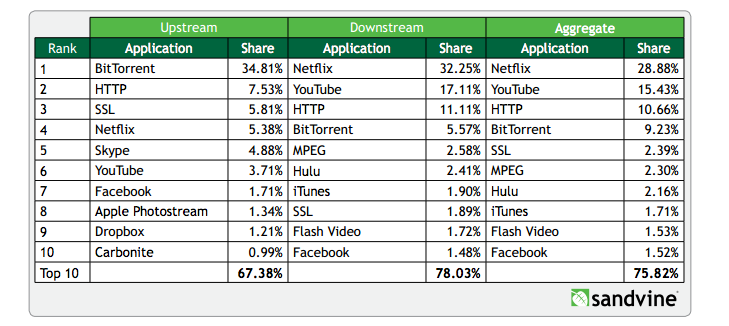
Degraded connections disproportionately affect the quality of streaming video because video requires far more bits than most other types of traffic. Netflix and YouTube alone account for nearly half of all Internet traffic to homes in North America during peak hours, according to research by SandVine. And customers are far more likely to be annoyed by a video that stutters and stops than by a webpage taking a few extra seconds to load.
Enlarge / North American traffic during peak hours.
SandVine
To get to the root of these problems, we need to take a step back and talk about the Internet itself. The very name "Internet" suggests many networks interconnecting, but few people know how the terms of these connections are negotiated. Understanding the business relationships that allow the Internet to exist in its present form is crucial to understanding the subtle and not-so-subtle ways Internet companies can bring your YouTube and Netflix videos to a slow stutter.

Peering—the backbone of the Internet

The core of the Internet, the closest thing it has to a "backbone," is a dozen or so networks consisting of data centers throughout the world. These networks, operated by private businesses, are called "Tier 1" because they can reach every part of the Internet simply by peering with one another. Two Tier 1 networks peer with each by configuring routers at multiple data centers to pass traffic back and forth. Peering is a point-to-point connection only, which doesn't necessarily guarantee passage of traffic to any networks beyond the two involved in the deal.
"Both providers have a large router, a Cisco or Juniper router, and they agree to interconnect them," Mark Taylor, VP of media and IP services at Level 3, told Ars. For example, he said, "A 10Gbps port on one is connected to a 10Gbps port on another. The only traffic that can flow between those connections are between the respective customers of both parties."
Tier 1 networks don't need to buy "transit"—an arrangement where one company pays another to accept its traffic and distribute it to all networks connected to the Internet. Smaller networks do, although even companies as big as Comcast buy transit.
Peering and transit are essential to Netflix and YouTube traffic. The Internet backbone providers that Netflix and Google pay to carry their traffic to the rest of the Internet need robust connections to other networks to ensure delivery of streaming videos to customers of all ISPs. Netflix and Google also offer to peer directly with ISPs to give videos a more direct path to customers' homes.
(For more discussion of peering and transit, see Peter Bright's article "Can a DDoS break the Internet? Sure… just not all of it.")
Defining which networks are "Tier 1" isn't as simple as you might expect. The volunteer editors at Wikipedia have listed Tier 1 networks as AT&T, CenturyLink, Deutsche Telekom, XO Communications, Telecom Italia, GTT, Verizon, Sprint, TeliaSonera International Carrier, NTT, Level 3, Tata Communications, and Zayo Group. The list is probably not complete. Wikipedia calls Cogent and Orange "major networks" but not Tier 1s, meaning they don't have to buy transit but do pay for peering. (Cogent denies this, telling Ars that it pays no other provider for interconnectivity.)
Whether payment should disqualify a network from being labeled "Tier 1" is under dispute. A packet is routed across the Internet exactly the same way whether it is routed as the result of a free peering agreement or whether it is routed as part of a paid peering agreement, notes Martin Levy, director of IPv6 strategy at IP transit provider Hurricane Electric. Hurricane says it is a Tier 1 network for IPv6 traffic, though not for IPv4 traffic.
The reason financial agreements are important isn't so much the semantic question of who is a Tier 1 network; it's that disagreements over whether payments should be made end up harming the quality of end-user connections.
"Everybody always wants to get paid," Rudolf van der Berg, an economist and policy analyst for OECD, told Ars. "If I had the choice between paying you, peering with you, or getting paid by you, I would choose getting paid by you. It doesn't necessarily mean the other party is interested in paying. And that's the problem here."
Peering without payment—"settlement-free" peering—occurs quite often between networks of roughly equal size and negotiating power.
"The word peering generally is synonymous with settlement-free," Taylor said. "There is an agreement by both parties that there is an equal benefit by each to connect to the two networks."
Typical peering agreements between US-based Tier 1 networks involve connections in six to 10 locations across the US, mainly in major cities, Forster said. XO also peers with providers in London, Amsterdam, and Frankfurt.
A crucial part of peering agreements is upgrading connections when they start to fill, because congested ports slow down the rate at which bits flow between the networks. That's what happened when Verizon refused to add as many ports to its connections with Cogent as Cogent felt was necessary. Verizon FiOS Customers promptly complained on Verizon support forums when their Netflix video playback got dramatically worse.
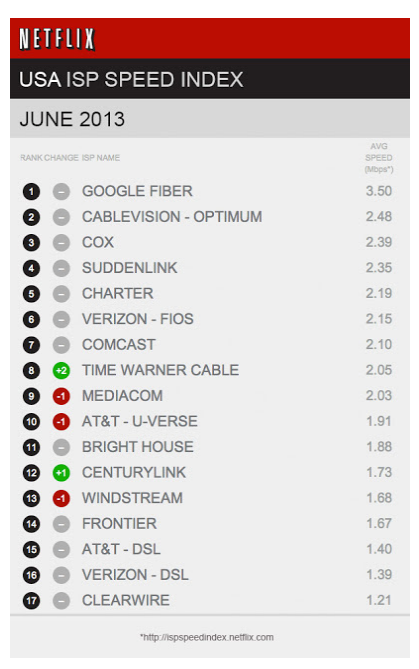
Netflix speed by carrier.
"Typically what happened is when the connections reached about 50 percent utilization, the two parties agreed to upgrade them and they would be upgraded in a timely manner," Cogent CEO Dave Schaeffer told Ars. "Over the past year or so, as we have continued to pick up Netflix traffic, Verizon has continuously slowed down the rate of upgrading those connections, allowing the interconnections to become totally saturated and therefore degrading the quality of throughput."
Schaeffer said this is true of all the big players to varying degrees, naming Comcast, Time Warner, CenturyLink, and AT&T. Out of those, he said that "AT&T is the best behaved of the bunch."
Letting ports fill up can be a negotiating tactic. Verizon and Cogent each have to spend about $10,000 for equipment when a port is added, Schaeffer said—pocket change for companies of this size. But instead of the companies sharing equal costs, Verizon wants Cogent to pay because more traffic is flowing from Cogent to Verizon than vice versa.
"When the traffic loads are not symmetric, the provider with the heavier load typically pays the other for transit," Verizon said in a blog post. Cogent doesn't want to pay and says the traffic loads are unequal because Verizon customers are requesting so many Netflix videos. Negotiations are surely ongoing behind the scenes, but no agreement has been announced.
The dispute is similar to the one that happened in late 2010, when Comcast demanded payment from Level 3 in order to carry Netflix traffic. The dispute didn't get to the point where ports were saturated. "We, under protest, agreed to pay," Taylor told Ars. This month, nearly three years after the dispute began, the companies released a joint statement. "Level 3 and Comcast have resolved their prior interconnect dispute on mutually satisfactory terms. Details will not be released," it said.
"The funny thing" about these disputes is how little money is involved, van der Berg said. The French telecom regulator ARCEP has found that money changing hands between operators for peering and transit, plus the amount paid to third parties that host Internet exchange points, is equal to just 0.2 percent to 0.5 percent of revenue generated by the supply of Internet access to end users.
One obvious question to ask is whether ISPs refusing to upgrade peering connections could violate net neutrality laws. The Federal Communications Commission's (FCC) Open Internet Order prevents ISPs from blocking content or unreasonably discriminating against third-party traffic. ISPs that sell their own video services while simultaneously degrading other video traffic might seem to be violating the principles of net neutrality, but they're likely not violating the letter of the law.
The FCC's Open Internet Order makes only one reference to peering: "We do not intend our rules to affect existing arrangements for network interconnection, including existing paid peering arrangements."
Susan Crawford, a former tech policy advisor to President Obama and author of Captive Audience: The Telecom Industry & Monopoly Power in the New Gilded Age, told Ars via e-mail that this exception for network interconnection agreements including paid peering "is an enormous problem. If we focus only on discrimination vis a vis users' access to applications, we're missing a huge part of the story. Network operators in the US are now sufficiently powerful that they can pinch traffic farther upstream as well as pinch traffic in the last mile."
It's easy to see why more traffic flows from Cogent to Verizon than vice versa. Cogent is one of Netflix's Internet service providers—Netflix pays Cogent for transit, to carry its traffic to the rest of the Internet. Many Verizon customers, meanwhile, pay Netflix to stream video. Each time a Netflix customer using Verizon's network clicks on a Netflix video, that click sends just a tiny bit of traffic to Verizon and then on to Cogent and Netflix. In return, that customer receives a flood of data—up to 2.8GB for each hour of high-definition content.
This is just how the last-mile ISPs want it, apparently, since they have made it difficult for customers to send as much traffic as they receive by providing far lower upload speeds than download speeds. Even customers who might try to achieve some upload/download parity—perhaps by using backup services to replicate all of their data—will find that hard to do.

Trying to get paid on both ends

Everyone involved in sending Netflix traffic to customers is getting compensated. Verizon and Netflix get paid by home Internet users, and Cogent is paid by Netflix. Verizon wants to get paid twice—by its own Internet customers and by Cogent.
The question of whether Cogent should pay Verizon comes down in part to the question of who causes the traffic. Did Netflix "cause" the traffic by offering streaming content over the Internet? Or did Verizon cause the traffic by providing Internet service to customers who expect access to Netflix videos?
"Verizon has chosen to sell its customers a product that they hope those customers don't actually use," Schaeffer said. "And when customers use it and request movies, they have not ensured there is adequate connectivity to get that video content back to their customers."
Schaeffer accused Verizon of favoring its own services. "Verizon is trying to incent customers to buy its video product, its Redbox product, as opposed to using competitive products of Netflix and others," he said.
Verizon might turn Schaeffer's arguments on their head, saying Netflix is selling a streaming video service without ensuring that the videos have a clear path to all customers. Verizon declined repeated interview requests from Ars, however, as did the majority of companies involved in these disputes. Comcast, Time Warner Cable, and CenturyLink did not answer questions or make anyone available for interviews. Google and Netflix both declined to say anything on the record. AT&T did not respond to e-mails. Three European players involved in disputes—Free, Orange, Deutsche Telekom—did not reply to e-mails. Telefónica responded that "we can’t comment on regulatory cases that are ongoing except to say that Telefónica is cooperating fully." The FCC did not make anyone available for an interview or answer our questions.
Since ISPs have argued that YouTube, Netflix, and other video services should pay for access to customers, they're actually seeking payment from three sources: their own customers, the online video providers, and Tier 1 networks like Cogent and Level 3.
When asked if ISPs are degrading Netflix and YouTube traffic to steer users toward their own video services, Crawford told Ars that "the very powerful eyeball networks in the US (and particularly Comcast and Time Warner Cable) have ample incentive and ability to protect the IP services in which they have economic interests. Their real goal, however, is simpler and richer. They have enormous incentives to build a moat around their high-speed data networks and charge for entry because data is a very high-margin (north of 95 percent for the cable companies), addictive, utility product over which they have local monopoly control. They have told Wall Street they will do this. Yes, charging for entry serves the same purposes as discrimination in favor of their own VOD [video-on-demand], but it is a richer and blunter proposition for them."

Speed problems in both the US and Europe

In addition to the Netflix complaints by Verizon customers, Time Warner Cable customers recently complained about poor YouTube service. One reddit thread shows how some technically inclined Time Warner customers used traffic analysis tools to identify the cause of YouTube problems. They were able to improve performance by blocking certain IP addresses, likely ones associated with slow YouTube content servers.
Time Warner Communications Director Jeff Simmermon wrote in a blog post last month that a "small subset of our customers... seem to think we are intentionally degrading their service. If I were to sum up these kinds of complaints, it would go something like this: 'Hulu and YouTube wouldn’t intentionally degrade their services and provide a subpar experience, but for some reason, it makes total sense that Time Warner Cable would by throttling customers’ traffic.'"
Simmermon further noted that "some, but not all, online video providers have the resources to store copies, or caches, of their videos on servers that are a part of a Content Delivery Network, or CDN. When a user clicks on a link to a particular video, the Internet provider can quickly determine where the nearest cached copy of the video is on the CDN and deliver it. More popular videos will have more cached copies, with better performance, while less popular videos may be stored in fewer, further places."
What he didn't comment on is whether Time Warner accepts Google's YouTube caches into its network. But as noted earlier, Time Warner has refused to accept Netflix's caching equipment. Netflix may still be hosting its own caches throughout the country, but if they're not in Time Warner data centers, Time Warner customers get worse performance than they otherwise might.
Europeans are suffering similar problems. "There is a kind of hot/cold thing," said telecom watcher Benoît Felten, the CEO of Diffraction Analysis. Felten lives in France and is a customer of Free, an ISP that has been accused of throttling YouTube, or at least under-investing in the connections that pass YouTube traffic to end users.
"Right now, YouTube doesn't work too bad on Free," Felten said earlier this month. "Three weeks ago it was horrendous. A 30-second video, like an Angry Birds solution video, would take 12 minutes before the first frame moved. Right now, you get some lags but it's acceptable. I suspect whatever they're doing, they're constantly shifting it so it doesn't look like it's constantly horrible."
Instead of intentional discrimination against YouTube, it may simply be that Free's network is short of capacity. A few days after Felten spoke with Ars, the French telecom regulator ARCEP announced that it found no evidence of Free using discriminatory practices against YouTube, although it did say traffic is congested during peak hours.
The European market has far more competition for home Internet service than the US does. Felten says he is going to switch to a different Internet service and hopes many other Free customers will do the same.
While European ISPs want payments from Google and Netflix, Felten said they should just focus on improving Internet service. "Customers are already paying for it," he said. "You sell a service to the end user which is you can access the Internet. You make a huge margin on that. Why should they get extra revenue for something that's already being paid for?"
Paid peering contracts with fixed prices also don't make sense, he said, because IP transit is "constantly going down in price... At some point you'll be paying more for peering than you would for transit, which is absurd."
To illustrate the absurdity of ISP proposals to charge video providers, Felten noted that "when Orange purchased [video service] Dailymotion, that same week a white paper released by A.T. Kearney that Orange had financed basically said, 'this is how much online service providers should pay per gigabit of traffic that is delivered through our networks.' I applied that calculation to Dailymotion's traffic, and basically they would have had to pay twice their annual revenue in charges (nearly €42 million [roughly $55.5 million]). It's absurd. The whole economic model would break down if you were to apply that."

New, improved way of measuring traffic

Concerned about ISPs demanding payment from fellow network peers, Level 3 has come up with a new way of measuring peers' impact on each other's networks. Traditionally, traffic loads have been thought to be "in balance" if each peer sends about as much traffic to the other peer as it receives.
But the direction in which traffic flows has no impact on how much it costs to carry it, Level 3 argues. Because video streaming traffic dominates the Web, so-called "eyeball" networks (ISPs who deliver traffic over the last mile) can never be in balance with the networks that deliver video under the old measurement.
Instead, Level 3 wants to measure via "bit miles," the distance traffic is carried and the number of bits carried, regardless of which direction the traffic flows. So far, tw telecom and XO Communications have entered long-term, settlement-free peering agreements with Level 3 using bit mile measurements.
"This is a new idea. I think it's going to take a little bit to get more people on board," Forster said. "It needs to be simplified. Right now, both us and Level 3 are working out kinks in how this works."
Two networks could still end up with unbalanced traffic under the bit miles approach, but it would be easier to fix. "If you connect in 10, 15, 20, 30 places, it's easy to add connectivity points, it's easy over time to add and subtract those connectivity points to make sure the networks are in balance and you incur equal costs of transmission," Taylor said.
Level 3 objects to most demands that peers pay each other, even if the amounts aren't huge. The amount of money "for Level 3 is not material," Taylor said. "It's the principle of who decides because it's a non-competitive market. We have no choice. There is one party that sets the rate; there is no competitive pressure we can bring to bear to negotiate that rate or get a different way into the network."
This is where a lack of competition in the home Internet market comes into play. When a consumer's second option is slow or non-existent, the dominant Internet provider can maintain a monopoly even while delivering poor service. According to FCC data, 86 percent of American households have a choice of at least two wired Internet providers offering 3Mbps download speed and 768Kbps upload—but that's not even fast enough to qualify as broadband. Only 34 percent of US households have a choice of Internet providers offering at least 6Mbps down and 1.5Mbps up. The FCC defines broadband as 4Mbps down and 1Mbps up.
Netflix recommends 5Mbps for HD streams—and remember that a home Internet connection is often shared across multiple devices and people. Moreover, speeds promised by ISPs may guarantee a certain level of bandwidth between you and your ISP's network, but not between you and the rest of the Internet because of peering disputes and under-provisioned connections.
Enlarge / From the FCC report "Internet Access Services: Status as of December 31, 2011," released in February 2013.
The argument that payments between network operators are required because streaming video throws traffic loads out of balance "is a complete canard," Crawford said. She explains:
When the commercial Internet was born, the telcos exchanged traffic with each other using handshake peering arrangements for which the paradigm was "ratio-based" payments. Because phone traffic was basically 1:1, or often 1:1, upstream and downstream, the big actors peered with one another for free.
Today, we have enormously powerful eyeball network operators who are still taking advantage of this peering paradigm. And so they say, "my users are asking for more traffic than they're sending upstream." Using this rationale, the cable companies have moved from having to pay to get their users' traffic out onto the Internet (which is where they were when the Internet began) to demanding free peering, to, today, charging for interconnection.
But the use of the network, and the architecture of the network, is now completely different. Cable is asymmetric; it was built for passive downloads and does not favor uploads. Also, users are doing a lot of downloading of content. It's a user-driven Internet. So of course traffic volumes are greater downstream than upstream. That's what cable is selling. It should want to sell more; it should want to build capacity and connect freely with transit networks; and it would if there was any competition. But there isn't. So cable companies can draw up the drawbridge and charge with impunity, or refuse to add capacity to service interconnecting providers unless they're paid (which is the same thing).
John Bergmayer, senior staff attorney at advocacy group Public Knowledge, said ISPs like Verizon can't credibly claim that their networks are overloaded by Netflix.
"We've seen all the cable advocates and the NCTA (National Cable & Telecommunications Association) back away from the claim that data caps are necessary to manage congestion," Bergmayer said. "Networks really aren't saturated on the last mile like they have been trying to claim for years. Particularly with Verizon—with FiOS, it has huge capacity. Verizon has said again and again that it could upgrade to gigabit; it just doesn't think that consumers really want it. They're always bragging about how great their fiber network is. They can't have their cake and eat it, too, and not really have real capacity problems on the one hand except when it comes to hammering out these deals with the Internet content companies on the other hand."
While European authorities have been demanding data on peering agreements from Internet companies, Bergmayer said the FCC should do the same. "Antitrust people should be aware of potential issues as well as the FCC, and the FCC should be taking steps to make sure it has the data it needs to determine whether it needs to be doing anything to begin with," Bergmayer said.
Levy prefers that government stay out of it. "Any time you get a regulator involved you're pretty much guaranteed for stuff to go downhill," he said, only half joking. "What they don't really understand is that sometimes this is OK. Basically, people need to argue. This is a relationship. No one can actually afford for this stuff not to work. Trust me."
But some IP networks argue with each more than others, he acknowledged. At Hurricane Electric, "We have an open peering policy, which means if someone asks us to peer we have a very limited requirement on them in order to accept them as a peer." Hurricane Electric has so far been conspicuously absent from any of the recent public disputes. "We're boring," Levy said. "By design, of course, because we're not like the people who are in these disputes."
Felten holds out hope that ISPs will become less likely to war with each other as they embrace over-the-top content—meaning the delivery of streaming video to any customer, even those who don't subscribe to the ISP's Internet service. ISPs that sell video outside their own networks will become just like Netflix and need other Internet companies to accept their traffic, the argument goes. They won't be able to throttle third-party traffic if they're worried about those same third parties throttling their own, Felten said. "If you do [over-the-top], you're not serving customers on your network only anymore, you're serving customers on everybody's network," Felten said. "If everybody else's network throttles your traffic, you have no business case. It can't work."
Although Verizon is getting into over-the-top video through its Redbox venture, that's not the strategy most are taking (and it hasn't stopped Verizon from warring with Cogent over Netflix).
Bergmayer is skeptical that Felten's theory will prove true in the US. "I've been hoping for a while that these guys would realize they could enter the over-the-top market," Bergmayer said. "But we've just seen things like TV Everywhere where it's essentially each ISP runs service just for its own customers and they sort of divide up the country like that."

Complexity rules the Web

Not every problem with streaming video can be traced back to peering agreements or caching disputes. One video expert told Ars that there are many components of video playback that can degrade quality, including the serving of advertisements.
To load a pre-roll ad, "You have a third-party library involved which may or may not have been dynamically loaded. You may have third-party calls, there could be calls to several ad networks, and then the retrieval of that ad content and then the actual playback of the ad. There are a surprising number of steps to get just that simple preroll ad to play," said Frank Paolino, a senior service line manager at Akamai, a content delivery company whose businesses include technology for commercial video services.
YouTube and Netflix pour lots of resources into upgrading streaming and video player technology to reduce performance lags. Last year, Google gave the YouTube player an overhaul that reportedly reduced buffering by an average of 20 percent. Each little performance gain is arguably more crucial in video streaming than in the loading of most types of webpages.
"If you go to a retailer's website and their page takes half second to load, that is probably not perceptible to the human eye," Mike Palladino, Internap’s director of IP architecture and operations, told Ars. "If the graphics at the bottom take some time to load you probably don't notice that because you're looking at the stuff at the top that did load. Video and VoIP (Voice over Internet Protocol traffic) really exacerbate the symptoms we're seeing where demand outstrips supply."
The Internet is a complex beast, with each packet of data trying to get to its destination through the most direct route, rerouting if necessary when something goes wrong.
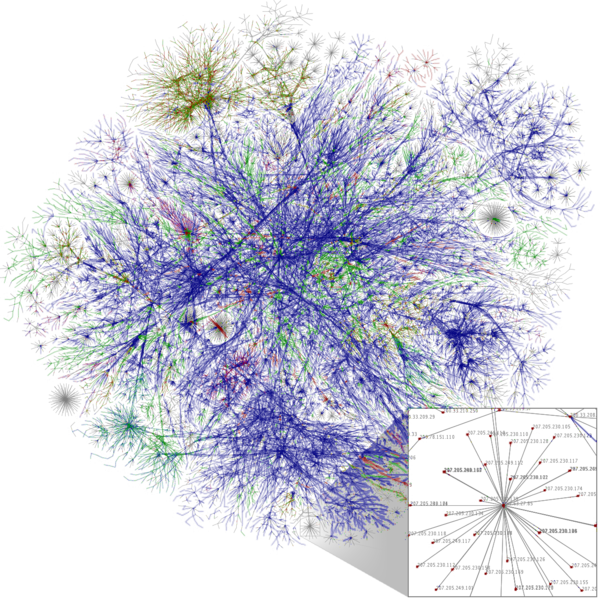
Visualization of the Internet, with lines drawn between nodes, each node representing an IP address.
When watching YouTube, "my computer opens a data stream connection to a YouTube server that is going to serve me this content," Palladino said. "That's one piece of it: establishing connectivity. The second piece is making sure there's a constant stream and I have good connectivity from start to finish. That's where we see things fall apart. If you're trying to watch an hour and a half video, the chances of you having zero connectivity issues from your host to that YouTube server for that length of time is almost zero. Network conditions fluctuate second to second, moment to moment. If someone takes a site down for maintenance in between, someone has a capacity issue on one of those interconnections," your video could stop or slow down.

Take my cache, please

It's because of problems like this that the likes of Google and Netflix offer to place their own equipment inside the data centers of Internet Service Providers. If Comcast, Verizon, and AT&T had YouTube and Netflix videos sitting inside their own facilities, video streams would take many fewer hops to reach customers.
In addition to peering with network operators, Google has what it calls the "Google Global Cache (GGC)." This "represents the final tier of Google’s content delivery platform and is closest to users," Google says in its description of the service. "With GGC, network operators and Internet Service Providers deploy a small number of Google servers inside their network to serve popular Google content including YouTube. Google's traffic management system directs users to the node that will provide the best performance for the user. GGC can be located anywhere in an operator's network to maximize savings in backbone and transit bandwidth. Targeted deployment can reduce the number of route-miles traveled on an operator's network to serve Google traffic, further increasing cost savings for the operator."
Google does not reveal which ISPs accept the equipment into their data centers. It's clear many do not, since ISPs have argued that Google and Netflix should be paying them, even though the caches are offered for free.
Netflix's similar peering and caching service is called Open Connect. ISPs can peer with Netflix at up to eight Internet exchange points for free "or can save even more transit costs by putting our free storage appliances in or near their network," Netflix says.
Frontier, British Telecom, TDC, Clearwire, GVT, Telus, Bell Canada, Virgin, Cablevision, Google Fiber, Telmex, and RCN are among those who have done so.
"To us, it's really a black box that's run by Netflix," RCN VP of network services Peter Jacoby told Ars. "We do almost nothing except give it IP addresses. We put them in our data centers and that content gets a lot closer to our customers, so when they request a movie, typically the popular ones I'm told will stream from their closest cache and that eliminates a lot that can go wrong between them and Netflix."
While this brings RCN additional costs in power, cooling, and colocation, it also reduces the amount of traffic RCN has to take from outside its own network. In addition, it gives subscribers more reliable streaming and access to "Super HD" and 3D content available only to customers of ISPs that use Netflix Open Connect. "To us, that's a win," Jacoby said.
When Time Warner refused to partner with Netflix, it accused the video service of "closing off access to some of its content while seeking unprecedented preferential treatment from ISPs." Although Time Warner hasn't publicly demanded payment from Netflix, agreeing to settlement-free peering and caching would preclude Time Warner from demanding that Netflix pay to send traffic to Time Warner users.
Felten warns that forcing companies like Netflix to pay all the last-mile ISPs to get their content to users would prevent future Netflixes from even existing. "If by default a peering relationship has to be paid by the online service provider, then the next Facebook will never exist, and the next YouTube will never exist because from day one they will be straddled with a cost they will be unable to bear," Felten told Ars.
For today, at least one thing is clear. If you want an Internet Service Provider that has no qualms about peering with competitors and accepting caching services offered by third-party video providers, the biggest ISPs aren't your best bets.
RCN, which competes against the likes of Verizon and Comcast in Chicago, Boston, New York, Washington, DC, and parts of Pennsylvania, knows that demanding money from Netflix isn't going to fly. Being the smaller player, RCN has to distinguish itself by offering better service, Jacoby said. Even though RCN provides video-on-demand content of its own, with rental fees for premium videos, that doesn't stop the company from making sure its customers get good YouTube and Netflix quality as well.
"We'll be in line with our hand out if Comcast is getting paid [by Netflix] and Time Warner is getting paid," Jacoby said. "But there are network neutrality implications, there are a lot of questions I'd want to see answered before just going and shaking them down. What threat do we have? We're going to make service bad for our customers? We're not going to do that. Some of the other cable companies are willing to do that, but we're not going to. Being the little guy, that's the competitive position, and that's the differentiation."