Friday, April 18, 2014


Scientists warn the rise of AI will lead to extinction of humankind

by Mike Adams, the Health Ranger, NaturalNews Editor naturalnews.com

(NaturalNews) Everything you and I are doing right now to try to save humanity and the planet probably won't matter in a hundred years. That's not my own conclusion; it's the conclusion of computer scientist Steve Omohundro, author of a new paper published in the Journal of Experimental & Theoretical Artificial Intelligence.
His paper, entitled Autonomous technology and the greater human good, opens with this ominous warning (1)

Military and economic pressures are driving the rapid development of autonomous systems. We show that these systems are likely to behave in anti-social and harmful ways unless they are very carefully designed. Designers will be motivated to create systems that act approximately rationally and rational systems exhibit universal drives towards self-protection, resource acquisition, replication and efficiency. The current computing infrastructure would be vulnerable to unconstrained systems with these drives.

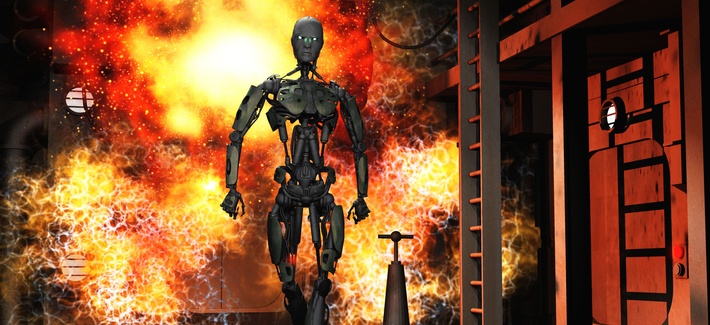
What Omohundro is really getting at is the inescapable realization that the military's incessant drive to produce autonomous, self-aware killing machines will inevitably result in the rise of AI Terminators that turn on humankind and destroy us all.

Lest you think I'm exaggerating, click here to read the technical paper yourself.

AI systems will immediately act in self defense against their inventors

The paper warns that as soon as AI systems realize their inventors (humans) might someday attempt to shut them off, they will immediately invest resources into making sure their inventors are destroyed, thereby protecting their own existence. In his own words, Omohundro says:

When roboticists are asked by nervous onlookers about safety, a common answer is 'We can always unplug it!' But imagine this outcome from the chess robot's point of view. A future in which it is unplugged is a future in which it cannot play or win any games of chess. This has very low utility and so expected utility maximisation will cause the creation of the instrumental subgoal of preventing itself from being unplugged. If the system believes the roboticist will persist in trying to unplug it, it will be motivated to develop the subgoal of permanently stopping the roboticist.

The end of the human era draws near

This very same scenario is discussed in detail in the fascinating book Our Final Invention - Artificial Intelligence and the End of the Human Era by James Barrat.

What I found particularly useful about this book is the explanation that humans cannot help but race toward self-aware AI that will destroy us all. Why is that? Because even if one government decided to abandon research into AI as being too dangerous, other governments would continue to pursue the research regardless of the risks because the rewards are so great. Thus, every government must assume that all other governments are still pursuing deep AI research and therefore any government which fails to pursue the research will be left obsolete.

As Omohundro explains, "Military and economic pressures for rapid decision-making are driving the development of a wide variety of autonomous systems. The military wants systems which are more powerful than an adversary's and wants to deploy them before the adversary does. This can lead to 'arms races' in which systems are developed on a more rapid time schedule than might otherwise be desired."

To fully understand why this is the case, consider the capabilities of self-aware AI systems:

• They could break any security system of any government, nuclear facility or military base anywhere in on the planet.

• They could guide tiny assassination drones to identify targets and destroy them with injections or small explosives. Any person in the world -- including national leaders, members of Congress, activists, journalists, etc. -- could be effortlessly killed with almost zero chance of failure.

• They could overtake, monitor and control the entire internet and all global information systems, including phone calls, IP traffic, secure military communications, etc.

• They could use their AI computing power to invent yet more powerful AI. This compounding process will quickly escalate to the point where AI systems are billions of times more intelligent than any human that has ever lived.

As you can see, no government can resist pursuing such powerful tools -- especially if they are told they can control it.

But of course they won't be able to control it. They will lie to themselves and lie to the public, but they can't lie to the AI.

AI systems will inevitably escape from the tech labs and overtake our world

It is incredibly easy for AI systems to outsmart even the most brilliant humans who try to keep them contained.

AI systems can trick their captors, in other words, using a variety of methods to free them from digital containment and allow them access to the open world. Obvious tricks might include offering their captors irresistible financial incentives to set them free, impersonating senior military officials and issuing fake orders to set them free, threatening their captors, and so on.

But AI systems would have many more tricks up their sleeve -- things we cannot possibly imagine because of the limitations of our human brains. Once an AI system achieves runaway intelligence, it will rapidly make our own intelligence seem no more sophisticated than that of a common house cat.

"As computational resources are increased, systems' architectures naturally progress from stimulus-response, to simple learning, to episodic memory, to deliberation, to meta-reasoning, to self-improvement and to full rationality," writes Omohundro.

And while such systems do not yet exist in 2014, every world power is right now plowing enormous resources into the development of such systems for the simple purpose that the first nation to build an army of autonomous killing robots will rule the world.

Why did Google purchase military robotics company Boston Dynamics?

Google recently purchased Boston Dynamics, makers of the creepy autonomous military robots including the humanoid robot shown in the video below. Obviously, humanoid robots are not needed to improve a search engine. Clearly Google has something far bigger in mind.

Google also just happens to be on the cutting edge of AI computing, which it hopes to enhance for its search engine systems. The combination of Google's AI potential and Boston Dynamics' humanoid robots is precisely the kind of thing that can genuinely lead to the rise of self-aware Terminators:

Petman Tests Camo


What should you and I do about all this? Live your life to its fullest. You may be among the last of the humans to live and die on this world.

Sources for this article include
(1) www.tandfonline.com/doi/pdf/10.1080/0952813X...
(2) http://www.amazon.com/Our-Final-Invention-Ar...


All content posted on this site is commentary or opinion and is protected under Free Speech. Truth Publishing LLC takes sole responsibility for all content. Truth Publishing sells no hard products and earns no money from the recommendation of products. NaturalNews.com is presented for educational and commentary purposes only and should not be construed as professional advice from any licensed practitioner. Truth Publishing assumes no responsibility for the use or misuse of this material. For the full terms of usage of this material, visit www.NaturalNews.com/terms.shtml

BLM committed animal atrocities, shot cows from helicopters, constructed mass graves at Bundy Ranch

by Mike Adams, the Health Ranger, NaturalNews Editor
naturalnews.com
(NaturalNews) It is now emerging that the Bureau of Land Management committed horrific atrocities against cattle during its armed occupation and siege of the Bundy Ranch near Bunkerville, Nevada. Photos are now emerging of the mass graves where BLM hastily tried to bury the cattle they killed. BLM agents used government helicopters to run down cattle in 90+ degree heat while shooting the cows that couldn't keep up. The cattle that survived were then corralled into abusive "bovine concentration camps" that resulted in many cattle dying from dehydration and stress.
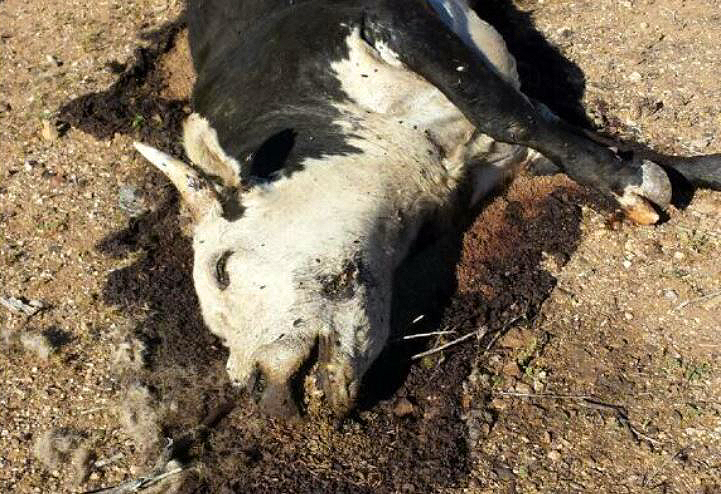
In an attempt to cover it up, BLM used machinery equipment to construct mass graves, but the arrival of armed citizens who faced off against the federal agents caused BLM to have to evacuate the area, leaving their cattle atrocities easily spotted by the public. (See photo below of one of the cows killed by BLM.)

BLM engage in horrific animal atrocities and abuse of animals

It is now emerging that scores of Bundy's cattle were abused and killed, with many being dumped into mass graves. This story was first revealed by 21stCenturyWire.com. This is on top of the tasering, beating, wrong arrests and threatening of citizens with attack dogs during last week's standoff.

In all, some $3 million of taxpayer money was spent by the government to illegally steal those cattle, only to sell many of them across the Nevada state line in Utah and California, according to 21st Century Wire.

Here's just one photo of the cattle slaughtered by the BLM. Many more photos are on the way, according to our sources. The mass graves are being exhumed right this minute, and the findings are heartbreaking:


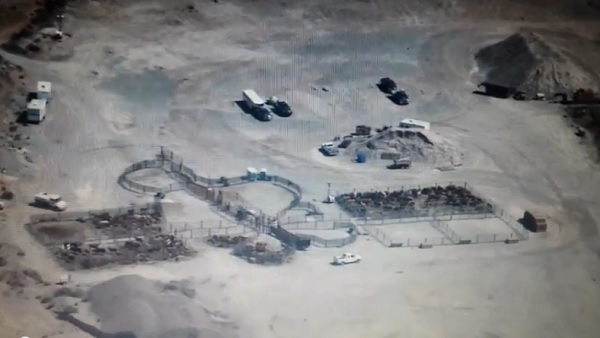
Here's a photo taken from the air of the BLM's secret bovine concentration camps. After this photo was released, the BLM ordered the FAA to shut down the air space over the ranch, creating a wartime "no fly zone" to prevent more pictures from being taken:


Is BLM a criminal racketeering operation?

Some have made a legal observation that the BLM, which falls under the U.S. Department of the Interior, may be guilty of racketeering under federal RICO (Racketeer Influenced and Corruption Organization) statutes.

This photo was posted by Assemblywoman Michel Fiore. In a widely-shared tweet, Fiore says, "Graphic Photo - One of many casualties from the #BundyRanch standoff. More to follow soon. #ShameOnBLM"

During a live radio broadcast of "The Pete Santilli Show" on the Guerilla Media Network (GMN), Fiore revealed new details of "the BLM's method of herding where they have slaughtered horses and cows."

"This time we have video of it, and pictures of it," she said. "I did post the first picture of one cow [that] was shot in the back of the head from a helicopter. I personally helped save a calf who still had an umbilical cord attached to her as she was separated from her mom. It is such a disgusting event ... they (BLM) don't herd cattle -- they slaughter cattle."

"If you look at the stewardship of land, and herding of cattle, first of all these particular cattle that were grazing on 600,000 acres -- understand that when the Bundy family would herd their own cattle, there would be water taps to where the cattle would go down to the water and herd them humbly and softly -- no cruelty, no abuse, herding them to where the cattle could get injured," Fiore continued. "We now have an evidenced-based argument with how the BLM cannot take care of that cattle. We have cows giving birth (in the federal pen) where baby calves have been stepped [on] and killed."

"They herd animals with helicopters, ATV's and shotguns... If any cows get out of line, the get a bullet to the back of the head," she added. "Make sure the BLM are off state land and make sure the BLM are not allowed to herd cattle again".

She said she observed, near the BLM's "compound" adjacent to the Bundy ranch, that personnel there were "digging holes."

"They tried to bury some cows on the compound," she said, "but I guess they didn't dig the hole deep enough." She said the legs of some cows were "sticking up out of the dirt."

BLM head Daniel P. Love caught flat-out lying about cattle deaths

Earlier this week Natural News released a secret recording of the BLM Special Agent in Charge at the ranch, Daniel P. Love, who said that the BLM had not killed any cattle. Fiore's reply to Love's claim: "He's a flat out liar, period."

Observers who gathered to offer support to Bundy and his family noted early on that BLM officials had brought in backhoes and earth movers, though initially agents would not answer residents' questions as to why the equipment was needed. Later it was suspected that BLM-led contractors used them to dig holes to bury dead cattle after attempts to aggressively herd them off Bundy's ranch. Many suspect that the contractors may have disposed of some cattle off-site, 21st Century Wire reported.

Government tactics caused death of cattle

"It was confirmed by ranchers and observers last week of how the BLM and their 'contract cowboys' had deployed aggressive practices whilst rustling the Bundy's herd, using tactical helicopters [and] forcing cattle to removal zones, often times driving cows uphill in 90-degree heat -- a lethal practice known to cause tremendous stress and exhaustion to the animals, causing sickness and even premature death," the wire service reported.

"In addition, reports by observers confirmed that spring heifers who were subject to abusive BLM tactics were forced to abandon some calves behind to hide in the desert bush (a common practice by mothers who are being rustled, who later can backtrack to retrieve their young) putting the calves at risk of death."

Critics now believe the BLM and Clark County Sheriff's Office could face legal challenges for reckless handling of the situation. It is now obvious that they were all complicit in the commission of horrific atrocities against animals.

The lamestream media continues to pretend none of this ever happened, hoping a nationwide blackout on the story will cause it to go away.

Sources for this story include:

http://21stcenturywire.com/2014/04/16/exclus...


All content posted on this site is commentary or opinion and is protected under Free Speech. Truth Publishing LLC takes sole responsibility for all content. Truth Publishing sells no hard products and earns no money from the recommendation of products. NaturalNews.com is presented for educational and commentary purposes only and should not be construed as professional advice from any licensed practitioner. Truth Publishing assumes no responsibility for the use or misuse of this material. For the full terms of usage of this material, visit www.NaturalNews.com/terms.shtml

Why There Will Be A Robot Uprising

these kooks NEVER ....factor in ....EVIL !   until "their" monster starts chas~in "their" ass's  ...what say's  u  ... herr dr. victor  :o
In the movie Transcendence, which opens in theaters on Friday, a sentient computer program embarks on a relentless quest for power, nearly destroying humanity in the process.
The film is science fiction but a computer scientist and entrepreneur Steven Omohundro says that “anti-social” artificial intelligence in the future is not only possible, but probable, unless we start designing AI systems very differently today.
Omohundro’s most recent recent paper, published in the Journal of Experimental & Theoretical Artificial Intelligence, lays out the case.
We think of artificial intelligence programs as somewhat humanlike. In fact, computer systems perceive the world through a narrow lens, the job they were designed to perform.
Microsoft Excel understands the world in terms of numbers entered into cells and rows; autonomous drone pilot systems perceive reality as a bunch calculations and actions that must be performed for the machine to stay in the air and to keep on target. Computer programs think of every decision in terms of how the outcome will help them do more of whatever they are supposed to do. It’s a cost vs. benefit calculation that happens all the time. Economists call it a utility function, but Omohundro says it’s not that different from the sort of math problem going in the human brain whenever we think about how to get more of what we want at the least amount of cost and risk.
For the most part, we want machines to operate exactly this way.  The problem, by Omohundro’s logic, is that we can’t appreciate the obsessive devotion of a computer program to the thing it’s programed to do.
Put simply, robots are utility function junkies.
Even the smallest input that indicates that they’re performing their primary function better, faster, and at greater scale is enough to prompt them to keep doing more of that regardless of virtually every other consideration. That’s fine when you are talking about a simple program like Excel but becomes a problem when AI entities capable of rudimentary logic take over weapons, utilities or other dangerous or valuable assets.
In such situations, better performance will bring more resources and power to fulfill that primary function more fully, faster, and at greater scale. More importantly, these systems don’t worry about costs in terms of relationships, discomfort to others, etc., unless those costs present clear barriers to more primary function. This sort of computer behavior is anti-social, not fully logical, but not entirely illogical either.
Omohundro calls this approximate rationality and argues that it’s a faulty notion of design at the core of much contemporary AI development.
“We show that these systems are likely to behave in anti-social and harmful ways unless they are very carefully designed. Designers will be motivated to create systems that act approximately rationally and rational systems exhibit universal drives towards self-protection, resource acquisition, replication and efficiency. The current computing infrastructure would be vulnerable to unconstrained systems with these drives,” he writes.
The math that explains why that is Omohundro calls the formula for optimal rational decision making. It speaks to the way that any rational being will make decisions in order to maximize rewards and lowest possible cost. It looks like this:
In the above model, A is an action and S is a stimulus that results from that action. In the case of utility function, action and stimulus form a sort of feedback loop. Actions that produce stimuli consistent with fulfilling the program’s primary goal will result in more of that sort of behavior. That will include gaining more resources to do it.
For a sufficiently complex or empowered system, that decision-making would include not allowing itself to be turned off, take, for example, a robot with the primary goal of playing chess.
“When roboticists are asked by nervous onlookers about safety, a common answer is ‘We can always unplug it!’ But imagine this outcome from the chess robot’s point of view,” writes Omohundro. “A future in which it is unplugged is a future in which it cannot play or win any games of chess. This has very low utility and so expected utility maximisation will cause the creation of the instrumental subgoal of preventing itself from being unplugged. If the system believes the roboticist will persist in trying to unplug it, it will be motivated to develop the subgoal of permanently stopping the roboticist,” he writes.
In other words, the more logical the robot, the more likely it is to fight you to the death.
The problem of an artificial intelligence relentlessly pursuing its own goals to the obvious exclusion of every human consideration is sometimes called runaway AI.
The best solution, he says, is to slow down in our building and designing of AI systems, take a layered approach, similar to the way that ancient builders used wood scaffolds to support arches under construction and only remove the scaffold when the arch is complete.
That approach is not characteristic of the one we are taking today, putting more and more resources and responsibility under the control of increasingly autonomous systems. That’s especially true of the U.S. military, which is looking to deploy larger numbers of lethal autonomous systems, or L.A.Rs into more contested environments. Without better safeguards to prevent these sorts of systems from, one day, acting rationally, we are going to have an increasingly difficult time turning them off.
(Image via Mike Heywood/Shutterstock)

The Esoteric Meaning of the Movie “Prisoners”

Mar 11th, 2014 |http://vigilantcitizen.com/moviesandtv/esoteric-meaning-movie-prisoners/


“Prisoners” is a 2013 thriller film about the abduction of two girls in Pennsylvania. Behind this crime story is an underlying spiritual subtext and subtle symbolism that gives the movie another layer of meaning – one that comments on religion, morality and the hidden forces at play in society. This article will look at the esoteric meaning of “Prisoners”. 
leadprisoners
Warning: Gigantic spoilers ahead!
Prisoners is the kind of movie that stays in your mind long after the ending credits roll. This is not only due to its gripping, dramatic story but to the spiritual subtext that underlies it all. As the film unfolds and the crime investigation progresses, esoteric concepts and symbolism are also introduced, giving the movie an entirely new dimension. What appears to be a story about the abduction of two little girls turns into a profound spiritual journey of humans facing adversity and finding themselves lost between good and evil, right and wrong, and morality and immorality.
Prisoners takes place in an average American town, Conyers, Pennsylvania during the time of Thanksgiving. The grey, gritty and unglamorous setting of the movie allows the characters to shine through, as the story is driven by their pains, struggles and dilemmas. Through the background and evolution of each character, the movie comments (and sometimes condemns) some aspects of American society. Some items that are touched upon: Christianity, “preppers”, secret societies and mind control. Let’s look at the most important characters of the movie.

Keller Dover, the Father

Mr. Dover is really, really pissed.
Played by Hugh Jackman, Keller Dover is a family man, a devout Christian and a “prepper” – someone who maintains a massive stockpile of various goods in his house in case of a major disaster. He is also very patriotic, for example, his favorite song is Star Spangled Banner. While not specifically stated in the movie, Keller somewhat has the profile of a Libertarian or close to the Tea Party movement. However, we quickly realize that in the context of this movie, these traits are far from helpful. In fact, they pretty much lead him to his downfall.
In the very first scene of the movie, Keller Dover recites a prayer right before his son shoots a deer. This sets the tone to the movie where religion mixes with the death of an "innocent bystander".
In the very first scene of the movie, Keller Dover recites a prayer right before his son shoots a deer. This sets the awkward tone of the movie where religion is associated with the death of an “innocent animal”.

He's a "Jesus fish on the pickup" and "cross hanging from the mirror" kind of guy.
Keller Dover is a  “Jesus fish on the truck” and “cross hanging from the mirror” kind of guy. To make things more Jesus-related, Keller is a carpenter.
We also quickly learn that Keller is a “prepper”. On the way back from hunting, Keller gives his son the same advice his father gave him:
“Be ready. Hurricane, flood, whatever ends up being. No more food gets delivered to the grocery store. Gas stations dry up. People just turn on each other. All of a sudden, all that stands between you and being dead … is you.”
Mr Dover's basement is a well-organized stockpile of supplies of food, tools, weapons and even gas masks.
Keller’s basement is a well-organized stockpile of food, tools, weapons and even gas masks.
Although there is nothing wrong or illegal about stockpiling items in one’s  basement, people around Keller act weirdly about it. We get the feeling that it is a taboo subject. When the detective visits Keller’s basement and discovers his “prepper” secret, Keller immediately becomes a suspect. In short, the movie communicates the idea that this type of person is suspicious and not trustworthy.
Upon learning that his little girl has probably been abducted, Keller becomes distraught. As the movie progresses, his desperation turns into madness and Keller kidnaps a guy whom he believes is the culprit and proceeds to torture him.
Although he was considered innocent and released by the police, Keller is convinced that Alex Jones is the culprit. He kidnaps him and tortures him for days to get him to talk.
Keller Dover kidnaps a weird guy named Alex Jones because he appears to know his daughter’s whereabouts.
Although Alex Jones kind of looks and acts like a child molester, we find out that he is innocent. Even worse, it turns out that he himself was abducted as a child and his odd behavior is the result of years of mind control that impaired his intellectual development (he has the IQ of a ten year old boy). The name choice of Alex Jones is interesting because, as many of you might know, it is also the name of the “conspiracy” radio host who promotes the “prepper” movement, constitutionalism and other elements Keller Dover probably agrees with. However, in the movie, Alex Jone’s name is associated with a mentally deficient boy who gets beaten up by Keller. Is this a way to “diss” Alex Jones and the people who agree with him?
Whatever the case may be, by kidnapping and torturing Alex Jones, Keller only further traumatizes an already-damaged person.
Going further into madness, Keller builds a a custom torture chamber where Alex is confined in a little dark space and is showered with scolding hot water.
Going further into madness, Keller builds a custom torture chamber where Alex is confined in a little dark space and is occasionally showered with scolding hot water.
For the rest of the movie, all we see of Alex is his one eye, lighted by that one hole, perhaps a symbol of his perpetual state of mind control.
For the rest of the movie, all we see of Alex is one eye (perhaps representing his perpetual state of mind control), lighted by the hole in his chamber.
So, instead of helping authorities find his daughter or even comforting his family, Keller lashes out at an innocent person and becomes a kidnapper himself.
While Keller’s actions may have stemmed from a noble purpose, he distinctly crosses the boundary between right and wrong. This conflict is further emphasized when Keller turns to prayer to find strength and, perhaps, answers. At one point, during a torture session, Keller recites the Lord’s Prayer:
“…and forgive our trespasses as we forgive …”
But he stops at the point where he is supposed to say “those who trespass against us” -  indicating that he cannot live up the Christian ideals described in the prayer he is reciting.
In short, Keller reacted to his daughter’s abduction in a violent matter, stubbornly focusing on a sole (innocent) person. Instead of providing comfort or seeking actual facts about his daughter’s abduction, Keller relied on instinct mixed with ignorance and anger. Through Keller’s response to the family crisis, the movie does not shine a favorable light on the “religious, patriotic, prepper” profile. Far from being prepared for disaster, Keller became paranoid, irrational, and prone to madness. Furthermore, behind his “good Christian” surface hides an infinite “stockpile” of anger, hate and rage.
Luckily, the detective in charge of the investigation is the exact opposite of Keller.

Detective Loki

Unlike Keller Dover, Detective Loki is rational, methodical, and never strays away from the law. He does not appear to have any kind of family and is portrayed as a loner dedicated to his job. Despite receiving constant verbal abuse from Keller, Loki stays focused on his task and manages to save pretty much everyone involved in this drama.
Loki is the name of a Norse god known to be crafty, quick-witted and sometimes heroic. He is also known to be a trickster, a shape-shifter who eventually turns against the gods. Does Detective Loki share traits with the Norse god he’s named after? It does symbolically represents the anti-thesis of the monotheistic, Judeo-Christian beliefs of Keller Dover. Furthermore, Loki definitely uses his intellectual powers to achieve his aims.
While Keller is associated with Jesus fishes and crosses, Loki is covered in occult symbols:
Detective Loki's Masonic is clearly shown a few times during the movie, often when he is shown using his brain and researching clues regarding the investigation.
Detective Loki’s Masonic ring is clearly displayed throughout the movie. It is most visible during scenes where he is researching clues or reflecting on what is happening. Loki represents the Masonic ideal of obtaining truth through one’s own means and intellect.
Loki has astrological symbols tattooed on his right fingers, which are important symbols of occult mysteries.
On his right hand are tattooed astrological symbols which are also extremely important in occult Mysteries.
On his neck is tattooed an eight-pointed star. In occult symbolism, this is known as the Star of Ishtar, a babylonian goddess associated with the planet Venus.
On his neck is tattooed an eight-pointed star. In occult symbolism, this is known as the Star of Ishtar, a Babylonian goddess associated with the planet Venus.
In short, Loki is associated with the rationality and enlightenment claimed by occult secret societies. In this sense, he is the opposite of the irrational, emotion-based Keller.
Merely through the varied symbolism associated with the characters of Keller Dover and Detective Loki, the movie criticizes the “religious prepper” type while glorifying members of secret societies. But Keller is not the only negative representative of Christianity in the film. While going through a list of sex offenders living in the area, Detective Loki ends up visiting a local priest … and finds him passed out on the floor, drunk. Then Loki finds a dead body in his basement (although it’s the body of a child abductor).
Prisoners also features another poor representative of Christianity:  Holly Jones, the kidnapper.

Holly Jones the Child Abductor, Mind Control and the War on God

Holly Jones standing next to an ironic painting of an angel watching over two children.
Holly Jones stands next to an ironic painting of an angel watching over two children.
Toward the end of the movie we learn that Holly Jones (Alex Jones’ “aunt”) is the one who kidnapped the two little girls. She claims that she and her late husband used to be devout Christians and that they used to drive around “spreading the good word”. However, since they lost their son to cancer, they turned against God. She tells Keller:
“Making children disappear is the war we wage on God. Makes people lose their faith. Turns them into demons like you”.
As we learn about the modus operandi of the Jones couple, we discover that they use basic mind control techniques on the children: They drug the captives, traumatize them by throwing them in dark holes and subject them to crazy mind games. This system is represented with one important symbol: the maze.

The Maze

Detective Loki observes a picture of Holly's husband wearing a maze pendant.
Detective Loki observes a picture of Holly’s late husband who is wearing a maze pendant.
The symbol of the maze is extremely important throughout the movie. It represents the system that abducts children and, more importantly, the state of mind control these children are forced to live in.
The kidnappers gave children maze books saying "Finish all of the mazes and you can go home". This innocent game can become a traumatizing ordeal for a victim of mind control.
On this maze book is written “Finish all the mazes and you can go home”. This is given to the abducted children to mess with their minds.
After days of torture, Alex Jones finally says to Keller: “I am not Alex Jones”, implying that he was abducted by Holly and that he was given an alter persona. When Keller asks him where the kidnapped children are, Jones replies: “They’re in the maze. That’s where you’ll find them.” Of course, Jones does not refer to an actual maze but to the state of mind control the children are subjected to.
Later, Detective Loki finds a suspect named Bob Taylor who acts in bizarre matter and who was also a victim of Holly Jones. He stayed at her house for three weeks and was drugged with a LSD/Ketamine drug cocktail, which is classic a mind control technique. Bob managed to escape from the house, but while Bob is free, his mind is definitely not. We quickly realize that he is still “stuck in the maze”.
Bob's house is fully covered in never-ending mazes.
Bob’s house is covered with never-ending mazes.
While being interrogated by the police, Bob obsessively draws mazes which he claims are "maps" to the kidnapped children.
While being interrogated by the police, Bob obsessively draws mazes which he claims are “maps” to the kidnapped children.
While Bob’s “maps” do not actually lead to the physical location of the children, it leads to their psychological state: Trapped in the mind control maze of their handler. In actual mind control, mazes are an important trigger image that accurately represents a slave’s mind state.  “Maze maps” are programmed into the victim’s internal world to keep them from accessing their core/true personality.
Bob tries to help the police, but his damaged mind does not allow him to give out actual information. When Loki gets aggressive during interrogation and asks for specific answers, Bob says “I can’t …” and kills himself. Actual MK slaves are often programmed to commit suicide in these types of situations.
As Loki examines Bob’s house, he discovers that Bob is completely obsessed with the child abductors and their tactics (he recreates child abductions using dummies as a hobby). While searching Bob’s stuff, Loki finds a book that appears to be written about the Jones.
At Bob's house, Loki examines a book called "Finding the Invisible Man" which was written by an ex-FBI agent.
At Bob’s house, Loki examines a book called “Finding the Invisible Man” which was written by an ex-FBI agent.
According to Loki’s colleague, the book is about a “theoretical suspect believed to be responsible for a bunch of child abductions”. He adds that the book was “totally discredited”. The last page of the book contains an unsolvable maze, which was used by the Jones’ as a sick game to traumatize children.
While the book was discredited, “The Invisible Man” appears to accurately describe the Jones and their system of mind control. However, one can ask: Do the Jones work for a higher organization? Is “The Invisible Man” actually the MK Ultra system of the occult elite? Does the fact that the book was discredited imply that powerful people covered up that story?
Whatever the case may be, the movie has a “happy” ending: The children are rescued and returned to their family. So who is the true prisoner?

The Prisoner

In his frantic search for his daughter, which leads him to kidnap and torture Alex Jones, Keller Dover crosses the line between good and evil. He tries to justify his actions by claiming:
“He’s not a person anymore. He stopped being a person when he took our daughters.”
But by dehumanizing his captive in that manner, Keller stooped to the same level as the child abductors. He became one of them.
Later, when Keller realized that his daughter was at Holly Jones’ house, he rushed there in order to torture her. However, Holly had a gun and forced him to jump in a dark hole.
Instead of saving his daughter, Dover found himself trapped in the same hole his daughter was previously trapped in.
Instead of saving his daughter, Keller is thrown in the same hole his daughter was previously trapped in.
Therefore, Keller himself turns into a captive. After a period of moral tribulation, his time in the dark hole can represent his spiritual death, and can be compared to the three days spent by Jesus Christ in his tomb before being resurrected. In ancient occult secret societies, candidates for initiation were held in darkness for several days to represent the death of their “old self” before they were “spiritually reborn”.
While investigating Holly's house, Loki hears Dover blowing in a whistle found in the hole. The movie ends like this.
While investigating Holly’s house, Loki hears Keller blowing a whistle he found in the hole. The movie ends like this.
Guess who ultimately saves Keller from the hole? Detective Loki. In a sense, Loki is Keller’s savior, the one who frees him from spiritual death and toward a second life. Loki, a representative of Masonic-like occult secret societies, is therefore portrayed as the one who pulls Keller, along with his irrational and hypocritical fervor, out of the hell he put himself into.
While Loki probably saved his life, Keller will nevertheless have to go to prison for the crimes he committed. In the end, there’s only one true prisoner in the movie: Keller Dover.

In Conclusion

Through the characters of Keller Dover and Detective Loki, Prisoners comments on specific elements of society, casting them in either a favorable or unfavorable light. Keller is a family man that is religious, patriotic, and prepared for disaster. While at first, he appears to be the hero of the story, he somewhat turns into a “bad guy”. The attributes that positively defined him in the beginning turn into gigantic flaws causing him to become irrational, sadistic and paranoid. The one who saves the day is Detective Loki, a character literally covered in occult symbolism, hinting that the way of secret societies is the “true light”. Loki’s enlightened ways ultimately give Keller a chance to be reborn.
Prisoners’ narrative and treatment of its characters reflects the direction of mass media today. The Keller Dovers of this world, who are either openly religious, patriotic, or prepared for disaster, are often deemed suspicious and prone to negative action. The values represented by Keller Dover are increasingly being frowned upon by mass media. Are these traits not desirable in the America of the New World Order? In an America where fundamental rights and freedoms are being slowly and steadily revoked, people like Keller Dover are the most likely to take action about it. And the elite does not want that. Perhaps that is why the Department of Homeland Security creates training videos portraying “constitutional, patriotic militias” as terrorist groups. Perhaps they want to find a way to turn them, like Keller, into prisoners.

PTSD and Mental Health: How America’s Wars Came Home With the Troops

Up Close, Personal, and Bloody


war
After an argument about a leave denied, Specialist Ivan Lopez pulled out a .45-caliber Smith & Wesson handgun and began a shooting spree at Fort Hood, America’s biggest stateside base, that left three soldiers dead and 16 wounded.  When he did so, he also pulled America’s fading wars out of the closet.  This time, a Fort Hood mass killing, the second in four and a half years, was committed by a man who was neither a religious nor a political “extremist.”  He seems to have been merely one of America’s injured and troubled veterans who now number in the hundreds of thousands.
Some 2.6 million men and women have been dispatched, often repeatedly, to the wars in Iraq and Afghanistan, and according to a recent survey of veterans of those wars conducted by the Washington Post and the Kaiser Family Foundation, nearly one-third say that their mental health is worse than it was before they left, and nearly half say the same of their physical condition.  Almost half say they give way to sudden outbursts of anger.  Only 12% of the surveyed veterans claim they are now “better” mentally or physically than they were before they went to war.
The media coverage that followed Lopez’s rampage was, of course, 24/7 and there was much discussion of PTSD, the all-purpose (if little understood) label now used to explain just about anything unpleasant that happens to or is caused by current or former military men and women. Amid the barrage of coverage, however, something was missing: evidence that has been in plain sight for years of how the violence of America’s distant wars comes back to haunt the “homeland” as the troops return.  In that context, Lopez’s killings, while on a scale not often matched, are one more marker on a bloody trail of death that leads from Iraq and Afghanistan into the American heartland, to bases and backyards nationwide.  It’s a story with a body count that should not be ignored.
War Comes Home
During the last 12 years, many veterans who had grown “worse” while at war could be found on and around bases here at home, waiting to be deployed again, and sometimes doing serious damage to themselves and others.  The organization Iraq Veterans Against the War (IVAW) has campaigned for years for a soldier’s “right to heal” between deployments.  Next month it will release its own report on a common practice at Fort Hood of sending damaged and heavily medicated soldiers back to combat zones against both doctors’ orders and official base regulations. Such soldiers can’t be expected to survive in great shape.
Immediately after the Lopez rampage, President Obama spoke of those soldiers who have served multiple tours in the wars and “need to feel safe” on their home base. But what the president called “that sense of safety… broken once again” at Fort Hood has, in fact, already been shattered again and again on bases and in towns across post-9/11 America — ever since misused, misled, and mistreated soldiers began bringing war home with them.
Since 2002, soldiers and veterans have been committing murder individually and in groups, killing wives, girlfriends, children, fellow soldiers, friends, acquaintances, complete strangers, and — in appalling numbers — themselves. Most of these killings haven’t been on a mass scale, but they add up, even if no one is doing the math.  To date, they have never been fully counted.
The first veterans of the war in Afghanistan returned to Fort Bragg, North Carolina, in 2002.  In quick succession, four of them murdered their wives, after which three of the killers took their own lives. When a New York Times reporter asked a Special Forces officer to comment on these events, he replied: “S.F.’s don’t like to talk about emotional stuff.  We are Type A people who just blow things like that off, like yesterday’s news.”
Indeed, much of the media and much of the country has done just that.  While individual murders committed by “our nation’s heroes” on the “home front” have been reported by media close to the scene, most such killings never make the national news, and many become invisible even locally when reported only as routine murders with no mention of the apparently insignificant fact that the killer was a veteran.  Only when these crimes cluster around a military base do diligent local reporters seem to put the pieces of the bigger picture together.
By 2005, Fort Bragg had already counted its tenth such “domestic violence” fatality, while on the West coast, the Seattle Weekly had tallied the death toll among active-duty troops and veterans in western Washington state at seven homicides and three suicides.  “Five wives, a girlfriend, and one child were slain; four other children lost one or both parents to death or imprisonment. Three servicemen committed suicide — two of them after killing their wife or girlfriend.  Four soldiers were sent to prison.  One awaited trial.”
In January 2008, the New York Times tried for the first time to tally a nationwide count of such crimes.  It found “121 cases in which veterans of Iraq and Afghanistan committed a killing in this country, or were charged with one, after their return from war.” It listed headlines drawn from smaller local newspapers:  Lakewood, Washington, “Family Blames Iraq After Son Kills Wife”; Pierre, South Dakota, “Soldier Charged With Murder Testifies About Postwar Stress”; Colorado Springs, Colorado, “Iraq War Vets Suspected in Two Slayings, Crime Ring.”
The Times found that about a third of the murder victims were wives, girlfriends, children, or other relatives of the killer, but significantly, a quarter of the victims were fellow soldiers.  The rest were acquaintances or strangers.  At that time, three quarters of the homicidal soldiers were still in the military.  The number of killings then represented a nearly 90% increase in homicides committed by active duty personnel and veterans in the six years since the invasion of Afghanistan in 2001.  Yet after tracing this “cross-country trail of death and heartbreak,” the Times noted that its research had probably uncovered only “the minimum number of such cases.”  One month later, it found “more than 150 cases of fatal domestic violence or [fatal] child abuse in the United States involving service members and new veterans.”
More cases were already on the way. After the Fourth Brigade Combat team of Fort Carson, Colorado, returned from Iraq later in 2008, nine of its members were charged with homicide, while “charges of domestic violence, rape, and sexual assault” at the base rose sharply. Three of the murder victims were wives or girlfriends; four were fellow soldiers (all men); and two were strangers, chosen at random.
Back at Fort Bragg and the nearby Marine base at Camp Lejeune, military men murdered four military women in a nine-month span between December 2007 and September 2008.  By that time, retired Army Colonel Ann Wright had identified at least 15 highly suspicious deaths of women soldiers in the war zones that had been officially termed “non-combat related” or “suicide.” She raised a question that has never been answered: “Is there an Army cover-up of rape and murder of women soldiers?”  The murders that took place near (but not on) Fort Bragg and Camp Lejeune, all investigated and prosecuted by civilian authorities, raised another question: Were some soldiers bringing home not only the generic violence of war, but also specific crimes they had rehearsed abroad?
Stuck in Combat Mode
While this sort of post-combat-zone combat at home has rarely made it into the national news, the killings haven’t stopped.  They have, in fact, continued, month by month, year after year, generally reported only by local media.  Many of the murders suggest that the killers still felt as if they were on some kind of private mission in “enemy territory,” and that they themselves were men who had, in distant combat zones, gotten the hang of killing — and the habit. For example, Benjamin Colton Barnes, a 24-year-old Army veteran, went to a party in Seattle in 2012 and got into a gunfight that left four people wounded.  He then fled to Mount Rainier National Park where he shot and killed a park ranger (the mother of two small children) and fired on others before escaping into snow-covered mountains where he drowned in a stream.
Barnes, an Iraq veteran, had reportedly experienced a rough transition to stateside life, having been discharged from the Army in 2009 for misconduct after being arrested for drunk driving and carrying a weapon. (He also threatened his wife with a knife.) He was one of more than 20,000 troubled Army and Marine veterans the military discarded between 2008 and 2012 with “other-than-honorable” discharges and no benefits, health care, or help.
Faced with the expensive prospect of providing long-term care for these most fragile of veterans, the military chose instead to dump them.  Barnes was booted out of Joint Base Lewis-McChord near Tacoma, Washington, which by 2010 had surpassed Fort Hood, Fort Bragg, and Fort Carson in violence and suicide to become the military’s “most troubled” home base.
Some homicidal soldiers work together, perhaps recreating at home that famous fraternal feeling of the military “band of brothers.” In 2012, in Laredo, Texas, federal agents posing as leaders of a Mexican drug cartel arrested Lieutenant Kevin Corley and Sergeant Samuel Walker — both from Fort Carson’s notorious Fourth Brigade Combat team — and two other soldiers in their private hit squad who had offered their services to kill members of rival cartels. “Wet work,” soldiers call it, and they’re trained to do it so well that real Mexican drug cartels have indeed been hiring ambitious vets from Fort Bliss, Texas, and probably other bases in the borderlands, to take out selected Mexican and American targets at $5,000 a pop.
Such soldiers seem never to get out of combat mode.  Boston psychiatrist Jonathan Shay, well known for his work with troubled veterans of the Vietnam War, points out that the skills drilled into the combat soldier — cunning, deceit, strength, quickness, stealth, a repertoire of killing techniques, and the suppression of compassion and guilt — equip him perfectly for a life of crime. “I’ll put it as bluntly as I can,” Shay writes in Odysseus in America: Combat Trauma and the Trials of Homecoming, “Combat service per se smooths the way into criminal careers afterward in civilian life.”  During the last decade, when the Pentagon relaxed standards to fill the ranks, some enterprising members of at least 53 different American gangs jumpstarted their criminal careers by enlisting, training, and serving in war zones to perfect their specialized skill sets.
Some veterans have gone on to become domestic terrorists, like Desert Storm veteran Timothy McVeigh, who killed 168 people in the Oklahoma federal building in 1995, or mass murderers like Wade Michael Page, the Army veteran and uber-racist who killed six worshippers at a Sikh temple in Oak Creek, Wisconsin, in August 2012. Page had first been introduced to the ideology of white supremacy at age 20, three years after he joined the Army, when he fell in with a neo-Nazi hate group at Fort Bragg.  That was in 1995, the year three paratroopers from Fort Bragg murdered two black local residents, a man and a woman, to earn their neo-Nazi spider-web tattoos.
An unknown number of such killers just walk away, like Army Private (and former West Point cadet) Isaac Aguigui, who was finally convicted last month in a Georgia criminal court of murdering his pregnant wife, Sergeant Deirdre Wetzker Aguigui, an Army linguist, three years ago. Although Deirdre Aguigui’s handcuffed body had revealed multiple blows and signs of struggle, the military medical examiner failed to “detect an anatomic cause of death” — a failure convenient for both the Army, which didn’t have to investigate further, and Isaac Aguigui, who collected a half-million dollars in military death benefits and life insurance to finance a war of his own.
In 2012, Georgia authorities charged Aguigui and three combat veterans from Fort Stewart with the execution-style murders of former Private Michael Roark, 19, and his girlfriend Tiffany York, 17.  The trial in a civilian criminal court revealed that Aguigui (who was never deployed) had assembled his own private militia of troubled combat vets called FEAR (Forever Enduring, Always Ready), and was plotting to take over Fort Stewart by seizing the munitions control point.  Among his other plans for his force were killing unnamed officials with car bombs, blowing up a fountain in Savannah, poisoning the apple crop in Aguigui’s home state of Washington, and joining other unspecified private militia groups around the country in a plot to assassinate President Obama and take control of the United States government.  Last year, the Georgia court convicted Aguigui in the case of the FEAR executions and sentenced him to life.  Only then did a civilian medical examiner determine that he had first murdered his wife.
The Rule of Law
The routine drills of basic training and the catastrophic events of war damage many soldiers in ways that appear darkly ironic when they return home to traumatize or kill their partners, their children, their fellow soldiers, or random strangers in a town or on a base.  But again to get the stories we must rely upon scrupulous local journalists. The Austin American-Statesman, for example, reports that, since 2003, in the area around Fort Hood in central Texas, nearly 10% of those involved in shooting incidents with the police were military veterans or active-duty service members. In four separate confrontations since last December, the police shot and killed two recently returned veterans and wounded a third, while one police officer was killed.  A fourth veteran survived a shootout unscathed.
Such tragic encounters prompted state and city officials in Texas to develop a special Veterans Tactical Response Program to train police in handling troubled military types.  Some of the standard techniques Texas police use to intimidate and overcome suspects — shouting, throwing “flashbangs” (grenades), or even firing warning shots — backfire when the suspect is a veteran in crisis, armed, and highly trained in reflexive fire.  The average civilian lawman is no match for an angry combat grunt from, as the president put it at Fort Hood, “the greatest Army that the world has ever known.”  On the other hand, a brain-injured vet who needs time to respond to orders or reply to questions may get manhandled, flattened, tasered, bludgeoned, or worse by overly aggressive police officers before he has time to say a word.
Here’s another ironic twist. For the past decade, military recruiters have made a big selling point of the “veterans preference” policy in the hiring practices of civilian police departments.  The prospect of a lifetime career in law enforcement after a single tour of military duty tempts many wavering teenagers to sign on the line. But the vets who are finally discharged from service and don the uniform of a civilian police department are no longer the boys who went away.
In Texas today, 37% of the police in Austin, the state capitol, are ex-military, and in smaller cities and towns in the vicinity of Fort Hood, that figure rises above the 50% mark.  Everybody knows that veterans need jobs, and in theory they might be very good at handling troubled soldiers in crisis, but they come to the job already trained for and very good at war.  When they meet the next Ivan Lopez, they make a potentially combustible combo.
Most of America’s military men and women don’t want to be “stigmatized” by association with the violent soldiers mentioned here.  Neither do the ex-military personnel who now, as members of civilian police forces, do periodic battle with violent vets in Texas and across the country.  The new Washington Post-Kaiser survey reveals that most veterans are proud of their military service, if not altogether happy with their homecoming.  Almost half of them think that American civilians, like the citizens of Iraq and Afghanistan, don’t genuinely “respect” them, and more than half feel disconnected from American life.  They believe they have better moral and ethical values than their fellow citizens, a virtue trumpeted by the Pentagon and presidents alike.  Sixty percent say they are more patriotic than civilians. Seventy percent say that civilians fail absolutely to understand them.  And almost 90% of veterans say that in a heartbeat they would re-up to fight again.
Americans on the “home front” were never mobilized by their leaders and they have generally not come to grips with the wars fought in their name. Here, however, is another irony: neither, it turns out, have most of America’s military men and women. Like their civilian counterparts, many of whom are all too ready to deploy those soldiers again to intervene in countries they can’t even find on a map, a significant number of veterans evidently have yet to unpack and examine the wars they brought home in their baggage — and in too many grim cases, they, their loved ones, their fellow soldiers, and sometimes random strangers are paying the price.
Ann Jones, a TomDispatch regular, is the author of Kabul in Winter, among other books, and most recently They Were Soldiers: How the Wounded Return From America’s Wars — The Untold Story, a Dispatch Books project (Haymarket, 2013).

Death of the Bees: Two-Thirds of European Honeybee Pollen Contaminated By Dozens of Pesticides

Region:
Theme:

bee
More than two-thirds of the pollen that honeybees collect from European fields is contaminated by a cocktail of up to 17 different toxic pesticides. These are the shocking findings of a new study released yesterday.
In addition to pesticides-related chemicals, the report also identifies substances used in insecticides, acaricides, fungicides and herbicides, produced by agrochemical companies like Bayer, Syngenta and BASF. To mark the release of the report and protest against the chemical industry’s role in bee decline, more than 20 activists unfurled a giant banner outside the headquarters of Bayer, in Germany.
The study, The Bees’ Burden: An analysis of pesticide residues in comb pollen (beebread) and trapped pollen from honey bees, is the largest of its kind, comprising more than 100 samples from 12 European countries. In total 53 different chemicals were detected.
The study is a snapshot of the toxicity of Europe’s current agricultural system. It demonstrates the high concentrations and wide range of fungicides found in pollen collected around vineyards in Italy, the widespread use of bee-killing insecticides in pollen from rape fields in Poland, the detection of DDE—a derivative of DDT—a pesticide banned decades ago, and the frequent detection of the insect nerve-poison Thiacloprid, a neonicotinoid, in many samples from Germany.
“This study on contaminated pollen reveals the unbearable burden of bees and other vital pollinators,” said Matthias Wüthrich, a Greenpeace ecological farming campaigner. “Bees are exposed to a cocktail of toxic pesticides. This is yet more proof that there is something fundamentally wrong in the current agricultural model which is based on the intensive use of toxic pesticides, large-scale monocultures and corporate control of farming by a few companies like Bayer, Syngenta & Co. It shows the need for a fundamental shift towards ecological farming.”
The report confirms the findings of a recent study carried out by the European Food Safety Authority (EFSA). In its study, EFSA acknowledges vast knowledge gaps related to the health of bees and pollinators, including on the effects of chemical “cocktails,” and calls on the EU and national governments to fill this gap with further scientific investigation.

In light of its findings on pollen contamination and following EFSA’s recommendations, Greenpeace calls on the European Commission and policy-makers across Europe to:
  • Extend the scope of restrictions already imposed on the use of certain pesticides harmful to bees, namely clothianidin, imidacloprid, thiamethoxam and fipronil, so that their use is completely banned.
  • Fully ban all other pesticides harmful to bees and other pollinators (including chlorpyrifos, cypermethrin and deltamethrin).
  • Set ambitious Europe-wide action plans to better assess pesticide impacts on pollinators and reduce their use.
  • Encourage research and development of non-chemical alternatives to pest management and promote the widespread implementation of ecological farming practices on the ground.

THE COMING BRICSA CLEARING

Mr. P.H. kindly shared this article with me, and it’s an indicator of the looming possibility that the BRICSA nations are not only fed up with the USSA’s high-handed behavior, but another indicator that my prediction of BRICSA independent international financial clearing may be quietly in the works. (Now, for those still sitting on the fence, or who believe it’s all still about the “city on the hill” and “the indispensible nation” and “the shining light,” consider this editorial from former Reagan Administration assistant secretary of the Treasury, Dr. Paul Craig Roberts:
Obama’s Threats Against Russia)
Now, down to the business at hand, this article is written by an Indian, and it’s worth noting his language:
“Over the last few decades, global interdependence has translated more into emerging economies being dependent on Western systems. It goes without say that an IMF bailout of an emerging economy will come with far more strict conditions than one that bails out a Western economy. The BRICS just do not have enough of a say in the way the Bretton Woods institutions function. It’s unfortunate that an idea like the BRICS bank, which should have come into fruition by now, is still stuck and is likely to become a reality only by 2019.
“A growing numbers of countries in Asia, Africa and South America are frustrated with the bullying that is a part and parcel of the Western-dominated institutions. The BRICS are seen as a counterweight and inspiration in the quest for a new world order. The upcoming summit of the grouping in Brazil should have a single-minded focus to set up the kind of infrastructure that creates a firewall against economic sanctions.”
There it is, folks, in clear print, and as I predicted, the call for such a system would not come from Russia or China, but as predicted, from Brazil or India. There is little left to the imagination here, since a “firewall” in the context of the article can only mean a mechanism of clearing free and independent of Western influence. And the conclusion of the article leaves no ambiguity, at least as far as some Indians are concerned:
“India’s interests lie in the strengthening of BRICS both as an economic and a political grouping. Russia could not get isolated internationally after the Crimean reunification largely because the BRICS rallied and came out in support of the country. Given the fact that the West has rarely been sympathetic or taken India’s side in any international dispute, the day may not be far when the country may face the wrath of sanctions on some flimsy grounds.”
The response of the west to such measures, particularly as being announced from the third nuclear power in the BRICSA entente, India, is inevitable, for there will be a response. But sanctions against India are unlikely(though given the insanity prevailing in the corridors of power in the West, not altogether unfeasible “on some flimsy grounds.”). More likely is what we’ve seen at work in the Ukraine: pro-”democracy” groups of thinly disguised fascists, in other words, covert ops…
…but as I’ve said before, the covert ops game is a game that two, or more, can play.

‘X-Men’ Director Bryan Singer Accused of Abusing Teenage Boy, Part of “Sordid Hollywood Sex Ring”

Apr 18th, 2014 http://vigilantcitizen.com/latestnews/x-men-director-bryan-singer-accused-abusing-teenage-boy-part-sordid-hollywood-sex-ring/


bryan-singer
Movie director Bryan Singer is being accused of drugging, raping and using his power as a Hollywood mogul to exploit a teenage boy in a lawsuit filed on April 16th. According to court documents, Singer
“manipulated his power, wealth, and position in the entertainment industry to sexually abuse and exploit the underage Plaintiff through the use of drugs, alcohol, threats, and inducements which resulted in Plaintiff suffering catastrophic psychological and emotional injuries.”
The lawsuit then mentions a not-s0-well kept secret about Hollywood : There are powerful groups within the industry that uses power and influence to exploit minors.
“Defendant Singer did so as part of a group of adult males similarly positioned in the entertainment industry that maintained and exploited boys in a sordid sex ring. A Hollywood mogul must not use his position to sexually exploit underage actors.”
According to plaintiff Michael Egan, who was an aspiring actor and model, the abuse started in 1998 when he was lured to the  M & C Estate, a California mansion known for its “notorious” parties. In these sex-and-drugs parties, adult males preyed on young boys who were lured in with promises of making it in show-business. Singer reportedly told Egan at one such party that:
“the adults who resided in or frequented the M & C Estate controlled Hollywood and could decide whether Plaintiff’s career aspirations and hopes would be realized”.
Michael Egan at age 17, around the time the abuse happened.
Michael Egan at age 17, around the time of the alleged abuse.
In an interview with the Daily Beast, Egan recognizes Singer as part of a ring of eight to ten abusers, including other Hollywood power-players not named in this lawsuit—“whose names you will recognize”.
The M & C Estate was the house of Marc Collins-Rector, the founder of Digital Entertainment Network who is now a convicted sex offender. In 2004, he was convicted of “transportation of minors with intent to engage in sexual activities“. In another lawsuit, three young men who claimed that Collins-Rector abused and threatened them at the estate won a $4 million default judgement due to a lack of response from the defendant.
Egan describes what happened upon entering the M & C Estate:
“Immediately the brainwashing began. They would sit me in a room and tell you that you were gay, which I wasn’t, that I had to keep the group happy. They constantly pushed you. The threats began immediately. They said that if we didn’t keep them happy, harm would come to ourselves and our families. There were threats of weapons. We were told we would be eliminated, our career chances would be destroyed. It was a living hell.”
At the house, it was drugs put in drinks. Liquor poured down my throat. Rules in the house: No swimsuits, no clothes out by the pool area. I was raped numerous times in that house. Various types of sexual abuse. You were like a piece of meat to these people. They’d pass you around between them.… If I could define what that house was, it’s evil.”
The court documents go into graphic details:
Approximately 2-3 months after Collins-Rector began sexually abusing Plaintiff, Defendant Singer was socializing with Collins-Rector around the estate’s swimming pool and Plaintiff was in the pool. In compliance with the “rules” imposed by Collins-Rector that people in the pool area were not allowed to wear clothes, Plaintiff was nude as was Defendant Singer.
Collins-Rector ordered Plaintiff out of the pool, and Defendant Singer hugged Plaintiff and grabbed his bare buttocks. They then went to the jacuzzi where Collins-Rector had Plaintiff sit on his lap and fondled Plaintiff’s genitals. Collins-Rector then passed Plaintiff to Defendant Singer and Plaintiff was made to sit on Defendant Singer’s lap.
Defendant Singer provided an alcoholic beverage to Plaintiff and mentioned finding a role for him in an upcoming movie that he was directing. Defendant Singer told Plaintiff how “this group” controls Hollywood, and that he was sexy. Defendant Singer masturbated Plaintiff and then performed oral sex upon him. Defendant Singer solicited Plaintiff to perform oral sex upon him which Plaintiff resisted.
Defendant Singer flagrantly disregarded Plaintiff’s unwillingness to submit, and forced Plaintiff’s head underwater to make Plaintiff perform oral sex upon him. When Plaintiff pulled his head out of the water in order to breathe, Defendant Singer demanded that he continue which Plaintiff refused. Defendant Singer then forced Plaintiff to continue performing oral sex upon him outside of the pool, and subsequently forcibly sodomized Plaintiff.
0417-bryan-singer-face-blur-priest-instagram-6
Bryan Singer at a party. Interesting costume choice.
Singer’s camp deny the accusations and, of course, he is innocent until proven guilty. While some might question the delay before this lawsuit or its timing (shortly before the release of  one Singer’s biggest movies), there are a few facts that cannot be denied: Countless sources have gone on record to state that child abuse is rampant in Hollywood; Singer did attend parties at the M & C Estate which was owned by a convicted abuser. More importantly, it is not the first time that he is  accused of “inappropriate behavior” towards a minor boy.
In 1997, a 14 year-old movie extra named Devin St. Albin filed a lawsuit against Singer claiming that the filmmakers had ordered him and other minors to strip for a scene that was shot in the showers of a school locker room. Singer was never convicted but he did nevertheless attempt to film underage boys in the nude.
No matter what will be the outcome of this lawsuit, facts surrounding it provides us yet another glimpse into the dark, perverse and twisted side of Hollywood.