Tuesday, November 22, 2016


dragoncult

The Sinister Saga of a Dragon Cult

The summer of 1969 was a very strange period in the quest for the truth behind the legend of the Loch Ness Monster. It was a decidedly alternative period, too: information surfaced on a secret “dragon cult” said to have been operating in the vicinity of the huge loch. In early June of that year, three American students paid a visit to Loch Ness. The purpose was to check out Boleskine House, an old hunting lodge which burned down in 2015. It had once been owned by one of the key players in the world of the occult. We’re talking about none other than Aleister Crowley.
While walking around a centuries-old cemetery located close to where Boleskine House stood, the students came across a strangely decorated piece of cloth; a tapestry, one might say. It was roughly four-feet by five-feet and was wrapped a large sea-snail shell. It was covered in artwork of snakes and words that were soon shown to have been written in Turkish. One of the words translated as “serpent,” which was a most apt description for the beast of Loch Ness. Turkey has its very own lake monster, which is said to dwell in the waters of Lake Van.
Of the several other people who had the opportunity to see and examine the tapestry in June 1969, one was a dedicated Nessie-seeker named Frederick “Ted” Holiday. He couldn’t fail to make a connection between the Loch Ness Monster and the dragon- and serpent-based imagery. Collectively, the above led Holiday to conclude that all of this was evidence of some kind of clandestine cult operating in the area.
serpentdarkwater
Holiday knew only too well that Aleister Crowley was linked to all manner of secret societies and the occult – and to Loch Ness itself. These were further factors that led Holiday to suspect the presence of a dragon-worshiping group in the area. As he began to dig even further into the story, Holiday uncovered disturbing (but never proved) rumors of alleged human sacrifice in the wooded areas surrounding Loch Ness. As well as attempts by the secret group to try and invoke supernatural serpents from the dark waters of the loch. As intriguing as all of this is, the idea that regular human sacrifice was performed at the loch in the late-1960s – and could have been achieved without those involved ever getting caught – is extremely unlikely.
The mysterious group at Loch Ness, Holiday believed, was said to worship Tiamat, a terrifying Babylonian snake-goddess, or sea-dragon, who was revered as much as she was feared. Encyclopedia Mythica says of Tiamat: “In Babylonian myths, Tiamat is a huge, bloated female dragon that personifies the saltwater ocean, the water of Chaos. She is also the primordial mother of all that exists, including the gods themselves. Her consort is Apsu, the personification of the freshwater abyss that lies beneath the Earth. From their union, saltwater with freshwater, the first pair of gods were born. They are Lachmu and Lachamu, parents of Ansar and Kisar, grandparents of Anu and Ea.”
tiamat_by_genzoman
If one knew the ways of the ancients, Holidays suggested, one could still call upon the power and essence of Tiamat, as a means to achieve power, wealth, influence, and sex. Such rituals were definitively Faustian in nature, however (as they almost always are). The conjurer had to take great heed when summoning the spirit-form of Tiamat, lest violent, deadly forces might be unleashed. It was highly possible, thought Holiday (as he suggested in correspondence with other Nessie seekers), that the monsters seen at Loch Ness were manifestations of Tiamat. Albeit in a very strange, latter day incarnation, and specifically provoked to manifest by that aforementioned cult.
Nothing was ever conclusively proved, but the entire situation left a bad taste in Holiday’s mouth, made him deeply worried for his own safety, and eventually helped convince him that the legendary creatures of Loch Ness were supernatural in nature.

 
suspended

Virtual Reality World Created for Head Transplant Patients

Thinking about getting a head transplant? Would you like to find out what it’s like before taking the plunge? Luckily, there’s an app for that. Actually, it’s more than an app – it’s a virtual reality world designed to prepare the world’s first head transplant patient for his new body … or head, depending on your perspective.
Italian neurosurgeon Sergio Canavero is the go-to guy when it comes to head transplants and he worked with the US firm Inventum Bioengineering Technologies to develop this virtual reality system for Valery Spiridonov, a Russian man with a genetic muscle-wasting disease who has agreed to be Canavero’s first patient. The operation is tentatively scheduled for December 2017, so Spiridakou has just over a year to prepare for the psychological challenge of life in a new body.
suspended-with-headset
That’s where Inventum comes in, says CEO Alexander Pavlovcik.
In preparing the patient of Heaven (Head Anastomosis Venture) to transition into a new body, virtual reality training will be used before the surgical procedure to prevent the occurrence of unexpected psychological reactions.
Unveiled just last week, the physical part of the VR system is a harness that holds the patient in a standing position to get used to the sensation and perspective. While wearing a VR headset, the harness and hand controls will help the patient will simulate body movements. Patient Spiridonov is also a computer scientist, so he’s expected to be involved in both the testing and refining of the system.
knife
Along with the virtual reality system, Dr. Canavero displayed for the first time the diamond scalpel that will allow him to separate the heads of patient and donor from their bodies with minimum damage to their nerve tissue. According to engineer Farid Amirouche of the University of Illinois who helped design the knife, it will allow Canavero to control cuts down to one micrometer (one millionth of a meter).
Once the pieces are separated, Dr. Canavero will connect the head, nerves and blood vessels of Valery Spiridonov to the donor body. If all goes well, that year of VR training will potentially allow Spiridonov to do the things he couldn’t do with his old body.
doc-and-patient
Dr. Canavero and head transplant patient Valery Spiridonov
It’s a long way from virtual reality to reality when it comes to performing surgery that’s never been done before on humans (Canavero helped perform the surgery on a monkey in January, but just to connect the arteries) and Canavero obviously has numerous critics. They haven’t stopped him yet.
To all the critics I say go and see what happens when you’re affected by a wasting disorder…trade places with (Mr Spiridonov) and then you tell me. That’s my counter criticism for the critics.
Is that enough of a justification for YOU?
               

Secret cargo from Syria to Crimea: the saga of Nadalina. Part 1

Secret cargo from Syria to Crimea: the saga of Nadalina. Part 2

Posted by George Freund on November 18, 2016 


By vasgri | on 11/05/2016


InformNapalm international volunteer intelligence community got on the trail of a secret cargo which was shipped from Syria to Crimea under very mysterious circumstances. It was unloaded at destination by Russian military personnel with utmost care and heightened security. This publication is a result of OSINT and HUMINT activity of our volunteer community.

On October 20, 2016 about 1:00 p.m. the cargo ship Nadalina sailing under the flag of Sierra Leone called at the port of Feodosia (occupied Crimea). The vessel arrived from Tartus (Syria), after a call to the Romanian Port of Navodari.

The unloading of the vessel started only about two days later; it was carried out on the night of October 21 to 22, 2016, from 10:00 p.m. to 02:00 a.m. It was performed by military servicemen using a port crane under heightened security. All the bystanders were cleared out, and the pier was cordoned off by extended police squads and gray men. The illumination was directed away from the pier, so the unloading process was poorly visible. The vessel floodlight periodically switched off when portions of the cargo were lifted up, instead of being on permanently, as it usually is the case during unloading.

The locals on social networks also noticed the uncommon manner of the unloading.


The unloaded cargo was in crates oblong 0.5 x 1 x 3 m, of khaki color that looked like non-flammable composite containers for storage and transportation of special-purpose products.


The screenshot of the video depicting the arrival of Nadalina in Feodosia clearly shows the bulb raised above the waterline, which indicates that the vessel was underloaded.


The unloading of one crate took 25-30 minutes. In total, 8-10 crates were unloaded. The crates were unloaded slowly, with great care; apparently, the “longshoremen” were very apprehensive of the cargo being damaged.

After the night unloading, the vessel remained at the port until October 25, and then it sailed towards Kerch. However, in the morning of October 26 still en-route, it backtracked to Feodosia, and started out for the return trip, presumably in the direction of the Bosporus.


The vessel

The operator and owner of Nadalina (IMO:8215754) is an offshore company, Bia Shipping Co Ltd. (the Marshall Islands, 2010), headquartered in Constanța (Romania). This company is a part of a family business of Syrian entrepreneurs coming from the outskirts of Tartus. Bia Shipping Co. is an official partner of Johar Shipping srl. registered in Constanța (Romania) and controlled by the a Syrian family http://johar.ro/. Its owner is Hassan Johar, born in 1981. The members of Johar’s family live in Syria, Romania and the UK.

Despite the fact that Johar is not the official owner of Bia Shipping Co Ltd, he actually controls the company and is entitled to sign for it. Three key positions at the company are occupied by Adnan Hassan (Managing Director), Johar Hassan (Head of Operational Department) and Ferhad Hassan (Ship Chandler).

Cargo

Apparently, the recent repair work on Nadalina in Navodari is also connected with the transportation of this cargo. This is another indirect indicator of the importance of this cargo, as any technical risks during the delivery had to be mitigated to the maximum extent.

The utmost care of the unloading operation points to an extremely hazardous character of the cargo, whereas its timing indicates a special effort taken to hide the fact of delivery.

The analysis of the peculiarities of the cargo delivery and unloading suggests the following possible considerations:

The cargo was delivered from Tartus. It is unlikely that a civil vessel would be chartered for the covert carriage of conventional ammunition from Syria to the territory occupied by Russia. Such ammunition would have been handed over to the Syrian government forces or kept in the territory of the Russian base in Syria. This implies that Russians had to remove from the Syrian territory some type of ammunition or its components that are not supposed to be located in this territory, cannot be safely stored due to inability to provide safe storage, cannot be used, but require special technologies and facilities for disposal, have political significance and implicate the Russian Federation or the Damascus regime, in the event these weapons are found in Syria. The small size of the cargo delivered (8-10 crates) is also an essential detail pointing to the importance of the contents.

The cargo was delivered to Feodosia, not to Sevastopol, where it would be more logical to deliver military cargoes. Choosing the port of unloading was probably determined by further routing or destination of the cargo. Near the port of Feodosia there is “Feodosia-13” facility that is best suited as a potential storage site for extremely hazardous cargoes.

The cargo was delivered by means of a third-party company, not by the Russian Navy ships regularly calling at Tartus. The choice of a private company can be explained by an attempt to hide the link of the cargo to the Russian Federation, as well as to reduce the risk to the crew of a naval ship.

The cargo was delivered by sea, not by air (which would have been much faster and less visible). The choice of the sea route shows that it was too dangerous to carry by air. Furthermore, if the aim was to deliver the cargo to Feodosia rather than anywhere else, the plane would have attracted more attention and required additional efforts to arrange an overland transportation between the storage facilities and the airports.

The analysis of the size and shape of the unloaded containers gives reason to suggest that they contained ammunition with at least 200 mm caliber. Despite the absence of direct evidence, the analysis of indirect features lets us assume that the contents of the shipment are ammunition/components of weapons of mass destruction (WMD) – most likely, chemical weapons.

The picture to the New York Times article published in 2015 shows a similar-sized crate used for the storage of Iraqi missiles (Borak-70) with a chemical warhead.


Conclusions: there is no reliable and direct evidence, that we have witnessed a delivery from Syria of WMD components/ammunition rather than anything else. However, our analysis of the information indicates the following:

regular violations of the sanctions regime with regard to the occupied Crimea by the ships of Hassan Johar’s affiliated companies;

an involvement of Hassan Johar’s companies in arms smuggling and delivery of illegal migrants from Syria and Turkey to Europe;

relations of Hassan Johar’s companies with the Syrian intelligence agencies (or authorities) and the Russian intelligence agencies;

there is indirect evidence of carriage of WMD from Syria to the occupied Crimea

This investigation was prepared by Dmytro K, Anatolii Baronin и Kateryna Yaresko for InformNapalmvolunteer intelligence community. An active link to the authors and our project is obligatory for any reprint or further use of the material.

Translated by Victoria Batarchuk

https://informnapalm.org/en/secret-cargo-from-syria-to-crimea-the-saga-of-nadalina-part-1/  

Secret cargo from Syria to Crimea: the saga of Nadalina. Part 2

Posted by George Freund on November 18, 2016 


By vasgri | on 11/06/2016

InformNapalm international volunteer intelligence community got on the trail of a secret cargo which was shipped from Syria to Crimea under very mysterious circumstances. It was unloaded at destination by Russian military personnel with utmost care and heightened security. This publication is a result of OSINT and HUMINT activity of our volunteer community.

The first part of our report will reveal the nature of cargo and walk you through other unexpected investigation findings:

Secret cargo from Syria to Crimea: the saga of Nadalina. Part 1

The second part of our report is devoted to the owner of the ship that transported the secret cargo from Syria.

The operator and owner of Nadalina (IMO:8215754) is an offshore company, Bia Shipping Co Ltd. (the Marshall Islands, 2010), headquartered in Constanța (Romania). This company is a part of a family business of Syrian entrepreneurs coming from the outskirts of Tartus. Bia Shipping Co. is an official partner of Johar Shipping srl. registered in Constanța (Romania) and controlled by the aSyrian family. Its owner is Hassan Johar, born in 1981. The members of Johar’s family live in Syria, Romania and the UK.

Despite the fact that Johar is not the official owner of Bia Shipping Co Ltd, he actually controls the company and is entitled to sign for it. Three key positions at the company are occupied by Adnan Hassan (Managing Director), Johar Hassan (Head of Operational Department) and Ferhad Hassan (Ship Chandler).

Nadalina

The social network analysis shows that Nadalina is supervised by Samir Fahel. Its pictures take up a significant portion of his posts on Facebook. Nadalina has been apparently named after his granddaughter, Nadalina Fahel (the company ships are mostly named after the daughters of a family member).

On October 18 Samir published the pictures of Nadalina in the dock of Navodari port (Romania), where the vessel was repaired. Besides, the pictures of the vessel were often posted on the account of Samir’s son, Amin. Nadalina is maintained by RUAD Marine Service, where the members of Fahel family work under the guidance of Rami Mustafa.


The relationship between Fahel family and Johar is clear from the diagram. Amin (Samir’s son), has a brother, Mahmoud Hassan, which confirms the kinship between the families.


There are different ways to spell the name used for the companies of the Johar family: Johar/Jaohar/Jawhar.

Khaled Johar is a cousin of Hassan Johar. He lives in London and owns the company Jaohar UK.http://www.jaohar.com/ Its branch offices also operate in Constanța and Beirut. A partner of Johar Hassan is Abdallah Aluf, Chairman of the Board of Misr Unimarine, an Egyptian company, and Allouf Safety Syria (Tartus), as well as President of Dameko Shipping Company S.A. (PO Box 726, c/o Unimarine Management Co, al-Mina street, Tartus, Syria). Taking advantage of his private contacts at the Ministry of Transport of Syria, Aluf obtained security certificates which were used for illegal transportation of Syrian migrants to Turkey and Europe.

Hassan Johar also owns Shnar Shipping Srl, another company registered in Constanța. The company is co-owned by Adnan Hassan, Ferhad Hassan and Abdul Rahman Hassan. The legal addresses of Shnar Shipping Srl and Johar Shipping in Constanța are the same.


Abdul Rahman Hassan, 53, was arrested in 2014 in Constanța for smuggling of 40,440 cigarettes from Turkey to Romania while he was the captain of the vessel Rania H (in October 2015 he was convicted to three years and eight months in prison). According to the Prosecutor of Constanța, Abdul Rahman Hassan was also convicted for human trafficking after he facilitated the illegal entry of two Syrian Kurds into Romania.

On social networks the Hassan-Fahel family members appear indifferent to politics and it looks like they have no long-term ties with Russia. While being tacit Assad supporters, the family representatives do not express their political views in public.

At the same time, taking into account the level of counterintelligence regime in Tartus, calling at this port and receiving delivery/shipment orders from the territory of the Crimean Peninsula would with great probability require contacts/relations with the Syrian intelligence agencies, or a coat-tail in the high political or military circles in Damascus and in the Russian intelligence agencies. Such contacts/relations are likely to have a business basis.

Apparently, choosing Nadalina for the transportation of this cargo is connected with the specialization of these shipowners on risky operations, as well as with their strong presence at Tartus and relations with the Syrian authorities. Today, Johar operates the vessels associated with illegal traffic. Thus, his company’s ships regularly violated the EU sanctions regime, calling at the ports of the occupied Crimea:


On October 1-8, 2014 ADNAN H, a Romanian cargo ship was loaded with scrap metal in the port of Feodosia. Previously, this cargo ship had also violated the sanctions and called at the Crimean ports. Three other Bia Shipping vessels violated the sanctions and called at the ports of Crimea in the period from July to September 2014: cargo ship Nargys H, IMO 9030333, cargo ship Anda, IMO 8027638, and cargo ship Sherin, IMO 8003943. All the four vessels are owned and operated by Bia Shipping.

The analysis of the marine traffic for the period of October 20-26, 2016 has revealed the regular character of the traffic by Johar-related fleet in the direction of the occupied Crimea to bypass the EU sanctions regime.


Thus, the routes of Bia Shipping Co Ltd vessels bear evidence of their regular use for cargo transportation to and from the occupied Crimea.

Johar had been directly or indirectly connected to illegal shipping. He had twice sold vessels to operators who then used them for arms smuggling. In 2012 ship Letfallah II was sold to Mohammad Khafaji, the owner of Khafaji Shipping Co. registered in Honduras. Khafaji is the only representative of the business group who actively publishes messages related to deaths of Syrian migrants and shows his utmost sympathy in this regard.

Letfallah II operated by ISM Group Ltd., was intercepted by Lebanese navy with three containers of weapons transported from Libya to Syria on board.

There are grounds to assume that Johar Shipping and Syrian ISM Group Ltd (Abdullah Yahia Building, BP 83, ath-Thawra street, Tartus, Syria) are related companies. Two vessels of the latter, Mega Star and Hiba K (renamed to Rasha D), were involved in arms smuggling allegations in 2013. ISM Group Ltd. also offered registration of ships under the flag of Sierra Leone (the flag of ship Nadalina) in Tartus. The flag of Sierra Leone, along with the flag of Togo, are frequently used by the Johar group vessels.

Conclusions: there is no reliable and direct evidence, that we have witnessed a delivery from Syria of WMD components/ammunition rather than anything else. However, our analysis of the information indicates the following:

regular violations of the sanctions regime with regard to the occupied Crimea by the ships of Hassan Johar’s affiliated companies;

an involvement of Hassan Johar’s companies in arms smuggling and delivery of illegal migrants from Syria and Turkey to Europe;

relations of Hassan Johar’s companies with the Syrian intelligence agencies (or authorities) and the Russian intelligence agencies;

there is indirect evidence of carriage of WMD from Syria to the occupied Crimea.

This investigation was prepared by Dmytro K, Anatolii Baronin и Kateryna Yaresko for InformNapalm volunteer intelligence community. An active link to the authors and our project is obligatory for any reprint or further use of the material.

Translated by Victoria Batarchuk

Edited by Artem Velichko

https://informnapalm.org/en/secret-cargo-syria-crimea-saga-nadalina-part-2/

Not even the history books would offer direct evidence of a covert WMD delivery to a theatre of conflict. Only a declassified file long after the event would. Without a source or a sample, we have to rely on our best analysis. That would be a untraceable WMD was shipped into the Crimea for insertion into The Ukraine/Donbass area with the only conceivable use being a false flag attack to justify a full scale retaliation. The Russians already have all the WMD at their disposal that they could ever require. Something off the books implies an operation is brewing. There are reports the Russians have inserted 30,000 ground troops and that mustard gas was being made by ISIS in Syria. However, this was preelection news. It would appear that if Hillary was elected President. a full scale war would have ensued on several fronts. That may be the reason the shadow government pulled the plug on her. A good sign would be the weapons are removed to Russia for destruction. 

Is Microsoft Purposefully Degrading/Crashing Internet Explorer to Bully Users into Upgrading to Windows 10 & Edge?


Posted by George Freund on November 18, 2016


by Wolf Richter November 13, 2016

Desperate measures to solve a festering market-share debacle?

Having spent years burning through any remaining goodwill among its users still clinging to Internet Explorer, Microsoft is apparently having problems getting them to use its Edge browser that is part of Windows 10. Even after about 15 months and three upgrades, the market share of Edge is still minuscule.

Over the past 30 days on wolfstreet.com, per Google Analytics, our readers used these five browsers the most:

Chrome (41.4%)
Safari (27.2%)
Firefox (13.7%)
Internet Explorer (10.1%)
Edge (3.0%)

The bottom one is Microsoft’s new miracle browser that people refuse to use. And IE has dropped to 4th place with a 10% share. A few years ago, well, many years ago, before the arrival of Chrome, IE was the number one browser, having crushed Netscape during the First Browser War (being bundled with Windows did the trick).

According to Net Market Share, Edge 12, 13, and 14 combined have a market share of 5.2%. Everyone has slightly different market-share numbers. But at that level – whether it’s 3% or 5% doesn’t matter – Edge is an also-ran, something statistically insignificant, abandoned by burned-out IE users.

So Microsoft appears to go to extremes to force Windows users who still cling to their IEs to upgrade to Windows 10 and switch to Edge.

It had already gone to extremes to get Windows 7 users – a reasonably happy crowd, unlike the Windows 8 crowd – to upgrade for “free” to Windows 10. The inescapable desktop harassment-and-interdiction campaigns from Microsoft finally stopped a few months ago, and Windows 7 users could go about their business unmolested. The survivors all knew: If someone is trying to push you that hard to “upgrade” to a “free” program that took years and thousands of people to put together, it’s a sign that you are the product, and you’re going to get sold.

But when Microsoft threw in the towel on its Windows 10 harassment-and-interdiction campaign, at about that time, IE, never particularly stable, became very unstable. And it has gotten worse since.

I use Chrome, Firefox, and IE all day long, in Private Browsing mode, doing different things with different browsers, on two different computers, to make it confusing for internet tracking programs to collect my browsing and personal data. I want someone else to be the low-hanging fruit.

And IE has been driving me nuts recently. So here is what I got today, over the course of about two hours, I took screenshots to show how terrible IE has become.

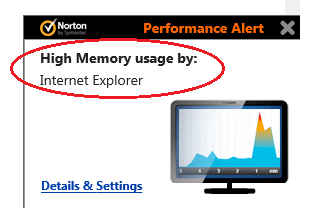
The first warning sign: the fan from the laptop starts whirring maniacally because the processor is busy running around in circles, and it’s generating heat. Soon, Norton opens a popup at the lower right-hand corner of the screen, warning, “High Memory Usage by: Internet Explorer”:


A little later, I got this message across the bottom of the screen (I took out the blank middle part, indicated by the red line, to make it fit the column width here):


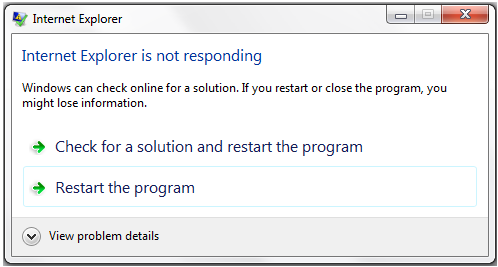
By now I have a bunch of tabs open. The machine is slowing to a crawl. The processor is running in circles and doesn’t have time for much else. After a while, when I try to open a new tab, IE informs me that it is “not responding.”


I soldier on, determined to take this to the bitter end. Soon this box pops up:


I click “Restart the program.” It shuts down an offending page and tries to reopen it which doesn’t work either, and the same box pops up. So I close that particular page directly and move on. Things are getting worse. The cursor is starting to dance around, and it’s difficult to maneuver it to the right spots. Taking a screenshot and pasting it into Paint requires enormous patience.

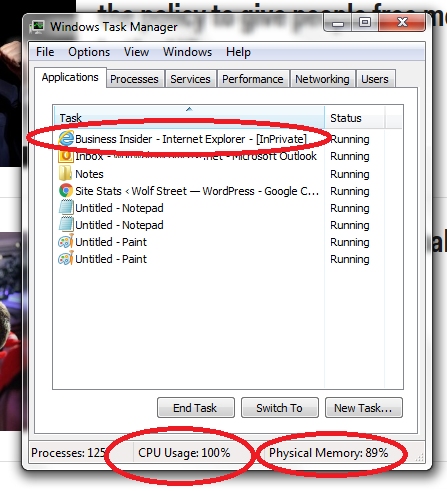
To see what’s going on, I open the Windows Task Manager. It shows that processor usage is 100%, when normally, with what I do, it should be under 10%. And the system uses 89% of the Physical Memory:


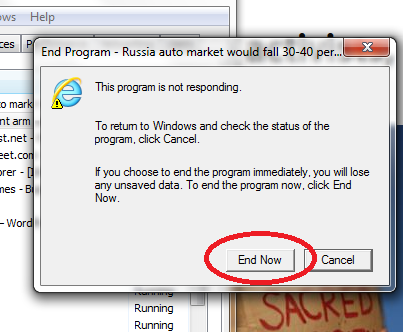
This is becoming a battle. Progress is at snail’s pace. Hardly anything moves. The bitter end is nigh. I can smell it. Not much later, it’s coming. IE hangs up. Links don’t work anymore. The scrollbar is dead. Switching tabs is impossible. I try to close IE, but can’t. So I return to Windows Task Manager to close IE that way. This all too familiar sign pops up.


Once IE is shut down, the fan stops whirring, things speed up, the cursor moves normally. The battle is over.

For current and former IE users, it’s easy to explain why the number of Edge users is still low. Edge may be great. But why even try? Chrome, Firefox, and other browsers beckon. And the above frustrations – which heavy IE users encounter on a daily basis – are leaving their marks. But apparently, Microsoft has trouble digesting the message. Instead, it seems to hound its surviving IE users by crashing their work in order to push them to upgrade to another Microsoft browser. But the market-share data shows that something in this twisted math doesn’t quite seem to work.

This would be hilarious if the broader ramifications weren’t so serious! Read… Amazon Algorithm Makes Decision about WOLF STREET, Hilarity Ensues

http://wolfstreet.com/2016/11/13/microsoft-purposefully-degrading-crashing-internet-explorer-to-push-users-to-upgrade-to-windows-10-edge/

I find the same thing. The more risque or closer to the truth the source link, the more difficult to open the page. If the page opens, then it freezes to become unusable. I believe they are purposely sabotaging sites that run contrary to the one worlders. After the liberation and the fiends are relegated to Devil's Island, I think we'll see a return to normal.

SCIENTISTS IN SPAIN CREATE “MAGNETIC WORMHOLE”   ~ hehe drip,drip, drip,  DRIP ? Image result for pic of cern

This interesting story was passed along (I forget who did so, so my apologies!) and I have to round out this week of otherwise serious blogs with something fun, and potentially very significant in its own right. Scientists in Spain at the Autonomous University of Barcelona have created a kind of "magnetic wormhole" by using metamaterials (watch the short four minute video for a fuller explanation than the article:
As this article and video make clear, this is a magnetic wormhole, not the gravitationally based Einstein-Rosen bridge, a kind of wormhole that would require gimongous amounts of energy to open and sustain, and which would be - as I've mentioned in various interviews before - a "billion times tinier than tiny," a phrase that, since physicists are enamored of quantization, captures the essence of the idea.
Now what's interesting to me here, and what fueled all sorts of entertaining high octane speculation on my part when I read the story and watched the video, was really that this "magnetic wormhole" was actually created by creating a kind of magnetic monopole, something that has been theorized about for a long time, but never successfully done, until, apparently, now. Normally, magnetic fields and magnetics are dipole phenomena, which is a fancy way of saying what we all know from elementary school, namely, magnets have two poles, a North and South, but not simply a North one all by itself, or a South one all by itself, which would be a "monopole." Electricity is likewise a dipole phenomena. Think, for example, of lightening, when electrical arcing occurs between regions of predominantly negative and positive charges building up, until the arc "restores the balance," so to speak. since such regions can develop at all, and because electricity is so closely related to magnetism, for such reasons people have theorized that magnetic monopoles, regions of predominantly one or another polarity, might develop without the other. But like electricity, an opposite corresponding region has to exist somewhere in order for that "balance" to be preserved.
In effect, what the scientists in Spain appear to have done - in so far as the video suggests - was to send one pole of the dipole "somewhere else", into a kind of hyper-dimensional region, where it was still invisibly coupled via that invisible "wormhole" to the pole that remained "here." As the article and video state, there's not currently any practical use for such a thing, the experiment being more of a "proof of concept" experiment, in this case, of the magnetic monopole and how they might exist.
And it was this point that of course made me think of all sorts of wild and crazy possibilities, for if one pole can exist "here" in this 4-dimensional space-time reality, and the other pole "there" in a kind of hyper-dimensional spatial reality, then at one stroke,  it would appear that the physical reality of hyperdimensional spaces and their connection to this 4d reality, is if not proven then at least strongly indicated. And that in turn opens up all sorts of intriguing possibilities for those of you who, like me, like to contemplate the mysteries of quantum entanglement and non-locality, for it would appear to be occurring here in a magnetic context, at a "macroscopic scale".  Here's one example from my fun private musings to contemplate: Place an object, say a molecule, ion, or atom, into the field of the monopole here, i.e., subject it to the stress of the monopole field, and what happens on the other side? Does its hyperdimensional signature appear "there"? All my instincts tells me it would.
On and on we could go, but with this little experiment, all sorts of new doors and puzzles appear to be opened.
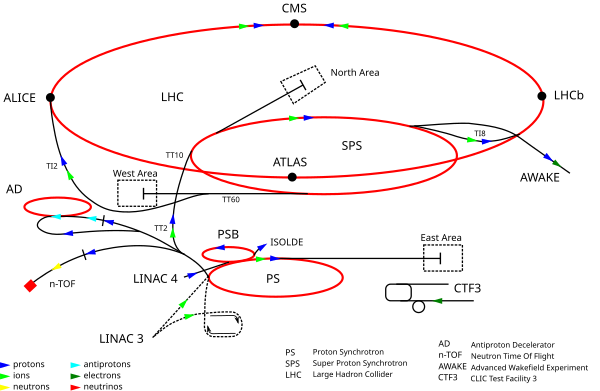
And you can guess what they're already thinking: why not scale the experiment up to, oh, say the size of CERN's hadron collider and its enormous magnetic fields with meta-materials... what might happen then?
Have a nice day, and,
I'll see you on the hyper-dimensional flip side...    Image result for pic of cern https://gizadeathstar.com/2016/11/scientists-spain-create-magnetic-wormhole/