Posts
Posts


US Intelligence and the Fate of the Private Pre-War International Banking System
The Dulles Brothers, Harry Dexter White, Alger Hiss
The key to this important change was not Eisenhower but the Dulles brothers, formerly both partners in the firm Sullivan and Cromwell, which for years had represented the oil cartel:
As long as his brother, John Foster
Dulles, was Secretary of State, [CIA Director] Allen Dulles had no need
to chafe under political “control.”…. An adventurous director… whose
brother held the second highest office in the administration… was able
to act almost at will as he was shielded from any unpleasant
consequences.3
The 1952 Republican campaign, for which John Foster Dulles was partly
responsible, successfully attacked Truman’s supposed weakness in
dealing with the alleged treason of two of his civil servants, Treasury
assistant secretary Harry Dexter White, and State Department official
Alger Hiss. In fact neither White nor Hiss was ever convicted of
treason; nor were they ever proven to have committed it. But both men’s
careers had been ruined by the sensational charges brought against them
in 1948 by a freshman congressman, Richard Nixon, in the House
Un-American Activities Committee (HUAC).An Overview of This Essay
It has long been known that Nixon, in his interrogation of White and Hiss, was being fed information by FBI agents acting with the approval of J. Edgar Hoover. This essay will argue that Nixon also received assistance from the Dulles brothers, especially in a key meeting between the three men on August 11, 1948, five days before White’s untimely and disputed death.
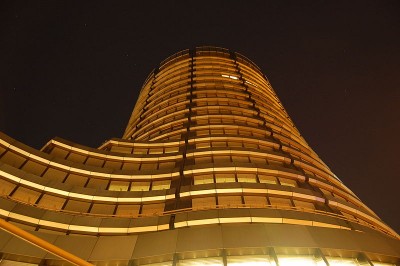
At stake in the meeting was the Republican campaign of 1948, the first campaign, ultimately unsuccessful, in which “the GOP dubbed the Democrats ‘the party of treason.’”4 But deeper issues were also at stake. As we shall see, Harry Dexter White, backed by Treasury Secretary Henry Morgenthau, had his own candidates for treasonable behavior: above all Allen Dulles’s friend and former OSS agent, Thomas McKittrick, the American wartime president of the Bank of International Settlements in Basel, Switzerland.5
The BIS had handled Nazi looted gold when other banks had refused to do so, and at the war’s end McKittrick was “arranging deals with Nazi industrialists to guarantee their profits after the war was over.”6 In contrast, the Morgenthau-White Plan for postwar Germany called for the country to be deindustrialized and the power of the German cartels to be broken. The pre-war banking system linking American bankers to those who had backed Hitler was also to be demolished: the meeting of Allies at Bretton Woods in July 1944, organized largely by White, had passed a resolution calling for the dissolution of the BIS “at the earliest possible moment.”
A version of the Morgenthau-White Plan was approved by Truman in May 1945 as JCS (Joint Chiefs of Staff policy) 1067, which directed the U.S. forces of occupation in Germany to “…take no steps looking toward the economic rehabilitation of Germany.”7
But both McKittrick and Allen Dulles had a quite antithetical vision for Germany – that its economy should indeed be rehabilitated, and eventually made the underpinning for a more united Western Europe.
Thus “Dulles and others began to campaign against…JCS 1067,” and for its replacement by what later came to be known as the Marshall Plan.8
On one level this was a conflict between powerful individuals: White in Washington (Morgenthau soon retired), versus the banker McKittrick and the lawyer Allen Dulles, both of whom returned after World War II to Wall Street. But it was also an institutional conflict between Washington and Wall Street, because each center was initially united behind conflicting visions for the future of Germany, and also for the future of the pre-war international banking system uniting Germany and America – at the heart of which was the BIS. Another way to say this is that it was a contest between the conflicting visions of the state (Washington) and the deep state (Wall Street).
In this contest, as in many others at this time, Washington lost, and Wall Street won.9
The Dulles brothers and their allies, who
argued that Germany must be rebuilt as rapidly as possible as a bulwark
against the Soviet Union, triumphed over Morgenthau and White. The BIS
returned the looted Nazi gold, and the calls for its dissolution faded
away.10
There are various reasons for Wall Street’s victory. Prominent among
these were the death of Roosevelt and his replacement by Truman with his
conservative Secretary of State James Byrnes. Perhaps even more
important was the brutish behavior of Stalin in eastern Europe, and the
revelation (thanks to the 1946 defection of a Soviet code clerk in
Ottawa), that Moscow had a robust network of spies in the west. These
and other factors soon made Washington agree to the replacement of JCS
1067 by the Marshall Plan (which perhaps would have been better called
the Dulles Plan).But there were deeper aspects to the conflict. The Dulles brothers were determined to destroy, not just a plan for Germany which they disliked, but the Democratic New Deal by which the party under first Roosevelt and then Truman had restricted the traditional freedoms of Wall Street, and were now threatening to break up the oil cartel. Here the Republicans had their eyes on Harry Dexter White in particular.
The reason then given for this, and still believed by some intelligent people, was that White was a spy.11 But as we shall see, there are also those who believe that the evidence for this is very debatable. We shall consider the suggestion of Anthony Summers and others that Allen Dulles and the CIA, as early as July 1948, were the source of the furor over the alleged treason of first White, and then (after White’s death in August 1948) a far less prominent substitute figure, Alger Hiss.12
Summers suggests that Allen Dulles, even while still a Wall Street lawyer, may have had access to a secret weapon not available to a mere Treasury assistant secretary like White – the VENONA record of deciphered Soviet communications.
VENONA, Harry Dexter White, and Alger Hiss
Many on the left have referred to the post-war prosecutions of Alger Hiss and the Rosenbergs as “show trials,” alleging that their underlying purpose was not to determine guilt or innocence, but to influence public opinion by publicizing a guilt already determined, as a warning against dissent. But the spy scare of the 1940s was at least partly genuine, based largely on evidence from the newly translated VENONA record of Soviet transmissions. It is certain that VENONA intercepts helped identify and convict spies such as Judith Coplon, even though, for security reasons, these intercepts were not introduced at their trials.13
VENONA evidence also was used to raise suspicions about two other suspects, senior Treasury official Harry Dexter White and Alger Hiss. However the VENONA evidence against these two men is still fiercely debated. And the campaign against both men was not powered by security concerns alone. In part at least also it was a by-product of a deeper conflict over the future of America — between Wall Street (represented by the Dulles brothers) and the remnants of the New Deal (represented by White, a principal architect of the International Monetary Fund and the World Bank.)
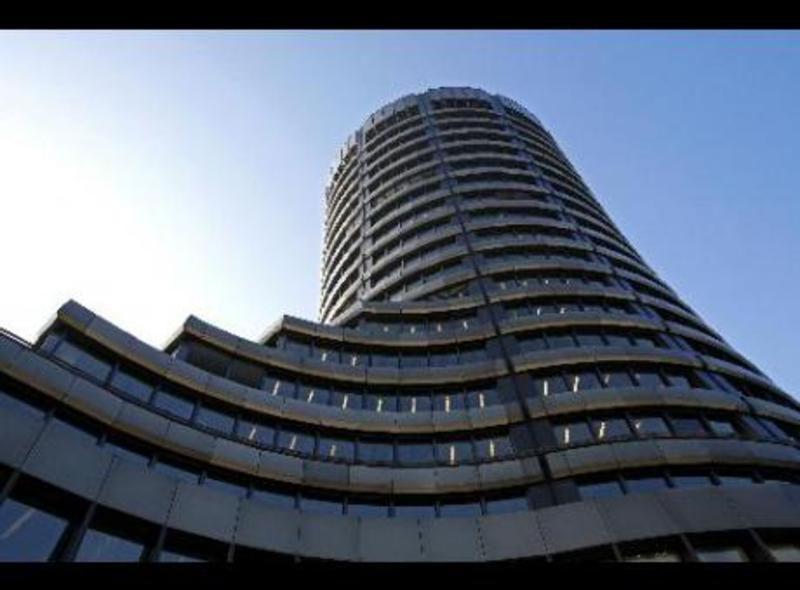
Image: The Bank of International Settlements HQ in Basel
The Dulles brothers, as lawyers at Sullivan and Cromwell, had played key roles in the inter-war western financing and refinancing of German debt. A primary bank in these transactions was the British merchant bank J. Henry Schröder and its American subsidiary the J. Henry Schroder Banking Corporation, where Allen Dulles served as director and his brother as attorney. A web of international banking connections was created between the wars; and much of this web “was connected to the BIS [Bank of International Settlements], via the Dulles brothers and their friends on Wall Street and in London and Germany.”14
Roosevelt New dealers like Treasury Secretary Henry Morgenthau and his assistant White intended to dismantle this complex network with German banks and corporations after World War II: in particular, they “loathed the BIS, seeing it, correctly, as a channel for the perpetuation of Nazi economic interests in the United States.”15 Their principal target was the wartime BIS president Thomas McKittrick (formerly of the Boston banking firm Lee, Higginson)– rightly so, in the opinion of Adam Lebor, who writes that “many of the things that McKittrick was doing, such as gold and foreign exchange deals with the Reichsbank after Pearl Harbor, were treasonable.” Lebor adds that McKittrick, a personal friend of Allen Dulles, came to New York and hired an attorney “to persuade the Treasury to unblock the BIS’s funds. His choice was never in doubt: John Foster Dulles.”16
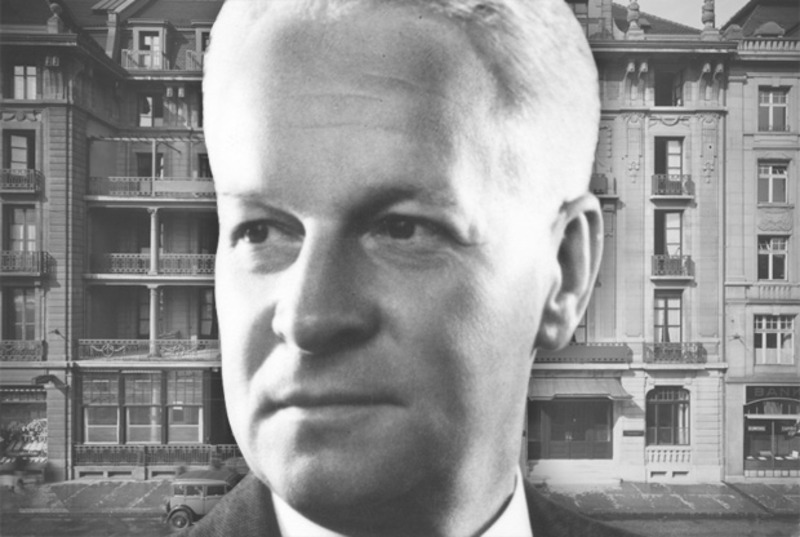 Image: Thomas McKittrick, American Head of the Swiss-based Bank for International Settlements
In July 1944, at Bretton Woods, Morgenthau and White led the American delegation at the conference which successfully established the International Monetary Fund, where White eventually became the executive director and U.S. representative. With the IMF at the center of the new international system, the two men also
wanted the BIS to be abolished. On July
10, 1944, they seemed about to get their wish. Wilhelm Keilhau, of the
Norwegian delegation, introduced a motion to liquidate the BIS…. No
delegation spoke publicly in defense of the BIS. But behind the scenes
its defenders – sections of the State Department, Wall Street, the Bank
of England… went into action…. Eventually a new Norwegian-Dutch
resolution calling for the liquidation of the bank at “the earliest
possible moment” was finally agreed.17
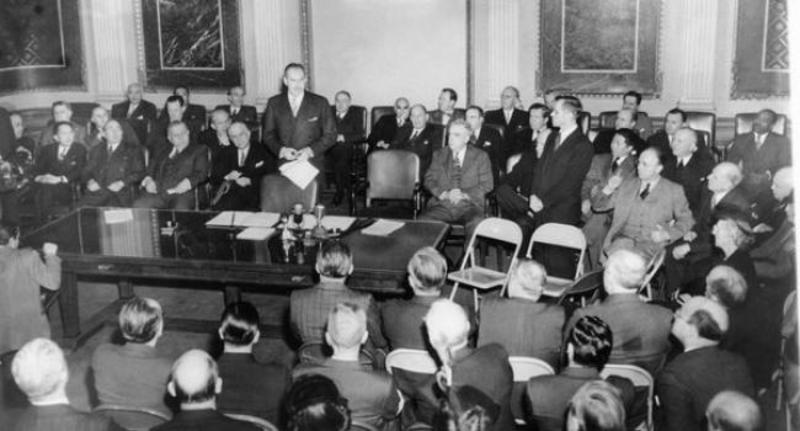
Image: The 1944 Bretton Woods Conference
The Morgenthau-White opposition to the BIS was consistent with their support of the Morgenthau Plan, endorsed by Roosevelt and Churchill at Quebec, which called for the partial deindustrialization of Germany. Though this extreme proposal was soon modified, Truman in May 1945 approved JCS (Joint Chiefs of Staff policy) 1067, which directed the U.S. forces of occupation in Germany to “…take no steps looking toward the economic rehabilitation of Germany or designed to maintain or strengthen the German economy.”18
But both McKittrick and Allen Dulles had a quite antithetical vision for Germany – that its economy should indeed be restored, strengthened, and eventually made the underpinning for a more united Western Europe. We know from an OSS communication to Allen Dulles that, even before the end of the war, McKittrick as president of the BIS “had already concluded an agreement [with German industrialists!] to ‘preserve the industrial substance of the Reich.’”19
Thus “Dulles and others began to campaign against…JCS 1067,” and for its replacement by what later came to be known as the Marshall Plan.20 By mid-1947 the remnants of Morgenthau’s deindustrialization program
had been so watered down by General
Lucius Clay, the American commander of occupation forces, that it was
meaningless…. Washington’s JSC Directive 1779, passed in the summer of
1947, institutionalized this change in policy. German industry would be
rebuilt; its steel mills and forges would once again be the powerhouse
of Europe.21
Who Was Guilty of Treason? McKittrick or White?The plans of White and other New Dealers for post-war Germany and the BIS had thus been decisively defeated by 1948. Only in the Clinton era, more than half a century later, did some Americans’ mistrust of the BIS and McKittrick become known. At a minimum,
McKittrick was suspected by Allied
authorities of helping Axis countries acquire funds the U.S. government
had tried to freeze. He maintained that the BIS was neutral and that no
looted gold was held by the BIS. The U.S. Office of Strategic Services,
the forerunner of the Central Intelligence Agency, had found evidence
that McKittrick had collaborated with the Nazis. A report given to
President Bill Clinton alleged that the Axis powers had virtually taken
over the BIS.22
John Loftus and Marcus Aarons go much further, accusing Allen Dulles
and McKittrick together of having conspired to move Nazi looted gold in the post-war era to Argentina.23 A more cautious account is given by James Calvin Baker, implicating the BIS under McKittrick’s wartime tenure, but not Dulles:
After the war, McKittrick was appointed
to a high-level position at Chase Manhattan [sic, i.e. Chase National]
Bank…. And for nearly 50 years, the operations involving the the BIS and
Swiss banks and looted assets by the Nazis were hidden in classified
documents…. The U.S. Treasury Department [under White] tracked Nazi gold
as it moved in and out of the BIS. Several of these transactions were
found to have occurred between the BIS and major Swiss banks. From these
Swiss banks, money was used by the Nazis to purchase war materiel or
was wired to accounts in Spain, Argentina, and he Middle East.24
But Wall Street rallied to protect McKittrick, offering him positions
at first the Chase National Bank, and then, at the invitation of
Averell Harriman, to administer what became the Marshall Plan. Harriman
also appointed an advisory committee consisting of Owen Young, a
principal author of the pre-war German debt arrangements, “and of course
Allen Dulles, who saw the Marshall Plan as the means of dealing the
death blow to the spread of Communism in Western Europe.”25One of the things that saved McKittrick and the BIS was the spy scare of the 1940s, which rightly or wrongly implicated White. Undoubtedly real spies were discovered, some of them thanks to deciphered VENONA intercepts, but others were the victims of hysteria.
Was White one of these victims? White died before he could be indicted, and the charges against him are still disputed in America.26 Undoubtedly White shared information with officials of the Soviet Union, which was then an ally; but the weight of evidence is that he was neither a Communist Party member nor securely under Soviet control. Chambers himself said of White, “His motives always baffled me.”27
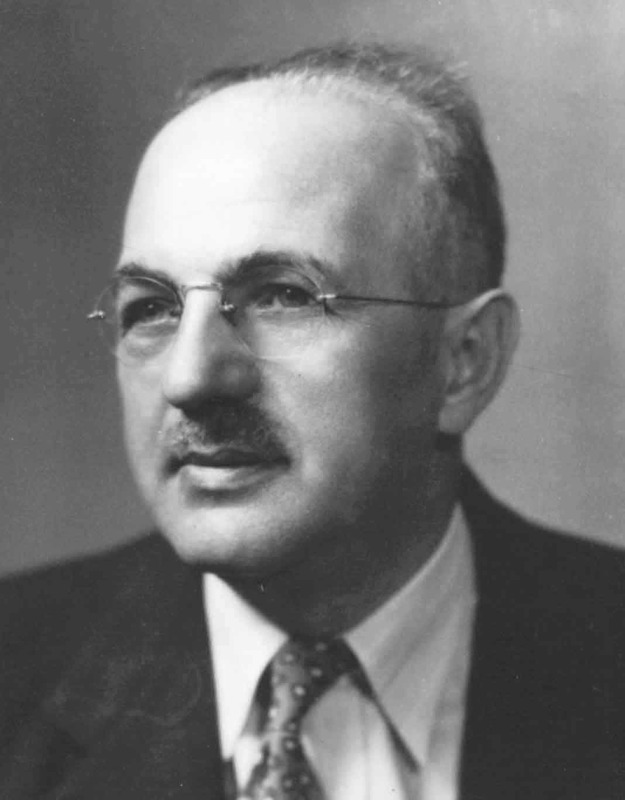
Image: Harry Dexter White, Architect of the Post-War International Monetary Fund
What is certain is that VENONA transcripts were used to persuade US officials that White was a Soviet spy – ending his career. It is clear too that hysteria also played a role. John Loftus and Mark Aarons claim that the Dulles brothers helped foment this hysteria, and Richard Nixon “became Allen Dulles’s mouthpiece in Congress.”28 Anthony Summers charges in addition that Nixon was fed secrets by the CIA as early as July 1948, before Allen Dulles joined the organization he had helped create.29
Nixon, Voorhis, and the BIS
Loftus and Aarons date this secret collaboration between Allen Dulles and Nixon back to 1945.
According to several of our sources among
the ‘old spies,’ Richard Nixon’s political career began in 1945, when
he was the navy officer temporarily assigned to review . . . captured
Nazi documents. Allen Dulles allegedly told him to keep quiet about what
he had seen and, in return, arranged to finance the young man’s first
congressional campaign against [incumbent Congressman] Jerry Voorhis.30
Although Loftus and Aarons do not mention it, Voorhis was the
principal ally and spokesman in Congress of Morgenthau and White’s
charges against the Bank of International Settlements, having called for
an investigation of the BIS in 1943.31 Dulles would therefore unquestionably have had another motive to see Voorhis defeated.Voorhis himself wrote in an unpublished 1947 book manuscript that he had a lot of documentation “which would have shown how the [1946] Nixon campaign was a creature of big Eastern financial interests,” including “the major oil companies.” And a representative of Standard Oil, a company (represented by Sullivan and Cromwell) whose shady government dealings Voorhis had exposed, was present at the meeting which selected Nixon as a candidate.32
Nixon and the Dulles Brothers, August 11, 1948 – and Harry Dexter White
Most accounts of Nixon’s career point to an important meeting between Nixon and John Foster Dulles at the latter’s Republican Party headquarters in the Roosevelt Hotel on August 11, 1948, a meeting attended also by Allen Dulles and Douglas Dillon of Dillon Read, “one of the banking firms that [had] financed Hitler.”33 The conventional account is that Nixon approached the Dulleses with the proceedings from the House Un-American Affairs Committee (HUAC) on which he sat.34 Virtually all accounts say that their discussion concerned Alger Hiss.
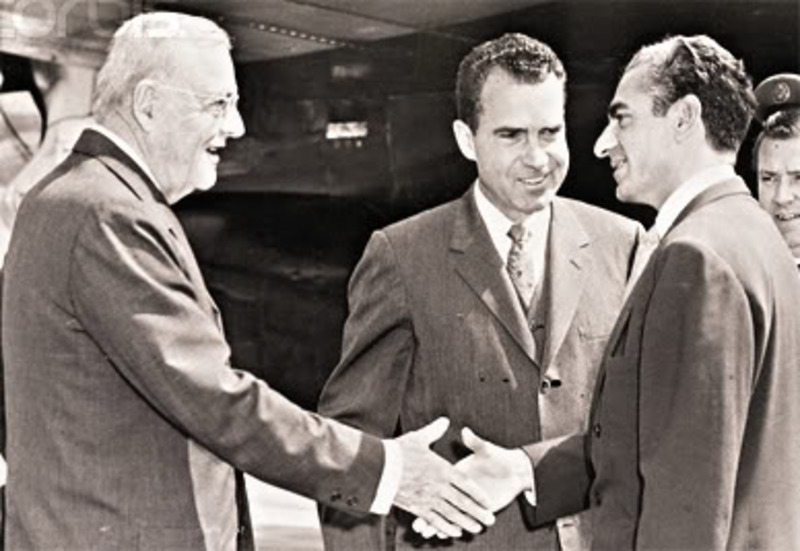
Image: John Foster Dulles, Vice-President Richard Nixon, and the Shah of Iran
It is probable however that when Nixon met with the Dulles brothers on August 11, 1948, the most urgent matter discussed was not Hiss, but the man then principally targeted by HUAC’s investigation – Harry Dexter White.
White had been the main focus of HUAC attention in 1948, both when Elizabeth Bentley had testified on July 31, and Whittaker Chambers on August 3. White and Lauchlin Currie, Bentley’s two principal targets (together with William Donovan’s law partner Duncan Lee), were due to testify in reply on August 13 (two days after the Dulles-Nixon meeting), along with Alger Hiss’s brother Donald. All three men would deny Bentley’s charges in their entirety, including Bentley’s charge (corroborated by Chambers) that White had “placed Communists in government posts to influence policy.”35
Chambers of course would be vindicated by Hiss’s ultimate conviction, twice, on perjury charges. But the main importance of Hiss at the Dulles-Nixon meeting on August 11, 1948, was as a challenge to the credibility of Chambers, a witness against the far more important target of White.36 One of the two men, either Hiss or Chambers, was apparently guilty of perjury. And Truman’s Justice Department was in the process of preparing a perjury indictment against Chambers, a key witness against White.37
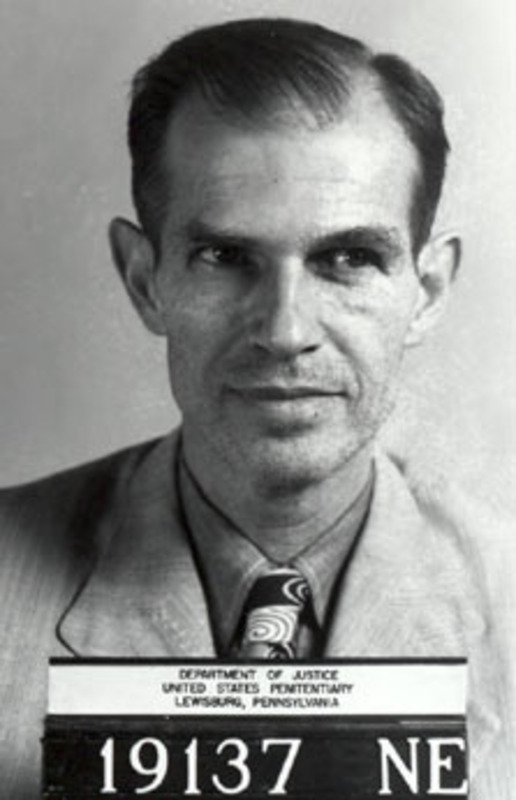
Image: Alger Hiss After His Conviction on Perjury Charges
Matters would change five days later. On August 16, three days after his stressful HUAC testimony, White died, after suffering two swift heart attacks. It was then that Hiss became by default HUAC’s principal target (and the key to Thomas Dewey’s presidential ambitions in the same year).
I mention all this because of the suggestion of many authors that, in post-war Washington, either White had to be discredited, or a number of those involved in the Wall Street-Berlin financial axis, including not just Thomas McKittrick but possibly also Prescott Bush (and perhaps even Bush’s lawyer Allen Dulles), risked being indicted. As Glen Yeadon and John Hawkins write,
White…was arguably one of the
government’s most important postwar economists. However, due to his
liberal economic policies, as well as his relentless pursuit of the
financial dealings of large corporations with the Nazis, he had to be
removed.38
Death did remove White on August 16, 1948, five days after the
Dulles-Nixon meeting on August 11. But whereas most accounts say White
died of a heart attack (e.g. Black, Richard M. Nixon, 118), the
well-informed journalist Willard Edwards reported in 1949 that White’s
cause of death, after being admitted to hospital with a heart attack,
was in fact an overdose of digitalis.39Summers charges that in August 1948, as the HUAC investigation of Alger Hiss
faltered in the face of Hiss’s denials,
Nixon received confirmation that Hiss had indeed known Chambers. It
came, according to CIA sources, from Allen Dulles. Dulles, who had had a
run-in with Hiss years earlier, was at this time in close contact with
his former chief, Donovan, and was likely to be privy to whatever the
OSS had learned about Hiss.40
And Summers asks whether a secret weapon used by the Dulleses and
Nixon against White and Hiss was a tendentious interpretation of
material which existed about White and Hiss in the then secret VENONA
transcripts of deciphered Soviet cable traffic:
A fascinating question, still unresolved,
is whether Nixon’s secret sources – J. Edgar Hoover, Allen Dulles, or
other OSS/CIA contacts – were aware by 1948 of the deciphered VENONA
messages – and of the ALES cable in particular [of March 30, 1945]– that
seem to point to Hiss’s guilt.41
He argues suggestively that “Allen Dulles may well have learned” of
the VENONA evidence; and “if as reported he briefed Nixon on the case –
then therein may perhaps lie the explanation for Nixon’s confidence in
his pursuit of Hiss.”42 This theory would also explain why
Nixon, backed by Hoover, relied on allegations that now look extremely
dubious – the most dubious of all (and yet the most persuasive at the
time) being the so-called Pumpkin Papers.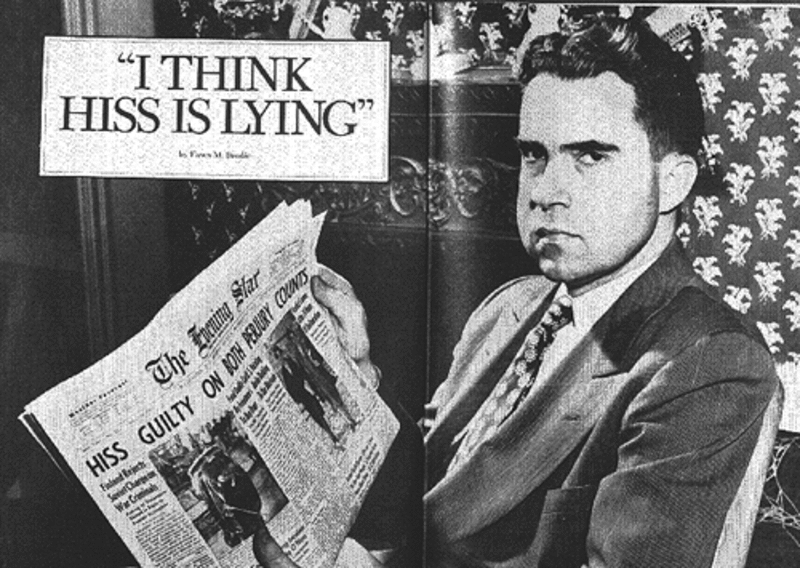 Image: Richard Nixon in a Moment of Triumph
The grand jury convened to indict Chambers was persuaded in December 1948 by Nixon, in an extraordinary performance by a Congressman, to indict Hiss instead. Nixon did so by the controversial act of giving the grand jury copies of films from the “Pumpkin Papers.”
Nixon had been warned by a fellow Congressman that the film belonged to the House and should not be given to the grand jury.
But Nixon, as he later wrote in his book ”Six Crises,” saw the film as crucial evidence of Hiss’s guilt, was convinced the Justice Department was not taking the investigation seriously and feared that the grand jury might seek to indict Chambers for perjury instead of Hiss.43
It is clear that in the case of the Rosenbergs the VENONA evidence played a key role in their identification and prosecution.44 Because, for national security reasons, it could not be revealed at their trial that the Soviets’ code had been broken, substitute evidence, some of it unconvincing, was used to obtain conviction. The result was to subject the U.S. justice system to a bifurcation of knowledge, between the public evidence presented in open courts, and a deeper history known only to those cleared for the secrets of the deep state.
Something like this bifurcation appears to have occurred also in the still disputed cases against first Harry Dexter White and then Alger Hiss.
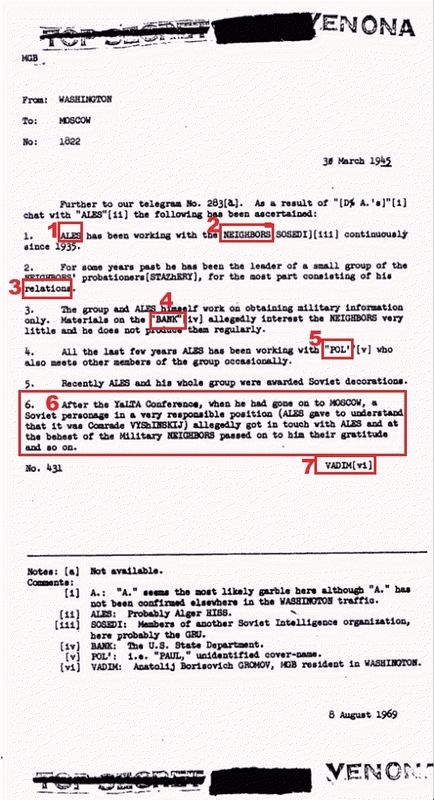 Image: “ALES” in the VENONA Files — Was This Alger Hiss?
Nixon, Hiss, and the Pumpkin Papers
What is clear is that judicial process in the Hiss case was overridden and predetermined by Nixon’s election-year persecution of Hiss in the media. In an essentially favorable biography of Nixon, Conrad Black concedes that “Nixon attacked Hiss however he could, having conducted a press assault after he had sworn under oath to maintain confidentiality about HUAC’s executive session proceedings.”45 Speaking to his White House staff on July 1, 1971, and contemplating a similar strategy against the leakers of the Pentagon Papers, Nixon himself recalled:
We won the Hiss case in the papers. We
did. I had to leak stuff all over the place. …. It was won in the
papers. We have to develop now a program, a program for leaking out
information. We’re destroying these people in the papers.46
And in 1948 the newspapers eventually took seriously, as mainstream historians like Stephen Ambrose have continued to take seriously, the “Pumpkin Papers” — five microfilm47 rolls planted in an outdoor pumpkin by Whittaker Chambers, where they were retrieved by investigators the next day. Two of these rolls contained classified State Department cables on economic relations with Germany, and on Sino-Japanese affairs.48Three more were withheld for decades: according to Nixon, “the State Department still felt…that publication…would be injurious to the national security.” In response to a FOIA suit, Alger Hiss in 1975
was allowed to examine the three withheld
rolls of microfilm. Two were from the U.S. Navy Department and
contained instructions on how to use fire extinguishers, life rafts, and
chest parachutes; the third roll was blank.49
It would seem that “national security” had been invoked to protect,
not the film, but the reputation of those like Nixon who exploited it.50The Pumpkin Papers, in other words, amounted to far less than what the press and the public believed. But the Pumpkin Papers were a media coup at the time, thanks to an elaborate stratagem, designed to keep the papers in the hands of HUAC and out of the hands of Truman’s hostile Justice Department. The stratagem, designed with the approval of Hoover, was the work of Nixon, HUAC Chief Investigator Robert Stripling, and an almost forgotten mastermind of the Pumpkin Papers scenario: Washington journalist Bert Andrews of the New York Herald Tribune.51
On December 1, 1948, UP carried a wire story, stating, “The Justice Department investigation [of Hiss and Chambers] is about to die for lack of evidence…. Unless something new turned up soon, officials said, there would be little use going to grand jury … to see if there were grounds for a perjury charge against either man.”52 That same night, Stephen Ambrose writes, Stripling and Nixon drove out to Chambers’ Westminster farm and heard from Chambers that he had “another bombshell.”
You keep that second bombshell,” Nixon
said. Don’t give it to anybody except the committee. Why he did not
issue a subpoena then and there on Chambers for the remaining documents
[the Pumpkin Papers] is another of the many mysteries in the case. In
any event, he did not — he and Stripling drove back empty-handed…. Back
in Washington, Nixon phoned Bert Andrews [who told him] “get hold of Bob
Stripling. Tell him to serve a blanket subpoena on Chambers to produce anything and everything he still has in his possession.53
A pro-Nixon biography summarizes the consequences:
The next evening, in a cloak-and-dagger
scene that fired the national imagination, an agent of the Committee
served a subpoena on the ex-Communist; Chambers led him in darkness to a
pumpkin in his garden, and from the pumpkin he drew five rolls of
microfilm containing photostatic copies of confidential and secret
documents stolen from the State Department. A New York Grand Jury, on
the verge of indicting Whittaker Chambers for perjury, reversed itself
when Nixon rushed to New York and testified that it must have been Hiss
who lied in saying he had not turned official documents over to
Chambers.54
This account fails to mention that, as a conservative website now concedes, the pumpkin was one Chambers “had hollowed out the night before” – i.e. the night of Nixon’s visit.55 Image: The Hollowed-Out Pumpkin at Whittaker Chambers’ Farm
What also fired the national imagination were the dramatic photos of Nixon, who had left on a sea voyage, returning “in theatrical fashion, transferring from his liner to a coast guard seaplane, then flying to Florida to be met by a posse of reporters.”56 This is the answer to Ambrose’s mystery of why the subpoena was not served by Nixon on December 1, nor the microfilm rolls simply taken.
The Chamber-Hiss controversy…was once again front-page news. … Reporters and photographers swarmed to Westminster. Even staid dailies ran pictures with arrows indicating the pumpkin patch. And there was the microfilm. Its contents remained secret and under twenty-four hour guard…. However [Stripling] did let Bert Andrews read some of the documents.57
In all of this Nixon was coached by Andrews “on how to handle the Hiss-Chambers confrontation.”58 David Halberstam adds that
By this time Andrews was not just a
reporter covering a story, he was friend adviser, press officer, and
reporter for Nixon…. He had steadied Nixon and advised him, and kept him
advised of other developments in the case through his sources in the
White House…. Andrews proved to be an invaluable connection and friend.
He not only helped brief the younger, rawer Nixon on strategy, he helped
legitimize him with other reporters.59
Press reaction to the Pumpkin Papers at the time was rather mixed,
with many liberal journalists still inclined to favor the well-spoken
Hiss over the young upstart Nixon. But that support waned after Hiss’s
conviction in 1950, possibly influenced by Russia’s successful test of
an atom bomb. Public criticism of the “Pumpkin Papers” drama – or farce –
became closely restricted to Hiss’s waning supporters, especially after
the convictions of the Rosenbergs during the Korean War, when the
choice presented to everyone was now whether to side with the
government, or the Communist enemy.By 1968 the columnist Drew Pearson was a maverick in his unpopular reproof of the US press for having “glossed over the fact that the pumpkin papers had been planted there as a phony but sensational plot so [Nixon] could discover them and make headlines.”60 But I believe Pearson’s salty reproof to have been justified.
Press coverage of the “Pumpkin Papers” in 1948 was intense, because the public was aroused by legitimate concerns much wider than the fate of Alger Hiss. One larger issue – how much the U.S. should commit to supporting Chiang Kai-shek – aroused a narrower segment of U.S. public opinion than another: how Roosevelt and Churchill could at Yalta in 1945 have ratified the delivery of Catholic eastern Europe into the hands of Stalin.
Hiss had accompanied Roosevelt and his Secretary of State Edward Stettinius to Yalta. Few today would ascribe to the “falsely claimed” charge by Senator McCarthy “that Hiss had been integrally involved in drafting the Yalta agreements.”61 But at the time the possibility of treason by White and Hiss was an unresolved question, exploited vigorously by Republican campaign manager Herbert Brownell in his unsuccessful 1948 campaign to elect Governor Thomas Dewey, and his successful campaign in 1952 to elect Eisenhower. It thus helped make John Foster Dulles Secretary of State, and Allen Dulles Director of Central Intelligence.
The two brothers promptly illustrated their break with Truman’s foreign policy by approving what Truman had rejected, the use of CIA resources to rescue the Anglo-Iranian Oil Company (now BP) from nationalization by Iran. The gates had been opened to four decades in which the resources of the American deep state would be used to defend U.S. corporate interests abroad by crushing local governments that had been democratically elected — from Guatemala in 1954 to Panama in 1989.62
The claims against White and Hiss continued for years to feed the phobic hysteria we remember as McCarthyism. And unfortunately they continue to the present.63
On the institutional level the results of the Washington-Wall Street conflict, initially at least, were less depressing. Germany was reconstructed as the strongest economy of western Europe; however Nazism did not seriously revive. The era of private banking influence, as symbolized by the BIS, was also restored, but within a new framework which also incorporated the public institutions of the International Monetary Fund and the World Bank.
For a quarter century, until it ended under Nixon in 1971, the Bretton Woods system largely worked, and the BIS functioned as part of its infrastructure. America prospered; and there were signs of a healthy reduction in income disparity, not just in America, but also in the Third World. Discussing the researches of the economist Thomas Piketty into the reduced income inequality of that era, Richard Brinkman has written, “The immediate period after WWII, from 1950 to 1973, has come to be called the Golden Age…. a close approximation to the best that in practice can be obtained from a capitalist economy.”64
Thanks to the Vietnam War and other factors, America went off the gold standard in 1971. Since then the dollar has been sustained by a system of high petroleum prices, highly profitable to the oil cartel, for which increasingly impoverished third world countries are forced to pay in dollars.
That is another story, too complex to be told here. But a major factor in the eventual collapse of the Bretton Woods system was the success of the Dulles brothers in freeing Wall Street and the oil majors from the restraints of law.
Peter Dale Scott, a former Canadian diplomat and English Professor at the University of California, Berkeley, is the author of Drugs Oil and War, The Road to 9/11, and The War Conspiracy: JFK, 9/11, and the Deep Politics of War. His most recent prose book is American War Machine: Deep Politics, the CIA Global Drug Connection and the Road to Afghanistan. His website, which contains a wealth of his writings, is here.
Recommended citation: Peter Dale Scott, “The Dulles Brothers, Harry Dexter White, Alger Hiss, and the Fate of the Private Pre-War International Banking System” The Asia-Pacific Journal, Vol. 12, Issue 16, No. 3, April 21, 2014.
Notes
1 Steve Coll, Private Empire: ExxonMobil and American Power (New York: Penguin Press, 2012), 19-20.
2 Bryce Wood, The Dismantling of the Good Neighbor Policy (Austin: University of Texas Press, 1985), 159: “In writing to Truman on 3 May 1961 about the Bay of Pigs fiasco, Acheson said: Why we ever engaged in this asinine Cuban adventure, I cannot imagine. Before I left [the department] it was mentioned to me and I told my informants how you and I had turned down similar suggestions for Iran and Guatemala and why I thought this Cuban idea had been put aside, as it should have been” [citing Dean Acheson, Among friends: personal letters of Dean Acheson, ed, David S. McLellan and David C. Acheson (New York: Dodd, Mead, 1980), 159].
3 Tom Wicker, New York Times, April 29, 2966.
4 Paul S. Boyer et al., The Enduring Vision: a history of the American people, Volume II (Lexington, MA: D.C. Heath and Co., 1995), 812.
5 Some in Washington wished to indict other Wall Street figures for wartime collaboration with Nazi Germany. Among those investigated were Herbert Walker and his son-in-law Prescott Bush (father of George H.W. Bush), for their role in representing the American interests of Fritz Thyssen, the German mogul who financed Hitler. According to John Loftus, Allen Dulles may also have been involved: “If the investigators realized that the US intelligence chief in postwar Germany, Allen Dulles, was also the Rotterdam bank’s lawyer, they might have asked some very interesting questions. They did not know that Thyssen was Dulles’ client as well. Nor did they ever realize that it was Allen Dulles’s other client, Baron Kurt Von Schroeder who was the Nazi trustee for the Thyssen companies which now claimed to be owned by the Dutch. The Rotterdam Bank was at the heart of Dulles’ cloaking scheme, and he guarded its secrets jealously” (John Loftus, “How the Bush Family Made Its Fortune from the Nazis,”Tetrahedron.org, September 27, 2000; cf. John Loftus and Mark Aarons, The Secret War Against the Jews New York: St. Martin’s Press, 1994], 358-60).
6 Adam LeBor, “Meet the American Banker Who Helped Hitler Loot Jewish Gold—While Spying for the OSS,” Tablet: A New Read on Jewish Life, August 30, 2013,
7 Frank W. Thackeray, ed., Events that Changed Germany (Westport, CT: Greenwood Press, 2004), 170. For text of JCS 1067, see here.
8 James Srodes, Allen Dulles: master of spies (Washington: Regnery, 2009), 373.) For a relatively dispassionate account of Allen Dulles’s wartime opposition to Roosevelt’s intentions to de-industrialize Germany, see e.g. Stuart Eizenstat, co-
ordinator, “U.S. and Allied Efforts To Recover and Restore Gold and Other Assets Stolen or Hidden by Germany During World War,” 37:
“Dulles looked forward to a postwar settlement that envisioned the United States working closely with European business and banking circles to reshape Western and Central Europe according to American interests.” See also Stuart Eizenstat, Imperfect Justice: Looted Assets, Slave Labor, and the Unfinished Business of World War II (Jackson, TN: PublicAffairs, 2009).
9 Two other relevant examples: Truman in 1945 terminated General Donovan’s plans to convert OSS into a peacetime CIA; but two years later he was persuaded to accept a plan, drafted largely by Allen Dulles, for just such a CIA. In 1948 Defense Secretary James Forrestal preferred that funds for the anti-Communist parties in the 1948 Italian election should be raised privately, and the hat was passed at the elite Brook Club in New York. But Allen Dulles, still just a lawyer, persuaded the CIA to take over the funding program.
10 Adam LeBor, “Meet the American Banker Who Helped Hitler Loot Jewish Gold—While Spying for the OSS,” Tablet: A New Read on Jewish Life, August 30, 2013.
11 Eric Rauchway, “How the Soviets saved capitalism,” TLS: The Times Literary Supplement, April 5, 2013.
12 Anthony Summers with Robbyn Swan, The Arrogance of Power: The Secret World of Richard Nixon(New York: Viking, 2000), 63.
13 “On February 8, 1951, about a month before the scheduled start of the trial, the Joint Congressional Committee on Atomic Energy met in secret session in Washington to discuss the Rosenberg prosecution… The main purpose of the meeting was to determine what classified information could be made public at the trial” (Curt Gentry, J. Edgar Hoover: the man and the secrets [New York: Norton, 1991], 421)
14 Adam Lebor, Tower of Basel: the shadowy history of the secret bank that runs the world (New York: Public Affairs, 2013), 17. Cf. p. 37: “The Standard Oil-IG Farben agreement set the pattern for a series of powerful cartels. John Foster Dulles carried out much of the pioneering legal work for these.”
15 Lebor, Tower of Basel, 95. White was the principal author of the so-called Morgenthau Plan to deindustrialize Germany. At the same time, White “tried without success [against Morgenthau] to soften the plan by allowing Germany to rebuild the industries in the Ruhr under international supervision” (James M. Boughton, “The Case against Harry Dexter White: Still Not Proven” [IMF Working Paper WP/00/149, 2000], 12.) This fact challenges one of the common claims against White: that he wished to weaken Germany in order to please the USSR.
16 Lebor, Tower of Basel, 96.
17 Lebor, Tower of Basel, 121-22, 124. Cf. Benn Steil, The Battle of Bretton Woods: John Maynard Keynes, Harry Dexter White, and the making of a new world order (Princeton: Princeton University Press, 2013); James Calvin Baker, Bank for International Settlements: Evolution and Evaluation (Westport, CT: Greenwood Press, 2002), 7: “During World War II, some attempts were made to abolish the BIS, so the Federal Reserve delayed joining the Board. After the war, the International Monetary Fund (IMF) and the World Bank were established at the Bretton Woods, New Hampshire, conference to form agencies to facilitate the finance and development operations of the United Nations. U.S. officials believed the BIS operations might be co-opted by these new agencies. However, the United States position on this matter was mellowed by the belief that the BIS might be able to perform beneficial operations with the IMF especially and, perhaps, with the World Bank.”
18 Frank W. Thackeray, ed., Events that Changed Germany (Westport, CT: Greenwood Press, 2004), 170. For text of JCS 1067, see here.
19 Lebor, Tower of Basel, 120.
20 James Srodes, Allen Dulles: master of spies (Washington: Regnery, 2009), 373.) For a relatively dispassionate account of Allen Dulles’s wartime opposition to Roosevelt’s intentions to de-industrialize Germany, see e.g. Stuart Eizenstat, co-
ordinator, “U.S. and Allied Efforts To Recover and Restore Gold and Other Assets Stolen or Hidden by Germany During World War,” 37:
“Dulles looked forward to a postwar settlement that envisioned the United States working closely with European business and banking circles to reshape Western and Central Europe according to American interests.” See also Stuart Eizenstat, Imperfect Justice: Looted Assets, Slave Labor, and the Unfinished Business of World War II (Jackson, TN: PublicAffairs, 2009).
21 Lebor, Tower of Basel, 138.
22 James Calvin Baker, The Bank for International Settlements: Evolution and Evaluation (Westport, CT: 2002), 203. Cf. John Singleton, Central Banking in the Twentieth Century (Cambridge: Cambridge University Press, 2011), 149: “In 1948 the BIS agreed to return 3,740 kg of looted gold to the original owners. After this concession, the US assets of the BIS, which had been frozen during the war, were unblocked.”
23 Loftus and Aarons, The Secret War Against the Jews, 109-13. Citing testimony from a former naval intelligence officer, Daniel Harkins, they claim that some of the funds were cycled through the post-war “World Commerce Corporation, with Allen Dulles, naturally, as their lawyer” (110). Cf. Mark Aarons and John Loftus, Unholy Trinity: The Vatican, The Nazis, and The Swiss Banks (New York: St. Martin’s/ Griffin, 1998), 278-79. I discuss their claims in American War Machine, 54-56.
24 Baker, Bank for International Settlements, 203.
25 Lebor, Tower of Basel, 140.
26 For the case against White, see e.g. John Earl Haynes and Harvey Klehr, Venona: Decoding Soviet Espionage in America (New Haven: Yale University Press, 1999), 125-26, 139. For rebuttal, see e.g. James M. Boughton, “The Case against Harry Dexter White: Still Not Proven,” IMF Working Paper WP/00/149, 2000, 1:”Evaluation of that [VENONA and other new] evidence in the context of White’s career and worldview casts doubt on the case against him and provides the basis for a more benign explanation.”
27 Whittaker Chambers, Witness (New York: Random House, 1952], 431; discussion in David Chambers (Whittaker Chambers’ grandson), “The Baffling Harry White,” History News Network, May 21, 2012.
28 John Loftus and Mark Aarons, The Secret War Against the Jews, 222; citing “Confidential interviews, former agents, U.S. CIC; former officers, U.S. MIS; former officers and agents, SSU, CIG, and OPC” (557n17).
29 Anthony Summers with Robbyn Swan, The Arrogance of Power: The Secret World of Richard Nixon(New York: Viking, 2000), 63.
30 Loftus and Aarons, The Secret War Against the Jews, 221.
31 On March 26, 1943, Congressman Jerry Voorhis introduced a resolution in the House of Representatives calling for an investigation of the Bank for International Settlements, including “the reasons why an American retains the position as president of this Bank” (John Spritzler The people as enemy: the leaders’ hidden agenda in World War Two [Montreal: Black Rose Books, 2003], 97; cf. Lebor, Tower of Basel, 97).
32 Summers, The Arrogance of Power, 46-47. With limited evidence, Russell Baker also suspects that Prescott Bush, another prominent member of the BIS German-American financial complex, may have flown to California and participated in the Nixon campaign (Family of secrets: the Bush dynasty, the powerful forces that put it in the White House, and what their influence means for America New York: Bloomsbury Press, 2009], 162-164).
33 Loftus and Aarons, The Secret War Against the Jews, 156. Dillon Read had handled 29 percent of the Wall Street financing of German reparations (Antony C. Sutton, Wall Street and the rise of Hitler[Seal Beach, CA: '76 Press, 1976], 29).
34 Conrad Black, Richard M. Nixon: A Life in Full (New York: PublicAffairs, 2007), 113.
35 Lewis Hartshorn, Alger Hiss, Whittaker Chambers and the Case That Ignited McCarthyism, 42. Today almost no one believes this. The accepted charges against White are that he shared information, and possibly passed documents, that reached the Soviet Union.
36 The sensational charges against Hiss, such as that he was the architect of betrayal at Yalta, would come later.
37 G. Edward White, Alger Hiss’s Looking-glass Wars: The Covert Life of a Soviet Spy
(Oxford: Oxford University Press, 2004), 62.
38 Glen Yeadon and John Hawkins, The Nazi Hydra in America (Joshua Tree, CA: Progressive Press, 2008), 195; cf. 193-94, 273-74, 368-70, etc.
39 Willard Edwards, “Hiss spy paper linked to late treasury aid,” Chicago Daily Tribune, November 29, 1949, 1-2. The doctor who signed White’s death certificate (and who was not present when White died) later denied that digitalis was a factor. More recently the right-wing author John Koster has charged (with no evidence other than a contemporary movie which White might have seen) that White overdosed on digitalis in order to commit suicide (John P. Koster, Operation Snow: how a Soviet mole in FDR’s White House triggered Pearl Harbor Washington: Regnery Publishing, 2012], 204-05).
40 Summers, The Arrogance of Power, 63; citing Peter Grose, Gentleman spy: the life of Allen Dulles(Boston: Houghton Mifflin, 1994), 297n (run-in).
41 Summers, The Arrogance of Power, 78. An anti-Hiss author has implied the opposite, suggesting from an annotation in the file that the identification of ALES as Hiss was made much later, in 1969 (White, Alger Hiss’s looking-glass wars, 225). But a partially declassified FBI memo from 1950, viewable on line here, makes it clear that by then the FBI was already investigating the possibility that Hiss was ALES, who had reportedly flown to Moscow after the Yalta conference (“The Alger Hiss Story: Venona and the Russian Files”).
42 Summers, Arrogance of Power, 78.
43 Benjamin Weiser, “Nixon Lobbied Grand Jury to Indict Hiss in Espionage Case, Transcripts Reveal,”New York Times, October 12, 1999: “Judge Peter K. Leisure of Federal District Court in Manhattan, who ordered the release after reviewing detailed summaries of the transcripts, had ruled that an exception to traditional grand jury secrecy should be made for the archive.
“‘The court finds the public has a significant interest in disclosure of Nixon’s testimony,’ Judge Leisure wrote. ‘Grand jury testimony by a Congressional official allegedly attempting to influence a grand jury’s charging decisions is of inherent and substantial historical importance.’”
44 Herbert Romerstein and Eric Breindel, The Venona Secrets: Exposing Soviet Espionage and America’s Traitors (Washington: Regnery, 2000), 233-34.
45 Conrad Black, Richard M. Nixon: A Life in Full (New York: PublicAffairs, 2007), 122.
46 “President Nixon Remembers the Alger Hiss Case: Selected References from the Nixon Tapes,”Stanley I. Kutler (ed.), Abuse of Power: The New Nixon Tapes (New York: Free Press, 1997), 7.
47 In addition, the materials produced by Chambers “included a long letter in Harry White’s own handwriting” (Haynes and Klehr, Venona: decoding Soviet espionage in America, 139).
48 Black, Richard M. Nixon, 131. My on-line investigations have failed to find a more detailed description of these cables. Black’s account should however be enough to establish that, if the microfilms did in fact come from Hiss, then Hiss was not, as many believe, the “ALES” of VENONA cable traffic, whose work was described as “obtaining military information only” (see facsimile reproduced in Summers,Arrogance of Power, 493).
49 Gentry, J. Edgar Hoover, 362n; quoting from Richard Nixon, The Memoirs of Richard Nixon (New York: Grosset and Dunlap, 1978), 69. The five rolls are now deposited in the National Archives (Record Group 60.3.5), Black was in error when he claimed that the withheld rolls contained “Navy Department secret files” (Black, Richard M. Nixon, 130); the Navy files were publicly available.
50 This impression is corroborated by the odd fact that the records of the long-defunct HUAC committee “were sealed, in 1976 [under Ford], for an additional fifty years” (Summers, Arrogance of Power, 77).
51 At the time Andrews “vowed that he could make Nixon president” (Tim Weiner, Enemies: a history of the FBI [New York: Random House, 2012], 476n).
52 We now know that on December 3 the Justice Department notified the FBI that an indictment of Chambers [for perjury] was contemplated (Athan Theoharis, Chasing spies: how the FBI failed in counterintelligence but promoted the politics of McCarthyism in the Cold War years [Chicago : Ivan R. Dee, 2002], 115; citing Allen Weinstein, Perjury: the Hiss-Chambers case New York : Random House, 1997], 271). Not surprising, since by this time Chambers was a self-admitted perjurer!
53 Stephen E. Ambrose, Nixon: The Education of a Politician 1913-1962, 128 (emphasis in original); Robert O. Blanchard, ed., Congress and the news media (New York, Hastings House, 1974), 305.
54 Gary Allen, Nixon: The Man Behind the Mask (Boston, Western Islands, 1971].
55 “Alger Hiss,” emphasis added. The brevity of the storage in the pumpkin (not known at the time) is also conceded by John Earl Haynes and Harvey Klehr: “The film had actually been in the pumpkin only since that morning…. Chambers explained later that he had briefly hidden the film in the pumpkin because he had feared that agents from Hiss’s defense team would steal it” (John Earl Haynes and Harvey Klehr, Early Cold War spies: the espionage trials that shaped American politics [Cambridge: Cambridge University Press, 2006], 108).
56 Summers, The Arrogance of Power, 69. The day before leaving, Nixon reportedly told the House doorkeeper, William Miller, “’I’m going to get on a steamship, and you will be reading about it/ I am going out to sea, and they are going to send for me. You will understand when I get back.’… Coast Guard logs also reportedly suggest that arrangements for Nixon’s return had been made even before his ship left harbor in New York, which would confirm suspicion that the trip was a charade to ensure maximum publicity.” (loc. cit., 70; citing William Miller, Fishbait: The Memoirs of the Congressional Doorkeeper Englewood Cliffs, NJ: Prentice Hall, 1977], 41-).
57 Sam Tanenhaus, Whittaker Chambers: A Biography (New York: Random House, 1997), 305.
58 Donald A. Ritchie, Reporting from Washington: The History of the Washington Press Corps (New York: Oxford University Press, 2005), 75. Ritchie, like many other authors, writes that Nixon (and Stripling) went out to the pumpkin field accompanied by Bert Andrews (Donald A. Ritchie, Reporting from Washington: The History of the Washington Press Corps New York: Oxford University Press, 2005], 75). Ritchie and the rest are probably relying on the badly edited posthumous memoir of Andrews, ed. Peter Andrews, A tragedy of history; a journalist’s confidential role in the Hiss-Chambers case (Washington: Robert. B. Luce, 1962]. Cf. U.S. State Department, History of the Bureau of Diplomatic Security of the United States, 56: “On December 2, 1948, Andrews joined Nixon on a trip to Chambers’ farm near Westminster, Maryland.” But on December 2, Nixon was already beginning his preplanned sea voyage.
59 David Halberstam, The Powers That Be (New York: Knopf, 1979), 260.
60 Drew Pearson, Toledo Blade, August 4, 1968. Pearson added, “Thanks in part to Bert Andrews of the New York Herald Tribune, Mr. Nixon’s mentor, the headlines helped catapult Mr. Nixon into the Senate.”
61 Sheldon Anderson, Condemned to repeat it: “lessons of history” and the making of U.S. Cold War containment policy (Lanham, MD: Lexington Books, 2008), 95.
One who still blames the Yalta handover on Hiss (and on Harry Hopkins, another alleged Soviet agent) is Christina Shelton, in Alger Hiss: Why He Chose Treason (New York: Simon & Schuster, Threshold Editions, 2012), 121-22.
62 The J. Henry Schröder & Co. Bank and J. Henry Schroder Banking Corporation (Schrobanco, the firm of which Allen Dulles had been an officer) had a financial stake in all three of Allen Dulles’ major CIA covert operations. Schröder had financed the creation of Anglo-Persian (later Anglo-Iranian) oil: thus Frank Cyril Tiarks was a partner both in J. Henry Schröder & Co., and also in the Anglo-Iranian Oil Company (1917-1948). (He was also a member of the Ribbentrop-inspired Anglo-German Fellowshipand of the British Union of Fascists.) Schrobanco had a stake in the International Railways of Central America, a firm developed in conjunction with what became United Fruit in order to ship out United Fruit’s bananas in Guatemala. Both Schröders and Schrobanco were heavily invested in Cuban sugar; and M.E. Rionda, president of Cuba Cane Corporation, was a member of Schrobanco’s board.
63 The surrender at Yalta of Eastern Europe to Soviet domination is still blamed on Hiss (and on Harry Hopkins, another alleged Soviet agent) by retired DIA intelligence analyst Christina Shelton, in Alger Hiss: Why He Chose Treason (New York: Simon & Schuster, Threshold Editions, 2012), 121-22. Cf. Ann Coulter, Treason: liberal treachery from the cold war to the war on terrorism (New York: Crown Forum, 2003).
64 Richard Brinkman, Corporate Pharaohs: A Vicious Circle of Globalization (Xlibris Corp, 2013.), 234.