Sunday, April 13, 2014

Breaking: Sen. Harry Reid Behind BLM Land Grab of Bundy Ranch

truther  
Kit Daniels
BLM attempted cover-up of Sen. Reid/Chinese gov’t takeover of ranch for solar farm
The Bureau of Land Management, whose director was Sen. Harry Reid’s (D-Nev.) former senior adviser, has purged documents from its web site stating that the agency wants Nevada rancher Cliven Bundy’s cattle off of the land his family has worked for over 140 years in order to make way for solar panel power stations.
Breaking Sen. Harry Reid Behind BLM Land Grab of Bundy Ranch
Corrupt Democratic Sen. Harry Reid (D-Nev.) working with the Chinese gov’t to take land from hard-working Americans.
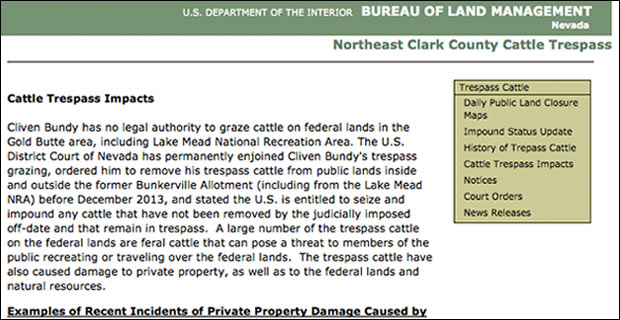
Deleted from BLM.gov but reposted for posterity by the Free Republic, the BLM document entitled “Cattle Trespass Impacts” directly states that Bundy’s cattle “impacts” solar development, more specifically the construction of “utility-scale solar power generation facilities” on “public lands.”
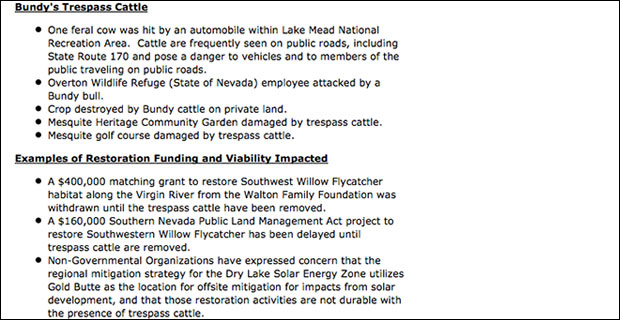
“Non-Governmental Organizations have expressed concern that the regional mitigation strategy for the Dry Lake Solar Energy Zone utilizes Gold Butte as the location for offsite mitigation for impacts from solar development, and that those restoration activities are not durable with the presence of trespass cattle,” the document states.
The first segment of the document pulled by the feds from BLM.gov.
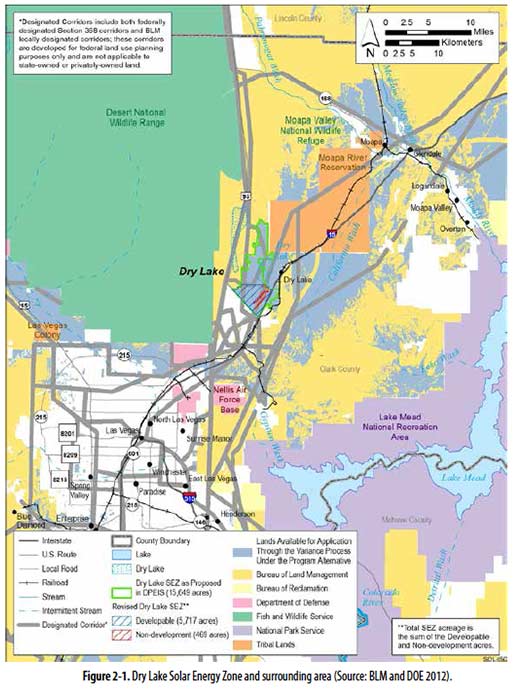
Another BLM report entitled “Regional Mitigation Strategy for the Dry Lake Solar Energy Zone” (BLM Technical Note 444) reveals that Bundy’s land in question is within the “Dry Lake Solar Energy Zone and surrounding area” which is part of a broad U.S. Department of Energy program for “Solar Energy Development in Six Southwestern States” on land “managed” by BLM.
The second segment of the document pulled by the feds from BLM.gov.
“In 2012, the BLM and the U.S. Department of Energy published the Final Programmatic Environmental Impact Statement (PEIS) for Solar Energy Development in Six Southwestern States,” the report reads. “The Final Solar Programmatic Environmental Impact Statement assessed the impact of utility-scale solar energy development on public lands in the six southwestern states of Arizona, California, Colorado, Nevada, New Mexico, and Utah.”
Dry Lake Solar Energy Zone and surrounding area (Click to enlarge.)
“The Approved Resource Management Plan Amendments/Record of Decision (ROD) for Solar Energy Development in Six Southwestern States implemented a comprehensive solar energy program for public lands in those states and incorporated land use allocations and programmatic and SEZ-specific design features into land use plans in the six-state study area.”
Back in 2012, the New American reported that Harry Reid’s son, Rory Reid, was the chief representative for a Chinese energy firm planning to build a $5-billion solar plant on public land in Laughlin, Nevada.
And journalist Marcus Stern with Reuters also reported that Sen. Reid was heavily involved in the deal as well.
“[Reid] and his oldest son, Rory, are both involved in an effort by a Chinese energy giant, ENN Energy Group, to build a $5 billion solar farm and panel manufacturing plant in the southern Nevada desert,” he wrote. “Reid has been one of the project’s most prominent advocates, helping recruit the company during a 2011 trip to China and applying his political muscle on behalf of the project in Nevada.”
“His son, a lawyer with a prominent Las Vegas firm that is representing ENN, helped it locate a 9,000-acre (3,600-hectare) desert site that it is buying well below appraised value from Clark County, where Rory Reid formerly chaired the county commission.”
Although these reports are in plain view, the mainstream media has so far ignored this link.
The BLM’s official reason for encircling the Bundy family with sniper teams and helicopters was to protect the endangered desert tortoise, which the agency has previously been killing in mass due to “budget constraints.”
“A tortoise isn’t the reason why BLM is harassing a 67 year-old rancher; they want his land,” journalist Dana Loesch wrote. “The tortoise wasn’t of concern when [U.S. Senator] Harry Reid worked with BLM to literally change the boundaries of the tortoise’s habitat to accommodate the development of his top donor, Harvey Whittemore.”
“Reid is accused of using the new BLM chief as a puppet to control Nevada land (already over 84% of which is owned by the federal government) and pay back special interests,” she added. “BLM has proven that they’ve a situational concern for the desert tortoise as they’ve had no problem waiving their rules concerning wind or solar power development. Clearly these developments have vastly affected a tortoise habitat more than a century-old, quasi-homesteading grazing area.”
“If only Cliven Bundy were a big Reid donor.”
Update: The Drudge Report, the #1 news aggregate site in the world, has now picked up this story. Unfortunately for the BLM, the documents they wanted to delete are now exposed for the world to see.
Update #2: ENN Energy Group describes itself as a “privately-owned clean energy distributor in China.” However, as the People’s Republic of China is a single-party state governed by the Communist Party, all large companies in China, one way or the other, are either controlled or are heavily influenced by the Chinese government.
David Knight confronts the Clark County Sheriff’s Office about this land grab – WARNING some strong language:

Infowars Reporter Goes Off On Propaganda Information Officer

US corn exports to China drop 85 percent after ban on GMO strains – industry report

the pushback from the BRICS ..HAS begun !!!  the "rest" of the World ..doesn't want/ tried of our shit ... folks u r c'ing the beginning of "our" elites get~in "their" ass's ..handed 2 em & y this NWO shit is just that  ....shit ! stop fucking fall~in fer it :o

truther  
China’s rejection of shipments of US corn containing traces of unapproved genetically modified maize has caused a significant drop in exports. According to a new report, US traders have lost $427 million in sales.
Overall, China has barred nearly 1.45 million tons of corn shipments since last year, the National Grain and Feed Association (NGFA), an American industry association, said Friday.
​US corn exports to China drop 85 percent after ban on GMO strains – industry report
The tally is based on data from export companies and is significantly higher than the previous numbers reported by the media, which said roughly 900,000 tons were affected. US corn exports to China since January are down 85 percent from the same period last year, the report says.
China has been blocking shipments of American corn from its market since November. This was caused by the presence of the MIR162 genetically modified corn strain in the shipments. It was developed by the company Syngenta and has not been approved by the Chinese government since an application was submitted in March 2010.
China has sharply increased corn imports since the late 2000s, with purchases increasing from 47,000 tons in 2008 to an estimated 5 million tons last year. It was the third-largest importer of American corn before the imports of Syngenta’s GMO strain were blocked.
US traders want seed companies to shoulder some of the losses. They also say seed companies should not introduce new varieties of seeds to farmers until they are approved by major markets, including China.
Part of the ire is also falling on the Chinese government, which, traders say, maintains an opaque process of approving and rejecting GMO strains, an accusation that Beijing rejects. China has so far approved 15 genetically modified corn strains for import.

THAT MYSTERIOUS LIGHT ON MARS: IT JUST GETS BETTER AND BETTER

By now, most of you have probably heard of that mysterious light on Mars that was photographed by NASA’s Curiosity rover, but in case you haven’t check out these articles shared with us by Mr. V.T., Ms. P.H., Mr. G.B. and many other regular readers here(and a big thank you to them!):
NASA offers 3 explanations for strange bright light seen in photo from Mars
NASA Curiosity rover captures mysterious bright light on Mars
And from our good friends at Phys.org, this gem:
‘Bright light’ on Mars is just an image artifact
My initial reaction, when I saw this photo, was “This is real, it’s not an artifact, And it’s anomalous.” I tried to explain it, or rather, explain it away, and to my surprise, subsequent articles, the first and  third which I linked above for example, rehearsed some of the very same explanations I ran through inside my own mind. There are three “explanations” according to the first article:
“According to NASA, a bright spot appears in single images taken by the stereo camera’s “right eye” camera, but the spot doesn’t show up in images taken less than a second later by the left-eye camera.
I”n the two right-eye images, the spot is in different locations of the image frame, and, in both cases, at the ground surface level in front of a crater rim on the horizon, Justin Maki, a NASA imaging scientist said April 8 by email through a spokesman.
“‘One possibility is that the light is the glint from a rock surface reflecting the sun,’ Maki said in the statement. ‘When these images were taken each day, the sun was in the same direction as the bright spot, west-northwest from the rover, and relatively low in the sky.’
“Another possibility is that the bright spots are sunlight reaching the camera’s image sensor through a vent hole in the camera housing, which has happened before with Curiosity and other Mars rovers, the agency said.”
Now compare this with our good friends at Phys.org’s statement here:
“Thanks to everyone who has emailed, Tweeted and texted me about the “artificial bright light” seen on Mars. And I’m so sorry to disappoint all the folks who were hoping for aliens, but what you see above is just an image artifact due to a cosmic ray hitting the right-side navigation camera on the Curiosity rover.
“If you do a little research, you can see that the light is not in the left-Navcam image that was taken at the exact same moment (see that image below). Imaging experts agree this is a cosmic ray hit, and the fact that it’s in one ‘eye’ but not the other means it’s an imaging artifact and not something in the terrain on Mars shooting out a beam of light.”
This is a bit disconcerting, to say the least, for it is almost as if our good friends at Phys.org are saying that our good friends at Never A Straight Answer cannot tell the difference between glinty rocks and cosmic rays. And you’ll have noticed a bit of obfuscation between the two articles: Never A Straight Answer is saying that the left hand image, which Phys.Org is citing as “confirmation” of its cosmic ray hypothesis, was taken at a different time than the right hand image with the light, which Phys.Org is saying was taken at the same time. So which is it guys? (and, having failed to get your story straight the first time, would anyone believe any additional statements or explanations at this juncture?)
Then there’s the “glinty rock” explanation, which I find dubious at best. For one thing, the light extends above the background line of the distant hill, which would mean a rock extending in the same fashion with its reflective surface. But no such rock appears in the second photo without the light, at least, not as far as my squinting eyes can tell. Other than this, I have no problem with the glinty rock hypothesis, except that usually glinty rocks are found lying around with other glinty rocks, and at that distance, one would expect other glinty rocks to be reflecting sunlight, since they’d be at more or less the same angle. Of course, glinty rocks can and do exist all by themselves, and I suspect we’ve all seen them before. But in that case, we’re still thrown back on the first problem, that this particular glinty rock appears to extend above the line of the hill in the distance, and no such rock appears in the second photo.
Now, on a planet where we have our space probes photographing this (and yes, folks, I checked the NASA site and as the article states, found this object on the NASA photo, after a bit of searching):
can we really afford to dismiss the hypothesis that this might be another anomaly? Suddenly there, and just as suddenly not?(q.v. Nasa’s explanation that the two pictures were taken at slightly different times).  For the moment, folks, I’m not satisfied with the explanations we’ve been given, and the subtle obfuscation evident in the explanations between two respected sources, so I’m holding all possibilities open, until the explanations do not conflict, and make some sort of sense.

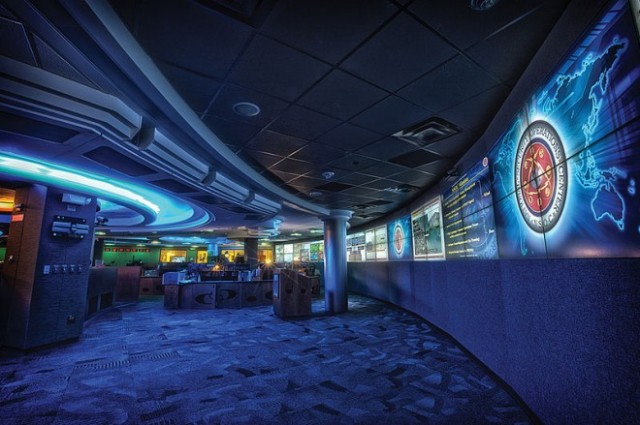
Inside the FBI’s secret relationship with the military’s special operations & New York Times Whitewashes FBI’s Handling of Boston Marathon Bomber


Inside the FBI’s secret relationship with the military’s special operationsInside the FBI’s secret relationship with the military’s special operations

When U.S. Special Operations forces raided several houses in the Iraqi city of Ramadi in March 2006, two Army Rangers were killed when gunfire erupted on the ground floor of one home. A third member of the team was knocked unconscious and shredded by ball bearings when a teenage insurgent detonated a suicide vest.
In a review of the nighttime strike for a relative of one of the dead Rangers, military officials sketched out the sequence of events using small dots to chart the soldiers’ movements. Who, the relative asked, was this man — the one represented by a blue dot and nearly killed by the suicide bomber?
After some hesi­ta­tion, the military briefers answered with three letters: FBI.
The FBI’s transformation from a crime-fighting agency to a counterterrorism organization in the wake of the Sept. 11, 2001, attacks has been well documented. Less widely known has been the bureau’s role in secret operations against al-Qaeda and its affiliates in Iraq and Afghanistan, among other locations around the world.
With the war in Afghanistan ending, FBI officials have become more willing to discuss a little-known alliance between the bureau and the Joint Special Operations Command (JSOC) that allowed agents to participate in hundreds of raids in Iraq and Afghanistan.
The relationship benefited both sides. JSOC used the FBI’s expertise in exploiting digital media and other materials to locate insurgents and detect plots, including any against the United States. The bureau’s agents, in turn, could preserve evidence and maintain a chain of custody should any suspect be transferred to the United States for trial.
The FBI’s presence on the far edge of military operations was not universally embraced, according to current and former officials familiar with the bureau’s role. As agents found themselves in firefights, some in the bureau expressed uneasiness about a domestic law enforcement agency stationing its personnel on battlefields.
The wounded agent in Iraq was Jay Tabb, a longtime member of the bureau’s Hostage and Rescue Team (HRT) who was embedded with the Rangers when they descended on Ramadi in Black Hawks and Chinooks. Tabb, who now leads the HRT, also had been wounded just months earlier in another high-risk operation.
James Davis, the FBI’s legal attache in Baghdad in 2007 and 2008, said people “questioned whether this was our mission. The concern was somebody was going to get killed.”
Davis said FBI agents were regularly involved in shootings — sometimes fighting side by side with the military to hold off insurgent assaults.
“It wasn’t weekly but it wouldn’t be uncommon to see one a month,” he said. “It’s amazing that never happened, that we never lost anybody.”
Others considered it a natural evolution for the FBI — and one consistent with its mission.
“There were definitely some voices that felt we shouldn’t be doing this — period,” said former FBI deputy director Sean Joyce, one of a host of current and former officials who are reflecting on the shift as U.S. forces wind down their combat mission in Afghanistan. “That wasn’t the director’s or my feeling on it. We thought prevention begins outside of the U.S.”
Read More @ Source

      New York Times Whitewashes FBI’s Handling of Boston Marathon Bomber


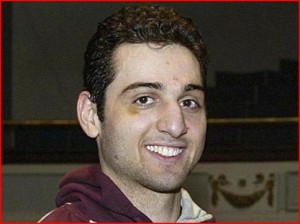
tamerlan
On the eve of the first anniversary of the Boston Marathon bombings, the New York Times Thursday published an article dedicated to whitewashing the failure of the FBI and other US intelligence agencies to detect and stop the perpetrators. This was despite warnings issued by the Russian government that Tamerlan Tsarnaev, now described as the ringleader of the attack, posed a serious threat of terrorism.
The article is based upon interviews with unnamed “senior American officials” on a report written by the inspector general of the Intelligence Community, the federation consisting of 17 separate US spy agencies.
Still secret, heavily redacted sections of this document are supposed to be made public before next Tuesday, the anniversary of the bombings, which occurred at the finish line of the Boston Marathon last April 15, claiming the lives of three people and wounding 264 others.
Tamerlan Tsarnaev was shot killed in a shootout with police days after the bombing. His younger brother, Dzhokhar, was severely wounded and captured by police. He now faces a trial in which US prosecutors are seeking the death penalty
The thrust of the article—and, according to the Times, of the report itself—is summed up in its headline: “Russia failed to share data on suspect, report says.”
“The Russian government declined to provide the FBI with information about one of the Boston Marathon bombing suspects that would have likely have led to more extensive scrutiny of him at least two years before the attack,” the inspector general’s report claims, according to the Times account.
It quotes one of the unnamed “senior American officials” as stating: “They found that the Russians did not provide all the information they had on him back then, and based on everything that was available the FBI did all that it could.”
This tendentious assertion manages to turn reality inside out, blaming the Russian government for the failure of US authorities to intercept Tsarnaev before he carried out a bombing on American soil.
The reality is that Moscow’s intelligence agency, the FSB, cabled the FBI in March 2011 with an explicit warning that Tamerlan Tsarnaev, an ethnic Chechen, was associating with Islamist militants and posed a threat of terrorism.
The Times itself quotes the inspector general’s report as stating that the Russians warned the FBI that Tsarnaev “was a follower of radical Islam and a strong believer” and that he “had changed drastically since 2010 as he prepared to leave the United States for travel to the country’s region to join unspecified underground groups.”
While the FBI opened an investigation of Tsarnaev the same month as the first Russian warning, it formally closed it by June 2011, affirming that there no evidence of terrorist links. The Tsarnaev family, however, has reported that the FBI continued contacting Tamerlan, attempting to recruit him as an informer.
In September 2011, the Russians issued a second warning, asking that he be detained and questioned upon attempting either to leave or re-enter the United States.
A month later, Tsarnaev’s name was reentered in the Treasury Enforcement Communications System (TECS) together with instructions that he be detained and “isolated” and that the National Counter-Terrorism Center be notified immediately upon his attempt to leave the US. Nonetheless, in 2012, he was able to take a six-month trip to Dagestan, where he attempted to make connections with jihadist elements, and return to the US with no attempt by authorities to detain or even question him.
The intelligence that the Times reports as having been withheld by the Russians from the FBI consists of the details about an intercepted telephone call between Tsarnaev and his mother in which he discussed his Islamist beliefs. Such detailed information is routinely kept secret by US intelligence agencies on the grounds that it would expose their “sources and methods.”
The spin placed by the Times and the inspector general’s report on the intelligence provided by the Russian FSB is contradicted by another report published in the Boston Globe Thursday quoting US Representative William R. Keating, a Massachusetts Democrat, who had access to the initial letter sent from Russia during a recent congressional trip to Moscow.
The congressman noted that the letter included a warning that Tsarnaev would attempt to change his name. Six months after the letter was sent, Tsarnaev did exactly that, filing a federal citizenship application, formally seeking to change his name to “Muaz,” that of an early Islamic martyr.
According to a government official cited by the Globe, in September 2012, three weeks after Tsarnaev filed the application, “the FBI ran a name check and indicated that Muaz was an alias for Tsarnaev.”
“It’s amazing how much information they did know, the Russians,” Keating said. “Look at everything that’s there. The change of the name, that’s corroborated. That he wanted to travel back to Russia, that’s been corroborated. That he wanted to enlist with extremists, that’s corroborated. I mean, everything that was in that [warning] has been corroborated.”
The attempted name change came eight months before the Boston bombings and followed Tsarnaev’s trip to Dagestan.
“The disclosure of the Russians’ specific warning about the name change raises additional questions about whether federal agencies missed another signal that the elder Tsarnaev brother was veering toward radical Islam after a six-month trip in 2012 to the restive Russian province of Dagestan,” theGlobe reported.
The account given by the inspector general’s report and the Times article differs from the more critical assessment made in a report prepared by the House Homeland Security Committee, which concluded that lessons from September 11, 2001 had not been learned by US intelligence agencies, which once again failed to “connect the dots” and share information. The panel’s chairman, Representative Michael McCaul, a Texas Republican, said at a hearing Wednesday that a number of “flags and warnings” had been missed by US intelligence agencies and “systemic problems” had led to Tsarnaev falling off their “radar.”
The Times article—however inadvertently—suggests another explanation for the FBI’s lack of response. At the time of the Russian warnings, the newspaper reports, “American law enforcement officials believed that Mr. Tsarnaev posed a far greater threat to Russia” than to the US itself.
In other words, it was not any disagreement with the FSB over whether Tsarnaev was a potential terrorist that led US authorities to adopt a hands-off approach as he freely traveled to and from Dagestan. Rather, it was Washington’s belief that his bombs would go off in Volgograd or Moscow and not in the streets of Boston.
There is strong evidence that US intelligence officials were basing themselves on more than a hunch. The Russians’ warning about the connection of the Tsarnaev family to radical elements in Chechnya would not have come as a surprise to US agencies. Ruslan Tsarni, the uncle of both Tamerlan and Dzhokhar, was the head of an organization known as the Congress of Chechen International Organizations, which he founded in 1995 to ship supplies to anti-Russian insurgents in Chechnya.
The organization was registered at the Maryland home address of Graham Fuller, the one-time vice chairman of the National Intelligence Council and the former CIA chief in Kabul, Afghanistan. Fuller had left the CIA and gone to work at the Rand Corporation, a major CIA contractor, at the time that Tsarni set up his organization. Previously, Tsarni, who married Fuller’s daughter, worked as a USAID contractor in Kyrgyzstan. The USAID is frequently used as a front for CIA operations.
The timing of the Times article and the inspector general’s report upon which it is based suggests a preemptive attempt to frame any public discussion on the first anniversary of the Boston bombings. The official narrative—that the FBI did all it could but was hindered by an uncooperative Russia—is designed to suppress any questioning of the links between the bombings, US intelligence and Washington’s covert operations aimed at destabilizing the Russian North Caucasus.

NSA denies report that it knew about Heartbleed from the start [Updated]


once again! ..this IS fer ALL u people that just keep on wit yer blathering nattery fucking blither ...that there R good people working fer U.S. bullshit ! ...that  y  sooo much shit being "produced" by  Our gov.  ..than ?  yup just a "few"  bad eggs ....just fucking producing ALL this shit !     yep if it  talks like a nazi & walks like a nazi & dress's like a nazi ..um pretty fucking sher it's a ...NAZI  :o lol  NOW don't fergeet 2 fill out yer fb ( dossier) page  :)

Bloomberg cites unnamed sources, says agency regularly used it to spy.

Citing two anonymous sources “familiar with the matter,” Bloomberg News reports that the National Security Agency has known about Heartbleed, the security flaw in the OpenSSL encryption software used by a majority of websites and a multitude of other pieces of Internet infrastructure, for nearly the entire lifetime of the bug—“at least two years.” The sources told Bloomberg that the NSA regularly used the flaw to collect intelligence information, including obtaining usernames and passwords from targeted sites.
“When Edward Snowden warned that the NSA is ‘setting fire to the future of the internet,’ this is presumably the kind of thing he was talking about," said Jameel Jaffer, deputy legal director at the American Civil Liberties Union, in a statement emailed to Ars. "If this report is true, then the NSA is making hundreds of millions of people around the world more vulnerable to hacking and identity theft, and it’s compromising the trust that allows the internet to function. The NSA has lost sight of its mission, and it has lost sight of the values of the society it’s supposed to be protecting.”
The NSA has issued a statement denying the report. In an email to Ars, NSA spokesperson Vanee VInes provided this official statement: “NSA was not aware of the recently identified vulnerability in OpenSSL, the so-called Heartbleed vulnerability, until it was made public in a private-sector cybersecurity report. Reports that say otherwise are wrong.”
As Ars reported on April 9, there have been suspicions that the Heartbleed bug had been exploited prior to the disclosure of the vulnerability on April 5. A packet capture provided to Ars by Terrence Koeman, a developer based in the Netherlands, shows malformed Transport Security Layer (TSL) Heartbeat requests that bear the hallmarks of a Heartbleed exploit. Koeman said the capture dates to November of last year.
But if the NSA has been exploiting Heartbleed for “at least two years,” the agency would have needed to discover it not long after the code for the TLS Heartbeat Extension was added to OpenSSL 1.0.1, which was released on March 14, 2012. The first “beta” source code wasn’t available until January 3, 2012.
That means that the agency would have had to learn of the flaw in the code within days of its full release at the latest. While not impossible, that possibility seems highly unlikely unless the NSA dedicated resources to follow the project while in development, watched changes in code, and did ongoing extensive analysis. According to budget documents published by the Washington Post in August 2013, the NSA spent $25 million in 2013 on zero-day exploits from “private vendors.”
When asked in the about the use of exploits by the agency in advance of his confirmation hearing , NSA’s new director, Vice Admiral Michael Rogers, said in his testimony that “the default is to disclose vulnerabilities in products and systems used by the US and its allies.” If the NSA opted in the case of Heartbleed to save the vulnerability for intelligence purposes, it would run contrary to that avowed tendency.
The Office of the Director of National Intelligence's Public Affairs Office issued the following, categorical denial of the Bloomberg story:
NSA was not aware of the recently identified vulnerability in OpenSSL, the so-called Heartbleed vulnerability, until it was made public in a private sector cybersecurity report. Reports that say otherwise are wrong.
Reports that NSA or any other part of the government were aware of the so-called Heartbleed vulnerability before April 2014 are wrong. The Federal government was not aware of the recently identified vulnerability in OpenSSL until it was made public in a private sector cybersecurity report. The Federal government relies on OpenSSL to protect the privacy of users of government websites and other online services. This Administration takes seriously its responsibility to help maintain an open, interoperable, secure and reliable Internet. If the Federal government, including the intelligence community, had discovered this vulnerability prior to last week, it would have been disclosed to the community responsible for OpenSSL.
The ODNI added that if the NSA had known of such a bug, it would have been in the interest of the Federal government to fix it: "It is in the national interest to responsibly disclose the vulnerability rather than to hold it for an investigative or intelligence purpose."