[CLICK HERE to continue watching this video on BoilingFrogsPost.com]
by James Corbett
BoilingFrogsPost.com
July 4, 2012
The NSA’s illegal
warrantless wiretapping program. The building of the
massive NSA data center in Utah to permanently store copies of all digital communication sent around the world. The UK government’s “
Communications Data Bill”
to monitor emails, instant messages and other personal information.
What was dismissed as crazy conspiracy theory just over a decade ago has
become, in this post-9/11 era, the all-too-familiar stuff of newspaper
headlines and talking head reportage.
In fact, it was about a decade ago that the tactic of the
intelligence agencies seemed to change. Instead of keeping their
activities classified–referring to the NSA as “No Such Agency,” for
example, or officially denying the existence of Echelon–the government
increasingly began
shoving this information in the public’s face.
Perhaps the scariest thing about something like the
Total Information Awareness Office is not merely that it was proposed in the first place, or that it incorporated such
blatantly creepy Orwellian imagery
to convey its true nature and purpose, but that, as we sit here 10
years later, and as the core functions of the TIA office are now being
openly performed by the NSA, DHS and other governmental agencies, people
are now actively making excuses for this nightmarish police state.
“If you have nothing to hide then you have nothing to fear” has
always been the rallying cry for those who are too afraid of questioning
presumed governmental authority to speak out against the surveillance
state and the implied assumption of guilt that goes along with it. With
feigned bemusement these moral midgets inevitably ask “What’s so bad
about the government spying on you, anyway?”
The answer, of course, is that the very question implies that the
agencies tasked with carrying out this constant Big Brother surveillance
are themselves above reproach, shining lights of moral rectitude who
would never abuse this incredible power for nefarious ends. For the
unimaginative out there, Hollywood yarns like “Enemy of the State” have
provided fictional examples of what can go wrong if someone, somewhere,
abuses this power of information and surveillance to target an innocent
person in the wrong place at the wrong time.
To be sure, the power that these technologies give for agencies, or
corrupt groups within those agencies, to destroy the lives of targeted
individuals, is itself a fitting answer to the question of why
government surveillance should be troubling to us. But beyond what can
happen to specific, targeted individuals in such a scenario, however, is
a much larger question: What if this data, our
emails, our
phone calls, our
credit card transactions, our
social media posts, our
cell phone GPS logs,
and all of the hundreds of other pieces of data that are admittedly
being collected on us every day, were being fed into a database so
gargantuan it contains a digital version of every single person on the
planet? And what if that database were being used by the Department of
Defense to war game various scenarios, from public reactions to natural
disasters to the likelihood of civil unrest in the wake of a declaration
of martial law?
Remarkably, this is precisely what is happening.
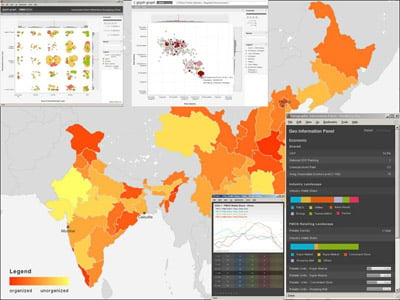
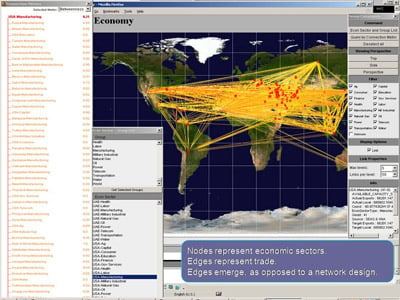
It is called the “Sentient World Simulation.” The program’s aim,
according to its creator,
is to be a “continuously running, continually updated mirror model of
the real world that can be used to predict and evaluate future events
and courses of action.” In practical terms that equates to a computer
simulation of the planet complete with billions of “nodes” representing
every person on the earth.
The project is based out of Purdue University in Indiana at the
Synthetic Environment for Analysis and Simulations Laboaratory. It is led by
Alok Chaturvedi, who in addition to heading up the Purdue lab also makes the project commercially available via his private company,
Simulex, Inc. which boasts an array of government
clients,
including the Department of Defense and the Department of Justice, as
well as private sector clients like Eli Lilly and Lockheed Martin.
Chatruvedi’s ambition is to create reliable forecasts of future world
events based on imagined scenarios. In order to do this, the
simulations “gobble up breaking news, census data, economic indicators,
and climactic events in the real world, along with proprietary
information such as military intelligence.” Although not explicitly
stated, the very type of data on digital communications and transactions
now being gobbled up by the NSA, DHS and other government agencies make
ideal data for creating reliable models of every individuals’ habits,
preferences and behaviors that could be used to fine-tune these
simulations and give more reliable results. Using this data, the SEAS
Laboratory and its Sentient World Simulation offshoot are able to create
detailed, operable real-time simulations of at least 62 nations. “The
Iraq and Afghanistan computer models,” according to a
2007 Register report
on the project, “each has about five million individual nodes
representing things such as hospitals, mosques, pipelines, and people.”
At the time of initial reports on the program five years ago, there
were only 62 country-level simulations being run by the US Department of
Defense. These simulations grouped humans into composites, with 100
individuals acting as a single node. But already at that time, the US
Army had used the systems to create a one-to-one level simulation of
potential Army recruits. The ultimate aim would be to archive enough
data on each individual to be able to make a computer model of everyone
on the planet, one that could be used to predict the behaviors and
reactions of every single person in the event of various scenarios.
The program
can be used
to predict what would happen in the event of a large scale tsunami, for
example, or how people would react during a bioterror attack.
Businesses can use the models to predict how a new product would fare in
the market, what kind of marketing plans would be most effective, or
how best to streamline a company’s organization.
The
original concept paper
for the project was published in 2006 and in 2007 it was reported that
both Homeland Security and the Defense Department were already using the
system to simulate the American public’s reaction to various crises. In
the intervening five years, however, there has been almost no coverage
at all of the Sentient World Simulation or its progress in achieving a
model of the earth.
There is a very good chance that these types of systems are, at least
for the moment, pure quackery. Computers are only as valuable as their
programming, after all, and the algorithms required to accurately
predict responses in chaotic systems with multiple, dimly-understood
variables is orders of magnitude beyond what is currently possible. Or
is it? One of the great ironies of our time, as Glenn Greenwald goes on
to point out in
his speech
on the surveillance state, is that although we live in a time when it
is possible for nebulous government agencies to know every detail of
your life, from what you ate for breakfast to where you shopped last
night to who your friends are, we are also living in an age of
unprecedented ignorance about what are our own governments are actually
doing.
This is the heart of the matter. Somehow we are expected to go along
with the sophomoric sophism that “If we have nothing to hide then we
have nothing to fear,” yet at the same time we are asked to believe that
the government must keep all manner of information secret from the
public in order to carry out its work of “protecting” that public.
If the government has nothing to hide, then why doesn’t it
release the notes, memoranda and findings of the 9/11 Commission in full and unredacted?
Why doesn’t it release the records of the JFK assassination investigation instead of arguing,
as it is,
that those records should once again be removed from a declassification
review that is to take place in 2013, 50 years after the assassination
itself took place?
Why doesn’t it release the full audit trail of what banks received the emergency TARP funds and in what amounts?
Is it because, after all, the government does have something to hide
from the public that are its ostensible masters? Is it because the old
maxim that “Knowledge is power” is more true than we could ever know,
and that the government’s one-way insistence on transparency for the
citizens and opacity for itself is a reflection of the power that it
holds over us?
The Sentient World Simulation is just one example of one program run
by one company for various governmental and Fortune 500 clients. But it
is a significant peek behind the curtain at what those who are really
running our society want: complete control over every facet of our lives
achieved through a complete invasion of everything that was once
referred to as “privacy.” To think that this is the only such program
that exists, or even that we have any significant details about the ways
that the SWS has already been used, would be hopelessly naive.
So where does this leave a public that is at such a disadvantage in
this information warfare? A public that is effectively told that
anything and everything they do, say or buy, can and will be catalogued
by the a.i. control grid even as the details of that grid are to be kept
from them? Unfortunately there is no easy way back from the precipice
that we were ushered toward with the creation of the national security
state and the passage of the
National Security Act of 1947.
Perhaps we have already stepped over that precipice and there is no
going back in the current political paradigm. These are things for an
informed, aware, knowledgeable citizenry to decide through a societal
dialogue over the nature of and importance of “privacy.”
But without a general awareness that programs like the Sentient World
Simulation even exist, what hope do we have in counteracting it?

 Posts
Posts