Wednesday, January 23, 2013

Sex and Scandal: Finding a Husband in France Under the Guise of Studying Abroad


An exchange student goes abroad to study. That’s why they call it “study abroad,” right? But there may be numerous other motivations besides study that send someone to live in foreign lands, and, for some, the title of ‘exchange student’ becomes the front for what they are really in search of. 
In Paris, a city where people from around the world gather to eat, drink and study, Excite News investigated a different kind of exchange student with a different set of circumstances…
In France, online dating services are filled with the personals of Eastern European women who have come in search of French husbands.  A residence permit for France is what they want, and a French husband can get them one.  The easiest way to reside legally while on the hunt for someone to marry is to enroll in one of the many language schools in France as an exchange student.
However, it has become difficult for even non-husband-hunting foreign students these days to gain a residence permit.
Excite News spoke with an instructor at one of the language schools traditionally attended by children of European and American politicians. According to the instructor, in France, you have to be enrolled in more than 20 hours of classes per week before you can get a proper student visa to stay longer than 90 days.  Due to the struggling economy, applications for work-study are not granted, leaving people with few alternatives. Furthermore, foreign student class attendance is reported to immigration to ensure that those in the country on student visas are actually hitting the books staying true to their word.
In this competetive environment, some schools were established solely to cater for those seeking residence permits, recruiting students wishing to stay in Paris. But getting residence permits even through these schools is difficult, so people apply to the bona-fide schools even if it means having to take classes just to stay in the country.
Another reason that some foreigners want to marry is for a work visa.
Foreign student are only permitted to work a maximum of 964 hours a year. However, if they marry a French national then that restriction no longer applies. France also has something called PACS, a civil solidarity pact which is a form of civil union between adults for organizing their joint life.  It brings rights and responsibilities but the contract is considered less binding than marriage.  If a foreigner can form a PACS with a French person then they are free to work in France and can obtain a residence permit.  But in order for a foreigner to form a PACS with a French person they must first live with their partner for at least a year.  Which mean they need a residence permit…
As shocking as it sounds, prostitution is often considered by some foreign women as a means of earn the money required to apply to a language school, find a French partner and get the ball rolling on a residency permit. Prostitution is not illegal in France unless it is solicited in a public place like a street corner. In the past, the vast proportion of foreign prostitutes in Paris were Brazillian, but in more recent times the number of Russians and women from former eastern bloc countries engaging in prostitution has increased.  The instructor that Excite News talked to recalls a student from the Dominican Republic who, as well as studying full-time and working as a prostitute, had a five-year-old son to take care of.
There appear to be many stories hiding behind the guise of the language school enrollment. Of course, for the most part, people enroll to simply to study a language, but for some, education in European countries is merely a front for those seeking permenant residency, and even then there may be a number of pitfalls to overcome…
Source: Excite Bit News

What’s the most popular website in the World?


After reading the title you all probably immediately know the answer.  Heck, most of you probably came to this article via king of the dot-com hill, Google.
Given Google is a pretty much no-brainer for most of the western countries; you may be surprised at how much competition they’re putting up with in other parts of the world.  Thanks to a development team known as Webempires, we can take a causal gander at this global market full of surprising results with their number one website by country map.

Looking at their map we can clearly see Google’s grip on the Americas, Europe, the Middle East and Australia.  However, there’s a lot more to the world than that.
It seems large parts of Northern Africa have been into Facebook.  That’s seems about right since in the past year and a half these countries have been more involved in communicating and organizing protests than looking up lolcats.  Mongolia and the South Pacific Islands also seem to be into Facebook more than any search engine. I reckon they’re big Farmville fans.
Two countries with a tendency to do things their own way, Russia and China, don’t disappoint in this area either.  In China, search engine Baidu was more than happy to fill the void left by Google after their falling out with the country.  Baidu is currently the 5th most used website according to Alexa, which is a testament to the massive population of that country.
Russia meanwhile has found a friend in Yandex.  Although an uncommon name outside of Russian and other Eastern European countries, Yandex is much appreciated for its superior understanding of the Russian language when used in search queries.
This leaves that strange dark spot over Japan.  Too small to read, that blotch actually represents Yahoo.  Yes, according to Alexa, the Japanese language Yahoo alone reaches the number 16 spot worldwide. That’s a very impressive ranking for such a limited language worldwide.
So why does Japan love Yahoo so much? Based on one die hard user I talked to, “their top page hardly ever changes format.”  True words since looking at the Yahoo.co.jp top page, it looks nearly identical to the Yahoo from ten years ago compared to their dot-com counterpart which has made some modest changes over the years.
So it seems much of Japan appreciates consistency in their websites, which is interesting since that’s one of Google’s key points too.  Yahoo just seemed to beat them to the punch here and is enjoying the rewards – for now…
Source: Ironically Excite News (Japanese)
Photo: Webempires (English)               http://en.rocketnews24.com/2012/06/25/whats-the-most-popular-website-in-the-world/

Giant Hadouken Fired Over Kanto Region, Internet Sky Gazers Track It


Beginning at around 2:45am on 20 January, Tweets were appearing with reports of an “explosion” and a glowing object falling from the sky.  On the same day a video showing the meteor in high detail began to spread across the Japanese internet.
From the video we can easily see that this was no average meteor – this was a fireball.

Among the early reports were a few still images of the fireball.  As rough as these were, they allowed trackers to get a good sense of where and how it fell.


流星/隕石?の閃光(本体は映っていません)     http://www.youtube.com/watch?feature=player_embedded&v=wzW2vJofmCU           

2013年1月20日 爆発音とともに関東の空を照らした流れ星  http://www.youtube.com/watch?feature=player_embedded&v=eCrOb4luF0I        

Also this security footage provided a good sense of what witnesses experienced that night in Kanto.

Then as luck would have it, a car equipped with an event data recorder (camera) happened to be driving in the right place at the right time to get a crystal clear view of the fireball from start to its explosive finished.
Keep your eyes peeled at the 31 second mark.

From identifying the cars location while viewing the fireball in combination with all other data, fireball enthusiasts at the sky related phenomenon website SonotaCo Network Japan were able to paint a clear picture of the event.
A “fireball” is defined by the American Meteor Society as a meteor which glows brighter than -4 magnitude in the sky.  This level of brightness is roughly equal to Venus’ when seen from Earth.  The Sun’s magnitude is about -26.
According to SonotaCo this fireball had a magnitude of -10.  This would likely classify it as a “bolide” which is loosely defined as having such a magnitude along with an explosion.
This fireball became visible “about 100km east of Chichibu City and touched down around the coastline in Mito City. It was falling at a 30°angle and at a speed of about 20km/s (44,700 mph).
Unfortunately, because it appears to have exploded over the water it might be hard finding any meteorites.  However, if you happen to be hanging around the beach in Mito, you may want to be on the lookout for any unusual looking rocks.
Source: SonotaCo Network Japan via Hatena Bookmark News (Japanese)
Video: Youtube – paQful, SOEK01M
This data and many more sciencey charts can be seen at SonotaCo.
The location of the event.

Sweden’s Euro Hostility Hits A Record

As the Eurozone flails about to keep its chin above the debt crisis that is drowning periphery countries, and as the European Union struggles to duct-tape itself together with more “integration,” that is governance by unelected transnational eurocrats, Sweden is having second thoughts: never before has there been such hostility toward the euro.
Sweden is a special case. It joined the EU in 1995 after its people had graciously been allowed to express their will in a referendum in 1994—with 52.3% voting in favor. As every country that joins the EU, Sweden signed an accession treaty that obligates it to adopt the euro, but without deadline. So in 2003, the government thought time had come to make the move. It asked the people in a non-binding referendum if they wanted to accede to the Eurozone. September 14 was the day.
The people rebelled. They demolished the euro, with 55.9% voting against it and 42% for it. They didn’t want to trade in their beloved krona for the newfangled currency. They didn’t want to give up sovereignty over their monetary policy. It shook up eurocrats, member governments, finance ministers, and heads of state around the continent. And the European power structure learned a lesson: don’t let the riffraff decide; it was the last time that people in the EU had been allowed to vote on the euro.
But in Sweden, the euro is on the table twice a year via a survey by the Swedish statistical agency that asks people how they’d vote if a referendum were held “today” on joining the euro. The results of the survey conducted in November just came out. Sobering results: 82.3% would vote against joining the euro, only 9.6% would vote for it, and 8% were betwixt and between. The euro’s descent into utter unpopularity hell set a new record.
(In an amusing aside of unknown unimportance, more women than men had trouble making up their minds with 10.2% of the women straddling the fence versus 5.8% of the men.)
There was a dramatic change of mind among those who in the May survey had voted to join the euro: 52% of them switched to no, 11% switched to undecided. Disillusionment is spreading even among the euro’s erstwhile supporters. Only 37% stuck to their original yes-vote. Of the naysayers in May, however, 95% stuck to their no-votes.
Historically, the no-vote has dominated the yes-vote in Sweden. Since the survey series started in 1997, there were only three periods when the yes-crowd—if that’s the right word—outnumbered the naysayers: a blip in 1999; from May 2001 through November 2002; and then another blip in 2009 during the financial crisis when the economy went into a horrific swoon. Perhaps they thought there was strength in numbers.
But in 2010, the economy rebounded vigorously. The budget deficit diminished and by 2012 nearly disappeared. Conversations about cutting taxes were heard in polite company. Meanwhile, in the Eurozone, the debt crisis, and its evil twin, austerity, were spreading far and wide. They mangled periphery countries, squashed GDP growth in other Eurozone countries, and started to gnaw even on Germany that had considered itself above the fray. Swedish opposition to the euro skyrocketed.

Alas, Statistics Sweden also asked the people how they’d vote if a referendum were held “today” on remaining in the EU—the very issue voters had already decided by referendum in 1994.
The popularity of EU membership, after an initial rough patch, had been climbing for years and peaked, or rather plateaued, from late 2008 through 2011 with around 55% of the people voting for it. But the debt crisis with its non-solutions, its sacrifices by the lower levels of society, its convoluted undemocratic taxpayer-funded bailouts of bondholders and banks finally had an impact. The yes-votes fizzled. In the November survey, only 45% voted for membership and 26% voted against it. And it set a record: 29% couldn’t decide.
EU membership is becoming unpopular in Sweden. And the euro is despised. Not a good omen. And not only in Sweden. The ills of the euro have infected the larger community of countries and their cohesion. People have expressed their anger in massive protests. Now, the very efforts to keep the Eurozone together are tearing up the fabric of the EU: the first one out may be the UK. Read.... Sacrificing the Will of the People on the Altar of the Euro.

Censored: Poverty Report in Germany

On September 17, the German Labor Ministry sent a draft report “on Poverty and Wealth” to the other ministries to be rubber-stamped. Only the final report, once sanctified by Chancellor Angela Merkel, would be made public. The draft was supposed to remain hidden. But it seeped to the surface almost immediately. And it was hot. Too hot.
The massive data (PDF, 535 pages) described the tough reality that many people faced in Germany—a reality that got tougher every year. For example, in 1998, the lower 50% of the population owned 4% of all private wealth, while the upper 10% owned 45%. By 2008, the lower 50% owned only 1%, but the upper 10% had increased its share to 53% (at the expense also of the in-between 40%). Other reports have painted similar pictures.
The poverty report by Germany’s statistical agency showed that the “poverty rate” in Germany has been creeping up: in 2008, it was 15.5%; in 2009 it was 15.6%, and in 2010 it was 15.8%. Particularly hard-hit were people under 65 who lived alone. Their poverty rate was 36.1%. For single-parent households, it was 37.1%. The city of Munich issued its own poverty report. By taking into account Munich’s high cost of living, it found that nearly a fifth of its residents lived in poverty.
Poverty data has been stirring public debate for a while, and across most of Europe. Even the largest consumer products companies are adjusting to it by using commercial strategies that were successful in developing countries [read....  The “Pauperization of Europe”]. But now the Labor Ministry’s “Poverty and Wealth” report, as revised by the Economy Ministry, was leaked to the Süddeutsche Zeitung, which then put a grunt to work to compare the two versions. Turns out, the original version had been censured!
It started in the introduction. In the new version, the sentence, “Private wealth in Germany is very unevenly distributed,” has been deleted.
The original version pointed out: “While wages have risen in the upper areas over the past ten years, lower wages adjusted for inflation have dropped. The income spread has increased,” which would hurt “the sense of justice of the people” and could “jeopardize social cohesion.” Incendiary words, emanating from a Labor Ministry run by a conservative government. Too incendiary.
It was replaced by the new jargon, heard so often in the battle over Greece: falling real wages were an “expression of structural improvements” in the labor market and created low-wage jobs for many unemployed people.
The report also noted that the hourly wage of many people who live alone and work fulltime wasn’t enough to secure a livelihood. This “increased the risks of poverty and weakened social cohesion.” That comment was deleted. Now it only said that the low-wage issue “should be looked at critically.”
Even certain data has been deleted, including this sentence: “However, in 2010, over four million people worked in Germany for an hourly wage of less than €7.”
The opposition was outraged. “The whitewash of the report is shabby,” said Katja Kipping, head of the Left Party, accusing the government of a cover-up.
“Those who hide and ignore reality cannot make fair policies,” said Andrea Nahles, SPD Secretary General. “The reality” for which the coalition was “responsible” was “too gloomy even for the Merkel government. She wants to deny it instead of tackling the problems.” And she lambasted the coalition’s policies that served “only a very specific affluent clientele.”
“The federal Government wants to water down, conceal, and beautify crucial elements of the report,” griped Annelie Buntenbach, board member of the Confederation of German Trade Unions (DGB), an umbrella organization representing over 6 million workers.
The report has heated up the public fight between Labor Minister Ursula von der Leyen (CDU), who doesn’t mind shining a light on conditions in Germany, and Economy Minister Philipp Rösler (FDP), who is facing a very iffy reelection fight. The CDU and FDP are uneasy coalition partners. But if the FDP, which is teetering, doesn’t make it into parliament in next year’s election, Rösler would be axed from any role in the government.
He and laissez-faire stalwarts at his ministry were bothered by comments on the increasing social chasms in Germany, and their impact on social cohesion. He’d already criticized the original report after it was leaked, claiming that certain elements weren’t “the opinion of the Federal government.”
Then the backpedaling started. A spokesperson of the Labor Ministry declared that, yes, there’d been requests to change some things, but “all reports of the Federal Government” had to be coordinated with all ministers and the chancellor. It allowed the government to speak with one voice. So this was “a totally normal process.”
Alas, the statement that censuring such reports was “a totally normal process” caused another burst of outrage. As always, to no effect.
That this debacle would occur just as more money was being tossed at Greece, where poverty has been surging and where wages have been plunging, was priceless. By keeping Greece in the Eurozone, eurocrats or better “euro morons” have successfully avoided a weak drachma and a subsequent Greek hyperinflation. Instead they have successfully created stagflation. Read...  Euro Morons: Hyperinflation Successfully Avoided, Stagflation Successfully Created.

A Year After Declaring War On The Banks

A Year After Declaring War On The Banks

On January 22, 2012, French presidential candidate François Hollande shook up the banks: “It has no name, no face, no party, it will never be candidate, it will therefore never be elected, yet it governs: that enemy is the world of finance,” he said. It “freed itself from all rules” and “took control of the economy, of society, and even our lives.” He’d fight it, he said, and promised some tough reforms.
But as the private sector in France sank deeper into an economic and fiscal quagmire, his words, designed to endear him to the left wing of his Socialist Party, were swept under the rug. And you’d think that since becoming President of France, he has been tutored by JPMorgan Chase CEO Jamie Dimon.
A year later, Dimon had some choice words himself, while at the World Economic Forum in Davos, Switzerland, where bankers, business leaders, politicians, and whoever was able to get in were hobnobbing for the better of the world.
Dimon lashed out at regulators and their feeble, slow, and confused efforts to rein in the banking industry so that it wouldn’t shove the world into another crisis. They were “trying to do too much, too fast,” he said. He defended inscrutable megabanks with their meaningless financial statements. “Businesses can be opaque,” he said. “They’re complex.” A word that in a financial crisis excuses everything, even massive bailouts that will haunt generations to come. “You don’t know how aircraft engines work, either,” he mollified us, based on the logic that we still get on a plane and fly across the Pacific.
And so the CEO of America’s largest TBTF bank, recipient of the Fed’s bailout trillions, praised the Fed because “they saved the system.” Indeed, they not only saved the system that had shoved the world into the financial crisis, but they also bailed out and enriched those who were, and still are, integral part of it—who now, according to Dallas Fed President Richard Fisher, “believe themselves to be exempt from the processes of bankruptcy and creative destruction” [for more on Fisher’s feisty fight against TBTF, read.... How Big Is ”BIG?”].
This is the world Hollande declared war on, back in the day. But now, France is sinking into a new crisis, and this time it’s the already diminutive private sector that is gasping for air and shedding jobs—and moving overseas, along with the rich and not-so-rich for whom the fiscal and rhetorical climate has become too hostile.
Not a day passes without another confirmation or a new indication. Today, the statistical agency Insee released its monthly Business Climate Index, which, after a soupçon of an uptick, has deteriorated again in the categories of Industry, Wholesale, Construction, and Retail. Only Service saw an improvement. The index, at 86.75, is down from 87.02 in December, and below where it was in October 2009, during the financial crisis.
Given this scenario, what happened to Hollande’s “enemy” and the reforms to rein it in? It’s not that he didn’t try—though there simply isn’t much appetite around the world for confronting the banks. For example, even the highly anticipated Basle III liquidity rules that were supposed to make global banks more stable and another financial meltdown less likely, well... A couple of weeks ago, after years of negotiations and intensive lobbying by the banks, the rules were finalized. In watered-down form. And implementation was delayed until 2019. A huge win for the banks.
Nevertheless, Hollande’s vow to separate the banks’ retail operations from their speculative activities coagulated into a proposal for a law that was presented to parliament last December. The government prided itself that it was the first in the EU to put banking reform on the table. Four years after the financial crisis. As Dimon said: “trying to do too much, too fast.” The proposal, of course, came with such huge concession to the banks that effectively not much will change.
And his vow to impose a tax on financial transactions? It has also turned into a proposal, and the EU just issued its blessing for the tax. The 11 countries, including France and Germany, that are considering such a tax are now free to impose it. Against a wall of opposition from the banks. Nothing will happen in Germany before the election later this year. But in France, which is dying for additional revenues, the tax might pick up momentum.
These days, tangled up in a real war in Mali, Hollande no longer declares war on the financial world. In fact, he already has the first taxpayer-funded bank bailouts under his belt, including the €7 billion bailout of Banque PSA Finance. He’d “saved the system,” Dimon would say, because when push comes to shove, citizens and taxpayers, and their kids, are the ones who pay, not bank investors. And it doesn’t matter who is president.
France’s economic foundations are cracking. Unemployment is rising incessantly. The private sector is comatose. Car sales sank 13.9% in 2012, from a lousy 2011; sales by its native automakers plunged even more. Now home sales are grinding to a halt. And the finger-pointing has already started. Read....  The Next Shoe To Drop In France.

30 Population Control Quotes That Show That The Elite Truly Believe That Humans Are A Plague Upon The Earth

that either  we go up  together or  we go down together .........still don't think "they" don't have bad intentions ,4  the  "rest"  of us ?  humm !                

30 Population Control Quotes That Show That The Elite Truly Believe That Humans Are A Plague Upon The Earth

The Georgia Guidestones Which Advocate A Maximum Human Population Of 500 Million
There is a clear consensus among the global elite that overpopulation is the primary cause of the most important problems that the world is facing and that something desperately needs to be done about it.  They truly believe that humans are a plague upon the earth and that we will literally destroy the planet if we are left to our own devices.  To the elite, everything from global warming to our growing economic problems can be directly traced back to the lack of population control.  They warn that if nothing is done about the exploding population, we will be facing a future full of poverty, war and suffering on a filthy, desolate planet.  They complain that it "costs too much" to keep elderly patients that are terminally ill alive, and they eagerly promote abortion for babies that are "not wanted" because they would be "too much of a burden" on society.  Anything that reduces the human population in any way is a good thing for those that believe in this philosophy.  This twisted philosophy is being promoted in our movies, in our television shows, in our music, in countless books, on many of the most prominent websites in the world, and it is being taught at nearly all of the most important colleges and universities on the planet.  The people promoting this philosophy have very, very deep pockets, and they are actually convinced that they are helping to "save the world" by trying to reduce the size of the human population.  In fact, many of them are entirely convinced that we are in a "life or death" struggle for the fate of the planet, and that if humanity does not willingly choose to embrace population control soon, then a solution will have to be "forced" upon them.
Yes, I know that all of this may sound like something out of a science fiction novel.  But there are a whole lot of people out there that are absolutely obsessed with this stuff, and many of them are in very prominent positions around the globe.
The following are 30 population control quotes which show that the elite truly believe that humans are a plague upon the earth and that a great culling is necessary...
1. UK Television Presenter Sir David Attenborough: "We are a plague on the Earth. It’s coming home to roost over the next 50 years or so. It’s not just climate change; it’s sheer space, places to grow food for this enormous horde. Either we limit our population growth or the natural world will do it for us, and the natural world is doing it for us right now"
2. Paul Ehrlich, a former science adviser to president George W. Bush and the author of "The Population Bomb": "To our minds, the fundamental cure, reducing the scale of the human enterprise (including the size of the population) to keep its aggregate consumption within the carrying capacity of Earth is obvious but too much neglected or denied"
3. Paul Ehrlich again, this time on the size of families: "Nobody, in my view, has the right to have 12 children or even three unless the second pregnancy is twins"
4. Dave Foreman, the co-founder of Earth First: "We humans have become a disease, the Humanpox."
5. CNN Founder Ted Turner: "A total world population of 250-300 million people, a 95% decline from present levels, would be ideal."
6. Japan’s Deputy Prime Minister Taro Aso about medical patients with serious illnesses: "You cannot sleep well when you think it’s all paid by the government. This won’t be solved unless you let them hurry up and die."
7. David Rockefeller: "The negative impact of population growth on all of our planetary ecosystems is becoming appallingly evident."
8. Environmental activist Roger Martin: "On a finite planet, the optimum population providing the best quality of life for all, is clearly much smaller than the maximum, permitting bare survival. The more we are, the less for each; fewer people mean better lives."
9. HBO personality Bill Maher: "I’m pro-choice, I’m for assisted suicide, I’m for regular suicide, I’m for whatever gets the freeway moving – that’s what I’m for. It’s too crowded, the planet is too crowded and we need to promote death."
10. MIT professor Penny Chisholm: "The real trick is, in terms of trying to level off at someplace lower than that 9 billion, is to get the birthrates in the developing countries to drop as fast as we can. And that will determine the level at which humans will level off on earth."
11. Julia Whitty, a columnist for Mother Jones: "The only known solution to ecological overshoot is to decelerate our population growth faster than it’s decelerating now and eventually reverse it—at the same time we slow and eventually reverse the rate at which we consume the planet’s resources. Success in these twin endeavors will crack our most pressing global issues: climate change, food scarcity, water supplies, immigration, health care, biodiversity loss, even war. On one front, we’ve already made unprecedented strides, reducing global fertility from an average 4.92 children per woman in 1950 to 2.56 today—an accomplishment of trial and sometimes brutally coercive error, but also a result of one woman at a time making her individual choices. The speed of this childbearing revolution, swimming hard against biological programming, rates as perhaps our greatest collective feat to date."
12. Colorado State University Professor Philip Cafaro in a paper entitled “Climate Ethics and Population Policy”: "Ending human population growth is almost certainly a necessary (but not sufficient) condition for preventing catastrophic global climate change. Indeed, significantly reducing current human numbers may be necessary in order to do so."
13. Professor of Biology at the University of Texas at Austin Eric R. Pianka: "I do not bear any ill will toward people. However, I am convinced that the world, including all humanity, WOULD clearly be much better off without so many of us."
14. Detroit News Columnist Nolan Finley: "Since the national attention is on birth control, here’s my idea: If we want to fight poverty, reduce violent crime and bring down our embarrassing drop-out rate, we should swap contraceptives for fluoride in Michigan’s drinking water.
We’ve got a baby problem in Michigan. Too many babies are born to immature parents who don’t have the skills to raise them, too many are delivered by poor women who can’t afford them, and too many are fathered by sorry layabouts who spread their seed like dandelions and then wander away from the consequences."
15. John Guillebaud, professor of family planning at University College London: "The effect on the planet of having one child less is an order of magnitude greater than all these other things we might do, such as switching off lights. An extra child is the equivalent of a lot of flights across the planet."
16. Democrat strategist Steven Rattner: "WE need death panels. Well, maybe not death panels, exactly, but unless we start allocating health care resources more prudently — rationing, by its proper name — the exploding cost of Medicare will swamp the federal budget."
17. Matthew Yglesias, a business and economics correspondent for Slate, in an article entitled "The Case for Death Panels, in One Chart": "But not only is this health care spending on the elderly the key issue in the federal budget, our disproportionate allocation of health care dollars to old people surely accounts for the remarkable lack of apparent cost effectiveness of the American health care system. When the patient is already over 80, the simple fact of the matter is that no amount of treatment is going to work miracles in terms of life expectancy or quality of life."
18. Planned Parenthood Founder Margaret Sanger: "All of our problems are the result of overbreeding among the working class"
19. U.S. Supreme Court Justice Ruth Bader Ginsburg: "Frankly I had thought that at the time Roe was decided, there was concern about population growth and particularly growth in populations that we don’t want to have too many of."
20. Planned Parenthood Founder Margaret Sanger: "The most merciful thing that the large family does to one of its infant members is to kill it."
21. Salon columnist Mary Elizabeth Williams in an article entitled "So What If Abortion Ends Life?": "All life is not equal. That’s a difficult thing for liberals like me to talk about, lest we wind up looking like death-panel-loving, kill-your-grandma-and-your-precious-baby storm troopers. Yet a fetus can be a human life without having the same rights as the woman in whose body it resides."
22. Alberto Giubilini of Monash University in Melbourne, Australia and Francesca Minerva of the University of Melbourne in a paper published in the Journal of Medical Ethics: "[W]hen circumstances occur after birth such that they would have justified abortion, what we call after-birth abortion should be permissible. … [W]e propose to call this practice ‘after-birth abortion’, rather than ‘infanticide,’ to emphasize that the moral status of the individual killed is comparable with that of a fetus … rather than to that of a child.  Therefore, we claim that killing a newborn could be ethically permissible in all the circumstances where abortion would be. Such circumstances include cases where the newborn has the potential to have an (at least) acceptable life, but the well-being of the family is at risk."
23. Nina Fedoroff, a key adviser to Hillary Clinton: "We need to continue to decrease the growth rate of the global population; the planet can't support many more people."
24. Barack Obama's primary science adviser, John P. Holdren: "A program of sterilizing women after their second or third child, despite the relatively greater difficulty of the operation than vasectomy, might be easier to implement than trying to sterilize men.
The development of a long-term sterilizing capsule that could be implanted under the skin and removed when pregnancy is desired opens additional possibilities for coercive fertility control. The capsule could be implanted at puberty and might be removable, with official permission, for a limited number of births."
25. David Brower, the first Executive Director of the Sierra Club: "Childbearing [should be] a punishable crime against society, unless the parents hold a government license ... All potential parents [should be] required to use contraceptive chemicals, the government issuing antidotes to citizens chosen for childbearing."
26. Thomas Ferguson, former official in the U.S. State Department Office of Population Affairs: "There is a single theme behind all our work–we must reduce population levels. Either governments do it our way, through nice clean methods, or they will get the kinds of mess that we have in El Salvador, or in Iran or in Beirut. Population is a political problem. Once population is out of control, it requires authoritarian government, even fascism, to reduce it…"
27. Mikhail Gorbachev: "We must speak more clearly about sexuality, contraception, about abortion, about values that control population, because the ecological crisis, in short, is the population crisis. Cut the population by 90% and there aren’t enough people left to do a great deal of ecological damage."
28. Jacques Costeau: "In order to stabilize world population, we must eliminate 350,000 people per day. It is a horrible thing to say, but it is just as bad not to say it."
29. Finnish environmentalist Pentti Linkola: "If there were a button I could press, I would sacrifice myself without hesitating if it meant millions of people would die"
30. Prince Phillip, husband of Queen Elizabeth II and co-founder of the World Wildlife Fund: "In the event that I am reincarnated, I would like to return as a deadly virus, in order to contribute something to solve overpopulation."
There is so much more that could be said about all of this.
If you would like to learn more, the following are 10 of my previous articles about the population control agenda of the global elite...
#1 "The Population Control Agenda Of The Radical Humanists Who Would Love For You And I To Die"
#2 "They Love Death"
#3 "From 7 Billion People To 500 Million People – The Sick Population Control Agenda Of The Global Elite"
#4 "Al Gore, Agenda 21 And Population Control"
#5 "The Green Agenda Is About Getting Rid Of As Many Humans As Possible"
#6 "Governments Around The World Are Eagerly Adopting The Strict Population Control Agenda Of The United Nations"
#7 "One Less Child? Environmental Extremists Warn That Overpopulation Is Causing Climate Change And Will Ultimately Destroy The Earth"
#8 "Hillary Clinton: Population Control Will Now Become The Centerpiece Of U.S. Foreign Policy"
#9 "New U.N. Report: We Must Reduce The Population To Fight Climate Change"
#10 "To The Global Elite The Math Is Simple: Human Overpopulation Is Causing Climate Change So The Solution To Climate Change Is Population Control"
So what do you think about all of this?
Do you agree or disagree with the sick population control agenda of the global elite?
Please feel free to post a comment with your thoughts below...
Be Sociable, Share!

Goldman Sachs Made $400 Million Betting On Food Prices In 2012 While Hundreds Of Millions Starved

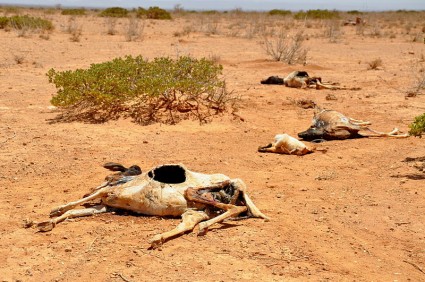
Starving Child In Ethiopia - Photo by Cate Turton - Department for International DevelopmentWhy does it seem like wherever there is human suffering, some giant bank is making money off of it?  According to a new report from the World Development Movement, Goldman Sachs made about 400 million dollars betting on food prices last year.  Overall, 2012 was quite a banner year for Goldman Sachs.  As I reported in a previous article, revenues for Goldman increased by about 30 percent in 2012 and the price of Goldman stock has risen by more than 40 percent over the past 12 months.  It is estimated that the average banker at Goldman brought in a pay and bonus package of approximately $396,500 for 2012.  So without a doubt, Goldman Sachs is swimming in money right now.  But what is the price for all of this "success"?  Many claim that the rampant speculation on food prices by the big banks has dramatically increased the global price of food and has caused the suffering of hundreds of millions of poor families around the planet to become much worse.  At this point, global food prices are more than twice as high as they were back in 2003.  Approximately 2 billion people on the planet spend at least half of their incomes on food, and close to a billion people regularly do not have enough food to eat.  Is it moral for Goldman Sachs and other big banks such as Barclays and Morgan Stanley to make hundreds of millions of dollars betting on the price of food if that is going to drive up global food prices and make it harder for poor families all over the world to feed themselves?
This is another reason why the derivatives bubble is so bad for the world economy.  Goldman Sachs and other big banks are treating the global food supply as if it was some kind of a casino game.  This kind of reckless activity was greatly condemned by the World Development Movement report...
"Goldman Sachs is the global leader in a trade that is driving food prices up while nearly a billion people are hungry. The bank lobbied for the financial deregulation that made it possible to pour billions into the commodity derivative markets, created the necessary financial instruments, and is now raking in the profits. Speculation is fuelling volatility and food price spikes, hurting people who struggle to afford food across the world."
So shouldn't there be a law against this kind of a thing?
Well, in the United States there actually is, but the law has been blocked by the big Wall Street banks and their very highly paid lawyers.  The following is another excerpt from the report...
"The US has passed legislation to limit speculation, but the controls have not been implemented due to a legal challenge from Wall Street spearheaded by the International Swaps and Derivatives Association, of which Goldman Sachs is a leading member. Similar legislation is on the table at the EU, but the UK government has so far opposed effective controls. Goldman Sachs has lobbied against controls in both the US and the EU."
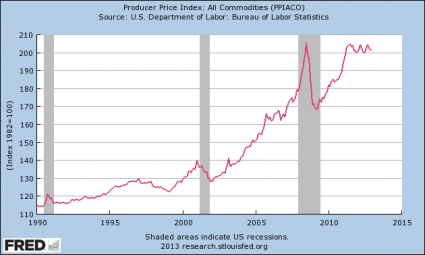
Posted below is a chart that shows what this kind of activity has done to commodity prices over the past couple of decades.  You will notice that commodity prices were fairly stable in the 1990s, but since the year 2000 they have been extremely volatile...
Commodity Prices
The reason for all of this volatility was explained in an excellent article by Frederick Kaufman...
The money tells the story. Since the bursting of the tech bubble in 2000, there has been a 50-fold increase in dollars invested in commodity index funds. To put the phenomenon in real terms: In 2003, the commodities futures market still totaled a sleepy $13 billion. But when the global financial crisis sent investors running scared in early 2008, and as dollars, pounds, and euros evaded investor confidence, commodities -- including food -- seemed like the last, best place for hedge, pension, and sovereign wealth funds to park their cash. "You had people who had no clue what commodities were all about suddenly buying commodities," an analyst from the United States Department of Agriculture told me. In the first 55 days of 2008, speculators poured $55 billion into commodity markets, and by July, $318 billion was roiling the markets. Food inflation has remained steady since.
The money flowed, and the bankers were ready with a sparkling new casino of food derivatives. Spearheaded by oil and gas prices (the dominant commodities of the index funds) the new investment products ignited the markets of all the other indexed commodities, which led to a problem familiar to those versed in the history of tulips, dot-coms, and cheap real estate: a food bubble. Hard red spring wheat, which usually trades in the $4 to $6 dollar range per 60-pound bushel, broke all previous records as the futures contract climbed into the teens and kept on going until it topped $25. And so, from 2005 to 2008, the worldwide price of food rose 80 percent --and has kept rising.
Are you angry yet?
You should be.
Poor families all over the planet are suffering so that Wall Street bankers can make bigger profits.
It's disgusting.
Many big financial institutions just seem to love to make money on the backs of the poor.  I have previously reported on how JP Morgan makes billions of dollars issuing food stamp cards in the United States.  When the number of Americans on food stamps goes up, so does the amount of money that JP Morgan makes.  You can read much more about all of this right here: "Making Money On Poverty: JP Morgan Makes Bigger Profits When The Number Of Americans On Food Stamps Goes Up".
Sadly, the global food supply is getting tighter with each passing day, and things are looking rather ominous for the years ahead.
According to the United Nations, global food reserves have reached their lowest level in nearly 40 years.  Global food reserves have not been this low since 1974, but the population of the world has greatly increased since then.  If 2013 is another year of drought and bad harvests, things could spiral out of control rather quickly...
World grain reserves are so dangerously low that severe weather in the United States or other food-exporting countries could trigger a major hunger crisis next year, the United Nations has warned.
Failing harvests in the US, Ukraine and other countries this year have eroded reserves to their lowest level since 1974. The US, which has experienced record heatwaves and droughts in 2012, now holds in reserve a historically low 6.5% of the maize that it expects to consume in the next year, says the UN.
"We've not been producing as much as we are consuming. That is why stocks are being run down. Supplies are now very tight across the world and reserves are at a very low level, leaving no room for unexpected events next year," said Abdolreza Abbassian, a senior economist with the UN Food and Agriculture Organisation (FAO).
The world has barely been able to feed itself for some time now.  In fact, we have consumed more food than we have produced for 6 of the last 11 years...
Evan Fraser, author of Empires of Food and a geography lecturer at Guelph University in Ontario, Canada, says: "For six of the last 11 years the world has consumed more food than it has grown. We do not have any buffer and are running down reserves. Our stocks are very low and if we have a dry winter and a poor rice harvest we could see a major food crisis across the board."
"Even if things do not boil over this year, by next summer we'll have used up this buffer and consumers in the poorer parts of the world will once again be exposed to the effects of anything that hurts production."
We desperately need a good growing season next summer, and all eyes are on the United States.  The U.S. exports more food than anyone else does, and last summer the United States experienced the worst drought that it had seen in about 50 years.  That drought left deep scars all over the country.  The following is from a recent Rolling Stone article...
In 2012, more than 9 million acres went up in flames in this country. Only dredging and some eleventh-hour rain kept the mighty Mississippi River from being shut down to navigation due to low water levels; continuing drought conditions make "long-term stabilization" of river levels unlikely in the near future. Several of the Great Lakes are soon expected to hit their lowest levels in history. In Nebraska last summer, a 100-mile stretch of the Platte River simply dried up. Drought led the USDA to declare federal disaster areas in 2,245 counties in 39 states last year, and the federal government will likely have to pay tens of billions for crop insurance and lost crops. As ranchers became increasingly desperate to feed their livestock, "hay rustling" and other agricultural crimes rose.
Ranchers were hit particularly hard.  Because they couldn't feed their herds, many ranchers slaughtered a tremendous number of animals.  As a result, the U.S. cattle herd is now sitting at a 60 year low.
What do you think that is going to do to meat prices over the next few years?
Meanwhile, the drought continues.  According to the U.S. Drought Monitor, this is one of the worst winter droughts the U.S. has ever seen.  At this point, more than 60 percent of the entire nation is currently experiencing drought.
If things don't turn around dramatically, 2013 could be an absolutely nightmarish year for crops in the United States.  If 2013 does turn out to be another bad year, food prices would soar both in the U.S. and on the global level.  The following is from a recent CNBC article...
The severe drought that swept through much of the U.S. last year is continuing into 2013, threatening to cripple economic growth while forcing consumers to pay higher food prices.
"The drought will have a significant impact on prices, especially beef, pork and chicken," said Ernie Gross, an economic professor at Creighton University and who studies farming issues.
So let us hope for the best, but let us also prepare for the worst.
It looks like higher food prices are on the way, and millions of poor families all over the planet will be hard-pressed to feed their families.
Meanwhile, Goldman Sachs will be laughing all the way to the bank.
A Global Food Crisis Is Coming - Are You Ready? - Photo by Oxfam East Africa

Salon.com attacks Jeff Rense and Jay Weidner

Mr. Alex Seitz-Wald of Salon.com attacks Jeff Rense and Jay Weidner
by Jon Rappoport
January 23, 2013
www.nomorefakenews.com
Alex Seitz-Wald has written a hit piece at Salon.com, attacking Jeff Rense, the owner of rense.com and long-time radio host, and Jay Weidner, who has decades of experience as a radio host and documentary producer, including extensive research into the films of Stanley Kubrick.
Seitz-Wald’s Salon article, “Your comprehensive answer to every Sandy Hook conspiracy,” slams a radio conversation between Rense and Weidner.
http://www.youtube.com/watch?v=iJj_wZtQb_k
http://www.youtube.com/watch?v=T76WAh9zVAY
Among dozens of holes in the official account of the Sandy Hook murders, we have massively disturbing interviews with parents of the dead children and key members of the Newtown community.
These boggling interviews were the subject of the radio conversation Rense had with Weidner. Apparently, it really got under Seitz-Wald’s skin, because he had to feature it in his hit piece.
In particular, he went after this comment Jay Weider made: “They [the Sandy Hook residents interviewed on television] aren’t behaving the way human beings would act.”
Seitz-Wald writes:
Why aren’t the [Sandy Hook] adults sadder [in their television interviews]? They aren’t behaving the way human beings would act,’ as conspiracy theorist Jay Weidner told fellow conspiracy theorist Jeff Rense on his radio show. Theorists have zeroed in on Robbie Parker, who they say wasn’t grieving hard enough for his slain 6-year-old daughter, Emilie. In one widely circulated clip, Parker laughs before stepping up to the microphone, and apparently someone says ‘read from the card (as in cue card) before Parker breathes heavily in anticipation of beginning a press conference. ‘This is what actors do to get into character,’ one popular YouTube video states.”
Let’s take this statement apart. It’s easy. Seitz-Wald actually makes Rense’s and Weidner’s case for them by pointing to Parker. Because Robbie Parker, as anyone can see, chuckles, smiles, and acts quite relaxed and chummy just before he takes to the podium to deliver his words of grief.
It’s so stunning you have to look at the clip several times to believe your own eyes. And worse, you then watch Parker huff and puff and try to, yes, put himself into character so he can appear suitably devastated.
Does this mean he’s a hired actor? Neither Rense nor Weidner drew that conclusion, but Setiz-Wald casually allows his readers to think so.
In fact, Rense and Weidner were talking about something else, something very important: the “missing pieces” in the psyches of people who are interviewed on television, in the wake of personal horrors, people who simply don’t behave as human beings would, who show no exploding grief, no collapse, no sign of profound shock or loss.
At Salon, Seitz-Wald tries to solve this “puzzle” by referring to a study that claims the alternation between “sadness and mirth” occurs often in people who have undergone a tragedy.
This is patently absurd. The irrelevant study wasn’t tightly focused on a devastating massacre of very young children. It didn’t take into account the omnivorous presence of television and its influence.
Seitz-Wald continues: “Rense and Weidner also take issue with the mourning of the school nurse, the family of slain teacher Victoria Soto, and others.”
Yes, absolutely, and why not? The behavior of these people, as they were interviewed on television, was profoundly lacking in the kind of grief we would expect.
And Seitz-Wald calls Rense and Weidner conspiracy theorists? It’s he who doesn’t have eyes to see. If he did, and actually watched these bizarre interviews, he too would be disturbed. But instead, he’s ready to cast “conspiracy theorists” as people who believe nothing happened at Sandy Hook and no one died.
That’s one of his missions in the article, and he’s willing to grossly misrepresent Rense and Weidner to achieve the objective.
His tactic is classic. Attack the people whose ideas you want to neutralize, don’t carefully examine and report what they’re saying, and along the way attribute to them ideas they never had.
Seitz-Wald mentions another now-famous Sandy Hook resident, Gene Rosen, who was interviewed several times about the help he gave to a group of children who had fled the school.
Seitz-Wald fails to point out what Jay Weidner was saying about Rosen—that he too showed no sign of real shock or grief, certainly not at the level one would expect after 20 children had been murdered a few blocks away.
Instead, Seitz-Wald focuses on criticisms made of Rosen’s account of the timeline, during which he brought children into his house and then called their parents.
Again, Weidner and Rense were talking about something else, something far more important: WHAT HAS HAPPENED TO PEOPLE IN OUR SOCIETY, SUCH THAT THEY CAN’T FIND HUMAN FEELINGS IN THEMSELVES WHEN HORRIFIC TRAGEDY STRIKES?
You want conspiracy? Here it is. People who make their living in media see no problem in the failure to be human. They set up, prepare for, and construct interviews in which people, routinely, do not act human. That is conspiracy-plus. It is an ongoing and concerted effort to hold up a mirror to millions of viewers—and the reflection says: ACT LIKE AN ANDROID BECAUSE WE LIVE IN AN ANDROID WORLD.
That is television’s day-to-day message: forget what it means to be human.
Weidner and Rense were carrying on a mature and vital conversation about the loss of humanity in modern society. For that, they were taken to task. How preposterous.
I’ll go out on a limb, after reading Seitz-Wald’s bio, and assume he’s on the side of gun control. He “interned at the NewsHour with Jim Lehrer at PBS.” He “co-founded and edited the Olive and Arrow, a blog on foreign affairs for and by young progressives.”
Does he want to avoid any break in the smooth advance from Sandy Hook to new gun laws? Does he want to derail the possibility that a real investigation of what happened at Sandy Hook would take the focus away from the guns?
I don’t know what his personal motive was for writing his Salon piece, but it surely missed the mark by a mile.
If Seitz-Wald wants to undertake something important, rather than deliver his brush-off, frivolous, and underhanded attack, he should invite Jeff Rense and Jay Weidner to a real conversation.
Let the three of them sit on camera for a couple of hours and put up the clips of television interviews with Gene Rosen, Robbie Parker, the Soto family, H Wayne Carver, Sally Cox, Kaitlin Roig, and other Sandy Hook residents.
Let’s hear a conversation about these stunning documents for our time. Stunning because they show that human beings can talk to television reporters about a profound and horrific personal tragedy without vaguely approaching what it means to be human.
That’s what Rense and Weidner were delving into on the radio, and that exploration is far from over. It makes what Seitz-Wald wrote shamelessly puerile.
Major media not only exploit victims of grief for the sake of a narrative, they tap into victims at a shocking level where there is no authentic feeling at all, and they show the audience that vacuum as a representation of reality.
If this were merely a trick, it wouldn’t be so significant. But as the television interviews with the people of Sandy Hook reveal, the interviewees are all too eager to play along. They have lost their compass completely. They have become robots by choice.
The day when a serious conversation about this is unimportant is the day when we are all underwater for good. Rense and Weidner were exploring this subject, as genuine investigators of the human condition should.

You want to talk about something real, Mr. Seitz-Wald? Start there. Buckle up, because you’re in for a bumpy ride.
Was your attack on Rense and Weidner just an offhand, tiresome, and predictable hit piece lumping together “conspiracy theorists,” because it was a slow day and you wanted to file something at Salon?
You really need to pay more attention to what the people you’re attacking are saying. It helps. I’ve found it really helps. You start by listening to their words and the intent of those words. That way you can glean the actual subject they’re covering, not some other subject.
From there, you think about what they’re exploring. You do a little thinking. Sometimes it’s hard and it throws you off your pre-formed opinion and headline, but you do it anyway. It’s part of the job.
Then (I’m really trying to help here), you decide what you think of what they think. You do it honestly. And then you gather yourself and you write. You write something that might turn out to be important.
That’s what you want. Something important, rather than something cheap that sheds paint flakes the first time you pick it up and shake it. In the long run, this will serve you. You’ll develop a habit and perhaps even a taste for going after what’s important.
In closing, I’d like to refer to another article of yours, “The Hitler gun control lie.” You made the point that Jews having guns in Germany wouldn’t have protected them from the death camps. The Nazi soldiers would have overwhelmed the Jews anyway.
I was struck by that point. I asked myself, and I ask you, if you were a Jew in Nazi Germany, how would you have wanted to die? I believe it’s a legitimate question, one that the scholars you cited rarely if ever consider.
Would you have chosen to move numbly with your family to a boxcar on a track, on your way to a camp, or would you rather have stood in your living room, in front of your wife and children, shooting bullets at your attackers?
I ask this because, again, it has to do with the definition of being human in this world. It has to do with possessing the means and the will and the desire to choose how to live and die.
Just as you ignored the very same subject in the radio conversation between Jeff Rense and Jay Weidner, I believe you ignored it in your article about Hitler, Jews, and guns.

The Matrix Revealed
One of the two bonuses in THE MATRIX REVEALED is my complete 18-lesson course, LOGIC AND ANALYSIS, which includes the teacher’s manual and a CD to guide you. I was previously selling the course for $375. This is a new way to teach logic, the subject that has been missing from schools for decades.

What is the world you hope will come to pass, Mr. Seitz-Wald? I’m not asking for the flip superficial answer here, but the real one, the one that hopefully beats in your heart and mind and spirit. What are you hoping and aiming for?
People like Rense and Weidner and me, and many others who are sometimes characterized as conspiracy theorists, consider this question every day.
In case you interested, that’s where we’re coming from. This isn’t a little foolish social game we’re playing. We’ve shoved in all our chips. We look at you and we don’t see that. We see something else.
If we’re wrong, prove it. Let’s see your hole cards, because it’s rather late in the evening, and this is the main hand, and it’s time for the Reveal.
You came into our house, and it appears you were riding on a goof, but this isn’t it. This is something entirely different.
If you’re out, walk away. If you’re in, lay down all your cards. Let’s see what you’ve really got.
Your brand has no cache here. What kind of human are you?
Jon Rappoport

Prenda's Latest Trick: Pretend There Are NO Defendants So No One Can Object

from the that-bag-o'-tricks dept

Back in December we talked about some of the many items in Prenda Law's bag of copyright trolling tricks, focused on getting courts to allow discovery on IP addresses at any cost. The end goal, of course, is merely to get contact info for the purpose of beginning the intimidation campaign to get people to pay up to avoid the "threat" of a lawsuit from Prenda. That post listed a whole series of "tricks" that Prenda used to set up this ridiculous house of cards to try to both avoid having to name people as defendants (whereby they might defend themselves against such discovery), while also filing a ton of lawsuits that implicate the same IPs around the country, doing a bit of jurisdiction shopping.

The latest trick is that after being called on this, Prenda is seeking to deny the efforts to fight back by some of those who are associated with the IP addresses connected to these lawsuits. How? By arguing not just that these IP addresses don't represent defendants in the case, but actually going so far as to argue that there are no defendants in the case because the case itself is filed against "John Doe." The fact that the people associated with the IP addresses in question are still being sought as possible "co-conspirators" is completely ignored, as Prenda claims that makes no difference.

The lawyers at Booth Sweet representing those associated with a few of the IP addresses have hit back, pointing out just how silly these legal claims are, but also noting that if there is no defendant in the case, then there is no case and the whole thing should be dismissed:
If Plaintiff is the only party in this action, then filing suit was premature. “[A]n actual controversy must exist not only at the time the complaint is filed, but through all stages of the litigation.” ... “With no defendant there is no case or controversy and thus no jurisdiction for this Court to act.” ... Plaintiff’s solitary version of litigation has no place in the federal courts. As Plaintiff conceded in the prior action, “courts only have subject matter jurisdiction over justiciable matters, which are matters in controversy between an actual plaintiff and an actual defendant.” ... The Court should order Plaintiff to show cause why its one-party suit should not be dismissed.
They also point out that courts have long rejected the ridiculous claim that as long as it's a "John Doe" being sued, the target is not a party to the lawsuit until being named. Obviously that would make it impossible to object to being named, because you'd have no standing to object... until you were already named. Such a scenario makes no sense, but it's one of the many crazy legal theories Prenda is now pushing.

As we've noted before, nearly every move by Prenda feels like a move by a cocky (and not very intelligent) lawyer who thinks he's outsmarted the system via a whole series of loopholes, while all the various moves really do is raise even more awareness of an impressive level of incompetence. I knew a kid like that back in college, who thought he'd figured out every angle, and had a loophole planned for everything. It was the sort of thing where you just shook your head and though that if he'd only applied half the effort he'd put into finding loopholes to actually doing the work in question, he might actually be really successful. But, instead, it's all about the loopholes that don't impress anyone.

Retired Federal Judge Criticizes Carmen Ortiz's Handling Of Aaron Swartz Case

from the good-for-her dept

While US Attorney Carmen Ortiz continues to stand by her actions in regards to the Aaron Swartz case (and other cases where she's being accused of being over-aggressive in prosecuting people), more and more criticism is coming to light, including from some influential voices who understand first hand the sorts of things that Ortiz has been engaged in. Former federal judge Nancy Gertner, who some may remember from being the judge in the Joel Tenenbaum trial, has spoken out about Ortiz's actions, suggesting that Ortiz took things too far.
“Just because you can charge someone with a crime, just because a technical crime has been committed, doesn’t mean you should,” Gertner said.

“At the time of the indictment, [Ortiz] said, ‘Stealing is stealing.’ I saw that all the time when I was on the bench,” she said. “This is a classic line. Stealing an apple if you’re hungry is different than Bernie Madoff. It is obviously different.”
She goes on to criticize Ortiz's continued public claims about how Swartz could get 35 years in jail based on the charges she presented. Gertner notes that, thanks to mandatory sentencing guidelines, judges have less power to push back against overzealous prosecutors like Ortiz, and, as a result, it gives those prosecutors much more power to bully people into agreements.
“And in the world of punishment, the prosecutor has enormous power and he has the enormous power to make you plead guilty and give up your rights,” Gertner said.
As she notes, since the prosecutor can choose what charges to file against you, and then just pile them all up until you agree to plead to something, the prosecutor often has way too much power:
“So the prosecutor determines the charges and the punishment,” Gertner explained. “Again, once they start the process, once the indictment is brought, the potential for enormous punishment is there and although a judge has some discretion in sentencing, often what the prosecutor wants is what the person gets.

“When that happens the prosecutor has enormous power and has to exercise that with some degree of fairness and judgment at that end,” she added.
On top of that, she points out that there were clearly alternative ways that Ortiz could have handled the Swartz case, either offering a deal that didn't involve prison time or even a diversion program with a suspended sentence (such that charges would be dropped if Swartz stayed out of trouble for a certain set period of time). Instead, she notes that Ortiz chose the hardline path that was designed to "wreck your life" even though it seems clear that merely drawing attention to the belief that his actions were criminal would have likely stopped further such actions.

Finally, Gertner points out that part of the problem is that US Prosecutors like Ortiz get rewarded for "high profile" takedowns, and thus all of the incentives she had were to turn the Swartz case into something a lot bigger than it really was:
“If the U.S. attorney is going to take credit for every successful prosecution, not matter what the issues were, the U.S. attorney then winds up as ‘Bostonian of the Year’ for these prosecutions, then you know high-profile prosecutions are valued in the office,” Gertner said. “Mr. Swartz was a high-profile prosecution. Whether they are right is another question.”
None of this, of course, is unique to the Swartz prosecution. We've pointed to similar things in the past, and it's unfortunately common today that US Attorneys use their position not to seek justice in the world, but as a political stepping stone to higher office. As such, "high profile" cases where they "put someone away" get them additional attention and acclaim. Being judicious and recognizing when prosecution doesn't make much sense... does not. The incentives are totally screwed up, and that can create calamitous results.