Monday, November 7, 2016

GMO GEOPOLITICS: THE UKRAINE BUCKS GMOsImage result for evil nazi science


Ms. M.W. sent this article and I include it in this week's blogs, reviews, and speculations because I found in it a small measure of hope. The story concerns GMOs, and The Ukraine:
What surprised me here is, of course, the history and relationships that emerged prior to and during the Maidan crisis and the US-sponsored overthrow of the legitimate government of The Ukraine and its replacement by the Proshenko crowd. Many people, however, may not recall that in the run-up to the crisis, various American "agribusiness" giants, like Mon(ster)santo, acquired ports rights on the Black Sea, and viewed The Ukraine - the traditional breadbasket of Europe - as a ripe new market to infuse with GMOs. From one point of view, the Ukrainian government could be viewed as the puppet and creature of the US State Department, of Darth Soros and his various NGOs(Non-Governmental Organizations), and the GMO giants.
Meanwhile, as we also know, across the border, Russia has all but banned GMOs completely in that country, and has become an agricultural exporter. I have called this "GMO geopolitics," as various nations realize the value of the growing opposition to GMOs in various countries, and position themselves to meet and address that market need.
Well, The Ukraine now appears to be set to play some GMO politics of its own:
Despite massive pressure from U.S. multinational Monsanto and the Ukrainian Grain Association, Ukraine’s Parliamentary Committee on Agrarian Policy and Land Relations supported a new moratorium Monday on genetically modified (GM) crops until 2023.
Earlier in 2016, the Petro Poroshenko Bloc “Solidarity” MP, Mikola Lyushnyak entered a Bill to the Ukrainian Parliament to continue and strengthen the current moratorium on GM crops in the country.
“Why is the prohibition of GMOs so acutely on the agenda in society? Because so far there is no definitive scientific evidence proving the necessity of growing GM crops and also no evidence about the safety of GMOs or their usefulness to human health,” Lyushnyak stated.
“In Ukraine, which occupies a leading position in the agricultural sector, there is a good chance to become a GMO-free country… in the near future,” Lyushnyak concluded.
The Ukrainian Parliament will vote on the moratorium on a date which is yet to be announced. The strong Bill would ban the growing of genetically modified crops as well as production, processing, circulation, transit and import of GMOs capable of reproduction or transmission of hereditary factors.
And note, The Ukraine's measure, according to the article, is being phrased precisely in terms of the global market, vs "pressures from (where else) Washington":
Ukraine’s non-GMO corn varieties have also made it China’s No. 1 source, helping to turn the former Soviet breadbasket into a global player. The fear is that the growing GMO contamination levels will now endanger this new and growing market. (Emphasis added)
Note also that the argument of Mr. Lyushnyak, sponsor of the bill, is arguing that there is no evidence "proving the necessity of growing GM crops," a new addition to the usual basket of arguments against GMOs, which tend to focus attention on the safety, rather than the necessity of growing them. The "necessity" argument was advanced usually in conjunction with "increased productivity" arguments and "feeding the hungry," and thus Mr. Lyushnyak's wording here is intriguing, for it suggests that perhaps he has followed recent Western studies, including some from American universities, which demonstrate falling per acre yields of GMOs over time, as compared to normal seeds, while costs actually rise over the long term. One important study that suggested these trends was recently done by the University of Iowa.
There's something else going on here, however, and I hope you noticed it: Mr. Lyushnyak's argument is very similar to language used in the debates on GMOs in neighboring Russia, and very similar to the language of the Russian agricultural ministry and its various spokesmen in their non-GMO policies.
And this brings me to some very high octane speculation: there is, of course, no love lost between The Ukraine and Russia for a variety of reasons: the forced collectivization of the kulaks under the Soviets, and the resulting famines and genocides being one.  But it is interesting to watch market forces driving both nations to take similar stances vis-a-vis the GMO issue, and that might, with time, become a basis on which to rebuild bridges. After all, I cannot imagine that Ukrainians right now are thinking that US corporate dominance, or being puppets for Washington, has worked out any better than being puppets for Moscow, and agriculture is that nation's chief strength. Time will tell of course, but it is an intriguing convergence...           http://gizadeathstar.com/2016/11/gmo-geopolitics-ukraine-bucks-gmos/

So alive - Love and Rockets


Chicago Cubs World Series Win Demonstrates Sports Teams Do Not Need Publicly Funded Stadiums


chicago cubs
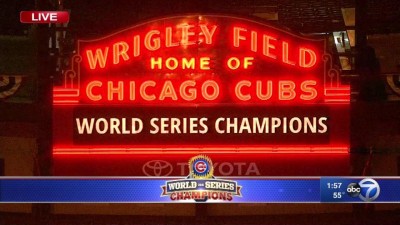
When the Chicago Cubs closed out a thrilling 8-7 victory over the Cleveland Indians in extra innings of Game 7 of the World Series on Tuesday night, they became World Champions for the first time since 1908. Their win disproved not only the Curse of the Billy Goat, but the notion that privately owned sports teams need to have publicly funded stadiums to survive and be competitive.
Since the gates of the Cubs’ beloved Wrigley Field (then Weeghman Park) opened to the public in 1914, owners of professional sports teams across the United States have bilked taxpayers out of hundreds of billions of dollars by demanding that the public bear a portion of – or, in many cases, the entire financial burden of constructing baseball, football, basketball, and hockey stadiums. Once completed, the owners – rather than the taxpayers – reap the rewards of admission, stadium concessions, and even parking fees. The taxpayers are rewarded for their largesse with highly inflated ticket prices and reduced access to new venues, which generally have much smaller seating capacities.
By now, the fact that stadiums are a terrible investment is as widely accepted as climate change. Not only do they not generate enough tax revenue to offset the expenditure of taxpayer funds, but the true cost to the public almost always exceeds the sticker price, and can be understated by as much as 40 percent.
Yet despite the long, documented history of stadiums saddling the public with a crushing burden of debt while delivering spectacular increases in the value of franchises to owners, those who control teams keep finding that they are able to dupe feckless politicians and a gullible public into supporting transfers from the public coffers into their own pockets.
Their ability to continually achieve these scams relies on a convincing propaganda campaign. There are several main arguments that comprise the narrative: that current stadiums are old and falling apart and must be replaced in the near future; that fans demand state-of-the-art facilities with the most modern amenities; and that without luxury boxes and corporate suites new stadiums could provide, the team will never be able to generate enough revenue to compete and win. When those arguments fail to do the trick, the owners resort to threatening to move to another city.
The first argument is always easy to disregard, as any engineering inspection will attest. Wrigley Field has lasted more than 100 years and there appears to be no reason it couldn’t last another 100 more. In almost every case ownership makes similar claims about other stadiums, they are unable to provide evidence to back them up, because none exists.
Any true baseball fan will understand the second argument is also bunk. Personally, the least important part about watching a game in person to me is the comfort and amenities. I want to sit as close to the field as possible, and that’s pretty much it. I can have comfort and amenities from my own couch the 363 days a year I don’t go to watch a game in person.
The Cubs championship demonstrates that success and suite revenue are not correlated. Having a rabid fan base that packs the stands every night (the Cubs ranked 5th in the league in attendance in 2016) and, more importantly in this day in age, watch on TV each night will generate more than enough revenue to put a winning team on the field. Fewer suites only means fewer profits that will be put into the owner’s investment portfolio, rather than put into the operations of the team.
The Cubs owners understand that true baseball fans value the charm of a historic stadium more than the allure of a shiny new one they have no emotional connection to. Fans would rather sit in the same seats they sat in years ago with their father than have a little more leg room. So after the Ricketts family (who recently donated $1 million to Donald Trump) bought the team in 2009, they aimed to renovate rather than replace.
They did attempt to seek taxpayer funds to pay for the $500 million worth of renovations. When they were met with a chilly reception, they tried to use what leverage they had by threatening to move the team. But Chicago officials understood that this was nothing more than empty posturing and ownership never thought seriously for a single second about going anywhere else.
Lo and behold, when public officials held their ground the Cubs ownership committed to paying for the entire project with private money. Predictably, it has neither sent them to the poor house nor impaired their ability to field a competitive team.
As Chicago officials and Cubs fans watched 5 million people gather Friday for the 7th largest gathering in human history, perhaps they wondered why they needed owners at all. The Cubs, like all sports teams, could be considered a public good that should belong to the community that sustains them. Rather than be operated by, and for the benefit of, a private individual, they could be managed in the interests of the millions of fans and residents of their city based on their input.
Sports teams are generally cash cows that pay for themselves and produce millions of dollars worth of surplus. The Green Bay Packers, who are owned by nearly 400,000 shareholders that operate the franchise democratically, are self-sustainable and have never run into financial trouble, much less ruin.
It’s unlikely that any cities will move to take control of their teams from their parasitic owners. But one can at least hope that the Cubs World Series will serve as a strong counterargument to the fatuous propaganda that sports owners have come to rely on as they continue to siphon billions of dollars from the public to themselves without contributing anything of value.