Thursday, April 24, 2014

Pre-Crime Systems Now Actively Monitoring the Internet: “The Computer Algorithm Learns the Pattern and Produces a Prediction”

what a fucking JOKE ! is there ANY MORE corrupt ,crooked thiev~in rat fucking criminal bastards ..than infest ANY level of Our so~call gov.  EVERY fucking body & their sister KNOWS Our "ass~facials"  r rat fucking bastards  & "this"   new  pre~crime fucking bull shit ...can't  "catch" just 1 of "these" (gov. ass facials)  fucks :o  LMMFAO (laughing my motherfucking ass off)   pre~crime ..my fucking ass lol  ...kooky fucks  lol  ...wonder what yer al~gee~rim~in ....thinks about ....go fuck yer~self  Oops  besides catch~in ..an potty mouth hehe

Mac Slavo
April 23rd, 2014
SHTFplan.com


pre-crime-algorithmsWith revelations that the National Security Agency has collected some 20 trillion phone calls and emails via an expansive nationwide surveillance network, most Americans have already come to the realization that everything they do is being monitored.
But many shrug off Big Brother’s prying eyes by suggesting that, since they aren’t doing anything wrong, they have nothing to worry about.
That may have been true several years ago, but the digital surveillance systems of today are far more advanced than most people understand. No longer are these machines simply recording the data and storing them in some historical archive to be pulled at a later date should the government ever have reason to take a closer look at your personal life.
The next generation of systems are being used to actively monitor your digital interactions, surfing habits, conversations and daily sentiment in an effort to predict your future behavior. Nowhere is this more apparent than in the systems currently operating within the social media sphere.
Researchers at the University of Virginia funded by the U.S. Army recently demonstrated that they can not only gather information from your personal Twitter account just like the NSA, but also aggregate and analyze that information with advanced predictive algorithms designed to determine what you’re going to do next. In this case, the researches focused specifically on predicting crime by individuals, as well as in crime “hot spots” around the country.
Here’s the kicker. The algorithms being used don’t just look for obvious keyword phrases associated with criminal activity like “I’m going to kill you” or “meet me later and we’ll give him a beat down,” but focus in on routine activities, geo-location, and aggregate historical information to calculate the chance of a particular individual being involved in a crime at some point in the future.
Researchers at the University of Virginia demonstrated tweets could predict certain kinds of crimes if the correct analysis is applied.
A research paper published in the scientific journal Decision Support Systems last month said the analysis of geo-tagged tweets can be useful in predicting 19 to 25 kinds of crimes, especially for offenses such as stalking, thefts and certain kinds of assault.
The results are surprising, especially when one considers that people rarely tweet about crimes directly, said lead researcher Matthew Gerber of the university’s Predictive Technology Lab.
Gerber said even tweets that have no direct link to crimes may contain information about activities often associated with them.

Gerber said Twitter data can be relatively easy to use because tweets are publicly available, and many of them are tagged with location information.
In addition, researchers, themselves, do not need to go into the high-crime areas to study the information.
Instead, “I send our algorithms to these locations and see what people are talking about,” Gerber said.
“The computer algorithm learns the pattern and produces a prediction.”
The study was funded by the US Army, which Gerber said uses similar techniques to determine threats in places such as Iraq and Afghanistan.
It’s no surprise then, that police departments all over the country are interested in the new technology. The New York Police Department has already showed asked for a demonstration.
To give you an idea of how this technology can be used to not only predict traditional crimes but domestic terrorism related activity, consider an earlier report out of Auburn, NY which indicates that the Department of Homeland Security is asking local businesses to keep an eye out for terrorists going so far as to provide retailers with a shopping list of possible items a terrorist might purchase such as MRE’s (Meals Ready to Eat), flashlights and other products readily available at local surplus shops and camping stores. The implications of these new algorithms, which will be taught that anyone discussing the purchase or ownership of these types of items should be flagged for review and visited by Homeland Security personnel as a person of interest, are staggering.
With the definitions for domestic terrorism being expanded to include everyone from kids making gun-like gestures with their hands to Americans joining a large protest against government over-reach, it’s only a matter of time before just about every American with a gripe or opposing view is flagged, investigated and incarcerated for a “crime” that they “may” commit in the future.
Though the notion may seem far fetched to some, this technology is being designed for a reason. Given the ever expanding intervention and interference of government into our lives on every level by way of relentlessly supplanting our protections under the U.S. Constitution, are we to believe these developing technologies won’t be used strike fear and compliance into the hearts and minds of Americans?
         

Before Silicon Valley got nasty, the Pirates of Analog Alley fought it out

Stealing ideas and fighting over patents existed back when computers had gears, too.

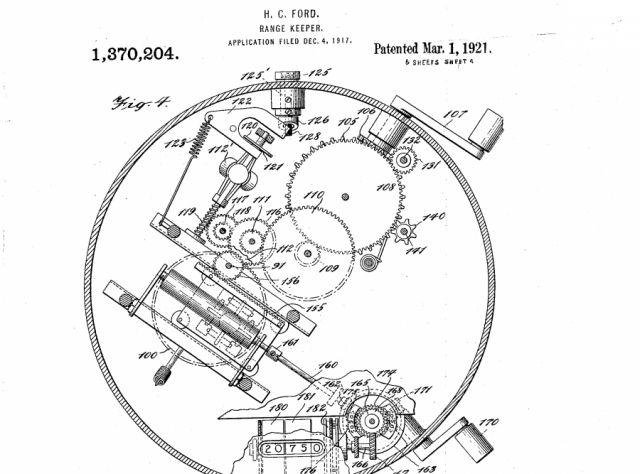
A patent drawing for the Range Keeper, Hannibal Ford's analog fire control computer.
The history of information technology has a way of repeating itself. Every era's corporate competitors elbow each other for success, try to better the other's ideas, and sometimes just plain steal from one another. In that light, it's no surprise that the battles of today’s technology giants may have been foretold by another wave of innovators—those at the turn of the 20th century, when electricity was new and computing was done with real machines. Think the kind with gears, cams, and shafts.
The startup culture created by the electrification and communications booms of the late 19th and early 20th centuries produced a generation of engineers looking for the next big thing. But their similarities with today's tech leaders go beyond the fact that "a generation of engineers looking for the next big thing" could just as easily describe anyone at Google, Facebook, or maybe even SnapChat. While researching the recent Ars report on Naval analog computers, parallels immediately revealed themselves. The behavior of the men who pioneered this analog computing eerily mimics actions we're more familiar with from Steve Jobs, Bill Gates, Larry Page and Sergey Brin, and the rest of today’s tech pantheon. These early engineers were, if you’ll pardon the phrase, the Pirates of Analog Alley.

Absolute Zero

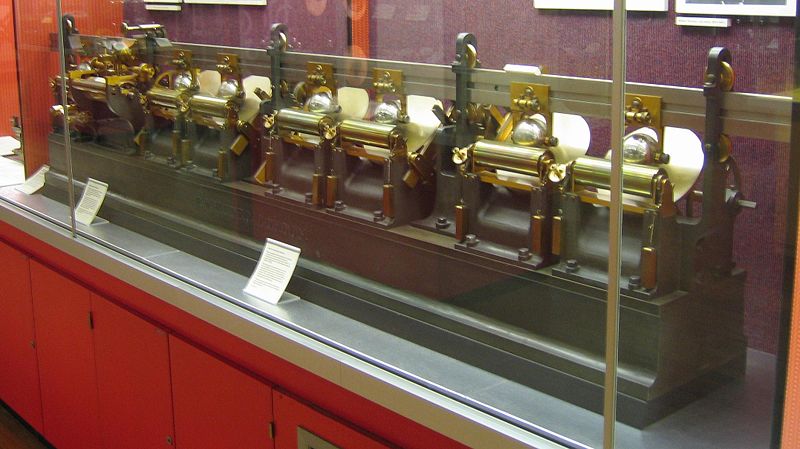
Enlarge / Lord Kelvin's "harmonic analyzer," with disk integrators.
While Charles Babbage may be the “father of computing,” the father of fire control computing (and of modern analog computing) was William Thompson, also known as Lord Kelvin. As detailed in Harold Sharlin's biography Lord Kelvin-The Dynamic Victorian, Kelvin was like a one-man equivalent of PARC or the Bell Labs of the latter half of the 20th century—a fountain of great ideas. Some of those ideas, he cashed in on; some, he let others steal. Kelvin figured out a number of things about long-distance telecommunications. He developed a model for the bandwidth capacity of undersea cables and invented equipment to automatically send and record messages. Enriched by (and knighted for) his success with trans-Atlantic telegraph cables and equipment, Kelvin was perpetually tinkering. In 1871, he perfected a little project his older brother had been working on: the “integrating machine,” or differential analyzer.
This device would be the basis of Kelvin’s machine to calculate tide tables. Nearly 60 years later, the same principles would be used at MIT to create the first machine called a differential analyzer, which is used for calculating complex differential equations. The integrating engine would be in the back of Kelvin’s mind 15 years later when, as a board member for Linotype & Machinery Co. Ltd., he had a conversation with the company’s managing director, Arthur Pollen.
As recounted by his son Anthony Pollen in the book The Great Gunnery Scandal: The Mystery of Jutland, Pollen traveled to Malta in 1900, where he was invited aboard a Royal Navy ship to witness gunnery exercises. When he returned to England, he told Kelvin how horrifically inaccurate the ships' big guns were. In the course of the conversation, Lord Kelvin mentioned an analog computer he had worked on and how it could probably be used to do the ballistic calculations required to make the guns hit their targets.
Pollen took the idea and ran with it. With a singular passion rivaling Steve Jobs', Pollen spent the next eight years developing what he would call the Argo Aim Correction System. Its integrating core concept was passed from Kelvin's brother to Kelvin and now finally to Pollen.
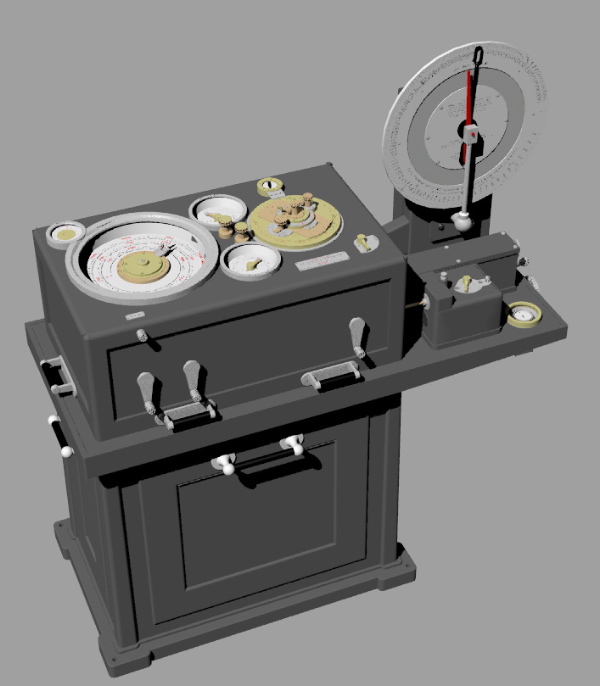
A 3D model of the Argo Clock, the heart of Arthur Pollen's fire control system.
Pollen’s Argo was supposed to provide a totally integrated system. It would use electromechanical mechanisms to transmit range and bearing data to a computer, then send the proper elevation and bearing orders back to the gunners’ mates in a similar way. If an enemy ship disappeared from view because of fog or a smoke screen, gunners would still have a good idea of where to aim. And the centerpiece of Pollen’s system was the Argo Clock—the world’s first electrically powered analog computer, which continuously analyzed the relative motion between the ship it was aboard and the target.
One of the Argo system’s major innovations was its use of gyroscopes, both for calculating directional information and as a “stable vertical­­­," sensing the ship’s pitch and yaw and adding that to the calculations. Pollen spent a great deal of development effort on his own gyroscope systems—based on early torpedo stabilizer systems—to create the stabilizing element that handled movement in the vertical plane. But unfortunately for Pollen, he became a groundbreaker in computing in another way—having his operating system ripped off.
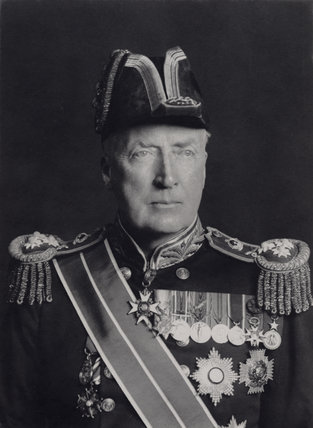
Sir Frederic Charles Dreyer recognized the best parts of Pollen's Argo system and copied them off for his own.
In 1906, as Pollen was coming close to his goal, he met with a Royal Navy officer to present his work. That officer, Lt. Frederic Dreyer, was the assistant to then-Rear Admiral John Rushworth Jellicoe, the Royal Navy’s Director of Naval Ordnance and Torpedoes (DNO). Dreyer was an up-and-comer, according to most accounts (including Anthony Pollen's), and he had a few ideas about fire control of his own. Dreyer would essentially become the Bill Gates to Pollen's Jobs. While the Royal Navy continued to buy systems from Pollen to test, Dreyer went off and designed his own fire control computer. That system, called the Dreyer Fire Control Table, had the benefit of Dreyer’s experience as a gunnery officer as well as his ongoing experience dealing with Pollen.
Originally, according to Norman Friedman's book Naval Firepower, Dreyer saw his system as something for individual turrets to help them stay on target—essentially an add-on to the Argo system. But the more time he spent with Pollen, the more he started to believe his system could be competitive with it. He took his design to his own personal Paul Allen-like figure: Keith Elphinstone, the chief designer and director at the naval instrument manufacturer Elliot Brothers. The two worked in the Argo's system of automatically transmitting bearing and range data from a stabilized rangefinder.
As much as the Dreyer Table borrowed from the Argo, it was also less integrated than Pollen’s system and more open to tinkering and hacking, since it was essentially a bunch of hardware bolted onto an open metal table. It was the Windows PC to Pollen’s carefully crafted Macintosh-like concept for the Argo. Dreyer's creation also preserved a place for human skill, and it was the product of an insider—as opposed to that of some upstart entrepreneur.
Dreyer still worked for the DNO as the officer responsible for fire control systems. He was able to stack the deck some against Pollen—though Pollen did enough of that himself, according to John Brooks' account in the book Dreadnought Gunnery and the Battle of Jutland. Equipped with his own reality distortion field, Pollen claimed that his system was accurate "to 1/10 of one percent"—an accuracy that would have required the information from the spotting system to be transmitted and turned into gun orders in milliseconds. Pollen was slow in delivering and combative in negotiations on price, plus much of his early hardware was, to put it kindly, idiosyncratic. For example, there was one feature of the Argo Clock that wasn't borrowed by the Dreyer Table: the Argo system couldn't automatically track a target while the ship it was on was turning.
So while Pollen sold a number of his full systems for installation on Russian warships and sold parts of systems to the Royal Navy, Dreyer’s hack of Pollen’s system became the standard for the British fleet just before the start of World War I. And as it became more and more apparent how badly he had been screwed by Dreyer, the tenor of Pollen’s relationship with the Navy soured. He was denied a special relationship with the Navy and was relegated to the same treatment as other inventors. Pollen's passion, pushiness, and eventual rage saw to it that he was eventually pulled from the approved contractor list all together. It led to a patent dispute that would be the gunnery equivalent of Apple vs. Microsoft.
  

The wizards of Brooklyn

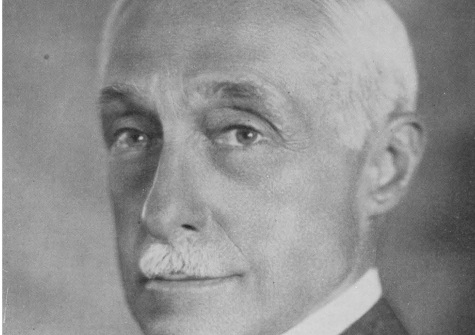
Elmer Ambrose Sperry.
National Academy of Science
Pollen wasn’t the only one working with gyros. In 1904, two men on opposite sides of the Atlantic would patent the first practical gyrocompass—a system that used a spinning gyroscope to sense the rotational axis of the earth and point to true north as opposed to Earth’s magnetic north pole. Those men were Germany’s Hermann Anschütz-Kaempfe and the American inventor Elmer Ambrose Sperry. Sperry would eventually have more than four hundred patents in his name, but he was not just a prolific inventor—he was a seasoned startup artist. Sperry got a manufacturing company to back his first company, an electric utility he started in Chicago that used dynamos of his own design. But his work with the gyrocompass would make him a major player in the early development of fire control systems as well as other analog computing systems based on gyroscopes: mechanical autopilots for ships (known as “Metal Mike” or “Iron Mike”), torpedo guidance systems, and bomb sights. His son Lawrence would use these systems for the first aircraft autopilots and artificial horizon instruments.
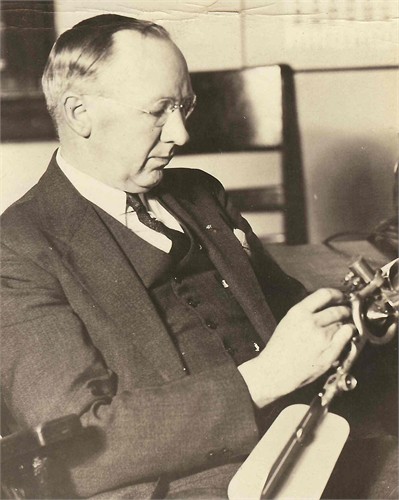
Hannibal Ford, in an undated photo.
Because Sperry had his hands in so many things—including a contract to develop a process to recover tin from scrap metal from the American Can Company—he needed some help. In 1909, around the same time Pollen was getting shafted, Sperry brought on a young hotshot engineer named Hannibal Ford who was from his home town. The two helped Sperry's hot Brooklyn tech startup, Sperry Gyroscope Company, turn the gyrocompass into a military-grade product. Within a year, Ford was Sperry’s chief engineer.
Ford took point with the Navy, working to install a gyro system aboard the dreadnaught USS Delaware in 1911. That trial was a huge success, and soon Sperry got pulled in deeper by the Navy as they realized the potential of the gyrocompass for gunnery. Sperry Gyroscope delivered its first fire control “clock” in 1912, and the Navy couldn’t get enough of it. Brooklyn soon became the analog computing equivalent of Silicon Valley, with its concentration of engineers and machinists, and most of the new startups were launched by engineers who got their start with Sperry.
In 1915, Ford set out to use the relationships and knowledge he built up with the Navy under Sperry and launched what would become Ford Instrument Company—the company that would, in his time, reach the pinnacle of analog computing. His first sale to the Navy was an add-on to the Sperry “clock” system: an improved “target bearing and range finding periscope” for gunners. The periscope used optics and a gyrocompass to pinpoint an enemy’s direction and position and then transmit it back to the Sperry computer. But Ford soon followed with an improved fire control computer called the Range-Keeper (which became known in the fleet as the “Baby Ford”). And like his partner Sperry, Ford's system would benefit from Pollen, specifically Pollen's Argo patents licensed by the Navy.

Tables turned at Jutland

The US Navy’s acquisition of the Argo patents may have been some consolation to Pollen, but his bitterness about the Royal Navy’s shafting of Argo would only grow stronger in June of 1916 by the Battle of Jutland. The only major fleet action involving battleships in World War I, Jutland was a strategic victory for the British—but tactically, it went horribly awry. A good deal of that was because of poor gunnery—gunnery directed by the Dreyer Table. While the Jellicoe-commanded British Grand Fleet eliminated the German fleet as a strategic threat, the British lost 14 ships and more than 6,000 sailors. The Germans only lost nine ships and 2,500 men.
Germany was able to use the battle as a propaganda victory, even though its surface fleet spent most of the remaining war in port. Pollen became the Great War's equivalent of a war blogger, gaining a position as a naval correspondent for the Westminster Gazette and the weekly journal Land and Water, the First World War’s closest equivalent to War is Boring (though it had more of a Fox News flair for sensation and occasionally pumped up enemy casualty figures to make better copy). While Pollen initially wrote a piece that colored Jutland as a strategic victory instead of an utter disaster, he later wrote a book that excoriated Jellicoe and laid credit for anything good that came out of Jutland to Admiral David Beatty, who commanded a battlecruiser squadron in the action and succeeded Jellicoe as fleet commander.
But Beatty’s gunnery was the worst of the lot, and he lost two battlecruisers because of his preferred style of running in close and firing fast. Meanwhile, the Germans were scoring hits at extreme range. Beatty famously said, “There seems to be something wrong with our bloody ships today.” Some (specifically Pollen’s son Anthony, who wrote a book on the topic) argue that the bargain-basement nature of the Dreyer Table was responsible for the Royal Navy’s shortcomings, though poor training on the systems (which took a roomful of people to operate) and tactics certainly played a role.
But in the final analysis, as Brooks and Friedman concluded, it came down to operator error. The Dreyer Table was far beyond what the Germans had, and it gave the few ships it was deployed upon an edge in battle—allowing the ships with big guns to score a greater number of hits at range than the Germans.
In 1918, the Royal Navy formed a committee to take a look at how to improve the Dreyer Table. Because of the open nature of the system, it proved relatively easy throughout the war to improve on it and plug in new components (such as the Sperry gyroscope). It was one of the first demonstrations of the benefit of an open architecture, and the lessons were applied to the Admiralty Fire Control systems that would be used by the Royal Navy through World War II.
After the war, Pollen would get some vindication, at least financially. In 1926, a Royal Commission found that the Dreyer Table was, in fact, based on Pollen’s invention, and Pollen was paid £30,000 (worth roughly $1.3 million in current US dollars) in compensation by the Royal Navy. The pay-day was based on how much Pollen would have made equipping the entire fleet, including ships that were never completed.

The end of the cam

Enlarge / Sperry Gyroscope Company headquarters at 40 Flatbush Avenue Extension, Brooklyn. At one point, the Sperry offices were a temporary site for the UN.
Just as the 1970s and 1980s saw the consolidation and downfall of many of the original giants of digital computing, the 1920s and 1930s led to the consolidation of the companies born from analog computing’s initial boomlet. Pollen’s Argo went bust after being cut out of the business by the Dreyer Table, and Pollen eventually ended up back at L&M as managing director before briefly taking the reigns of Birmingham Small Arms in 1932 in an attempt to turn the company around. These days, he is heralded mostly in corporate management books as the originator of the use of management consulting and the use of managerial controls. Sperry sold his company to North American Aviation in January of 1929, but he didn’t live long enough to enjoy his retirement. He died in 1930 of complications from gallstones, three months after his wife died while visiting Havana. Sperry, the corporation, got spun off again when North American was acquired by General Motors in 1933.
Hannibal Ford retired from the engineering bench shortly after his Range Keeper Mark 8 firing system was completed and moved to the executive suite. He returned to the nest, after a fashion, when his company was acquired by Sperry Corporation shortly after its spinoff.
And the father of the business, Lord Kelvin? He became the president of one of the first technology standards bodies—the International Electrotechnical Commission. He died in 1907, never seeing what Pollen and the others would make of his contribution to computing. But he already had that whole thermodynamics thing going for him.
As for the devices these men wrought, the demands of World War II sent mechanical analog computers off to a much less glamorous side-gig. Full electric analog systems were developed when it appeared Ford Instrument wouldn’t be able to keep up with the war's demand. Cheaper and lighter, the electrical systems based on the same principles as mechanical computers started to take over during the 1950s, only to be replaced themselves by digital systems starting in the 1970s. Sperry would become part of the digital revolution when the company merged with the former typewriter company Remington-Rand in 1955 and created the Univac. But that’s a whole other chapter in the history of technological contention and backstabbing.

The Myth of American Democracy – Money Talks and Those Without Money Have No Voice


bankster-chess
A new study confirms the obvious: the will of the people carries no weight in the United States. Within the nation’s borders democracy is everywhere proclaimed but nowhere to be found. These truths we hold to be self-evident: “ordinary citizens have virtually no influence over what their government does in the United States.”
Too many Americans love to boast that the United States is a democracy. That idea is accepted uncritically and celebrated as proof of this country’s superiority. Every public activity and event is an opportunity for the false narrative to be repeated and indulged. Events as disparate as elections, holiday celebrations, advertisements, school commencements and religious worship are all used to propagandize and create false belief about the degree of power the average citizen has vis a vis their government.
Of course all evidence shows that this narrative is and always was a lie. Dictionaries define democracy as government representing the citizens through elected representatives, or as majority rule, or a society which provides equal rights to all. The history of this country has rarely lived up to any of those descriptions but in the recent past the notion that this country is a democracy has become openly farcical. We have nothing but meaningless trappings and any power exercised by the people is sadly in short supply.
This state of affairs has been obvious to anyone who has been paying close attention. Americans not only don’t get what they want from the political system, they actually get the opposite of what they want. The pace of the oligarchic state has quickened lately but the dynamic has been evident for quite some time.
Even elite academia is taking notice and has given official imprimatur to a conversation that had been ignored. Professors Martin Gilens of Princeton University and Benjamin Page of Northwestern University are the authors of the study “Testing Theories of American Politics: Elites, Interest Groups, and Average Citizens.” While their work does not as news stories suggest use the word oligarchy, the authors are quite clear about their findings. Professor Gilens gave this brief summary of their conclusions:
“I’d say that contrary to what decades of political science research might lead you to believe, ordinary citizens have virtually no influence over what their government does in the United States [italics mine]. And economic elites and interest groups, especially those representing business, have a substantial degree of influence. Government policy-making over the last few decades reflects the preferences of those groups – of economic elites and of organized interests.”
While this study has however briefly changed public discourse, it is important to note that the disregard of popular will is obvious for all to see. If this were not true, the minimum wage would be higher, there would be no cuts to entitlement programs, and Americans would have a single payer health care system. There would be no NAFTA or TPP free trade agreements which force a race to the bottom for workers, destroy entire eco-systems and violate national and popular sovereignty. If this country were truly democratic, the city of Detroit would not have filed for bankruptcy for the simple reason that voters in Detroit and in the state of Michigan voted to repeal the emergency manager law which brought bankruptcy into being.
Americans don’t want the increasingly frequent interventions abroad forced upon by them by president after president yet that is what they get. We want to address the problems created by human made climate change. We don’t want hydraulic fracturing, or the pollution or earthquakes that come with it, but that is what we have. We don’t want rich people to control the political process but the Supreme Court has said time and again that money equals speech and those decisions prove the point of the study. Simply put, money talks and those without money have no voice.
If that were not the case, American workers would not be poorer than their counterparts in the rest of the world. The so-called middle class workers in this country had the distinction of being better off than their peers around the world. That is no longer the case with stagnating wages and job loss and a country that does not practice income distribution that would keep people out of poverty. In a democratic country, Walmart and its low wages would not be the largest employer. The manufacturing that once dominated the economic landscape would still employ the bulk of the work force with its higher wages and other benefits that provide economic security.
In a democracy, the financial services industry that created the worldwide economic meltdown would not have been bailed out. Workers would be bailed out. Corporations wouldn’t get tax breaks and other government subsidies. Workers would get them. And if the average person had any say in the matter, the big time banksters would now be behind bars.
The myth of American democracy is just one of many that are cherished out of ignorance and suspension of disbelief but that is not a reason to continue the confusion and self-delusion. The only time we get any taste of democracy is when we proclaim that we don’t have it but assert plainly and loudly that we intend to get it.
The phony narrative wears thin as the quality of life diminishes. The United States of America is not a democratic nation if the only right that citizens have is to go to a polling place every few years. It is time to stop fetishizing what clearly does not work for the majority of people and start talking about something new. After all, the definition of insanity is doing the same thing over and over but expecting a different result. The only result we have to show is rule by the elites and if that is acceptable then the people have gone truly insane.
Margaret Kimberley‘s Freedom Rider column appears weekly in BAR, and is widely reprinted elsewhere. She maintains a frequently updated blog as well as athttp://freedomrider.blogspot.com. Ms. Kimberley lives in New York City, and can be reached via e-Mail at Margaret.Kimberley(at)BlackAgendaReport.com.

12 Numbers Which Prove That Americans Are Sick And Tired Of Politics As Usual

Barack_Obama_and_John_Boehner_enjoying_Saint_Patrick's_Day_2014The American people are increasingly waking up to the fact that nothing ever seems to change in Washington D.C. no matter which political party is in power.  In fact, as you will see later on in this article, an all-time high 53 percent of all Americans believe that neither party "represents the American people".  Over the past several decades, we have sent a Bush, a Clinton, another Bush and an Obama to the White House, but the policies coming out of Washington have remained pretty much the same the entire time.  The mainstream media would have us believe that the Republicans and the Democrats are constantly fighting like cats and dogs, but the truth is that the Republicans want to take us to the same place that the Democrats want to take us - just a little more slowly perhaps.  And behind the scenes, Republicans and Democrats have a good time with one another and they are ultimately controlled by the same set of oligarchs.  The Americans people are really starting to recognize what a sham our system has become, and the numbers show that they are quite fed up with it.
I truly wish that things were different.  When I was much younger, I was actively involved in politics and I enthusiastically campaigned for certain candidates.  But then when they got to Washington D.C., they never did most of the things that they promised to do during their campaigns.
I was quite bewildered by this.  At the time, I concluded that we just needed to send even more "good politicians" to D.C. and then things would finally turn around.
But things never did turn around.  No matter which party had the upper hand, the same garbage continued to spew forth from Washington.
Ultimately, like millions of other Americans, I have come to see that there is not really much of a difference between Barack Obama, Hillary Clinton, Harry Reid and Nancy Pelosi on one side, and John Boehner, John McCain, Mitch McConnell and Jeb Bush on the other side.
Sure, if you listen to their campaign speeches you might be tempted to think that they were polar opposites, but when you watch what they actually do there is not that much that really separates them.
Fortunately, large numbers of Americans are starting to see through this disgusting charade.  Most of our politicians are con men that tell us what we want to hear during their campaigns, and then after they are elected they forget all about us.  Dissatisfaction with these politicians has risen to unprecedented levels in recent years, and that could be a good thing.  The following are 12 numbers which prove that Americans are sick and tired of politics as usual...
#1 A national Rasmussen Reports survey has found that an all-time high 53 percent of all Americans believe that neither major political party "represents the American people".
#2 According to a Real Clear Politics average of national polls, only 29 percent of Americans believe that the country is heading in the right direction.
#3 According to a Real Clear Politics average of national polls, Americans disapprove of the job that Barack Obama is doing by a 52.2 to 43.7 percent margin.
#4 According to a Real Clear Politics average of national polls, Americans disapprove of the job that Congress is doing by a 77.6 percent to 14.2 percent margin.
#5 52 percent of Americans "do not think the economy is fair to those willing to work hard".
#6 65 percent of Americans are dissatisfied "with the U.S. system of government and its effectiveness".  That is the highest level of dissatisfaction that Gallup has ever recorded.
#7 Only 4 percent of Americans believe that it would "change Congress for the worse" if every member was voted out during the next election.
#8 An all-time low 31 percent of Americans identify themselves as Democrats.
#9 An all-time low 25 percent of Americans identify themselves as Republicans.
#10 An all-time high 42 percent of Americans identify themselves as Independents.
#11 60 percent of Americans report feeling "angry or irritable".  Two years ago that number was at 50 percent.
#12 70 percent of Americans do not have confidence that the federal government will "make progress on the important problems and issues facing the country in 2014".
Of course at the heart of much of this dissatisfaction is the continuing problems in our economy.  For example, check out the Gallup daily employment tracking survey that you can find right here.  As you can see, the payroll to population number (those Americans working 30 hours a week or more) has been flatlining in the low forties for more than four years now.  The truth is that there never has been an employment recovery in this nation since the last recession. For much more on all this, please see my previous article entitled "This Is What Employment In America Really Looks Like…"
The last wave of the economic crisis really devastated the middle class, and as a result record numbers of Americans have become dependent on the government.  As I mentioned in one recent article, ten years ago the number of women working outnumbered the number of women on food stamps by more than a 2 to 1 margin. But now the number of women on food stamps actually exceeds the number of women that have jobs.
No wonder so many Americans are so angry.  Things are not nearly as good as they used to be.
Unfortunately, even though so many people are angry and frustrated, there is very little consensus on the solutions to our problems.
Many Americans even want to throw out the principles that this country was founded upon entirely.  For example, one recent survey discovered that 59 percent of all Americans believe that the U.S. Constitution is "outdated".
That is a very chilling number.  We live at a time when Americans are becoming increasingly ignorant about who we are, where we came from and how we get here.
And a lot of our fellow citizens do not even know how our system of government works.  One survey actually found that only 25 percent of all Americans knew how long U.S. Senators are elected for (6 years), and only 20 percent of all Americans knew how many U.S. senators there are (100).
In the final analysis, it is hard to be optimistic about a political solution to any of our major problems in the near future.  Most of our politicians are deeply corrupt, the American people are incredibly angry and are deeply divided, and the vast majority of campaigns for federal office are won by the candidate that raises the most money.

GERMAN SPACE CENTER UNDER CYBER ESPIONAGE ATTACK FOR MONTHS

A regular reader here, Ms. P.H., noticed this important article from our friends at Phys.org, and this is one that really raises the eyebrows:
German Space Research Center Under Espionage Attack
The DLR center stands for Deutsches Zentrum fur Luft- und Raumfaht e.V , the German Center for Air and Space Travel, located, as the article indicates, in Cologne, and with a budget approaching one billion euros annually, a drop in the bucket by NASA standards, but a relatively significant chunk of money nonetheless. But what is interesting is the article itself, which I reproduce in full below:

 ”Germany’s aeronautics and space research centre has for months been the target of a suspected cyber attack by a foreign intelligence service, a German news weekly reported Sunday.
“Der Spiegel said that several computers used by scientists and systems administrators at the Cologne-based DLR centre had been infiltrated by spy programmes.
“‘The government classes the attack as extremely serious because it, among other things, is aimed at armament and rocket technolgies,’ Spiegel said.
“In some computers IT experts found traces of spy programmes that were set up to destroy themselves on discovery, while others only activated themselves after months of lying in wait.
“Spiegel said the attacks were ‘coordinated and systematic’ and all the centre’s operation systems were affected.
“IT forensic experts probing who could be behind the assault have turned up clues that seem to point to China, but Spiegel quoted an unidentifed ‘insider’ as saying they could also simply be ‘camouflage’.
“Government sources said the case was being investigated but declined to confirm any details.
“The German aeronautics and space research centre is active in the fields of aeronautics, space, energy, transport and security and is involved in international cooperative ventures, according to its website.”
The real question here is the implication of why anyone, China or otherwise, would want to spy on a German space research center. The article itself is citing a Der Spiegel article, which in turn references the usual unnamed “insider” who states that the espionage could simply be designed to make China look like the guilty party. In short, it could be anyone with an interest in snooping on a space rival’s technology, from Russia, to the USSA, to France, the UK, China, India…anyone. However, in the wake of last week’s revelations about German discontent and displeasure about the extent of US electronic spying coming from German Interior Minister Thomas de Maziere himself, the possibility that the “insider” might come from the German Interior Ministry is not out of the question, and in the context, the possibility that it is the USSA that is an equal possibility along with the other usual list of suspects, including China, cannot be discounted.
Another intriguing thing about the article is the statement that it had been going on for months, and that the target of the operation is “armaments and rockets.” I suspect that there is little that the USSA or Russia might learn about space armaments or rockets from Germany, since all three countries are on a technological par (still, it’s nice to know what the other guy’s up to).
The real implication of the article is that the German Center is studying space weaponry and other systems… and the question is, why? I suspect, given the pressures on the dollar and the growing challenges to it, that the answer is clear: reserve currency status depends on space in today’s world, and Germany, caught between two spheres of power and influence, has to have a redundancy capability to back it, or bolt from it, if and as necessary.
The real question will be to see if the German government ever announces who the ultimate culprit behind the spying was…

The Mark: Scientist Claims Human Microchip Implants Will Become “Not Optional”

wonder what would happen if ...ah oh um about 6.5 Billions of us  say ...nope ?  :(   whatta the odds ???  :0  huh

Mac Slavo
April 24th, 2014
SHTFplan.com


tracking-chip
And he causes all, the small and the great, and the rich and the poor, and the free men and the slaves, to be given a mark on their right hand or on their forehead, and he provides that no one will be able to buy or to sell, except the one who has the mark, either the name of the beast or the number of his name.…
Revelations 13:16-17
Technologies designed specifically to track and monitor human beings have been in development for at least two decades.
In the virtual realm, software programs are now capable of watching us in real time, going so far as to make predictions about our future behaviors and sending alerts to the appropriate monitoring station depending on how a computer algorithm flags your activities. That is in and of itself a scary proposition.
What may be even scarier, however, is what’s happening in the physical realm. According to researches working on human-embedded microchips it’s only a matter of time before these systems achieve widespread acceptance.
Chances are you’re carrying a couple of RFID microchips now. And if you are, they’re sending out a 15-digit number that identifies you. That number can be picked up by what’s called an ISO compliant scanner. And they’re everywhere, too.

It’s not possible to interact with society in a meaningful way by not having a mobile phone. I think human implants are likely to go along a very similar route. It would be such a disadvantage to not have the implant that it essentially becomes not optional.
Video Report:

(Watch at The Age)
Your initial reaction to this idea may be one of disbelief. There’s no way society would accept such a device. Why would anyone want to implant this in their body?
Consider for a moment where we are right now. For decades Americans rejected the notion that they would submit to being tracked or recorded.
Yet, just about every American now carries a mobile phone. They’re so prevalent, in fact, that many consider it a “right,” prompting the government to actually provide subsidies to those who can’t afford one on their own.
Embedded in every one of those phones is an RFID chip that can track our every movement via GPS or cell tower triangulation. Moreover, those microphones and cameras that come standard on every phone can be remotely activated by law enforcement surveillance systems, a capability that has existed since the early 2000′s.
But as intrusive as these devices are, they are accepted as the norm by billions of people world wide. Not only that, but no one had to “force” them on us. We are, it seems, the masters of our own enslavement. And we pay top dollar to have the best tracking device money can buy!
Granted, one can simply disconnect from “the grid” by throwing away their cell phone. But, the direction these new monitoring technologies are moving coupled with continued government expansion of surveillance suggests that microchip RFID technology will eventually be non-voluntary.
Michael Snyder of The Truth Wins asks What will you do when you can no longer buy or sell without submitting to biometric identification?
This technology is going to keep spreading, and it is going to become harder and harder to avoid it.
And it is easy to imagine what a tyrannical government could do with this kind of technology.  If it wanted to, it could use it to literally track the movements and behavior of everyone.

And one day, this kind of technology will likely be so pervasive that you won’t be able to open a bank account, get a credit card or even buy anything without having either your hand or your face scanned first.
It’s difficult to imagine a populace that will freely submit to such digital bondage. But as has been the case with the degradation of personal privacy and rights in America, be assured it won’t simply become law over night.
First, the technologies will need to be generally accepted by society. It’ll start with real-time consumer based products like Google Glass. The older generations may reject it, but in a couple of years you can bet that tens of millions of kids, teens and younger adults will be roaming the streets while sporting cool shades, interactive web surfing and the capability to record everything around them and upload it to the internet instantly.
Next, as we’re already seeing from early adopters, RFID chips will be voluntarily implanted under our skin for everything from access to high security buildings to grocery store purchases.
Eventually, once the concept is generally accepted by the majority, it will become our new “social security number.”
To gain access to official services, you’ll need to be a verified human. Without verification you won’t even be able to purchase a six pack of beer, let alone get medical care or a driver’s license.
Whether we like it or not this is the future. Every purchase you make and every step you take will be tracked by a tiny 15-digit passive microchip, meaning that the only way to “turn it off” will be to physically remove it from your body.
In essence, we’ll soon live in a world of Always On Monitoring.
Our children and grandchildren – at least most of them – will likely not only submit to implantation, they’ll gladly pay the costs so that they, too, can “interact with society in a meaningful way.”

Hattip Be Informed

Police Chief: Not Wanting To Talk To Police Officers Is 'Odd'

maybe because if  IT dresses like a nazi ,walks LIKE a nazi & ACTS like a NAZI ... lol :O  lol  huh "chiefy"

from the and-following-a-woman-down-the-street-on-your-bike-ISN'T? dept

This insight into how police think the public should interact with them is certainly enlightening. (via this tweet and Amy Alkon's Advice Goddess blog)

The backstory is this: a woman was walking down the street when a motorcycle cop approached her, asked her if she lived in the area and if she would talk to him. She says his approach made her feel uncomfortable, so she refused and continued on her way.
"I thought that maybe he was flirting," she said. "I just thought it was odd, I thought it was odd. I wasn't really sure but I felt uncomfortable because there wasn't anyone around."

She says she was worried he might not even a real cop, so she refused to stop and began jogging away from him.

"He just crept along beside me on his motorcycle and he started saying, 'Hey ma'am! I want to talk to you. Hey stop, ma'am! I want to talk to you.' Then my anxiety rose even higher," she said.
This was followed shortly thereafter by the cop dismounting, chasing her down, tackling her and placing her under arrest. The police chief claims this arrest was for "walking on the wrong side of the road," (as well as "evading arrest" and "resisting arrest") despite the fact that the woman wasn't ultimately charged with anything.

Even if the preceding events could possibly be dismissed as hearsay, or something tainted by false impressions and emotions, there's the police chief's responses to questions about this interaction.

Whitehouse Police Chief Craig Shelton says this:
Shelton says by law you're not required to stop and talk to an officer if there's not a lawful reason for them to be stopping you.
But then he says this:
"Normally if a police officer pulls up, in my opinion, it's awful odd for somebody just to take off and not want to speak to the police officer," Shelton said.
Yes, this may seem "odd" to a police officer, but it's not all that odd for citizens, even those committing no real crime (Shelton justifies the stop with the "walking on the wrong side of the street" crap) to have no desire to talk to police officers. A huge imbalance of power makes conversation uncomfortable. Anyone who's attempted small talk with their boss understands this. If someone doesn't want to talk to a cop, it's not odd, it's normal.

Only a cop -- someone who doesn't understand the strain caused by the imbalance of power -- would consider this response "odd." And when law enforcement officials use the word "odd," they actually mean "suspicious." (Hence this woman being chased, tackled and arrested -- all for "walking on the wrong side of the street.") Holding a conversation with a cop without somehow appearing nervous, fidgety or otherwise strained (all natural body responses that will be read by most cops as signs of guilt) isn't something many people can do. Knowing that these common reactions will only serve to "alert" cops to theoretical criminal behavior further exacerbates the situation.

Beyond that, there's the other assertions Shelton makes in defense of his officer's actions. First, he claims the cop's motorcycle and uniform clearly indicated he was a cop and not some bad guy seeking to do harm.
"The motorcycle has a patch on both sides of the gas tank. It's black and white and says 'Whitehouse Police,' and has red and blue lights on it," Whitehouse Police Chief Craig Shelton said. "So you have to take it for what it is. Do you think he's a Whitehouse police officer? Why would you think he's someone impersonating a police officer?"
Why would you assume he isn't? Shelton is completely divorced from reality. For one, most people can't determine the difference between a cop and an impostor, especially if they're making active efforts to disengage from the interaction.

For another, plenty of cops -- real cops -- have been charged with rape and sexual assault. So, being a legitimate cop doesn't really eliminate the danger for a woman walking on her own with no one else around. Sure, this cop may not be a rapist, but I would imagine those who have been raped by a cop probably thought the officer who violated them wasn't a rapist right up to the point they were being raped.

The fact is that the woman probably would have extricated herself from the situation no matter what. A strange man -- in uniform or out -- persistently trying to get a woman to talk to him in an area with few other pedestrians is almost always going to be treated as a possible threat. It's the persistence that sets off the alarms. If you're rebuffed and go away, the threat subsides. But if you persist, whether you're just some stranger or a guy in full uniform on a police motorcycle, it will continue to push the needle toward "threat."

But that's the problem. Despite all of this, Chief Shelton just thinks it's "odd" the woman wouldn't stop. Shelton makes things even worse by making this contradictory claim.
Bonnette hasn't been charged with anything, but the entire incident was caught on dashcam video and Shelton says it will be investigated further. He also says Johnson acted appropriately and won't be reprimanded.
There go the odds of ever seeing the video. Shelton has already cleared the officer ahead of his promise to investigate further. How does that even add up in his head? He's already made his decision. Unless, of course, he means he's going to investigate to see if any further charges can be brought against the "odd" woman who refused to talk to his officer until he had her pinned on the ground and handcuffed. But that would just be vindictive and surely the Whitehouse PD is above that. If that's not what Shelton meant, then the investigation he's performing will be open-and-shut, caged in by air quotes and quite possibly doing away altogether with the bothersome "open" half of open-and-shut.

Wall Street Greed and the Corrupt Global Banking Cartel: Too Big to Prosecute? Not for a California Jury


too big to jail
Sixteen of the world’s largest banks have been caught colluding to rig global interest rates.  Why are we doing business with a corrupt global banking cartel?
United States Attorney General Eric Holder has declared that the too-big-to-fail Wall Street banks are too big to prosecute.  But an outraged California jury might have different ideas. As noted in the California legal newspaper The Daily Journal:
California juries are not bashful – they have been known to render massive punitive damages awards that dwarf the award of compensatory (actual) damages. For example, in one securities fraud case jurors awarded $5.7 million in compensatory damages and $165 million in punitive damages. . . . And in a tobacco case with $5.5 million in compensatory damages, the jury awarded $3 billion in punitive damages . . . .
The question, then, is how to get Wall Street banks before a California jury. How about charging them with common law fraud and breach of contract?  That’s what the FDIC just did in its massive 24-count civil suit for damages for LIBOR manipulation, filed in March 2014 against sixteen of the world’s largest banks, including the three largest US banks – JP Morgan Chase, Bank of America and Citigroup.
LIBOR (the London Interbank Offering Rate) is the benchmark rate at which banks themselves can borrow. It is a crucial rate involved in over $400 trillion in derivatives called interest-rate swaps, and it is set by the sixteen private megabanks behind closed doors.
The biggest victims of interest-rate swaps have been local governments, universities, pension funds, and other public entities. The banks have made renegotiating these deals prohibitively expensive, and renegotiation itself is an inadequate remedy. It is the equivalent of the grocer giving you an extra potato when you catch him cheating on the scales. A legal action for fraud is a more fitting and effective remedy. Fraud is grounds both for rescission (calling off the deal) as well as restitution (damages), and in appropriate cases punitive damages.
Trapped in a Fraud
Nationally, municipalities and other large non-profits are thought to have as much as $300 billion in outstanding swap contracts based on LIBOR, deals in which they are trapped due to prohibitive termination fees. According to a 2010 report by the SEIU(Service Employees International Union):
The overall effect is staggering. Banks are estimated to have collected as much as $28 billion in termination fees alone from state and local governments over the past two years. This does not even begin to account for the outsized net payments that state and local governments are now making to the banks. . . .
While the press have reported numerous stories of cities like Detroit, caught with high termination payments, the reality is there are hundreds (maybe even thousands) more cities, counties, utility districts, school districts and state governments with swap agreements [that] are causing cash strapped local and city governments to pay millions of dollars in unneeded fees directly to Wall Street.
All of these entities could have damage claims for fraud, breach of contract and rescission; and that is true whether or not they negotiated directly with one of the LIBOR-rigging banks.
To understand why, it is necessary to understand how swaps work. As explained in my last article here, interest-rate swaps are sold to parties who have taken out loans at variable interest rates, as insurance against rising rates. The most common swap is one where counterparty A (a university, municipal government, etc.) pays a fixed rate to counterparty B (the bank), while receiving from B a floating rate indexed to a reference rate such as LIBOR. If interest rates go up, the municipality gets paid more on the swap contract, offsetting its rising borrowing costs. If interest rates go down, the municipality owes money to the bank on the swap, but that extra charge is offset by the falling interest rate on its variable rate loan. The result is to fix borrowing costs at the lower variable rate.
At least, that is how they are supposed to work. The catch is that the swap is a separate financial agreement – essentially an ongoing bet on interest rates. The borrower owes both the interest onits variable rate loan and what it must pay on its separate swap deal. And the benchmarks for the two rates don’t necessarily track each other. The rate owed on the debt is based on something called the SIFMA municipal bond index.  The rate owed by the bank is based on the privately-fixed LIBOR rate.
As noted by Stephen Gandel on CNNMoney, when the rate-setting banks started manipulating LIBOR, the two rates decoupled, sometimes radically. Public entities wound up paying substantially more than the fixed rate they had bargained for – a failure of consideration constituting breach of contract. Breach of contract is grounds for rescission and damages.
Pain and Suffering in California
The SEIU report noted that no one has yet completely categorized all the outstanding swap deals entered into by local and state governments.  But in a sampling of swaps within California, involving ten cities and counties (San Francisco, Corcoran, Los Angeles, Menlo Park, Oakland, Oxnard, Pittsburgh, Richmond, Riverside, and Sacramento), one community college district, one utility district, one transportation authority, and the state itself, the collective tab was $365 million in swap payments annually, with total termination fees exceeding $1 billion.
Omitted from the sample was the University of California system, which alone is reported to have lost tens of millions of dollars on interest-rate swaps. According to an article in the Orange County Register on February 24, 2014, the swaps now cost the university system an estimated $6 million a year. University accountants estimate that the 10-campus system will lose as much as $136 million over the next 34 years if it remains locked into the deals, losses that would be reduced only if interest rates started to rise. According to the article:
Already officials have been forced to unwind a contract at UC Davis, requiring the university to pay $9 million in termination fees and other costs to several banks. That sum would have covered the tuition and fees of 682 undergraduates for a year.
The university is facing the losses at a time when it is under tremendous financial stress. Administrators have tripled the cost of tuition and fees in the past 10 years, but still can’t cover escalating expenses. Class sizes have increased. Families have been angered by the rising price of attending the university, which has left students in deeper debt.
Peter Taylor, the university’s Chief Financial Officer, defended the swaps, saying he was confident that interest rates would rise in coming years, reversing what the deals have lost. But for that to be true, rates would have to rise by multiples that would drive interest on the soaring federal debt to prohibitive levels, something the Federal Reserve is not likely to allow.
The Revolving Door
The UC’s dilemma is explored in a report titled “Swapping Our Future: How Students and Taxpayers Are Funding Risky UC Borrowing and Wall Street Profits.” The authors, a group called Public Sociologists of Berkeley, say that two factors were responsible for the precipitous decline in interest rates that drove up UC’s relative borrowing costs. One was the move by the Federal Reserve to push interest rates to record lows in order to stabilize the largest banks. The other was the illegal effort by major banks to manipulate LIBOR, which indexes interest rates on most bonds issued by UC.
Why, asked the authors, has UC’s management not tried to renegotiate the deals? They pointed to the revolving door between management and Wall Street. Unlike in earlier years, current and former business and finance executives now play a prominent role on the UC Board of Regents.
They include Chief Financial Officer Taylor, who walked through the revolving door from Lehman Brothers, where he was a top banker in Lehman’s municipal finance business in 2007. That was when the bank sold the university a swap related to debt at UCLA that has now become the source of its biggest swap losses. The university hired Taylor for his $400,000-a-year position in 2009, and he has continued to sign contracts for swaps on its behalf since.
Investigative reporter Peter Byrne notes that the UC regent’s investment committee controls $53 billion in Wall Street investments, and that historically it has been plagued by self-dealing. Byrne writes:
Several very wealthy, politically powerful men are fixtures on the regent’s investment committee, including Richard C. Blum (Wall Streeter, war contractor, and husband of U.S. Senator Dianne Feinstein), and Paul Wachter (Gov. Arnold Schwarzenegger’s long-time business partner and financial advisor). The probability of conflicts of interest inside this committee—as it moves billions of dollars between public and private companies and investment banks—is enormous.
Blum’s firm Blum Capital is also an adviser to CalPERS, the California Public Employees’ Retirement System, which also got caught in the LIBOR-rigging scandal. “Once again,” said CalPERS Chief Investment Officer Joseph Dear of the LIBOR-rigging, “the financial services industry demonstrated that it cannot be trusted to make decisions in the long-term interests of investors.” If the financial services industry cannot be trusted, it needs to be replaced with something that can be.
Remedies
The Public Sociologists of Berkeley recommend renegotiation of the onerous interest rate swaps, which could save up to $200 million for the UC system; and evaluation of the university’s legal options concerning the manipulation of LIBOR. As demonstrated in the new FDIC suit, those options include not just renegotiating on better terms but rescission and damages for fraud and breach of contract. These are remedies that could be sought by local governments and public entities across the state and the nation.
The larger question is why our state and local governments continue to do business with a corrupt global banking cartel. There is an alternative. They could set up their own publicly-owned banks, on the model of the state-owned Bank of North Dakota. Fraud could be avoided, profits could be recaptured, and interest could become a much-needed source of public revenue. Credit could become a public utility, dispensed as needed to benefit local residents and local economies.
Ellen Brown is an attorney, founder of the Public Banking Institute, and a candidate for California State Treasurer running on a state bank platform. She is the author of twelve books, including the best-selling Web of Debt and her latest book, The Public Bank Solution, which explores successful public banking models historically and globally.