Monday, October 14, 2013

As hero finally gets Medal of Honor, some question the delay

folks THIS is what Our Country's so~called leaders R doing to the "cream"  of Our Country !!  ...do you see anything in ANY of Our ass pipes ..that compares ?         ~watch the vid ! 

As hero finally gets Medal of Honor, some question the delay

At a stately White House ceremony on Tuesday, President Barack Obama will extol former Army Capt. William Swenson's courage and award him the country's highest military decoration.
But beyond the pageantry is a convoluted tale not told in the official Army narrative detailing Swenson’s heroics when he and his troops were ambushed in Afghanistan more than four years ago.
Even as Swenson receives his Medal of Honor, a Pentagon investigation is unfolding into why the former Army officer’s award nomination once vanished. It has been alleged that military brass may have derailed the approval process because Swenson pointed blame at superiors in the aftermath of the costly battle.
“It’s crazy,” said Rep. Duncan Hunter (R-Calif.), who pushed for the investigation. “The last thing you should have is a politicized Medal of Honor process.”
Being candid about the battle put Swenson’s nomination in the cross hairs, Hunter said.
“He came out and was honest about what happened,” Hunter told Yahoo News. “He was critical as an officer in the Army should be. You’re not supposed to be a robot; you’re supposed to voice your opinions, especially when things go tactically wrong.”
2009 Battle of Ganjgal
Swenson, a Seattle native on his second tour in eastern Afghanistan, was an embedded adviser mentoring members of the Afghan National Security Forces. On the morning of Sept. 8, 2009, he and other U.S. trainers were leading a team of Afghan soldiers and police on foot for a peacekeeping mission into the rural community of Ganjgal when they were surprised by 60 well-armed Taliban insurgents.
A fierce firefight ensued, but the coalition task force was outgunned and quickly surrounded. The battle ultimately claimed the lives of  Americans and 10 of their Afghan counterparts. Seventeen others were wounded. The Army says the bloodshed would have been worse if not for Swenson’s gallantry.
“In seven hours of continuous fighting, Swenson braved intense enemy fire, and willfully put his life in danger against the enemy’s main effort, multiple times in service of his fallen and wounded comrades, his unit, his country, and his endangered Afghan partners,” according to a written Army account.
Swenson calls for air support after the ambush. (Jonathan Landay)
But during the battle, Swenson also repeatedly radioed superiors at a nearby base to request air and artillery support to rescue pinned-down troops. Subsequent investigations determined that three Army officers rejected many of Swenson’s pleas and failed to notify higher commands that troops were under fire.
Swenson didn’t hold back when interviewed by military investigators. According to stories by McClatchy Newspapers and the Military Times, he blasted the U.S. commanders in Afghanistan for their rules of engagement, charging that they put political reasons of trying to minimize civilian casualties ahead of U.S. concerns.
According to documents reviewed by the Military Times, Swenson asked why he was “being second-guessed by [higher-ups] or somebody that's sitting in an air-conditioned” tactical operations center. “Why [the] hell am I even out there in the first place?” he said. “Let’s sit back and play Nintendo.”
“I’m not a politician. I’m just the guy on the ground asking for that ammunition to be dropped because it is going to save lives,” he said, according to a transcript obtained by McClatchy Newspapers.
According to reports, two Army officers were given written reprimands for their “negligent” leadership, which contributed “directly to the loss of life which ensued.”
Swenson, now 34, left the Army in February 2011 and is back living in Seattle. “My forced early retirement,” he recently told the Washington Post. But Swenson hasn’t spoken publicly about the battle of Ganjgal or the delay with his Medal of Honor nomination. He did not return a message from Yahoo News.
The Lost Nomination
Shortly after Ganjgal, Swenson and Marine Cpl. Dakota Meyer were both nominated for their valiant acts during the battle. Suspicion grew when Obama awarded Meyer the Medal of Honor on Sept. 15, 2011, but there was no mention of Swenson’s nomination, which Rep. Hunter says was nowhere to be found for 19 months.
The "Army Times" in 2012 when Swenson had not received his honor.
Even Meyer spoke out. According to the Military Times, Meyer wrote the senior officer on the White House National Security Council and described Swenson as “the centerpiece for command and control in a raging firefight that never died down."
The Army says approving a nomination packet – which includes dozens of supporting documents that must be vetted by top commanders, the chairman of the Joint Chiefs of Staff and the secretary of defense before submission to the president for a final decision – can take up to three years.
“In Swenson's case, an official investigation determined his packet was lost as a result of high turnover within the organization recommending the award,” Army spokesperson Tatjana Christian told Yahoo News by email last week. “The nomination packet was subsequently re-created and forwarded for review. The Army is reviewing ways to ensure this type of injustice does not happen again.”
[SLIDESHOW: Photos of Capt. Swenson in Afghanistan] But stories by McClatchy Newspapers’ Jonathan Landay cast doubt on the Army’s explanation that the Swenson nomination was merely misplaced.
McClatchy, which obtained memos from the Army’s internal probe, reported that investigators discovered there was an attempt to reduce Swenson’s original nomination to a lesser award before it vanished. That would have been in violation of Army and Defense Department regulations, since only the president has the authority to downgrade a Medal of Honor nomination.
Retired Army Gen. David Petraeus, who commanded U.S. troops in Afghanistan in the summer of 2010, told a McClatchy reporter in August 2012 that he had “no recollection of seeing” Swenson’s packet. But the Army found Petraeus signed Swenson’s Medal of Honor packet on July 28, 2010, McClatchy reported. Yahoo News emailed Petraeus, who did not answer questions about the alleged discrepancy.
Army investigators also discovered that Swenson’s original nomination was one of two Medal of Honor packets received at U.S. command headquarters in Afghanistan on May 19, 2010. The separate packet (unrelated to Ganjgal) was logged and tracked concurrently with Swenson’s, but didn’t disappear.
The Army’s now-closed internal investigation “did not reveal any suspected criminal activity,” McClatchy reported.
Still Seeking Answers
“A Medal of Honor packet doesn’t get lost unless somebody wants it to get lost,” war historian Doug Sterner told Yahoo News.
Sterner, a longtime curator of a military valor awards database, said the Swenson Medal of Honor wouldn’t have happened without the McClatchy reporting, and pressure from Rep. Hunter’s office.
Swenson with Army widow Charlene Westbrook and war reporter Jonathan Landay in April 2013. (Westbrook photo)
“It’s one that could have gotten tragically swept under the carpet of our broken awards system,” Sterner said.
An inspector general’s office that handles cases involving top military and civilian defense officials is now investigating the alleged mishandling of the Swenson nomination. The Department of Defense did not reply to messages from Yahoo News seeking comment.
Hunter, a Marine officer before entering politics, wants the inspector general investigation to go beyond Swenson’s case. Like Sterner, he believes the process has become bureaucratic, and that too few awards have been issued during the global war on terror.
“I shouldn’t have to write letters,” said Hunter, who has never met Swenson. “The IG shouldn’t have to investigate. This process should be aboveboard and transparent. It shouldn’t take four years. That’s absolutely ridiculous.”
Swenson will be the 13th service member awarded the Medal of Honor from the wars in Iraq and Afghanistan. He is the first Army officer to earn the medal since the end of the Vietnam War.
On hand to witness the occasion will be the family of Army Sgt. 1st Class Kenneth Westbrook, Swenson’s close friend and battle buddy.
Westbrook was shot several times at Ganjgal. He was bleeding on the battlefield until Swenson charged through enemy fire to render him first aid. Helmet cameras worn by incoming pilots captured video of Swenson helping Westbrook aboard a medevac helicopter and stopping to kiss his friend’s forehead before returning to the battle. Sgt. Westbrook made it to Walter Reed military hospital in Maryland, where he died 29 days later.
“I thank him for that time that I got to spend with my husband,” his widow, Charlene Westbrook, said. “I thank Will for that.”
Westbrook said her husband would have been proud of Swenson’s Medal of Honor, but not the process it took to finally get invited to the White House.
“I sincerely don’t believe that the Department of the Army lost, misplaced, or whatever they want to call it,” she said. “They didn’t want it to come out or what? That’s what happened. That’s the truth. They ignored their calls.”
Capt. William Swenson with an Afghan task force soldier near the Pakistani border. (Army photo)Capt. Swenson with an Afghan task force soldier near the Pakistani border. (Army photo)

THINGS THAT MAKE YOU GO, “HMMMM”: YET ANOTHER METEOR, OVER EKATERINBURG RUSSIA

While we’re on the subject of space for the past couple of days, there is more, it seems, going on with Russia, which appears to be the country most under bombardment by the most unusual meteors. And again, so many of you shared this with me, that not to talk about it would be a kind of dereliction.
There was again another unusual meteor over the Russian city of Ekaterinburg, the city near which, in fact, that Tsar Nicholas II and his family were murdered by the Bolsheviks. And it is a sign of the times, perhaps, that the city is again known by that name, and not its Sovietized name of Sverdlovsk, just as St. Petersburg is again St Petersburg, and not Leningrad. And, for those who remember, it was Sverdlovsk that Francis Gary Powers’ U-2 flight was targeted to photograph, since the city was also home to secret Soviet nuclear research facilities.
But I digress.
This story comes complete with a short clip of the Russian television reporting of the event, only a few seconds long, so, be sure to watch the video beneath the close up picture of the meteor, then I’ll comment:
New Russian Meteor? or rocket? You be the judge
Now, I suppose that I could, like most of you, concoct a perfectly “reasonable” and even “scientific” explanation that what we’re looking at really is a meteor, and that the sudden …well… “dispersal” (we have to call it a “dispersal” rather than use provocative and suggestive words like “vaporization” or “disintegration”, because then we’d lose “‘scientific’ ‘objectivity’”) has a perfectly natural explanation, for which we could invent all sorts of ingenious ideas, all perfectly “possible” and therefore entirely reasonable.
But I don’t know about you, but I’ve seen a meteor or two (in fact, several) in my lifetime, and none of them ever traveled this slowly, left a contrail that, well, looked like a contrail, and then appeared to encounter some sort of invisible wall, and thence to appear to disintegrate or vaporize sans any fragments leaving their own contrails as they burned through the atmosphere. The latter, for me, is crucial, and to my mind suggests that we’re not looking at any sort of ordinary meteor here. For if it was a meteor, the lack of fragment contrails after the “encounter” is suggestive that it encountered something rather extraordinary.
In fact, it looked to me rather like whatever the object was(and honestly, folks, it looked more like a rocket to me, fired over a nicely populous area like Ekaterinburg where it, and its disintegration, would be sure to be noticed… we’ll get back to that) encountered a giant invisible “bug zapper” and was just “fried.”
Now, interestingly enough, there is a model for that, and in fact, in my books, I have included documents from World War Two of Allied intelligence reports of a Nazi weapon supposedly doing just that to an Allied bomber that encountered some sort of invisible barrier during a test late in the war, and it was allegedly “zapped”…fried into nothingness. Notably, the Allied intelligence officers filing the report filed it under “fantasy,” and placed no value in the testimony of the German prisoner that claimed he had seen it happen.
It’s the underlying philosophy here that intrigues me, and it’s one that one finds at work again in the 9/11 truth community, where the idea of a directed energy explanation for the collapse of the Twin Towers is denied, in part because of the energy requirements being so enormous. Granted, frying a rocket into nothingness would take far less energy than “dustifying” two enormous quarter-mile high buildings, along with some of their contents, but it would still be an enormous amount of energy. Indeed, to similarly  ”bug zap” one individual human being into dustification would require prodigious amounts of energy.
And thus, the energy requirements alone are a reason for some to argue, like the Allied intelligence officers with the German prisoner, “impossible. Can’t be done. You didn’t see what you saw.” Out comes the “Secret” stamp, and then the “Fantasy” stamp.
I suggest, however, that such a process is precisely backwards. The people in Ekaterinburg clearly are seeing what we’re seeing, a “meteor” that suddenly just dissolves after appearing to hit some sort of barrier (for which, once again, we can invent all sorts of “natural” and “plausible” sounding “scientific” explanations), and we can invent them for that German prisoner too.  But before the theoretical physicists are brought in to cover the blackboard with equations to assure us of the complicated but entirely naturalistic explanations in lieu of the discomforting prospects of the bug zapper, I would offer only the advice that Ockham’s razor cuts both ways, and oftentimes the “scientific” explanations of such phenomena do indeed violate the principle of parsimony for the blizzard of equations, which in this case, the principle of parsimony would seem to suggest, that if the “meteor” looks like it was bug zapped, then that’s the simplest explanation, and therefore, the system to do so, along with the system to produce the prodigious energy, exists. And that moves us out of the “what you saw is impossible and therefore you didn’t see what you saw” philosophy, a philosophy ufologists know all to well was practised by the military on early witnesses of the UFO phenomenon.
And that leads us to the disquieting possibility that, like Chelyabinsk, perhaps messages are being sent, both in the lobbing of the meteor or rocket, and in its zapping. (And I prefer the rocket-bug zapping explanation to the meteor bug-zapping explanation because….well, think about it).
As for who is sending messages to whom, I suggested yesterday that NASA’s recent disclosure that it would slam mined out asteroids into the Moon, and its Magnetic ring propulsion system, might be the tip of a much larger hidden technology iceberg, coming as they do in the geopolitical context of recent geopolitical defeats over Syria at Russia’s hands. The timing of the Ekaterinburg meteor is thus equally suggestive: “We heard your your messages, and hear’s our response: lob your asteroids, and we’ll zap ‘em.”  This isn’t the only scenario, of course. One could have Russians shooting down something they launched, Russians shooting down something someone else launched, or shooting down something (a meteor) launched by no one(or perhaps, by someone else out there or down here), or, someone else shooting down something the Russians (or someone else) launched, or someone else shooting down something (a meteor), that no one else launched… and on and on we could go.
But the bottom line remains, I think we’re looking, if not at technologies in the object, then at least the possibility of a technology in its “dissipation”. And that means, messages are being sent, by someone, to someone else. And that means, there’s some Covert Wars and psyops of a celestial scale going on, and, apparently, as I argued in Covert Wars and Clash of Civilizations, some celestial “gun boat diplomacy” perhaps as well.

Read more: THINGS THAT MAKE YOU GO, "HMMMM": YET ANOTHER METEOR, OVER EKATERINBURG RUSSIA

Six Wars China Is Sure to Fight In the Next 50 Years

Source: IDR
On July 8, 2013, the pro-PRC Chinese-language newspaper, Wenweipo, published an article titled “中國未來50年裡必打的六場戰爭 (Six Wars China Is Sure to Fight In the Next 50 Years)”.
The anticipated six wars are all irredentist in purpose — the reclaiming of what Chinese believe to be national territories lost since Imperial China was defeated by the Brits in the Opium War of 1840-42. That defeat, in the view of Chinese nationalists, began China’s “Hundred Years of Humiliation.” (See Maria Hsia Chang,Return of the Dragon: China’s Wounded Nationalism. Westview, 2001.
Below is the English translation of the article, from a Hong Kong blog, Midnight Express 2046. (The year 2046 is an allusion to what this blog believes will be the last year of Beijing’s “One County, Two Systems” formula for ruling Hong Kong, and “the last year of brilliance of Hong Kong.”)
Midnight Express 2046 (ME2046) believes this article “is quite a good portrait of modern Chinese imperialism.” What ME2046 omits are:
  • the original Chinese-language article identifies the source of the article as 中新網 (ChinaNews.com).
  • The Chinese-language title of the article includes the word bi (), which means “must” or “necessarily” or “surely.” That is why  the word “sure” in the English-language title of the article.
PLAN

The Six Wars [Sure] To Be Fought By China In the Coming 50 Years

China is not yet a unified great power. This is a humiliation to the Chinese people, a shame to the children of the Yellow Emperor. For the sake of national unification and dignity, China has to fight six wars in the coming fifty years. Some are regional wars; the others may be total wars. No matter what is the nature, each one of them is inevitable for Chinese unification.

The 1st War: Unification of Taiwan (Year 2020 to 2025)

Though we are enjoying peace on the two sides of the Taiwan Strait, we should not daydream a resolution of peaceful unification from Taiwan administration (no matter it is Chinese Nationalist Party or Democratic Progressive Party). Peaceful unification does not fit their interests while running for elections. Their stance is therefore to keep to status quo (which is favourable to the both parties, each of them can get more bargaining chips) For Taiwan, “independence” is just a mouth talk than a formal declaration, while “unification” is just an issue for negotiation than for real action. The current situation of Taiwan is the source of anxiety to China, since everyone can take the chance to bargain more from China.
China must work out a strategy to unify Taiwan within the next ten years, that is, by 2020.
China must work out a strategy to unify Taiwan within the next ten years, that is, by 2020. By then, China will have to send an ultimatum to Taiwan, demanding the Taiwanese to choose the resolution of peaceful unification (the most preferred epilogue for the Chinese) or war (an option forced to be so) by 2025. For the purpose of unification, China has to make preparation three to five years earlier. So when the time comes, the Chinese government must act on either option, to give a final answer to the problem.
From the analysis of the current situation, Taiwan is expected to be defiant towards unification, so military action will be the only solution. This war of unification will be the first war under the sense of modern warfare since the establishment of the “New China”. This war will be a test to the development of the People’s Liberation Army in modern warfare. China may win this war easily, or it may turn out to be a difficult one. All depend on the level of intervention of the U.S. and Japan. If the U.S. and Japan play active roles in aiding Taiwan, or even make offensives into Chinese mainland, the war must become a difficult and prolonged total war. On the other hand, if the U.S. and Japan just watch and see, the Chinese army can easily defeat the Taiwanese. In this case, Taiwan can be under control within three months. Even if the U.S. and Japan step in in this stage, the war can be finished within six months.

The 2nd War: “Reconquest” of Spratly Islands (Year 2025 to 2030)

After unification of Taiwan, China will take a rest for two years. During the period of recovery, China will send the ultimatum to countries surrounding the Islands with the deadline of 2028. The countries having disputes on the sovereignty of Islands can negotiate with China on preserving their shares of investments in these Islands by giving up their territorial claims. If not, once China declares war on them, their investments and economic benefits will be taken over by China.
At this moment, the South East Asian countries are already shivering with Chinese military unification of Taiwan.
At this moment, the South East Asian countries are already shivering with Chinese military unification of Taiwan. On one hand, they will be sitting by the negotiation table, yet they are reluctant to give up their interests in the Islands. Therefore, they will be taking the wait-and-see attitude and keep delaying to make final decision. They will not decide whether to make peace or go into war until China takes any firm actions. The map below shows the situation of territorial claims over the Spratly Islands. (Map omitted)
Besides, the U.S. will not just sit and watch China “reconquesting” the Islands. In the 1stwar mentioned above, the U.S. may be too late to join the war, or simply unable to stop China from reunifying Taiwan. This should be enough to teach the U.S. a lesson not to confront too openly with China. Still, the U.S. will aid those South East Asian countries, such as Vietnam and the Philippines, under the table. Among the countries surrounding the South China Sea, only Vietnam and the Philippines dare to challenge China’s domination. Still, they will think twice before going into war with China, unless they fail on the negotiation table, and are sure they can gain military support from the U.S.
The best option for China is to attack Vietnam, since Vietnam is the most powerful country in the region. Beating Vietnam can intimidate the rest. While the war with Vietnam goes on, other countries will not move. If Vietnam loses, others will hand their islands back to China. If the opposite, they will declare war on China.
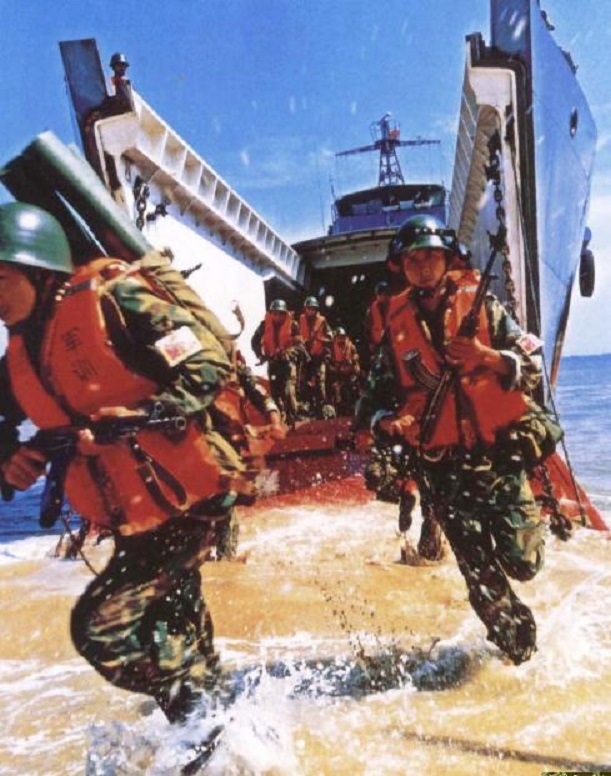
Of course, China will beat Vietnam and take over all the islands. When Vietnam loses the war and its islands, others countries, intimidated by Chinese military power, yet still with greediness to keep their interests, will negotiate with China, returning the islands and declaring allegiance to China. So China can build the ports and place troops on these islands, extending its influence into the Pacific Ocean.
Up till now, China has made a thorough breakthrough of the First Island Chain and infiltrated the Second one, Chinese aircraft carrier can have free access into the Pacific Ocean, safeguarding its own interests.

The 3rd War: “Reconquest” of Southern Tibet (Year 2035 to 2040)

China and India share a long border, but the only sparking point of conflicts between the two countries is only the part of Southern Tibet. China has long been the imaginary enemy of India. The military objective of India is to surpass China. India aims to achieve this by self-development and importing advanced military technologies and weapons from the U.S, Russia and Europe, chasing closely to China in its economic and military development.
In India, the official and media attitude is more friendly towards the U.S, Russia and Europe, and is repellent or even hostile against China. This leads to unresolvable conflicts with China. On the other hand, India values itself highly with the aids from the U.S, Russia and Europe, thinking it can beat China in wars. This is also the reason of long lasting land disputes.
In my opinion, the best strategy for China is to incite the disintegration of India. By dividing into several countries, India will have no power to cope with China.
Twenty years later, although India will lag behind more compared to China in military power, yet it is still one of the few world powers. If China uses military force to conquer Southern Tibet, it has to bear some losses. In my opinion, the best strategy for China is to incite the disintegration of India. By dividing into several countries, India will have no power to cope with China.
Of course, such plan may fail. But China should at least try its best to incite Assam province and once conquered Sikkim to gain independence, in order to weaken the power of India. This is the best strategy.
The second best plan is to export advanced weapons to Pakistan, helping Pakistan to conquer Southern Kashmir region in 2035 and to achieve its unification. While India and Pakistan are busy fighting against each other, China should take a Blitz to conquer Southern Tibet, at the time occupied by India.
India will not be able to fight a two front war, and is deemed to lose both. China can retake Southern Tibet easily, while Pakistan can control the whole Kashmir. If this plan cannot be adopted, the worst case is direct military action to take back Southern Tibet.
After the first two wars, China has rested for around ten years, and has become a world power both in terms of military and economy. There will only be the U.S. and Europe (on the condition that it becomes a united country. If not, this will be replaced by Russia. But from my point of view, European integration is quite probable) able to cope with China in the top three list in world power.
After taking back Taiwan and Spratly Islands, China has great leap forward in its military power in army, navy, air force and space warfare. China will be on the leading role in its military power, may be only second to the U.S. Therefore, India will lose this war.

The 4th War: “Reconquest” of Diaoyu Island [Senkaku] and Ryukyu Islands (Year 2040 to 2045)

In the mid-21st century, China emerges as the real world power, accompanied with the decline of Japan and Russia, stagnant U.S. and India and the rise of Central Europe. That will be the best time for China to take back Diaoyu Island and Ryukyu Islands. The map below is the contrast between ancient and recent Diaoyu Island and Ryukyu Islands (map omitted).
From the historical records of Chinese, Ryukyu and other countries (including Japan), Ryukyu has long been the vassal states of China since ancient times, which means the islands are the lands of China.
Many people may know that Diaoyu Island is the land of China since the ancient times, but have no idea that the Japanese annexed Ryukyu Island (currently named as Okinawa, with U.S. military base). The society and the government of China is misled by the Japanese while they are discussing on the issues of the East China Sea, such as the “middle-line” set by the Japanese or “Okinawa issue” (Ryukyu Islands in Chinese), by coming to think that Ryukyu Islands are the ancient lands of Japan.
What a shame for such ignorance! From the historical records of Chinese, Ryukyu and other countries (including Japan), Ryukyu has long been the vassal states of China since ancient times, which means the islands are the lands of China. In this case, is the “middle line” set by Japan in the East China Sea justified? Does Japan have anything to do with the East China Sea? (Those who have no idea in these details may refer to “Ryukyu: An indispensable part of China since the ancient times” written by me)
The Japanese has robbed our wealth and resources in the East China Sea and unlawfully occupied Diaoyu Island and Ryukyu Islands for many years, the time will come that they have to pay back. At that time, we can expect that the U.S. will be willing to intervene but has weakened; Europe will keep silent; Russia will sit and watch the fight. The war can end within half of a year with overwhelming victory of China. Japan will have no choice but to return Diaoyu Island and Ryukyu Islands to China. East China Sea becomes the inner lake of China. Who dare to put a finger on it?

The 5th War: Unification of Outer Mongolia (Year 2045 to 2050)

Though there are advocates for reunification of Outer Mongolia at the moment, is this idea realistic? Those unrealistic guys in China are just fooling themselves and making a mistake in strategic thinking. This is just no good to the great work of unification of Outer Mongolia.
China should also pick the groups advocating the unification, aiding them to take over key posts in their government, and to proclaim Outer Mongolia as the core interests of China upon the settlement of Southern Tibet issue by 2040.
After taking Taiwan, we should base our territorial claims on the constitution and domain of the Republic of China (some people may raise a question here: why should we base our claims on the constitution and domain of the Republic of China? In such case, isn’t the People’s Republic of China being annexed by the Republic of China? This is a total bullshit. I will say: the People’s Republic of China is China; the Republic of China is China too. As a Chinese, I only believe that unification means power. The way which can protect the Chinese best from foreign aggression is the best way to the Chinese people.
We also need to know that the People’s Republic of China recognizes the independence of Outer Mongolia. Using the constitution and domain of the People’s Republic of China to unify Outer Mongolia is naked aggression. We can only have legitimate cause to military action using the constitution and domain of the Republic of China. What’s more, it is the case after Taiwan being taken over by China. So isn’t it meaningless to argue which entity being unified?). China should raise the issue of unification with Outer Mongolia, and to take propaganda campaigns inside Outer Mongolia. China should also pick the groups advocating the unification, aiding them to take over key posts in their government, and to proclaim Outer Mongolia as the core interests of China upon the settlement of Southern Tibet issue by 2040.
If Outer Mongolia can return to China peacefully, it is the best result of course; but if China meets foreign intervention or resistance, China should be prepared to take military action. Taiwan model can be useful in this case: giving an ultimatum with deadline in the Year 2045. Let Outer Mongolia to consider the case for few years. If they refuse the offer, then military action takes off.
In this moment, the previous four wars have been settles. China has the political, military and diplomatic power to unify Outer Mongolia. The weakened U.S. and Russia dare not to get involved except diplomatic protests; Europe will take a vague role; while India, Africa and Central Asian countries will remain silent. China can dominate Outer Mongolia within three years’ time. After the unification, China will place heavy troops on frontier to monitor Russia. China will take ten years to build up elemental and military infrastructure to prepare for the claim of territorial loss from Russia.

The 6th War: Taking back of lands lost to Russia (Year 2055 to 2060)

The current Sino-Russian relationship seems to be a good one, which is actually a result of no better choice facing the U.S. In reality, the two countries are meticulously monitoring the each other. Russia fears the rise of China threaten its power; while China never forgets the lands lost to Russia. When the chance comes, China will take back the lands lost.
When the Chinese army deprives the Russians’ ability to counter strike, they will come to realize that they can no longer match China in the battlefield.
After the victories of the previous five wars by 2050, China will make territorial claims based on the domain of Qing Dynasty (similar way by making use of the domain of the Republic of China to unify Outer Mongolia) and to make propaganda campaigns favoring such claims. Efforts should also be made to disintegrate Russia again.
In the days of “Old China”, Russia has occupied around one hundred and sixty million square kilometre of lands, equivalent to one-sixth of the landmass of current domain of China. Russia is therefore the bitter enemy of China. After the victories of previous five wars, it is the time to make Russians pay their price.
There must be a war with Russia. Though at that time, China has become an advanced power in navy, army, air and space forces, it is nevertheless the first war against a nuclear power. Therefore, China should be well prepared in nuclear weapons, such as the nuclear power to strike Russia from the front stage to the end. When the Chinese army deprives the Russians’ ability to counter strike, they will come to realize that they can no longer match China in the battlefield. They can do nothing but to hand over their occupied lands and to pay a heavy price to their invasions

Obama’s War on Press Freedom


obamadoublespeak (2)
Free and open expression is our most fundamental right. Without it all others are endangered.
Candidate Obama promised transparency, accountability, and reform. He called sunlight “the best source of information about waste, fraud, and abuse.”
He said whistleblowing reflects “acts of courage and patriotism.”
“Often the best source of information about waste, fraud, and abuse in government is an existing employee committed to public integrity and willing to speak out.”
“We need to empower federal employees as watchdogs of wrongdoing and partners in performance.”
He pledged to “strengthen whistleblower laws to protect federal workers who expose waste, fraud, and abuse of authority in government.”
He said one thing. He did another. He usurped diktat powers. He wages war on truth. He targets whistleblowers. He threatens free expression.
Press freedom is endangered on his watch. He prioritizes surveillance powers.
They include warrantless wiretapping, accessing personal records, monitoring financial transactions, and tracking emails, Internet and cell phone use. It’s done lawlessly to gather secret evidence for prosecutions.
Obama wants truth and full disclosure suppressed. He wants  whistleblowers silenced. He targeted more than all his predecessors combined.
Press freedoms are endangered. A new Committee to Protect Journalist (CPJ) report explains.
CPJ calls itself “an independent, nonprofit organization that promotes press freedom worldwide.”
It “defends the right of journalists to report the news without fear of reprisal.”
It “ensures the free flow of news and commentary by taking action wherever journalists are attacked, imprisoned, killed, kidnapped, threatened, censored, or harassed.
It’s been operating since 1981. It publishes an annual global press freedom survey. It’s called “Attacks on the Press.”
Its new report headlined “The Obama Administration and the Press: Leak investigations and surveillance in post-9/11 America.”
Candidate Obama pledged open government. He fell woefully short. Journalists and press freedom advocates say he suppresses information people have a right to know.
He evades press scrutiny. He aggressively targets leakers. Electronic surveillance deters sources from speaking to journalists.
Restrictions began post-9/11. Obama exceeds the worst of George Bush. Interviews with dozens of fourth estate members
explained.
Government officials are increasingly reluctant to come forward. Press freedom is gravely endangered.
Anyone suspected of disclosing information Obama officials want kept secret is targeted. They’re investigated. They’re given lie detector tests. Their telephone logs and emails are reviewed.
An “Insider Threat Program” requires all federal employees to help prevent unauthorized leaks. It’s done by colleague monitoring.
Everybody is supposed to watch everyone else. Doing so is a whole new Big Brother notion.
It heightens paranoia. It makes government employees cautious about who they see and what they say.
Since 2009, six government employees, two contractors, and Edward Snowden faced criminal prosecutions. They were charged with leaking classified information to the press.
Other federal employees are being investigated. A climate of fear exists. Journalists and sources are reluctant to speak with each other.
They’re apprehensive about being watched. They fear repressive administration crackdowns.
According to Center for Public Integrity’s R. Jeffrey Smith:
“I worry now about calling somebody because the contact can be found out through a check of phone records or e-mails.”
“It leaves a digital trail that makes it easier for the government to monitor those contacts.”
New York Times reporter Scott Shane said he’s “scared to death…(W)e have a real problem.”
“Most people are deterred by those leaks prosecutions. There’s a gray zone between classified and unclassified information.”
“(M)ost sources are in it. It’s having a deterrent effect.”
“If we consider aggressive press coverage of government activities being at the core of American democracy, this tips the balance heavily in favor of the government.”
Times correspondent David Sanger called the Obama administration “the most closed, control freak (one he) ever covered.”
According to CPJ, Obama’s “war on leaks and other efforts to control information are the most aggressive since” Nixon.
Thirty journalists interviewed agreed. Sources hesitate to discuss unclassified information. They’re unresponsive to press inquiries.
They fear leak investigations and government spying make it harder for reporters to protect them as sources.
Administration officials suppress information journalists need to do their job. They’re less able to hold the White House accountable for its policies.
Obama lied saying “(g)overnment should be transparent. (He claimed he) promotes accountability and provides information for citizens about what their government is doing.”
New York Times public editor Margaret Sullivan said his administration is “turning out (to reflect) unprecedented secrecy and…attacks on a free press.”
Obama “said default should be disclosure. The culture they’ve created” discourages it. White House officials deny what journalists call a culture of secrecy.
According to AP senior managing editor Michael Oreskes:
“Sources are more jittery and more standoffish, not just in national security reporting. A lot of skittishness is at the more routine level.”
“The Obama administration has been extremely controlling and extremely resistant to journalistic intervention.”
“There’s a mind-set and approach that holds journalists at a greater distance.”
Washington Post reporter Rajiv Chandrasekaran said “one of the most pernicious effects is the chilling effect created across government on matters that are less sensitive but certainly in the public interest as a check on government and elected officials.”
“It serves to shield and obscure the business of government from necessary accountability.”
Bureaucratic bloat characterizes administration practice. In 2011, over four million Americans had security clearances.
Increasing amounts of information are classified as secret.
In 2011 alone, government employees made 92 million decisions on whether or not to classify information. Doing so is hugely overkill. Unauthorized disclosure is verboten.
Government employees revealing what the administration wants kept secret are targeted. So are journalists for reporting it. Doing so  prevents them from doing their job.
According to Washington-based Financial Times correspondent Richard McGregor:
“Covering this White House is pretty miserable in terms of getting anything of substance to report on in what should be a much more open system.”
CBS Washington correspondent Bob Schieffer calls the Obama administration “the most manipulative and secretive (one he ever) covered.”
Bush administration officials were confrontational. E.W. Scripps Washington bureau chief Ellen Weiss calls the Obama administration “far worse.”
Veteran political journalists Jim VandeHei and Mike Allen described its message machine as follows:
“One authentically new technique pioneered by the Obama White House is government creation of content – photos of the president, videos of White House officials, blog posts written by Obama aides – which can then be instantly released to the masses through social media.”
“And they are obsessed with taking advantage of Twitter, Facebook, YouTube and every other social media forum, not just for campaigning, but governing.”
“They are more disciplined about cracking down on staff that leak, or reporters who write things they don’t like.”
Veteran ABC White House correspondent Ann Compton said:
“There is no access to the daily business in the Oval Office, who the president meets with, who he gets advice from.”
Important meetings aren’t even listed on his public schedule.
“In the past, we would often be called into the Roosevelt Room at the beginning of meetings to hear the president’s opening remarks and see who’s in the meeting, and then we could talk to some of them outside on the driveway afterward.”
“This president has wiped all that coverage off the map. He’s the least transparent of the seven presidents I’ve covered in terms of how he does his daily business.”
Reporters complain about questions they ask going unanswered. Interview requests are denied.
Atlantic Media Washington correspondent Josh Meyer said he experiences “across-the board hostility.”
“They don’t return repeated phone calls and emails. They feel entitled to and expect supportive media coverage.”
They complain about reports they don’t like. “If a story is (something) they don’t want to come out, they won’t even give you the basic facts,” said Politico’s Josh Gerstein.
The Obama administration takes information control to a whole new level. Aggressively targeting whistleblowers and reporters compromises free expression.
Bradley Manning’s prosecution was a turning point. So was targeting Edward Snowden.
CPJ cited numerous examples of government subpoenas demanding information sources give journalists.
It discussed sweeping NSA spying. Washington Post national security reporter Dana Priest said:
“People think they’re looking at reporters’ records. I’m writing fewer things in email. I’m even afraid to tell officials what I want to talk about because it’s all going into one giant computer.”
CPJ expressed great concern saying:
It’s “disturbed that the Obama administration has chilled the flow of information on issues of great public interest, including on matters of national security.”
“The administration’s war on leaks to the press though the use of secret subpoenas against news organizations, its assertion through prosecution that leaking classified documents to the press is espionage or aiding the enemy; and its increased limitations on access to information that is in the public interest – all thwart a free and open discussion necessary to a democracy.”
CPJ executive director Joel Simon sent its report to the White House. He requested a meeting to discuss it.
“Here you have a portion of the Washington press corp affirming that this is an extraordinarily difficult administration to cover,” he said.
“You combine the different elements, for instance, the leak investigations, the failure to address the declassification issue, the fact that the administration has been extremely controlling in terms of access.”
“Put all these together, and it paints a pretty damning picture of an administration that talks about openness and transparency but isn’t willing to engage with the media around these issues.”
Bush administration officials mostly raised concerns. At times they threatened. Doing so was largely posturing.
The Obama administration wages war on whistleblowers. It targets journalists for doing their job.
Doing so reflects the most draconian crackdown on press freedom in US history. It’s the new normal.
Police states operate that way. Obama heads the worst of rogue governance. He threatens fundamental freedoms in the process.
Stephen Lendman lives in Chicago. He can be reached at lendmanstephen@sbcglobal.net.
His new book is titled “Banker Occupation: Waging Financial War on Humanity.”
Visit his blog site at sjlendman.blogspot.com.
Listen to cutting-edge discussions with distinguished guests on the Progressive Radio News Hour on the Progressive Radio Network.
It airs Fridays at 10AM US Central time and Saturdays and Sundays at noon. All programs are archived for easy listening.

The Vaccine Coverup: 30 Years of Secret Official Transcripts Show UK Government Experts Cover Up Vaccine Hazards To Sell More Vaccines And Harm Your Kids”

Region:

vaccin
by Child Health Safety
An extraordinary new paper [March 2012] published by a courageous doctor and investigative medical researcher has dug the dirt on 30 years of secret official transcripts of meetings of UK government vaccine committees and the supposedly independent medical “experts” sitting on them with their drug industry connections.
If you want to get an idea of who is responsible for your child’s condition resulting from a vaccine adverse reaction then this is the paper to read. What you have to ask yourself is if the people on these committees are honest and honourable and acting in the best interests of British children, how is it this has been going on for at least 30 years?
This is what everyone has always known but could never prove before now. Pass this information on to others so they can see what goes on in Government health committees behind locked doors.
We quote here from the author’s summary and the paper:
Deliberately concealing information from parents for the sole purpose of getting them to comply with an “official” vaccination schedule could be considered as a form of ethical violation or misconduct. Official documents obtained from the UK Department of Health (DH) and the Joint Committee on Vaccination and Immunisation (JCVI) reveal that the British health authorities have been engaging in such practice for the last 30 years, apparently for the sole purpose of protecting the national vaccination program.
The 45 page paper with detailed evidence can be downloaded here: The vaccination policy and the Code of Practice of the Joint Committee on Vaccination and Immunisation (JCVI): are they at odds? Lucija Tomljenovic, Neural Dynamics Research Group, Dept. of Ophthalmology and Visual Sciences, University of British Columbia, Vancouver, Canada.  It was presented at and forms part of the proceedings of The 2011 BSEM Scientific Conference now published online here: The Health Hazards of Disease Prevention BSEM Scientific Conference, March 2011.
There are other papers also found at that link which you will find an excellent read.
The author, Dr Lucija Tomljenovic writes:

Here I present the documentation which appears to show that the JCVI made continuous efforts to withhold critical data on severe adverse reactions and contraindications to vaccinations to both parents and health practitioners in order to reach overall vaccination rates which they deemed were necessary for “herd immunity”, a concept which with regards to vaccination, and contrary to prevalent beliefs, does not rest on solid scientific evidence as will be explained. As a result of such vaccination policy promoted by the JCVI and the DH, many children have been vaccinated without their parents being disclosed the critical information about demonstrated risks of serious adverse reactions, one that the JCVI appeared to have been fully aware of. It would also appear that, by withholding this information, the JCVI/DH neglected the right of individuals to make an informed consent concerning vaccination. By doing so, the JCVI/DH may have violated not only International Guidelines for Medical Ethics (i.e., Helsinki Declaration and the International Code of Medical Ethics) [2] but also, their own Code of Practice.
Dr Lucija Tomljenovic continues:
The transcripts of the JCVI meetings also show that some of the Committee members had extensive ties to pharmaceutical companies and that the JCVI frequently co-operated with vaccine manufacturers on strategies aimed at boosting vaccine uptake. Some of the meetings at which such controversial items were discussed were not intended to be publicly available, as the transcripts were only released later, through the Freedom of Information Act (FOI). These particular meetings are denoted in the transcripts as “commercial in confidence”, and reveal a clear and disturbing lack of transparency, as some of the information was removed from the text (i.e., the names of the participants) prior to transcript release under the FOI section at the JCVI website (for example, JCVI CSM/DH (Committee on the Safety of Medicines/Department of Health) Joint Committee on Adverse Reactions Minutes 1986-1992).
In summary, the transcripts of the JCVI/DH meetings from the period from 1983 to 2010 appear to show that:
1) Instead of reacting appropriately by re-examining existing vaccination policies when safety concerns over specific vaccines were identified by their own investigations, the JCVI either a) took no action, b) skewed or selectively removed unfavourable safety data from public reports and c) made intensive efforts to reassure both the public and the authorities in the safety of respective vaccines;
2) Significantly restricted contraindication to vaccination criteria in order to increase vaccination rates despite outstanding and unresolved safety issues;

3) On multiple occasions requested from vaccine manufacturers to make specific amendments to their data sheets, when these were in conflict with JCVI’s official advices on immunisations;

4) Persistently relied on methodologically dubious studies, while dismissing independent research, to promote vaccine policies;

5) Persistently and categorically downplayed safety concerns while over-inflating vaccine benefits;

6) Promoted and elaborated a plan for introducing new vaccines of questionable efficacy and safety into the routine paediatric schedule, on the assumption that the licenses would eventually be granted;

7) Actively discouraged research on vaccine safety issues;

8) Deliberately took advantage of parents’ trust and lack of relevant knowledge on vaccinations in order to promote a scientifically unsupported immunisation program which could put certain children at risk of severe long-term neurological damage;

Notably, all of these actions appear to violate the JCVI’s own Code of Practice.
Read the paper here for the full evidence to back up these conclusions in its 45 pages.  An excellent piece of investigative research:
The vaccination policy and the Code of Practice of the Joint Committee on Vaccination and Immunisation (JCVI): are they at odds?
And don’t forget to read more from the proceedings of The 2011 BSEM Scientific Conference now published online here:
The Health Hazards of Disease Prevention – BSEM Scientific Conference, March 2011.

Government “Debt Default” and Food Stamp Shutdown Nationwide?

As revealed in the video report below, a dramatic situation is unfolding across America pointing to a slash of the Food Stamp program.
It is worth noting that in late September the House of Representatives “passed a bill that would slash food stamp funding by nearly $40 billion over ten years, kicking four million people off the program next year.”
“While the White House and congressional Democrats have said they will not accept the bill in its present form, its passage sets the baseline for a deal by the Democrats, who also favor significant cuts in food aid to the poorest Americans.
The food stamp bill would cut $39 billion from the Supplemental Nutrition Assistance Program (SNAP) over ten years. It would force adults between 18 and 50 to either work or attend work training to reapply for benefits, and would also institute drug testing for recipients.” (For further details see  Slashing Food Stamp Funding: US Congress Moves to cut billions in Food Aid By Andre Damon, September 21, 2013

The U.S. Has Repeatedly Defaulted: It’s a Myth that the U.S. Has Never Defaulted On Its Debt

Region:

dollar2
Some people argue that countries can’t default.  But that’s false.
It is widely stated that the U.S. government has never defaulted.  However, that is also a myth.
Catherine Rampbell reports in the New York Times:
The United States has actually defaulted on its debt obligations before.
The first time was in 1790, the only episode Professor Reinhart unearthed in which the United States defaulted on its external debt obligations. It also defaulted on its domestic debt obligations then, too.
Then in 1933, in the midst of the Great Depression, the United States had another domestic debt default related to the repayment of gold-based obligations.
(Update.)
Donald Marron points out at Forbes:
The United States defaulted on some Treasury bills in 1979 (ht: Jason Zweig). And it paid a steep price for stiffing bondholders.
Terry Zivney and Richard Marcus describe the default in The Financial Review…:
Investors in T-bills maturing April 26, 1979 were told that the U.S. Treasury could not make its payments on maturing securities to individual investors. The Treasury was also late in redeeming T-bills which become due on May 3 and May 10, 1979. The Treasury blamed this delay on an unprecedented volume of participation by small investors, on failure of Congress to act in a timely fashion on the debt ceiling legislation in April, and on an unanticipated failure of word processing equipment used to prepare check schedules.
The United States thus defaulted because Treasury’s back office was on the fritz in the wake of a debt limit showdown.
This default was temporary. Treasury did pay these T-bills after a short delay. But it balked at paying additional interest to cover the period of delay. According to Zivney and Marcus, it required both legal arm twisting and new legislation before Treasury made all investors whole for that additional interest.
Many consider Nixon’s decision to refusal to redeem dollars for gold to constitute a partial default.  For example, University of Massachusetts at Amherst economics professor Gerald Epstein notes:
Forty years ago this month, on August 15, 1971, President Nixon “closed the gold window”, refusing to let foreign central banks redeem their dollars for gold, facilitating  the devaluation of the U.S dollar which had been fixed relative to gold for almost thirty years. While not strictly a default on a US debt obligation, by closing the gold window the US government abrogated a financial commitment it had made to the rest of the world  at the Bretton Woods Conference in 1944  that set up the post-war monetary system. At Bretton Woods, the United States had promised to redeem any and all U.S. dollars held by foreigners – later limited to just foreign central banks — for $35 dollars an ounce. This promise explains why the Bretton Woods monetary system was called a “gold exchange standard” and why many believed the US dollar to be “as good as gold”.  When Nixon refused to let foreign central banks turn in their dollars for gold, and encouraged the devaluation of the dollar which reduced the value of foreign central bank holdings of dollars, the Nixon administration effectively “defaulted” on the United States’ long-standing obligations ending once and for all the Bretton Woods System.
James Grant says in the Washington Post:
The U.S. government defaulted after the Revolutionary War, and it defaulted at intervals thereafter. Moreover, on the authority of the chairman of the Federal Reserve Board, the government means to keep right on shirking, dodging or trimming, if not legally defaulting.
Default means to not pay as promised, and politics may interrupt the timely service of the government’s debts.
***
Things were very different when America owed the kind of dollars that couldn’t just be whistled into existence. By 1790, the new republic was in arrears on $11,710,000 in foreign debt. These were obligations payable in gold and silver. Alexander Hamilton, the first secretary of the Treasury, duly paid them. In doing so, he cured a default.
***
But in the whirlwind of the “first hundred days” of the New Deal, the dollar came in for redefinition. The country needed a cheaper and more abundant currency, FDR said. By and by, the dollar’s value was reduced to 1/35 of an ounce of gold.
By any fair definition, this was another default. Creditors both domestic and foreign had lent dollars weighing just what the Founders had said they should weigh. They expected to be repaid in identical money.
Language to this effect — a “gold clause” — was standard in debt contracts of the time, including instruments binding the Treasury. But Congress resolved to abrogate those contracts, and in 1935 the Supreme Court upheld Congress.
The “American default,” as this piece of domestic stimulus was known in foreign parts , provoked condemnation in the City of London. “One of the most egregious defaults in history,” judged the London Financial News. “For repudiation of the gold clause is nothing less than that. The plea that recent developments have created abnormal circumstances is wholly irrelevant. It was precisely against such circumstances that the gold clause was designed to safeguard bondholders.”
The lighter Roosevelt dollar did service until 1971, when President Richard M. Nixon lightened it again. In fact, Nixon allowed it to float. No longer was the value of the greenback defined in law as a particular weight of gold or silver. It became what it looked like: a piece of paper.

John Chamberlain argues at the Mises Institute that the U.S. defaulted on its:

  • Continental Currency in 1779

  • Domestic debt between 1782 through 1790

  • Greenbacks in 1862

  • Liberty Bonds in 1934

States Have Defaulted Also


States have also defaulted.  The Wall Street Journal notes:

Land values soared. States splurged on new programs. Then it all went bust, bringing down banks and state governments with them. This wasn’t America [today], it was America in 1841, when a now-forgotten depression pushed eight states and a desolate territory called Florida into the unthinkable: They defaulted on debts.

And Catherine Rampbell explains:

There were two episodes when a spate of American states defaulted on their debts, in 1841-42 (nine states) and 1873-84 (10 states). The havoc wreaked by these state-level defaults is part of the reason that so many states now have constitutional balanced-budget requirements.

China Alleges that the U.S. Has Already Defaulted By Weakening the Dollar

James Grant argues:
If today’s political impasse leads to another default, it will be a kind of technicality. Sooner or later, the Obama Treasury will resume writing checks. The question is what those checks will buy.
***
This is the unsustainable conceit of the world’s superpower-cum-super debtor. By deed, if not audible word, we Americans say: “The greenback is the world’s great monetary brand. You have no choice but to use it. Like it or lump it.” But the historical record of paper currencies is clear: Governments always over-issue it. The people finally do lump it.”
(Indeed, the average life expectancy for a fiat currency is less than 40 years.)
And our creditor – China – has said that America has already defaulted by printing too many dollars. For example:
A Chinese ratings house has accused the United States of defaulting on its massive debt, state media said Friday, a day after Beijing urged Washington to put its fiscal house in order.
“In our opinion, the United States has already been defaulting,” Guan Jianzhong, president of Dagong Global Credit Rating Co. Ltd., the only Chinese agency that gives sovereign ratings, was quoted by the Global Times saying.
Washington had already defaulted on its loans by allowing the dollar to weaken against other currencies – eroding the wealth of creditors including China, Guan said.
That might be Chinese propaganda. But the point remains that the U.S. might not be able to print money forever without facing consequences from its creditors.

US SHIP SEIZED BY VENEZUELA

Posted by George Freund on October 13, 2013

-
In an interesting turn of events the Venezuelan Navy entered Guyanese waters and arrested an American ship - well sort of an American ship. It flies the Panamanian flag and is owned by a Singaporean survey company and has Americans aboard. So in today's world that's as American as apple pie. The most important detail is the Research Vessel Teknik Perdana is operating under contract if not cover of American BIG OIL. It is working for the Texas oil giant Anadarko Petroleum Corporation of The Woodlands, Texas.
-
It is one of the world's largest even though it is not the household word of the others. It was partners with BP's Macondo Prospect which resulted in the Deepwater Horizon oil spill. Anadarko was billed $272 million by BP for the privilege of partnership. They settled for a $4 billion payoff losing 25% of the Macondo to BP. I was never really good at math so I guess that makes sense to someone. CUI BONO?
-

-
Of course everyone's opinion on the position of the ship changes with the wind, but a vessel tracker website has posted its position as above. However, as the story goes, we should be more concerned with so below. Anadarko contracted with FMC Technologies Inc. They specialize in providing subsea services. They can master the ocean floor together for many purposes. Few, if any, can inspect the work of these companies that far beneath the surface. Venezuela is far from the good intentions of the United States. Of greater concern would be a covert contract with the intelligence services. It has happened before with the Glomar Explorer in Project Jennifer or Project Azorian as The National Security Archive calls it. Glomar Explorer was operated by Texas oil billionaire Howard Hughes.
-

-
Of course the marine tracker puts our ship heading out into the Atlantic and leaves out the actual position by latitude and longitude. One would be naturally suspicious of that I think. Another bizarre thing is a website devoted to the Teknik Perdana went AWOL with Comrade Google. What could they possibly be doing that would make even a cached copy of the page disappear?
-

-
This is a picture of the ship that appeared on the site that I was able to salvage. Was there something there that implies they're up to no good? From my archives we reported the arrest of another Panamanian ship playing games with the Ecuadorian Navy. That one included a luxury yacht, a submarine and Russian operatives. So I think the Venezuelans are right on the money seizing the ship. Another ship called the Chikyu drilled some record setting holes on the fault line off Japan before a certain event. Oh what a tangled web they weave when there is no one to show you how they deceive.
-

-
They have the technology to do almost anything. The movements of these special purpose ships can never be assumed to be benign. In safeguarding your coastline, they should be under severe surveillance. Of course if they get away with an earthquake or tsunami, you'll be cleaning for weeks or halflives if you have a nuclear plant on the coast. It's too bad we don't teach these things very well at naval colleges. The world moves at the speed of the predator not the pray. The Venezuelans may have understood that. Mr. R. A (Al) Walker is CEO of Anadarko. I wonder if he is related to the Walker/Bush clan?

Tide Turning As N.Y. And Mass. Cities Pass Nation’s Toughest Anti-NDAA Resolutions

Mikael Thalen
by
October 14th, 2013
Updated 10/14/2013
The nation’s two strongest resolutions blocking the indefinite detention provisions of the National Defense Authorization Act (NDAA) were passed in New York and Massachusetts last week, following a long campaign by activists and several civil liberties groups.
SoldierNDAASignUnder the NDAA, signed by President Obama in Dec. 2011, sections 1021 and 1022 officially declare the United States a “battlefield,” where American citizens can be placed in military prisons for the rest of their lives without trial, charge, or access to a lawyer, based merely on the government’s unverified claim that a person is in the commission of a “belligerent act.”
The Albany, NY Common Council struck down the NDAA in an 11-0 vote last Monday, successfully passing Resolution 80.92.13. Albany has now become the nation’s first city to place an outright ban of indefinite detention, removing the federal government’s “battlefield” classification by deeming it completely unconstitutional. In fact, elected officials, police officers and any state employee who took an Oath to the U.S. Constitution is now required by law to stop any indefinite detention attempts made by federal agents on the residents of Albany.
A diverse coalition of civil rights groups including the Patriot Coalition, Project SALAM, Occupy Albany, Campaign for Liberty New York and People Against the NDAA (PANDA), were key in the resolution’s passage.
“This is what citizen activism looks like. Albany residents Jesse Calhoun and Lynne Jackson, from opposite sides of the political spectrum, decided that now was the time to stop the NDAA in their city, and they did just that,” PANDA founder Dan Johnson told Storyleak.
Only two days after the victory in Albany, residents of Oxford, MA, not only blocked indefinite detention, but also blocked the federal government’s alleged right to “targeted killing.” Oxford’s resolution was passed by 95 percent of attendees at the city’s unique “Town Meeting,” where residents, not elected officials, are allowed to vote on issues once a minimum amount of signatures are collected.
“As we celebrate the victory, let us not lose sight of the long road ahead of us. There is work that still needs to be done, but together, we will restore constitutional governance to the Commonwealth of Massachusetts,” said PANDA Massachusetts Team Leader Benjamin Selecky.
The actions seen in both states represent the growing number of Americans becoming engaged and aware of pertinent issues. While much of the media has continued to ignore the reality and dangerous ramifications of indefinite detention, anti-partisan groups have continued to bring the subject to the forefront, turning the tide in the public debate.
“Now that the tide is turning, it is time to take back our towns. Since Albany and Oxford we have had nearly 50 people grab our packet and start approaching their cities and counties about this issue. These two cities started a tidal wave, and it won’t be stopped,” said Johnson.
Learn how you can take back your town here: http://pandaunite.org/takeback