Thursday, March 14, 2013

Financial crisis revealed and resolved in the world of Bitcoin


Financial crisis revealed and resolved in the world of Bitcoin
By Adam B. Levine
Contributing writer for End the Lie
http://endthelie.com/wp-content/uploads/2013/03/Bitcoin-accepted-here.jpg
(Image credit: Adam Crowe/Flickr)
Monday, March 11th saw calamity strike at the core of the Bitcoin system – over the last 3 years the number of users has increased exponentially, and the value along with it.  In the past we’ve seen large public thefts, but Monday’s event was fundamentally different.
Note: be sure to read Adam’s previous article, “Ulterior motives behind the Copyright Alert System
Bitcoin is basically one big public distributed ledger (known as The Blockchain) where the ownership of every Bitcoin ever created is tracked, accounted for, and verified automatically by various participants in the system.  Transactions can be detected within a few seconds, but merchants generally take the hour or so to gather 6 confirmations to ensure the payment cannot be reversed.
Other participants, upon receiving news of the ownership transfer (payment), check the payer’s account to ensure that they haven’t already spent them publicly.  A confirmation is the return message saying “Yes, this all seems to be in order, the value is truly available to be transferred to the intended recipient and we’ve updated our ownership records to reflect that.”
With that background in mind, on Monday the blockchain split in two without warning.
http://endthelie.com/wp-content/uploads/2013/03/blockchain-split.jpg
Why’d it happen?
Call it growing pains – Berkeley Database (BDB) was used for versions of the Bitcoin software .7 and below and as luck would have it, will accept a maximum number of changes per block.  The protocol’s self adjusting difficulty seeks to issue a block every 10 minutes.  As Bitcoin usage has increased, so have the number of transactions contained in the average block.
So what happened?
On Monday, a single block went through the system containing 1700 transactions, and was rejected by the participants still running on .7 due to how many changes it made.  Had everyone been running .7, the block would have been rejected and the transactions processed in (hopefully) smaller blocks.
Because an upgrade to .8 was rolled out several months ago that switched to a different database system without the same limitation, we found ourselves with two separate blockchains (ledgers) each disagreeing with the other’s interpretation of reality.   Those running .7 saw too-large blocks as invalid, while to those running .8, everything was normal and the larger blocks were acceptable and built upon.
Cause and effect
An alert went out immediately (at 1:30am UTC) from the mostly volunteer open source development team letting merchants know to not accept Bitcoins for the next few hours while the system sorted itself out.  To miners, they asked that everyone revert back to .7 so no incompatible blocks will be generated. The average user was unaffected.
Crisis isn’t good for anyone, so participants quickly fell in line wanting to resolve the issue as soon as possible.   Within 8 hours things were back to normal;  If you live in America, chances are pretty good you slept through the whole thing, including the 23% drop in price, which vanished by morning.
Schrödinger’s Bitcoin
The “Double Spend” is the bogeyman of digital currency world. Since Bitcoins are just data and data can be copied, what’s to protect a merchant from being paid with money already spent elsewhere?  This is the function of the blockchain, which represents the network consensus of reality.
When that consensus broke down due to the fork, it created a state best represented by the Schrödinger’s Cat thought experiment – one in which a single entity simultaneously and paradoxically exists in two states, only one of which can eventually be real.
During the disruption, one large Double Spend actually occurred and was paid out in US Dollars.  When the faulty blockchain was abandoned, the reality consensus settled on the backwards compatible ledger.  In this case, payment processor OKPAY was left without the Bitcoins they thought they received, and were also still out the nearly $10,000 they exchanged for them.
This is the most valuable instance of a successful Double Spend in the Bitcoin ecosystem, which can only occur under the Schrödinger’s Bitcoin scenario described above.
Luckily this story has a happy ending.  Both parties “did the right thing” and have refunded each other. But will things work so well next time?  Will there be a next time, is this situation repeatable?
I asked Gavin Andresen, Lead Developer on the Bitcoin project about the risks moving forward:
Question: Are “Double Spends” possible under normal circumstances?
Gavin: Double-spend risk is not a “yes or no” — like most risks, it is “more risky” or “less risky”, down to “So little risk I won’t worry about it.  One of the reasons I still tell people “bitcoin is an experiment” is because everybody is still figuring out where the edge-case risks are.
Q: So for the average user or merchant, how much risk is there in every-day use?
G: For the, average user or merchant delivering a physical product to customers:  I’d say very close to zero risk after 3 confirmations.  Exchanges or merchants that deliver “cash-like” high-value products or services have their own particular set of risks, and they need to be more careful. merchants that deliver services that have a zero marginal cost to them (e.g. “Subscribe to my e-magazine”) have even less risk than users or merchants delivering physical products.
And all of that is modified if you have some trust in the person you’re transacting with.  I recently sold a couple thousand dollars worth of bitcoin to a friend who promised to send me a check in the mail, and I was happy to do that.
Q: In your worst case scenario, where you flat out do not trust the person but want to do business with them, what would you recommend?
G: For ultimate trust transacting a huge amount of value to somebody who I think will try to rip me off– 24 hours would be the “100% safe” time.  It really is confirmations and not time, but unless something wacky is happening those two are equal after 6 confirmations or so.
I pick 24 hours because that would be 120+ confirmations.  I can’t conceive of a situation where “we” (the shared consensus of the bitcoin network) would allow a 120-block fork to happen that double-spent
Q: Now that the issue has been resolved for a day, any lessons learned or things that will be improved on?
G: actually one really stupid/simple thing ‘we’ should have done long ago:  make it easy for bitcoin services to get alerts sent to their email/SMS/etc.  We’ll be concentrating on things like improving communication during crises, because no two crises are exactly alike.
Regarding specific tasks:  implementing a -alertnotify=<run some command> is very high on my TODO list. That’s easy to do, and is the thing I’m kicking myself for not doing sooner
Q: What does that mean?
G: That means “if you get an alert, run this command to tell me about it” where “this command” is specified by the service operator — send email, send sms, whatever
Moving forward
History would have us believe Bitcoin scandal leads to big losses in the trading value of the currency, but this time was different.  Despite the currency itself seeming at risk and the impossible momentarily made real, the price immediately bounced back up to near all-time highs.
Bitcoin may be small as currencies go, but the hourly chart below speaks volumes given that every 1K Bitcoins represents about $50,000 USD.
http://endthelie.com/wp-content/uploads/2013/03/bitcoinchart.png
So here we are, less than 72 hours after the event, and we’re basically back to where we started.  The system is stable, the fork abandoned and the consensus reality once again agreed upon.  And all this with a basically volunteer development team who has no real ability to make anybody do anything, outside of telling them it’s a good idea.
Compare that to the ongoing crisis in currencies controlled by central banks, who have the unilateral authority not only to make all decisions related to their respective monetary policy, but also the ability to issue more bills at will, should the need arise.
Lacking such an option, Bitcoin is forced to deal with its problems and try as quickly as possible to return to a state of normality. So does it work? For now, the answer is a definitive “yes,” but since it was just created in 2009, only time will tell.
From where I’m sitting this was just about as good an outcome as anyone could hope for.  No value was lost, even though the system prides itself on irreversible transactions (which once you’ve dealt with Paypal’s merchant Chargebacks, you begin to see the appeal of).
The development team isn’t hiding the cause of the recent issue and is instead using this as a reason to dig into the response with work being done on an internal, comprehensive post-mortem.
They’ve taken the whole thing as a learning opportunity and have pledged to implement a more agile communication-alert system so if this does happen again, users will be alerted and large users will take appropriate precautions.
I like to see people with power admit they are not omniscient, and in this world of centrally planned money it’s too rare a thing.
One thing is certain: Bitcoin isn’t suffering for lack of its own Bernanke, and that should give us all reason to hope.
Adam writes about new technology at Mind to Matter and forestry, photography and custom wood products at NapaWood. You can contact Adam here.
Edited by Madison Ruppert
Did I forget anything or miss any errors? Would you like to make me aware of a story or subject to cover? Or perhaps you want to bring your writing to a wider audience? Feel free to contact me at admin@EndtheLie.com with your concerns, tips, questions, original writings, insults or just about anything that may strike your fancy.

Go Ahead and Short Your 'InTrade Will Come Back' Contract

from the betting-the-house dept

Cross-posted from
While most of you are busily reading about the latest effort from U.S. News to calculate with the incalculable, applying its formula to tease out razor-thin distinctions between law schools, you’re missing the demise of the once lauded Internet prediction site, InTrade. What were the odds? Over the weekend, the Irish-based website shuttered itself completely, noting in a statement to customers that there may be “financial irregularities.” Uh-oh.
All this comes at the worst possible time for InTrade customers, who were looking to cash in on that sweet, sweet Conclave action…

Customers in the U.S. already lost access to InTrade back in November, when the CFTC waved around a 2005 cease and desist. The CFTC’s beef with InTrade revolved around the website selling contracts that looked an awful lot like commodity futures. The CFTC does not like commodity futures traded from outside their regulatory framework. And even though InTrade specifically asked the CFTC to step in and regulate their trading, the CFTC opted to functionally shut them down (once the Presidential election contracts were all paid out, of course). The CFTC didn’t give a very clear explanation for this decision, but the CFTC apparently felt that allowing micro-level trading on commodity futures constituted a societal ill they could not accept — while institutional investors tossing around trillions seems perfectly harmless. Or the CFTC was just lazy. Never underestimate “just lazy.”
InTrade’s closure over the weekend was not related to trading commodity futures, but some vague suggestion of “financial irregularities.” Details remain sketchy, but the best guess out there alleges that InTrade failed to maintain duly segregated accounts.
What on earth is going on? My best guess is that the margin posted by traders was not held, as it should be, in segregated accounts separate from company funds. When bets are made on this market, both parties must post margin equal to their worst-case loss, so that neither is subject to counterparty risk. In effect, each party is taking a position against the exchange, but these positions are exactly offsetting so the exchange bears no risk. To ensure that all promised payments can be made, these funds must be held in the form of cash, insured deposits, or safe dollar-denominated securities such as Treasury bills. They cannot be invested in risky assets, and cannot be used for the payment of salaries or expenses.
The latter point about the “payment of salaries or expenses” is in line with the recent announcement that auditors had flagged payments to InTrade’s former CEO, the late John Delaney.
The loss of InTrade will spark glowing eulogies from multiple sectors, but losing the political prediction market will be the toughest loss. The political reporting class openly crowed about InTrade’s predictive power for years. The Washington Post already published its lament over the passing of InTrade as the loss of the last, best hope for pundit accountability:
It’s a shame, and this is why. We live in a world of punditry in which there are large amounts of, to put it nicely, horse manure. Those of us who write and talk about what will happen inevitably rely on vague predictions, full of qualifications. I’m guilty of it myself, and often find myself writing things like “this ought to be an OK year for the economy, if fiscal austerity isn’t too severe and there isn’t a return of the European crisis.”
On Intrade, by contrast, the traders who participate and collectively set market prices, are forced to choose—and put money where their mouths are. Will the United States enter a recession in 2013? Before it shut down, the prices for that contract on Intrade implied a 16.9 percent chance that the answer was “yes.” In a world in which people hold their pundits to a higher standard, people spouting off on the economy (or politics, or foreign affairs, or the selection of the pope) would be forced to make specific, testable predictions, and attach probabilities to those guesses.
I actually thought the best hope for pundit accountability would be a media willing to confront their own pundits with past flawed predictions, rather than sweeping the past under the rug every day, but what do I know?
But the legal fallout from the end of InTrade, for the U.S., will be the inevitable rise of the next online predictive market. With InTrade out of the way, some other online gambling site — anyone from PaddyPower to Betfair — will grow into the hole created by InTrade, subtly open itself to U.S. customers, and likely reignite the legal battles with the CFTC all over again. Hopefully, next time around, cooler heads will prevail at the CFTC and welcome these predictive markets to the regulatory regime.
But I’m not buying that contract.
To Our Customers [InTrade]
A Prediction Market Mystery [Rajiv Sethi]
RIP Intrade: The Last, Best Hope for Pundit Accountability [Washington Post]
Now You Can’t Buy Your Crude Oil Futures In $10 Increments On Intrade [DealBreaker]

Court will sanction Prenda lawyers if they don’t appear March 29

John Steele and other Prenda officials' porn-trolling days may be numbered.

Judge Otis Wright is angry. He ordered the principals of the porn-trolling firm Prenda law to come to his courtroom and justify their conduct at a Monday hearing. Most of them made lame excuses and skipped the hearing. The one former Prenda attorney who did show up, Brett Gibbs, portrayed himself as a mere pawn carrying out the orders of his bosses, John Steele and Paul Hansmeier. "Someone has an awful lot to hide," Judge Wright said at Monday's hearing.
Now Judge Wright has issued an order that's even more ominous than his previous ones. Steele, Hansmeier, and other Prenda officials are ordered to report to his courtroom on March 29 to answer for a long list of alleged misconduct. In addition to the charges raised in Monday's hearing, Judge Wright now wants Prenda to explain "why they should not be sanctioned for defrauding the Court" about the relationships among Prenda's various shell companies.
Prenda filed a request to be excused late in the day on the Friday before the last hearing. In Thursday's order, Judge Wright wrote that the motion's "eleventh-hour filing exemplifies gamesmanship." Judge Wright wants Prenda's lawyers to explain why they shouldn't be punished for failing to show up on Monday.
"Should the persons and entities in subparagraphs a–m above not appear on March 29, 2013, the Court is prepared to draw reasonable inferences concerning their conduct in the cases before the Court, including any inferences derived from their failure to appear," Judge Wright wrote. "Failure to comply with this order will result in the imposition of sanctions."
The wheels of justice move slowly—frustratingly slowly for those who were rooting for Prenda's top lawyers to receive harsh penalties on Monday. But Judge Wright's latest order makes it clear that he has no intention of dropping the issue, and that continued defiance of his orders will only make things worse.
At this point, Prenda's top lawyers may have to worry about more serious problems than an angry judge, like criminal penalties. As Ken from Popehat suggested, Prenda's lawyers "should only submit to questioning about their conduct after a very serious discussion with competent attorneys about their constitutional rights."
Correction: This story originally suggested Prenda's lawyers filed its Friday motion on paper as a delaying tactic. But a source tells us that as non-parties to the case, Steele and company may have been unable to e-file. Accordingly, we've removed that sentence.

911 tech pinpoints people in buildings—but could disrupt wireless ISPs

FCC decision could wreak havoc on ISPs, baby monitors, and smart meters.

NextNav's enhanced 911 technology locates people within buildings—but may interfere with millions of existing devices.
Cell phones replacing landlines are making it difficult to accurately locate people who call 911 from inside buildings. If a person having a heart attack on the 30th floor of a giant building can call for help but is unable to speak their location, actually finding that person from cell phone and GPS location data is a challenge for emergency responders.
Thus, new technologies are being built to accurately locate people inside buildings. But a system that is perhaps the leading candidate for enhanced 911 geolocation is also controversial because it uses the same wireless frequencies as wireless Internet Service Providers, smart meters, toll readers like EZ-Pass, baby monitors, and various other devices.
NextNav, the company that makes the technology, is seeking permission from the Federal Communications Commission to start commercial operations. More than a dozen businesses and industry groups oppose NextNav (which holds FCC licenses through a subsidiary called Progeny), saying the 911 technology will wipe out devices and services used by millions of Americans.
Harold Feld, legal director for Public Knowledge, a public interest advocacy group for copyright, telecom, and Internet issues, provided the best summary of these FCC proceedings in a very long and detailed blog post:
Depending on whom you ask, the Progeny Waiver will either (a) totally wipe out the smart grid industry, annihilate wireless ISP service in urban areas, do untold millions of dollars of damage to the oil and gas industry, and wipe out hundreds of millions (possibly billions) of dollars in wireless products from baby monitors to garage door openers; (b) save thousands of lives annually by providing enhanced 9-1-1 geolocation so that EMTs and other first responders can find people inside apartment buildings and office complexes; (c) screw up EZ-Pass and other automatic toll readers, which use neighboring licensed spectrum; or (d) some combination of all of the above.
That’s not bad for a proceeding you probably never heard about.

All eyes on the FCC

While the Progeny proceeding has flown under the radar, the FCC may be inching toward a decision. The FCC's public meeting next Wednesday will tackle the problem of improving 911 services. Feld says the FCC seems to be close to making a decision, although the FCC itself did not respond to our requests for comment this week. All the public documents related to the proceeding are available on the FCC website.

"The FCC appears poised to completely disregard technical reality."
NextNav's website says the company "was founded in 2007 to solve the indoor positioning problem." But it has no revenue today, and it won't unless the FCC approves its application or it finds another line of business. The Wireless Internet Service Providers Association (WISPA) is worried that the FCC will rule in Progeny's favor, despite tests that WISPA and others believe prove Progeny service would degrade performance of many existing devices or render them unusable altogether.
"The FCC appears poised to completely disregard technical reality, disregard the record in their own proceeding and give final approval to Progeny to do something that's going to be very disruptive to the band that's been in use for 20 years harmoniously by millions of users," Jack Unger, WISPA's technical consultant, told Ars.
The band in question is 902-928MHz. This band is similar to Wi-Fi in that it permits many unlicensed uses such as the ones mentioned earlier in this article. It also permits a select few licensed uses, including Progeny's M-LMS (Multilateration Location and Monitoring Service), which forms the backbone of its enhanced 911 service.
NextNav has already set up a network of roughly 60 transmitters to cover a 900-square-mile area including San Francisco, Oakland, and San Jose, NextNav CEO Gary Parsons told Ars in a phone interview. NextNav has begun deployments in the rest of the top 40 markets in the country, but the Bay Area is the only one fully built out.
Enlarge / NextNav's marketing pitch.
"We've been actually broadcasting in the San Francisco and Silicon Valley area now, portions of it, for over three years," Parsons said. NextNav has FCC licenses allowing it to transmit, but it needs a further approval in order to begin commercial operations, he said.

Progeny technology may not solve the 911 problem

"If you're trying to send someone to a heart attack victim, you better hope they can tell you where they are."
In order to work, the GPS chips in the next generation of cell phones would need to be slightly modified to allow communication with the Progeny network. That's just a software upgrade, but one that has to be done prior to a phone being built, Parsons said. Why is this necessary? GPS is good at locating people outside, but not indoors, Parsons said. "What we bring to the party is a location accuracy that is much more precise than that which is currently available, with the ability to identify vertically what floor you're on," Parsons said. "It's one thing knowing what block you're in, but if you're trying to send someone to a heart attack victim on the 89th floor of the Chrysler Building in New York, you better hope they can tell you where they are."
Results for the Progeny system are promising, but perhaps not enough so to declare it a winner. An FCC advisory committee known as CSRIC (Communications Security, Reliability, and Interoperability Council) gave Progeny high marks compared to contenders Qualcomm and Polaris in a report dated February 19, 2013. (Unger provided a copy of this report to Ars.)
Progeny claims horizontal accuracy to within 20 meters and vertical accuracy to within 2 meters. But the CSRIC report said that even today's best technology consistent enough.
"[P]rogress has been made in the ability to achieve significantly improved search rings in both a horizontal and vertical dimension," CSRIC wrote. "However, even the best location technologies tested have not proven the ability to consistently identify the specific building and floor, which represents the required performance to meet Public Safety's expressed needs. This is not likely to change over the next 12-24 months. Various technologies have projected improved performance in the future, but none of those claims have yet been proven through the test bed process."

One set of test results, interpreted in many different ways

NextNav and its opponents collaborated on a series of tests to determine how the Progeny system would interact with WISP signals and smart meters. The test results were released last October. The numbers themselves aren't in dispute, but each side interprets them very differently.
Among Progeny's opposition is the Part 15 Coalition (Part 15 of the FCC rules regulate the operation of low power devices on unlicensed spectrum). Besides those already mentioned, Part 15 technology includes devices that monitor safety of gas and oil pipelines, hearing aids, Plantronics headsets, and emergency response devices made by Inovonics, said Henry Goldberg, counsel for the Part 15 Coalition.
Goldberg told Ars that the Progeny system has an 80 percent duty cycle (meaning it operates 80 percent of the time), and that Progeny's 30-watt transmissions would overwhelm the 1-watt transmissions used by numerous Part 15 devices.
This is one example of where the two sides interpret the same results differently. Parsons said each Progeny transmitter operates only 10 percent of the time, explaining that the 80 percent figure is true only when you add up the transmissions of devices within range of each other.
"What [Progeny opponents] generally fail to note is the ones they are seeing that are far away have a very weak signal coming in," Parsons said. "They might see one or two strong ones and six more that are miles away and at a much lower intensity level."
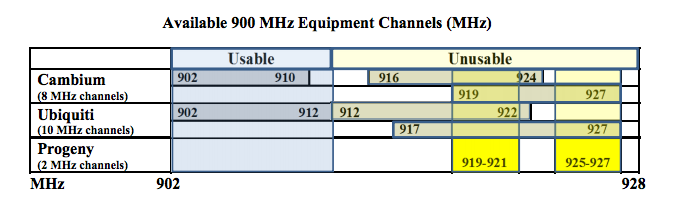
Progeny operates on a total of 4MHz in the 902-928MHz band, roughly within 920-922 and 926-928, he said. Smart meters that periodically report statistics to utilities could occasionally miss one transmission due to interference from Progeny but get the data through the next time by hopping frequencies, Parsons said.
Smart meter maker Itron said in a recent filing that "Any radio receiver mounted outdoors is subject to multiple beacons, experiencing the effect of cumulative duty cycles which, as Itron has shown, would be 80-90% in densely deployed areas… testing shows that unlicensed devices cannot co-exist with the Progeny system on its frequencies, which means that, at the very least, Progeny’s operations will take away 4 MHz of spectrum from unlicensed use, that the compression effect will further degrade use of the remaining spectrum, and that some users will experience greater loss of the spectrum."
Unger believes the wireless Internet Service Providers are at the greatest risk of interference from Progeny systems. WISPs serve more than 3 million users nationwide, with perhaps a quarter of them on the 900MHz band, he said.
This service is primarily for rural areas where customers have no other options. WISP speed is already low, from 500Kbps to 3 or 4 Mbps, and at its worst, interference from Progeny could reduce download speeds by 47.9 percent and upload speeds by 41.5 percent, Unger said. Besides lower speeds, interference could result in lost connections, he said.

The interference isn't really that bad, Progeny says

Progeny put a more positive spin on those numbers in a filing. "In two of the co-frequency tests the BWA [broadband wireless access] throughput reduction did reach 47.9 and 49 percent," Progeny said. "Most of the co-frequency tests documented much lower levels of BWA throughput reduction, however, with two co-frequency tests documenting reductions of just 2.5 and 8.3 percent. In fact, when the two worst case outliers are excluded from the results, the average throughput reduction for even the co-frequency tests drops to 16.33 percent."
Unger said the WISPs 4-watt transmissions would be wiped out by Progeny's much stronger ones. The 30 watts used by Progeny is measured in ERP (Effective Radiated Power) whereas the WISP's 4 watts is measured in EIRP (Effective Isotropic Radiated Power). Ultimately, this means the WISPs use 4 watts compared to Progeny's 49.2 watts when measured on the same scale, Unger said.
Although Progeny uses just 4MHz of spectrum, it's placed in such a way as to wipe out two of the three usable channels in the 902-928MHz band, WISPA argued in its most recent filing:
Progeny further counters that WISP equipment already has to avoid interference from other unlicensed devices, and that their networks could be designed to avoid interference from Progeny. "What the joint tests do show is that the impact of Progeny’s M-LMS network on BWA equipment is highly variable and can be affected significantly by the configuration of the BWA link, the choice and placement of antennas, and the proximity and direction toward Progeny’s M-LMS beacons," Progeny wrote. "The test results also demonstrate that the impact of Progeny’s M-LMS network on BWA equipment is only a small fraction of the degradation that BWA networks already routinely experience from other users of the 902-928 MHz band."
Parsons argued that the existence of Progeny's network in the Bay Area without any complaints proves that it can co-exist with unlicensed devices. "It's not like we're asking to light up a network," he said. "All of this interference potential that some of these parties are making political points about are not there in practical impact, because we've been operating for years."
Unger counters that while Progeny has operated, there could be interference that wasn't detected because Progeny didn't actually test for interference with existing devices except for when the FCC demanded it. Of course, Progeny's opponents believe those tests prove the network would disrupt devices in the band, and the opponents are numerous.

One Progeny, many opponents

Businesses and organizations filing opposition against Progeny or at least demanding further testing include Plantronics, Google, the Utilities Telecom Council, the Maryland Transportation Authority, National Association of Regulatory Utility Commissioners, smart grid company Landis & Gyr, Inovonics, the New America Foundation, the American Petroleum Institute., the Alarm Industry Communications Committee, several individual utilities, EZ-Pass, and others.
A few members of Congress have weighed in. US Rep. Anna Eshoo (D-CA) wrote favorably of Progeny's ability to improve 911 services but acknowledged that more work may be required to prevent interference with "other important spectrum users."
US. Sen. Maria Cantwell (D-WA) and Sen. Amy Klobuchar (D-MN) opposed Progeny's request for a waiver.
"There are like 60 companies saying to the FCC there is a real problem and Progeny is the only one saying there's no problem," Unger said. "I've never seen this kind of an unbalanced record before."
Goldberg said the Progeny proceeding reminds him of LightSquared, which wanted to build a nationwide LTE network but failed to gain FCC approval because of interference with GPS devices. Goldberg, who was counsel to Lightsquared in that case, believes the Progeny one could have a more favorable outcome for both sides if Progeny is willing to compromise.
"As originally proposed and as currently pushed by Progeny, it can't live together with Part 15," Goldberg said. "There's a way for there to be more compatibility between Part 15 and Progeny but that means Progeny has to use lower power and less of a duty cycle. It has to look more like a Part 15 device."
Parsons contends that Progeny has already compromised by using only one-way transmissions and using a duty cycle of 10 percent on each transmitter. "There was no need for us to put a 10 percent duty cycle in. We already gave up 90 percent," he said. If Progeny reduced its power output to 4 watts, "we would have to put a lot more beacons, which frankly I'm not sure it really improves the situation much."
The FCC will have to sort it all out. But the outcome seems to be up in the air because the FCC has not yet defined what an "unacceptable" level of interference would be in this case. The stakes are high for NextNav, for all its opponents, and for the millions of people using devices and services in the 902-928MHz band.
The Progeny case is also a perfect example of just how complicated an FCC proceeding can be. As Feld wrote, "For me, the Progeny Waiver is a microcosm of why it has become so damn hard to repurpose spectrum for new uses."
US war in Iraq costs over USD 2 trillion, 189,000 lives: Study
Helmets, boots and rifles are displayed at a ceremony at Camp Lejeune in Jacksonville, North Carolina, marking 265 US marines, sailors and soldiers killed in Iraq. (File photo)
Thu Mar 14, 2013 4:54PM GMT

A new study has shown that the US war on Iraq has cost more than USD two trillion, including USD 490 billion in benefits owed to war veterans.


The report released by the US-based Watson Institute for International Studies at Brown University stated that the amount owed to veterans may rise to USD six trillion over the next four decades if interest is included.

The report, drawn up by about 30 academics, also said at least 189,000 people have been killed since the US-led invasion of Iraq in 2003.

It said the war left 134,000 Iraqi civilians dead and may have contributed to the deaths of as many as four times that number.

The Costs of War Project concluded that Washington has gained but little from the years of conflict and occupation in Iraq.

The study, released ahead of the 10th anniversary of the US offensive on Iraq, emphasized that the energy-rich nation is still traumatized by the invasion.            http://www.presstv.ir/detail/2013/03/14/293593/us-war-in-iraq-costs-over--2-trillion/

Local Government Pain and Rolling Political Failure in the US

As commentators noted from the outset, the financial and automotive sector bailouts of 2008-09 effectively transferred enormous quantities of private sector debt onto the public sector. This emplaced a looming threat of runaway federal budget deficits, escalating borrowing costs for the federal government, currency devaluation, and inflation. As chronologically distant as these dangers may be, they are legitimate cause for concern, and have hindered the efforts of progressive elements in Congress and the Obama administration to revivify the economy with spending programs. While the duel between conservatives preaching budget “austerity” and progressives promoting government reinforcement of the flagging economy has dominated national attention, the feared government budget crisis has in fact surfaced--off stage, in state, county, and municipal governments nationwide. Local budget crises are intensifying in unprecedented ways, and the economic knock-on effects are catching the country by surprise. For the moment, the political consequences remain malleable, which gives the Obama administration and the Democratic Party one more opportunity to lead. Will they take it?

A Dark Prospect—900,000 Jobs

Local government in the US is not an insignificant backwater. States, counties, and cities now employ 14.4 million people (about 7.3 percent of the working population), and they collect about $2 trillion (about 13 percent of GDP) in taxes and duties of various kinds. (1) The recession has been choking local tax collections for three years now. Despite imposing about $30 billion in a variety of new taxes and fees in FY2010 alone, tax receipts at the state level in FY2010 declined 12 percent below that of FY2008. And so states’ expenditures fell from $687 billion in FY2008 to $613 billion in FY2010. (2) Need for services is, however, swelling rapidly, what with populations growing, safety nets supporting ever more people, and obligations to pension plans rising every year. Obama’s February 2009 stimulus package kept the local budget crisis somewhat at bay for about a year, by allocating $135 billion in flexible emergency funding to states. This year’s emergency local government stimulus was only one-tenth the size, however, which leaves the localities in dire straits. (3) At the state level alone, administrations need to close budget gaps totaling $140 billion in FY2011 and an anticipated $120 billion in FY2012. (4)
This is a dark prospect. Local governments have by now depleted their emergency reserves; they have raised taxes about as far as they dare; and they have reduced the least essential services (at least 30 states have raised taxes during the first two fiscal years of the recession, and at least 45 have reduced services). (5) The start of the new fiscal year on July 1st brought a wave of merciless service cuts seemingly everywhere in the country. Thus, the city of Atlanta, where about 250,000 workers are wholly dependent on public transportation, is abolishing 30 percent of its bus lines and 14 percent of its commuter train service, is raising rates on remaining service, and is laying off 300 workers. (6) A plethora of cities are turning off streetlights; police departments are auctioning off helicopters; firefighting stations are closing on some days of the week; some schools are going to a four-day week; some counties are returning to gravel roads because they can’t afford to maintain pavement. The list is endless. (7 Widespread privatization of parks, bridges, prisons, universities, and other public assets is likely to come next. (8)
Local governments at all levels are expected to shed 247,000 workers just in the next few months, and the cascade will continue from there. (9) Analysts at the Economic Policy Institute estimate three private sector job losses accompany the loss of every ten government jobs. (10) Absent further federal assistance, contraction of local administrative activity stands to shave a full percentage point off US GDP, according to a sober estimate, with the cumulative cost to labor over one year reaching 900,000 jobs. (11)
Even after the recession abates, the longer-term future promises little relief for local government budgets. Swelling pension liabilities are a particular problem in many states, and could scare bond buyers away. (12) No state has defaulted on its bonds since the 1930s, and the federal government would surely support any state that risked default now. No one knows, however, how Washington would cope if a swathe of states headed towards default simultaneously. History shows that governments can default on very small amounts of debt, and also shows that the plunge into default can catch them by surprise. (13)

Another Front in the One-Sided Class War

Predictably, the Right is pouncing on local budget crises as evidence of bloated government. They are fulminating about runaway spending at the local level, and rejecting federal support in favor of local budget cuts and layoffs. The rhetoric features wild exaggerations, such as accusations that government employees get 45 or 60 percent more pay than do private sector employees (the difference is well below 20 percent (14)). More sinister is the Right’s vitriol over supposedly lavish pension and health care benefits for public sector retirees, which they insist are bankrupting the country. (15)
The goal of this agitation is not merely to shrink government, so as to extend the conquest of the market system at the expense of planning and social safety nets. It also aims to drive down labor unionization and to divide the labor movement against itself. The public sector is one of the last refuges of unionized labor in the US, with almost 37 percent unionization, versus less than 8 percent in the private sector. (16) Public sector workforce reductions play straight into the hands of the ownership class. Further, insofar as working Americans can be persuaded of the illegitimacy of public sector pay and benefits packages, the labor movement will be split and neutralized. Regrettably, some current and former trade union leaders are now siding with conservative agitators and calling for reducing outlays to government workforces. (17)
Even where local governments are providing more to their employees than does the private sector, to blame them for this is deeply insidious. It is to ignore the evisceration of wages, benefits, and retirement prospects that the monied elites have imposed on the private sector over the last thirty years in order to line their own pockets. Is it not remarkable that wages for the bottom 90 percent of the population have more or less stagnated in real terms across nearly a half century of economic growth? (18) The fruits of economic productivity have flowed exclusively upward. (19) The burden of health care costs on lower and middle class Americans has increased far beyond the value of newly available drugs and technologies, and retirement prospects are distinctly dismal for the great mass of the ageing population. (20) Over 40 percent of those still working are now engaged in low-paying service jobs. (21) Local government employees deserve respectable wages, health care benefits, and retirement prospects, not savage reductions.

Yet Another Failure of Political Leadership

The Republican Party’s attitude to the needs of local administration is well established. In early 2009 they successfully pressured the Obama administration to deduct $100 billion from the stimulus plan’s support for state budgets, and they will pursue the same line going forward. (22) Given the stakes, and given that progressives have proposed a raft of corrective measures, why is Obama doing so little to address the local government crisis or to shape public opinion towards support of aggressive reforms to solve it? Well, to turn the question around, what makes you think this administration prioritizes the solution of problems over catering to powerful corporate and military interests? The Republicans and the White House are effectively united in opposition to any reforms that would redirect resources away from such interests. So local governments will be hung out to dry, with consequences we cannot fully predict.

________________________________
(1) The workforce number comes from Simone Baribeau, “State, Local Government Payrolls Shrink to 2007 Levels”, Bloomberg.com, August 06, 2010. Tax collection data is from U.S. Census Bureau, State and Local Government Finance (http://www.census.gov/govs/estimate/). Local administrations’ budget expenditures are considerably higher than their revenues, on account of allocations from the federal government and debt issuance. Expenditures topped $3 trillion in FY2010. FY stands for fiscal year—from July 1 to the end of June in 46 of the 50 states. The four states whose fiscal years begin on a date other than July 1 are New York (April 1), Texas (September 1), and Alabama and Michigan (both October 1).
(2) National Governors’ Association, The Fiscal Survey of States, 2010, p. 14. http://www.nasbo.org/LinkClick.aspx?fileticket=gxz234BlUbo%3D&tabid=38
(3) Congress did approve a $26 billion state-aid package on August 10th, but only after cutting the original proposal in half, and securing about half of the $26 billion through reductions in future funding for food stamp programs (see, e.g., Joshua Green, “The Raid on Food Stamps”, Boston Globe, August 12th, 2010. Since some money remains from the 2009 stimulus plan, federal assistant to states will be about $40 billion this fiscal year (Elizabeth McNichol, Phil Oliff, and Nicholas Johnson, “Recession Continues to Batter State Budgets”, Center on Budget and Policy Priorities, July 15th, 2010)..
(4) McNichol et al., op. cit.
(5) McNichol et al., op. cit.
(6) “End of the Lines”, The Economist, August 21st-27th, 2010, p.24.
(7) The Rachel Maddow Show blog, August 9th, 2010 (http://www.msnbc.msn.com/id/38625585/ns/msnbc_tv-rachel_maddow_show/). A thorough overview of state-level service cuts is Nicholas Johnson, Phil Oliff and Erica Williams, “An Update on State Budget Cuts”, Center on Budget and Policy Priorities, August 4th, 2010.
(8) Henry Blodget. “Broke States Should Save Themselves By Selling Off Roads, Schools, Parks, And Other Assets, Says Altucher”, August 20th, 2010 (http://www.businessinsider.com/broke-states-should-save-themselves-by-selling-off-roads-schools-parks-and-other-assets-says-altucher-2010-8).
(9) The Rachel Maddow Show blog, August 6th, 2010.
(10) “The Lex Column”, Financial Times, August 3rd, 2010, p.12.
(11) McNichol et al., op. cit.
(12) The current poster child in this respect is New Jersey. See, e.g. Richard Perez-Pena, “Deep Crisis for New Jersey’s Pension Funds”, New York Times, August 19th, 2010. According to the Pew Center on the States, states overall are $452 billion behind in their pension contributions while also having $554 billion in liabilities for retiree health care (Steven Greenhouse, “Payback Time; Labor’s New Critics: Old Allies in Elected Office”, New York Times, June 28th, 2010.).
(13) For discussion, see Mary Williams Walsh, “States’ Debt Woes Grow too Big to Camouflage”, New York Times, March 29th, 2010.
(14) See, e.g. James Sherk, “Government Jobs: Bloated Pay, Benefits Cost us All”, USA Today, July 7th, 2010. Pay for Federal workers is 60 percent above the private sector average, but only 22 percent after accounting for educational qualifications. Local government wages are far more modest. The gap is just 4.5 percent in North Carolina municipal administrations, to take one example (Brian Balfour, “As Private Sector Struggles, local Government Workforce Expands”, Civitas Institute, July 26th, 2010 (http://www.nccivitas.org/media/publication-archive/policy-brief/private-sector-struggles-local-government-workforce-expands). And The Economic Policy Institute calculates that public employees in New Jersey are undercompensated by almost 6 percent (Jeffrey H. Keefe, “Are New Jersey Public Employees Overpaid?”, July 30th, 2010, http://www.epi.org/publications/entry/BP270).
(15) The flag bearer is Mortimer Zuckerman, “The Bankrupting of America”, Wall Street Journal, May 21st, 2010, Opinion page. Another is State Budget Solutions’ policy brief, “Public Employee Costs Sap Budgets and Constrain Reform”, February 19th, 2010 (http://www.statebudgetsolutions.org/publications/detail/public-employee-costs-sap-budgets-and-constrain-reform-2).
(16) http://en.wikipedia.org/wiki/Labor_unions_in_the_United_States
(17) Greenhouse, op. cit. The source records that 22 percent of cities did reduce unions’ pay and benefit packages in 2009, and we can expect much more in the same vein this year.
(18) In 2008 dollars, average hourly wages were $17.54 in 1964, and $18.52 in 2008 (Gus Lubin, “15 Mind-Blowing Facts About Wealth and Inequality in the US”, businessinsider.com, July 16th, 2010, slide 6).
(19) As of 2007 the bottom half of the population owned 0.5 percent of the stocks and bonds; the top 10 percent owned 90 percent, and the top 1 percent by itself owned 51 percent (ibid, slide 3).
(20) One calculation shows 59 percent of Americans aged 56-62 do not have enough savings to retire (Mark Whitehouse, “Another Threat to Economy: Boomers Cutting Back”, Wall Street Journal, August 16th, 2010).
(21) Kit R. Roane, “Wal-Mart Sales Suggest the Economy is Still Shaky”, Fortune , May 20, 2010 (http://money.cnn.com/2010/05/20/news/economy/consumer_retail_walmart.fortune/index.htm).
(22) The Rachel Maddow Show blog, August 6th, 2010.


Republishing is welcomed with reference to Strategic Culture Foundation on-line journal www.strategic-culture.org.

What is behind the information attacks on the FED?

Every year the financial world becomes more and more turbulent. There are sharp fluctuations in the stock market index, highly volatile exchange rates, massive bank failures, sudden cross-border movements of «hot» money in the tens and hundreds of billions of dollars, and generally increased instability in the global financial system. Information attacks play a huge role in maintaining the global financial system in this state, by throwing breaking news at the information space, often of a shocking nature…
In general, these attacks are:
- Directed against existing financial institutions;
- Directly or indirectly aimed at destruction and / or radical restructuring;
- Contain a variety of information (mostly of an insider nature), compromising these institutions;
- Appeal to wider society, objectively using people's existing discontent with the current financial system.
These kinds of information attacks are a relatively recent phenomenon, and they emerged from the financial crisis of 2008-2009. The main targets of these attacks are the U.S. Federal Reserve and its constituents (the Federal Reserve banks, especially the Federal Reserve Bank of New York). Other targets are the largest banks, directly related to the Federal Reserve as the main recipients of loans from the Fed and the (probable) main shareholders of this private corporation. To some extent, other financial institutions began to be exposed to information attacks - Japan's central bank, and the Bank for International Settlements in Basel (the media call it the «club of central banks»).
To determine who is actually making these attacks is not easy. The external attackers appear to be «lone partisans «: independent journalists, lawyers, social activists, ex-military, bankers, economists, etc. Usually they claim that their publications and documents (such as lawsuits) are made on the basis of «insider» information. Some have quite an extensive network of agents and informants. However, it is easy to see that the «lone partisans” know each other, share information and plan joint actions. Here, apparently, we should speak of a network. You can hear that the «lone partisans” rely on a broad network of supporters, particularly in the state apparatus. For example, the fact is often suggested that information attacks against the Federal Reserve and «banksters» (bankers, gangsters) are made with the support of some of the staff of the U.S. Secretary of Defense.
As to the character of the material thrown in such attacks, it is, as a rule, different kinds of investigative journalism, class actions prepared by unknown lawyers, copies of previously unknown documents (financial statements, contracts, international agreements), securities (bonds, certificates), photos of gold stored in secret and antique chests storing unknown valuable documents, etc. Usually in these materials previously released information is supplemented with shocking new data, and all of this together is directed against the Federal Reserve, associated banks and the «cover up» in the structures of power in the U.S. government.
The following names just some of the material published that has formed the basis of information attacks against the Federal Reserve and banksters. All of them are available on the Internet and have been for a period of just over a year – from the autumn of 2011 to the present day.
1. A series of publications by the famous American esoteric David Wilcock under the title «Financial Tyranny: Defeating the greatest cover-up of all time.» It also includes other articles by the author about the Federal Reserve, the global financial system, and so-called black gold (gold, which does not appear in official statistics and the accounts of central banks and other institutions). At the time of the appearance of the «Financial Tyranny» series on the web(the first part was published in December 2011), David Wilcock was well «promoted» and was well known as the author of numerous works on esoteric topics, organized under the title «Divine Cosmos.»
2. Publications associated with the speech made on February 16th, 2012 in the British Parliament by businessman, industrialist and former chief adviser to the Conservative Party, Lord David Noel James, Baron James of Blackheath on the secret transfer of funds from the Federal Reserve Bank to HSBC, Royal Bank of Scotland and the twenty largest European banks. The total volume of these secret transactions is not reflected in the financial statistics of international organizations and financial reports of the banks and amounts to about $ 15 trillion.
3. Statements in the media by the editor of the site «Veterans Today» Gordon Duff (Marine Corps veteran of the U.S. Army), which confirmed the charges by Lord James against the Fed and claiming that he has more than 2,000 pages of documents disclosing details of the 15 trillion dollars fraud. An interesting part of his publications is that Duff provides information about a secret CIA financial fund, created in the Cold War years and used to actively undermine the Soviet Union. This fund still exists today, and its resources, according to Duff, are measured in trillions of dollars.
4. An anonymous publication by the «White Hat Group”, which confirms the allegations made by Lord Blackheath against the Federal Reserve (this group, according to some, supplied Lord James with the necessary information.)
5. A lawsuit against businesses and individuals in one way or another connected with the Fed, filed on November 23rd, 2011 in the U.S. District Court for the Southern District of New York by Neil Keenan. Keenan, was acting as representative of an anonymous group of people of Chinese origin, code-named the Dragon Family. Numerous comments and materials were published to supplement the Dragon Family claim. The claim of the lawsuit requires that the Federal Reserve must return the gold, which at one time was given to them by rich Chinese families (Dragon Family). The evidence in the hands of these families in their claim against the Fed is nominally valued in billions of dollars. If the claims are calculated in gold equivalent, it is in the hundreds of thousands of tons of the yellow metal.
6. Publications by Benjamin Fulford, the former Asia-Pacific Bureau Chief of «Forbes» magazine, which reveals the existence of a parallel global financial world, created decades ago with the assistance of the Fed. It also explains many oddities of global finance and global policy in the struggle between two factions - the Rothschilds and the Rockefellers. While many of Fulford’s publications relate to an earlier period, his inside information only became widely known in the past year. This is thanks to the efforts of the above-mentioned David Wilcock.
7. Publications containing various comments and interpretations of the results of research scientists at the Swiss Federal Institute of Technology in Zurich (the results were made public in the autumn of 2011). We are talking about the computer processing of large volumes of information on tens of millions of companies around the world (2007 Orbis database). The result revealed the «core» of the world economy, which consists of 147 multinational corporations, closely related by cross shareholdings. Most of these corporations are in the banking sector. It is noted that in fact it is a consolidated banking «core» that is manipulating not only the economy, but also all aspects of life on the planet.
8. Numerous publications in connection with the disclosure of the global banking scam to manipulate LIBOR interest rates in the credit market. In June 2012, the Commodity Futures Trading Commission (an independent organization under the Department of Justice, dealing with financial investigation) filed charges against Barclays Bank in connection with the manipulation of interest rates. After some time as a result of independent investigations, a global scale fraud was revealed: it turned out that a giant banking cartel operates in the world, at the heart of which is the Federal Reserve.
9. A new wave of publications related to an event, which took place in June 2009. Then, on the border with Switzerland, the Italian police Guardia Italiana di Finanza arrested two Japanese traveling to Switzerland, in one of their cases there were U.S. Treasury securities in the amount of 134.5 billion dollars. The papers were in bearer form. At first, the Italians declared them to be fakes, and then they recognized that the paper was real. In 2009, the world media reported and commented very sparingly on the event. During the last year the story was «revived» and became «untwisted» to fit into the Dragon Family lawsuit.
10. Countless media reports in late 2012 that allegedly the lease period for the U.S. Federal Reserve «printing press» is due to expire (stating that in adopting the in law in December 1913 for the Federal Reserve, the U.S. Congress gave private bankers the right to issue money for 99 years). Publications on the subject are very colorful; they differently explain the legal basis of the 99 years lease term, even if they differ in the description of the consequences of stopping the Fed’s «printing press». However, most authors describe these effects as the «end of the world.»
11. At the end of October 2012, information about the collective lawsuit, filed in the U.S. Supreme Court by law firm Spire Law Group, LLP was thrown into the mix. The claim was made by a group of American taxpayers and mortgage debtors. The defendants in it are some important U.S. government officials (some now in power, and those who previously held the positions), and all U.S. banks and bankers. The amount in dispute is an unprecedented 43 trillion dollars. That was the sum the plaintiffs estimate U.S. banks have moved out from the U.S. economy and put in various offshore funds.
* * *
Even if this partial list of information attacks made on the Federal Reserve and other elements of the global financial system in the last year looks impressive, some of the common features of the information cast deserve our attention.
1. All of them are a mixture of real facts and all sorts of sensational speculation. The credence given to the evident facts is, as a rule, based on the credibility of these materials. The conspiratorial nature of the information leads to an increased interest in it.
2. Sensational information is usually based on documents, the accuracy of which can be neither confirmed nor refuted without special expertise. Such expertise has never been used, although all the technical and legal basis for its implementation is available.
3. It is suspicious that many of the documents came to the attention of the world community only in the last year or two. If these documents do exist (and many of them date back to the first half of the twentieth century), they probably would have already been taken advantage of.
4. Some of the «sensation» does not require any special expertise, and is obviously designed for gullible people. For example, the publications about the amount of so-called «black» gold which is estimated to be more than 2 million metric tonnes, are just talk and do not tally with the official statistics for the world’s mined gold. Any gold specialist (pertaining to the fields of geology, mining, gold refining, gold trading, etc.) will tell you that this figure is a fantasy. Real reserves of gold accumulated in the world exceed this figure by an order of magnitude.
5. Much of the material thrown into the information space is extremely sloppily composed. Often there is confusion in the orders of the numbers (on different pages of the same document millions, billions, or trillions of dollars can be mentioned). You can see that there is a limited knowledge of historical realities. For example, some materials refer to the operations of the Federal Reserve with Chinese gold in 1938, and in more recent times. However, on April 5th, 1933 the newly elected U.S. President Franklin Roosevelt signed a decree that all the gold of individuals and banks that were part of the Fed, was to be transferred to the U.S. Treasury. If that is true, then has the Fed violated a presidential decree? Such violations are not like looking for a «needle in a haystack”...
In general, the instability of the evidence on which the information attacks by «lone partisans» against the Federal Reserve are based, is obvious. However, the Fed's real sins and crimes go through the roof. There are more than enough legitimate reasons to close this private shop. This raises the questions: what are the reasons and who is the real organizer (or contractor) behind these information attacks? There are many versions. Starting from the version that it is merely the desire of individuals within the group of «lone partisans» to express themselves in cyberspace, and ending with the version that the attacks represent a continuous power struggle between the world's financial clans, the Rothschilds and the Rockefellers, that has now passed in to an acute phase.
Some analysts cautiously suggest that these information attacks are part of a conspiracy of senior members of the American military, who oppose the banksters’ adventurism, which is destroying the integrity of the United States.


Republishing is welcomed with reference to Strategic Culture Foundation on-line journal www.strategic-culture.org.