Sunday, November 17, 2013

                       COMING SOON: A JAPANESE DARPA, CALL IT DARPA-SAN…

                                                               
Ms. P.H. sent this to me, and I find it interesting on a number of levels, but the general tenor of the article is unmistakeable: Japan has decided to create its own version of DARPA, the Diabolically Apocalyptic Research Projects Agency. Call it “DARPA-san.” And in a bit of ironic deja vu, the Minister heading this development just happens to be named Yamamoto. Now, of course, Yamamoto is a fairly common surname in Japan, but I still cannot get out of my mind certain fleet admirals wearing thee Order of the Carnation and named Isoroku Yamamoto when I read this article, nor is the image of the blitz he led during the first six months of World War Two in the Pacific entirely without some analog here.
But first, the article:
Japan looks to tap technology for military use, in another step away from pacifism
Now the analog:
I suspect what we are seeing here is a Japanese version of that very careful tightrope diplomacy we see Germany currently embarked upon. It is possible, for example, that this current push in Japan to create an out-of-the-box paradigm-changing technology agency like DAPRA is in response to hidden American pressure on Japan. After all, America needs powerful allies, especially now, and of all its allies, Japan is easily the most powerful, both economically, and in terms of its technological and military potential. And Japanese collaboration in creating the technologies of the future would be a welcome relief on America. But, within this possibility, there is another, deeper one, one perhaps indicative of that careful diplomatic game the island empire is now embarking upon. Years ago, during the Fukushima disaster, I was one of those who entertained the possibility that the entire disaster may not have been entirely natural. That it may have been, in part, a “shot across the bow” to warn Japan away from the course it was embarked upon. At that time, the Japanese had just held a significant election, one heralding a diminution in the power of the Liberal Democratic party that had ruled Japan – essentially as surrogates for Washington – since the end of the Second World War and the Japanese surrender. Shortly after being thrown out of power, it will be recalled, Japan made quiet overtures to Beijing; there was talk of a state visit of Emperor Akahito. It was transparently an effort to bury old wartime wounds – still festering – between Asia’s two most powerful economies. Then, it will be recalled, the Japanese quietly but firmly let it be known that they would like the American base in Okinawa – long a thorn in US-Japanese relations – closed down. The base, essential to America’s military posture in the western Pacific, was not about to be closed; and then U.S. Secretary of Defense Robert Gates, responding to this request, basically issued to the Japanese government a statement that was little more than a direct threat.
Shortly thereafter, Fukushima happened, and Japanese researchers quickly called into question the official accounts of accidents and “acts of nature.” For some, the political context surrounding the event was too suspicious.
So in that context I suggest we may be looking at two things: at one level, a Japanese response to American pressures, a response designed to integrate the defense posture of that nation more completely into the “Anglosphere.” But at a deeper level, I suspect that the Japanese, like the Chinese, Russians, many in Europe, and the other BRICS nations, have concluded that the oligarchs of the West are dangerously out of control, and that the time is now to lay the foundations for a more direct competition later.
And true to form, the Japanese have decided that technology may constitute the area where they are able to compete most directly. Tokyo is about to become the industrial espionage capital of the world (if it isn’t already).


Read more: COMING SOON: A JAPANESE DARPA, CALL IT DARPA-SAN...
 

REVIVING THE LOCAL ECONOMY WITH PUBLICLY-OWNED BANKS

The credit crunch is getting worse on Main Street, despite a Wall Street bailout that is now in the trillions of dollars. The Federal Reserve’s charts show that “base money” is rapidly expanding – meaning coins, paper money, and commercial banks’ reserves with the central bank. But the money isn’t making it to where it needs to go to stimulate economic growth: into the bank accounts of American businesses and consumers. The Fed has been pumping out money to the banks, and their reserves have been growing at unprecedented rates; but the money supply in the real economy has been declining.
According to Ambrose Evans-Pritchard, writing last month in the UK Telegraph, U.S. bank credit and M3 (the broadest measure of the money supply) contracted over the summer at rates comparable to the onset of the Great Depression. In the summer quarter, U.S. bank loans fell at an annual pace of almost 14 percent. “There has been nothing like this in the USA since the 1930s,” said Professor Tim Congdon of International Monetary Research. “The rapid destruction of money balances is madness.”
Chartered banks are allowed to create credit on their books equal to many times their deposit base, but lately they haven’t been doing it. In more normal times, one dollar in base money has been fanned by the banks into $8.50 in loans. Today, one dollar in base money is producing only one dollar in loans. Although the Fed has been frantically pushing cash into the banks, it can’t make them lend to consumers.
This is not because the banks are trying to be difficult. If they had prudent loans on which to turn a profit and the capital base to do it, they no doubt would. But their books have been choked with toxic assets, destroying their capital positions; and the “shadow lenders” who once took subprime loans off their books have gotten wise to the scam and gone away. Bankers who know the endangered state of their own books don’t trust each other, so money is tight all around. And the Fed has already dropped interest rates as low as they can go, so it has no more leverage with which to entice borrowers.

Local Government to the Rescue?

The Fed may have played all its cards, but state and local governments still hold a few aces. Some local politicians are looking into the feasibility of opening their own publicly-owned banks, providing them with their own credit machines. A new public bank would have a clean set of books, untainted by the Wall Street addiction to gambling in complex derivatives; and its profits would go back to the local government and community, rather than being siphoned off in exorbitant salaries, bonuses and dividends. A publicly-owned bank could funnel credit where it is needed most, directly into the local economy.
One legislator who is considering a publicly-owned bank is Bruno Barreiro, County Commissioner for Miami-Dade County in Florida. In a September 23 article titled “Capital Sources: Recession Steers Banks Away from Business as Usual”, The Daily Business Review reported that Miami-Dade is planning to conduct a feasibility study proposing alternatives for becoming its own depository. Said the journal:
“Barreiro notes that throughout the year, a portion of the county’s $7.5 billion operating budget is deposited with outside financial institutions in return for an interest rate. However, he feels that given the instability of many banks, the county might be better off going into such a business on its own.”
Brian Bandell, writing in The South Florida Business Journal on September 11, reported that Barreiro’s concern is that bank accounts are insured by the FDIC for only up to $250,000. Some businesses have lost millions of dollars in uninsured deposits when banks failed. The county often has over $50 million in a single account. If the county were to open its own depository institution, it could safeguard against these losses.
However, said Bandell, Barreiro is not proposing to allow the institution to make loans. Rather, the state’s money would be invested conservatively in Treasury bonds. The problem with that approach, said Miami banking analyst Kenneth Thomas, is that it would be a challenge to get good interest rates for the county’s deposits without making loans. “There’s a reason most other municipalities aren’t doing it,” he said.
In stopping short of making loans, the county could be missing a major business opportunity. The average interest rate on U.S. government bonds is currently 3.35%. If the funds in Miami-Dade’s operating budget were deposited in the county’s own bank, the money could serve as the reserves to support at least nine times that sum in loans. Assuming an average interest rate of 5% on these loans, the county could increase its revenues by over 1,000% (45% vs. 3.35%). [A fuller explanation and references are here.]  

Maximizing the Potential of a Publicly-owned Bank

Economist Farid Khavari is a Democratic candidate for governor of Florida in 2010. He proposes a Bank of the State of Florida (BSF) that would take full advantage of the potential of a bank charter. It would not only act as a depository for the state’s funds but would actually make loans to Floridians, at much lower interest rates than they are getting now. Among other benefits, the BSF could open up frozen credit markets, save homeowners many thousands of dollars in payments, produce major revenues for the state, and allow the state’s own debts to be refinanced at much lower rates. All those benefits are possible, says Khavari, because of the “fractional reserve” banking system used by all banks when they make loans. As he explained in a July 29 article in Reuters:
“Using the fractional reserve regulations that govern all banks, we can earn billions per year for Florida’s treasury, while saving thousands of dollars per year for Florida homeowners. . . . For $100 in deposits, a bank can create $900 in new money by making loans. So, the BSF can pay 6% for CDs, and make mortgage loans at 2%. For $6 per year in interest paid out, the BSF can earn $18 by lending $900 at 2% for mortgages.
“The BSF can be started at no cost to taxpayers, and will be a permanent engine driving Florida’s economy. We can refinance state and local projects at 3%, saving taxpayers billions and balancing state and local budgets without higher taxes.”
The state would earn $15,000 per $100,000 of mortgage, at a cost of about $1,700; while the homeowner would save $88,000 in interest and pay for the home 15 years sooner. “Our bank will save people about seven years of their pay over the course of 30 years, just on interest costs,” Khavari said. “We should work to support ourselves and our families, not the banks. . . . What we have now . . . makes everyone work for a few greedy fat cats.”

Earlier Models

This sort of healthy public competition for the private banking monopoly has earlier precedents, going back to the colony of Pennsylvania in Benjamin Franklin’s day. Before Pennsylvania founded its own bank, the province was having difficulty attracting settlers, because there was a shortage of money with which to conduct trade. The settlers could get credit only by borrowing from the British bankers at a hefty 8% interest, and even those loans were hard to come by. The provincial government then got the bright idea of printing its own paper money and lending it to the farmers at 5% interest. When credit became cheaper and more freely available, the local economy flourished.
The only state that owns its own bank today is North Dakota. North Dakota is also one of only two states (along with Montana) that are on track to meet their budgets by 2010; it has the lowest unemployment rate in the country; and it has the largest budget surplus it has ever had, tallying in at $1.3 billion. Why this cold and isolated farming state should be doing so well when other states are teetering on bankruptcy has been the subject of several TV commentaries, including a spoof by Conan O’Brien on NBC’s Tonight Show, which attributed it to theft by local farmers from tourists. But North Dakota’s real secret seems to be that it has escaped the Wall Street credit debacle. The state has generated its own credit through its own publicly-owned bank for nearly a century.
The Bank of North Dakota (BND) was founded in 1919, when a political party called the Non Partisan League succeeded in uniting farmers suffering from an earlier credit crisis. The BND’s website states that the bank was originally formed to create additional competition in the credit industry, while providing a local source of capital for state investment and development. The BND avoids opposition from other banks by partnering with them in loan projects. According to the bank’s website:
“The primary deposit base of the BND is the State of North Dakota. All state funds and funds of state institutions are deposited with the bank as required by law. . . . Use of the banks’ earnings are at the discretion of the state legislature. As an agent of the state it can make subsidized loans to spur development . . . . [It] underwrites municipal bonds for all of the political units in the state, and has been one of the leading banks in the nation in the number of student loans issued. The bank also serves as the state’s ‘Mini Fed’ . . . . As a result of the banks’ services, it enjoys widespread support among the public and the independent banking community.”

Bringing the Model Current

The private banking system is in systemic failure, and the public is waking up to the fact. We have been fleeced by Wall Street, the banks are not providing loans, and our savings are no longer secure. The publicly-owned Bank of North Dakota has provided an alternative model that has worked remarkably well for nearly a century.
The BND has been around for so long, however, that skeptics can write off the state’s remarkable success to other factors. A modern-day public bank that quickly turned its flagging local economy around could set a precedent that was irrefutable. If Florida were to establish a successful public banking model, it could blaze a trail out of the economic wilderness for local governments everywhere.
First posted on Yes! Magazine, October 14, 2009.

Epic Fail: Less Than 0.02% of America Has Signed Up for Obamacare

obamascare
(Melissa Melton via The Daily Sheeple, finding a clever reason to compare the government to Miley Cyrus twerking with a dwarf just to see if I could pull it off. Living the dream, people. Living the dream.)
According to a report yesterday by the Wall Street Journal, two sources privy to official government info have confirmed that less than 50,000 and as few as 40,000 people actually signed up for Obamacare through the $600-million epic fail that was Healthcare.gov in the last month.
That’s only 8-10% of the government’s projected figure. Supposedly 700,000 applications have been received through all methods including mostly offline from all 50 states as of last week. Of course, on the first day the website was live, only six people — that’s right, six out of the 314 million people in this country — had successfully signed up for their shiny new health insurance plan created in backroom, off-the-record deals between the insurance companies, Big Pharma and our government that is the resultant magic and wonder of… Obamacare.
The report comes out ahead of the government’s planned release of Obamacare enrollment figures this week. But don’t get too excited and start jumping up and down with sheer joy just yet; this isn’t exactly the Administration well-known for its transparency or anything (that last part was supposed to be a cute throw-away line about the least-transparent Administration in America’s history, sorry, you probably aren’t laughing).
Apparently when the government releases its Healthcare.gov figures report, the definition of ‘enrollee’ will be enhanced for maximum Obamacare sparkliness:
Health insurance plans only count subscribers as enrolled in a health plan once they’ve submited[sic] a payment. That is when the carrier sends out a member card and begins paying doctor bills.
When the Obama administration releases health law enrollment figures later this week, though, it will use a more expansive definition. It will count people who have purchased a plan as well as  those who have a plan sitting in their online shopping cart but have not yet paid.
“In the data that will be released this week, ‘enrollment’ will measure people who have filled out an application and selected a qualified health plan in the marketplace,” said an administration official, who requested anonymity to frankly describe the methodology. (source)
So, when it comes to the definition of Obamacare ‘enrollee’, there’s no real standard of people giving their information to Healthcare.gov and it resulting in them successfully walking away with an actual health insurance plan whatsoever.
It’s not the part about not limiting the count to people who have actually submitted a bona fide payment to their new health insurance provider that adds insult to injury here.
It’s the part where the definition of ‘enrollment’ will be magically enhanced — changed to the bare bones of anyone who has filled out an application and selected a plan. It didn’t specify if that application has to be completed properly or even completed at all.
That’s it. Considering the complete box of utter fail the Obamacare website is, that doesn’t mean jack. 
The Healthcare.gov website was replete with screw ups that even armchair web designers don’t make to the point of Monty Python-esque absurdity, such as not even being able to give even basic correct information about the insurance plans we are all supposed to be buying, duplicate enrollment issues (that’ll do wonders for legitimate enrollment numbers!), spouses being reported as children (each child will surely count as an enrollee too, no matter how many children the system falsely assigns you)…the list goes on and on (and on…did I mention “and on?” P.S. — and on).
No matter; whatever number the government releases, you can be sure they probably got it the same way Miley Cyrus was able to grab news headlines this week. That is, by smoking a joint and twerking in a dwarf’s face at the European MTV music awards.
So, just like the government’s unemployment figures never count all those people who have fallen out of the workplace altogether for various reasons (like finally giving up already because we live in a country where only 47% of the adults even have a full-time job at this point), these figures will be all spiced up with fairy sprinkles and unicorn farts and, like everything else that comes out of the Obama Administration’s mouth, it won’t be worth the paper the Federal Reserve prints its bogus fiat Monopoly money on.
As Reason.com put it:
“The rare early success story” of Obamacare is that a massively expensive program that doesn’t actually accomplish its core objective has jacked up the number of people enrolled in it. So break out the champagne because Medicaid is booming? We really can’t afford to do that now and will be even less likely in a few years.
In the meantime, be sure to visit My Cancellation.com, where you can read letter after letter after letter sent to angry, bitter Americans who have either had their premiums raised in some cases 167%, or had their insurance plan cancelled altogether because it doesn’t meet the Obamacare standard of providing maternity care to single men and other completely ridiculous, useless features that serve no purpose but to spike rates (and make our Health and Human Services secretary look like a complete moron when congresspeople have to explain the basic biology of human birth to her in congressional testimony).
Don’t worry though; the government promises they’ll fix the Obamacare website just like Obama promised at least 36 times that if you liked your health insurance plan, you’d get to keep it. (Good thing Tennessee Senator Brian Kelsey gave Sebellius that Web Sites for Dummies book.)
Never mind that most people wouldn’t even trust the government to make a noodle salad at this point, let alone possess the ability to effectively oversee a large part of the nation’s health insurance.
Well, as Senator Harry Reid said, this is all headed toward a single-payer system where the government completely controls the one and only payment mechanism for all healthcare anyway. Surely most Americans are just beside themselves waiting for the government to have even more control over health care in this country, as it really has been a blast so far.
And by the way, the government still fully expects some 7 million Americans to sign up for their healthcare through the Affordable Care Act exchanges by the end of the year, but they’ve been gracious enough to give us a six-week extension on paying our oh-so-constitutional Obamacare fines if we don’t.
Yay.

Contributed by Melissa Melton of The Daily Sheeple. Melissa Melton is a writer, researcher, and analyst for The Daily Sheeple and a co-creator of Truthstream Media. Wake the flock up!

The Military-Industrial Complex is Ruining the Economy

Everyone knows that the too big to fails and their dishonest and footsy-playing regulators and politicians are largely responsible for trashing the economy.
But the military-industrial complex shares much of the blame.
Nobel prize winning economist Joseph Stiglitz says that the Iraq war will cost $3-5 trillion dollars.
Sure, experts say that the Iraq war has increased the threat of terrorism. See this, this, this, this, this, this, this and this. And we launched the Iraq war based on the false linkage of Saddam and 9/11, and knowingly false claims that Saddam had WMDs. And top British officials, former CIA director George Tenet, former Treasury Secretary Paul O’Neill and many others say that the Iraq war was planned before 9/11. But this essay is about dollars and cents.
America is also spending a pretty penny in Afghanistan. The U.S. admits there are only a small handful of Al Qaeda in Afghanistan. As ABC notes:

U.S. intelligence officials have concluded there are only about 100 al Qaeda fighters in the entire country. With 100,000 troops in Afghanistan at an estimated yearly cost of $30 billion, it means that for every one al Qaeda fighter, the U.S. will commit 1,000 troops and $300 million a year.
Sure, the government apparently planned the Afghanistan war before 9/11 (see this and this). And the Taliban offered to turn over Bin Laden (see this and this). And we could have easily killed Bin Laden in 2001 and again in 2007, but chose not to, even though that would have saved the U.S. hundreds of billions of dollars in costs in prosecuting the Afghanistan war. But this essay is about dollars and cents.
Increasing the Debt Burden of a Nation Sinking In Debt
All of the spending on unnecessary wars adds up.
The U.S. is adding trillions to its debt burden to finance its multiple wars in Iraq, Afghanistan, Yemen, etc.
Two top American economists – Carmen Reinhart and Kenneth Rogoff – show that the more indebted a country is, with a government debt/GDP ratio of 0.9, and external debt/GDP of 0.6 being critical thresholds, the more GDP growth drops materially.
Specifically, Reinhart and Rogoff write:
The relationship between government debt and real GDP growth is weak for debt/GDP ratios below a threshold of 90 percent of GDP. Above 90 percent, median growth rates fall by one percent, and average growth falls considerably more. We find that the threshold for public debt is similar in advanced and emerging economies…
Indeed, it should be obvious to anyone who looks at the issue that deficits do matter.
Even the top American military and intelligence officials say that debt is the main threat to our country’s national security.
A PhD economist told me:


War always causes recession. Well, if it is a very short war, then it may stimulate the economy in the short-run. But if there is not a quick victory and it drags on, then wars always put the nation waging war into a recession and hurt its economy.
You know about America’s unemployment problem. You may have even heard that the U.S. may very well have suffered a permanent destruction of jobs.
But did you know that the defense employment sector is booming?
As I pointed out in August, public sector spending – and mainly defense spending – has accounted for virtually all of the new job creation in the past 10 years:

The U.S. has largely been financing job creation for ten years. Specifically, as the chief economist for BusinessWeek, Michael Mandel, points out, public spending has accounted for virtually all new job creation in the past 1o years:
Private sector job growth was almost non-existent over the past ten years. Take a look at this horrifying chart:
longjobs1.gif
Between May 1999 and May 2009, employment in the private sector sector only rose by 1.1%, by far the lowest 10-year increase in the post-depression period.
It’s impossible to overstate how bad this is. Basically speaking, the private sector job machine has almost completely stalled over the past ten years. Take a look at this chart:
longjobs2.gif
Over the past 10 years, the private sector has generated roughly 1.1 million additional jobs, or about 100K per year. The public sector created about 2.4 million jobs.
But even that gives the private sector too much credit. Remember that the private sector includes health care, social assistance, and education, all areas which receive a lot of government support.
***
Most of the industries which had positive job growth over the past ten years were in the HealthEdGov sector. In fact, financial job growth was nearly nonexistent once we take out the health insurers.
Let me finish with a final chart.
longjobs4.gif
Without a decade of growing government support from rising health and education spending and soaring budget deficits, the labor market would have been flat on its back. [120]
Raw Story argues that the U.S. is building a largely military economy:

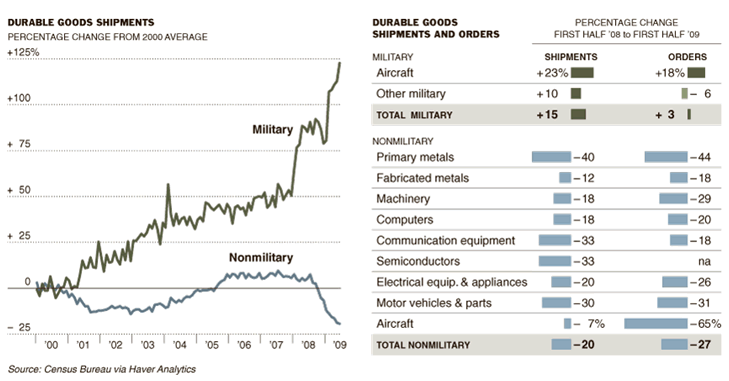
The use of the military-industrial complex as a quick, if dubious, way of jump-starting the economy is nothing new, but what is amazing is the divergence between the military economy and the civilian economy, as shown by this New York Times chart.
In the past nine years, non-industrial production in the US has declined by some 19 percent. It took about four years for manufacturing to return to levels seen before the 2001 recession — and all those gains were wiped out in the current recession.
By contrast, military manufacturing is now 123 percent greater than it was in 2000 — it has more than doubled while the rest of the manufacturing sector has been shrinking…
It’s important to note the trajectory — the military economy is nearly three times as large, proportionally to the rest of the economy, as it was at the beginning of the Bush administration. And it is the only manufacturing sector showing any growth. Extrapolate that trend, and what do you get?
The change in leadership in Washington does not appear to be abating that trend…[121]
So most of the job creation has been by the public sector. But because the job creation has been financed with loans from China and private banks, trillions in unnecessary interest charges have been incurred by the U.S.
And this shows military versus non-military durable goods shipments:

[Click here to view full image.]
So we’re running up our debt (which will eventually decrease economic growth), but the only jobs we’re creating are military and other public sector jobs.
PhD economist Dean Baker points out that America’s massive military spending on unnecessary and unpopular wars lowers economic growth and increases unemployment:

Defense spending means that the government is pulling away resources from the uses determined by the market and instead using them to buy weapons and supplies and to pay for soldiers and other military personnel. In standard economic models, defense spending is a direct drain on the economy, reducing efficiency, slowing growth and costing jobs.
A few years ago, the Center for Economic and Policy Research commissioned Global Insight, one of the leading economic modeling firms, to project the impact of a sustained increase in defense spending equal to 1.0 percentage point of GDP. This was roughly equal to the cost of the Iraq War.
Global Insight’s model projected that after 20 years the economy would be about 0.6 percentage points smaller as a result of the additional defense spending. Slower growth would imply a loss of almost 700,000 jobs compared to a situation in which defense spending had not been increased. Construction and manufacturing were especially big job losers in the projections, losing 210,000 and 90,000 jobs, respectively.
The scenario we asked Global Insight [recognized as the most consistently accurate forecasting company in the world] to model turned out to have vastly underestimated the increase in defense spending associated with current policy. In the most recent quarter, defense spending was equal to 5.6 percent of GDP. By comparison, before the September 11th attacks, the Congressional Budget Office projected that defense spending in 2009 would be equal to just 2.4 percent of GDP. Our post-September 11th build-up was equal to 3.2 percentage points of GDP compared to the pre-attack baseline. This means that the Global Insight projections of job loss are far too low…
The projected job loss from this increase in defense spending would be close to 2 million. In other words, the standard economic models that project job loss from efforts to stem global warming also project that the increase in defense spending since 2000 will cost the economy close to 2 million jobs in the long run.
The Political Economy Research Institute at the University of Massachusetts, Amherst has also shown that non-military spending creates more jobs than military spending.
So we’re running up our debt – which will eventually decrease economic growth – and creating many fewer jobs than if we spent the money on non-military purposes.
But the War on Terror is Urgent for Our National Security, Isn’t It?
For those who still think that the Iraq and Afghanistan wars are necessary to fight terrorism, remember that a leading advisor to the U.S. military – the very hawkish and pro-war Rand Corporation – released a study in 2008 called “How Terrorist Groups End: Lessons for Countering al Qa’ida“.
The report confirms that the war on terror is actually weakening national security. As a press release about the study states:
“Terrorists should be perceived and described as criminals, not holy warriors, and our analysis suggests that there is no battlefield solution to terrorism.”
Former U.S. National Security Adviser Zbigniew Brzezinski told the Senate that the war on terror is “a mythical historical narrative”. And Newsweek has now admitted that the war on terror is wholly unnecessary.
In fact, starting right after 9/11 — at the latest — the goal has always been to create “regime change” and instability in Iraq, Iran, Syria, Libya, Sudan, Somalia and Lebanon; the goal was never really to destroy Al Qaeda. As American reporter Gareth Porter writes in Asia Times:

Three weeks after the September 11, 2001, terror attacks, former US defense secretary Donald Rumsfeld established an official military objective of not only removing the Saddam Hussein regime by force but overturning the regime in Iran, as well as in Syria and four other countries in the Middle East, according to a document quoted extensively in then-under secretary of defense for policy Douglas Feith’s recently published account of the Iraq war decisions. Feith’s account further indicates that this aggressive aim of remaking the map of the Middle East by military force and the threat of force was supported explicitly by the country’s top military leaders.
Feith’s book, War and Decision, released last month, provides excerpts of the paper Rumsfeld sent to President George W Bush on September 30, 2001, calling for the administration to focus not on taking down Osama bin Laden’s al-Qaeda network but on the aim of establishing “new regimes” in a series of states
***
General Wesley Clark, who commanded the North Atlantic Treaty Organization bombing campaign in the Kosovo war, recalls in his 2003 book Winning Modern Wars being told by a friend in the Pentagon in November 2001 that the list of states that Rumsfeld and deputy secretary of defense Paul Wolfowitz wanted to take down included Iraq, Iran, Syria, Libya, Sudan and Somalia [and Lebanon].
***
When this writer asked Feith . . . which of the six regimes on the Clark list were included in the Rumsfeld paper, he replied, “All of them.”
***
The Defense Department guidance document made it clear that US military aims in regard to those states would go well beyond any ties to terrorism. The document said the Defense Department would also seek to isolate and weaken those states and to “disrupt, damage or destroy” their military capacities – not necessarily limited to weapons of mass destruction (WMD)…
Rumsfeld’s paper was given to the White House only two weeks after Bush had approved a US military operation in Afghanistan directed against bin Laden and the Taliban regime. Despite that decision, Rumsfeld’s proposal called explicitly for postponing indefinitely US airstrikes and the use of ground forces in support of the anti-Taliban Northern Alliance in order to try to catch bin Laden.
Instead, the Rumsfeld paper argued that the US should target states that had supported anti-Israel forces such as Hezbollah and Hamas.
***
After the bombing of two US embassies in East Africa [in 1998] by al-Qaeda operatives, State Department counter-terrorism official Michael Sheehan proposed supporting the anti-Taliban Northern Alliance in Afghanistan against bin Laden’s sponsor, the Taliban regime. However, senior US military leaders “refused to consider it”, according to a 2004 account by Richard H Shultz, Junior, a military specialist at Tufts University.
A senior officer on the Joint Staff told State Department counter-terrorism director Sheehan he had heard terrorist strikes characterized more than once by colleagues as a “small price to pay for being a superpower”.
If you still believe that the war on terror is necessary, please read this.
Torture is Bad for the Economy
For those who still think torture is a necessary evil, you might be interested to learn that top experts in interrogation say that, actually:
Indeed, historians tell us that torture has been used throughout historynot to gain information – but as a form of intimidation, to terrorize people into obedience. In other words, at its core, torture is a form of terrorism.
Moreover, the type of torture used by the U.S. in the last 10 years is of a special type. Senator Levin revealed that the the U.S. used torture techniques aimed at extracting false confessions.
McClatchy subsequently filled in some of the details:
Former senior U.S. intelligence official familiar with the interrogation issue said that Cheney and former Defense Secretary Donald H. Rumsfeld demanded that the interrogators find evidence of al Qaida-Iraq collaboration…
For most of 2002 and into 2003, Cheney and Rumsfeld, especially, were also demanding proof of the links between al Qaida and Iraq that (former Iraqi exile leader Ahmed) Chalabi and others had told them were there.”
It was during this period that CIA interrogators waterboarded two alleged top al Qaida detainees repeatedly — Abu Zubaydah at least 83 times in August 2002 and Khalid Sheik Muhammed 183 times in March 2003 — according to a newly released Justice Department document…
When people kept coming up empty, they were told by Cheney’s and Rumsfeld’s people to push harder,” he continued.”Cheney’s and Rumsfeld’s people were told repeatedly, by CIA . . . and by others, that there wasn’t any reliable intelligence that pointed to operational ties between bin Laden and Saddam . . .
A former U.S. Army psychiatrist, Maj. Charles Burney, told Army investigators in 2006 that interrogators at the Guantanamo Bay, Cuba, detention facility were under “pressure” to produce evidence of ties between al Qaida and Iraq.
“While we were there a large part of the time we were focused on trying to establish a link between al Qaida and Iraq and we were not successful in establishing a link between al Qaida and Iraq,” Burney told staff of the Army Inspector General. “The more frustrated people got in not being able to establish that link . . . there was more and more pressure to resort to measures that might produce more immediate results.”
“I think it’s obvious that the administration was scrambling then to try to find a connection, a link (between al Qaida and Iraq),” [Senator] Levin said in a conference call with reporters. “They made out links where they didn’t exist.”
Levin recalled Cheney’s assertions that a senior Iraqi intelligence officer had met Mohammad Atta, the leader of the 9/11 hijackers, in the Czech Republic capital of Prague just months before the attacks on the World Trade Center and the Pentagon.
The FBI and CIA found that no such meeting occurred.
In other words, top Bush administration officials not only knowingly lied about a non-existent connection between Al Qaida and Iraq, but they pushed and insisted that interrogators use special torture methods aimed at extracting false confessions to attempt to create such a false linkage. See also this and this.
Paul Krugman eloquently summarized the truth about the type of torture used:
Let’s say this slowly: the Bush administration wanted to use 9/11 as a pretext to invade Iraq, even though Iraq had nothing to do with 9/11. So it tortured people to make them confess to the nonexistent link.
There’s a word for this: it’s evil.
But since this essay in on dollars and cents, the important point is that terrorism is bad for the economy.
Specifically, a study by Harvard and the National Bureau of Economic Research (NBER) points out:

From an economic standpoint, terrorism has been described to have four main effects (see, e.g., US Congress, Joint Economic Committee, 2002). First, the capital stock (human and physical) of a country is reduced as a result of terrorist attacks. Second, the terrorist threat induces higher levels of uncertainty. Third, terrorism promotes increases in counter-terrorism expenditures, drawing resources from productive sectors for use in security. Fourth, terrorism is known to affect negatively specific industries such as tourism.
The Harvard/NBER concludes:

In accordance with the predictions of the model, higher levels of terrorist risks are associated with lower levels of net foreign direct investment positions, even after controlling for other types of country risks. On average, a standard deviation increase in the terrorist risk is associated with a fall in the net foreign direct investment position of about 5 percent of GDP.
So the more unnecessary wars American launches, the more innocent civilians we kill, and the more people we torture, the less foreign investment in America, the more destruction to our capital stock, the higher the level of uncertainty, the more counter-terrorism expenditures and the less expenditures in more productive sectors, and the greater the hit to tourism and some other industries.
Moreover:

Terrorism has contributed to a decline in the global economy (for example, European Commission, 2001).
So military adventurism and torture, which increase terrorism, hurt the world economy. And see this.
For the foregoing reasons, the military-industrial complex is ruining the economy.

Democrat Wants Amnesty so Illegal Immigrants Can Enroll in Obamacare

A Colorado Democrat who wanted Obamacare waivers for some of the country's wealthiest patrons of ski resorts wants the law's individual mandate to apply to today's illegal immigrants, which can only happen if they are given a pathway to citizenship.

Rep. Jared Polis (D-CO) said on Friday that the House should pass comprehensive immigration reform with a pathway to citizenship for all of the country's illegal immigrants so they could get on Obamacare.
“American citizens are essentially being forced to pay for the health care costs of people who are here illegally every day, until we pass comprehensive immigration reform,” he said. “We’re wondering why rates are going up... It’s no surprise. When somebody doesn’t have insurance, their costs are shifted onto other people that do.”
Last month, Polis said he would ask for Obamacare waivers for residents of some of the wealthiest ski resort town in his state of Colorado. As the Washington Times noted, "illegal immigrants are one of the few categories of people in the U.S. who aren’t subjected to Obamacare’s individual mandate requiring all people to have health insurance coverage." Illegal immigrants also "aren’t eligible for taxpayer subsidies" to buy Obamacare on the insurance exchanges.
Polis said if the House can pass a pathway to citizenship for the country's illegal immigrants, "people who are here illegally will have to get insurance on their own instead of forcing Americans to pay for their insurance."
This week, House Speaker John Boehner (R-OH) and other House leaders ruled out going to conference on the Senate's immigration bill this year, but those who are championing a pathway to citizenship for the country's illegal immigrants--like Sen. John McCain (R-AZ)--have indicated they will make one more push for the legislation after the Republican primaries next year.
The Congressional Budget Office determined that the pathway to citizenship provision in the Senate's immigration bill would lower the wages of working class Americans and "end up costing $82.3 billion over the next decade in higher Obamacare subsidies."

Cops Can Crack an iPhone In Under Two Minutes


From http://classic.slashdot.org/story/12/03/27/212254

Sparrowvsrevolution writes

"Micro Systemation, a Stockholm-based company, has released a video showing that its software can easily bypass the iPhone's four-digit passcode in a matter of seconds. It can also crack Android phones, and is designed to dump the devices' data to a PC for easy browsing, including messages, GPS locations, web history, calls, contacts and keystroke logs. The company's director of marketing says it uses an undisclosed vulnerability in the devices it targets to run a program on the phone that brute-forces its passcode. He says the company's business is 'booming' and that it's sold the devices to law enforcement and military customers in 60 countries. He says Micro Systemation's biggest customer is the U.S. military."

Empire and Cyber Imperialism: The Logic behind the Global Spy Structure


empire
            Revelations about the long-term global, intrusive spying by the US National Security Agency (NSA) and other allied intelligence apparatuses have provoked widespread protests and indignation and threatened ties between erstwhile imperial allies. 
            Allied regimes have uniformly condemned NSA espionage as a violation of trust and sovereignty, a threat to their national and economic security and to their citizens’ privacy.
             In contrast, Washington has responded in a contradictory manner: on the one hand, US officials and intelligence chiefs have acknowledged ‘some excesses and mistakes’, on the other hand, they defend the entire surveillance program as necessary for US national security.
           Interpretations vary about the US global spy apparatus – how it was built and why it was launched against  hundreds of millions of people. ‘Subjective’ and ‘objective’ explanations abound, evoking psychological, social, economic, strategic and political considerations.
            A multi-factorial explanation is required.
The Integrated Hypothesis of the Global Police State
            One of the essential components of a police state is an all-pervasive spy apparatus operating independently of any legal or constitutional constraints.  Spy operations include: 1) massive surveillance over text, video and audio communications and 2) the capacity to secretly record, store and use information secretly collected.  This information strengthens political and economic leaders who, in turn, appoint and direct the spy chiefs.  The political and economic rulers control the spy-lords by setting the goals, means and targets of the surveillance state.  The US global spy apparatus is neither ‘self-starting nor self-perpetuating’.  It did not arise in a vacuum and it has virtually no strategic autonomy.  While there may be intra-bureaucratic conflicts and rivalries, the institutions and groups function within the overall ‘paradigm’ established and directed by the political and economic elite.
 The Global Spy Structure
The growth and expansion of the US spy apparatus has deep roots in its history and is related to the colonial need to control subjugated native and enslaved peoples. However, the global operations emerged after the Second World War when the US replaced Europe as the center of world imperialism.  The US assumed the principal role in preventing the spread of revolutionary and anti-colonial movements from the Soviet Union, China , Korea , Vietnam and Cuba to war and crisis-burdened countries of Europe, North and Southeast Asia and Latin America .  When the collectivist states fell apart in the 1990’s the US became the sole superpower and a unipolar world emerged.
For the United States, ‘unipolarity’ meant (1) an impetus toward total global domination; (2) a world-wide network of military bases; (3) the subordination of capitalist competitors in other industrial countries, (4) the destruction of nationalist adversaries and (6) the unfettered pillage of resources from the former collectivist regimes as they became vassal states.  The last condition meant the complete dismantling of the collectivist state and its public institutions – education, health care and worker rights.
            The opportunities for immense profits and supreme control over this vast new empire were boundless while the risks seemed puny, at least during the ‘golden period’, defined by the years immediately after (1) the capitalist takeover of the ex-Soviet bloc, (2) the Chinese transition to capitalism and (3) the conversion of many former African and Asian nationalist regimes, parties and movements to ‘free-market’ capitalism.
             Dazzled by their vision of a ‘new world to conquer’ the United States set up an international state apparatus in order to exploit this world-historical opportunity.  Most top political leaders, intelligence strategists, military officials and business elites quickly realized that these easy initial conquests and the complicity of pliable and kleptocratic post-Communist vassal rulers would not last.  The societies would eventually react and the lucrative plunder of resources was not sustainable.  Nationalist adversaries were bound to arise and demand their own spheres of influence.  The White House feared their own capitalist allies would take on the role of imperialist competitors seeking to grab ‘their share’ of the booty, taking over and exploiting resources, public enterprises and cheap labor. 
            The new ‘unipolar world’ meant the shredding of the fabric of social and political life.  In the ‘transition’ to free market capitalism, stable employment, access to health care, security, education and civilized living standards disappeared.  In the place of once complex, advanced social systems, local tribal and ethnic wars erupted.  It would be ‘divide and conquer’ in an orgy of pillage for the empire.  But the vast majority of the people of the world suffered from chaos and regression when the multi-polar world of collectivist, nationalist, and imperialist regimes gave way to the unipolar empire. 
For US imperialist strategists and their academic apologists the transition to a unipolar imperial world was exhilarating and they dubbed their unchallenged domination the ‘ New World Order’ (NWO).  The US imperial state then had the right and duty to maintain and police its ‘New World Order’ – by any means. Francis Fukiyama, among other academic apologists celebrated the ‘end of history’ in a paroxysm of imperial fever. Liberal-imperial academics, like Immanuel Wallerstein, sensed the emerging challenges to the US Empire and advanced the view of a Manichean world of ‘unipolarity’ (meaning ‘order’) versus ‘multipolar chaos’– as if the hundreds of millions of lives in scores of countries devastated by the rise of the post-collectivist US empire did not have a stake in liberating themselves from the yoke of a unipolar world.
By the end of its first decade, the unipolar empire exhibited cracks and fissures.  It had to confront adversarial nationalist regimes in resource-rich countries, including Muammar Gaddafi in Libya , Bashar Assad in Syria , Saddam Hussein in Iraq and Khamenei in Iran .  They challenged US supremacy in North Africa and the Middle East .  The Taliban in Afghanistan and nationalist Islamist movements questioned US influence over the vassal rulers of Muslim countries – especially the puppet monarchs in the Persian Gulf .
On the other side of the imperial coin, the domestic economic foundations of the ‘New World Order’ were weakened by a series of speculative crises undermining the support of the US public as well as sectors of the elite.  Meanwhile European and Japanese allies, as well as emerging Chinese capitalists, were beginning to compete for markets.
Within the US an ultra-militarist group of political ideologues, public officials and policy advisers, embracing a doctrine combining a domestic police state with foreign military intervention, took power in Washington .  ‘Conservatives’ in the Bush, Sr. regime, ‘liberals’ in the Clinton administration and ‘neo-conservatives’ in the Bush, Jr. administration all sought and secured the power to launch wars in the Persian Gulf and the Balkans, to expand and consolidate the unipolar empire.
            Maintaining and expanding the unipolar empire became the trigger for the White House’s global police state apparatus.  As new regimes were added to Washington ’s orbit, more and more surveillance was needed to make sure they did not drift into a competitor’s sphere of influence.
            The year 2000 was critical for the global police state.  First there was the dot-com crash in the financial sector.  The speculative collapse caused massive but unorganized disaffection among the domestic population.  Arab resistance re-emerged in the Middle East .  The cosmically corrupt Boris Yeltsin vassal state fell and a nationalist, Russian President Vladimir Putin took power.  The willing accomplices to the disintegration of the former USSR had taken their billions and fled to New York , London and Israel . Russia was on the road to recovery as a unified nuclear-armed nation state with regional ambitions.  The period of unchallenged unipolar imperial expansion had ended.
            The election of President Bush Jr., opened the executive branch to police state ideologues and civilian warlords, many linked to the state of Israel , who were determined to destroy secular Arab nationalist and Muslim adversaries in the Middle East .  The steady growth of the global police state had been ‘too slow’ for them.  The newly ascendant warlords and the proponents of the global police state wanted to take advantage of their golden opportunity to make US/Israeli supremacy in the Middle East irreversible and unquestioned via the application of overwhelming force (‘shock and awe’).
Their primary political problem in expanding global military power was the lack of a fully dominant domestic police state capable of demobilizing American public opinion largely opposed to any new wars.  ‘Disaster ideologues’ like Phillip Zelikow and Condoleezza Rice understood the need for a new ‘ Pearl Harbor ’ to occur and threaten domestic security and thereby terrify the public into war. They lamented the fact that no credible regimes were left in the Middle East to cast as the ‘armed aggressor’ and as a threat to US national security. Such an enemy was vital to the launching of new wars. And new wars were necessary to justify the scale and scope of the new global spy apparatus and emergency police state edicts the warlords and neoconservatives had in mind.  Absent a credible ‘state-based adversary’, the militarists settled for an act of terror (or the appearance of one) to ‘shock and awe’ the US public into accepting its project for imperial wars, the imposition of a domestic police state and the establishment of a vast global spy apparatus.
The September 11, 2001 explosions at the World Trade Center in New York City and the plane crash into a wing (mostly vacant for repairs) of the Pentagon in Washington , DC were the triggers for a vast political and bureaucratic transformation of the US imperial state.  The entire state apparatus became a police state operation.  All constitutional guarantees were suspended.  The neo-conservatives seized power, the civilian warlords ruled.  A huge body of police state legislation suddenly appeared, as if from nowhere, the ‘Patriot Act’.  The Zionists in office set the objectives and influenced military policies to focus on Israel ’s regional interests and the destruction of Israel ’s Arab adversaries who had opposed its annexation of Palestine .  War was declared against Afghanistan without any evidence that the ruling Taliban was involved or aware of the September 11 attack of the US .  Despite massive civilian and even some military dissent, the civilian warlords and Zionist officials blatantly fabricated a series of pretexts to justify an unprovoked war against the secular nationalist regime in Iraq , the most advanced of all Arab countries. Europe was divided over the war. Countries in Asia and Latin America joined Germany and France in refusing to support the invasion.  The United Kingdom , under a ‘Labor’ government, eagerly joined forces with the US hoping to regain some of its former colonial holdings in the Gulf.
At home, hundreds of billions of tax dollars were diverted from social programs to fund a vast army of police state operatives.  The ideologues of war and the legal eagles for torture and the police state shifted into high gear.  Those who opposed the wars were identified, monitored and the details of their lives were ‘filed away’ in a vast database.  Soon millions came to be labeled as ‘persons of interest’ if they were connected in any way to anyone who was ‘suspect’, i.e. opposed to the ‘Global War on Terror’.  Eventually even more tenuous links were made to everyone…family members, classmates and employers.
Over 1.5 million ‘security cleared’ monitors were contracted by the government to spy on hundreds of millions of citizens. The spy state spread domestically and internationally.  For a global empire, based on a unipolar state, the best defense was judged to be a massive global surveillance apparatus operating independently of any other government – including the closest allies.
The slogan, ‘Global War on Terror’ (GWOT) became an open-ended formula for the civilian warlords, militarists and Zionists to expand the scope and duration of overt and covert warfare and espionage.  ‘Homeland Security’ departments, operating at both the Federal and State levels, were consolidated and expanded with massive budgets for incarceration and repression.  Constitutional protections and the Writ of Habeas Corpus were ‘rendered quaint vestiges of history’.  The National Security Agency doubled its personnel and budget with a mandate to distrust and monitor allies and vassal states. The targets piled upon targets, far beyond traditional adversaries, sweeping up the public and private communications of all political, military and economic leaders , institutions, and  citizenry.
            The ‘Global War on Terror’ provided the ideological framework for a police state based on the totalitarian conception that ‘everybody and everything is connected to each other’ in a ‘global system’ threatening the state.  This ‘totalistic view’ informs the logic of the expanded NSA, linking enemies, adversaries, competitors and allies.  ‘Enemies’ were defined as anti-imperialist states or regimes with consistently critical independent foreign and domestic policies. ‘Adversaries’ occasionally sided with ‘enemies’, or tolerated policymakers who would not always conform to imperial policies.  ‘Competitors’ supported the empire but had the capacity and opportunity to make lucrative trade deals with adversaries or enemies – Allies were states and leaders who generally supported imperial wars but might provide a forum condemning imperial war crimes (torture and drone attacks).  In addition allies could undermine US imperial market shares and accumulate favorable trade balances.
            The logic of the NSA required spying on the allies to root out any links, trade, cultural or scientific relations with adversaries and enemies, which might have spillover consequences. The NSA feared that associations in one sphere might ‘overlap’ with adversaries operating in strategic policy areas and undermine ally loyalty to the empire.
            The spy logic had a multiplier effect – who gets to ‘spy on the spies?’  The NSA might collaborate with overseas allied intelligence agencies and officials – but American spymasters would always question their reliability, their inclination to withhold vital information, the potential for shifting loyalties. ‘Do our allies spy on us?  How do we know our own spies are not colluding with allied spies who might then be colluding with adversarial spies?’  This justified the establishment of a huge national vacuum cleaner to suck up all transactions and communications – justified by the notion that a wide net scooping up everything might catch that big fish!
The NSA regards all ‘threats to the unipolar empire’ as national security threats.  No country or agency within or without the reach of the empire was excluded as a ‘potential threat’.
            The ‘lead imperial state’ requires the most efficient and overarching spy technology with the furthest and deepest reach.  Overseas allies appear relatively inefficient, vulnerable to infiltration, infected with the residua of a long-standing suspect ‘leftist culture’ and unable to confront the threat of new dangerous adversaries.  The imperial logic regards surveillance of ‘allies’ as ‘protecting allied interests’ because the allies lack the will and capacity to deal with enemy infiltration.
There is a circular logic to the surveillance state.  When an allied leader starts to question how imperial espionage protects allied interest, it is time to intensify spying on the ally. Any foreign ally who questions NSA surveillance over its citizens raises deep suspicions.  Washington believes that questioning imperial surveillance undermines political loyalties.
Secret Police Spying as a “Process of Accumulation”
            Like capitalism, which needs to constantly expand and accumulate capital, secret police bureaucracies require more spies to discover new areas, institutions and people to monitor.  Leaders, followers, citizens, immigrants, members of ethnic, religious, civic and political groups and individuals – all are subject to surveillance.  This requires vast armies of data managers and analysts, operatives, programmers, software developers and supervisors – an empire of ‘IT’.  The ever-advancing technology needs an ever-expanding base of operation.
The spy- masters move from local to regional to global operations.  Facing exposure and condemnation of its global chain of spying, the NSA calls for a new ‘defensive ideology’.  To formulate the ideology, a small army of academic hacks is trotted out to announce the phony alternatives of a ‘unipolar police state or terror and chaos’.  The public is presented with a fabricated choice of its perpetual, ‘well-managed and hi-tech’, imperial wars versus the fragmentation and collapse of the entire world into a global war of ‘all against all’.  Academic ideologues studiously avoid mentioning that small wars by small powers end more quickly and have fewer casualties.
The ever-expanding technology of spying strengthens the police state.  The list of targets is endless and bizarre.  Nothing and no one will be missed!
            As under capitalism, the growth of the spy state triggers crisis.  With the inevitable rise of opposition, whistleblowers come forward to denounce the surveillance state.  At its peak, spy-state over-reach leads to exposure, public scandals and threats from allies, competitors and adversaries.  The rise of cyber-imperialism raises the specter of cyber-anti-imperialism.  New conceptions of inter-state relations and global configurations are debated and considered.  World public opinion increasingly rejects the ‘necessity’ of police states.  Popular disgust and reason exposes the evil logic of the spy-state based on empire and promotes a plural world of peaceful rival countries, functioning under co-operative policies – systems without empire, without spymasters and spies.

Obama’s Healthcare Fix: Millions of Uninsured and Underinsured Americans


health
Obamacare is rife with problems. It leaves millions uninsured. It leaves millions more underinsured. It makes healthcare coverage more expensive.
Mandated market rules include rude awakenings. Many consumers are left paying much more than they thought.
Most plans include huge deductibles and co-pays. Doing so means tens of millions face unaffordable out-of-pocket costs.
Federal subsidies for America’s poor are woefully inadequate. Millions live from paycheck to paycheck. Limited resources make expensive treatments unaffordable.
Insurers have plenty of wiggle room. They can’t deny preexisting conditions. They can delay. They can block in backdoor ways.
They can game the system for profit. They wrote the law that way. They assured it benefits them hugely.
Obama’s Affordable Care Act (ACA) made a fiasco debut. Healthcare.gov doesn’t work. Accessing it is nightmarish. When it’ll be fixed, who knows.
Since launched on October 1, federal and state exchanges enrolled only 106,185. Healthcare.gov managed only 26,794. Administration officials hoped for at least half a million.
On November 14, Obama addressed a press conference. He sought to put lipstick on a pig. He tried to quell growing anger.
Insurers sent cancellation notices to hundreds of thousands of policyholders. They don’t meet ACA rules. Consumers have no choice. They’re stuck with mandated provisions. It doesn’t matter if they like them or not.
Obama promised Americans they could keep their coverage if they wish. They can keep their providers, he said. He lied.
His fix is too little, too late. Instead of canceling unqualified plans on January 1, consumers get to keep them through 2014.
Obama’s announcement came ahead of House Republican sponsored legislation. It passed 261 to 157.
Doing so included 39 Democrats. It lets all consumers keep their plans. It lets others buy whatever type coverage they wish.
It undercuts Obamacare. It has no chance to become law. Some Senate Democrats aren’t happy with Obama’s fix.
Legislation is being considered to change it. ItMajority Leader Harry Reid (D. NV) isn’t likely to permit it. At least not any time soon.
Senators Mary Landrieu (D. LA) and Mark Udall (D. CO) have competing bills. Landrieu wants consumers able to keep their current plans indefinitely. Udall wants them available though 2015.
Democrat senators up for reelection next year express greatest concern. Senator Kay Hagan (D. NC) called Obama’s fix a “step in the right direction.” It’s “not enough, and we need to do more,” she said.
Other Senate Democrats said they’ll wait to see how insurers respond. Will cancelled policyholders be given their coverage back?
Some congressional Democrats expressed anger. Obama didn’t alert them. Some learned about his fix from press reports. Others knew nothing until he announced it.
He operates this way. Transparency isn’t his long suit. He upsets members of his own party. An observer called it “par for the course.”
Obamacare’s future may depend on how things go from here. If problems stay unresolved, growing dissatisfaction will follow.
Cost and inadequate coverage are major issues. Millions will discover they’ve been had. How they react remains to be seen.
Obama’s popularity is slipping. A new Quinnipiac University poll shows only 39% approval. It’s a new low.
Gallup’s latest poll has Congress at 9%. It’s an all-time low. In its congressional ratings for 39 years, Capitol Hill’s average was 33%. Post-9/11, affirmation hit a 56% high.
Americans today deplore both sides of the aisle. They do so for good reason. They sold out their constituents. They do it consistently.
Republicans oppose Obamacare for the wrong reasons. Democrats support its worst features. Quinnipiac’s poll showed only 19% of Americans believe ACA will improve their healthcare quality.
Another 43% expect it to worsen. About one-third expect no change either way. America is the only developed country without some form of universal coverage.
Many developing ones have it. Thais get it. So do Taiwanese. Brazilians have what Americans lack. All Venezuelans and Cubans are fully covered.
It’s constitutionally guaranteed. It’s state-funded. It’s not commodified. It’s not run by marketplace rules. It’s not based on the ability to pay. It’s free.
Chavez called healthcare “a fundamental social right, and the state will assume the principal role in the construction of a participatory system for national public health.”
It’s not just a right. It’s essential for participatory democracy. It’s preventative as well as treating symptoms when they occur.
It includes emergency services, mental health, surgeries, cancer care and other expensive illnesses, dental and eye treatment, prescription drugs, as well as free eyeglasses and contact lenses.
Healthcare is based on need, not bottom line priorities. Venezuelans in every barrio are covered. An “army of white jackets” provide universal care. It’s a reality throughout the country.
Comprehensive community medicine is policy. It’s part of a Chavez/Fidel Castro agreement. It swaps oil for Cuban medical professionals.
They provide care. They help train Venezuelan doctors. They staff Venezuela’s “Barrio Adentro” (Inside the Barrio) public health program.
They provide healthcare based on Cuba’s preventative, community-based model.
Article 50 of Cuba’s Constitution guarantees everyone the “right to health protection and care. The state guarantees (it) by:
providing free medical and hospital care by means of the installations of the rural medical service network, polyclinics, hospitals, preventative and specialized treatment centers;
providing free dental care;
promoting the health publicity campaigns, health education, regular medical examinations, general vaccination and other measures to prevent the outbreak of disease.”
“All the population cooperates in these activities and plans through the social and mass organizations.”
All Cubans get state-sponsored healthcare. They get it free. It matches what developed countries provide.
It’s a model for developing ones. Medical professionals live in communities they serve. They know the people they treat.
They call their system medicina general integral (comprehensive general medicine). It focuses on prevention.
It treats illnesses and diseases as soon as possible. It works as intended. It controls health problems effectively.
It’s unmatched in treating infectious diseases. It deals effectively with chronic ones. It works wonders with limited resources.
It provides medical services in over 150 countries. Venezuelans benefit. So do Haitians, Peruvians, Nicaraguans, Bolivians, Ecuadorians, Ghanaians, Angolans and Namibians among others.
Cuba matches America’s life expectancy. It has double or more the number of physicians per 1,000 population.
It has an overall lower mortality rate. It has an exemplary national health and nutrition education program.
It emphasizes chemical-free, non-GMO, organically grown fresh produce.
It delivers top quality healthcare at a minuscule cost compared to America. It shows treatment doesn’t have to be expensive.
Extensive services include rehabilitation, x-rays, ultrasound, optometry, ophthalmology, endoscopy, thrombolysis, emergency services, traumatology, clinical lab services, family planning, dentistry, pre and postnatal child care, immunization, diabetic and elderly care.
Others include dermatology, psychiatry, psychology, cardiology, general medicine, pediatrics, obstetrics, gynecology, and mouth diseases.
Acupuncture and message therapy are provided. So are electromagnetic therapy, mud therapy, reflex therapy, heat therapy, speech therapy, physical therapy, and more.
Quality care, results, and patient satisfaction are stressed. Americans deserve the same type universal coverage.
They currently pay over twice as much as other industrialized nations. They’ll pay more when Obamacare is fully implemented. Millions will be left uncovered. Millions more will get much less than they need.
Pay more, get less is official US healthcare policy. Anyone can get whatever they want provided they pay for it. Millions can’t afford expensive care. Expect it to become more out of reach ahead.
Universal single payer coverage alone works effectively. Insurers provide no care whatever. They’re predatory middlemen. They add over $400 billion annually in administrative costs.
Eliminating them assures big savings. Americans deserve coverage for all medical services.
They include physician visits, hospitalizations, surgeries, preventive care, longterm when needed, mental health, dental, vision, prescription drugs, rehabilitation, and alternative treatments among others.
Eliminating administrative waste means more available resources. Everyone in/no one out would replace marketplace medicine.
Financial barriers no longer would exist. Insurance premiums would disappear. So would co-pays and deductibles.
Patients could choose providers freely. Doctors would regain autonomy over delivering care. It would feature prevention and healing.
It would de-commodify medicine. It would end providing the least care for the most profit. It would deliver healthcare responsibly.
It would take fear out of getting ill. At least in terms of receiving and paying for it. Treatment would be readily available no matter the problem or cost.
Isn’t that what healthcare is supposed to be? It’s a fundamental human right.
Stephen Lendman lives in Chicago. He can be reached at lendmanstephen@sbcglobal.net.
His new book is titled “Banker Occupation: Waging Financial War on Humanity.”
http://www.claritypress.com/LendmanII.html
Visit his blog site at sjlendman.blogspot.com.
Listen to cutting-edge discussions with distinguished guests on the Progressive Radio News Hour on the Progressive Radio Network.
It airs Fridays at 10AM US Central time and Saturdays and Sundays at noon. All programs are archived for easy listening.
http://www.progressiveradionetwork.com/the-progressive-news-hour
http://www.dailycensored.com/obamas-healthcare-fix/