Wednesday, October 30, 2013

Insurance Companies Profit from Obamacare


healthcare
No one can reasonably deny that the major Insurance Companies were the driving force behind the writing of the Affordable Care Act legislation. “The health care industry spent nearly $500 million lobbying for health care issues in 2012, and $243 million so far in 2013.” Obamacare or Corporate-care: The Writing of the Affordable Care Act, sums up the process.
“Essentially, the ACA was designed to write the for-profit health care system into law, increase corporate profits, and to discourage people from demanding a health care system that would actually provide real health care coverage for all. The ACA wasn’t written to fix a broken system – it was written to ensure that the broken system would be kept in place. After all, from the standpoint of the health care industry, the system is working just fine for their profits.”

Obamacare-health-ins.-cc2-565x565.jpg

Since the public insurance providers are enjoying a jump in their stock values and a protected rise in premiums, the normal conclusion is that Obamacare is the big winner in the socialization of medicine. Before going any further, The Health Care Blog raises a curious issues regarding Obamacare in the article, Does Obamacare Limit Profits for Health Insurance Companies in Your State?

“The ACA imposes a minimum medical loss ratio (MLR) on all insurers. The MLR is the amount of money spent on covered person medical care divided by the total revenue received through premiums.
The ACA requires health insurers in the individual and small group market to spend 80 percent of their premiums (after subtracting taxes and regulatory fees) on medical costs. The corresponding figure for large groups is 85 percent.
Even though the MLR is a national law, it may not apply in your state. Why? Because many States are petitioning for a waiver.
Why did these States receive waivers? For a variety of reasons, but one of the reasons is due to the fact that some states have a less competitive medical market. Maine, for instance, requested a MLR of 65%. The reason was that State only has two large commercial insurers, Anthem Blue Cross Blue Shield (with 49% of the market) and MEGA Life and Health Insurance Company (with 33% of the market).”

Now put this argument into a proper perspective. WHY should insurance companies profit at all, and WHY is it necessary for private companies to issue insurance for medical coverage to begin with?

Readers of Negotium know this series advocates free enterprise economics. However, the mandate requirements in Obamacare are nothing more than a guarantee for insurance companies to terminate current catastrophic coverage and offer highly expensive policies that include unnecessary treatment.

With this reality in mind, as the horror reports come in daily, sticker shock is forcing Middle America into untenable decisions. Add the practice of reducing employment to part time status and that train wreck is becoming more like the black plague.
The medical care alternative is not universal Medicaid for an impoverished population. However, the article Rush on Medicaid could spell trouble for ObamaCare’s health, cites “The Democrat and Chronicle newspaper reports that in New York, nearly 24,000 of the 37,000 newly enrolled residents are going into Medicaid, which millions of New Yorkers are already on. Just 13,313 chose private plans.”
Such blowback dooms the failed experiment. When your heart stops pumping, a bypass will not work. It is time to look for a transplant.
One such option outlined in the essay, Could nonprofit health insurance plans be the real reformers?, is a viable alternative would be the fostering of nonprofit health insurance CO-OPs (Consumer Oriented and Operated Plans) throughout the country.
The Affordable Care Act might even facilitate a medical graft.

“They could even hasten the day when the big investor-owned corporations cede the marketplace to nonprofits and move on to other ways of earning a profit.
The reform law provides a total of $3.4 billion in loans for local groups that meet high eligibility criteria, so several more prospective CO-OPs will be selected in the months ahead. We’re not talking about grants here. The start-up money must be repaid to the government — with interest. All of the CO-OPs will have to offer coverage through the Internet-based marketplaces (exchanges) the reform law requires states to establish by January 1, 2014.
If all goes as planned, every state will have at least one CO-OP. And there are reports that at least one plan already has negotiated a good rate with local hospitals by explaining how CO-OPs can help them reduce the amount of uncompensated care they incur every year by treating uninsured patients.”
In the real world, the lobbyists for the mega corporatists own the politicians. In spite of this influence, the uproar of the citizenry is building, by the fallout from the Obamacare weapon of mass destruction. The normal fallout shelters for the careerists “pols” will not protect them from the wrath of a sickly public, who cannot afford medical coverage.
Add to this diagnosis, Obamacare Causes Doctor to Retire.
“The Deloitte Center for Health Solutions survey of more than 600 physicians, which found “Six in 10 physicians (62 percent) said it is likely many of their colleagues will retire earlier than planned in the next one to three years.”
The prescription for a long-term solution is to promote alternative medicine that reduces a damaging dependency on pharmaceutical drugs. The side effect disclaimers need to extend to the practice of medicine itself. Excluding homoeopathy alternatives coverage from patient’s choice only perpetuates the for profit hospital model. Charity medicine, now viewed with the same disdain as bloodletting, by the medical establishment, is a prime causality of the Obamacare. The lobotomy culture never will cure the mental illness of the eugenics cult.
Insurance companies will play divine with their clout of who qualifies for payment of treatment. In an interview, The God Factor Interview, Obama states: “If there’s a senior citizen in downstate Illinois that’s struggling to pay for their medicine and having to chose between medicine and the rent, that makes my life poorer even if it’s not my grandparent.” Well, your health insurance donors will not suffer, only the rest of us.

Mike Rogers: You Can't Have Your Privacy Violated If You Don't Know About It

from the say-what-now? dept///http://www.techdirt.com/articles/20131029/18020225059/mike-rogers-you-cant-have-your-privacy-violated-if-you-dont-know-about-it.shtml

We already wrote a bit about yesterday's House Intelligence Committee hearing concerning NSA surveillance. There were two sections to it: the first three hours were the top government spooks and lawmakers, and then the last half an hour or so involved three pundits outside of government (though with former government credentials). At the very very end of that, there was an absolutely incredible exchange between Intel Committee Chair Rep. Mike Rogers and law professor Stephen Vladeck (the only panelist the entire day who expressed concerns about what the NSA was doing). You have to watch the exchange to believe it, but it ends with Rogers insisting that "you can't have your privacy violated if you don't know your privacy is violated, right?" Vladeck immediately disagreed and Rogers seemed to find it astounding that anyone could agree, suggesting that it would upend the law. Watch the exchange:
If you don't watch the video, Rogers basically asks all three panelists if they think it's okay to do the kind of business records search that's currently done, and the two intelligence community apologists on the panel immediately agree. Vladeck suggests that there are caveats, and Rogers attacks him for equivocating, misattributing a quote about "give me a one-armed economist" (it was Harry Truman, but Rogers gives credit to Ronald Reagan). Vladeck again points out that the specifics matter, and notes that it's possible to agree with the concept of a program, but not the implementation of the program -- using the death penalty as a comparison. Rogers gets upset at this (bizarrely appearing to totally not comprehend the point Vladeck is making) and then finally Vladeck again points out that the process matters, and it's ridiculous to answer a substantive question about whether the concept makes sense without discussing the process, leading to the following, in which Rogers suggests there are no process questions because no one has complained:
Rogers: I would argue the fact that we haven't had any complaints come forward with any specificity arguing that their privacy has been violated, clearly indicates, in ten years, clearly indicates that something must be doing right. Somebody must be doing something exactly right.

Vladeck: But who would be complaining?

Rogers: Somebody who's privacy was violated. You can't have your privacy violated if you don't know your privacy is violated.

Vladeck: I disagree with that. If a tree falls in the forest, it makes a noise whether you're there to see it or not.

Rogers (astounded): Well that's a new interesting standard in the law. We're going to have this conversation... but we're going to have wine, because that's going to get a lot more interesting...
This is kind of astounding. According to Mike Rogers, you can apparently violate his privacy, so long as he doesn't know about it. How is it that such a person is supposedly in charge of oversight of the intelligence community? He honestly believes that as long as the NSA spies on people privately, their privacy isn't violated?

No, People Who Choose To Write On The Internet For Free Are Not 'Slaves'

from the swing-low,-sweet-chariot dept

For the sake of humor, I am generally a big fan of hyperbole. Miley Cyrus is cheaper than a half-off sale at the flea market. The Chicago Cubs are more futile than a company that builds igloos in Hell. See? When you're trying to be funny, hyperbole just works. However, when you're trying to make an actual point, comparing people who have agreed to write for free on the internet to slaves doesn't work, isn't funny, and deserves an argumentative kick in the rocks. We saw this previously in a ridiculous lawsuit by writers of The Huffington Post who somehow thought that their previous agreement to write for free entitled them to untold amounts of cash.

Yet, despite the stupidity of that lawsuit, we're back on the topic again thanks to a New York Times piece that somehow conflates asking for a free written work with slavery, not calling people after you have sex with them, and the nuclear bomb (and, no, I'm not kidding about any of those three). Here are some highlights from Tim Kreider's screed against the world.
People who would consider it a bizarre breach of conduct to expect anyone to give them a haircut or a can of soda at no cost will ask you, with a straight face and a clear conscience, whether you wouldn’t be willing to write an essay or draw an illustration for them for nothing. They often start by telling you how much they admire your work, although not enough, evidently, to pay one cent for it.
Aaaaand we're off, and on shaky ground, no less. I have received numerous cans of soda and even haircuts for free in my life, but I understand what he's saying. If something has value, thou must pay for it. Which would be all fine and good if the concept of writing on the internet were a one-way street, a la a soda can. If Mike Masnick comes up to me, says he's thirsty, and asks me to simply give him my soda can so that he might drink the sugary goodness of it, I am left without my soda can and have gained nothing in return, economically speaking. However, if Mike Masnick asks me to write for Techdirt for free (which he did), and I agree (which I did) with the idea being that I'd get some pleasure from it, build up some reputation that might lead to future paid work (which it did, for Techdirt, actually), and so that I can include that work when I send out query letters to literary agents in the future (which I did), then the transaction works both ways. We both attain something of value and the price tag on my writing is only one part of the equation. In other words, this analogy sucks.

But Kreider takes this on directly.
A familiar figure in one’s 20s is the club owner or event promoter who explains to your band that they won’t be paying you in money, man, because you’re getting paid in the far more valuable currency of exposure. This same figure reappears over the years, like the devil, in different guises — with shorter hair, a better suit — as the editor of a Web site or magazine, dismissing the issue of payment as an irrelevant quibble and impressing upon you how many hits they get per day, how many eyeballs, what great exposure it’ll offer.
Well, you know what, chief, not all of us are willing, capable, or privileged enough to write silly op-eds for the New York Times. Many of us actually do value that exposure that Satan is offering us, which is why we, you know, agree to do this stuff. It seems to me to be the height of arrogance for someone who has done well for himself attempting to unite a population against what they themselves had agreed to do, on the notion that he knows better for the masses. Now for some of the fun stuff:
-This is partly a side effect of our information economy, in which “paying for things” is a quaint, discredited old 20th-century custom, like calling people after having sex with them.

-Just as the atom bomb was the weapon that was supposed to render war obsolete, the Internet seems like capitalism’s ultimate feat of self-destructive genius, an economic doomsday device rendering it impossible for anyone to ever make a profit off anything again.
-Here, for public use, is my very own template for a response to people who offer to let me write something for them for nothing...
I have to admit, that last one is my favorite. The simple irony of completing an op-ed about how you should never give away your writing for free by then giving away something you wrote for free is the kind of thing I couldn't think up. At some point when the idea formed inside my head, the synapses would all shut down, angrily insisting that something so stupid should never be put into print.

That's why this former slave is thankful that he had the opportunity to write for free, which became writing for pay, all while avoiding writing an entire op-ed with a culminating line that negates the entire thing.

Top BitTorrent and Music Download Sites Pushed Underground in the UK

Accessing major file-sharing sites through a regular search engine or browser entry will become much more difficult today for users in the UK. Thanks to action taken by the major labels of the BPI and elsewhere by the MPAA, none of the torrent sites listed in the top 10 at the start of 2013 will be available for direct access. File-sharing is being pushed back underground in the hope of starving its ecosystem of new UK recruits, but The Pirate Bay’s PirateBrowser is pushing back.
During the past 15 years or so, online file-sharing has transformed from a relatively niche hobby into a mainstream activity. As Internet speeds and file availability have increased, most Internet users have contributed to the growth of the sharing phenomenon over the past decade.
But of course, as more and more copyrighted files such as music, movies and TV shows have been shared online over the years, rightsholders have employed varying techniques to try and bring that to a halt. Their latest tool is the blocking of entire domains by Internet service providers and thanks to the efforts of the music industry, the UK will today become the world leader.
As predicted by TorrentFreak back in May, the BPI have been building cases against more than 20 sites that they say are infringing their members’ copyrights. Today that work will come to fruition when six ISPs – BT, Sky, Virgin Media, O2, EE and TalkTalk – begin blocking them at the ISP level.
The range is the broadest so far, hitting BitTorrent indexing sites, a torrent meta-search engine, a cyberlocker search engine, and several MP3 search engines/download sites.
Torrent sites: 1337x, BitSnoop, ExtraTorrent, Monova, TorrentCrazy, TorrentDownloads, TorrentHound, Torrentreactor and Torrentz.
Others: Abmp3, BeeMP3, Bomb-MP3, FileCrop, FilesTube, MP3Juices, eMP3World, MP3Lemon, MP3Raid, MP3Skull, NewAlbumReleases and Rapidlibrary.
The list is almost identical to the original list sent by the BPI to record companies earlier in the year, but has a couple of interesting omissions.
Gone from the blocking proposals are music streaming service GrooveShark and music download service Dilandau. The former now holds several music licensing deals while the latter is the third most DMCA’d domain on the Internet according to Google’s Transparency Report. IsoHunt is also absent, having shut down earlier this month.
Speaking with TorrentFreak, the BPI said that over the summer they had contacted all 21 sites with a request that they “stop infringing copyright.”
“Unfortunately they declined to co-operate in any meaningful way, so BPI applied to the High Court, where the judge considered the evidence and decided that the sites should no longer be accessible in the UK. The new blocks will come into force by Wednesday, 30 October 2013,” a spokesman said.
The music industry group, which represents all the major labels, defended its action as both “fair” and “proportionate”.
“All of the sites were given a chance to stop infringing copyright before we went to Court, and the Orders were then only made once a High Court judge had fully considered our detailed evidence,” the BPI said. “We also believe that it is fair that the people who work to create music should be rewarded when it is downloaded, rather than sites overseas that are exploiting this music without permission.”
Interestingly, when conducting a review of the Top 10 Torrent Sites 2013 as published earlier this year, after today none of them will be directly accessible in the UK, either due to BPI blocking or in the case of H33T and isoHunt, being taken offline following legal action.
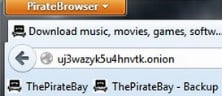
The BPI told us that they accept that blocking can never be 100% effective, and that is something the team at The Pirate Bay know quite a bit about. Earlier this year they released PirateBrowser, an anti-censorsip tool designed to facilitate access to any blocked site.
PirateBrowser has been downloaded more than a million times and will be in even greater demand after today. TorrentFreak is informed that a fresh update will include bookmarks for all the blocked sites so that users can gain easy access.

ECONOPHYSICS AND THE PREDICTIONS OF FINANCIAL BUBBLES

October 30, 2013 By
Our friends over at phys.org are reporting that the latest brainchild of the field of “econophysics” is the ability to predict financial bubbles:
Chaos-on-a-chip model shows market bubbles may be predictable, controllable
Now, there’s a lot going on and implied in this article, so we’d best get to it. Our focus is on these statements:

It’s an idea financial regulators have dreamed of. Experiments on a simple model of chaos have found that it may be possible not only to predict an extreme event, like a stock market collapse, but to intervene and prevent it from happening.
In a paper appearing October 21 in the journal Physical Review Letters, an international team of researchers say that these extreme events, which they call “dragon kings,” are less random than had been thought and that, in a simple experiment at least, they can be anticipated and controlled.

Those interfered waves in turn, to extend the analogy, implied a carrier wave into which the other waves are modulated. The carrier wave carries the information of the other waves.
Thus, in order to control the cycle itself, one would, quite literally, have to control history itself, the underlying carrier wave…
In short, to indulge in some very high octane speculation, and reading behind the lines here – and they’ll never admit this publicly – what they’re talking about is the ability not just to ride the wave of history, but to change it at a fundamental level, that of the information modulating wave itself, the aether, the information in the field, Akashik records, the Dirac sea, the collapse of phase space, call it what you will… It’s most definitely on the edge of fringe science.
And that’s breathtaking, any way one slices it. It’s a long way off course (and perhaps), but it makes one wonder just how much this capability and  analysis already exists and has been expanded in the breakaway civilization and hidden system of finance, for a question directly to the point is, has that system shown any public indicators of suffering the same cyclic activity as the world of public international finance?
But as I said before, it’s breathtaking any way one slices it…. Multiverse theory, anyone?

Read more: ECONOPHYSICS AND THE PREDICTIONS OF FINANCIAL BUBBLES

Epic fail: just 1 percent of Obamacare requests successfully processed

hey ain't that the DOUCHE fucking bag !! ..that said   "we gotta pass this bill so we can read it ? "  is it possible to b an douche bag & an ass pipe! ...at the same time ?      ......apparently :o   & again  George  Carlin ..was right ..there's some more motherfuckers  who need hit in the head wit an hammer  :o  

Epic fail: just 1 percent of Obamacare requests successfully processed

Published time: October 07, 2013 
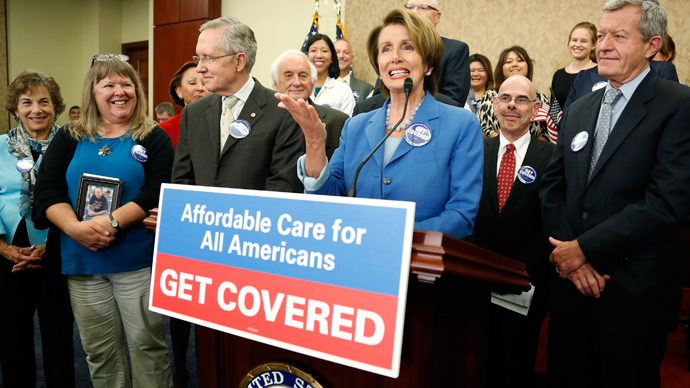
U.S. House Minority Leader Nancy Pelosi (3rd R) and Senate Democratic leader Harry Reid (3rd L) lead a rally to celebrate the start of the Affordable Care Act (commonly known as Obamacare) at the U.S. Capitol in Washington (Reuters / Jonathan Ernst)
Millions of Americans visited newly launched websites last week to learn more about the benefits offered through the president’s health insurance mandate, but Obamacare is apparently not ready for everyone.
Americans officially became able to sign up for insurance coverage provided through President Barack Obama’s Affordable Care Act program Tuesday morning, but a number of issues have impacted the amount of people who are actually able to sign up for so-called Obamacare.
Heavy traffic early in the week caused many of the websites to reportedly crash, but complications are continuing to plague some pages. A report conducted by CNBC suggests that as few as one percent of those online applications were actually submitted correctly.
As few as 1 in 100 applications on the federal exchange contains enough information to enroll the applicant in a plan,” CNBC health care reporter Dan Mangan wrote Friday.
According to several insurance industry sources who spoke to CNBC during the first week of Obamacare’s roll-out, a number of complications are causing the vast majority of submitted applications to be absent of the information necessary to implement coverage.
But while user error would presumably be the main culprit, some experts are saying the websites established to register Americans for the president’s health care plan were brimming with internal problems.
"It is extraordinary that these systems weren't ready," Sumit Nijhawan, CEO of Infogix, told CNBC.
According to Nijhawan, whose company handles data processing for insurers such as WellPoint and Cigna, there will be a “public relations nightmare” if the Obama administration can’t correct the issues that are complicating the sign-up process. If a large number of people wrongly believe they have new insurance when it officially goes into effect in January, he said, the response could be damaging for the White House.
"One hundred people submit their application, one of them goes all the way through the processing ... a big chunk of them are being held," Infogix Chief Product Officer Bobby Koritala added to CNBC. "They need to get more clarifying information."
Dan Mendelson, the CEO of consulting firm Avalere Health, added to Mangang’s report that he wasn’t surprised by the 1-in-100 rate cited by Nijhawan.
"This is not a traffic issue," Mendelson said. "Right now, the systems aren't working."
Dan Schuyler, director of the consultancy Leavitt Partners, added that "If we continue to see these issues through the next three or four weeks there's a lot of concern about how many people will have effective coverage by Jan. 1.”
According to the New York Times, around 8.6 million people visited the new Obamacare websites last week. Before long, however, the Department of Health and Human Services had to take the website down during off-leak hours in order to provide "significant improvements in the online consumer experience."
"We have built a dynamic system and are prepared to make adjustments as needed and improve the consumer experience," HHS spokeswoman Joanne Peters said in a statement.

Rep. Eric Cantor (R-Virginia), the second-highest ranking Republican in the House of Representatives, said in a statement of his own that "Americans have seen once again that Obamacare is not ready for prime time.”
"We have been warned time and time again that ObamaCare is not ready for prime time," independently added Rep. Tim Huelskamp (R-Kansas). "Well, it turns out that is right."
Republican efforts to stall Obamacare largely led to the government shutdown that started last Tuesday morning. GOP members of the House opposed approving any budget that funds the health insurance program, but Obamacare rolled out regardless early Tuesday just as hundreds of thousands of federal workers became furloughed over Congress’ failure to pass a spending bill.
According to the White House, healthcare.gov was visited by one million unique visitors within hours of its launch last week. Americans have until Dec. 15 to enroll in the president’s health insurance plan.
"In the first week, first month, first three months, I would suspect that there will be glitches," Pres. Obama told NPR recently. "This is 50 states, a lot of people, signing up for something. And there are gonna be problems."

Obamacare sites cost more than Facebook, Twitter and LinkedIn

Published time: October 10, 2013                                                ...  fucking no shit ? 
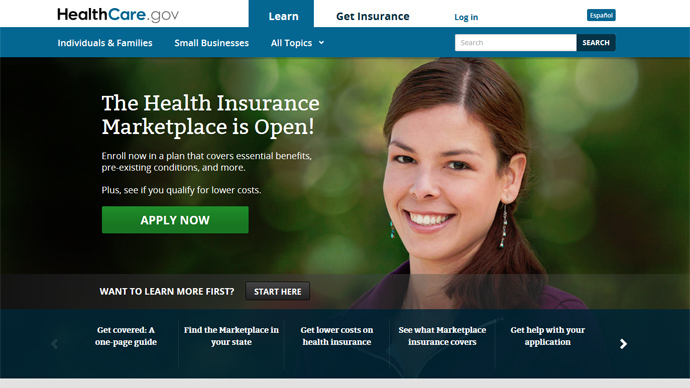
Screenshot from healthcare.gov
An array of issues surrounding the recently launched websites for President Barack Obama’s Affordable Care Act have rendered them largely unavailable during the last week, and a lack of funding might not be to blame.
With the official launch of so-called Obamacare last Tuesday, millions of Americans flocked instantly to brand new Web portals where people could sign up for inexpensive health insurance plans. Bugs, glitches, an overload of traffic and other snafus resulted in many of those sites voluntarily shutting down while programmers picked through code and attempted to revamp the websites in recent days, but a new investigation by Digital Trends’ Andrew Couts suggests that a stupendous amount of money was involved in getting some of those sites off the ground — only for them to crash and burn almost instantly.
Couts has since revised his original estimate since going live with his report on Tuesday this week, but his latest round of research led him to assume that American taxpayers spent over $500 million on the Obamacare websites that have been plagued by problems since their launch one week earlier.
The website for healthcare.gov, Couts wrote, has been so prone to problems “that its track record for failure is challenged only by Congress.” Perhaps an even better example of something the two entities have in common is the vast amount of money spent on making either all too unbearable.
According to Couts’ calculations, data from the US Government Accountability Office and subsequent IT contracts he has stumbled on suggest that at least half-a-billion dollars has been invested in Healthcare.gov and other similar websites so far, which might not seem all too much when compared to other endeavors entertained by Washington.
Compared to other websites, though, Couts says the cost is astronomical.
From his DigitalTrends piece:
Given the complicated nature of federal contracts, it’s difficult to make a direct comparison between the cost to develop Healthcare.gov and the amount of money spent building private online businesses. But for the sake of putting the monstrous amount of money into perspective, here are a few figures to chew on: Facebook, which received its first investment in June 2004, operated for a full six years before surpassing the $500 million mark in June 2010. Twitter, created in 2006, managed to get by with only $360.17 million in total funding until a $400 million boost in 2011. Instagram ginned up justt $57.5 million in funding before Facebook bought it for (a staggering) $1 billion last year. And LinkedIn and Spotify, meanwhile, have only raised, respectively, $200 million and $288 million.”
Indeed, not only is the $500 million blown on Obamacare websites a lot by Washington standards, but even some of the most successful names in Silicon Valley history spent fractions of that sum to steer their projects to the pinnacle of the Web.
There have been more expensive government boondoggles over the years,” American Thinker blogger Rick Moran added. “But as a metaphor for government incompetence, this example takes the cake.”

Couts settled at his latest estimate by taking into account the “almost $394 million from fiscal year 2010 through March 2013” awarded in federal contracts to build the “federally facilitated exchanges,” or FFEs, including healthcare.gov and similar sites. Not all of that figure was used towards building the site, Couts determined, but roughly $363 million did get funneled towards technology-related costs, which was then topped off by at least $150 million just during 2012 and 2013, according to budget requests filed by the Center for Medicare and Medicaid Services to go towards the sites.
At this point I can only speculate on the total cost to build out Healthcare.gov and the related FFEs. Based on the available data, however, a conservative estimate puts the cost so far at over $500 million,” he wrote.

Europe mulls sanctions against U.S. over spying

Source: TFP
BERLIN — The United States could lose access to an important law enforcement tool used to track terrorist money flows, German officials said Monday, as Europe weighed a response to allegations that the Americans spied on their closest European allies.
In Washington, Senate Intelligence Committee Chairwoman Dianne Feinstein called for a “total review” of all U.S. intelligence programs in response to the allegations — activity the California Democrat said she wasn’t told about.
Feinstein said that while her committee was informed of the National Security Agency’s collection of phone records under a secret court order, it “was not satisfactorily informed” that “certain surveillance activities have been in effect for more than a decade” — including eavesdropping on German Chancellor Angela Merkel’s own cellphone.
She said President Barack Obama was also not told that Merkel’s communications were being collected since 2002.
“With respect to NSA collection of intelligence on leaders of U.S. allies — including France, Spain, Mexico and Germany — let me state unequivocally: I am totally opposed,” Feinstein said in a statement Monday.
“Unless the United States is engaged in hostilities against a country or there is an emergency need for this type of surveillance, I do not believe the United States should be collecting phone calls or emails of friendly presidents and prime ministers,” Feinstein said. “The president should be required to approve any collection of this sort.”
Spain became the latest U.S. ally to demand answers after a Spanish newspaper reported that the NSA monitored more than 60 million phone calls in that country during one month alone. The report Monday in the daily El Mundo came on the heels of allegations of massive NSA spying in France and Germany.
With European leaders dissatisfied with the U.S. response so far, officials have been casting about for a way to pressure Washington to provide details of past surveillance and assurances that the practice will be curbed. The challenge is to send a strong message to Washington against wholesale spying on European citizens and institutions without further damage to the overall trans-Atlantic relationship.
As possible leverage, German authorities cited last week’s non-binding resolution by the European Parliament to suspend a post-9/11 agreement allowing the Americans access to bank transfer data to track the flow of terrorist money.
German Justice Minister Sabine Leutheusser-Schnarrenberger said Monday she believed the Americans were using the information to gather economic intelligence apart from terrorism and that the deal, popularly known as the SWIFT agreement, should be suspended. That would represent a sharp rebuke to the United States from some of its closest partners.
“It really isn’t enough to be outraged,” she told rbb-Inforadio. “This would be a signal that something can happen and make clear to the Americans that the (EU’s) policy is changing.”
Suspending the agreement, officially known as the Terrorist Finance Tracking Program, would require approval by an overwhelming majority of the 28 European Union countries. The agreement allows access to funds transferred through the private, Belgium-based Society for Worldwide Interbank Financial Telecommunication, which handles the movement of money between banks worldwide.
Asked Monday if the NSA intelligence gathering had been used not only to protect national security but American economic interests as well, White House spokesman Jay Carney said: “We do not use our intelligence capabilities for that purpose. We use it for security purposes.”
Still, he acknowledged the tensions with allies over the eavesdropping disclosures and said the White House was “working to allay those concerns,” though he refused to discuss any specific reports or provide details of internal White House discussions.
The German justice minister’s comments follow days of vocal indignation in Berlin after German news weekly Der Spiegel reported the NSA had kept tabs on Merkel’s phone calls since as early as 2002, three years before she became chancellor.
Merkel said Friday that she was open to the idea of suspending the SWIFT agreement, saying she “needed to look at this again more closely” and weigh “what we will lose for the security of our citizens and what we don’t.”
Germany and other European governments have made clear they don’t favor suspending the U.S.-EU trade talks which began last summer because both sides stand to gain so much through the proposed deal, especially against competition from China and other emerging markets.
Still, the Europeans have said they will insist that the trade agreement includes stronger rules for protecting data as a result of the NSA allegations. Data protection laws in Europe are generally stronger than in the United States.
“It’s obvious to us that we have to and will bring our European convictions regarding data protection, and protection of privacy and business information, into these negotiations,” Merkel’s spokesman Steffen Seibert told reporters in Berlin on Monday.
The European Parliament’s foreign affairs committee chairman, Elmar Brok, told reporters that failure to resolve the differences over data protection could threaten the trade talks. Brok, a member of Merkel’s party who was in Washington to discuss the spy allegations, said the challenge was to strike a balance between security and personal freedom.
“We are fighting for the rights of our citizens,” he said.
The steady drumbeat of reports stemming from documents provided to various media by NSA leaker Edward Snowden has created a sense of urgency among European governments that, at the very least, they need to be seen in the eyes of their citizens to be doing something to stop the spying.
At the same time, European leaders are anxious to avoid lasting damage in relations with their major ally. So far the issue has not hurt Obama politically within the United States because Republicans have blamed Snowden rather than the White House for the flap.
In the latest allegation, the Spanish newspaper El Mundo published a document it said showed the NSA had eavesdropped on more than 60 million phone calls in Spain between Dec. 10, 2012 and Jan. 8, 2013. The U.S. ambassador to Spain was summoned to the Foreign Ministry for an explanation.
Still, Florentino Portero, a political analyst at Madrid’s Open University, said Spain’s response to the allegations wasn’t as strong as it could have been because of the country’s ties with the U.S., especially intelligence sharing.
“The Spanish government doesn’t want to create a crisis with the United States based on these leaks,” he told The Associated Press.
Madrid is wary of endangering the U.S. military presence in Spain at two bases, Portero said. The U.S. is boosting its presence there as part of a missile defense system, and both Spanish and American officials have stressed that this will give Spain an economic boost as it struggles with unemployment of 26 percent following years of recession.
But Heather Conley, Europe director for Washington-based Center for Strategic and International Studies, said that for Germany, at least, the situation appeared to have reached tipping point and for now other European countries were willing to follow Berlin’s lead.
German intelligence officials are to travel to Washington this week and expect something tangible to bring home, she said.
“If they leave empty-handed, we’ve got a big problem,” Conley said.

GEOINT tradecraft: ‘Human geography’

Source: Def Systems
Geography and social media analytics represent the latest tradecraft within Defense Department and the intelligence community, incorporating “human geography” into geospatial intelligence. For instance, the 2013-2017 National Geospatial-Intelligence Agency (NGA) Strategy calls for using both traditional and non-traditional (e.g., human geography and social media) geospatial sources.
Case in point: When the Somali terrorist group al-Shabaab massacred more than 60 civilians at a shopping mall in Nairobi, Kenya, in September, they tweeted live during the attack trying to explain and justify the carnage. While al-Shabaab’s use of Twitter to communicate its motives to a worldwide audience was brazen, it was not surprising. Jihadists like al-Shabaad with links to al-Qaeda are increasingly turning to social media sites to exchange ideas and publicize their beliefs, according to a 2013 report from the New America Foundation.
“It is only a matter of time before terrorists begin routinely using Twitter, Instagram, and other services in ongoing operations,” concluded the report. “We have already seen this in a limited manner from al-Shabaab, which tweets its #JihadDispatches on recent battles.”
Social media platforms such as blogs, Facebook, Twitter and YouTube have “flattened control over the production of online jihadi media,” enabling jihadist groups to share news items, original articles and essays, tribute videos and even Islamic-sanctioned music, the report revealed. “Those so inclined can talk about jihad all day on the Web, even if they are geographically dispersed,” the report added.
In response, U.S. defense and intelligence agencies are monitoring Arabic-language jihadist Web forums and other online communications in order to “map” the “human terrain” of terror groups based on a treasure trove of open source data available on the Internet. Among the emerging tools is a discipline called Activity Based Intelligence.
SAS Federal, a business analytics and software services company, is helping U.S. intelligence agencies to leverage open source data to better understand the motivation of jihadist groups, where they operate and what they are doing. Social media analytics and content categorization technology from SAS coupled with data mining capabilities are used to scan more than 20 million websites, including blogs, chats, Facebook, Twitter and YouTube, while “natural language processing” extracts online discussions in Arabic, Farsi and 28 other native languages and dialects.
All this is used to support geospatial intelligence gathering and analysis. The technology is designed to enable the identification of “unknown unknowns.”
“With a couple of mouse clicks, an NGA analyst, as an example, could look at a whole category of unknown neighborhoods or villages and see the latest conversations and discover that there is a local reference to a neighborhood we did not have on the map,” said Marc Kriz, an account executive with SAS Federal’s National Security Group. “We’re constantly extracting conversations about things like unknown hospitals and clinics, schools, mosques, neighborhoods, villages and governance. We’re discovering a rich plethora of geospatial data vis-a-vis social media.”
“It sounds funny but it’s very difficult to know when a hotel changes, for instance, from a Best Western to a Hilton,” added Scott Simmons, CACI’s executive director of Geospatial Solutions. “You can try and search on websites every day and hope that they have that updated information. But, shockingly, someone in Nairobi is going to tweet about it and send a message that the hotel’s Best Western sign came down.”
Kriz said there are often local slang words used by indigenous populations for neighborhoods or villages that are identified by social media analytics and have been subsequently added to the U.S. geospatial intelligence names database. Based on an assessment of the “patterns of life” in a particular neighborhood or village, analysts can better understand those patterns and linkages. For instance, through open source media, analysts leveraging social network analytics can discover conversations about mosques in a particular part of the world that helps them to identify Imams and their followers, he said.
“Sentiment analysis” is another area of geospatial intelligence that is important to some DOD and intelligence community customers, according to Rebecca Garcia, director of intelligence solutions for SAS Federal. “We can look at how unrest may be spread through an area or within a human geography,” said Garcia, noting that the Arab Spring, the revolutionary wave of demonstrations and protests (both non-violent and violent) that have rocked the Middle East in recent years, have been fueled by social media.
This kind of analysis seeks to extract and identify popular, negative or neutral sentiment from open source content.
Understanding the “Human Domain,” defined as the presence, activities, social structure or organization, networks and relationships, motivation, intent, vulnerabilities and capabilities of individuals or groups is a vital part of Activity Based Intelligence.  ABI, a multi-intelligence approach to analysis embraced by U.S. intelligence agencies, is a discipline in which analysis and subsequent collection is focused on the activity and transactions associated with an entity, a population or an area of interest. It is based on persistent collection of intelligence over a broad area from multiple sources.
“ABI is really a new tradecraft that builds on top of something that’s been around for awhile called ‘patterns of life,’” said Jordan Becker, vice president and general manager for GEOINT-ISR at BAE Systems. “As a new tradecraft, it really moves away from some of the traditional processes such as tasking, collection, processing, exploitation and dissemination. What ABI does is [it] enhances and breaks the linearity of that process.”
Geospatial intelligence, coupled with human domain analytics, is the foundation of ABI. In December 2012, BAE won a multi-year, $60 million contract to provide ABI systems, tools and support to NGA. Using a computer-assisted problem solving methodology, ABI analysts leverage big data to spot trends and patterns of activity when they intersect, enabling the identification of “unknown unknowns” and more predictive intelligence that anticipates targets and threats. As NGA COO Ellen McCarthy has stated, ABI “reveals what we don’t know and helps us find what doesn’t want to be found.”
McCarthy could not be reached for comment for this story.
“The ultimate goal is better intelligence,” added Becker of SAS. “It’s not about how many more reports you can generate or how many more items you can identify on a map, whether it’s relevant or not. It’s can you really get closer to intent and help that analyst formulate better hypotheses.”
Mike Manzo, director of geospatial solutions for General Dynamics Advanced Information Systems, said ABI allows analysts to be proactive rather than reactive. “ABI has been around in different forms in the past, but what has made it more attractive now is computing power,” said Manzo. “The cloud enables you to have those real-time capabilities where you have access to a lot more data and computing power.
“As processing power increases and smarter algorithms are developed,” he added, “we’re going to start to see more intelligence systems infer activity based on a myriad of different data coming in.”

2009: Man Buys 5000 Bitcoins For $27, Forgets About Them. 2013: Man Rediscovers His Bitcoins, Now Worth $886,000

from the valuable-information dept

Bitcoin shares with drones the unhappy distinction of being the subject of almost exclusively negative reports. Just as drones are usually doing bad things to people, so Bitcoins are usually helping people do bad things because of their supposed untraceability. So it makes a pleasant change to come across an upbeat Bitcoin story like this, as told by the Guardian:
Kristoffer Koch invested 150 kroner ($26.60) in 5,000 bitcoins in 2009, after discovering them during the course of writing a thesis on encryption. He promptly forgot about them until widespread media coverage of the anonymous, decentralised, peer-to-peer digital currency in April 2013 jogged his memory.
In those four years, his Bitcoin holding had become worth around $886,000 -- a rather nice gain on the original outlay. But the real moral here is not, as it might appear, that you should rush out and buy Bitcoins in the hope that they will be worth fabulous sums in a few years' time -- the continuing fluctuations in Bitcoin's value and doubts about its underpinnings make that a very risky proposition. Rather, the key thing to note is the following:
Bitcoins are stored in encrypted wallets secured with a private key, something Koch had forgotten.
Fortunately for him, Koch did manage to remember his password. But just imagine how he would have felt if he hadn't been able to recall his private key, and had meanwhile discovered that he had $886,000 worth of Bitcoins that he couldn't access. So the real moral here is this: make sure you back up all your passwords -- even the ones you think you'll never need again -- just in case.