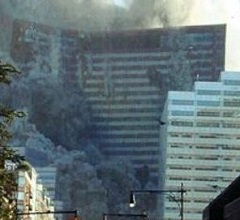
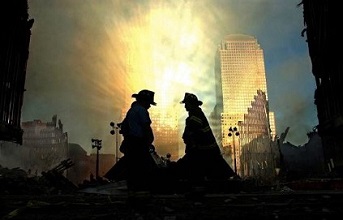
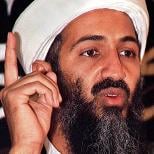
The article below entitled Who is Osama bin Laden? was drafted twelve years ago on September 11, 2001.
I started writing on the evening of September 11, late into the
night, going through piles of research notes, which I had previously
collected on the history of Al Qaeda. It was first published on the
Global Research website on the evening of September 12, 2001.
From the outset, the objective was to use 9/11 as a pretext
for launching the first phase of the Middle East War Central Asian war,
which consisted in the bombing and occupation of Afghanistan.
Within hours of the attacks, Osama bin Laden was identified
without evidence as the architect of 9/11. On the following day, the
“global war on terrorism” had been launched. The media disinformation
campaign went into full gear.
Also on September 12, less than 24 hours after the attacks, NATO
invoked for the first time in its history “Article 5 of the Washington
Treaty – its collective defense clause” declaring the 9/11 attacks on
the World Trade Center (WTC) and the Pentagon “to be an attack against
all NATO members.” Implied in this statement was that Afghanistan as a
nation state had attacked the United States, a totally absurd
proposition.
What happened subsequently, with the invasions of Afghanistan, Iraq and Libya is already part of history.
Syria and Iran constitute the next phase of the US administration’s military road map.
Al Qaeda is a terrorist construct, and “intelligence asset” financed, trained and supported covertly by the CIA.
“Jihadist” mercenaries continue to be recruited by the US and its allies.
Al
Qaeda and its numerous affiliates –including Al Nusrah in Syria– are
used as a means to destabilizing sovereign countries under the banner of
the “Global War on Terrorism”.
9/11 propaganda prevails. The September 11, 2001 attacks continue
to be used by the US administration as a pretext and a justification
for waging a war without borders.
On this twelfth anniversary commemoration of the tragic events
of September 11, 2001, the central issue remains 9/11 Truth as a means
to dismantling Washington’s global military agenda, upholding civil
liberties and restoring World Peace.
Michel Chossudovsky, Montreal, September 10, 2013
Who Is Osama Bin Laden?
by Michel Chossudovsky
Global Research, September 12, 2001
A few hours after the terrorist attacks on the
World Trade Centre and the Pentagon, the Bush administration concluded
without supporting evidence, that “Osama bin Laden and his al-Qaeda
organisation were prime suspects”. CIA Director George Tenet stated that
bin Laden has the capacity to plan “multiple attacks with little or no
warning.” Secretary of State Colin Powell called the attacks “an act of
war” and President Bush confirmed in an evening televised address to the
Nation that he would “make no distinction between the terrorists who
committed these acts and those who harbor them”. Former CIA Director
James Woolsey pointed his finger at “state sponsorship,” implying the
complicity of one or more foreign governments. In the words of former
National Security Adviser, Lawrence Eagleburger, “I think we will show
when we get attacked like this, we are terrible in our strength and in
our retribution.”
Meanwhile, parroting official statements, the Western media
mantra has approved the launching of “punitive actions” directed against
civilian targets in the Middle East. In the words of William Saffire
writing in the New York Times: “When we reasonably determine our
attackers’ bases and camps, we must pulverize them — minimizing but
accepting the risk of collateral damage” — and act overtly or covertly
to destabilize terror’s national hosts”.
The following text outlines the history of Osama Bin Laden and the
links of the Islamic “Jihad” to the formulation of US foreign policy
during the Cold War and its aftermath.
Prime suspect in the New York and Washington terrorists attacks,
branded by the FBI as an “international terrorist” for his role in the
African US embassy bombings, Saudi born Osama bin Laden was recruited
during the Soviet-Afghan war “ironically under the auspices of the CIA,
to fight Soviet invaders”. 1
In 1979 “the largest covert operation in the history of the CIA” was
launched in response to the Soviet invasion of Afghanistan in support of
the pro-Communist government of Babrak Kamal.2:
With the active encouragement of the CIA and Pakistan’s
ISI [Inter Services Intelligence], who wanted to turn the Afghan jihad
into a global war waged by all Muslim states against the Soviet Union,
some 35,000 Muslim radicals from 40 Islamic countries joined
Afghanistan’s fight between 1982 and 1992. Tens of thousands more came
to study in Pakistani madrasahs. Eventually more than 100,000 foreign
Muslim radicals were directly influenced by the Afghan jihad.3
The Islamic “jihad” was supported by the United States and Saudi
Arabia with a significant part of the funding generated from the Golden
Crescent drug trade:
In March 1985, President Reagan signed National Security
Decision Directive 166,…[which] authorize[d] stepped-up covert military
aid to the mujahideen, and it made clear that the secret Afghan war had a
new goal: to defeat Soviet troops in Afghanistan through covert action
and encourage a Soviet withdrawal. The new covert U.S. assistance began
with a dramatic increase in arms supplies — a steady rise to 65,000 tons
annually by 1987, … as well as a “ceaseless stream” of CIA and Pentagon
specialists who traveled to the secret headquarters of Pakistan’s ISI
on the main road near Rawalpindi, Pakistan. There the CIA specialists
met with Pakistani intelligence officers to help plan operations for the
Afghan rebels.4
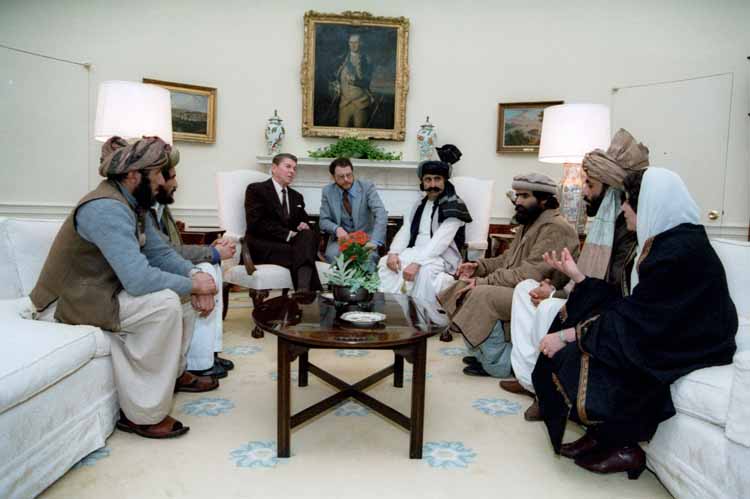
Ronald Reagan Meets Mujahideen Leaders at the White House
The Central Intelligence Agency (CIA) using Pakistan’s military
Inter-Services Intelligence (ISI) played a key role in training the
Mujahideen. In turn, the CIA sponsored guerrilla training was integrated
with the teachings of Islam:
Predominant themes were that Islam was a complete
socio-political ideology, that holy Islam was being violated by the
atheistic Soviet troops, and that the Islamic people of Afghanistan
should reassert their independence by overthrowing the leftist Afghan
regime propped up by Moscow.5
Pakistan’s Intelligence Apparatus
Pakistan’s ISI was used as a “go-between”. The CIA covert support to
the “jihad” operated indirectly through the Pakistani ISI, –i.e. the CIA
did not channel its support directly to the Mujahideen. In other words,
for these covert operations to be “successful”, Washington was careful
not to reveal the ultimate objective of the “jihad”, which consisted in
destroying the Soviet Union.
In the words of CIA’s Milton Beardman “We didn’t train Arabs”. Yet
according to Abdel Monam Saidali, of the Al-aram Center for Strategic
Studies in Cairo, bin Laden and the “Afghan Arabs” had been imparted
“with very sophisticated types of training that was allowed to them by
the CIA” 6
CIA’s Beardman confirmed, in this regard, that Osama bin Laden was
not aware of the role he was playing on behalf of Washington. In the
words of bin Laden (quoted by Beardman): “neither I, nor my brothers saw
evidence of American help”. 7
Motivated by nationalism and religious fervor, the Islamic warriors
were unaware that they were fighting the Soviet Army on behalf of Uncle
Sam. While there were contacts at the upper levels of the intelligence
hierarchy, Islamic rebel leaders in theatre had no contacts with
Washington or the CIA.
With CIA backing and the funneling of massive amounts of US military
aid, the Pakistani ISI had developed into a “parallel structure wielding
enormous power over all aspects of government”. 8 The ISI had a staff
composed of military and intelligence officers, bureaucrats, undercover
agents and informers, estimated at 150,000. 9
Meanwhile, CIA operations had also reinforced the Pakistani military regime led by General Zia Ul Haq:
‘Relations between the CIA and the ISI [Pakistan's
military intelligence] had grown increasingly warm following [General]
Zia’s ouster of Bhutto and the advent of the military regime,’… During
most of the Afghan war, Pakistan was more aggressively anti-Soviet than
even the United States. Soon after the Soviet military invaded
Afghanistan in 1980, Zia [ul Haq] sent his ISI chief to destabilize the
Soviet Central Asian states. The CIA only agreed to this plan in October
1984…. `the CIA was more cautious than the Pakistanis.’ Both Pakistan
and the United States took the line of deception on Afghanistan with a
public posture of negotiating a settlement while privately agreeing that
military escalation was the best course.10
The Golden Crescent Drug Triangle
The history of the drug trade in Central Asia is intimately related
to the CIA’s covert operations. Prior to the Soviet-Afghan war, opium
production in Afghanistan and Pakistan was directed to small regional
markets. There was no local production of heroin. 11 In this regard,
Alfred McCoy’s study confirms that within two years of the onslaught of
the CIA operation in Afghanistan, “the Pakistan-Afghanistan borderlands
became the world’s top heroin producer, supplying 60 percent of U.S.
demand. In Pakistan, the heroin-addict population went from near zero in
1979… to 1.2 million by 1985 — a much steeper rise than in any other
nation”:12
CIA assets again controlled this heroin trade. As the
Mujahideen guerrillas seized territory inside Afghanistan, they ordered
peasants to plant opium as a revolutionary tax. Across the border in
Pakistan, Afghan leaders and local syndicates under the protection of
Pakistan Intelligence operated hundreds of heroin laboratories. During
this decade of wide-open drug-dealing, the U.S. Drug Enforcement Agency
in Islamabad failed to instigate major seizures or arrests … U.S.
officials had refused to investigate charges of heroin dealing by its
Afghan allies `because U.S. narcotics policy in Afghanistan has been
subordinated to the war against Soviet influence there.’ In 1995, the
former CIA director of the Afghan operation, Charles Cogan, admitted the
CIA had indeed sacrificed the drug war to fight the Cold War. `Our main
mission was to do as much damage as possible to the Soviets. We didn’t
really have the resources or the time to devote to an investigation of
the drug trade,’… `I don’t think that we need to apologize for this.
Every situation has its fallout…. There was fallout in terms of drugs,
yes. But the main objective was accomplished. The Soviets left
Afghanistan.’13
In the Wake of the Cold War
In the wake of the Cold War, the Central Asian region is not only
strategic for its extensive oil reserves, it also produces three
quarters of the World’s opium representing multibillion dollar revenues
to business syndicates, financial institutions, intelligence agencies
and organized crime. The annual proceeds of the Golden Crescent drug
trade (between 100 and 200 billion dollars) represents approximately one
third of the Worldwide annual turnover of narcotics, estimated by the
United Nations to be of the order of $500 billion.14
With the disintegration of the Soviet Union, a new surge in opium
production has unfolded. (According to UN estimates, the production of
opium in Afghanistan in 1998-99 — coinciding with the build up of armed
insurgencies in the former Soviet republics– reached a record high of
4600 metric tons.15 Powerful business syndicates in the former Soviet
Union allied with organized crime are competing for the strategic
control over the heroin routes.
The ISI’s extensive intelligence military-network was not dismantled
in the wake of the Cold War. The CIA continued to support the Islamic
“jihad” out of Pakistan. New undercover initiatives were set in motion
in Central Asia, the Caucasus and the Balkans. Pakistan’s military and
intelligence apparatus essentially “served as a catalyst for the
disintegration of the Soviet Union and the emergence of six new Muslim
republics in Central Asia.” 16.
Meanwhile, Islamic missionaries of the Wahhabi sect from Saudi Arabia
had established themselves in the Muslim republics as well as within
the Russian federation encroaching upon the institutions of the secular
State. Despite its anti-American ideology, Islamic fundamentalism was
largely serving Washington’s strategic interests in the former Soviet
Union.
Following the withdrawal of Soviet troops in 1989, the civil war in
Afghanistan continued unabated. The Taliban were being supported by the
Pakistani Deobandis and their political party the
Jamiat-ul-Ulema-e-Islam (JUI). In 1993, JUI entered the government
coalition of Prime Minister Benazzir Bhutto. Ties between JUI, the Army
and ISI were established. In 1995, with the downfall of the
Hezb-I-Islami Hektmatyar government in Kabul, the Taliban not only
instated a hardline Islamic government, they also “handed control of
training camps in Afghanistan over to JUI factions…” 17
And the JUI with the support of the Saudi Wahhabi movements played a
key role in recruiting volunteers to fight in the Balkans and the former
Soviet Union.
Jane Defense Weekly confirms in this regard that “half of Taliban
manpower and equipment originate[d] in Pakistan under the ISI” 18
In fact, it would appear that following the Soviet withdrawal both
sides in the Afghan civil war continued to receive covert support
through Pakistan’s ISI. 19
In other words, backed by Pakistan’s military intelligence (ISI)
which in turn was controlled by the CIA, the Taliban Islamic State was
largely serving American geopolitical interests. The Golden Crescent
drug trade was also being used to finance and equip the Bosnian Muslim
Army (starting in the early 1990s) and the Kosovo Liberation Army (KLA).
In last few months there is evidence that Mujahideen mercenaries are
fighting in the ranks of KLA-NLA terrorists in their assaults into
Macedonia.
No doubt, this explains why Washington has closed its eyes on the
reign of terror imposed by the Taliban including the blatant derogation
of women’s rights, the closing down of schools for girls, the dismissal
of women employees from government offices and the enforcement of “the
Sharia laws of punishment”.20
The War in Chechnya
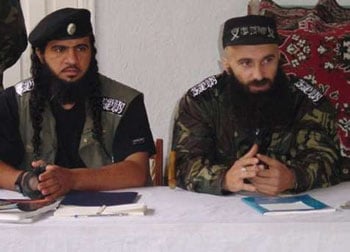
With
regard to Chechnya, the main rebel leaders Shamil Basayev and Al
Khattab were trained and indoctrinated in CIA sponsored camps in
Afghanistan and Pakistan. According to Yossef Bodansky, director of the
U.S. Congress’s Task Force on Terrorism and Unconventional Warfare, the
war in Chechnya had been planned during a secret summit of HizbAllah
International held in 1996 in Mogadishu, Somalia. 21
The summit, was attended by Osama bin Laden and high-ranking Iranian
and Pakistani intelligence officers. In this regard, the involvement of
Pakistan’s ISI in Chechnya “goes far beyond supplying the Chechens with
weapons and expertise: the ISI and its radical Islamic proxies are
actually calling the shots in this war”. 22
Russia’s main pipeline route transits through Chechnya and Dagestan.
Despite Washington’s perfunctory condemnation of Islamic terrorism, the
indirect beneficiaries of the Chechen war are the Anglo-American oil
conglomerates which are vying for control over oil resources and
pipeline corridors out of the Caspian Sea basin.
The two main Chechen rebel armies (respectively led by Commander
Shamil Basayev and Emir Khattab) [image right] estimated at 35,000
strong were supported by Pakistan’s ISI, which also played a key role in
organizing and training the Chechen rebel army:
[In 1994] the Pakistani Inter Services Intelligence
arranged for Basayev and his trusted lieutenants to undergo intensive
Islamic indoctrination and training in guerrilla warfare in the Khost
province of Afghanistan at Amir Muawia camp, set up in the early 1980s
by the CIA and ISI and run by famous Afghani warlord Gulbuddin
Hekmatyar. In July 1994, upon graduating from Amir Muawia, Basayev was
transferred to Markaz-i-Dawar camp in Pakistan to undergo training in
advanced guerrilla tactics. In Pakistan, Basayev met the highest ranking
Pakistani military and intelligence officers: Minister of Defense
General Aftab Shahban Mirani, Minister of Interior General Naserullah
Babar, and the head of the ISI branch in charge of supporting Islamic
causes, General Javed Ashraf, (all now retired). High-level connections
soon proved very useful to Basayev.23
Following his training and indoctrination stint, Basayev was assigned
to lead the assault against Russian federal troops in the first Chechen
war in 1995. His organization had also developed extensive links to
criminal syndicates in Moscow as well as ties to Albanian organized
crime and the Kosovo Liberation Army (KLA). In 1997-98, according to
Russia’s Federal Security Service (FSB) “Chechen warlords started buying
up real estate in Kosovo… through several real estate firms registered
as a cover in Yugoslavia” 24
Basayev’s organisation has also been involved in a number of rackets
including narcotics, illegal tapping and sabotage of Russia’s oil
pipelines, kidnapping, prostitution, trade in counterfeit dollars and
the smuggling of nuclear materials (See Mafia linked to Albania’s
collapsed pyramids, 25 Alongside the extensive laundering of drug money,
the proceeds of various illicit activities have been funneled towards
the recruitment of mercenaries and the purchase of weapons.
During his training in Afghanistan, Shamil Basayev linked up with
Saudi born veteran Mujahideen Commander “Al Khattab” who had fought as a
volunteer in Afghanistan. Barely a few months after Basayev’s return to
Grozny, Khattab was invited (early 1995) to set up an army base in
Chechnya for the training of Mujahideen fighters. According to the BBC,
Khattab’s posting to Chechnya had been “arranged through the
Saudi-Arabian based [International] Islamic Relief Organisation, a
militant religious organisation, funded by mosques and rich individuals
which channeled funds into Chechnya”.26
Concluding Remarks
Since the Cold War era, Washington has consciously supported Osama
bin Laden, while at same time placing him on the FBI’s “most wanted
list” as the World’s foremost terrorist.
While the Mujahideen are busy fighting America’s war in the Balkans
and the former Soviet Union, the FBI –operating as a US based Police
Force- is waging a domestic war against terrorism, operating in some
respects independently of the CIA which has –since the Soviet-Afghan
war– supported international terrorism through its covert operations.
In a cruel irony, while the Islamic jihad –featured by the Bush
Adminstration as “a threat to America”– is blamed for the terrorist
assaults on the World Trade Centre and the Pentagon, these same Islamic
organisations constitute a key instrument of US military-intelligence
operations in the Balkans and the former Soviet Union.
In the wake of the terrorist attacks in New York and Washington, the
truth must prevail to prevent the Bush Adminstration together with its
NATO partners from embarking upon a military adventure which threatens
the future of humanity.
Notes
- Hugh Davies, International:
`Informers’ point the finger at bin Laden; Washington on alert for
suicide bombers, The Daily Telegraph, London, 24 August 1998.
- See Fred Halliday, “The Un-great game: the Country that lost the Cold War, Afghanistan, New Republic, 25 March 1996):
- Ahmed Rashid, The Taliban: Exporting Extremism, Foreign Affairs, November-December 1999.
- Steve Coll, Washington Post, July 19, 1992.
- Dilip Hiro, Fallout from the Afghan Jihad, Inter Press Services, 21 November 1995.
- Weekend Sunday (NPR); Eric Weiner, Ted Clark; 16 August 1998.
- Ibid.
- Dipankar Banerjee; Possible Connection of ISI With Drug Industry, India Abroad, 2 December 1994.
- Ibid
- See Diego Cordovez and Selig
Harrison, Out of Afghanistan: The Inside Story of the Soviet Withdrawal,
Oxford university Press, New York, 1995. See also the review of
Cordovez and Harrison in International Press Services, 22 August 1995.
- Alfred McCoy, Drug fallout: the CIA’s Forty Year Complicity in the Narcotics Trade. The Progressive; 1 August 1997.
- Ibid
- Ibid.
- Douglas Keh, Drug Money in a
changing World, Technical document no 4, 1998, Vienna UNDCP, p. 4. See
also Report of the International Narcotics Control Board for 1999,
E/INCB/1999/1 United Nations Publication, Vienna 1999, p 49-51, And
Richard Lapper, UN Fears Growth of Heroin Trade, Financial Times, 24
February 2000.
- Report of the International Narcotics Control Board, op cit, p 49-51, see also Richard Lapper, op. cit.
- International Press Services, 22 August 1995.
- Ahmed Rashid, The Taliban: Exporting Extremism, Foreign Affairs, November- December, 1999, p. 22.
- Quoted in the Christian Science Monitor, 3 September 1998)
- Tim McGirk, Kabul learns to live with its bearded conquerors, The Independent, London, 6 November1996.
- See K. Subrahmanyam, Pakistan is Pursuing Asian Goals, India Abroad, 3 November 1995.
- Levon Sevunts, Who’s calling the
shots?: Chechen conflict finds Islamic roots in Afghanistan and
Pakistan, 23 The Gazette, Montreal, 26 October 1999..
- Ibid
- Ibid.
- See Vitaly Romanov and Viktor Yadukha, Chechen Front Moves To Kosovo Segodnia, Moscow, 23 Feb 2000.
- The European, 13 February 1997, See also Itar-Tass, 4-5 January 2000.
- BBC, 29 September 1999).

 Posts
Posts





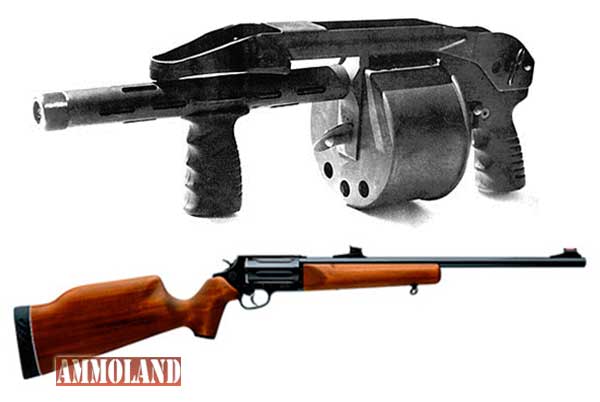 Circuit Judge sporting arm with the vilified Street Sweeper,
California Democrat politicians can’t tell the difference between each.
Circuit Judge sporting arm with the vilified Street Sweeper,
California Democrat politicians can’t tell the difference between each.