Friday, April 10, 2015

The CIA and the Media 

by Carl Bernstein

Rolling Stone, Oct. 20, 1977,http://danwismar.com/uploads/Bernstein%20-%20CIA%20and%20Media.htm

In 1953, Joseph Alsop, then one of America's leading syndicated columnists, went to the Philippines to cover an election. He did not go because he was asked to do so by his syndicate. He did not go because he was asked to do so by the newspapers that printed his column. He went at the request of the CIA.

Alsop is one of more than 400 American journalists who in the past twenty-five years have secretly carried out assignments for the Central Intelligence Agency, according to documents on file at CIA headquarters.


Some of these journalists' relationships with the Agency were tacit; some were explicit. There was cooperation, accommodation and overlap. Journalists provided a full range of clandestine services -- from simple intelligence gathering to serving as go-betweens with spies in Communist countries. Reporters shared their notebooks with the CIA. Editors shared their staffs. Some of the journalists were Pulitzer Prize winners, distinguished reporters who considered themselves ambassadors-without-portfolio for their country. Most were less exalted: foreign correspondents who found that their association with the Agency helped their work; stringers and freelancers who were as interested it the derring-do of the spy business as in filing articles, and, the smallest category, full-time CIA employees masquerading as journalists abroad. In many instances, CIA documents show, journalists were engaged to perform tasks for the CIA with the consent of the managements America�s leading news organizations.

The history of the CIA's involvement with the American press continues to be shrouded by an official policy of obfuscation and deception . . . .

Among the executives who lent their cooperation to the Agency were William Paley of the Columbia Broadcasting System, Henry Luce of Time Inc., Arthur Hays Sulzberger of the New York Times, Barry Bingham Sr. of the Louisville Courier-Journal and James Copley of the Copley News Service. Other organizations which cooperated with the CIA include the American Broadcasting Company, the National Broadcasting Company, the Associated Press, United Press International, Reuters, Hearst Newspapers, Scripps-Howard, Newsweek magazine, the Mutual Broadcasting System, The Miami Herald, and the old Saturday Evening Post and New York Herald-Tribune. By far the most valuable of these associations, according to CIA officials, have been with The New York Times, CBS, and Time Inc.

... From the Agency's perspective, there is nothing untoward in such relationships, and any ethical questions are a matter for the journalistic profession to resolve, not the intelligence community ... .

Many journalists were used by the CIA to assist in this process and they had the reputation of being among the best in the business. The peculiar nature of the job of the foreign correspondent is ideal for such work; he is accorded unusual access, by his host country, permitted to travel in areas often off-limits to other Americans, spends much of his time cultivating sources in governments, academic institutions, the military establishment and the scientific communities. He has the opportunity to form long-term personal relationships with sources and -- perhaps more than any other category of American operative -- is in a position to make correct judgments about the susceptibility and availability of foreign nationals for recruitment as spies.

The Agency's dealings with the press began during the earliest stages of the Cold War. Allen Dulles, who became director of the CIA in 1953, sought to establish a recruiting-and-cover capability within America's most prestigious journalistic institutions. By operating under the guise of accredited news correspondents, Dulles believed, CIA operatives abroad would be accorded a degree of access and freedom of movement unobtainable under almost any other type of cover.

American publishers, like so many other corporate and institutional leaders at the time, were willing us commit the resources of their companies to the struggle against "global Communism." Accordingly, the traditional line separating the American press corps and government was often indistinguishable: rarely was a news agency used to provide cover for CIA operatives abroad without the knowledge and consent of either its principal owner; publisher or senior editor. Thus, contrary to the notion that the CIA era and news executives allowed themselves and their organizations to become handmaidens to the intelligence services. "Let's not pick on some poor reporters, for God's sake," William Colby exclaimed at one point to the Church committee's investigators. "Let's go to the managements. They were witting" In all, about twenty-five news organizations (including those listed at the beginning of this article) provided cover for the Agency.

... Many journalists who covered World War II were close to people in the Office of Strategic Services, the wartime predecessor of the CIA; more important, they were all on the same side. When the war ended and many OSS officials went into the CIA, it was only natural that these relationships would continue.

Meanwhile, the first postwar generation of journalists entered the profession; they shared the same political and professional values as their mentors. "You had a gang of people who worked together during World War II and never got over it," said one Agency official. "They were genuinely motivated and highly susceptible to intrigue and being on the inside. Then in the Fifties and Sixties there was a national consensus about a national threat. The Vietnam War tore everything to pieces -- shredded the consensus and threw it in the air." Another Agency official observed: "Many journalists didn't give a second thought to associating with the Agency. But there was a point when the ethical issues which most people had submerged finally surfaced. Today, a lot of these guys vehemently deny that they had any relationship with the Agency."

... The CIA even ran a formal training program in the 1950s to teach its agents to be journalists. Intelligence officers were "taught to make noises like reporters," explained a high CIA official, and were then placed in major news organizations with help from management. "These were the guys who went through the ranks and were told, "You're going to be a journalist," the CIA official said. Relatively few of the 400-some relationships described in Agency files followed that pattern, however; most involved persons who were already bona fide journalists when they began undertaking tasks for the Agency. The Agency's relationships with journalists, as described in CIA files, include the following general categories:

- Legitimate, accredited staff members of news organizations - usually reporters. Some were paid; some worked for the Agency on a purely voluntary basis.

- Stringers and freelancers. Most were payrolled by the Agency under standard contractual terms.

- Employees of so-called CIA "proprietaries." During the past twenty-five years, the Agency has secretly bankrolled numerous foreign press services, periodicals and newspapers -- both English and foreign language -- which provided excellent cover for CIA operatives.

- Columnists and commentators. There are perhaps a dozen well-known columnists and broadcast commentators whose relationships with the CIA go far beyond those normally maintained between reporters and their sources. They are referred to at the Agency as "known assets" and can be counted on to perform a variety of undercover tasks; they are considered receptive to the Agency"s point of view on various subjects.

Murky details of CIA relationships with individuals and news organizations began trickling out in 1973 when it was first disclosed that the CIA had, on occasion, employed journalists. Those reports, combined with new information, serve as casebook studies of the Agency's use of journalists for intelligence purposes.

The New York Times -- The Agency's relationship with the Times was by far its most valuable among newspapers, according to CIA officials. [It was] general Times policy ... to provide assistance to the CIA whenever possible.

... CIA officials cite two reasons why the Agency's working relationship with the Times was closer and more extensive than with any other paper: the fact that the Times maintained the largest foreign news operation in American daily journalism; and the close personal ties between the men who ran both institutions ... .

The Columbia Broadcasting System -- CBS was unquestionably the CIA's most valuable broadcasting asset. CBS president William Paley and Allen Dulles enjoyed an easy working and social relationship. Over the years, the network provided cover for CIA employees, including at least one well-known foreign correspondent and several stringers; it supplied outtakes of newsfilm to the CIA; established a formal channel of communication between the Washington bureau chief and the Agency; gave the Agency access to the CBS newsfilm library; and allowed reports by CBS correspondents to the Washington and New York newsrooms to be routinely monitored by the CIA. Once a year during the 1950s and early 1960s, CBS correspondents joined the CIA hierarchy for private dinners and briefings.

... At the headquarters of CBS News in New York, Paley's cooperation with the CIA is taken for granted by many news executives and reporters, despite the denials. Paley, 76, was not interviewed by Salant's investigators. "It wouldn't do any good," said one CBS executive. "It is the single subject about which his memory has failed."

Time and Newsweek magazines -- According to CIA and Senate sources, Agency files contain written agreements with former foreign correspondents and stringers for both the weekly news magazines. The same sources refused to say whether the CIA has ended all its associations with individuals who work for the two publications. Allen Dulles often interceded with his good friend, the late Henry Luce, founder of Time and Life magazines, who readily allowed certain members of his staff to work for the Agency and agreed to provide jobs and credentials for other CIA operatives who lacked journalistic experience.

... At Newsweek, Agency sources reported, the CIA engaged the services of several foreign correspondents and stringers under arrangements approved by senior editors at the magazine.

... "To the best of my knowledge:" said [Harry] Kern, [Newsweek's foreign editor from 1945 to 1956] "nobody at Newsweek worked for the CIA.... The informal relationship was there. Why have anybody sign anything? What we knew we told them [the CIA] and the State Department.... When I went to Washington, I would talk to Foster or Allen Dulles about what was going on .... We thought it was admirable at the time. We were all on the same side." CIA officials say that Kern's dealings with the Agency were extensive.

... When Newsweek was purchased by the Washington Post Company, publisher Philip L. Graham was informed by Agency officials that the CIA occasionally used the magazine for cover purposes, according to CIA sources. "It was widely known that Phil Graham was somebody you could get help from," said a former deputy director of the Agency. . . . But Graham, who committed suicide in 1963, apparently knew little of the specifics of any cover arrangements with Newsweek, CIA sources said.

... Information about Agency dealings with the Washington Post newspaper is extremely sketchy. According to CIA officials, some Post stringers have been CIA employees, but these officials say they do not know if anyone in the Post management was aware of the arrangements. ...

Other major news organizations -- According to Agency officials, CIA files document additional cover arrangements with the following news gathering organizations, among others: the New York Herald Tribune, Saturday Evening Post, Scripps-Howard Newspapers, Hearst Newspapers, Associated Press, United Press International, the Mutual Broadcasting System, Reuters and The Miami Herald. ...

"And that's just a small part of the list," in the words of one official who served in the CIA hierarchy. Like many sources, this official said that the only way to end the uncertainties about aid furnished the Agency by journalists is to disclose the contents of the CIA files -- a course opposed by almost all of the thirty-five present and former CIA officials interviewed over the course of a year.

The CIA's use of journalists continued virtually unabated until 1973 when, in response to public disclosure that the Agency had secretly employed American reporters, William Colby began scaling down the program. In his public statements, Colby conveyed the impression that the use of journalists had been minimal and of limited importance to the Agency.

He then initiated a series of moves intended to convince the press, Congress and the public that the CIA had gotten out of the news business. But according to Agency officials, Colby had in fact thrown a protective net around his most valuable intelligence assets in the journalistic community.

... After Colby left the Agency on January 28th, 1976, and was succeeded by George Bush, the CIA announced a new policy: "Effective immediately, the CIA will not enter into any paid or contract relationship with any full-time or part-time news correspondent accredited by any U.S. news service, newspaper, periodical, radio or television network or station." . . . The text of the announcement noted that the CIA would continue to "welcome" the voluntary, unpaid cooperation of journalists. Thus, many relationships were permitted to remain intact.

The Agency's unwillingness to end its use of journalists and its continued relationships with some news executives is largely the product of two basic facts of the intelligence game: journalistic cover is ideal because of the inquisitive nature of a reporter's job; and many other sources of institutional cover have been denied the CIA in recent years by businesses, foundations and educational institutions that once cooperated with the Agency.


<a href="http://www.unknownnews.net/hh030102.html">source link</a>

Published by Rolling Stone

Unknown News note: The above article comes from the printed pages of an old copy of Rolling Stone. The text went through my eyeballs and came out my fingers, but I didn't type every word that originally appeared in the article, just the parts that seemed pertinent. Omissions are indicated by elipses (...). --HH

This material is copyrighted by its original publisher.

It is reprinted by Unknown News without permission, solely for purposes of criticism, comment, and news reporting, in accordance with the Fair Use Guidelines of copyright material under � 107 of U.S.C. Title 17.

Secret Space War: America’s Former Nazi Scientists Dream of Ruling the World


spaceplane
In an exclusive interview with the Voice of Russia, Bruce Gagnon shares little known facts about the militarization of space by the United States, the development of first strike space drones and the foundation of the US military industrial complex by Nazi scientists bent on victory in World War III. If you thought missile defense and drones were bad, you haven’t heard anything yet.
Robles: According to your organization the US Space Command has publicly stated they intent to control space in order to protect US interests and investments. Is space now US territory?
Gagnon: Well, indeed the United States likes to believe that it owns space, and particularly the Space Command, who on their headquarters building in Colorado Springs, just above the doorway they have their logo that reads “Master of Space”. So, I think that it is quite evident that the Space Command does indeed view space as US territory that must be controlled because they clearly understand that all warfare on the earth today is coordinated by space technology and that whoever essentially controls space will control the planet below, in this case on behalf I believe of corporate globalization. And so the Space Command in our thinking has become the military arm of corporate globalization.
And so today the US is developing a whole host of technologies to allow it to fight war from space, through space and in space, controlling not only the Earth but also the pathway on and off the planet Earth, the pathway to other planetary bodies as resources are discovered on other planets: magnesium, cobalt, uranium, gold, water etc.
In a congressional study done back in the 1980s, the Congress gave the Pentagon the mandate to develop the technologies to control the pathway on and off the planet Earth. So, the Space Command sees its role in a very-very robust kind of way.
Robles: Several questions just popped up after what you just said. First one: how do they intend to “control the pathway”, I mean there is not only one pathway off the planet, I mean, how are they going to do that?
Gagnon: Well, in this particular study entitled “Military Space Forces the Next 50 Years”, they talk about the Earth-Moon Gravity Well, that whoever controls the Earth-Moon Gravity Well, essentially with bases on the Moon and armed space stations between, what they said were the L4 and L5 positions in space, they would be able to control these.
And interestingly enough, we know that it was in fact the former Nazi scientists that were brought to the United States following World War II under a program, a secret program, called Operation Paper Clip. These Nazi scientists that ran Hitler’s V1 and V2 rocket programs, they were the first to bring to the Congress of the United States, this idea of having orbiting battle stations controlling the pathway on and off the planet as well as the Earth below.
So, today again there is the whole host of technologies that are being developed by the Space Command. They say at the Pentagon that we are not going to get all of these technologies to work, but through the investment and the research and development in these various technologies, things like “Rods from God”: orbiting battle stations with tungsten-steel rods they would be able to hit targets on the Earth below…
Robles: They call those “Rods from God”?
Gagnon: Yes, they call it “Rods from God”. The new military space plane that is being tested now by the Pentagon, it has shown its ability to stay in orbit for a whole year at a time: an unpiloted space drone essentially. And then with ground stations all over the planet that the United States has established, what they call downlink stations that communicate with US military satellites all over the planet. This whole network has been put into place to really give the US, as they say in one of their planning documents, “control and domination of space”.
Robles: More questions: The space drone that you just mentioned, it is actually…it’s operational right now?
Gagnon: It is called the X37B, it’s been over the past couple of years. The testing program has accelerated and they’ve had three successful launches of it now. Just recently, I believe it was just at the end 2012, was the last of the missions, the third mission actually. But prior to that they had one of them spend a whole year in space.
The role of this X37B, or the military space plane, is somewhat in dispute. Some people believe that it is for surveillance, to spy on various countries, like Russia and China. Or others believe that it is actually a first strike weapons system whose job would be to fly down from orbit, drop an attack on a particular country.
In fact the Space Command annually war games a first strike attack on China set in the year 2016. And in one of the articles, in one of the industry publications, Aviation Week and Space Technology, I read a report about the first weapon that was used in one of these computer war game attacks of China, was this military space plane. So, indeed they are war gaming with it as a first strike weapon.
Robles: Now, you mentioned Nazi scientists a minute ago. I mean, it is not a very widely known fact that after World War II, I believe it was, about 400,000 Nazis found refugee in the United States. Can you tell us a little more on the scientists that were developing these programs and working with the US government? Can you expand on that a little bit?
Gagnon: Under Operation Paper Clip, 1,200 Nazis were brought into the United States, former Nazi intelligence. They were brought in to help create the CIA.
Wernher von Braun, the Nazi scientist that ran the V1 and V2 operations, was brought in. He became one of the leaders of NASA and he built the first successful rockets that were launched by the US military after the Kennedy administration wanted to respond to the Soviet Union’s launch of Sputnik.
Other Nazi scientists were brought in to create US Flight Medicine programs, the MKUltra LSD-drug experiments of the 1960s in the United States, where people were jumping out of windows and killing themselves because they were given drugs.
The people that were running these were the former Nazi scientists who had been doing similar tests on prisoners of war and Jews and other people in concentration camps inside of Germany.
So, the entire military industrial complex was seeded with these top Nazi operatives. And I’ve always maintained that when you do that: “Is there an ideological contamination that comes along with that?” My belief is: indeed there is.
Robles: That’s exactly the point I wanted to make myself.
Gagnon: Major-General Walter Dornberger was the Head of Hitler’s secret Space Development Program. He was brought to the United States to work for Bell Aerospace in New York State after the war.
He testified before the Congress in the 1950s. And I can quote him, he said to the Congress: “Gentlemen, I didn’t come to this country to lose the third world war, I lost two already.” And he again was one of the first to lay out this vision of control of space, giving the US full control of the planet Earth.
Bruce Gagnon is the coordinator for the Global Network Against Weapons and Nuclear Power in Space.
Stop NATO e-mail list home page with archives and search engine:
http://groups. yahoo.com/ group/stopnato/ messages
Stop NATO website and articles:
http://rickrozoff. wordpress. com

Soldiers, Spies and the Moon: Secret U.S. and Soviet Plans from the 1950s and 1960s

Declassified Documents Reflect the Covert Side of Lunar Programs


image001
Earth rising behind the moon. (Photo courtesy of NASA, Lewis Research Center)
Washington, DC – Forty-five years ago, astronaut Neil Armstrong took his “one small step” for mankind, becoming the first person to set foot on the moon. The program that resulted in that historic event — managed by the National Aeronautics and Space Administration (NASA) — had been a very public one ever since its announcement by President John F. Kennedy in 1961. Even the Soviet government had publicized aspects of its own effort.
But there were also highly secret elements to the U.S. and Soviet schemes, which are the subject of today’s National Security Archive posting of previously classified records. The documents focus on three topics — early U.S. military plans, including the possibility of conducting nuclear tests in space, the use of the moon to reflect signals for military or intelligence purposes, and U.S. intelligence analyses and estimates of Soviet missions and their intentions to land a man on the lunar surface.
The posting includes:
Figure 1-23, “View from Flight Simulator” from Document 1.

Army and Air Force studies from 1959 – 1961 on the creation of a military lunar base, with possible uses as a surveillance platform (for targets on earth and space) and the Lunar Based Earth Bombardment System (Document 1a, Document 1b, Document 3, Document 4).
A study on the detonation of a nuclear device on or in the vicinity of the moon (Document 2).
The use of the lunar surface to relay signals from Washington to Hawaii and from U.S. spy ships (Document 15).
Collection of Soviet radar signals after they bounced off the moon — a technique known as Moon Bounce ELINT (Document 11, Document 14).
The U.S. theft and return of a Soviet space capsule during an exhibition tour (Document 13).
A 1965 estimate of Soviet intentions with regard to a manned moon landing (Document 5).
Several analyses of Soviet Luna missions, including Luna 9 — the first mission to result in a soft landing on the moon (Document 6, Document 7, Document 8, Document 10, Document 16).
* * * *
Soldiers, Spies, and the Moon
On July 20, 1969, Neil Armstrong became the first person to set foot on the moon, an event watched by a worldwide audience of approximately 600 million people. Armstrong’s “one small step” was the result of a prolonged and intense campaign initiated when President John F. Kennedy told Congress on May 25, 1961, that “this nation should commit itself to achieving the goal, before the decade is out, of landing a man on the moon and returning him safely to the earth.”1
Apollo 11 commander Neil Armstrong left a small, gold replica of an olive branch on the moon in 1969. “The gesture represented a wish for peace for all mankind,” according to NASA. (Photo courtesy of NASA)
The prolonged and public U.S. effort that resulted in Armstrong’s arrival on the lunar surface took place along with a competing Soviet program that involved spacecraft in lunar orbit as well as unmanned landings. While the U.S. had attained a number of important firsts with regard to the secret efforts to employ space for military, particularly intelligence, purposes, the Soviets had beat the United States in the more visible achievements of placing a spacecraft in orbit (Sputnik) and a man in space (Yuri Gagarin on April 12, 1961). For much of the U.S. effort there was the concern that the Soviet astronauts would also arrive on the moon first.
While the U.S. civilian program to reach the moon, and some details of the Soviet one, were public, there were other aspects of the race to the moon that were more secretive. They included the details of earlier proposals for military activities on or near the moon, the ability to use “moonbounce” for intelligence or communications purposes, and the U.S. intelligence community’s attempt to collect and analyze information about the Soviet lunar program.
Lunar Bases and Detonations
Before the mission of landing a man on the moon was definitively assigned to the civilian National Aeronautics and Space Administration, both the Army and the Air Force lobbied to establish outposts on the moon. A two-volume Army study (Document 1a, Document 1b), Project Horizon, argued that there was a need for a military moon base that would be used to develop techniques for surveillance of both earth and space, communications relay, and operations on the lunar surface. The study examined not only the technical aspects — the necessary space transportation system, its launch, construction of the base, and communications — but political, management, policy and legal implications.
One Air Force study (Document 3), produced by the service’s Ballistic Missile Division in April 1960, had alternative titles — one classified (Military Lunar Base Program) and one unclassified (S.R. 183 Lunar Observatory Study). It laid out a six-phase effort, beginning in November 1964 and concluding with a lunar base becoming operational in June 1969. Among the options being considered, according to the study, was a Lunar Based Earth Bombardment System. The second Air Force study (Document 4), published in May 1961, was the Air Force Systems Command’s Lunar Expedition Plan — LUNEX. A key reason for such an expedition was to demonstrate that the United States could successfully compete with the Soviets in the technology sphere.
A different potential military use of the moon was found in a study (Document 3) produced by Leonard Reiffel of the Armour Research Institute at the Illinois Institute of Technology in 1959. Its title, A Study of Lunar Research Flights, did not reveal the proposed purpose of those flights — to deliver a nuclear device to the surface or to the vicinity of the moon, where it would be detonated. Also involved in the study effort was the yet-to-become-famous astronomer Carl Sagan. Many years later, Reiffell said that the “foremost intent [of such a detonation] was to impress the world with the prowess of the United States” and that the Air Force ended the project when its leadership decided the risks exceeded the potential benefits.2
Moonbounce
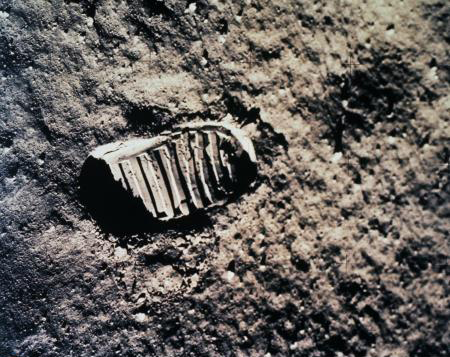
Footprint left on the moon by an Apollo 11 astronaut. (Photo courtesy of NASA Langley Research Center)


While NASA’s lunar program helped preclude — undoubtedly along with international political considerations — any military service ambitions to establish an outpost on the moon, the military and the Intelligence Community found at least two ways, after 1961, to make use of the moon without leaving Earth. Both approaches involved signals bounced off the moon, a possibility that had been confirmed by experiment as early as 1946.
In one case, the U.S. was purposefully bouncing signals off the Moon as a means of relaying intelligence information. Carried on-board U.S. Navy signals intelligence ships, such as the U.S.S. Liberty, was a system designated TRSSCOMM — Technical Research Ship Special Communications — a successor to the Communications Moon Relay (CMR) system established in 1956 to relay teletype and facsimile messages between Washington, D.C. and Hawaii (Document 15). As James Bamford reported, TRSSCOM consisted of a “sixteen-foot, dish-shaped antenna mounted on a movable platform and capable of bouncing a 10,000-watt microwave signal off a particular spot on the moon and down either to the receiving station at Cheltenham, Maryland or to one of the other Navy SIGINT ships.” He also noted that, while the system had the advantage of allowing large volumes of information to be transmitted without giving away the location of the ship carrying out the transmissions, it seldom worked properly.3
In the second case, as explained in two articles (Document 11, Document 14) in the CIA’s Studies in Intelligence journal, the United States Intelligence Community was intercepting signals from Soviet anti-ballistic and air defense radar systems after they had exited the Earth’s atmosphere and bounced off the moon. The CIA employed a 150-foot dish antenna at Stanford University in Palo Alto, California to monitor Soviet radar signals reflected off the moon, while the National Security Agency used the Arecibo Ionospheric Observatory in Puerto Rico to intercept signals that had originally been transmitted from a Soviet Arctic Coast radar. The Air Force also had its own moonbounce project — designated FLOWER GARDEN — which relied on several antennas, including the 250-foot antenna at Jodrell Bank Radio Observatory in England. Other moonbounce antennas were located at Sugar Grove, West Virginia, and the Naval Research Laboratory’s Chesapeake Bay Annex. The latter made the first intercept of a signal from the Soviet Hen House radar.4
Monitoring the Soviet Lunar Program
While NASA pursued its lunar program, the U.S. Intelligence Community closely monitored the entire Soviet space program, including its lunar component. The declassified documents in this posting concern a number of aspects of that effort — collection through a variety of means, different levels of analysis, and analysis of specific missions.
Two very different collection activities are the subjects of two Studies in Intelligence articles. One, published in 1964 (Document 6), examined the interception of Soviet space pictures that had been transmitted from their assorted space programs — including Sputnik, Cosmos, and Lunik — to stations in the Soviet Union. A second, published three years later (Document 13), involved a more unconventional approach – the temporary theft of a Lunik spacecraft that was part of an exhibition of Soviet industrial and economic achievements in an unspecified country.
Early in the U.S. lunar program, in April 1963, the CIA’s Office of National Estimates, the forerunner of today’s National Intelligence Council, explored the subject of Soviet intentions concerning a manned lunar landing (Document 5). It reviewed relevant developments in the Soviet program as well as tried to assess the extent of the Soviet commitment to beating the U.S. to the moon.
One particular mission — the Luna 9 mission of February 1964 — produced a number of different classified publications. Two of those (Document 7, Document 8) followed closely after the mission and were intended to provide reasonably current intelligence. One (Document 7) was an assessment of the entire mission, while the other (Document 8) was more narrowly focused — a preliminary technical analysis of Luna 9 photography performed by the National Photographic Interpretation Center (NPIC) at the request of the CIA’s Foreign Missile and Space Analysis Center (FMSAC). (A similar study (Document 12) with regard to Luna 13 photography was also produced by NPIC at FMSAC’s request).5
Two articles published in CIA and NSA journals represented retrospective accounts concerning the Luna 9 collection and analysis effort. One (Document 16) recounted in the NSA’s Crytpologic Almanac the author’s participation in intercepting and processing Luna 9 imagery. Another (Document 10) contains a broader account of the U.S collection and analysis effort concerning Luna 9 and the years preceding it.
Overview
Much of the U.S. lunar program that followed President Kennedy’s decision to assign NASA the responsibility to send men to the moon was conducted openly — but there are other aspects of U.S. plans with regard to the moon are revealed, at least in part, by declassified documents.
The Soviet lunar program was only one part of the Soviet space program, which involved launch facilities and vehicles, production facilities, earth-orbiting military and civilian spacecraft, and interplanetary probes to Mars and Venus.6 While Soviet military satellites were the most important targets due to their potential threat to U.S. national security, the Cold War competition between the United States and Soviet Union meant that space exploration efforts, even if devoid of military activities, were significant elements of the propaganda war — which made them important targets for the U.S. Intelligence Community, a story which is also partially told by declassified documents.
THE DOCUMENTS
Document 1a: United States Army, Project Horizon, Volume I: Summary and Supporting Considerations, March 20, 1959. Classification Not Available.
Source: www.history.army.mil
Document 1b: United States Army, Project Horizon, Volume II: Technical Considerations and Plans, March 20, 1959. Classification Not Available.
Source: www.history.army.mil
This two-volume study was based on the Army’s premise that “there is a requirement for a manned military outpost on the moon” and that outpost was required to develop techniques in moon-based surveillance of the earth and space, in communications relay, and in operations on the lunar surface. Volume I consists of four chapters (introduction, technical considerations and plans, management and planning considerations, non-technical supporting considerations) and three appendices (U.S. space policy, legal and political implications, and technical services support capabilities). The second volume, fully focusing on technical considerations, examines the possible outpost, the space transportation system required, communications, the launch site, program logistics, research and development, and program cost and schedule.
Document 2: L. Reiffel, Armour Research Foundation, Illinois Institute of Technology, A Study of Lunar Research Flights, Volume I (Kirtland Air Force Base, New Mexico: Air Force Special Weapons Center, June 19, 1959). Classification Not Available.
Source: www.dtic.mil
This volume focuses on the possibility of a nuclear detonation on or near the moon’s surface. The introduction notes the possibility that both scientific and military purposes would be advanced — including information on the space environment as well as the capability of nuclear weapons for space warfare. The chapters of volume I focus on optical studies concerning the nuclear device’s trip to the moon, the blast, and the thermal conductivity of the lunar surface; seismic observations on the Moon; the lunar radiation environment; the Moon’s magnetic field; and other topics. Two, probably classified/sensitive, chapters are contained in Volume II.
Document 3: Air Force Ballistic Missile Division, Military Lunar Base Program (C) or S.R. 183 Lunar Observatory Study (U), Volume I: Study Summary and Program Plan , April 1960. (Extract)
Source: Air Force Freedom of Information Act Release
This volume summarizes a study whose objective was to “determine an economical and sound approach for establishing a manned intelligence observatory on the moon” — with technical requirements being the subject of Volume II. It delineates a six-phase effort beginning with lunar probes in late 1964 and progressing through lunar orbits, a soft lunar landing, lunar landing and return, manned vehicle development, and concluding with an operational lunar base in June 1969. It also states that decisions concerning the types of strategic systems to be placed on the moon (including a Lunar Based Earth Bombardment System) could be safely deferred for three to four years.
Document 4: Air Force Systems Command, Lunar Expedition Plan – LUNEX , May 1961. Secret.
Source: Air Force Freedom of Information Act Release
This document identifies the purpose of a Lunar Expedition as being manned exploration of the moon with first landing and return in late 1967. It asserts that “this one achievement if accomplished before the USSR, will serve to demonstrate conclusively that this nation possesses the capability to win future competition in technology.” Its main sections provide a program description, and discuss master schedules, development and production, budget matters, program management, materiel support, engineering, personnel and training, and intelligence matters.
Document 5: Office of National Estimates, Central Intelligence Agency, Memorandum for the Director, Subject: Soviet Intentions Concerning a Manned Lunar Landing, April 25, 1963, Top Secret/ DINAR [DELETED] RUFF .
Source: CIA Records Search Tool (CREST), National Archives and Records Administration, College, Park, Maryland.
The summary to this estimate notes the uncertainty about Soviet intentions with regard to a moon landing: while repeating the Office of National Estimate’s previous view that the odds were better than even that the Soviets would seek to beat the U.S. to moon, it also states that it was possible “Soviet lunar objectives are less ambitious.” The authors examine the resumption of Soviet unmanned lunar launchings, Soviet statements concerning a manned lunar landing, an analysis of Soviet ground facilities, and offer conclusions.
Document 6: Henry G. Plaster, “Snooping on Space Pictures,” Studies in Intelligence, Fall 1964, pp. 31-39. Secret.
Source: www.foia.cia.gov
One component of the U.S. Intelligence Community’s effort in gathering intelligence on the Soviet space program was intercepting the signals, including video, from Soviet spacecraft. This article reports on the efforts and results with regard to a variety of categories of Soviet spacecraft operations – Sputnik, Cosmos, and Lunik. Included is a discussion of the efforts with regard to Lunik III’s video of the lunar surface.
Document 7: Office of Scientific Intelligence, Directorate of Science and Technology, “Preliminary Analysis of Luna 9,” Scientific Intelligence Digest, March 1966. Top Secret.
Source: CIA CREST
This heavily redacted article, which appeared in a journal of the CIA’s Directorate of Science and Technology, focuses on the Soviet Luna 9 mission — which concluded with the first soft landing on the moon and the transmission of images of the lunar surface. Portions of the article cover the configuration of the Luna 9 spacecraft, its missions, and the implications of radiation measurements on the Moon for human safety.
Document 8: National Photographic Interpretation Center, NPIC/R-5017/66, Preliminary Analysis of Luna-9 Photography , June 1966. Secret.
Source: CIA CREST
In response to a request from the CIA’s Foreign Missile and Space Analysis Center, the agency’s National Photographic Interpretation Center produced a preliminary analysis of the photography transmitted by the Soviet Luna 9 spacecraft. The analysis focused on the spacecraft’s photographic system, the spacecraft, and identifying new information on the lunar surface.
Document 9: Carl Berger, USAF Historical Liaison Division Office, The Air Force in Space, Fiscal Year 1961, April 1966 (Extract). Secret.
Source: Air Force Freedom of Information Act Release
This extract titled “Man on the Moon – A National Objective” notes that the Air Force was concerned over “the apparent inadequacy of our current National Space Program” and reports that the “Air Force said that long-time studies showed convincingly that an orderly and phased lunar expedition culminating in a 1967 landing and return was perfectly feasible.”
Document 10: James Burke, “Seven Years to Luna 9,” Studies in Intelligence, 10 (Summer 1966), pp. 1-24. Secret.
Source: http://isulibrary.isunet.edu
This article also concerns the 1966 Luna 9 mission, examined more narrowly in earlier reports (Document 7, Document 8). Its purpose is “to tell the story of how intelligence kept track of that effort through the collection and analysis of telemetric and other information.” The author covers a number of events and activities leading up to the mission and the U.S. collection effort — the early lunar program, Soviet launch vehicles, collection and prediction through 1961, US. deep-space collection, Soviet planetary shots in 1962, and Soviet space launches in 1964 and 1965 — and then the Luna 9 mission itself.
Document 11: Frank Eliot, “Moon Bounce ELINT,” Studies in Intelligence 11, 2 (Spring 1967): 59-65. Secret.
Source: www.foia.cia.gov
While the moon figured in purely hypothetical plans to collect intelligence from the lunar surface, it was employed, in a different way, in an actual effort to gather intelligence on Soviet anti-aircraft and anti-ballistic missile radars. That technique, recounted in this article, was based on the 1946 detection of a man-made signal reflected off the moon.
Document 12: National Photographic Interpretation Center, NPIC/R-5015/67, Analysis of Luna-13 Photography, July 1967. Secret.
Source: CIA CREST
As with Document 8, this NPIC report was a response to a request from the Foreign Missile and Space Analysis Center for an analysis of the video signals transmitted by a Soviet lunar spacecraft — focusing on the photographic system, the spacecraft, and the lunar surface.
Document 13: Sydney Wesley Finer, “The Kidnaping of the Lunik,” Studies in Intelligence, 11, 3 (Winter 1967), pp. 33-39. Secret.
Source: http://media.nara.gov
While a common source of intelligence on Soviet space, including lunar, efforts was collected through satellite photography and electronic intercepts, a more unusual and less frequent source is described in this article. It describes how the CIA “borrowed,” examined, and returned a Soviet Lunik spacecraft that was part of an exhibition touring several countries to promote Soviet industrial and economic achievements.
Document 14: N.C. Gerson, “SIGINT in Space,” Studies in Intelligence, 28, 2 (Summer 1984). Secret.
Source: Author’s collection
Among the topics discussed in this article is the author’s work on the “moonbounce” phenomenon and the possibility of establishing an intercept site on the moon.
Document 15: Applied Research Laboratory, Pennsylvania State University, From the Sea to the Stars: A Chronicle of the U.S. Navy’s Space and Space-related Activities, 1944-2009, 2010. Unclassified. (Extract)
Source: www.history.navy.mil/space/FromTheSeaToTheStars-2010ed.pdf
These pages from an official history discuss two attempts to use the moon as a communication relay — the establishment of a Communications Moon Relay (CMR) system in 1956 for transmission of teletype and facsimile messages between Washington, D.C. and Hawaii, and the Technical Research-Ship Special Communications (TRSSCOM) for “spy ship” communications.
Document 16: John O’Hara, “Luna 9, the First Soft Landing on the Moon,” Cryptologic Almanac, January – March 2003. Unclassified/For Official Use Only.
Source: www.nsa.gov
This article, from a National Security Agency journal, focuses on NSA’s role, and particularly that of the author, in intercepting and processing the images from the Luna 9 spacecraft — and in delivering them to the president’s desk that afternoon.
Notes
[1] William E. Burrows, This New Ocean: The Story of the First Space Age (New York: Random House, 1998), p. 330.
[2] William J. Broad, “U.S. Planned Nuclear Blast on the Moon, Physicist Says,” New York Times, May 16, 2000, p. A15; Keay Davidson, Carl Sagan: A Life (New York: Wiley, 1999), pp. 94-95.
[3] James Bamford, The Puzzle Palace: A Report on NSA, America’s Most Secret Agency (Boston: Houghton, Mifflin Company, 1982), p. 219.
[4] Jeffrey T. Richelson, The Wizards of Langley: Inside the CIA’s Directorate of Science and Technology (Boulder, Co.: Westview Press, 2001), pp. 89-90.
[5] On the Luna program see, William E. Burrows, Exploring Space: Voyages in the Solar System and Beyond (New York: Random House, 1990), pp. 160-163.
[6] A future National Security Archive Electronic Briefing Book will cover U.S. Intelligence efforts focusing on the other elements of the Soviet space program.

Big Pharma’s Exorbitant Cancer Drug Prices Are Due to Corrupt Monopolies, Not Development Costs, Study Shows

Region:
 
Pharma-Money
Authors of a new report published online in Mayo Clinic Proceedings say that dramatically higher prices for cancer medications are beginning to have a negative effect on patient care in the U.S., as well as the American health care system overall.
“Americans with cancer pay 50 percent to 100 percent more for the same patented drug than patients in other countries,” wrote S. Vincent Rajkumar, M.D., of Mayo Clinic Cancer Center, one of the authors of the recently posted report. “As oncologists we have a moral obligation to advocate for affordable cancer drugs for our patients.”
Rajkumar and a colleague, Hagop Kantarjian, M.D., of the MD Anderson Cancer Center, write that the average prices of cancer medications for about 12 months of treatment grew between $5,000 and $10,000 before the year 2000 to more than $100,000 by 2012, or a 100-fold increase.
Over roughly the same period of time, the average American household income fell by about 8 percent, perhaps in large part to the Great Recession of 2008-09.
In their paper, the authors refute the primary arguments used by Big Pharma to justify such dramatic increases and continued high cost of cancer drugs, especially that it costs so much to conduct research and development of drugs, the comparative benefits to patients, that eventually market forces will equalize and stabilize prices, and that putting price controls on cancer medications would quash further R & D.
All rules favor Big Pharma
“One of the facts that people do not realize is that cancer drugs for the most part are not operating under a free market economy,” wrote Rajkumar. “The fact that there are five approved drugs to treat an incurable cancer does not mean there is competition.
“Typically,” he continued, “the standard of care is that each drug is used sequentially or in combination, so that each new drug represents a monopoly with exclusivity granted by patent protection for many years.”
The authors go onto to say that there are other reasons for the high cost of cancer medications. Included among them is legislation that prevents Medicare from being permitted to negotiate drug prices (in a likely sop to Big Pharma political contributors) and a lack of value-based pricing, which they say would attach the cost of a drug to its relative effectiveness in comparison with other medications.
But the authors recommended some solutions they believe would decrease prices, some of which are already being utilized in other developed countries. They include:
– Permit Medicare to negotiate prices, because doing so would result in lower costs for taxpayers;
– Develop new cancer treatment guidelines and pathways that incorporate the cost and benefit of the drugs;
– Permit the Food and Drug Administration or doctor panels to make recommendations regarding prices that are based on a drug’s sum benefit (value-based pricing);
– Get rid of “pay-for-delay” strategies that enable a Big Pharma company with a brand name drug to share profits with a generic drug maker for the duration of the patent period, thereby eliminating competition and any patent challenges (which keep prices artificially high);
– Allow drugs to be imported from abroad, for personal use;
– Empower cancer advocacy organizations like the Patient-Centered Outcomes Research Institute to consider cost in any recommendations;
– Build patient-driven grassroots networks and groups that can advocate effectively for cancer patient interests, in order to balance the overt and overwhelming influence of Big Pharma companies, insurance firms, pharmacies and hospitals.
Now, for a natural treatment…
And we would add even more recommendations, such as:
– Allow for equal presentation of evidence that cancer treatment alternatives to chemotherapy, radiation therapy and surgery exist and are effective in some patients;
– Give holistic physicians equal opportunity to compete for cancer patients;
– End the mainstream medical industry’s campaign of disinformation and lies regarding holistic, natural and alternative cancer treatments.
You can see more of those treatments, and learn about the official duplicity behind keeping them hidden, here.
Sources:
http://www.sciencedaily.com/releases/2015/03/150316092809.htm
http://www.mayoclinicproceedings.org
http://www.naturalnews.com

Was Germanwings jetliner taken down as a message to Germany not to align with Russia?

The most overlooked piece of evidence in the downing of the Germanwings Airbus A320 is as follows:
“Witnesses have described hearing an explosion ‘like the sound of dynamite’, and then seeing fighter jets fly past, suggesting the passenger plane had been under military escort.”

Was Germanwings jetliner taken down as a message to Germany not to align with Russia?


150326173242-05-germanwings-0326-exlarge-169
The Millennium Report

TMR Editor’s Note
In the history of the commercial airline industry never has a jetliner been brought down under the bizarre and much publicized circumstances of a depressed pilot deliberately executing a “crash and burn” scenario.   Given the number of mysterious airliner crashes and explosions over the past few years, there appears to be only one explanation for this purposeful takedown.
Germany is the pivotal nation of the European Union (EU).  The NSA knows — without a doubt — that Prime Minister Merkel is wavering in her commitment to both the Anglo-American dominated NATO, as well as to the U.S.-directed sanction regime against Russia.  Given such a perceived lack of loyalty on the part of Germany to the Anglo-American Axis (AAA), anything now goes.  The CIA, MI6 and MOSSAD have already proven that they will do ANYTHING to enforce the dictates of the AAA tyrannical leadership.
Especially during the current shaky and very tenuous phase of the US and UK economies, will no departure from the party line be tolerated.   That includes a firm commitment, by every EU nation, to uphold their end (imposed, of course) of the sanction regime against Russia.  Only in this way can Russia be sufficiently softened up before the next phase of the planned World War III. AAA knows that if Germany were to leave the reservation, whether conspicuously or secretly, their leverage against Russia would completely fall apart.
Not only were 72 Germans aboard the Germanwings flight, 35 Spaniards were also killed in this state-sponsored terrorist attack.  Of all the members within the Eurozone, Spain has been viewed as perhaps the weakest link where it concerns the AAA-fabricated strategy to relentlessly persecute and propagandize against Russia.  As follows:
“Spain is widely seen to be one of most sympathetic countries to Moscow (along with Greece, Italy, Hungary and Bulgaria) and is one of the most openly reluctant to taking a hard line with Russia. This Spanish policy produces irritation and incomprehension in other European societies, particularly among Russia’s neighbours.”
(Source: Spain and the European Union-Russia Conflict: the Impact of the Sanctions
The following two articles covering this matter present different perspectives on why everything we are being told by the Mainstream Media (MSM) is patently false. Therefore, it can only be deduced that yet another coverup has been fastidiously put into place. One really wonders how much of history is really just an overwhelming assortment of coverups, since the MSM only seems to know how to misrepresent the facts.

Black box memory card stolen from crash site of Germanwings jetliner? Plausible cover-up theories now taking shape

by Mike Adams
Editorial-Use-Germanwings-Airbus-A320
(NaturalNews) For some reason we have yet to fully understand, jetliners keep disappearing or falling out of the sky with disturbing regularity. Air travel is amazingly safe, of course. Statistically, it produces far fewer injuries and deaths than vaccine shots which injure so many children that the United States Congress was forced to set up a special “vaccine court” just to handle all the injury claims and billions of dollars in compensation payouts.
But the circumstances under which jetliners keep disappearing smack of conspiracy and cover-ups. Flight MH370, for example, has still never been located. In July of last year, I was the first independent media journalists to suggest the plane had been hijacked. Mainstream media outlets like CNN ridiculed the theory, but just this month CNN began rolling out the exact same explanation, now claiming the jetliner was, indeed, hijacked. (Funny how CNN’s narratives completely flip-flop over time, isn’t it?)
Now with the Germanwings jetliner incident, we have the New York Times “pulling a CNN,” you might say. According to this NYT story, the memory card of one of the airplane’s two black boxes is missing, and the story claims it must have been “destroyed by the impact.”
“Investigators have so far been unable to retrieve data from one black box, and the other was badly damaged and its memory card was missing,” reports the New York Times.
If you read the logic of that sentence, it seems to state that no data was recovered from either black box, right?
But then in the exact same story, the NYT also reports, “Remi Jouty, director of France’s Bureau of Investigation and Analysis, confirmed that audio of voices had been recovered from the black box in the crash of the Germanwings plane in the French Alps.”
So, wait: there WAS voice recording data recovered from one of the black boxes? Confusing things even further, another paragraph in the same story says:
At the crash site, a senior official working on the investigation said, workers found the casing of the plane’s other black box, the flight data recorder, but the memory card containing data on the plane’s altitude, speed, location and condition was not inside, apparently having been thrown loose or destroyed by the impact.
So what we really have here is a story about two black boxes: one which either has voice data on it or doesn’t have voice data on it, and the other black box which we are supposed to believe was located but the memory card it protects was missing because it was destroyed even though it was surrounded by a black box that’s almost impervious to destruction.

Black boxes are designed to survive plane crashes… DOH!

Now, those of you who understand the laws of physics — which obviously makes you a terrorist in modern America where any real grasp of scientific reality is widely condemned — know that black boxes are designed for the precise purpose of making sure nothing inside them gets destroyed even in a violent airplane explosion or impact crash.
If black boxes did not survive plane crashes, there would be no real point in having them in the first place.
It’s nearly impossible to destroy these black boxes — which are really orange — without resorting to extreme methods of destruction. As this NPR story explains, “The black box must be able to withstand an acceleration of 3,400 Gs (3,400 times the force of gravity)…”
To test the structural integrity of a black box, “[a]t 3,400 Gs,” adds HowStuffWorks.com, “the CSMU hits an aluminum honeycomb target at a force equal to 3,400 times its weight. This impact force is equal to or in excess of what a recorder might experience in an actual crash.”
What the New York Times is now asserting, against all known laws of physics, is that a black box was found, it was opened, the memory card was missing and therefore it must have been “thrown loose or destroyed.”
Consider the unlikelihood of such a claim being true. It mirrors the similarly ludicrous claim after 9/11 that the terrorist’s passports survived the crash and were found on the sidewalk below the building… but the aircraft black boxes were all destroyed in the crash, of course. And like magic, we’re all supposed to believe that U.S. passports will survive an extremely hot explosion that melts steel girders and collapses buildings, but a black box — which is DESIGNED to be blown up and still survive — somehow “lost” its memory card as a jetliner descended into terrain.
How convenient.
The far more reasonable explanation, of course — which also happens to be aligned with the laws of physics — is that someone took the memory card out of the black box, which is why it’s no longer in the black box.
If you scan a quick history of mysterious plane crashes that might be linked to rogue nations or government-run operations, you’ll notice that the black boxes are missing from ALL such plane crashes: 9/11, Malaysia Airlines, this Germanwings flight and no doubt many others. Black boxes, it seems, are only found intact when governments want to find them intact.

Why would someone want to take the memory card out of the black box?

You don’t have to be a rocket scientist to figure out that the only reason someone who remove the memory card from the black box is because they won’t want the world to find out what’s on the memory card.
And what is stored on these memory cards, exactly? Audible recordings of the flight deck and a detailed digital log of every flight command, environmental variable, flight control surface, altitude, heading, airspeed and everything else you might imagine is important in an airliner crash investigation. Black boxes contain all the data needed to entirely reconstruct the accident and find out what happened.
If someone carried out the attack on purpose, they could have easily been pre-positioned on the ground, ready to rush to the wreckage and pull the memory card. Black boxes are not terribly difficult to find if the wreckage is sufficiently broken apart. They’re bright orange and unmistakable to identify, even in a pile of wreckage. They are designed to scream out “FIND ME!” in a mass of rubble. Because of the rugged terrain, it took rescue workers many hours to even arrive at the scene, leaving plenty of time for someone with a pre-positioned ground-based scout team to reach the wreckage first.

Why were the pilots apparently unconscious?

One reasonable working theory in all this is that some rogue government wanted to kill someone on the plane but make it look like an accident. Somehow they managed to incapacitate the pilots and then put the plane into a controlled descent into terrain, the theory goes.
“Among the theories that have been put forward by air safety analysts not involved in the investigation is the possibility that the pilots could have been incapacitated by a sudden event such as a fire or a drop in cabin pressure,” reports the NYT. “A senior French official involved in the investigation, who spoke on the condition of anonymity, said that the lack of communication from the pilots during the plane’s descent was disturbing, and that the possibility that their silence was deliberate could not be ruled out.”
On this point, I concur. Commercial pilots are incredibly well trained and tend to be very intelligent people. If they were conscious, they would have absolutely noticed the altitude descent, especially when flying among high-altitude mountains. All pilots who are still living are fully aware that if your aircraft altitude goes LOWER than the height of the nearby mountains, you probably need to go full throttle and climb. Monitoring your altitude is one of the very first things all pilots are taught (airspeed, altitude and heading, actually), and commercial pilots are taught to scan their instruments on a regular basis to watch for unexpected readings.
On top of that, pilots tend to be people who prefer to be living rather than dead. In fact, one of the best assurances of pilots doing a good job flying commercial airliners is the inescapable fact that they are on board that same airliner. (Never fly in an aircraft remotely piloted via drone technology, if it ever comes to that…)
Thus, pilots tend to keep passengers alive because they want to keep themselves alive, too. It is almost inconceivable that the two pilots of this Airbus A320 would have both failed to notice the descent in mountainous terrain. The fact that the aircraft obviously did not suffer a sudden flight control failure also means it was not blown up in mid-air.

The list of plausible theories narrows

So what’s left in the realm of deductive logic? The list of possibilities narrows rapidly:
• Pilot murder-suicide.
• On-board hijacking that incapacitated the pilots.
• A sophisticated cyber war hack attack that somehow took control of the plane and its communications capabilities.
• A bizarre coincidence of mechanical failures (such as a loss of oxygen) combined with highly unlikely aircraft control failures (loss of altitude calibration or electronics glitches). This possibility is almost certainly ruled out, as all commercial pilots are trained in emergency oxygen mask deployment when noticing signs of hypoxia.
• An unusual electromagnetic attack of some kind — perhaps a “pulse” weapon that selectively disabled some functionality of the aircraft. (Extremely unlikely.)
The award for the most bizarre theory of all belongs to the “CERN brought down the aircraft” explanation you can read about at All News Pipeline.
We still don’t have enough information to know with any degree of certainty what really happened, but we do have enough information to know that the “official narratives” being put out by the media just don’t hold water. Not if you believe in the laws of physics, anyway. And if you don’t, then how do you think airplanes fly in the first place?
~~~~~~~~~~~~~~~~~~~~~~~~~~~~~~~~~~~~~~~~~~~~~~~~~~~~~~~~~~~~~~~~~~~~

GORDON DUFF EXPOSES GERMANWINGS CRASH AS FALSE FLAG (Video) “We Are Being Punished”

This Crash Is in no way manner nor form a credible accident or suicide

Posted by Gordon Duff, Senior Editor on March 26, 2015

You have heard of the Christmas Crotch Bomber, do we now have the “Piss Break Plunger?”

“As humorist Rob Hanson points, out, what kind of plan figures a pilot can’t make two hours without a bathroom break?  It all falls apart here, I hope you see it.  Thank you Robert Hanson, the blind will lead us out of the wilderness.”
 By Robert Hanson@ Robert Hanson
By Gordon Duff with Col Jim Hanke, Lt. Col Steve Avery and FBI SSA Fred Coward
Last night, after consulting with team members, I broke the story of Flight 9525 on the Rense Radio Network.  Not only was this no accident, it wasn’t a suicide either.  This is a “fly by wire” jet.  International convention required this plane to have certain anti-hijacking safeguards.  One of them, complicated by German pig-headedness, left a co-pilot alone in a cockpit, something illegal in the US.
As humorist Rob Hanson points, out, what kind of plan figures a pilot can’t make two hours without a bathroom break?  It all falls apart here, I hope you see it.  Thank you Robert Hanson, the blind will lead us out of the wilderness.
There is nothing about yesterday’s crash of Germanwings 9525, a two hour shuttle flight from Barcelona to Dusseldorf that can believed.  Were this one crash, we might begin to accept what we expect, lies and deceit, but it isn’t one crash.  This is the third?  Are there more?  Planes disappear, they are shot down by non-existent missiles seen by satellites suddenly disabled and radar that has conveniently failed, up to 15 independent systems.
Then again, there is the human factor.  Is the “Charlie” episode, equally tragic-farcical a type of plane crash, one were street theatre, so much like the Boston event or Sandy Hook or London or Madrid, where these carelessly staged plays are acted out before a public increasingly incredulous to it all.
If you think this is a tragedy or something a bit unusual, perhaps odd, you aren’t paying attention.  They have so much more of this planned.  You are being punished.  From Netanyahu’s infamous “Fink’s Bar diatribe” of 1990:
“If we get caught they will just replace us with persons of the same cloth. So it does not matter what you do, America is a golden calf and we will suck it dry, chop it up, and sell it off piece by piece until there is nothing left but the world’s biggest welfare state that we will create and control. Why? Because it is the will of God and America is big enough to take the hit so we can do it again and again and again. This is what we do to countries that we hate. We destroy them very slowly and make them suffer for refusing to be our slaves.”  (Credit to the Defense Intelligence Agency of the United States Department of Defense)
We all knew this one was coming, coinciding with so many events, the meltdown of Kolomoisky and his thugs in Ukraine.  20,000 Iranian troops are engaged in battle around Tikrit, now under a carefully coordinated American air umbrella, an American now closely aligned in war alongside Syria and Iran.
A few hundred miles away, a Saudi led coalition prepares to enter Yemen on behalf of the Islamic State/Al Qaeda coalition being held off by Iranian backed Houthi militias.
More from Rense
Reading the tale of French air traffic controllers watching 9525 plunge inexorably ground ward is equally incredulous.  This plane has a remote, satellite initiated fly by wire system.  You see, 150 passengers and crew are one thing.  Crashing a plane into a hospital, stadium or nuclear power plant, such as the ones directly under 9525’s flight path, is reason to initiate through satellite the Raython system.
Did the French forget it existed?  Oh, did we tell you that the same system that can automatically land planes can crash them as well?  Did we mention that the source code for the system is “less than secure” and that a nation known for cyber attacks, China, Russia, Israel or even the United States, is quite capable of taking control of any airliner at any time and plunging it into anything at all?
What is even better is that no investigator can legally mention this, no reporter can write of it, no one can admit such a system exists though any idiot with the money to buy a couple of drinks at an airport bar can find out.  Pilots gossip like nobody’s business.
We can go further, we can tell you exactly how it works, what frequencies, how airports are selected and how a covert system meant to protect air passengers from tragedies like this and the rest of us from having hundreds of tons of aluminum and body parts dropped on our heads, is updated and patched.
If You Thought This Was Enough
Last night we brought something else out on Rense.  DARPA, the American version of the famous “Q” branch of James Bond films, was tasked in 2010 to build a robot destroyer, a 100 plus foot long ship that could hunt down diesel nuclear armed subs.
You see, back in 2001 one such sub, a German built diesel sub fired a cruise missile into a building a few miles from the Capitol in Washington DC.  The missile skimmed across the Potomac, its every move watched by AEGIS defense ships off Maryland and New Jersey, monitored by Dick Cheney who had ordered the JLens backed defense system which doesn’t exist.
Courtesy of Adamus Defense Group, LondonCourtesy of Adamus Defense Group, London

Veterans Today’s Gordon Duff and Mike Smith Expose RADAR SPOOFING – Very Important

Veterans Today Radio (3-12-15) Stew Webb, Gordon Duff, Jim Dean, Preston James

Accidents Do Happen
We have accidents, we have suicides and then we have events that continually violate statistical probabilities at “trillions to one” levels.  This is no suicide, it is a revenge attack perpetrated by a national intelligence agency.  You will never know what it is revenge for, what it warns of or who it is intended to leverage.
You will never know, not this time, not 9/11, not “Charlie,” not any of it.  Don’t try to figure it out.  There is an issue of access.  I can speak personally of this to a point.  I remember a meeting maybe 18 months ago.  I had been getting briefings, private, official, from all the “smart people.”  Then I got on the ground, and is so often the case, realized immediately that everyone who thought they knew things, the CIA, the Rand Corporation, the CFR, were simply making it all up.
They knew nothing at all.
Have any of you ever used a satellite telephone?  Do you know where to buy one?  Could you pass the credit check to set up an account?  How do you charge the battery in a country where only 2% of the nation has electricity?
Do you use the cig plug in your $85,000 Toyota pickup truck with a $300,000 anti-aircraft gun mounted on the back?  Then again, you don’t have the money to buy tennis shoes.
And so it goes…
__________________________
An Airbus A320 with 142 passengers and 8 crewmembers has crashed in Digne region, southern France, media reports say. The jet, which belonged to Germanwings low-cost airline, was flying from Barcelona to Düsseldorf.
LIVE UPDATES: http://on.rt.com/besjt3

———
TMR Editor’s Note:
Once again, the most overlooked piece of evidence concerning the downing of the Germanwings Airbus A320 is as follows:
“Witnesses have described hearing an explosion ‘like the sound of dynamite’ then seeing fighter jets fly past, suggesting the passenger plane had been under military escort.”