Monday, November 30, 2015

Paris Attack Anomalies: News Media Death Tallies Don’t Add Up 

As of November 27, 2015 the BBC, one of the world’s most powerful mass media outlets, still has an incomplete sketch on the details of exactly who perished in the November 13 Paris terror attacks, which French authorities  say resulted 130 deaths and over 350 injuries. With its abundant staff and resources, it is unusual that the news outlet with global reach would abandon such an important story. Yet it has–as have many of its competitors.
BBC_Paris1
On its page, “Paris Attacks: Who Were the Victims?” the government-sponsored broadcasting giant lists hyperlinked photo descriptions of 42 victims, and verbal descriptions of an additional 83, for a grand total of 125. That means there are five fatalities Aunt Beebe–which played a central role in publicizing the attacks throughout the world–has failed to document.
 It asks online readers to provide details on those it has listed, while overlooking the five it apparently cannot account for.
BBC_Paris2
In contrast, on November 27, the day the French government officially commemorated the deceased, Agence France-Presse published this graphic, but it includes the names of only 127 victims.
CUzVFUDXAAAtL9x
Other major news outlets have also run articles with incomplete listings of the deceased. For example, on November 17, 2015 CNN ran a piece with profiles of 72 deceased, while Buzzfeed posted a story, “Here are the Victims of the Paris Attacks,” with a total of only 71 profiles. Buzzfeed promised to continually update the article, but it was last revised on November 20.
Buzzfeed_Paris
The venerable Washington Post lists profiles of 123 victims yet admittedly omits the identities and biographical material on “at least seven others” for which the paper claims to have no information. The Post promises to update the page “as more information becomes available.” However, no details have been added since November 23.
In 2013 Memory Hole Blog reported how the Boston Globe failed to accurately document those injured in the Boston Marathon bombing. [“The Boston Marathon Bombing’s Inflated Injury Tallies“] In that event municipal authorities and the Boston Globe claimed there were an incredible 286 injuries. Yet the Globe could only provide information for 55 individuals who sustained injuries.

Life Imitating Art? Strange Cases Where Fiction has Foretold the Futuretype

Between 1949 and 1950, American novelist Norman Mailer was hard at work crafting the follow up to his breakthrough novel, The Naked and the Dead. His home and base of operations at the time had been a boarding house in New York, and the subject of this new work that would eventually become 1951’s Barbary Shore was, rather transparently, reflective of Mailer’s current state of affairs: the story was that of a World War II veteran, holed up in a New York boarding house, trying to write a novel.
To his credit, Mailer had added amnesia to his character’s plight, but this alone hadn’t helped make the post-war novel anything more spectacular than what it was destined already to be: a shortcoming in the wake of his breakthrough masterpiece, and one so bad it would launch a decade-long hiatus from work as a novelist, during which Mailer would turn his attention to societal themes, writing of (and occasionally berating) hipsters, politicians, and American life in general.
The otherwise innocuous and disappointing Barbary Shore might have been forgotten altogether, had it not been for one other unique facet it possessed. As much as the story had intentionally mirrored the happenings of Mailer’s life, there were other things occurring beneath the surface which the author included, though seemingly despite having no way of gaining knowledge of them at the time.
Norman Mailer
Norman Mailer
To be specific, another of the book’s themes dealt with a Soviet spy, who is found to be living undercover in the same New York Boarding House. Strangely, after the publication of Barbary Shore, it was revealed that an actual spy, similarly working with the USSR, had been living within an apartment just above Mailer’s. Despite the odd foretelling of events that the novel contained, not even this would help it become memorable in the minds of Mailer’s critics; once, the occasionally obstreperous writer even went so far as to take out advertisements quoting the negative critiques his literary adversaries launched against him.
The theme of “predictions” made by novelists is indeed one that we’ve covered before here at Mysterious Universe. In a 2010 post on the subject, I noted one of the most peculiar of them all, which dealt with Edgar Allan Poe’s one and only novel-length manuscript, The Narrative of Arthur Gordon Pym. Here, a similarly striking — if not more unsettling prediction — had been made, involving a storm that destroys a sailing vessel, leaving the stranded seamen faced with a damning decision about who would ultimately survive:
“Among them was a lowly cabin boy named Richard Parker, who later was cannibalized in what was then known as the grim “custom of the sea.” Though this series of events was conjured from Poe’s mind, decades later the [sailing ship] Mignonette was destroyed under almost identical circumstances, where a sudden 40-foot wave capsized the ship. Among the survivors–and first to be killed and cannibalized–was the cabin boy, whose name was none other than Richard Parker! Captain Tom Dudley, along with those who had helped devour young Parker, were later discovered alive, and were tried for murder.”
Poe
While the similarities here might be chalked up to coincidence alone, it is worth noting that the turn of events described above came about resulting from political writer Arthur Koestler’s interest in psychic phenomena and coincidences later in life. His fascination was great enough that he proposed a contest in which an award would be offered for the best example of a bizarre prediction or coincidence. That award was later given to none other than Nigel Parker, a relative of the deceased Richard Parker, who shared the family’s strange story.
Another notable example of a novelist whose work seemingly predicted the future had been Jules Verne, who discussed the future of space flight in his book From the Earth to the Moon. Here, Verne’s fictional meanderings ended up being uncannily similar to what would later become the very real American space program’s Apollo Program. In the book, Verne even wrote that three astronauts were launched from the Florida peninsula, and recovered through a splash landing of their spacecraft upon reentry; also in the book, the spacecraft is launched from “Tampa Town”, whereas Tampa, Florida is approximately 130 miles from what would later become NASA’s launch site at Cape Canaveral.
Perhaps among the most famous instances of alleged predictions set forth in novels involved Morgan Robertson’s 1898 novella Futility, or the Wreck of the Titan. In this book, Robertson wrote of a large sailing vessel which went down tragically in the North Atlantic after striking an iceberg on its starboard side. The events of the novel transpire in the month of April, and adding to the tragedy of Robertson’s tale, the fictional Titan would lack enough lifeboats needed to save all its passengers.
titanic
The obvious similarities here to the sinking of the RMS Titanic were indeed noteworthy to many of Robertson’s readers, right down to the accident’s distance from Newfoundland, and the number of casualties that would ensue. While Robertson’s readers proclaimed that he possessed the gift (or perhaps curse) of clairvoyance, the author would maintain that he had merely deduced such a remarkably similar turn of events based on his extensive knowledge of seafaring. 
The examples cited here are among the best, though countless other cases of tales spun by fiction writers which bore similarity to later happenings do exist. Whether or not it is indeed evidence of psychic abilities or premonitions, it would certainly seem that on occasion the notion of “life imitating art” does take on a whole new, and far more literal meaning.

French Government Using State Of Emergency As An Excuse To Round Up Climate Change Activists      ~ gee that will work ?... the bad~guys 

from the mission-creep dept

In response to the attacks in Paris earlier this month, the French government has enacted a state of emergency. Like the War on Terror itself, this "state of emergency" has no discernible end in sight. The government has given itself an incredible amount of power for an indefinite period of time. When this power shift happens, abuse follows.

The Guardian is reporting that the nation's law enforcement agencies are straying far from their original targets: those responsible for the attacks, along with anyone who appears to be sympathetic to the cause. The government now appears to be authorizing the arrest of anyone it can brand a troublemaker.

At least 24 climate activists have been put under house arrest by French police, accused of flouting a ban on organising protests during next week’s Paris climate summit, the Guardian has learned.
One legal adviser to the activists said many officers raided his Paris apartment and occupied three floors and a staircase in his block.
French authorities did not respond to requests for comment but lawyers said that the warrants were issued under state of emergency laws, imposed after the terror attacks that killed 130 people earlier this month.
The French now understand what it's like to be Spanish. Of course, it must be pointed out that very few countries, even a country once at the forefront of personal freedoms, would handle this situation any differently.
The Garland (TX) attack ushered in several months of stepped-up use of 24/7 monitoring on suspected ISIS supporters. FBI Director James Comey has described the period between May and July as one that stretched the FBI's resources, and that isn't sustainable. Dozens of arrests were made, in many cases not for terrorism-related charges if the FBI couldn't gather enough evidence of a plot.

"In some cases we just needed to get people off the streets," one senior law enforcement official said.
A few of the targeted activists have been placed under house arrest. Others have been handed restraining orders by local judges. Police have also been confiscating computers and personal documents during these raids.

Some might argue that until everything calms down in France, the best plan for activists is to lay low. This could prevent the hijacking of a cause as cover for a violent attack motivated by a different ideology. But this sort of advice only makes sense if the government had expressed a fear of large gatherings in general.
Some protesters argue that the permission granted to football matches, trade fairs and Christmas markets in Paris over the summit period suggests that the authorities’ real concern is to suppress dissent.
This makes the orders some received to limit participants to less than 50 look hypocritical, at best. At worst, it looks like the government is using its state of emergency powers to protect itself from vocal and highly-visible criticism.

Details Of How The Paris Attacks Were Carried Out Show Little Effort By Attackers To Hide Themselves   ~  Oops

from the but-we-blame-encryption? dept https://www.techdirt.com/articles/20151127/22282132933/details-how-paris-attacks-were-carried-out-show-little-effort-attackers-to-hide-themselves.shtml

On Friday, the Wall Street Journal's Stacy Meichtry and Joshua Robinson published an in-depth bit of reporting on the planning and operational setup of the Paris attackers, revealing a bunch of previously unknown details. The key thing, however, isn't just the total lack of anything that looks like sophisticated encryption, but the opposite. The attackers basically did nothing to hide themselves, communicating out in the open, booking houses and cars in their real names, despite some of them being on various terrorist watch lists. It discusses how Brahim Abdeslam booked a house using an online website (Homelidays -- a French service that is similar to Airbnb, though it predates Airbnb by a lot), using his own name. So did his brother, Salah Abdeslam, who booked a hotel for a bunch of the attackers (using his real name) on Booking.com.

The piece mentions, as we noted earlier, that the attackers appeared to communicate via unencrypted SMS. It also mentions how the guy who planned the attacks, Abdelhamid Abaaoud, bragged about his plans in ISIS's English-language glossy magazine months ago. Again, you'd think that this would alert the intelligence community to actually watch the guy, but again it appears he did little to hide his movements or communications.

In fact, the report notes that after Abaaoud shot up a restaurant, he went back to check out the aftermath of the attacks that he had helped put together -- and kept his mobile phone with him the whole time, making it easy to track his whereabouts:
An hour after Mr. Abaaoud finished shooting up restaurants, he emerged from a metro station in the 12th district, according to data police pulled from his cellphone. He headed west toward the sound of sirens, his path zigzagging as he returned to the scene of his crimes.

For two hours after the massacre ended, prosecutors say, Mr. Abaaoud surveyed his handiwork, at one point blending in with panicked crowds and bloodied victims streaming from the Bataclan
You can read the entire thing and note that, nowhere does the word "encryption" appear. There is no suggestion that these guys really had to hide very much at all.

So why is it that law enforcement and the intelligence community (and various politicians) around the globe are using the attacks as a reason to ban or undermine encryption? Again, it seems pretty clear that it's very much about diverting blame for their own failures. Given how out in the open the attackers operated, the law enforcement and intelligence community failed massively in not stopping this. No wonder they're grasping at straws to find something to blame, even if it had nothing to do with the attacks.

U.S. identified Paris attackers six months ago and predicted terror plot, so why didn’t they stop it?


http://www.evil.news/2015-11-19-u-s-identified-paris-attackers-six-months-ago-and-predicted-terror-plot-so-why-didnt-they-stop-it.html

November 19th, 2015, by
The U.S. government predicted ISIS-led terror plots against Western cities six months ago, as well as knew the identity of the man believed to be the mastermind behind the recent attacks in Paris, France.
In May of this year, the U.S. Department of Homeland Security published an intelligence assessment[PDF] warning of coming terror attacks in Western cities, even naming the guy they thought would do it.(1)

Published by DHS Intelligence and Analysis directorate in partnership with the FBI and the National Counterterrorism Center, the report named Abdelhamid Abaaoud, a 27-year-old from Belgium, as being a man who would orchestrate terror attacks against the West, reports the Daily Mail.(2)
If the West and its allies knew Abaaoud was an imminent threat, why didn’t they stop him?
While we don’t support the government’s targeted drone program due to its ineffectiveness and its inability to be precise (just to name a few reasons), based on arguments made by U.S. intelligence officials, suspected militants like Abaaoud are exactly the kind of targets the military says it prioritizes.
Under the U.S. military’s drone program, President Obama has about two months to sign off  on the assassination of a target they suspect is “a continuing, imminent threat,” according to a report written by The Intercept’s Cora Currier titled “The Kill Chain” – one of eight reports published by The Intercept in a series coined The Drone Papers.(3)

Belgium raid in early 2015 provided U.S. with intel on Paris attacks, report finds

The DHS reportedly learned about Abaaoud’s identity following an anti-terrorism raid in Verviers, Belgium, in January 2015. Two suspected terrorists with radical Islamist ties were killed during the raid in Belgium, and a third was arrested, the Daily Mail reports. Officials believe the suspected terrorists were under the influence of ISIS.http://www.evil.news/wp-content/uploads/2015/11/ABB.jpg

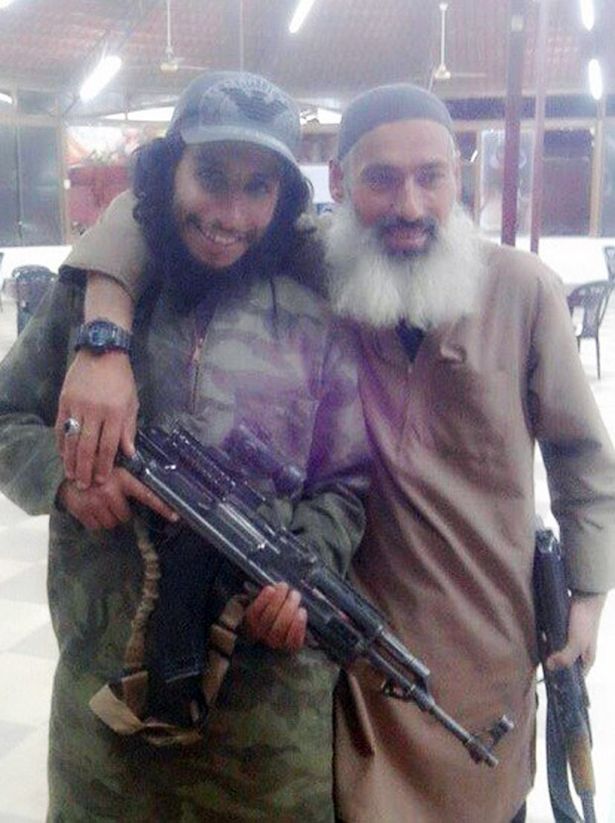
Abdelhamid Abaaoud on the left (Credit: London Media)
Following the raid, “multiple individuals” were arrested in several European countries and charged in connection with planned terrorist plots in the West. The DHS says the bust was the first in which a “large group of terrorists” possibly acting under the influence of ISIS was discovered, leading them to believe that more attacks throughout Europe were on its way.
Items recovered by Belgian officials during the raid suggested that terrorists may use “small arms, improvised explosive devices” and tactics such as impersonating police officers in future attacks, according to the assessment.
Automatic firearms, precursors for the explosive triacetone triperoxide (TATP), a body camera, multiple cell phones, handheld radios, fraudulent identification documents and large quantities of cash were also found.
The assessment predicted that terror attacks were more likely to happen in Europe “where several recruitment networks have been disrupted, and several returning fighters have already demonstrated the ability to conduct attacks—than in the United States given the different operating environments, number of European foreign fighters currently in theater, and Europe’s geographic proximity to the conflicts in Syria and Iraq.”

Mastermind behind Paris attacks faked his death in 2014 in order to avoid detection

Terror networks operating across several countries pose challenges regarding law enforcement’s ability to “detect and investigate multi-jurisdictional threats,” says the assessment, highlighting the importance of “sharing information about emerging and ongoing threats.”
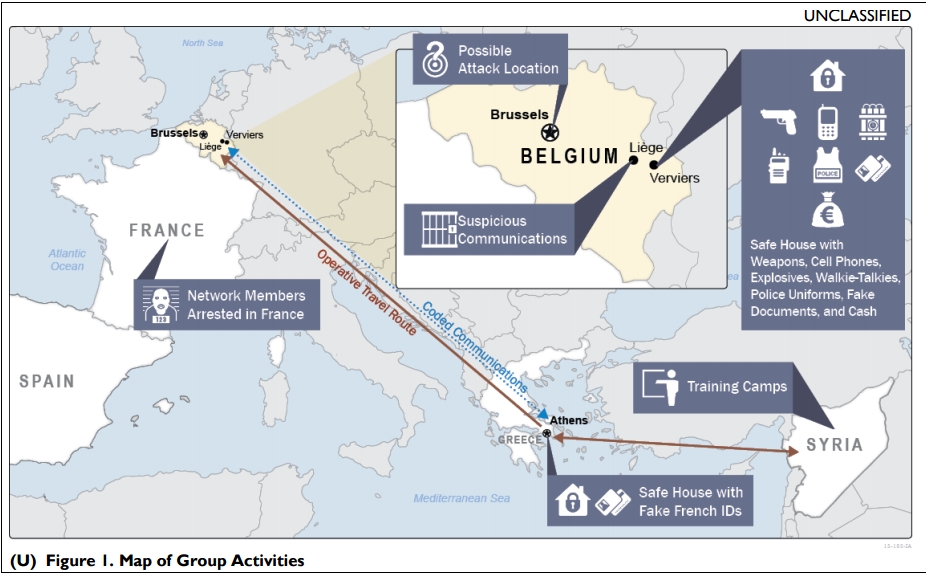
The DHS wrote that the terrorist group’s activities spanned several European countries, including France, Greece, Spain and the Netherlands.
Abaaoud, the purported leader of the foiled Belgium attack, was believed to have orchestrated “the operation from a safe house in Athens, Greece using a cell phone, while other group members operated in several other European countries.”
Media reports indicate that he was behind a phone call made in 2014 to his family informing them that he had died while fighting in Syria. Authorities only discovered this to be untrue upon learning about his involvement in the foiled Belgium attacks.
The following illustration depicts the Belgian location where some of the suspected militants were apprehended, as well as their training grounds and other networks operating in France.
DHS13
Sources:
  1. Info.PublicIntelligence.net[PDF]
  2. DailyMail.co.uk
  3. TheIntercept.com