Britain's
surveillance agency
GCHQ, with aid from the US National Security Agency, intercepted and stored the webcam images of millions of
internet users not suspected of wrongdoing, secret documents reveal.
files dating between 2008 and 2010 explicitly state that a surveillance
program codenamed Optic Nerve collected still images of
Yahoo
webcam chats in bulk and saved them to agency databases, regardless of
whether individual users were an intelligence target or not.
In
one six-month period in 2008 alone, the agency collected webcam imagery –
including substantial quantities of sexually explicit communications –
from more than 1.8 million Yahoo user accounts globally.
Yahoo
reacted furiously to the webcam interception when approached by the
Guardian. The company denied any prior knowledge of the program,
accusing the agencies of "a whole new level of violation of our users'
privacy".
does not have the technical means to make sure no images of UK or US
citizens are collected and stored by the system, and there are no
restrictions under UK law to prevent Americans' images being accessed by
British analysts without an individual warrant.
The documents also chronicle 's
sustained struggle to keep the large store of sexually explicit imagery
collected by Optic Nerve away from the eyes of its staff, though there
is little discussion about the privacy implications of storing this
material in the first place.
Optic Nerve, the documents provided by
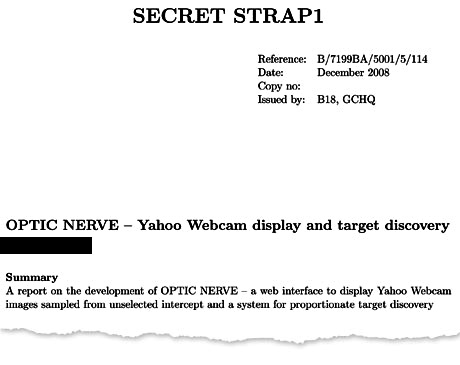
NSA whistleblower Edward Snowden show, began as a prototype in 2008 and was still active in 2012, according to an internal wiki page accessed that year.
The
system, eerily reminiscent of the telescreens evoked in George Orwell's
1984, was used for experiments in automated facial recognition, to
monitor 's
existing targets, and to discover new targets of interest. Such
searches could be used to try to find terror suspects or criminals
making use of multiple, anonymous user IDs.
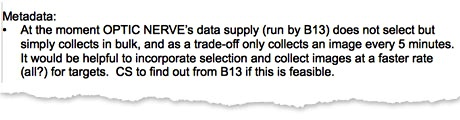
Rather than collecting
webcam chats in their entirety, the program saved one image every five
minutes from the users' feeds, partly to comply with human rights
legislation, and also to avoid overloading 's
servers. The documents describe these users as "unselected" –
intelligence agency parlance for bulk rather than targeted collection.
One
document even likened the program's "bulk access to Yahoo webcam
images/events" to a massive digital police mugbook of previously
arrested individuals.
"Face detection has the potential to aid
selection of useful images for 'mugshots' or even for face recognition
by assessing the angle of the face," it reads. "The best images are ones
where the person is facing the camera with their face upright."
The agency did make efforts to limit analysts' ability to see webcam images, restricting bulk searches to only.
However,
analysts were shown the faces of people with similar usernames to
surveillance targets, potentially dragging in large numbers of innocent
people. One document tells agency staff they were allowed to display
"webcam images associated with similar Yahoo identifiers to your known
target".
Optic Nerve was based on collecting information from 's huge network of internet cable taps, which was then processed and fed into systems provided by the . Webcam information was fed into NSA's search tool, and NSA research was used to build the tool which identified Yahoo's webcam traffic.
Bulk surveillance on Yahoo users was begun, the documents said, because "Yahoo webcam is known to be used by targets".
Programs like Optic Nerve, which collect information
in bulk from largely anonymous user IDs, are unable to filter out
information from UK or US citizens. Unlike the ,
is not required by UK law to "minimize", or remove, domestic citizens'
information from its databases. However, additional legal authorisations
are required before analysts can search for the data of individuals
likely to be in the British Isles at the time of the search.
There are no such legal safeguards for searches on people believed to be in the US or the other allied "" nations – Australia, New Zealand and Canada.
insists all of its activities are necessary, proportionate, and in accordance with UK law.
The documents also show that
trialled automatic searches based on facial recognition technology, for
people resembling existing GCHQ targets: "[I]f you search for similar
IDs to your target, you will be able to request automatic comparison of
the face in the similar IDs to those in your target's ID".
The undated document, from 's internal wiki information site, noted this capability was "now closed … but shortly to return!"
The privacy risks of mass collection from video sources have long been known to the and ,
as a research document from the mid-2000s noted: "One of the greatest
hindrances to exploiting video data is the fact that the vast majority
of videos received have no intelligence value whatsoever, such as
pornography, commercials, movie clips and family home movies."
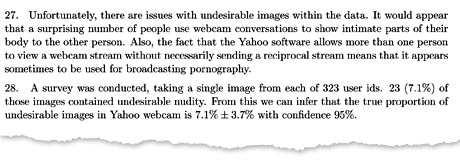
Sexually explicit webcam material proved to be a particular problem for ,
as one document delicately put it: "Unfortunately … it would appear
that a surprising number of people use webcam conversations to show
intimate parts of their body to the other person. Also, the fact that
the Yahoo software allows more than one person to view a webcam stream
without necessarily sending a reciprocal stream means that it appears
sometimes to be used for broadcasting pornography."
The document estimates that between 3% and 11% of the Yahoo webcam imagery harvested by
contains "undesirable nudity". Discussing efforts to make the interface
"safer to use", it noted that current "naïve" pornography detectors
assessed the amount of flesh in any given shot, and so attracted lots of
false positives by incorrectly tagging shots of people's faces as
pornography.
did not make any specific attempts to prevent the collection or storage
of explicit images, the documents suggest, but did eventually
compromise by excluding images in which software had not detected any
faces from search results – a bid to prevent many of the lewd shots
being seen by analysts.
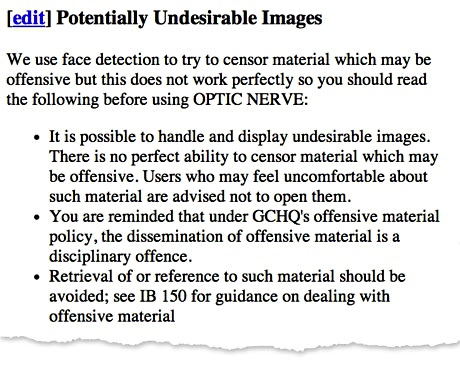
The system was not perfect at stopping those images reaching the eyes of
staff, though. An internal guide cautioned prospective Optic Nerve
users that "there is no perfect ability to censor material which may be
offensive. Users who may feel uncomfortable about such material are
advised not to open them".
It further notes that "under 's offensive material policy, the dissemination of offensive material is a disciplinary offence".
Once collected, the associated with the videos can be as valuable to the intelligence agencies as the images themselves.
It is not fully clear from the documents how much access the
has to the Yahoo webcam trove itself, though all of the policy
documents were available to NSA analysts through their routine
information-sharing. A previously revealed NSA repository, codenamed , has what the documents describe as a protocol class for webcam information.
In
its statement to the Guardian, Yahoo strongly condemned the Optic Nerve
program, and said it had no awareness of or involvement with the collection.
"We
were not aware of, nor would we condone, this reported activity," said a
spokeswoman. "This report, if true, represents a whole new level of
violation of our users' privacy that is completely unacceptable, and we
strongly call on the world's governments to reform surveillance law
consistent with the principles we outlined in December.
"We are
committed to preserving our users' trust and security and continue our
efforts to expand encryption across all of our services."
Yahoo has been one of the most outspoken technology companies objecting to the 's
bulk surveillance. It filed a transparency lawsuit with the secret US
surveillance court to disclose a 2007 case in which it was compelled to
provide customer data to the surveillance agency, and it railed against
the NSA's reported interception of information in transit between its
data centers.
The documents do not refer to any specific court orders permitting collection of Yahoo's webcam imagery, but
mass collection is governed by the UK's Regulation of Investigatory
Powers Act, and requires certification by the foreign secretary,
currently William Hague.
The Optic Nerve documentation shows
legalities were being considered as new capabilities were being
developed. Discussing adding automated facial matching, for example,
analysts agreed to test a system before firming up its legal status for
everyday use.
"It was agreed that the legalities of such a
capability would be considered once it had been developed, but that the
general principle applied would be that if the accuracy of the algorithm
was such that it was useful to the analyst (ie, the number of spurious
results was low, then it was likely to be proportionate)," the 2008
document reads.
The document continues: "This is allowed for
research purposes but at the point where the results are shown to
analysts for operational use, the proportionality and legality questions
must be more carefully considered."
Optic Nerve was just one of a series of efforts at biometric detection, whether for target recognition or general security.
While
the documents do not detail efforts as widescale as those against Yahoo
users, one presentation discusses with interest the potential and
capabilities of the Xbox 360's Kinect camera, saying it generated
"fairly normal webcam traffic" and was being evaluated as part of a
wider program.
Documents previously revealed in the Guardian showed the were exploring the video capabilities of game consoles for surveillance purposes.
Microsoft,
the maker of Xbox, faced a privacy backlash last year when details
emerged that the camera bundled with its new console, the Xbox One,
would be always-on by default.
Beyond webcams and consoles, and the
looked at building more detailed and accurate facial recognition tools,
such as iris recognition cameras – "think Tom Cruise in Minority
Report", one presentation noted.
The same presentation talks about
the strange means the agencies used to try and test such systems,
including whether they could be tricked. One way of testing this was to
use contact lenses on detailed mannequins.
To this end, has a dummy nicknamed "the Head", one document noted.
In a statement, a spokesman said: "It is a longstanding policy that we do not comment on intelligence matters.
"Furthermore, all of 's
work is carried out in accordance with a strict legal and policy
framework which ensures that our activities are authorised, necessary
and proportionate, and that there is rigorous oversight, including from
the secretary of state, the interception and intelligence services
commissioners and the Parliamentary Intelligence and Security Committee.
"All our operational processes rigorously support this position."
The
declined to respond to specific queries about its access to the Optic
Nerve system, the presence of US citizens' data in such systems, or
whether the NSA has similar bulk-collection programs.
However, spokeswoman Vanee Vines said the agency did not ask foreign partners such as to collect intelligence the agency could not legally collect itself.
"As
we've said before, the National Security Agency does not ask its
foreign partners to undertake any intelligence activity that the US
government would be legally prohibited from undertaking itself," she
said.
"The
works with a number of partners in meeting its foreign intelligence
mission goals, and those operations comply with US law and with the
applicable laws under which those partners operate.
"A key part
of the protections that apply to both US persons and citizens of other
countries is the mandate that information be in support of a valid
foreign intelligence requirement, and comply with US Attorney
General-approved procedures to protect privacy rights. Those procedures
govern the acquisition, use, and retention of information about US
persons."

 Posts
Posts