Wednesday, July 3, 2013

Ins Document Found: U.S. Certificate Issued To One East African-born Child Of U.s. Citizen In 1961

Ins Document Found: U.S. Certificate Issued To One East African-born Child Of U.s. Citizen In 1961

Wednesday, July 3, 2013 10:28
INS Hawaii Arrival Records Missing for Critical Week in 1961
INS DOCUMENT FOUND: U.S. CERTIFICATE ISSUED TO ONE EAST AFRICAN-BORN CHILD OF U.S. CITIZEN IN 1961
 
“The only certificate of acquired citizenry issued based on the grounds of birth to a U.S. citizen abroad was coincidentally also issued in the same time frame during which Barack Obama’s alleged birth date occurred on August 4th, 1961…
Dunham’s passport information was known to have existed from the 1960s, but was said by State Department officials to have been conveniently discarded as a part of an administrative order to make more file storage space in the 1980s…
Divorce decree documents for Dunham and Obama Sr. revealed that a conspicuously missing page from the section of the court proceedings declaring the custody of Obama Jr. is the same page which corresponds to other divorce records where a birth certificate would be required by a judge in order to determine original parentage at birth for a custody ruling based on HRS 571.”
 
 
By Dan Crosby
of THE DAILY PEN
 
IMPLICATIVE DISCOVERY: A government document found buried in the online reference section of a Boston Public Library archive bolsters a growing mountain of evidentiary data against Barack Obama’s constitutional eligibility to be president. The document indicates that a consular officer issued a single certificate of statutory citizenship, within the time frame including August 4, 1961, to a child born to a U.S. citizen between July 1st and December 31st, 1961 in the Kenyan region of Africa. The record also reveals that the certificate was the only one issued for this specific type of arrival in the U.S. over a span of more than 18 months, among thousands from other parts of the world.
 
*****************
 
A recently discovered rare immigration record found by researchers working on behalf of an ongoing investigation into the Constitutional eligibility of Barack Obama to hold the office of the U.S. presidency reveals that an American consular officer issued a single Certificate of Citizenship to only one passenger arriving in the U.S. from the Kenyan region of Africa between July and December of 1961.
The record shows demographic and status classifications for a passenger who was explicitly recorded at the INS Arrival Inspection Station as an individual being born to a U.S. citizen parent arriving from the Kenyan region of Africa between July 1st and December 31st, 1961.
This information and the dates of its documentation are disturbing given the rare nature of the issuance of certificates of citizenship for children who acquire their citizenship by birth to incoming U.S. citizens in this particular region of Africa.
These dates not only align with the alleged date of Obama’s birth on August 4, 1961, but also with evidence indicating that Ann Dunham departed from Hawaii beginning in February, 1961, shortly after her undocumented marriage to Obama Sr.The table below shows there were a total of 13 children of U.S. citizens who entered the U.S. from Africa’s Kenyan region. It also shows there were 11 from the United Kingdom in the same time in comparison, to demonstrate the consistency of this class of arrivals, regardless of the country of embarkation.
These children were classified by the INS upon arrival based on a passport which already named them when they departed from the U.S. prior, or they received requisite documentation, pre-approved by the U.S. before embarkation, which identified them specifically as children of U.S. citizens who were up to 18 years old.
However, a child who enters the U.S. who was not named on a passport prior to the use of that passport to depart the U.S. must undergo another form of identification process upon returning. A child who did not exist when the parent departed the U.S., in the absence of a passport, must be classified as one of three definitions, a non-resident alien, a derived citizen by parentage or marriage, or a child with acquired citizenship by birth or legal adoption by a U.S. citizen. The following table shows the quantity of children who were granted acquired citizenship from Africa.
 
 
Also supporting this data is the implication of an African trip by the absence of Dunham’s passport information which is known to have existed from the 1960s, but which was said by State Department officials to have been conveniently discarded as a part of an administrative order to make more file storage space in the 1980s.
We know Dunham used a passport at that time on at least one occasion for her departure with Obama Jr. to Indonesia where the two lived with Lolo Soetoro, Dunham’s second husband. If Dunham had filed for a “renewal” of an old passport, rather than for a new passport in the mid 1960’s for the Indonesian trip, which would have been the common practice for the life of a passport, this would have been indicated on the missing application which would have been included with the series of documents released by an FOIA request in early 2010.
 
 
The Immigration and Naturalization Service published its annual Report of the Immigration and Naturalization Service in 1963, for the year of July 1st, 1961 ending on June 30th, 1962. According to information on page 99 of the report the only certificate of acquired citizenry issued based on the grounds of birth to a U.S. citizen abroad was coincidentally also issued in the same time frame during which Barack Obama’s alleged birth date occurred on August 4th, 1961.
 
 
Successive yearly reports add COC recipients to their roster for previous years as applicants receive those certificates for the year they were born. Table 48 appears to show the data of the acquisition of citizenship by birth, not the year the COC is delivered. Review of later annual reports shows that each year’s COC by birth quantities increase as applicants born in those years receive the COC, regardless of the year of reception. However, in almost all cases, the COC is delivered for the child within a year of the birth date. COC delivery is often delayed while the circumstances of the birth abroad are confirmed for older births who might apply for retroactive COC. However, when a newborn child enters the U.S. bearing a foreign birth registration from an official medical facility or institution identifying the citizen parent, a COC is expedited based on the registration form, the parent(s) testimony and inspection of the child by the INS. In those cases, a COC may be delivered in days, not months or years.
According to the INS, Certificates of Citizenship are issued upon arrival in the U.S. to those who have acquired statutory citizenship (not natural-born citizenship) by birth to at least one U.S. citizen parent within the previous year while that parent(s) was temporarily in another country.
COC are notifications provided by the American Consulate Service, via the INS, to individuals born to at least one U.S. citizen abroad in order to provide interim citizen alien status while immigration status is processed and secured. COC are not issued to natural-born citizens or children born to non-U.S. citizen parents arriving in the U.S., nor are COC received through the same process as required for naturalized citizenship, according to the INS.


A COAC is issued to an arriving child from abroad who is:
- born abroad to one U.S. citizen parent and one parent with “alien” non-citizen status, or
- born in the U.S. to two alien parents who both naturalize after the child’s birth, or
- born abroad to a U.S. citizen who did not live in (or come to) the United States for a period of time prior to the child’s birth, or
- adopted and is permanently residing in the United States and can become a U.S. citizen by action of law on the date on which all of the following requirements have been met:
- The child was lawfully admitted for permanent residence; and
- Either parent was a United States citizen by birth or naturalization; and
- The child was still under 18 years of age; and
- The child was not married; and
- The child was the parent’s legitimate child or was legitimated by the parent before the child’s 16th birthday (Stepchildren or children born out of wedlock who were not legitimated before their 16th birthday do not derive United States citizenship through their parents.); and
- If adopted, the child met the requirements of section 101(b)(1)(E) or (F) and has had a full and final adoption; and
- The child was residing in the United States in the legal custody of the U.S. citizen parent (this includes joint custody).
There is yet other historical documented evidence supporting the plausibility that Ann Dunham possessed a birth registration for Obama Jr. from Kenya. In 2009, divorce decree documents for Dunham and Obama Sr. revealed that a conspicuously missing page from the section of the court proceedings declaring the custody of Obama Jr. is the same page which corresponds to other divorce records where a birth certificate would be required by a judge in order to determine original parentage at birth for a custody ruling based on HRS 571.
As previously reported by Dr. Jerome Corsi of WND and other sources, the void of documented and testimonial evidence accounting for Ann Dunham’s presence in Hawaii between February and early August of 1961 implies that she had reasons to travel to Kenya shortly after her undocumented marriage to Obama’s alleged father in February of 1961.According to the widely accepted but highly suspicious uncorroborated account of events, Dunham would have been at least three months pregnant at the time of the marriage. It was documented that Obama Sr.’s father, living in Kenya at the time, denounced the marriage leaving the couple with a reconciliatory reason to travel there.
Following the completion of her classes at the University of Hawaii in winter 1961, the only evidence accounting for Dunham’s presence was months after the alleged marriage, in late August 1961. A transcript of registration to attend fall extension classes at the University of Washington, in Seattle, beginning in late August, 1961 was discovered in 2009.
The previous year’s INS report shows that no other Certificates of Derived Citizenry by birth were issued to anyone arriving from the Kenyan region of Africa between July 1st, 1960 and June 30th, 1961. During this time, the INS recorded 282 alien arrivals from Kenya by air, and three U.S. citizens.
The arrival of these Kenyan aliens is corroborated by the African American Students Foundation Report of Activities 1959-1961 which documents the arrival of the same number of students in the U.S. on September 7, 1960 from Nairobi, Kenya via the second sortie of the Airlift America Project, a project initiated in April 1959 by the AASF and Kenyan politician, Tom Mboya, to bring African students from Nairobi to study in the U.S.
 
Of the 2397 arrivals from Africa who were originally classified by the INS as “Aliens” between July 1, 1961 and June 30, 1962, only one was from Kenya. INS procedures dictate that arrivals under the age of 18 not possessing a U.S. passport are issued “alien” status until the alleged parents of the child are officially issued a Certificate of Citizenry. The Certificate of Citizenry can then be used in conjunction with state birth registration procedures to acquire a birth certificate for the child.
It should noted that the AASF sent more than 800 students to the United States via the Airlift Project from East Africa in the early 1960s. Some of the student are not accounted by the 1961-1962 Immigration report as having departed from Kenya in the third airlift transport in fall of 1961. However, several of these students attended the University of Chicago where it has been widely speculated they had expenses paid for by six separate U.S. families including the family of Tom and Mary Ayers, parents of domestic terrorist and long-time Obama affiliate, Bill Ayers, with whom Obama served on the Annenberg Education Project Fund board for almost 10 years.
Recent testimony from a retired postal worker who delivered mail to the Ayers’ Glen Ellyn, Chicago residence collaborates with AASF report accounts and indicates the Ayers may have a longer history of supporting foreign exchange students than initially suspected. Barack Obama II, was likely one of these foreign students supported by the Ayers in the late 1980s which would explain his engagement to serve with Ayers on the Annenberg Fund board, perhaps as appreciation for the Ayers’ help.
A COC is also considered a primary form of identification by the State of Hawaii in 1961 to prove a foreign born infant’s residency in the U.S. prompting the issuance of a standard Certificate of Live Birth under Hawaii Revised Statute 338-17 which would then allocate the location of the birth to the mother’s residence.
Corroborating data from passenger arrivals of flights entering the U.S. between July 1st, 1961 and June 30th, 1962 indicates this one individual may have been originally classified as an alien upon arrival prior to application for derivative citizenship. The INS report shows there was only one individual who was originally classified by the INS as an alien arriving by air from Kenya. This individual was possibly inspected by INS officers in Hawaii upon arrival at the INS station located within Honolulu International Airport sometime in early August of 1961.
Unfortunately, the report does not give data supporting that this individual was accompanied by a U.S. citizen parent. This may be explained by the disparity of time between being classified as an “alien” in the interim until a COAC was granted and the collection of data for this report’s date of publication.
According to the INS report data, a voluntary birth to a U.S. resident in Africa in 1961, away from the quality of care offered at U.S. hospitals was extremely rare with only eight such cases in more than two years. The rarity of this event would leave an easily referenced recording of the birth abroad. Hawaiian law also specifies that documentation used to issue birth certificates by the Hawaiian Health Department includes certificates of citizenship issued by the Immigration and Naturalization Service upon arrival of children born to U.S. citizens abroad.
 
_____________________________________________________
 
National Archives Caught Altering Hawaii Arrival Records For 1961
 
 
https://blogger.googleusercontent.com/img/b/R29vZ2xl/AVvXsEiBiB38OVrVm_01NpjHaWnnUchGO3fsziDxK133BbWhYS_HUrMy1RE95DklDl-WexTEJ2WhbZsT4V4wtlrmA20LHM5O1BjeA0_yWmaY_w44T3XFZ2n1P3up5ODhv7EucUoVrvzTrw_e4nqu/s640/altered-national-archives-1961-hawaii-arrival-records-12-20-2012.jpg
 
Thursday, December 20, 2012
 
Emergency Motion Filed: National Archives Caught 
Altering Hawaii Arrival Records For August 7, 1961
 
SIBLEY PRESENTS EVIDENCE TO COURT OF CRIMINAL TAMPERING OF RECORDS RELATED TO OBAMA’S BIRTH AND JUDGE BATES REFUSES TO RULE ON MOTIONS TO HOLD OBAMA IN CONTEMPT

WASHINGTON D.C. – The multifaceted litigation that Montgomery Blair Sibley has initiated in an attempt to get to the truth regarding the birth records of Barack Hussein Obama II has both produced fruit and met judicial stonewalling. Yesterday, Sibley filed an Emergency Second Motion for Order to Release Privacy Act Protected Records. That motion presented photographic evidence to Judge Bates that someone has tampered with the evidence related to Obama’s putative birth in Hawaii on August 4, 1961. Sibley had subpoena from the National Archives the “Arrival Records” for August 1 through August 10, 1961, of all passengers arriving in Honolulu, Hawaii to see if records existed that Obama and his mother arrived in Hawaii during that time frame. What NARA produced were two microfilm spools of the arrival records for July 28 through August 1, 1961 and August 8 through August 12, 1961. As detailed in the Emergency Motion, the original date on the box of “August 7” has been altered by “white-out” and a new date of “August 1” had been written on the box. Proof of that alteration comes from a photograph of the same box taken nine months earlier which reveals the date was originally “August 7”. Thus, indisputably the box has been tampered with – a criminal offense – to hide the fact that the microfilm for the August 2 through August 7, 1961 arrivals is now missing.
Judge Bates continues to ignore Court Rules and stonewall the resolution of Sibley’s pending Motions for a Contempt against: (i) Obama 1st and Obama 2nd, (ii) Harvard Law School, (iii) the Social Security Administration, (iv) the Selective Service System and (v) the State Department.
Sibley said: “To me, Judge Bates is no Judge John Sirica of the same Court who, in 1973, ordered President Nixon to turn over subpoenaed tapes of White House conversations. As all who remember know, when the Supreme Court upheld Judge Sirica’s order in July 1974, Nixon resigned in the face of impeachment and nineteen officials from the Nixon White House were convicted. It is a sad commentary on the state of our so-called judiciary that even when faced with evidence of criminal behavior related to birth records of Obama, Judge Bates refuses to rule in order to shield Obama from the engine of truth which is a judicial proceeding.”
 
 
NESARA- Restore America – Galactic News


Source: http://nesaranews.blogspot.com/2013/07/ins-document-found-us-certificate.html

Facebook Pages Promote Killing Zimmerman, Rioting for Trayvon

Facebook Pages Promote Killing Zimmerman, Rioting for Trayvon

Kurt Nimmo
Infowars.com
July 3, 2013

Earlier this week, Facebook faced criticism for removing a post written by Fox News radio personality Todd Starnes.
“I’m about as politically incorrect as you can get. I’m wearing an NRA ball cap, eating a Chick-fil-A sandwich, reading a Paula Deen cookbook and sipping a 20-ounce sweet tea while sitting in my Cracker Barrel rocking chair with the Gather Vocal Band singing ‘Jesus Saves’ on the stereo and a Gideon’s Bible in my pocket. Yes sir, I’m politically incorrect and happy as a june bug,” Starnes wrote.
Following a spate of complaints, Facebook relented. “As our team processes hundreds of thousands of reports each week, we occasionally make a mistake. In this case, we mistakenly removed content from the Todd Starnes Page, and worked to rectify the mistake as soon as we were notified,” a Facebook statement on the situation reads.
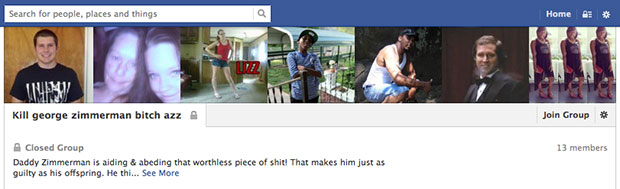
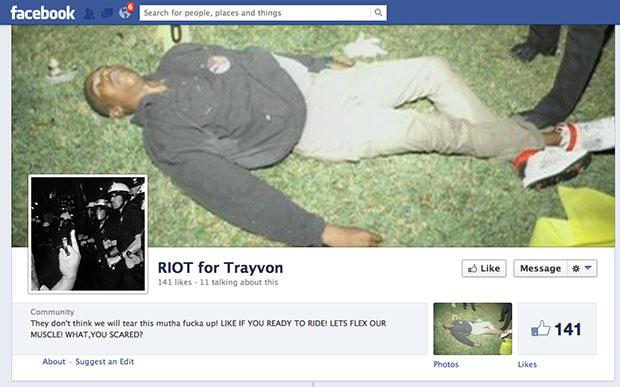
Complaints about other Facebook pages, however, have not resulted in take-downs. For instance, pages calling for the murder of George Zimmerman and one urging riots if he is not guilty in the murder of Trayvon Martin.
bitchazz
riotfortrayvon
“They don’t think we will tear this mutha fucka up! LIKE IF YOU READY TO RIDE! LETS FLEX OUR MUSCLE! WHAT, YOU SCARED?” the “About” page on the RIOT for Trayvon Facebook page states.
Another Facebook page is simply titled “Kill george zimmerman bitch azz.” It is currently closed, so the page content is not viewable.
Facebook apparently operates under a double standard. A Fox News radio host is removed for making a politically incorrect joke while people who say they want to commit murder and incite rioting are allowed to stay.
In fairness, however, it should be noted that only a small number of people actually “like” the pages. This does not excuse the fact that Facebook continues to use its terms of service as a weapon against political activists, especially on the so-called right.
It does not help when idiotic actors like the socialist Roseanne Barr call for arming teenagers and regretting that Martin had not killed Zimmerman. Barr had earlier violated Twitter’s rules when she tweeted home address of George Zimmerman’s parents. She subsequently deleted the tweet, but despite the damage the popular micro-blogging site did not close down her account.
This article was posted: Wednesday, July 3, 2013 at 3:01 pm

The Guardian Revealed A Major NSA ‘Scoop’ Then Deleted It From Their Website

The Guardian Revealed A Major NSA ‘Scoop’ Then Deleted It From Their Website

Paul Szoldra
Business Insider
June 30, 2013
The Guardian released another shocking NSA scoop on Saturday, revealing collusion and mass harvesting of personal communications among the United States and at least six European Union countries — only to delete it from their website hours after publication.
The article, titled “Revealed: secret European deals to hand over private data to America,” was written by Jamie Doward, who reported information from Wayne Madsen, a former Navy Lt. and NSA employee for 12 years.
Doward wrote:
Madsen said the countries had “formal second and third party status” under signal intelligence (sigint) agreements that compels them to hand over data, including mobile phone and internet information to the NSA if requested.
Under international intelligence agreements, confirmed by declassified documents, nations are categorised by the US according to their trust level. The US is first party while the UK, Canada, Australia and New Zealand enjoy second party relationships. Germany and France have third party relationships.
He went on to say that seven European countries and the U.S. have access to a fiberoptic cable network, intercepting phone calls, emails, and user logs from websites. The article describes Madsen as having “been attacked for holding controversial views on espionage issues.”
That’s a light way of putting it.
Some of Madsen’s controversial views include the belief that President Obama is secretly a homosexual and that the Boston bombing suspects were government agents. He’s also reported on a “former CIA agent” alleging the 2000 USS Cole bombing was perpetrated not by al Qaeda terrorists, but by a missile fired from an Israeli submarine.
John Schindler, a professor at the Naval War College and intelligence expert, called Madsen ”batsh– crazy, to use the technical term.”
The pulled article now bears the message, “this article has been taken down pending an investigation” but appears to still be on tomorrow’s front page of the print edition. It was originally published in The Observer, a Sunday newspaper owned by The Guardian and hosted on their website.
You can still read a cached copy of the article via Google.
Here’s a partial screenshot:
wayne madsen guardian article
This article was posted: Sunday, June 30, 2013 at 5:09 am

Turning Patents Into ‘Invention Capital’

http://www.nytimes.com/2010/02/18/technology/18patent.html?_r=0
Stuart Isett for The New York Times
Nathan Myhrvold, chief of Intellectual Ventures, says patent holders are being treated unfairly.

Published: February 17, 2010
BELLEVUE, Wash. — Nathan Myhrvold wants to shake up the marketplace for ideas. His mission and the activities of the company he heads, Intellectual Ventures, a secretive $5 billion investment firm that has scooped up 30,000 patents, inspire admiration and angst.
Stuart Isett for The New York Times
Nathan Myhrvold with a machine that freeze-dries food. Intellectual Ventures so far has paid $315 million to individual inventors.
Admirers of Mr. Myhrvold, the scientist who led Microsoft’s technology development in the 1990s, see an innovator seeking to elevate the economic role and financial rewards for inventors whose patented ideas are often used without compensation by big technology companies. His detractors see a cynical operator deploying his bulging patent trove as a powerful bargaining chip, along with the implied threat of costly litigation, to prod high-tech companies to pay him lucrative fees. They call his company “Intellectual Vultures.”
White hat or black hat, Intellectual Ventures is growing rapidly and becoming a major force in the marketplace for intellectual capital. Its rise comes as Congress is considering legislation, championed by large technology companies, that would make it more difficult for patent holders to win large damage awards in court — changes that Mr. Myhrvold has opposed in Congressional testimony and that his company has lobbied against.
Intellectual Ventures spent more than $1 million on lobbying last year, according to public filings compiled by OpenSecrets.org. In the three most recent election cycles — 2006, 2008 and 2010 — Intellectual Ventures executives, led by Mr. Myhrvold, have contributed more than $1 million to Democratic and Republican candidates and committees.
Mr. Myhrvold makes no apology for playing hard under the current patent system. If his company is going to help change things, it must be a force to be reckoned with. “We have to be successful,” he said.
The issues surrounding Intellectual Ventures, viewed broadly, are the ground rules and incentives for innovation. “How this plays out will be crucial to the American economy,” said Josh Lerner, an economist and patent expert at the Harvard Business School.
Mr. Myhrvold certainly thinks so. He says he is trying to build a robust, efficient market for “invention capital,” much as private equity and venture capital developed in recent decades. “They started from nothing, were deeply misunderstood and were trashed by people threatened by new business models,” he said in his offices here.
Mr. Myhrvold presents his case at length in a 7,000-word article published on Thursday in the Harvard Business Review. “If we and firms like us succeed,” he writes, “the invention capital system will turbocharge technological progress, create many more new businesses, and change the world for the better.”
In the article and in conversation, Mr. Myhrvold describes the patent world as a vastly underdeveloped market, starved for private capital and too dependent on federal financing for universities and government agencies, which is mainly aimed at scientific discovery anyway. Eventually, he foresees patents being valued as a separate asset class, like real estate or securities.
His antagonists, he says, are the “cozy oligarchy” of big technology companies like I.B.M., Hewlett-Packard and others that typically reach cross-licensing agreements with each other, and then refuse to deal with or acknowledge the work of inventors or smaller companies.
Ignoring the patents of others is “deeply ingrained in parts of certain industries,” he writes in the article, “most notably software, computing and other Internet-related sectors.”
Large technology companies complain about patent suits but, Mr. Myhrvold says, their actions often invite litigation. “The attitude of the big guys has been that unless you sue me or threaten to sue me, get lost,” he said in the interview. “I know, I was one of those guys.” Indeed, Mr. Myhrvold, 50, supplied his considerable brain power to Microsoft for 13 years, serving as chief technology officer until 2000.
Mr. Myhrvold personifies the term polymath. He is a prolific patent producer himself, with more than 100 held or applied for. He earned his Ph.D. in physics from Princeton and did postdoctorate research on quantum field theory under Stephen Hawking, before founding a start-up that Microsoft acquired.
He is an accomplished French chef, who has also won a national barbecue contest in Tennessee. He is an avid wildlife photographer, and he has dabbled in paleontology, working on research projects digging for dinosaur remains in the Rockies.
His Intellectual Ventures is not simply a patent hedge fund. Its 650 employees include scientists and engineers, and it has an in-house invention effort and lab that last year applied for 450 patents. To date, the company has paid $315 million to individual inventors.
He calls patents “the next software,” noting that software did not become a market on its own until the 1980s, spurred by innovators and the enforcement of intellectual property laws. “I’m trying to get inventions that kind of respect as an economic entity,” he said.
Yet while Mr. Myhrvold is saying one thing, his company’s main activity is quite another, according to Mark Bohannon, general counsel and senior vice president for public policy for the Software and Information Industry Association.
Intellectual Ventures, Mr. Bohannon says, is the largest of the category of firms that hold patents, but do not make products. Lawyers call such firms nonpracticing entities, NPEs, though they are often labeled as patent trolls. “Our concern is that it games the patent litigation system so it can extract licensing fees and investments from technology companies that create jobs, innovate and make products,” said Mr. Bohannon, whose trade association includes I.B.M., Google, Oracle, SAP and Adobe.
Several analysts say that Intellectual Ventures has been primarily a master practitioner of exploiting the current rules of the game to its advantage. Many companies in the patent field use shell companies to mask their activities, and Intellectual Ventures seems to employ them with uncommon frequency. A report last month by Avancept, an intellectual property consulting firm, said that up to 1,110 shell companies and affiliated entities appear to be linked to Intellectual Ventures. The secrecy, said Thomas Ewing, principal consultant for Avancept, makes it “far more difficult to confidently negotiate with Intellectual Ventures.”
Intellectual Ventures, founded in 2000, began operating in 2003. It says it has returned $1 billion to investors and collected more than $1 billion in license fees to date. Most of the revenue has apparently come from 16 so-called strategic investors — big companies that pay to license patent rights and get a stake in an Intellectual Ventures fund.
The companies must sign strict nondisclosure agreements to even talk with Intellectual Ventures. Only Microsoft has publicly stated that it is one of the group. In 2008, The Wall Street Journal reported that Verizon Communications had agreed to pay Intellectual Ventures $350 million. Other companies that have agreed to sizable payments to Intellectual Ventures include Intel, Nokia and Sony, according to people told of deals. And Intellectual Ventures has sought deals with others, including I.B.M. and Amazon, so far without success, say people informed of the talks.
Intellectual Ventures’ penchant for secrecy, Mr. Myhrvold says, is partly a legacy from its early days as an upstart when it did not want to tip its hand. Personally, he says he advocates not only the public disclosure of patents but also license agreements, but he will not give up the competitive edge of secrecy unilaterally. “If everybody in the industry does it, I’ll be right there,” Mr. Myhrvold said.

Intellectual Ventures Says Patent Trolling, Shaking Down Actual Innovators Is The American Way

from the check-your-constitution,-nathan dept

Ah, Intellectual Ventures, and its hamfisted attempts to make itself and its massive patent trolling operation look good. Today it tried to wrap itself in the American Flag for July 4th, by posting the results of a "survey" that it commissioned, pretending to make itself look awesome. Of course, as pretty much everyone knows, when you ask leading questions in a survey, you can get the answers you want. And, tellingly, IV doesn't bother to release the actual questions it asked, but it's not difficult to figure out how it was able to get the following results:
  • By a margin of more than 2:1, Americans believe that individual inventors contribute the most to society versus corporations, government organizations and universities.
  • The majority of Americans believe that allowing inventors to patent new technology ideas increases the pace of innovation. On average, less than 10 percent said the practice decreases the pace of innovation.
  • More than half of Americans believe that if an inventor comes up with a popular technology idea first, the inventor should not only be allowed to patent it, but always be able to enforce their patent rights and receive compensation from the companies using the same technology in their products.
If you ask questions about "independent inventors" in a vacuum, without explaining how Intellectual Ventures and those like it abuse the patent system by using vague or bogus patents to shake down actual innovators and force them to pay up to avoid being sued, of course you'll get those kinds of answers. Yes, lots of folks love independent inventors, but that's not the real issue. It's the smokescreen red herring that IV has tried to wrap itself in, when we all know it's pure hogwash.

First off, if "individual inventors" contribute the most to society compared to corporations -- then shouldn't we be skeptical of a massive corporation like Intellectual Ventures that appears to be sucking up tons of patents? Of course, IV will claim that it's "helping the independent inventor" by providing them with "much needed capital" or some such crap. But when reporters actually asked them to support that claim, the one "example" that IV gave those reporters turned out to be something else entirely -- a trolling operation on a bogus patent, which was later revealed to have involved a patent holder who mislead the patent office to get that patent and where Intellectual Ventures actually got 90% of the profits. That's helping individual inventors?

Second, it's no surprise that lots of people think that patents increase the pace of innovation. That's the story that's been told for years. But what people think isn't always what reality is, and at this point the number of studies showing how much patents have held back innovation is overwhelming. I think I'm going to go with the data on this one, rather than what random people who haven't seen the data think.

Third, on the question of the inventor being able to receive compensation, it seems pretty clear that the question here implies, almost entirely incorrectly, that companies who actually bring products to market are often "copying" the ideas from the inventor. That's almost never the case. If the question properly asked whether or not companies who actually built a product and then brought it to market successfully, totally independent of some guy who got a vague patent, should have to pay someone who had a vague idea that was never implemented, and which they never even tried to take to market, the answers would be very different.

Once again, IV seems to think people are stupid, and that all it needs to do is spew bullshit to support its position. What a sad place it must be to work at when the best they can do is to ask misleading questions that, even when answered as is, make "big corporation" Intellectual Ventures look so bad.

MORSI OVERTHROWN! Egypt Rejects Obama’s Muslim Brotherhood Candidate

MORSI OVERTHROWN! Egypt Rejects Obama’s Muslim Brotherhood Candidate

Anti-Obama Fever Grips Nation
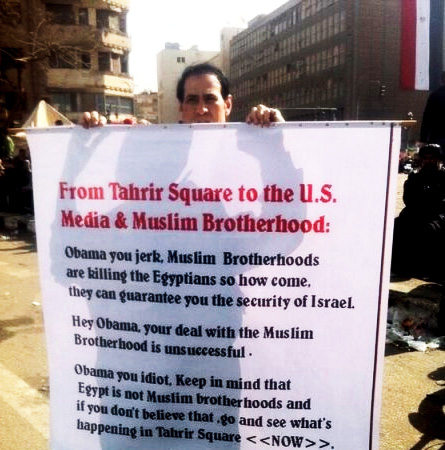
US President Barack Hussein Obama’s greatest achievement in 2012 was creating an Islamist Egypt ruled by the Muslim Brotherhood. Make no mistake about it, without Obama giving the Muslim Brotherhood financial support and the backing of the United States, the phony Arab Spring never would have taken hold. Of course, all this was done to turn the Middle East’s largest Muslim country into a Sharia-ruled regime that just happens to sit on the southern border of Israel. Today, the Egyptian people and their army took their country back out of the hands of Barack Hussein Obama. source – NTEB
egypt-rejects-obama-and-muslim-brotherhood-military-coup-july-03-2013
Egyptians have no problem seeing Obama for the phony that he is…how come we can’t do the same? Hmm….
Photo Gallery: View all the photos posted today showing massive anti-Obama frenzy sweep across Egypt
From Breitbart: On Wednesday, Gen. Abdel Fatah Said Al-Sisi announced a military coup in Egypt. He said that the Constitution had been suspended, that early elections would take place, and that there would be a “code of ethics” for the media. He stated that the chief of the Constitutional court would be taking charge during a transitional period before another election. He said the new government would be “diverse and include all the people,” and that the constitution would be revised to reverse changes made by ousted Muslim Brotherhood President Mohammed Morsi.
morsi-ousted-as-egyptian-army-stages-coup
Anti-Obama fever grips Egypt as his candidate Mohammed Morsi is ousted by the Egyptian Army in dramatic coup
Al-Sisi said there would be a code of ethics for the media that would “establish values and ethics for the media to follow.” He also stated that there would be a committee for reconciliation from leaders who are credible. The armed forces, he said, call on the great Egyptian people with its various groups to continue to have peaceful protests and end the crisis. He also said that the military warned it would take action against anyone moving beyond peaceful protest.
“May Allah preserve Egypt and its people,” al-Sisi concluded.
UPDATES: A Morsi aide has said that Morsi has been removed to an undisclosed location.
Dr. Mohammed El-Baradei, a leader of the anti-Morsi opposition, stated that he hopes “all of us come back as reconciled people together. I hope that this ‘road map’ will be a beginning to continue with the revolution for which the Egyptian people have spent dearly to achieve social justice for every Egyptian man and woman.”
CNN reports the sound of gunfire near pro-Morsi demonstrators, adding that Muslim Brotherhood followers had been training with sticks in preparation for violence. The crowd is chanting “victory or martyrdom.” The Egyptian military, CNN reports, is 400 to 500 yards down from the pro-Morsi demonstrations.
Just before the military announced the ouster of Morsi, the army sent troops and armored vehicles to militarily sensitive points around the country, including throughout Cairo. Troops are also surrounding rallies by pro-Morsi forces.
egypt-rejects-barack-obama-support-for-muslim-brotherhood-antiobama
Anti-Obama fever sweeps across Egypt today
Travel bans were imposed on Morsi and top figures from his Muslim Brotherhood including its chief Mohammed Badie and his powerful deputy Khairat el-Shater.
Associated Press reports that Egyptian defense leaders have told US officials that there will be no long-term military rule, telling Secretary of Defense Chuck Hagel and Chairman of the Joint Chiefs of Staff Gen. Martin Dempsy that a civilian government would be installed shortly. The Egyptian military has reportedly stated that it will protect US citizens in Egypt. AP also reports that American Councils for International Education in Washington, D.C., announced that it would be evacuating 18 Arabic language program students from Egypt to Morocco thanks to security concerns. The students hail from the Universities of Oklahoma, Michigan, Texas, Maryland, and Michigan State.
President Mohammed Morsi’s Twitter account has called the military’s announcement a “full coup.” Morsi has been quoted as stating that today’s events “represent a full coup categorically rejected by all the free men of our nation.” CNN reports that Morsi appealed to his supporters to react peacefully to the military action.
Meanwhile, Reuters reports that the time frame of the early election will be determined by the interim administration. Christiane Amanpour of CNN says that Egyptian sources inform her it could be nine months to a year before new elections.
The US embassy in Cairo is closed Wednesday and was scheduled to be closed Thursday thanks to July 4, as well as for the weekend, according to CNN. The Washington Post reports that US embassy personnel in Cairo has ordered mandatory evacuation of all non-essential personnel, stating, “We will begin departures immediately, with the expectation that all evacuees will have left for the States by this weekend.” Departures are mandatory, not voluntary. It is not yet clear, according to the Associated Press, whether an evacuation operation would be necessary.
All Muslim Brotherhood television channels in Egypt have now gone off the air, according to UPI. Al-Ahram reports that Al-Hafez and Al-Nas both went off the air immediately after al-Sisi’s speech.
Reuters reports that the head of the constitutional court will be sworn in tomorrow as interim head of state in Egypt.
The United States has remained silent on the military action thus far, but the State Department charted an enigmatic course earlier on Wednesday, with spokeswoman Jen Psaki stating, “We think that all sides need to engage with each other and need to listen to the voices of the Egyptian people, and what they are calling for, and peacefully protesting about, and that’s a message we’ve conveyed at all levels to all sides.”
CNN reports that Attorney General Eric Holder and Secretary of Defense Chuck Hagel, among others, have been visiting the White House this afternoon, and that President Obama is in the loop. source – Breitbart

Controversial EU Data Protection Regulation May Be Negotiated In Secret In Breach Of Parliamentary Process


from the snowden-effect dept

Today, the European Parliament held a three-hour long debate on PRISM, Tempora and what the EU response should be. Many wanted TAFTA/TTIP put on hold; others didn't. But one theme cropped up again and again: the need for strong data protection laws that would offer at least some legal protection against massive and unregulated transfer of Europeans' personal data to the US.
As Techdirt readers may recall, the EU's Data Protection Regulation was already contentious even before Ed Snowden revealed the scale of US and UK spying on EU citizens. The new focus on passing it soon only intensifies the battle going on there between those who want to introduce meaningful constraints on what can be done with EU data, and those who seem happier to listen to lobbyists and allow personal information to flow across the Atlantic largely unchecked. But it looks like the politicians have come up with a way to avoid public debate on the matter, as Monica Horten at Iptegrity.com reports:
Secret trilogue negotiations between the European Parliament and the Council of Ministers are being proposed as a way to get around the impasse of 3000+ amendments on the Data Protection Regulation.
As Horten explains:
trilogues are held in secret, behind closed doors, and the only people allowed in are the rapporteur [the lead MEP representing the European Parliament] and his shadows, the Commissioner, the Presidency, and selected advisers from each institution. The trilogue discussions are not made public.
As well as being reprehensible -- if anything needed to be conducted in public, this did -- it may be against the EU's own rules:
trilogues cannot start before the responsible committee has given a mandate. That's what's a little bit odd here. The mandate can only be given when the committee votes in October.

But the Brussels rumour mill is suggesting that there could be a move to begin trilogues on the Data Protection Regulation before October, without waiting for the committee mandate.
That might solve the problem of avoiding high-profile arguments over what should be in the Regulation, but it would also place anything that comes out of these secret negotiations on a questionable footing:
it would be a breach of Parliamentary process, and especially egregious given that this law deals with fundamental rights.

In any event, the rapporteur does not have to agree to trilogues. It is an option.
In other words, nobody really knows what will happen here. Call it the Snowden Effect: anything relating even indirectly to his case seems to become more complex and unpredictable....

Team Prenda Plays Dumb In Central California, As Brett Gibbs Says They Lied In Northern California


from the have-fun-guys dept/ http://www.techdirt.com/articles/20130703/12114623707/team-prenda-plays-dumb-central-california-as-brett-gibbs-throws-them-under-bus-northern-california.shtml

It was a busy day for Team Prenda yesterday, as summarized by Joe Mullin. Down in Central California, in the case overseen by Judge Otis Wright -- who famously called out Team Prenda on their scam -- four of the members of Team Prenda all sent coordinated filings, attacking the opposing lawyers, Morgan Pietz and Nick Ranallo, claiming that they should be sanctioned for failing to serve the various members of Team Prenda concerning the additional filings in the case. John Steele, Paul Hansmeier, Peter Hansmeier and Mark Lutz all claim that they've been blissfully unaware that anything was happening in the case. Yeah, seriously. Lutz's is the funniest of the bunch:
I am Mark Lutz and two attorneys named Morgan Pietz and Nicholas Ranallo are filing motions asking this court to issue orders without notifying me! I apologize to the Court for my anger, but I have never had a chance to fight any of their motions! The Constitution gives me the right of Due Process, which means that the courts can't take something from me without first giving me a chance to contest that decision. Just so I am as clear as I can be, I have never been served with any paperwork by either attorney Pietz or Ranallo. EVER.

People's faith in the law rests on the belief that attorneys who break the rules don't get away with it. I place my trust in this Court to make sure that these attorneys will be held accountable for their actions. Here the record is obvious that Pietz and Ranallo have been breaking the rules. I therefore ask the court to strike all pleadings filed by attorneys Pietz and Ranallo that do not have a proof of service filed with them. I also ask that any orders that were entered by this court against AF Holdings, Ingenuity 13 or me be vacated. These guys are total fraudsters
The other filings are similar, if only slightly more professional. Steele had actually filed a similar filing a week earlier, which Judge Wright rejected within an hour. It seems unlikely that he'll be any more open to these latest claims as he's made it clear that he's very much onto Team Prenda's usual tactics of denying everything, trying to talk their way out of any hole they've dug, and when caught, attacking those who caught them. This latest is straight out of their playbook. The question of whether or not these four guys are being served is an important one, but as Judge Wright made clear in his initial ruling, Steele and Paul Hansmeier are considered by the Court to be principals of Prenda, so as long as Pietz and Ranallo are serving Prenda itself, in the form of Paul Duffy (who, you'll notice, is the lone member of the "Team" as defined by Judge Wright and who did not file one of these statements), it probably covers those three. The situation may be different with Lutz and Peter Hansmeier, but even then, I'll wait on Pietz's and Ranallo's reply, since nearly every statement from Team Prenda ends up proving to be less than fully accurate later on.

On a related note, earlier in this same case, we discussed how Team Prenda had done everything to try to hide from being served during an earlier round of filings. Their efforts to avoid service may become fairly relevant should this issue get any further.

Of course, on the same day this happened, something even more interesting was happening up in Northern California, in the AF Holdings v. Navasca case. That was the case where Judge Edward Chen had ordered Team Prenda to produce a copy of the supposed "Salt Marsh" signature, which Mark Lutz insisted he could not find (as did Paul Duffy). Lutz tried to brush off everything, saying that Brett Gibbs regularly asked him to sign various things and he would do so on behalf of the mysterious Salt Marsh trust. While this argument was an odd one, Judge Chen accepted it and was ready to close the case.

However, Ranallo has now asked Judge Chen for sanctions against a variety of the members of Team Prenda for their actions and statements in the case, and has presented a tremendous amount of evidence that Steele, Hansmeier and Lutz have been flat out lying. And, some of that evidence comes in the form of a damning deposition from former Prenda lawyer Brett Gibbs. Gibbs, it appears, has finally realized that Steele and Hansmeier were throwing him under the bus. While Gibbs had already given one deposition against Steele and Hansmeier, it was fairly tame compared to this latest one, in which he points out that Lutz's claims are clearly untrue:
I have reviewed the Affidavit of Mark Lutz filed in this case on May 13, 2013 (Doc. #80). I believe that the information provided in the fifth paragraph of that affidavit regarding my interactions with Mr. Lutz is not an accurate description of those events. I did not "from time to time" send certificates for Mr. Lutz to sign on behalf of the Salt Marsh Trust. I did not have the alleged conversations with Mr. Lutz. In fact, I did not know that Mark Lutz was directly affiliated with these companies, as an owner or otherwise, until months after filing the ADR Certification in this case.

Instead, I was specifically told by Mr. Hansmeier that Salt Marsh was the owner of AF Holdings, and that he, Salt Marsh, had read and understood the ADR handbook, and that I could go ahead and file the ADR Certification with the electronic signature of Salt Marsh. Again, I never spoke with Salt Marsh directly. Through my conversation with Mr. Hansmeier, I was under the impression that the Salt Marsh was an individual who had in fact complied with the Local Rule and that his original signature existed on a document that was being held by my then employer, Prenda Law, Inc. Given that information, I proceeded to file the ADR Certification on that basis.

After I filed this case, I learned through a separate case filed in Minnesota that the assignment agreement may have been invalid because there was a dispute whether a signature on the agreement was in fact forged. Once alerted to this, I immediately discussed this matter with John Steele and Paul Hansmeier. They assured me that it was a valid signature, that the allegations were mere "conspiracy theories," and that I should have no concern in continuing to prosecute this and other AF Holdings' cases. I believe I was diligent in my factual and legal investigation of this matter.
Of course, one could argue that Gibbs' credibility is less than perfect (though, still better that Steele/Hansmeier/Lutz). But, even without Gibbs' deposition, Ranallo has pretty strong evidence of the typical shenanigans from Steele/Hansmeier here, in that he actually shows that Steele and Hansmeier's own statements in two different cases, directly contradicts each other.
AF Holdings' first attempt to explain this assignment came on February 19th, when Paul Hansmeier appeared as AF Holdings' 30(b)(6) deponent in this action. In a clearly rehearsed explanation, Mr. Hansmeier stated that Mark Lutz, paralegal for Steele Hansmeier, Prenda Law, and the Anti-Piracy Law Group tasked his boss, John Steele, with arranging a "corporate representative" to acknowledge the assignment in this case (Hansmeier Dep. at 121:11-128:12).

We are to believe that Mr. Steele did this as a favor to his paralegal, because the paralegal was himself too busy to personally sign his own name on behalf the company he supposedly runs. It is unclear how Mr. Lutz saved any time this way, since it undoubtedly took at least as long to arrange for the "representative" as it would have to sign his own name, but nonetheless, we are told that efficiency was the motivation. See Hansmeier Dep. at 127:22- 128:8 ("...Mr. Lutz is an individual. There are a certain number hours in a day and for him to accomplish everything he's going to accomplish in a given day, or for anyone in any capacity in any business, you rely on third parties to aid you to accomplish tasks.")

According to Mr. Hansmeier, Mr. Steele then sought out his property caretaker in Minnesota, Alan Cooper, to serve as "corporate representative" to acknowledge the assignment. Hansmeier Dep. at 122:5-11. According to Mr. Hansmeier, Mr. Steele was therefore the sole individual that could shed any light on the circumstances surrounding the execution. Hansmeier Dep. at 122:11-126:21. Specifically, Mr. Hansmeier testified that
"Mark Lutz spoke to Mr. Steele and said, Well, I understand that there's an issue with this Alan Cooper and asked Mr. Steele point-blank, Is the signature a forgery. Mr. Steele said the signature is not forgery. And he asked him, Is the— is the signature authentic. Mr. Steele says, yes, the signature is authentic..." and, "...all I can say is that AF Holdings – the only person who knows who this Alan Cooper is is John Steele...". Hansmeier Dep. 122:11-18 and 126:10-127:2.
Mssrs. Steele, Hansmeier, and Duffy were each given a chance to forward their own explanation(s) for the Cooper assignment on April 2, 2013 at a hearing in the Central District of California. Rather than testifying under oath (and subject to cross examination), however, each invoked their Fifth Amendment right. Ingenuity 13 v. Doe, 2013 WL 1898633 at * 2 (C.D. Cal., May 6, 2013).

Mr. Steele later decided to address this issue in the form of an affidavit– safe from cross-examination - in response to yet another Order to Show Cause regarding sanctions in the District of Arizona. A copy of the Arizona Order to Show Cause is annexed hereto as Exhibit K , AF Holdings response is annexed as Exhibit L, and Mr. Steele's affidavit in support is annexed hereto as Exhibit M. Mr. Steele's affidavit is wholly inconsistent with Mr. Hansmeier's version of events, and Mr. Steele cannot bring himself to even claim that Mr. Cooper actually executed the assignment. What Mr. Steele does say, however, contradicts Mr. Hansmeier's testimony and various publicly available documents. See, e.g. Exhibit M... Specifically, Mr. Steele describes the Alan Cooper circumstances as follows:
"8. ...I agreed to help him set up a company for him and help him out in getting started with his business.
9. Shortly thereafter, Alan told me that he could not put any time into the project and I believe that he never ended up following through with getting his new company off the ground. As a less time intensive alternative, I suggested that if Alan wanted to learn more about the adult industry, I could connect him to a new company that was run by Mark Lutz.
10. I informed Alan that one way to get his name established would be to serve in a corporate representative role, which would let him gain exposure to the types of deals Mr. Lutz was doing and see if that was something that appealed to him.
11. My understanding is that Alan took me up on the offer and participated in a limited number of transactions in 2011 with Mr. Lutz’s companies. I am not aware of any post-2011 transactions in which Alan participated.” Steele Aff. at 8- 11.
Several things are notable about Mr. Steele's version of events. First, and most conspicuously, is his purported ignorance regarding the Alan Cooper transactions, notwithstanding Mr. Hansmeier's testimony that Mr. Steele was the only one with information. In contrast to Mr. Hansmeier's testimony, which makes it clear that Mark Lutz specifically tasked Mr. Steele with finding a corporate representative for the purpose of acknowledging AF Holdings' assignments, Mr. Steele implies that this was a favor for Mr. Cooper, wholly unrelated to any specific task. Moreover, Mr. Steele disclaims any personal knowledge regarding the "limited number of transactions" that Mr. Cooper was involved in, and disclaims any knowledge that would allow him to reassure Mr. Lutz and Mr. Hansmeier that the relevant assignments were not forgeries, as he apparently did. Indeed, Mr. Steele's affidavit seems to indicate that Mr. Lutz would himself have all the necessary information regarding the assignment, and there would be no reason for Mr. Lutz to go to Mr. Steele for confirmation regarding the validity of the assignments.

Secondly, AF Holdings response and Mr. Steele's affidavit simply do not square with documented reality. AF Holdings' response to the OTSC indicates that "At some point in early 2011, Steele and Cooper discussed how a friend of Steele's was exploring opportunities related to purchasing and marketing adult content. Cooper expressed interest in learning more about these opportunities, and Steele offered to help him learn more...Cooper ended up not moving forward with the ideas Steele proposed to him..." See Exhibit N at 6.

This explanation does not square with history. Indeed, John Steele began misappropriating Mr. Cooper's identity before "early 2011," in connection with VPR, Inc., and other entities. As previously described in ECF No. 55, 55-1, and 55-5, VPR, Inc., was formed and registered with the Nevada Secretary of State in late 2010 and identified Alan Cooper as the president, secretary, and all other relevant positions in the entity. As previously described, the corporate address identified by the Nevada Secretary of State is 4532 East Villa Theresa Drive ("the Villa Theresa Address"), an address previously shared by John Steele's sister and Anthony Saltmarsh. See ECF Nos. 55-1, 55-3 and 55-4.

VPR, Inc. cannot be the entity that never came to fruition, as described in Mr. Steele's affidavit, as it has filed copyright lawsuits against more than a thousand Does, through its counsel, Steele Hansmeier.
Believe it or not, there's much more in there, but that selection of using Steele's claims against Hansmeier's claims is really quite classic. This is, of course, what happens when you dig yourself a giant hole and then try to bullshit your way out of it. Sooner or later you're going to contradict your own claims.

U.S. space-based missile alert system moves forward

U.S. space-based missile alert system moves forward

Source: SpaceDaily
U.S. space-based missile alert system moves forward
The United States’ futuristic missile alert system operating from outer space moved forward with Lockheed Martin’s delivery of the third “highly elliptical earth orbit” satellite payload system.
A further fourth HEO is due to complete the USAF order, which will be yet another step toward initiating the Space Based Infrared System. SBIRS is designed to give the U.S. military a global capability to detect and monitor a ballistic missile launch from anywhere.
“The SBIRS program delivers timely, reliable and accurate missile warning and infrared surveillance information to the President of the United States, the Secretary of Defense, combatant commanders, the intelligence community and other key decision makers,” Lockheed Martin said.
The aerospace manufacturer said the system, in addition to enhancing global missile launch detection capability, would support the ballistic missile defense system, expand technical intelligence gathering capacity and bolster situational awareness for fighters on a battlefield.
SBIRS will include what Lockheed Martin calls “a resilient mix of satellites” in geosynchronous earth orbit, hosted payloads in HEO orbit and ground hardware and software.Â
As an integrat­ed system it will support multiple missions simultaneously and provid­e robust performance with persistent coverage worldwide.
“Our full attention is now on completing HEO 4 and GEOs 3 and 4,” Jeff Smith, vice president of Lockheed Martin’s Overhead Persistent Infrared mission area.” The focus, he said, was on “delivering unprecedented infrared surveillance capabilities to our warfighters.”
SBIRS includes four HEO payloads, four GEO satellites, and ground assets to receive, process and disseminate the infrared mission data.Â
The first two HEO payloads were delivered in 2004 and 2005 and have provided mission performance surpassing specifications. Prior to its delivery, the HEO 3 payload successfully completed rigorous environmental and functional testing to demonstrate performance in family with HEOs 1 and 2.Â
“This is the third SBIRS HEO payload delivery and the first from the SBIRS Follow On Production Program,” said Steve Toner, vice president of Northrop Grumman’s Military and Civil Space business unit. “Its sensor will enhance the high quality of information being provided to our warfighters by the SBIRS constellation.”
Air Force Space Command declared GEO 1 operational May 17 and recommended Integrated Tactical Warning and Attack Assessment certification of the asset to the U.S. Strategic Command.Â
The second USAF SBIRS GEO satellite was launched May 19 and has been delivering “outstanding infrared data as part of on-orbit testing.” Lockheed Martin has also received contracts to procure long-lead items for GEOs 5 and 6.
The new satellites will replace the existing Defense Support Program fleet, Defense Industry Daily said on its website. The new satellites’ infrared sensors have thrice the sensitivity of DSP and twice the revisit rate, while providing better persistent coverage.
Unfortunately, it said, the program has been beset by massive cost overruns on the order of 400 percent, technical challenges that continue to present problems and uncertainties about performance.
Despite those problems USAF is proceeding with the program and has terminated potential alternatives and supplements, Defense Industry Daily said.

Hold the Ethics: Surveillance, Data Mining and the Destruction of Personal Privacy

Photographer: 
Wikipedia Commons
"Why, tell me, why?
I wanna reach you with this binary mind
Cause if I do I'm sure that we'll be complete" -Ra Ra Riot

A mid-2000 Klondike bar campaign poses this question: "What would you do for a Klondike bar?" The answers run a predictably banal gamut: a fatuous act of self-imposed embarrassment, a singular performance of suspended inhibitions. The commercial follows this template: I'll offer a glimpse of my private self (or, temporarily deactivate my defense mechanisms and self-consciousness) for a Klondike bar, but I'm unwilling to concede anything more penetrating (i.e. exploitation of my failing relationship, my arachnophobia, my mounting debts) for public display.

Each actor willingly offers a tiny slice of their private consciousness for the ice cream treat, relinquishing very little for very little. Today, the Klondike exchange represents a nominal sacrifice. The exchange of very little for very little has bloated to colossal and disturbingly so-real-it's-surreal proportions. We no longer sacrifice a superfluous glimpse into our personal lives for a measly Klondike, we offer everything and all for the newest and trendiest anything, and sometimes without knowledge of the transaction. The rupture between our personal and public self, hemorrhages toward complete elimination of personal privacy. If the commodification of our private lives (or, private data) is the currency for today's transactions, are we receiving appropriate compensation for the keys to our diary?

Futurism --> Transhumanism

As technological fervor took root in Western culture during the late 19th/early 20th centuries, the future of the human population underwent a physical and philosophical morph. Industries adapted to welcome the means of mechanized production, commodity output accelerated, and labor became displaced by the quicker, cheaper assembly line. Typical to periods of industrialization, the populace lacked the terminology to comprehend what Vaclav Smil referred to as "The Age of Synergy" (or, as Hollywood might say: “When Science Met Production!”). As the population furtively shifted to accommodate internal combustion engines and radios, a cultural movement formed in Italy, dubbed Futurism by its progeny.

In homage to the new era, Futurists walked "in step with the progress of the machine, of aircraft, of industry, of trade, of the sciences, of electricity." (The Futurist Manifesto, Filippo Marinetti). Futurism embraced the speed and violence of mechanical energy, and the youth and vitality it proffers (unsurprisingly, many futurists rallied around fascism). As the Futurists' devotion to industrialization adjoined and eventually meshed with the prevailing Western culture, human life became inextricably linked with technology.

Futurism re-entered the cultural canon thanks largely to the work of Alvin Toffler. Toffler observed the dawning of the super-industrial society and unceremoniously hitched the new epoch of industrialization with overstimulation in his seminal piece, Future Shock. Industrialization, to Toffler, signified "too much change in too short a period of time." This phenomenon continues to resonate with humanity; apps, updates and innovations define our day-to-day. The consequence of too much change in too short a period of time? Information overload, said Toffler. Information overload registers particularly familiar in the 21st century, where every day is a world's expo.

As Futurism waned from avant garde to normality and subsequently, irrelevance, transhumanism gained traction.

A quick summary on transhumanism for the unacquainted:

Nietzsche’sÜbermensch plays a significant role in transhumanism, as does J.B.S. Haldane, geneticist and author of the monograph: Daedalus or Science and Future in which Haldane posited that new inventions will be considered "blasphemous" and "perverse." Transhumanism transcends salivating over unsexy cars or trains like futurists; it's artificial intelligence that makes their toes curl like venetian blinds.

Contemporary transhumanists you may recognize:

Raymond Kurzweil (probably the most well-known transhumanist, more on him later), Hans Moravec (robot philosopher - well,philosopher of the evolution of robots, not an actual robot). Anyone affiliated with the NGO. World Transhumanist Association, now known as Humanity+. Humanity+'s definition of transhumanism: The study of the ramifications, promises, and potential dangers of technologies that will enable us to overcome fundamental human limitations, and the related study of the ethical matters involved in developing and using such technologies. Humanity+ produces a transhumanist magazine, H+.


Futurism <--> Transhumanism

In this 21st century, the term futurist/m receives postmodernism's highest honor of hackneyed trendiness, where the once emergent aesthetic is scrubbed clean of its origins and tidied up for creatives in black V-necks to throw on their Linkedin resumes. Futurism and Transhumanism co-exist in the modern epoch, but Transhumanism entertains serious academic luridness, while futurism exists chiefly as a neo-corporate buzz word. Kurzweil, one of the more renowned academics associated with Transhumanism (he's the director of engineering at Google, a prolific inventor and a regular futurist/transhumanist mouthpiece), is rabidly enthusiastic (despite his monotone delivery) about the evolutionary transition into transhuman culture, and acts as one of the most clamorous harbingers of the tipping point into super intelligence. This watershed shift in the not-so-distant future is known as singularity.

Enter Singularity or How I Stopped Worrying and Learned to Love the Cyborg

When singularity will tip the scales and change everything remains completely unpredictable, despite what your technophile roommate preaches as he jailbreaks your iPhone. Some say 40 years from now, others say 30, and the more authoritative offer a range between five and 100. Paul Allen speculates singularity won't occur within this century (this seems important, somehow). When singularity will take place is indeterminable, but trust your local technophile, it will occur.

What is singularity? Technological singularity is the moment human technology creates a super intelligence, representing a tipping point for human intelligence to make way for artificial intelligence. For some, this marks the beginning of the book of Revelations, for others, the dawning of a new species and the humankind's crowning achievement.

Return to Haldane's quote (full length version): "The chemical or physical inventor is always a Prometheus. There is no great invention, from fire to flying, which has not been hailed as an insult to some god. But if every physical and chemical invention is a blasphemy, every biological invention is a perversion." Like the hindsight condemnation of a great invention as blasphemous or perverse, there's a tendency to deny and repress the coming of imminent creation, by the creator or the prescient. In response to the imminent singularity, a staggering amount of the population will (to borrow a loathsome phrase) call shenanigans and resume reading Blue Like Jazz, but the evidence offered in favor of singularity is quite staggering.

Raymond Kurzweil, who has already begun the countdown to singularity with red X's on his Google calendar, famously extrapolates to the exact moment of singularity through an adaptation of Moore's law, or the Law of Accelerating Returns, which demonstrates an exponential rise of technological progress. From the man himself: "We won’t experience 100 years of progress in the 21st century—it will be more like 20,000 years of progress (at today’s rate). The 'returns,' such as chip speed and cost-effectiveness, also increase exponentially. There’s even exponential growth in the rate of exponential growth. Within a few decades, machine intelligence will surpass human intelligence, leading to The Singularity." Kurzweil estimates 2045 as the year of Singularity, and according to his calculations, we're right on track.

As humanity endeavors ever closer to "The Singularity," a negative correlation emerges. Each invention, each progress of technology indirectly influences a loss of the collective private consciousness.

Shut Up and Take My Privacy!

How humanity lost the private space isn't a tale of struggle or resistance. We gave it willingly, blithely and with no thought to consequence.

During the nascent George W. Bush era, Vice President Cheney admitted to the public that American military intelligence will employ "dark side" methods (a.k.a. illegal and despicable methods of torture) to battle terrorism. Which begs the question, why admit to torture now? If Cheney felt comfortable advocating torture (which the Bush administration played ignorant to for at least five years afterward), what other inhumane perpetrations are left unsaid? To quote Slavoj Žižek: "Here we enter the domain of secret operations, of what power does without ever admitting it."

A few years prior (1999), Sun Microsystems then-CEO Scott McNealy infamously stated: "You have zero privacy. Get over it." Like Cheney's call for America to back torture, McNealy calls for Internet users to halt the war for Internet anonymity. McNealy's candor is simultaneously refreshing and threatening, but his dismissive attitude toward personal privacy is suspect. Was McNealy attempting to manipulate the public into lowering their defenses against corporate and government invasiveness, or is privacy actually nonexistent? Was it a proclamation or a certainty?

"Privacy, after all, encompasses much more than just control over a data trail, or even a set of data. It encompasses ideas of bodily and social autonomy, of self-determination, and of the ability to create zones of intimacy and inclusion that define and shape our relationships with each other. Control over personal information is a key aspect of some of these ideas of privacy, and is alien to none of them." -Michael Froomkin


Digital privacy found itself in corporate crosshairs since the web's inception. In 1994, the Washington Post outed America Online for selling subscribers' (around 1 million at the time) personal information to direct marketers without consent. Before and after America Online's gaffe, users suffered invasive incursions into their personal privacy. Beholden to avarice, the data economy was too profitable to question the ethics of privacy destruction. And so, the benefactors of dataveillance set about strip-mining Internet user privacy par tous les moyens nécessaires. Subsequently, user data is stored and sold to the highest bidder, be it corporation or government. Users received nothing in compensation.

"Ah!" McNealy and his contemporaries cry, "That's where you're wrong. Users have gained much in exchange for their privacy, they have the Internet. They have Facebook and Skype; open source software and the ability to quick-design infographics and minimalist renditions of kitsch Hollywood films. The user is in power!"

At what cost? What is our privacy worth?

The America Online scandal is now status quo. Every digital service and platform subsides off user data, and marketing agencies encourage data mining to drive e-consumption. For our part, we depend on these companies to sate our desire to connect and create. And so, we turn over our personal data to the faceless digi-corporations in exchange for programs that extract pertinent personal info, commoditize it and sell it back to us with some varnish and packaging from Amazon or eBay.The result? This is us losing ourselves.

Not-So-Anonymous

As 9/11 jingoism ebbed and the Bush administration initiated the maligned war on terror, the Patriot Act took the future of citizens and their personal privacy and placed it at the mercy of a particularly invasive government. The act withstood excoriation from civil rights activists and leftist media for the past 11-plus years, and in spite of its spurious title and First and Fourth Amendment infringements, the Act metastasized into a reliable trump card for government security branches (specifically the NSA and Dept. of Homeland Security) to flash after direct attacks on American privacy.


The ensuing invasions on personal privacy in the name of the Act are well-catalogued (NSLs and the gag orders, circumventing the Fourth Amendment through sneak and peeks), and the transgressions are only accumulating as hyper-surveillance normalizes: the Dept. of Homeland security's biometric database, the National Security Agency's multibillion-dollar Fort Williams data center and so on. Balance, the founding principle of America's representative republic and safeguard against totalitarianism, is slipping, shifting impassively in favor of the government and their cronies. While the argument for government transparency wages on, our government (thanks to the Act's room for maneuvering among other succeeding clauses) is methodically amassing the facilities and power to render the populace completely transparent. And, conversely, through layers of bureaucracy and private contracts, our government becomes more opaque.

If, like Scott McNealy assures us, privacy is a figment of the past, how is it that our government is so inscrutable?

Criticism against the government intrusions into our personal spheres foments in the digital margins on blogs/news outlets or Revelations-obsessed podcasts. The mainstream response remains lethargic, reacting/responding to the intrusions with a "nothing-to-hide" mentality of indifference. This mentality pervades in the public, yet the significance of the statement is in its contradiction. If you truly have nothing to hide, why make the claim?

When public opinion is indifferent to personal invasion, we find ourselves on loose footing. "I have nothing to hide" betrays much more than our desire for secrecy - it's a disempowering concession. By saying, "I have nothing to hide" you condone a culture of investigating the innocent (Go ahead and search me, I have nothing to hide!). Search and seizure laws exist to promote the culture of innocent until proven guilty (You can't search me, I still remain innocent!), and the growing trope of "I have nothing to hide" deconstructs our assumed innocence into the new era of surveillance: all are guilty.

From Personal Privacy in an Information Society: The Report of the Privacy Protection Study Commission, as transmitted to Jimmy Carter in 1977:
          
The balance to be struck is an old one; it reflects the tension between individual liberty and social order. The sovereign needs information to maintain order; the individual needs to be able to protect his independence and autonomy should the sovereign overreach. The peculiarly American notions of legally limited government and the protections in the Bill of Rights provide broad theoretical standards for reaching a workable balance. But the world has a way of disrupting the particular balance struck in past generations; the theory may remain unaltered but circumstances change, requiring a reworking of the mechanisms which maintained the balance in the past.


The emerging information technology requires a serious "reworking of the mechanisms which maintained the balance," and the government and corporations are speaking for the individual, causing the balance to slip into the precarious realm of "unwarranted intrusions by government [and corporations] which, in John Adams' mind, provided the spark that ignited revolution."

Patriot Acts and Social Widgets

After the Boston bombings, surveys asked if Americans are willing to give up more of their civil liberties to ensure safety. The answer? "No."

American citizens operate largely in hindsight. We lampoon the Obama Administration's torture practices after offering our blessing to the Bush administration to use "dark side" measures. Of course, there were no weapons of mass destruction. Of course, the U.S. profits from occupying, destroying, and rebuilding countries. Such certainties surface long after the original deception, when the populace musters the courage to stand as one and declare "No!" when the damage is already done. As counter-terrorism measures are bolstered by the Boston Marathon deaths and injuries, the aggressive security measures that followed the attacks on September 11 are now non grata. In line with our torture and war-profiteering dissent, our cries against the destruction of civil liberties, especially in the form of dataveillance, are too late.

Like a nude photo, user data is impossible to retrieve from the digital realm. Every relinquished personal detail becomes a permanent data gene stored in the ether. Companies such as America Online and Google were quick to recognize the value of user data and cultivated applications intended to encourage users to hemorrhage their personal information. America Online quantified the data and sold it to direct marketing companies. Google used the data internally, personalizing their ad-space and making a killing off of their users’ personal inclinations. Other companies adopted similar models, and today, the data economy features thousands of companies offering digital consumer profiles for corporations or providing assessment of civilians for the government. To trade and compile user data more efficiently and fruitfully, the government-corporate barriers were pushed aside, allowing corporations and the feds to analyze Internet users with dual scrutinies. A user could feasibly purchase a mass-produced Quran one day, and be placed on the government's No-Fly list the following morning.

With the accumulation of consumer/civilian data in capitalist vogue, most new technologies are either devised with the data economy in mind (i.e., customer relationship management software) or manipulated to feed the economy's unslakable thirst for analyzable data (reddit, instagram). Technological innovations, no matter how ostensibly open for public use, will always be subject to this process.


It is important to note that those dealing in the buying and selling of data work through corporate or government mediums. The technology that propels us toward Singularity operates in the same realm. Even if Singularity occurs in some anonymous garage in the armpit of Kentucky, the achievement will file through corporate and government channels. Each institution will alter the intelligences to their specifications and only then will the new technologies be made available to the consumer. For corporations, surveillance delivers the consumer genotype, including buying habits and the products each consumer is apt to purchase. Consequently, corporations now enjoy unprecedented brand-consumer intimacy. Federales use surveillance to "keep the peace." Of course, peacekeeping is simultaneously a mediating and nefarious process, where maintaining public routine is a function of political agenda. And the dominant agenda, keeping the throne, bears little oversight.

Each power structure is immeasurably dependent on public disinterest in anonymity and this common interest has encouraged campaigns in favor of privacy destruction on both sides. The government's campaign acquired considerable territory during the post-9/11 security measures extravaganza, where America happily forked over personal rights to eliminate the faceless other in the war on terrorism. Corporate campaigns gained momentum as technology evolved and dazzled, trading slices of user privacy for the newest design program or social widget.

And Amazon Shaped Users in Its Own Image

The transformative power of technology is astounding. E-commerce, one of the principle beneficiaries of advancements in technology, gains considerable potency as the capacity to market and sell goods on the Web develops on the cutting edge. To better sell their wares, digital businesses use data-based technologies to strip and rebuild every consumer into a more receptive, more programmable participant. As a result of the reprogramming, when an online shopper makes their umpteenth Amazon purchase, they're already shopping more fluidly then when they began. The process of personalization, in the form of search personalization or personalized consumer profiles, catalyzes the transformation from casual consumer to guided buyer.

How this goes down (example: Amazon): Every search inquiry, purchase and review provides Amazon with valuable data. The data (when analyzed) spits out products statistically proven to be of interest to specific users. Although some occasional tweaks will transpire now and again, Amazon uses the data to sculpt a working digital profile of each consumer and caters to this projection. Users can either accept the proposed digital Projection or shop in the margins of this e-commerce behemoth.

The Internet, in this sense, has changed drastically. Now, by using the Internet, a user agrees to an unwritten contract requiring the person to betray sensitive personal information. Like the public sphere, the digital sphere went the way of the corporation, where our enjoyment of the Internet depends largely on the whim of monopolies and corporate influence. This isn't the age of the empowered consumer; it's the age of the well-trained buyer, receptive and conditioned. In this vein, the Projection never changes. An individual's cast is taken and remains the same ad infinitum. And Amazon shaped its users in its own image.

A Trap of Our Own Design

As more desirable products crowd the digital sphere, personal data proves difficult to quantify. Granted, some users aren't interested in the retention of privacy (the "I have nothing to hide" purview). For those unaware of privacy loss or even for the moderately concerned, the digital commodity always shines brighter than the value of personal privacy. However, determining value of an ostensibly complimentary service, such as social media, is incredibly difficult. This dilemma has users a bit psychologically scrambled. They're given a free service, but they suspect (correctly) that free is a misleading descriptor (it's the same doubt associated with a free cookie from a younger or older sibling where the immediate response is suspicion: "What's in it?"). Conversely, there's no pricing sheet for our personal data and if there is, it's unavailable to the public.

And so we use the free service, relinquishing slices of our data (or large swaths, depending on the service in question) and suppress our doubts. Michael Froomkin refers to this phenomenon as the privacy myopia: "Consumers suffer from privacy myopia: They will sell their data too often and too cheaply. Consumer privacy myopia suggests that even Americans who place a high value on information privacy will sell their privacy bit by bit for frequent-flyer miles." In contrast, if companies attempt to take away privacy in a one-hand-swipe (Instagram, SOPA, CISPA, Facebook), ardent Web users go bonkers. Why?

We're more comfortable dismantling our private sphere bit by bit than letting corporations throw wrecking balls into our fortress of solitude. Psychologically, this makes sense. It's how relationships work — we relinquish bits and pieces and throw down our baggage only when we feel safe to do so. But a relationship with a digital program, an app, or an e-device? Demonstrating amor for a digital object is Hollywood's favorite form of foolishness, yet we can't help but defy ourselves in spite of our own logic to the contrary. We know using an automaton as a confidant represents a personal flaw (perhaps our inability to confide in ourselves?), but we fear self-judgment or peer judgment. And automatons don't judge. Ultimately, we realize that indulging in ill-advised technophilia is much more satisfying then admitting to our own need for physical comfort.

Questioning the motives for our digital affair won't shed any light on the phenomenon of privacy destruction. There are too many variables at play (atomization as a result of technology, the fickle nature of human relationships, social psychoses, and so on). What we can (and should) do is analyze how we are courting the machines that may one day forge with our own intelligence.

When a potential buyer uses Kayak, or one of many travel aggregator sites (we'll stick with Kayak as an example), the platform stores a significant amount of information about the user for later sale and personalized ads. Additionally, Kayak stores a cookie on their computer that indicates when the user was on the site and what flight they searched for. If a user views flights to Oaxaca and checks prices the following day, the price inevitably rises (to create the perception of less supply/more demand). The value of the tickets remains the same, but the multiple views of the ticket indicates added value. Unintentionally, the user gouges their own prices.

This model succeeds on two planes. The user purchases the ticket as a result of the added value (out of fear that prices will only rise higher) or, aware of the process, the user shops impulsively, opting to avoid rising ticket prices over the benefits of looking around and comparing prices (you can circumvent the ticket-cost algorithm by clearing your cookies regularly). Behind this interface is the heart of Kayak's data model. Kayak's privacy policy on why they use cookies: "To serve you with advertising content in which we think you will be interested. As part of this customization, we may observe your behaviors on this website or on other websites. We may also get information about your browsing history from our trusted business partners." Is this not exploitative? Not only is Kayak manipulating ticket prices, they're using your data, selling your data and buying data from "trusted business partners." Is the buyer not to be trusted? Can we not decide what we want for ourselves?

We can, but prevailing sentiment concedes to Web personalization making our decisions for us. By returning to kKyak's privacy policy, specifically this clause (italics added): "To serve you with advertising content in which we think you will be interested," a snapshot of the current consumer atmosphere emerges where personalization reigns as the in-marketing tool. "We think you will be interested" evokes the transformational process that exposes our indecisiveness for exploitation. This transformation removes the user, and replaces our multitudes with a simplified digital projection. As our projection or data is passed around, marketers personalize us into a confined space; presenting the user with the choice to conform and receive all the Internet has to offer or refuse and miss out on the trappings of the Web. It's a precarious wedge with extensive implications for the destruction of personal privacy.

Neil Gaiman's Sandman contains this excellent quote: "Sometimes I suspect that we build our traps ourselves, then we back into them, pretending amazement all the while." It summarizes hindsight culture quite well, but it also speaks to humanity's flirtation with Singularity. The drive to destroy the private sphere of consciousness inextricably links Moore's law and Singularity with advances in surveillance, data mining and the systematic destruction of personal privacy. Singularity and privacy will not coexist, although the technology that propels us toward the Singularity needs privacy and its destruction to study human intelligence more acutely. As private consciousness becomes more available for examination and translation, Singularity becomes more realistic. Thus, the Singularity will occur, but only when personal privacy is compiled, analyzed and ultimately extinguished. The implications of this tradeoff represent an enormous paradigm shift in humanity, but those (engineers, computer scientists, and so on) impelling us toward the Singularity seem to shirk any moral universe. We'll revel in amazement post-Singularity that we hadn't employed moral scrutiny beforehand. But perhaps we wanted to omit scrutiny all along. I'll take Singularity for the future please, and hold the ethics.

Author Bio:
Tyler Huggins is a contributing writer at Highbrow Magazine.

Photos: Wikipedia Commons; Beverly and Pack (Flickr); DSearls (Flickr); Tom Murphy (Flickr).