Saturday, July 19, 2014

The Flight Path of MH17 Was Changed. July 17 Plane Route was over the Ukraine Warzone

In-depth Report:
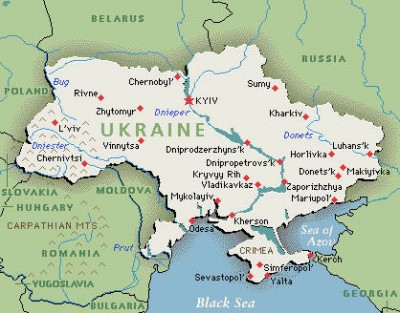
ukrainemap
This report –which remains to be fully corroborated– was sent to us by slavyangrad.wordpress.com
The maps below clearly indicate a change in flight path for Malaysian airlines MH17 on July 17. They also indicate on the map the two regions of Ukraine which are part of the warzone, namely Donetsk and Lugansk.
The first dynamic map compares the two flight paths:
It indicates the regular flight path on July 16th which takes the plane in a Southeasterly direction across the Sea of Azov.
The second flight path which is that of July 17th take the plane over the Donesk oblast warzone, bordering onto Lugansk oblast. 
The four static images  indicate screen shots of the Flight Paths of MH17 for July 14-17, 2014
The information conveyed in these maps suggests that the flight path on July 17 was changed.
MH17 was diverted from the normal South Easterly route over the sea of Azov to a path over the Donetsk oblast.
Who was behind the change of  the flight path?
Michel Chossudovsky, July 19, 2014

CLICK IMAGES TO ENLARGE

Changing MH17 Route From July 14, 2014 to July 17, 2014
IngoGraph
Screenshots of Flight Paths of MH17 for July 14-17, 2014
14th July Route15th July Route  16th July Route17th July Route

A LITTLE FLIGHT MH 17 ROUNDUP

I had fully expected to begin this week’s blogs with a review of some of the geopolitical stories of the past month, but after my News and Views from the Nefarium and yesterday’s blog, I’ve been virtually flooded with news and articles about the subject of the shootdown of Malaysia Air flight 17, none of which I have had any time to check out.  So why am I trying to summarize some of the recent finds here? Well, for one thing, as a kind of cultural mirror of what we’ve become: we’ve become a world that no longer buys easy official stories about anything, and in a way, that’s a good thing. But it’s also a bad thing, because it demonstrates how low the standing of western institutions has fallen. And they have only themselves to blame.The second reason I’m sharing all these stories is to show how quickly people now begin to gather data and analyze, and how each such event does seem to have a multi-leveled nature, as if several motivations or objectives were being accomplished all at once. Here’s what some of that snooping and sniffing has already found out, along with my usual high octane speculation commentary:
Mama Merkel is (Pretending to be?) Out of Her Chancellorial Mind
Yea, you guessed it: the West’s organs of mass disinformation and hypnotism are already pointing the finger of suspicion at Russia, and Mama Merkel wants to be part of the fun:
World Leaders Match Anger With Calls for Inquiry Into Ukraine Plane Crash
OK, so maybe Mama Merkel wasn’t pointing the finger of suspicion as loudly at Russia as everyone else seems to be (after all, she knows that Russia has nothing to gain, and Russia knows she knows, and she knows that Russia knows that she knows, and they both know that the NSA knows that she knows that Russia knows that she knows). But she does seem to be cheerily goosestepping along with Washington’s line that Russia is to blame for the whole Ukrainian fiasco, which most people also know is nonsense, and Mama Merkel knows this, knows that Russia knows it, and knows that Russia knows that she knows that Russia knows &c. And she knows Germany gets a lot of its energy from Russia. We’ll get back to Germany in tomorrow’s blog, by way of a stopover in France. The bottom line here to remember is that it’s an old chancellorial tradition, since Bismarck, for German chancellors to say one thing to keep London and Washington happy (notice I left out Paris, which is currently very unhappy), while quietly setting out to do very different things, like absorb Austria and Czechoslovakia, or expel CIA station chiefs.
Blame Russia, for it is the Home of Moustache Twirling Evil:
As if on cue, the current sock puppet-in-chief has weighed in to denounce Russia with a string of somersaulting non sequiturs truly breathtaking in its scope and intensity:
Monitors find confusion, hostility at Malaysia Airlines crash site
The “logic” here is truly a wonder to behold: (1) Russian missiles did it (2) the rebels had Russian missiles, (3) Russians had to train them (4) Russia is guilty, (5) we need more sanctions against Russia (hidden text here: “Will you guys over at the CIA pleeaase find those poison cigars that you were going to use on Castro and send some to Putin?”) Now, what’s missing in this whole analysis is the very annoying problem of why Russia, or for that matter, Ukrainian rebels, would want to scuttle their prospects in world opinion by shooting down a civilian airliner, either by accident or by intention. It makes no geopolitical sense. Then there’s the little teensy weensy problem of point number 3 above. Russian missiles don’t necessarily have to come directly from Russia, and even if they did, they don’t necessarily have to have Russians train the rebels. Pretty much anyone who’s kept up their subscription to Jane’s Defence Weekly would probably have some idea how to do it (we assume, of course, for the sake of argument here, that Msrs. Poroshenkorruption, Soros and Brzznsk are regular readers).
Was the Flight Deliberately Diverted over the Donetsk Region?
This one pretty much speaks for itself:
Was Flight MH-17 Diverted Over Restricted Airspace?
Except for another teensy problem: if it was diverted, who did the diverting? Given the West’s rather low standing in the aftermath of the Ukraine fiasco  not even the West has anything to gain by staging such an event(yes I know I know, you’re supposed to say “Ukraine” now without the definite article, but I’m sorry, I refuse to butcher the English language just for the sake of being “PC”, it’s still the United Kingdom, and in my obsolete grammar book, it’s still the Ukraine, Ketchup Kerry’s droning pronouncements notwithstanding). Of course, if it didn’t, then who did? (And no, for the Israel-is-behind-everything-bad-that-happens crowd, I don’t think they did either. Just because they exploited the crisis in Gaza doesn’t mean they’re behind the shootdown.) I’m still waiting for someone to blame _____ (Fill in the blank with your favorite “evil nation”, Iran, China, Syria, Mon(ster)santo, &c).
Then there was that Italian Airliner Thing…
Now, this one is one of those “memory recall” moments, sent to me in an email, so I don’t have an article to share, but Mr. S.D., a regular reader here, sent me an email reminding me about the NATO/French attempts to shoot down Qadaffi’s airplane with French fighters, until, according to some reports, Italy, with ties to Libya dating from before World War Two, quietly informed Qadaffi of the effort. Then, you’ll recall, an Italian airliner was shot down…. accidentally of course.
And then finally, there are the Passengers…
This one comes courtesy of The Huffington Post, whose headline says it all:
Malaysia Airlines MH17 Flight Carried Up To 100 AIDS Researchers – ‘The Cure For AIDS Could Have Been On That Plane’
True enough, like flight 370, this flight seems more than suspiciously loaded with people with “unusual interests and expertise” that, in the typical modus operandi of the sorts of evil people that do such evil things, could have been a corollary objective, for it’s a favorite technique of mounting such operations that several operational goals or objectives are combined. So again, the question of cui bono is relevant.
But it seems clear who does not benefit from such an operation: none of the countries or major powers mentioned really has anything to gain by planning and executing such an operation (in my opinion), neither the Ukraine, nor Russia, nor Germany, Great Britain, France, Italy, and yes, not even Iran or Israel or China or Mon(ster)santo or any of the usual “bad guys”. To be sure, it is the rule of geopolitics that if an event occurs that you haven’t orchestrated or engineered, then if it is possible to do so, you exploit it for your own purposes.
Which leaves an interesting question, doesn’t it? For if all that is the case, then who did do it? From the threadbare bits of data thus far gathered, it certainly appears that this was someone’s deliberate act. The real question is, whose?
See you on the…
Oh yea, one more thing: there are also some saying that the bodies were already dead, and some, of course, are already saying that the bodies of MH 17 are in reality the bodies of MH 370… Just had to mention it for the sake of completeness:
Bizarre Account of Malaysian ‘Plane Crash’
Rebel Leader Gives Bizarre Account of Plane Crash

Malaysia MH17 crash: 10 questions Russia wants Ukraine to answer

Published time: July 18, 2014 
Russia’s Deputy Defense Minister Anatoly Antonov (A still image from RT video)
Some Western states and Kiev rushed to find Russian involvement in the MH17 crash having no evidence to back their claims, Russia’s Deputy Defense Minister told RT. He invited Ukraine to answer 10 questions to prove their commitment to an impartial probe.
Speaking to RT, Russia’s Deputy Defense Minister Anatoly Antonov has criticized Western countries for jumping to conclusions just “24 hours after the crash” while there is no evidence.
“They try to show to the whole world that we are responsible for the crash. It is very strange that without any evidence my colleagues from western media would like to find somebody who is responsible for the crash,” Antonov said. “It seems to me that this is part of information warfare which has been started against the Russian Federation and armed forces.”
READ MORE: Unverified tape released by Kiev presented as ‘proof’ E. Ukraine militia downed MH17
Instead of using the incident as the pretext for groundlessly blaming one of the sides, the catastrophe over Ukrainian sky should be used as a possibility to restart cooperation to “prevent such tragedies in the future.”
“As for me, I don’t want to use this opportunity to blame anybody. I would just like to raise few questions for my colleagues from the armed forces of Ukraine,” Antonov said. “I hope they try to answer the questions, it will be a good opportunity for us to realize where we are, whether there is a possibility for us to restart cooperation and to find who is really responsible for the tragedy.”
“Answers for these questions could help us find an opportunity to prevent such tragedies in the future,” the Deputy Defense Minister said.

A picture taken on July 17, 2014 shows the wreckages of the malaysian airliner carrying 295 people from Amsterdam to Kuala Lumpur after it crashed, near the town of Shaktarsk. (AFP Photo / Dominique Faget)

TEN QUESTIONS FOR THE UKRAINIAN AUTHORITIES

1. Immediately after the tragedy, the Ukrainian authorities, naturally, blamed it on the self-defense forces. What are these accusations based on?
2. Can Kiev explain in detail how it uses Buk missile launchers in the conflict zone? And why were these systems deployed there in the first place, seeing as the self-defense forces don’t have any planes?
3. Why are the Ukrainian authorities not doing anything to set up an international commission? When will such a commission begin its work?
4. Would the Ukrainian Armed Forces be willing to let international investigators see the inventory of their air-to-air and surface-to-air missiles, including those used in SAM launchers?
5. Will the international commission have access to tracking data from reliable sources regarding the movements of Ukrainian warplanes on the day of the tragedy?
6. Why did Ukrainian air traffic controllers allow the plane to deviate from the regular route to the north, towards “the anti-terrorist operation zone”?
7. Why was airspace over the warzone not closed for civilian flights, especially since the area was not entirely covered by radar navigation systems?
8. How can official Kiev comment on reports in the social media, allegedly by a Spanish air traffic controller who works in Ukraine, that there were two Ukrainian military planes flying alongside the Boeing 777 over Ukrainian territory?
9. Why did Ukraine’s Security Service start working with the recordings of communications between Ukrainian air traffic controllers and the Boeing crew and with the data storage systems from Ukrainian radars without waiting for international investigators?
10. What lessons has Ukraine learned from a similar incident in 2001, when a Russian Tu-154 crashed into the Black Sea? Back then, the Ukrainian authorities denied any involvement on the part of Ukraine’s Armed Forces until irrefutable evidence proved official Kiev to be guilty.

How US satellites pinpointed source of missile that shot down airliner

Satellite technology built to detect ballistic missile launches caught Buk’s signature.

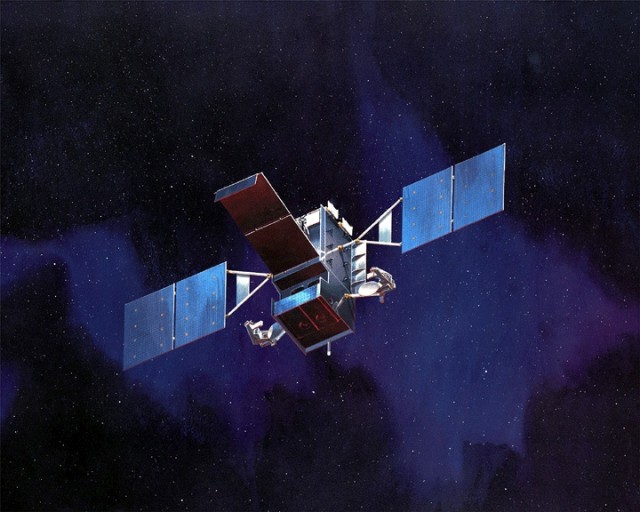
An artist's rendering of the SBIRS "High" geosynchronous infrared surveillance satellite, one of the newer additions to the DOD's constellation of missile launch detection satellites.
Lockheed Martin
President Barack Obama today said without hesitation that the missile that shot down Malaysia Airlines Flight 17 was launched from within territory controlled by pro-Russian separatists in Eastern Ukraine. While he didn’t go into the sources the US used to pinpoint the launch, early reports say that US intelligence had identified the infrared signature of a missile launch just before contact with the airliner was lost.
That information likely came from one of a network of satellites operated by the Air Force and the National Reconnaissance Office (NRO), the US intelligence community’s spy satellite operations agency. Using highly sensitive infrared sensors and other electronic intelligence gathering sensors, these satellites can detect a variety of ground-based missile systems, as well as some aircraft, by their infrared signature. They also carry sensitive electronic intelligence sensors that can detect radar signals associated with anti-aircraft missile systems like the Buk launcher that has been widely pointed to as the culprit in the MH17 downing.
The latest of these satellite systems is the Space Based Infrared System (SBIRS), the successor to the long-running and euphemistically named “Defense Support Program” (DSP) satellite system. The DSP started in the late 1960s and continued in various forms through the last decade. A portion of the DSP constellation of satellites continues to function today and has been considered for use in tracking forest fires and potentially forecasting impending volcanic eruptions.

The unblinking eyes in the sky

DSP satellites were built with Cold War specifications to detect Soviet and Chinese ballistic missile launches. They needed to be able to detect even the relatively low infrared signature of submarine-launched missiles. Because their sensors were so sensitive, they frequently picked up forest fires and refinery fires from space. In December of 1975, a message was sent from the Ford administration’s Deputy National Security Advisor William Hyland to Hal Sonnenfeld, Secretary of State Henry Kissenger’s adviser, about a potential Soviet attempt to blind a DSP satellite with a strong infrared signal. It turned out to be a pipeline fire. During the Iran-Iraq War of the late 1980s and the Persian Gulf War in 1991, DSP satellites detected the launch of Iraqi “Scud” missiles and even surface-to-air missile batteries. And a capability called “Slow Walker” developed in the 1980s allowed satellites to track aircraft afterburner exhaust, a capability pushed by the US Navy to help it defend against potential attack by Soviet Tu-22 “Backfire” bombers.
In 1995, as the Cold War came to an end and the demands on satellite infrared systems increased, the Air Force launched the SBIRS program. Built under the direction of the US Air Force’s Space and Missile Systems Center’s Infrared Space Systems Directorate, SBIRS was designed for four mission areas:
  • Strategic ballistic missile launch warning for the president and the Defense Department leadership
  • Theater and strategic missile defense information, to provide early targeting data to systems such as the Aegis Ballistic Missile Defense system aboard US Navy cruisers
  • Collecting technical intelligence on potential adversary’s missile systems
  • “Battlespace awareness”—real-time information provided to military commanders about infrared “events” that could affect forces in the field and provide data for strike planning against launch systems.
The Air Force’s SBIRS program was intended to have two components: “SBIRS High,” the geosynchronous portion of the surveillance network, and “SBIRS Low,” a low-orbit system that could track ballistic missiles from launch through mid-course of their flight.
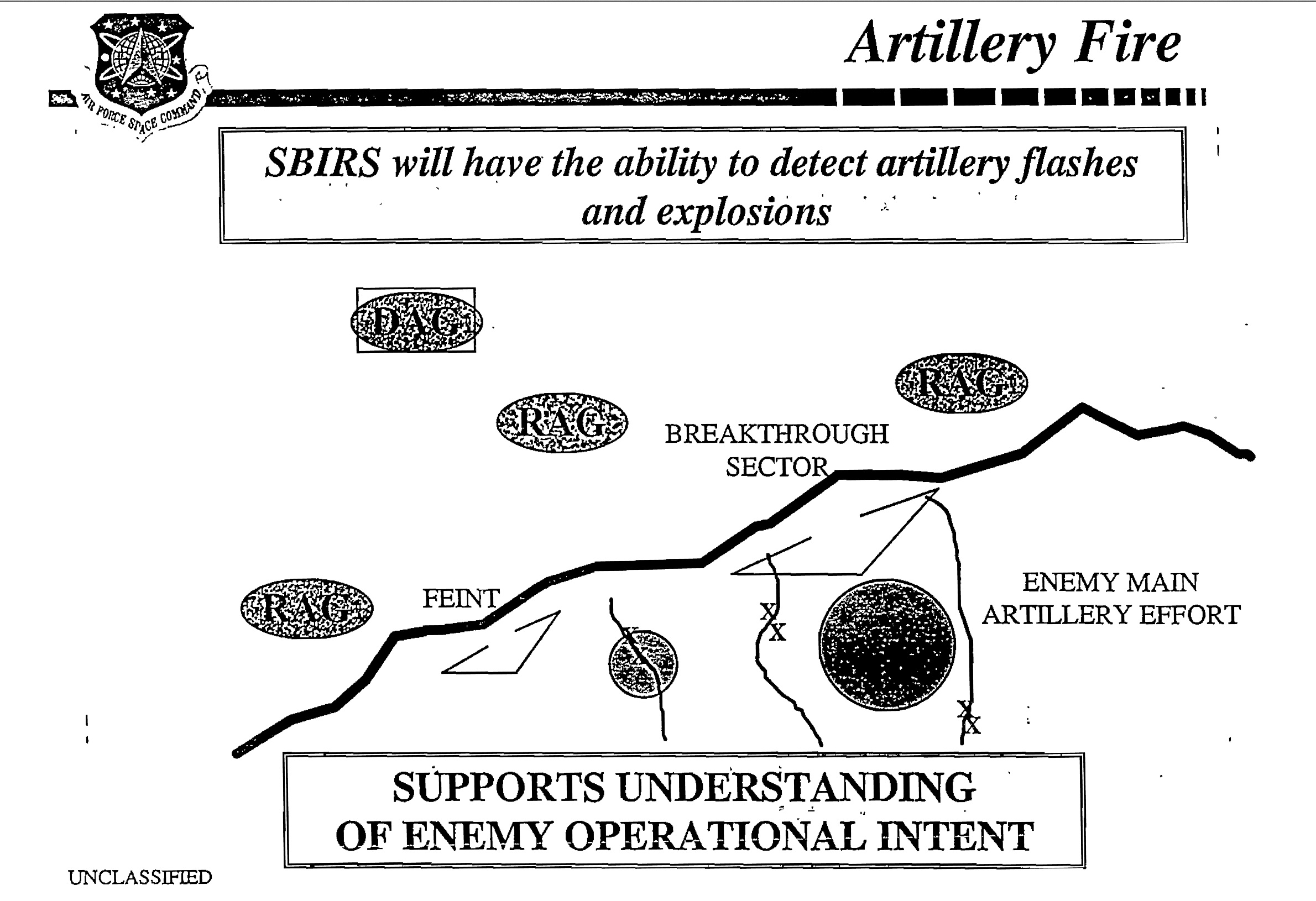
Enlarge / A slide from a 1998 Air Force Space Command presentation sells SBIRS' capability to detect artillery flashes to understand where the enemy's real attack objectives are.

Plan B

But the SBIRS High program ran into repeated trouble. To verify the functionality of SBIRS Low, two NRO signals intelligence satellites launched into highly elliptical orbits in 2006 and 2008. However, a geosynchronous NRO satellite launched in 2007 failed after only 7 seconds in orbit, resulting in further delays.
The Air Force SBIRS Low program had similar problems. It was cancelled and resurrected as the Space Tracking and Surveillance System (SSTS) and handed over to the Missile Defense Agency (MDA) as the Bush administration pushed ahead with ballistic missile defense research. Two SSTS satellites were put in orbit in September of 2009. But the MDA decided not to take SSTS any further. A month after the SSTS launches, the MDA kicked off the Precision Tracking Space System program—a program that was killed in 2013.
All the while, existing infrared satellites were expiring, and the Air Force started to explore alternatives to SBIRS. The service continued to launch DSP satellites until 2007, at which point its leadership started looking for a SBIRS alternative. That plan B, the Alternate Infrared Surveillance System (AIRSS) was later renamed the Third Generation Infrared Surveillance (3GIRS) program and was led by Raytheon and defense contractor SAIC. It quickly picked up steam as a lower-cost alternative—it used a “full earth staring sensor” that could watch an entire hemisphere of the planet for infrared plumes. But despite being on track and on budget, 3GIRS was cancelled in 2011 as the first SBIRS geosynchronous satellite was successfully put into orbit.
So far, the DOD has spent $2.35 billion on the SBIRS High satellite program, and it has two satellites in orbit. The SSTS satellites and NRO satellites have exceeded their expected lives but still remain in orbit—as do some later DSP satellites. And they have all been pressed into service for monitoring emerging potential threats, such as the flashpoints on Ukraine’s eastern border.
It's for that reason that NRO and Air Force satellite assets were most likely watching the area near Donetsk, Ukraine, yesterday as an anti-aircraft battery launched a single missile at the Malaysian Airlines Boeing 777, bearing witness to a tragedy that no missile defense system was ever intended to thwart.