Tuesday, November 10, 2015

Artificial intelligence: 'Homo sapiens will be split into a handful of gods and the rest of us'

Posted by George Freund on November 9, 2015


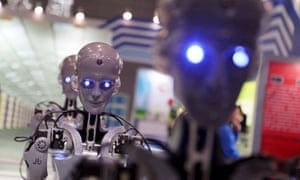
Robots manufactured by Shaanxi Jiuli Robot Manufacturing Co on display at a technology fair in Shanghai Photograph: Imaginechina/Corbis

A new report suggests that the marriage of AI and robotics could replace so many jobs that the era of mass employment could

by Charles Arthur

Saturday 7 November 2015 16.18 GMT

If you wanted relief from stories about tyre factories and steel plants closing, you could try relaxing with a new 300-page report from Bank of America Merrill Lynch which looks at the likely effects of a robot revolution.

But you might not end up reassured. Though it promises robot carers for an ageing population, it also forecasts huge numbers of jobs being wiped out: up to 35% of all workers in the UK and 47% of those in the US, including white-collar jobs, seeing their livelihoods taken away by machines.

Haven’t we heard all this before, though? From the luddites of the 19th century to print unions protesting in the 1980s about computers, there have always been people fearful about the march of mechanisation. And yet we keep on creating new job categories.

However, there are still concerns that the combination of artificial intelligence (AI) – which is able to make logical inferences about its surroundings and experience – married to ever-improving robotics, will wipe away entire swaths of work and radically reshape society.

“The poster child for automation is agriculture,” says Calum Chace, author ofSurviving AI and the novel Pandora’s Brain. “In 1900, 40% of the US labour force worked in agriculture. By 1960, the figure was a few per cent. And yet people had jobs; the nature of the jobs had changed.

“But then again, there were 21 million horses in the US in 1900. By 1960, there were just three million. The difference was that humans have cognitive skills – we could learn to do new things. But that might not always be the case as machines get smarter and smarter.”

What if we’re the horses to AI’s humans? To those who don’t watch the industry closely, it’s hard to see how quickly the combination of robotics and artificial intelligence is advancing. Last week a team from the Massachusetts Institute of Technology released a video showing a tiny drone flying through a lightly forested area at 30mph, avoiding the trees – all without a pilot, using only its onboard processors. Of course it can outrun a human-piloted one.

MIT has also built a “robot cheetah” which can jump over obstacles of up to 40cm without help. Add to that the standard progress of computing, where processing power doubles roughly every 18 months (or, equally, prices for capability halve), and you can see why people like Chace are getting worried.

https://www.youtube.com/watch?v=_qah8oIzCwk

Drone flies autonomously through a forested area

But the incursion of AI into our daily life won’t begin with robot cheetahs. In fact, it began long ago; the edge is thin, but the wedge is long. Cooking systems with vision processors can decide whether burgers are properly cooked. Restaurants can give customers access to tablets with the menu and let people choose without needing service staff.

Further afield, Foxconn, the Taiwanese company which assembles devices for Apple and others, aims to replace much of its workforce with automated systems. The AP news agency gets news stories written automatically about sports and business by a system developed by Automated Insights. The longer you look, the more you find computers displacing simple work. And the harder it becomes to find jobs for everyone.Lawyers who used to slog through giant files for the “discovery” phase of a trial can turn it over to a computer.An “intelligent assistant” called Amy will, via email, set up meetings autonomously. Google announced last week that you can get Gmail to write appropriate responses to incoming emails. (You still have to act on your responses, of course.)

So how much impact will robotics and AI have on jobs, and on society? Carl Benedikt Frey, who with Michael Osborne in 2013 published the seminal paper The Future of Employment: How Susceptible Are Jobs to Computerisation? – on which the BoA report draws heavily – says that he doesn’t like to be labelled a “doomsday predictor”.

He points out that even while some jobs are replaced, new ones spring up that focus more on services and interaction with and between people. “The fastest-growing occupations in the past five years are all related to services,” he tells the Observer. “The two biggest are Zumba instructor and personal trainer.”

Frey observes that technology is leading to a rarification of leading-edge employment, where fewer and fewer people have the necessary skills to work in the frontline of its advances. “In the 1980s, 8.2% of the US workforce were employed in new technologies introduced in that decade,” he notes. “By the 1990s, it was 4.2%. For the 2000s, our estimate is that it’s just 0.5%. That tells me that, on the one hand, the potential for automation is expanding – but also that technology doesn’t create that many new jobs now compared to the past.”

“I think our best hope going forward is figuring out how to live in an economy of radical abundance, where machines do all the work, and we basically play.”This worries Chace. “There will be people who own the AI, and therefore own everything else,” he says. “Which means homo sapiens will be split into a handful of ‘gods’, and then the rest of us.

Arguably, we might be part of the way there already; is a dance fitness programme like Zumba anything more than adult play? But, as Chace says, a workless lifestyle also means “you have to think about a universal income” – a basic, unconditional level of state support.

Perhaps the biggest problem is that there has been so little examination of the social effects of AI. Frey and Osborne are contributing to Oxford University’s programme on the future impacts of technology; at Cambridge, Observer columnist John Naughton and David Runciman are leading a project to map the social impacts of such change. But technology moves fast; it’s hard enough figuring out what happened in the past, let alone what the future will bring.

But some jobs probably won’t be vulnerable. Does Frey, now 31, think that he will still have a job in 20 years’ time? There’s a brief laugh. “Yes.” Academia, at least, looks safe for now – at least in the view of the academics.



Smartphone manufacturer Foxconn is aiming to automate much of its production facility. Photograph: Pichi Chuang/Reuters

The danger of change is not destitution, but inequality

Productivity is the secret ingredient in economic growth. In the late 18th century, the cleric and scholar Thomas Malthus notoriously predicted that a rapidly rising human population would result in misery and starvation.

But Malthus failed to anticipate the drastic technological changes - from the steam-powered loom to the combine harvester - that would allow the production of food and the other necessities of life to expand even more rapidly than the number of hungry mouths. The key to economic progress is this ability to do more with the same investment of capital and labour.

The latest round of rapid innovation, driven by the advance of robots and AI, is likely to power continued improvements.

Recent research led by Guy Michaels at the London School of Economics looked at detailed data across 14 industries and 17 countries over more than a decade, and found that the adoption of robots boosted productivity and wages without significantly undermining jobs.

Robotisation has reduced the number of working hours needed to make things; but at the same time as workers have been laid off from production lines, new jobs have been created elsewhere, many of them more creative and less dirty. So far, fears of mass layoffs as the machines take over have proven almost as unfounded as those that have always accompanied other great technological leaps forward.

There is an important caveat to this reassuring picture, however. The relatively low-skilled factory workers who have been displaced by robots are rarely the same people who land up as app developers or analysts, and technological progress is already being blamed for exacerbating inequality, a trend Bank of America Merrill Lynch believes may continue in future.

So the rise of the machines may generate huge economic benefits; but unless it is carefully managed, those gains may be captured by shareholders and highly educated knowledge workers, exacerbating inequality and leaving some groups out in the cold. Heather Stewart

http://www.theguardian.com/business/2015/nov/07/artificial-intelligence-homo-sapiens-split-handful-gods

The Mystery of the Nine Unknown Men

gray_dark_council_hooded_robed_abstract_figures_hd-wallpaper-746000
Humankind has always had a sort of fascination with the idea of secret societies. From the Freemasons to the Illuminati, there is a certain allure to the idea that behind the scenes of our everyday life there are powerful forces at work pulling the strings, privy to knowledge beyond our mainstream understanding, and with access to ancient secrets beyond our wildest dreams. They operate just under the surface of our civilization, their motives and aims enigmatic and inscrutable, working towards ends that we may never fully understand. One such alleged secret society concerns a shadowy group of nine mysterious men, formed in ancient India and charged with guarding ancient secrets and protecting us from the potentially destructive knowledge which we manage to glean from the mysteries of the universe. Operating in secrecy, they are spread throughout the world, silently watching and accruing ever more potent secrets, all the while hidden from our view. These are the Nine Unknown Men.
It was 237 BC and a bloody war was waging. India was under the reign of Emperor Asoka, a merciless and cruel military king who desired nothing more than to lay waste to all in his path, and was indeed the first to truly unify the country in the wake of the Maurya dynasty, the brutal plundering of Mahmud of Ghazni, and the more than three centuries of rule under the Moguls. Such was his potent all encompassing rule that H.G. Wells once wrote of Asoka in his book Outline of World History, “Among the tens of thousands of names of monarchs accumulated in the files of history, the name of Asoka shines almost alone, like a star.” In this particular harrowing battle, Emperor Asoka was in the midst of trying to conquer the region of Kalinga, which lay between what is now Calcutta and Madras, a task which was expected to be an easy defeat but which resulted in the brutal slaughter of over 100,000 men, many killed in a senseless orgy of blood and massacres. The sight of the horrors of war and the ruthless mass killing of so many men took its toll on Asoka, and the once coldblooded emperor realized the horrors of all of the bloodshed.
Emperor Asoka's envoy in the aftermath of the Battle of Kalinga
Emperor Asoka’s peace envoy in the aftermath of the Battle of Kalinga
In the aftermath of the massacres of Kalinga, haunted by the display of so many men brutally slain and the sight of so many smoldering homes and rotting corpses, Emperor Asoka decided to renounce the idea of trying to violently subjugate others, rather opting for a system of winning over the people through the observance of the laws of duty and piety; to integrate rather than destroy. He converted to Buddhism, and went about spreading this system of beliefs throughout the land, from Malaya, Ceylon and Indonesia, to Nepal, Tibet, China and Mongolia, even going so far in his desire to avoid blood that he preached vegetarianism and the avoidance of the slaughter of animals. Emperor Asoka also realized at the time that humankind was apt to use intelligence, as well as to put scientific and technological knowledge to evil use for the purpose of destruction. He vowed to create a way in which all manner of technological secrets and discoveries of mankind would be kept protected from the gaze of those who would use them for the purposes of annihilation and death, in order to protect mankind from those who would use scientific knowledge to put it into peril and bring about the downfall of all society.
To this end, he formed a secret society tasked with keeping the accumulated knowledge which could be used for destruction safe from those who would misuse it, and to further pursue research and knowledge that would benefit mankind instead of destroy it. It was Emperor Asoka’s desire that all new technology be hidden away forever from those who would use it to nefarious ends. Thus was the Nine Unknown Men born. Nine trusted disciples of science were chosen and each entrusted with a book containing all of mankind’s accumulated and ever growing knowledge in a certain field, which the holder of the book would add to, revise and perfect, and this duty would be passed down to the select chosen throughout the ensuing centuries. Some accounts even go as far as to suggest The Nine have unlocked the secrets of immortality and retain their position for eternity. There were to always be nine of them, no more and no less, and they were to remain obscured from the world at large and to avoid any and all dealings with politics or mainstream science, instead opting to remain hidden in the shadows. In order to conceal their communications, the Nine Unknown Men were said to speak in a synthetic language of their own devising and which was incomprehensible to anyone but themselves. They would serve as keepers and guardians of this hidden knowledge contained within the ever expanding books and observers of the world around them, to witness the rise and fall of whole civilizations yet to never interfere or play an active role in any of it except perhaps in times when mankind was in dire need of help.
1374526-ultima_by_joachim_barrum
The subjects of these nine mysterious books vary wildly, and cover a range of disciplines and knowledge, much of which we still do not possess today and would have been certainly unheard of at the time. The first deals with techniques of propaganda and psychological warfare, the science of manipulating mass opinions and sculpting the attitudes of society at large, which has long been thought to be among the most dangerous of sciences. The second deals with the subject of human physiology, an equally dangerous field outlining such things as how to create poisons, kill more efficiently, ways to manipulate pressure points, and indeed how to kill with a mere touch. The third book delves into the area of microbiology, with its vast potential to create and manipulate microbes that could save or wipeout mankind, as well as more beneficial microbes for medicinal purposes or purification. Some legends hold that the Ganges River is purified with microbes designed by the Nine Unknown Men with the use of this book. The fourth book is on the subject of alchemy, namely the transmutation of metals, a power which is used to explain the sudden influx of gold to some temples around the country from an unknown source in times of need. The fifth book delves into the subject of communication, strangely supposedly including methods for which to communicate with extraterrestrials, which would have been a fairly high concept notion in 237 BC at the least, and would suggest they knew of alien intelligences. The sixth book is all about the secrets of gravity, including the ways in which to make anti-gravity aircraft called Vimana, which are persistent in Indian myth throughout history and are sometimes called ancient UFOs of India. In the seventh book there is said to be a vast, exhaustive amount of information on cosmology and the workings of the universe, including allegedly the secrets of faster than light travel, how to bend space and time, travel between dimensions, and by some accounts even time travel. The eighth book is said to be about the nature of light, including increasing or decreasing its speed, bending it to one’s will, and using it to create weapons such as lasers. The ninth and final book is about sociology, and is said to include the immutable rules of the rise and fall of civilizations, as well as the secrets of how to predict the decline of society, and how to stop it or hasten it.
Although the knowledge of these books is supposedly kept totally secret from mankind, over the centuries there are said to have been leaks, which have gone on to account for a number of innovations throughout history. For instance, it is said that the secret of aeronautics and flight, using radiation to sterilize objects as well as produce the atomic bomb, pressure points or techniques used in various martial arts, and numerous medical breakthroughs, among others, were all the result of information from the nine books somehow leaking out or being released into the outside world. Indeed it has long been believed that the Nine Unknown Men intentionally release tidbits of information from their books on occassion in order to help mankind in times of great need, with such gifts from the mysterious cabal being allegedly the vaccines for cholera and plague. They are also said to sometimes reveal themselves to those who they deem to be wise and worthy in order to share portions of the secrets and information they have gathered over the centuries.
ashoka nine-red
One notable case of knowledge from the alleged nine books seeping out into the world can be seen in the case of Pope Sylvester II, who was born as Gerbert d’Aurillac in 920 and was a Benedictine monk, a professor at the University of Rheims, the Archbishop of Ravenna, and Pope by the grace of Otho III. Pope Sylvester II spent some time in Spain before taking a trip to India for unknown reasons. Upon his return, he was said to have brought with him a variety of knowledge that was well ahead of its time and which puzzled those around him. Perhaps the most well-known of these displays of knowledge can be found in the story of bronze head constructed by the Pope in his palace, which purportedly had the ability to answer yes or no questions asked of it on a wide range of subjects and which absolutely astounded those who saw it in operation. Sylvester II claimed that it was merely a simple mechanical automaton akin to a primitive robot, but to those who saw it it was like magic. This was just one of the many astounding gadgets well ahead of their time that Sylvester II would construct over the years upon his return from India and it has often been speculated that he gained this knowledge somehow from one of the books of the Nine Unknown Men. Unfortunately, we will never know how the talking head worked or indeed whether it ever existed at all, because it was supposedly disassembled and destroyed when Sylvester II died, as were all of his other wondrous inventions. The talking bronze head and Sylvester’s vast technical knowledge were mentioned in a 1954 issue of Computers and Automation, in which it says:
We must suppose that he (Sylvester) was possessed of extraordinary knowledge and the most remarkable mechanical skill and inventiveness. This speaking head must have been fashioned ’under a certain conjunction of stars occurring at the exact moment when all the planets were starting on their courses.’ Neither the past, nor the present nor the future entered into it, since this invention apparently far exceeded in its scope its rival, the perverse ’mirror on the wall’ of the Queen, the precursor of our modern electronic brain. Naturally, it was widely asserted that Gerbert was only able to produce such a machine because he was in league with the Devil and had sworn eternal allegiance to him.
Sylvester II is not the only one thought to have allegedly had some sort of contact with the Nine Unknown Men, and indeed others throughout history have been said to have been privy to their information, or to perhaps even been members amongst them. Some of the theorized names associated with gaining this secret knowledge are one of the most important figures in India’s space program, Vikram Sarabhai, as well as Jagdish Chandra Bose, who is considered to be one of the pioneering forces behind the rise of science in India, and the French chemist and microbiologist Louise Pasteur. In all of these cases, the innovations and genius they are known for were said to have been heavily influenced and informed by the secret knowledge kept by the Nine Unknown Men.
mage
In modern times, the popularization of the Nine Unknown men perhaps first started in the late 19th century with the writings of the French writer Jacolliot, who was best known for writing works in the vein of Jules Verne, which in many cases uncannily predicted technological advances which would appear in later years. The author made mention of many concepts that were well ahead of their time at the time of publication, such as the concepts of the liberation of energy, sterilization by radiation, and psychological warfare. Jacolliot stated that the Nine Unknown Men did in fact exist, and this mention of advanced knowledge well before it was ever thought possible, although not concrete evidence of their existence, is certainly eerie. Another writer who further brought the Nine Unknown Men into the public consciousness was an author who had spent 25 years on the British police force in India by the name of Talbot Mundy, and whose book The Nine Unknown reveals many of the details concerning the secret society, such as their possession of the books of knowledge and the use of an artificial language known only to them. Other authors who would go on to write on the Nine Unknown Men include Louis Pauwels and Jacques Bergier, who would write of them in their book Morning of the Magicians. Yet for all of the myths, legends, and accounts of the Nine Unknown Men, there has never been any evidence that they truly exist, and they remain mere specters on the fringes of our understanding, perhaps secretly watching us or perhaps just a figment of the imagination.
Who are the Nine Unknown Men? Is this just a myth, with just enough historical reference to give it some facade of believability? Or are they really out there, entrusted with the most powerful knowledge mankind has ever seen, collected over thousands of years? Is so, who are they, where are they now, and what is there ultimate plan? Are they truly benign, or is there the potential of malevolence? Will we ever truly know the answer to these questions? We may never know if they really exist or not, and they would undoubtedly hope to keep it that way. Whether they really exist or not, the idea of a secret cabal of nine mysterious figures guarding the secrets of the universe is certainly a romantic notion. Maybe they are out there now, watching over us as they always have from the shadows, relentlessly collecting knowledge as they have for millennia and will for many more, guarding us from secrets we are no meant to know and saving us from ourselves in the process.