Monday, January 27, 2014

Way Beyond Bitcoin: The Coming of "Smart Contracts"

January 27, 2014

Source: Economic Policy Journal

Forget about Bitcoin as a currency. The Bitcoin technology has much more interesting applications in other areas.

Wired has a short profile on Vitalik Buterin and what he is working on.  A few weeks ago Vitalik passed through San Francisco and I had the chance to meet up with him. I found him to be very smart, intellectually honest,, a very creative thinker and a visionary. That's part of the reason, I am very excited about what he is working on.

Key snippets from Wired:

Most people think of bitcoin as a form of money, if they think of bitcoin at all. But 19-year-old hacker Vitalik Buterin sees it as something more — much more. He sees it as a new way of building just about any internet application.

The bitcoin digital currency is driven by open source software that runs across thousands of machines around the globe. Borrowing code from this rather clever piece of software, independent hackers have already built applications such as the Twitter-style social network Twister, the encrypted e-mail alternative Bitmessage, and the unseizable domain name system Namecoin. But Buterin believes that many other applications can benefit from the genius of the bitcoin software, and that’s why he’s joining forces with several other hackers to create something called Ethereum.

He envisions Ethereum as an online service that lets you build practically anything in the image of bitcoin and run it across a worldwide network of machines. At its core, bitcoin is a way of reliably storing and moving digital objects or pieces of information. Today, it stores and moves money, but Buterin believes the same basic system could give rise to a new breed of social networks, data storage systems and securities markets — all operated without the help of a central authority[...]

Ethereum won’t use the peer-to-peer network that bitcoin runs on, nor will it use the same software. Instead, Buterin and his team are building a completely new system that will run atop its own network. But the project borrows heavily from the ideas behind the bitcoin software.

All bitcoin transactions, for instance, are stored in a massive public ledger called the “blockchain.” This is a type of encrypted database, and you can use it to power other applications — as we’ve seen with Twister and BitMessage. Ethereum will feed still more applications through something similar to the blockchain, and it will offer a stripped-down version of the Python programming language — known as Ethereum Script — that’s specifically designed for building these blockchain-based applications.

As with bitcoin, the network that underpins Ethereum will be powered by machines donated by the people of the world, and to encourage donations, the system will allow these machines to collect fees from developers who build and run an applications atop the network. In similar fashion, bitcoin shares its money with those who run the machines driving its network.

The system could potentially drive everything from Dropbox-style storage systems to custom digital currencies. According to Buterin, it will be particularly well suited to something called “smart contracts.” A simple example is a betting system. Two people could place bets on, say, the outcome of the Super Bowl, entrusting a certain amount of digital currency to system. The system would then check the final score of the game via the web and distribute the funds appropriately. No bookie needed.

But Buterin also envisions far more complex smart contracts, including joint savings accounts, financial exchange markets, or even trust funds. Theoretically, these contracts would be more trustworthy because — if the software is properly designed — no one could cheat. Many bitcoin geeks even believe that smart contracts could lead to the creation “autonomous corporations” — entire companies run by bots instead of humans.

The Ethereum team plans to have a test network up and running soon, and on February 1, it will launch a crowdfunding campaign to finance its further development. The code will be open source, another reflection of the bitcoin way.

Out in the Open: Teenage Hacker Transforms Web Into One Giant Bitcoin Network

Vitalik Buterin. Image: Vitalik Buterin
Most people think of bitcoin as a form of money, if they think of bitcoin at all. But 19-year-old hacker Vitalik Buterin sees it as something more — much more. He sees it as a new way of building just about any internet application.
The bitcoin digital currency is driven by open source software that runs across thousands of machines around the globe. Borrowing code from this rather clever piece of software, independent hackers have already built applications such as the Twitter-style social network Twister, the encrypted e-mail alternative Bitmessage, and the unseizable domain name system Namecoin. But Buterin believes that many other applications can benefit from the genius of the bitcoin software, and that’s why he’s joining forces with several other hackers to create something called Ethereum.
Buterin believes so many other applications can benefit from the genius of the bitcoin software, and that’s why he has joined forces with several other hackers to create something called Ethereum.
He envisions Ethereum as an online service that lets you build practically anything in the image of bitcoin and run it across a worldwide network of machines. At its core, bitcoin is a way of reliably storing and moving digital objects or pieces of information. Today, it stores and moves money, but Buterin believes the same basic system could give rise to a new breed of social networks, data storage systems and securities markets — all operated without the help of a central authority.
Born in Russia and raised in Canada, Buterin was interested in mathematics and computer science from an early age. But when he first stumbled on to bitcoin in 2011, it didn’t grab him. “I ignored it,” he says. “I thought it had no intrinsic value, so it had to fail.”
But, over the next few weeks, he grew curious about this unusual creation. He received his first bitcoins as payment for articles written for a site called Bitcoin Weekly, where he was paid five bitcoins per article, the equivalent of $3.75 at the time. “It was my first ever real job, and it paid around $1.30 per hour,” he says. He kept writing about the digital currency in the pages of Bitcoin Magazine and other pubs. Then, in 2013, just as he was about to lose interest in the thing, the price of bitcoin skyrocketed.
Deciding that bitcoin was going to be a much bigger deal than most people realized, he dropped out of university and started traveling the world, jumping from bitcoin meetup to bitcoin meetup and contributing to various open source projects. Ethereum is the result of all those conversations and software experiments.

A Bitcoin for Everything

Ethereum won’t use the peer-to-peer network that bitcoin runs on, nor will it use the same software. Instead, Buterin and his team are building a completely new system that will run atop its own network. But the project borrows heavily from the ideas behind the bitcoin software.
All bitcoin transactions, for instance, are stored in a massive public ledger called the “blockchain.” This is a type of encrypted database, and you can use it to power other applications — as we’ve seen with Twister and BitMessage. Ethereum will feed still more applications through something similar to the blockchain, and it will offer a stripped-down version of the Python programming language — known as Ethereum Script — that’s specifically designed for building these blockchain-based applications.
As with bitcoin, the network that underpins Ethereum will be powered by machines donated by the people of the world, and to encourage donations, the system will allow these machines to collect fees from developers who build and run an applications atop the network. In similar fashion, bitcoin shares its money with those who run the machines driving its network.
The system could potentially drive everything from Dropbox-style storage systems to custom digital currencies. According to Buterin, it will be particularly well suited to something called “smart contracts.” A simple example is a betting system. Two people could place bets on, say, the outcome of the Super Bowl, entrusting a certain amount of digital currency to system. The system would then check the final score of the game via the web and distribute the funds appropriately. No bookie needed.
But Buterin also envisions far more complex smart contracts, including joint savings accounts, financial exchange markets, or even trust funds. Theoretically, these contracts would be more trustworthy because — if the software is properly designed — no one could cheat. Many bitcoin geeks even believe that smart contracts could lead to the creation “autonomous corporations” — entire companies run by bots instead of humans.
The Ethereum team plans to have a test network up and running soon, and on February 1, it will launch a crowdfunding campaign to finance its further development. The code will be open source, another reflection of the bitcoin way.

A Web of Our Own

Ethereum isn’t alone in its lofty ambitions. There are several projects trying to add smart contracts and other new tools to bitcoin. Some, like QixCoin and Bitcloud, are building their own networks. Others, like Colored Coins and Mastercoin, are piggybacking on the existing bitcoin network. Buterin has contributed to both Colored Coins and Mastercoin, but ultimately, he decided that it would make more sense to create an entirely new system.
“I saw really smart people whacking their heads against the wall at Colored Coins, and eventually, I realized people are having such a hard time not because the problem is hard,” he says. “The problem is easy. People are having a hard time because bitcoin is a bad protocol to build this stuff onto.”
‘The problem is easy. People are having a hard time because bitcoin is a bad protocol to build this stuff onto’
Although applications that run on the bitcoin network have the advantage of using existing infrastructure — and they benefit from the scrutiny that security experts give the system — they’re limited by the design of the host software. For example, although bitcoin offers its own scripting language, the language is deliberately limited to ensure security. The Ethereum team believe these limitations made sense in the early days of bitcoin, when the ideas surrounding the currency were new and unproven. But they say that since bitcoin now seems reasonably stable and secure, it’s time to experiment with ways of making it more flexible.
But, certainly, Ethereum faces several challenges. Many are worried that the Ethereum blockchain will quickly grow to an unwieldy size if it gains widespread use. Buterin thinks the team can tackle this problem, but we won’t know for sure until the network is in action. Security is another big concern. These are just two reasons why the team is launching a test network before rolling out the real thing. “It won’t be the official network and transactions won’t carry over, and it will likely be quite buggy and fail a lot at first,” Buterin says.
In other words, it’s very early days for this new-age software system. But Ethereum and other next-gen crypto-platforms paint a very attractive picture of our online future, one where users are in control, not governments or big companies. Building this future is an enormous task, but Vitalik Buterin wouldn’t have it any other way.

Exposed: Covert, Real-Time Spying on Youtube, Facebook, Blogs


NSA docs exposed by Snowden reveal British gov't gave lessons to US on cyber surveillance


(Photo: AP)

The British government gave the U.S. lessons in how to spy on users of popular websites, including Youtube and Facebook, in real-time and without the consent of users or cyber companies.
This is according to a report released Monday afternoon by a team of NBC journalists, including Glenn Greenwald who is listed as a special contributor, based on NSA documents exposed by whistleblower Edward Snowden.
The report unearths a slide presentation by British intelligence agency GCHQ, given to their U.S. counterparts in August 2012, detailing their "Squeaky Dolphin" program that allows them to glean information from "the torrent of electronic data that moves across fiber optic cable and display it graphically on a computer dashboard," according to the NBC article.

Documents taken from the NSA by Edward Snowden and obtained by NBC News detail how British cyber spies demonstrated a pilot program to their U.S. partners in which they were able to monitor YouTube in real time.

In the slides, published by NBC, GCHQ officials tout their abilities to conduct "Broad, real-time monitoring of online activity of: Youtube Video Views, URLs Liked on Facebook, and Blogspot/Blogger Visits."
While the presenters stated that the program was for purposes of identifying broad trends, not individual information, NBC journalists say they were told by cyber experts that "once the information has been collected, intelligence agencies have the ability to extract some user information as well."
Spokespeople from Facebook and Google said they were not aware that governments were surveying this information and they had not granted permission.
GCHQ is apparently not the only agency wielding these online surveillance tools. The NBC report states, "According to a source knowledgeable about the agency’s operations, the NSA does analysis of social media similar to that in the GCHQ demonstration."
The report comes the same day as revelations of NSA and GCHQ spying on personal data leaked from smartphone apps.

Exclusive: College counselors, substitute teachers across Illinois seeing pay slashed in half due to Obamacare

hey America ..hows that O~slam~our~asses~care ...working fer U.S.   humm  we's quickly pissin pass an 3 rd  rate  country huh  OMFG  is "there" any thin crazier than an dummycock ..or republipude

naturalnews.com

Originally published January 27 2014

college counselors

Exclusive: College counselors, substitute teachers across Illinois seeing pay slashed in half due to Obamacare

by Mike Adams, the Health Ranger, NaturalNews Editor

(NaturalNews) As the economic fallout of Obamacare continues to devastate U.S. workers, Natural News has learned that a new class of victims is now feeling the wake: college counselors and substitute teachers across the state of Illinois are seeing their wages slashed as once-full-time jobs are being retitled and cut to 28 hours per week to comply with Obamacare.

"I will be making [the income] I made 11 years ago," one school counselor told Natural News. "Thanks Obamacare and the state of Illinois!"

College counselors seeing pay cut in half

College administrators are, of course, caught between the impossibility of paying the Obamacare-mandated health insurance fees for full-time employees and the devastating impact of slashing hours and pay for seasoned counselors. They have chosen to "retitle" counseling jobs and cut the pay in half.

The upshot is that college students will now receive virtually no meaningful counseling because many counselors are so economically devastated by the pay cut, they are seeking employment elsewhere.

But employment for college counselors is hard to come by, and this is part of what's contributing to the new wave of middle class Americans on food stamps -- a frightening sign of just how quickly socialist economic policies can devastate a nation and send tens of millions of workers into economic dependency.

Substitute teachers being rotated to avoid a full work week

Illinois colleges and school districts are also implementing bizarre new work hour limits on substitute teachers, Natural News has learned. In many schools, substitute teachers are now barred from working a full work week because that would obligate the school to cover their health insurance costs as mandated by Obamacare.

The result is that substitute teachers are now only hired for four days a week, and a different substitute stands in the fifth day. This "musical chairs" of teachers creates a disconnect in the classroom and dramatically diminishes the quality and continuity of substitute teaching for children. This is just one of the many ways in which President Obama's milestone legislation is destroying America one child at a time. (And one teacher at a time, too...)

America headed for economic devastation, runaway disease pandemic and a collapsing education system

Policies like Obamacare are pushing America to the brink of collapse, creating widespread economic destruction and job losses running in the tens of millions. At the same time, the costs of all this have no real reward as rates of chronic degenerative disease continue to rise with no end in sight.

Obamacare does not create health; it merely creates financial rewards for the continuation of disease while forcing American workers to empty their pockets at the altar of for-profit medicine. Insurance companies, hospitals, drug companies and bureaucrats are making record profits while the American people suffer with unemployment, cancer, diabetes and an inflationary money supply that robs them of their hard-earned financial gains with each passing day.

Drug companies and vaccine manufacturers prey upon the sick and the weak while government-funded institutions like the NIH, FDA and USDA continue their delusional policies which intentionally avoid any validation of the real causes of disease and poor health: junk foods, toxic chemicals, heavy metals, toxic prescription medications, toxic fluoride in the water supply and nutritionally-depleted foods. The government that forces you -- essentially at gunpoint -- to buy the most expensive health insurance scheme in the world is also the same government that refuses to ban aspartame, sodium nitrite, MSG or even toxic heavy metals in the food supply. They want you to be sick. It's the best way to keep you down.

The end game is fast approaching. America will soon be relegated to a nation of diseased, dumbed-down, unemployed, chemically-intoxicated government dependants who are incapable of taking back their nation from the cabal of criminals in Washington who have maliciously doomed them all.


All content posted on this site is commentary or opinion and is protected under Free Speech. Truth Publishing LLC takes sole responsibility for all content. Truth Publishing sells no hard products and earns no money from the recommendation of products. NaturalNews.com is presented for educational and commentary purposes only and should not be construed as professional advice from any licensed practitioner. Truth Publishing assumes no responsibility for the use or misuse of this material. For the full terms of usage of this material, visit www.NaturalNews.com/terms.shtml

Corporate Welfare: Bankrupting US Cities, Destroying Pensions, Jobs and City Services

Region:

corporate welfare
To some, it may come as a surprise that the bankrupt City of Detroit and the hard-hit State of Michigan are subsidizing the Big Three automakers, the pharmaceutical industry, energy companies and virtually every large Michigan business. But a massive giveaway—“corporate welfare,” both locally and nationally—is bankrupting municipalities everywhere as shown by reports from Demos (“The Detroit Bankrupcty”, the New York Times (“United States of Subsidies”) and Good Jobs First (“Megadeals”).
While making the political decision to use the bankruptcy court to destroy pensions, jobs, city services and public institutions like the Detroit Institute of Arts, the government has been nothing but generous to Fortune 500 CEOs asking for a handout.
In a city where citizens routinely wait for up to three hours for public transportation and tens of thousands suffer from utility shutoffs in the dead of winter, more than $20 million a year has been awarded to companies including Comerica Bank, Rock Ventures/Garbsman, the Farbman Group, Quicken Loans, the Detroit Medical Center and multibillion-dollar conglomerate DTE Energy.
Wallace C. Turbeville’s report on the bankruptcy for Demos calls these “extensive subsidies” and suggests the emergency manager “reclaim tax subsides and other expenditures to incentivize investment in the downtown area” and treat them similarly to the rest of the city’s debt. Of course Emergency Manager Kevyn Orr, a Democrat, has been placed into his dictatorial position not to penalize his corporate masters but to ensure their interests and lay the basis for their dramatic increase in profit-taking.
Tax boondoggles in the city include a whopping $285 million to billionaire Mike Ilitch for a 45-block entertainment district and $100 million in tax abatements for Compuware, also a billion-dollar company.
Smaller gifts were available as well, including $27 million in tax incentives awarded to the Meridian Health Plan building to be built in the central business district. Owners David, Sherry, Jon, Sean and Michael Cotton are real estate developers whose core business is a series of health care businesses in Michigan, Illinois, Iowa and several other states. The Cottons believe they can boost that number to $35 million in public financing through additional credits, according to Crain’s Detroit Business.
Another recipient of the city’s munificence is Whole Foods Market, a wildly profitable firm paying out $500 million last year in stock dividends, which is receiving $4.2 million, but hopes to get more from so-called brownfield (“blighted” areas requiring “revitalization”) incentives.
Detroit has been saddled with 16 “renaissance zones” that were virtually tax-free for business and forgave millions of dollars in taxes. At the same time, Detroit homeowners have the highest property taxes among the nation’s 50 largest cities, and paid twice the national average in tax.
Last September, a frenzy of downtown Detroit developers spurred the first-ever Novogradac Historic Tax Credit Conference. It brought them together with hundreds of assorted accountants and tax attorneys looking to parlay the Federal Historic Preservation Tax Incentive program into millions of dollars. The possibility of funding 20 percent of rehabilitation costs with federal dollars has whetted the appetites of the gentrifiers/developers who are in the process of evicting hundreds of elderly and disabled Section 8 renters living in downtown buildings.
But it was not just Detroit and federal agencies that contributed to the corporate coffers. The role of the State of Michigan was pivotal to the Detroit bankruptcy on multiple levels. It was Governor Rick Snyder who conspired with law firm Jones Day and Kevyn Orr to declare the city in “financial emergency” and appoint Orr with the prearranged plan to impose bankruptcy, void contracts and loot the city’s assets.
Not as well publicized was the fact that the “tipping point” in Detroit’s cash flow crisis was reached when Michigan’s annual state revenue sharing was cut by $67 million per year. Author of the Demos report, Walter Turbeville, explains the mechanics in “The Detroit Bankruptcy”. It was in two stages, and part of the cut followed declining populations, but “$42.8 millions (64 percent of the total state cuts) were at the discretion of the state legislature.
“By cutting revenue-sharing with the city, the state effectively reduced its own budget challenges on the backs of the taxpayers of Detroit (and other cities). These cuts account for nearly a third of the city’s revenue losses between FY 2011 and FY 2012.” Turbeville, a former Goldman Sachs accountant, concludes, “Thus, the state was an active player in the events leading to the cash flow crisis.”
Put more bluntly, Governor Rick Snyder and the state legislature—with the full support of both Republicans and Democrats—pulled the plug on Detroit, suffering in the aftershock of the Great Recession of 2008.
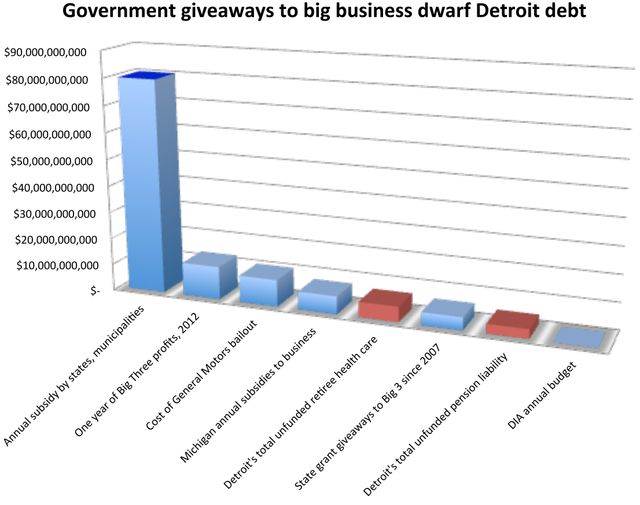
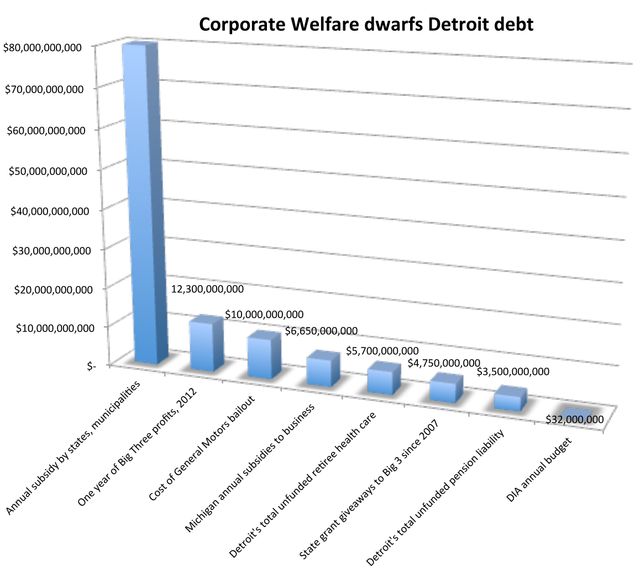
Yet while depriving Detroit, as well as other Michigan municipalities, of desperately needed revenues, the State of Michigan was spending—as it has done annually—a staggering $6.65 billion on business incentives.

Michigan: More megadeals than any other state

According to the Good Jobs First report, Michigan—possibly the hardest hit state of the “Rust Belt”—has offered more large government-funded subsidies to corporations than any other in the nation. It identifies 29 megadeals involving awards higher than $75 million.
The New York Times series “United States of Subsidies” by Louise Story points out that 30 cents out of every dollar in Michigan’s budget goes to this type of “corporate welfare” at the direct expense of support to education, infrastructure and municipalities.
The lion’s share of these gifts went to the Big Three automakers, now expecting to post all-time record profits in 2013, above the already banner year of 2012 at $12.3 billion. General Motors (whose government bailout is now estimated to have cost taxpayers $10 billion) was the top beneficiary receiving $3.3 billion in aid, according to the Center for Automotive Research. The New York Times puts Ford at $1.58 billion and Chrysler at $1.4 billion. Overall national incentives for automakers since 1985 are pegged at an astronomical $13.9 billion. It should be noted that whether Democrats or Republicans were in power, the process escalated.
Among others, Story conducted more than two dozen in-depth interviews with former GM officials and tax consultants to prepare “United States of Subsidies”. She pointed to the role of Argonaut Realty, the automaker’s real estate division, in conducting the shakedown of local governments across the US. GM enlisted their tax managers, charities’ accountants and union representatives alongside plant managers and executives in a combination of threats and negotiations to rein in the biggest tax boondoggles. “For towns, it became a game of survival,” notes Story.
The procedure is classic: cities and states are pitted against each other in a reverse auction. Often even the scenario presented was a fraud, perpetrated by the transnational company seeking higher profits. One example in the GM saga was the company’s demand for tax cuts in Moraine, Ohio. GM told the city that Moraine was competing with Shreveport, Louisiana and Linden, New Jersey to maintain an auto plant. After the Moraine school board caved and accepted the property tax cuts to education funding, it was discovered that the other towns had not been in discussion with GM.
This is a national scourge. As the stakes for jobs has intensified, states are creating more and more incentives. In 2010 alone, 40 new types of tax credits were created or expanded. Oklahoma and West Virginia give up amounts equal to about one-third of their budgets, Maine about one-fifth. Texas awards $19 billion a year and Alaska, West Virginia and Nebraska give up the most per resident, according to the Times.
Because no national database of corporate incentives exists, Story and Good Jobs First had to conduct months-long investigations to uncover the myriad layers of giveaways by thousands of government agencies and officials.

$80 billion annually funneled to big business

The Times uncovered a staggering $80 billion annually donated by states, counties and cities to business. And it cautioned that the actual cost of awards is certainly far higher. The report points to the wide range of corporate entities receiving money, including many among the world’s most profitable firms: Exxon Mobil, Royal Dutch Shell, Boeing, Airbus, Citigroup, Goldman Sachs, Walt Disney, ESPN, Sears, General Electric, Dow Chemical, Amazon, Apple, Intel and Samsung. Sixteen of the Fortune 50 are represented.
Dozens of officials at large corporations who were questioned by Louise Story justified the whipsawing of communities as “owing it to the shareholders to maximize profits,” she reported. Hallmark CEO Donald Hall Jr. said, “this use of incentives is really transferring money from education to businesses.”
It is also no accident how difficult it was assembling these statistics; the government accounting standards board has failed to regulate the accounting of tax-based economic development expenditures. There is furthermore very little oversight once grants are issued. For the most part, no one tracks the “effectiveness” of job retention as a result of giveaways.
A poignant Metro Detroit example is the famed Ford Willow Run plant in Ypsilanti, Michigan, designed by Albert Kahn and used to build bombers in World War II. After the war, it became Kaiser Motors and then was taken over by General Motors, which expanded the facility into a complex. Over the years, the small outlying town of Ypsilanti granted more than $200 million in incentives to the facility.
Doug Winters, the city’s attorney, explained to the Times reporter, “They had put basically a stranglehold on the entire state of Michigan and other places across the country by just grabbing these tax abatements by the billions. They were doing it with a very thinly disguised threat that if you don’t give us these tax abatements, then we’ll have to go somewhere else.”
After the company closed the first plant, the city sued, but was unsuccessful. The judge said that a company’s job assurances “cannot be evidence of a promise.” In 2010 the company closed the remaining factory and Winters sued again. The claim has now been relegated to the corporate books of the defunct “bad GM”.
Referring to General Motors, Winters told Story, “We’re their own private ATM. When they need money, they come begging, but when they don’t want oversight, they say ‘get out of the way’.”
Like payoffs to the Mafia consigliere, there is no respite for states, counties, school districts or municipalities. Ford and GM are now slated to receive federal tax credits for making more fuel-efficient vehicles… worth $50 million, an event celebrated by Michigan Democratic Senators Carl Levin and Debbie Stabenow. Republican Governor of Michigan Rick Snyder recently announced a state grant of $2.5 million for infrastructure improvements for Hyundai’s Superior Township technical center in Metro Detroit. The GM plant in the small enclave of Detroit, Hamtramck, is asking for $1.8 million in order to make critical investments in their operations.
It goes on and on. The substantial New York Times exposé demonstrates the proliferation of this “beggar-thy-neighbor” policy in the false hope of local officials maintaining economically viable communities. As a result, hundreds of school districts are in financial emergency, teachers and staffs are subjected to pay cuts and layoffs, recreation centers are closed and city infrastructure is allowed to rot. Municipalities are systematically being bankrupted as a greater and greater portion of social wealth is diverted to the profits of their resident corporations.
The extent of corporate blackmail nationally demonstrates that the looting of Detroit is just the beginning. Here is a glimpse of the national picture:
*Walmart, the world’s most profitable corporation, receives $1.2 in taxpayer assistance.
*Alcoa receives a 30-year discounted electricity deal worth $5.6 billion.
*Sasol natural gas could receive as much as $21 billion on investment subsidies.
*Boeing’s tax breaks and subsidies are estimated at $3.2 billion.
*Nike’s 30-year single sales factor tax commitment nets it $2.02 billion.
*Intel’s property tax abatement for a computer chip plant means $2 billions in benefits.
*Cheniere Energy of Louisiana will retain $1.69 billion in earnings due to subsidies for the Sabine Pass natural gas liquefaction plant.
*Google’s North Carolina deal received $254,700,000 (for 210 jobs).
*Apple’s North Carolina negotiations yielded $320,700,000 (for 50 jobs).
*Goldman Sachs moved operations from Manhattan to Jersey City, New Jersey and netted $164 million in tax incentives.
What was once considered extortion or bribery has become a normal business model. The blood and sweat of the working class demands nationalization of the ill-gotten gains of the parasitic financial elite and the establishment of a society where jobs, housing, education, pensions, and culture are considered basic rights for all of society.

Comrades in arms: Britain and Russia to sign defence deal

Source: UK Telegraph
Comrades in arms: Britain and Russia to sign defence deal
Britain could buy weapons from its former Cold War foe for the first time under a landmark defence treaty, the Telegraph can reveal.
Defence chiefs are preparing to sign a deal that would see British defence companies working jointly on projects with the Russian arms industry.
The treaty allows arms companies to buy kit from Russia – and Russian diplomatic sources said they hope one day to see British soldiers carrying the Red Army’s famous Kalashnikov rifle as a result.
Ministry of Defence sources confirmed the deal creates the legal framework for the British Army to buy Russian equipment, but stressed their main focus is on allowing firms to share information and buy components from one another.
The MoD and the Russian Federal Service for Military Technical Co-operation are now studying the draft text. It could be signed in the spring, Moscow sources said, earlier than previously thought after making quick progress.
The deal covers ‘unclassified’ technology, so it is unlikely to allow co-operation on advanced battlefield equipment such as missile systems.
Nevertheless treaty is regarded by defence chiefs and diplomats as a major step forward in the relationship between Britain and Russia, which went into deep freeze following the polonium murder of Alexander Litvinenko in London and the granting of asylum in Britain to some of Mr Putin’s rivals.
The British and Russian security services have worked together to defend the Sochi Olympics, and last year British veterans of the Arctic Convoys, which ferried supplies to the USSR in World War II, were awarded medals recognising their bravery after decades of prevarication by ministers.
President Putin wants to dramatically boost Russia’s arms exports to compete with the European defence industry. He has also announced a radical expansion in military spending in order to overhaul an army and navy that are reliant on hopelessly outdated weapons from the Soviet era. The deal means that British factories are in line to benefit from those orders.
The Russian authorities are keen for a closer business relationship with Britain. Only 600 British firms currently trade in Russia, compared to 7000 German.
The release of British Greenpeace activists who were jailed after protesting on a Russian oilrig, following lobbying from MPs and extensive back-channel negotiations, was seen privately as a minor diplomatic breakthrough.
The US has in recent years spent hundreds of millions of dollars on buying Russian Mi-17 helicopters to give to the Afghan armed forces, although Congress has protested at Russia’s role in supplying arms to the Syria conflict.
In 2010 Russia bought two helicopter carrying warships from France, in a deal that caused surprise in a country that had strong shipbuilding industry during the Soviet period.
A Ministry of Defence spokesman said: “Work is ongoing on a Military Technical Cooperation Agreement (MTCA) between the UK MOD and Russian Federal Service for Military Technical Cooperation which will provide a framework for Russian and UK defence companies to cooperate at an unclassified level.”

The Inside Story of Tor, the Best Internet Anonymity Tool the Government Ever Built

http://www.businessweek.com/articles/2014-01-23/tor-anonymity-software-vs-dot-the-national-security-agency

Behind this week’s coverBehind this week’s cover
Last year, Edward Snowden turned over to the Guardian, a British newspaper, some 58,000 classified U.S. government documents. Just a fraction of the files have been made public, but they outline the National Security Agency’s massive information-collection system. They’ve thrown light onto the methods of an arm of the government used to working in the shadows and started an intense debate over national security and personal liberty. One of the earliest and most explosive revelations was the existence of Prism, a top-secret program giving the NSA direct access to the systems of Google, Facebook, and other U.S. Internet companies.
Snowden himself remains something of a mystery even as the U.S. government attempts to obtain his return from Russia, where he’s in hiding, and very possibly jail him for the rest of his life. As an infrastructure analyst for the NSA, he came to understand at a high level how information moves around the Internet. Snowden almost certainly relied on one very specific and powerful tool to cover his tracks. In photographs he’s often with his laptop, and on the cover of his computer, a sticker shows a purple and white onion: the “o” in the word “Tor.”
Tor, an acronym for “the onion router,” is software that provides the closest thing to anonymity on the Internet. Engineered by the Tor Project, a nonprofit group, and offered free of charge, Tor has been adopted by both agitators for liberty and criminals. It sends chat messages, Google (GOOG) searches, purchase orders, or e-mails on a winding path through multiple computers, concealing activities as the layers of an onion cover its core, encrypting the source at each step to hide where one is and where one wants to go. Some 5,000 computers around the world, volunteered by their owners, serve as potential hop points in the path, obscuring requests for a new page or chat. Tor Project calls these points relays.
Its users are global, from Iranian activists who eluded government censors to transmit images and news during the 2009 protests following that year’s presidential election, to Chinese citizens who regularly use it to get around the country’s Great Firewall and its blocks on everything from Facebook (FB) to the New York Times. In addition to facilitating anonymous communication online, Tor is an access point to the “dark Web,” vast reaches of the Internet that are intentionally kept hidden and don’t show up in Google or other search engines, often because they harbor the illicit, from child porn to stolen credit card information.
It’s perhaps the most effective means of defeating the online surveillance efforts of intelligence agencies around the world, including the most sophisticated agency of them all, the NSA. That’s ironic, because Tor started as a project of the U.S. government. More than half of the Tor Project’s revenue in 2012, or $1.24 million, came from government grants, including an $876,099 award from the Department of Defense, according to financial statements available on the project’s website.
Yet because of Snowden, we now know that the NSA has been working to unpeel the protective layers built by the Tor system. Along with evidence of the NSA’s mass data collection, Snowden leaked an agency presentation that demonstrated just how surveillance-proof the software is. It was titled “Tor Stinks.” The spooks, according to the slide deck, were thwarted by the software at every turn. Gaining access to some Tor relays, for example, didn’t work, because they had to control all three computers in a circuit to defeat the encryption. “We will never be able to de-anonymize all Tor users all the time. With manual analysis we can de-anonymize a very small fraction of Tor users,” one slide reads. NSA spokeswoman Vanee Vines said in an e-mailed statement: “It should hardly be surprising that our intelligence agencies seek ways to counteract targets’ use of technologies to hide their communications. Throughout history, nations have used various methods to protect their secrets, and today terrorists, cybercriminals, human traffickers, and others use technology to hide their activities. Our intelligence community would not be doing its job if we did not try to counter that.”
Countering Tor is clearly frustrating for the NSA, and Internet users have taken note. Hits to Tor’s download page almost quadrupled last year, to 139 million. “Encryption works,” Bruce Schneier, a cybersecurity expert who helped the Guardian analyze the Snowden documents, said at a talk in New York in January. “That’s the lesson of Tor. The NSA can’t break Tor, and it pisses them off.”


Tor’s world headquarters occupies one room of a YWCA in Cambridge, Mass. Its neighbor is Transition House, which helps survivors of domestic abuse. Of 33 “core people” listed on Tor’s website, nine are full-time employees, and the majority work remotely. For the most part, the project is crowdsourced: Hundreds of volunteers around the world work on improving Tor’s software and solving technical challenges like staying ahead of censors in China, which has devoted enormous resources to shutting down anti-censorship tools, including Tor. A request to visit the office in person provoked some mild skepticism from Kelley Misata, who handles press for the group. “The Tor team is primarily virtual (and spread around the world),” she e-mailed, “so our office is made up of only a few members of the team working there on a regular basis.”
On a Friday in December, Executive Director Andrew Lewman, Misata, and a researcher named Sarah Cortes showed up to talk at the office, which has the air of a temporary camp, with little décor other than an enlarged Tor logo stuck between two windows and one Ikea run’s worth of furniture. We sat at a tall table surrounded by stools that required an awkward perch.
“What most of the world takes away is this privacy stuff exists, there’s this thing called Tor, and the NSA doesn’t like it.”—LewmanPhotograph by Harry Gould Harvey IV for Bloomberg Businessweek“What most of the world takes away is this privacy stuff exists, there’s this thing called Tor, and the NSA doesn’t like it.”—Lewman
Lewman, 43, has longish dark hair threaded with gray and pulled back by a headband, accentuating heavy eyebrows and large dark eyes. He swallows audibly and speaks quickly. He says he first came across Tor in 2003, when he was working for a large international company with employees in China—he won’t say which one—who needed to get around Beijing’s increasing Internet controls. Tor was an effective and inexpensive solution, and he began volunteering as a code developer, eventually designing the software’s user interface. He’s been executive director since 2009. “People now know about Tor. They’ve heard the name,” he says. “What most of the world takes away is this privacy stuff exists, there’s this thing called Tor, and the NSA doesn’t like it.”
Lewman seems, if not tired of talking about the NSA, at least eager to shift discussion to the many uses of Tor that are totally unrelated to three-letter agencies. When the Chinese government clamped down on the Internet in 2009 to ensure a triumphant 60th anniversary celebration of the founding of the People’s Republic, Tor saw a spike in use in the country. Teenagers in the Boston exurb of Natick installed it on school-issued laptops so they could get on Facebook, to the school district’s displeasure.
Lewman also works with victims of domestic violence, teaching them to get online without revealing to abusers their location and activities. Tor and Transition House are developing guidelines for women at the shelter regarding technology use and online safety.
For Lewman—as with other people behind Tor—the cause has a personal side. When he worked for an Internet marketing firm in the mid 2000s, a consumer, irritated by marketing e-mails, found Lewman’s name on the website and began to threaten him, and then his family, online. The stalker eventually showed up at the office, requiring intervention by the police.
“A lot of the conversations that I have in D.C., when they stand on their soapbox and say, ‘Tor is only used by bad guys,’ it’s very easy for me to step back and say, ‘Here’s why it’s so important to keep the network open for those who need it.’ ”—MisataPhotograph by Harry Gould Harvey IV for Bloomberg Businessweek“A lot of the conversations that I have in D.C., when they stand on their soapbox and say, ‘Tor is only used by bad guys,’ it’s very easy for me to step back and say, ‘Here’s why it’s so important to keep the network open for those who need it.’ ”—Misata
Misata has also had her privacy invaded online. A former colleague cyberstalked her for five years, she says, including posting nasty allegations that topped Google results, complicating job applications. She became an advocate and motivational speaker against cyber harassment. When she heard Lewman speak in 2012, she decided Tor was the safest place for her to work. “A lot of the conversations that I have in D.C., when they stand on their soapbox and say, ‘Tor is only used by bad guys,’ it’s very easy for me to step back and say, ‘Here’s why it’s so important to keep the network open for those who need it,’ ” says Misata, who is pursuing a Ph.D. at Purdue University and researching the use of technology in human trafficking.
Lewman’s message is the same, whether he’s talking to teenagers, Fortune 500 companies, or the U.S. Drug Enforcement Agency, whose agents must maintain deep cover as they infiltrate smuggling and production networks: Everything on the Internet is tracked and recorded, and you might not want that. “A simple question I ask companies is, ‘What do you Google for?’ ” Lewman says. “A number of firms are starting to realize, when we are doing sensitive things, we shouldn’t be doing it ‘naked’ on the Internet.”
Companies routinely use Internet traffic analysis to track what’s coming from competitors’ IP addresses. Searches for patents on specific technologies can lead to hints about what another company is planning. What if a company wants to research a competitor’s pricing? Chances are, Lewman says, if they’re doing it without cloaking their identity, they’ll get answers tailored for them, not the answers a real customer would get.
Living up to its credo of anonymity online, Tor doesn’t have detailed data on its users. They’re clearly not all noble political dissidents, though. Tor had a cameo in October in the FBI takedown of the online drug market, Silk Road, an operation that took years for the Feds to crack because it operated exclusively on the network. Tor estimates that users currently number about 300,000 a day, down from a peak of more than half a million a day over the summer.
“Tor’s biggest problem is press. No one hears about that time someone wasn’t stalked by their abuser. They hear how somebody got away with downloading child porn,” says Eva Galperin, global policy analyst at the Electronic Frontier Foundation, a civil liberties advocacy group in San Francisco. “The reason bad guys use Tor is because it works better than anything else. But at the same time, if there was no Tor, bad guys would still find a way of maintaining their anonymity and everyone else would be left out in the cold.”


Paul Syverson at the U.S. Naval Research Laboratory in Washington is one of the world’s foremost researchers on encrypting and routing data and one of Tor’s creators. He works in the lab’s Center for High Assurance Computer Systems, where a joke nameplate outside his office reads “cryptologicist.” I meet him in December in an all-purpose room stuffed with detritus, including a vacuum cleaner, half-dead plants, some battered cardboard boxes, and shelves crammed with old journals. White dust from a chalkboard scrawled over with formulas covers the floor and chairs.
Syverson, 55, has a Ph.D. in philosophy and looks distinctly unmilitary in an oversize flannel shirt and cargo pants. “The thing we had in mind when we started working on it was to protect government workers going on the public Internet,” he says, specifically analysts doing open-source intelligence gathering. That was in 1995, the Internet’s infancy. By 1996 the research lab had a publicly accessible onion routing system in place, hosted on a Navy server with virtual relays, to demonstrate the concept.
In 2000, Syverson met Roger Dingledine, whose graduate work at the Massachusetts Institute of Technology had focused on the creation of an anonymous online publishing system. Syverson persuaded Dingledine, and eventually another MIT graduate named Nick Mathewson, to help him develop an onion router that could be deployed on the wider Internet. (Dingledine is now project leader of the Tor Project and a researcher and advocate for privacy-enhancing technologies; Mathewson, a director and researcher, continues to help develop the software.)
“The basic notion of onion routing is that you have a distributed collection of computers that are scattered around, and you build a cryptographic circuit,” Syverson says. “We wanted it to work with parts of the Internet that don’t know anything about onion routing.”

The group developed the system as it works today, creating a routing process in which the cryptographic keys for each leg of the path are separate and ephemeral, so that no one can go back and decrypt old traffic. It’s one of the elements that has frustrated the NSA—in the original design, a single hostile node could record traffic and compromise the rest of the system.
For the onion router to work properly, the Navy needed to step back from running it. A cloaking system is not useful if all the cloaks say “Navy” on them. “If you have a system that’s only a Navy system, anything popping out of it is obviously from the Navy,” Syverson says. “You need to have a network that carries traffic for other people as well.” Tor Project was incorporated as a nonprofit in 2006 to manage operations.
In technical terms, Tor provides privacy by separating identity from routing online. In a normal session online, you’re browsing from your computer or a router that’s assigned its own IP address. Every request you send out carries that address, and information is returned there. When you use Tor, instead of your chat message, or the URL you type going directly to its destination, it’s routed through Tor’s network of volunteer nodes, moving through at least three of them, before exiting the network and proceeding to the endpoint. The website that receives it doesn’t know what your IP address is, nor does any point in the Tor circuit except for the entry relay. For most users, a Tor session does not feel different from going on the Web with the Firefox browser. But all the winding through relays does slow things down, and the default settings disable some functions for security reasons—including plugins that allow videos—but they can be turned back on.
Despite being designed to enable secrecy, Tor’s methods are almost totally transparent. From the start, Tor has been built on open-source code, meaning the software’s building blocks are freely available. Anyone with the skill to read code can look at how it’s built and how it works—and help improve it.
A sticker on Edward Snowden’s laptop shows a purple and white onionPhotograph by Barton Gellman/Getty ImagesA sticker on Edward Snowden’s laptop shows a purple and white onion
Such transparency is one of the organization’s key tenets. The Snowden documents have revealed the NSA’s effort to undermine encryption techniques and insert “back doors,” or deliberate vulnerabilities, into hardware and software that the NSA can then use to get into and spy on systems. In December, the German magazine Der Spiegel revealed the existence of vulnerabilities for commercially developed systems from the likes of Juniper Networks (JNPR) and Cisco Systems (CSCO). (When contacted by Der Spiegel, both companies denied having knowledge of such back doors or collaborating with the government; Juniper reiterated this to Bloomberg Businessweek.) With Tor’s code open for all to see and examine, flaws can’t remain hidden—or as easy to exploit.
Syverson and other researchers have written voluminously about Tor’s weaknesses. The network operates within the wider Web, and the way users behave and configure their computers outside Tor is one of the biggest sources of insecurity. One way the NSA found to get around Tor’s software and spy on users was an attack called “EgotisticalGiraffe,” exploiting a vulnerability in the Firefox browser. Another approach was to try to reconstruct the encrypted path to find the identity of a Tor user by monitoring relays, according to the “Tor Stinks” presentation. Success with this approach was “negligible,” because all three hops in the circuit had to be part of the set NSA could monitor, and the agency had access to few of them.
Tor exerts little control over who volunteers to host traffic, and researchers have found evidence of abuse, such as cases where an operator is snooping on traffic. The group has worked on solving that problem by ranking some relay points as more trusted than others, and giving users the ability to choose a set of trusted computers for the first relay.
Tor has evolved in other ways to stay ahead of what are sometimes referred to on its website as adversaries. Because Tor keeps a public list of all its relays—the IP addresses that volunteer to route Tor users’ requests—the Chinese government has tried blocking all of those IP addresses. To get around that, Tor in 2009 invented “bridges,” relays provided upon request to users who are blocked from regular Tor relays. Bridges aren’t listed in a public directory, making them more difficult to block.
There is a deeper layer of Tor, where information is hosted, called hidden services. These sites are tagged with the extension “.onion” and can only be accessed using Tor. A regular Internet user’s traffic goes through at least three hops; hidden services traffic goes through at least six. Iranian activists during the Green Movement protests in 2009 maintained blogs and websites using hidden services, according to Lewman. The drug bazaar Silk Road operated as a hidden service. You couldn’t find and use Silk Road with a Google search—its IP address was hidden from users. Those who wanted to buy drugs on the site had to use Tor as their browser, type in Silk Road’s .onion address, and use Bitcoins to pay for their purchases.
There is naturally suspicion that the NSA has in fact cracked Tor. In September a security researcher, Robert Graham of Errata Security, analyzed almost 23,000 connections to a relay he’d set up, and concluded that the majority were vulnerable to NSA decryption. Three-quarters of the traffic he monitored used an older version of Tor based on encryption keys that “everyone seems to agree” the NSA can break, he wrote. Version 2.4 of Tor’s software uses a different form of encryption keys, based on something called elliptic curves, which are more difficult to decode—but according to Graham’s analysis only a small subset of users have upgraded to that software version.
Conspiracy theories abound. On one Reddit discussion about Tor’s links to the government, an anonymous poster asked: “How can we be sure that TOR isn’t a front for the CIA or FBI? I mean, it’s too easy to just download, install, and be on your merry way browsing in ‘anonymity.’ ”

Lewman’s job, as he tries to drum up more funding and more volunteers to host relays, is to counter such thinking, which the Snowden revelations have, ironically, added to. “People have such fear of the NSA and the CIA and all these other three-letter organizations,” he says, “that they’re just like, ‘Whoa, I don’t want anything to do with that whatsoever.’ ”
More bandwidth, Lewman says, is what Tor needs most. He says he wants to increase Tor’s capacity by getting universities to run it and work out all the kinks before business puts in real money—citing the example of Facebook, which also started on campus. Major corporations are interested in using Tor, but they expect a ready-made product that’s already incorporated into the big enterprise packages provided by companies such as Cisco. So far, few large corporations have offered to host relays, he says.
It’s the kind of thing the Tor developers might discuss at their next meeting. Asked how often the “virtual team” gets together in person, Misata says she’s in the midst of organizing one of two such annual get-togethers for February. The core group of 30-plus spends the first half of the week discussing current and future initiatives and “bonding” and the second half hosting public meetings to spread the word of Tor. For privacy reasons, some in the developers group refuse to come to the U.S. For the gathering, Misata ended up choosing Iceland. She’s looking for hotels that don’t require guests to provide their passport.
Lawrence is a reporter for Bloomberg News in New York.

Innovation Asymmetry: Why The Copyright Industry Always Freaks Out About New Technologies

from the copyright-and-innovation dept

A few weeks ago, I was in Washington DC to moderate a panel concerning the intersection of innovation and copyright. One of the panelists, law professor Michael Carrier whose work we've mentioned before, talked about an interesting concept to explain why many people in the "copyright industries" freaked out about new innovations, rather than recognizing their opportunities. He referred to it as "innovation asymmetry" and he's now expanded on the idea over at the Disruptive Competition Project's blog.
I define the innovation asymmetry as an overemphasis on a technology’s infringing uses and insufficient appreciation of its noninfringing uses. Why is there such an asymmetry? Because infringing uses are immediately apparent, quantifiable, and advanced by motivated, well-financed copyright holders. Noninfringing uses, in contrast, are less tangible and less apparent at the onset of a technology.

The costs of infringing uses can be quantified. They roll off copyright owners’ tongues: $250 billion in losses to the U.S. economy each year from IP infringement. 750,000 jobs lost annually from infringement. It doesn’t matter if the figures are correct. For even if they are completely disproved, the mere articulation of numbers promises a precision that is difficult to dislodge from the audience’s consciousness.
On the flip side, the power of potential innovation is much harder to quantify.
In contrast, noninfringing uses are less tangible, less obvious at the onset of a technology, and not advanced by an army of motivated advocates. First, they are less tangible. Noninfringing uses are difficult to quantify. How do we put a dollar figure on the benefits of enhanced communication and interaction? Estimates of future noninfringing uses will be less powerful than the actual, hard-dollar figures presented by copyright owners.

Second, they are more fully developed over time. When a new technology is introduced, no one, including the inventor, knows all of the beneficial uses to which it will eventually be put. The path of history is replete with inventions for which nobody foresaw the eventual popular and revolutionary use.
He then lists out a whole series of inventions where the inventor was completely wrong in how their invention would be used. In some ways, this is a modified form of loss aversion. People often strongly prefer avoiding losses to acquiring gains. But it goes a bit further than that, because Carrier correctly notes that you can look at what's around and try to "quantify" those losses, making them feel more "real" even if they're not. But the opportunities and advancements that these innovations almost always enable are things that are less obvious, even to the inventors, even if they always show up eventually.

So you have a classic form of "information asymmetry" in that you can believe you have real information about the potential losses, but not have the information on the very large gains, leading many to simply focus on the losses rather than the gains. That leads to misguided attacks on the technology, moral panics and the like. Carrier hopes that by explaining this concept, more will begin to actually be aware of it, rather than automatically be swayed by the fear mongering.
When policymakers and courts consider copyright law, they must take into account the innovation asymmetry. For if they do not, innovation will suffer. And we will not even know what we have lost.

Tor Developer Suspects NSA Interception of Amazon Purchase

Mikael Thalen
by
January 25th, 2014
Updated 01/26/2014
Andrea Shepard, a Seattle-based core developer for the Tor Project, suspects her recently ordered keyboard may have been intercepted by the NSA.
Following the purchase of a new IBM Thinkpad Keyboard from Amazon.com, Shepard discovered her package to be taking a strange detour to the East Coast, revealed by a screenshot of her shipment tracking information.
You’d think #NSA shipment ‘interdiction’ would be more subtle… pic.twitter.com/KVCscLbdgG
— Andrea (@puellavulnerata) January 24, 2014
phototrack
Instead of shipping straight towards Seattle from the Amazon storage warehouse in Santa Ana, California, Shepard’s package made its way clear across the country to Dulles, Virginia. Jumping around an area deep inside what some privacy experts refer to as America’s “military and intelligence belt,” the package was finally delivered to its new endpoint in Alexandria.
While not uncommon to see packages sent to major shipping hubs in different areas of the country, the “out for delivery” and successful “delivered” statuses clearly indicate the item’s final destination was changed without Shepard’s approval, leading privacy experts to take notice.
“Could Amazon have made a mistake in notifying Shepard about this extra journey, which was likely meant to stay a secret?” PrivacySOS asks. “If this really is an example of the TAO laptop-interception program in action, does this mean that companies like Amazon are made aware of the government’s intention to “look after” consumer products ordered by their customers? Or did Shepard receive this weird notice only after some sort of glitch in the NSA’s surveillance matrix?”
According to recently revealed internal NSA documents, the agency’s Office of Tailored Access Operations group, or TAO, is responsible for intercepting shipping deliveries of high-interest targets.
“If a target person, agency or company orders a new computer or related accessories, for example, TAO can divert the shipping delivery to its own secret workshops,” Der Speigel noted last month. “At these so-called ‘load stations,’ agents carefully open the package in order to load malware onto the electronics, or even install hardware components that can provide backdoor access for the intelligence agencies.”
Given the NSA’s deep interest in Tor, a popular online anonymity tool, some speculate Shepard’s keyboard could likely have been implanted with a TAO bug known as “SURLYSPAWN,” a small keylogging chip implanted in a keyboard’s cabling. According to NSA slides, a bugged keyboard can be monitored even when a computer is offline.
“If it ever shows, I’ll be inspecting it as closely as I’m capable of,” Shepard said on Twitter.
Other leaked documents have revealed the NSA’s repeated attempts at identifying users of Tor, which according to the agency’s “Tor Stinks” presentation has only received minor success at best.
“We will never be able to de-anonymize all Tor users all the time,” the presentation states. “With manual analysis we can de-anonymize a very small fraction of Tor users.”
Whether Shepard’s incident was the result of a simple error by Amazon, an NSA interception, or an act of intimidation is still unclear. Given the government’s history of targeting Jacob Appelbaum, Tor’s main advocate, the idea of a top Tor developer being singled out for advanced NSA surveillance is far from unlikely.

Hollywood Writers Warn Against Draconian Anti-Piracy Measures

The Writers Guild of America is warning that current initiatives to protect copyright holders from online piracy go too far. The labor union, which represents many Hollywood writers, says that free speech and the open Internet should be balanced against copyright protection. Among other things they see high statutory damages, such as those the MPAA demanded against torrent site isoHunt, as unreasonable.
writers-guildLast year the U.S. Government’s Internet Policy Task Force published a Green Paper signaling various copyright issues that need to be addressed.
Interested parties were invited to comment on the plans and many have done so. Thus far most responses have been rather predictable. The MPAA and RIAA, for example, vowed to keep high fines for pirates, and civil rights groups and copyright experts argued against it.
A few days ago the second round of comments was made public and many of the same arguments were repeated. However, there also was a submission from the Writers Guild of America, West (WGAW), that is quite atypical to say the least.
The labor union represents thousands of screen writers in Hollywood and Southern California, many of whom work for the major movie and TV studios. In common with other people in the copyright industry, the writers are concerned by piracy, but they also warn that copyright shouldn’t trump the open Internet and free speech.
“While many of the most pirated works are created by WGAW members, we believe that copyright must be balanced with the preservation of an open, competitive Internet and protection of consumers’ rights to access the lawful content, services and applications of their choice,” WGAW writes.
“Achieving this balance requires the creation of guiding principles for the development of piracy detection and prevention tools in laws and industry agreements that do not infringe on free speech and the right to privacy,” the writers add.
Instead of calling to increase copyright enforcement, they suggest that current initiatives and legislation should be toned down.
For example, unlike the MPAA and RIAA the writers are against high statutory damages for copyright infringement. According to WGAW these high damages are unreasonable and unnecessary, citing the recent case against BitTorrent site isoHunt as an example.
“High statutory penalties are not only often unreasonable but unpayable. Recently, in its case against the torrent site isoHunt, the MPAA requested nearly $600 million in statutory damages despite admitting that $5 million at most would be enough to bankrupt the defendants. Whether a statutory penalty bankrupts infringers once or a hundred times over probably has little additional deterrent effect.”
The writers don’t agree with the Hollywood studios, who argue that high damages are needed as a deterrent. Instead, they warn that the current legislation stifles innovation as people may be hesitant to start innovating businesses, fearing that copyright holders may come after them.
“Rather, the threat of such large damages and the cost of litigation may deter further investment in web sites that serve as venues for independent production and allow users to upload content without gatekeeper permission for fear of liability.”
runThe same “chilling effect” applies to a proposal which would make streaming of copyrighted videos a felony. This could introduce jail sentences for people who watch or stream copyrighted material on YouTube, and prevent people from showing off their talent online.

“A broad interpretation of such a law could chill innovation through the use of copyrighted works in remixes, cover versions of songs and fair use. For example, artists like Justin Bieber have used YouTube videos of themselves singing covers as a way to gain exposure,” WGAW writes.
“Allowing felony charges for such activities could have a chilling effect on artists who use such independent forums and may harm sites that allow streaming of user-generated content by driving away contributors,” the writers add.
With regard to the DMCA the labor union suggests that the Government could setup a common template for takedown notices, making them easier for smaller copyright holders to issue and for websites to process. At the same time, DMCA abuse and mistakes should be prevented where possible.
Finally, the writers warn against the voluntary anti-piracy agreements that have emerged recently, including the six-strikes Copyright Alert System. WGAW fears that these initiatives are not always in the best interests of consumers.
“While these agreements have yet to prove their effectiveness in limiting copyright infringement, they have raised concerns regarding their lack of consumer protections,” they write.
One of the examples the writers give is that the notices can only be appealed after several warnings, and that the burden of proof lies on the alleged copyright infringers. In addition, the Copyright Alert System may hurt the availability of open Wi-Fi networks, as people can be held liable for the actions of others.
“Private agreements must not become a way of circumventing due process when an essential forum for free speech and commerce is at stake. If the government is going to endorse private agreements it should also promote transparency and comprehensive stakeholder participation in these initiatives,” WGAW writes.
With their submission the writers guild goes directly against the comments of the major Hollywood studios, which is a surprise. The comments are more in line with those from civil rights groups and academics, who will welcome an organization from the core of the copyright industry at their side.
All comments in response to the Green Paper have been published on the Internet Policy Task Force website.

MUCH MORE THAN A TIDBIT: RUSSIA PREDICTS 2014 TSUNAMI


This was sent to me by a regular reader here, Ms. P.H., and I think this one definitely has to be passed along, for a very simple reason. As many of you know, former Assistant Secretary of Housing and Urban Development Catherine Austin Fitts, in a number of interviews and talks, has suggested that “manipulated weather” can be detected by its concurrence with political contexts, or announcements  or moves – particularly in the financial sector – that have few if no real “reasons” for the activity.  In this respect, she has mentioned a massive sell-off of Indonesian sovereign debt securities and other Indonesian securities approximately a week prior to the tsunami that struck that country. The activity had no real explanation, until, of course, the tsunami struck a week later.  ”Oh my God they knew,” and if they knew, then their ability either to predict or manipulate weather and geophysical events vastly exceeds public knowledge. Well, with that in mind, ponder this article:
Russia Predicts Far East Tsunami in 2014
You’ll note too that the earthquake-tsunami one-two punch is expected near the northernmost island of the Japanese chain, Sakhalin Island… of course, the power elites rarely oblige us by fulfilling such predictions, but there is much in this short little article to give me pause to consider some “high octane speculation.”  As most of you are probably aware, I’ve been entertaining, since the tragedy first unfolded, that the disaster that hit Japan was somehow not quite normal and natural. While I have not a shred of proof beyond some strangely suggestive “context and comments,” the whole ongoing Fukushima mess just does not make sense, including the Japanese government’s unusually inept and incompetent response to it.  That response – particularly in the initial and hours and days after the disaster – led me(and others incidentally) to suspect that there was a coverup of “something” with respect to Fukushima, and that many including this author suspected was a secret nuclear weapons program. 
In the “it was not a natural event column,” many pointed to seismic readings, HAARP output readings, and so on, but for me, the decisive considerations were the then moves by the Japanese government to assert more of its own sovereignty vis-a-vis requesting the USA close its base at Okinawa, and there were some subtle but important attempts to bury the hatchet with China… now, of course, talks of state visits of the Japanese Emperor to Beijing are anathema on both sides of the China sea… in short, the geopolitical climate, the great “might-have-been” of a few years ago, has turned almost 180 degrees.  What happened?
Former US Secretary of Defense Robert Gates happened, that’s what happened. For me, this was one of the decisive considerations, for as the then Japanese government was making these moves, Secretary Gates issued to Japan a statement that could not be taken in any other way by that (or any other) nation as nothing short of a direct threat; Gates said in effect that if Japan continued its then present course there would be “dire consequences.” A short time later, the earthquake-tsunami struck that country, and shortly after that, some Japanese began to question the whole official story and to suspect that the event was a deliberate attack and manifestation of a hidden and weaponized technology. And it’s easy to see why the greater context here is significant to the interpretation of the Fukushima disaster, and why such speculations as we are entertaining here should not be discounted, for simply put, the USA – having antagonized not only enemies and neutrals but friends and allies, could ill afford the massive geopolitical consequences even of the exchange of a respectful bow between China and Japan.
Or to put it even more plainly, for Americans, Pearl Harbor is still a memory, and to people such as Gates within the national security apparatus, it is a symbol, indeed, their very raison d’etre. Conversely, for the Japanese, including many fanatical elements, Hiroshima and Nagasaki are still memories, and indeed, symbols. And for some fanatical elements hidden in the upper echelons of power in that country, and particularly in the notorious Yakuza, reminders of a score to be settled.
Now we finally come to Russia, and why this article – short though it may be – is so strange. The Russians are no more insulated from making “tabloid predictions” than anyone else. But I suspect we’re not looking at the normal “generalized scientific speculation” with this article, and here’s why:
Recall that a month before the Chelyabinsk meteor incident, then President Dmitri Medvedev stated publicly that Russia should prepare a space defense system to defend against – you guessed it – asteroids. A month later, as if to punctuate the announcement, the Chelyabinsk meteor conveniently and in my opinion suspiciously rips across the Russian skies, and just as conveniently and suspiciously explodes. Now, exploding meteors or bollides are not all that unusual, but in this instance, Russian state TV also obligingly ran videos captured by Chleyabinsk locals that look as if something and someone caused that explosion.
Going further back in history, as I pointed out years ago to some friends privately, in the final days of the tottering Soviet Union, Russia was hit in the transcaucusus region, home to then Soviet Foreign Minsiter Eduard Shervadnadze, with several devastating earthquakes… just as Helmut Kohl’s Germany was in the process of its shotgun Wiedervereinigung with East Germany…
So what are we getting at in the final analysis? Bear with me, for this is not only high octane speculation, but some, I am sure, would describe it as “oxygen-deprived” speculation. What I’m getting at is simply this: If the technology to produce earthquakes (and therewith tsunamis) exists, then so does the technology for the detection of its use, and I suspect that part both of the weaponized and of the predictive technology consists of a more detailed “map” of the Earth’s interior than “they” are letting on; such indeed would be a secret of the same extreme classification as hydrogen bombs, ICBM launch codes, and so on. Such earthquake-producing technology, as I outlined in Covert Wars and Breakaway Civilizations, would be based upon the exploitation of such geophysical knowledge of high tension areas, and these areas in turn would be monitored by careful attention to VLF, ULF ELF(very/ultra/ extremely low frequency, respectively) longitudinal waves. That monitoring would thus also permit the ability to know when certain areas are under greater than normal stress, and when one possessing the weaponized technology could “tweak them” or “tickle” them, disturbing the delicate equilibrium of built up stress and… voila! earthquake.
If all this sounds like the wildest science fiction, it is. But the problem is, that the very speculation, as I have outlined it in the preceding paragraph, has been around for a long time, and was presented by various people involved in the US defense and research establishment.
And with the Russians it is always necessary to read between the lines, for once more, they may just be sending messages that they know all about it, and about the future (and past), “geophysical events” in the Pacific. So if they are going to send messages about such technologies and their use, watch for them(or their allies and surrogates) to publish articles in the future precisely about the types of analysis I am suggesting.

University of Alaska Scientists: Fukushima Radiation May Be Making Alaska Seals Sick

truther January 27, 2014
WashingtonsBlog

Is Fukushima Radiation Making West Coast Wildlife Sick?

American sailors on the USS Reagan got really sick after having snowball fights with radioactive snow blowing off of the coast of Fukushima.
University of Alaska professors Doug Dasher, John Kelley, Gay Sheffield, and Raphaela Stimmelmayr theorize that radioactive snow might have also caused Alaska’s seals to become sick (page 222; hat tip EneNews):
On March 11, 2011 off Japan’s west coast, an earthquake-generated tsunami struck the Fukushima Daiichi nuclear power plant resulting in a major nuclear accident that included a large release of airborne radionuclides into the environment. Within five days of the accident atmospheric air masses carrying Fukushima radiation were transiting into the northern Bering and Chukchi seas. During summer 2011 it became evident to coastal communities and wildlife management agencies that there was a novel disease outbreak occurring in several species of Arctic ice-associated seals. Gross symptoms associated with the disease included lethargy, no new hair growth, and skin lesions, with the majority of the outbreak reports occurring between the Nome and Barrow region. NOAA and USFWS declared an Alaska Northern Pinnipeds Usual Mortality Event (UME) in late winter of 2011. The ongoing Alaska 2011 Northern Pinnipeds UME investigation continues to explore a mix of potential etiologies (infectious, endocrine, toxins, nutritious etc.), including radioactivity. Currently, the underlying etiology remains undetermined [i.e. scientists don't yet know what caused the seals' sickness, but they think it might have been Fukushima radiation]. We present results on gamma analysis (cesium 134 and 137) of muscle tissue from control and diseased seals, and discuss wildlife health implications from different possible routes of exposure to Fukushima fallout to ice seals. Since the Fukushima fallout period occurred during the annual sea ice cover period from Nome to Barrow, a sea ice based fallout scenario in addition to a marine food web based one is of particular relevance for the Fukushima accident. Under a proposed sea ice fallout deposition scenario, radionuclides would have been settled onto sea ice. Sea ice and snow would have acted as a temporary refuge for deposited radionuclides; thus radionuclides would have only become available for migration during the melting season and would not have entered the regional food web in any appreciable manner until breakup (pulsed release). The cumulative on-ice exposure for ice seals would have occurred through external, inhalation, and non-equilibrium dietary pathways during the ice-based seasonal spring haulout period for molting/pupping/breeding activities. Additionally, ice seals would have been under dietary/metabolic constraints and experiencing hormonal changes associated with reproduction and molting.
Here are some pictures of the sick seals (rounded up by EneNews):
Harmed: Seals like this one in Barrow, Alaska, have been found with bleeding lesions, damaged fur and flippers thought to have been caused by radiation from Fukushima, Japan.
University of Alaska Scientists Fukushima Radiation May Be Making Alaska Seals Sick
Many other West Coast animals have gotten sick. Scientists need to get to the bottom of what is making them sick, whether it’s radiation or something else.