Friday, January 11, 2013

Mysterious Structures In China

http://usahitman.com/structures-china/    

Mysterious Structures In China

Posted: 1 year, 48 days ago

Satellite Photos of the Mysterious Area

Source 1 | Source 2


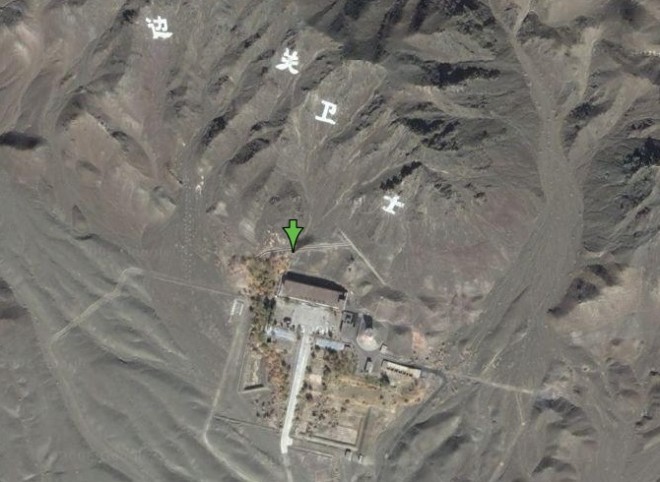
The characters that surround this place mean “Border Guard.” But why would they need them on such a large scale?
Now what is this? An antenna farm? HAARP?
Solar Panels?
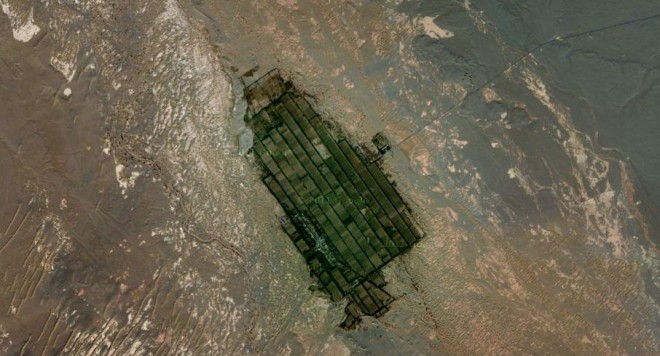
Farming in the desert?
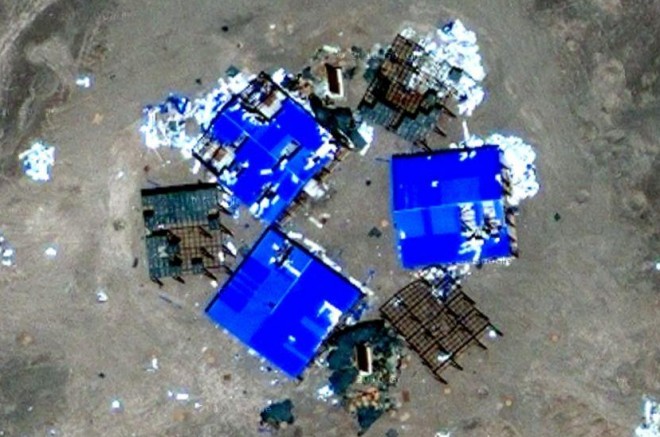
Bunkers or something else?
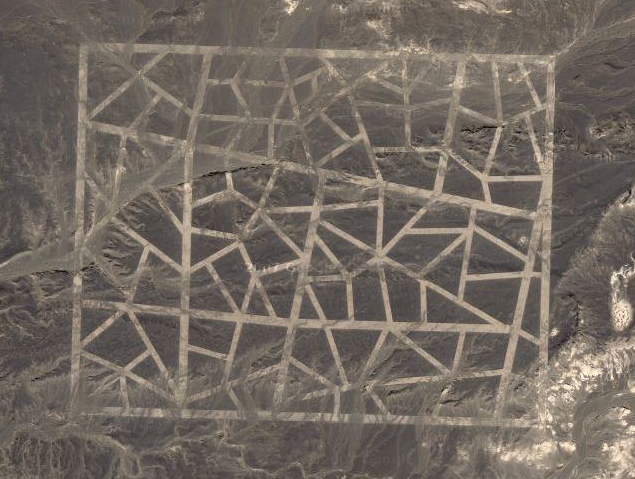
There is yet another pattern of mysterious lines that can be seen using Google Maps. This pattern is completely different from the first two linear patterns, however. Consisting of thousands of lines, this pattern seems to form a massive grid. These grid lines are displayed in two massive strips that intersect each other perpendicularly. The vertical line is approximately one mile wide by a whopping 20 miles long. The horizontal line is approximately one mile wide by 30 miles long. The northern most point of the vertical line reaches within 10 miles of the Mongolian border.
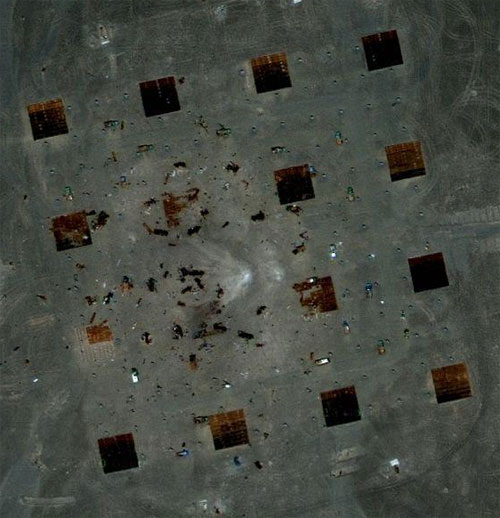
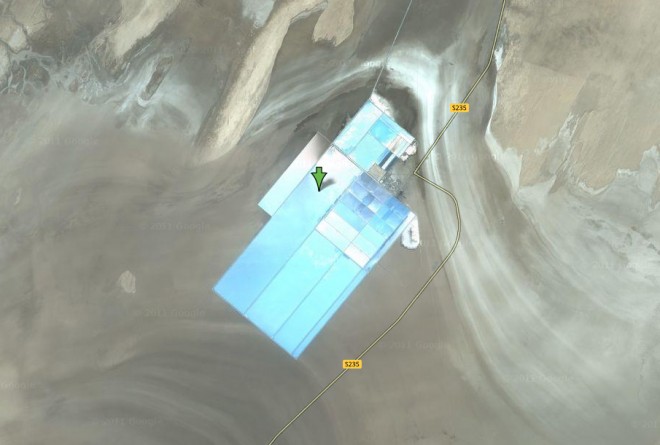
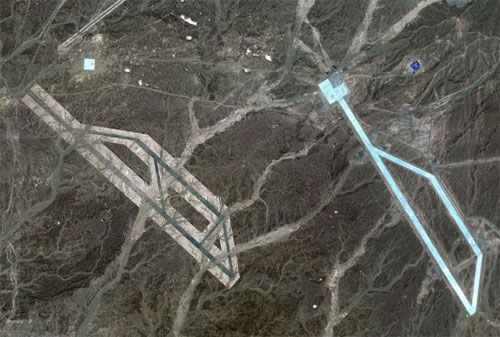
Another mysterious surface feature in the nearby area is what appears to be some kind of airfield. But a couple of the structures that could be runways appear to either be water, or a strange blue material, which makes this “runway” highly visible–something that could come in handy to visitors from space trying to locate a landing location. But there is something else strange about this airfield. In a couple of locations near the airfield, there are dozens of what appear to be impact marks, some that include signs of charring. If this is indeed an airfield, then either the pilots landing there are very clumsy, or, like with the previously mentioned “targeting grid” formation, these could be signs of space-based weaponry.
So what is the explanation for all of these bizarre formations in China? Are they all related? Do they indicate that China is sending coded messages to space? Do they prove that China is testing space-based weapons? Or are glitches with Google’s satellite causing some very strange, yet highly detailed, photo abnormalities? The real answer is unknown at this time. But these are, without a doubt, some very puzzling formations.
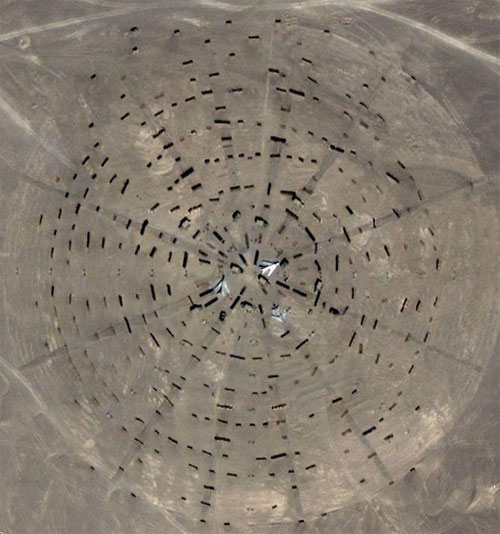
Destroyed vehicles are within this grid, which opens the door to the possibility of space-based weaponry testing?

This same grid pattern is visible in several locations in nearby areas. But in some locations, the pattern varies, combining zig-zag lines with straight lines.

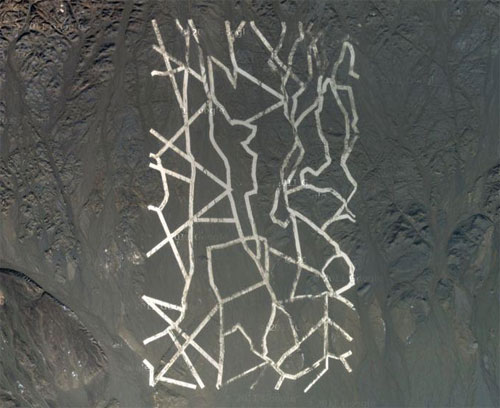
The strange surface features and mysterious structures are visible using Google Maps. The first oddity pointed out by Dias is a series of wide, white lines. These lines are located in “Dunhuang, Jiuquan, Gansu, north of the Shule River, which crosses the Tibetan Plateau to the west into the Kumtag Desert,” according to Dias. This formation reportedly covers an area approximately one mile long by more than 3,000 feet wide. Dias mentions that the “tracks are perfectly executed, and they seem to be designed to be seen from orbit.” He goes on to speculate, “Perhaps it’s some kind of targeting or calibrating grid for Chinese spy satellites? Maybe it’s a QR code for aliens? Nobody really knows.”

Somebody Ordered Tons Of Satellite Photographs Of Chinas Mysterious Structures

There are lots of explanations for the gigantic structures built in China’s desert. But the most mysterious thing is invisible: according to a former CIA analyst, there’s someone who has ordered tons of satellite photos of this area since 2004.
And the plot thickens. Allen Thomson, an analyst who used to work for the agency in the field of reconnaissance satellites, has noticed that “starting in 2004, somebody has ordered many, many satellite pictures of it.”
You can see the extreme density of these requests if you turn on the DigitalGlobe layer in Google Earth—the satellite has received commands to photograph this area many hundreds of times. Compare that crazy grid of squares to the few images taken of its surroundings.
I doubt these orders come from the US military, since they have their own spy satellites—more accurate than Google’s. Perhaps it’s some low level agency not connected to the military. Or another country. Or Magneto. Whoever it is, Thomson points out to Wired’s Danger Room that it “can’t have been cheap.”
Source     

The ultimate NFL coach interview script

http://espn.go.com/blog/playbook/fandom/post/_/id/16855/the-ultimate-nfl-coach-interview-script        Pretty cool. Everybody thinks  Volume ,Volume ..Look  we interviewed 4  20  non-stop hrs &  looky,looky his notebook is 4in thick !  awwwww  um oh yea ;0   & every yr  ..how many get the axe?  NFL /College hehehe  

The ultimate NFL coach interview script

January, 11, 2013
Jan 11
Phil Emery David Banks/USA TODAY SportsChicago Bears general manager Phil Emery could find the perfect coach with this questionnaire.
It’s football coach interviewing season. Every team with a coaching vacancy wants to find the next coaching genius who will lead their team to championships as far as the eye can see.

Hard to do? Not at all. All of us who sit on our couches watching football every Sunday know the job is not difficult. It would be easy for teams to find a great coach if they asked these 50 simple questions to every candidate.

1. Are you willing to do what it takes to win now?

2. Can you promise that you won’t mortgage the long-term future of the organization by winning now?

3. Will you play an exciting, dynamic brand of football that will get our fans excited?

4. Will you focus on fundamentals and execution, knowing that winning above all else is the goal?

5. How do you intend to make all of your challenges successful?

6. Timeouts. Will you always have all of them available late in the game?

7. Will you take a hands-on approach with your offense and defense and special teams, knowing the buck ultimately stops with you, but not be so hands-on that you can be accused of meddling?

8. Will you always shake hands with the opposing coach after the game in a manner that in no way can be perceived as cocky, confrontational or weak?

9. Do you agree that statistical analysis is an invaluable tool in making decisions in modern football?

10. Are you going to coach like some sort of robot, or do you understand that the greatest coaches know when to play a hunch?

11. How is your system the best?

12. Are you married to any one system, or are you able to change your approach based on the personnel you have?

13. Are you loyal to your players?

14. Do you promise to not play favorites with players?

15. Do you have a zero-tolerance policy when it comes to player misconduct off the field?

16. Do you understand that people make mistakes, and that sometimes all someone needs is a second chance, and that cutting a player over one – or even a few misdeeds – may not ultimately get him the help he needs, and also hurt the team’s on-field performance?

17. Do you understand that this is a business?

18. Do you understand that this is a game and sports are ultimately about fun and entertainment?

19. Will you be engaging with the media and fans?

20. Do you understand that your job is to prepare the team to win football games, not for you to market yourself, be a good interview or become famous?

21. Do you promise that all of your decisions to go for it on fourth down will be successful?

22. When you have third and short, or fourth and short, or are right at the goal line, do you promise to just run it down their throats instead of messing around?

23. Will you perfectly employ unexpected passes, reverses and fakes occasionally in short-yardage situations instead of predictably slamming the ball into the line all the time?

24. If a specific play is working, do you promise to continue going to it?

25. Will you diversify your play-calling so it doesn’t become predictable?

26. Will you work 100-hour weeks and sleep on the couch in your office if that is what is required to be a winner?

27. Will you be active and engaged with your family, knowing that’s what’s really important, and have a life outside of football so you are regularly refreshed to perform at your best as a coach?

28. Do you promise to avoid nepotism and not put anyone from your family on your staff?

29. Is this your dream job?

30. Do you have assistants lined up who are among the finest coaches in football and will you empower them to succeed?

31. Will you have constant coaching staff turnover as your assistants interview for other jobs, or will you be able to engender loyalty and keep your staff in place?

32. Can you win without elite talent?

33. How much credit can a coach even take for a successful team that has elite talent?

34. Will you take care of yourself physically, understanding that you are the face of this organization and should teach your players about personal discipline?

35. Will you give everything you have to this job, even if doing so affects your health, hairline or waistline?

36. Do you promise to draft players who are proven commodities who performed on the field in college?

37. Do you promise to draft players who have upside and room to improve in the NFL?

38. Are you able to drown out the noise from local and national media and focus on the task at hand?

39. Can you take constructive criticism from the media and even fans and use it to make yourself and your team better?

40. Do you promise to have a ball-control offense that eats up the clock, dictates the flow of the game, keeps the other team off the field and gives your defense time to rest?

41. Do you promise to have a quick-strike offense that will keep the opposing defense on their heels?

42. If you get the ball with just 30 seconds or so left in the half, do you promise to still try to put some points on the board?

43. If you get the ball with just 30 seconds or so left in the half, do you promise to just kneel down so you don’t risk a bad turnover?

44. Will you insist that your players perform at their best in practice?

45. Do you understand that the best way to evaluate a player is how he performs in games?

46. Do you promise to have the toughest team in the NFL?

47. Do you promise to not have your players play when they could risk further injury?

48. Will you vow to always make sure your team is extra motivated and performing at its best for big games against rivals and playoff games?

49. Will you vow that your team never has letdown games or overlooks inferior opponents?

50. Do you think you are the best coach out there for this job and are you humble?

DJ Gallo |

ESPN Playbook

Report: Armstrong seeks 'pathway to redemption'


Report: Armstrong seeks 'pathway to redemption'

Lance Armstrong
Lance Armstrong has had his seven Tour de France titles stripped.
Lucas Jackson/Reuters
Lance Armstrong recently met with the head of the U.S. Anti-Doping Agency to explore a "pathway to redemption," according to a report Wednesday night on "60 Minutes Sports" dealing with the investigation that cost the cyclist his Tour de France titles.
USADA CEO Travis Tygart, in an interview that aired Wednesday night during the show's premiere on Showtime, didn't discuss the meeting on camera and provided no details, including when it was held and where. The only mention, with no elaboration, came at the end of the segment.
Tygart didn't respond to messages left by The Associated Press seeking comment.
The New York Times reported last week that Armstrong and Tygart had been meeting about a possible confession. Armstrong's attorney, Tim Herman, denied the meetings had taken place.
During the show, Tygart detailed his mission to investigate Armstrong, calling the cyclist's refusal to help in the probe "one of the lowest days of this investigation, quite honestly."
"We were disappointed he didn't come in and be part of the solution," Tygart said.
Last October, USADA released a 200-page report detailing the doping program Armstrong ran. At the time, Tygart called it "the most sophisticated, professionalized and successful doping program that sport has ever seen."
If Armstrong were to confess, there could be legal consequences, involving past and present civil cases and possibly perjury.
In addition to having his seven Tour de France titles stripped, Armstrong was banned for life from competing, which makes him ineligible for triathlons and other events sanctioned by USADA or the World Anti-Doping Agency.
In the interview, Tygart said a representative of Armstrong's approached USADA in 2004 with an offer of a donation of more than $150,000.
Asked if it felt like he was being bought off, Tygart responded: "It was a clear conflict of interest for USADA and we had no hesitation in rejecting that offer."
Tygart also said he had been subject to numerous death threats from anonymous emails and letters.
"The worst was probably puttin' a bullet in my head," Tygart said when asked to recall specific details of the letter.
He said the threatening letters were turned over to the FBI.
Tygart also discussed the pressure he felt while pursuing the investigation, even after federal officials decided to shut down their probe. Last year, two members of Congress called for stronger oversight of USADA, which receives more than half its $15 million annual budget from the government.
"We're always concerned about the grant we get from the federal government," Tygart said. "If we're unwillin' to take this case and help this sport move forward, that we're here for naught. We should shut down. And if they wanna shut us down for doing our job on behalf of clean athletes, and the integrity of competition, then shut us down."
Copyright 2013 Associated Press. All rights reserved. This material may not be published, broadcast, rewritten, or redistributed.

Read More: http://sportsillustrated.cnn.com/more/news/20130109/lance-armstrong-seeks-pathway-to-redemption.ap/#ixzz2HiSs8WFW

How Red Bull Takes Content Marketing to the Extreme

http://mashable.com/2012/12/19/red-bull-content-marketing/           

How Red Bull Takes Content Marketing to the Extreme

Red-bull-helicopter
James O'Brien writes for The Content Strategist, a digital magazine by Contently, the leading technology company for brand publishing tools and talent.
The button is five stops in, counting from the left on the homepage of RedBull.com. Along the smaller of two navigation bars, it's sandwiched between "Audio" and "Games." There it is, the fifth one: "JUST EPIC."
In a sense, the channel embodies Red Bull's entire marketing approach. You want to click it. You have to see what it is. What is this epic stuff?!
Click.
Instantly, you're browsing videos of a 12-year-old skateboarder nailing the world's first ever 1080 (that's three full revolutions) during a ramp jump. You're inside a world where men skim treetops in something called a wingsuit. Looking a bit like a bat, he hoots and hollers with the thrill.
Red Bull's universe is extreme sports and adrenaline-junky stunts. Sure, you'll recognize the familiar twin bovine and sun logo on the skate ramp. And yes, you'll spy the bulls on the back of the wingsuit. But there's no mention of the actual drink, really. And there is certainly no cut to Red Bull's now-iconic blue and silver can.

Red Bull is a publishing empire that also happens to sell a beverage.
Red Bull is a publishing empire that also happens to sell a beverage. Lately, every conference PowerPoint on the future of advertising or PR seems to mention Red Bull as a — if not the — shining example of a brand-turned-publisher, what every future-leaning agency encourages its clients to emulate.
Yet, no one seems to know exactly how Red Bull does it.
"The marketing strategy that has worked best for us is not to publish our strategies," says a Red Bull representative.
Perhaps by painting around the edges of Red Bull's content machine, we can glimpse what's inside the can.

A High-Concept Drink (In Other Words, the Drink Is Not the Point)


When we talk about "content marketing," we mean the creation of storytelling material that attracts readers, viewers and listeners to a brand.
Content marketing is not an ad on a billboard or a one-page spread in a magazine. It doesn't have to be a commercial on cable television or the 28 annoying seconds before the start of that next YouTube hit.
The idea central to content marketing is that a brand must give something valuable to get something valuable in return. Instead of the commercial, be the show. Instead of the banner ad, be the feature story. The value returned is often that people associate good things with — and return to engage with — the brand.

In the early 1980s, Austrian toothpaste salesman Dietrich Mateschitz (left) stumbled upon a Thai energy drink, at the time called Krating Daeng. He recognized that if he transformed Krating Daeng from an obscure local remedy for sluggishness into a more universal concept, he could create a new beverage category. And so, he wrapped the drink in a blue and silver can, and then he wrapped that can in a platinum marketing campaign.
By 2011, Mateschitz controlled 44% of the exploding energy drink market, according to Symphony IRI, and was selling 4.6 billion cans a year, most purchased by men between the ages of 18 and 35. They're voracious endorsers of the brand, and that's because, with the beverage, Mateschitz commandeered — if not created — a new, high-octane lifestyle category.
To promote the lifestyle, Red Bull built a media house.

The First Rule of Red Bull's Content Strategy...


Red Bull North America's Manhattan office, 15 Watts Street in SoHo, looks like a castle. The top of its cappuccino-colored facade is ringed with arch-like details. In the giant front windows, huge images of skiers, surfers and airborne motocross machines loom above a diagonal, six-way intersection. In the center, the Red Bull logo launches upwards from a froth of icy bubbles.
On the fourth floor, the elevator opens onto an immaculate space: shiny grey floors, high white ceilings roped with pristine refurbished industrial ductwork. The walls are wrapped in a kind of liquid graffiti splash pattern. A biking jersey sits behind a frame on one wall, the twin bulls logo upon it.
The woman at the desk is pleasant, but this reporter is not going to get his interview today, she says. No, there is nobody in the building he can talk to about Red Bull Media House. But yes, such people do work here.
"They're just always in and out," she says.
And so, the reporter sits down to wait. Maybe, he thinks, a Media House employee will come through the doors.

Content as an Engine: Red Bull, the Market, and Every Media Under the Sun

Red Bull Media House got its start in Europe in 2007, then expanded to Hollywood and New York City. An umbrella for Red Bull's massive print, television, online and feature film production, RBMH employs over 135 people, according to its LinkedIn profile.
Part Associated Press for action sports content, part production company, RBMH has an IMDB page and a sports magazine, with circulation comparable to Sports Illustrated. It even owns an in-house record label.
Spidering across the media universe are snippets from the Red Bull Content Pool, a well of fan images and videos — material like the wingsuit video, the skateboarder and plenty more.


While Red Bull provides a portion of its more than 5,000 videos and 50,000 photos to users free-of-charge, most of this stuff is professionally high-end enough to be network-ready. And it shows up on the news, from MSNBC to ESPN, and in specialty markets such as Halogen TV.
At Halogen, which reaches viewers via cable with a message of positive change, Red Bull inked a multi-year deal for Thursday night programming. From the action sports roundup Ultimate Rush to street sports shows, such as Breakdance, this is the Red Bull brand idea, front and center on cable every week.

"There is brand synergy in our ideology about content," says Marshall Nord
"There is brand synergy in our ideology about content," says Marshall Nord, senior vice president of programming at Halogen. He drew a parallel between Halogen's tagline, "Be the Change," describing its "inspiring and empowering programming that entertains and motivates," and Red Bull's slogan, "We give wings to people and ideas."
The two companies' user demographics are also linked. "Halogen Programming desired to partner with a proven brand that would provide programming directed at young males, as well reach consumers aligned with our brand via other media," Nord says.
In Red Bull, he says, Hologen has found "a lifestyle brand with the number-one energy drink and a media company that cuts across demographics and psychographics, that produces and distributes content."
Indeed, Red Bull is working in multiple media. It recently released a feature film, The Art of Flight. The movie cost a reported $2 million to make, but when it hit iTunes in 2011, it parked atop the charts for more than a week — bringing in $10 per download.

The company also publishes a print magazineThe Red Bulletin — with a distribution of about 5 million.
Celeste Thorson, a self-described "adrenaline seeker" living her dream in Los Angeles — acting, writing, modeling and, well, sometimes jet-packing — is a regular reader. "I love that it features incredible photography and an action sports lifestyle," Thorson says. "After seeing cover girls like Lolo Jones, Maya Gabiera and Lindsey Vonn, I was hooked."
As a hiker, biker and jet-packer, Thorson's feelings about the content are a testament that the brand's power exceeds its product.
"Obviously the name does a great job of reminding you about the drink," she said of Red Bulletin. "But honestly, I'm a bigger fan of the Bulletin and event sponsorships than the beverage. I think of Red Bull as more than just an energy drink maker. To me, it's about having an energetic lifestyle."

From the Outside In: Content in the Red Bull World

One might ask a Red Bull executive whether the company's media forward thinking means the loss leader is the content. Or rather, is it the drink in Red Bull's cans?
Or is there even a loss leader?
Rebecca Lieb, analyst at Altimeter Group, recently published a report that categorizes content marketing efforts into progressive degrees of human motion: the least mature is stuck in the "stand" stage (i.e., motionless). At the other end of the spectrum there is Red Bull, characterized at "run" on Lieb's graph.


"Look, Red Bull has introduced its content marketing around and about the product, but it is never directly correlated to the drink itself," Lieb says. "Nobody is going to go to a website and spend 45 minutes looking at video about a drink. But Red Bull has aligned its brand unequivocally and consistently with extreme sports and action. They are number-one at creating content so engaging that consumers will spend hours with it, or at least significant minutes."
Another question is whether Red Bull is succeeding on all fronts. Is its brand strategy adequately promoting both a drink and a collection of cool footage?
"One measure of success is," Lieb says, "are they selling more Red Bull this year than last year? Another might be brand awareness. Another might be purchase intent.
"I think Red Bull's brand awareness accomplishment is through the roof," she continues. "Ten years ago, nobody knew what Red Bull was. Now, maybe they're not up there with McDonald's or Coke, but you could say they're on a par with Starbucks."
Red Bull Media House makes content that other media outlets can use. It's a production studio, full of writers, filmmakers, editors and other creative types. And while its in-house staff kept the reporter running in circles, some of its freelancers and athletes opened up about their experiences.
First and foremost, a Red Bull assignment is mostly like any other kind of journalism.
"I've never been asked to crowbar Red Bull into any story I've done with them," says Nick Amies, who freelances for the lifestyle and music beat for Red Bulletin Europe, and also covers similar topics for The New York Times and The Economist. "The promotion of the brand comes through the activities I cover."
"Just because Red Bull is a brand, it doesn't mean that The Red Bulletin is a vanity project with minimal editorial control," he says. "It's as hard to write for and as professional as any other international magazine I have been involved with.
The idea is for The Red Bulletin to be seen as a great lifestyle magazine first and a Red Bull project second.
The idea is for The Red Bulletin to be seen as a great lifestyle magazine first and a Red Bull project second."
Alison Smith, a New Zealand-based freelancer — who cut her teeth following and writing about the world surfing circuit — worked with the Red Bull marketing team from 2000 to 2002.
"Much of the media strategy was in its early stages in New Zealand at the time, so developing a team of freelance photographers and video people to work on projects with was also part of what I did," Smith says. "At the same time, they wanted someone cool enough — if I’m allowed to say that — to get on with their athletes, understand their culture and be fun to be around when attending the events and trips with athletes."
She says shackles were never part of the editorial side of Red Bull's projects.
"I worked independently and had pretty much complete editorial freedom," says Smith. "I don’t recall ever being questioned about the work I produced, and was very much in the mindset of a freelance journalist. That’s what my card said, in fact, 'freelance journalist,’ even though it had a Red Bull office number and cell."
Red Bull is also, of course, a way for athletes to get noticed. If you had to distill the Red Bull aesthetic into one such athlete, you'd end up with a performer most probably like Ryan Doyle.
An acrobatic freerunner, Doyle seems to exist free of the laws of physics. He can float across a slanted roof, roll along the railing on a flight of stairs, launch himself into and off of solid concrete surfaces, and descend from heights in freefalls that would put most of us in traction. He is a devotee of parkour athletics, which emphasizes speed and agility, overcoming obstacles with no equipment.
His version of athletics bonds martial arts with ballet, then tosses the whole thing into a kind of urban, cross-country blender. This is not the NBA. But it is RBMH.
"I often find parkour athletes to be 'divergent thinkers,'" says Doyle. "Where there is never only one answer, they are open-minded, creative. And Red Bull is a fantastic company that loves to get involved with the parkour world."

Red Bull's Challenges in the Content World

Red Bull Media House has swiftly progressed toward something that looks more like a studio model than an advertising agency. While some see this as a new creation, others suggest it actually reflects an older dynamic.
"You have a patronage model that goes back a thousand years, where some rich guy is paying some artist to make himself look good," says Kyle Monson, founding partner and chief creative at content marketing and public relations firm Knock Twice.
"Red Bull makes a sexy video about snowboarding? Total patronage," he said at an August panel hosted by Outbrain. "Not in a bad way. But it's the best snowboarding video ever produced, and it's been produced by a brand."
Red Bull's marketing zeal has also stretched some limits.
For instance, in 2009, Red Bull employees went to European bars that sold only Monster, a competing energy drink, and cracked open smuggled Red Bulls to suggest dissatisfaction with the other choice. Bar managers were supposed to panic and order the blue and silver stuff. Instead, the company found itself in legal hot water and a minor PR flap: Posing as a customer in such a setting is illegal in the European Union. Red Bull apologized and attributed the whole idea to "overzealous junior employees," according to a report in Marketing.
Red Bull is still, from time to time, drawn into the debate over whether the enzyme taurine, one of its oft-mentioned ingredients, really enhances body and health performance. Never mind the early rumor that its ingredients included an extract from the testicles of bulls.
Another flap occurred in the German market in 2009, when several states banned the beverage after trace amounts of cocaine were allegedly found in the mixture. The company maintains Red Bull is safe to drink, and that its own tests didn't turn up any cocaine.
"They're not totally insulated from blowback," says Peter Shankman, chief executive of The Geek Factory, a Manhattan-based social media and marketing strategy firm. Shankman is also a skydiver, and his own website carries photos not so far removed from the Red Bull kind.
He suggests that the blowback might be more problematic for company officials and investors, however, than for anyone who loves to watch a race car or tune in to a video featuring Doyle's freerunning.
"The majority of people that like a brand like Red Bull...want to see excitement, they want to see fun, and that kind of story isn't going to filter down," Shankman says, addressing the complications that arise from aggressive marketing.
"The issue only becomes," he says, "when they start to believe that the only people that matter are the fans. [Then] they may have to worry about investors and markets, as well."

What's Waiting in the Wings?

Back at Red Bull's office, the reporter is still waiting.
The receptionist has taken his business card, but declined to say with whom the reporter can follow up. The sleek red couches, over near the elevator doors, are a good place to sit and wait for the Media House staff who aren't coming. A lone office worker peers over a half-cube station wall.
A short while later, the woman from the reception desk gestures toward a pod-like vending machine. Its shape suggests the familiar thin, blue and silver cans inside.
"Would you like one?" she says.
For a lot of people, the answer has been been an energetic, "Yes."
Images courtesy of Flickr, PsychoScheiko, compscigrad, Dietrich Mateschitz, Red Bull Media House, Red Bull Content Pool, The Red Bulletin, Altimeter Group

Game-changing video: Moon facts refute ‘official’ story: it’s a spaceship

http://www.washingtonsblog.com/2013/01/game-changing-video-moon-facts-refute-official-story-its-a-spaceship.html     hey man ...hope them Pred's  aren't  HIDING  up there?    is there water up there ? u know .. mud,mud! MUD !    hehe            

Game-changing video: Moon facts refute ‘official’ story: it’s a spaceship

Preface from the owner of Washington’s Blog: I am agnostic about aliens, and have spent no time looking into the issue. I tend not to believe the claims set forth in this post by guest poster Carl Herman, and I wouldn’t have posted it myself. However, Carl has guest posting privileges. Because I have spent zero time researching this issue, I am not qualified to weigh in one way or the other. If you are interested in the issue, then think for yourself, investigate whether the claims are true or false … and make up your own mind.      

David Icke - Ancient Spaceships    http://www.youtube.com/watch?feature=player_embedded&v=09w6kuYJks4

First: the more we demonstrate leadership to destroy false beliefs when presented with clear objective data, the easier we make this path for others to travel. You and I empathize with:
  • Cognitive dissonance people may experience, and we both present essential facts to understand our human condition regardless.
  • Nobody has time to explore all interesting hidden histories, and we both reject uninformed/unsubstantiated opinions saying something is “impossible” because such voices literally don’t know what they’re talking about.
  • Some topics are more useful than others to different people, and this topic might be among your top few upon examination.
And remember: you said you wanted Truth and promised to follow facts wherever they lead. Among compelling documentaries and resources, perhaps 35-minutes now is a wise investment to be briefed on this area of Truth.
“Official” related stories we already refute because we command facts rather than stories from even the “highest authorities”:
  • The sun and universe orbit Earth.
  • Kings have divine right from the God of Earth and Moon to rule.
  • The Earth is a few thousand years old.
Facts we’ve recently learned that refute authorities’ “official stories.” Please recall when you called proponents “lunatics” or perhaps “Moonies”:
Among the Moon facts that refute official stories:
  • A 1969 NASA Moon experiment (and here, here with NASA confirmation) of a surface-shock caused the Moon to “ring like a bell,” consistent with having a hollow core. MIT analysis of the Moon’s gravitational field agrees with this conclusion. NASA data from an unplanned 1970 Saturn V launch vehicle abortion replicated this data.
  • A 1970 Soviet Academy of Sciences publication (encyclopedia summary here) analyzed Moon surface materials and concluded they are the result of machinery hollowing-out the interior with design to shield the interior from radiation, meteor strikes, and heat. Uniform depth of every large meteor-impact crater is consistent with an hardened shell. Nobel Prize scientist Harold Urey concurred that he could not account for natural occurrence of the Moon’s surface chemistry.
  • NASA film shows massive structures on the Moon that they plainly airbrush-out to hide, and NASA film footage show UFOs they confirm as UFOs; both shown in our 35-minute video.
Helpful resources:
What’s the point of Moon/UFO/ET info? Free and non-polluting energy, discovery of our true history, help in our evolution in unimaginable ways, and unpredictable adventure if we can connect with these beings.
Last and always: res ipsa loquitur (facts always speak for themselves). And that said, the only pathway I see to get our most important facts accessible to humanity on this topic is for Earth’s law enforcement to demand, “Take us to your leaders,” and:

No, Mentally Ill People Would NOT Necessarily Have Become Violent Without Anti-Depressants

http://www.washingtonsblog.com/2012/12/no-mentally-ill-people-would-not-have-become-violent-without-anti-depressants.html         

No, Mentally Ill People Would NOT Necessarily Have Become Violent Without Anti-Depressants

Scientific Evidence Shows that New Anti-Depressants MAKE Disturbed People Violent

The number of school shootings, murders and murder-suicides, workplace violence, road rage, and random violence by soldiers by people taking anti-depressants is staggering.
It is a reasonable – but false - assumption that mentally disturbed people who commit violence would have done so whether or not they were on medication.
For example, the Journal of Psychiatry and Neuroscience published a study in 2001 showing that one modern anti-depressant is associated with violent acts.
David Healy and David Menkes from Cardiff University, and Andrew Herxheimer from the UK Cochrane Centre, published a study in 2006 showing that antidepressants can cause severe violence in a small number of individuals.
Numerous other mental health experts say that anti-depressants may be a substantial factor in school shootings and other gun-related violence. And see this, this, this, this.
If you have any doubt that anti-depressants cause violence in disturbed people, please watch this Congressional testimony by a top expert on anti-depressants:
And this short interview with a number of other mental health experts:
And these short videos:
So – whatever else we do to address school shootings – we must either stop pushing anti-depressants on kids or at least stop selling guns to people taking anti-depressants.

Peter R. Breggin, MD - Antidepressants & Suicide - Congressional Testimony http://www.youtube.com/watch?feature=player_embedded&v=SBJfZtB_3cc 

CCHR Videos 10a - Prescription For Violence. Anti-Depressants. Psychotropic Drugs.
http://www.youtube.com/watch?feature=player_embedded&v=dgrb2CmoRhM 

Can Antidepressants Cause Violence?      http://www.youtube.com/watch?feature=player_embedded&v=OyPuE314SDQ                       

Antidepressants, School Shooters, & Suicide http://www.youtube.com/watch?feature=player_embedded&v=rtrLBYwIOZs

The Fraud Started At the Very Top: With Government Leaders

http://www.washingtonsblog.com/2010/11/fraud-started-at-very-top-with.html        

The Fraud Started At the Very Top: With Government Leaders

The government’s entire strategy now – as during the S&L crisis – is to cover up how bad things are.
But it is not only a matter of covering up fraud that has already happened. The government also created an environment which greatly encouraged fraud.
Here are just a few of many potential examples:
  • Business Week wrote on May 23, 2006:
“President George W. Bush has bestowed on his intelligence czar, John Negroponte, broad authority, in the name of national security, to excuse publicly traded companies from their usual accounting and securities-disclosure obligations.”
  • Tim Geithner was complicit in Lehman’s accounting fraud, (and see this), and pushed to pay AIG’s CDS counterparties at full value, and then to keep the deal secret. And as Robert Reich notes, Geithner was “very much in the center of the action” regarding the secret bail out of Bear Stearns without Congressional approval. William Black points out: “Mr. Geithner, as President of the Federal Reserve Bank of New York since October 2003, was one of those senior regulators who failed to take any effective regulatory action to prevent the crisis, but instead covered up its depth”
  • The former chief accountant for the SEC says that Bernanke and Paulson broke the law and should be prosecuted
  • The government knew about mortgage fraud a long time ago. For example, the FBI warned of an “epidemic” of mortgage fraud in 2004. However, the FBI, DOJ and other government agencies then stood down and did nothing. See this and this. For example, the Federal Reserve turned its cheek and allowed massive fraud, and the SEC has repeatedly ignored accounting fraud. Indeed, Alan Greenspan took the position that fraud could never happen
  • Bernanke might have broken the law by letting unemployment rise in order to keep inflation low
  • Paulson and Bernanke falsely stated that the big banks receiving Tarp money were healthy, when they were not
  • Of course, deregulation by Larry Summers, Robert Rubin, Phil Gramm and many other high-level politicians and regulators also helped to grease the skids for fraud
Economist James K. Galbraith wrote in the introduction to his father, John Kenneth Galbraith’s, definitive study of the Great Depression, The Great Crash, 1929:

The main relevance of The Great Crash, 1929 to the great crisis of 2008 is surely here. In both cases, the government knew what it should do. Both times, it declined to do it. In the summer of 1929 a few stern words from on high, a rise in the discount rate, a tough investigation into the pyramid schemes of the day, and the house of cards on Wall Street would have tumbled before its fall destroyed the whole economy. In 2004, the FBI warned publicly of “an epidemic of mortgage fraud.” But the government did nothing, and less than nothing, delivering instead low interest rates, deregulation and clear signals that laws would not be enforced. The signals were not subtle: on one occasion the director of the Office of Thrift Supervision came to a conference with copies of the Federal Register and a chainsaw. There followed every manner of scheme to fleece the unsuspecting ….
This was fraud, perpetrated in the first instance by the government on the population, and by the rich on the poor.
***
The government that permits this to happen is complicit in a vast crime.
In other words, the fraud started at the very top with Greenspan, Bush, Paulson, Negraponte, Bernanke, Geithner, Rubin, Summers and all of the rest of the boys.
As William Black told me today:

In criminology jargon: they created an intensely criminogenic environment. I have no knowledge whether the national security aspects played any role, but the anti-regulatory dogma was devastating.

Richest People in Congress

http://worldtruth.tv/richest-people-in-congress/        

Recently, Roll Call analyzed the financial assets of U.S. lawmakers, contained in mandatory annual disclosures, to determine the members of the U.S. Congress that have the highest approximate net worth.

Although these Congressional disclosures are not exact—they are displayed in a range of estimated value over broad categories—Roll Call, a Capitol Hill news and information provider, analyzed the assets and liabilities of every U.S. representative and senator to come up with the 50 richest members of Congress. The 15 richest members are presented here.

Rep. Darrell Issa (R-Calif.) $448.1 million

Issa secured $815,000 in earmarks between 2007 and 2009 to widen a road less than a mile from a medical building in Vista, Calif., that Issa purchased for $16.6 million in 2008. Issa sold the property on Jan. 19 for $15 million. These earmarks were first reported in March by the Center for American Progress and in August by The New York Times. “Rep. Issa’s request for the widening project was made on behalf of local leaders and predated his purchase of the medical center building,” a spokesman said. –Washington Post

Rep. Michael McCaul (R-Texas) $380.4 million

Since 2004, Michael McCaul’s net worth has increased by 1013 percent – from $34.2 million to $380.4 million. He has served Texas’s 10th congressional district since 2005, and is a member of the House Committee on Ethics. Some of the increase comes from his marriage to his wife, Linda, a daughter of the Clear Channel Communications CEO who inherited a fortune.

Sen. John Kerry (D-Mass.) $231.7 million

Kerry, a presidential nominee in 2004, has increased his wealth like many other politicians — he married money. As a result, his net worth spiked to $336.2 million at the height of the bubble, but lost 16 percent by 2010 to $231.7 million. Most recently, as debate coach to President Obama, he’s been blamed for derailing Obama’s performance.

Sen. Mark Warner (D-Va.) $192.7 million

Mark Warner, who in recent days has refused to rule out a 2013 gubernatorial bid, Saturday night convened a reunion in Richmond of several hundred of his former advisers and supporters. “Everyone in that room was hoping he’d run for Governor again,” said a senior Virginia Democrat. But Warner, who left Richmond in 2006 with stratospheric approval numbers and remains widely popular in the commonwealth, is now suggesting publicly that he may consider trying to reclaim his old job. His 2007 $237.8 net worth lost 19 percent by 2010, down to $192.7 million.

Sen. Herb Kohl (D-Wisc.) $173.5 million

Herbert H. “Herb” Kohl (born February 7, 1935) is an American businessman and politician. He is the senior United States Senator from Wisconsin and a member of the Democratic Party. He is also a philanthropist and the owner of the Milwaukee Bucks National Basketball Association (NBA) team. He is not seeking reelection in 2012. His net worth dropped nearly by half since 2006, when his estate was valued at $337 million.

Rep. Jared Polis (D-Colo.) $143.2 million

Rep. Jared Polis, D-Boulder, spent $6 million on his initial 2008 congressional campaign. He made his fortune by selling his online businesses, according to The Daily Camera. He was also instrumental in urging Congress to pass the Internet Radio Fairness Act.

Rep. Vern Buchanan (R-Fla.) $136.2 million

Buchanan owns two reinsurance companies in Turks and Caicos, and part of the Bermuda reinsurance company Greater Atlantic Insurance Co. The three companies offer extended warranty policies to car buyers. Buchanan invests some of the proceeds from his reinsurance companies in real estate developments in the Bahamas.
Buchanan has defended his record, saying, “I have always paid my taxes and it is a substantial amount, but I don’t think anyone should pay more taxes than they owe.” His campaign spokeswoman added that his use of offshore reinsurance companies is normal. She noted, “This is a widely accepted practice offered by hundreds of businesses and enjoyed by thousands of consumers.”

Rep. Nancy Pelosi (D-Calif.) $101.1 million

Earmark near personal property: $50.0 million
Over the past decade, the House minority leader helped secure $50 million in earmarks toward a light-rail project that will provide direct access to San Francisco’s Union Square and Chinatown for neighborhoods south of Market Street. Pelosi’s husband owns a four-story commercial building blocks from Union Square. These earmarks were reported in the book “Throw Them All Out.” A Pelosi spokesman said the project was requested by community leaders and that the new stations on the line will be farther away from the building than those on the existing line.

Sen Jay Rockefeller (D-W.Va.) $99.1 million

Jay Rockefeller wasn’t about to lose his family fortune during the Great Recession. His net worth dropped a mere 3 percent from 2004, from $101.7 million in 2004 to $99.1 million in 2010. Paul Rosenzweig of the Heritage Foundation wrote in a blog last month, “In a remarkable letter to all Fortune 500 CEOs, Senator Jay Rockefeller bemoans the business community’s opposition to his cyber security legislation, the Cyber security Act of 2012. He is shocked – simply shocked, as was Captain Renaut in Casablanca – that any business institution could possibly oppose more government red tape when ‘security’ is on the line.”

Sen. Frank Lautenberg (D-NJ) $85.6 million

Lautenberg did OK during the recession. Since 2004, his net worth is up 63 percent – from $52.4 million to $85.6 million. One of the most vocal advocates of gun control legislation, he introduced legislation after Gabrielle Giffords was shot. The bill went nowhere.

Sen. Richard Blumenthal (D-Conn.) $73.2 million

As a real estate investor, Blumenthal didn’t do well between 2009 and 2010. His net worth fell 23 percent from $94.9 million to $73.2 million. He is fighting the Federal Housing Finance Agency, the overseer of Fannie and Freddie, and new fees they are imposing on his state. “I will fight to stop Fannie and Freddie from punishing Connecticut for protecting its citizens from unfair and abusive foreclosure practices. I am seeking immediate action to reverse this misguided, unacceptable decision.”

Sen. Diane Feinstein (D-Calif.) $69.0 million

She represents a state with one of the worst deficits in the U.S. and one of the least favorable business conditions. Now she’s asking for the Federal Trade Commission to investigate what she calls “malicious trading schemes” on the part of gasoline producers and oil refineries. The average price of gas in the state hit $4.668, according to AAA.

Sen. Bob Corker (R-Tenn.) $59.6 million

Bob Corker wants to take the Tennessee Valley Authority back from the federal government, which he says can destroy the energy source. He’s also been attacking the administration on what he calls Benghazi-gate and whether the State Department ignored requests for more security at the embassy where U.S. Ambassador Chris Stevens and three others were killed. Not exactly a low profile for a guy with nearly $60 million.

Sen. James Risch (R-Idaho) $54.1 million

The only odd thing we could find about the former governor of Idaho was that he’s among 60 lawmakers who don’t use Twitter. Holdouts are divided almost equally between the two parties. Sen. Jim Risch (R-Idaho) — part of the over-60 crowd — might be technically challenged. Risch’s office said the senator has not ruled it out. “He certainly sees the benefit of Twitter as a social medium, as demonstrated by the Usain Bolt tweets during the Olympics, but less useful as a policy discussion tool,” said spokesman Brad Hoaglun.

Rep. Kenny Marchant (R-Tex.) $49.3 million

Marchant nearly doubled his money from 2004 to 2010 — from $26.8 million to $49.3 million. He worked closely with Bush when he was governor of Texas, and bills himself as a staunch conservative. However, he has occasionally broken ranks with the GOP, as he did to increase the minimum wage. He has said that his top priority on Capitol Hill will be cutting the federal deficit with fiscal conservative policies. The Sunlight Foundation pointed out that among the 435 members of the U.S. House of Representatives in 2008, Marchant has the fifth-highest amount of investment in oil stocks.

Rep. Gary Miller (D-Calif.) $46 million

Earmark near personal property: $1.3 million
Miller secured $1.28 million in earmarks in 2005 to help repave, re-landscape and install new drains along Grand Avenue in Diamond Bar, Calif. The project, previously reported by The Inland Valley Daily Bulletin of Ontario, upgraded an access road for a residential and retail development that he co-owned with a campaign donor. Miller sold the property months after securing the earmark. “At no time did Congressman Miller use his position to promote or enhance his personal business partnerships,” Miller’s spokeswoman said.

Rep. Rodney Frelinghuysen (R-NJ) $42.9 million

Frelinghuysen has more than a little national politics in his blood: His father, great-great grandfather and great-great-great uncle all represented New Jersey in Congress. Frelinghuysen sat on a congressional Appropriations committee, spending much of his Washington career serving as a go-to for his state when federal funding was needed. A relatively moderate Republican and a supporter of earmarking, Frelinghuysen calls the practice a “constitutional responsibility.” Frelinghuysen is also a member of two moderate Republican groups: the Republican Main Street Partnership and Republicans for Environmental Protection.

Rep. Jim Renacci (R-Ohio) $42.1 million

Wow. We wonder who his broker is. Renacci’s net worth climbed 28 percent between 2009 and 2010, from $28.1 million to $42.1 million. As a freshman Republican, Renacci is up for reelection this year. He owns a nursing home management firm and co-owns an Arena Football League team.

Rep. Jim Renacci (R-Ohio) $42.1 million

Wow. We wonder who his broker is. Renacci’s net worth climbed 28 percent between 2009 and 2010, from $28.1 million to $42.1 million. As a freshman Republican, Renacci is up for reelection this year. He owns a nursing home management firm and co-owns an Arena Football League team.

Rep. Nita Lowey (D-NY) $41.2 million

Nita Lowey has a rich husband — and an investment strategy that pays off. The couple’s net worth has risen 36 percent since 2004, from $30.3 million to $41.2 million in 2010. As the chairwoman of the House Appropriations State and Foreign Operations subcommittee, Lowey has wielded power far beyond New York’s 18th district. The veteran New York pol achieved her highest degree of national exposure when she declined to run for the 2000 Senate race for then-Sen. Daniel Patrick Moynihan’s (D-N.Y.) seat when it became clear that then-First Lady Hillary Rodham Clinton intended to compete. In 2001, in what was often interpreted as rewarding party loyalty for bowing of that Senate race gracefully, Lowey assumed control of House Democrats’ campaign arm. In 2008, Lowey made headlines in connection to Clinton’s Senate seat yet again when she withdrew from the running to replace Clinton when the former first lady became President Obama’s secretary of state.

What Did Google Earth Spot in the Chinese Desert? Even an Ex-CIA Analyst Isn’t Sure

http://www.wired.com/dangerroom/2013/01/google-earth-china-hunh/?pid=1749     

What Did Google Earth Spot in the Chinese Desert? Even an Ex-CIA Analyst Isn’t Sure

Late last month, former CIA analyst Allen Thomson was clicking through a space news website when he noticed a story about a new orbital tracking site being built near the small city of Kashgar in southwestern China. Curious, he went to Google Earth to find it. He poked around for a while, with no luck. Then he came across something kind of weird.
Thomson, who served in the CIA from 1972 to 1985 and as a consultant to the National Intelligence Council until 1996, has made something of a second career finding odd stuff in public satellite imagery. He discovered these giant grids etched into the Chinese desert in 2011, and a suspected underground missile bunker in Iran in 2008. When the Israeli Air Force destroyed a mysterious facility in Syria the year before, Thomson put together an 812-page dossier on the so-called “Box on the Euphrates.” Old analyst habits die hard, it seems.
But even this old analyst is having trouble ID’ing the objects he found in the overhead images of Kashgar. “I haven’t the faintest clue what it might be — but it’s extensive, the structures are pretty big and funny-looking, and it went up in what I’d call an incredible hurry,” he emails.
So he’d like your help in solving this little mystery. What follows are 10 images of the site. If you’ve got ideas on what might be there, leave ‘em in the comments, drop me a note, or find me on Twitter or Facebook. I’ll pass it on to Thomson.

Why Americans will soon pay more to drive every mile

How LONG  R  WE gonna put UP with this SHIT , Folks----Tax,Tax! TAX!  ...This shit in D.C. (degenerate city)  ...THEY  r pissing away Billions ? trillions    of OUR  $$$$    ...  enough is ENOUGH ! ....R we gonna just wait until  100 % or MORE of what WE earn is gonna go 2 this  scum !!!   ....just gonna B happy being an slave huh......OUR  Fore Fathers ...bet  we ' s    make  in  em  Proud  ,that WE came from their loins ! yup  real  proud they must B .      http://autos.yahoo.com/blogs/motoramic/why-americans-soon-pay-more-drive-every-mile-235604924.html        
The financial lookouts who toil in America's transportation departments have been waving red flags for years that there wasn't enough money to keep the nation's 4 million miles of roads and bridges drivable. Now the federal government's top accountant has told Congress it should experiment with taxing drivers by the mile to make up billions of dollars in shortfalls. The debate isn't whether you'll pay more to drive in the future, but how you'll pay — and how much.
For decades, federal and state governments have relied on gasoline and diesel taxes to pay for road building and maintenance. By one industry group estimate, the nation needs a minimum of $123 billion a year just to resurface roads and shore up the bridges it has, let alone build anything new.
But the tax side of that equation hasn't kept pace with those needs. The federal tax of 18.4 cents a gallon on gasoline was last raised in 1993. State taxes add on an average of 22 cents a gallon, and many of those haven't been raised in several years as well; Georgia charges the same 7.5 cents a gallon in taxes it did in 1971. (In Europe and Japan, fuel taxes for roads are 10 times higher.) And as new, more efficient vehicles hit the road — along with electric cars and plug-in hybrids like the Chevy Volt, whose owners may buy a tank of gas every few months — road-building taxes will soon start falling.
Since 2008, Congress has been forced to kick in $52.8 billion to patch the sinkhole in the federal highway building fund; states have been forced to spend money from other sources or even turned rural roads from pavement back to gravel to keep maintenance costs down. The U.S. Government Accounting Office says over the next 10 years, the federal road jar will run $110 billion short without changes.
The favored answer of road engineers? Taxing by the mile driven. A handful of states — Oregon, Minnesota and Nevada — have already tested ways to use GPS and other electronics to adjust taxes. In the Nevada and Oregon tests, drivers had devices installed on their cars that sent data to special fuel pumps; those pumps automatically adjusted their fees based on how far the vehicles had driven, without revealing data that would amount to tracking drivers.
The GAO told Congress this week it should allow a similar test on electric vehicles and commercial trucks, and estimated that a pay-by-the-mile tax of 0.9 cents to 2.2 cents per mile designed to replace fuel taxes would raise a typical driver's costs from $98 to between $108 to $248.
But it's not the only answer to filling this financial sinkhole. Washington state lawmakers have put a flat fee of $100 a year on electric vehicles to make up for the gas taxes they don't generate, and Oregon lawmakers may follow suit. In Virgina, Gov. Bob McDonald has proposed abolishing the gas tax entirely, replacing it with a sales tax and a new $100 fee on "alternative fuel" cars and trucks. That idea has already drawn fire from critics who point out that it would make Virginians who never drive pay for roads while letting people who travel through the state do so for free.
Congress would need to act to create such a test, and there's many concerns about the privacy of giving the government unfettered access to drivers' odometers. But there's no signs on this highway to higher taxes of any off-ramp.