Saturday, April 19, 2014

FDIC SUING OVER LIBOR RATE FIXING: HIGH OCTANE SPECULATIONS

Ellen Brown, who is running for treasurer in California, and who is also a major advocate of the “public bank” solution(i.e., a central bank owned by the government, not a consortium of private banks, and issuing debt-free money), has written an interesting article from any viewpoint, whether or not one agrees with her on the issue of public banks. The article is interesting, not only for what it says, but for the many things that might be gleaned from it, reading between the lines, and indulging in some high octane speculation. On the surface, the article is significant because the FDIC it joining in a lawsuit against several major banks over LIBOR rate fixing. But before we get to the article, a word for our non-American readers: the Federal Deposit Insurance Corporation, the government entity that [supposedly] guarantees an individual’s deposits in a bank for up to $250,000. It was established in the wake of the Depression and runs on banks. Thus, the FDIC joining any such lawsuit is a significant event:
The Global Banking Game Is Rigged, and the FDIC Is Suing
1. Harvesting Local Economies
I want to draw the reader’s attention to a number of points in the article. First, in confirmation of an observation made by my colleague Catherine Austin Fitts, the international financial system has been so constructed so as to entwine significant localities directly into the system so that local monies can be harvested for the system; observe carefully the mechanism described by Brown here:
“Interest-rate swaps are sold to parties who have taken out loans at variable interest rates, as insurance against rising rates. The most common swap is one where counterparty A (a university, municipal government, etc.) pays a fixed rate to counterparty B (the bank), while receiving from B a floating rate indexed to a reference rate such as LIBOR. If interest rates go up, the municipality gets paid more on the swap contract, offsetting its rising borrowing costs. If interest rates go down, the municipality owes money to the bank on the swap, but that extra charge is offset by the falling interest rate on its variable rate loan. The result is to fix borrowing costs at the lower variable rate.
“At least, that is how it’s supposed to work. The catch is that the swap is a separate financial agreement – essentially an ongoing bet on interest rates. The borrower owes both the interest on its variable rate loan and what it must pay out on this separate swap deal. And the benchmarks for the two rates don’t necessarily track each other. As explained by Stephen Gandel on CNN Money:
“The rates on the debt were based on something called the Sifma municipal bond index, which is named after the industry group that maintains the index and tracks muni bonds. And that’s what municipalities should have bought swaps based on.
“Instead, Wall Street sold municipalities Libor swaps, which were easier to trade and [were] quickly becoming a gravy train for the banks.”
2. The Biggest Cartel in History
The second thing I want to draw your attention to, is that this process was put into place by what the article – rightly – calls “the world’s biggest cartel,” and some of the players are well known by now:
On March 14, 2014, the FDIC filed suit for LIBOR-rigging against sixteen of the world’s largest banks – including the three largest USbanks (JPMorgan Chase, Bank of America, and Citigroup), the three largest UKbanks, the largest German bank, the largest Japanese bank, and several of the largest Swiss banks. Bill Black, professor of law and economics and a former bank fraud investigator, calls them “the largest cartel in world history, by at least three and probably four orders of magnitude.”
One can easily name what the three largest UK banks would be(Barclay’s, Lloyd’s and so on), Deutschebank is easy, as are the Mitsubishi group in Japan, Union Bank, Credit Suisse, and so on in Switzerland. But to say that this is the largest cartel in history, trading in interest rate swaps which alone exceeds the entire world’s gdp by a factor of seven (and that’s not including all those credit default swaps and other sorts of derivatives, which run(by some estimates) into the quadrillions of dollars).
Now here comes my high octane speculation of the day. Recently we’ve seen a spate of strange murders in the guise of suicides of bankers, and, in a couple of perhaps related cases, a CIA official, and a gentleman involved in the mortgage title business. Most of these murders have been of middle-echelon individuals, people involved in the computerized end of banking, and, in a few cases, of people more highly placed. I and others have been maintaining that they are meeting their untimely deaths because they may have been able to expose the vast amount of fraud in the system. Enter Brown’s article once again:
“Suits to recover damages for collusion, antitrust violations and racketeering (RICO), however, have so far failed. In March 2013, SDNY Judge Naomi Reece Buchwald dismissed antitrust and RICO claims brought by investors and traders in actions consolidated in her court, on the ground that the plaintiffs lacked standing to bring the claims. She held that the rate-setting banks’ actions did not affect competition, because those banks were not in competition with one another with respect to LIBOR rate-setting; and that ‘the alleged collusion occurred in an arena in which defendants never did and never were intended to compete.’”
One shouldn’t be too surprised that a corrupt court would rule in favor of a corrupt system, and do so by stating the plaintiffs “lack standing” on a clear case of what amounts to a cartel.  In other words, in my opinion, the judge acted to protect the system from the exposure of something; her’s is the flip side of the murders.
The question is, where is all this money going? Careful reading of Brown’s article shows how decoupled the financial system is from productive reality: after all, if securities instruments exist in the hundreds of trillions of dollars, and those exceed the world’s GDP by a factor of seven (and we’re still not counting the estimated quadrillions of dollars of credit default swaps), then should we all have been seeing people carrying their grocery shopping money in wheelbarrows long before now?
A clue, perhaps, lies not only in the absence of hyper-inflation thus far, but the people involved in the “suicides” thus far, and the lack of mention of two important banking players, for note that many of the “suicides” were in the computer end of the business. Since so much of the modern securities market is now electronic, a computer becomes the equivalent of a paper shredder. The only link to what has been electronically shredded is, so to speak, the person hitting the delete key.  The omissions in the article are significant as well. There is no mention of the Vatican Bank or HSBC(neither involved in the LIBOR scandal… or so we’re told), but if you’ve been following the bankster story of the past few years, these are also major and significant players in an international structure designed – if I may borrow Catherine Fitt’s insight again – to harvest local economies.
And thus comes Brown to the crux of the matter, at least, legally: the plaintiff’s in the lawsuit were denied standing because they were not suing for the right thing: fraud:
Why would keeping interest rates low enrich the rate-setting banks? Don’t they make more money if interest rates are high?
The answer is no. Unlike most banks, they make most of their money not from ordinary commercial loans but from interest rate swaps. The FDIC suit seeks to recover losses caused to 38USbanking institutions that did make their profits from ordinary business and consumer loans – banks that failed during the financial crisis and were taken over by the FDIC. They include Washington Mutual, the largest bank failure inUShistory. Since the FDIC had to cover the deposits of these failed banks, it clearly has standing to recover damages, and maybe punitive damages, if intentional fraud is proved.
And, at the end of her article, this:
“In the meantime, if the FDIC can bring a civil action for breach of contract and fraud, so can state and local governments, universities, and pension funds. The possibilities this opens up for California(where I’m currently running for State Treasurer) are huge. Fraud is grounds for rescission (terminating the contract) without paying penalties, potentially saving taxpayers enormous sums in fees for swap deals that are crippling cities, universities and other public entities across the state. Fraud is also grounds for punitive damages, something an outraged jury might be inclined to impose. My next post will explore the possibilities for California in more detail. Stay tuned.”
In stating the legal implication in this fashion, Brown has perhaps inadvertently set off the tripwire… because localities are were the fraud begins. Can you say… “money laundering?”  To prove the fraud case in court would mean being able to reconstruct the paper-electronic trail… hence, I suspect, the murders…
The problem for the people at the top of this scheme is that of any Mafioso capo: no hit list is ever complete… no purge is ever sufficient.  ”Did I get everyone…?”
Probably not.

The Global Banking Game Is Rigged, and the FDIC Is Suing


fraud1
Taxpayers are paying billions of dollars for a swindle pulled off by the world’s biggest banks, using a form of derivative called interest-rate swaps; and the Federal Deposit Insurance Corporation has now joined a chorus of litigants suing over it. According to an SEIU report:
Derivatives . . . have turned into a windfall for banks and a nightmare for taxpayers. . . . While banks are still collecting fixed rates of 3 to 6 percent, they are now regularly paying public entities as little as a tenth of one percent on the outstanding bonds, with rates expected to remain low in the future. Over the life of the deals, banks are now projected to collect billions more than they pay state and local governments – an outcome which amounts to a second bailout for banks, this one paid directly out of state and local budgets.
It is not just that local governments, universities and pension funds made a bad bet on these swaps. The game itself was rigged, as explained below. The FDIC is now suing in civil court for damages and punitive damages, a lead that other injured local governments and agencies would be well-advised to follow. But they need to hurry, because time on the statute of limitations is running out.
The Largest Cartel in World History
On March 14, 2014, the FDIC filed suit for LIBOR-rigging against sixteen of the world’s largest banks – including the three largest USbanks (JPMorgan Chase, Bank of America, and Citigroup), the three largest UKbanks, the largest German bank, the largest Japanese bank, and several of the largest Swiss banks. Bill Black, professor of law and economics and a former bank fraud investigator, calls them “the largest cartel in world history, by at least three and probably four orders of magnitude.”
LIBOR (the London Interbank Offering Rate) is the benchmark rate by which banks themselves can borrow. It is a crucial rate involved in hundreds of trillions of dollars in derivative trades, and it is set by these sixteen megabanks privately and in secret.
Interest rate swaps are now a $426 trillion business. That’s trillion with a “t” – about seven times the gross domestic product of all the countries in the world combined. According to the Office of the Comptroller of the Currency, in 2012 US banks held $183.7 trillion in interest-rate contracts, with only four firms representing 93% of total derivative holdings; and three of the four were JPMorgan Chase, Citigroup, and Bank of America, the US banks being sued by the FDIC over manipulation of LIBOR.
Lawsuits over LIBOR-rigging have been in the works for years, and regulators have scored some very impressive regulatory settlements. But so far, civil actions for damages have been unproductive for the plaintiffs. The FDIC is therefore pursuing another tack.
But before getting into all that, we need to look at how interest-rate swaps work. It has been argued that the counterparties stung by these swaps got what they bargained for – a fixed interest rate. But that is not actually what they got. The game was rigged from the start.
The Sting
Interest-rate swaps are sold to parties who have taken out loans at variable interest rates, as insurance against rising rates. The most common swap is one where counterparty A (a university, municipal government, etc.) pays a fixed rate to counterparty B (the bank), while receiving from B a floating rate indexed to a reference rate such as LIBOR. If interest rates go up, the municipality gets paid more on the swap contract, offsetting its rising borrowing costs. If interest rates go down, the municipality owes money to the bank on the swap, but that extra charge is offset by the falling interest rate on its variable rate loan. The result is to fix borrowing costs at the lower variable rate.
At least, that is how it’s supposed to work. The catch is that the swap is a separate financial agreement – essentially an ongoing bet on interest rates. The borrower owes both the interest on its variable rate loan and what it must pay out on this separate swap deal. And the benchmarks for the two rates don’t necessarily track each other. As explained by Stephen Gandel on CNN Money:
The rates on the debt were based on something called the Sifma municipal bond index, which is named after the industry group that maintains the index and tracks muni bonds. And that’s what municipalities should have bought swaps based on.
Instead, Wall Street sold municipalities Libor swaps, which were easier to trade and [were] quickly becoming a gravy train for the banks.
Historically, Sifma and LIBOR moved together. But that was before the greatest-ever global banking cartel got into the game of manipulating LIBOR. Gandel writes:
In 2008 and 2009, Libor rates, in general, fell much faster than the Sifma rate. At times, the rates even went in different directions. During the height of the financial crisis, Sifma rates spiked. Libor rates, though, continued to drop. The result was that the cost of the swaps that municipalities had taken out jumped in price at the same time that their borrowing costs went up, which was exactly the opposite of how the swaps were supposed to work.
The two rates had decoupled, and it was chiefly due to manipulation. As noted in the SEUI report:
[T]here is . . . mounting evidence that it is no accident that these deals have gone so badly, so quickly for state and local governments. Ongoing investigations by the U.S. Department of Justice and theCalifornia,Florida, and Connecticut Attorneys General implicate nearly every major bank in a nationwide conspiracy to rig bids and drive up the fixed rates state and local governments pay on their derivative contracts.
Changing the Focus to Fraud
Suits to recover damages for collusion, antitrust violations and racketeering (RICO), however, have so far failed. In March 2013, SDNY Judge Naomi Reece Buchwald dismissed antitrust and RICO claims brought by investors and traders in actions consolidated in her court, on the ground that the plaintiffs lacked standing to bring the claims. She held that the rate-setting banks’ actions did not affect competition, because those banks were not in competition with one another with respect to LIBOR rate-setting; and that “the alleged collusion occurred in an arena in which defendants never did and never were intended to compete.”
Okay, the defendants weren’t competing with each other. They were colluding with each other, in order to unfairly compete with the rest of the financial world – local banks, credit unions, and the state and local governments they lured into being counterparties to their rigged swaps. The SDNY ruling is on appeal to the Second Circuit.
In the meantime, the FDIC is taking another approach. Its 24-count complaint does include antitrust claims, but the emphasis is on damages for fraud and conspiring to keep the LIBOR rate low to enrich the banks. The FDIC is not the first to bring such claims, but its massive suit adds considerable weight to the approach.
Why would keeping interest rates low enrich the rate-setting banks? Don’t they make more money if interest rates are high?
The answer is no. Unlike most banks, they make most of their money not from ordinary commercial loans but from interest rate swaps. The FDIC suit seeks to recover losses caused to 38USbanking institutions that did make their profits from ordinary business and consumer loans – banks that failed during the financial crisis and were taken over by the FDIC. They include Washington Mutual, the largest bank failure inUShistory. Since the FDIC had to cover the deposits of these failed banks, it clearly has standing to recover damages, and maybe punitive damages, if intentional fraud is proved.
The Key Role of the Federal Reserve
The rate-rigging banks have been caught red-handed, but the greater manipulation of interest rates was done by the Federal Reserve itself. The Fed aggressively drove down interest rates to save the big banks and spur economic recovery after the financial collapse. In the fall of 2008, it dropped the prime rate (the rate at which banks borrow from each other) nearly to zero.
This gross manipulation of interest rates was a giant windfall for the major derivative banks. Indeed, the Fed has been called a tool of the global banking cartel. It is composed of 12 branches, all of which are 100% owned by the private banks in their districts; and the Federal Reserve Bank of New Yorkhas always been the most important by far of these regional Fed banks.New York, of course is where Wall Street is located.
LIBOR is set in London; but as Simon Johnson observed in a New York Times article titled The Federal Reserve and the LIBOR Scandal, the Fed has jurisdiction whenever the “safety and soundness” of the US financial system is at stake. The scandal, he writes, “involves egregious, flagrant criminal conduct, with traders caught red-handed in e-mails and on tape.” He concludes:
This could even become a “tobacco moment,” in which an industry is forced to acknowledge its practices have been harmful – and enters into a long-term agreement that changes those practices and provides continuing financial compensation.
Bill Black concurs, stating, “Our system is completely rotten. All of the largest banks are involved—eagerly engaged in this fraud for years, covering it up.” The system needs a complete overhaul.
In the meantime, if the FDIC can bring a civil action for breach of contract and fraud, so can state and local governments, universities, and pension funds. The possibilities this opens up forCalifornia(where I’m currently running for State Treasurer) are huge. Fraud is grounds for rescission (terminating the contract) without paying penalties, potentially saving taxpayers enormous sums in fees for swap deals that are crippling cities, universities and other public entities across the state. Fraud is also grounds for punitive damages, something an outraged jury might be inclined to impose. My next post will explore the possibilities forCaliforniain more detail. Stay tuned.
Ellen Brown is an attorney, founder of the Public Banking Institute, and a candidate for California State Treasurer running on a state bank platform. She is the author of twelve books, including the best-selling Web of Debt and her latest book, The Public Bank Solution, which explores successful public banking models historically and globally.

The Boston Marathon Bombing’s “Constructed Reality”


“The only feeling that anyone can have about an event he does not experience is the feeling aroused by his mental image of that event … For it is clear enough that under certain conditions men respond as powerfully to fictions as they do to realities.” Walter Lippmann, Public Opinion, 1922.
The careful coordination of information and visual representations governs the mass mind. The conditions for such are accentuated in times of perceived crisis. For a relatively brief period following the Boston Marathon bombing two sets of photographs emerged that actually depicted what appeared to have taken place at “ground zero,” where the first explosive device detonated. Each series of photos strongly suggests the execution of a mass casualty exercise.
The first set of photographs was taken by amateur sports photographer Benjamin Thorndike, whose employment as a financial advisor at FOC Partners on Boylston provided him with an ideal position. The second set was taken by graphic designer Aaron Tang, whose office is several doors down Boylston Street from FOC. In fact, Tang’s photos are especially revealing as they chronicle the unusual law enforcement and first responder reactions to the incident.
While Tang’s photos and personage are almost entirely absent from corporate news reportage and commentary, Thorndike and a handful of his more than two dozen photos receive sporadic consideration in the short-lived news cycle preceding 5:00PM on April 18, when the FBI revealed images of Tamarlan and Dzhokhar Tsarnaev in the vicinity of the finish line.
The federal government and its major media appendages would then employ this dubious evidence vis-á-vis the Tsarnaevs’ non-American otherness to essentially indict the brothers in the court of public opinion. The spectre of Muslim terrorism–an important propaganda element of the “war on terror”–further legitimated the declaration of martial law in the greater Boston area, culminating in the extrajudicial killing of Tamarlan and the near-murder (so far as the public is lead to believe) of Dzhokhar.
The Boston bombing’s “forgotten” photographs are worthy of further consideration as they suggest the ways in which major news media operate in a de facto censorial fashion with the federal government to highlight certain phenomena while simultaneously rendering important artifacts down the memory hole. The images’ misuse or sheer absence arguably contributed to a major tragedy and miscarriage of justice.
Thorndike’s credentials alongside his bird’s eye perspective of America’s most horrendous terrorist attack since September 11 are of tremendous significance. With this in mind one would think major media would have been clamoring to disseminate his eyewitness account and series of photographs worldwide. Indeed, following the event Mr. Thorndike made himself readily available to the media for interviews.
Although the Associated Press circulating a select few of Thorndike’s photos, LexisNexis and Start Page web searches for “Ben Thorndike” and “Boston Marathon bombing” between the dates April 15, 2013 to May 15, 2013 reveal photo credits in only three US print publications within two weeks of the incident–the New York Daily News (April 17) the Boston Globe (April 18) and the New York Times (April 27)[1] each of which used the photo below; one European paper, the Scottish Express, also used the photos in two pieces.[2] The Globe was the sole outlet to publish remarks from Thorndike extending beyond a soundbite.[3]
As for broadcast outlets, the same search for transcripts reveals only four stories referencing Thorndike, none of which extend beyond a reference or brief interview excerpt. CNN published seven of Thorndike’s photos on its website, yet referenced them only once in subsequent broadcasts.[4]
Mr. Thorndike asserts that he was at his office building on Boylston almost directly above where the first explosion erupted on April 15, 2013. “Almost momentarily when I got there, directly in front of me, right in my sight-line, the explosion went off,” he said. “Just out of reflex, I had the camera on, had it in sports mode, which means I can shoot rapid-fire.” As CBS Boston reported,
“Thorndike shot a sequence of 25 photos right after the blast that shows injured and stunned victims on the ground below. But it was the behavior of one man — seen running from the scene — that prompted Thorndike to contact the FBI.”
“His reflex is to sprint away that really caught my eye [sic]” Thorndike recalls. “Everyone else in the photo is stunned, shocked and frozen,” he said. “It’s either someone who is badly burned, panicked and running, or they’re running for another reason.”[5]
The important fact overlooked, however, that the observed man is running with all limbs intact from the epicenter of a harrowing blast and its purportedly lethal wave of shrapnel.
Thorndike turned the photos over to FBI investigators, who repeatedly interviewed him concerning what he observed. The FBI was tight-lipped concerning the investigation, and what some media termed the “running away man” depicted in the photographs who remains unidentified.
Thorndike’s photographs of what transpired at “ground zero” of the Boston Marathon bombing event contrast sharply with the widely-circulated video footage from the Boston Globe, where the videographer appears to purposely arch the camera away from alleged bombing victims and activity on the sidewalk.
Although more than 260 individuals supposedly suffered injuries as a result of the bombings,[6] the high resolution photographs of both Thorndike and Tang indicate no more than three-to-four dozen persons in the immediate vicinity of the initial explosion, most of whom remain mobile in the immediate aftermath and are soon eclipsed in number by law enforcement and medical responders.
According to the CBS Boston report, “Thorndike and his co-workers fled soon after the photos were taken.” This is perhaps an unusual observation since journalists given that within seconds of the detonations the Boston Police locked down surrounding buildings in order to strictly control media access to the unfolding event. [See, for example, video here at 0:07-2:24].[7] CBS also curiously reports, “All the other bay windows in the office were blown out except the one where Thorndike stood.”[8]
img_8722
{Photo Credit: Benjamin Thorndike]
In terms of broadcast, with the exception of the more detailed interview highlighted above by CBS Boston, the novice photographer is given a soundbite on ABC and NBC newscasts, as the photos are presented and lightly touched upon.[9] For example, like Thorndike, NBC’s Pete Williams similarly references the man emerging from the center of the initial blast. “[Y]ou can see the impact of the blast has partially ripped his clothes away,” Williams remarks.[10]
Thorndike’s photos are also brought up twice on one specific CNN program by the cable channel’s “law enforcement analyst” Mike Brooks, who explains how the visual evidence from a typical crime investigation is handled. “What [federal law enforcement] have done,” Brooks remarks, is that

Boston Marathon Bombings - Clear footage

they will take this picture, any video that is along that route, and they will try to put together a timeline. Going back before, during and after and what they’ll do is they’ll take this video, and they will send it to Quantico. The FBI lab at Quantico has an engineering section. I have used them on a number of my cases to help enhance video and the technology has increased so much, you know, over the years–”[11]
What the FBI in fact proceeded to do with the assistance of major media was almost the exact opposite–focusing on the Tsarnaevs to the exclusion of all other agents and phenomena–and foregrounding these images alongside those of purported evidence and the injured to forthrightly incriminate the Tsarnaevs. The overall effect of this gross manipulation was evident in the jubilation exhibited by Boston residents upon Tamarlan’s murder and Dzhokhar’s capture; mass ecstasy eerily akin to the effect of a public lynching.
Events such as momentous political assassinations, the Tonkin Gulf, Oklahoma City, and 9/11 have suggested that government-corporate manipulation of the public for broader political ends is not difficult to achieve. Control over an event and the select use of stimuli elicits certain desired responses. This is particularly the case in a society that exercises almost unquestioning allegiance toward what Erich Fromm termed “anonymous authority.” The Boston Marathon bombing event suggests the end result of this blind faith; how such finely tuned stagecraft can mobilize a mass mentality to the degree that it misinterprets the implementation of martial law as a genuine representation of a public will.
Notes:
[1] Bev Ford, Greg B. Smith, and Larry McShane, “Police Narrow in on Two Suspects in Boston Marathon Bombing,” New York Daily News, April 17, 2013; Brian MacQuarrie, “Spectator’s Picture [sic] of Scene Draws Attention,” Boston Globe, April 18, 2013; Katharinie Q. Steelye and Ian Lovett, “After Attack, Suspects Returned to Routines, Raising No Suspicions,” New York Times, April 28, 2013.
[2] “Boston Terror Link to N-bomb at Olympics,” Scottish Express, April 21, 2013; “Did Hamza [sic] Inspire Boston Bombers?” Scottish Express, April 28, 2013.
[3] Sera Congi, “Photographer Discusses Images of Boston Marathon Bombing Blast,” CBS WBZ TV Boston, April 17, 2013.
[4] “After the Explosion: Moment by Moment,” CNN, April 17, 2013.
[4] Congi, “Photographer Discusses Images of Boston Marathon Bombing Blast.”
[5] Ibid.
[6] James F. Tracy, “The Boston Marathon Bombing’s Inflated Injury Tallies,” Global Research, May 11, 2013.
[7] PlasmaBurns, “Heroes Are Scripted – Boston Lies,” YouTube, January 11, 2014.
[8] Congi, “Photographer Discusses Images of Boston Marathon Bombing Blast.”
[9] Brian Williams, Anne Thompson, et al., “NBC News for April 16, 2013,” NBC; “Images of Bomb and Torn Backpack, Pressure Cooker with Ball Bearings,” ABC News Transcript, April 17, 2013; Anderson Cooper, Tom Fuentes, et al., “Reports On Bombing Arrest; Justice Department: No Arrest Made,” CNN, April 17, 2013; Mark Lauer, Savannah Guthrie, et al., “NBC News for April 17, 2013.”
[10] Lauer, Guthrie, et al., “NBC News for April 17, 2013.”
[11] Cooper, Fuentes, et al., “Reports On Bombing Arrest; Justice Department: No Arrest Made,” CNN, April 17, 2013.

War Creates Massive Debt and Makes the Banks Rich


Government of the Rich, by the Rich and for the Rich
Bankers are often the driving force behind war.
After all, the banking system is founded upon the counter-intuitive but indisputable fact that banks create loans first, and then create deposits later.
In other words, virtually all money is actually created as debt. For example, in a hearing held on September 30, 1941 in the House Committee on Banking and Currency, the Chairman of the Federal Reserve (Mariner S. Eccles) said:
That is what our money system is. If there were no debts in our money system, there wouldn’t be any money.
And Robert H. Hemphill, Credit Manager of the Federal Reserve Bank of Atlanta, said:
If all the bank loans were paid, no one could have a bank deposit, and there would not be a dollar of coin or currency in circulation. This is a staggering thought. We are completely dependent on the commercial Banks. Someone has to borrow every dollar we have in circulation, cash or credit. If the Banks create ample synthetic money we are prosperous; if not, we starve. We are absolutely without a permanent money system. When one gets a complete grasp of the picture, the tragic absurdity of our hopeless position is almost incredible, but there it is. It is the most important subject intelligent persons can investigate and reflect upon. It is so important that our present civilization may collapse unless it becomes widely understood and the defects remedied very soon.
Debt (from the borrower’s perspective) owed to banks is profit and income from the bank’s perspective.  In other words, banks are in the business of creating more debt … i.e. finding more people who want to borrow larger sums.
Debt is so central to our banking system. Indeed, Federal Reserve chairman Greenspan was so worriedthat the U.S. would pay off it’s debt, that he suggested tax cuts for the wealthy to increase the debt.
What does this have to do with war?
War is the most efficient debt-creation machine.   For starters, wars are very expensive.
For example, Nobel prize winning economist Joseph Stiglitz estimated in 2008 that the Iraq war could cost America up to $5 trillion dollars.  And a new study by Brown University’s Watson Institute for International Studies says the Iraq war costs could exceed $6 trillion, when interest payments to the banks are taken into account.
This is nothing new … but has been going on for thousands of years. As a Cambridge University Press treatise on ancient Athens notes:
Financing wars is expensive business, and the scope for initiative was regularly extended by borrowing.
So wars have been a huge – and regular – way for banks to create debt for kings and presidents who want to try to expand their empires.
War is also good for banks because a lot of material, equipment, buildings and infrastructure get destroyed in war.    So countries go into massive debt to finance war, and then borrow a ton more to rebuild.
The advent of central banks hasn’t changed this formula.   Specifically, the big banks (“primary dealers”) loan money to the Fed, and charge interest for the loan.
So when a nation like the U.S. gets into a war, the Fed pumps out money for the war effort based upon loans from the primary dealers, who make a killing in interest payments from the Fed.

World Bank wants water privatized, despite risks

Mahesh Kumar A. / AP
Efforts endanger access to and pricing of life’s most precious resource
Humans can survive weeks without food, but only days without water — in some conditions, only hours. It may sound clichéd, but it’s no hyperbole: Water is life. So what happens when private companies control the spigot? Evidence from water privatization projects around the world paints a pretty clear picture — public health is at stake.
In the run-up to its annual spring meeting this month, the World Bank Group, which offers loans, advice and other resources to developing countries, held four days of dialogues in Washington, D.C. Civil society groups from around the world and World Bank Group staff convened to discuss many topics. Water was high on the list.
It’s hard to think of a more important topic. We face a global water crisis, made worse by the warming temperatures of climate change. A quarter of the world’s people don’t have sufficient access to clean drinking water, and more people die every year from waterborne illnesses — such as cholera and typhoid fever — than from all forms of violence, including war, combined. Every hour, the United Nations estimates, 240 babies die from unsafe water.
The World Bank Group pushes privatization as a key solution to the water crisis. It is the largest funder of water management in the developing world, with loans and financing channeled through the group’s International Finance Corporation (IFC). Since the 1980s, the IFC has been promoting these water projects as part of a broader set of privatization policies, with loans and financing tied to enacting austerity measures designed to shrink the state, from the telecom industry to water utilities.
But international advocacy and civil society groups point to the pockmarked record of private-sector water projects and are calling on the World Bank Group to end support for private water.
In the decades since the IFC’s initial push, we have seen the results of water privatization: It doesn’t work. Water is not like telecommunications or transportation. You could tolerate crappy phone service, but have faulty pipes connecting to your municipal water and you’re in real trouble. Water is exceptional.

Private sector priorities

“Water is a public good,” Shayda Naficy, the director of the International Water Campaign at Corporate Accountability International (CAI), told me, “for which inequality has to fall within a certain range — or it means life and death.” When the private sector engages in water provision, greater disparities in access and cost follow.
Water is also different because it requires such huge, and ongoing, infrastructure investments. An estimated 75 percent of the costs of running a water utility are for infrastructure alone.
The track record of publicly funded private water projects shows that the private sector doesn’t find it profitable to invest in the infrastructure really needed to ensure that communities have access to clean and affordable water. “Water companies have found that their niche is seeking efficiency solutions through hiking prices and cutting spending on infrastructure investment,” Naficy told me.
Even as the World Bank Group continues to promote water privatization, its own data reveal that a high percentage of its private water projects are in distress. Its project database for private participation in infrastructure documents a 34 percent failure rate for all private water and sewerage contracts entered into between 2000 and 2010, compared with a failure rate of just 6 percent for energy, 3 percent for telecommunications and 7 percent for transportation, during the same period.
Instead of using its position to line the pockets of water companies, the World Bank should support what is most needed: affordable and clean – and public – water for all.
A look at projects deemed successes (PDF) by the World Bank Group shows they are not experienced that way on the ground. An IFC-funded private water project in central India’s largest city, Nagpur, for example, is the country’s first “full city” public-private partnership and has raised serious concerns among local residents. Worries range from high prices to project delays to unequal water distribution and service shutdowns. Allegations of corruption and illegal activity have led residents to protest, and city officials have called for investigations of contract violations. “In the last three years, the cost of operation and maintenance of the system has increased drastically and the price of water has increased manyfold,” Jammu Anand of the Nagpur Municipal Corporation Employees Union said in a statement released by CAI. (CAI details other examples like this one from Nagpur in its 2012 report “Shutting the Spigot on Private Water: The Case for the World Bank to Divest.” Full disclosure: I am a strategic adviser to CAI.)
What advocates, including Naficy and Anand, are reminding the IFC today is that significant and steady infrastructure investment is the only way to foster safe, affordable and dependable water supplies. And that is done more effectively by the public sector than by private corporations. Water systems need treatment facilities and a mechanism to channel water from its source in a stable way, usually through pumps, piping to households and individual connections from main pipes to households. According to Naficy, “There is no end run around building a strong public sector and building strong public oversight.”
In addition, financing by the IFC, which is both investor and adviser on these projects, poses a conflict of interest. On the one hand, the IFC is advising governments to privatize the sector; on the other, it’s investing in the corporations getting those contracts. “It’s self-dealing: setting up a project that it’s in a position to profit from,” Naficy told me. When the IFC was established in 1956, it was expressly prohibited from purchasing corporate equity to avoid this sort of conflict, but the board amended this rule a few years later, allowing these kinds of deals. The IFC insists there are interior barriers to such conflicts of interest, even as its own annual report touts “client solutions that integrate investment and advice.”

Opening up the spigot

Independent water advocates, from CAI to Anand’s group in India and others including the Focus on the Global South network, point to India today as evidence that privatized systems lead to underfunded infrastructure and unpredictable, often high prices. The IFC defends the private sector by claiming that these companies offer efficiency gains (PDF). But those gains come at the expense of lower-income households, advocates such as Naficy point out, as companies increase rates to subsidize their own profitability.
There’s a growing backlash against these projects. In 2000, headlines around the globe documented protests in Bolivia’s third-largest city in response to the privatization of the city’s municipal water supply and against the multinational water giant Bechtel, eventually pushing the company out of the country. The IFC’s own complaint mechanism reports that 40 percent of all global cases from last year were about water, even though water projects are only a small fraction of what the IFC funds. In 2013, CAI and 70 advocates from around the globe released an open letter (PDF) to the World Bank Group calling for “an end of all support for private water, beginning with IFC divestment from all equity positions in water corporations.”
“Corporations don’t have a social or development mission,” Naficy told me. “Right now we’re funding development to prop up private projects, instead of putting the decisions for funding in the hands of governments that are accountable to people.”
Clean and affordable water is the basis of life. Skyrocketing water prices, unsafe supply, failing infrastructure — these problems fall disproportionately on the most vulnerable among us. This is why public institutions, not private corporations, must lead the development of water systems and delivery. The World Bank Group is uniquely positioned to increase access to clean water for the billions who need it. Instead of using its position to line the pockets of water companies, it should support what is most needed: affordable and clean — and public — water for all.
The views expressed in this article are the author's own and do not necessarily reflect Al Jazeera America's editorial policy.

Gerry Rafferty - Home And Dry (HQ Audio)

I gotta see you, I gotta be with you ....it's gotta b u ! :o

Gerry Rafferty - Home And Dry (HQ Audio)

Published on Apr 26, 2013
Album: City to City (1978)
http://www.gerryrafferty.com/clientsi...
This silver bird takes me 'cross the sky
Just one more hour and I'll be home and dry
'Cross the ocean, way above the clouds I come stealin'.

Feelin' tired, but I feel good
Cause I did everything I said I would
I think of you, and I know how you'll be feelin'.

I gotta see you, I gotta be with you
We'll make it better now in every way
It's gotta be you, it's gotta be you
Yes from now on I'll tell you everyday.

Way up here above this timeless sea
I realize just what it is you mean to me
You give me somethin' when I thought that everything we had was dyin'.

I need a reason just to make me carry on
Well I know better now, I know where I belong
I can't imagine how I ever let myself just give up tryin'.

I gotta see you, I gotta be with you
We'll make it better now in every way
It's gotta be you, it's gotta be you
Yes from now on I'll tell you everyday.

Oooooh, yes i'm home and dry.

Ain't nothin' up here gonna slow me down
You know I never ever take the long way 'round
I think of you, cause I know how you'll be feelin'.

This silver bird takes me 'cross the sky
Just one more hour and I'll be home and dry
'Cross the ocean, way above the clouds I come stealin'.

I gotta see you, I gotta be with you
We'll make it better now in every way
It's gotta be you, it's gotta be you
Yes from now on I'll tell you everyday.

Oooooh, yes I'm home and dry.


Drums: Henry Spinetti
Bass Guitar: Gary Taylor
Piano/Moogs: Tommy Eyre
Guitars: Hugh Burns
String Arrangement: Graham Preskett
Lead Guitar: Nigel Jenkins
Vocals: Gerry Rafferty (16 April 1947 -- 4 January 2011) R.I.P.

American Predator State

American Predator State

AMERICAN PREDATOR STATE

Michael C. Ruppert appeared on Ground Zero twice and he also hosted a seminar in Portland that was sponsored by a public access television network I worked with to produce a local public affairs show called Mad as Hell TV. I remember how Ruppert always spoke of the apex or the point in which we would know that America has reached its tipping point.
Ruppert illustrated the future war for resources and land use; he also spoke of the full collapse of society based on the transition from oil to other forms of energy.
From the time he testified as an LAPD officer that the CIA was part of a drug trafficking scheme to exploring the corruption of government, he connected the dots and showed us that the future would be a never ending cycle of big money bullies using bribery and intimidation to force agendas that would be devastating to the American way of life.
The idea was that the schemers love to play with people, divide them and play both sides in order to create a controlled demolition of the American way of life.
He continued to write and produce information that left him in a situation where he feared for his life. He had suffered financial hardships and emotional upheaval as revealing the truth can often lead to being shunned and abandoned.
He did it right up to the point where he took his own life last Sunday. I think he knew that the tipping point had arrived and that suicide was a surefire way to not find out how the plot ends.
The show goes on, and while he is gone a lot of what he predicted is now seemingly coming true. We are not only a nation of intimidation but we are now becoming, as author James K. Galbraith put it, a “predator state.”
Today as I was looking over my Facebook page, someone was posting that my position about what has been happening lately in the news is exactly the same position as Rush Limbaugh, Sean Hannity, or even Glenn Beck.
As I was reading the post I realized that this was his attempt to put me into a category of a right wing extremist because below his post he placed the web address of a CNN opinion piece about how the right wing are similar to Islamic terrorists.
Of course, the proof that has been cited is the story about Frazier Glenn Cross – an extreme example of hate.
As that CNN op-ed titled ‘U.S. right wing extremists more deadly than jihadists’ says, Cross is the man that “shot and killed a 14-year-old boy and his grandfather at the Jewish Community Center of Greater Kansas City and then drove to a nearby Jewish retirement community where he shot and killed a third person. Police arrested a suspect, Frazier Glenn Cross, who shouted “Heil Hitler” after he was taken into custody.
Cross, who also goes by Frazier Glenn Miller, is a well-known right wing extremist who founded the Carolina Knights of the Ku Klux Klan and the White Patriot Party, according to the Southern Poverty Law Center.
Peter Bergen, the author of the article, is CNN’s National Security Analyst and makes the claim that Cross killed as many people as the Boston Marathon bombers and that his “Heil Hitler” shout could easily have been substituted with “Allahu Akbar” – implying that we are to be aware of the new terrorists and they are the right wing extremists that even the right wing don’t claim as their own.
But that won’t sell to a struggling left wing that wants to point fingers at the extremist views of people and completely avoid the stories of left wing whack jobs that have shot up schools and shopping malls leaving behind notes that there needs to be gun control.
If one wants to point out a conspiracy sometimes they sound political, but rest assured that the conspiracy that exists is not all right wing or left wing. It is a conspiracy that shows no loyalty to one party or neither can we blame one party for a conspiracy. However that does not stop people from doing so.
The Las Vegas Review-Journal reported:
U.S. Sen. Harry Reid on Thursday called supporters of Bunkerville rancher Cliven Bundy “domestic terrorists” because they defended him against a Bureau of Land Management cattle roundup with guns and put their children in harm’s way.
“Those people who hold themselves out to be patriots are not. They’re nothing more than domestic terrorists … I repeat: what went on up there was domestic terrorism.”
The Nevada range war story is now spiraling into a war of words between political parties and the spin has now painted the militias and the so-called freedom fighters as extremists who are the equivalent of Frazier Glen Cross.
This is an amazing turn of events as the media has cleverly found a way to get people to figuratively eat each other and fight the idea that standing up for freedom is an extremist view that is right up there with Islamic terrorism, ideologies of the KKK or even Hitler.
There are more times than not that I am finding myself cringing at the emotional investment that many people put into political topics. Those who wish to point out the malfeasance in the entire political riff-raff are faced with derision and marginalization.
Emotional investments in anyone or any political ideology can sometimes lead to disenchantment. Nationalism has never been a substitute for common sense.
In a predatory state where intimidation is seems to be the way politicians do business in the apocalypse, the average American does not realize the mental traps that are intentionally set to get a reaction and to foment an age of turmoil and division.
There are still a few people out there that are so hopeful that things will change that we ignore that they really haven’t.
Somehow the people surrounding President Obama seem to be taking advantage of their power and those who were on the other side are becoming more embittered and polarized.
I want to refresh your memory about how propaganda works and how we forget how spin keeps us divided and how money can buy an illusion with regard to political conspiracy.
Not too long ago George W. Bush was considered a President with Nazi philosophies. Now, conservatives claim that Obama is the Nazi, or the socialist, or even the Marxist.
The problem is how we can’t identify the problem of government overreach because we blame it on a political party and how right and left wing extremists are the Nazis, the fascists, and the Marxists in our midst. Isn’t it obvious that the entire government is corrupt, and that Nazi / Marxist suspicion is really the ghost of good old fashioned fascism whispering in your ear that ‘something wicked this way comes‘?
Can we not determine that there is a plan afoot with all of the same trappings that were set prior to many extremist coup-d’etats that have been recorded in history?
Can we see this as a warning that someone or some organization with a truckload of non-traceable money is about to commit another crime of the century that is equivalent to either 9/11 or the Boston Bombings?
The war that we are waiting for is a war from within and it is being created by spin doctors that wish to see civil upheaval through collapse and implosion of the rule of law.
It is time that our nation, as a collective whole, toughens its emotional skin and stop pretending that whatever horrors are happening are going to change or go away soon. Otherwise, we will make harsh judgments on our fellow man based on programmed prejudices that have been fortified by pundits who wish to keep pushing the right and left paradigm.
Our mainstream thinking is that our home, our government, our system is too great to fail. We need to bring into perspective the reality those who place themselves above us, will soon see their end too.
The whole machine is showing signs of corruption. This spans the entire political spectrum, from Republican to Democrat. Ambition, while admirable, can also be detrimental if it has its foundation in lawlessness and uses the pain of others for unknown ends. This nation will eventually become undeveloped and we will no longer have the luxuries we once cherished.
The dangerously naïve in this country, comfortable in their manicured lawn suburban sprawl, complacent with American Idol, and Sports will discount the possibility that a there could be civil unrest, war, bio threat and even a coup that bring about a dictatorship in this country.
It is becoming evident that if anyone points out that sociopaths or psychopaths are creating and taking advantage of crisis they will be labeled a lunatic or worse. We need to be mindful of what was written in Section 5 of the Project for the New American Century.
It was proposed by neo-cons and war hawks, many of them involved now with the Ukrainian crisis, that change begins when there are trigger events to set off the chaos. We can easily perceive that a terror event or a “homeland” crisis is looming. We have been programmed for this since the days of the Bush administration.
We can also read over many documents and facts that point to the possibility that what the future holds is a mass uprising and possible mega-death scenario that will create chaos in a country that already has been ravaged by economic debt and victimized by a terrorist event and the paranoia of an unknown enemy ready to strike.
Each time there is a crisis on the horizon, or there is an attack no matter how minor or major, the dialogue in the media is open to socialist programs, growth in the national security state and how we can eliminate extremists. The definition of extremist is loosely defined.
There is also an immediate response from both political parties as to how failures within an administration are to blame and how the answer is with the alternative. The problem is we have been choosing one or the other because the system coerces you into thinking that only two parties are capable of protecting and providing a solid plan to combat the threats that exist.
All the while they are incapable of identifying the threat that is within the ranks of both political groups. During elections, some Americans are cocksure that the choice to remove one incompetent administration is guarantee that the new choice will not continue the same corrupt policies and ideologies.
Carroll Quigley, author of the book “Tragedy and Hope,” was very aware of how America was being intentionally transformed into socialist nation by wealthy individuals working together behind the scenes of government.
As Debbie O’Hara wrote in the article ‘America’s Two-Party System is a Hoax‘: “These individuals figured that if they could give the people two candidates with the same socialist goals but still call one a “Democrat” and one a “Republican”, they could give the people the illusion of choice while keeping the country headed in the same direction no matter who was elected to office.
Quigley himself stated: “The two parties should be almost identical, so that the American people can ‘throw the rascals out’ at any election without leading to any profound or extensive shift in policy.
We are now feeling a climate of intimidation and dissension. Ranks are splitting on what is truly going on and things are getting too real and too bizarre for some people.
It can only be speculated that there is a hidden hand in all of this, and that hidden hand is providing a means to provide enough misinformation and confusion to generate hatred between the citizens of the United States. The question is who is behind all of this and what their goals are.
There is an axiom that comes from the movie ‘All the President’s Men‘ that’s says if you want to know who is behind malfeasance just “follow the money“.
Money buys political influence and it is money that buys off people in the media who shift their positions abruptly in order to look as if they have nothing to do with pushing an agenda, when all along their souls have been bought off.
We all know that both conservative and liberal groups have rushed to create non-profit organizations that supposedly exist to work on “social welfare” causes. The truth is that they are fronts to raise what is called “dark money” in order to secretly spin the political views in the zeitgeist.
Most of the money they generate is sent by private donors and these organizations do not have to reveal who those donors are. “Dark money” pushes agendas and spins the political climate and this is why we see the tide turn against those who wish to stand up to the oligarchy.
By law, candidates and elected officials cannot coordinate with these so-called “shell groups,” “front organizations” or “fence groups” during an election or to shape policy.
It’s a crime to do so, but that hasn’t stopped the super rich banksters and gatekeepers like Charles and David Koch from helping politicians of both parties get elected – and then calling in political favors.
During one of their secret meetings an official donor list was left behind and on that list it has been proposed were the names of those who drop heavy money into pushing different agendas.
Now the scary part is the Koch brothers and others like George Soros are actually playing on the same side as both have enough funds to play both sides against each other creating a chaotic body politic.
Both claim to have right wing and left wing interests and yet both sides seem to be creating the same atmosphere of enabling what can be called a controlled demolition of the United States.
Another multibillion dollar agenda pusher is the head of the powerful DeVos family led by Amway tycoon Richard DeVos Jr. who pushes his authoritarian agendas that enable both left and right wing discord.
The conspiracy that is happening between the big money families can only be speculated about because the default is to say that it is all about the right wing when both sides are being played and many politicians and others are being bought off in order to spin a certain agenda.
It is a dark and sinister underworld where bribery and intimidation are used to get certain outcomes.
Now we are seeing turmoil and confusion in the United States.
Is it any wonder why these things are happening? Is it a vast right wing or left wing conspiracy or is it simply a conspiracy of enablers with enough money that is being generated by shell organizations that answer to multi-billion dollar controllers that have the power to put certain people intro positions of power and eliminate those who cross them?
There are many blanket crises that can be targeted and followed and eventually you can reveal who benefits monetarily from all of the pain and suffering.
Sham profiteering and megalomaniacal power players are now getting too much power in our new found predator state and are more than likely planning the next crisis to carry out.
It can either be a world war or a range war, it does not matter because the war is always against you and they benefit from some sick and twisted disaster capitalism blueprint, that is a valuable in influencing your vote and your decisions about how you plan your future.

Global Cooling is Here

hehe hey where's that nit fucking wit "internet" invent~tor at .. ass gore  & hows 'bout that "os~gore" he "won" & you's fell fer his shit LMMFAO (laughing my motherfucking ass off)    fucking dummycocks lol  & you's kooky republipubes 2  Oops :o  & NOW "they" will push glo~ding~bell cooooool~ing 

Evidence for Predicting Global Cooling for the Next Three Decades


Global Cooling is Here
Global Research Editor’s note
The following article represents an alternative view and analysis of global climate change, which challenges the dominant Global Warming Consensus.
Global Research does not necessarily endorse the proposition of “Global Cooling”, nor does it accept at face value the Consensus on Global Warming. Our purpose is to encourage a more balanced debate on the topic of global climate change.
[Article originally published by Global Research in November 2008]
INTRODUCTION
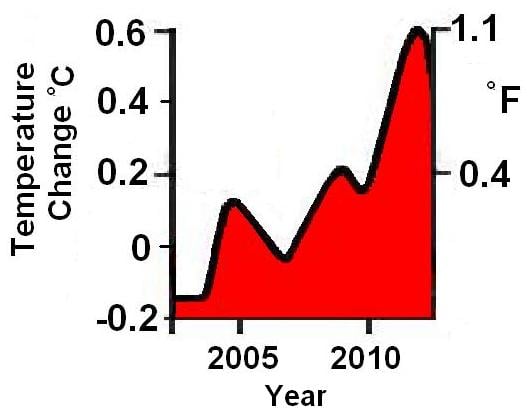
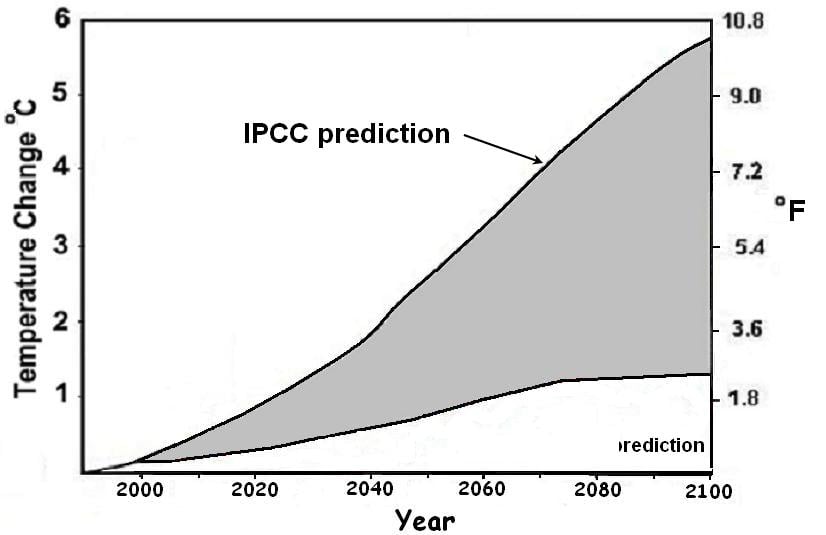
Despite no global warming in 10 years and recording setting cold in 2007-2008, the Intergovernmental Panel on Climatic Change (IPCC) and computer modelers who believe that CO2 is the cause of global warming still predict the Earth is in store for catastrophic warming in this century. IPCC computer models have predicted global warming of 1° F per decade and 5-6° C (10-11° F) by 2100 (Fig. 1), which would cause global catastrophe with ramifications for human life, natural habitat, energy and water resources, and food production. All of this is predicated on the assumption that global warming is caused by increasing atmospheric CO2 and that CO2 will continue to rise rapidly.


Figure 1. A. IPCC prediction of global warming early in the 21st century. B. IPCC prediction of global warming to 2100. (Sources: IPCC website)
However, records of past climate changes suggest an altogether different scenario for the 21st century. Rather than drastic global warming at a rate of 0.5 ° C (1° F) per decade, historic records of past natural cycles suggest global cooling for the first several decades of the 21st century to about 2030, followed by global warming from about 2030 to about 2060, and renewed global cooling from 2060 to 2090 (Easterbrook, D.J., 2005, 2006a, b, 2007, 2008a, b); Easterbrook and Kovanen, 2000, 2001). Climatic fluctuations over the past several hundred years suggest ~30 year climatic cycles of global warming and cooling, on a general rising trend from the Little Ice Age.
PREDICTIONS BASED ON PAST CLIMATE PATTERNS
Global climate changes have been far more intense (12 to 20 times as intense in some cases) than the global warming of the past century, and they took place in as little as 20–100 years. Global warming of the past century (0.8° C) is virtually insignificant when compared to the magnitude of at least 10 global climate changes in the past 15,000 years. None of these sudden global climate changes could possibly have been caused by human CO2 input to the atmosphere because they all took place long before anthropogenic CO2 emissions began. The cause of the ten earlier ‘natural’ climate changes was most likely the same as the cause of global warming from 1977 to 1998.

Figure 2. Climate changes in the past 17,000 years from the GISP2 Greenland ice core. Red = warming, blue = cooling. (Modified from Cuffy and Clow, 1997)
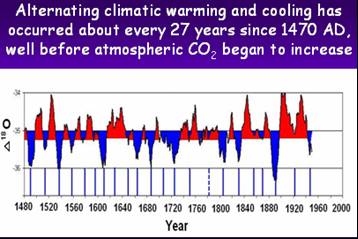
Climatic fluctuations over the past several hundred years suggest ~30 year climatic cycles of global warming and cooling (Figure 3) on a generally rising trend from the Little Ice Age about 500 years ago.

Figure 3. Alternating warm and cool cycles since 1470 AD. Blue = cool, red = warm. Based on oxygen isotope ratios from the GISP2 Greenland ice core.
Relationships between glacial fluctuations, the Pacific Decadal Oscillation, and global climate change.
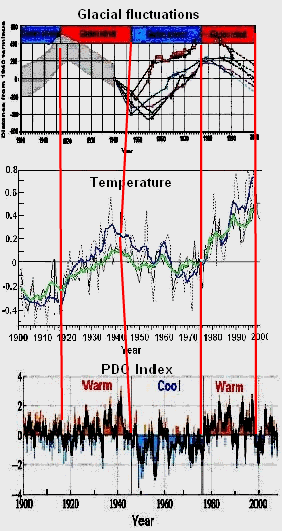
After several decades of studying alpine glacier fluctuations in the North Cascade Range, my research showed a distinct pattern of glacial advances and retreats (the Glacial Decadal Oscillation, GDO) that correlated well with climate records. In 1992, Mantua published the Pacific Decadal Oscillation curve showing warming and cooling of the Pacific Ocean that correlated remarkably well with glacial fluctuations. Both the GDA and the PDO matched global temperature records and were obviously related (Fig. 4). All but the latest 30 years of changes occurred prior to significant CO2 emissions so they were clearly unrelated to atmospheric CO2.

Figure 4. Correspondence of the GDO, PDO, and global temperature variations.
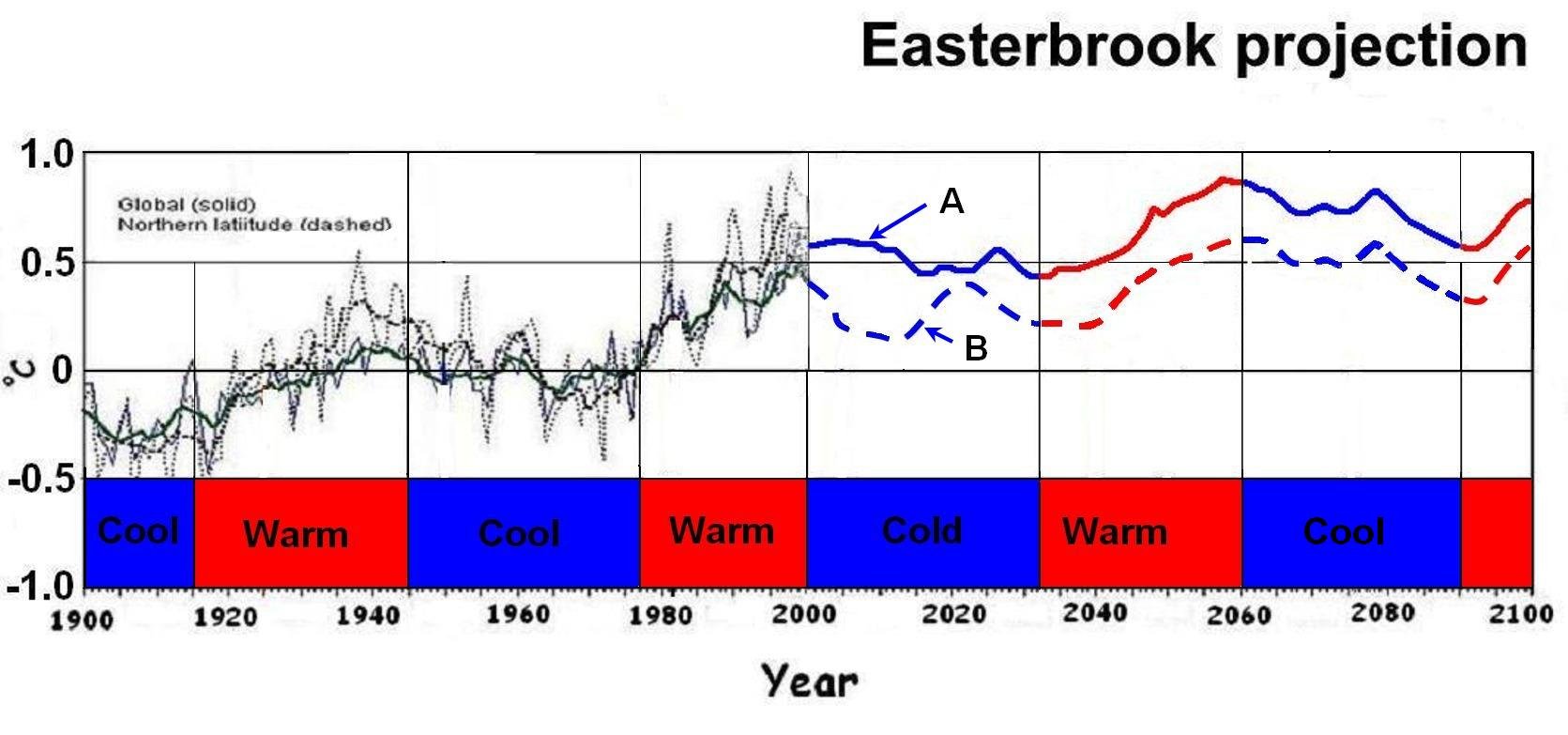
The significance of the correlation between the GDO, PDO, and global temperature is that once this connection has been made, climatic changes during the past century can be understood, and the pattern of glacial and climatic fluctuations over the past millennia can be reconstructed. These patterns can then be used to project climatic changes in the future. Using the pattern established for the past several hundred years, in 1998 I projected the temperature curve for the past century into the next century and came up with curve ‘A’ in Figure 5 as an approximation of what might be in store for the world if the pattern of past climate changes continued. Ironically, that prediction was made in the warmest year of the past three decades and at the acme of the 1977-1998 warm period. At that time, the projected curved indicated global cooling beginning about 2005 ± 3-5 years until about 2030, then renewed warming from about 2030 to about 2060 (unrelated to CO2—just continuation of the natural cycle), then another cool period from about 2060 to about 2090. This was admittedly an approximation, but it was radically different from the 1° F per decade warming called for by the IPCC. Because the prediction was so different from the IPCC prediction, time would obviously show which projection was ultimately correct.
Now a decade later, the global climate has not warmed 1° F as forecast by the IPCC but has cooled slightly until 2007-08 when global temperatures turned sharply downward. In 2008, NASA satellite imagery (Figure 6) confirmed that the Pacific Ocean had switched from the warm mode it had been in since 1977 to its cool mode, similar to that of the 1945-1977 global cooling period. The shift strongly suggests that the next several decades will be cooler, not warmer as predicted by the IPCC. 

Figure 5.Global temperature projection for the coming century, based on warming/cooling cycles of the past several centuries. ‘A’ projection based on assuming next cool phase will be similar to the 1945-1977 cool phase. ‘B’ projection based on assuming next cool phase will be similar to the 1880-1915 cool phase. The predicted warm cycle from 2030 to 2060 is based on projection of the 1977 to 1998 warm phase and the cooling phase from 2060 to 2090 is based on projection of the 1945 to 1977 cool cycle.
Implications of PDO, NAO, GDO, and sun spot cycles for global climate in coming decades
The IPCC prediction of global temperatures, 1° F warmer by 2011 and 2° F by 2038 (Fig. 1), stand little chance of being correct. NASA’s imagery showing that the Pacific Decadal Oscillation (PDO) has shifted to its cool phase is right on schedule as predicted by past climate and PDO changes (Easterbrook, 2001, 2006, 2007). The PDO typically lasts 25-30 years and assures North America of cool, wetter climates during its cool phases and warmer, drier climates during its warm phases. The establishment of the cool PDO, together with similar cooling of the North Atlantic Oscillation (NAO), virtually assures several decades of global cooling and the end of the past 30-year warm phase. It also means that the IPCC predictions of catastrophic global warming this century were highly inaccurate.
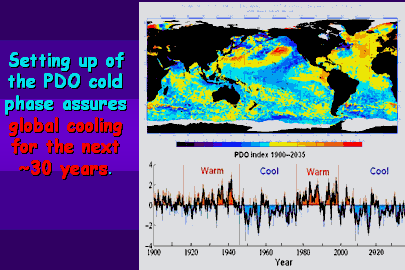
The switch of PDO cool mode to warm mode in 1977 initiated several decades of global warming. The PDO has now switched from its warm mode (where it had been since 1977) into its cool mode. As shown on the graph above, each time this had happened in the past century, global temperature has followed. The upper map shows cool ocean temperatures in blue (note the North American west coast). The lower diagram shows how the PDO has switched back and forth from warm to cool modes in the past century, each time causing global temperature to follow. Comparisons of historic global climate warming and cooling over the past century with PDO and NAO oscillations, glacial fluctuations, and sun spot activity show strong correlations and provide a solid data base for future climate change projections.
The Pacific Ocean has a warm temperature mode and a cool temperature mode, and in the past century, has switched back forth between these two modes every 25-30 years (known as the Pacific Decadal Oscillation or PDO). In 1977 the Pacific abruptly shifted from its cool mode (where it had been since about 1945) into its warm mode, and this initiated global warming from 1977 to 1998. The correlation between the PDO and global climate is well established. The announcement by NASA’s Jet Propulsion Laboratory that the Pacific Decadal Oscillation (PDO) had shifted to its cool phase is right on schedule as predicted by past climate and PDO changes (Easterbrook, 2001, 2006, 2007). The PDO typically lasts 25-30 years and assures North America of cool, wetter climates during its cool phases and warmer, drier climates during its warm phases. The establishment of the cool PDO, together with similar cooling of the North Atlantic Oscillation (NAO), virtually assures several decades of global cooling and the end of the past 30-year warm phase.


Figure 6. Switch of PDO cool mode to warm mode in 1977 initiated several decades of global warming. The PDO has now switched from its warm mode (where it had been since 1977) into its cool mode. As shown on the graph above, each time this has happened in the past century, global temperature has followed. The upper map shows cool ocean temperatures in blue (note the North American west coast). The lower diagram shows how the PDO has switched back and forth from warm to cool modes in the past century, each time causing global temperature to follow. Projection of the past pattern (right end of graph) assures 30 yrs of global cooling
Comparisons of historic global climate warming and cooling over the past century with PDO and NAO oscillations, glacial fluctuations, and sun spot activity show strong correlations and provide a solid data base for future climate change projections. As shown by the historic pattern of GDOs and PDOs over the past century and by corresponding global warming and cooling, the pattern is part of ongoing warm/cool cycles that last 25-30 years. The global cooling phase from 1880 to 1910, characterized by advance of glaciers worldwide, was followed by a shift to the warm-phase PDO for 30 years, global warming and rapid glacier recession. The cool-phase PDO returned in ~1945 accompanied by global cooling and glacial advance for 30 years. Shift to the warm-phase PDO in 1977 initiated global warming and recession of glaciers that persisted until 1998. Recent establishment of the PDO cool phase appeared right on target and assuming that its effect will be similar to past history, global climates can be expected to cool over the next 25-30 years. The global warming of this century is exactly in phase with the normal climatic pattern of cyclic warming and cooling and we have now switched from a warm phase to a cool phase right at the predicted time (Fig. 5)
The ramifications of the global cooling cycle for the next 30 years are far reaching―e.g., failure of crops in critical agricultural areas (it’s already happening this year), increasing energy demands, transportation difficulties, and habitat change. All this during which global population will increase from six billion to about nine billion. The real danger in spending trillions of dollars trying to reduce atmospheric CO2 is that little will be left to deal with the very real problems engendered by global cooling.
CONCLUSIONS
Global warming (i.e, the warming since 1977) is over. The minute increase of anthropogenic CO2 in the atmosphere (0.008%) was not the cause of the warming—it was a continuation of natural cycles that occurred over the past 500 years.
The PDO cool mode has replaced the warm mode in the Pacific Ocean, virtually assuring us of about 30 years of global cooling, perhaps much deeper than the global cooling from about 1945 to 1977. Just how much cooler the global climate will be during this cool cycle is uncertain. Recent solar changes suggest that it could be fairly severe, perhaps more like the 1880 to 1915 cool cycle than the more moderate 1945-1977 cool cycle. A more drastic cooling, similar to that during the Dalton and Maunder minimums, could plunge the Earth into another Little Ice Age, but only time will tell if that is likely.
Don J. Easterbrook is Professor Emeritus of Geology at Western Washington University. Bellingham, WA. He has published extensively on issues pertaining to global climate change. For further details see his list of publications