Monday, January 13, 2014

NSA Goes From Saying Bulk Metadata Collection 'Saves Lives' To 'Prevented 54 Attacks' To 'Well, It's A Nice Insurance Policy'

from the this-is-why-no-one-trusts-them dept

Want to know why no one trusts anything NSA officials and their defenders have to say any more? When the bulk metadata collection was first revealed, those defenders went on and on about how the program "saved countless lives" and was instrumental in stopping terrorist attacks. Some skeptics then asked what terrorist attacks, and we were told "around 50" though details weren't forthcoming. Eventually, we were told that the real number was "54 terrorist events" (note: not attacks) and a review of them later revealed that basically none of them were legitimate. There was one "event" prevented via the program on US soil, and it was a taxi driver in San Diego sending some money to a terrorist group in Somalia, rather than an actual terrorist attack.

In fact, both judges and the intelligence task force seemed shocked at the lack of any actual evidence to support that these programs were useful.

And yet, the NSA and its defenders keep insisting that they're necessary. Director of National Intelligence, James Clapper, a few months ago, tried out a new spin, claiming that effectiveness wasn't the right metric, but rather "peace of mind." Of course, the obvious response to that is to point out that spying on everyone makes most of us fairly uneasy, and we'd have a lot more "peace of mind" if they dropped the program.

And, now, the NSA number 2 guy, who's about to retire, John C. "Chris" Inglis, gave a long interview with NPR, in which he is now claiming that even if the program hasn't been particularly useful in the past, that "it's a good insurance policy."
"I'm not going to give that insurance policy up, because it's a necessary component to cover a seam that I can't otherwise cover."

REMEMBER THAT LITTLE “PROBLEM” WITH GERMANY’S GOLD? IT JUST BECAME WORSE, AS IN, HITLER ESCAPED, WITH A LITTLE HELP FROM HIS FRIENDS…(PART THREE)


Over the past two days I’ve been writing about the story of the problems of repatriating Germany’s gold. You’ll recall that I’ve argued that one cannot understand current secrecy and obfuscation concerning this issue, without an understanding of the history and hidden system of finance behind it, and the covert arrangements that were put into place during and after World War Two by the highest echelons of the Allied and Axis elites to implement that system.
I’ve suggested, in those blogs, that pulling on the golden Ariadne’s thread of Germany’s bullion reserves was a thread that would lead all the way through the labyrinth to the beast at the heart of it all, and the institutions and families supporting it.
In that respect, one should consider this news, kindly shared with me by Mr. T.M.:
Did US Intell Help Smuggle Hitler to South America?
Now, for readers unaware of it, Jerome Corsi is somewhat of a “fixture” in the alternative research community, and a well-respected researcher. I just read Mr. Corsi’s book concerning the survival of Adolf and Eva Hitler from the war, and  I concur in the main with the summary of its arguments:
“Corsi brings to light many troubling questions, including:
  • Why were the Americans unable to obtain physical evidence of Hitler’s remains after the Russians absconded with his body?
  • Why did both Stalin and Eisenhower doubt Hitler’s demise?
  • Why did nobody in Hitler’s bunker hear any shots fired?
  • Did U.S. intelligence agents in Europe, including the OSS and Allen Dulles (who later headed the CIA under President Eisenhower), aid Hitler’s escape, as they did with so many other Nazis?
  • Argentinean media reported Hitler arrived in the country and it continued to report his presence. Why have the findings not made it to the US?”
Indeed, as I have pointed out in The Nazi International and other books, Argentina is the forgotten World War Two belligerent, and its perspective on postwar events is all but ignored in mainstream Western Media.  (Consider: that curious Eisenhower “disappearance” in 1954 folks that so many in ufology think was to talk to “ETs” at a certain US Air Force base, or was he really just visiting a certain hotel cum-plastic surgery clinic in Argentina, as the Argentines maintain?) Its role and perspectives are signally important to a proper understanding of postwar history, including the persistent stories, since the end of the war, of Hitler’s presence in and around San Carlos di Bariloche and the Rio Negro province.
But the reasons for that malign presence are even more significant, and the article strongly suggests them:
“(Corsi) presents documentary evidence Allen Dulles’ wartime mission in Switzerland included helping Martin Bormann, Hitler’s secretary, to funnel billions of dollars of Nazi ill-gotten financial gain out of Germany and invest in the U.S. and Argentinian stock markets to provide a financial cushion to survive in hiding after the war.”
Well, this is the argument that I and other researchers have been making as well. But it would appear Mr. Corsi has added a new factor to consideration: namely, the exchange of a postwar hideout and non-prosecution for war crimes to Herr und Frau Hitler, in return for access to that vast pile of plunder the Nazis had looted from occupied Europe.
Pulling on that golden Ariadne’s thread of German bullion reserves thus inevitably invokes the dirty deals done between the corporate elite of the American and German “military industrial complexes”, and that leads ultimately to the implied dirty deals some within the Allied (and mostly American) camp made with Martin Bormann, and his boss. And it recalls some observations I made in The Nazi International: the German armed forces surrendered, and that could be taken to mean Germany did. But no one was present at either the Rheims or Berlin ceremonies signing for the Reich government itself, nor for the Nazi Party. It is a curious omission that, in the wider context of secret financial and intelligence deals and postwar Nazi “fusion” experiments in Argentina, make one wonder if that omission was not intentional. What was it that he said? Oh yea: “There will never again occur a November 1918 in German history,” and “I have never known the word ‘surrender.’”
And of all the people able to point a very aware and knowing finger at complicit American corporations and families that helped him and his regime into power, and of all the people that knew where he had instructed his lackey Bormann to “bury his treasure,” it was Adolf Hitler.  He and Bormann both knew of the depth of the deal struck with US General Siebert, and OSS station chief Allen Dulles, whose brother, John Foster, was Eisenhower’s secretary of State.

Declassified: Did U.S. Intel Smuggle Hitler To South America ?

Posted by

World Net Daily
Everyone knows Adolf Hitler committed suicide by gunshot in his underground bunker on April 30, 1945.
At least, that has been the conventional wisdom.
Now comes WND senior staff reporter Jerome R. Corsi’s new book, “Hunting Hitler: New Scientific Evidence That Hitler Escaped Germany.”
Examining declassified FBI and U.S. military intelligence files, Corsi makes a compelling case that U.S. investigators suspected from the beginning Hitler had escaped. For political purposes, the evidence indicates, they were willing to go along with the cover story that in the final days of World War II, Hitler married his mistress, Eva Braun, and the two took their lives in a joint-suicide ritual just before the Soviet army entered Berlin.
But the truth is, no one actually saw Hitler commit suicide. There are no photographs documenting a joint suicide of Hitler and Eva Braun, and the bodies of the two were never recovered or preserved for positive identification.
In 2009, Corsi pointed out, Nicholas Bellatoni, the Connecticut state archaeologist, was allowed by the Russian Federation State Archive in Moscow to examine skull fragments the Russians have claimed for decades are proof Hitler committed suicide.
Bellatoni’s startling findings prompted Corsi to investigate further.
“What caused me to question Hitler’s suicide was Bellatoni’s DNA analysis that proved conclusively the skull fragments belonged not to Hitler, but to a 40-year-old woman unrelated to Eva Braun,” Corsi said.
In “Hunting Hitler,” Corsi posits Hitler made his way to Argentina with the help of U.S. intelligence agents that had been secretly working with the Nazis since 1943. Allen Dulles, then an agent of the Office of Strategic Services, or OSS, the predecessor agency to the CIA, was communicating secretly with top Nazis from his office in Bern, Switzerland, Corsi said.
Corsi brings to light many troubling questions, including:
  • Why were the Americans unable to obtain physical evidence of Hitler’s remains after the Russians absconded with his body?
  • Why did both Stalin and Eisenhower doubt Hitler’s demise?
  • Why did nobody in Hitler’s bunker hear any shots fired?
  • Did U.S. intelligence agents in Europe, including the OSS and Allen Dulles (who later headed the CIA under President Eisenhower), aid Hitler’s escape, as they did with so many other Nazis?
  • Argentinean media reported Hitler arrived in the country and it continued to report his presence. Why have the findings not made it to the US?
Corsi relies on autopsy reports, interrogation transcripts, documents from Soviet archives, CIA reports, extensive research in the National Archives and Records Administration in Washington, D.C., and in College Park, Md., and more to back up his case.
Did U.S. intelligence help Hitler get away?
His evidence is shockingly abundant, and his clear argument lends credence to a new theory that disembowels the double-suicide narrative.
“The story Hitler and Eva Braun committed suicide was a cover story, designed by U.S. intelligence agents at the end of World War II to facilitate the escape not only of Hitler and Eva Braun, but also of top Nazi war criminals such as Adolf Eichmann who was discovered in 1960 hiding in Argentina,” Corsi argued.
He presents documentary evidence Allen Dulles’ wartime mission in Switzerland included helping Martin Bormann, Hitler’s secretary, to funnel billions of dollars of Nazi ill-gotten financial gain out of Germany and invest in the U.S. and Argentinian stock markets to provide a financial cushion to survive in hiding after the war.
Continue Reading

The heartbreaking final tweets of an overworked copywriter

it's called ..get a fucking life ..who controls "their"  Life  ... we ALL make "choices"   we ALL CHOOSE Our own ..fate  ...  how can you help somebody ..who doesn't /wont  help  themselves 1st  ?       why is IT always God ... or our fault  ...we all have the POWER to ..choose   our path
“Please people,” wrote her mother’s coworker on Path the night of Miran’s passing. “Know your own body limits and don’t push yourself too hard.”
B3fGMJj.jpg (JPEG Image, 1280 × 960 pixels)

In June of 2011, Mita Diran wrote “an open plea” on her Tumblr:
“Tonight, I carry the keys to the office for the eighth day running. I’m still here. I have no life. Someone please take me out for drinks, kicks and giggles.”
But the young Indonesian copywriter never got the break—or the help—she was seeking. On Dec. 14, Diran posted the following tweet:
Hours later, she was dead.
“Hi everyone,” Diran’s mother, Yani Syahrial, wrote Dec. 15 on Path, the image-sharing social network popular in Indonesia.
“Since last night and until now my daughter who is a copywriter lay in coma in RSPP. Chances not very good. She collapsed after continuous working overtime for 3 days last night. i have not slept since then.”
Diran would never wake up. She died of a heart failure-induced coma.
Like her mother, reportedly the creative director of an ad agency, Diran loved advertising. “Pretty words make my blood hum, and so does good food,” she wrote on her Instagram, which suggested a young writer living an exciting life in the city.
But in the days leading up to her death, her Twitter told a different story—of a workaholic struggling to “crawl out of the quicksand” of her own life:
Her tweet history suggests that she struggled to break out of her work-centric lifestyle:
Diran’s employer was the Jakarta branch of international ad agency conglomerate Young & Rubicam, which claims offices in 186 countries and 6,800 employees. As one of them, Diran routinely worked long hours. In the long weeks before her death, her family suggested, she might have worked as many as three days straight.
The VulcanPost reported that within the Indonesian Facebook and Twitter community, outrage boiled over with the hashtag #RIPMita and images like the one below, which reads, “ “How many more lives will it take to change all this? RIP, Mita Diran:”
“Mita was a talented copywriter with a gentle smile who will always live on in our hearts,” the agency wrote Dec. 15 in a statement released through Facebook and Twitter. Angry comments flooded the company’s Facebook page as friends and supporters accused the agency of fostering stressful working conditions.
Diran may not have been caught in the cutthroat business of Mad Men, but her own tweets hint at the kind of competitive atmosphere in which she worked:
Diran is not the first young employee to die on the job in recent years after working strenuous hours. A 21-year-old Merrill Lynch employee recently died after suffering an epileptic seizure that may have been due to extreme overworking and stress. A Beijing ad agency employee died in May after collapsing due to “work-related exhaustion.”
Industry insiders suggested the two ad agency deaths were due to improper project management on the part of supervisors. Additionally, Diran reportedly subsisted on Krating Daeng, the Thai predecessor of Red Bull, during her marathon work sessions. Though Red Bull is currently facing a wrongful death lawsuit, no deaths have been officially attributed to Krating Daeng.
On Twitter, friends and supporters have sent condolences and words of caution using the hashtag #RIPDiraMiran.
“Please people,” wrote her mother’s coworker on Path the night of Miran’s passing. “Know your own body limits and don’t push yourself too hard.”
Photo via @mitdog/Twitter

How To Protect A Portable Radio From EMP

January 9, 2014, by Ken Jorgustin

protect-a-portable-radio-from-emp
Protecting a portable Shortwave/AM/FM radio from an EMP (electro-magnetic-pulse) is (theoretically) fairly easy, and is a wise course of preventative action to take with a critical electronic piece of equipment like a radio which could provide you with critical news and information about an ongoing disaster…


An EMP event (from a solar super-storm or nuclear EMP attack) could bring down the electrical power grid — either regionally or even wider; and if strong enough, it has the potential to critically damage circuits within electronic devices…
A portable shortwave radio has the ability to receive stations all around the world, and could be your information lifeline after an EMP event — enabling you to hear communications from far away in other regions of the world that are still “up and running”, and will provide invaluable insight to your predicament.
The thing is… if your radio has been fried by the EMP, then you’re SOL…

An EMP

An EMP from a nuclear atmospheric detonation is an instantaneous jolt of tens of thousands of volts per square meter that is generated from the interaction between the explosion and the Earth’s magnetic field.
The invisible but catastrophic pulse occurs instantly over an area that is within line-of-sight of the EMP-weapon detonation while its devastating electro-magnetic-pulse decays by the inverse-square-law the further away it gets form its origin.
Having said that, an EMP detonation at an altitude of 50 miles would affect an area with a diameter of 1,400 miles while a detonation altitude of 200 miles would affect an area of 2,900 miles in diameter. The area directly beneath the blast is affected the worst, while the extreme fringes are barely affected.
The EMP effects from from a massive solar flare event from the sun — similar to what happened in 1859 (the Carrington event), could also bring down the electrical power grid, although may not affect stand-alone electronics like radios, etc. as would a nuclear EMP weapon attack (the grid-down would be bad enough…).
An EMP potentially has the energy to wipe out things ‘electronic’ and could potentially send a region back to the 1800′s in the blink of an eye. An EMP weapon is a very real threat in today’s increasingly unstable world and has always been a threat from the sun.

Protect your portable radio from EMP

I will preface this opinion with the fact that none of us have ever experienced a major EMP event and there has never been an attack anywhere in the world using a nuclear EMP weapon (as of this post). Therefore any advice as to how and protect your electronics are theoretical at best. You might say that there has not been any real ‘hands-on’ experience…

First, completely wrap your portable radio in a non-conductive material being sure that no (metal) part of the radio is exposed before the next step. You can use paper, a paper bag, cardboard, or even easier…slip the radio inside a zip lock bag (if it fits). If using a Zip lock bag, ‘burp’ the bag of air for a nice snug fit.
Next firmly wrap the now-covered radio with aluminum foil — being sure not to leave any open spaces. Wrap tight and well.
Repeat the process for even more protection… another non-conductive layer or zip lock bag over the now-wrapped radio… followed by another wrapping of aluminum foil.
Lastly, place the now-wrapped radio in yet another bag so as to protect the outer foil layer from tearing.
The theory is that the pulse will enter the conductive foil and dissipate around it while not affecting (or inducing currents) within the electronic circuits which are isolated and protected inside the bag.
It is, in effect, a do-it-yourself Faraday cage. A Faraday cage is a conductive casing that prevents the electromagnetic radiation from reaching the electronic circuits contained within.
It is the opinion of many that a make-shift Faraday cage does not have to be grounded in order to prevent damaging electrical currents from an EMP getting inside the protected electronic circuits which are isolated within.
Another simple technique is to use a metal trash can with a secure metal lid. Line the trash can with cardboard or other such non-conductive material, and place your radio and other salvageable electronics inside.

Myth: War is beneficial

Probably the most common defense of wars is that they are necessary evils.  That myth is debunked on its own page here. /// http://worldbeyondwar.org/beneficial

But wars are also defended as being in some way beneficial. The reality is that wars do not benefit the people where they are waged, and do not benefit nations that send their militaries abroad to wage wars. Nor do wars help to uphold the rule of law -- quite the reverse. Good outcomes caused by wars are dramatically outweighed by the bad and could have been accomplished without war.

Polls in the United States through the 2003-2011 war on Iraq found that a majority in the U.S. believed Iraqis were better off as the result of a war that severely damaged -- even destroyed -- Iraq[1]. A majority of Iraqis, in contrast, believed they were worse off.[2] A majority in the United States believed Iraqis were grateful.[3] This is a disagreement over facts, not ideology. But people often choose which facts to become aware of or to accept. Tenacious believers in tales of Iraqi "weapons of mass destruction" tended to believe more, not less, firmly when shown the facts. The facts about Iraq are not pleasant, but they are important.

War Does Not Benefit Its Victims

To believe that the people who live where your nation's government has waged a war are better off for it, despite those people's contention that they are worse off, suggests an extreme sort of arrogance -- an arrogance that in many cases has explicitly relied on bigotry of one variety or another: racism, religion, language, culture, nationalism, or general xenophobia. A poll of people in the United States or any nation involved in occupying Iraq would almost certainly have found opposition to the idea of their own nation being occupied by foreign powers, no matter how benevolent the intentions. This being the case, the idea of humanitarian war is a violation of the most fundamental rule of ethics, the golden rule that requires giving others the same respect you desire. And this is true whether the humanitarian justification of a war is an afterthought once other justifications have collapsed or humanitarianism was the original and primary justification.

There is also a fundamental intellectual error in supposing that a new war is likely to bring benefits to a nation where it is waged, given the dismal record of every war that has occurred heretofore. Scholars at both the anti-war Carnegie Endowment for Peace and the pro-war RAND Corporation have found that wars aimed at nation-building have an extremely low to nonexistent success rate in creating stable democracies.  And yet the temptation rises zombie-like to believe that Iraq or Libya or Syria or Iran will finally be the place where war creates its opposite.

Advocates for humanitarian war would be more honest if they totalled the supposed good accomplished by a war and weighed it against the damage done. Instead, the often-quite-dubious good is taken as justifying absolutely any tradeoff. The U.S. didn't count the Iraqi dead. The U.N. Security Council required that the U.N.'s human rights officer report on Libyans killed by NATO only in closed session.

Believers in humanitarian war often distinguish genocide from war. Pre-war demonization of dictators (often dictators who have been generously funded by their would-be assailants for decades prior) frequently repeats the phrase "killed his own people" (but do not ask who sold him the weapons or provided the satellite views). The implication is that killing "his own people" is significantly worse than killing someone else's people. But if the problem we want to address is mass-killing, then war and genocide are siblings and there is nothing worse than war that war can be used to prevent -- even were it the case that war tended to prevent, rather than to fuel, genocide.

Wars fought by wealthy nations against poor ones tend to be one-sided slaughters; quite the opposite of beneficial, humanitarian, or philanthropic exercises.  In a common mythical view, wars are fought on "a battlefield" -- a notion that suggests a sportsmanlike contest between two armies apart from civilian life. On the contrary, wars are fought in people's towns and homes. These wars are one of the most immoral actions imaginable, which helps explain why governments that wage them lie about them to their own people.

The wars leave lasting damage in the form of brewing hatred and violence, and in the form of a poisoned natural environment. Belief in the humanitarian possibilities for war can be shaken by looking closely at the short- and long-term results of any war. War tends to leave behind danger, not security -- in contrast to the more successful record of nonviolent movements for fundamental change.  War and preparations for war removed the entire population of Diego Garcia; of Thule, Greenland; of much of Vieques, Puerto Rico; and of various Pacific Islands with Pagan Island next on the endangered list. Also threatened is the village on Jeju Island, South Korea, where the U.S. Navy wants a new base built. Those who have lived down-wind or down-stream from weapons testing have often been little better off than those who have been targeted by weapons use.

Violations of human rights can always be found in nations that other nations wish to bomb, just as they can be found in nations whose dictators are being funded and propped up by the very same humanitarian crusaders, and just as they can be found within those warrior nations themselves. But there are two major problems with bombing a nation to expand its respect for human rights. First, it tends not to work. Second, the right not to be killed or injured or traumatized by war ought to be considered a human right worthy of respect as well. Again, a hypocrisy check is useful: How many people would want their own town bombed in the name of expanding human rights?

Wars and militarism and other disastrous policies can generate crises that could benefit from outside assistance, be it in the form of nonviolent peaceworkers and human shields or in the form of police. But twisting the argument that Rwanda needed police into the argument that Rwanda should have been bombed, or that some other nation should be bombed, is a gross distortion.

Contrary to some mythical views, suffering has not been minimized in recent wars. War cannot be civilized or cleaned up. There's no proper conduct of war that avoids inflicting serious and unnecessary pain. There is no guarantee that any war can be controlled or ended once begun. The damage usually lasts much longer than the war. Wars do not end with victory, which cannot even be defined.

War Does Not Bring Stability
War can be imagined as a tool for enforcing the rule of law, including laws against war, only by ignoring the hypocrisy and the historical record of failure. War actually violates the most basic principles of law and encourages their further violation. The sovereignty of states and the requirement that diplomacy be conducted without violence fall before the hammer of war. The Kellogg-Briand Pact, the U.N. Charter, and domestic laws on murder and on the decision to go to war are violated when wars are launched and escalated and continued. Violating those laws in order to "enforce" (without actually prosecuting) a law banning a particular type of weapon, for example, does not make nations or groups more likely to be law abiding. This is part of why war is such a failure at the task of providing security.
War Does Not Benefit the War Makers

War and war preparations drain and weaken an economy. The myth that war enriches a nation that wages it, as opposed to enriching a small number of influential profiteers, is not supported by evidence.

A further myth holds that, even if war impoverishes the war making nation, it can nonetheless be enriching it more substantially by facilitating the exploitation of other nations. The leading war-making nation in the world, the United States, has 5% of the world's population but consumes a quarter to a third of various natural resources. According to this myth, only war can allow that supposedly important and desirable imbalance to continue.
There is a reason why this argument is rarely articulated by those in power and plays only a minor role in war propaganda. It is shameful, and most people are ashamed of it. If war serves not as philanthropy but as extortion, admitting as much hardly justifies the crime. Other points help weaken this argument:
  • Greater consumption and destruction does not always equal a superior standard of living.
  • The benefits of peace and international cooperation would be felt even by those learning to consume less.
  • The benefits of local production and sustainable living are immeasurable.
  • Reduced consumption is required by the earth's environment regardless of who does the consuming.
  • One of the largest ways in which wealthy nations consume the most destructive resources, such as oil, is through the very waging of the wars.
  • Green energy and infrastructure would surpass their advocates' wildest fantasies if the funds now invested in war were transferred there.

War provides fewer jobs than alternative spending or tax cuts, but war can supposedly provide noble and admirable jobs that teach young people valuable lessons, build character, and train good citizens. In fact, everything good found in war training and participation can be created without war. And war training brings with it much that is far from desirable. War preparation teaches and conditions people for behavior that is normally considered the worst affront to society possible. It also teaches dangerous extremes of obedience. While war can involve courage and sacrifice, paring these with blind support for ignoble goals sets a bad example indeed. If thoughtless courage and sacrifice is a virtue, ant warriors are demonstrably more virtuous than human ones.
Advertisements have credited recent wars with helping to develop brain surgery techniques that have saved lives outside of wars. The internet on which this website exists was developed largely by the U.S. military. But such silver linings could be shining stars if created apart from war. Research and development would be more efficient and accountable and more directed into useful areas if separated from the military.

Similarly, humanitarian aid missions could be run better without the military. An aircraft carrier is an overpriced and inefficient means of bringing disaster relief. The use of the wrong tools is compounded by justifiable skepticism from people aware that militaries have frequently used disaster relief as cover for escalating wars or stationing forces permanently in an area.
War Creators' Motives Are Not Noble

Wars are marketed as humanitarian, because many people, including many government and military employees, have good intentions. But those at the top deciding to wage war almost certainly do not. In case after case, less than generous motives have been documented.

"Every ambitious would-be empire, clarions it abroad that she is conquering the world to bring it peace, security and freedom, and is sacrificing her sons only for the most noble and humanitarian purposes. That is a lie, and it is an ancient lie, yet generations still rise and believe it." —Henry David Thoreau


Footnotes:

Each line above to be footnoted here.

1.
The last such poll may have been Gallup in August 2010.
2.
Zogby, Dec. 20, 2011.
3.
The last such poll may have been CBS News in August 2010.


Video and Audio:
Nobel Lecture by Harold Pinter

Jean Bricmont on Talk Nation Radio

Rafia Zakaria on Talk Nation Radio

Articles:

War Should Be Ended: Part II of "War No More: The Case for Abolition" by David Swanson

Wars Are Not Waged Out of Generosity: Chapter 3 of "War Is A Lie" by David Swanson

Wars Are Not Won, And Are Not Ended by Enlarging Them: Chapter 9 of "War Is A Lie" by David Swanson

Books:

Humanitarian Imperialism: Using Human Rights to Sell War by Jean Bricmont

Killing Hope: U.S. Military Interventions Since World War II
by William Blum

Arab Spring, Libyan Winter
by Vijay Prashad

Slaughterhouse-Five by Kurt Vonnegut

The Phoenix Program by Douglas Valentine
War Is A Lie by David Swanson

War No More: The Case for Abolition by David Swanson

Overtthrow: America's Century of Regime Change from Hawaii to Iraq by Stephen Kinzer

Winter Soldier: Iraq and Afghanistan: Eyewitness Accounts of the Occupations
by Iraq Veterans Against the War and Aaron Glantz

Island of Shame: The Secret History of the U.S. Military Base on Diego Garcia by David Vine

Why America Fights: Patriotism and War Propaganda from the Philippines to Iraq
by Susan Brewer

The Shock Doctrine: The Rise of Disaster Capitalism
by Naomi Klein

The Liberal Defence of Murder by Richard Seymour

Rwanda and the New Scramble for Africa: From Tragedy to Useful Imperial Fiction by Robin Philpot

Slouching Toward Sirte: NATO's War on Libya and Africa by Maximilian Forte

Other Myths:

War is inevitable.
War is necessary.

Sexting common, linked to sex among high-risk youth


NEW YORK (Reuters Health) - More than one in five middle-school aged children with behavioral or emotional problems has recently engaged in sexting, according to a new study.
What's more, researchers found those who reported sexting in the past six months were four to seven times more likely to also engage in other sexual behaviors, compared to adolescents who said they didn't sext.
"We know early adolescents are using mobile phones and all forms of technology more and more and we know that early adolescence is a time when people become engaged in sexual activity," Christopher Houck said. "So how those two connect is an important area of study."
Houck is the study's lead author and a staff psychologist at Rhode Island Hospital's Bradley Hasbro Children's Research Center in Providence.
"Sexting" refers to sending nude or seminude images or sexually explicit messages over an electronic device, such as a mobile phone.
Previous research has found that about one in four teens admits to sexting, but the new study is among the first to estimate how many younger adolescents send sexually explicit images or messages.
Houck cautioned, however, that the findings are based on youths who were determined to have behavioral and emotional problems. They may not apply to all middle-school aged children.
The 420 participants, who were between 12 and 14 years old, were recruited from five urban public middle schools in Rhode Island between 2009 and 2012.
The results are based on an initial questionnaire the participants took as part of a larger study that is attempting to reduce risky behaviors among adolescents with behavioral or emotional problems.
Overall, 17 percent of the participants said they had sent a sexually explicit text message in the past six months. Another 5 percent reported sending both sexually explicit text messages and nude or seminude photos, according to findings published Monday in the journal Pediatrics.
Adolescents who said they were further along in puberty and those who had trouble processing their emotions were most likely to report sexting.
"It could be that for kids who have trouble with emotional processing that it's a little bit easier to sext somebody than to say face-to-face, 'Hey, I like you' and see what that response is," Houck said.
The researchers also found that participants who reported any type of sexting were between four and seven times more likely to engage in other sexual behaviors, compared to those who didn't sext.
Those other behaviors included making out, touching genitals and having vaginal or oral sex.
Adolescents who reported sending sexually explicit images in addition to text messages were the most likely to engage in those other behaviors, according to the researchers.
Youths who reported sexting were also more likely to report intending to have sex, Houck said.
"I think it adds to the growing literature on this that the line between offline and online behaviors is becoming increasingly blurred," Jeff Temple, who was not involved with the new research, told Reuters Health of the study.
Temple is director of behavioral health and research in the Department of Obstetrics and Gynecology at the University of Texas Medical Branch in Galveston.
He said this and similar studies reinforce calls for parents and guardians to have ongoing conversations with adolescents about sexual behaviors, including sexting.
"It should go hand in hand with a talk about healthy relationships and sexual behavior," Temple said. "It's just part of the new portfolio of adolescence these days."
In a previous study, Temple and his colleagues found that almost 60 percent of teens had been asked to send naked photos of themselves through text or email.
"That's going to happen," he said. "Your kid is going to be asked to send a naked picture."
Houck said conversations about sexting should be worked into talks that parents should be having throughout their child's lifespan about developmental milestones.
"If you're waiting for your child to come to you and you never broached that topic, they're not going to know you're open to that kind of conversation," he said.
Houck also said sexting may be a way for a pediatrician to broach the topic of broader sexual behavior.
"This can be sometimes a less threatening strategy to get adolescents to open up," he said.
SOURCE: Pediatrics, online January 6, 2014.

Taxpayers Paid Nearly $175M for Penis Pumps Between 2006 and 2011

no shit :o


Federal government paid more than double the retail price
Andromedical Indonesia Flickr
BY:

Taxpayers paid nearly $175 million for vacuum erection systems (VES), commonly known as “penis pumps,” from 2006 to 2011, according to an inspector general report released on Monday.
The federal government paid more than double the retail price for VES, the Department of Health and Human Services IG found. Medicare prices for the systems, the report said, “remain grossly excessive compared with the amounts that non-Medicare payers pay.”
Medicare paid 473,620 VES claims during calendar years 2006 through 2011, according to the IG report.
Health care policy experts said the revelations in the IG report are a troubling indication of what they describe as wasteful spending in federal health programs.
“The fact that taxpayers have spent more than a quarter of a billion dollars over the past decade on penis pumps via Medicare is obscene and insulting – even more so when you consider that this is an arena of Medicare expenditures rife with fraud and where the government doesn’t even bother to assess medical necessity,” said Ben Domenech, a senior fellow at the Heartland Institute.
“This is a perfect example of what happens when government becomes the be all and end all of human existence – a system where everyone has a right to a taxpayer-funded penis pump.”
Vacuum erection systems, which are used to treat impotence, are covered by Medicare Part B under its Durable Medical Equipment, Prosthetics, Orthotics, and Supplies (DMEPOS) competitive bidding program.
Medicare payments for VES have swelled in recent years. The Department of Health and Human Services paid $20.6 million for 61,589 claims in 2006. It paid $38.6 million for 103,448 claims in 2011.
That increase came despite recommendations from federal watchdogs that HHS limit payments for certain DMEPOS claims, including those made for VES.
The Centers for Medicare and Medicaid Services recommended changing the fee schedule for VES and five other DMEPOS products in a 1999 notice in the federal register.
Existing fee schedules, CMS said, were “grossly excessive.” Medical device manufacturers, though, “expressed concerns about the payment limits,” the IG noted.
Congress instructed the Government Accountability Office to examine the issue. It mostly concurred in 2000 with CMS’s recommendations for a revised fee schedule. HHS issued regulations granting CMS the authority to adjust the pay schedule, but the agency never actually did so.
Most VES, the IG noted, are purchased through mail-order services online, over the phone, or by mail. The authors examined retail prices through Google and Yahoo! search results.
“Medicare currently pays suppliers more than twice as much for VES as the Department of Veterans Affairs and consumers over the Internet pay for these types of devices,” the IG found.
By exercising that authority and limiting Medicare payments for VES, the IG found, CMS could save taxpayers millions. For the six years examined in the report, a pay schedule on par with standard consumer prices would have saved Medicare, on average, $14.4 million per year.
Because Medicare covers 80 percent of DMEPOS claims, with consumers footing the other 20 percent, a revised fee schedule could also provide direct savings for Medicare beneficiaries themselves, to the tune of $3.6 million per year.

NIH Commits $5 Million to ‘Mine’ Facebook, Instagram, Twitter to Study Drug Abuse

  don't fer~geet 2 fill in yer nazi "dossier"    daily   folks :o                          

Funding to ‘observe and systemically analyze’ social media interactions
AP
AP
BY:

The federal government has committed $5 million to “mine and analyze” social media for studies on Americans’ drug habits.
The National Institutes of Health (NIH) posted two matching grant announcements on Jan. 3, allotting a total of $5 million to be spent this year. The funding will go to several projects that will involve monitoring sites such as Facebook, Twitter, and Instagram to survey the population’s drug and alcohol use, and conduct “social media-based interventions” aimed at altering behaviors.
“The goal of this [Funding Opportunity Announcement] FOA is to inspire and support research projects investigating the role of social media in risk behaviors associated with the use and abuse of alcohol, tobacco, and other drugs (hereafter referred to as ‘ATOD’) and projects using social media to ameliorate such behaviors,” the NIH said in one announcement, worth $1.5 million.
The studies will use social media interactions as “surveillance tools to aid in the understanding of the epidemiology, risk factors, attitudes, and behaviors associated with ATOD use and addiction.”
The NIH said the growing use of social media provides the government with an “unprecedented opportunity” to facilitate research and change behaviors, since roughly 80 percent of American adults regularly use social media.
“Social influences play a key role in shaping health behaviors,” the NIH said in an overview of the project. “With the recent surge of social media, online user-generated content and social networking sites (such as Facebook, Instagram, and Twitter) are becoming an integral part of the communication landscape.”
“Consequently, social media are increasingly affecting people’s everyday behaviors, including their attitudes to issues relevant to health,” the agency said.
“Various technologies and tools to analyze social media interactions have proliferated and are commercially available,” the NIH said. “In this context, behavioral scientists have the unprecedented opportunity to observe and systemically analyze the interactions occurring in social media in studies that may contribute to the goal of improving public health.”
The projects will involve two investigative areas, including “observational research,” and online interventions that “take advantage of social media” to prevent drug abuse.
The NIH will pay for studies that use “advanced computational techniques to mine and analyze content of public dialogue on social media.” The observational area will also identify social media “use patterns” by age, gender, and “health profiles.” Other studies will use social media to identify underage drinking.
The research can then be used to examine changing laws related to health behaviors, with a “special interest in cannabis use,” the NIH said.
“Monitor social media trends to understand the effects of changing federal, state, or local laws, regulations, and policies on ATOD with a special interest in cannabis use,” one objective states.
The second area of research will sanction “social media-based interventions delivered via mobile technology.”
The NIH will begin accepting applications next month. Each grant opportunity will provide funding for six or seven studies, ranging from $200,000 to $400,000 in direct costs per year. The projects will last between two and three years.
The federal government is already funding studies for using social media to target health behavior. The National Library of Medicine is spending $30,000 to mine Facebook and Twitter, and learn how tweets can be used as “change-agents” for health behavior.
The NIH has also given $82,800 on how to use Twitter for surveillance on depressed people.
The NIH said in announcing an additional $5 million that not enough research has been done on social media’s effect on health.
“Social networking sites and social media interactions present an important data source for understanding health behaviors and attitudes,” it said. “However, current scientific evidence for social media’s utility in health promotion is limited and inconclusive.”
“User-generated social media interactions may offer realistic insights into substance use patterns, intentions, consequences, situational factors, and triggering social contexts,” the NIH said.

“Wiping Countries Off the Map”: Who’s Failing the “Failed States”

Washington is in the "business of destroying" a very long list of countries.


war
“Across the world, a dangerous rumor has spread that could have catastrophic implications. According to legend, Iran’s President has threatened to destroy Israel, or, to quote the misquote, “Israel must be wiped off the map”. Contrary to popular belief, this statement was never made, …” (Arash Norouzi, Wiped off  The Map: The Rumor of the Century   January 2007)
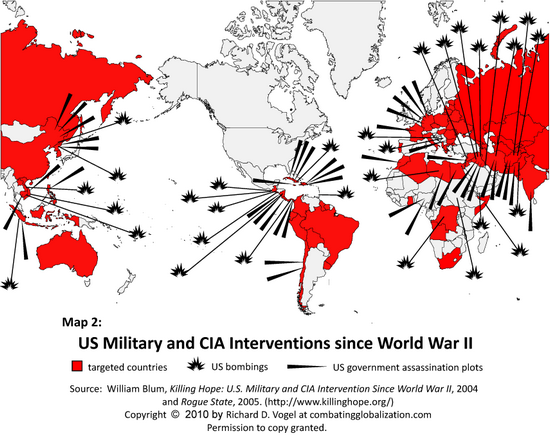
The United States has attacked, directly or indirectly, some 44 countries throughout the world since August 1945, a number of them many times. The avowed objective of these military interventions has been to effect “regime change”. The cloaks of “human rights” and of “democracy” were invariably evoked to justify what were unilateral and illegal acts. (Professor Eric Waddell,  The United States’ Global Military Crusade (1945- ), Global Research, February 2007
This is a [Pentagon] memo that describes how we’re going to take out seven countries in five years, starting with Iraq, and then Syria, Lebanon, Libya, Somalia, Sudan and, finishing off, Iran.” I said, “Is it classified?” He said, “Yes, sir.” I said, “Well, don’t show it to me.” (General Wesley Clark, Democracy Now, March 2, 2007)
*         *        *

Washington is in the “business of destroying” a very long list of countries.

Who is “Wiping Countries off the Map”? Iran or the United States?
During a period which is euphemistically called the “post-war era” –extending from 1945 to the present–, the US has directly or indirectly attacked more than 40 countries.
While the tenets of US foreign policy are predicated on the “spread of democracy”, US interventionism –through military means and covert operations– has resulted in the outright destabilization and partition of sovereign nations.
Destroying countries is part of a US Imperial project, a process of global domination.  Moreover, according to official sources, the US has a total of 737 military bases in foreign countries. (2005 data)
The Notion of “Failed States”
The Washington based National Intelligence Council (NIC) in its Global Trends report  (December 2012)  “predicts” that 15 countries in Africa, Asia and the Middle East will become “failed states” by 2030, due to their “potential for conflict and environmental ills”.
The list of countries in the 2012 NIC report includes Afghanistan, Pakistan, Bangladesh, Chad, Niger, Nigeria, Mali, Kenya, Burundi, Ethiopia, Rwanda, Somalia, DR Congo, Malawi, Haiti, Yemen. (see p  39)
In its previous 2005 report, published at the outset of Bush’s second term, the National Intelligence Council had predicted that Pakistan would become a “failed’ state” by 2015 “as it will be affected by civil war, complete Talibanisation and struggle for control of its nuclear weapons”.
Pakistan was compared to Yugoslavia which was carved up into seven proxy states after a decade of US-NATO sponsored “civil wars”.
The NIC forecast for Pakistan was a “Yugoslav-like fate” in a “country riven by civil war, bloodshed and inter-provincial rivalries” (Energy Compass, 2 March 2005).
While the failed states are said to “serve as safehavens for political and religious extremists” (p. 143), the report does not acknowledge the fact that the US and its allies have, since the 1970s, provided covert support to religious extremist organizations as a means to destabilize sovereign secular nation states. Both Pakistan and Afghanistan were secular states in the 1970s.
A Yugoslav or Somalia-style “failed state status” is not the result of internal social divisions, it is a strategic objective implemented through covert operations and military action.

The Washington based Fund for Peace, whose mandate is to promote “sustainable security through research”, publishes (annually) a “Failed States Index” based on a risk assessment (see map below).  Thirty three countries (included in the Alert and Warm categories) are identified as “failed states”.
According to the Fund for Peace, the “failed states” are also “targets for Al Qaeda linked terrorists”
“The annual ranking of nations by the Fund for Peace/Foreign Policy for failing/fragile-state trouble-signs comes as international alarm grows about al-Qaeda-linked extremists setting up a state-based sanctuary in northern Mali for jihadi expansion.”
Needless to say, the history of Al Qaeda as a US intelligence asset, its role in creating factional divisions and  instability in the Middle East, Central Asia and sub-Saharan Africa are not mentioned.  The activities of the jihadist Al Qaeda units in most of these countries are part of a diabolical covert intelligence agenda.


“Weaker” and “Failed States”: A Threat to America
In a twist logic, “weaker failed states”, according to the US Congress, are said to constitute a threat to the security of the US. The latter includes “several threats emanating from states that are variously described as weak, fragile, vulnerable, failing, precarious, failed, in crisis, or collapsed“.
As the Cold War concluded in the early 1990s, analysts became aware of an emerging international security environment, in which weak and failing states became vehicles for transnational organized crime, nuclear proliferation pathways, and hot spots for civil conflict and humanitarian emergencies. The potential U.S. national security threats weak and failing states pose became further apparent with Al Qaeda’s September 11, 2001, attack on the United States, which Osama bin Laden masterminded from the safe haven that Afghanistan provided. The events of 9/11 prompted President George W. Bush to claim in the 2002 U.S. National Security Strategy that “weak states, like Afghanistan, can pose as great a danger to our national interests as strong states.” (Weak and Failing States: Evolving Security, Threats and U.S. Policy, CRS Report for the US Congress, Washington, 2008)
What is not mentioned in this Congressional CRS report is that the “hot spots of organized crime and civilian conflict” are the result of US covert intelligence operations.
Amply documented, the Afghan drug economy which generates over 90 percent of the World’s supply of heroin is tied into a multibillion dollar money laundering operation involving major financial institutions.  The drug trade out of Afghanistan  is protected by the CIA and US-NATO occupation forces.
Syria: Categorized as a “Failed State”

The atrocities committed against the Syrian population by the US-NATO sponsored Free Syrian Army (FSA) create  conditions which favor sectarian warfare.
Sectarian extremism favors the breakup of Syria as a Nation State as well as the demise of the central government in Damascus.
Washington’s foreign policy objective is to transform Syria into what the National Intelligence Council (NIC) calls a “failed state”.
Regime change implies maintaining a central government. As the Syrian crisis unfolds, the endgame is no longer “regime change” but the partition and destruction of Syria as a Nation State.
The US-NATO-Israel strategy is to divide the country up into three weak states. Recent media reports intimate that if  Bashar Al Assad “refuses to step down”, “the alternative is a failed state like Somalia.”

One possible ”break-up scenario” reported by the Israeli press would be the formation of separate and  “independent” Sunni, Alawite-Shiite, Kurdish and Druze states.
According to Major-General Yair Golan of Israel’s IDF “Syria is in civil war, which will lead to a failed state, and terrorism will blossom in it.”  The Israel Defence Forces are currently analyzing “how Syria would break up”, according to Major General Golan (Reuters, May31, 2012)
In November,  United Nations peace envoy Lakhdar Brahimi intimated that Syria could become “A New Somalia” ,… “warning of a scenario in which warlords and militia fill a void left by a collapsed state.” (Reuters, November 22, 2012)
 ”What I am afraid of is worse … the collapse of the state and that Syria turns into a new Somalia.”
“I believe that if this issue is not dealt with correctly, the danger is ‘Somalisation’ and not partition: the collapse of the state and the emergence of warlords, militias and fighting groups.” (Ibid)
What the UN envoy failed to mention is that the breakup of Somalia, was deliberate. It was part of a covert US military and intelligence agenda,  which is now being applied to several targeted countries in the Middle East, Africa and Asia, which are categorized as “failed states”.
The central question is: who is failing the failed states? Who is “Taking them Out”?
The planned break-up of Syria as a sovereign state is part of an  integrated regional military and intelligence agenda which includes Lebanon, Iran and Pakistan. According to the “predictions” of the National Intelligence Council, the breakup of Pakistan is slated to occur in the course of the next three years.
_______________________________________________________________________________________________________________________________________


“The US has embarked on a military adventure, “a long war”, which threatens the future of humanity. US-NATO weapons of mass destruction are portrayed as instruments of peace. Mini-nukes are said to be “harmless to the surrounding civilian population”. Pre-emptive nuclear war is portrayed as a “humanitarian undertaking”.
“While one can conceptualize the loss of life and destruction resulting from present-day wars including Iraq and Afghanistan, it is impossible to fully comprehend the devastation which might result from a Third World War, using “new technologies” and advanced weapons, until it occurs and becomes a reality. The international community has endorsed nuclear war in the name of world peace. “Making the world safer” is the justification for launching a military operation which could potentially result in a nuclear holocaust.
Nuclear war has become a multibillion dollar undertaking, which fills the pockets of US defense contractors. What is at stake is the outright “privatization of nuclear war”.
The Pentagon’s global military design is one of world conquest. The military deployment of US-NATO forces is occurring in several regions of the world simultaneously.
Central to an understanding of war, is the media campaign which grants it legitimacy in the eyes of public opinion. A good versus evil dichotomy prevails. The perpetrators of war are presented as the victims. Public opinion is misled.
Breaking the “big lie”, which upholds war as a humanitarian undertaking, means breaking a criminal project of global destruction, in which the quest for profit is the overriding force. This profit-driven military agenda destroys human values and transforms people into unconscious zombies.
The object of this book is to forcefully reverse the tide of war, challenge the war criminals in high office and the powerful corporate lobby groups which support them.
(Michel Chossudovsky, Towards a World War III Scenario, Global Research, Montreal,  2012)