Monday, November 11, 2013

THE LATEST BIGGEST FINANCIAL SCANDAL…

My thanks to Mr. V.T. for sharing this, and you may not have heard of it, and if you haven’t heard of it, I don’t blame you. It seems we’ve been subjected to a “latest biggest financial scandal” about every six months. First Greece and “austerity”; then Italy, then Spain. Before that we had the derivatives and credit default swap scandal. The mortgage bubble and fraud, the news that big banks were – surprise surprise! – basically crooks and robo-signing mortgages. There was massive inducement to fraud in the system (think of that in respect to the Obamacare fiasco). Then came the bailouts and the “too big to jail”…er… I mean, “too big to fail” banks and their banksters. Then LIBOR… then the highly suspicious death of Michael Hastings, then the Edward Snowden allegations and the increasing corroboration from other sources that the NSA spying was really about finance.  Granted, the socialist policies of various countries has a lot to do with the problem, the USA being the biggest example of rich hypocritical leftists in bed with rich hypocritical mercantilist crapitalists; forget about Spain or Italy. They’ve merely been following our example.
Then came the calls for gold repatriation. The late Mr. Hugo Chavez of Venezuela – himself no foreigner to expropriation – asked for his gold back. That began a “repatriation” run, as he was quickly followed by Ecuador, and a variety of other countries, most importantly Germany, which, for the second time in a century, discovered that the US New York Federal Reserve had apparently lost its gold (the first time was in 1928, during a visit of Reichsbank President Hjalmar Schacht).
But wait! There’s more!
Chase Isn’t the Only Bank in Trouble
Now I hope you caught the really interesting thing in this article, and it isn’t about the sudden spikes before and after the WM/Reuters announcements are made in London. The intriguing thing here to me is this:
“Perhaps most importantly, however, there’s a major drama brewing over legal case in London tied to the Libor scandal.
“Guardian Care Homes, a British “residential home care operator,” is suing the British bank Barclays for over $100 million for allegedly selling the company interest rate swaps based on Libor, which numerous companies have now admitted to manipulating, in a series of high-profile settlements. The theory of the case is that if Libor was not a real number, and was being manipulated for years as numerous companies have admitted, then the Libor-based swaps banks sold to companies like Guardian Care are inherently unenforceable.
“A ruling against the banks in this case, which goes to trial in April of next year in England, could have serious international ramifications. Suddenly, cities like Philadelphia and Houston, or financial companies like Charles Schwab, or a gazillion other buyers of Libor-based financial products might be able to walk away from their Libor-based contracts. Basically, every customer who’s ever been sold a rotten swap product by a major financial company might now be able to get up from the table, extend two middle fingers squarely in the direction of Wall Street, and simply walk away from the deals.
“Nobody is mincing words about what that might mean globally. From a Reuters article on the Guardian Care case:
“‘”To unwind all Libor-linked derivative contracts would be financial Armageddon,” said Abhishek Sachdev, managing director of Vedanta Hedging, which advises companies on interest rate hedging products.
“Concern over all of this grew even hotter last week with the latest Libor settlement, in which yet another major bank, the Dutch powerhouse Rabobank, got caught monkeying with the London rate.”
Now, let’s put this into perspective by connecting the LIBOR rate to all those credit-default swaps and derivatives that we heard about in connection to the “too big to jail” bailouts, for the thing to be noted here is that at some level, all derivatives were tied more or less implicitly to the LIBOR rates, since they play such a major role in international transaction, and since many derivatives “products” bundle all sorts of swaps – domestic and international – together. Nor is this just speculation, for it is explicitly mentioned in the article:
“Here at home, virtually simultaneous to the Rabobank settlement, Fannie Mae filed a suit against nine banks – including Barclays Plc (BARC), UBS AG (UBSN), Royal Bank of Scotland Plc, Deutsche Bank AG, Credit Suisse Group AG, Bank of America, Citigroup and JPMorgan – for manipulating Libor, claiming that the mortgage-financing behemoth lost over $800 million due to manipulation of the benchmark rate by the banks.”
Note also the role of prime international banks like JP Morgan:
“And virtually simultaneous to that, JP Morgan Chase disclosed that it is currently the target of no fewer than eight federal investigations, for activities ranging from possible bribery of foreign officials in Asia to allegations of improper mortgage-bond sales to . . . the Libor mess. “The scope and breadth of risky practices at JPMorgan are mind-boggling,” Mark Williams, a former Federal Reserve bank examiner, toldBloomberg.”
(Now, as an aside to those who like dot-connecting and who’ve been following the much bigger story: remember that the sprawling web of JP Morgan Chase also made an appearance in the metal-bands around $100,000 Wilson Gold certificates in the Spanish Bearer Bond scandal. See my Covert Wars and Breakaway Civilizations, pp. 49-50, making it a possibility that this is one of the institutions perhaps participating in the hidden system of finance that I have hypothesized was put into place before, and immediately after, World War Two… and it makes that little alleged check-cashing episode with Martin Bormann even more interesting).
But the scale of what is involved here is what Rolling Stone gets correct, and it’s the sheer scale of the fraud that has been perpetrated that is rocking the trust in western financial institutions and the “too big to jail” banksters to their very foundations:
“One gets the feeling that governments in all the major Western democracies would like to sweep these manipulation scandals under the rug. The only problem is that the scale of the misdeeds in these various markets is so enormous that even the most half-assed attempt at regulation will cause a million-car pileup.
“There’s simply no way to do a damage calculation that won’t wipe out the entire finance sector when you’re talking about pervasive, ongoing manipulation of $5-trillion-a-day markets. That’s the problem – there’s no way to do a slap on the wrist in these cases. If they’re guilty, they’re done.”
However, we can’t leave it there. The real importance of all of this - all of it, from hidden systems of finance, bearer bonds scandals, Martin Bormann checks being cashed on big name western banks after the war and over his own signature, of LIBOR and bailouts, of currency manipulations, credit default swaps, robo-signed mortgage fraud, is this:
“It would have been impossible for us to develop our plan for the world if we had been subjected to the lights of publicity during those years. But, the world is more sophisticated and prepared to march towards a world government. The supranational sovereignty of an intellectual elite and world bankers is surely preferable to the national autodetemination practiced in past centuries.” (David Rockefeller, June 1991 Bilderberg meeting, Baden, Germany).
Uhm… Mr. Rockefailure, sir….uhm… it sort of looks like a lot of the data is in, and your bank isn’t doing so well, and is implicated in a whole lot of fraud… so might the same be said of your ideas?

Read more: THE LATEST BIGGEST FINANCIAL SCANDAL...

The 35 Reasons You Should Store Salt

Monday, November 11, 2013

saltSalt has a lot of surprising uses in a survival scenario. The most common uses of salt are as food flavoring, for food preserving and baking. But here’s 35 more reasons to store salt – and lots of it!
1. Rust remover. Make paste out of 2 tablespoons lemon juice and 6 tablespoons of salt, apply to rusted area with cloth. Rub thoroughly then rinse and dry.
2. Improve coffee flavor. Adding a pinch of salt in your ground coffee before turning the coffeemaker on will reduce the beverage’s acidic taste.
3. Eliminate bad odors. Pour 1/2 cup of salt into the garbage disposal then run it according to manufacturer’s directions. Get rid of fish odor from your hands by rubbing them with a lemon wedge dipped in salt and then rinse with water. For smelly wooden cutting boards, remove the bad odor by gently rubbing a generous amount of salt over the surface using a damp cloth. Wash it with warm, sudsy water afterwards.
4. Salt soothes sore throats. A mild sore throat can be remedied by gargling several times a day with a mixture of 1/4 teaspoon salt and 1/2 cup warm water.
5. Test egg freshness with salt. Add 2 teaspoonfuls of salt to a cup of water. Put the egg in the cup of water; if it sinks, it is fresh. If it floats, throw it away.
6. Clean greasy pans with salt. Greasy iron pans are no match to salt; simply use a bit of the substance on the greasy surface then wipe with paper towels.
7. Remove coffee or tea stains on cups by rubbing them with salt.
8. Calm that rogue BBQ fire. Sprinkle some salt on flames from food dripping in barbecue grills to minimize the flames and smoke without cooling the coals. Also, throwing salt on a kitchen fire will extinguish it.
9. Remove pinfeathers easily from a chicken by rubbing the chicken skin with salt.
10. Prevent mold on cheese by wrapping it in a cloth dampened with saltwater before putting it in the fridge.
11. Keep milk fresh longer by adding a pinch of salt to milk. (Great if you don’t mind your milk a tad salty)
12. Make it easier to scale fish by soaking the fish in salt water first before descaling it.
13. Make non-stick pancakes by first rubbing salt on your pancake griddle.
14. Cut flowers can be kept fresh by adding a dash of salt to the water in the vase.
15. Kill weeds by spreading salt on the ground near the roots of the weeds. This is an easy and effective way to get rid of unwanted weeds on your rock garden, patios and driveways. However, be careful not to sprinkle too much salt because this substance in excess can ruin the soil.
16. Kill poison ivy by mixing 3 pounds of salt with a gallon of soapy water then spray the mixture to the leaves and stems.
17. Deodorize your canvas shoes by sprinkling it with a little salt occasionally. The salt will reduce moisture and remove bad odor.
18. Relieve bee stings by immediately wetting the stung area and covering it with salt.
19. Discourage ants from invading your home by sprinkling salt in places where ants can sneak in such as doorways and window sills.
20. Clean your teeth with salt. Mix 1 part fine salt with 2 parts baking soda, dip your toothbrush in the mixture and brush your teeth. The baking soda also helps whiten teeth.
21. Saltwater mouthwash will treat sore gums, canker sores and bad breath. Just add 1 teaspoon salt with 1 glass warm water and you have a very effective oral hygiene treatment.
22. Melt ice by sprinkling salt over it.
23. Salt removes soot. Loosen soot from the chimney by throwing a handful of salt on the flames in your fireplace. The salt also makes a bright yellow flame.
24. Soak pecans and walnuts to make them easier to shell.
25. Lessen the starch content of potatoes by soaking them in salt water before using them. Saltwater also keeps potatoes and apples white.
26. Freshen the air in your house by cutting an orange in half and sprinkling both halves with salt.
27. Fix small holes in plaster using salt and cornstarch paste. Mix up to 2 tablespoons of salt and cornstarch and add enough water to make a thick paste.
28. Brighten your curtains and rugs by pouring ½ cup of salt into your washing machine along with the curtains or rugs.
29. Keep windows from becoming frosty during the winter by rubbing a rag dampened with saltwater over them.
30. Dry clean your dog with salt. Sprinkling salt on your dog’s fur and then brushing the salt out will easily remove dirt and fleas.
31. Exfoliate your skin with salt. Add salt to some baby oil then gently rub on skin. Rinse well after.
32. Make an antiseptic saline solution to use both internally and externally on sores and minor lacerations. Dilute 1 teaspoon of salt diluted in one cup of warm water (best to use natural sea salts) and you have an excellent antiseptic solution.
33. Make salt soaks that can offer relief in times of duress and bodily pain. Salt soaks can be applied to cramped and aching hands and feet or used as a whole body bath.
34. Reduce boiling time (especially in high altitude) by adding a dash of salt to the water.
35. Sanitize sponges with salt. Sponges can be a breeding ground for bacteria. Remove some of the germs by sudsing up the sponges, rinsing them thoroughly and then soaking them in cold, heavily salted water for up to 2 hours.
Source / Source / Source


Source: http://crisissurvivortips.com/the-35-reasons-you-should-store-salt/

US-China Relations and the Geopolitics of the Trans Pacific Partnership Agreement (TPPA)


chinadollar
In criticising the leaders of her native New Zealand for their myopia in treating the TPPA as a depoliticised international agreement, Jane Kelsey argues that China is the ultimate target of every major US proposal in this ‘new-generation, twenty-first-century agreement.’
The term ‘competitive imperialism’ applies where ‘free trade is subservient to the goal of projecting influence to another country or throughout a region, and checking actual or perceived reciprocal efforts by another power’. Last decade, it was used to describe the contest between the US and the European Union (EU) as they competed to secure new-generation free trade agreements (FTAs) for strategic reasons. Today, ‘competitive imperialism’ is more appropriately used to describe the growing desperation of the US to neutralise the ascent of the ‘BRICS’ – Brazil, Russia, India, China and South Africa. China is preeminent among them, to the point that, even though it is not a party to the proposed Trans-Pacific Partnership Agreement (TPPA), it is the elephant that is constantly in the room and the ultimate target of the US’s most aggressive proposals.
The strategic and foreign policy dimension of the TPPA has especially serious implications for a country like New Zealand which wants to remain best friends with both sides. On the one hand, Trade Minister Tim Groser warned in February 2012 that New Zealand would pull out of the negotiations if politicians in the United States used them as a vehicle to try to contain the rise of China. Senior government representatives from New Zealand and Australia are believed to have been very uncomfortable with some of Washington’s anti-China rhetoric. As detailed below, that rhetoric continues unabated, but predictably Groser has not walked away.
At other times, political leaders and journalists resort to that happy place where New Zealand can claim neutrality as an independent small power and play on both teams. In late 2012 Prime Minister John Key welcomed the talks for a mega-deal involving China and the Association of South-East Asian Nations (ASEAN), ‘but TPP is the big game for us at the moment’.
New Zealand’s approach is to treat the TPPA as a depoliticised international economic arrangement and float above the geopolitics. That may be achievable in the early stages, but if this becomes a Cold War by proxy each side will expect friends to become allies. A similar studied myopia informs the grand plan for all members of the Asia-Pacific Economic Cooperation (APEC) forum and their other agreements to ‘dock’ onto this US-centred treaty and form one regional APEC free trade agreement. Repeated attempts to achieve that goal have foundered since it was first proposed in the early 1990s because there are divergent economic models and strategic relationships among APEC’s 23 members. It is true that all the TPPA countries have their own reasons for being in this game, and some, such as Vietnam, see it as constructing their own bulwark against China. But there is no evidence to suggest those decades of resistance to a binding and enforceable US template for the Asia-Pacific will simply melt away.
The US Pacific century
US President Barack Obama and Secretary of State Hillary Clinton left no doubts at the APEC meeting they hosted in Honolulu in November 2011 about the drivers behind the TPPA. The US aims to revive its geopolitical, strategic and economic influence in the Asian region to counter the ascent of China, in part through constructing a region-wide legal regime that serves the interests of, and is enforceable by, the US and its corporations. In the TPPA context, what the US wants is ultimately what counts.
Expanding on her article entitled ‘America’s Pacific Century’ in the November 2011 issue of Foreign Policy magazine, Clinton said the security and economic challenges that currently confront the Asia-Pacific ‘demand America’s leadership’. Officials described the US role as ‘the anchor of stability in the region’, committed to ‘managing the relationship with China, economically and militarily’.
According to Obama’s advisers, he made it ‘very clear’ during his bilateral discussions with China’s President Hu Jintao ‘that the American people and the American business community were growing increasingly impatient and frustrated with the state of change in the China economic policy and the evolution of the US-China economic relationship’. China had failed to show the same sense of ‘responsible leadership’ as the US had tried to do.
At the TPPA leaders’ meeting Obama had talked about establishing international norms that would ‘be good for the United States, good for Asia, good for the international trading system – good for any country in dealing with issues like innovation and the discipline of state-owned enterprises (SOEs), creating a competitive and level playing field’. Above all, the TPPA would create international norms that would be good for resurrecting US strategic and economic hegemony.
The bellicose tone intensified during the 2012 US presidential election campaign. Republican candidate Mitt Romney complained that Obama had not been tough enough with China and then endorsed the TPPA as a ‘dramatic geopolitical and economic bulwark against China’. Obama was equally belligerent. While China could be a partner, America was ‘sending a very clear signal’ that it is a Pacific power and intended to have a presence there. In a coded reference to the TPPA he said ‘we’re organising trade relations with countries other than China so that China starts feeling more pressure about meeting basic international standards. That’s the kind of leadership we’ve shown in the region. That’s the kind of leadership that we’ll continue to show’.
There is some tension between the antagonistic foreign policy position of the State Department and the commercial drivers of the TPPA. China is the ultimate target of every US major proposal in this ‘new generation, twenty-first century agreement’, in particular stricter protection for intellectual property rights, disciplines on ‘anti-competitive’ state-owned enterprises, and processes and rules to stop ‘unjustified and overly burdensome’ regulation. It is unclear how they intend to get China to adopt these rules. Sometimes it sounds like an encirclement strategy, creating a model that dominates the Asia-Pacific and forces China first to adjust, and ultimately to accede to the TPPA. At other times, the target seems to be China’s alliances and operations in third countries to undercut its economic foothold and strategic influence.
The US’s potential leverage over China stepped up a notch with the announcement in February 2013 of negotiations for a Trans-Atlantic Free Trade Area (TAFTA) between the US and the EU bloc of 27 countries. There is a synergy between the EU’s Global Europe strategy to externalise its internal regulatory regime and the US goal for the TPPA to provide a seamless regulatory environment for capital, goods, services, data and elite personnel throughout the Asia-Pacific. But there is the sticky question of whose regime would rule, given their longstanding conflicts in areas such as agriculture, food safety, telecommunications and intellectual property. The commercial and strategic attractions of a trans-Atlantic pact are obvious, especially for the US. If they were able to pull it off, America would span the powerful TPPA and TAFTA blocs, massively boosting its power in the face of the BRICS.
China’s diplomatic counter
China’s public response has been measured. In late September 2011, China’s Ambassador to the World Trade Organisation (WTO) said diplomatically that they had ‘no objections to the TPP’ and were waiting to see whether there was a possibility that China might be involved in the discussions. Speaking immediately before the APEC Summit in 2011, a senior Chinese official more sharply criticised US goals as ‘too ambitious’ and called for a balance between the TPPA and ‘other paths to achieve multilateral and regional trade liberalisation’. The TPPA negotiations should be ‘open’; China had not been invited to participate. The US replied that any country must apply to join and demonstrate that it is prepared to operate by the TPPA’s gold-standard 21st-century rules.
China has a number of options. Ignoring the TPPA in the hope that it stalls and goes the way of the Doha Round of WTO negotiations and the moribund Free Trade Area of the Americas carries too high a risk. China could seek to join the talks indirectly through its Hong Kong proxy, but that would bring the extensive holdings of China’s SOEs in Hong Kong under the TPPA disciplines. It would also expose Hong Kong’s governance processes to unpalatable obligations on process, disclosure and external participation.
China could make a direct request to participate in the TPPA. That would set off a feeding frenzy among the TPPA negotiating countries that do not have a free trade agreement with China: the US, plus Canada, Japan, Mexico and Australia. But accession involves a lengthy and demeaning process of bilateral discussions and endorsement by each existing participant, then a collective decision to allow them entry, followed by a 90-day notification to the US Congress. The process for Canada and Mexico took a year. They were told they had to accept everything that had been agreed by the time they formally joined the negotiations, but they were not permitted to see the text itself before then. Even though the US ensured that Japan’s accession was expedited, it will come to the table in late July 2013 on the same terms: Japan will not have had access to the formal texts and will not be able to reopen anything that has already been agreed in negotiations. In reality, many of the chapters of greatest interest to Japan will not have been concluded, which guarantees that an October deadline is unachievable.
It seems inconceivable that China would agree to a process of bilateral discussions and arduous preconditions simply to get to the table, and accept a raft of US-drafted rules that are designed to cripple China’s principal sources of commercial advantage.
The most realistic option is for China to grow its own mega-group. That is already in play. China has a free trade agreement with ASEAN whose scope has progressively expanded from goods to services to investment. It is in bilateral negotiations with South Korea, and the first talks for a China-Japan-Korea FTA were held in March 2013. These relationships are crucial for China. There are ongoing foreign policy tensions with Japan over the disputed Diaoyu/Senkaku islands and this was clearly a factor in Japan joining the TPPA talks, despite vigorous domestic opposition. However, South Korea has said it will not follow suit at this stage because it is focusing on the China negotiations and the three-way deal with Japan.
China’s other major counter-play is the 16-country Regional Comprehensive Economic Partnership (RCEP), which brings China and the 10 ASEAN countries together with India, South Korea, Japan, Australia and New Zealand – but not the US. The talks were launched in November 2012. The rhetoric is similar to the TPPA, with supporters describing it as ‘a framework within which business can use the region’s resources to best effect in generating higher living standards and welfare for the region’s people’. There are similar expectations around services and investment liberalisation, supply chains and connectivity, but they are weaker in relation to intellectual property, domestic regulatory reforms, environment, labour, government procurement and non-tariff measures such as consumer protection laws.
Whereas the US sees the TPPA as a vehicle for American leadership in the Asia-Pacific, ASEAN researchers assert ‘it is in the interests of East Asia and the world as a whole that East Asia should be the engine of growth for the world economy’, while being open to the rest of the world. The RCEP negotiations and agreement itself should follow the precedent set by the ASEAN Economic Community and should be guided by the ‘ASEAN way’.
The ethos of the China and ASEAN-led project is fundamentally different from the US-led TPPA. Rather than a uniform commitment to a ‘gold-standard twenty-first century agreement’, the RCEP will recognise ‘the individual and diverse circumstances of the participating countries’. Whereas the TPPA has rejected any special and differential treatment for poorer countries beyond longer phase-in periods and some technical assistance, the RCEP promises to ‘include appropriate forms of flexibility including provision for special and differential treatment’, especially for least developed countries.
Seven countries currently span both sets of negotiations: Australia, Brunei, Japan, Malaysia, New Zealand, Singapore and Vietnam. The timeframe is to conclude an RCEP agreement by the end of 2015. The US clearly does not want these negotiations to advance until it has locked the crossover countries into the orbit of its own TPPA rules, especially those with which it does not already have a free trade agreement. That will become more difficult with Japan at the table.
If both agreements were eventually concluded, countries like New Zealand that are party to both would face some hard decisions further down the line. The two agreements will reflect divergent paradigms, as well as geopolitical allegiances. Parties would be required to implement quite different sets of obligations, and compliance with them both would be enforceable by state parties and foreign firms.
Jane Kelsey is Professor of Law at the University of Auckland in New Zealand. For several decades her work has centred on the interface between globalisation and domestic neoliberalism, with particular reference to free trade and investment agreements. Since 2008 she has played a central role in the international and national campaign to raise awareness of, and opposition to, the Trans-Pacific Partnership Agreement. The above is extracted from her new book Hidden Agendas: What We Need to Know About the TPPA (Bridget Williams Books, May 2013).

The U.S. Secret State and the Internet: “Dirty Secrets” and “Crypto Wars” from “Clipper Chip” and ECHELON to PRISM


1984_270x453
Back in the 1990s, security researchers and privacy watchdogs were alarmed by government demands that hardware and software firms build “backdoors” into their products, the millions of personal computers and cell phones propelling communication flows along the now-quaint “information superhighway.”
Never mind that the same factory-installed kit that allowed secret state agencies to troll through private communications also served as a discrete portal for criminal gangs to loot your bank account or steal your identity.
To make matters worse, instead of the accountability promised the American people by Congress in the wake of the Watergate scandal, successive US administrations have worked assiduously to erect an impenetrable secrecy regime backstopped by secret laws overseen by secret courts which operate on the basis of secret administrative subpoenas, latter day lettres de cachet.
But now that all their dirty secrets are popping out of Edward Snowden’s “bottomless briefcase,” we also know the “Crypto Wars” of the 1990s never ended.
Documents published by The Guardian and The New York Times revealed that the National Security Agency “actively engages the US and IT industries” and has “broadly compromised the guarantees that internet companies have given consumers to reassure them that their communications, online banking and medical records would be indecipherable to criminals or governments.”
“Those methods include covert measures to ensure NSA control over setting of international encryption standards,” The Guardian disclosed, along with “the use of supercomputers to break encryption with ‘brute force’, and–the most closely guarded secret of all–collaboration with technology companies and internet service providers themselves.”
According to The New York Times, NSA “had found ways inside some of the encryption chips that scramble information for businesses and governments, either by working with chipmakers to insert back doors or by surreptitiously exploiting existing security flaws, according to the documents.”
In fact, “vulnerabilities” inserted “into commercial encryption systems” would be known to NSA alone. Everyone else, including commercial customers, are referred to in the documents as “adversaries.”
The cover name for this program is Project BULLRUN. An agency classification guide asserts that “Project BULLRUN deals with NSA’s abilities to defeat the encryption used in specific network communication technologies. BULLRUN involves multiple sources, all of which are extremely sensitive. They include CNE [computer network exploitation], interdiction, industry relationships, collaboration with other IC entities, and advanced mathematical techniques.”
In furtherance of those goals, the agency created a “Commercial Solutions Center (NCSC) to leverage sensitive, cooperative relationships with industry partners” that will “further NSA/CSS capabilities against encryption used in network communications technologies,” and already “has some capabilities against the encryption used in TLS/SSL. HTTPS, SSH, VPNs, VoIP, WEBMAIL, and other network communications technologies.”
Time and again, beginning in the 1970s with the publication of perhaps the earliest NSA exposé by Ramparts Magazine, we learned that when agency schemes came to light, if they couldn’t convince they resorted to threats, bribery or the outright subversion of the standard setting process itself, which destroyed trust and rendered all our electronic interactions far less safe.
Tunneling underground, NSA, telcos and corporate tech giants worked hand-in-glove to sabotage what could have been a free and open system of global communications, creating instead the Frankenstein monster which AT&T whistleblower Mark Klein denounced as a “Big Brother machine.”
The Secret State and the Internet
Five years after British engineer Tim Berners-Lee, Belgian computer scientist Robert Cailliau and their team at CERN developed a system for assembling, and sharing, hypertext documents via the internet, which they dubbed the World Wide Web, in 1994 the Clinton administration announced it would compel software and hardware developers to install what came to known as the “Clipper Chip” into their products.
The veritable explosion of networked communication systems spawned by the mass marketing of easy-to-use personal computers equipped with newly-invented internet browsers, set off a panic amongst political elites.
How to control these seemingly anarchic information flows operating outside “normal” channels?
In theory at least, those doing the communicating–academics, dissidents, journalists, economic rivals, even other spies, hackers or “terrorists” (a fungible term generally meaning outsider groups not on board with America’s imperial goals)–were the least amenable users of the new technology and would not look kindly on state efforts to corral them.
As new communication systems spread like wildfire, especially among the great unwashed mass of “little people,” so too came a stream of dire pronouncements that the internet was now a “critical national asset” which required close attention and guidance.
President Clinton’s Commission on Critical Infrastructure Protection released a report that called for a vast increase in funding to protect US infrastructure along with one of the first of many “cyberwar” tropes that would come to dominate the media landscape.
“In the cyber dimension,” the report breathlessly averred, “there are no boundaries. Our infrastructures are exposed to new vulnerabilities–cyber vulnerabilities–and new threats–cyber threats. And perhaps most difficult of all, the defenses that served us so well in the past offer little protection from the cyber threat. Our infrastructures can now be struck directly by a variety of malicious tools.”
And when a commercial market for cheap, accessible encryption software was added to the mix, security mandarins at Ft. Meade and Cheltenham realized the genie would soon be out of the bottle.
After all they reasoned, NSA and GCHQ were the undisputed masters of military-grade cryptography who had cracked secret Soviet codes which helped “win” the Cold War. Were they to be out maneuvered by some geeks in a garage who did not share or were perhaps even hostile to the “post-communist” triumphalism which had decreed America was now the world’s “indispensable nation”?
Technological advances were leveling the playing field, creating new democratic space in the realm of knowledge creation accessible to everyone; a new mode for communicating which threatened to bypass entrenched power centers, especially in government and media circles accustomed to a monopoly over the Official Story.
US spies faced a dilemma. The same technology which created a new business model worth hundreds of billions of dollars for US tech corporations also offered the public and pesky political outliers across the political spectrum, the means to do the same.
How to stay ahead of the curve? Why not control the tempo of product development by crafting regulations, along with steep penalties for noncompliance, that all communications be accessible to our guardians, strictly for “law enforcement” purposes mind you, by including backdoors into commercially available encryption products.
Total Information Awareness 1.0
Who to turn to? Certainly such hush-hush work needed to be in safe hands.
The Clinton administration, in keeping with their goal to “reinvent government” by privatizing everything, turned to Mykotronx, Inc., a California-based company founded in 1983 by former NSA engineers, Robert E. Gottfried and Kikuo Ogawa, mining gold in the emerging information security market.
Indeed, one of the firm’s top players was Ralph O’Connell, was described in a 1993 document published by Computer Professionals for Social Responsibility (CPSR) as “the father of COMSEC” and the “Principle NSA Technical Contact” on Clipper and related cryptography projects.
A 1993 Business Wire release quoted the firm’s president, Leonard J. Baker, as saying that Clipper was “a good example of the transfer of military technology to the commercial and general government fields with handsome cost benefits. This technology should now pay big dividends to US taxpayers.”
It would certainly pay “big dividends” to Mykotronx’s owners.
Acquired by Rainbow Technologies in 1995, and eventually by Military-Industrial-Surveillance Complex powerhouse Raytheon in 2012, at the time the Los Angeles Times reported that “Mykotronx had been privately held, and its owners will receive 1.82 million shares of Rainbow stock–making the deal worth $37.9 million.”
The Clipper chip was touted by the administration as a simple device that would protect the private communications of users while also allowing government agents to obtain the keys that unlocked those communications, an early manifestation of what has since become know as law enforcement’s alleged “going dark” problem.
Under color of a vague “legal authorization” that flew in the face of the 1987 Computer Security Act (CSA), which sought to limit the role of the National Security Agency in developing standards for civilian communications systems, the administration tried an end-run around the law through an export ban on Clipper-free encryption devices overseen by the Commerce Department.
This wasn’t the first time that NSA was mired in controversy over the watering down of encryption standards. During the development of the Data Encryption Standard (DES) by IBM in the 1970s, the agency was accused of forcing developers to implement changes in the design of its basic cipher. There were strong suspicions these changes had weakened the algorithm to such a degree that one critical component, the S-box, had been altered and that a backdoor was inserted by NSA.
Early on, the agency grasped CSA’s significance and sought to limit damage to global surveillance and economic espionage programs such as ECHELON, exposed by British and New Zealand investigative journalists Duncan Campbell and Nicky Hager.
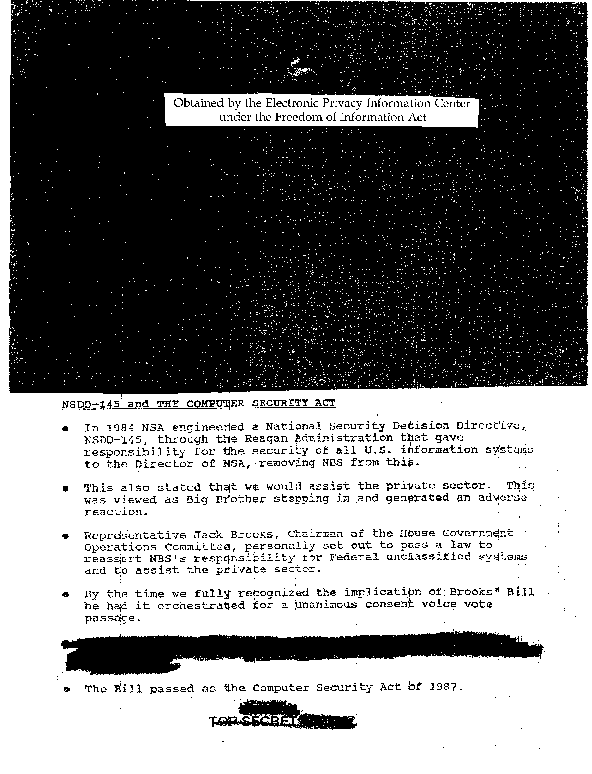
Before the 1987 law was passed however, Clinton Brooks, a Special Assistant to NSA Director Lieutenant General William Odom, wrote a Top Secret Memorandum which stated: “In 1984 NSA engineered a National Security Decision Directive, NSDD-145, through the Reagan Administration that gave responsibility for the security of all US information systems to the Director of NSA, removing NBS [National Bureau of Standards] from this.”
Conceived as a follow-on to the Reagan administration’s infamous 1981 Executive Order 12333, which trashed anemic congressional efforts to rein-in America’s out-of-control spy agencies, NSDD-145 handed power back to the National Security Agency and did so to the detriment of civilian communication networks.
Scarcely a decade after Senator Frank Church warned during post-Watergate hearings into government surveillance abuses, that NSA’s “capability at any time could be turned around on the American people, and no American would have any privacy left, such is the capability to monitor everything: telephone conversations, telegrams, it doesn’t matter . . . there would be no place to hide,” the agency was at it with a vengeance.
“This [NSDD-145] also stated,” Brooks wrote, “that we would assist the private sector. This was viewed as Big Brother stepping in and generated an adverse reaction” in Congress that helped facilitate passage of the Act.
Engineered by future Iran-Contra felon, Admiral John Poindexter, President Reagan’s National Security Adviser who would later serve as President George W. Bush’s Director of DARPA’s Information Awareness Office, the Pentagon satrapy that brought us the Total Information Awareness program, NSDD-145 stated that the “Director, National Security Agency is designated the National Manager for Telecommunications and Automated Information Systems Security.”
NSA’s new mandate meant that the agency would “act as the government focal point for cryptography, telecommunications systems security, and automated information systems security.”
Additionally, NSA would “conduct, approve, or endorse research and development of techniques and equipment for telecommunications and automated information systems security for national security information.”
But it also authorized the agency to do more than that, granting it exclusive authority to “review and approve all standards, techniques, systems and equipments for telecommunications and automated information systems security.” As well, NSA was directed to “enter into agreements for the procurement of technical security material and other equipment, and their provision to government agencies, where appropriate, to private organizations, including government contractors, and foreign governments.”
In other words, NSA was the final arbiter when it came to setting standards for all government and private information systems; quite a coup for the agency responsible for standing-up Project MINARET, the Cold War-era program that spied on thousands of antiwar protesters, civil rights leaders, journalists and members of Congress, as recently declassified documents published by the National Security Archive disclosed.
NSA Games the System
Although the Computer Security Act passed unanimously by voice vote in both Houses of Congress, NSA immediately set-out to undercut the law and did so by suborning the National Bureau of Standards, now the National Institute of Standards and Technology (NIST).
The battle over the Clipper Chip would be the template for future incursions by the agency for the control, through covert infiltration, of regulatory bodies overseeing civilian communications.
According to the Clinton White House, Clipper “would provide Americans with secure telecommunications without compromising the ability of law enforcement agencies to carry out legally authorized wiretaps.”
Neither safe nor secure, Clipper instead would have handed government security agencies the means to monitor all communications while giving criminal networks a leg up to do the same.
In fact, as the Electronic Privacy Information Center (EPIC) discovered in documents unearthed through the Freedom of Information Act, the underlying algorithm deployed in Clipper, Skipjack, had been developed by NSA.
Cryptography expert Matt Blaze wrote a now famous 1994 paper on the subject before the algorithm was declassified, Protocol Failure in the Escrowed Encryption Standard: “The EES cipher algorithm, called ‘Skipjack’, is itself classified, and implementations of the cipher are available to the private sector only within tamper-resistant modules supplied by government-approved vendors. Software implementations of the cipher will not be possible. Although Skipjack, which was designed by the US National Security Agency (NSA), was reviewed by a small panel of civilian experts who were granted access to the algorithm, the cipher cannot be subjected to the degree of civilian scrutiny ordinarily given to new encryption systems.”
This was precisely as NSA and the Clinton administration intended.
A partially declassified 1993 NSA memo noted that “there will be vocal public doubts expressed about having a classified algorithm in the device we propose for the US law enforcement problem, the CLIPPER chip, we recommend the following to address this.” We don’t know what those agency recommendations were, however; more than 20 years after the memo was written they remain secret.
The memo continued: “If such people agree to this clearance and non disclosure process, we could go over the algorithm with them to let them develop confidence in its security, and we could also let them examine the detail design of the CLIPPER chip made for the US law enforcement problem to assure themselves that there were no trapdoors or other techniques built in. This would likely require crypto-mathematicians for the algorithm examination and microelectronics chip design engineers for the chip examination.”
But the extreme secrecy surrounding Skipjack’s proposed deployment in commercial products was the problem. Even if researchers learned that Clipper was indeed the government-mandated backdoor they feared, non-disclosure of these facts, backed-up by the threat of steep fines or imprisonment would hardly assure anyone of the integrity of this so-called review process.
“By far, the most controversial aspect of the EES system,” Blaze wrote, “is key escrow.”
“As part of the crypto-synchronization process,” Blaze noted, “EES devices generate and exchange a ‘Law Enforcement Access Field’ (LEAF). This field contains a copy of the current session key and is intended to enable a government eavesdropper to recover the cleartext.”
“The LEAF copy of the session key is encrypted with a device-unique key called the ‘unit key,’ assigned at the time the EES device is manufactured. Copies of the unit keys for all EES devices are to be held in ‘escrow’ jointly by two federal agencies that will be charged with releasing the keys to law enforcement under certain conditions.”
What those conditions were however, was far from clear. In fact, as we’ve since learned from Snowden’s cache of secret documents, even when the government seeks surveillance authorization from the FISA court, the court must rely on government assurances that dragnet spying is critical to the nation’s security. Such assurances, FISA court judge Reggie B. Walton noted, were systematically “misrepresented” by secret state agencies.
That’s rather rich considering that Walton presided over the farcical “trial” that upheld Bush administration demands to silence FBI whistleblower Sibel Edmonds under the state secrets privilege. Edmonds, a former contract linguist with the Bureau charged that top FBI officials had systematically covered-up wrongdoing at its language division and had obstructed agents’ attempts to roll-up terrorist networks before and after the 9/11 provocation, facts attested to by FBI whistleblower Coleen Rowley in her 2002 Memo to then-FBI Director Robert Mueller.
In 2009, Walton wrote that “The minimization procedures proposed by the government in each successive application and approved and adopted as binding by the orders of the FISC have been so frequently and systemically violated that it can fairly be said that this critical element of the overall BR regime has never functioned effectively.”
“The Court,” Walton averred, “must have every confidence that the government is doing its utmost to ensure that those responsible for implementation fully comply with the Court’s orders. The Court no longer has such confidence.”
Predating those critical remarks, a heavily-redacted 1993 Memo to then-Special Assistant to the President and future CIA chief, George Tenet, from FBI Director William Sessions noted that NSA “has developed a new encryption methodology and computer chip which affords encryption strength vastly superior to DES [Digital Encryption Standard], yet which allows for real time decryption by law enforcement, acting pursuant to legal process. It is referred to as ‘Clipper’.”
[Two redacted paragraphs] “if the devices are modified to include the ‘Clipper’ chip, they would be of great value to the Federal, state and local law enforcement community, especially in the area of counter narcotics, investigations, where there is a requirement to routinely communicate in a secure fashion.”
But even at the time Sessions’ memo was written, we now know that AT&T provided the Drug Enforcement Administration “routine access” to “an enormous AT&T database that contains the records of decades of Americans’ phone calls,” The New York Times reported, and had done so since 1987 under the auspices of DEA’s Hemisphere Project.
Furthermore, in the wake of Snowden revelations we also learned that listening in on the conversations of drug capos is low on NSA’s list of priorities. However, programs like X-KEYSCORE and TEMPORA, which copies all data flowing along fiber optic cables, encrypted and unencrypted alike, at petabyte scales, is supremely useful when it comes to building profiles of internet users by intelligence agencies.
This was an implicit goal of Clinton administration maneuvers to compel developers to insert Clipper into their product designs.
According to Sessions, “the ‘Clipper’ methodology envisions the participation of three distinct types of parties.” [Redacted] It is proposed that the second party, the two custodians of the ‘split’ key infostructure [sic], be comprised of two disinterested and trustworthy non law enforcement Government agencies or entities. Although, such decision and selection are left for the Administration, a list of reccommended [sic] agencies and entities has been prepared (and included in the text), [redacted]. This party would administer and oversee all facets of the ‘Clipper’ program and methodology.”
Based on NSDD-145′s mandate, one can assume “this party” would be NSA, the agency that designed the underlying algorithm that powered Clipper.
The Sessions memo averred: “The Clipper chip provides law enforcement access by using a special chip key, unique to each device. In the AT&T TSD 3600, a unique session key is generated, external to the Clipper chip for each call.”
“This session key,” the memo explained, “is given to the chip to control the encryption algorithm. A device unique ‘chip key’ is programmed into each Clipper at the time of manufacture. When two TSD 3600s go to secure operation, the device gives out its identification (ID) number and the session key encrypted in its chip key.”
Underlining a key problem with Clipper technology Sessions noted, “Anyone with access to the chip key for that identified device will be able to recover the session key and listen to the transmission simultaneously with the intended receiver. This design means that the list of chip keys associated with the chip ID number provides access to all Clipper secured devices, and thus the list must be carefully generated and protected. Loss of the list would preclude legitmate [sic] access to the encrypted information and compromise of the list could allow unauthorized access.”
In fact, that “anyone” could include fabulously wealthy drug gangs or bent corporations with the wherewithal to buy chip keys from suborned government key escrow agents!
Its ubiquity would be a key selling-point for universal deployment. The memo explained, “the NSA developed chip based ‘Clipper’ solution works with hardware encryption applications, such as those which might be used with regard to certain telecommunications and computers devices,” which of course would allow unlimited spying by “law enforcement.”
Such vulnerabilities built into EES chip keys by design not only enabled widespread government monitoring of internet and voice traffic, but with a few tweaks by encryption-savvy “rogues” could be exploited by criminal organizations.
In his 1994 paper Blaze wrote that “a rogue system can be constructed with little more than a software modification to a legal system. Furthermore, while some expertise may be required to install and operate a rogue version of an existing system, it is likely that little or no special skill would be required to install and operate the modified software.”
“In particular,” Blaze noted, “one can imagine ‘patches’ to defeat key escrow in EES-based systems being distributed over networks such as the Internet in much the same way that other software is distributed today.”
In the intervening years since Blaze observed how easy it would be to compromise key escrow systems by various bad actors, governments or criminals take your pick, the proliferation of malware powered botnets that infect hundreds of thousands of computers and smart phones every day–for blanket surveillance, fraud, or both–is a fact of life.
It didn’t help matters when it emerged that “escrow agents” empowered to unlock encrypted communications would be drawn from the National Institute of Standards and Technology and the Automated Services Division of the Treasury Department, government outposts riddled with “No Such Agency” moles.
As EPIC pointed out, “Since the enactment of the Computer Security Act, the NSA has sought to undercut NIST’s authority. In 1989, NSA signed a Memorandum of Understanding (MOU) which purported to transfer back to NSA the authority given to NIST.”
The MOU required that NIST request NSA’s “assistance” on all matters related to civilian cryptography. In fact, were NIST and NSA representatives on the Technical Working Group to disagree on standards, the ultimate authority for resolving disputes would rest solely with the Executive Branch acting through the President, the Secretary of Defense and the National Security Council, thus undercutting the clear intent of Congress when they passed the 1987 Computer Security Act.
EPIC noted:
“The memorandum effectively returned to NSA many of the powers rejected by the Computer Security Act. The MOU contained several key goals that were to NSA’s benefit, including: NSA providing NIST with ‘technical security guidelines in trusted technology, telecommunications security, and personal identification that may be used in cost-effective systems for protecting sensitive computer data;’ NSA ‘initiating research and development programs in trusted technology, telecommunications security, cryptographic techniques and personal identification methods’; and NSA being responsive to NIST ‘in all matters related to cryptographic algorithms and cryptographic techniques including but not limited to research, development, evaluation, or endorsement’.”
A critique of the Memorandum in 1989 congressional testimony by the General Accounting Office (GAO) emphasized: “At issue is the degree to which responsibilities vested in NIST under the act are being subverted by the role assigned to NSA under the memorandum. The Congress, as a fundamental purpose in passing the act, sought to clearly place responsibility for the computer security of sensitive, unclassified information in a civil agency rather than in the Department of Defense. As we read the MOU, it would appear that NIST has granted NSA more than the consultative role envisioned in the act.”
Five years after the GAO’s critical appraisal, NSA’s coup was complete.
“In 1994,” EPIC noted,
“President Clinton issued Presidential Decision Directive (PDD-29). This directive created the Security Policy Board, which has recommended that all computer security functions for the government be merged under NSA control.”
Since PDD-29 was issued matters have only gotten worse. In fact, NIST is the same outfit exposed in Snowden documents published by The Guardian and The New York Times that allowed NSA to water down encryption and build backdoors into the Dual EC DRBG standard adopted by the Institute in 2006.
“Eventually, NSA became the sole editor.”
Besieged by widespread opposition, the Clinton administration was out maneuvered in the court of public opinion and by 1996 had abandoned Clipper. However, this proved to be a pyrrhic victory for security-minded researchers and civil libertarians as we have since learned from Edward Snowden’s revelations.
Befitting a military-intelligence agency, the dark core of America’s deep state, NSA was fighting a long war–and they were playing for keeps.

Derivatives are Destroying the Real Economy: Michel Chossudovsky

stealing_money_safe_lg_nwm
Press TV has conducted an interview with Professor Michel Chossudovsky, economic analyst and researcher with the Center for Research on Globalization, Montreal about the issue of the widening gap between the richest in society and the poorest globally.
“It is not production and trade, which is the source of enrichment;
It is  manipulation and fraud at a global stage. 
We’re dealing with institutionalized theft, which is embedded in the financial system. 
It is not what we might describe as capital accumulation from a productive process, nor is it through work performed by these wealthy people.”


If unable to view video, click below (MP4 download):
http://64.150.186.181/presstv/site%20video/20131110/chussodovsky.mp4
or link to Press TV posting:
http://www.presstv.ir/detail/2013/11/10/334012/derivatives-are-causing-a-global-crisis/
The following is an approximate transcript of the interview.
Press TV: That is a staggering difference as far as a percentage, a very small percentage basically controlling the majority of the wealth in the world and they continue to get richer.
What do you attribute this, what seems to be a vast difference between the haves and the have-nots in this world?
Chossudovsky: I think we have to focus on the sources of this enrichment. It is not production and trade, which is the source of enrichment; it is manipulation and fraud at a global stage.
In other words, we’re dealing with institutionalized theft, which is embedded in the financial system; it is not what we might describe as capital accumulation from a productive process, nor is it through work performed by these wealthy people.
It is through displacement and destruction of the real economy where small and medium-sized enterprises are driven into bankruptcy. In other words, what I’m saying is that enrichment creates dislocation of the financial system of the real economy and in turn it leads to massive concentration of ownership.
Now, we might ask, how do these people actually become rich? They essentially become rich through the powers of manipulation, through speculative activity.
They have the ability to undertake secure speculative transactions; through derivative trade; through acts of deception.
They conduct insider trading; they are able to influence and manipulate markets; they are able to influence those markets – they know where the market is going, they can position themselves. At the same time they influence policies and legislation in government and the legislature; they co-opt politicians.
So, in effect, this process of concentration of wealth is very different to what we have experienced historically, let’s say in the course of the 20th century.
Press TV: Do you see the situation continuing to get worse and if so what will it take to turn this around?
Chossudovsky: Speculation will lead to increased concentration of wealth and assets because the underlying economic policies in fact favor this process.
The massive austerity measures; the deregulation of financial markets; the development of trading blocs, which in turn wipes off the small and medium sized enterprises from the market.
The only way to ultimately undermine this process of wealth concentration is through regulatory policy and I would say one of the major instruments would be in fact to cancel speculative trade – derivative trade, trade in derivative markets. That would be the first step.
Because… in a deregulated environment with complicit governments and very powerful financial institutions this enrichment is ultimately feeding on poverty, leading to a massive concentration of ownership.
But you can see also in certain countries how these self-made billionaires are in fact fabricated at the expense of the large majority of the population, leading to mass poverty.
Press TV: With what you are talking about, “leading to mass poverty;” how likely then do you think it will be that we’re going to see mass demonstrations, people taking to the streets as they are getting less and less of the pie and a small percentage actually is taking the majority of the pie?
Chossudovsky: Inevitably this process of concentration of wealth is leading to mass unemployment and poverty, but ultimately also destitution – where people are no longer even within the labor market, they don’t get work, they can’t even apply for low wage work. This will lead to a massive protest movement.
But at the same time we see particularly in Western countries the development of a large scale police apparatus, surveillance, which is intended essentially to quell the protest movement.
This process is leading the world into a very serious global crisis because on one hand we see the development of the luxury goods economy; we see the development of the weapons economy – the war economy; and at the same time we see the collapse in the production of essential commodities for the large majority of the population.

10 Facts About The Growing Unemployment Crisis In America That Will Blow Your Mind

hows it going ,America ! .....still "think" we r going in the right direction !! do u still "think"  these elite's & the ass pipes "they" got "their" arms jammed up their (ass pipes)  asses  are "leading" U.S.  in the right direction ??  ..what's the plan folks ...just gonna "wait"  until there is fucking NOTHING left ....  &  then OUR only "option"  is          ....    fighting fer your/ our  VERY  survival .   that the  "plan"  huh   ... soon time is gonna force it  & if'in u don't c it yet ...    deserve's  got nut~in 2 do wit it  !!!

10 Facts About The Growing Unemployment Crisis In America That Will Blow Your Mind

UnemploymentDid you know that there are more than 102 million working age Americans that do not have a job?  Yes, I know that number sounds absolutely crazy, but it is true.  Right now, there are more than 11 million Americans that are considered to be "officially unemployed", and there are more than 91 million Americans that are not employed and that are considered to be "not in the labor force".  When you add those two numbers together, the total is more than 102 million.  Overall, the number of working age Americans that do not have a job has increased by about 27 million since the year 2000.  But aren't things getting better?  After all, the mainstream media is full of headlines about how "good" the jobs numbers for October were.  Sadly, the truth is that the mainstream media is not being straight with the American people.  As you will see below, we are in the midst of a long-term unemployment crisis in America, and things got even worse last month.
In this day and age, it is absolutely imperative that people start thinking for themselves.  Just because the media tells you that something is true does not mean that it actually is.  If unemployment was actually going down, the percentage of the working age population that has a job should actually be going up.  As you are about to see, that is simply not the case.  The following are 10 facts about the growing unemployment crisis in America that will blow your mind...
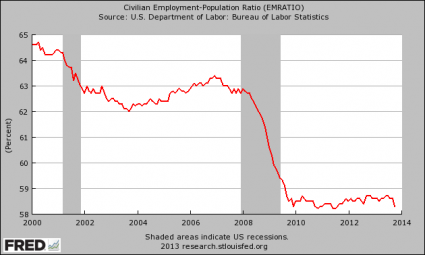
#1 The percentage of working age Americans with a job fell to 58.3 percent in October.  The lowest that number has been at any point since the year 2000 is 58.2 percent.  In other words, there has been absolutely no "jobs recovery".  During the last recession, the civilian employment-population ratio dropped from about 63 percent to below 59 percent and it has stayed there for 50 months in a row.  Will the percentage of working age Americans with a job soon drop below the 58 percent mark?...
Employment-Population Ratio November 2013
#2 The U.S. economy lost 623,000 full-time jobs last month.  But we are being told to believe that the economy is actually getting "better".
#3 The number of American women with a job fell by 357,000 during the month of October.
#4 The average duration of unemployment in October 2013 was nearly three times as long as it was in October 2000.
#5 The number of Americans "not in the labor force" increased by an astounding 932,000 during October.  In other words, the Obama administration would have us believe that nearly a million people "disappeared" from the U.S. labor force in a single month.
#6 The number of Americans "not in the labor force" has grown by more than 11 million since Barack Obama first entered the White House.
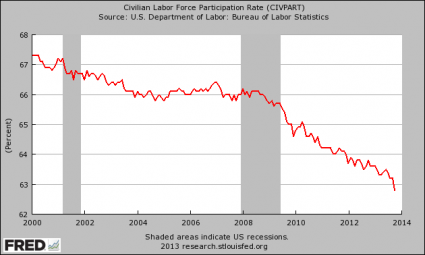
#7 In October, the U.S. labor force participation rate fell from 63.2 percent to 62.8 percent.  It is now the lowest that it has been since 1978.  Below is a chart which shows how the labor force participation rate has been steadily declining since the year 2000.  How can the economy be "healthy" if the percentage of Americans that are participating in the labor force is continually declining?...
Labor Force Participation Rate
#8 If the labor force participation rate was still at the same level it was at when Barack Obama was elected in 2008, the official unemployment rate would be about 11 percent right now.
#9 Even if you are working, that does not mean that you are able to take care of yourself and your family without any help.  In fact, approximately one out of every four part-time workers in America is living below the poverty line.
#10 In January 2000, there were 75 million working age Americans that did not have a job.  Today, there are 102 million working age Americans that do not have a job.
So what are our politicians doing to fix this?
Shouldn't they be working night and day to solve this crisis?
After all, Barack Obama once made the following promise to the American people...
"But I want you all to know, I will not rest until anybody who's looking for a job can find one -- and I'm not talking about just any job, but good jobs that give every American decent wages and decent benefits and a fair shot at the American Dream."
Unfortunately, things have not improved since Obama made that promise, but he has found the time to play 150 rounds of golf since he has been president.
Meanwhile, because there aren't enough jobs, the number of Americans living in poverty continues to grow.
As I wrote about the other day, according to new numbers that were just released an all-time high 49.7 million Americans are living in poverty.
And right now 1.2 million public school students in the United States are homeless.  For many more statistics like this, please see my previous article entitled "29 Incredible Facts Which Prove That Poverty In America Is Absolutely Exploding".
The only thing that most Americans have to offer in the marketplace is their labor.  If they can't find a job, they don't have any other way to take care of themselves and their families.
The future of the middle class in America depends upon the creation of good jobs.  It really doesn't matter how far the quantitative easing that the Federal Reserve has been doing pumps up the current stock market bubble.  The American people were told that "economic stimulus" was the reason for doing all of this reckless money printing, but the percentage of working age Americans with a job is now actually lower than it was four years ago.  Quantitative easing has been a complete and total failure in the job creation department, and it is doing a tremendous amount of long-term damage to our financial system.
The really frightening thing is that the Federal Reserve and the federal government have supposedly been doing all they can to try to "create jobs" and they have utterly failed.  In fact, this is the first time in the post-World War II era that we have not seen an employment recovery following a recession.
And now the next wave of the economic collapse is rapidly approaching.  What that hits us, millions more Americans will lose their jobs.
So the truth is that this is just the beginning of the unemployment crisis in America.
Yes, things are bad now, but soon they will get much worse.

CAPTAIN PETTIGREW, SS BEAVERFORD AND THE BATTLE FOR CONVOY HX84

Posted by George Freund on November 10, 2013


November 11th is the anniversary of Armistice Day marking the end of WWI the war to end all wars at least until the next WWII. At the 11th hour of the 11th day of the 11th month, we pause to remember the men and women who died in the greatest calamity created by man - WAR! As time fades, so do the memories. The greater battles and events may linger longer, but they too, slowly subside. One I found while researching the Canadian Pacific Line which brought my grandparents to Canada was the story of the SS Beaverford a cargo ship in convoy HX84. It was attacked by a German pocket battleship. The rest is forgotten history. Lest we forget; let us remember.


On November 5th 1940 an epic and one sided battle occurred in the Atlantic around Convoy HX84. Though a footnote in history after 73 years, one of the greatest acts of courage in Canadian naval history took place on the SS Beaverford under the command of Captain Pettigrew a veteran of the Gallipoli campaign.


ADMIRAL SCHEER

LAID DOWN ON THE STOCKS IN 1931 AND LAUNCHED IN 1933. SHE WAS BOMBED AND SUNK BY THE BRITISH RAF ON 9TH MAY 1945. SHE HAD BEEN A VESSEL OF 15,423 TONS WITH A TOP SPEED OF 28 KNOTS.

Convoy HX84 was attacked that day by a German pocket battleship. The Admiral Scheer was armed with six-11 inch guns, eight-5.9 inch guns and torpedoes. In another epic battle its sister ship the Graf Spee, fought three British cruisers to a draw in the Battle of the River Plate.


This time, however, the only escort vessel would be the Armed Merchant Cruiser HMS Jervis Bay. This vessel was a converted passenger ship armed with antiquated 6-inch guns from the First World War. To the uninitiated that isn't much protection because passenger ships have no armour plate and are very vulnerable to shellfire. Admiral Scheer's cannon would easily penetrate into the Jervis Bay while she stayed well outside of the British ship's guns.

HMS Jervis Bay did her duty. She positioned herself in the path of the battleship while the convoy scattered. It did not last long. She succumbed to her wounds in about 20 minutes and foundered. Her crew received medals including the Victoria Cross and the Distinguished Service Order. The Swedish ship Stureholm moved in to rescue survivors. This story has been immortalized in books and a movie.


The damaged San Demetrio

Admiral Scheer moved in among the fleeing ships. Another remarkable action was her attack on the San Demetrio. This ship was a tanker carrying 12,000 tons of aviation gasoline. She was set ablaze and the crew took to the boats. One of the lifeboats was rescued. The other wasn't. The men of that boat returned to the still burning vessel after two days in the water. It was a miracle that the San Demetrio didn't explode. The crew put out the fire and sailed their ship back to England through U-Boat infested waters. A movie was made about their exploits. In the battle for convoy HX84 legends were made.


BEAVERFORD

BUILT IN GLASGOW BY BARCLAY CURLE & CO, AND LAUNCHED IN 1927. SHE WAS MANAGED BY THE CANADIAN PACIFIC STEAMSHIP COMPANY, BUT ACTUALLY OWNED BY CANADIAN PACIFIC RAILWAY CO. IN 1940 SHE WAS REQUISITIONED TO CARRY WAR SUPPLIES, THE REASON SHE WAS PART OF CONVOY HX84. SHE WAS SUNK BY THE ADMIRAL SCHEER AFTER ENGAGING THE GERMAN RAIDER, IN AN ATTEMPT TO ALLOW THE REST OF THE CONVOY TO ESCAPE, ALL 77 CREW MEMBERS WERE LOST.


Captain Pettigrew made a decision to turn his ship around and face the German head on. The Beaverford was armed with one 4-inch gun and one 3-inch gun. It had no armour plate either. It never got within range to hit the battleship. However, he skillfully manoeuvred his ship dodging shells for four and one half hours. Admiral Scheer fired twelve 11-inch shells with three hitting Beaverford and seventy-one 5.9-inch shells with 16 striking their target. It wasn't until 10:35 p.m. that Admiral Scheer destroyed the Beaverford with torpedoes. The ship was lost with all hands. There were 77 crew members aboard.

Captain Pettigrew and the men of the Beaverford bought valuable time allowing the other ships to scatter in the darkness. Thirty-two vessels made good their escape out of the thirty-eight ship convoy. The actions of these men were another legend, but one that is not too well remembered. There was no book. There was no movie. There was just the legend.

Captain Pettigrew had a strange foreboding before he sailed. He broke tradition by not dining aboard ship with his friends telling them it would be their last time together.


Downhills Central School

A school in England adopted every ship. It surprises me that after 73 long years, they still remember. A plaque is mounted in the school to the men of the Beaverford. They have posted details of the action, the ship, and the casualties on a website. They are remembered. I, too, remember. Years ago while researching my grandparents' journey to Canada; I found interesting history on the Canadian Pacific ships of which the Beaverford was a part. Legends should never be forgotten. A Canadian freighter fought a German battleship and even though David did not slay Goliath, he did save his shipmates. We should be thankful and proud.

Categories: New World Order

Piracy Release Group Has Been Spying on Downloaders For 9 Months

While viruses and malware can be added to any file online, it is rare for malicious content to planted by those in the so-called warez scene. Nevertheless, it has now been revealed that since February 2013 one particular group has been dropping a little something extra into its cracked software releases. Anyone who has installed the group’s software patches may well have had their username, hard drive serial, computer name and IP address emailed out without their knowledge.
warezIf the RIAA and MPAA are to be believed, torrent and other file-sharing sites are incredibly dangerous places. Anyone visiting them should be prepared to become infected with a virus, infiltrated by malware, or be otherwise exposed to similar threats.
The actual situation is nowhere near as bad as some would like to make out, but every now and again something happens to remind us that it is very possible for something nasty to slip through the net.
On February 12, 2013 a new warez group appeared calling themselves MeGaHeRTZ. Their first release was BurnAware Professional v6.0 plus a patch to remove the software’s protection. Over the months that followed the group released a lot of noteworthy products such as SmartFTP, DVDFab, FlashFXP, Incredimail, Traktor and hundreds more, each with the obligatory ‘freebie’ patch.
Tomorrow the group will have been operating for a full nine months and during that time their releases have spread to every corner of the Internet. However, far from merely wanting to do downloaders a favor, MeGaHeRTZ have been playing a little dirty.

A small sample of MeGaHeRTZ releases

Megahertz
Over the weekend a notice spread around the warez scene which detailed how one individual became alarmed by unusual firewall activity after he had installed, ironically, a MeGaHeRTZ release of Malwarebytes Anti-Malware Pro.
The problem reportedly came from patch that MeGaHeRTZ supplied with the release which attempted to send out traffic on port 25, a port commonly used to send email. The same individual who found the strange activity then ran the patch through a debugger and to his alarm found that it was harvesting information from the host machine.
The data being gathered from infected machines includes the username, computer name/drive serial obtained from the Windows API, and the host machine’s IP address. This information is then packaged up and sent off to any of three predetermined email addresses, all of which have account names containing some variation of the MeGaHeRTZ group name.
Further tests were carried out on several other MeGaHeRTZ releases and they were all found to carry similar mechanisms for pulling data from host machines and funneling it back to the release group.

The scene reacts – all MeGaHeRTZ releases get nuked

Megahertznuke
Quite what MeGaHeRTZ intend to do with the data is unclear but it appears that as an active release group they are now finished, at least under their current identity. On Saturday the warez scene took action to ‘nuke’ every MeGaHeRTZ release, which means they won’t be allowed to release anymore.
Revealing malware in scene releases is a very unusual occurrence and malicious content is usually added at a later stage by third parties. Still, the damage has now been done. MeGaHeRTZ releases are now all over the Internet and there is nothing that anyone can do to get them back. Avoidance is the only solution now.