Tightening the U.S. Grip on Western Europe: Washington’s Iron Curtain in Ukraine
NATO leaders are currently acting out a deliberate charade in Europe,
designed to reconstruct an Iron Curtain between Russia and the West.
With astonishing unanimity, NATO leaders feign surprise at events
they planned months in advance. Events that they deliberately triggered
are being misrepresented as sudden, astonishing, unjustified “Russian
aggression”. The United States and the European Union undertook an
aggressive provocation in Ukraine that they knew would force Russia to
react defensively, one way or another.
They could not be sure exactly how Russian president Vladimir Putin
would react when he saw that the United States was manipulating
political conflict in Ukraine to install a pro-Western government intent
on joining NATO. This was not a mere matter of a “sphere of influence”
in Russia’s “near abroad”, but a matter of life and death to the
Russian Navy, as well as a grave national security threat on Russia’s
border.
A trap was thereby set for Putin. He was damned if he did, and damned
if he didn’t. He could underreact, and betray Russia’s basic national
interests, allowing NATO to advance its hostile forces to an ideal
attack position.
Or he could overreact, by sending Russian forces to invade Ukraine.
The West was ready for this, prepared to scream that Putin was “the new
Hitler”, poised to overrun poor, helpless Europe, which could only be
saved (again) by the generous Americans.
In reality, the Russian defensive move was a very reasonable middle
course. Thanks to the fact that the overwhelming majority of Crimeans
felt Russian, having been Russian citizens until Khrushchev frivolously
bestowed the territory on Ukraine in 1954, a peaceful democratic
solution was found. Crimeans voted for their return to Russia in a
referendum which was perfectly legal according to international law,
although in violation of the Ukrainian constitution, which was by then
in tatters having just been violated by the overthrow of the country’s
duly elected president, Victor Yanukovych, facilitated by violent
militias. The change of status of Crimea was achieved without
bloodshed, by the ballot box.
Nevertheless, the cries of indignation from the West were every bit
as hysterically hostile as if Putin had overreacted and subjected
Ukraine to a U.S.-style bombing campaign, or invaded the country
outright – which they may have expected him to do.
U.S. Secretary of State John Kerry led the chorus of self-righteous
indignation, accusing Russia of the sort of thing his own government is
in the habit of doing. “You just don’t invade another country on phony
pretext in order to assert your interests. This is an act of aggression
that is completely trumped up in terms of its pretext”, Kerry
pontificated. “It’s really 19th century behavior in the 21st century”.
Instead of laughing at this hypocrisy, U.S. media, politicians and
punditry zealously took up the theme of Putin’s unacceptable
expansionist aggression. The Europeans followed with a weak, obedient
echo.
It Was All Planned at Yalta
In September 2013, one of Ukraine’s richest
oligarchs, Viktor Pinchuk, paid for an elite strategic conference on
Ukraine’s future that was held in the same Palace in Yalta, Crimea,
where Roosevelt, Stalin and Churchill met to decide the future of Europe
in 1945. The Economist, one of the elite media reporting on what it
called a “display of fierce diplomacy”, stated that: “The future of
Ukraine, a country of 48m people, and of Europe was being decided in
real time.” The participants included Bill and Hillary Clinton, former
CIA head General David Petraeus, former U.S. Treasury secretary Lawrence
Summers, former World Bank head Robert Zoellick, Swedish foreign
minister Carl Bildt, Shimon Peres, Tony Blair, Gerhard Schröder,
Dominique Strauss-Kahn, Mario Monti, Lithuanian president Dalia
Grybauskaite, and Poland’s influential foreign minister Radek Sikorski.
Both President Viktor Yanukovych, deposed five months later, and his
recently elected successor Petro Poroshenko were present. Former U.S.
energy secretary Bill Richardson was there to talk about the shale-gas
revolution which the United States hopes to use to weaken Russia by
substituting fracking for Russia’s natural gas reserves. The center of
discussion was the “Deep and Comprehensive Free Trade Agreement” (DCFTA)
between Ukraine and the European Union, and the prospect of Ukraine’s
integration with the West. The general tone was euphoria over the
prospect of breaking Ukraine’s ties with Russia in favor of the West.
Conspiracy against Russia? Not at all. Unlike Bilderberg, the
proceedings were not secret. Facing a dozen or so American VIPs and a
large sampling of the European political elite was a Putin adviser named
Sergei Glazyev, who made Russia’s position perfectly clear.
Glazyev injected a note of political and economic realism into the conference.
Forbes
reported at the time on the “stark difference” between the Russian and
Western views “not over the advisability of Ukraine’s integration with
the EU but over its likely
impact.” In contrast to Western euphoria, the Russian view was based on “very specific and
pointed
economic criticisms” about the Trade Agreement’s impact on Ukraine’s
economy, noting that Ukraine was running an enormous foreign accounts
deficit, funded with foreign borrowing, and that the resulting
substantial increase in Western imports ccould only swell the deficit.
Ukraine “will either default on its debts or require a sizable bailout”.
The Forbes reporter concluded that “the Russian position is far
closer to the truth than the happy talk coming from Brussels and Kiev.”
As for the political impact, Glazyev pointed out that the
Russian-speaking minority in Eastern Ukraine might move to split the
country in protest against cutting ties with Russia, and that Russia
would be legally entitled to support them, according to
The Times of London.
In short, while planning to incorporate Ukraine into the Western
sphere, Western leaders were perfectly aware that this move would entail
serious problems with Russian-speaking Ukrainians, and with Russia
itself. Rather than seeking to work out a compromise, Western leaders
decided to forge ahead and to blame Russia for whatever would go wrong.
What went wrong first was that Yanukovych got cold feet faced with the
economic collapse implied by the Trade Agreement with the European
Union. He postponed signing, hoping for a better deal. Since none of
this was explained clearly to the Ukrainian public, outraged protests
ensued, which were rapidly exploited by the United States… against
Russia.
Ukraine as Bridge…Or Achilles Heel
Ukraine, a term meaning borderland, is a country without clearly
fixed historical borders that has been stretched too far to the East and
too far to the West. The Soviet Union was responsible for this, but
the Soviet Union no longer exists, and the result is a country without a
unified identity and which emerges as a problem for itself and for its
neighbors.
It was extended too far East, incorporating territory that might as
well have been Russian, as part of a general policy to distinguish the
USSR from the Tsarist empire, enlarging Ukraine at the expense of its
Russian component and demonstrating that the Soviet Union was really a
union among equal socialist republics. So long as the whole Soviet
Union was run by the Communist leadership, these borders didn’t matter
too much.
It was extended too far West at the end of World War II. The
victorious Soviet Union extended Ukraine’s border to include Western
regions, dominated by the city variously named Lviv, Lwow, Lemberg or
Lvov, depending on whether it belonged to Lithuania, Poland, the
Habsburg Empire or the USSR, a region which was a hotbed of anti-Russian
sentiments. This was no doubt conceived as a defensive move, to
neutralize hostile elements, but it created the fundamentally divided
nation that today constitutes the perfect troubled waters for hostile
fishing.
The Forbes report cited above pointed out that: “For most of the past
five years, Ukraine was basically playing a double game, telling the EU
that it was interested in signing the DCFTA while telling the Russians
that it was interested in joining the customs union.” Either Yanukovych
could not make up his mind, or was trying to squeeze the best deal out
of both sides, or was seeking the highest bidder. In any case, he was
never “Moscow’s man”, and his downfall owes a lot no doubt to his own
role in playing both ends against the middle. His was a dangerous game
of pitting greater powers against each other.
It is safe to say that what was needed was something that so far
seems totally lacking in Ukraine: a leadership that recognizes the
divided nature of the country and works diplomatically to find a
solution that satisfies both the local populations and their historic
ties with the Catholic West and with Russia. In short, Ukraine could be
a bridge between East and West – and this, incidentally, has been
precisely the Russian position. The Russian position has not been to
split Ukraine, much less to conquer it, but to facilitate the country’s
role as bridge. This would involve a degree of federalism, of local
government, which so far is entirely lacking in the country, with local
governors selected not by election but by the central government in
Kiev. A federal Ukraine could both develop relations with the EU and
maintain its vital (and profitable) economic relations with Russia.
But this arrangement calls for Western readiness to cooperate with
Russia. The United States has plainly vetoed this possibility,
preferring to exploit the crisis to brand Russia “the enemy”.
Plan A and Plan B
U.S. policy, already evident at the September 2013 Yalta meeting, was
carried out on the ground by Victoria Nuland, former advisor to Dick
Cheney, deputy ambassador to NATO, spokeswoman for Hillary Clinton, wife
of neocon theorist Robert Kagan. Her leading role in the Ukraine events
proves that the neo-con influence in the State Department, established
under Bush II, was retained by Obama, whose only visible contribution to
foreign policy change has been the presence of a man of African descent
in the presidency, calculated to impress the world with U.S.
multicultural virtue. Like most other recent presidents, Obama is there
as a temporary salesman for policies made and executed by others.
As Victoria Nuland boasted in Washington, since the dissolution of
the Soviet Union in 1991, the United States has spent five billion
dollars to gain political influence in Ukraine (this is called
“promoting democracy”). This investment is not “for oil”, or for any
immediate economic advantage. The primary motives are geopolitical,
because Ukraine is Russia’s Achilles’ heel, the territory with the
greatest potential for causing trouble to Russia.
What called public attention to Victoria Nuland’s role in the
Ukrainian crisis was her use of a naughty word, when she told the U.S.
ambassador, “Fuck the EU”. But the fuss over her bad language veiled
her bad intentions. The issue was who should take power away from the
elected president Viktor Yanukovych. German Chancellor Angela Merkel’s
party been promoting former boxer Vitaly Klitschko as its candidate.
Nuland’s rude rebuff signified that the United States, not Germany or
the EU, was to choose the next leader, and that was not Klitschko but
“Yats”. And indeed it was Yats, Arseniy Yatsenyuk , a second-string
US-sponsored technocrat known for his enthusiasm for IMF austerity
policies and NATO membership, who got the job. This put a U.S. sponsored
government, enforced in the streets by fascist militia with little
electoral clout but plenty of armed meanness, in a position to manage
the May 25 elections, from which the Russophone East was largely
excluded.
Plan A for the Victoria Nuland putsch was probably to install,
rapidly, a government in Kiev that would join NATO, thus formally
setting the stage for the United States to take possession of Russia’s
indispensable Black Sea naval base at Sebastopol in Crimea.
Reincorporating Crimea into Russia was Putin’s necessary defensive move
to prevent this.
But the Nuland gambit was in fact a win-win ploy. If Russia failed
to defend itself, it risked losing its entire southern fleet – a total
national disaster. On the other hand, if Russia reacted, as was most
likely, the US thereby won a political victory that was perhaps its main
objective. Putin’s totally defensive move is portrayed by the Western
mainstream media, echoing political leaders, as unprovoked “Russian
expansionism”, which the propaganda machine compares to Hitler grabbing
Czechoslovakia and Poland.
Thus a blatant Western provocation, using Ukrainian political
confusion against a fundamentally defensive Russia, has astonishingly
succeeded in producing a total change in the artificial Zeitgeist
produced by Western mass media. Suddenly, we are told that the
“freedom-loving West” is faced with the threat of “aggressive Russian
expansionism”. Some forty years ago, Soviet leaders gave away the store
under the illusion that peaceful renunciation on their part could lead
to a friendly partnership with the West, and especially with the United
States. But those in the United States who never wanted to end the Cold
War are having their revenge. Never mind “communism”; if, instead of
advocating the dictatorship of the proletariat, Russia’s current leader
is simply old-fashioned in certain ways, Western media can fabricate a
monster out of that. The United States needs an enemy to save the world
from.
The Protection Racket Returns
But first of all, the United States needs Russia as an enemy in order
to “save Europe”, which is another way to say, in order to continue to
dominate Europe. Washington policy-makers seemed to be worried that
Obama’s swing to Asia and neglect of Europe might weaken U.S. control of
its NATO allies. The May 25 European Parliament elections revealed a
large measure of disaffection with the European Union. This
disaffection, notably in France, is linked to a growing realization that
the EU, far from being a potential alternative to the United States, is
in reality a mechanism that locks European countries into U.S.-defined
globalization, economic decline and U.S. foreign policy, wars and all.
Ukraine is not the only entity that has been overextended. So has
the EU. With 28 members of diverse language, culture, history and
mentality, the EU is unable to agree on any foreign policy other than
the one Washington imposes. The extension of the EU to former Eastern
European satellites has totally broken whatever deep consensus might
have been possible among the countries of the original Economic
Community: France, Germany, Italy and the Benelux states. Poland and
the Baltic States see EU membership as useful, but their hearts are in
America – where many of their most influential leaders have been
educated and trained. Washington is able to exploit the anti-communist,
anti-Russian and even pro-Nazi nostalgia of northeastern Europe to
raise the false cry of “the Russians are coming!” in order to obstruct
the growing economic partnership between the old EU, notably Germany,
and Russia.
Russia is no threat. But to vociferous Russophobes in the Baltic
States, Western Ukraine and Poland, the very existence of Russia is a
threat. Encouraged by the United States and NATO, this endemic
hostility is the political basis for the new “iron curtain” meant to
achieve the aim spelled out in 1997 by Zbigniew Brzezinski in
The Grand Chessboard:
keeping the Eurasian continent divided in order to perpetuate U.S.
world hegemony. The old Cold War served that purpose, cementing U.S.
military presence and political influence in Western Europe. A new Cold
War can prevent U.S. influence from being diluted by good relations
between Western Europe and Russia.
Obama has come to Europe ostentatiously promising to “protect” Europe
by basing more troops in regions as close as possible to Russia, while
at the same time ordering Russia to withdraw its own troops, on its own
territory, still farther away from troubled Ukraine. This appears
designed to humiliate Putin and deprive him of political support at
home, at a time when protests are rising in Eastern Ukraine against the
Russian leader for abandoning them to killers sent from Kiev.
To tighten the U.S. grip on Europe, the United States is using the
artificial crisis to demand that its indebted allies spend more on
“defense”, notably by purchasing U.S. weapons systems. Although the U.S.
is still far from being able to meet Europe’s energy needs from the new
U.S. fracking boom, this prospect is being hailed as a substitute for
Russia’s natural gas sales – stigmatized as a “way of exercising
political pressure”, something of which hypothetic U.S. energy sales are
presumed to be innocent. Pressure is being brought against Bulgaria
and even Serbia to block construction of the South Stream pipeline that
would bring Russian gas into the Balkans and southern Europe.
From D-Day to Dooms Day
Today, June 6, the seventieth anniversary of the D-Day landing is
being played in Normandy as a gigantic celebration of American
domination, with Obama heading an all-star cast of European leaders. The
last of the aged surviving soldiers and aviators present are like the
ghosts of a more innocent age when the United States was only at the
start of its new career as world master. They were real, but the rest is
a charade. French television is awash with the tears of young
villagers in Normandy who have been taught that the United States is
some sort of Guardian Angel, which sent its boys to die on the shores of
Normandy out of pure love for France. This idealized image of the past
is implicitly projected on the future. In seventy years, the Cold War, a
dominant propaganda narrative and above all Hollywood have convinced
the French, and most of the West, that D-Day was the turning point that
won World War II and saved Europe from Nazi Germany.
Vladimir Putin came to the celebration, and has been elaborately
shunned by Obama, self-appointed arbiter of Virtue. The Russians are
paying tribute to the D-Day operation which liberated France from Nazi
occupation, but they – and historians – know what most of the West has
forgotten: that the Wehrmacht was decisively defeated not by the
Normandy landing, but by the Red Army. If the vast bulk of German
forces had not been pinned down fighting a losing war on the Eastern
front, nobody would celebrate D-Day as it is being celebrated today.
Putin is widely credited as being “the best chess player”, who won
the first round of the Ukrainian crisis. He has no doubt done the best
he could, faced with the crisis foisted on him. But the U.S. has whole
ranks of pawns which Putin does not have. And this is not only a chess
game, but chess combined with poker combined with Russian roulette. The
United States is ready to take risks that the more prudent Russian
leaders prefer to avoid… as long as possible.
Perhaps the most extraordinary aspect of the current charade is the
servility of the “old” Europeans. Apparently abandoning all Europe’s
accumulated wisdom, drawn from its wars and tragedies, and even
oblivious to their own best interests, today’s European leaders seem
ready to follow their American protectors to another D-Day … D for Doom.
Can the presence of a peace-seeking Russian leader in Normandy make a
difference? All it would take would be for mass media to tell the
truth, and for Europe to produce reasonably wise and courageous leaders,
for the whole fake war machine to lose its luster, and for truth to
begin to dawn. A peaceful Europe is still possible, but for how long?
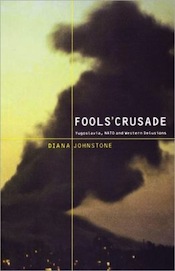
Diana Johnstone is the author of Fools’ Crusade: Yugoslavia, NATO, and Western Delusions. She can be reached at diana.johnstone@wanadoo.fr

 Posts
Posts