Tuesday, October 22, 2013

Pirate Bay Downloaders Trolled By Movie Director’s Shaven Balls

One of the oldest tricks in the file-sharing world is to relabel material as something else in order to annoy downloaders. While many tactics have been tried over the years the one just employed by a Norwegian movie director has to go down as the most outrageous yet. Those downloading Johan Kaos’s movie from The Pirate Bay get to see 10 minutes of the production for free, followed by an estimated one hour and twenty minutes of the director’s shaven scrotum.
pornopungIn years gone by downloading material from file-sharing applications could be a risky occupation. Traditional file-sharing networks such as FastTrack (Kazaa) and Gnutella (LimeWire) became dumping grounds for millions of junk files, many incorrectly named, to the point where shutting them down was the only thing that could save them.
These days things are very much different. Although BitTorrent sharing is carried out mainly in software clients, torrent files themselves are generally obtained from indexes, or torrent sites as most people know them. Not only do these sites carry comments from users which can be read in order to avoid downloading trash, many are policed by teams of moderators who remove junk, fake and malicious files.
But despite the superior moderation of today’s ecosystem, it is still entirely possible to get a file onto a torrent site that isn’t entirely what it seems. That has just been achieved to hilarious effect by film director Johan Kaos, who got past the moderators on the world’s most infamous torrent site to play a never-seen-before prank on its users.
The joke involved Kaos’ just released movie ‘Pornopung‘ (Norwegian slang for “shaven balls”), a Norwegian comedy featuring two pick up artists who share their tricks with a ‘novice’ called Christian, enabling him to become more attractive to the opposite sex.
Those downloading the movie from The Pirate Bay got a decent copy to begin with, but little did they know that it was Kaos himself seeding the video. The director had heavily modified the rest of the movie, as they would soon discover. As can be seen below, after the first 10 mins or so the camera switches to Kaos who filmed himself chatting in his bathroom. Then things get very much worse.
kaos
“Hehe. I thought the movie was going to end up on The Pirate Bay sooner or later anyway, so why not be a little ahead?” Kaos told Aftenposten.no.
“The film clip was recorded as an impulse once I sat on the toilet. Actually, I considered filling the remaining 80 minutes by filming my butt, but then I realized how exceptionally bad it was going to be, aesthetically that is.”
So, confronted with the problem of filming something more pleasing to the eye than his own rear end, Kaos said he landed on an idea to delight file-sharers for the remaining 80 minutes of the movie.
“I created a clean-shaven scrotum,” Kaos said. “A little more thematically relevant and easily more aesthetically pleasing, it seems, at least in my opinion.”
Despite his memorable cultural contribution to The Pirate Bay, Kaos says he bears no animosity towards file-sharers.
“In no way do I bear any grudges against people who download my film. It’s just a compliment that people want to see it. I would obviously prefer it if they chose to see it in theaters, since for me as a director it has the most to do with the movie and the best movie experience,” he said.
The director, who is currently backpacking in Laos, says that reaction to the prank has been largely positive.
“Most of the feedback I’ve gotten so far has been from people who have laughed themselves to death, but there have also been some who have been pissed. Well, they certainly can’t accuse me of having given them something they didn’t ask for, when they download a movie called Pornopung,” Kaos concludes.
Anyone wanting to see a 10 min promo of Pornopung followed by 80 mins of Kaos’ shaven extremities can do so here. Have fun.

Army’s next challenge: The ocean

Source: Politico
The U.S. Army has proved over its 238-year history that it can fight and win almost anywhere — in the jungles, deserts or mountains.
The next venue, however, might prove to be the most difficult: oceans.
President Barack Obama’s strategic “rebalance” to the Western Pacific was good news for three military services: the Navy, whose ships sail on or under the vast ocean; the Marine Corps, whose troops deploy from them; and the Air Force, which needs long-range weapons and aircraft to cover the skies. Less so for the Army with its heavy tanks and infantry formations.
The Army says it has an important role, too, but selling its sibling services, Pentagon leaders and Congress on what that is has become a full-time job.
As the Army gathers this week for its annual meeting at the Washington Convention Center, attendees are reminded that it’s playing for the highest stakes. If it can convince the Pentagon and Congress about the value of its role in the Pacific, the service could move into a natural new phase as it winds down the era of the Iraq and Afghanistan wars. But if it can’t seal the deal, the Army risks getting left behind.
“We are looking forward — regardless of where our budgets are, regardless of what we’re given, we have to look forward,” said Army Chief of Staff Gen. Ray Odierno. “We can’t wait.”
Odierno and Army Secretary John McHugh are eager to talk up the Army’s future in the Pacific. Most of the chiefs of defense of the major Pacific powers are Army chiefs, they say. Seven of the world’s largest 10 land armies belong to Pacific powers. Tens of thousands of American troops are already stationed in Japan and South Korea.
The Army wants to meet the other services and U.S. allies overseas more than halfway. It’s elevated the head of U.S. Army Pacific, Gen. Vincent Brooks, to a four-star commander. That move was a posthumous vindication for the long-serving late Sen. Daniel Inouye of Hawaii, who represented Brooks’s headquarters at Fort Shafter as part of his longtime advocacy for the state’s military installations.
“My late husband felt that this fourth star was critical to our position in the Pacific,” Inouye’s widow, Irene, said at Brooks’s change of command.
Brooks said Monday that “doors have opened to the four-star command position in ways they weren’t before. This has been beneficial to the interest of the United States and certainly to the Army in the region.” Being a more-senior general gets Brooks in the door with senior commanders and ministers of defense, he said.
The Association of the U.S. Army gave Brooks a starring spot on the opening day of its conference on Monday, where he continued to describe the important role he said the Army would have.
“There’s plenty of work to be done in the Pacific, and our partners are eager to see us coming around,” Brooks said.
The trick will be carving out a role for the Army that the other services don’t already play. The Marine Corps, for example, has ancestral ties to the Navy and already owns fleets of vehicles and aircraft designed to operate from amphibious ships. And the Army needs the long-distance reach of Air Force cargo aircraft to get its troops across the vast Pacific — Brooks described how Army paratroopers had to fly for 16 hours from Alaska before they could jump into an exercise in Australia this year.
But the future can’t be about individual services, he said — commanders have to broaden their perspectives no matter which uniforms they wear.
“We operate jointly, everywhere in the world today. There’s no environment that doesn’t do something with another service. It’s not about the services. It’s about the environment.”
The Army also has short-term problems greater than winning over its uniformed siblings. McHugh blasted Congress for the budget roller coaster he has endured since he’s been on the job — he hasn’t had a budget for more than half the time he’s been secretary, he said, and Congress hasn’t passed an appropriation on time since 2007.
And sequestration has meant hundreds of vehicles, weapons and aircraft from Afghanistan aren’t being repaired and are unavailable, McHugh said, and many soldiers can’t even get time to train with their rifles.
“It really does bring back those pictures of World War I, of recruits working out with broom handles and sticks because recruits didn’t have real weapons to train with,” he said.
Even under these circumstances, commanders still say they don’t want the Army’s new philosophy to be just an academic exercise inside Washington — they want it to go all the way down to the operational level. That means doing their best to be a part of the Navy and Air Force’s big new conceptual push known as Air-Sea Battle.
Army Maj. Gen. Gary Cheek, who recently served as the Army’s deputy commander in the Middle East, told Congress this month that the services were cooperating to create new tactics in key areas such as the Strait of Hormuz. Both Army Patriot missiles and Navy cruisers might be placed under the tactical command of the Air Force, he said, ensuring “overlapping” coverage of weapons and air defense.
Cheek also described Army AH-64 Apache gunship helicopters operating from the decks of Navy warships at sea, training to go after small attack craft with targeting data from Air Force early warning aircraft. This kind of novel arrangement might help Navy commanders keep a “swarm” of Iranian small boats well away from American warships or oil tankers in the event of a crisis or conflict.
“Despite the title Air-Sea Battle, I’m very happy — and the Army’s very happy — to be a charter member of the organization, and a participant,” Cheek said.

Can we trust the data brokers who store our most intimate private details?

Report: ID theft site that victimized 500,000 people bought data from Experian.

Some of the information Krebs found on Superget.info.
An identity theft service that prosecutors say illegally sold social security numbers, birth dates, driver license numbers, and other sensitive data for more than 500,000 people purchased much of the information from credit service Experian, according to a report published Sunday night.
The revelation, reported by KrebsOnSecurity journalist Brian Krebs, is striking because Experian is one of the three major credit services. Experian also sells its own line of services for preventing identity theft. That means the company was in a position to profit not only from the data it reportedly sold to underground service Superget.info but also from the demand the underground site created for Experian's credit-monitoring and other identity theft protection services. Sunday's report comes four weeks after Krebs reported that members of a different identity theft ring hacked into LexisNexis and two other data brokers and obtained personal information belonging to at least one million people.
Interestingly, Krebs reports that the alleged proprietor of Superget.info paid Experian for his monthly data access using wire transfers sent from Singapore. Experian, which by law is required to restrict access to private investigators and other users for "permissible purposes," should have regarded the unusual payment arrangement as a red flag that the account was being used for fraudulent purposes, according to critics. Superget.info gained access to Experian's databases by posing as US-based private investigators even though the people who ran the service were located overseas.
An indictment unsealed last week in federal court in New Hampshire charged 24-year-old Hieu Minh Ngo of Vietnam with operating Superget.info and a similar ID theft service called findget.me. The services specialized in selling "fullz," a term online crooks use to describe a complete package of identifiable information including a person's name, address, Social Security number, birth date, place of work, duration of work, state driver's license number, mother's maiden name, bank account numbers, bank routing numbers, e-mail accounts, and account passwords. The two services acquired and sold fullz data on more than a half million people, the indictment alleged.
Ngo was arrested after federal investigators working under cover presented him with a phony business deal to lure him out of Vietnam, where they had no jurisdiction. He was taken into custody upon his arrival in Guam and then transferred to New Hampshire. If convicted on all 15 criminal charges listed in the indictment, Ngo could face a lengthy prison sentence.
Krebs's investigations raise troubling questions about the security of the world's biggest data brokers who know some of the most intimate private details on hundreds of millions of people. If these services are so vulnerable to fraud and hacking, can they really be trusted by consumers to prevent identity theft? And if we can't count on them to secure their own databases, at what point should state or federal regulators step in?
Listing image by Clint Chilcott.

An insecticide-infection connection in bee colony collapses

Researchers discover a common insecticide shuts down a key immune protein in bees.

Colony collapse disorder has been decimating bees for several years, but explanations have been hard to come by. After some spurious claims about cell phones causing the problem, researchers began identifying factors that did create problems for the health of bees, including infections, insecticides, and agricultural practices. The problem is that all of these seemed connected to colony collapse, which suggested the cause was likely to be complex.
Now, some researchers may have cut through the complexity. They've found that a common insecticide causes changes in the immune system of insects, which in turn leaves them more vulnerable to infection. And they've begun the process of determining how those immune changes come about on the molecular level.
The Italian researchers behind this current work previously analyzed at infections present in bees. But the concerns being raised about insecticides motivated them to look in to whether there might be a connection between the two. Rather than focusing on bee mortality, they decided to look at the pathways that mediate immune responses in insects.
Bees lack that adaptive immune system that generates pathogen-specific antibodies and T cells in mammals. But they share an innate immune system, which is able to generally recognize infectious agents like bacteria. In fact, this innate immune system is evolutionary ancient, as the same genes are used to control the response in animals as distantly related as bees and humans.
Previous toxicology work in mammals indicated that a specific class of insecticides, the neonicotinoids, could influence the activity of genes involved in the innate immune system. These genes were activated by the presence of neonicotinoids, and they shut down a key regulator of the innate immune system (a protein called NF-κb). Thus, the more of these insecticides, the less effective the innate immune system is likely to be—at least in mammals.
The researchers started by showing that the same is true in insects. Initially, they worked with everyone's favorite fruit fly, Drosophila, showing that the equivalent genes responded in the same ways in the flies. They then showed that the innate immune response isn't activated when these same flies are exposed to an infection. A different class of insecticide (an organophosphate) had a much weaker effect on the fly's innate immunity. With the molecular activity well characterized, they went on to demonstrate that the same effects could be seen in bees.
To show that the changes in gene activity had an impact on the bees' immune function, the authors turned to the deformed wing virus. Animals that were not given dose of a neonicotinoid were able to largely keep the viral infection in check. But two different neonicotinoid insecticides showed a dose response: the more you gave the bees, the more likely the infection was to flourish.
If this result holds up, it neatly ties together a number of observations. Various infections may still be doing the ultimate job of killing the bees, but their virulence could be explained by compromised immune function, caused by a combination of insecticide use and agricultural practices. The results will also provide further support for the European Union's attempt to ban the use of neonicotinoid pesticides, a decision that was made earlier this year. Several chemical companies have announced that they will sue to block the ban.
PNAS, 2013. DOI: 10.1073/pnas.1314923110  (About DOIs).

Getting Sampled by Girl Talk Boosts Sales, Research Finds

An extensive study of the music sales of more than 350 tracks sampled on Girl Talk’s album All Day suggests that “unauthorized” use actually boosts sales. While limited to one album, researcher and patent attorney Mike Schuster hopes that the study will help courts to understand that sampling can have beneficial effects and promote creativity at the same time. He hopes that courts will start to look beyond “missed revenue” when deciding on fair use in sampling cases.
girl talk all dayA lot of music genres wouldn’t exist without samples, but too much sampling can sometimes fray tempers.
Interestingly, new research suggests that this shouldn’t necessarily be the case as the use of samples may actually boost sales of the original tracks.
These findings come from an article titled “Fair Use, Girl Talk, and Digital Sampling: An Empirical Study of Music Sampling’s Effect on the Market for Copyrighted Works,” of which a draft version was published a few days ago.
At the center of the study is Girl Talk‘s album All Day. Girl Talk is the stage name of Gregg Gillis, who is renowned for sampling the works of hundreds of other artists without obtaining licenses.
As a result, many music platforms refuse to carry Girl Talk’s music, even though Gillis argues that his sampling is fair use. Whether the fair use argument holds up has yet to be seen, as none of the sampled artists has taken Girl Talk to court.
In the new study, patent attorney Mike Schuster examines the effect Girl Talk’s sampling has on actual sales. With 374 sampled songs, All Day is an interesting example to assess whether the samples help or hurt sales, and the results are quite clear.
“This study found that within the bounds of Girl Talk’s All Day, the unlicensed sampling actually benefited sales of the sampled songs,” Schuster writes.
The findings are valid at a 92.5% degree of statistical significance and appear to be unrelated to factors such as sample length and previous success. While Schuster recognizes that his research is just an initial step, he hopes that it will make courts recognize the positive effects of sampling.
“Beyond supporting the premise that digital sampling may constitute fair use, the results of this study raise several notable issues and subjects for future study. One such issue is that courts only address an alleged fair use’s effect on the market for the original as a binary system, wherein the only options are harm to the market (disfavoring fair use) or no harm to the market (favoring fair use).”
The study notes that in this case both the original artists and Girl Talk would benefit from considering the samples as fair use. This is something the courts should take into account.
“There is no accepted rule on how to treat a market benefit. The failure to address this issue is questionable because a market benefit actually furthers the utilitarian goal of copyright by incentivizing the creation of new works through economic gain,” Schuster writes.
Whether the major record labels will agree with this stance has yet to be seen. For now, Girl Talk will continue his trademark use of samples and his new album is expected to drop soon on Illegal Art.

Getting Sampled by Girl Talk Boosts Sales, Research Finds

An extensive study of the music sales of more than 350 tracks sampled on Girl Talk’s album All Day suggests that “unauthorized” use actually boosts sales. While limited to one album, researcher and patent attorney Mike Schuster hopes that the study will help courts to understand that sampling can have beneficial effects and promote creativity at the same time. He hopes that courts will start to look beyond “missed revenue” when deciding on fair use in sampling cases.
girl talk all dayA lot of music genres wouldn’t exist without samples, but too much sampling can sometimes fray tempers.
Interestingly, new research suggests that this shouldn’t necessarily be the case as the use of samples may actually boost sales of the original tracks.
These findings come from an article titled “Fair Use, Girl Talk, and Digital Sampling: An Empirical Study of Music Sampling’s Effect on the Market for Copyrighted Works,” of which a draft version was published a few days ago.
At the center of the study is Girl Talk‘s album All Day. Girl Talk is the stage name of Gregg Gillis, who is renowned for sampling the works of hundreds of other artists without obtaining licenses.
As a result, many music platforms refuse to carry Girl Talk’s music, even though Gillis argues that his sampling is fair use. Whether the fair use argument holds up has yet to be seen, as none of the sampled artists has taken Girl Talk to court.
In the new study, patent attorney Mike Schuster examines the effect Girl Talk’s sampling has on actual sales. With 374 sampled songs, All Day is an interesting example to assess whether the samples help or hurt sales, and the results are quite clear.
“This study found that within the bounds of Girl Talk’s All Day, the unlicensed sampling actually benefited sales of the sampled songs,” Schuster writes.
The findings are valid at a 92.5% degree of statistical significance and appear to be unrelated to factors such as sample length and previous success. While Schuster recognizes that his research is just an initial step, he hopes that it will make courts recognize the positive effects of sampling.
“Beyond supporting the premise that digital sampling may constitute fair use, the results of this study raise several notable issues and subjects for future study. One such issue is that courts only address an alleged fair use’s effect on the market for the original as a binary system, wherein the only options are harm to the market (disfavoring fair use) or no harm to the market (favoring fair use).”
The study notes that in this case both the original artists and Girl Talk would benefit from considering the samples as fair use. This is something the courts should take into account.
“There is no accepted rule on how to treat a market benefit. The failure to address this issue is questionable because a market benefit actually furthers the utilitarian goal of copyright by incentivizing the creation of new works through economic gain,” Schuster writes.
Whether the major record labels will agree with this stance has yet to be seen. For now, Girl Talk will continue his trademark use of samples and his new album is expected to drop soon on Illegal Art.

Girl Talk – Oh No

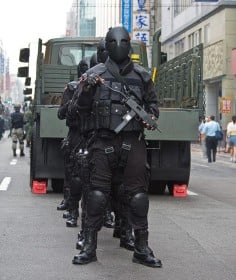
Taiwanese soldiers wearing ballistic masks look like ‘the cavalry from hell’

Source: SCMP
Taiwanese soldiers wearing ballistic masks look like 'the cavalry from hell'
Images of Taiwanese soldiers decked out in black body armour and ballistic masks have gone viral thanks to exposure on Japanese news sites, where viewers compared the look of the officers to something out of a video game or comic book.
The photographs, originally part of a series taken during a 2011 ceremonial parade in Taipei, depict Taiwan’s Armed Forces, including both male and female special operations soldiers and military frogmen.
All of the soldiers in the photos wield heavy weaponry including assault rifles, bulletproof shields and submachine guns, but the images that especially captivated netizens were those that showed the elite forces wearing ballistic face masks.

Japanese Twitter users said that these elite force units looked like something out of a video game. Photo: DDN Japan
“They look like the calvary from hell,” wrote a blogger on Japanese news portal DDN Japan, where the images went viral after they were posted on 19 October, attracting over 500 shares on Twitter and nearly 700 Facebook likes.
The photos were originally taken during a 2011 military parade in Taipei. Photo: DDN Japan
Other internet users compared the intimidating masks to the headgear worn by Japanese kendo fighters, while some said that they were reminded of characters in the video game franchise Army of Two, which features two armed mercenaries fighting in locations like Somalia and Shanghai.
The photos were later picked up by Western sites like Kotaku, which said that the soldiers were reminiscent of “comic book villains.”
In reality, ballistic face masks are usually made of bullet resistant synthetic materials like Kevlar and are meant to protect soldiers from head wounds. The masks are padded for shock absorption and are built to absorb close-range shots of anything up to a .44 Magnum. Wearing a mask does not render a soldier completely bulletproof, however, as the force of a bullet’s impact can still fracture a person’s skull, depending on the proximity of the blast and the firearm used.

Europe Breakup Forces Mount as Stalwarts Regret Losing Relevance

Source: Bizweek
Thomas Bellinck, a Belgian theater director, has put a date on the European Union’s collapse: 2018.
The doomsday timeline of his Brussels exhibition called “Life in the Former EU: Final Years of the Long Peace,” presented the bloc’s six-decade run as a peaceful interregnum before the continent’s relapse into nationalism, an interlude where technocrats were too focused on regulating the diameter of tomatoes as their experiment in multinational democracy withered.
“We need national politicians who are either prepared to defend the project and redo it or admit that they don’t want to do it,” says the 30-year-old Bellinck. “But now we have something in-between.”
What the EU’s founders in the 1950s intended as “ever closer union” now risks going in the opposite direction: Britain is threatening to secede; the euro, battered by the four-year debt crisis, remains at risk of splintering; anti-euro forces are advancing in France, the EU’s heartland; separatists are pushing to burst the U.K., Belgium and Spain.
Economic lethargy combined with a deepening political quagmire and mounting debt load as leaders struggle to tame the legacy of the financial crisis risk condemning Europe to lag further behind emerging powers like China. Europe’s global heft is eroding: the euro zone’s share of global gross domestic product has fallen to 13.1 percent from 18.3 percent when the currency was forged in 1999, according to International Monetary Fund data.

‘Quite Delicate’

“The situation is quite delicate, but the scenario of the disappearance or crumbling of Europe is not real,” Romano Prodi, a former Italian prime minister and European Commission president, said in an Oct. 14 telephone interview from Bologna. “For the short and medium term, to become more and more irrelevant — this is the real risk.”
It’s not the only scenario. Collapse, slow decline, or renaissance are the EU’s three alternative futures, a U.S. intelligence analysis argued last year.
Dissolution of the world’s largest market — with 507 million people in 28 nations and economic output of $17.8 trillion — wasn’t the base case of the U.S. spy agencies. Their “Global Trends” paper — released on the same day in December 2012 as EU leaders accepted the Nobel Peace Prize in Oslo — found a “low” likelihood of collapse, in which the euro and European single market fragment and civic order breaks down.

Federalist Utopia

Equally unlikely is a federalist utopia sketched out Oct. 3 by European legislators led by Guy Verhofstadt, a former Belgian prime minister. Turning the Brussels-based commission into the bloc’s government, imposing EU-wide taxes and gutting national vetoes over EU policies are non-starters in virtually every capital.
“What we see all over Europe is more nationalization of policy instead of more federalization,” said Elina Viilup, a former EU Parliament adviser from Estonia who is now at CIDOB, Barcelona Centre for International Affairs.
Instead, Europe is living through what the U.S. spy report dubbed “slow decline”: the commission expects the 17-country euro zone to shrink 0.4 percent in 2013, lagging behind the U.S. for the fifth year. The Pew Research Center called the EU the “new sick man of Europe” in May after its annual poll in eight countries showed a drop in the bloc’s favorability rating to 45 percent from 60 percent in 2012.

Corporate Shifts

The malaise extends beyond politics. German software maker SAP AG (SAP) is morphing into an ever-more U.S. company, having spent $12 billion on takeovers in California’s Silicon Valley since 2010. Fiat SpA (F), owner of Chrysler, got 75 percent of its 2012 operating earnings from North America, with CEO Sergio Marchionne considering a primary listing in the U.S.
Creditors led by Germany have committed 496 billion euros ($679 billion) to fight the debt crisis, expecting all of it to be repaid. With unemployment at 27.9 percent in Greece and joblessness in the under-25 bracket as high as 56 percent in Spain, the human and political costs are harder to recoup.
The political radicalism that ensued isn’t limited to the economically distressed Mediterranean rim. Across Europe, movements that define themselves as against something — the euro, austerity, the perceived European superstate, banks, U.S.- style capitalism, foreigners, Islamic extremism or just politics as usual — are making headway, echoing the gains by the Tea Party in the U.S.
“The rise of extremism and populism is an enormous concern for the EU,” Luxembourg’s Viviane Reding, the EU’s justice commissioner, said in an Oct. 9 EU Parliament debate. “It fuels racism, xenophobia, homophobia, all forms of intolerance.”

Protest Movements

The euro area’s lowest jobless rate, at 4.9 percent, didn’t prevent a party trumpeting the slogan “Austria First” from capturing 20.5 percent of the vote in September’s election there. Italy’s Five Star Movement, a protest group headed by Beppe Grillo, a former comedian, picked up 25.5 percent in February with a message blending environmentalism, civil rights and rejection of the traditional elite. Doubts about the euro are part of the Five Star package, since Italy has gone backwards during the euro era: Italian economic production per person is now 91 percent of the euro-zone average, down from 104 percent when the currency debuted in 1999, EU data shows.
Globalization’s discontents are dominating the conversation in France, where National Front leader Marine Le Pen is turning what her father started as an anti-foreigner clique into a mainstream force. “Economic patriotism,” ditching the euro and casting off “the dictates of economic policy from Brussels and Berlin” form the credo she has used to siphon votes away from established parties.

Soviet Example

The EU will “crumble like the Soviet Union,” Le Pen said in an interview published Oct. 15 with Agence France-Presse, RFI and Liberation. “We are the 5 percent of the world’s people with no control over our economy or currency, or over the people circulating on our territory.”
Le Pen has had a good month. An Oct. 3 TNS Sofres poll ranked her as the country’s third-most-popular politician, followed by an Oct. 9 Ifop poll showing her party in front nationwide for the first time. A breakthrough at the ballot box came Oct. 13 when the National Front won a by-election for a regional council seat in Brignoles near the Mediterranean coast, prompting panic and finger-pointing between the two traditional parties, President Francois Hollande’s Socialists and former President Nicolas Sarkozy’s UMP.

‘Deluded Idiot’

Britain’s contribution is the U.K. Independence Party, which makes a U.K. secession from the EU and curbs on immigration its raison d’etre. Headed by Nigel Farage, a former commodity broker who once called EU commission President Jose Barroso “a deluded idiot,” UKIP tallied 10 percent in this month’s YouGov poll, making it Britain’s No. 3 force.
Facing those headwinds, Prime Minister David Cameron gave in to the anti-EU wing of his Conservative party and promised to put Britain’s EU membership to a popular vote in 2017, assuming he is re-elected in 2015.
For now, the political center has a tenuous hold on European affairs. National unity coalitions run Greece, on financial life support since 2010, and Italy, seeking to escape that plight. The anti-euro forces that did so well in Austria put on a weaker showing in Germany a week earlier, getting 4.7 percent and missing out on seats in the Bundestag. Chancellor Angela Merkel is moving toward negotiating a unity government with her traditional rivals, the Social Democrats.

Parliamentary Elections

Next May’s elections to the EU Parliament are shaping up as a continent-wide referendum on where the EU is going. Declining turnout — from a peak of 62 percent in 1979, the year of the first direct balloting, to 43 percent in 2009 — makes the Parliament susceptible to protest votes, turning the home of European democracy into a sounding board for anti-EU populism.
The European elections are sure to rattle the government of Greek Prime Minister Antonis Samaras — if it survives that long. Samaras’s New Democracy has 22.7 percent support, virtually tied with 22.5 percent for the anti-bailout Syriza party, according to a Marc SA poll for Alpha TV on Oct. 11. In third place with 7.1 percent is the anti-immigrant Golden Dawn, now with three of its leaders jailed for alleged hate crimes.
Three other elections threaten to remake Europe in 2014.
Voters in Scotland will decide in September whether to break away from the U.K. Catalonia, Spain’s biggest economic region, may also hold an independence ballot. Belgium holds a federal election in May with a separatist party likely to be the top vote-getter in the richer Dutch-speaking Flanders region, renewing debate over whether the country will stay intact.

Secessionists’ Fate

One reason for secessionists to think twice is that the setup of a new regional state would propel them out of the EU, cutting them off from European consumers, employers and investors.
Recession, fragmentation and retreat are far from what the framers of the EU’s first-ever constitution had in mind at the start of the millennium. With the euro in place, the EU set to expand to eastern Europe and U.S. vulnerabilities exposed by the Sept. 11 attacks, European leaders launched a constitutional convention in late 2001 with the question: “Does Europe not, now that it is finally unified, have a leading role to play in a new world order?”
More than a decade later, the interim answer is: no, or not yet. The constitution was torpedoed by French and Dutch voters in 2005 and resurrected in scaled-down form in 2009 as the Lisbon Treaty. The euro’s wobbles have questioned a half-century of economic integration. The crisis buried the myth that the currency was a one-way street, with no exit clause. Greece was threatened with expulsion in 2011 and Cyprus careened toward the precipice this year, only to be saved at the last minute.

‘Historic Moment’

“The situation is quite fragile, not only for Greece,” said Anna Diamantopoulou, a former Greek government minister and European commissioner. “It is a very historic moment. We cannot go step by step any more, we have to jump. What is important now is to overcome this gradualism.”
Making that leap rests with Germany, thrust by the debt crisis into the role of Europe’s reluctant leader with Merkel as the indispensable decision-maker. To many, Merkel has exercised the wrong kind of leadership. German-inspired emphasis on deficit reduction is opposed by 60 percent of Europeans, according to an EU-wide Gallup poll last month. While 94 percent of Greeks demanded alternatives, so did 50 percent of Germans.

Reluctant Leader

To others, even in a country invaded by Germany in 1939, Merkel’s leadership is too reluctant. The trained physicist’s case-by-case approach prompted Polish Foreign Minister Radoslaw Sikorski to label himself as the first top Polish diplomat to fear German inactivity more than German power. With Merkel’s tactics validated by her party’s biggest electoral score since 1990, boldness isn’t likely in her third term.
“The danger of German aggression is about zero, the danger of German inactivity stands extremely high,” said Brendan Simms, a professor of the history of European international relations at Cambridge University and author of “Europe: The Struggle for Supremacy” about Germany’s pivotal role. “What you don’t have at the moment is the visionary chancellor who will set out a roadmap and a project. It’s just surviving from moment to moment, which is a lot better than nothing, but isn’t going to solve the problem in the long run.”
The duelling forces of union and disunion were summed up by Herman Van Rompuy, a former Belgian leader who became the EU’s first full-time president in 2009, in time for the financial crisis. When not chairing save-the-euro summits, Van Rompuy dabbles in haiku, a form of stylized Japanese poetry. His second haiku collection, published in five languages on Oct. 3, includes this meditation:
Winter slips away,
spring is still holding its breath.
Heaven has its doubts.

Paradigms Of Control

the "ONLY" war going on folks! ...is the war on IDEAS !!      who's gonna win out ..... ?     

Paradigms Of Control

truther October 22, 2013
Jon David Miller
AP
Those who are in power in human affairs have developed and used a variety of paradigms over the centuries to expand and maintain their control. Building on past success and with today’s much more powerful technologies, they are close to complete control in The New World Order Empire.
Paradigms Of Control
Feudalism
In primitive group consciousness, individual pursuits were minimal. A person with intelligence, character, skill and strength filled the role of leadership for group decision making.
To the mythic mind, the environment seemed to be affected by unpredictable spirits. Practices developed to honor or appease them. There may have been an intuitive shaman who would guide the community in numinous spiritual matters. Leaders realized the benefit early on of their people being calmed and mystified by an adept at handling what the people did not understand and thus feared. Spiritual guides or priests operated by the good graces of the ruler, so they would not rock the boat much.
Eventually the leadership organized the group to better protect or expand its territory. The leader became more powerful and wanted to extend that power to his offspring. Protection of wealth and power became important to the rulers. As kings and queens rewarded descendants and key loyal warriors with land, wealth and the honor of nobility, feudalism was established.
The landed aristocracy garnered fees from the serfs toiling on their land, and paid taxes to the layers of nobles above them, including the king and queen.
Gradually religion became an institutionalized method for perpetuating a common paradigm to keep the people in order. The sacred establishment and its doctrines and priests presented the social conditioning for the family and beyond. People worked in their individual daily activities and came together for religious rituals and celebrations.
With the Renaissance came the demand of the masses for greater freedom and self-determination. The elite powers had to become more subtle to regain and maintain control of the essentials and the people they still consider as serfs even today.
The nobility and a few other insiders had been invited into secret societies where occult traditions and practices behind religions were taught. The leaders of secret societies made plans to keep themselves in power, fashioning more sophisticated paradigms of control and grander psyops to manipulate the population.
They developed strategies of politics, law, finance and mass mind control to consolidate and maintain their dominance.
Controlling basic needs is a key tenet of dominating a captive population. In feudalism, the land, the food, the resources, the military and even the religious priesthood were all controlled by the royal court and its minions.
Democracy, Law & Finance
Moving from feudalism to the new paradigm of democracy, they could offer a political system of majority vote that seemed to give the people the power to elect their own government leaders.
By selecting the candidates and guiding the process from behind the scenes using bribery, threat, propaganda, assassination and powerful mind control methods, while keeping the people as uninformed and ignorant as possible, the elites gradually arranged to have puppets in nearly all key government positions.
The manipulation of law from all angles has led to a legal environment that serves the elites well. They control numerous lawmakers as well as many of those who adjudicate the law. Lobbying to have laws made or revised in their favor, they have encouraged the development of regulatory bureaucracies to limit their own competitors, while they favor divisive competition in business, politics, sports, etc., among their subjects.
Through fractional reserve banking, financing and other ventures, and the establishment of privately controlled central banks, the elite powers regained the controlling position through the financial realm. Employing bribery or threat they got officials to contract with them to issue nations’ currencies as loans.
The National Debt paradigm as well as the concept of the fiat dollar debt note, have been used by the banking powers to control governments and their populations. The U.S. dollar has the all-seeing eye pyramid, a common occult symbol, on the back.
Similarly the bankers have used the credit / debt tool to gain control of property and resources, and to trap people in their corporate work system.
The Corporate Paradigm
Another of the greatest concepts the controllers developed was that of the corporation. A corporation is a legal entity, a fictional stand-in for a person. It has powers and liabilities independent of its stockholders, board executives and employees.
The main purpose of a corporation is to control an operation of business activity, while limiting the liability of the owners or administrators, primarily the board of directors and officers. The corp is an entity of its own, and if it gets in trouble it is usually only the corp that has to deal with it or get penalized.
The corporation normally has the hierarchical structure of a pyramid, a favorite image of the esoteric societies. This is not unlike the royal courts of feudalism. The topmost controllers of the Transnational Interlocking Corporate Kingdom behind the global corporate system actually include among them those of royal blood and wealth.
Corporate executives enjoy being in charge of making decisions and setting policies. They like to keep expanding the realm under their control, similar to a feudal noble being master of their domain.
Most of what is available in the U.S. marketplace, and most of the world, is produced and/or sold by a corporation.
Almost every common business, union, educational institution, church and organization, including governments, is a corporation. Nearly every product, service, food concept, medicine, toy, movie, song, celebrity, candidate and personality, that becomes known to the general public, goes through the normal corporate process of analysis, R & D, market research, packaging, branding, marketing, and, if necessary, spin or repositioning.
The commercial areas of nearly every town look pretty much the same. You find mostly the same corporate stores, the same restaurants, the same cinemas, the same auto services, the same gasoline companies, and the same corporate brands in supermarkets, convenience stores and other home product outlets.
Almost every home is a model of corporate product development, promotion and merchandizing, from the furnishings, to the refrigerator and kitchen cupboards and the food products in them, and also in the bathroom, the basement, the yard and the garage.
Corporations dominate every major industry, including finance, oil and energy, chemicals, mining, metals, war, transportation, communications, medicine, computers, technology, news, entertainment and more.
The corporate news broadcasts only what they want us to know or believe, or what will keep us apathetic, and keep certain things under wraps. Predictive programming is used in the news, TV programs, movies, etc., to present memes and serve psyops.
Most charities, foundations, arts & cultural organizations, churches, social groups, service organizations, etc., are not-for-profit corporations with a board of directors and officers. A non-profit operates in a similar style to a for-profit corporation. Instead of stockholders, most non-profits have members or supporters.
Some non-profits are very embedded in the corporate world. A number of charities, foundations and educational institutions are heavily supported by big corps, their execs and management. There are numerous non-profits that are operated to foster circumstances favorable to profit making corporations related by interlocking boards.
Corporate Government
The federal government of the United States was replaced with a corporate form during the years after the Civil War. Before long state and local governments were manipulated into following suit. All of these government corporations are interrelated and they often work together.
The corporate model of government administration utilizes various departments, agencies and bureaucracies, many with revenue generating activities, including licenses and fees, income taxes, property taxes, sales or excise taxes and fines and penalties. One or more of these are employed at every level of government.
There is a great deal of crossover of top corporate execs into high level government positions and back to the companies, often in the same industry to which the government job is related.
Modern corporate government is a giant inefficient business with the luxury of compelled revenues, similar to the forced taxation and penalties by kings and emperors. Enforcement agents are in place to maintain a high level of compliance in paying taxes and to seek out violations of statutory regulations and administer fines.
Further, the U.S. government controls most all of the land in the nation, nearly all of several western states. State and local governments own a good deal of land as well.
The individual citizen who has paid off a mortgage and believes that they finally own the land they occupy, is ultimately subject to the “eminent domain” of multiple layers of corporate government. Meanwhile, government charges taxes for using the land and its “improvements”, somewhat like lease payments.
Like the kings of old, the corporate state compels massive financial support from its subjects, and uses some of its resources to develop tighter surveillance and controls on the population.
Controlled & Poisoned
A modern lifestyle has been fashioned by the elite controllers in which distribution of “scarce” fuel, remotely delivered metered energy, commercially engineered food, medicine and access to avenues of communication, are all owned and controlled by their corporate system.
Sugar, corn syrup, Aspartame, MSG, GMOs, preservatives, dyes, BPA in packaging, and other poisons, are in much of the food supply. Public water is a chemical cocktail containing especially toxic chlorine and fluoride, as well as traces of agricultural, industrial and medical chemicals. Chemtrails fill the skies a few days a week in most areas.
Pharmaceutical medicine is a key tool in the controllers’ tool bag. Most drugs do not correct health problems. They simply mask the symptoms. Drug side effects and interactions are major detriments to health. Health issues, often medically caused, preoccupy and stress many people, and waste massive amounts of time and attention.
Children are being victimized early by administration of psychotropic medicines, often requested by schools to help manage behavior. Their brain is usually already impaired before they get to school by the vaccinations beginning at birth.
Public poisoning is done on purpose to drive medical profits, decrease fertility and reduce the population.
Through a birth certificate, social security number, driver’s license, auto registration, professional license, business license, bank account, credit accounts, credit bureau profile, utilities accounts, insurance policies, securities holdings, passport, and/or various taxation accounts, etc., as well as by exchanges within the marketplace, almost everyone has a corporate identity.
Universal health care, dietary practices, family size, child rearing, lifestyle and more are coming to be managed by the ever more dominating bureaucracies. Travel, utility use, consumption and health care support will be rationed according to predetermined limits. Even length of life could be preset by genetic programming or another eugenics protocol.
What we have been taught and thus think we know about science has been falsely manipulated to create a powerful advantage for those in control. They have knowledge and technology far above what they allow even those in science-related education and careers to know, except for piecemeal information on a “top-secret, need-to-know, non-disclosure-or-else-serious-penalty” basis.
Global Paradigms
Routinely, there are little publicized meetings and agreements between government officials of various nations that are rarely subject to critical review. There have been many unopposed small steps, seemingly of minor importance, toward a global corporate state.
Those behind this are strategic and deliberate in their progress, and they have a very long-term view that spans generations.
They try to gauge how much the public will accept at any point; they set themselves up for rationalization and deniability; and they create manipulative circumstances that make their solutions more palatable.
Based on the “thesis, antithesis, synthesis” dialectical concept of European philosopher Georg Wilhelm Friedrich Hegel, the elite tricksters employ a strategy of alternating strokes, first slightly this way, then slightly that way. They move back and forth with problems and reactions, raising one arm then the other, creating a threat from one direction then another, and offering their preset solutions.
The synthesis between two pre-selected alternatives is usually the goal.
In this way the controllers guide the course of events so their solutions seem acceptable to enough people that their policies are gradually enacted without evoking a rebellion. Even better if they can get the people to request that something be done, in response to which they roll out the preset paradigm.
As an example of their use of the Hegelian dialectic philosophy, they have used methods of socio-economic organization they developed to divide and conquer the world.
Capitalism is private ownership of property and means of production primarily by individuals or corporations. Business is developed with either one’s own funds or other people’s money through selling stock or borrowing.
With socialism and communism there is community ownership of property and means of production, which is usually by the state. In practice, a communist state may be controlled by totalitarian dictators.
Setting capitalism against communism was the basis for the “Cold War” build up of militaries, nuclear weapons, technologies and espionage.
With the Hegelian formula:
Thesis: Corporate Capitalism
+
Antithesis: Communism/Socialism
Synthesis: Corporate Statist Communitarianism
Communitarianism is a softer sounding version of collective ownership of property and means of production, and operation of the government, with a focus on costly limitation on the use of resources in the face of the false threat of human caused climate change.
However, through regulation and control of a hypnotized populace, and a corporate structure crossing traditional lines between business and government, using the propaganda of saving us from disaster with a one world community agenda, communitarianism would also become a monolithic totalitarian highly controlled state.
While promoting the paradigms of sustainability and reducing overpopulation, the global elite are consolidating their ownership and/or control of oil, natural gas, water, land, farms and forests in the United States and around the world. It is important to learn how they are using Agenda 21 of the United Nations to redesign life as we have known it toward a fully controlled society.
Communitarianism, communism, socialism, capitalism, corporatism and even democracy, are all conceptual and organizational tools in the psyop game bag of the power controllers.
Fraud & Tyranny
Unfortunately, now the level of criminal fraud of the banksters is undermining the entire world economy. Economic collapse could be a prelude to global tyranny.
The issuing of subprime mortgages, and the securitizing and sale of bundles of these to companies, pension funds and governments all over the world, along with the associated marketing of shaky derivative hedge contracts, made the financial marketplace a gambling casino, destroying the real estate market and the economy along with it. Many have lost their homes and jobs with this fraud.
It now appears that rebellion is possibly being purposely evoked as a reaction to problems concocted by these tricksters. “Order out of Chaos” is a key Illuminati principle that coincides with Hegel’s philosophy. Stir up trouble, generate a disturbing reaction, offer an appealing solution. This is how “false flag” events and the preplanned reactions to them are used.
Insurrection would set up martial law as the solution. This is considered to be a possible method for their final implementation of obvious tyranny.
At the same time, many are concerned that the powers that be may be moving toward World War III. War has been one of the main paradigms of control throughout history.
Strategic Operations
There has been a continuing long-term gradual movement in the direction of accomplishing the goal of global government.
The controllers have used the threat of terrorism and “false flag” events to justify expanding security measures. The security state is now full blown. There are cameras all over the cities, on the streets, in stores, in public buildings, also on the highways, and on many computers, very nearly like the society depicted in George Orwell’s 1984.
Cell phone calls, texts, emails, Internet browsing, social networking sites, and purchases are all monitored by computers looking for suspicious or incriminating key words, products, services or relationships. Travel and whereabouts are tracked by global positioning, license plate reading, and even facial and body recognition and iris scans.
Thus the power controllers have used a variety of paradigms, primarily the corporate pyramidal structure, employing these and other mind control tools with strategic propaganda to divide and conquer, and to organize the Transnational Interlocking Corporate Kingdom for ever more effective control of governments and populations in The New World Order Empire.

Homeland Security Spends $80 Million On Armed Guards for “Civil Disturbances”

truther October 22, 2013
IRS buildings to be protected; What is the federal government preparing for?
The Department of Homeland Security is set to spend $80 million dollars on hiring a raft of armed guards to protect IRS and other government buildings in upstate New York during “public demonstrations” and “civil disturbances,” once again prompting concerns that the federal agency is preparing for food stamp riots, anti-tax demonstrations or some other form of domestic unrest.
Homeland Security Spends $80 Million On Armed Guards for “Civil Disturbances”
According to a solicitation posted on the Federal Business Opportunities website, the Federal Protective Service (a unit of the DHS), is looking for a contractor to supply armed Protective Security Officers (PSOs) to guard a variety of government buildings in the region, including “IRS buildings(s) during tax season.”
“PSOs will be required to be armed and some posts may require screening of visitors using x-rays/magnetometers,” states the solicitation.
The armed guards will be used during “public demonstration(s),” as well as “civil disturbances, or other unanticipated events on an as-needed basis.”
“This acquisition is for approximately 380,000 hours of Basic Service, 20,000 hours of Temporary Additional Services and 3,500 hours of Emergency Security Services per year. Currently, there are an estimated 205 guards protecting approximately 95 posts at over 55 buildings. The estimated value of this Contract is between $75M and $80M,” states the solicitation.
Why does the DHS feel the need to blow $80 million dollars at a time of cutbacks on yet more armed guards to protect government buildings during “public demonstrations”? What is the federal agency preparing for? Food stamp riots? Anti-IRS demonstrations? Or some other form of civil disorder?
In June, it emerged that the DHS was purchasing top of the range body armor and helmets for FPS guards as part of preparations for “riot control situations.” This followed a controversial drill last year dubbed “Operation Shield,” during which FPS agents armed with semiautomatic guns were posted outside a Social Security office in Florida. The unannounced exercise centered around “detecting the presence of unauthorized persons and potentially disruptive or dangerous activities.” Residents were forced to show identification papers to the guards during the drill.
Could the increased security around IRS buildings be related to the introduction of Obamacare? The federal government has consistently denied that any fines pertaining to Obamacare non-compliance could be seized from bank accounts, despite reports last year that the IRS had hired 16,500 new agents to harass citizens who attempt to evade the new law.
As we reported earlier this year, Federal Protective Service officers were hired to guard an IRS building in St. Louis during a Tea Party protest against the federal agency’s discrimination targeting conservative groups. The FPS has previously been used to spy on protesters. In 2011, the DHS asserted that it had every right to spy on peaceful protest groups and had been using Federal Protective Service (FPS) agents to do so since at least 2006.
In March, Arkansas State Fusion Center Director Richard Davis admitted that the federal agency spies on Americans deemed to be “anti-government,” noting that the DHS concentrates on, “domestic terrorism and certain groups that are anti-government. We want to kind of take a look at that and receive that information,” so-called threats which included people, “putting political stickers in public bathrooms or participating in movements against the death penalty.”

THE DAILY BELL: SIGNS (LITERALLY) THAT THE SHUTDOWN WAS THEATER

October 22, 2013 By

As you know folks, the Daily Bell is back, with a new look, but continuing the same analysis of what it calls “dominant social memes”. And, in this instance, it’s back with a provocative confirmation of my own views that the recent government shutdown hysteria was, at some level at least, theater, with the Tea Party, the President, the Speaker, and the Senate Majority Leader each playing Oscar winning roles as they ratcheted up the shrill rhetoric to new high frequency shrieks. It was good, and distracting.
But why would the Bell suggest that it was all theater? What were the signs?
The signs of theater were, quite literally, the signs.
You know, the signs that were professionally made, and which magically appeared on the barricades that equally magically appeared at national parks and memorials while government goons prohibited World War Two veterans from visiting the memorial they helped to build:
Who Is Really Destabilizing the Dollar
I hope you caught it, but in case you didn’t here it is again:
“And then there is this, regarding the recent US government shutdown:
I”n less than 8 hours of the shutdown, miraculously, professionally printed 3X4 foot signs appeared all over the country in the tens of thousands saying “this [park, facility, etc. with custom logos] closed due to government shutdown.”
“There has not been a government shutdown in 17 years. These signs were designed, specifications were determined, signs were then requisitioned, bids were posted and vetted, government contracts were awarded. The materials were then ordered and the signs manufactured then distributed [by] U.S. Mails [sic] or [another method].
“This shutdown was orchestrated and planned well in advance at least 6-8 months ago. Millions of tax dollars were appropriated and spent in this process. There is a paper trail a mile long leading directly to the White House.
“It’s hard to determine the source of this statement and we have no idea if it is accurate or even insightful, but into the hopper it goes.” (Emphasis in the original)
Whatever one makes of it, the signs had to be made, contracted for, and that would take at least some degree of lead time, before “the show began.” And that means, it was theater. One heard little, if anything, about this on the major lamestream media in the USA.
And if it was theater, then that means that all that “principled” opposition one was treated to from the Tea Party and its leaders was every bit as much theater too.
What was the theater for?
Let’s indulge in some high octane speculation.  It was for the purpose of convincing the American people that their leadership is ineluctably corrupt and incompetent, and that the institutions of government are no longer capable of addressing the now enormous problems facing the country. I agree with the first two, and strongly dissent from the last. If there are incompetent and corrupt leaders, it is because they are mirrors of their real masters: the super-rich and the corporations and banking institutions they control.
What are we to make of it? Well, even the Daily Bell is having difficulty pinning down a scenario:
“Why would Anglosphere elites want to weaken the dollar? Because they are getting ready to try to substitute a more globalized currency? When we read the IBT article excerpted above, we find this:
“As the first step in creating a de-Americanised world, all nations must try to shape an international system that respects the sovereignty of all nations and ensures the US keeps out of the domestic affairs of others, Xinhua said.
“The developing and emerging market economies need to have more say in major international financial institutions including the World Bank and the International Monetary Fund, so that they could better reflect the transformations of the global economic and political landscape,” the editorial says.
“It also called for an end to the use of the US dollar as the international reserve currency, a step that would ensure the international community could maintain a safe distance from the side-effects of domestic political turmoil in the United States.
“Look, we can’t prove it … can’t touch it … can’t feel it as a tangible object. But like the sudden eruption of fracking (which may or may not be a long-term viable technology but, it can be argued, is destabilizing the Petrodollar) to the selected targeting of BRIC countries via Snowden’s evidence to the current “shutdown” of the US government, we find a pattern that we can easily characterize as “directed.”
“The IMF and World Bank in particular are elite facilities. The idea that communist China wants “more say” in it is certainly a bit strange. Anyway, weren’t the BRICs going to create their own mini-IMF?
“Are US and British elites conspiring to weaken the world’s dollar reserve currency in order to substitute a more global currency like Keynes’s bancor? We can’t say for certain, of course, but if top men have set out to deliberately destabilize the dollar, that’s big news with tremendous ramifications.
“The dollar was in fairly good shape, post-Bill Clinton … for a monopoly fiat-currency, anyway. George Bush’s deliberate wars and grandiose domestic schemes further destabilized it. Barack Obama has doubled and trebled the damage.”
I have been suggesting that at least part of this scenario is because there is a quiet “retrenchment” into North America taking place, in part an elite-driven one. Such a retrenchment would be consistent with a plan to destabilize the US dollar to the point it is no longer practical as an international reserve currency. It would, however, also be consistent with a scenario that viewed all these machinations, not as the ineluctable plan of a single unified elite at the top of the western system, but rather, as the manifestations of serious infighting between them.  If the latter, then I am bold to suggest that there are indicators of such infighting, as Europe, long a preserve of one of those bankster dynasties, has increasingly distanced itself from the USA, and aligned with either Russia or China, the two senior powers in the BRICSA bloc, and as the American component of that “Anglosphere” has apparently been quietly driving the development of American energy sources, pulling capital, and, in my word, “retrenching.” There are, of course, the “footnote exceptions” to these two broad patterns.  One thing remains a constant, however, and that is, we can expect a replay of the recent theater, whether in the form of even more shrill hysteria between the Dummycrook and Republithug wings of America’s dominant political party and class(note the singular), or a theater of brinksmanship and mock concessions (“bi-partisanship” is the conventional buzz-word).
This of course suggests that the recent movements of opposition and protest, Tea Party and truckers converging on the District of  Corruption, are really targeting the wrong people and places. And we saw, of course, how the Occupy Wall Street movement was coopted early on by left-wing radicals with the predictable result that it lost its credibility with mainstream America. Nonetheless, people are increasingly aware that the source of the log-jams really isn’t in DC… it’s elsewhere.
But the signs themselves remain as a little-noticed, and big unanswered question, about the recent show.

Read more: THE DAILY BELL: SIGNS (LITERALLY) THAT THE SHUTDOWN WAS THEATER

Governments no longer have to worry about door-to-door consensus when they have operations like healthcare.gov at their fingertips

World Governments hijacking Information Highway with Spy Networks

Author
By Judi McLeod (Bio and Archives)  Tuesday, October 22, 2013
http://canadafreepress.com/index.php/article/58714
The most significant story of our lifetime isn’t that a ‘Canadian’  company’s glitches are keeping Americans from signing up for ObamaCare on a system that’s failing abysmally.  It gets much worse than that.
CGI—the IT system gleaning personal information from people signing up at healthcare.gov is the same company providing the computer software for world governments to spy on their own people and in some cases, on the friendly governments of others.
Billion dollar spy networks are floated by taxpayers.  In other words, civilians being spied on by government are paying to be spied on.
None of these billion dollar spy networks were able to stop the September 11, 2001 terrorist attack on America.  Nor did they save any lives in the massacre of innocents that shocked the world at Westgate Mall in Kenya, one month ago today.
Reasonable people the world over expect government-sponsored spy systems to spy on the enemy and not average people in their own countries.
While so many waited for One World Government, aka Big Brother to come walking through the front door, it sneaked through the back door as Big Brother Digital.
You no longer have to wait for conspiracy theories to put a face on it.  Big Brother is not black; is not white and doesn’t have to be bothered about belonging to any particular ethnicity or culture.  Its face should be as familiar as one of your own relatives.  Big Brother’s the computer on your desk, your iPad and cell phone and there’s no running away from him because there’s nowhere to hide.
Your tax dollars pay for his big bucks’ setup and salary and he knows everything that makes you, you.
When Big Brother discovered how easy it would be getting information from people in setting up the computer system for ObamaCare, he yelled, “Bingo!”
Governments no longer have to worry about door-to-door consensus when they have operations like healthcare.gov at their fingertips.
Why is no one putting together that the same company that can’t (or won’t) get healthcare.gov up and running is the same company governments use to spy on the masses?
With American jobs disappearing,  President Obama did go to a Canadian company to set up the ObamaCare website, paying $292-million for a website that’s still not working.
 In 2013, CGI has 31,000 employees in 125+ offices worldwide.
Let’s hope Obama is not starting a world-wide trend in showing governments how to spy on their own populations.
It now turns out that Canada is following the U.S. in providing billion dollar headquarters for coverts to spy in stealth.
In Canada, the most expensive Canadian government building ever constructed will be headquarters for a little-known military spy agency: CSEC (Communications Security Establishment Canada).
“When completed next year, the facility in suburban Ottawa will house the roughly 2,000 employees of the Communications Security Establishment Canada, a federal agency that spies mainly on foreigners by hacking into their computers, reading their email and intercepting their phone calls.” (Greg Weston, CBC News, Oct. 8, 2013).
“Under tight security, CBC obtained an exclusive tour of the top secret complex that most Canadians will otherwise never get to see, a development even National Defence apparently thinks is so grandiose that the department dubbed the project “Camelot” in official documents.
“CSECC officially estimates the complex will cost $880 million.  But sources close to the project say it will be closer to $1.2 billion by the time all the associated costs are tallied.  The new CSEC headquarters will have more floor space than the Air Canada Centre in Toronto, and its cost would build several big city hospitals.”
The massive glass skyscraper that is Canada’s new intelligence headquarters has soaring atriums, grand staircases and filtered drinking fountains.
In Canada, every comfort imaginable is being built in.  Spying on others comes with ultra comfort zones.  We’re waiting for teenagers to sport T-shirts emblazoned with the words, “Spies and Coverts rule!”
Incredibly, governments who spy on their own people, also encourage coverts to spy on other governments and seem to be getting away with it.
“France and Mexico Monday angrily demanded swift explanations about fresh leaks by former US security contractor Edward Snowden, which alleged that the United States had spied on millions of phone communications. (AP, Oct. 21, 2013)
“French daily Le Monde reported that the US National Security Agency (NSA) secretly monitored 70.3 million phone communications in France over a 30-day period from December 10, 2012, to January 8.
“German magazine Der Speigel said the NSA had hacked into former Mexican president Felipe Calderon’s email account.
“The allegations come on top of revelations already leaked by Snowden—who has sought refuge in Russia as the US seeks to try him for leaking classified information—and published in June that the US had a vast, secret programme called PRISM to monitor Internet users.
“French prosecutors are already investigating the programme, and French Prime Minister Jean-Marc Ayrault said he was “deeply shocked” by the new revelations.
“It’s incredible that an allied country like the United States at this point goes as far as spying on private communications that have no strategic justification, no justification on the basis of national defence,” he told journalists.
“French Foreign Minister Laurent Fabius, on a visit to Luxembourg, said US ambassador Charles Rivkin was summoned to his ministry early Monday.
“These kinds of practices between partners that harm privacy are totally unacceptable,” he told reporters, adding France needed assurances that the United States was no longer monitoring its communications.”
Spying, which used to be the much ballyhooed preserve of the FBI/KGB during the Cold War, is now archived on the Hollywood screen which romanticizes spies as handsome heroes out to save the world rather than peopled by techno nerds on the take, some of them paid for information that imperils human lives. 
A cut-throat world came in with the election of Senator Barack Obama as president in 2008, who even when he was still out on the campaign trail, was touting CGI as a “wonderful” company providing “well-paying” jobs when unleashing the world of spydom on his own unwitting citizens.
The Worldwide Web-dubbed Information Highway was supposed to provide Internet access to all the peoples of the world, putting them on equal footing,  but was hijacked by big governments along the way.
Meanwhile, someone needs to start an organization called ‘Stop Big Government from Spying on Little People’.
Copyright © Canada Free Press