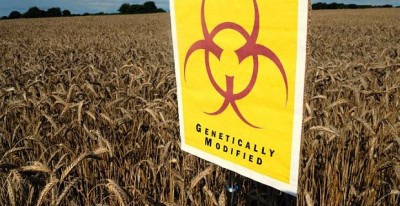
The Plight of Indian Farmers: From Militarism and Monsanto’s GMO to Gandhi and “Bhaskar Save”
US Presidential hopeful Bernie Sanders recently tweeted:
“It is no mystery why Monsanto fights against our right to know about
GMOs in food – business is booming for this huge chemical company.”
Supporters of
GMO are fond of telling everyone that this technology will ‘feed the
world’ and those who oppose it are below the standards of common
decency. But Sanders hits the nail on the head by implying commercial
interests and huge profits take precedence over concern for the public
good. Labelling would lead to consumers rejecting food containing GMOs.
Monsanto makes huge annual profits, and, as its front men, CEO Hugh
Grant and VP Robb Fraley are amply rewarded. Grant brought in just
under $12m in 2015. Fraley raked in just under $3.4m. In January 2015, Monsanto reported a profit of $243m (down from $368m the previous year).
In the meantime, millions of India farmers live on a knife-edge
thanks to them having been encouraged to experiment with the Monsanto’s
GM cotton. Read about the case of Bharat Dogra here whose
shift to GM cotton as a result of heavy pressure from company sales
agents proved disastrous. His case is not a one-off. A strong link has been discovered between economic distress among Indian farmers and the planting of Monsanto’s GM cotton.
With a legal obligation to maximise profits for shareholders,
Monsanto seems less concerned with the impacts of its products on public
health (whether in Argentina or the US) or the conditions of Indian farmers and more concerned with roll-outs of its highly profitable disease-associated weed-killer (Roundup) and its GM seeds.
The negative impacts on health or the debt that Indian farmers find
themselves getting into appears to be of concern to rich transnational
companies only when it becomes a public relations nightmare. If the
issue can be successfully managed through slick PR and an assortment of media and scientist mouthpieces to confuse the issue or attack and smear critics, it’s business as usual.
And to ensure it remains ‘business as usual’, part of the message is
that there is no alternative to the chemical-intensive, GMO model of
farming. Despite talk by company bosses of GMO being just being one
option from a mix of possible options that include for example organic
and agroecology, the companies they head or their associates have done
everything possible (including bribery and fakery)
to ensure their model dominates by smearing certain scientists,
capturing trade bodies and negotiations, incorporating themselves within
government policy and regulatory agencies, using the concept of
‘commercial confidentiality’ to justify a lack of transparency and by
funding universities, media outlets and research with the ultimate aim
of privileging their model of agriculture ahead of others, which they or
their supporters seek to attack, discredit and marginalise (see this).
The industry and its supporters attempt to wrap themselves in ‘free
market’ ideology, while failing to acknowledge that any concept of
‘freedom’ that they attempt to associate with ‘the market’ has long been
discredited. In terms of farmers ‘choosing’ to adopt GMO for instance
and letting ‘the market decide’, this is little more than rhetoric. A
combination of monopoly, financial incentives and coercion put paid to
that notion (see this, this, this, this and this).
Moreover, we don’t have markets that are ‘free’ but an economic system
protected by legislation that enshrines private property as being
sacrosanct and allows by various means for the flow of wealth to move
from consumers and workers to owners of capital who run cartels and
conspire to destroy competition and rig the system to their advantage
(see this).
Unfortunately, for the environment and our health, we have ended up
with a model of industrialised food and agriculture dominated by green
revolution ideology and technologies (and wedded to and fuelled and driven by powerful commercial and geopolitical interests),
which include hybrid corporate seeds to be doused with chemicals and an
over-reliance on other external inputs from large, rich corporations,
ranging from machinery and antibiotics to growth hormones and GMOs.
Rather than present a range of studies and practical examples that
indicate alternative approaches are both viable and should play a
leading role when it comes to feeding the world sustainably, which have
been outlined many times before (for example, see this), it would be interesting to look at the experience of one farmer from India as recently reported in The Hindu.
Prem Singh runs a farm in the drought-hit Bundelkhand area of Uttar
Pradesh, where many farmers have committed suicide in the past few
decades. While water shortages are one of the problems faced by the
people in the region, this is not the case on Singh’s farm, where
farming revolves around crop rotation, agricultural biodiversity and
organic agriculture. The farm also conducts research for improving soil
fertility (see this on
improving soil health in the US and the subsequent eradication of
synthetic fertilisers, while maintaining/increasing productivity) and
seed development.
Singh believes that if his formula of sustainable farming were to be
implemented across India, national food security, ecological balance and
the prosperity of a farmers’ families could be ensured.
The green revolution and the powers behind it played a big role in
dismantling the traditional structure of farming and pushed the farmer
to the mercy of unsustainable methods, which also harmed environment. In
the area where Singh farms, there has been three recent consecutive
droughts, with bouts of unseasonal rains and hailstorm.
The outside know-how of ‘experts’ was forced on farmers who were then
forced to abort traditional and more sustainable methods, eventually
leading them into debt-traps.
Singh says: “Every time a farmer commits suicide, the government says
he was burdened by debt. What is the key reason for the debt? The
farmers are dying because they follow the schemes of the government.
This is the real injustice.”
In Bundelkhand, there were 17 major droughts during the last century,
10 of them caused by deficient rainfall. But the traditional
water-recharging methods, numerous ponds and natural harvesting
techniques of people then mitigated the scarcity.
With 60 years’ hands-on farming experience, Bhaskar Save was able to describe how
the green revolution in India destroyed traditional farming, which,
among other things, was much more drought resistant, and how
water-guzzling cash crops led to water shortages and groundwater
depletion. Vandana Shiva has also outlined the
devastating impact of the green revolution on both food security and
water resources along with the degradation of soil, including its
diminished capacity for storing water.
As with Save, Singh says the steps taken by the government over a
period of decades have nullified the work of his ancestors because the
crops previously grown did not require much water. With the green
revolution, though, underground water began to be extracted heavily to
sustain the thirst of the seeds, whereas local seeds were tested and
adapted to fight drought.
At the centre of it all, says Singh, was “the ruling class’s apathy
towards farmers manifested in their lack of representation in policy
formation.”
Singh’s philosophy and practices reflect those of the late Bhaskar
Save, whose farm in Gujarat was both an inspiration and a model for
sustainable, productive farming. Save argued that restoring the natural
health of Indian agriculture is the path to solve the inter-related
problems of poverty, unemployment and rising population. He went on to
state that farming should require a minimum of financial capital and
purchased inputs and minimum external technology. Agricultural
production would increase, without costs increasing, poverty would
decline and the rise in population would be spontaneously checked (based
on the belief poverty itself leads to high birth rates).
Whereas Prem Singh and Bhaskar Save provide a glimpse into what
things could be like, not only in India but elsewhere too, the
transnational agribusiness companies have an investment in maintaining
the status quo.
This is because their business models and practices grow out of and drive a
political and economic system run by oligarchical interests. These
companies are instrumental in pushing for corrupt, anti-democratic trade
deals like TTIP and fuel and profit from a model of globalisation that
encourages unnecessary massive environmental destruction, the production of bad food,
unsustainable farming practices and the use of health-damaging inputs.
The system moreover thrives on an urban-centric model of development
centred on resource-depletion, over-consumption and an economic
neoliberalism underpinned by imperialist wars.
It all begs the question: what future humanity?
A future based on uncontrolled urban sprawl, worklessness, massive
inequalities (and subsequent political repression) and conflict over
finite resources, which continues to push the world to the brink of
nuclear annihilation, as well as the appropriation of all facets of life
from water and land to forests, seeds and food by powerful
corporations. 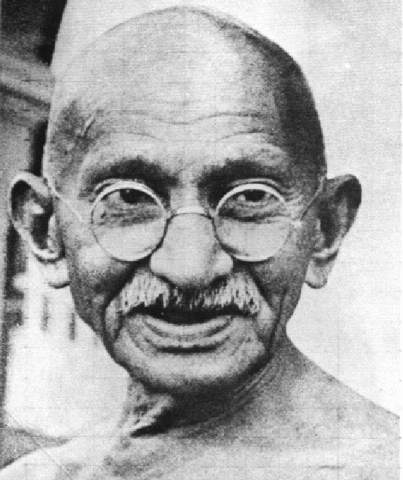 Or a future that adheres to a model based on certain Gandhian principles,
such as indigenous capability and local self-reliance, wherein people
limit their needs, live within the limits imposed by the environment and
work with the natural ecology rather than by forcing it to bend to the
will of profiteering industries.
Or a future that adheres to a model based on certain Gandhian principles,
such as indigenous capability and local self-reliance, wherein people
limit their needs, live within the limits imposed by the environment and
work with the natural ecology rather than by forcing it to bend to the
will of profiteering industries.
“… Gandhiji called the so-called modern society a
nine-day wonder. Poverty has been aggravated due to cumulative
environmental degradation on account of resource depletion, increasing
disparities, rural migration to urban areas resulting in deforestation,
soil erosion, loss of soil fertility, desertification, biological
impoverishment, pollution of air, water and land on account of lack of
sanitation, chemical fertilizers, pesticides and their biomagnification,
and a whole range of other problems.” T N Khoshoo: ‘Mahatma Gandhi: An Apostle of Applied Human Ecology‘
The original source of this article is Global Research

 Posts
Posts