The White House refusal to recognize China’s new air-defense identification zone (ADIZ)
is a knee-jerk reaction that reveals an astounding ignorance of
historical, legal and geopolitical issues in Asia and the Pacific. The
US-Japan Security Treaty, as a defense agreement to protect the Japanese
homeland against foreign invasion, was never intended for settling
boundary conflicts, as in the current cases of the Senkaku-Diaoyu islets
dispute with China, the Tokishima-Tokdo tussle with South Korea and the
Northern Territories-South Kurile claim against Russia. Washington
should not poke its long nose into these bilateral matters of limited
local concern, just as Japan should never militarily intervene in the
U.S. border problems with Mexico.
If anything should cause Washington to
desist from war-mongering, it is the Japanese claim that there exists no
islets dispute whatsoever. Tokyo maintains the pretense that the
Senkaku-Diaoyu issue is just being exploited by Beijng for
energy-exploration domination of the seabed and that the controversy
will soon blow over like a summer squall. This diplomatic posture is, in
reality, contradicted by the dispatch of battle-ready Japanese warships
and fighter aircraft to the surrounding waters and airspace.
.
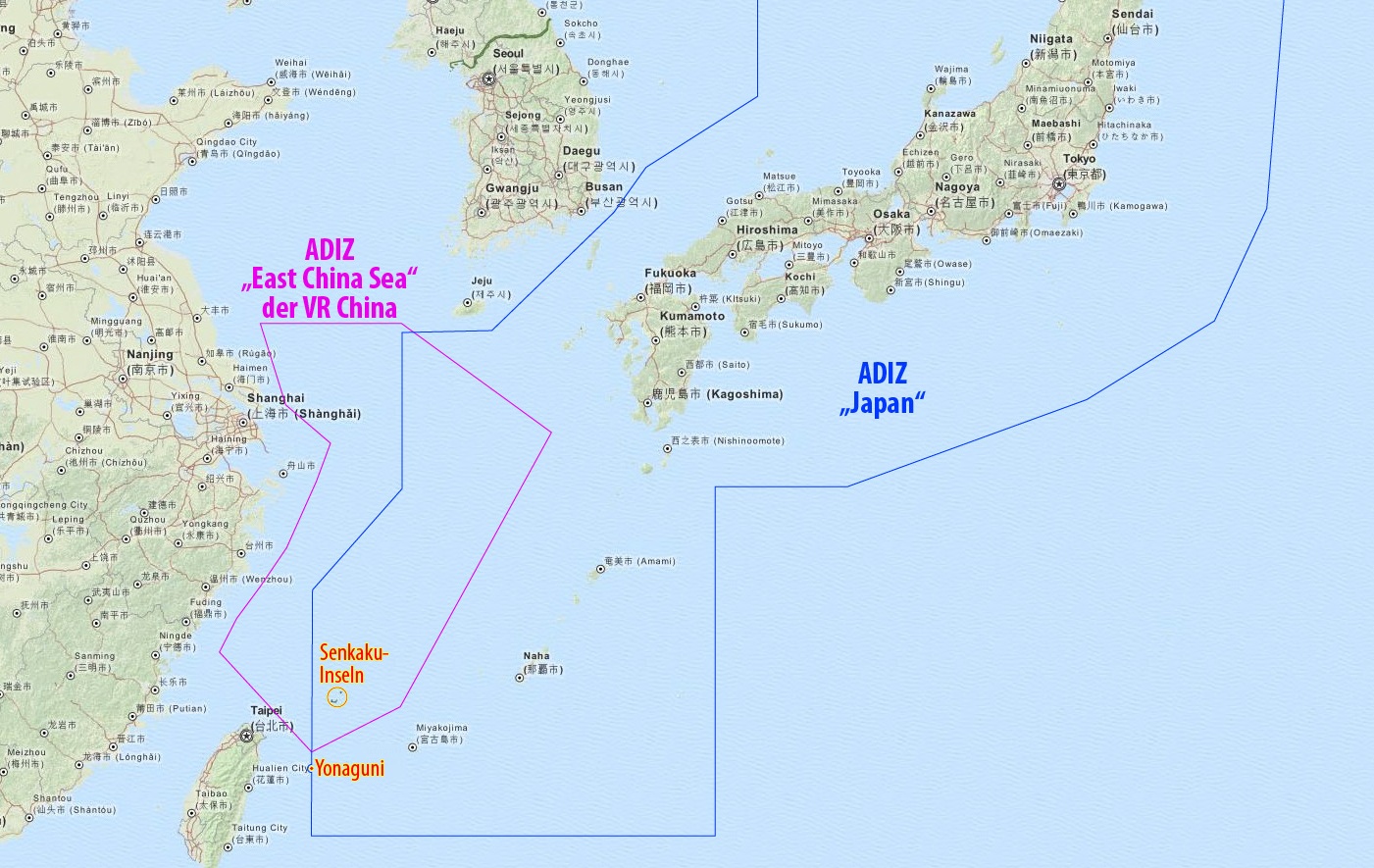
Japan has drawn its own ADIZ, modeling it after the 1945 airspace map drawn up by the U.S. occupation force. The
Japanese claim includes not just those barren rocks but also a vast
swath of far inside the continental shelf, which is claimed by China and
South Korea. In 2011, Beijing and Seoul filed a joint position paper
and complaint with the United Nations against Japanese encroachment
across the continental shelf.
-
Rejecting the World Court
The
quickest resolution to the Senkaku-Diaoyu quarrel, along with the
overlapping air-defense zones, is to bring a territorial case to the
International Court of Justice (ICJ), the world court that handles
international boundary disputes at The Hague. The ICJ requires sovereign
parties involved in the dispute to accept the court’s jurisdiction and
abide by its ruling. Japan’s rejection of an ICJ case therefore
indicates serious weaknesses in its territorial claims under existing
international law.
The U.S. is thus backing a sure loser under the UN Law of the Sea,
rendering its support for Japanese control over the Senkaku an untenable
and probably illegal act of maritime aggression and territorial
expansionism. For a nation that from its very inception has supported
freedom of navigation and national sovereignty, Washington’s bias toward
the Japanese claim runs counter to America’s traditional standards of
maritime law.
Before
proceeding, as someone born on Japanese soil it is difficult not to be
arguing instead in Japan’s defense against hostile neighboring
countries. Protection of one’s native land is paramount, especially when
considering the fact that Japan has so little acreage compared with its
gigantic neighbors. By the same token, for its national honor, Japan
should relinquish any territory that might still be illegally held as a
vestige of the colonialist policies of the past 120 years. The seizure
and renaming of those tiny islets was a disgraceful act of international
deception, which harms Japan’s postwar policy of legitimate
self-defense under international law.
Logic of Air Defense Zones
.
China’s recent move to declare an
air-defense zone is not precedent-setting, since the U.S., Japan and
South Korea have already imposed their own arbitrary ADIZ boundaries in
the East China Sea. Under ADIZ rules, which by the way are not regulated
by any international treaty, civilian aircraft are required to notify
the relevant national air-traffic authority of its flight plan and
aircraft number.
.
These security measures are especially needed over disputed maritime
areas to avert the shoot-down of a civilian aircraft mistaken as a
military intruder. The potential for the deliberated downing of a
passenger jet was highlighted in the missile that struck KAL007 in 1983,
when a Korean Airline jet was flown on a CIA espionage mission over a
Soviet air-defense base on the Kamchatka Peninsula, just north of Japan.
An air-defense zone is therefore sometimes necessary to ensure the
safety of civil aviation and to discourage harmful incidents by
intelligence agencies or terrorist hijackers.
.
There is a darker side to this airspace dispute, which none of the
parties are willing to admit. Former Tokyo Governor Shintaro Ishihara,
during his last year in office, led an ultranationalist team of civil
engineers to plan the construction of a helipad, capable of landing
light aircraft, on the largest islet Uotsuri. Donations for Tokyo’s
Olympic bid were allegedly misappropriated in 2012 for the
quasi-military project, according the city press.
Ishihara’s intervention in the Senkaku-Diaoyu dispute was initiated much earlier, back
in
1996 with the construction of a lighthouse on the islets, intended to
enable boat landings, by the Japan Youth Federation. This rightist
organization was created by a Ginza-based yakuza group whose members are
“zai-nichi” or ethnic Koreans, specifically descendants of
collaborators with the Japanese colonialist occupation of the Korean
Peninsula from 1895 to 1945. The ethnic gangster group provided campaign
funds for Tokyo Metropolitan Governor Ishihara in spite of his racist
agitation against third-world immigrants from Korea, China and the
Philippines.
Manchurian Memories
More
worrisome perhaps from the Chinese historical perspective is the
potential for covert sabotage of one of Japan’s own passenger jets. A
violent plane crash, blamed on Beijing, could rally international
support for invoking the U.S.-Japan Security Treaty to launch a
counterstrike against Beijing. Then notorious precedent for false-flag
attacks was set in the 1931 Mukden Incident, when Imperial Army officers
bombed the Japanese-owned South Manchurian Railroad (Mantetsu). The
clandestine operation provided the pretext for an outright military
invasion of northeast China . Soon after the plot was exposed in the
world press, Japanese Foreign Minister Yosuke Matsuoka, former head of
the Mantetsu, led the 1933 walk-out from League of Nations, which marked
the actual start of World War II.
The legacy of the Manchurian covert operation is also a major
chapter in the family history of Prime Minister Shinzo Abe, whose
grandfather Nobusuke Kishi became the finance and economy minister of
the puppet state of Manchukuo as a direct beneficiary of that false-flag
attack. Inside Manchuria , Kishi sponsored the infamous bioweapons Unit
731, which launched mass-murder attacks on populous cities with bubonic
plague and Hanta virus. Simultaneously, Kishi served as wartime head of
the Munitions Ministry, which developed an atomic bomb program on Konan
( Hungnam Island ) in northern Korea and inside Fukushima Prefecture .
Prime Minister Shinzo Abe is an unrepentant admirer of his
grandfather Kishi, often quoting his forebear on the necessity of
nuclear weapons for Japan . The naval standoff around the Senkaku-Diaoyu
islets, as a provocation campaign, is connected with the continuing
nuclear armaments program centered in Fukushima Prefecture, where the
military ran uranium and thorium mines in the late 1930s, under a secret
project codenamed BUND-1.
The pall of secrecy is being reinforced by the Liberal Democratic
Party, which has just rammed through a state secrets law aimed at
suppressing whistleblowers and journalists on grounds of national
security in foreign affairs. While the Senkaku-Diaoyu clash serves as a
news diversion from the massive radioactive releases from the destroyed
Fukushima nuclear plant, the maritime conflict also serves as a rallying
point for Abe’s calls for “nuclear capability”.
The postwar “peace” Constitution, forbidding Japan from war as an
instrument of state policy, was drafted with assistance from Americans
aiming to prevent a repeat of the wartime horrors. However, a by-now
forgotten point that needs reminding is that the United States was a de
facto ally of Japanese militarist aggression in Manchuria, where U.S.
Army observers and railway engineers with the Harriman-owned Union
Pacific Railway were stationed until just before the Pearl Harbor
attack..
Statements by Defense Secretary Chuck Hagel in support of Tokyo’s
claims on the islets reveal a deep-seated split between the Pentagon’s
global military agenda and the State Department’s traditional support
for democracy and sovereignty.
Deceptions in History
Tokyo’s claim to the Senkaku group is based on the principle of
“terra nullis”, a Latin term that means the site was uninhabited and
unclaimed until discovery by Japan. On historical record, however, the
Diaoyu group was registered as part of Toucheng Township in northeast
Taiwan, the closest land mass to those islets (140 kilometers versus 170
km distance from Ishigaki Island, Okinawa Prefecture).
Japanese
“discovery” of the islets in January 1895 happened to coincide with the
seven-month-long First Sino-Japanese War. That conflict ended in April
of that same year with the signing of the Treaty of Shimonoseki, under
which diplomats of the defeated Qing Dynasty ceded the Korean Peninsula
and Taiwan to Japanese rule.
While that treaty, drafted and signed under coercion, did not
specifically mention the Diaoyu group, those islets formed the critical
flank for subsequent Japanese naval operations, which began in June
against resistance from the newly declared Republic of Formosa. Japanese
cruisers and troop carriers had to cruise past the Senkaku isets to
attack the offshore Pescadore Islands in the Taiwan Strait and then
proceed to the southernmost tip of Taiwan. In short, capture of the
Daioyu was an integral step in Japan’s first war against China and in
preparation for its military takeover of Taiwan.
Roots of American-Japanese militarism
Taiwan was the victim of aggression from the first joint U.S.-Japan
military operations decades prior to the Nine-Power intervention against
the Boxer Rebellion, which destroyed Beijing and Tianjin at the turn of
the century. The punitive Taiwan Expedition of 1874 was organized by
American Civil War veteran Gen. Charles Le Gendre, while the Japanese
invasion forces were led by Saigo Tsugumori. These real-life figures
inspired the fictional characters for the film “The Last Samurai” with
Tom Cruise in the role of Capt. Nathan Algren (modeled after Le Gendre)
and Ken Watanabe as Katsumoto (Saigo Takamori, Tsugumori’s elder
brother).
In contrast to the romantic Orientalism of that Hollywood version of
events, the actual historical figures were not traditionalist
practitioners of the warrior code known as “bushido.” In fact, Le Gendre
and the Saigo brothers were military modernizers and aggressive
imperialists responsible for the slaughter of Taiwanese aboriginal
people who established the guidelines for Japanese expansionism into
Korea and China.
Since the 1879 visit to Japan of retired President and Civil War hero
Ulysses Grant and as continued by Theodore Roosevelt during the 1904-05
Russo-Japanese War, the United States was firmly allied with its fellow
republic, Meiji Japan , against a “backward” East Asia . The American
view of republican Japan conveniently ignored the “deep-state” power of a
coterie of militarist aristocrats and war industrialists who stood
above the law from the 1868 Restoration until the 1945 defeat. The Cold
War and the conflicts in Korea and Vietnam led to the revival of the
military-industrial complex known as the “zaibatsu”, which is now, at
this very moment, proceeding to eliminate the democratic rights of a
cowed Japanese public.
The Pacific War of 1941-45 was therefore
a rare rupture i the historical cooperation between the hegemonic
powers of West and East. The rise of China now threatens to upset this
longstanding alliance between Washington and Tokyo, and so their joint
military forces are mobilizing at the “strategic pivot” to roll back
unwanted challenger. The fulcrum of the pivot, around which the entire
Western Pacific now turns, is the Senkaku islets, where American and
Japanese naval and air forces have a formidable strategic and tactical
advantage over the People’s Liberation Army.
Meiji Japan’s spectacular victories over the navies of Qing-dynasty
China and tsarist Russia, along with the capture and colonization of
Taiwan and Korea, were made possible by top-of-the-line battleships
built at Scottish shipyards with loans from J.P. Morgan bank and with
gunnery training from British and American officers. Ever since those
days of gunpowder and glory, the domination of continental Asia remains a
vital part of the globalist agenda of the financial and political
elites in New York, Tokyo and London. The threat of another world war
arises from these global centers, and certainly not from a defensive
Beijing, Pyongyang or Moscow.
Maritime Resource Rivalry
In its policy paper on the Senkaku non-dispute, Japan’s Foreign
Ministry claimed that China never claimed sovereignty over the islets
until oil resources were discovered in the vicinity in the late 1970s.
The credibility of this claim, however, was overturned by a 2012
revelation from LDP veteran Hiromi Nonaka, an expert on security
affairs, in his recollection of the late Prime Minister Kakuei Tanaka’s
unexpected query to Chinese Premier Zhou En-lai in September 1972.
Aides
from the Foreign Ministry were reportedly taken aback by Tanaka’s
off-the-cuff question to Premier Zhou about China’s position on the
islets dispute. Given the urgency to normalize relations with the US and
Japan, while negotiating for an end to the Vietnam War, the Chinese
statesman suggested a deferral of the Senkaku negotiations until the
unspecified future, according to Nonaka, who was present at that
historic summit. Foreign Ministry spokesmen have since claimed that the
diplomatic archives contain no record of this exchange, which is
certainly not the first or last time that the historical record
disappears in Tokyo.
.
Taiwan left out
.
Even among diehard supporters of Taiwan
independence, Beijing and not Taipei has been recognized as sovereignty
holder in the bilateral dispute. As a former LDP parliamentarian,
Shintaro Ishihara organized the Blue Wave club of Diet members who
supported Taiwan independence. In wake of the Tokyo subway gassing,
however, Ishihara resigned from the Liberal Democrats due to media
disclosures of his role in founding the Russo-Japan College, which was
run by the subway sect Aum Shinrikyo as a front for smuggling weapons of
mass destruction from a collapsing Russian economy. His close partner
in creating the doomsday sect was the late Foreign Minister Shintaro
Abe, father of the present prime minister.
-
Despite his verbal support for an
independent Taiwan, Ishihara never acknowledged that the Senkaku islets
or disputed Yonaguni Island were part of Taiwan, and instead focused on
opposing mainland China as the sovereign power and sworn enemy.
Ishihara’s bluster and antics on the islets have united the Chinese
worldwide as never before, a backlash with negative ramifications for
Japan’s economy as well as its diplomacy. The landing by
Hong Kong activists on the islets lends even more support for a united
Chinese claim on the Diaoyu as a part of Taiwan Province.
A note in passing: Yonaguni, famed for its mysterious underwater
“pyramid”, is the southernmost island of the Ryukyu chain, and was
traditionally controlled by Taipei. In the 1970s, then President Chiang
Ching-kuo sent Taiwanese jet fighters on flyovers to assert Taipei’s
territorial claim over that small inhabited island
Maritime Markers
Today, the barren outcrops are far more important as markers for 200
nautical mile maritime economic zones, under the UN Law of the Sea, than
for their land value. The countries of East Asia are vying for fishery
resources and more importantly the mineral and petroleum deposits below
the seafloor.
Chinese
and Korean claims to the East Asian continental shelf add up to about 1
million square kilometers of maritime area, excluding the Paracel and
Spratley archipelagos, which are disputed by Southeast Asian nations.
.
In contrast, Japan’s ever-expanding
Exclusive Economic Zone comprises 4.5 million square kilometers, a dozen
times larger than Japan’s landmass. While fixating the news media on
the Senkaku-Diaoyu confrontation, Tokyo has quietly laid claim to more
than 30 islands and atolls on the far ends of the North Pacific, along
with the 200-mile oceanic zone around every reef and outcrop.
The Senkaku islands comprise only about 9 hectares of steep rock
jutting out of rough seas. In comparison, the land area lost to the
Fukushima nuclear disaster within the exclusion zone amounts to some
3,000 square kilometers. More than 33,000 Senkaku archipelagos could fit
inside the radioactive dead zone.
A die-hard supporter of nuclear power, Prime Minister Abe is willing
to throw away millions of dollars “defending” a remote fringe of the
East China Sea while failing to provide compensation and living
expenses, much less alternative land and homes, to 160,000 evacuees from
radioactive areas of Fukushima in the Honshu heartland. The current
emphasis on national security and nuclear capability are completely out
of kilter with the increasingly harsh conditions faced by the Japanese
people.
Winners and Losers
The
islets conflict has also permanently harmed Japan’s chances of ever
recovering from Russia two of the four disputed islands of the South
Kurile chain, which are lush with vegetation and once inhabited by
Japanese fisher folk, who have lived in exile on Hokkaido since the
war’s end. Provoking China and South Korea, while alienating Russia,
have wrecked any hopes for regaining the Northern Territories.
-
The only winner in the islets dispute is
the Chinese navy, which by now has overwhelming and unquestioning
domestic support for naval modernization and fleet expansion. Tokyo’s
confrontational attitude has resurrected painful memories of past
atrocities and imperialist arrogance during the two modern wars against
China. It is just a matter time before an aging and less agile Japan
slips badly, and the Chinese forces move in – hopefully for no more than
those tiny outcrops.
The strategic pivot policy promises only costly military spending and
humiliating setbacks ahead. Japanese policymakers should accept a world
court judgment, if only to prevent future losses of legitimate national
territory, which is more vulnerable than any military strategist is
ready to admit in public. The long-term interests of Japan and the US
are better served by a maritime security treaty and resource partnership
with China and Russia, not a self-defeating rivalry against these East
Asian powers.
If a strategic retreat is not implemented sooner than later, the
Senkaku-Diaoyu dispute could rapidly escalate into the last battle of
the Pacific War and the first shots fired in World War III. Diplomacy,
as the art of compromise, is needed more than ever to prevent the
unthinkable.
Yoichi Shimatsu, a Hong Kong-based journalist, is former editor of the Japan Times Weekly in Tokyo .

 Posts
Posts