Thursday, March 20, 2014

MISSION ACCOMPLISHED MH370 FOUND

Posted by George Freund on March 20, 2014


Map: Four aircraft have been sent to the area, pictured, where the objects were spotted


Narrowed the search: Investigators have halved the scope of the search for missing Malaysian Airlines Flight 370 to an area roughly the size of Arizona, off the coast of Australia

The beauty of being a student of the methods of crime for the better part of my life is I see through the smoke and mirrors of deception the perpetrators create to deflect any evidence from sticking to their shoes. The micro has all the aplomb of the macro just on a much greater scale. If Clint Eastwood's 'PUNK' steals a car, what does he do with it when it is of no further use? He ditches it. The reason is obvious. It is evidence that ties him to the crime. It is specific undeniable evidence that leaves no way out of the certainty of conviction. It is no different with a jumbo jet. It is specific evidence that everyone in the world is aware of. It has to be gotten rid of. It is a liability of enormous proportions.


Two pieces of wreckage that are possibly from the missing Malaysian Airlines Flight 370 - one estimated to be 78ft in size - have been found to the west of Australia, it was announced today. Pictured: Satellite pictures released by the Australian Maritime Safety Authority of the object thought to be related to the search for MH370

The problem we face in this matter is that it appears nation states are involved in the crime. They have had and concealed evidence that would be commonly known to exist. The main example would be military radar. It took many days to pry that detail loose. A fly cannot hide from the surveillance grid that exists today. They can follow migrating birds or whales in real time for research projects. Our leaders try to pawn off a hopeless, helpless set of circumstance to pacify persons with the IQ of a child as if the technological abilities still parallel the 1930's when Amelia Earhart disappeared. How we play our roles as the fools to accept these lies. I mean LOOK at the date stamp on the image the Australian government released today the 20th of March. It is dated March 16th. They have known the whereabouts of the plane for FOUR DAYS. They have probably known for longer because they knew where to look. This is not a conspiracy theory. It is evidence their evidence that shows gross negligence or worse. I lobby for worse COMPLICITY! In four days search vessels would have covered a lot of sea to reach the wreckage. My submission is that this has been a well orchestrated plot on the behalf of numerous countries, their militaries, intelligence agencies and the corporate vassals we call a media.


The debris was spotted on satellite imagery and a total of four aircraft have been sent to investigate the sighting, some 1553 miles off the coast of Perth


This Google Earth map shows just how remote the search area is

The above image gives you an indication of how remote this area is. It is even amazing satellites are even monitoring the area. That is another bizarre twist to the evolution of the story matrix. The Malacca Strait is one of the busiest sea lanes in the world yet they had no evidence to offer as to the movements of Flight MH370. Yet in the remotest corner of the Earth, we just happened to be scanning the ocean. As Maxwell Smart always said I find that hard to believe. Of course the million dollar question was WHY? All I can offer is it had to be GOOD. It had to be a destiny changing attempt at altering the timeline of the planet. The world was heading to a major east west confrontation with the Russian army massing and drilling to invade Europe. They were testing their abilities at an all our FIRST STRIKE! The Chinese were reported to be ready for an all out nuclear first strike against Japan. Flight MH370 was carrying some top scientists at the cutting edge of systems development. They were bound for Beijing. They never made it.


Thai military yesterday said they picked up an unidentified aircraft on radar bearing off the flight path, heading left over Malaysia and towards the Strait of Malacca

So now that the mission or crime is a fait accompli the suspect vehicle a Malaysian Airlines Boeing 777 can be reported found four days after it was found. I still surmise the plane was diverted to Diego Garcia. Some people may have been put in the ultimate rendition operation. The rest may have been left on the aircraft for its last flight to give credibility to the cover story. Aviation experts are already on record stating there is NO WAY the aircraft could have gotten to the crash point without human intervention. I would tend to agree. The plane was under control from the moment it changed course. However, that might very well have been remote control. As in 9/11 the planes were flown at the behest of something called The Flight Termination System that allows aircraft to be controlled from on the ground or in flight. I would suspect that can be done via satellite as well. The pilots never had a chance. Whoever or whatever was removed at Diego Garcia made possession of the plane redundant. In fact it became a great liability.


If I had to speculate, it was launched on a one way remote controlled flight across the Indian Ocean to the remotest part of the world where it crashed after running out of fuel. I would suspect alternative media's dogged prosecution of the known facts made the operation TOO HOT to handle further. We as a people have tasted TRUTHS. We will never accept the packs of lies from the traitorous SCUM that control nations. militaries, and intelligence agencies. Like spring water in comparison to sewer water, we can tell the difference. Deceit mandarins take notice your days of control are ebbing. There will come a day when your system will end. At that time true justice will be applied. Your cells or your scaffolds will be the reward for your evil deeds. To God we give our troth. Do you feel lucky PUNK?

The Problem with Serious Games: Solved


Serious games are becoming increasingly popular, but the inability to generate realistic new content has hampered their progress. Until now.

Here’s an imaginary scenario: you’re a law enforcement officer confronted with John, a 21-year-old male suspect who is accused of breaking into a private house on Sunday evening and stealing a laptop, jewelry, and some cash. Your job is to find out whether John has an alibi and if so whether it is coherent and believable.
That’s exactly the kind of scenario that police officers the world over face on a regular basis. But how do you train for such a situation? How do you learn the skills necessary to gather the right kind of information?
An increasingly common way of doing this is with serious games, those designed primarily for purposes other than entertainment. In the last 10 years or so, medical, military, and commercial organizations all over the world began to experiment with game-based scenarios that are designed to teach people how to perform their jobs and tasks in realistic situations.
But there is a problem with serious games which require realistic interaction with another person. It’s relatively straightforward to design one or two scenarios that are coherent, lifelike, and believable but it’s much harder to generate them continually on an ongoing basis.
Imagine in the example above that John is a computer-generated character. What kind of activities could he describe that would serve as a believable, coherent alibi for Sunday evening? And how could he do it a thousand times, each describing a different realistic alibi. Therein lies the problem.
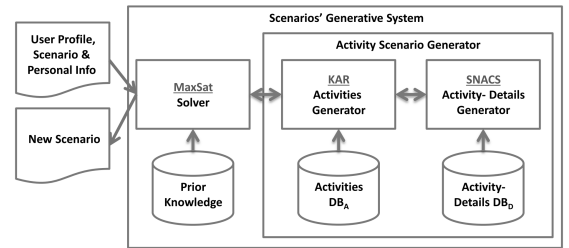
Today, Sigal Sina at Bar-Ilan University in Israel, and a couple pals, say they’ve solved this problem. These guys have come up with a novel way of generating ordinary, realistic scenarios that can be cut and pasted into a serious game to serve exactly this purpose. The secret sauce in their new approach is to crowdsource the new scenarios from real people using Amazon’s Mechanical Turk service.
The approach is straightforward. Sina and co simply ask Turkers to answer a set of questions asking what they did during each one-hour period throughout various days, offering bonuses to those who provide the most varied detail.
They then analyze the answers, categorizing activities by factors such as the times they are performed, the age and sex of the person doing it, the number of people involved, and so on.
This then allows a computer game to cut and paste activities into the action at appropriate times. So, for example, the computer can select an appropriate alibi for John on a Sunday evening by choosing an activity described by a male Turker for the same time while avoiding activities that a woman might describe for a Friday morning, which might otherwise seem unbelievable. The computer also changes certain details in the narrative, such as names, locations, and so on to make the narrative coherent with John’s profile.
Sina and co tested the resulting narratives by asking dozens of people to rate how authentic and coherent they seemed and compared this to how they judged the authenticity of the original, real narratives supplied by the Turkers. The results are impressive, with no significant difference between the ratings.
These guys have even begun to use that new technique in real games. “We have begun integrating this approach within a scenario-based training application for novice investigators within the law enforcement departments to improve their questioning skills,” say Sina and co. These investigators will now find that John has an almost unlimited set of new alibis to draw on.
That solves a significant problem with serious games. Until now, developers have had to spend an awful lot of time producing realistic content, a process known as procedural content generation. That’s always been straightforward for things like textures, models, and terrain in game settings. Now, thanks to this new crowdsourcing technique, it can be just as easy for human interactions in serious games, too.
Ref: arxiv.org/abs/1402.5034: Using the Crowd to Generate Content for Scenario-Based Serious-Games

EPA Lifts Ban, BP Wins $40 Billion in New Contracts

image source
Joe Wright
Activist Post

The financial penalties levied against BP for the Gulf oil disaster began as a landmark $4.5 billion settlement, topping the previous largest U.S. criminal penalty issued against Pfizer for marketing fraud. As the BP oil spill has continued to ravage the food chain and the environment, other rulings were added. The second ordered BP to pay $7.8 billion in payouts to businesses and tourist companies affected by the spill. The latter class action suit was signed off on by Judge Carl Barbier in a 125-page ruling. BP continues to face payouts from their $38 billion dollar allotment under SEC fines and fines under the Clean Water Act.

While these settlements are at least a record of BP's guilt, families who have lost loved ones realize all too well that none of it amounts to what was truly lost.  To add insult to injury, BP is still in business; in fact, strong as ever. Just days after the EPA lifted their one-year ban, the company has been awarded 24 new contracts valued at more than $40 billion.

Just after the initial $4.5 billion fine was announced, Huffington Post sardonically noted the following: "BP Oil-Spill Fine So Horrible, BP's Stock Price Only Rises 1 Percent," One of the five ways they put this in perspective was the following:
Sales And Profits: BP in 2011 recorded revenue of $234.25 billion, with net income of $16 billion, according to data tracker FactSet. In other words, BP could pay even a $10 billion penalty with just nine months' worth of profits. A $4.5 billion penalty would wipe out a little more than a single quarter's profits. In this case, it will be paid out over five years -- beginning in 2013 -- meaning the hit to quarterly profits will be much gentler. BP has more than enough cash to cover this, meaning it won't have to borrow money to pay the costs, saving on interest payments. This latest Friday night ruling awaits its Wall Street reception in a short session on Monday before closing for Christmas. You can follow the stock price HERE. Every indication is that there will be little to no effect.
And since the time of that article, posted 11/15/2012, BP stock has risen another 17.42%.


Despite that, the $40 billion in new contracts itself quickly replaces nearly all that was, or ever will be, lost in fines and legal actions. It also says a lot about how much "protection" is part of the Environmental Protection Agency. The bids entail rights to specifically explore the Gulf of Mexico, while also hinting at a special threat agreement that has taken place between BP and the EPA.
Under the agreement, BP will implement stronger safety and corporate governance rules, and will be monitored by an EPA-approved independent auditor over the next five years. BP had filed a lawsuit against the EPA to have the ban lifted, but will now drop the suit as part of this month's agreement. (Source) [emphasis added]
So, as researchers still continue to gauge the long-term health and economic effects of BP's criminality, the EPA has granted BP the right to explore the very same area that they already devastated ... and profit unhindered once again. And if anyone is actually placated by the "EPA-approved independent auditor" just remember Ground Zero.

The EPA quickly went on the record to assure people at Ground Zero following 9/11 that air quality was not an issue. Then-administrator Whitman stated at the time:
“We are very encouraged that the results from our monitoring of air quality and drinking water conditions in both New York and near the Pentagon show that the public in these areas is not being exposed to excessive levels of asbestos or other harmful substances,” Whitman said. “Given the scope of the tragedy from last week, I am glad to reassure the people of New York and Washington, D.C. that their air is safe to breathe and their water is safe to drink,” she added. (Source)
This, of course, has led to an untold number of people being negatively impacted, including an astounding number of first responders who have battled ever since to be compensated for the now-established cover-up.
...the CDC has confirmed that out of several hundred thousand first responders near the scene of Ground Zero, and an estimated 100,000 working the pile, more than 65,000 first responders were sickened by exposure to the toxic dust and later enrolled in a health monitoring program. Federal health authorities have tied some 58 types of cancer to the police, fire fighters, EMTs, military. National Guard and volunteers who later became ill from working the site. (Source)
I offer the Ground Zero example, because that event is the exact parallel that was drawn by an epidemiologist in the aftermath of Deepwater Horizon - and she worked for the petroleum industry to address negative health impacts:
"With the World Trade Center, there have been unpredictable adverse health effects to the populations that were exposed and not just the workers," she said. "In this case, we have a soup of chemicals from the crude, chemicals from the dispersants and pollutants that were already in the water. Who can say how they will interact?" (Source)
Sure, who can say?

Meanwhile, the actions of the EPA continue to speak volumes.

U.S. SPACE CHIEF ADM. HANLEY: U.S FACES SPACE THREAT FROM RIVALS

Over the course of the last few weeks I have, like many of you, been following the spate of sad banker “suicides,” and like many of you, I suspect that the grief that their families have been subjected to is not accidental, that their “suicides” may have been impelled or “helped along” by external factors. I suspect, in short, that these people have been murdered, even in the cases where they have clearly been seen to “jump” on their “own” accord; invisible hands may have helped them take that fatal step. In the course of these blogs, I have speculated that the motivation for their murders may have stemmed from the discovery of financial clues leading directly into the black budget and black projects world of the military-industrial complex, perhaps even indicating to them that they were looking at a “breakaway civilization” that, for the moment, would prefer to remain hidden rather than openly declare itself. I have speculated on a variety of possible “hidden physics” models lately as well, and finally, about the role of space in maintaining the U.S. grip on international financial clearing and reserve currency status.
It is that last factor – the connection between space and reserve currency status – that I wish the reader to bear in mind as they consider this article concerning the statements of Admiral Cecil Hanley, chief of the US’s space command, made recently concerning the growing counter-space capabilities of “other nations”:
US Space Assets Face Growing Threat from Adversaries
As the article indicates, while Admiral Hanley does not mention names, U.S. General Shelton did mention China, and this is a significant clue as to what really may be going on behind the scenes.
The keys to bear in mind here are
  1. the connection between reserve currency status in the modern world and space;
  2. the recent moves to expand the Shanghai accords nations into the BRICSA entente – Brazil, Russia, India, China, and more recently South Africa;
  3. the recent statements from France, Germany, and Brazil that they wish to cooperate in the establishment of US-free internets, in response to the perceived threat of US electronic eavesdropping which, as I have said many times here, is as much about financial spying as it is about combatting terrorism, a kind of “ultimate insider trading mechanism” as former Assistant Secretary of Housing and Urban Development Catherine Austin Fitts has astutely suggested;
  4. recent agreements between China and Brazil to cooperate in space matters, and finally
  5. the fact that Russia and China, particularly, have large space programs and ambitious anti-satellite programs, with India, Japan, and Europe most likely not far behind in the development of such capabilities.
In this context, is is easy to see what the concern is, for space assets have to be protected, for in protecting them, reserve currency status is also protected. Thus, the general targets of Admiral Hanley’s remarks have to be, in this context, the growing awareness of counter-space capabilities on the part of China, Russia, and the other BRICSA nations. The geopolitical contest, in other words, has become a spatio-political contest as well.
I suggest that all this means that we must now all adjust our thinking to include a much bigger canvas from which to view terrestrial events, and to include dots that one normally would not include or connect when considering certain events, no matter how apparently far-fetched they may appear to be.

After Several Near Misses, Experts Warn The Next Carrington Event Will Plunge Us Back Into The Dark Ages

The United States Of America At Night
Most people have absolutely no idea that the Earth barely missed being fried by a massive EMP burst from the sun in 2012, in 2013 and just last month.  If any of those storms would have directly hit us, the result would have been catastrophic.  Electrical transformers would have burst into flames, power grids would have gone down and much of our technology would have been fried.  In essence, life as we know it would have ceased to exist – at least for a time.  These kinds of solar storms have hit the Earth many times before, and experts tell us that it is inevitable that it will happen again.  The most famous one happened in 1859, and was known as the Carrington Event.  But other than the telegraph, humanity had very little dependence on technology at the time.  If another Carrington Event happened today, it would be a complete and utter nightmare.  A study by Lloyd’s of London has concluded that it would have taken a $2,600,000,000,000 chunk out of the global economy, and it would take up to a decade to repair the damage.  Unfortunately, scientists insist that it is going to happen at some point.  The only question is when.

Just this week, the near miss of 2012 is suddenly making headlines all over the globe.  The following is from a recent Reuters report
Fierce solar blasts that could have badly damaged electrical grids and disabled satellites in space narrowly missed Earth in 2012, U.S. researchers said on Wednesday.
The bursts would have wreaked havoc on the Earth’s magnetic field, matching the severity of the 1859 Carrington event, the largest solar magnetic storm ever reported on the planet. That blast knocked out the telegraph system across the United States, according to University of California, Berkeley research physicist Janet Luhmann.
The two bursts that the Reuters article is referring to happened very closely to one another, and the scientists that study these things say that it could have taken a decade to recover from such a catastrophe…
“Had [the latest storm] hit Earth, it probably would have been like the big one in 1859, but the effect today, with our modern technologies, would have been tremendous,” said Janet Luhmann, who is part of the STEREO (Solar Terrestrial Observatory) team and based at UC Berkeley’s Space Sciences Laboratory.
Luhmann and physicist Ying Liu of China’s State Key Laboratory of Space Weather led a team in analysing the magnetic storm, which was detected by NASA’s STEREO A spacecraft and published their results in Nature Communications.
“An extreme space weather storm – a solar superstorm – is a low-probability, high-consequence event that poses severe threats to critical infrastructures of the modern society,” warned Liu.
“The cost of an extreme space weather event, if it hits Earth, could reach trillions of dollars with a potential recovery time of 4-10 years. Therefore, it is paramount to the security and economic interest of the modern society to understand solar superstorms.”
You can see video of this massive coronal mass ejection event on YouTube

STEREO Captures Fastest CME to Date

But this is not the only near miss that we have had in recent years.
In fact, there was another harrowing near miss in 2013
The earth barely missed taking a massive solar punch in the teeth two weeks ago, an “electromagnetic pulse” so big that it could have knocked out power, cars and iPhones throughout the United States.
Two EMP experts told Secrets that the EMP flashed through earth’s typical orbit around the sun about two weeks before the planet got there.
“The world escaped an EMP catastrophe,” said Henry Cooper, who led strategic arms negotiations with the Soviet Union under President Reagan, and who now heads High Frontier, a group pushing for missile defense.
“There had been a near miss about two weeks ago, a Carrington-class coronal mass ejection crossed the orbit of the Earth and basically just missed us,” said Peter Vincent Pry, who served on the Congressional EMP Threat Commission from 2001-2008.
And very few people have heard of it, but we had another one just last month
A huge magnetic filament shot out of the sun Monday, sending shockwaves racing at 1.7 million miles per hour and a brief roar of static through shortwave radios across the planet. And with a geomagnetic storm causing Northern Lights to dance across the Canadian border and into North America, the sun is clearly acting up.
According to a report on Spaceweather.com, Monday’s massive blast shot off the sun and into space, away from our planet, so it didn’t have the same effect on radio signals, power grids and communication satellites that an Earth-facing eruption would have.
So what is going to happen when one of these things finally hits us?
Well, basically it will be a technological Armageddon.  The following is a brief excerpt from one of my previous articles
An electromagnetic pulse can range from a minor inconvenience to a civilization-killing event.  It just depends on how powerful it is.  But in the worst case scenario, we could be facing a situation where our electrical grids have been fried, there is no heat for our homes, our computers don’t work, the Internet does not work, our cell phones do not work, there are no more banking records, nobody can use credit cards anymore, hospitals are unable to function, nobody can pump gas, and supermarkets cannot operate because there is no power and no refrigeration.  Basically, we would witness the complete and total collapse of the economy.  According to a government commission that looked into these things, approximately two-thirds of the U.S. population would die from starvation, disease and societal chaos within one year of a massive EMP attack.  It would be a disaster unlike anything we have ever seen before in U.S. history.
Without any electrical power, our society would descend into a state of chaos very rapidly.  The following is an excerpt from an article by Mac Slavo that explains some of the things that we would be likely to see in the immediate aftermath of such an event…
The first 24 – 48 hours after such an occurrence will lead to confusion among the general population as traditional news acquisition sources like television, radio and cell phone networks will be non-functional.
Within a matter of days, once people realize the power might not be coming back on and grocery store shelves start emptying, the entire system will begin to delve into chaos.
Within 30 days a mass die off will have begun as food supplies dwindle, looters and gangs turn to violent extremes, medicine can’t be restocked and water pump stations fail.
Today, our lives have been made very comfortable by technology.
But that technology could be stripped away from us in a single moment.
We should be thankful for the good things that we have, and we should not take for granted that we will always have them.
All it would take is one giant burst from the sun, and everything would change.

Government Agency: If 9 Substations Are Destroyed, The Power Grid Could Be Down For 18 Months

North American Power GridWhat would you do if the Internet or the power grid went down for over a year?  Our key infrastructure, including the Internet and the power grid, is far more vulnerable than most people would dare to imagine.  These days, most people simply take for granted that the lights will always be on and that the Internet will always function properly.  But what if all that changed someday in the blink of an eye?  According to the Federal Energy Regulatory Commission's latest report, all it would take to plunge the entire nation into darkness for more than a year would be to knock out a transformer manufacturer and just 9 of our 55,000 electrical substations on a really hot summer day.  The reality of the matter is that our power grid is in desperate need of updating, and there is very little or no physical security at most of these substations.  If terrorists, or saboteurs, or special operations forces wanted to take down our power grid, it would not be very difficult.  And as you will read about later in this article, the Internet is extremely vulnerable as well.
When I read the following statement from the Federal Energy Regulatory Commission's latest report, I was absolutely floored...
"Destroy nine interconnection substations and a transformer manufacturer and the entire United States grid would be down for at least 18 months, probably longer."
Wow.
What would you do without power for 18 months?
FERC studied what it would take to collapse the entire electrical grid from coast to coast.  What they found was quite unsettling...
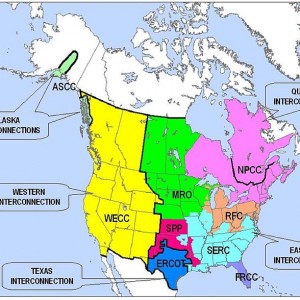
In its modeling, FERC studied what would happen if various combinations of substations were crippled in the three electrical systems that serve the contiguous U.S. The agency concluded the systems could go dark if as few as nine locations were knocked out: four in the East, three in the West and two in Texas, people with knowledge of the analysis said.
The actual number of locations that would have to be knocked out to spawn a massive blackout would vary depending on available generation resources, energy demand, which is highest on hot days, and other factors, experts said. Because it is difficult to build new transmission routes, existing big substations are becoming more crucial to handling electricity.
So what would life look like without any power for a long period of time?  The following list comes from one of my previous articles...
-There would be no heat for your home.
-Water would no longer be pumped into most homes.
-Your computer would not work.
-There would be no Internet.
-Your phones would not work.
-There would be no television.
-There would be no radio.
-ATM machines would be shut down.
-There would be no banking.
-Your debit cards and credit cards would not work.
-Without electricity, gas stations would not be functioning.
-Most people would be unable to do their jobs without electricity and employment would collapse.
-Commerce would be brought to a standstill.
-Hospitals would not be able to function.
-You would quickly start running out of medicine.
-All refrigeration would shut down and frozen foods in our homes and supermarkets would start to go bad.
If you want to get an idea of how quickly society would descend into chaos, just watch the documentary "American Blackout" some time.  It will chill you to your bones.
The truth is that we live in an unprecedented time.  We have become extremely dependent on technology, and that technology could be stripped away from us in an instant.
Right now, our power grid is exceedingly vulnerable, and all the experts know this, but very little is being done to actually protect it...
"The power grid, built over many decades in a benign environment, now faces a range of threats it was never designed to survive," said Paul Stockton, a former assistant secretary of defense and president of risk-assessment firm Cloud Peak Analytics. "That's got to be the focus going forward."
If a group of agents working for a foreign government or a terrorist organization wanted to bring us to our knees, they could do it.
In fact, there have actually been recent attacks on some of our power stations.  Here is just one example
The Wall Street Journal’s Rebecca Smith reports that a former Federal Energy Regulatory Commission chairman is acknowledging for the first time that a group of snipers shot up a Silicon Valley substation for 19 minutes last year, knocking out 17 transformers before slipping away into the night.
The attack was “the most significant incident of domestic terrorism involving the grid that has ever occurred” in the U.S., Jon Wellinghoff, who was chairman of the Federal Energy Regulatory Commission at the time, told Smith.
Have you heard about that attack before now?
Most Americans have not.
But it should have been big news.
At the scene, authorities found "more than 100 fingerprint-free shell casings", and little piles of rocks "that appeared to have been left by an advance scout to tell the attackers where to get the best shots."
So what happens someday when the bad guys decide to conduct a coordinated attack against our power grid with heavy weapons?
It could happen.
In addition, as I mentioned at the top of this article, the Internet is extremely vulnerable as well.
For example, did you know that authorities are so freaked out about the security of the Internet that they have given "the keys to the Internet" to a very small group of individuals that meet four times per year?
It's true.  The following is from a recent story posted by the Guardian...
The keyholders have been meeting four times a year, twice on the east coast of the US and twice here on the west, since 2010. Gaining access to their inner sanctum isn't easy, but last month I was invited along to watch the ceremony and meet some of the keyholders – a select group of security experts from around the world. All have long backgrounds in internet security and work for various international institutions. They were chosen for their geographical spread as well as their experience – no one country is allowed to have too many keyholders. They travel to the ceremony at their own, or their employer's, expense.
What these men and women control is the system at the heart of the web: the domain name system, or DNS. This is the internet's version of a telephone directory – a series of registers linking web addresses to a series of numbers, called IP addresses. Without these addresses, you would need to know a long sequence of numbers for every site you wanted to visit. To get to the Guardian, for instance, you'd have to enter "77.91.251.10" instead of theguardian.com.
If the system that controls those IP addresses gets hijacked or damaged, we would definitely need someone to press the "reset button" on the Internet.
Sadly, the hackers always seem to be several steps ahead of the authorities.  In fact, according to one recent report, breaches of U.S. government computer networks go undetected 40 percent of the time
A new report by Sen. Tom Coburn (R., Okla.) details widespread cybersecurity breaches in the federal government, despite billions in spending to secure the nation’s most sensitive information.
The report, released on Tuesday, found that approximately 40 percent of breaches go undetected, and highlighted “serious vulnerabilities in the government’s efforts to protect its own civilian computers and networks.”
“In the past few years, we have seen significant breaches in cybersecurity which could affect critical U.S. infrastructure,” the report said. “Data on the nation’s weakest dams, including those which could kill Americans if they failed, were stolen by a malicious intruder. Nuclear plants’ confidential cybersecurity plans have been left unprotected. Blueprints for the technology undergirding the New York Stock Exchange were exposed to hackers.”
Yikes.
And things are not much better when it comes to cybersecurity in the private sector either.  According to Symantec, there was a 42 percent increase in cyberattacks against businesses in the United States last year.  And according to a recent report in the Telegraph, our major banks are being hit with cyberattacks "every minute of every day"...
Every minute, of every hour, of every day, a major financial institution is under attack.
Threats range from teenagers in their bedrooms engaging in adolescent “hacktivism”, to sophisticated criminal gangs and state-sponsored terrorists attempting everything from extortion to industrial espionage. Though the details of these crimes remain scant, cyber security experts are clear that behind-the-scenes online attacks have already had far reaching consequences for banks and the financial markets.
For much more on all of this, please see my previous article entitled "Big Banks Are Being Hit With Cyberattacks 'Every Minute Of Every Day'".
Up until now, attacks on our infrastructure have not caused any significant interruptions in our lifestyles.
But at some point that will change.
Are you prepared for that to happen?
We live at a time when our world is becoming increasingly unstable.  In the years ahead it is quite likely that we will see massive economic problems, major natural disasters, serious terror attacks and war.  Any one of those could cause substantial disruptions in the way that we live.
At this point, even NASA is warning that "civilization could collapse"...
A new study sponsored by Nasa's Goddard Space Flight Center has highlighted the prospect that global industrial civilisation could collapse in coming decades due to unsustainable resource exploitation and increasingly unequal wealth distribution.
Noting that warnings of 'collapse' are often seen to be fringe or controversial, the study attempts to make sense of compelling historical data showing that "the process of rise-and-collapse is actually a recurrent cycle found throughout history." Cases of severe civilisational disruption due to "precipitous collapse - often lasting centuries - have been quite common."
So let us hope for the best.

Tech Giants Knew About Prism All Along, the NSA’s Top Lawyer Says

nice "try" puckerman , phony fuck lol

facebook-mark-zuckerbergMarch 20, 2014 – Last week, Mark Zuckerberg, CEO of one of the internet’s largest data-mining companies, called President Obama to lecture him on privacy and surveillance. It was great diversionary theater, apparently. Today, the National Security Agency’s General Counsel, Rajesh De, said that Silicon Valley’s tech giants actually knew about the PRISM program all along.
De was testifying today in front of the Civil Liberties Oversight Board. ”[De] said all communications content and associated metadata harvested by the NSA under a 2008 surveillance law occurred with the knowledge of the companies,” wrote theGuardian’s Spencer Ackerman, who interviewed the lawyer.
“Both for the internet collection program known as Prism and for the so-called ‘upstream’ collection of communications moving across the internet.”
De told the Guardian that data collection under this program was a compulsory legal process, and that the legal process of Section 702—which mines communications between Americans and international recipients—applies when the NSA collects metadata in everyday transit across the internet.
De’s testimony might seem like a face-saving move by the NSA, which has been under continuous public scrutiny since last summer. But it was always hard to believe that tech companies like Google, Yahoo, Facebook, and Microsoft were in the dark about PRISM, despite their claims of ignorance. For the NSA to efficiently hoover up bulk amounts of data from services and platforms like Gmail, Facebook, Skype, and so on, it’s hard to believe they didn’t get some help along the way.
For now, the tech giants aren’t commenting. Zuckerberg, all brash last week in lecturing Obama on privacy, is silent. Perhaps these Silicon Valley firms are talking to their legal counsels. But, don’t expect them to admit anything—chances are they’ll fight tooth and nail against accepting any responsibility, considering the amount of revenue that’s at stake if they lose consumers’ trust.
For Silicon Valley’s tech behemoths, it’s better to play the illusionist’s game, and keep the NSA looking like the enemy.
Source: http://motherboard.vice.com/read/tech-giants-knew-about-prism-all-along-says-the-nsas-top-lawyer

Missing pilot uploaded island runways into home flight simulator days before disappearance

Full_Flight_Simulator_5573438825-1560x690_cMarch 20, 2014 – Captain Zaharie Ahmad Shah, a father-of-three, is the pilot on the missing Malaysian flight.  Earlier this week we reported that, he was said to be a ‘fanatical’ supporter of the country’s opposition leader Anwar Ibrahim.
Many have speculated that the plane could have been hijacked by the pilot himself, as a protest against the recent arrest of Anwar Ibrahim.
Recent investigations have indicated that the pilot may have been preparing to take the plane off course just days prior to the disappearance.
The police confiscated the flight simulator from the pilot’s house in Shah Alam on Saturday and reassembled it at the police headquarters where experts are conducting checks.
“The simulation programmes are based on runways at the Male International Airport in Maldives, an airport owned by the United States (Diego Garcia), and three other runways in India and Sri Lanka, all have runway lengths of 1,000 metres. We are not discounting the possibility that the plane landed on a runway that might not be heavily monitored, in addition to the theories that the plane landed on sea, in the hills, or in an open space,” an unnamed source told Berita Harian.
Although Defence Minister Datuk Seri Hishammuddin Hussein denied that the plane had landed at the US military base Diego Garcia, the source told the daily that this possibility will still be investigated based on the data found in Zaharie’s flight simulator software.
Source: http://intellihub.com/missing-pilot-uploaded-island-runways-home-flight-simulator-days-disappearance/

The Truth Is Finally Out: Money Is Just An IOU & The Banks Are Rolling In It

the only "kooks" in this world ...r the 1's  who 'believe'  any fucking thing the "main/lame stream whores"   ...put out :o  Oops

1
Currency_IOU_moneyThe things “conspiracy theorists” have been saying for years are coming true one by one. The more recent mainstream topic is the revelation that money is just an IOU. This comes as the Bank of England published a paper called “Money Creation in the Modern Economy” which revealed how our financial system functions and what role money plays.

Another recent conspiracy theory that was revealed as true involved fluoride, which was classified officially as a neuro-toxin in the world’s longest running and most popular medical journal, The Lancet. This after so-called conspiracy theories had been saying it for decades. It’s important to mention 9/11 has been proven beyond any reasonable doubt that the official story is false. Mainstream ad campaigns have been popping up over cities in North America to raise awareness and hopefully force the US government to re-visit and admit what they’ve been hiding.
Now sure, not all of this financial system information was hidden completely from the public, but one had to go looking pretty hard to find out that banks are actually operating under behaviour that would be illegal for you and I or that the central banks who lend money to our governments are not actually government run, but instead are private institutions with more power than any government on earth. Yes, these things that were once only said by few and were once laughed at and ridiculed as be conspiracy theories are now becoming very public and mainstream knowledge. The question becomes, when will we the public, realize that we are being enslaved and lied to and choose to do something about this on a mass scale?
The Guardian, a fairly mainstream news and media site, was the first I saw posting about the fact that money is now being publicly called an IOU. This is another positive step forward as we see the awareness of people and the overall consciousness of our planet changing which results in a change in the way we see our world. Amazing times we are living in.
Written by: David Graeber
The Guardian
Back in the 1930s, Henry Ford is supposed to have remarked that it was a good thing that most Americans didn’t know how banking really works, because if they did, “there’d be a revolution before tomorrow morning”.
Last week, something remarkable happened. The Bank of England let the cat out of the bag. In a paper called “Money Creation in the Modern Economy“, co-authored by three economists from the Bank’s Monetary Analysis Directorate, they stated outright that most common assumptions of how banking works are simply wrong, and that the kind of populist, heterodox positions more ordinarily associated with groups such as Occupy Wall Street are correct. In doing so, they have effectively thrown the entire theoretical basis for austerity out of the window.
To get a sense of how radical the Bank’s new position is, consider the conventional view, which continues to be the basis of all respectable debate on public policy. People put their money in banks. Banks then lend that money out at interest – either to consumers, or to entrepreneurs willing to invest it in some profitable enterprise. True, the fractional reserve system does allow banks to lend out considerably more than they hold in reserve, and true, if savings don’t suffice, private banks can seek to borrow more from the central bank.
The central bank can print as much money as it wishes. But it is also careful not to print too much. In fact, we are often told this is why independent central banks exist in the first place. If governments could print money themselves, they would surely put out too much of it, and the resulting inflation would throw the economy into chaos. Institutions such as the Bank of England or US Federal Reserve were created to carefully regulate the money supply to prevent inflation. This is why they are forbidden to directly fund the government, say, by buying treasury bonds, but instead fund private economic activity that the government merely taxes.
It’s this understanding that allows us to continue to talk about money as if it were a limited resource like bauxite or petroleum, to say “there’s just not enough money” to fund social programmes, to speak of the immorality of government debt or of public spending “crowding out” the private sector. What the Bank of England admitted this week is that none of this is really true. To quote from its own initial summary: “Rather than banks receiving deposits when households save and then lending them out, bank lending creates deposits” … “In normal times, the central bank does not fix the amount of money in circulation, nor is central bank money ‘multiplied up’ into more loans and deposits.”
In other words, everything we know is not just wrong – it’s backwards. When banks make loans, they create money. This is because money is really just an IOU. The role of the central bank is to preside over a legal order that effectively grants banks the exclusive right to create IOUs of a certain kind, ones that the government will recognise as legal tender by its willingness to accept them in payment of taxes. There’s really no limit on how much banks could create, provided they can find someone willing to borrow it. They will never get caught short, for the simple reason that borrowers do not, generally speaking, take the cash and put it under their mattresses; ultimately, any money a bank loans out will just end up back in some bank again. So for the banking system as a whole, every loan just becomes another deposit. What’s more, insofar as banks do need to acquire funds from the central bank, they can borrow as much as they like; all the latter really does is set the rate of interest, the cost of money, not its quantity. Since the beginning of the recession, the US and British central banks have reduced that cost to almost nothing. In fact, with “quantitative easing” they’ve been effectively pumping as much money as they can into the banks, without producing any inflationary effects.
What this means is that the real limit on the amount of money in circulation is not how much the central bank is willing to lend, but how much government, firms, and ordinary citizens, are willing to borrow. Government spending is the main driver in all this (and the paper does admit, if you read it carefully, that the central bank does fund the government after all). So there’s no question of public spending “crowding out” private investment. It’s exactly the opposite.
Why did the Bank of England suddenly admit all this? Well, one reason is because it’s obviously true. The Bank’s job is to actually run the system, and of late, the system has not been running especially well. It’s possible that it decided that maintaining the fantasy-land version of economics that has proved so convenient to the rich is simply a luxury it can no longer afford.
But politically, this is taking an enormous risk. Just consider what might happen if mortgage holders realised the money the bank lent them is not, really, the life savings of some thrifty pensioner, but something the bank just whisked into existence through its possession of a magic wand which we, the public, handed over to it.
Historically, the Bank of England has tended to be a bellwether, staking out seeming radical positions that ultimately become new orthodoxies. If that’s what’s happening here, we might soon be in a position to learn if Henry Ford was right.
Source:

Pal Cuts Off Torrent Streaming Service Streamza


Streamza, a handy service that allows people to stream music or video torrents directly from the cloud, is no longer allowed to accept PayPal payments. According to the payment provider Streamza violates its policies, even though it has plenty of legitimate uses.
paypaldeniedPayPal is widely known for its aggressive stance towards BitTorrent sites, Usenet providers and file-hosting services, and it appears that streaming services based on BitTorrent technology are receiving the same treatment.
Last summer Polish developer and Wikidot CEO Michal Frackowiak launched Streamza, a torrent download service that lets users stream music and movies securely to their PC, TV, iPhone or iPad. Streamza has been growing steadily ever since and welcomes thousands of new users each month.
Earlier this week, however, the developer was presented with some bad news. Without prior warning, PayPal stopped providing payment services to Streamza and limited the associated account. That also means that all funds have been frozen for the time being.
“They emailed to inform me that my PayPal account had been reviewed and that Streamza does not comply with their policies. My account became ‘limited’ until I removed PayPal from checkout and agreed to their policies, which I did immediately,” Michal informs TF.
The PayPal ban is a major setback for Streamza, as it will no longer be able to process new and recurring membership fees from premium subscribers. At the time of writing the PayPal account is still locked, and Michal hasn’t heard from PayPal after the initial email.
As usual, PayPal remains vague about the precise reason for the ban. The payment provider mentioned that Streamza violated their Acceptable Use Policy, which suggests that PayPal is concerned about possible infringing uses of Streamza.
Streamza
streamzz
PayPal’s policies don’t allow “infringing” services to accept payments. In addition, the company requires file-sharing services to be pre-approved.
“Service Requiring Pre-Approval: Offering online dating services; providing file sharing services or access to newsgroups; or selling alcoholic beverages,” PayPal’s AUP reads.
This approvals process requires services to agree to a list of strict terms and conditions. As can be seen below, this includes full disclosure of the processes that are in place to deter piracy, and allowing PayPal to actively monitor their service for copyright infringements.
PayPal’s Termspaypalterminate
While Streamza doesn’t promote copyright infringement in any way, it could be used to download or stream pirated files, much like any other streaming or download services including YouTube. Michal believes, however, that the payment provider is more strict with smaller players.
“When looking at these policies I wonder how the hell Mega.co.nz can work with PayPal. Somehow I am not that surprised: rules between two bigger players can be different from between a bigger player and a smaller one,” Michal tells TF.
Technically, PayPal may have the right to cut off Streamza under its policies, but it would have been appropriate to send an early warning. Over the past few days the service could only accept payments via Bitcoin, which is hurting business.
Due to personal circumstances Michal had plans to auction off Streamza, and the PayPal issue is the straw that broke the camel’s back. He is accepting bids on Flippa and hopes someone is willing to take over the service, to keep the 34,000 registered users happy.
“I believe that after half a year of running Streamza I created something cool. A project that some people love. It’s not only a great tech and user interface, but a service that fills a niche,” Michal says.
“Personally I hope someone smart can take it from here. It’s a really good piece of tech and a project that has its fans.”
Update: A few hours after publication Michal heard back from PayPal. He can enter the pre-approval process to accept payments for file sharing. This means that Streamza has to comply with the terms listed above. Until this process is completed Streamza can’t process PayPal payments, but the other account restrictions have been lifted.
Tagged in: ,

Through a glass, darkly: Chinese, American, and Russian anti-satellite testing in space

Source: Space Review
Through a glass, darkly: Chinese, American, and Russian anti-satellite testing in space
On May 13, 2013, China launched a rocket from the Xichang Satellite Launch Center in Sichuan Province. The Chinese Academy of Sciences stated it was a high-altitude scientific research mission, but unofficial U.S. government sources say it was actually a test of a new ballistic missile related to China’s anti-satellite (ASAT) program. This article uses open source information, including commercial satellite imagery purchased fromDigitalGlobe, to assess these claims. It also compares what is known about current Chinese ASAT testing in space with American and Russian ASAT testing in space over the last five decades.
Remaining silent risks sending the message to China and other countries that developing and testing hit-to-kill ASAT capabilities is considered responsible behavior as long as it does not create long-lived orbital debris.
While there is no conclusive proof, the available evidence strongly suggests that China’s May 2013 launch was the test of the rocket component of a new direct ascent ASAT weapons system derived from a road-mobile ballistic missile. The system appears to be designed to place a kinetic kill vehicle on a trajectory to deep space that could reach medium earth orbit (MEO), highly elliptical orbit (HEO), and geostationary Earth orbit (GEO). If true, this would represent a significant development in China’s ASAT capabilities. But it would not be the first instance of an ASAT weapons system designed to attack satellites in deep space, as the Russians developed at least the components of such a system in the 1990s. Thus it is more a signal that China is a new entrant into what is an old game, and while there is some knowledge as to what capabilities China may be developing, why they are developing those capabilities is still unclear.
In June 2013, I argued that the Obama administration should release more information publicly about China’s ASAT program and testing in space. Following China’s purposeful destruction of its FengYun 1C (FY-1C) satellite using a direct ascent ASAT weapon in 2007 and the resulting creation of more than 3,000 pieces of trackable space debris, the public information released by the United States played a major role in mobilizing international outrage about the test. This international criticism, combined with the United States’ destruction of its own USA 193 satellite the following year, arguably resulted in a change in Chinese behavior. Subsequent tests of the same SC-19 system in 2010 and 2013, characterized by China as missile defense tests, targeted suborbital targets and did not result in the creation of any long-lived space debris.
Going public about the testing of a potential new Chinese ASAT test could lead to similar political pressure on the Chinese government, particularly if they plan to conduct another destructive test in the future. Remaining silent risks sending the message to China and other countries that developing and testing hit-to-kill ASAT capabilities is considered responsible behavior as long as it does not create long-lived orbital debris. That message would likely encourage the proliferation of ASAT capabilities, increasing the threat to the space assets of all States, and thus contributing to greater political and strategic instability in space and potentially on Earth.
To date, the US government’s public response to and information about China’s ASAT testing activities has been relatively muted. The US government remained silent about 2005 and 2006 tests of the Chinese ASAT system designated SC-19 by the US government. The existence of those tests was only made public after the 2007 test of the same system. Following the 2010 test of the same system, a US government official stated that they “detected two geographically separated missile launch events with an exo-atmospheric collision also being observed by space-based sensors.” Confirmation that this was indeed another test of the same SC-19 ASAT system comes from a classified State Department cable that was leaked by Wikileaks in 2011. In January 2013, China publicly reported another “mid-course missile interception test” that many have concluded is yet another test of the SC-19 system based on the similarities of its description by the Chinese media to the 2010 test, but it has not been publicly declared as such by the US government.
The US government has provided a single official quote regarding the May 2013 launch, stating that “the launch appeared to be on a ballistic trajectory nearly to [GEO]. We tracked several objects during the flight…and no objects associated with this launch remain in space.” The 2013 report of the U.S.-China Economic and Security Review Commission to Congress mentions the May launch and the claims about it being an ASAT test, but provides no new evidence to support those claims. Public statements from multiple US officials, including Director of National Intelligence (DNI) James Clapper, mention increasing threats to U.S. national security space assets and China’s ASAT program but provide no details. A January 2014 hearing convened by the House Armed Services Committee (HASC) focused on the challenges China’s counterspace program poses for US national security and potential strategies for addressing those challenges, but yielded no new facts or information about the May 2013 test or China’s actual ASAT capabilities either. A March 2014 hearing convened by the Senate Armed Services Committee (SASC) discussed the Pentagon’s strategy to deal with the growing ASAT threat but no specific details.
The purpose of this article is to place more information about the May launch and other Chinese ASAT testing into the public domain and also in the context of other known ASAT testing activities by the United States and Russia. The hope is that this information will spur both more openness from the US and Chinese governments and spark public debate on this issue by reducing the possibility that doing so would reveal intelligence sources and methods. However, it is possible that the US government will still remain silent despite the newly available public information. That would suggest other rationales for the silence, such as not wanting public discussion of the ASAT testing to jeopardize potential bilateral discussions with China on space security issues. It may also be that the United States does not want criticism of Chinese ASAT testing to lead to a norm that testing and developing ballistic hit-to-kill systems is irresponsible, which in turn would undermine the political support for the United States’ own Phased Adaptive Approach (PAA) midcourse missile defense system, which uses the same technologies. Creating such a norm would also constrain the United States from developing its own hit-to-kill ASAT capabilities again in the future. If that is the position of the United States, it would be very troubling as it would almost certainly lead to a proliferation of more ASAT capabilities that further increase the threats to all space systems, including those of the United States, and undermine political and strategic stability in space.
Both the United States and China agree that something was launched from Xichang on May 13, 2013. Discovering what rocket was used could help evaluate what actually happened.
The first section of this article analyzes the May 2013 launch from Xichang and attempts to determine why it was characterized by the U.S. government as an ASAT test. A critical part of this analysis utilizes commercial satellite imagery and information from Chinese bloggers and the Chinese public. The second section provides a summary of American and Russian ASAT testing in space from the late 1950s to the present. This section provides important context for the Chinese ASAT testing in that it shows the ASAT technologies and techniques developed and tested by all three countries are very similar in nature, and that efforts to develop means of attacking satellites have gone hand-in-hand with the development of satellites themselves. The third and final section examines the parallels between hit-to-kill ASAT testing and midcourse missile defense and the political difficulty in proscribing one but not the other. It also examines the role that the culture of secrecy plays in the public silence over this issue, and how that may cause more harm than good over the long-term. The article concludes with a call for greater transparency and confidence building measures by all countries, and in particular the United States and China, to enhance strategic stability in space and on Earth.
Read More @ Source

Yet Another Study Shows That Metadata Reveals A Hell Of A Lot

from the where's-dianne-feinstein's-metadata? dept

With the NSA and its defenders still defending the bulk phone (and other) records collection programs as being about "just metadata," we've already highlighted how metadata is incredibly revealing. Now there's yet another study demonstrating this quite clearly. Jonathan Mayer and Patrick Mutchler, over at Stanford, did a study in which they convinced a bunch of people to run an app called MetaPhone, in which users agree to give up the metadata on their phone, voluntarily, for the sake of research. What these researchers found, of course, is that the metadata reveals an awful lot of details about one's lives, often much more clearly than if the actual content had been collected. The researchers give a few examples where what someone is up to becomes quite obvious very, very quickly.
  • Participant A communicated with multiple local neurology groups, a specialty pharmacy, a rare condition management service, and a hotline for a pharmaceutical used solely to treat relapsing multiple sclerosis.
  • Participant B spoke at length with cardiologists at a major medical center, talked briefly with a medical laboratory, received calls from a pharmacy, and placed short calls to a home reporting hotline for a medical device used to monitor cardiac arrhythmia.
  • Participant C made a number of calls to a firearm store that specializes in the AR semiautomatic rifle platform. They also spoke at length with customer service for a firearm manufacturer that produces an AR line.
  • In a span of three weeks, Participant D contacted a home improvement store, locksmiths, a hydroponics dealer, and a head shop.
  • Participant E had a long, early morning call with her sister. Two days later, she placed a series of calls to the local Planned Parenthood location. She placed brief additional calls two weeks later, and made a final call a month after.
We were able to corroborate Participant B’s medical condition and Participant C’s firearm ownership using public information sources. Owing to the sensitivity of these matters, we elected to not contact Participants A, D, or E for confirmation.
There's a lot more in the research, showing how it's relatively easy to pick out fairly sensitive information from a bunch of participants. And, remember, these participants opted-in, knowing that the information would be shared.

Of course, as we've said from the beginning, there's a pretty easy way to prove that everyone inherently knows that metadata reveals all sorts of sensitive information. Just ask any of the biggest defenders of these programs to share the metadata from their phone. They insist there's nothing sensitive in metadata, and yet, oddly they're unwilling to reveal their own.

New Zealand Supreme Court Says DOJ Doesn't Have To Provide Its Evidence In Megaupload Extradition Case

from the blind-justice dept

Despite two earlier rulings that the US Justice Department needed to provide Kim Dotcom and others involved in Megaupload with the actual evidence being used against them for the extradition trial, an appeals court overturned those rulings and now the New Zealand Supreme Court has agreed in rejecting the request. While the chief judge dissented, the majority found that the extradition treaty does not require the country that has filed the charges against the individuals to provide the information and that the New Zealand courts have no real authority to order the US DOJ to provide the evidence. It does seem rather ridiculous that someone can be sent halfway around the world to face criminal charges without first being able to see the evidence against them, but that's apparently the law in New Zealand. They might want to fix that.

Either way, the actual extradition trial was recently pushed back until July (it had been scheduled to start in a few weeks). Seems quite bizarre that they're only just getting to the trial over extradition nearly two and a half years after Megaupload was seized and shut down. The judicial process isn't exactly known for its speed, which is kind of crazy when you realize how quickly (and with such flimsy evidence) DOJ and New Zealand officials acted to arrest Kim Dotcom and his colleagues.