Friday, March 28, 2014


Former World Bank Senior Council Says A “Second Species” On Earth Controls Money & Religion


Former World Bank Senior Council, Karen Hudes has been making a lot of noise lately, and she recently said something she’s never said before. She said that a second species on Earth controls money and religion. Many people who have held positions to know things that the rest of us might not know have made some very shocking statements lately. For example, Paul Hellyer, former Canadian Minister of National Defence recently said that there are at least “4 known alien species that have been visiting Earth for thousands of years.” You can read more about that here.
I am aware that just because somebody says something does not mean that it’s true, no matter what their background. At the same time, what she says corroborates with a lot of ancient historical facts, and modern day disclosures of other strange phenomenon, like UFOs, secret societies and more. For someone like this to gain credibility as a World Bank whistle-blower and then all of a sudden make a comment like this is quite shocking. Although, in her interview she did discredit the idea of extraterrestrials on the planet, which I definitely disagree with. There is an enormous amount of evidence out there to suggest we are not alone, and we have indeed been visited. For more information on that click here.
These countries are not monolithic, there are forces fighting the corruption and there are forces that have totally been co-opted, and the way they act is treasonous to the people in those countries. The group that’s behind the network of control are the Jesuits, and there are also some groups behind them. One of these groups are hominids, they’re not human beings. They are very smart, they are not creative, they are mathematical. They had a much stronger force in the earlier ice-age. They have elongated skulls, they may produce offspring in mating with female humans, but that offspring is not fertile. We live in a world of secret societies, and secrets, and the information that ought to be public is not public.” (source starts at approximately 21:20)
Karen held her senior position at the World Bank for twelve years before deciding to blow the whistle on the World Bank and corruption within it. She studies law at Yale Law School and economics at the University of Amsterdam. She worked in the US Export Import Bank of the US from 1980-1985 and in the Legal Department of the World Bank from 1986-2007. She established the Non-Governmental Organization Committee of the International Law Section of the American Bar Association and the Committee on Multilateralism and the Accountability of International Organizations of the American Branch of the International Law Association.
These are shocking statements that come shortly after gaining attention for being a credible world bank whistleblower, stating that the world is in a “currency war,” that the Federal Reserve continues to print money like crazy, and if they keep going at the pace they are on, other countries will no longer accept this currency. She has been exposing criminal corruption that takes place at the highest levels of financial institutions. In 1999, she reported the corrupt take-over of the second largest bank in the Philippines. She’s exposed the collusion that takes place between financial institutions and various governments, and much much more.
This is a great clip of her telling us some important stuff. Before you brush off what she has to say, keep in mind that the reality of many strange phenomenon has a large amount of proof to back it up, or at least be open to the possibility.

World Bank: Money Laundering Criminals | Interview with Whistleblower Karen Hudes

Piracy Continues Killing The Movie Business To New Record Highs

from the yet-again dept

So, earlier this week, the MPAA came out with its annual report that shows that once again, its box office take hit new record highs. This same thing happens basically every year, so we almost didn't cover it at all this year. It's kind of old news. But people keep submitting it, and so we'll oblige, but mainly for the chance to repeat BoingBoing's awesome title on its story over this: Motion picture industry continues to stagger under piracy with mere record-breaking income.
You can read the MPAA's full PDF right here, though for reasons that make no sense at all, they will block you from reading the PDF if you have javascript or cookies disabled. For a PDF? Really guys? There is no reason at all that anyone ever needs cookies or javascript to read a PDF file.

The report further notes that ticket prices have continued to rise pretty consistently over the past decade from a $6.21 average price in 2004 to $8.13 last year. For an industry supposedly being destroyed, you'd think they wouldn't be able to get away with raising prices... but, apparently (as we've been pointing out for nearly two decades) going to the movies is a different experience than downloading a film and people are paying for that experience.

And, yes, just to cut off the line of criticism: this only applies to theatrical revenue, and not home viewership. But that's somewhat a red herring, given that, if left to the movie industry, there basically would be no home video market to speak of at all.

Death and Extinction of the Bees

Region:

bee1
Scientists have recently reported that mass extinctions of marine animals may soon be occurring at alarmingly rapid rates than previously projected due to pollution, rising water temperatures and loss of habitat. Many land species also face a similar fate for the same reasons. But perhaps the biggest foreboding danger of all facing humans is the loss of the global honeybee population. The consequence of a dying bee population impacts man at the highest levels on our food chain, posing an enormously grave threat to human survival. Since no other single animal species plays a more significant role in producing the fruits and vegetables that we humans commonly take for granted yet require near daily to stay alive, the greatest modern scientist Albert Einstein once prophetically remarked, “Mankind will not survive the honeybees’ disappearance for more than five years.” 
 
Since 2006 beekeepers have been noticing their honeybee populations have been dying off at increasingly rapid rates. Subsequently researchers have been scrambling to come up with an accurate explanation and an effective strategy to save the bees and in turn save us homo sapiens from extinction. Recent harsh winters that stay freezing cold well into spring have been instrumental in decimating the honeybee population in Iowa by up to 70% as well as the other historically high yielding honey states – the Dakotas, Montana, Minnesota. The northern Plains and Midwestern states that have regionally always produced the nation’s most honey have been severely hurt by the long harsh winters in the last couple years. Florida as the third largest honey producer and especially California always among the top producers have been hit especially hard by decreasing bee colony populations. In 2006 when the problem of bee loss first was noticed, California was right up at the top with North Dakota producing nearly twice as much honey as the next state South Dakota but its bee numbers have incurred such heavy losses that in 2011, though still second, California’s honey production fell by nearly half in just six years. The recent severe drought in California has become an additional factor driving both its honey yield and bee numbers down as less rain means less flowers available to pollinate.

Honeybee Colony Collapse Disorder (CCD) as this loss of bee phenomenon has been called is currently recognized as such an urgent crisis that a month ago Newsweek ran an article outlining the U.S. Department of Agriculture (USDA) announcement that it will provide a $3 million subsidy in order to help the one animal on the planet that will either make or break food prices. According to the latest USDA industry survey, this emergency plan assistance comes after nearly a third of commercial honeybees died last winter, a whopping increase of 42% from the previous year. The three million dollar giveaway program is designed to entice both Midwest dairy farmers and cattle ranchers to reseed their fields this spring with eco-friendly crops like alfalfa and clover to develop healthier habitats for increasing the national bee population. Farmers and ranchers only had until March 21st, 2014 to sign up and take advantage as eligible seedling recipients.
Last month’s Newsweek reported that honeybees in trucks migrate to various regions of the country to pollinate an estimated $40 billion worth of the nation’s agricultural produce each year. This means that every third bite of food we eat comes as the result of bees and other pollinators. USDA Agriculture Secretary Tom Vilsack stated that more than 130 fruits and vegetables that make up a nutritious diet are cross pollinated by honeybees. Commercial bees raised on farms and then shipped to other farms in the country used for pollination purposes along with wild bees are responsible for pollination of an estimated 80% of all food crops in the United States.
In the last half decade alone 30% of the national bee population has disappeared and nearly a third of all bee colonies in the U.S. have perished. Though the rate of bee depopulation is growing each year, 42% more last year than the year before, even at the current annual rate the estimated monetary loss is a colossal 30 billion dollars a year. With such an enormous loss in revenue, last month’s USDA announcement of just a three million dollar investment in farmer aid in comparison to the formidable challenge seems like a paltry drop in the bucket to making any real dent in the epidemic.
With so much at stake, efforts to investigate and uncover reasons for this sudden global pandemic have been robust. A new government study blames a combination of factors for the mysterious and dramatic loss of honeybees, including increased use of pesticides especially in the US, shrinking habitats, multiple viruses, poor nutrition and genetics, and even cell phone towers. However, according to last year’s joint EPA-USDA study, the biggest cause is the parasite called the Varroa destructor, a type of mite found to be highly resistant to the insecticides that US beekeepers have used in attempts to control the mites from inside the beehives. Moreover, new virus species have been found in the US and several of these have been associated with Colony Collapse Disorder.

In a vicious cycle, since 1987 when the Varroa mite was first discovered in the US, Monsanto, Dow, Bayer and other large chemical manufacturers aggressively glommed onto the bee industry selling genetically modified insecticides and herbicides as the quick and easy fix to remedy the parasitic invasion, only to weaken the bees’ natural genetic defenses to fight off the parasite. In an article from the Guardian earlier this month, Monsanto’s contribution to the vanishing bee population is detailed. From genetically altered corn, Monsanto produced an insecticide called Bacillus thuringiensis (Bt), which once ingested by bees, Bt binds to receptors within the bee’s stomach lining that keeps the bee from eating. Of course this weakens the bee, causing the breakdown of the inner stomach wall, which in turn makes the bee susceptible to spores and bacteria. To further compound the problem, for years the lobbying power of the chemical giant denied causing damage to the bee’s internal immune capacity for resistance to parasites, which of course only continued to kill off the bee population worldwide. Thus, continued chemical use, especially in America, only exacerbates this growing problem.
Also on Greenpeace’s Save the Bees page, a type of insecticide called neonicotinoids, is known to cause acute and chronic poisoning not just of one bee, but the entire colony. Bees take the contaminated nectar and pollen spread through the plant’s DNA back to the hive, creating a highly toxic living environment for all the bees. Toxicity builds up destroying the Central Nervous System, causing further disorientation and bees ultimately can neither fly nor make it back to the nest. Meanwhile, unlike the US, in Europe and Australia where the health of insects and humans is deemed more important than corporate profit, laws banning insecticide use have been passed, which in large part has largely saved the bee populations from being so decimated there.
A study last year found 35 pesticides and fungicides, some at lethal doses, in the pollen collected from bees that were used to pollinate food crops in five U.S. states. In another research study, bees that contacted pollen contaminated with fungicides ended up three times more likely to get infected by a parasite closely associated with Colony Collapse Disorder.
The results of a new study conducted by Mark Brown of Royal Halloway University in London released several weeks ago found that wild bumblebee populations are also disappearing at a similar rate to the domestic honeybee. In its sample one in five wild bees were afflicted by the Deformed Wing Virus believed to be caused by the parasitic Varroa mite. 88% of the honeybees at the 26 field sites were affected by this virus. The research study also concluded that while honeybees are important and obviously responsible for the multimillion dollar global honey industry, wild bees are believed to be just as important in pollination of plants throughout the world.
Another probable factor in America is the widespread use of feeding bee colonies with high fructose corn syrup (HFCS) instead of its natural self-made food honey. For maximum profit, industrialized US bee farms utilize maximum honey yields, not leaving any honey for the bees to consume during the long colder winter months. It is speculated that the natural hormonal and enzyme effects interacting with honey’s natural nutritional advantages provided bees with the increased defenses that historically have been effective in fighting off parasitic threats and viruses. In contrast, the artificially processed HFCS is believe to weaken the immune system of the honeybees’ genetic strength to ward off disease.
The largest selling company of honey in the US is the Sioux Honey brand located in Sioux City, Iowa founded in 1921. More than 35 million pounds of honey are processed at the Sioux City and Anaheim, California plants comprised of a cooperative of over 300 beekeepers from the Midwest and Rocky Mountain states. Vice president for research and development Bill Huser interviewed in the local paper last year stated, “One of the wrinkles is a focus on increased diversity in genetics, which the [USDA] report’s authors said could help improve bees’ resistance to disease. Specifically, they said, genetic variation could help keep the bees’ body temperature steady, even if the surrounding environment changes.” This would enhance the bees’ capacity to acclimate to the recent harsher winter conditions in northern climates.
Most commercial beekeepers transport their bee colonies by truck in the winter to farms in Texas and California to pollinate in early spring agricultural fields in the warmer regions of the country. However, these last couple winters with far fewer bees, less pollination occurred during the early spring at the Southern California almond orchards. Moreover, because of poor management in agricultural farming over many geographical areas growing only one cash crop, there are far less variety of plants now to pollinate. Bees will not flourish where there exists less opportunity to work their pollen magic because of a lack of diversity in plant vegetation throughout the year. Thus, the almond fields of California need more types of crops planted that will attract bees year-round. That same problem occurs in states like Iowa and Nebraska, once high producers of honey. But in recent decades the agri-industry choice to maximize profit by planting corn and soybean crops instead of the rich alfalfa and clover fields that previously offered a healthy habitat for bee pollination has caused a steady decline in bee population. Additionally, fewer wildflower fields and other natural land space in America in general limit available healthy bee habitats.
These corrections to introduce a richer diversity that enhances and expands the bee habitat are both very do-able and obviously urgently needed. Per last month’s report, federal and state partners have been encouraged to consider making prudent changes in land management in order to optimize available nutritional forage for promoting bee health and protecting bee colonies by avoiding use of pesticides. Earlier this month Eugene, Oregon became the first municipality to ban insecticides in the nation. A bill in California would push the state’s Department of Pesticide Regulation to make a decision on its reevaluation of neonicotinoids by July. Maine, New Jersey, and Vermont are also considering plans to ban the use of neonicotinoids.

The USDA report strongly recommends increased collaboration and information sharing between crop growers and beekeepers to implement mutually beneficial best known practices. Finally, more research centers designed to learn effective new and innovative methods to facilitate restoration of bee populations throughout the world are sorely needed. Just this month the University of Florida announced the plan to build and develop through research grants a major addition to increase both knowledge and revenue in enhancing the honeybee population.
Another viable solution toward increasing the bee population is implementing programs teaching and training urban residents to become amateur beekeepers. Many cities are now offering startup assistance to a growing number of hobbyists of all ages interested in beekeeping. Plus educating urban populations about plant diversity in municipal gardens will enhance both bee habitats and bee health. With increasing interest and awareness in the profound importance of nurturing a much larger bee population globally, the progress dividends for both humanity and the planet will prove immeasurable.
Joachim Hagopian is a West Point graduate and former Army officer. Having written a manuscript based on his military experience, the link is below:
http://www.redredsea.net/westpointhagopian/. After the military Joachim earned a masters degree in psychology and eventually became a licensed therapist working in the mental health field for more than a quarter century.

How to grow food in a window sill, balcony or countertop: Amazing deals on urban preparedness seed and sprouting packs

naturalnews.com

Originally published March 27 2014
food

How to grow food in a window sill, balcony or countertop: Amazing deals on urban preparedness seed and sprouting packs

by Mike Adams, the Health Ranger, NaturalNews Editor

(NaturalNews) Due to radical weather, drought, floods and the increasing failure of GMO crops, food prices have already skyrocketed 19% in the first quarter of 2014 (see chart below).
To save money and also create at-home food security, more and more people are growing gardens, sprouting microgreens, building aquaponic systems and finding innovative ways to produce food at home for pennies on the dollar.

I'm one of them, and I eat sprouts daily! In fact, for the last six months or so, I've been tossing a handful of fresh sprouts into my morning smoothie. The taste seemed bizarre for only 3 days, after which it now tastes quite nice. I love my sprouts in my smoothie! And I'm getting living enzymes, raw fresh greens, minerals, phytonutrients and more every single day.

Meeting the challenge of growing food in a city apartment, condo or small home

As much as I talk about food security, home gardens and growing your own food, the challenge with many people is that they live in a city and don't own acres of land. So they need ways to grow food that don't require large yards or garden plots.

We've got just the solution! Natural News has just put together an amazing deal with Heirloom Organics to bring you an unprecedented value on urban seed kits that you can use to:

• Grow food on your countertop, with no soil and no sunlight needed!
• Grow food in a window sill, with very little light and water needed!
• Grow food in containers on your balcony or porch, with no yard needed!

Even better, we've made these kits available with FREE shipping to the USA 48 states. Yep, we pay the shipping on all these urban garden kits. (Sorry, no sales outside the USA or Canada because other countries seize seeds as if they were more dangerous than drugs or something...)

Three amazing seed kits for urban gardeners and preppers

All three of these kits are must-have assets for preparedness and food security. They're all available right now and ready to ship immediately:

Urban Window Garden Pack, which includes:
- City Survival Seed Vault (21,000+ seeds to grow masses of edibles)
- Fresh Sprouts Kit (with 4 lbs. of fresh sprouting seeds)
- Complete Microgreens Kit (with over 200,000 nutrient-rich microgreens seeds, plus sprouting trays, organic growmats, nutrients and a growing guide)

Urban Readiness Garden Pack, which includes:
- City Survival Seed Vault (21,000+ seeds to grow masses of edibles)
- Fresh Sprouts Kit (with 4 lbs. of fresh sprouting seeds)
- Home Microgreens Pack (over 200,000 sprouting seeds)

Urban Countertop Garden Pack, which includes:
- Fresh Sprouts Kit (with 4 lbs. of fresh sprouting seeds)
- Complete Microgreens Kit (with over 200,000 nutrient-rich microgreens seeds, plus sprouting trays, organic growmats, nutrients and a growing guide)

Skyrocketing food prices mean growing your own food makes great sense for your pocketbook and your health

Growing your own food (microgreens, sprouts, vegetables) is extremely good for your health. But it's also a way to save huge dollars in an economy where food prices are exploding everywhere.

This CRB US Spot Foodstuff Index chart shows you just how high food prices have already gone in just the first three months of 2014:


Thanks to radical weather events, food prices are headed even higher!

Home-grown food is CLEANER food with low heavy metals

Guess what else matters in all this? Many foods grown outdoors are absorbing toxic heavy metals like lead, cadmium, arsenic and mercury. These toxic metals are literally falling out of the sky thanks to industrial pollution in China.

The jet stream carries China's toxic pollution over North America, where it falls onto soils and contaminates everything. I've documented this in my laboratory results at the Natural News Forensic Food Lab.

If you want clean, pristine food, it turns out that growing it indoors is the cleanest way to produce it! That's why sprouting is so amazing: it's vibrant, full of vitamins and minerals, and incredibly clean because it's not absorbing heavy metals from the sky and soils.

You can't buy food this clean! The only way to have food this clean is to grow it yourself. (And of course make sure you only use filtered water as your water source. Absolutely do NOT use unfiltered tap water or you will poison your seeds with fluoride and chlorine.)

Click here to check out all 3 of our "amazing deal" seed packs for urban food production, survival and preparedness.

They're all ready to ship immediately. You'll be healthier as a result, and you'll save a huge amount of money compared to buying organic produce at the store.

See all our amazing health products at the Natural News Store, and know that we are the ONLY superfood retailer that tests every single batch that we sell for toxic heavy metals. If it's high in heavy metals, we won't sell it!


All content posted on this site is commentary or opinion and is protected under Free Speech. Truth Publishing LLC takes sole responsibility for all content. Truth Publishing sells no hard products and earns no money from the recommendation of products. NaturalNews.com is presented for educational and commentary purposes only and should not be construed as professional advice from any licensed practitioner. Truth Publishing assumes no responsibility for the use or misuse of this material. For the full terms of usage of this material, visit www.NaturalNews.com/terms.shtml

London Gold Vaults Are Emtpy

London Gold Vaults Are Emtpy

Russia Floats Out Fourth Stealth Submarine for Vietnamese Navy

Russia Floats Out Fourth Stealth Submarine for Vietnamese Navy
 28/03/2014
Tags: Varshavyanka submarine, Vietnamese Navy, Admiralty Shipyards, Vietnam, Russia
SAINT PETERSBURG, March 28 (RIA Novosti) - The fourth Russian Varshavyanka-class submarine for delivery to the Vietnamese navy has been launched in a ceremony at the shipyard where it was built, St. Petersburg city officials said Friday.
Vietnam signed a contract in 2009 to buy six of the diesel-electric submarines - dubbed "black holes in the ocean" by US navy officials for their near invisibility - in a deal reportedly worth $2 billion.
Analysts saw the purchase as a move to counterbalance China's expanding maritime influence in the region.
Two of the submarines have already been delivered to Vietnam, with the third currently undergoing sea trials and another now under construction at St. Petersburg's Admiralty Shipyards.
The Varshavyanka class (Project 636) is an upgrade to the Kilo class, featuring advanced stealth technology, extended combat range and the ability to strike land, surface and underwater targets.
The boats, which can be armed with torpedoes, mines, and Kalibr 3M54 cruise missiles, are mainly intended for anti-shipping and anti-submarine missions in the relatively shallow waters of littoral zones.
The submarines have a displacement of 3,100 tons, can reach speeds of some 20 knots, dive to 300 meters and are manned by 52 crew members.

Sandy Hook school custodian linked to Crisis Actors East director

Shockingly, but also at the same time to no surprise, the director for Crisis Actors East, has a bit of a connection to the Sandy Hook Elementary School

By Shepard Ambellas
NEWTOWN (INTELLIHUB) – Recently uncovered by OctoberReinz and posted onto YouTube is a video demonstrating various connections of David Makl, the director of Crisis Actors East, some of which are rather disturbing.
Starting on David Makl’s Facebook page, we have our first clue as pointed out by OctoberReinz, it lists Makl as the director to the company “Crisis Actors East”. Strangely, if you click on the company’s link you will see that it reveals another shocking detail. Out of the 4 people who like this rather secretive company on Facebook, one of them is none other than Kevin J. Anzellotti, the head custodian for the Sandy Hook School at the time of the shooting. In fact, Anzellotti was head custodian of the school since 2002.
This detail is rather interesting and bombshell to say the least, considering many independent investigators believe that crisis actors were used during a live active shooter drill which was widely publicized as a mass shooting carried out by the lone wolf Adam Lanza, 19, son of a General Electric finance executive.
However, most well researched individuals believe that the Sandy Hook Elementary School shooting was merely staged event, scripted by the U.S. government in a failed attempt to take away guns from private citizens.
Moreover, a vast amount of rather odd real estate transactions took place in and around Newtown within the past few years. In fact, the majority of them ended up being $1 sales or free home giveaways. Upon more research, some of the people who inherited the homes at such a low price or even for free, were traced back to the same few organizations such as G.E., the schools financial committee, and actor guilds.

Vatican Astronomers Ramp Up Their Search For “Brother Extraterrestrial”

no shit ! the ass probers on Earth R look~in fer the ass probers  ...off planet ?  .... what's that say~in ...birds of a feather ??? :O  lol probe 2~gether  er   errrr um some thin like that ?  Oops

Vatican
Why in the world is the Vatican searching for extraterrestrial life?  Does the Catholic hierarchy know something about alien life that the rest of us do not?  Why is the largest religious organization on the planet spending so much time and energy looking for “brother extraterrestrial”?  Earlier this month, the Vatican Observatory cosponsored a major conference on extraterrestrial life that brought together 200 of the leading astrobiologists in the world.  One of the organizers stated that one of the goals of the conference was to figure out “how we can find life among the stars within the next two decades“.  Certainly it would not be unusual for a group of astronomers and astrobiologists to get together and discuss such things.  But why is the Vatican seemingly obsessed with this stuff?  As you will see below, there are some high profile Vatican astronomers that seem quite confident that “something” is out there.  In fact, one has stated that once it is revealed, “everything we think we know” may have to “be thrown out”.
Normally, a conference that brings together several hundred scientists is not going to make headline news.  What makes this one different is the involvement of the Vatican.  The following is how this conference was described on NASA’s website
Motivated by the rapidly increasing number of known Earth-sized planets, the increasing range of extreme conditions in which life on Earth can persist, and the progress toward a technology that will ultimately enable the search for life on exoplanets, the Vatican Observatory and the Steward Observatory announce a major conference entitled The Search for Life Beyond the Solar System: Exoplanets, Biosignatures & Instruments.
The goal of the conference is to bring together the interdisciplinary community required to address this multi-faceted challenge: experts on exoplanet observations, early and extreme life on Earth, atmospheric biosignatures, and planet-finding telescopes.
In recent years, the Vatican has really taken a position of leadership in the search for extraterrestrial life.  The current head of the Vatican Observatory, José Gabriel Funes, does not believe that there is any conflict between his faith and his search for life beyond this world…
José Gabriel Funes, an Argentine Jesuit priest and astronomer, and the current director of the Vatican Observatory says there is no conflict between believing in God and in the possibility of extraterrestrial civilizations perhaps more evolved than humans.
“In my opinion this possibility exists,” said the Reverend José Gabriel Funes, current director of the Vatican Observatory and a scientific adviser to Pope Benedict XVI, referring to life on other planets.
In fact, Funes sounds quite optimistic about the possibility of finding “brother extraterrestrial” someday…
Asked if he was referring to beings similar to humans or even more evolved than humans, he said: “Certainly, in a universe this big you can’t exclude this hypothesis.”
“Just as there is a multiplicity of creatures on earth, there can be other beings, even intelligent, created by God. This is not in contrast with our faith because we can’t put limits on God’s creative freedom. Why can’t we speak of a ‘brother extraterrestrial’? It would still be part of creation.”
Funes, who runs the observatory that is based south of Rome and in Arizona, held out the possibility that the human race might actually be the “lost sheep” of the universe. There could be other beings “who remained in full friendship with their creator,” he said.
Wow.
So Funes is actually suggesting that when we do encounter extraterrestrial beings, they may not have fallen into sin like humanity has.
The implications of this are staggering.  Just check out what researcher Tom Horn recently had to say about this
This is an argument that they continue to make and they’re becoming more and more adamant about it, that what we know about ourselves is that we are fallen, right? But we cannot necessarily assume the same thing about our space brethren, and if they’re unfallen, they’re closer to God than we are. Therefore they have a better understanding of the Gospel and of the Godhead and of the nature of God. And when they started out three years ago, Funes was saying “I’d like to baptize an alien into the Catholic faith.” Well that’s not what they’re saying today. What they’re saying now is that they [aliens] are coming here and they’re going to baptize us into their faith and it is going to require us to make changes to our knowledge, to our understanding, of the Gospel. In fact, some of their deepest theologians have said, “Perhaps everything we think we know about the Gospel is going to have to be thrown out.”
Another prominent Vatican astronomer, Guy Consolmagno, has publicly suggested that aliens could actually be the “saviors of humankind“…
Captivating comments from Jesuit priests like Guy Consolmagno—a leading astronomer who often turns up in media as a spokesman for the Vatican who has worked at NASA and taught at Harvard and MIT and who currently splits his time between the Vatican Observatory and laboratory (Specola Vaticana) headquartered at the summer residence of the Pope in Castel Gandolfo, Italy, and Mt. Graham in Arizona. Over the last few years, he has focused so much of his time and effort in an attempt to reconcile science and religion in public forums specifically as it relates to the subject of extraterrestrial life and its potential impact on the future of faith that we decided to contact him. He agreed to be interviewed from Rome, and over the numerous exchanges that followed he told us some things that seemed beyond the scope. He even sent us a copy of a private pdf, a literal goldmine of what he and the Vatican are considering regarding the ramifications of astrobiology and specifically the discovery of advanced extraterrestrials… in which he admits how contemporary societies will soon “look to The Aliens to be the Saviours of humankind.
So if aliens showed up and wanted to show us a “new way”, would society be willing to accept it?
Well, the truth is that even hardcore atheist Richard Dawkins is willing to theorize that aliens could have “seeded” life on this planet…
So what would happen someday if “aliens” showed up and claimed that they seeded life on this planet, guided our evolution and are now here to lead us into a new golden age?
And what would happen if the Catholic Church gave those aliens their stamp of approval?
That sounds absolutely bizarre, but there are very important Vatican officials that are apparently thinking very hard about these things.

Richard Dawkins admits to Intelligent Design

America is the Greatest Purveyor of Violence in the World – Where Are the Calls for Boycotts and Sanctions?

hey America ! how long before "our" 'elites'  manage 2 piss OFF the Entire rest of the World ( & off world) ... before "they"  (rest of the world/off world )   ...say ....enough !    huh  we's  got an ass pipe 'infes~ta~tion   prob.  ???


imperialism_usa
The United States is a military superpower in economic decline. Consequently, its foreign policy resembles that of the mafia extortionist who “offers protection when it is in fact the only threat in the neighborhood.” Old bullies do not fade away; they must be confronted. “Who will insist on punishing the United States?” – by far the “greatest purveyor of violence in the world, today.”
The United States continues to be the worst and most persistent aggressor on the planet in large part because it has paid no price for its crimes. Our government has acted with complete impunity even as it has ravaged countries as disparate as Iraq, Haiti, and Libya with military force and occupations. It has supported proxies to destabilize an elected government in Venezuela and thwart the will of the people in that country. It has ruined the Iranian economy with harsh sanctions and now seeks to do the same with Russia. America has no shame in asserting its right to intervene anywhere it chooses to on the planet, and to punish any other nation with a mistaken belief that it will be allowed to act in its best interests.
In 2003 the United States invaded Iraq under the pretext of bringing democracy and eliminating weapons of mass destruction. The charge that Saddam Hussein was in possession of WMDs was proven to be a bald faced lie and the intent to uphold democracy was an equally atrocious fabrication. Yet America suffered not at all for its deceit or its role in killing hundreds of thousands of people.
After America’s interference overthrew an elected Ukrainian president, Russian president Vladimir Putin drew a red line around his country. Because he stood up to the bully, the United States has decreed that he must be punished. The G8 nations are now the G7 because the United Kingdom, Canada, Japan, Germany, Italy and France all submitted to America’s demand that Putin be kicked out of their club house. The G8 meeting scheduled to be hosted by Putin in Sochi will now be held at the European Union headquarters in Belgium and will have no Russian presence for the first time since 1998.
The appalling arrogance and bullying of the United States is matched only by the obsequiousness of its allies, who never dare take America to task. They certainly could have used the same logic to toss the United States out of the G8 group after the invasion of Iraq, or the occupation of Haiti, or the destruction of Libya, or the ongoing destruction of Syria, but the big criminal goes untouched. They are both afraid of American power and also complicit in its crimes. Their hypocrisy is matched by their cowardice.
Unfortunately, the United States is the most powerful country in the world and it uses its power to crush anyone who dares to stand in its way and Vladimir Putin is the demon du jour. His government gave temporary asylum to another wanted man, Edward Snowden, who committed the crime of revealing the extent of the American security state. When Obama and other NATO leaders sought to intervene directly in Syria and make their “rebels” victorious it was Putin who stood in their way. When NATO subverted the democratically elected president of Ukraine, Russia’s neighbor to the east, Putin told NATO in no uncertain terms that he was having none of it and that defiance made him persona non grata to the United States and its lackeys.
Who will insist on punishing the United States? Where are the calls for boycotts and sanctions? Of course the G7 nations are often partners in crime but they also know that a wounded predator is very dangerous. The U.S. faces the constant economic crises brought on by collapsing capitalism and uses its muscle to keep others in line. It can prevent other countries from dropping the dollar as a reserve currency or exercising their abilities to sell their resources but it isn’t weak enough yet to be opposed without serious consequence.
In popular vernacular, it can be said that the United States is “gangsta.” Like a mafia extortionist it offers protection when it is in fact the only threat in the neighborhood. Russia doesn’t threaten any of the G7 countries. None of them have any reason to fear Putin but they do have reason to fear the orchestrator of the coups and the occupations unless they go along with the shake down.
Not only is Putin punished for stopping the criminality but America is rewarded for committing the crimes. Sanctions and isolation are meant to turn Russia into another Iran, an energy rich nation unable to sell its energy resources. The ultimate winner will be the United States which will have the dubious distinction of dispatching yet another competitor for influence in the world. It also has the distinction of bringing the world to the brink of catastrophic violence. Even in the cold war era the Soviet Union’s prerogatives were accepted as pragmatic realpolitik. Those niceties are no longer respected and American meddling may bring about the conflict which was feared but not realized in the past.
Margaret Kimberley‘s Freedom Rider column appears weekly in BAR, and is widely reprinted elsewhere. She maintains a frequently updated blog as well as athttp://freedomrider.blogspot.com. 
Ms. Kimberley lives in New York City, and can be reached via e-Mail at
Margaret.Kimberley(at)BlackAgendaReport.com.

How satellites tracked down flight MH370 – but why we still can’t find the plane (updated)

MH370 search and rescue, helicopter and ship

Share This article

Updated @ 11:10 March 27: Thailand’s Thaicote satellite has spotted another 300 objects in the Indian Ocean, about 200 kilometers (120 miles) south of the objects spotted by the French satellite. This new imagery was captured on March 24, one day after the French data. Earlier today, the 11 search-and-rescue aircraft were called off after just a couple of hours due to bad weather and zero visibility. We still haven’t physically located any of the objects spotted by satellites — and due to bad weather and strong currents, it may be some time until we finally track down the debris of flight MH370.
300 new objects, spotted by the Thaichote satellite
The MH370 search area, on March 27 [Image credit: BBC]
 Updated @ 10:45 March 26: 122 objects, possibly debris from flight MH370, have been identified in new satellite imagery captured by the French company Airbus Defence and Space. The objects are up to 23 meters (75 feet) in length, and are spread out over an area of 400 square kilometers. Australian search-and-rescue planes today checked the areas highlighted by the satellite imagery, but left without finding anything. There is still no sign of oil slicks or floating debris that would help pinpoint the wreckage of flight MH370. As you can see in the image below, we’re searching tens of thousands of square kilometers for signs of debris — using just seven military and five civilian planes, and a few ships (but they cover a very small area, very slowly).
Suffice it to say, I would not be surprised if we never find the remains of flight MH370.
The 122 new bits of possible MH370 debris
The original story, about how we tracked flight 370 to its crash landing in the Indian Ocean, continues below.
Yesterday morning, the Malaysian prime minister confirmed that Malaysia Airlines flight 370 crashed in the south Indian Ocean, killing all 239 people on board. Curiously, though, despite the PM’s confidence, this conclusion is based entirely on second-hand information provided by UK satellite company Inmarsat. There is still no sign of debris from MH370, and investigators still have absolutely no idea what happened after the final “All right, good night” message from the cockpit. If you’ve been following the news, you probably have two questions: How did Inmarsat narrow down MH370′s location from two very broad swaths across central Asia and the Indian Ocean, and furthermore, if we know where the plane crashed into the ocean, why haven’t we found it yet?

How Inmarsat tracked down flight MH370

After flight MH370′s communication systems were disabled (it’s still believed that they were disabled manually by the pilots, but we don’t know why), the only contact made by the plane was a series of pings to Inmarsat 4-F1, a communications satellite that orbits about 22,000 miles above the Indian Ocean.
The initial Inmarsat report, which placed MH370 along two possible arcs, was based on a fairly rudimentary analysis of ping latency. Inmarsat 4-F1 sits almost perfectly stationary above the equator, at 64 degrees east longitude. By calculating the latency of MH370′s hourly satellite pings, Inmarsat could work out how far away the plane was from the satellite — but it couldn’t say whether the plane went north or south.
Inmarsat, flight MH370 satellite communications radius
A map showing the location of Inmarsat 4-F1, which received Satcom pings from MH370, and the plane’s radius from the satellite (calculated from the “ping” round-trip time).
Inmarsat's global coverage
Inmarsat’s global coverage. The satellite that tracked flight MH370 is shown in purple.
To work out which direction was taken by flight MH370, Inmarsat, working with the UK’s Air Accidents Investigation Branch (AAIB), says it used some clever analysis of the Doppler effect. The Doppler effect describes the change in frequency (the Doppler shift) as a sound/light/radio source travels towards the listener, and then again as it moves away. The most common example is the change in frequency of a police or fire truck siren as it passes you. Radio waves, such as the pings transmitted by flight MH370, are also subject to the Doppler effect.
Basically, Inmarsat 4-F1′s longitude wobbles slightly during its orbit. This wobble, if you know what you’re looking for, creates enough variation in the Doppler shift that objects moving and north and south have slightly different frequencies. (If it didn’t wobble, the Doppler shift would be identical for both routes.) Inmarsat says that it looked at the satellite pings of other flights that have taken similar paths, and confirmed that the Doppler shift measurements for MH370′s pings show an “extraordinary matching” for the southern projected arc over the Indian Ocean. ”By yesterday [we] were able to definitively say that the plane had undoubtedly taken the southern route,” said Inmarsat’s Chris McLaughlin.
MH370, Australian satellite imagery of possible plane debris
A satellite spotted some possible debris off the coast of Australia — but by the time airplanes arrived to check out the scene, the debris had gone.

So, where is flight MH370?

At this point, if we assume that Inmarsat knows what it’s doing, we know with some certainty that flight MH370′s last satellite ping originated from around 2,500 kilometers (1,500 miles) off the west coast of Australia. Because we know how much fuel the Boeing 777 was carrying, we know that it probably ran out of fuel sometime after that last ping, crashing into the Indian Ocean. Assuming the plane was flying at around 450 knots (517 mph, 833 kph), the potential crash zone is huge.
The southern Indian Ocean is one of the most inhospitable and remote places on Earth. Its distance from major air and navy bases make it one of the worst possible places to carry out a search and rescue mission. Even if satellite imagery purports to show debris from flight 370, waves, weather, and ocean currents mean that the debris will be constantly moving. ”We’re not searching for a needle in a haystack,” said Mark Binskin, vice chief of the Australian Defence Force. “We’re still trying to define where the haystack is.”
Multiple nations are sending search-and-rescue aircraft and ships to the region to look for flight 370, and the US is deploying its Towed Pinger Locator — a device that can locate black boxes up to a depth of 20,000 feet (6,100 meters). The flight data recorder (FDR) or cockpit voice recorder (CVR) generally only have enough battery power to ping for a month or two, so time is of the essence.

What happened to flight MH370?

An airplane blackbox -- they're not actually black, incidentallySo, the million dollar question remains: What series of events led to Malaysia Airlines flight 370 ending up in the Indian Ocean?
There appear to be two likely options. The most pertinent point still seems to be that the plane’s ACARS (automated reporting system) was manually disabled. This would indicate that the plane was either hijacked, or that the ACARS had to be disabled for some other reason (a fire). It’s possible that there was some kind of disaster on-board, killing or disabling everyone, and the plane continued on auto-pilot until it ran out of fuel. It’s also possible that the plane was hijacked (perhaps by a passenger or one of the pilots), and they continued to fly the plane on some kind of suicide mission.
Neither of these explanations quite ring true, but really, given the dearth of information, it’s the best that we can do. At this point though, we should be terrified of another eventuality: Given where the plane crashed, we may never find the flight data recorder (FDR) or cockpit voice recorder (CVR) — theorizing about the fate of flight 370 might be all we can ever do.

Littoral failure: Navy hedges bets on high-tech littoral combat ships

DoD looks for alternatives to modular ship that are less likely to be cannon fodder.

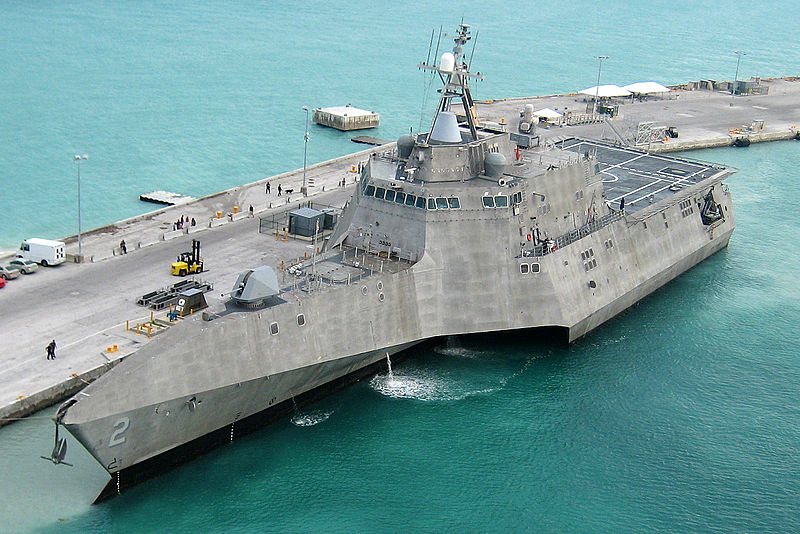
The USS Freedom (LCS-1), one of three littoral combat ships now in service, is designed for fighting the last war—but probably not the next.
US Navy
The Navy’s littoral combat ship (LCS) was supposed to be the ship of the future, designed to be easily converted from one role to another with a relatively quick swap-out of “mission modules.” But what the Navy got instead was a range of headaches and a ship with significantly less flexibility and capability than the ships the LCS was replacing. Now, as National Defense reports, the Department of Defense has cut the number of ships to be built nearly in half, and it has put future purchases on hold while it considers its options.
But there could still be good news for the defense contractors building the LCS: the options include a beefed-up version of the ship that could raise its cost further—and increase the profits of Lockheed Martin and Austal USA in the process. Considering the fact that these ships have already had significant problems (including “aggressive corrosion“ of one design’s hull because it didn’t include cathodic protection), yet another design change could cost the US billions more for a class of ships that has never lived up to its concept.
Stu Slade, warship analyst for Forecast International, told National Defense, “This isn’t a done deal. It’s certainly a setback for the LCS program viewed in isolation, but it’s one that could yet be reversed” because the cuts won’t hit until 2016—when the White House gets a new occupant.

Back to the future

In a way, the LCS is a hangover from the Army’s Future Combat Systems program. The Navy intended the LCS to be an all-in-one replacement for its aging guided missile frigates and minesweepers, taking on both anti-mine and anti-submarine roles. But the Navy also wanted to use the ship to provide fire support for troops ashore, using technology being developed by the Army for its force modernization: the Fire Scout unmanned helicopter and the Non-Line Of Sight (NLOS) Missile system.
To accommodate all of these roles, the Navy pushed for a ship design that would ideally allow the LCS to change jobs by swapping out modules. Additional modules, such as anti-surface ship systems and “irregular warfare” packages to support special operations troops, could be built separately to avoid the need to build other specialized ships, saving money. And all of this was bundled together with technology to reduce the required crew size for the LCS.
The NLOS was supposed to give the LCS serious firepower, with a range of 25 miles and the ability to hit targets on land and sea. The modular missile system was supposed to provide two capabilities: a “precision attack munition” (PAM) using inertial and GPS guidance, with infrared and laser designation by the Fire Scout or a ground spotter, and a “loitering attack munition” (LAM) that could fly to a designated point and wait for a target of opportunity.
But the NLOS has never materialized, mostly because of the collapse of the Army’s Future Combat Systems project. Another system, the Griffin missile, is still being considered as an alternative. The Griffin, which only has a range of 3.5 miles, was designed for use on aircraft against ground targets and would only be effective against “swarm” small boat attacks.
The mission modules themselves also turned out to be something of a bust. After evaluations, it was determined that it would take weeks, not days, to swap out an LCS’ mission modules, and the process would be much more expensive than anticipated. So the Navy decided that those “modules” would be more or less permanent instead, fixing the role of the ships they were deployed on outside of a major overhaul.
In the end, what the Navy got was a ship that was suited to none of these jobs in particular, designed to operate in what Defense Secretary Chuck Hagel recently described as “permissive environments.” In other words, it was designed for wars like the Iraq War, where there was no need to worry about threats from aircraft, ships, or coastal missile batteries. And by ordering 52 of them, the Navy was effectively guaranteeing that a sixth of its fleet would be made up of sitting ducks for those sorts of attacks.
The cost overruns of the LCS program haven’t helped its case much. The Navy ended up picking two winners for the program: Lockheed Martin’s more traditional Freedom class design and the General Dynamics/Austal USA trimaran Independence class. (Full disclosure: the Lockheed Martin program was run by my former commanding officer aboard USS Iowa, Fred Moosally.) Cost overruns caused the Navy to hold up building more ships several times. Only three LCS ships have been delivered so far; a fourth, the Milwaukee, was launched in December, and another 20 are already on order. So the Navy’s “freeze” actually allows the Navy to order 12 more ships before 2016, down from the 28 planned.
Enlarge / The Austal USA-built trimaran USS Independence.
US Navy
The Milwaukee is launched on December 18, 2013.

Back to the drawing board (sort of)

This month, Chief of Naval Operations Adm. Jonathan Greenert created a task force to look into alternatives to the LCS that would be more effective against air attacks, submarines, and surface vessels. The Small Surface Combatant Task Force, which is led by Marine Corps Systems Command Director John D. Burrow, has until July to come up with the best option.
Given the constraints that the task force is under, the answer may turn out to be a bigger, badder version of the LCS, because anything else would require a totally new design process or a switch to another existing design. The Navy could conceivably go with a modified version of the Coast Guard’s National Security Cutter as an option, or it could buy a new multi-mission frigate being built for the French and Italian navies. But both of those options seem highly unlikely since the designs come from outside the Navy’s development process.
The most likely outcome of this trip back to the drawing board, then, is a bigger, heavier version of the LCS, with a bigger crew and more weapons systems. In other words, it will be a lot more expensive, and it will give the companies that built the LCS in the first place a chance to squeeze more money out of what has been a questionable effort from the start.

LCS 5 Milwaukee Side Launch

U.S. Military Seeking ‘Cheap Stealth’ on Ocean Floor

Pentagon explores hiding war-fighting gear on the sea bottom for years
The Navy’s endless push to build cheaper ships alarmed Rep. Pete Visclosky, D-Ind., at a House  hearing Tuesday. “You mention that we’re hitting a cost target,” he told the Navy brass about one class of vessels. “But if the ship’s not survivable, I don’t care if I meet my cost target if it’s in the bottom of the ocean.”
Bingo!
That’s exactly where the Pentagon is looking to build underwater mini-depots for the U.S. Navy. In fact, only hours after Visclosky grumbled about sunken ships sitting on the bottom of the ocean, the Pentagon said it’s moving closer to making that cold and forbidding place a base for U.S. military hardware. It’s planning to test the concept in the Western Pacific, conveniently close to China, starting next year.
“The approach centers on pre-deploying deep-ocean nodes years in advance in forward areas which can be commanded from standoff to deliver a wide range of unmanned and distributed systems to the sub-surface, surface, and air,” the Pentagon says. “The node must survive at greater than 6 km [3.7 miles] of depth, last up to 5 years, and operate in less than two hours after commanded to launch from the seafloor.” The system is designed for the world’s maritime hotspots, where cost and complexity limit how many ships the Navy can deploy.
In a nutshell, the Pentagon wants to seed potential hotspots with equipment—including small drones and other reconnaissance gear—in capsules rooted on the ocean floor under at least 4 kilometers (2.5 miles) of water. That’s nearly 50% of the world’s oceans, and “provides a vast area for concealment and storage,” according to the Defense Department. These nodes would “hibernate”—that’s the word the Pentagon uses—until roused from their “dormancy” by signals from the U.S. military. They would then rise to the surface, which is why the Pentagon calls it the “Upward Falling Payloads” program. Then their payloads would deploy into the sky or water.
Pentagon engineers believe “the cost to an adversary to retrieve a properly designed UFP node is asymmetric with the cost to produce and distribute them on the seafloor,” making it a bargain for the deployer. It’s the ultimate in “cheap stealth,” according to the Defense Advanced Projects Research Agency, the Pentagon office in charge. “The trick is to show how these systems offer lower-cost alternatives to traditional approaches, and that they scale well to large open-ocean areas,” DARPA program manager Andy Coon said Wednesday.
Early node designs contained “risers” made of metal, ceramic or plastic, capable of handling payloads up to four feet long and 17 inches in diameter and 200 pounds. “Some risers were multi-launch systems whereas others were single-launch units,” DARPA says. The Pentagon plans on awarding several contracts totaling $38 million to develop and demonstrate the technologies involved. There are no details available on how many nodes the Pentagon might want, where they might be planted, how much they might cost and how they would be put into place.
Read More @ Source

Boston Bombing Suspect Avoided CIA, FBI Because His Last Name Was Misspelled In DHS Database

from the intelligence-screwups-also-include-typos dept

Everyone makes mistakes. There's hardly anyone out there who can claim a misspelling-free existence. And government employees -- even highly-trained analysts and agents charged with protecting national security -- are no different. Mistakes will be made. Let he who is without sin be the pedantic ass casting stones in the comments below, etc.

The problem is that when mistakes are made on highly-sensitive forms, the damage is almost irreparable. As we've covered extensively, an agent's failure to fill out paperwork properly put a non-terrorist on the government's "no fly" list for over a decade. To add insult to cock-up, the government spent most of that time trying to bury the challenge with layers and layers of "national security" obfuscation. Confirming or denying anything about terrorist watchlists would somehow lead to terrorists gaming the system.

Speaking of terrorist attacks, the Tsarnaev brothers somehow managed to elude those specifically tasked with preventing events like the Boston Marathon bombing. The same lack of inter-agency communication that allowed some 9/11 terrorists to return to the US unnoticed was at play in the recent attack. Unbelievably, these agencies have used both attacks as justification for leaving their surveillance powers intact, arguing that curtailing these programs will somehow prevent them from stopping the next 9/11 or Boston bombing -- despite having been unable to prevent either of those.

But these "terrorist watchlists" the government likes to keep are sacrosanct, even if they're populated by people who shouldn't be on there and missing people who should be, thanks to human error.
On January 21, 2012 Tsarnaev traveled to JFK airport in New York to board an Aeroflot flight to Moscow.

Though an alert was triggered, Tsarnaev was not pulled out for a secondary search or interview. According to sources familiar with the report, there were almost 100 other names on the “Hot List” of individuals traveling through Customs at JFK that day, and Tsarnaev was not considered high priority.

Tsarnaev flew to Moscow, and then to Dagestan, where he stayed for six months and received jihad training, according to U.S. authorities.

On July 17, 2012, Tsarnaev flew back to the United States, landing at JFK. TECS notes remain in effect for one year. The initial TECS note had expired. The second, more urgent TECS note filed in October 2011 that said he might be armed and dangerous had not.

But no alert was triggered when Tsarnaev passed through Customs at JFK, because of the misspelling of his name on the second TECS note. The difference of one letter – Tsarnayev instead of Tsarnaev – meant that he was not detained or questioned despite the warning in his file, according to sources familiar with the report.
It's the sort of error anyone can make. But it had serious repercussions. In Tsarnaev's case, this error helped contribute to an attack on American citizens.

The government aggressively battles anyone who questions their placement on terrorist watchlists, ignoring the fact that it still employs human beings and that those people -- being human -- will occasionally make mistakes. No one's asserting any sort of maliciousness on the government's behalf in Ibrahim's case, but no one should to be willing to completely excuse its behavior in Tsarnaev's, either.

Errors will be made, but it's of utmost importance to correct them. The government needs to stop pretending its watchlists are infallible. It's not as though this is a recent development and possibly the first time these agencies have been made aware of the lists' shortcomings. Back in 2009, the Office of the Inspector General had this to say about the FBI's list.
We found that the FBI failed to nominate many subjects in the terrorism investigations that we sampled, did not nominate many others in a timely fashion, and did not update or remove watchlist records as required.... We believe that the FBI's failure to consistently nominate subjects of international and domestic terrorism investigations to the terrorist watchlist could pose a risk to national security.
The FBI failed in both directions, failing to add suspected terrorists to the list fast enough and being pretty much unresponsive when it came to removing those not deemed a threat. Add this to the fact that clerical errors will always be present in a certain percentage of records and you have a list whose veracity is highly questionable. But the government doesn't see it that way, and that's the problem.