Wednesday, December 23, 2015

dee

Was John Dee’s Fascination With the Occult Driven by Espionage?

Throughout the middle 1500s, renowned scientist and philosopher John Dee became what many would recognize as the first of the famous British spies. Whilst working as an educator in the fields of astronomy and mathematics (among other areas of expertise), Dee had famously been an advisor to Queen Elizabeth during his lifetime, occasionally working to secretly collect and transfer information to her as a personal liaison. Foreshadowing things to come, it had even been the insignia for Queen Elizabeth’s nickname for Dee—she referred to him as “eyes”—that likely inspired the later codename “007” that would appear in Ian Fleming’s James Bond novels.
Despite his scientific prowess and work as a statesman, John Dee has remained a controversial historical figure due to his occult leanings. Dee, after all, had aspired to study the fields of science in equal measure to that of magic and hermeticism, all during in an era in which the divide between the two was growing to be ever-more divided. 
Because of his indistinguishable focus between such disparate fields of study, many scholars looking back on Dee’s life and work consider him a troubling–and perhaps also a troubled–figure. While obviously one of the great minds of his era, he had seemingly also appeared to be, at times, a rather credulous dupe. 
Etching that depicts John Dee and Edward Kelley conjuring a spirit by magical means.
Dee’s infamous partnership with occult seer Edward Kelley, for instance, would produce the “Enochian scripts” for which Dee is perhaps most famous; though at times, this came with great personal struggle and loss on Dee’s part. Kelley, for instance, wishing to rid himself of such boring pursuits with the passing of time, would go to great extremes with hope of repelling Dee from any further interest in such collaborations. In one notable instance, Kelley even advised Dee that the “angels” they communicated with had advised that the two men must share their wives. Rather than rejecting the idea (and Kelley) as intended, Dee begrudgingly agreed to the arrangement, revealing his apparent utter trust for Kelley’s divining abilities, which, as history has since shown, were probably little more than the acts of an opportunistic charlatan.
The prolonged fascination that Dee maintained for such occult studies have remained a dark mark in the minds of many modern scholars, who cannot accept how such faith and fascination in the realms of “magic” might have complimented a learned man like Dee in any manner. And yet, there is perhaps another, less-often observed possibility pertaining to Dee, which some scholars suggest as an underlying reason for his devotion to magical studies. If true, it would suggest far less about his interest in the occult, instead having everything to do with his operations as a spy for the Queen during this period.
Around the same period Dee had been enthralled with his magical studies, Sir Francis Walsingham had served his tenure as Queen Elizabeth’s secretary of state. It has been speculated by some historians that Dee and Walsingham, with Dee’s role as spy and advisor to Elizabeth at the time, may indeed have been involved in British espionage work while he was visiting Prague (this is also where his angelic collaborations with Kelley had taken place). Given this set of circumstances, the angelic “revelations”, and their focus on the creation of a secret language, may be interpreted differently from having been an obsessive occult interest; the “Enochian” scripts may in fact have been representative of a coded language which Dee might use to communicate secretly with Walsingham, who remained in England at the same time.
enochian
Further, the language itself, rather than having been “divinely” inspired by Kelley’s alleged observations through his shew stone of an angel Dee recognized as “Madimi”, could have had simpler origins: the earlier work of German cryptographer Johannes Trithemius may even have served as the inspiration for these scripts.
However, there are other possible implications that would have resulted from this odd tidbit in the annals of secret history. As suggested by occult scholar Peter Levenda, “the entire basis of the famous occult order known as the Golden Dawn may well have had its origins in espionage work.” It is well known, of course, that Dee’s works would go on to inspire the likes of MacGregor Mathers, as well as William Wynn Wescott, principle founder of the Golden Dawn that emerged, in part, from the earlier Masonic traditions that influenced these men. Later, Aliester Crowley would similarly borrow from the Enochian scripts of Dee (the latter, though, having expressed a certain disdain for Dee, ascribing the greater importance to the manipulator Kelley. We know, of course, that Kelley would go on to practice the magical arts well beyond his years with Dee, though none of this would end well for him. Kelley, after making the claim that he possessed knowledge on how to alchemically produce gold, would become essentially imprisoned by Emperor Rudolph II at Křivoklát Castle, near Prague. None of this, of course, might remove Kelley from having been complicit with Dee’s espionage operations, had he in fact been aware of them during their cooperative years.
It would indeed be interesting if Dee’s involvement in occult workings while in Prague might have had far less to do with the pseudoscientific “obsession” that many modern scholars attribute to him. In fact, due to his known activities as an Elizabethan spy, it may very well be the case that Dee was up to more than many may ever have realized.

ANALYSIS: Chipotle is a victim of corporate sabotage... biotech industry food terrorists are planting e.coli in retaliation for restaurant's anti-GMO menuChipotle e.coli outbreak

by Mike Adams, the Health Ranger, NaturalNews Editor   http://www.naturalnews.com/052405_Chipotle_ecoli_outbreak_corporate_sabotage_biotech_bioterrorism.html

(NaturalNews) After observing recent events involving Chipotle and e.coli, here's my analysis of the situation: Chipotle's e.coli outbreaks are not random chance. They are the result of the biotech industry unleashing bioterrorism attacks against the only fast food company that has publicly denounced GMOs.
How do we know? The CDC has already admitted that some of these e.coli outbreaks involve a "rare genetic strain" of e.coli not normally seen in foods. Furthermore, we also know the track record of the biotech industry engaging in the most criminal, dirty, sleazebag tactics imaginable against any person or company that speaks out against GMOs.

Doctor Oz, for example, was maliciously targeted in a defamation campaign funded by the biotech industry earlier this year. The onslaught against Oz was initiated because he publicly expressed his support for honest GMO labeling on foods.

As the attacks escalated, Doctor Oz had his own team investigate the source of the attacks and found they were all biotech industry shills, some with felony criminal records and long histories of dubious propaganda activities targeting anti-GMO activists.

GMO industry routinely resorts to tactics that resemble terrorism or criminal mafias

As a clean food advocate myself, I know firsthand of the malicious tactics used by these biotech mafia operations, including tactics of intimidation and terrorism, such as calling in bomb threats to locations where clean food activists are about to speak.

There is absolutely no question that the biotech industry will resort to ANY activity necessary to destroy food companies that oppose GMOs. And yes, this includes acts of bioterrorism against Chipotle -- something that's ridiculously easy for biotech industry operatives to carry out with simple, low-cost laboratory supplies sold online at places like Amazon.com.

In my HealthRangerReport.com podcast, shown below, I am now openly encouraging Chipotle's management to initiate a criminal investigation with the FBI to attempt to identify the sources of this corporate sabotage campaign.

To be clear, what's really happening at Chipotle is that biotech industry shills are deliberately contaminating Chipotle's food with strains of e.coli in a malicious attempt to destroy both the reputation and finances of the Chipotle food chain. This act of bioterrorism is entirely consistent with the known behavior patterns of the biotech industry which, for example, engaged in illegal money laundering in Washington state in order to destroy the GMO labeling bill there.

The biotech industry not only sells deadly glyphosate herbicide poison that destroys human health (and contaminates ecosystems), it also uses its dirty money to financially influence academics, journalists and lawmakers. Those individuals who don't fall into line with the biotech agenda are then treated to intense campaigns of defamation, slander, intimidation and threats to try to silence or discredit them.

And when that doesn't work, biotech industry operatives will literally engage in acts of terrorism like we're seeing right now with Chipotle. To understand the biotech industry, you have to first understand that these are truly EVIL people who have no ethical boundaries whatsoever. They will target and destroy any person, any institution or any public company that they see as standing in their way of total world domination over the seed supply (and hence the food supply). The idea that exposing the public to e.coli might be harmful to some people doesn't cause them to hesitate for even a moment. The more people get sick or die from their Chipotle operation, the better for biotech!


Sources for this story include:
http://www.naturalnews.com/049510_Chipotle_n...
http://www.naturalnews.com/049464_Doctor_Oz_...
http://healthrangerreport.com/chipotle-a-vic...
http://www.naturalnews.com/046303_gmo_labeli...
http://www.naturalnews.com/051184_Monsanto_m...
GMO.news
Truthwiki.org

CISA Is Now The Law: How Congress Quietly Passed The Second Patriot Act

Posted by George Freund on December 22, 2015


Update: CISA is now the law: OBAMA SIGNS SPENDING, TAX BILL THAT REPEALS OIL EXPORT BAN

* * *

Back in 2014, civil liberties and privacy advocates were up in arms when the government tried to quietly push through the Cybersecurity Information Sharing Act, or CISA, a law which would allow federal agencies - including the NSA - to share cybersecurity, and really any information with private corporations "notwithstanding any other provision of law." The most vocal complaint involved CISA’s information-sharing channel, which was ostensibly created for responding quickly to hacks and breaches, and which provided a loophole in privacy laws that enabled intelligence and law enforcement surveillance without a warrant.

Ironically, in its earlier version, CISA had drawn the opposition of tech firms including Apple, Twitter, Reddit, as well as the Business Software Alliance, the Computer and Communications Industry Association and many others including countless politicians and, most amusingly, the White House itself.

In April, a coalition of 55 civil liberties groups and security experts signed onto an open letter opposing it. In July, the Department of Homeland Security itself warned that the bill could overwhelm the agency with data of “dubious value” at the same time as it “sweep[s] away privacy protections.” Most notably, the biggest aggregator of online private content, Facebook, vehemently opposed the legislation however a month ago it was "surprisingly" revealed that Zuckerberg had been quietly on the side of the NSA all along as we reported in "Facebook Caught Secretly Lobbying For Privacy-Destroying "Cyber-Security" Bill."

Even Snowden chimed in:

Following the blitz response, the push to pass CISA was tabled following a White House threat to veto similar legislation. Then, quietly, CISA reemerged after the same White House mysteriously flip-flopped, expressed its support for precisely the same bill in August.

And then the masks fell off, when it became obvious that not only are corporations eager to pass CISA despite their previous outcry, but that they have both the White House and Congress in their pocket.

As Wired reminds us, when the Senate passed the Cybersecurity Information Sharing Act by a vote of 74 to 21 in October, privacy advocates were again "aghast" that the key portions of the law were left intact which they said make it more amenable to surveillance than actual security, claiming that Congress has quietly stripped out "even more of its remaining privacy protections."

"They took a bad bill, and they made it worse," says Robyn Greene, policy counsel for the Open Technology Institute.

But while Congress was preparing a second assault on privacy, it needed a Trojan Horse with which to enact the proposed legislation into law without the public having the ability to reject it.

It found just that by attaching it to the Omnibus $1.1 trillion Spending Bill, which passed the House early this morning, passed the Senate moments ago and will be signed into law by the president in the coming hours.

This is how it happened, again courtesy of Wired:

In a late-night session of Congress, House Speaker Paul Ryan announced a new version of the “omnibus” bill, a massive piece of legislation that deals with much of the federal government’s funding. It now includes a version of CISA as well. Lumping CISA in with the omnibus bill further reduces any chance for debate over its surveillance-friendly provisions, or a White House veto.And the latest version actually chips away even further at the remaining personal information protections that privacy advocates had fought for in the version of the bill that passed the Senate.

It gets: it appears that while CISA was on hiatus, US lawmakers - working under the direction of corporations adnt the NSA - were seeking to weaponize the revised legislation, and as Wired says, the latest version of the bill appended to the omnibus legislation seems to exacerbate the problem of personal information protections.

It creates the ability for the president to set up “portals” for agencies like the FBI and the Office of the Director of National Intelligence, so that companies hand information directly to law enforcement and intelligence agencies instead of to the Department of Homeland Security. And it also changes when information shared for cybersecurity reasons can be used for law enforcement investigations. The earlier bill had only allowed that backchannel use of the data for law enforcement in cases of “imminent threats,” while the new bill requires just a “specific threat,” potentially allowing the search of the data for any specific terms regardless of timeliness.

Some, like Senator Ron Wyden, spoke out out against the changes to the bill in a press statement, writing they’d worsened a bill he already opposed as a surveillance bill in the guise of cybersecurity protections.

Senator Richard Burr, who had introduced the earlier version of bill, didn’t immediately respond to a request for comment.

"Americans deserve policies that protect both their security and their liberty," he wrote. "This bill fails on both counts."

Why was the CISA included in the omnibus package, which just passed both the House and the Senate? Because any "nay" votes - or an Obama - would also threaten the entire budget of the federal government. In other words, it was a question of either Americans keeping their privacy or halting the funding of the US government, in effect bankrupting the nation.

And best of all, the rushed bill means there will be no debate.

The bottom line as OTI's Robyn Green said, "They’ve got this bill that’s kicked around for years and had been too controversial to pass, so they’ve seen an opportunity to push it through without debate. And they’re taking that opportunity."

The punchline: "They’re kind of pulling a Patriot Act."

And when Obama signs the $1.1 trillion Spending Bill in a few hours, as he will, it will be official: the second Patriot Act will be the law, and with it what little online privacy US citizens may enjoy, will be gone.

http://www.zerohedge.com/news/2015-12-18/congress-just-passed-second-patriot-act-and-nobody-noticed-how-cisa-became-law

GEORGISM:

Those who have nothing to hide have nothing to fear. When the time comes that you have something to fear, you'll have no place to hide.

Incremental fascism is hardly ever noticed and frequantly extolled by those it is to be applied too.


Modern Porn mimics Aleister Crowley’s Sex Magick Philosophiesgreat-rite-edit

Modern porn is chock full of the consumption of bodily fluids, sodomy, and other overtly hedonistic acts, and that’s only what goes on in the mainstream stuff. A century ago when Aleister Crowley included acts like these in his occultist writings about Sex Magick — and yes he insisted on the “K”— there was no mainstream for such things. 
Crowley cultivated a public image that stoked the fires of fear in a culture entrenched in repressive, Christian-inspired social mores, and the result was Crowley being labelled as an evil lunatic doomed to an eternity in Hell for his blasphemy. He thrived on this notoriety. His ability to market himself was truly an otherworldly gift.
His name was synonymous with black magic, numerology, and spiritualism, but it seems his passion was Sex Magick — ritual involving sex to achieve a predetermined goal.
Some of Crowley’s writings indicate he might have been more of a man obsessed with the power of sex and the drug-like rush that accompanies a good orgasm than the hellbent lunatic who conjures spirits inside of creepy castles as the public imagined him to be.
That’s not to say his approach to Sex Magick wasn’t outrageous. Even when his writings are looked back upon with a century of social evolution in between, some elements of his approach were “out there” to say the least.
Porn is guilty of extremes on par with Crowley’s.
Perhaps the most viral, and seemingly bacterial, porn clip in Internet history is simply known as “Two Girls, One Cup.” The clip was so outside the norm of sexual behavior, even by porn standards, posting videos of the shock on someone’s face while watching it for the first time was the charge that triggered the clip’s explosion in popularity.
When it comes to Crowley, however, he didn’t bother using a cup .
[youtube]https://www.youtube.com/watch?v=aQRoCcfNnVE[/youtube]
Crowley’s Sex Magick in Brief
Magick
Crowley’s sex rituals involving the consumption of blood, semen, or feces, were allegedly intended to achieve a higher consciousness, to empower a talisman, or to simply empower ones self. Intense focus on the intended result during the ritual, especially during orgasm, were paramount to achieving the desired goal in Sex Magick.
Crowley saw in orgasm (as in drug experience) a means to create ‘breakages of consciousness’ by pushing the mind to a point of extreme exhaustion and so opening it to the ‘supersensual:’  ‘The technique…was that of excess; through pain or pleasure, sex or intoxication, it was necessary to attain a condition of exhaustion taken to the extreme limit.’
When he established his own spiritual community called Abbey of Thelema, he declared its philosophy to be one of, “Do what thou will,” where free experimentation with sex, drugs, and other self-gratification, were acceptable.
In his writings, he revealed some of the directions in which he took his anything-goes philosophy. For example, his involvement with an American who studied under Crowley:
Now I’ll shave and make up my face like the lowest kind of whore and rub on perfume and go after Genesthai [A man whose real name was Cecil Fredrick Russell] like a drunken two-bit prick-pit in old New Orleans. He disgusts me sexually, as I him, as I suspect…[T]he dirtier my deed, the dearer my darling will hold me; the grosser the act the greedier my arse to engulph him!  – From Crowley’s 1918 Diary
Crowley found power in challenging the norms of society when it came to sexual satisfaction. Some even claim he intended to tear down the commonly repressed views on sexuality by directly attacking taboos with his actions and writings.
In his diaries, Crowley even wrote of his own Two Girls, One Cup experience involving a woman with whom he lived for quite some time:
My mouth burned; my throat choked, my belly wretched; my blood fled wither who knows …She stood above in hideous contempt…She ate all the body of God and with Her soul’s compulsion made me eat…My teeth grew rotten, my tongue ulcered, raw was my throat, spasm-torn my belly, and all my Doubt  of that which to Her teeth was moonlight and to her tongue ambrosia; to her throat nectar, in her belly the One God.  – From The Magical Record of the Beast: The Diaries of Aleister Crowley
Of course, these are just highlights of a much-deeper philosophy Crowley built with influences from various religions, occult organizations, mythology, and other sources. It was also something he continued to study and develop until his death in 1947:
If this secret [of sexual magic], which is a scientific secret, were perfectly understood, as it is not by me after more than twelve years’ almost constant study and experiment, there would be nothing which the human imagination can conceive that could not be realized in practice.  —The Confessions of Aleister Crowley: An Autobiography
Sex Magick vs. Sex Industry
More than likely porn performers have had sexual experiences on film where they too were disgusted by their partner, or partners, with whom they had to perform as Crowley was with Genesthai. Also, as we pointed out earlier, the consumption of bodily fluids is as common to the nearly ritualistic sexual performances in porn as Chevrolet Camaros are to the parking lot of a Lynyrd Skynyrd concert. Most every act/ritual Crowley described that shocked the culture of his day, can now be seen on the Internet with a good search term and a few clicks of the mouse.
Crowley
The split between porn makers and Sex Magick occultists like Crowley comes at the point where the desired goal of the actions is considered. The goal of porn makers is to simply make butt-loads of cash. In a perverse way, thinking about the “Benjamins” while being sodomized seems less pure than thinking about spiritual growth during the act.
When reading the works of Crowley, one can’t help but to draw connections between Sex Magick and modern pornography. There are just too many similarities in the acts to not make the connection.
Like Crowley in his day, porn makers often use extremes to lash out at social sexual mores to get headlines and titivate an audience open to exploring their own curiosity when it comes to taboo sexual acts.
The approach has certainly worked for both parties.
Here we are nearly 70 years after Aleister Crowley died, and we’re still talking about him, even if it is just when we hear Ozzy Osbourne sing about him on the radio, and porn is now more mainstream than ever.
Great Rite Tablet
Sex sells. It always has. It always will.
Outside of his desires to push the envelope of sexual acceptability and consumption of drugs, many of Crowley’s other philosophies might be appealing to a mass audience. Strengthening one’s character and empowering ones self, were often at the root of what he wrote and taught. The concept of empowerment is something often heard from porn stars, particularly female porn stars, for example, porn veteran Nina Hartley, when interviewed by mainstream sources. Performers like Hartley claim to love what they do and even draw self esteem from it.
So is there magic in sex? When it comes to the way our bodies react to it, and crave it, it is certainly something powerful, even when it comes to the seemingly hollow-sex world of pornography.
Crowley certainly believed.
Do you?
[youtube]https://www.youtube.com/watch?v=mvXE-YU4kNI[/youtube]

Who Owns the Federal Reserve Bank—and Why is It Shrouded in Myths and Mysteries?

Region:

la-reserve-federale-americaine
It is well enough that people of the nation do not understand our banking and monetary system, for if they did, I believe there would be a revolution before tomorrow morning. (Henry Ford)
Give me control of a Nation’s money supply, and I care not who makes its laws. (M. A. Rothschild)
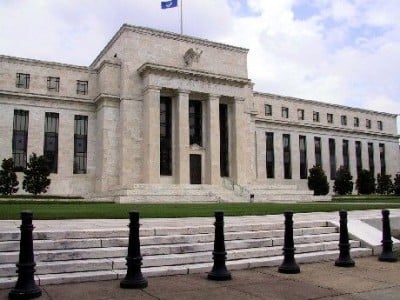
The Federal Reserve Bank (or simply the Fed), is shrouded in a number of myths and mysteries. These include its name, its ownership, its purported independence form external influences, and its presumed commitment to market stability, economic growth and public interest.
The first MAJOR MYTH, accepted by most people in and outside of the United States, is that the Fed is owned by the Federal government, as implied by its name: the Federal Reserve Bank. In reality, however, it is a private institution whose shareholders are commercial banks; it is the “bankers’ bank.” Like other corporations, it is guided by and committed to the interests of its shareholders—pro forma supervision of the Congress notwithstanding.

The choice of the word “Federal” in the name of the bank thus seems to be a deliberate misnomer—designed to create the impression that it is a public entity. Indeed, misrepresentation of its ownership is not merely by implication or impression created by its name. More importantly, it is also officially and explicitly stated on its Website: “The Federal Reserve System fulfills its public mission as an independent entity within government. It is not owned by anyone and is not a private, profit-making institution” [1].
To unmask this blatant misrepresentation, the late Congressman Louis McFadden, Chairman of the House Banking and Currency Committee in the 1930s, described the Fed in the following words:

Some people think that the Federal Reserve Banks are United States Government institutions. They are private monopolies which prey upon the people of these United States for the benefit of themselves and their foreign customers; foreign and domestic speculators and swindlers; and rich and predatory money lenders.
The fact that the Fed is committed, first and foremost, to the interests of its shareholders, the commercial banks, explains why its monetary policies are increasingly catered to the benefits of the banking industry and, more generally, the financial oligarchy. Extensive deregulations that led to the 2008 financial crisis, the scandalous bank bailouts in response to the crisis, the continued showering of the “too-big-to-fail” financial institutions with interest-free money, the failure to impose effective restraints on these institutions after the crisis, the brutal neoliberal cuts in social safety net programs in order to pay for the gambling losses of high finance, and other similarly cruel austerity policies—can all be traced to the political and economic power of the financial oligarchy, exerted largely through monetary policies of the Fed.
It also explains why many of the earlier U.S. policymakers resisted entrusting the profit-driven private banks with the critical task of money supply and credit creation:

The [private] Central Bank is an institution of the most deadly hostility existing against the principles and form of our constitution . . . . If the American people allow private banks to control the issuance of their currency . . ., the banks and corporations that will grow up around them will deprive the people of all their property until their children will wake up homeless on the continent their fathers conquered (Thomas Jefferson, 3rd U.S. President).
In 1836, Andrew Jackson abolished the Bank of the United States, arguing that it exerted undue and unhealthy influence over the course of the national economy. From then until 1913, the United States did not allow the formation of a private central bank. During that period of nearly three quarters of a century, monetary policies were carried out, more or less, according to the U.S. Constitution: Only the “Congress shall have power . . . to coin money, regulate the value thereof” (Article 1, Section 8, U.S. Constitution). Not long before the establishment of the Federal Reserve Bank in 1913, President William Taft (1909-1913) pledged to veto any legislation that included the formation of a private central bank.
Soon after Woodrow Wilson replaced William Taft as president, however, the Federal Reserve Bank was founded (December 23, 1913), thereby centralizing the power of U.S. banks into a privately owned entity that controlled interest rate, money supply, credit creation, inflation, and (in roundabout ways) employment. It could also lend money to the government and earn interest, or a fee—money that the government could create free of charge. This ushered in the beginning of the gradual rise of national debt, as the government henceforth relied more on borrowing from banks than self-financing, as it had done prior to granting the power of money-creation to the private banking system. Three years after signing the Federal Reserve Act into law, however, Wilson is quoted as having stated:

I am a most unhappy man. I have unwittingly ruined my country. A great industrial nation is controlled by its system of credit. Our system of credit is concentrated. The growth of the nation, therefore, and all our activities are in the hands of a few men. We have come to be one of the worst ruled, one of the most completely controlled and dominated governments in the civilized world. No longer a government by free opinion, no longer a government by conviction and the vote of the majority, but a government by the opinion and duress of a small group of dominant men [2].
While many independent thinkers and policy makers of times past thus viewed the unchecked power of private central banks as a vice not to be permitted to interfere with a nation’s monetary/economic policies, most economists and policy makers of today view the independence of central banks from the people and the elected bodies of government as a virtue!
And herein lies ANOTHER MYTH that is created around the Fed: that it is an independent, purely technocratic or disinterested policy-making entity that is solely devoted to national interests, free of all external influences. Indeed, a section or chapter in every college or high school textbook on macroeconomics, money and banking or finance is devoted to the “advantages” of the “independence” of private central banks to determine the “proper” level of money supply, of inflation or of the volume of credit that an economy may need—always equating independence from elected authorities and citizens with independence in general. In reality, however, central bank independence means independence from the people and the elected bodies of government—not from the powerful financial interests.

Independence has really come to mean a central bank that has been captured by Wall Street interests, very large banking interests. It might be independent of the politicians, but it doesn’t mean it is a neutral arbiter. During the Great Depression and coming out of it, the Fed took its cues from Congress. Throughout the entire 1940s, the Federal Reserve as a practical matter was not independent. It took its marching orders from the White House and the Treasury—and it was the most successful decade in American economic history [3].
Another MAJOR MYTH associated with the Fed is its purported commitment to national and/or public interest. This presumed mission is allegedly accomplished through monetary policies that would mitigate financial bubbles, adjust credit or money supply to commercial and manufacturing needs, and inject buying power into the economy through large scale investment in infrastructural projects, thereby fostering market stability and economic expansion.
Such was indeed the case in the immediate aftermath of the Great Depression and WW II when the Fed had to follow the guidelines of the Congress, the White House and the Treasury Department. As the regulatory framework of the New Deal economic policies restricted the role of commercial banks to financial intermediation between savers and investors, finance capital moved in tandem with industrial capital, as it essentially greased the wheels of industry, or production. Under those circumstances, where financial institutions served largely as conduits that aggregated and funneled national savings to productive investment, financial bubbles were rare, temporary and small.
Not so in the age of finance capital. Freed from the regulatory constraints of the immediate post-WW II period (which determined the types, quantities and spheres of its investments), the financial sector has effectively turned into a giant casino. Accordingly, the Fed has turned monetary policy (since the days of Alan Greenspan) into an instrument of further enriching the rich by creating and safeguarding asset-price bubbles. In other words, the Fed’s monetary policy has effectively turned into a means of redistribution from the bottom up.
This is no speculation or conspiracy theory: redistributive effects of the Fed policies in favor of the financial oligarchy are backed by undeniable facts and figures. For example, a recent study by the Pew Research Center of income/wealth distribution (published on December 9, 2015) shows that the systematic and escalating socio-economic polarization has led to a sharp decline in the number of middle-income Americans.
The study reveals that, for the first time, middle-income households no longer constitute the majority of American house-holds: “Once in the clear majority, adults in middle-income households in 2015 were matched in number by those in lower- and upper-income households combined.” Specifically, while adults in middle-income households constituted 60.1 percent of total adult population in 1971, they now constitute only 49.9 percent.
According to the Pew report, the share of the national income accruing to middle-income households declined from 62 percent in 1970 to 43 percent in 2014. Over the same period of time, the share of income going to upper-income households rose from 29 percent to 49 percent.
A number of critics have argued that, using its proxies at the heads of the Fed and the Treasury, the financial oligarchy used the financial crisis of 2008 as a shock therapy to transfer trillions of taxpayer dollars to its deep pockets, thereby further aggravating the already lopsided distribution of resources. The Pew study unambiguously confirms this expropriation of national resource by the financial elites. It shows that the pace of the rising inequality has accelerated in the aftermath of the 2008 market implosion, as asset re-inflation since then has gone almost exclusively to oligarchic financial interests.
Proxies of the financial oligarchy at the helm of economic policy making no longer seem to be averse to the destabilizing bubbles they help create. They seem to believe (or hope) that the likely disturbances from the bursting of one bubble could be offset by creating another bubble! Thus, after dot-com bubble, came the housing bubble; after that, energy-price and emerging markets bubble, after that, the junk bond market bubble, and so on. By the same token as the Fed re-inflates one bubble after another, it also systematically redistributes wealth and income from the bottom up.
This is an extremely ominous trend because, aside from issues of social justice and economic insecurity for the masses of the people, the policy of creating and protecting asset bubbles on a regular basis is also unsustainable in the long run. No matter how long or how much they may expand financial bubbles—like taxes and rents under feudalism—are ultimately limited by the amount of real values produced in an economy.

*******
Is there a solution to the ravages wrought to the economies/societies of the core capitalist countries by the accumulation needs of parasitic finance capital—largely fostered or facilitated by the privately-owned central banks of these countries?
Yes, there is indeed a solution. The solution is ultimately political. It requires different politics and/or policies: politics of serving the interests of the overwhelming majority of the people, instead of a cabal of financial oligarchs.
The fact that profit-driven commercial banks and other financial intermediaries are major sources of financial instability is hardly disputed. It is equally well-known that, due to their economic and political influence, powerful financial interests easily subvert government regulations, thereby periodically reproducing financial instability and economic turbulence. By contrast, public-sector banks can better reassure depositors of the security of their savings, as well as help direct those savings toward socially-beneficial credit allocation and productive investment.
Therefore, ending the recurring crises of financial markets requires placing the destabilizing financial intermediaries under public ownership and democratic control. It is only logical that the public, not private, authority should manage people’s money and their savings, or economic surplus. As the late German Economist Rudolf Hilferding argued long time ago, the system of centralizing people’s savings and placing them at the disposal of profit-driven private banks is a perverse kind of socialism, that is, socialism in favor of the few:

In this sense a fully developed credit system is the antithesis of capitalism, and represents organization and control as opposed to anarchy. It has its source in socialism, but has been adapted to capitalist society; it is a fraudulent kind of socialism, modified to suit the needs of capitalism. It socializes other people’s money for use by the few [4].
There are compelling reasons not only for higher degrees of reliability but also higher levels of efficacy of public-sector banking and credit system when compared with private banking—both on conceptual and empirical grounds. Nineteenth century neighborhood savings banks, Credit Unions, and Savings and Loan associations in the United States, Jusen companies in Japan, Trustee Savings banks in the UK, and the Commonwealth Bank of Australia all served the housing and other credit needs of their communities well. Perhaps a most interesting and instructive example is the case of the Bank of North Dakota, which continues to be owned by the state for nearly a century—widely credited for the state’s budget surplus and its robust economy in the midst of the harrowing economic woes in many other states.
The idea of bringing the banking industry, national savings and credit allocation under public control or supervision is not necessarily socialistic or ideological. In the same manner that many infrastructural facilities such as public roads, school systems and health facilities are provided and operated as essential public services, so can the supply of credit and financial services be provided on a basic public utility model for both day-to-day business transactions and long-term industrial projects.
Provision of financial services and/or credit facilities after the model of public utilities would allow for lower financial costs to both producers and consumers. Today, between 35 percent and 40 percent of all consumer spending is appropriated by the financial sector: bankers, insurance companies, non-bank lenders/financiers, bondholders, and the like [5]. By freeing consumers and producers from what can properly be called the financial overhead, or rent, similar to land rent under feudalism, the public option credit and/or banking system can revive many stagnant economies that are depressed under the crushing burden of never-ending debt-servicing obligations.
References
[1] “Who owns the Federal Reserve?” < http://www.federalreserve.gov/faqs/about_14986.htm>.
[2] This statement of President Wilson is quoted in numerous places. A number of commentators have argued that some of the damning words used in this much-quoted statement are either not Wilson’s own, or taken out of context. Nobody denies, however, that regardless of the exact words used, he had serious reservations about the formation of the Federal Reserve Bank, and the misguided policy of delegating the nation’s money supply and/or monetary policy to a cabal of private bankers.
[3]. Ellen Brown, “How the Fed Could Fix the Economy—and Why It Hasn’t,” <http://www.webofdebt.com/articles/fedfixeconomy.php>.
[4] Hilferding’s book, Finance Capital: A Study of the Latest Phase of Capitalist Development, has gone through a number of prints/reprints. This quotation is from Chapter 10 of an online version of the book, which is available at: <http://www.marxists.org/archive/hilferding/1910/finkap/ch10.htm>.
[5]. Margrit Kennedy, Occupy Money: Creating an Economy Where Everybody Wins, Gabriola Island, BC (Canada): New Society Publishers, 2012.
Ismael Hossein-zadeh is Professor Emeritus of Economics (Drake University). He is the author of Beyond Mainstream Explanations of the Financial Crisis (Routledge 2014), The Political Economy of U.S. Militarism (Palgrave–Macmillan 2007), and the Soviet Non-capitalist Development: The Case of Nasser’s Egypt (Praeger Publishers 1989). He is also a contributor to Hopeless: Barack Obama and the Politics of Illusion.