---BREAKAWAY CIVILIZATION ---ALTERNATIVE HISTORY---NEW BUSINESS MODELS--- ROCK & ROLL 'S STRANGE BEGINNINGS---SERIAL KILLERS---YEA AND THAT BAD WORD "CONSPIRACY"--- AMERICANS DON'T EXPLORE ANYTHING ANYMORE.WE JUST CONSUME AND DIE.---
The FBI’s Uniform Crime Reporting (UCR) Program defines murder
and nonnegligent manslaughter as the willful (nonnegligent) killing of
one human being by another.
The classification of this offense is based solely on police
investigation as opposed to the determination of a court, medical
examiner, coroner, jury, or other judicial body. The UCR Program does
not include the following situations in this offense classification:
deaths caused by negligence, suicide, or accident; justifiable
homicides; and attempts to murder or assaults to murder, which are
scored as aggravated assaults.
Data collection
Supplemental Homicide Data—Supplementary Homicide
Data—The UCR Program’s supplementary homicide data provide information
regarding the age, sex, and race of the murder victim and the offender;
the type of weapon used; the relationship of the victim to the offender;
and the circumstance surrounding the incident. Law enforcement
agencies are asked to provide complete supplementary homicide data for
each murder they report to the UCR Program. Data gleaned from these
supplementary homicide data can be viewed in the Expanded Homicide Data section. Justifiable homicide—Certain willful killings must be
reported as justifiable or excusable. In the UCR Program, justifiable
homicide is defined as and limited to:
The killing of a felon by a peace officer in the line of duty.
The killing of a felon, during the commission of a felony, by a private citizen.
Because these killings are determined through law enforcement
investigation to be justifiable, they are tabulated separately from
murder and nonnegligent manslaughter.
More information about justifiable homicide is furnished in the Expanded Homicide Data section and in Expanded Homicide Data Table 14, "Justifiable Homicide, by Weapon, Law Enforcement, 2005–2009" and Expanded Homicide Data Table 15, "Justifiable Homicide, by Weapon, Private Citizen, 2005–2009".
Overview
An estimated 15,241 persons were murdered nationwide in
2009, which is a 7.3 percent decrease from the 2008 estimate, a 9.0
percent decrease from the 2005 figure, and a
2.2 percent decrease from the 2000 estimate.
There were 5.0 murders per 100,000 inhabitants in 2009, an
8.1 percent decrease from the 2008 rate. Compared with the 2005 rate,
there was a
12.1 percent decrease in the murder rate; compared with the
2000 rate, a 10.4 percent decrease was recorded.
More than 44 percent (44.8) of murders were reported in the
South, the most populous region, with 21.3 percent reported in the West,
20.0 percent reported in the Midwest, and
13.9 percent reported in the Northeast. (See Table 3.)
Expanded murder data
UCR expanded offense data are details of the various offenses
that the UCR Program collects beyond the count of how many crimes law
enforcement agencies report. These details may include the type of
weapon used in a crime, type or value of items stolen, and so forth. In
addition, expanded data include trends (for example, 2-year
comparisons) and rates per 100,000 inhabitants.
Expanded information regarding murder is available in the following tables:
Trends (2-year): Tables 12, 13, and 14
Rates (per 100,000 inhabitants): Tables 16, 17, and 18 Expanded Homicide Data (supplemental homicide information):
Victim data: Expanded Homicide Data Tables 1, 2, 4, 5, 6, 8, 9, 10, 12, and 13
Offender data: Expanded Homicide Data Tables 3, 5, and 6
Victim/offender relationship data: Expanded Homicide Data Table 10
Circumstance data: Expanded Homicide Data Tables 10, 11, 12, and 13
Weapons data: Expanded Homicide Data Tables 7, 8, 9, 11, 14, 15, and Table 20
In the FBI’s Uniform Crime Reporting (UCR) Program, violent
crime is composed of four offenses: murder and nonnegligent
manslaughter, forcible rape, robbery, and aggravated assault. Violent
crimes are defined in the UCR Program as those offenses which involve
force or threat of force.
Data collection
The data presented in Crime in the United States
reflect the Hierarchy Rule, which requires that only the most serious
offense in a multiple-offense criminal incident be counted. The
descending order of UCR violent crimes are murder and nonnegligent
manslaughter, forcible rape, robbery, and aggravated assault, followed
by the property crimes of burglary, larceny-theft, and motor vehicle
theft. Although arson is also a property crime, the Hierarchy Rule does
not apply to the offense of arson.
Overview
In 2009, an estimated 1,318,398 violent crimes occurred nationwide, a decrease of
5.3 percent from the 2008 estimate.
When considering 5- and 10-year trends, the 2009 estimated violent crime total was
5.2 percent below the 2005 level and 7.5 percent below the 2000 level.
There were an estimated 429.4 violent crimes per 100,000 inhabitants in 2009.
Aggravated assaults accounted for the highest number of
violent crimes reported to law enforcement at 61.2 percent. Robbery
comprised 31.0 percent of violent crimes, forcible rape accounted for
6.7 percent, and murder accounted for 1.2 percent of estimated violent
crimes in 2009.
Information collected regarding type of weapon showed that firearms were used in
67.1 percent of the Nation’s murders, 42.6 percent of
robberies, and 20.9 percent of aggravated assaults. (Weapons data are
not collected for forcible rape.) (See Expanded Homicide Data Table 7, Robbery Table 3, and the Aggravated Assault Table.)
Data from the
U.S. Federal Bureau of Investigation show that America has been on a
firearms buying spree since the end of 2005. Meanwhile, the FBI recently
released preliminary 2009 crime data indicating that violent crime has been dropping at an accelerating rate since the end of 2006.
The FBI reports the number of background checks,
by month, requested for potential firearms purchases through licensed
dealers. When a prospective buyer wants to buy a gun, he fills out a
form which the dealer submits to law enforcement. If approved, the sale
proceeds. This system is called the National Instant Criminal Background
Check System, or NICS for short.
Between November 2005 and October 2009, nearly every month’s requests
were higher than the year before. (For example, there were 12.4% more
NICS requests in September 2009 than in September 2008.) The sole
exception was December 2007, which saw 1.9% fewer requests than December
2006. On an annual basis, each year’s total saw double-digit growth
over the previous year beginning in 2006.
NICS data mirror the estimated sales data
from the Bureau of Alcohol, Tobacco, Firearms, and Explosives, which
also show double-digit growth beginning in 2006. (Not all background
checks result in one gun being purchased.)
The chart below shows that after gun sales attained record growth in
2006, violent crime rates began to fall in 2007. As gun sales continued
to register records each following year, violent crime rates decreased
at an accelerating rate. More guns, less murder
The following chart shows that, like overall violent crime, after gun
sales began to peak in 2006, the murder rate declined at an
accelerating pace beginning in 2007, going from -0.7% to -3.9% in 2008,
to -7.2% in 2009.
Murder rates are perhaps the best indicator of violent crime trends,
compared to the other FBI major violent crimes. A dead body with bloody
wounds clearly indicates violence, but living victims don’t always tell
police they were assaulted. The FBI calculates violent crime rates based
upon what’s reported to police.
After the Virginia Tech shooting, Katie Couric interviewed Paul Helmke, president of the Brady Campaign to Prevent Gun Violence. Said Helmke:
“While it is ‘people who kill people,’ they do so more often, and
more successfully because we make it so easy to get such lethal weapons
[guns].”
It’s true that NICS data show how easy it is for Americans to buy
guns, but FBI crime data shows that law-abiding gun owners are not the
problem. More guns, less rape, robbery, and aggravated assault
The table below shows that after NICS requests attained 10% annual
growth during the 2006-2009 period, crime rates for all four FBI major
violent crimes began to decrease, generally at accelerating rates.
Is this because criminals know more people have been buying guns and
getting concealed carry permits? Even old media has been reporting the
surge in gun sales.
In 2006, ABC reported:
More women, from soccer moms to professionals like the
ones at the Blue Ridge Arsenal gun range in Chantilly, Va., are packing
heat for sport, self-empowerment and protection.
Local gun shop owners are seeing an increase in the
number of women customers. Personal protection is the main reason
they’re shopping. According to the national shooting sports foundation,
almost half the people taking their first handgun class this past year
were women.
These are just two examples of the numerous articles about new women
shooters and their desire to empower themselves with effective
self-defense tools.
Elizabeth Hellmann, program director for NRA women’s shooting sports programs, says:
In 2000, our first year, Women on Target had 13 clinics
with 496 participants. Based upon attendance reports submitted so far
this year, WOT is slightly above the figures for last year, which had a
record of over 9,000 attendees.
Most women who call about WOT clinics say they are interested in
learning to shoot for the purpose of personal protection. Generally, the
NRA finds that women who are interested in learning to shoot often
state that they want to obtain concealed carry permits.
Pistol training is our most popular class, whether it’s for Women On Target or basic NRA courses.
MSNBC recently ran an article entitled “Record numbers now licensed to pack heat.” An ABC affiliate in California noted:
With budget cuts depleting local police and sheriffs
[sic] departments, concealed weapons permit applications have bumped up
slightly.
The Boston Globe
noted that even in Massachusetts — where gun ownership is restricted to
those who complete coursework and pass a police background check — gun
ownership increased over 15% during the 2008-2009 period.
All across America, concealed carry permits are on the rise. Between 2006 and 2009, Florida issued over 271,000 new licenses, a 66% increase to over 684,000.
During the same time period, Texas saw a 56% increase, bringing their total to over 402,000; Michigan saw an 80% increase in licensees; and Utah experienced a 78% increase.
Since 2005, there has been a 25% increase in justifiable homicides by private citizens, 31% more by citizens with handguns. (Justifiable homicides result when citizens stop felonious attacks against themselves or another person, killing the attacker.)
While few defensive gun uses result in the attacker’s death,
justifiable homicide data serve as an indicator of how more citizens are
choosing self-defense over victimhood.
News items abound where armed citizens successfully defended themselves. A perusal of The Armed Citizen contains a generous sampling of successful self-defense articles going back to November 2003, and Keep and Bear Arms usually posts a number of stories each day.
More guns. More gun owners. More law-abiding citizens carrying handguns in public. More caution amongst violent predators?
When interviewed by the Christian Science Monitor,
Violence Policy Center founder Josh Sugarmann complained about how much
influence pro-gun writers and organizations have gained in recent
years, saying that pro-rights bloggers “clearly have more free time than
people on our side of the issue do.” He conveniently overlooked the
fact that he has plenty of time to promote his side because he receives
over $135,000 yearly from the Joyce Foundation, compared to these volunteer “bloggers.”
In 2009, Gallup
found that support for a handgun ban had faded to its lowest level
(29%) since they began the survey in 1959. Gallup got similar results
when asking people whether or not they supported stricter gun control
laws.
Organizations like the Brady Campaign and Violence Policy Center like
to blame the “gun lobby’s undue influence” on policy makers for their
difficulty in passing “sensible gun laws” that “the public supports.”
The numbers speak louder than anti-rights rhetoric: more guns, less crime.
Former civilian disarmament
supporter and medical researcher Howard Nemerov investigates the civil
liberty of self-defense and examines the issue of gun control, resulting
in his book Four Hundred Years of Gun Control: Why Isn’t It Working? He appears frequently on NRA News as their “unofficial” analyst and was published in the Texas Review of Law and Politics with David Kopel and Carlisle Moody.
You Won’t Believe The Crazy Things That Are Being Said About Gun Owners
By Michael, on December 17th, 2012
Whenever there is a great crisis or a great tragedy in the United
States, the collectivists immediately try to use it for their own
political advantage. As Rahm Emanuel once said, "you never want a
serious crisis to go to waste". So it should be no surprise that
liberals are doing their best to exploit the horrible tragedy that just
happened at Sandy Hook Elementary School in Newtown, Connecticut. 20
small children and 6 adults were savagely murdered, and instead of
appropriately mourning this great loss, liberals are in a feeding frenzy
and are falling all over one another as they rush to exploit this
horrible tragedy for political gain. Some of the most horrible things
that you can imagine are being said about gun owners and about the NRA.
They are being called murderers, terrorists and "the new KKK". Some
are even suggesting that they should be shot or rounded up and put into
camps. It is absolutely disgusting to watch what is going on, and the
mainstream media is just eating all of this up. The mainstream media
loves any story that they can use to demonize those that are opposed to
the collectivist agenda.
Fortunately, the rampant demonization of gun owners is only having a
limited impact on the poll numbers. One new survey taken after the
shooting at Sandy Hook Elementary School has found that 71 percent
of all Americans are against banning handguns entirely. So hopefully
we won't see our politicians try to ban all gun ownership any time soon.
But they are definitely going to come after "assault weapons" early
next year. Some members of Congress have already indicated that they
plan to introduce new gun control legislation in January.
Meanwhile, we can expect the demonization of gun owners and the NRA
to continue. The following are a few of the crazy things that have been
said by gun grabbers in recent days...
-A statement by progressive grassroots group CREDO...
"After the shooter Adam Lanza, no one is more to blame
for the massacre of 20 first graders and six women at the Sandy Hook
Elementary School than the National Rifle Association"
"You know, I did not go as far as I’d like to go because
my thoughts on the NRA and America’s gun culture – I believe the NRA is
the new KKK. And that the arming of so many black youths, uh, and
loading up our community with drugs, and then just having an open
shooting gallery, is the work of people who obviously don’t have our
best interests [at heart]."
"And then I guess my final point would be, I think if we're going to control guns, we really have to do it massive.
I think I'm all for getting rid of the assault weapons and machine
guns and all that tough, but if we want to prevent something like this,
we have to really think seriously about drastically reducing the number
of guns in our society, and particularly -- this is an old Patrick
Daniel Moynihan idea -- the number of bullets. It is very hard to
control 300 million guns. The bullets are a little easier to control."
"The issue with it will be, politically, I think; the
profile is white men. That’s a profile that’s not, essentially, in
America allowed to be profiled. That’s the one profile in America that’s
not allowed to be profiled."
"...it's the confiscation of these types of weapons that counts and will have an impact."
The things that people are saying on Twitter are even worse...
-Sam Tarling: "All NRA members should be shot!!!! I thank you, that's one of my own!!"
-@fullofbalogna:
"The NRA & gun manufacturers are terrorist organizations. We need
to eliminate them. Why do RWers support terrorists & murder of
kids?"
-Ryan:
"The NRA is nothing more than an enabler of mass murder, a terrible
organisation that has children's blood on their hands. Wake up USA."
-John Cobarruvias: "Can we now shoot the #NRA and everyone who defends them?"
-Stacy Fernandes: "all NRA members need to be rounded up and put in camps where they cant hurt anyone else"
But it is not just gun owners that are being demonized by the
mainstream media. Over the past couple of days there has also been an
attempt to portray the mother of Adam Lanza as a deluded prepper that
had been preparing "for the end of the world". The following quotes
from mainstream sources come from a recent article by Daisy Luther...
Nancy was a member of the Doomsday Preppers movement, which believes people should prepare for end of the world. (Riehl World View)
According to reports, Nancy Lanza was a so-called ‘prepper’, a part
of the survivalist movement which urges individuals to prepare for the
breakdown of society by training with weapons and hoarding food and
other supplies. ( The UK Independent)
Reports are starting to emerge of the troubled young man and his unusual upbringing. (Yahoo)
Dan Holmes, owner of a landscaping firm who worked on the family’s
home, said she was an avid gun collector: ‘She told me she would go
target shooting with her kids.’ (UK Daily Mail)
He was reportedly homeschooled by his mother, a school principal and
gun enthusiast, who wasn’t satisfied with the education her son was
receiving.. (Yahoo)
As America searches for answers, investigators are turning towards Nancy Lanza’s supposed identification as a survivalist. (Yahoo)
Her former sister-in-law Marsha said she had turned her home ‘into a fortress’. (UK Daily Mail)
Mother of Sandy Hook school gunman Adam Lanza was a ‘prepper’
survivalist preparing for economic and social collapse, say reports. ( The UK Independent)
Mrs Lanza is thought to have trained her sons, Adam and Ryan to shoot, even taking them to local ranges. ( The UK Independent)
‘Nancy had a survivalist philosophy which is why she was stockpiling
guns. She had them for defense. She was stockpiling food. She grew up
on a farm in New Hampshire. She was skilled with guns. We talked about
preppers and preparing for the economy collapsing.’ (UK Daily Mail)
Before this crisis I wrote an article entitled "Why Are Preppers Hated So Much?", and in that article I detailed how preppers and survivalists are increasingly being demonized by the media.
Well, now it is getting a whole lot worse.
As I wrote about the other day, political correctness
has taken over America, and the mainstream media is systematically
demonizing any group that will not go along with the program.
That includes gun owners.
Sadly, the truth is that if just one teacher or one principal at
Sandy Hook Elementary School had been armed, a whole lot of lives could
have been saved. There have been numerous examples of mass shootings
that have been stopped by private citizens with guns. University of
Tennessee law professor Glenn Harlan Reynolds discussed a couple of
these in a recent piece for USA Today...
If there's someone present with a gun when a mass
shooting begins, the shooter is likely to be shot himself. And, in fact,
many mass shootings — from the high school shooting by Luke Woodham in Pearl, Miss., to the New Life Church shooting in Colorado Springs, Colo., where an armed volunteer shot the attacker — have been terminated when someone retrieved a gun from a car or elsewhere and confronted the shooter.
And time after time we have seen crime go down
when gun laws are relaxed. Criminals are much less likely to try
something when they know that their targets are likely to be armed.
Here are some more statistics about guns and crime from foxandhoundsdaily.com...
* Guns are used 2.5 million times annually or 6,860 times
a day. This means that each year, firearms are used more than 80 times
more often to protect the lives of honest citizens than they are to take
lives.
* Less than 8 percent of the time, a citizen will kill or wound his/her attacker.
* 200,000 women use a gun every year to defend themselves against sexual abuse
* Citizens shoot and kill at least twice as many criminals as police do every year.
* Only 2 percent of civilian shootings involved an innocent person
mistakenly identified as a criminal. The ‘error rate’ for the police,
however, was 11 percent, more than five times as high.
Sadly, the collectivists seem absolutely determined to use the
tragedy at Sandy Hook Elementary School to unleash a new era of strict
gun control laws.
So if you wanted to get a gun to protect your home and your family,
you might want to do it now. The witch hunt has begun, and it will soon
become much more difficult to exercise your 2nd Amendment rights.
December 15, 2012 While some are calling for stricter gun
laws in the wake of yesterday’s horrific shooting, it is the constant
drumbeat in favor of mental health ‘reforms’ that I find most curious.
Very little is known (or so we’re told) about the shooter, Adam Lanza,
but beginning only a few hours into the constant news coverage, we began
to hear a ‘mental health’ meme from TV ‘experts’ such as Dr. Phil and
Dr. Drew. Yesterday on CNN International, Dr. Drew and a female
psychologist (whose name escapes me) both mentioned a need for family
and neighbors to ‘force’ patients to take their medicine, and that these
loved ones and even neighbors should consider calling police to enforce
compliance.
Derek and I have been watching ‘The Prisoner’ (original) on DVD
recently, and last night’s episode dovetailed neatly into the call for
mental health ‘enforcement’. The episode title is ‘Change of Mind’,
and it follows the events inside ‘The Village’ during a time when the
current No. 2 uses No. 86 (a euphemism for ‘death’ – as in ‘Let’s eighty-six
the guy.’) to trick No. 6 (Patrick McGoohan) into revealing why he had
resigned from his job as top spy for Britain. No. 6 is shown throughout
the series as a rebel and a trouble-maker, and he is constantly on the
lookout for a means of escaping. In this episode, the Committee
(composed of cooperative villagers) determines that No. 6 is not only
insolent and disruptive but also ‘unmutual’ (a buzz word that
essentially means that he requires involuntary, mental health intervention).
No sooner is the pronouncement made than we see the people of The
Village actually rise up, drag No. 6 from his home, and force the
recalcitrant ‘Six’ (Man, as in ‘created on the sixth day’) into a mental
health facility!
As the show’s producer and star Patrick McGoohan explained in an interview conducted shortly before his death, the core premise of the The Prisoner and ‘The Village’:
“It was a place that is trying to destroy the individual
by every means possible; trying to break his spirit, so that he accepts
that he is No. 6 and will live there happily as No. 6 for ever after.
And this is the one rebel that they can’t break.” When asked why the
people of The Village behave like automatons, McGoohan continues with
this explanation: “…the majority of them have been sort of brain-
washed. Their souls have been brainwashed out of them. Watching too many
commercials is what happened to them.”
It’s tempting to laugh when you read that last bit, but McGoohan is serious. He explains:
“…we’re run by the Pentagon, we’re run by Madison Avenue,
we’re run by television, and as long as we accept those things and
don’t revolt we’ll have to go along with the stream to the eventual
avalanche.”
In other words, our programming commences at birth. Perhaps, it is no
coincidence that Hillary Clinton wrote a book that proclaims that ‘It takes a Village to
raise a child’. Politics, law, social constraints, and consumerism
program, conform, and constrain us from a very early age. Nearly every
American household contains at least one psychotropic drug (a class that
includes sleep aids as well as anti-depressants and ADHD drugs). Our
chemical constraints fuel a $33 Billion industry, making it in the
interest of pharmaceutical companies to find off-label uses and stoke
the fires.
Does this mean the citizens of our ‘village’ are more often mentally
ill, or are these drugs sometimes used for financial gain as well as
‘control’? The truth about Adam Lanza—or the ‘truth’ as we are allowed
to know it—will become more clear in the coming days and weeks. The
media would have us believe that many more potential ‘school shooters’
are lurking in our neighborhoods and towns. Our world is being
programmed. If we are not careful, we will find ourselves permanent
‘prisoners’, where soulless ‘villagers’ enforce medical care and
confinement upon any other ‘villagers’ whom they regard as ‘unmutual’.
============ Addendum (Dec. 17) — As of this morning, Adam Lanza’s rare
form of ‘autism’ (I put this in quotes, because the jury is still out
on whether or not Asperger’s Syndrome is autism) reportedly manifested
with a lack of physiological pain recognition. In other words, Adam did
not feel injuries such as fire, cuts, scrapes, etc. I suspect that we
will learn more and more about this troubled young man and about his
family’s efforts to find him treatment as this week continues. The
mental health drumbeat has only grown louder over the weekend, and I
foresee a federal effort to regulate our children’s lives all the more
by requiring increased mental health screenings (many school systems
already conduct such screenings in middle or high school). There’s no
quick fix, but a grieving nation gives lawmakers an excuse to quickly
pass bills and bills and bills. Sigh.
Before going forward, an important
spoiler warning: this article assumes that you've seen An Unexpected
Journey and have read The Hobbit, and takes no pains to avoid spoilers
for either. As such, it will spoil not just the movie and the book, but
probably also many elements of the next two Hobbit films. If you haven't
read the books and want to be surprised by the next two movies, do not
pass beyond this point.
I first read J.R.R. Tolkien's The Hobbit when I was no more than eight or nine years old. The Lord of the Rings
trilogy followed when I wasn't much older than that. I continue to make
a point of reading through all of the books (and their appendices, at
least the ones that aren't concerned with Elvish grammar) at least once
every couple of years or so—even making it through The Silmarillion two
or three times. I haven't read every posthumously published scrap about
Middle Earth that Tolkien's son has seen fit to compile and publish,
but my credibility as a Tolkien nerd should go unquestioned.
Apple Editor Jacqui Cheng, Social Editor Cesar Torres, Lead Developer Lee Aylward, and I will all be discussing An Unexpected Journey, the first of Peter Jackson's long-awaited Hobbit film adaptations, on Friday's upcoming episode of the Ars Technicast. In the meantime, I wanted to really examine the film as it relates to The Hobbit and also to Jackson's Lord of the Rings films,
then distill the many mixed reactions I had during and after the movie
into something a bit more coherent. As a fan of both, I've been awaiting
An Unexpected Journey with some excitement, but more
apprehension: on the one hand, it's a chance to revisit Jackson's
lovingly rendered film version of Middle Earth. On the other, a
much-criticized decision to make The Hobbit into three movies has
only exacerbated fears that it would be a cash grab lacking in the care
and craft that went into either the books or the first film trilogy. I
ultimately came away disappointed in the movie, but not in the way I
thought I would be.
Cut from the same cloth
An Unexpected Journey better integrates the events of The Hobbit with those of The Lord of the Rings.
Let's start with the good stuff.
The Hobbit was first published in 1937: 17 years before the publication of The Lord of the Rings in 1954 and 1955, before much of the world-building that Tolkien did for those books and the posthumously published The Silmarillion
had been thought out. Despite numerous (and sometimes quite
substantial) edits for the book's second and third editions, this means The Hobbit
at times feels a bit disconnected from the rest of the Middle Earth
legendarium. There are hints of things wider and deeper sprinkled
throughout the book as it exists today—there's a mention of Moria, and
the Necromancer who factors into some of the book's subplots is in fact
Sauron himself. However, where the events of The Lord of the Rings are often tied directly to people, places, and things from bygone Ages, the world of The Hobbit is significantly smaller.
One of An Unexpected Journey's strengths, then, is that it better integrates The Hobbit with the rest of the canon. Locations like Rivendell, identical to its Lord of the Rings counterpart, and the presence of characters not even named in the book(Saruman
and Galadriel, among others, with Orlando Bloom set to return as
Legolas in at least one of the next two films) make the stories feel
more like they're pieces of the same whole.
The tone of the movie is also a step forward in this regard. The events of The Hobbit occur on a much smaller scale than in LOTR—the fate of the world hangs in the balance in the latter and it's hard to have higher stakes than that. The movie versions of The Hobbit's events are rendered with an epicness consistent with the LOTR
movies. The integration and fleshing out of narrative threads that
either appear elsewhere in Tolkien's work or are only summarized in The Hobbit itself—the
war of the dwarves in Moria, the threat of the Necromancer—make the
story feel more significant. There are some parts of The Hobbit that aren't really built to support all of this added weight, but we'll get into that more in a bit.
Characters who would go on to appear again in LOTR are also lighter in the earlier book—The Hobbit's Gandalf is more flighty than his LOTR counterpart, and LOTR's ever-somber Elves are merry to the point of silliness in The Hobbit. The movie version again smooths out these inconsistencies, bringing the Hobbit characters who appear in both books more in line with their LOTR renderings.
A sense of place
Enlarge
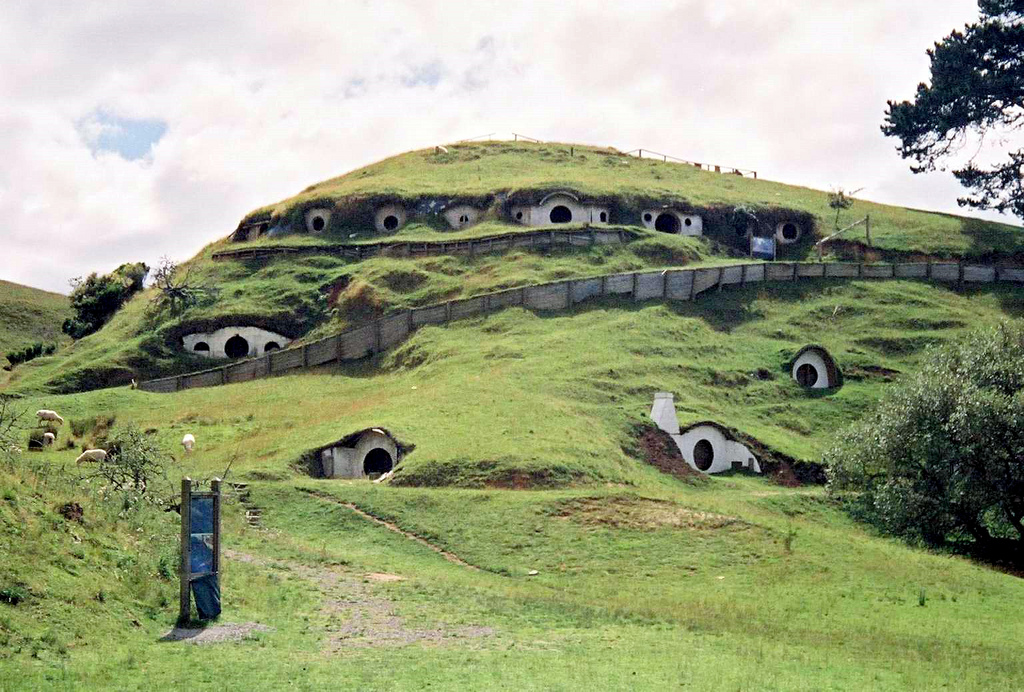
/ Hobbiton, which was built in New Zealand for The Lord of the Rings
films and still stands as a tourist attraction today, is but one of
Jackson's beautifully rendered Middle Earth locales.
Another strength of An Unexpected Journey— and Jackson's
Tolkien adaptations in general—is its rendering of Middle Earth's
locations. The movies take locations like Erebor (which by Tolkien's
descriptions seems like little more than a few dark, cavernous hallways
and the treasure room inhabited by Smaug) and make them into huge,
beautiful set pieces that look worthy of the significance placed upon
them by the narrative. They look lived-in, and in almost every
case they're superior to the mental images that I've formed over the
years that I've been reading these books.
Doing right by Tolkien
Any movie that says it's going to stretch The Hobbit out into three
films is going to need to take some liberties with the source material,
mostly in the form of additions. Some of the changes made to the
narrative in Jackson's LOTR movies broke with Tolkien's versions of events in a way that weakened the story. An UnexpectedJourney happily
avoids these pitfalls, even when it's filling in the blanks by
inserting its own material or fleshing out events which were merely
implied in the books.
Most of the changes made to the book's narrative are driven by a need
to transform that book (which relies on an omniscient narrator and,
often, the unseen internal thought processes of its characters) into a
film. Both the book and the film are about not just Bilbo's physical
there-and-back-again journey between The Shire and the Lonely Mountain,
but also Bilbo's mental journey from timid, too-comfortable hobbit to a
minor hero in his own right.
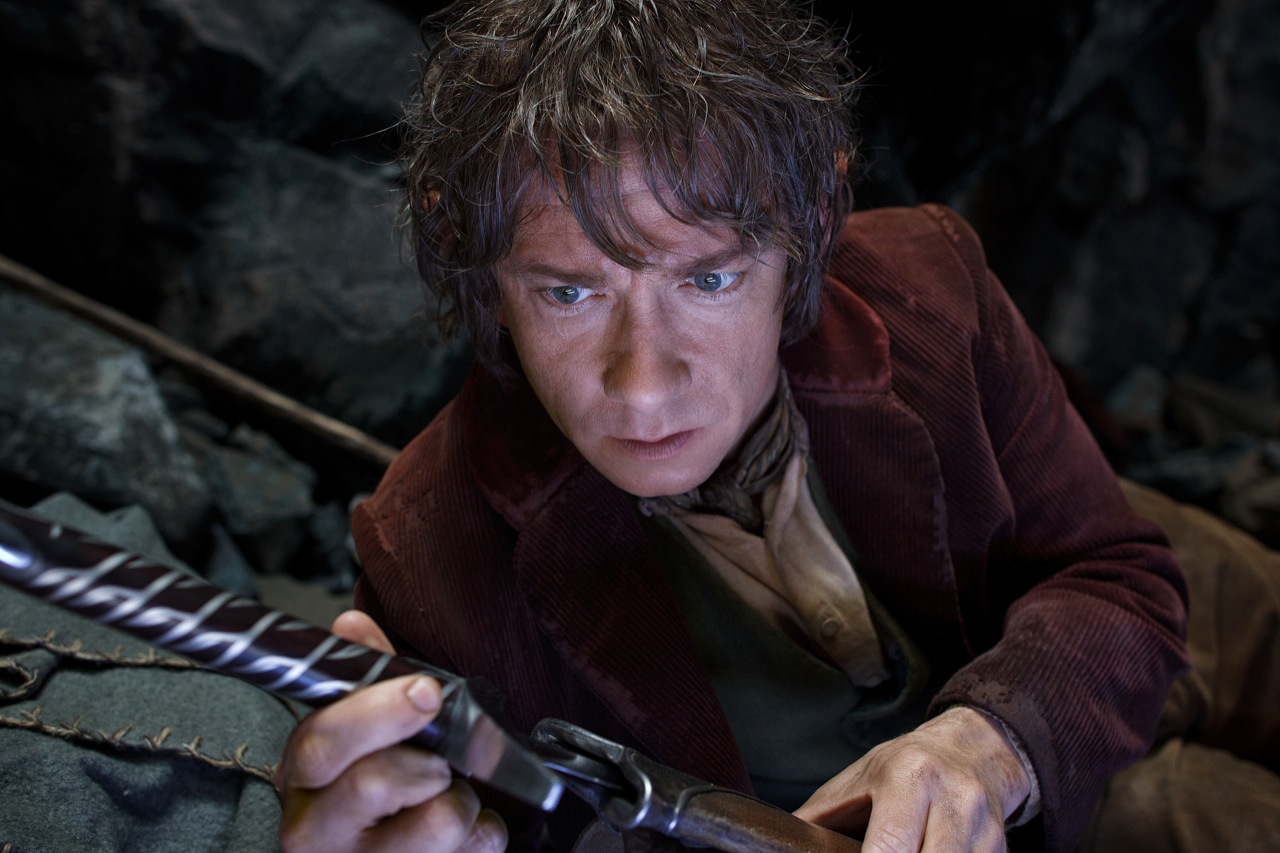
Enlarge / Bilbo's transformation from stay-at-home hobbit to unlikely hero is by necessity more rapid and more overt in the film.
Warner Bros.
In the book, a large part of Bilbo's transformation is shown through
internal monologue and his first overtly heroic deed comes rather late
in the game, when he saves the dwarves from giant spiders in Mirkwood
and then later helps them escape imprisonment by the elves who live in
the forest (material that, based on the pacing of this first movie, will
probably crop up in the second of the three Hobbit films).
Because this film is split three ways (and because showing a character thinking to themselves is, at best, dull cinema), An Unexpected Journey needs
to make this mental transformation happen both more quickly and more
obviously. To make it more obvious that the Bilbo at the beginning of
the story is entrenched in his own too-comfortable rut, there's a scene
where Gandalf tells him so. To kickstart his transformation from timid
to heroic, it is Bilbo (rather than Gandalf) who thinks to stall the
trolls until they're turned to stone by the rising sun. And to really
drive home his character's growth, by the end of the film Bilbo is
standing up against wolves and orcs all by his lonesome to prove his
worth to Thorin and company, and to himself. All of these are changes to
the book's version of events, but none of them feel wildly inconsistent
with Tolkien's narrative or with his characters.
Thorin's character has also been tweaked slightly for the film. His
stubbornness and pride, qualities present in the book but only really
emphasized near the end (and, coincidentally, in one of Tolkien's Unfinished Tales recalling the events of The Hobbit from
Gandalf's perspective), is made explicit in several scenes. The film's
Thorin also has a particular dislike for elves, where the book's Thorin
has no particular distaste or love for them (save after being captured
and held in Mirkwood by Thranduil and the wood-elves, but even then his
beef is with them specifically and not the race as a whole). These
character tweaks didn't make too much of a difference in this first
movie but will pay dividends later when he's captured by Thranduil
(probably in the second movie) and when he's negotiating with the men
and elves for shares of Smaug's treasure after the dragon's defeat
(probably in the third film).
Enlarge
/ The film's Thorin Oakenshield differs from the one depicted in the
book, but the changes are consistent with his characterization in some
of Tolkien's more obscure writings.
The last big change to The Hobbit's core narrative is Azog, an
orc fought by Thorin at Moria who serves as Bilbo and the dwarves'
primary antagonist this outing. Azog is indeed a character from the
books—the battle outside Moria is depicted in one of the LOTR appendices and Azog is mentioned briefly in The Hobbit, though in the books another dwarf kills him during that battle and he has no particular dislike of Thorin.
This is another change that was necessitated to some degree by the
source material, though I'm not sure how it will play out in the end.
The vast majority of The Hobbit is presented in concise, cut-up
chapters, and while Smaug is the de facto villain, he's not an immediate
threat to the heroes until toward the end of the story (and he's
dispatched after only a handful of chapters). The Necromancer is
likewise a threat on a larger scale, but he has little impact on Bilbo
and the dwarves. A more immediate antagonist is necessary to drive the
action, and Azog fills that role well enough (though as villains go he's
about as one-dimensional as they get).
So far, I've written a lot about what I've liked, but don't let me
give you the wrong impression: there's a lot wrong with this movie. As
much as I enjoy all things Tolkien, it's ultimately a film with more
problems than virtues. The largest and most endemic is the source
material itself. The Hobbit is an excellent book for what it is: a relatively
short, light, one-shot children's novel. I've found that peoples'
opinion of the book varies largely based on when they first read it. I
was very young the first time I read it, and as such my memories of the
book are mostly positive. It was one of the first big "chapter books" I
really got into, and in length, style, and subject matter it's a good
bridge between more overtly kid-targeted fare like Goosebumps and young-adult fiction like The Lord of the Rings itself.
Enlarge
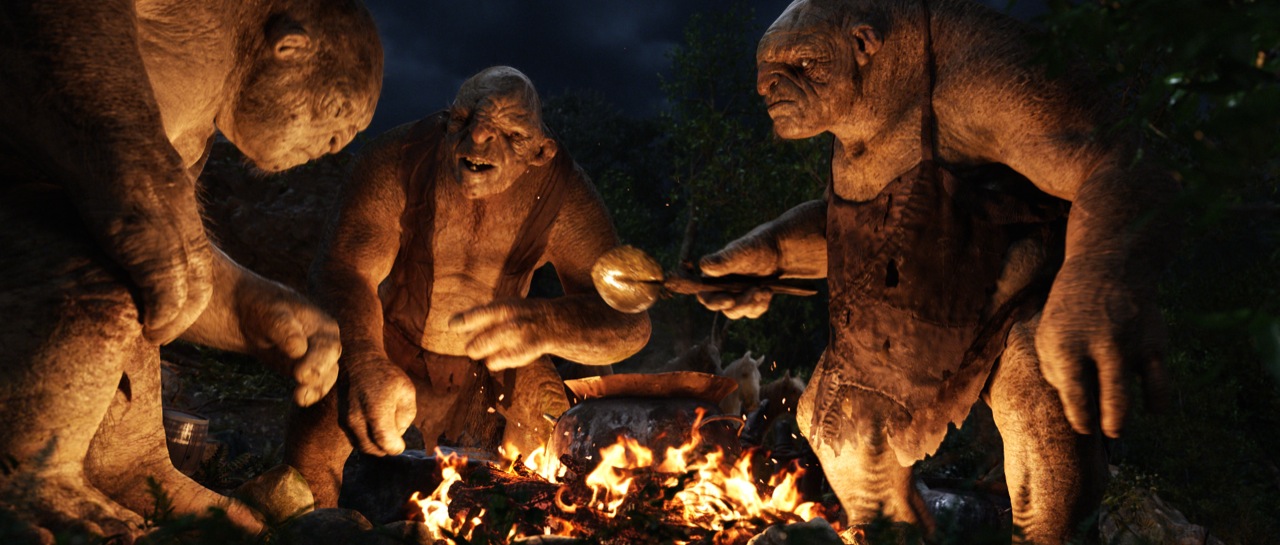
/ Bilbo and the dwarves' rescue from the trolls by Gandalf is the first
example of the book's (and the film's) over-reliance on dei ex machina
to save the day.
Warner Bros.
A side effect of this is that The Hobbit is much simpler, narratively speaking, than The Lord of the Rings itself. One of the story's chief weaknesses is its over-reliance on dei ex machina—Bilbo
and the dwarves are twice separated from Gandalf in the early stages of
the book, and twice Gandalf reappears just in time to save the party
from what seems like certain doom. Twice (once while the party is run up
fir trees by orcs and wolves, and once again at the end of the book
during the Battle of Five Armies), eagles swoop in from nowhere to
snatch victory from the jaws of defeat. There are other scenes ripped
from the pages of the book that bog the movie down—a battle between
stone giants, mentioned briefly in The Hobbit but expanded into
one of the movie's more laughable and superfluous sequences—but the
sheer number of last-minute rescues is probably the biggest narrative
failing that the book transmits to the film.
Things like this are less of an issue for children, who are rarely
critical enough to stop and think, "Wait, did that make sense?" By the
time you're watching the third such improbable rescue in as many hours
play out on the screen, most adults will be left unable to suspend their
disbelief.
Equally distracting is the movie's disjointed feel, especially in the
first half. It's peppered with flashbacks and other breaks from the
main action that help to expand the movie's scope, but they feel like
exactly what they are: snippets from many different stories patched
together. All of this material is either taken directly from Tolkien's
writings (the dwarves' war in Moria) or is a logical expansion of events
merely hinted at in the body of The Hobbit's text (anything
involving Radagast, the Necromancer, or the White Council). The movie's
attempt to bring them all together under one roof results in a sometimes
piecemeal narrative where many of the seams between the stories are
showing.
Padding, oh the padding
Much has been made of Jackson's decision to split the diminutive Hobbit into a staggering three films. Some of this is no doubt related to his desire to tie the events of The Hobbit more explicitly to those of The Lord of the Rings,
thus imbuing the films with more weight than a straightforward
book-to-film translation would have. Up until now, I was willing to give
Jackson the benefit of the doubt, but the first movie hasn't convinced
me that this was a necessary step.
What happens in the next two movies remains to be seen, but An Unexpected Journey
is stuffed to the brim with filler material. This begins right out of
the gate, where what starts as a simple expository framing device for
the films (narrated by Ian Holm, who here reprises his role from the LOTR films as an older Bilbo Baggins; appropriate since even in-universe the body of The Hobbit
is presented as Bilbo's self-penned memoirs) expands into an overlong
and occasionally draggy scene that serves no other purpose than to give
Elijah Wood some screen time.
A later scene where a flummoxed Bilbo Baggins has his pantry raided
by hungry dwarves is similarly overlong; it turns out that the boring
eating scenes and descriptions of food present in so much fantasy
fiction is just as boring to watch as it is to read. It doesn't help
that this (and a couple other scenes) are played much too broadly.
Dwarves burping and trolls using hobbits as tissues may play well to
younger viewers and those with juvenile senses of humor, but the theater
full of adults who I watched the movie with looked on in stony and
awkward silence.
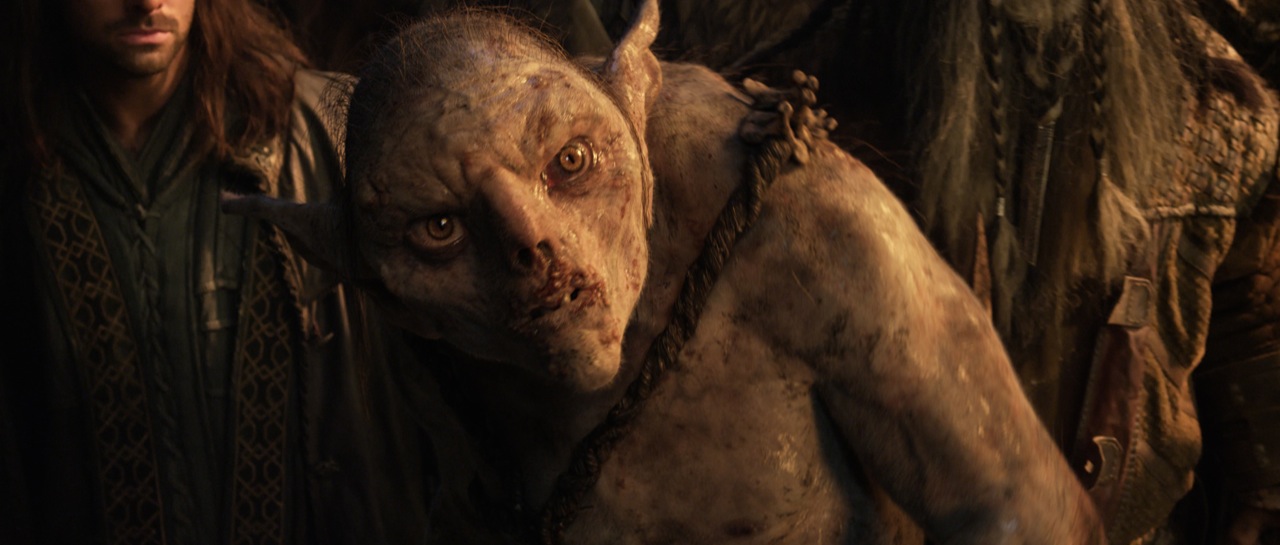
Enlarge / If you go to see An Unexpected Journey, prepare to be chased by this guy and his pals for what feels like at least a quarter of the film.
Warner Bros.
A more serious problem is the sheer number of overlong battle and
chase sequences. The former are replete with people running in slow
motion and shouting "NOOOOOOOOO!"
The latter try to introduce some tension into scenes that would
otherwise just be about our heroes walking from one place to another,
but by the second wolves-chasing-dwarves sequence (which itself followed
a 10-to-15-minute segment in which the party is chased out of a cave by
orcs) I was checking the time to see how much longer the movie was.
I ultimately suspect that, even with all of the added and expanded
elements, Jackson had the material for perhaps two to two-and-a-half
films and decided it would be easier to expand the series to three
movies instead of murdering some of his darlings and cutting back. The
decision was also probably driven by the studio, which stands to make
roughly ten hojillion dollars from each Hobbit film released
whether there's one movie or eight movies. It's safe to say that they
exerted no pressure on Jackson to be more judicious in his editing, and
that's a shame because this movie needs an editor like Gandalf needs pipe-weed.
A Not Wholly Unexpected Disappointment
The movies has other problems, of course; these are merely the
biggest and most obvious. It takes forever to get going, and the first
half of the movie is littered with flashbacks and side stories that lay
the foundation for later films but drag the pacing of this one way down.
It's often too jargon-y, throwing around phrases like "Morgul-blade"
and "Rhosgobel rabbits" and "Belladonna Took" as though viewers should
be able to make heads or tails of them without context. The main Lord of the Rings films succeeded in part because of their mainstream appeal, but An Unexpected Journey's
focus on bringing material from Tolkien's notes and appendices into the
fold often makes it feel like it's aimed only at the people with
dog-eared copies of The Silmarillion and Unfinished Tales on their bookshelves.
Based on this one film, I don't think that The Hobbit films will be to The Lord of the Rings films as the Star Wars prequels were to the original films, but they will undoubtedly by the lesser of the two trilogies. An Unexpected Journey is bloated where the LOTR movies are nimbler and more concise. It has a sort of forced epicness to it, in part due to The Hobbit
being a simpler book with a narrower scope written for a younger
audience. Martin Freeman's Bilbo is hands-down the best performance in
the film (perhaps excepting Andy Serkis' short but scene-stealing
reprisal of Gollum), but he too often has to take a backseat so a
flashback or chase sequence can play out.
There are plenty of things to like about this movie, but they
ultimately become evident only after you've had time to digest it, not
while you're actually in the theater watching one of its many padded-out
battle scenes. It's hard to say how the next two movies will pan out,
but those already cynical about the adaptation will find little here to
assuage their fears—it turns out that even a book-to-film adaptation
that's true to the source material can still be tanked by shoddy
filmmaking.
Andrew Cunningham
/ Andrew has a B.A. in Classics from Kenyon College and has over five
years of experience in IT. His work has appeared on Charge Shot!!! and
AnandTech.
The Chinese government
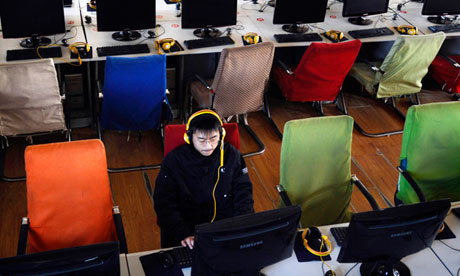
has introduced new technology to tighten controls on internet
visibility within the country. Photograph: Stringer Shanghai/Reuters
China appears to be tightening its control of internet
services that are able to burrow secretly through what is known as the
"Great Firewall", which prevents citizens there from reading some
overseas content.
Both companies and individuals are being
hit by the new technology deployed by the Chinese government to control
what people read inside the country.
A number of companies
providing "virtual private network" (VPN) services to users in China say
the new system is able to "learn, discover and block" the encrypted
communications methods used by a number of different VPN systems.
China
Unicom, one of the biggest telecoms providers in the country, is now
killing connections where a VPN is detected, according to one company
with a number of users in China.
VPNs encrypt internet
communications between two points so that even if the data being passed
is tapped, it cannot be read. A VPN connection from inside China to
outside it also mean that the user's internet connection effectively
starts outside the "Great Firewall" – in theory giving access to the
vast range of information and sites that the Chinese government blocks.
That includes many western newspaper sites as well as resources such as
Twitter, Facebook and Google.
Users in China suspected in May 2011 that the government there was trying to disrupt VPN use, and now VPN providers have begun to notice the effects.
Astrill,
a VPN provider for users inside and outside China, has emailed its
users to warn them that the "Great Firewall" system is blocking at least
four of the common protocols used by VPNs, which means that they don't
function. "This GFW update makes a lot of harm to business in China,"
the email says. "We believe [the] China censorship minister is a smart man … and this blockage will be removed and things will go back to normal."
But
the company added that trying to stay ahead of the censors is a
"cat-and-mouse game" – although it is working on a new system that it
hopes will let it stay ahead of the detection system.
The
tragedy last week in Connecticut is still horrifying to think about on
many different levels -- but the constant search for blame, and using it
to support pet political ideas is troubling. This isn't to say that we
don't necessarily need to have a "conversation" on various hot potato
political issues, but basing it around an event like this isn't likely
to be a productive and informed conversation, but one driven purely by
emotions. I understand the desire, and the idea that making use of such
a tragedy to create political will to do something, is all too
tempting. But I fear what happens when we legislate around emotions,
rather than reality. And, no I'm not even going to touch the question
of gun control or mental health treatment. Both obviously evoke strong
opinions from people on all sides of the issue (and, contrary to popular
opinion, there are more than two sides to those issues). Instead,
let's talk about the rush to blame video games and TV shows, as seems to
happen every single time there's a mass shooting -- and almost always done with no evidence.
We already talked about people rushing to blame a video game,
after the incorrectly named "original" suspect in the shootings had,
possibly, at some point "liked" the game on Facebook. But, of course,
now the politicians are stepping in, and retiring Senator Joe Lieberman
is using the tragedy to push forth one of his pet ideas that he's
brought up in the past: violent video games and TV must have something to do with it.
He's trying to set up a commission to "scrutinize" "the role that
violent video games and movies might play in shootings" among other
things (yes, including gun control and mental health care).
Lieberman, not surprisingly, was not the only one. A large group of politicians and punidts immediately jumped to the conclusion that video games and movies must have something to do with all of this:
A disturbing number of public figures have lashed out at video games
since the atrocity committed at Sandy Hook Elementary on Friday. A
bipartisan group of legislators embraced this scapegoating on the Sunday
news programs; from Democrats like Sen. Joe Lieberman and Gov. John Hickenlooper to Rep. Jason Chaffetz and former Pennsylvania Gov. Tom Ridge.
They were joined by members of the media – sadly, too many to count.
On MSNBC on Monday, Chris Jansing asked her guests what connection Adam Lanza’s interest in video games had to his murderous shooting spree. She quoted senior White House advisor David Axelrod
who tweeted “shouldn’t we also quit marketing murder as a game?”
Liberal contributor Goldie Taylor revealed that she refused to let her
child play games until he was 14-years-old.
[....]
On Fox & Friends on Monday, legal analyst Peter Johnson Jr.
delivered an offensively sermonizing renunciation of entertainment
producers and videogame makers who are “clinging to guns economically.”
“They are glamorizing guns in this country. They are the scourge in
terms of these guns,” Johnson Jr. said of game and filmmakers
Of course, time and time again when these shootings happen, the reports
later show... that video games and movies played little to no role.
Yes, sometimes the killers played these games, but it's difficult to
find teenagers these days who have not played a violent video
game or watched a violent movie. It's like saying that we should
explore "the role that breakfast plays" in such shootings. How many of
the killers ate breakfast that day? In fact, studies seem to suggest
that, if anything, violent movies may actually decrease incidents of violence.
Bizarrely, the person with the most thoughtful explanation on some of this might be movie critic Roger Ebert, in a review of Gus Van Sant's movie Elephant from nearly a decade ago. That movie portrayed a similar school shooting, and did so by making it clear that sometimes there are no answers
and there is no "other thing" to blame. Sometimes (perhaps many times)
these things don't make sense, no matter how many times we want them to
make sense. But Ebert also points to another factor that rarely gets
discussed:
Let me tell you a story. The day after Columbine, I was interviewed for
the Tom Brokaw news program. The reporter had been assigned a theory and
was seeking sound bites to support it. "Wouldn't you say," she asked,
"that killings like this are influenced by violent movies?" No, I said, I
wouldn't say that. "But what about 'Basketball Diaries'?" she asked.
"Doesn't that have a scene of a boy walking into a school with a machine
gun?" The obscure 1995 Leonardo Di Caprio movie did indeed have a brief
fantasy scene of that nature, I said, but the movie failed at the box
office (it grossed only $2.5 million), and it's unlikely the Columbine
killers saw it.
The reporter looked disappointed, so I offered her my theory. "Events
like this," I said, "if they are influenced by anything, are influenced
by news programs like your own. When an unbalanced kid walks into a
school and starts shooting, it becomes a major media event. Cable news
drops ordinary programming and goes around the clock with it. The story
is assigned a logo and a theme song; these two kids were packaged as the Trench Coat Mafia. The message is clear to other disturbed kids around the country: If I shoot up my school, I can be famous.
The TV will talk about nothing else but me. Experts will try to figure
out what I was thinking. The kids and teachers at school will see they
shouldn't have messed with me. I'll go out in a blaze of glory."
In short, I said, events like Columbine are influenced far less by
violent movies than by CNN, the NBC Nightly News and all the other news
media, who glorify the killers in the guise of "explaining" them. I
commended the policy at the Sun-Times, where our editor said the paper
would no longer feature school killings on Page 1. The reporter thanked
me and turned off the camera. Of course the interview was never used.
They found plenty of talking heads to condemn violent movies, and
everybody was happy.
Meanwhile, Danah Boyd has a related, but somewhat different perspective
on the whole thing, noting how the media frenzy around these events also
tends to mess with everyone else
who are trying to cope with the situation, and makes sure their lives
can never go back to any semblance of normalcy. She talks about running
into some kids who had gone to Columbine high school, a few months
after those attacks:
What I heard was heartbreaking. They had dropped out of school because
the insanity from the press proved to be too much to deal with. They
talked about not being able to answer the phone – which would ring all
day and night – because the press always wanted to talk. They talked
about being hounded by press wherever they went. All they wanted was to
be let alone. So they dropped out of school which they said was fine
because it was so close to the end of the year and everything was chaos
and no one noticed.
As she notes, it's not the press's fault either. They're also giving
the public what they want -- and, she agrees, that some of these topics
are important and should be discussed. But the focus on the people in
Newtown isn't helping.
But please, please, please… can we leave the poor people of Newtown
alone? Can we not shove microphones into the faces of distraught
children? Can we stop hovering like buzzards waiting for the fresh meat
of gossipy details? Can we let the parents of the deceased choose when
and where they want to engage with the public to tell their story? Can
we let the community have some dignity in their grief rather than
turning them and their lives into a spectacle of mourning?
Yes, the media are the ones engaging in these practices. But the reason
that they’re doing so is because we – the public – are gawking at the
public displays of pain. Our collective fascination with tragedy means
that we encourage media practices that rub salt into people’s wounds,
all for the most salacious story. And worse, our social media practices
mean that the media creators are tracking the kinds of stories that are
forwarded. And my hunch is that people are forwarding precisely those
salacious stories, even if to critique the practices (such as the
interviews of children).
What happened last week was senseless and tragic and painful to think
about in all sorts of ways. And, yes, there are reasons to hope that
such an event might lead to ideas that would prevent such things in the
future, but the way we go about things on such discussions doesn't
provide much hope that we're going to do anything valuable or thoughtful
in response. Instead, it becomes a rush to do something purely out of
an emotional response, and it's unclear how that helps.

 Posts
Posts


 By Michael, on December 17th, 2012