Saturday, August 3, 2013

Monica Lewinsky’s Raunchy Secret Sex Tape For Bill Clinton Surfaces

truther August 3, 2013             http://www.mrconservative.com/2013/07/22197-monica-lewinskys-raunchy-secret-sex-tape-for-bill-clinton-surfaces/
Kristin Tate
BREAKING: A tape of Monica Lewinsky talking to former President Bill Clinton has surfaced for the first time. It has never been heard until now.
In it, Lewinsky is heard telling Clinton that if he met with her she could “take all my clothes off.”  She practically begged Clinton to meet up with her and said, “I really want to see you.”
Monica Lewinsky’s Raunchy Secret Sex Tape For Bill Clinton Surfaces
At the time of the tape recording, in November 1997, Lewinsky was a 24-year-old White House intern. It is clear from the recording that the young woman was trying extremely hard to seduce Clinton.
article-2381941-0011C7CF00000258-268_634x492 article-2381941-0011B4A400000258-837_634x439
Lewinsky said in the tape that she wanted to either meet Clinton in his office or watch a movie with him. She said, “Since I know you will be alone tomorrow evening, I have two proposals for you, neither of which is you not seeing me… I could take my clothes off and start… well… I know you wouldn’t enjoy that? I hope to see you later and I hope you will follow my script and do what I want.”
She then told him to lie to his secretary, Betty Currie, about where he was going so that the meeting would not be recorded. She said, “I quickly sneak over and then we can have a nice little visit for, you know, 15 minutes or half an hour. Whatever you want.”
“You can’t refuse me because I’m too cute and adorable and soon I won’t be here anymore to pop over,” she suggestively said. “I’m very persistent, but um… I really want to see you.”
Most people believed that the tape had been destroyed in the late ’90s, but it was allegedly found by a housekeeper hired by Lewinsky’s friend. He was the one who released it to the public.
As reported by The Daily Mail:
The Enquirer reported that Lewinsky played the tape for Linda Tripp, who later revealed telephone tapes of the intern which led to Clinton’s impeachment.
Tripp reportedly heard it on November 20, 1997 and it was taken to the Oval Office the next day, but it is not known if a rendezvous ever occurred. In the audio, Lewinsky explained that she had decided to record it because she couldn’t face writing him another letter.
The Enquirer reported that the tape – and begging love letters Lewinsky wrote to Clinton – were obtained by a cleaner who was hired by friends of Lewinsky’s.
‘I was supposed to shred everything in late 1998, but for some reason I kept this material,’ the cleaner told the Enquirer.
The pleading notes reportedly reveal Lewinsky begging Clinton to make time for her and to explain why he ended their illicit romance.
In one of said notes, Lewinsky wrote, “It was so sad seeing you last night because I was so angry with you that you once again rejected me and yet, all I wanted was for everyone else in the room to disappear and for you to hold me. I loved you with all of my heart, Bill.”
The sexual relationship between Clinton and the intern lasted from November 1995 to March 1997.
After the scandal became national news in 1998, Lewinsky had to move to England to escape the media frenzy. There, she worked as a news reporter for a local station.
The scandal has left a permanent mark on the Clintons, both personally and professionally. It is now known that Hillary Clinton plans to run for president in 2016; this new tape threatens all of her plans. It is an embarrassment to both Bill and his wife.
(H/T: Daily Mail)

Money man: A-Rod wants cash over playing time

Alex Rodriguez stands to lose around $100 million if he gets a lifetime ban from baseball. (AP)This always was going to be about the money, you know. Some of Alex Rodriguez's associates like to tell stories about Alex and his money, how it's at the root of this whole mess he's in now, how all this talk about his love of baseball and desire to be a role model for his children is a smokescreen for the greed that consumes him. He's made $315 million playing baseball, and that's not enough.
Some of it vanished in real-estate deals gone bad. More of it disappeared as it tends to when entourages swell and ten grand here or a hundred grand there is like the rest of us tossing a couple bucks into the Salvation Army kettle at Christmas. A-Rod is still filthy rich, in no financial danger whatsoever, but that's not the point. He wants more. He always wants more.
In this case, he wants to salvage as much as he can of the $100 million or so remaining on his contract with the New York Yankees before Major League Baseball disciplines him for using performance-enhancing drugs, lying about it and a litany of other offenses. That – not this cockamamie burning desire to come back and play baseball – is the grand imperative of his haggling sessions with MLB, two associates of Rodriguez's told Yahoo! Sports. He wants to take his money, he wants to screw the Yankees because he feels like they ditched him and he wants to become a property mogul, buying and selling, wheeling and dealing, away from the sport that turned on him despite everything he did for it.
Such myopia is only one of the variables as Rodriguez goes into the biggest weekend of his professional life, one that will help determine the prism through which the public ultimately views his career. Already he has cemented his reputation as a cheater, a narcissist and a clown, all well-earned. If he chooses to keep fighting – calls Bud Selig's bluff of a lifetime ban, takes the route of lawsuits and appeals and mass chaos, and prolongs this foul state of affairs any further – he will fall into the same category as Barry Bonds and Roger Clemens and the rest of the players who rage, rage against the dying of the light, only to see it go darker than they could've imagined.
Bud Selig will soon announce the fate of Alex Rodriguez and others who allegedly used PEDs. (USAT Sports)Considering the reams of material MLB has on Rodriguez, his posture is curious. He might as well walk into an arbitration hearing with a needle in his ass. Text messages, notes, witness testimony – baseball has the whole kit and caboodle, and Rodriguez knows that. He knows, too, that contrition is the best defense when it comes to PEDs. Problem is, he tried that the first time, and, well, that one didn't work out so great.
It's one reason Selig has turned into a 79-year-old mob boss: All of this makes him and his sport look bad. Selig is behind the lifetime ban. Not his attack-dog lawyers who have done a brilliant job ferreting out the truth behind baseball's lurid association with the Biogenesis clinic in south Florida that peddled the PEDs. Not the Yankees and their desire to wriggle out of the money they foolishly promised to A-Rod through his 42nd birthday. This is Selig's doing, and he's dangerously close to a precipice that no commissioner should approach.
If his threats to invoke a best-interests-of-baseball clause to suspend Rodriguez are more than a bargaining chip – if Selig truly believes Rodriguez deserves banishment for activities that, though egregious, aren't so much worse than others caught using PEDs – he is making a monumental mistake. Baseball's joint drug agreement is in place to discipline players. To step around that – to subvert due process – would be an insult to every player in the union and an act of labor war.
It's dangerous beyond that. The only way Rodriguez comes out of this with even a shred of sympathy is if Selig overreaches, and booting A-Rod from the game certainly would constitute that. It's such a disturbing threat that deep down, for the sake of reminding MLB that it does not unilaterally run this game, one hopes A-Rod appeals and shoves it to someone who got even more greedy than him. 
Even if the chances of a lifetime ban holding up in front of an arbitrator are slim, Rodriguez is businessman enough to know that it likely would end up reduced to around what MLB would settle at these days – somewhere in the vicinity of 150 to 200 games – and that the risk of potentially forfeiting all $100 million is not worth the reward of a fight with an indeterminate ending. So we are left with a story that features two central characters, neither of whom could be called a protagonist: the suit trying to remedy his past blindness by overcompensating with the deft touch of a jackhammer and the ballplayer who sort of wants to play ball but really wants to grab his cash and run away from this inferno of fraud that he set ablaze.
Within the next 72 hours, Alex Rodriguez will make his choice to fight or surrender. For a while now, one person close to him has suggested that his decision-making skills are so bad that they oughta let ol' Mr. Murphy off the hook and make it A-Rod's Law: whatever can go wrong will go wrong. No matter what he chooses, the truth is it already has.

Post-Zimmerman: CNN Viewership Drops 32%, HLN 50%

folks get OFF the alphabet soup networks   ALL of them !   :(    & 'their' media  whores ..spewing bullshit !  get on alternative sites ..as MANY different  1's as you like/can ? :o        'they' spew the same shit as the ass pipes in D.C. (degenerate city)  & the "elites" who's arms B jammed UP both "their" asses    hehe & lets NOT fer~get the mega~corps :o 

Post-Zimmerman: CNN Viewership Drops 32%, HLN 50%

Considering their previous lows, both CNN and HLN enjoyed respectable viewer gains in the month of July, but the latest ratings that look at a full week of post-Zimmerman trial viewership shows that both networks might be falling back to earth. TV Newser reports that last week, CNN saw its viewership plummet -32%. HLN fared even worse with a -50% drop-off.

Fox News, however, continues to dominate its cable news competition. In all of cable, Fox beat CNN and MSNBC combined during primetime and ranked 4th in total primetime viewers, behind only the USA Network, TNT, and the History Channel.
In total day viewers, Fox News ranked 5th in all of cable.
TV Newser reports that "CNN placed 36th in primetime and 31st in total day, while MSNBC placed 32nd in both categories."
HLN did not rank in the top 40.
Both CNN and HLN had obviously hoped to hold on to the viewers gained during the Zimmerman trial, but during their coverage both networks likely turned off viewers. On her primetime show, Nancy Grace, the face and star of HLN, demeaned the Hispanic Zimmerman with a racial attack.
CNN, on the other hand, made it official policy to deny Zimmerman his racial heritage, lied about his use of a racial slur, broadcast his private information; and despite the evidence proving the opposite was the case, continued to fabricate the notion that race had something to do with fatal shooting of teenager Trayvon Martin.
This is the second time during big news and with an increase in viewers that CNN has disproven the notion that it is "The Most Trusted Name In News." During its Boston Marathon bombing coverage, CNN distinguished itself only by its on-air smears of political opponents on the right  and misinformation.

Snowden Warns Americans To Fear The Military-Intelligence Complex

Unburdened by the Constitutional requirement to obtain a search warrant, those nice people at the National Security Agency (NSA) have teamed with Apple, Google and Microsoft to take time out of their busy day to capture all your party pictures from college, intimate letters with your lover and financial activities of your business in order to build a "permanent file" for leverage against you at a later date.

These are just the latest depressing revelations about the rise of the military-industrial complex from whistleblower/traitor Edward Snowden as he accepted political asylum in Russia today.
Snowden's latest bombshell, via Glenn Greenwald at the UK Guardian, is the outing of the NSA's XKeyscore software that is vacuuming up "nearly everything a typical user does on the internet." The top secret program allows civilian contractors in the U.S. to troll vast databases containing emails, online chats and the browsing histories of millions of individuals around the world.
The NSA boasts in training materials that XKeyscore is its "widest-reaching" system for developing intelligence from the Internet.
Snowden was already the "most wanted person on earth", but with his newly-awarded legal status in Russia he cannot be legally handed over or kidnapped by the CIA. Snowden remains a very "marked man," and seems to need to stay in the public eye to avoid accidentally being assassinated in some lonely hideout. Consequently,he will likely continue to talk to the international press and appears to have more information for future release.
Snowden's latest revelations will also add fuel to the intense political revulsion to Obama's 18-to-29-year-old voting bloc that was the key to miraculous reelection in the face of the worst economic performance since President Herbert Hoover. This group has already dropped support for Obama by a stunning 17% over the last seven weeks as Snowden informed them that when they look at their cell phone, Big Brother is looking at them.
The timing of the Snowden release came the morning after senior intelligence officials testified to the Senate Judiciary Committee on Wednesday and released formally classified documents in response to earlier Snowden interviews by the Guardian.  The testimony essentially admitted that the FISA Surveillance Court that supposedly assures Constitutional Fourth Amendment prohibition against unreasonable searches and seizures without "probable cause" does not apply to cell phones, computers and all online activity.
The Obama administration, Intelligence Committee members and the NSA yesterday continued to vehemently deny Snowden's most controversial statement that: "I, sitting at my desk could wiretap anyone, from you or your accountant, to a federal judge or even the president, if I had a personal email." But Snowden's disclosures this morning seem to prove he and thousands of other NSA contractors could wiretap any American.
But the training materials for XKeyscore detail how analysts can use it to mine enormous agency databases by filling in a short "on-screen form giving only a broad justification for the search", without obtaining a warrant from a judge.  XKeyscore then provides the technological capability that once the NSA has the "metadata" of email or IP address to perform Digital Network Intelligence (DNI) covering all forms of electronic communications. Given that Apple, Google, Microsoft and others have already admitted to providing the NSA with email and IP addresses, that explains how XKeyscore was able to collected and store at least 41 billion total records in a 30 day period during last year.
The NSA states: "These types of programs allow us to collect the information that enables us to perform our missions successfully--to defend the nation and to protect US and allied troops abroad." Some of that may be true, but the Boston Bombing happened despite direct Russian intelligence agency warnings about the militant activities of Chechen-born Tamerlan Tsarnaev.
Daniel Guerin warned in his 1936 book Fascism and Big Business to be vigilant against "an informal and changing coalition of groups with vested psychological, moral, and material interests in the continuous development and maintenance of high levels of weaponry, in preservation of colonial markets and in military-strategic conceptions of internal affairs."  President Eisenhower updated that message with a similar warning to fear the rise of the “military-industrial complex.”  Edward Snowden has updated the message that Americans must fear the rise of the “military-intelligence complex.”

America’s Undeclared War on Pakistan: Fresh Evidence of CIA Drone Strikes on Rescuers

America’s Undeclared War on Pakistan: Fresh Evidence of CIA Drone Strikes on Rescuers

NSA Whistleblowers: NSA Collects ‘Word for Word’ Every Domestic Communication

NSA Whistleblowers: NSA Collects ‘Word for Word’ Every Domestic Communication

VIDEO: NSA Spying Program – Has the Government Lied on Snooping? Let’s Go to the Videotape

VIDEO: NSA Spying Program – Has the Government Lied on Snooping? Let’s Go to the Videotape

America Punk’d: Proof Obama’s Newspaper Birth Announcements Can’t Be Believed


Obama’s Unbelievable 
Birth Announcements
By Adrien Nash | h2ooflife
Why Obama’s Newspaper Birth Announcements can’t be believed
reference: Click here for related article by Shawn Glasco
DATE:  JUNE 9, 2008  Jim Geraghty of the Nation Review asks (in response to the rumor that Obama’s second middle name was  Muhammed) why doesn’t Obama’s camp just  “release a copy of his birth certificate”?
The Obama-supporting website Politifact (like Snopes) could find no publicly available image of a copy of Obama’s birth certificate  though they search for one.  They stated that Obama’s “campaign would not release it and the state of Hawaii does not make such  records public.“  (Note:  you can’t release what you ain’t got.)
DATE: JUNE 12, 2008: Just three days after the question of why the birth certificate hadn’t been released, one mysteriously is posted  on the Daily Kos website with no fan-fare or explanation. *  Why?  Undoubtably because of the political positions of its owner and  founder, Markos Moulitsas, who authored “Taking On the System: Rules for Radical Change in a Digital Era“, -inspired by the Saul  Alinsky socialist bible: “Rules for Radical” which was the far-Left’s guidebook for forcing change on society by every underhanded  tactic conceivable, especially ridicule and mockery.  Hillary Clinton was a huge fan and devoted her dissertation to him and his thoughts and methods (which inspired her Progressive passion).  Alinsky dedicated the book to the first radical in history; SATAN.
[* Three days?  Wow!  How did they get Hawaii to issue one so fast?  And mail it as well?  Or did they?]
The birth certificate that appear with the words; “[h]ere is Obama’s birth certificate” was the never seen before short form  Certification of Live Birth form from Hawaii.  He added: “the latest batch of crazy internet rumors” are now “debunked.”
DATE:  JUNE 12TH 2008 (the same day) Politifact also received an e-mail containing the jpg image of the same short-from birth  certification said to be from the previously unhelpful Obama campaign.  That was to be the end of the Muhammed rumors.
DATE: about JULY 23, 2008; an image is posted on the internet of the August 13, 1961 “Honolulu SUNDAY Advertiser” with a listing of birth announcements including Obama’s.  It seems to have been posted by Lori Starfelt on a TexasDarlin blog.  Malcolm X was  one of her heros.  She authored “More Americans Killed By Right Wing Terrorists In The 90s Than Foreign Terrorists.”
Starfelt’s Claim #1. She received her copy from an unnamed research librarian at the Hawaii State Library.
Starfelt’s Claim #2. She “talked” to the Department of Vital Records and the Honolulu Advertiser
Starfelt’s Claim #3.  She was informed that in 1961 new Vital Records would be posted at the end of the week on a sheet which the newspaper would pick up for routine Sunday publication.
Starfelt Calculated:  having been born early Friday evening, Obama’s hospital record would not have been completed, sent to the  Vital Statistics Office, added to the list of births and been posted for pickup until the next Friday.  That explains its publication on  the next Sunday (August 13 edition of the weekend paper).
Starfelts Lie or Error:  Blogger “Ladyforest” compiled a 10-day sampling of birth lists from the daily papers and it turns out they  were printed almost everyday.
Question:  Did Starfelt deliberately lie or was she lied to?  Or was it a mistake of ignorance of detail by respondents inside the Vital Records Office or the newspaper? (if that’s even possible)
HUGE Question:  Why was the appearance of the announcement of the Nordyke twins not in that Sunday edition as well since they  were born the next day (Saturday August 5th) and the records for them and Obama would not have left the hospital separately since  their births were supposedly so close together?  (Note: Mrs. Nordyke has no recollection of Ann Dunham nor her mix-race baby and  she is a loyal Obama supporter)
COINCIDENCE:  Starfelt died three years later and her memorial service was held in May 2011 at The Unitarian Universalist Church  in Studio City, California.  Obama’s grandparents, Madeline and Stanley Dunham, were members of The Unitarian Universalist  Church in Seattle and Hawaii.  Madeline Dunham’s memorial service was also held (in 2008) at The Unitarian Universalist Church (in  Hawaii).
A SECOND COPY APPEARS:  July 2008 another blogger (Infidel Granny) posts the same newspaper birth announcement image of  the Dunham birth.  She states she received it in an e-mail also from a nameless research librarian in the State Library.  http://butterdezillion.files.wordpress.com/2011/03/the-online-birth-announcement-claims.pdf
A NEW BIRTH ANNOUNCEMENT APPEARS: DATE: mid AUGUST, 2008
A Honolulu resident posts an image of the August 14, 1961 Honolulu Star-Bulletin birth announcement which includes Obama’s  birth, conveying that she found it herself in the Hawaii State Library.
It’s significant revelation: the order of the first 25 births perfectly matched that of the Honolulu Advertiser.
QUESTION: Was that normal?
CONFIRMED:  Hawaii Health Department spokeswoman Janice Okubo states that both newspapers received their vital statistics  from the Health Department which obtained their birth reports directly from Hawaiian hospitals.  The lists would naturally be the same.
CONFIRMATION DISCREDITED:  A comparison of births between the two newspapers covering ten days in August 1961 reveals  enormous dissimilarities to each other.  Had the released images been doctored?   Was the newspaper, descendant of the two original papers which were closely associated, shared the same building for 50 years, and then merged into one newspaper, lying or speaking confidently but ignorantly?
So either the newspaper (or the Hawaii Department of Health) was dishonest and untruthful or was incompetent and incorrect.  That is made manifestly clear by the fact that the editions of the papers surrounding the days in which Obama’s birth is shown are an  inexplicable jumble of disjointed irrational orders of appearance, -beyond making any sense at all, -as if deliberately done to cover-up   some manipulation that would be recognizable if the orders were seen in their normal identical order in both papers.  The odds  calculated to allow for such an order of disorder are four quadrillion to one.   http://www.americanthinker.com/2012/10/are_obamas_1961_newspaper_birth_announcements_fake.html
UNANSWERABLE QUESTION:  Why would the Obama birth announcement not be closely associated with those of the Nordyke  twins and printed in the same edition of announcements?  Since theirs were printed on August 16th in the Wednesday Advertiser,  why was Obama’s not also, -but instead appears in the Sunday edition of August 13?  Similarly with the other newspaper’s listing.  If such questions have no logical answers in the legal above-board world, then how about answers in the under-handed,  dishonest, amoral political world?
Many questions arise and are asked in an excellent expose of the disorder seen in the two microfilm records of those birth  announcement pages, -questions which are rationally unanswerable.  Such questions give rise to reasonable speculation that the  images of those newspaper pages were “doctored” to include the name of Barack Obama, -questions such as: “Why were blocks of  identical names between the two newspapers jumbled together in a hodgepodge manner when identical birth lists were given to the  newspapers by the Hawaii Vital Records office?  Did someone from the Hawaii Newspaper Agency in the summer of 2008 intentionally cut and paste blocks in a random fashion in order to sow confusion into “phonied up” August 12, 13, 14, 1961 microfilms?”
One thing is certain.  The appearance of Obama’s name in those newspapers was all the “proof” that people needed to be  convinced and to shutdown any further investigation into Obama’s questionable origins.  If that was what was intended by a  conspiracy to legitimize someone without an American birth certificate, then it worked spectacularly because that is just what  happened.  The lead anchor of FOX News, Bill O’Reilly gave the newspaper birth announcement story his august benediction saying  he had looked into the birth certificate and “found out there were two separate birth announcements made in Honolulu newspapers  on the day Barack Obama was born.”  The day he was born?  Wow! How’s that for the requisite level of fact checking called for in a  high-stakes case just ripe for fraud?
Then he dove face-first into the brain-dead thinking that if the newspaper announcements were faked, then they were faked in 1961, (against odds of a “gazillion to one”), with nary a thought at all given to the possibility that they were not faked when the papers were printed but rather the microfilm record of what was printed had been altered in 2008 or 2007.
The odds he failed to calculate were the odds against the genuineness of a fake Hawaiian short form birth certificate image that appeared from nowhere on a Saul Alinsky-imspired website, followed by “corroborating” newspaper announcement images from two  integrated  newspapers which made false claims and whose “records” was disjointed jumbled messes of disorder surrounding Obama’s birth  announcement, -which images were forwarded from an unknown source to two anonymous bloggers, -one of which wrote an essay  claiming “More Americans Killed By Right Wing Terrorists In The 90s Than Foreign Terrorists.”  How can you ignore the odds against  honest coincidences happening when those who wish you to ignore those coincidences and the suspicions they raise are also those who embrace one who dedicated his “finest work”  to the Devil?
PS.  The reels of microfilm for the days surrounding Obama’s birth are all identical reels from when the microfilm was developed with the lone exception for August 1-15, 1961 which is on a brand of reel completely different from all the others and totally unexplainable
PPS  I’ll explain in my next exposition why no announcement of Obama’s birth appeared in the newspapers in August 1961, which lead to the need to doctor the microfilm records. - By Adrien Nash | h2ooflife | Obama-Nation -
WATCH: Full HD Video: Sheriff Arpaio Obama ID Fraud Presentation Broadcast From Missouri – VIDEO HERE.

((( This High Definition video was produced in 720P HD – Select the HD quality setting for optimal viewing experience )))
2006: Obama In Kenya: I Am So Proud To Come Back Home – VIDEO HERE. 
2007: Michelle Obama Declares Obama Is Kenyan And America Is Mean – VIDEO HERE. 
2008: Michelle Obama Declares Barack Obama’s Home Country Is Kenya – VIDEO HERE. 
FLASHBACK: Obama Is The Original Birther! Obama In 1991 Stated In His Own Bio He Was Born In Kenya. DETAILS HERE. 
WATCH SHERIFF OBAMA INVESTIGATION PRESS CONFERENCE HERE: CLICK HERE.
-ARTICLE II ELIGIBILITY FACTS HERE: http://www.art2superpac.com/issues.html


Source: http://obamareleaseyourrecords.blogspot.com/2013/08/america-punkd-proof-obamas-newspaper.html

Seven telcos named as providing fiber optic cable access to UK spies

New Snowden leaks show Verizon, Vodafone, and BT share direct data.

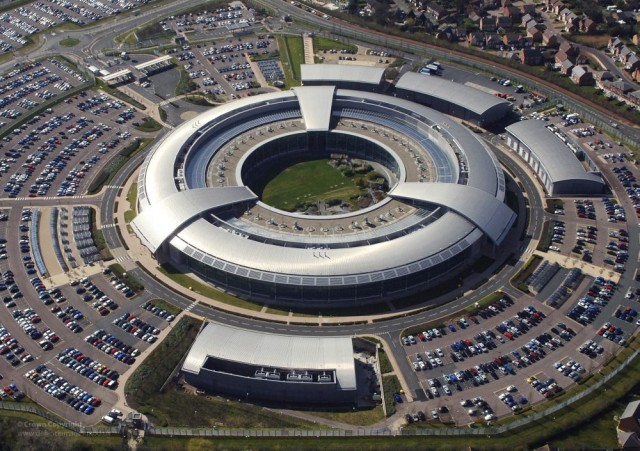
The Government Communications Headquarters (GCHQ) is based in Cheltenham, Gloucestershire, United Kingdom.
In the latest leak from the documents acquired by former National Security Agency (NSA) contractor Edward Snowden, a German newspaper has published a list of the telecommunications companies that have provided British intelligence with direct access to their undersea fiber optic cables.
The Süddeutsche Zeitung (Google Translate) and German public broadcaster NDR (Google Translate) published not only the names of the companies, but also their Government Communications Headquarters (GCHQ) nicknames: "Verizon ('Dacron'), BT ('Remedy'), Vodafone Cable ('Gerontic'), Global Crossing ('Pinnage'), Level 3 ('Little'), Viatel ('Vitreous') and Interoute ('Streetcar')."
The German newspaper cited as its source an internal GCHQ presentation slide. It also slammed the GCHQ, the NSA's British counterpart, saying that the GCHQ had “lost all sense of proportion.”
Under Britain's Regulatory and Investigatory Powers Act (RIPA) of 2000, the government does have broad powers to conduct digital surveillance; however, many believe that this wholesale data sharing is outside the scope of targeted warrants as described under RIPA. In July 2013, Privacy International, a London-based advocacy group, sued the British government, alleging abuses under the law.
NDR also pointed out that many of these companies operate major hubs and data centers in German cities, including Berlin, Hamburg, Dusseldorf, Frankfurt, and Munich, and that a Global Crossing landing station even sits on the northern German island of Sylt.
BT, Level 3, Viatel, Interoute, and Vodafone did not immediately respond to our request for comment.
Many of the companies, however, did provide a brief statement to The Guardian, largely reiterating the same comments they've made since Snowden began leaking documents—that they were essentially forced to.
"Media reports on these matters have demonstrated a misunderstanding of the basic facts of European, German, and UK legislation and of the legal obligations set out within every telecommunications operator's licence,” a Vodafone spokesperson told the paper. “Vodafone complies with the law in all of our countries of operation.”
In an e-mail to Ars, a spokesperson wrote, "Verizon continually takes steps to safeguard our customers' privacy. Verizon also complies with the law in every country in which we operate."

Teutonic tension

The move comes the same day that Germany canceled a Cold War-era agreement with the United States and the United Kingdom that allows those two allies and France “to request German authorities to conduct surveillance operations within Germany to protect their troops stationed there,” according to the Associated Press.
However, this provision has not apparently been enacted since 1990, so this dissolution is viewed as largely symbolic—German Chancellor Angela Merkel is facing re-election next month.
"We urgently need clarity on how close the relationship is between companies assisting with intelligence gathering and government," Eric King, head of research for Privacy International also told The Guardian. "Were the companies strong-armed, or are they voluntary intercept partners?"

If You Think The Employment Numbers Are Good, Then You Really Need To Read This Article

If You Think The Employment Numbers Are Good, Then You Really Need To Read This Article

XKeyscore: NSA tool collects 'nearly everything a user does on the internet'

• XKeyscore gives 'widest-reaching' collection of online data
• NSA analysts require no prior authorization for searches
• Sweeps up emails, social media activity and browsing history
NSA's XKeyscore program – read one of the presentations

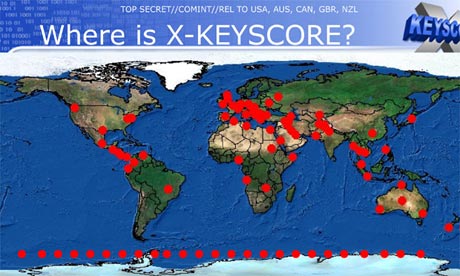
XKeyscore map
One presentation claims the XKeyscore program covers 'nearly everything a typical user does on the internet'
A top secret National Security Agency program allows analysts to search with no prior authorization through vast databases containing emails, online chats and the browsing histories of millions of individuals, according to documents provided by whistleblower Edward Snowden.
The NSA boasts in training materials that the program, called XKeyscore, is its "widest-reaching" system for developing intelligence from the internet.
The latest revelations will add to the intense public and congressional debate around the extent of NSA surveillance programs. They come as senior intelligence officials testify to the Senate judiciary committee on Wednesday, releasing classified documents in response to the Guardian's earlier stories on bulk collection of phone records and Fisa surveillance court oversight.
The files shed light on one of Snowden's most controversial statements, made in his first video interview published by the Guardian on June 10.
"I, sitting at my desk," said Snowden, could "wiretap anyone, from you or your accountant, to a federal judge or even the president, if I had a personal email".
US officials vehemently denied this specific claim. Mike Rogers, the Republican chairman of the House intelligence committee, said of Snowden's assertion: "He's lying. It's impossible for him to do what he was saying he could do."
But training materials for XKeyscore detail how analysts can use it and other systems to mine enormous agency databases by filling in a simple on-screen form giving only a broad justification for the search. The request is not reviewed by a court or any NSA personnel before it is processed.
XKeyscore, the documents boast, is the NSA's "widest reaching" system developing intelligence from computer networks – what the agency calls Digital Network Intelligence (DNI). One presentation claims the program covers "nearly everything a typical user does on the internet", including the content of emails, websites visited and searches, as well as their metadata.
Analysts can also use XKeyscore and other NSA systems to obtain ongoing "real-time" interception of an individual's internet activity.
Under US law, the NSA is required to obtain an individualized Fisa warrant only if the target of their surveillance is a 'US person', though no such warrant is required for intercepting the communications of Americans with foreign targets. But XKeyscore provides the technological capability, if not the legal authority, to target even US persons for extensive electronic surveillance without a warrant provided that some identifying information, such as their email or IP address, is known to the analyst.
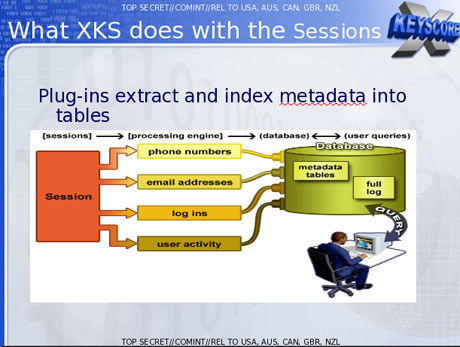
One training slide illustrates the digital activity constantly being collected by XKeyscore and the analyst's ability to query the databases at any time.
KS1
The purpose of XKeyscore is to allow analysts to search the metadata as well as the content of emails and other internet activity, such as browser history, even when there is no known email account (a "selector" in NSA parlance) associated with the individual being targeted.
Analysts can also search by name, telephone number, IP address, keywords, the language in which the internet activity was conducted or the type of browser used.
One document notes that this is because "strong selection [search by email address] itself gives us only a very limited capability" because "a large amount of time spent on the web is performing actions that are anonymous."
The NSA documents assert that by 2008, 300 terrorists had been captured using intelligence from XKeyscore.
Analysts are warned that searching the full database for content will yield too many results to sift through. Instead they are advised to use the metadata also stored in the databases to narrow down what to review.
A slide entitled "plug-ins" in a December 2012 document describes the various fields of information that can be searched. It includes "every email address seen in a session by both username and domain", "every phone number seen in a session (eg address book entries or signature block)" and user activity – "the webmail and chat activity to include username, buddylist, machine specific cookies etc".

Email monitoring

In a second Guardian interview in June, Snowden elaborated on his statement about being able to read any individual's email if he had their email address. He said the claim was based in part on the email search capabilities of XKeyscore, which Snowden says he was authorized to use while working as a Booz Allen contractor for the NSA.
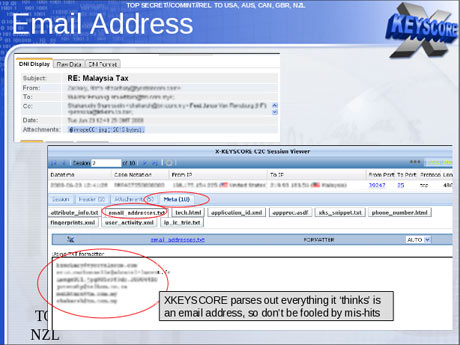
One top-secret document describes how the program "searches within bodies of emails, webpages and documents", including the "To, From, CC, BCC lines" and the 'Contact Us' pages on websites".
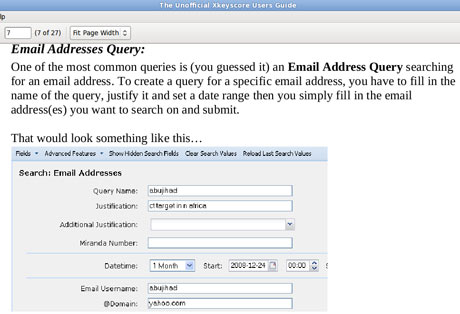
To search for emails, an analyst using XKS enters the individual's email address into a simple online search form, along with the "justification" for the search and the time period for which the emails are sought.
KS2
KS3edit2
The analyst then selects which of those returned emails they want to read by opening them in NSA reading software.
The system is similar to the way in which NSA analysts generally can intercept the communications of anyone they select, including, as one NSA document put it, "communications that transit the United States and communications that terminate in the United States".
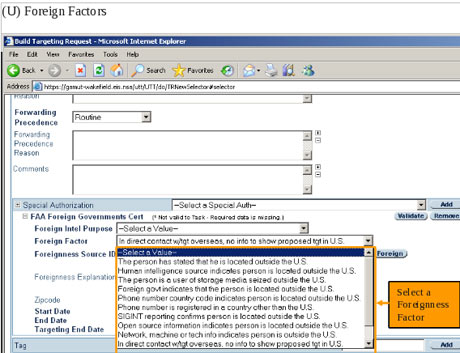
One document, a top secret 2010 guide describing the training received by NSA analysts for general surveillance under the Fisa Amendments Act of 2008, explains that analysts can begin surveillance on anyone by clicking a few simple pull-down menus designed to provide both legal and targeting justifications. Once options on the pull-down menus are selected, their target is marked for electronic surveillance and the analyst is able to review the content of their communications:
KS4

Chats, browsing history and other internet activity

Beyond emails, the XKeyscore system allows analysts to monitor a virtually unlimited array of other internet activities, including those within social media.
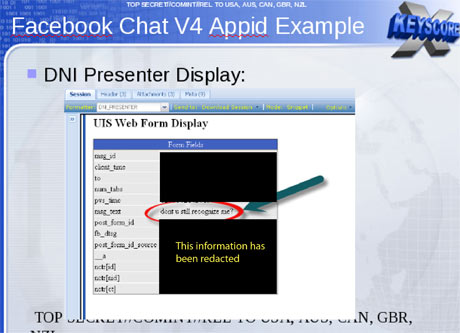
An NSA tool called DNI Presenter, used to read the content of stored emails, also enables an analyst using XKeyscore to read the content of Facebook chats or private messages.
KS55edit
An analyst can monitor such Facebook chats by entering the Facebook user name and a date range into a simple search screen.
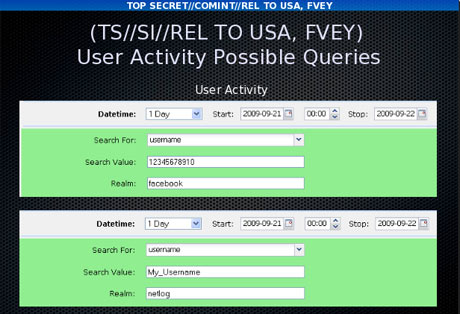
KS6
Analysts can search for internet browsing activities using a wide range of information, including search terms entered by the user or the websites viewed.
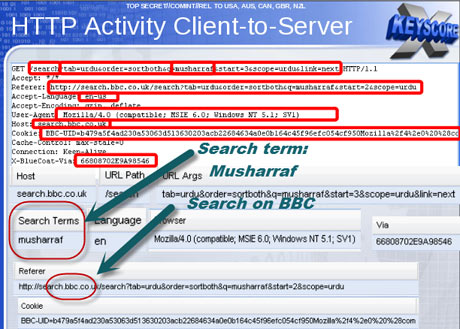
KS7
As one slide indicates, the ability to search HTTP activity by keyword permits the analyst access to what the NSA calls "nearly everything a typical user does on the internet".
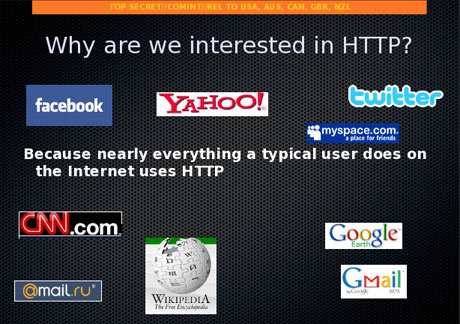
KS8
The XKeyscore program also allows an analyst to learn the IP addresses of every person who visits any website the analyst specifies.
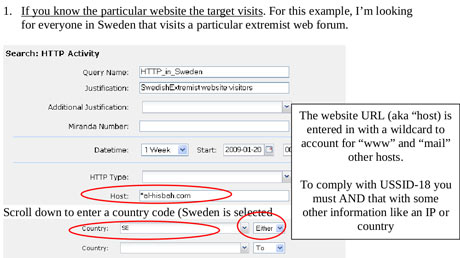
KS9
The quantity of communications accessible through programs such as XKeyscore is staggeringly large. One NSA report from 2007 estimated that there were 850bn "call events" collected and stored in the NSA databases, and close to 150bn internet records. Each day, the document says, 1-2bn records were added.
William Binney, a former NSA mathematician, said last year that the agency had "assembled on the order of 20tn transactions about US citizens with other US citizens", an estimate, he said, that "only was involving phone calls and emails". A 2010 Washington Post article reported that "every day, collection systems at the [NSA] intercept and store 1.7bn emails, phone calls and other type of communications."
The XKeyscore system is continuously collecting so much internet data that it can be stored only for short periods of time. Content remains on the system for only three to five days, while metadata is stored for 30 days. One document explains: "At some sites, the amount of data we receive per day (20+ terabytes) can only be stored for as little as 24 hours."
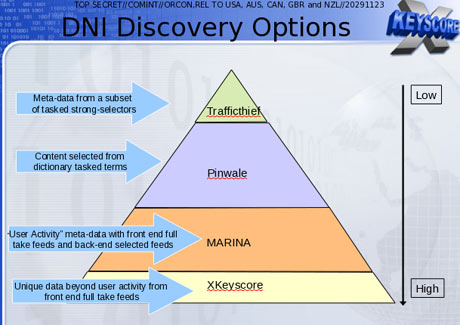
To solve this problem, the NSA has created a multi-tiered system that allows analysts to store "interesting" content in other databases, such as one named Pinwale which can store material for up to five years.
It is the databases of XKeyscore, one document shows, that now contain the greatest amount of communications data collected by the NSA.
KS10
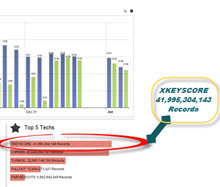
In 2012, there were at least 41 billion total records collected and stored in XKeyscore for a single 30-day period.
KS11
Legal v technical restrictions
While the Fisa Amendments Act of 2008 requires an individualized warrant for the targeting of US persons, NSA analysts are permitted to intercept the communications of such individuals without a warrant if they are in contact with one of the NSA's foreign targets.
The ACLU's deputy legal director, Jameel Jaffer, told the Guardian last month that national security officials expressly said that a primary purpose of the new law was to enable them to collect large amounts of Americans' communications without individualized warrants.
"The government doesn't need to 'target' Americans in order to collect huge volumes of their communications," said Jaffer. "The government inevitably sweeps up the communications of many Americans" when targeting foreign nationals for surveillance.
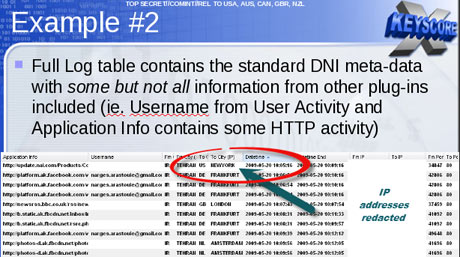
An example is provided by one XKeyscore document showing an NSA target in Tehran communicating with people in Frankfurt, Amsterdam and New York.
KS12
In recent years, the NSA has attempted to segregate exclusively domestic US communications in separate databases. But even NSA documents acknowledge that such efforts are imperfect, as even purely domestic communications can travel on foreign systems, and NSA tools are sometimes unable to identify the national origins of communications.
Moreover, all communications between Americans and someone on foreign soil are included in the same databases as foreign-to-foreign communications, making them readily searchable without warrants.
Some searches conducted by NSA analysts are periodically reviewed by their supervisors within the NSA. "It's very rare to be questioned on our searches," Snowden told the Guardian in June, "and even when we are, it's usually along the lines of: 'let's bulk up the justification'."
In a letter this week to senator Ron Wyden, director of national intelligence James Clapper acknowledged that NSA analysts have exceeded even legal limits as interpreted by the NSA in domestic surveillance.
Acknowledging what he called "a number of compliance problems", Clapper attributed them to "human error" or "highly sophisticated technology issues" rather than "bad faith".
However, Wyden said on the Senate floor on Tuesday: "These violations are more serious than those stated by the intelligence community, and are troubling."
In a statement to the Guardian, the NSA said: "NSA's activities are focused and specifically deployed against – and only against – legitimate foreign intelligence targets in response to requirements that our leaders need for information necessary to protect our nation and its interests.
"XKeyscore is used as a part of NSA's lawful foreign signals intelligence collection system.
"Allegations of widespread, unchecked analyst access to NSA collection data are simply not true. Access to XKeyscore, as well as all of NSA's analytic tools, is limited to only those personnel who require access for their assigned tasks … In addition, there are multiple technical, manual and supervisory checks and balances within the system to prevent deliberate misuse from occurring."
"Every search by an NSA analyst is fully auditable, to ensure that they are proper and within the law.
"These types of programs allow us to collect the information that enables us to perform our missions successfully – to defend the nation and to protect US and allied troops abroad."

As cost goes down, 3-D printers begin to make an impression

as the 'western elites' are getting "their" asses handed to them  ? ( BRICS ???) ..NOW "they" gotta retreat & retrench ( N.America & England )  & 'retool'  ... we are gonna see explosion of 3~D  Printing   INDUSTRY !!! in America ?   watch folks !   

As cost goes down, 3-D printers begin to make an impression

August 1st, 2013 in Technology / Engineering
Diego Porqueras' Deezmaker store in Pasadena, Calif., is a geeky version of Santa's workshop, brimming with action figures, chess pieces and jewelry. But instead of relying on elves, Porqueras has built his own one-man factory using 3-D printers capable of churning out plastic objects within a few hours. He sells the printers, which go for as little as $650, at the shop, which opened in September in a strip mall.
The 37-year-old entrepreneur is part of an emerging industry for affordable 3-D printers. The technology has long been used in the aerospace and automotive industries, among others, to create , but has slowly crept into the consumer market with simplified printers that can be had for a few hundred or thousand dollars.
"You can make so many things with them," Porqueras said. "People who have businesses buy them for making prototypes. Parents buy them to make toys for their kids. Hobbyists buy them because they like to tinker."
3-D imagine a day when these printers are as ubiquitous as phones and people print out many household goods instead of stopping at a store. Small-business owners are already switching to these printers from more expensive industrial machines. Prices are expected to drop even further after key patents on 3-D expire next year.
Usually about the size of a microwave, these machines "print" three-dimensional objects by melting plastic and depositing the material layer by tiny layer based on a three-dimensional computer-generated design of a necklace, say, or a fork. More advanced - and expensive - printers can use materials such as metal and chocolate.
For those who are less tech-savvy, there are new smartphone applications that streamline the process of crafting or altering a design. Online markets have also popped up in which shoppers can customize and order 3-D-printed clothing, toys, gadget accessories and other products.
Industry experts say 3-D printing could revolutionize traditional manufacturing, much as the Internet upended the music industry, and fundamentally alter how consumers shop and how much they pay. Some tech companies are already foreseeing a day when every home contains a 3-D printer churning out custom furniture and clothes, or a Kinko's-esque store in every neighborhood where items can be manufactured on demand via printers.
It's also raised concerns among law enforcement professionals, who worry that criminals will be able to print untraceable guns and other weapons at home.
"The billion-dollar question is, how big will this become and when?" said Terry Wohlers, president of consulting firm Wohlers Associates, which tracks the industry. "You see companies already making fashion garments and jewelry through printing. And we have seen demonstrations of 3-D printing food and living tissue."
Wohlers said that by 2021, the U.S. market is estimated to hit $10.8 billion, up from $2.2 billion last year and $$1.18 billion in 2008. The industry has been growing, on average, more than 25 percent a year for the past decade. The consumer side, which is in its nascent stages, is especially ripe for growth, Wohlers said.
Tech companies are already salivating at the opportunities.
In June, 3-D veteran Stratasys Ltd., which for decades has made ultra-pricey printers for companies such as Boeing Co. and General Motors Co., announced plans to buy MakerBot, which specializes in affordable desktop printers. Rival 3D Systems Inc. launched two consumer-oriented models this year, the Cube ($1,299) and the CubeX ($2,499 and up).
3D Systems' chief technology officer, Chuck Hull, is widely credited with pioneering 3-D printing about three decades ago. He leads a research lab in Valencia, Calif., where scientists such as engineer Scott Turner experiment with new materials in the chemistry lab and tinker on machine prototypes.
Turner said that health care is one of the biggest areas for 3-D printing; already, companies are testing living cells with a view toward making organs and other human parts such as ears. In March, a man in the U.S. had 75 percent of his skull replaced with a 3-D printed implant.
Another early adopter is the education sector: With a 3-D printer, students can make and play with models of cells rather than just study them in textbooks, or make custom robots in physics class.
The Art Center College of Design in Pasadena already owns seven 3-D printers and plans to order more. The machines give students the luxury of repeatedly tweaking their designs for products as varied as car fenders and kitchenware, said David Cawley, director of the school's rapid prototyping and model shop.
"If you are making a design and you have to create it by carving it out of wood, the amount of time to create a model would be prohibitive," Cawley said. "But 3-D printing allows them to refine the design because it's pretty fast. You send the file the night before, and the day after that a physical object will be on the shelf."
Small-business owners have already taken to the printers.
John Hariot of Los Angeles, for one, is using a printer bought from Deezmaker to create prototypes, such as knobs for drawers, for his new cabinet-making company. He said the 3-D printer is a much cheaper option compared with the pricey rapid-prototyping machines he once had to use.
"It's much easier to work with, and there's less waste," he said.
For consumers who aren't tinkerers or designers, industry experts say, a potentially bigger market could lie in on-demand services. Think of it as Amazon.com for custom orders, only with no warehouses required because a purse or belt is only made after it's ordered.
Shoppers can already go on sites such as Shapeways or Cubify, run by 3D Systems, and either find a designer for a custom design or tweak an available product.
More than 10,000 shops have been set up by designers on Shapeways, which manufactures and ships a product after an order comes in, said company spokeswoman Elisa Richardson. Bestselling items include iPhone accessories, jewelry, home decor and wedding cake toppers - grooms and brides-to-be send in photos of themselves and receive toppers with their faces printed on them.
Kimberly Orvitz, a fashion designer who recently launched a 3-D printed jewelry line, said the technology saves money: There's no requirement to order products in bulk from a factory and no storage costs. Shoppers can also "customize by selecting colors and materials," she said.
But the technology has not been without controversy.
Cody Wilson, the owner of a gun-manufacturing firm in Texas, made headlines after he successfully fired a 3-D-printed gun of his own design earlier this year (he also uses the technology to make firearm magazines and lower receivers).
For now, such guns may pose more of a danger to the maker. Australian police who tried making Wilson's design reported the plastic gun exploded after firing. Still, a recently leaked Department of Homeland Security bulletin said such firearms pose public safety risks.
Industry experts say there is more danger in consumers making ordinary products that are defective.
"The gun thing has been way overhyped because if you really want to make a gun, there are better and cheaper ways to do it," Wohlers said. "But just think about people printing a brake part for their car, and it breaks going down the highway and people are injured or worse."
For now, the relatively untapped market has allowed not just big corporations but also entrepreneurs to jump in.
Porqueras, the owner of the Pasadena store, was a Hollywood camera technician before becoming fascinated with 3-D printing.
Always a tinkerer, he created his own ideal 3-D printer, started a campaign on the fundraising site Kickstarter, and raised $167,000 - enough to quit his job and start selling his machine full time. He recently launched another campaign to raise funds for the Bukito, his portable 3-D printer priced at $650.
"It just blew my mind what these printers can do," Porqueras said. "Who knows what the future will hold?"
©2013 Los Angeles Times
Distributed by MCT Information Services

"As cost goes down, 3-D printers begin to make an impression." August 1st, 2013. http://phys.org/news/2013-08-d-printers.html

New topological technique helps scientists 'see' and search large data sets

August 1st, 2013 in Technology / Computer Sciences
Throwing a lifeline to scientists drowning in data
Geographically correct map of the London Underground.

Geographically correct map of the London Underground.
New computational techniques developed at Lawrence Berkeley National Laboratory (Berkeley Lab) may help save scientists from drowning in their own data. Computational scientists at the Lab have figured out how to streamline the analysis of enormous scientific datasets. The analysis uses the same techniques that make complex subway systems understandable at a glance.
They describe their work in a paper published in PPoPP'13: Proceedings of the 18th ACM SIGPLAN Symposium on Principles and Practice of Parallel Programming.
What's the problem here?
Sophisticated sensors and supercomputers are generating bigger and more complex scientific datasets than ever before. In disciplines like genomics, combustion and , these datasets can range anywhere from tens of terabytes to several in size. A petabyte of data is equivalent to the storage consumed by 13.3 years of high-definition television.
To tease out the significant features for analysis, many scientists turn to a branch of mathematics called topology, which characterizes shapes of objects without considering aspects like length or angles—simplifying them the same way a subway turns a complex maze of tunnels, trains and stations into colored lines and dots.
But scientific data are becoming so massive and complex that even simplified topological representations are becoming difficult to analyze efficiently. So more and more researchers are turning to massively parallel supercomputers to study their data.
The problem is that existing algorithms for analyzing data topologically do not take the best advantage of a supercomputer's thousands of processors. So Berkeley Lab created a new approach—called distributed merge trees—for analyzing these datasets. This approach will let scientists make better use of next-generation supercomputers, as well as quickly sift out significant features from "noisy" data. In science, noise is irrelevant data generated by obstructing features, such as atmospheric dust in astronomical data, and measurement errors.
"The growth of serial computational power has stalled, so data analysis is becoming increasingly dependent on massively parallel machines," says Gunther Weber, a computational researcher in Berkeley Lab's Visualization Group. "To satisfy the computational demand created by complex datasets, algorithms need to effectively use these parallel computer architectures."
Both Weber and Berkeley Lab postdoctoral researcher Dmitriy Morozov pioneered the distributed merge tree approach to topological data analysis.
Topology: What is it good for?
Anybody who has looked at a pocket map of the London Underground or New York City subway system has seen topology in action. These seemingly simple representations ignore details like distance and physical locations of stations, but still preserve important information like what line a station is on, how different lines are connected and the overall structure of this complicated network.
In topology, what matters most is how things are connected. By disregarding distance, the size of an object no longer matters. The object can be stretched or squeezed and still remain topologically unchanged. So a large complicated structure like London's tube network can be condensed into an easy-to-read pocket-sized map by omitting geography and placing subway stations evenly on a line. Likewise, topology can be used to map the distribution of galaxies in the Universe, or burning regions in a combustion simulation.
Sifting through the noise
Once a massive dataset has been generated, scientists can use the distributed merge tree algorithm to translate it into a topological map. The algorithm scans the entire scientific dataset and tags values that are of interest to the scientists, as well as merge points or connections in the data.
Throwing a lifeline to scientists drowning in data
Topological representation of the London Underground.
So if the dataset is a height map of the Himalayas, the distributed merge tree algorithm will initially scan the entire dataset and record all the peaks in the mountain range. Then, it will generate a topological map illustrating how the different mountains in this dataset are connected. Morozov notes that these connections allow researchers to quickly differentiate between "real features" and "noise" in the data.
"A quick Internet search for the six tallest mountains in the Himalayas will show: Mount Everest, K2, Kangchenjunga, Lhotse, Makalu and Cho Oyu. But, there are many more peaks in this range," says Morozov. "For example, the peak of Lhotse Shar is actually higher than Cho Oyu, but it doesn't count as one of the highest mountains because Lhotse Shar's base—where it merges into Lhotse—is almost as high as its peak."
Thus, a researcher that is only interested in the tallest mountains might consider Lhotse Shar "noise" in the data. A quick search of a topological map generated by the distributed merge tree will show that this mountain merges into Lhotse and disregard it based on the query.
New topological technique helps scientists ‘see’ and search large data sets
"This analogy applies to many areas of science as well," says Morozov. "In a combustion simulation, researchers can use our algorithm to create a topological map of the different fuel consumption values within a flame. This will allow scientists to quickly pick out the burning and non-burning regions from an ocean of 'noisy' data."
Parallelizing the search
According to Weber, distributed merge trees take advantage of massively parallel computers by dividing big topological datasets into blocks, and then distributing the workload across thousands of nodes. A supercomputer like the National Energy Research Scientific Computing Center's (NERSC) Hopper contains about 6,384 nodes, and each of which contains 24 processor cores.
In this approach, each block of data is assigned to a single node. Additionally, each node also stores an aggressively simplified global map, much like subway maps. The nodes only communicate to exchange information pertaining to a shared boundary.
New topological technique helps scientists ‘see’ and search large data sets
Generated with the distributed merge tree algorithm, this visual characterizes a porous material at a glance. The colored spheres represent the pockets in the material, while the grey spheres represent solid material. The graph (right) shows how "prominent" individual pockets are by plotting the radius of each pore on the vertical axis, and radius of the largest sphere that can leave/escape the pocket on the horizontal axis. Prominence is the difference in sizes of the largest sphere that fits in and the largest sphere that can escape. The algorithm eliminates "noisy" data by ignoring pockets close to the diagonal, i.e., pockets that are not very prominent.
"Although the individual nodes simplify non-local parts of the map, each portion of the map is still available in full resolution on some node, so that the combined analysis of the map is the same as the unsimplified map," says Morozov. "By identifying thresholds, or tags, scientists can ensure that the desired level of detail required for analysis is not disregarded as the global map is simplified."
"Today, most researchers will only have one node keep track of the 'big picture', but the memory on a single compute node is often insufficient to store this information at the desired detail for analysis," says Weber. "These problems are further exacerbated by the trend in supercomputing to add more processor cores to a chip without adding correspondingly more memory. As a result, each new generation of parallel computers is operating with less memory per core than the previous one."
According to Weber, once a global topological representation is resident on a single node, it is difficult to parallelize queries for features and derived quantities. This in-turn leads to processor underutilization and slower queries.
"By reducing the tree size per node while maintaining a full accurate representation of the merge tree, we speed up the topological analysis and make it applicable to larger datasets, " says Weber. "This is also an important step in making topological analysis available on massively parallel, distributed memory architectures."
More information: dl.acm.org/citation.cfm?id=2442526
Provided by US Department of Energy

Scientists to study synthetic telepathy

Aug 13, 2008
A team of UC Irvine scientists has been awarded a $4 million grant from the U.S. Army Research Office to study the neuroscientific and signal-processing foundations of synthetic telepathy.
The research could lead to a communication system that would benefit soldiers on the battlefield and paralysis and stroke patients, according to lead researcher Michael D’Zmura, chair of the UCI Department of Cognitive Sciences.
“Thanks to this generous grant we can work with experts in automatic speech recognition and in brain imaging at other universities to research a brain-computer interface with applications in military, medical and commercial settings,” D’Zmura says.
The brain-computer interface would use a noninvasive brain imaging technology like electroencephalography to let people communicate thoughts to each other. For example, a soldier would “think” a message to be transmitted and a computer-based speech recognition system would decode the EEG signals. The decoded thoughts, in essence translated brain waves, are transmitted using a system that points in the direction of the intended target.
“Such a system would require extensive training for anyone using it to send and receive messages,” D’Zmura says. “Initially, communication would be based on a limited set of words or phrases that are recognized by the system; it would involve more complex language and speech as the technology is developed further.”
D’Zmura will collaborate with UCI cognitive science professors Ramesh Srinivasan, Gregory Hickok and Kourosh Saberi. Joining the team are researchers Richard Stern and Vijayakumar Bhagavatula from Carnegie Mellon’s Department of Electrical and Computer Engineering and David Poeppel from the University of Maryland’s Department of Linguistics.
The grant comes from the U.S. Department of Defense’s Multidisciplinary University Research Initiative program, which supports research involving more than one science and engineering discipline. Its goal is to develop applications for military and commercial uses.
Source: UC Irvine