Monday, November 19, 2012

“Labyrinth” Starring David Bowie: A Blueprint to Mind Control

http://vigilantcitizen.com/moviesandtv/labyrinth-starrin

“Labyrinth” Starring David Bowie: A Blueprint to Mind Control


The 1986 movie Labyrinth, starring David Bowie and Jennifer Connelly, immerses the viewers into a world of fantasy and wonder. Like many other fantastic tales, the movie conceals within its symbolism an underlying meaning and, in this case, it is rather disturbing. Labyrinth describes the programming of a mind control victim at the hands of a sadistic handler. We will look at the occult meaning of the symbolism found in Labyrinth.

Labyrinth is a quintessential 80s movie that contains everything we love from the 80s: 80s synth music, 80s CGI effects and a 80s David Bowie in the same 80s hairdo that your aunt Susan had in the 80s. What’s not to love? The movie has, in fact, become a “cult classic” and is still a children’s favorite.
But like many of these delightfully twisted fantasy movies, there is more to Labyrinth than meets the eye. By understanding the occult symbolism and references in Labyrinth, the movie becomes a big allegory for mind control, where each scene refers to a particular aspect of the process. What appears to be a young girl’s quest through a Labyrinth to find her baby brother becomes a metaphor for the internal world of a mind control victim that is being programmed by a handler. The obstacles that Sarah, the hero of the story, must go through relate to real life ordeals inflicted to mind control slaves to incite dissociation (if you have no idea what I’m talking about, read the article entitled Origins and Techniques of Monarch Mind Control). Mind games, torture, drugs and sexual abuse are all referred to in veiled symbolism during the movie, giving to “those in the know” an entirely different story than what is shown at face value. Labyrinth is therefore constructed like most esoteric works in History: it uses symbolism to conceal from the masses while revealing to the initiates.
Very little prior knowledge is required to understand the underlying meaning of Labyrinth. however. The movie was, in fact, mentioned by a few authors on mind control who described it as one of the most blatant movies on Monarch programming. Fritz Springmeier even states Labyrinth is used by actual mind control handlers as a programming script to train the slaves. This very plausible as the movie bears many similarities to Alice in Wonderland and Wizard of Oz – two movies that are known to be used in mind control programming. The only difference is that Labyrinth was probably specifically constructed to this purpose while, at the same time, exposing the masses to this kind of symbolism.
Since Labyrinth is a blueprint for mind control, it is only fitting that the star of the show is an artist who has served as a blueprint to modern pop stars: David Bowie. Throughout his long and eclectic career, Bowie has touched on many occult and ritualistic themes that are today rehashed by industry-made pop stars. And, for some reason, many of those who touch upon these occult themes also integrate mind control into their works. Maybe it is due to the fact that mind control heavily relies on black magic rituals and Kabbalistic teachings. So, before we look at the symbolism of the movie, let’s take a brief look at some of the symbolism used by David Bowie.
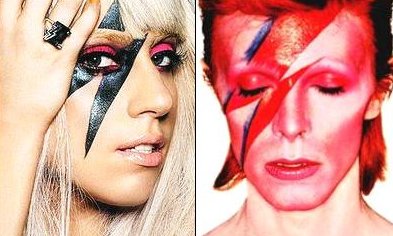

David Bowie: The One They All Imitated

Many articles on this site mention modern pop stars and the occult symbolism embedded in their works. It was only a matter of time before David Bowie was mentioned as he is apparently a major source of inspiration for many of them. David Bowie is indeed the prototype of the pop-star/occult icon whose works incorporated concepts originating from Secret Societies. From strange alter-egos, to the occult concept of androgyny, and of course including references to Aleister Crowley and his Thelema, Bowie did decades ago what pop stars are doing now.

"Bowie's alter-ego named Ziggy Stardust was a representation of the "illuminated man" who has reached the highest level of initiation: androgyny. There was also a lot of one-eye things going on.

Drawing the Kabbalistic Tree of Life

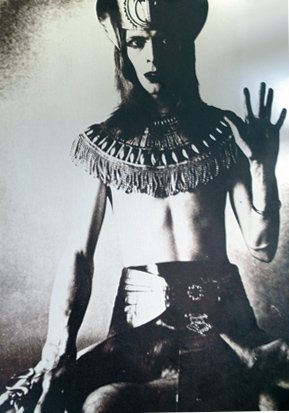
Bowie dressed in Egyptian garbs (like Crowley used to do) and displaying the hand sign of "as above so below"
The difference between Bowie and today’s pop stars is that he was rather open regarding the occult influence in his act and music. In a 1995 interview, Bowie stated: “My overriding interest was in cabbala and Crowleyism. That whole dark and rather fearsome never-world of the wrong side of the brain.” In his 1971 song Quicksand, Bowie sang:
“I’m closer to the Golden Dawn
Immersed in Crowley’s uniform of imagery”
(Golden Dawn is the name of a Secret Society that had Crowley as member). These are only some examples of the occult influence on Bowie’s work and an entire book could be written on the subject.
Since the main antagonist of Labyrinth is a sorcerer who also happens to enjoy singing impromptu pop songs, David Bowie was a perfect fit for the role. Did he know that he played the role of a mind control handler?
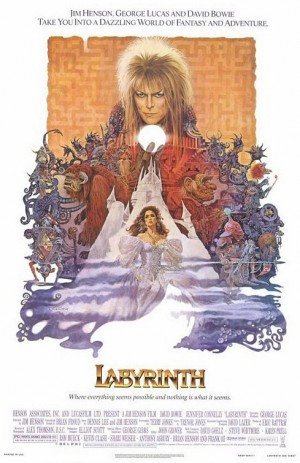
Labyrinth


This poster of the movie Labyrinth is full of MK trigger images.
Released in 1986, Labyrinth was a collaborative effort between George Lucas, Jim Henson (his last movie) and David Bowie. Using state-of-the-art effects, the movie quickly became a classic in what we can call the “twisted fantasy” genre. The plot of the movie is simple: A teenage girl named Sarah goes through a strange, magical Labyrinth to recover her baby brother who was kidnapped by a sorcerer named Jareth and his army of goblins.
Some critics did not appreciate the random nature of the events of the movie. Robert Ebert stated that these kind of movies “aren’t as suspenseful as they should be because they don’t have to follow any logic. Anything can happen, nothing needs to happen, nothing is as it seems and the rules keep changing.” By describing the movie this way, Ebert unknowingly describes the inner-world of a mind control slave, which is exactly what the Labyrinth represents. Through trauma, the psyche of the slave is reprogrammed by the handler resulting in a situation where anything can happen, nothing needs to happen, nothing is as it seems and the rules keep changing.
Sarah’s quest for her baby brother is, in fact, a quest to recover her innocent core persona (her “real” self) that was taken by the handler. The various events that happen to Sarah are distorted reflections of real mind control trauma – hidden behind a veil of fantasy and imagination.

The Premise

The plot of the movie is very reminiscent of the Wizard of Oz and Alice in Wonderland, two stories that are incidentally known to be used in mind control programming. A young girl, bored and distraught with her normal life, finds herself in a fantasy land, where everything can happen. In order to go back home, she embarks on a dangerous quest to reach a great castle (not unlike the Emerald city of the Wizard of Oz). Along the way, the assertive girl uses her wits, courage and strength to go past the obstacles in a world where no rules are established.
Labyrinth is heavily symbolic from beginning to end, starting from the very first scene. Sarah is at a park, dressed as a princess, practising lines to a play under the watchful eye of an owl that is standing on top of an obelisk.

An owl is standing at the top of an obelisk, watching over Sarah.
We quickly learn that the owl is Jareth, the goblin King (played by David Bowie). The fact that Jareth takes the form of an owl in the “real world” and that he sits at the top of an obelisk is very telling about what he actually represents: The occult elite. The owl is known to be the main symbol of the Bavarian Illuminati and is still used by elite groups such as the Bohemian Grove. It represents “those who act under the cloak of darkness”.

Symbol of the Minerval Church of the Bavarian Illuminati featuring a watchful owl.
The owl is at top of an obelisk, a monument that is constantly visible throughout the entire movie. The obelisk has been, for centuries, the ultimate symbol of power of the occult elite. It is found standing at the world’s most powerful places and strange occult powers are attributed to them. These tall monuments originate from the ancient Egypt and are said to represent the lost phallus of Osiris – in other words, male energy. The obelisk is therefore a phallic symbol and the fact that this young girl encounters many of them during her quest might be a reminder of the male handler dominating her mentally and sexually (through abuse).
The owl watches Sarah, who is dressed as a princess and practising a role for a play, illustrating her natural tendency to dissociate from reality and to take on other personalities, a characteristic that MK handlers seek when scouting for potential slaves. Sarah is therefore “marked” by the shady Illuminati Mind Control system.
At Sarah’s house, we find several clues relating to her predisposition to mind control. She is surrounded by toys, books and posters that foretell the dissociative adventure she is about to embark in. Many of Sarah’s toys will be found animated during her adventure, which tells us that everything that will happen will be a result of her own imagination, fuelled by the things that are familiar to her.

Among Sarah's stuff we find a toy version of the obelisk-studded labyrinth she is about to enter and the books of Wizard of Oz and Alice in Wonderland. Both of these fairy tales are used to encourage victims to dissociate from reality. Labyrinth is no different and is probably used in actual mind control programming.
Right above Sarah’s bed is Escher’s famous drawing named “Relativity”.

Escher's "Relativity" (the image with the stairs going in all directions) right above Sarah's bed.
Escher’s mind-boggling images contain confusing features that the mind can never compute. For this reason, they are used in actual mind-control programming. This particular painting will become very important later in the movie.
“If [the child] has artistic brainwaves, then the programmer will use art work in programming. The art work of the european artist M.C. Escher is exceptionally well suited for programming purposes. For instance, in his 1947 drawing “Another World”, the rear plane in the center serves as a wall in relation to the horizon, a floor in connection with the view through the top opening and a ceiling in regards to the view up towards the starry sky. Reversals, mirror images, illusion, and many other qualities appear in Escher’s art work which make all 76 or more of his major works excellent for programming.”
- Fritz Springmeier, The Illuminati Formula to Create a Mind Control Slave
So Sarah is angry at her parents, especially her step-mother, because she has to stay at home and babysit her little brother named Toby while they go out. Confronted with the child’s incessant cries, Sarah wishes for the Goblin King to take him away. An owl then enters the room and turns itself into Jareth, the Goblin King.

Jareth offering Sarah "gifts" represented by the crystal ball
Jareth has taken Toby to his world and will turn him into one of his goblins. In mind control terms, baby Toby represents Sarah’s core personality that was taken away by Jareth, her handler. As long as Jareth holds Sarah’s core persona, he will be able to make her go through the Labyrinth – which will represent her programming.
When Sarah asks to Jareth to hand back Toby, the Goblin King uses his skills for manipulation and persuasion. He shows Sarah a crystal ball and tells her that it contains “all of her dreams”. He however warns that is is “not a gift for an for an ordinary girl who takes care of a screaming baby”. In other words, the gift is only for girls who have lost the baby – victims of mind control. Jareth the handler has the power to help Sarah escape the life she loathes but she must allow him to own her core personality – to control her mind. When Sarah refuses Jareth’s offer, which is equivalent to the Faustian theme of selling one’s soul to the Devil, the crystal ball magically turns into a snake and is thrown at her. Jareth then menacingly says: “Don’t defy me”. Seeing that she will not forget about the baby, Jareth tells Sarah that Toby is at his castle and that she has 13 hours to find him. They are both transported into the Labyrinth, which is a big image representing Sarah’s inner-world under the control of a handler.

Inside the Labyrinth


Sarah must traverse a gigantic Labyrinth in order to reach the castle, which represents her walled-off and compartmentalized core persona. The entire labyrinth is Sarah's inner-world and Jareth is the undisputed master of everything that happens in it. He can also change everything at will. Obelisks are found all across the Labyrinth, a phallic symbol reminding of the sexual control the handlers have over their slaves.
Inside the Labyrinth, Sarah quickly realizes that it does not obey the rules of reality. She finds herself walking never-ending straight paths leading to nowhere.

The Labyrinth appears to be an infinite straight path to nowhere.
Sarah then learns that it is only by mentally picturing an entry towards the castle that one will appear. She must make her own path within her own mind.
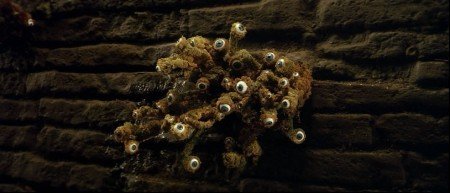
Strange plants with eyes on the walls of the Labyrinth reminds us that Sarah is tightly monitored by her handler during the entire process. The symbol of the all-seeing eye is heavily used in actual mind control programming.
While trying to advance through the Labyrinth, Sarah realizes that everything keeps changing around her. She meets strange creatures who say confusing riddles that lead to never-ending loops of circular logic. Her catchphrase appears to be “It’s not fair” as she repeats it numerous time during the movie. This phrase does sum up pretty nicely the life of a MK slave. There are no rules and every kind of unfairness can occur.
Meanwhile, Jareth is in the castle with Toby, monitoring Sarah.

Jareth on his horned throne.

The Ordeals

In her path towards the castle, Sarah goes through all kinds of obstacles, many of which symbolically represent actual traumas lived by mind control victims.
In Sarah’s first ordeal, she falls into a pit filled with “helping hands”.
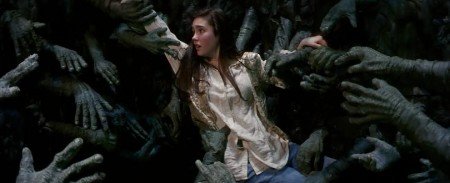
Sarah is held and grabbed by countless hands around her. This can refer to the victims being manipulated and abused by hidden handlers.
Later, Sarah finds herself in a forest and surrounded by the Fire Gang, who are strange singing creatures that can remove parts of their bodies at will. The concept of dismembered body parts is central to mind control programming.
The Fire Gang’s performance soon turns into a nightmare when they jump on Sarah and try to remove her head.
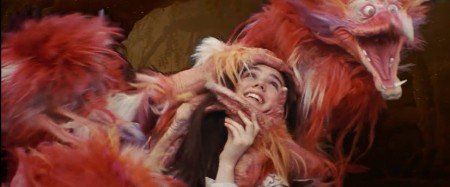
The Fire Gang trying to remove Sarah's head from her body, representing the MK slave's dissociation from reality.
Upon escaping the Fire Gang, Sarah finds herself in an even worst place, the Pool of Eternal Stench.

The Pool of Eternal Stench is basically a big gassy pond full of feces. It keeps emitting flatulence and belches and is therefore very "bodily" place.
Sarah and her friends are forced to go through the nauseating pond in order to continue the quest. This odd scene can refer to the actual mind control technique to induce trauma which consists in immersing the slaves in feces and urine and/or to consume them. Our natural repulsion to excrements and the foul odor we get from them are our body’s way to tell us to stay away from them because they are infested with all kinds of worms and parasites that are toxic to us. Our organisms are so well made that we are instinctively repulsed by the things that are bad for us. The forced consumption of excrements is therefore particularly traumatic as it goes against the human body’s most basic instincts. Sarah’s episode in the Pool of Eternal Stench is a “imaginative” way to describe Sarah’s traumatic experience as a MK slave during programming.
After crossing the pool, Sarah is given a gift – one that is poisoned of course.

Sarah receives a peach that makes her hallucinate - a thinly veiled allusion to the drugs that are given to Monarch slaves during programming.
When Sarah takes a bite from the peach, she feels woozy and starts hallucinating. Monarch slaves are constantly given drugs to amplify the effects of the programming and to incite fear and terror. Laying on the ground, Sarah sees a crystal ball with a symbolic image representing her.

Sarah sees doll in princess clothes surrounded by bars - a classic way to portray dissociative mind control slaves.
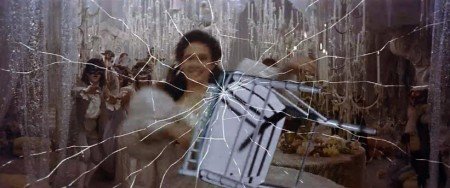
Sarah is then shown at a strange ball with guest wearing masks of goats, pigs and birds (commonly called an Illuminati ball) and finds Jareth, her handler, waiting for her.
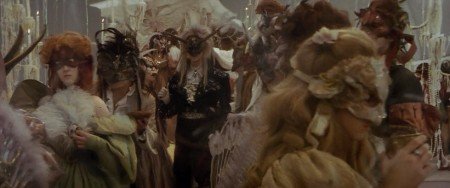
Jareth waiting for Sarah behind a horned masked at the Illuminati ball.
Jareth and Sarah find each other and begin waltzing together, with Jareth giving suggestive looks … to a 15-year-old girl. The scene symbolically portrays the forced Satanic union between the slave (who is said to be the princess of her world) and her handler. The lyrics of David Bowie’s song playing during the ball can be interpretative as a “love song” from a handler to a mind control slave.
“As the pain sweeps through
Makes no sense for you
Every thrill has gone
Wasn’t too much fun at all
But I’ll be there for you
As the world falls down …

… It’s falling down”
The ball then quickly turns into a nightmare, where all of the masked guests start running after her (is she “bad-tripping”?). Sarah starts running, shatters a mirror and runs through it, another classic symbol of mind control.

To escape the ball, Sarah must shatter a mirror - a symbolic image representing the fracture of her personality.

Confronting Jareth

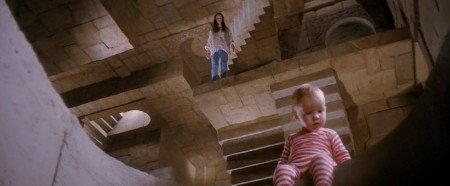
Despite all of those troubles, Sarah finally reaches the castle and enters it. She finds herself lost in a life-size Escher painting with Toby crawling. Jareth magically appears from everywhere in the scene, the same way handlers appear in the inner-world of Monarch slaves.

Sarah in a life-size Escher image
Then the entire world around Sarah crumbles, leaving only her facing her handler. Sarah asks Jareth to give her back the baby (her innocent core). Jareth gives her a classic double-speak, mind-bending lecture – the kind MK slaves get from their handlers. He says:

“I have reordered time … I have turned the world upside down … I have done it all for you. I am exhausted from living up to your expectations of me. Isn’t that generous?”
He then offers her the crystal ball again.

"Jareth asks Sarah to sell her soul in exchange of her dreams
He says:
“Look what I’m offering you. Your dreams. I ask for so little. Just let me rule you, and you can have everything that you want. Just fear me, love me, do as I say, and I will be your slave”.
This is the classic Faustian “deal with the Devil” proposal, where Jareth says that he “asks for so little” while he is actually asking for Sarah’s everything: Her mind, body and soul.
Sarah then starts reciting the lines she was practising at the beginning of the movie and says “You have no power over me”. Everything crumbles again, Sarah leaves her internal world and finds herself back in the external world, the real world, her house. Toby is back in his crib and everything is apparently back to normal.
In her room, sees some of the creatures she has met in the Labyrinth and is apparently happy to see them. She tells them:

“I don’t know why, but … every now and again in my life, for no reason at all, I need you.”
In other words, Sarah has accepted the internal world that was programmed into her by her handler. It now can be triggered by him at any time during her life.

Sarah and her friends party in her room under the watchful eye of an owl, Jareth, who has never lost control of her. He is actually the winner of the duel with Sarah. Her programming is complete.
The movie closes with David Bowie’s song “Underground”. The song has very church-y feel (with a loud a gospel choir accompanying him) and talks about a place with “no pain”. That place is not heaven, but “Underground”, which can be equated to hell, which, in mind-control terms, is the trauma-filled life of a MK slave.
So, in perfect continuation with the movie, Bowie leaves the viewers with one last inversion of good and evil, heaven and hell and pleasure and pain, with this song:
“No one can blame you
For walking away
Too much rejection (na na)
No love injection
Life can be easy
It’s not always swell
Don’t tell me truth hurts, little girl
‘Cause it hurts like hell
But down in the underground
You’ll find someone true
Down in the underground
A land serene
A crystal moon, ah, ah
It’s only forever
Not long at all
Lost and lonely
That’s underground
Underground
Daddy, daddy, get me out of here
Ha ha I’m underground
Heard about a place today
Nothing ever hurts again
Daddy, daddy, get me out of here
Ah ha I’m underground
Sister sister, please take me down
Ah ah I’m underground
Daddy, daddy, get me out of here
While most viewers interpret the story of Labyrinth as a tale about “the importance of imagination” or something of the sorts, the symbolism of the movie gives it a deeper meaning. While the story could be interpreted in numerous ways (another article could be written about Sarah’s quest being a metaphor for esoteric initiation) references to mind control are definitely present. Once the imagery and the triggers relating to mind control are understood, the movie becomes a vivid description of the internal world of a Monarch slave during programming. Totally at the mercy of her handler and the twisted world he created in her mind, the slave attempts to return to reality, where things make sense. The task is difficult as the handler controls time (hence the 13-hour clock that keeps popping up during the movie) and space (secret passages in the Labyrinth). During the quest, the slave meets friends who appear to be helping her, but who are, in actuality, leading her to exactly where her handler wants her to be. In fact, Sarah’s entire “quest for liberation” is actually her being manipulated towards the acceptance of her programming. By going through the Labyrinth, Sarah went through all of the trauma necessary to program her. What appears to be the defeat of Jareth is actually a victory as he successfully programmed Sarah’s internal world. It can be used, in her words “every now and again in her life”.

In Conclusion

Like Wizard of Oz and Alice in Wonderland, Labyrinth is an imaginative fairy tale whose story can be used as a programming script in mind control programming. Unlike the older tales however, Labyrinth might have been specifically constructed for mind control purposes. The story, the symbolism and the music of the movie all form a cohesive sensory-overload, where the viewers are totally immersed in the strange world of mind control. There is however one hitch: like mind-control victims, most viewers are completely duped by the movie and its message. While it appears to be about the triumph of a girl’s mind over evil, its is actually the triumph of evil over a girl’s mind. In the words of Bowie, Don’t tell me truth hurts, little girl, ‘Cause it hurts like hell.
g-david-bowie-a-blueprint-to-mind-control/            

Taylor Swift’s Performance at the 2012 AMA’s: A Typical Initiation Ritual

http://vigilantcitizen.com/latestnews/taylor-swifts-performance-at-the-2012-amas-a-typical-initiation-ritual/                     

Taylor Swift’s Performance at the 2012 AMA’s: A Typical Initiation Ritual


We’ve seen in previous articles that music award shows are often rife with ritualistic elements that reflect the occult inner-workings of the entertainment industry. The elaborate musical performances of these shows are conceived to promote artists’ latest singles but also contain symbolism reflecting elite’s  Agenda and philosophy.
In the article on the 2009 VMA Awards, we’ve seen that Taylor Swift undergone a symbolic initiation ritual. In her performance at the 2012 American Music Awards, she appears to undergo another initiation, by partaking in the often seen “girl good gone bad” narrative, complete with a transformation symbolized by color codes. Let’s look at the performance.
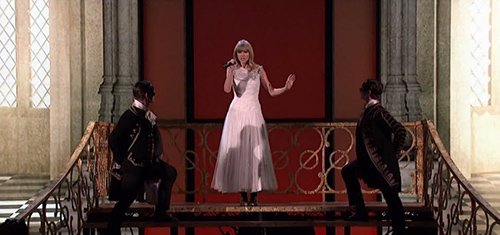
Swift begins her performance in a virginal white dress. Notice the Masonic checkerboard pattern floors on each side of her.
Her performance takes place in what I like to call an “Illuminati Ball”: Parties where guests are masked and that are known to turn into all-out orgies (see the movie Eyes Wide Shut). For centuries, the occult elite enjoyed these masquerade balls. In more secretive circles, these events were also used to initiate new members.
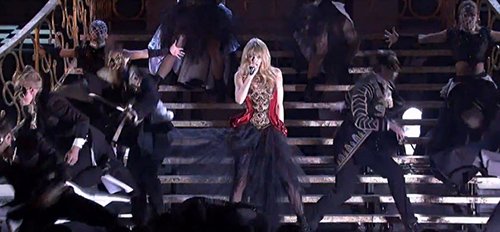
Taylor Swift begins her performance in a white dress, representing purity and innocence. She is the new candidate for initiation and is welcomed by two masked individuals. In the background, we see a checkerboard pattern floor, the ceremonial Masonic surface on which transformative rituals occur.
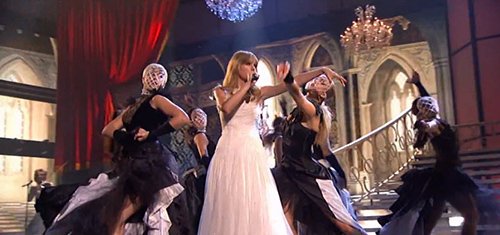
Swift innocently dances around and mingles with some masked individuals for a while.
Who are these faceless individuals?
Then her transformation occurs.
Swift emerges from a pile of people wearing a red and black dress – symbol of sacrifice and initiation.
After Swift’s initiation, the set gets dark and things get nastier.
From dancing innocently, things get a lot more sexual. Do these moves symbolically allude to the orgy that happen in these Illuminati balls?
Swift’s song is called I Knew You Were Trouble and appears to be, at first glance, about  guy that is not too nice with her. However, after seeing the symbolic meaning of her performance, can this heartless “guy” actually represent the occult entertainment industry? Here’s the chorus:
“Cause I knew you were trouble when you walked in
So shame on me now
Flew me to places I’d never been
So you put me down oh
I knew you were trouble when you walked in
So shame on me now
Flew me to places I’d never been
Now I’m lying on the cold hard ground”
Yes, being initiated into the industry can allow you to fly to new places…but it’ll eventually leave you lying on the cold hard (checkerboard) ground.

Double Fine's Tim Schafer On Openness And His New Game Project With Humble Bundle

Double Fine's Tim Schafer On Openness And His New Game Project With Humble Bundle

from the you-fight-like-a-dairy-farmer dept               http://www.techdirt.com/blog/casestudies/articles/20121119/13151621095/double-fines-tim-schafer-openness-his-new-game-project-with-humble-bundle.shtml

Today, the always innovative Humble Bundle launched yet another great new project. This time they've teamed up with Tim Schafer, whom some may remember as the founder of Double Fine and the creator of their insanely successful Kickstarter campaign (and others may remember him as the creator of several classic adventure games). The project is a twist on the standard Humble Bundle system: instead of paying what you want for a collection of existing games, contributors get to vote on various game ideas from the Double Fine team to decide which ones get prototyped. The whole development process will then be live-streamed, and contributors will be able to download the prototypes at the end. The ideas themselves come from a feverous internal brainstorming process called the Amnesia Fortnight, the secrets of which are being revealed to the public, as best (and most entertainingly) explained in the video:
It's rare, maybe unprecedented, to see gamers brought into the development process on such a wide scale and at such an intimate level. Though participation takes the form of an single vote, you can bet that people who get involved will have lots of feedback and questions, and probably a few demands, as the process continues — which, in addition to forging a strong connection with fans, could actually be kind of scary. Today I spoke briefly with Tim Schafer to ask more about the thinking behind the project and his expectations for where it might go. For him, the key revelation from the Kickstarter campaign was less about identifying demand for a new adventure game, and more about discovering that a more transparent development process can be a really positive experience:
We're building off of one of the things we learned from that project, which is that it's okay to open the doors. We've had this Willy Wonka & The Chocolate Factory thing for many years, and the Kickstarter changed all that.

...

We let people see the making of the game and realized it's okay. You think people will laugh at us or they'll judge us for the work or they'll get mad when we cut something from the game. ... We realized that the players are smarter than people are giving them credit for.
He expressed some slight anxiety at the idea of handing the choice of games over to the public, but it was far outweighed by curiosity:
It's really interesting. Usually I pick, usually I deal with the deciding. I think I just wanted to try a different way to see. I like getting my way some of the time, but not all of the time. If you don't have any sort of agent of chaos or wild card then you never have any sort of evolution of ideas, and fresh blood. ... I really want to see what the people at large have to say, to see if it's different.
Similarly, he noted that live-streaming the development process would be a real dose of reality for some gamers, and he's interested to see how they react. While there's plenty of fun stuff to show, like the Art Jams where they flesh out a game's visuals, there's also the painful side, like the budget meetings where exciting ideas get reluctantly cut. But such things are necessary, and as he notes, displaying them helps to humanize the process — which is something we talk about a lot when it comes to connecting with fans and being open, human and awesome.
It's going to be great to see the results of this team-up. Schafer started his career at Lucasfilm Games when secrecy and control were the orders of the day, and developers tried all sorts of wacky schemes to prevent piracy — that's what he was used to, and he credits the Humble Bundle with helping to inspire a different outlook:
Besides the fact that they bring a lot of smaller, lesser known games to light, a lot of what's inspiring is the business model.

Keeping things secret, hoarding information, protecting your copyright. That's just what I was used to, and Humble Bundle says let it go, open it up, let people have it for a penny or a dollar, let people pay what they want and give all the money to charity if they want.

...

You can't have this 100% watertight, airtight grip on that stuff. You have to make other people not want to pirate, make it easy for them, and respect them enough to let them choose. People respond to not being treated like criminals.
If you want to get in on the project and cast your vote for which games get developed, you can do so over at the Humble Bundle site — there are also two existing prototypes of other games for contributors to download right away

Russia demands broad UN role in Net governance, leak reveals

http://news.cnet.com/8301-13578_3-57551442-38/russia-demands-broad-un-role-in-net-governance-leak-reveals/               

Russia demands broad UN role in Net governance, leak reveals

commentary Leaked document from upcoming treaty negotiations reveals Russia wants transfer of authority over Net to national governments. The U.N.'s increasingly shrill denials are ringing ever more hollow.
commentary The Russian Federation is calling on the United Nations to take over key aspects of Internet governance, including addressing and naming, according to documents leaked on Friday from an upcoming treaty conference.
The Russians made their proposal on November 13 in the lead-up to December's World Conference on International Communications in Dubai. The conference will consider revisions to the International Telecommunications Regulations (ITRs), a treaty overseen by the UN's International Telecommunications Union (ITU). The treaty has not been revised since 1988, before the emergence of the commercial Internet.
Russia's proposals would, if adopted, dramatically affect Internet governance, transferring power from engineering-based organizations such as the Internet Society and ICANN to national governments, all under the authority of the UN.
There are 193 Member States participating in the WCIT. Each gets a single vote on proposed changes to the treaty. The treaty negotiations and its documents are secret, though many have been exposed through the Web site WCITLeaks, run by two researchers at George Mason University.
"The [proposed] additions to the ITRs...are aimed at formulating an approach that views the Internet as a global physical telecommunications infrastructure, and also as a part of the national telecommunications infrastructure of each Member State," the Russian proposal says.
Russians propose bringing "IP-Based Networks" under UN control
Currently, the ITRs cover only international telecommunications services (PDF). But the Russians propose adding a new section to the treaty to deal explicitly with "IP-based networks." Bringing the Internet into the treaty in any capacity would represent a major expansion of the scope of the ITU's authority.
The leaked proposal would strongly endorse national control over those parts of the Internet that reside within a country's borders, including ISPs, traffic, and engineering. One suggested change to the treaty, for example, declares that "Member States shall have the sovereign right to manage the Internet within their national territory, as well as to manage national Internet domain names."
Russia is also calling for a major revision to the multi-stakeholder governance process that has long-presided over domain names and Internet addressing, which it calls a "critical transnational resource." Under a proposed revision, the treaty would be amended to make clear that "Member States shall have equal rights in the international allocation of Internet addressing and identification resources."
Today, oversight of domain names and IP addresses is delegated to ICANN, a nongovernmental organization, which manages key Internet resources through a complex mechanism. According to ICANN, its model is "bottom up" and includes "registries, registrars, Internet Service Providers (ISPs), intellectual property advocates, commercial and business interests, noncommercial and nonprofit interests, representation from more than 100 governments, and a global array of individual Internet users."
The ITU, by contrast, allows only its member nations to vote. Private organizations can participate in its proceedings by paying a large annual fee but cannot propose amendments or vote.
The multi-stakeholder system is seen as a major roadblock to long-standing efforts by some governments to control both incoming and outgoing Internet traffic, particularly for political purposes. Critics inside and outside the U.S. have been warning all year that some countries as well as private members of the ITU were determined to hijack the conference and transform the UN's increasingly trivial international telephone rules into a broad, UN-sanctioned takeover of Internet governance.
Proposals leaked earlier from Russia, China, Iran, and others would authorize member nations, with UN blessing, to inspect and censor incoming and outgoing Internet traffic on the premise of monitoring criminal behavior, filtering spam, or protecting national security.
Curbing the Internet is a priority for these countries that goes well beyond the WCIT process. China, for example, recently hosted its first annual "Internet Roundtable for Emerging Countries," attended by Russia, Brazil, India, and South Africa. According to observers of the meeting, the participants agreed that "The Internet must be managed by governments, with a particular focus on the influence of social networks on society."
The Russian proposal, however, is the most audacious power grab to date. And it comes as little surprise to observers of the ITU, which has deepened ties to Russia in a bid to demonstrate its relevance in cybersecurity. Last year, during a meeting between Russian Prime Minister Vladimir Putin and ITU Secretary-General Hamadoun Toure, Putin bluntly told Toure that Russia was keen on the idea of "establishing international control over the Internet using the monitoring and supervisory capability of the International Telecommunications Union."
Some private organizations are also exploiting WCIT in an effort to overcome local regulatory constraints. As first reported by CNET in June, for example, a trade association of European telephone companies known as ETNO proposed altering the ITRs to mandate new transit agreements for Internet traffic, implementing a "sending party network pays" model that would have taxed Internet content companies on behalf of local telecommunications companies.
So far, the Internet traffic tax proposed by ETNO has not been endorsed by any European member nation, but versions of the plan have appeared in secret proposals from some African and Arab states.
ITU efforts at spin go badly out of control
Even before the Russians' latest proposal, the ITU had become increasingly desperate to cast itself as an innocent third party in the growing firestorm of criticism ahead of the WCIT meeting. Secretary-General Toure has been sharply critical of "sensationalist claims in the press" that characterize any WCIT proposal as antidemocratic or that suggest the ITU has a stake in extending its reach to IP-based networks. "WCIT is definitively not about taking control of the Internet or restricting people's freedom of expression or freedom of speech," Toure said in a speech in September.
In a follow-up interview with Bloomberg BNA, Toure denied that his organization had any interest in Internet governance. "Internet Governance as we know it today," he said, concerns only "Domain Names and addresses. These are issues that we're not talking about at all," Toure said. "We're not pushing that, we don't need to."
The Russian proposal, and earlier leaked proposals dealing with Internet engineering and protocols, belies that claim. Nor is WCIT the start of UN efforts to wrest control from existing multi-stakeholder organizations. Since 2004, the UN has tried in particular to seize power from ICANN, an effort the Russian proposal now endorses.
To counter negative attention focused on the secrecy of ongoing treaty negotiations, the ITU has conducted a clumsy PR campaign rife with misdirection and misstatements. Today, for example, three days after receiving the Russian proposal and translating it into English, the ITU issued a statement on its Web site reiterating that "there have not been any proposals calling for a change from the bottom-up multi-stakeholder model of Internet governance to an ITU-controlled model."
The ITU, which dates back over 150 years, seems increasingly desperate to control criticism that is now coming not only from government officials and private sources but from Internet users worldwide.
In an op-ed published November 7 on Wired, Toure pleaded with readers to accept his "heartfelt" assurance that the ITU's only agenda was to expand Internet access for developing nations:
The conference will address issues that relate to improving online access and connectivity for everyone. (To be clear, the conference will not examine management of critical Internet resources such as domain names and IP addresses. These functions are already performed by ICANN and regional Internet registries.)
After commenters on the piece savaged Toure's hypocrisy, the secretary-general added a postscript as "an engineer who comes from one of the world's poorest countries." He reassured readers that, "For me and the ITU, it's about giving people the power to totally transform their lives through education, health care, and everything else the online world can deliver."
With the added postscript, Wired also notably changed the headline of the article, without any notice or explanation. The original title, "UN Must Regulate the Internet" was revised to "UN: We Seek to Bring Internet to All."
In response to growing criticism about the ITU's lack of transparency, Toure also encouraged Internet users to "participate" in the WCIT process. "ITU has opened an online space where anyone can post an opinion on the issues, to be shared with all conference delegates," he said in the Wired article.
A link directed readers to the WCIT 12 "Public Views and Opinions" page , which, since it was created in July, has received only 15 posts.
But perhaps that's because the ITU required commenters to first register, provide extensive identifying information, and agree to a lengthy terms of service agreement before they could "express their views" on the contents of a single, and highly redacted, early draft of the proposals the ITU decided to release. (The complete document, as well as many more recent versions, are available on WCITLeaks.)
Or perhaps that's because, as one of Wired's reader's pointed out, the "Public Views and Opinions" page had actually been shut down before Toure's editorial was even published.
Weeks ahead of the conference, and just as some of the worst proposals are leaking out of the ITU's information fortress, the public comment page now reads solemnly: "We inform you that the WCIT-12 Open Consultation process is now closed."
That statement captures, in a nutshell, everything that's wrong with the WCIT, and the ITU's pathetic effort to spin it.

Norway’s Terror as Systemic Destabilization: Breivik, the Arms-for-Drugs Milieu, and Global Shadow Elites

http://japanfocus.org/-Peter_Dale-Scott/3590                                

Norway’s Terror as Systemic Destabilization: Breivik, the Arms-for-Drugs Milieu, and Global Shadow Elites

Peter Dale Scott
Breivik’s Terror: Was It a Deep Event?
The most surprising aspect of the recent unexpected terrorist violence in Norway is that, in retrospect, it is not surprising. Our revived hopes after the end of the Cold War, that we might finally be emerging into a world of diminishing bloodshed, have been abundantly disabused. Events of seemingly random irrational violence, such as that which so shocked us when President Kennedy was assassinated, have become a predictable part of the world in which we live.
To some extent we can blame the violence on our social system itself. It is clearly unsatisfactory, and needs fundamental reconstructions that nonviolent actions have been painfully slow to deliver. Thus violence slowly builds up at all levels, from the flash mobs of the hopeless at the base of society to the war schemes of those in high places. In such a milieu Anders Breivik is only one of many, from the Unabomber in America to the jihadi suicide bombers everywhere, who have chosen to dedicate themselves to sacrificial violence, rather than to an eventless survival in an alienating status quo.
But the backgrounds of some violent events are more mysteriously organized than, say, those of a resentful and quasi-spontaneous grudge killing or flash mob. For some time I have discussed acts such as the Kennedy assassination as what I have called deep events: events, obscured and/or misrepresented in mainstream media, whose origins are mysterious but often intelligence-related, attributed to marginal outsiders, but intersecting with large and powerful but covert forces having the power and the intent to influence history. More recently I have emphasized the need to analyze deep events comparatively, as part of an on-going hidden substrate in so-called developed societies. And to raise the question whether key deep events are interrelated.
Breivik’s mayhem on July 22, 2011, (henceforth 7/22) has forced me to clarify my definition of a deep event, to distinguish between those which are merely unsolved or mysterious in themselves, and those which have proved to be part of a larger systemic mystery grounded in the structures of either society itself, or its shadow underworld (demi-monde, Irrwelt), or in some combination of the two. As I wrote three years ago, “The unthinkable – that elements inside the state would conspire with criminals to kill innocent civilians – has become not only thinkable but commonplace in the last century.”1
Breivik under arrest
There is no evidence that Unabomber’s actions, or the two assassination attempts against President Gerald Ford (by Lynette Fromm and Sara Jane Moore) were deep events in this second, more limited sense. The still not understood nerve gas attacks of 1995 in the Tokyo subway, by the Buddhist group Aum Shinrikyo, can be seen as a possible deep event.2 The attack on Pope John Paul II is a more probable one, because of the murderer’s membership in the Turkish Grey Wolves, an activist movement close to the Turkish security apparatus now known as Turkey’s gizli devlet or deep state.3
As examples of systemic deep events, we can point to two spectacular bombings in Italy, the Piazza Fontana bombing in Milan and simultaneous Rome bombing of 1969. These were initially blamed on marginal left-wing anarchists, but were ultimately revealed to have been false-flag attacks organized, as part of a strategy of tension, by right-wing neo-fascists inside the Italian military intelligence agency SISMI, with a possible green light (according to the chief of SISMI) from elements in the CIA.4 Since then an Italian premier has confirmed that the parallel intelligence structure responsible for the bombings was part of a stay-behind network, Gladio, which we now know was originally organized by NATO as a potential resistance in the event of a Soviet occupation of western Europe. Moreover, in the words of an Italian parliamentary commission, “Those massacres, those bombs, those military action had been organized or promoted or supported…by men linked to the structures of the United States.”5
In country after country, the Gladio networks soon deteriorated into activist anti-democratic cells with intelligence connections. They have been shown to have been behind other acts of violence, including the actions of the Grey Wolves in Turkey, and the Brabant massacres of 1983-85 in Belgium.6 Nor is this ancient history. In November 1990 Italian Premier Andreotti revealed that Italy, along with France and the other NATO countries, had just convened at a secret NATO Gladio meeting just the month before – i.e., after the fall of the Berlin Wall.7
This persisting presence of Gladio networks throughout Europe, including Norway, raises the question: was 7/22 a systemic deep event, or at least a possible deep event? Having pondered this for a month, my conclusions, all tentative except the first, are these:
1) Breivik most probably did not act alone, despite the latest official reports: “prosecutors and police have said they are fairly certain that Breivik planned and committed them on his own.”8
2) We should probably look for his associates in the demi-monde mobilized outside and against the state, rather than in the structures of the state itself.
3) 7/22 is probably not a traditional false-flag operation; the milieu of Breivik’s associates is indeed probably that pointed to, without incrimination, in the alleged Breivik manifesto and video.
4) The motive of 7/22 may have been to maximize publicity for the political message of one particular group in this milieu, the Euronationalist Knights Templar of former neo-Nazi turned counter-jihad publicist Nick Greger.
5) We should look behind the counter-jihad ideology of Breivik and Greger’s Knights Templar to the arms-for-drugs trafficking connections of their avowed heroes and contacts – particularly of the Serbian Mafioso and Red Beret veteran Milorad Ulemek.
6) Of particular interest are the criminal connections between the drug trafficker Ulemek (and possibly Breivik) and the Russian arms-and-drugs meta-group Far West LLC – a group I have discussed elsewhere for its involvement in systemic destabilization and conceivably even 9/11.9
7) Far West’s involvement in systemic destabilization was probably not just self-motivated, but had protection if not instigation from Far West’s connections to what David Rothkopf, in an important book, has called the illicit shadow elites that are part of the world’s elite superclass.10
8) Thus Norway’s terror, like comparable bombings in Italy and Turkey, illustrates, once again, the congruence between the dark quadrant of systemic destabilization (or what I once called “managed violence”) and the milieu of the international drug traffic.11
James Petras has wondered whether Breivik’s actions on 7/22 were part of a Norwegian strategy of tension on the model of Piazza Fontana. He has raised what he calls the “obvious question…as to the degree to which the ideology of right wing extremism – neo-fascism – has penetrated the police and security forces, especially the upper echelons?”12 He thus suspects the extreme delay of the police in reaching the island of Utøya – a suspicion enhanced by “confirmed reports in the Norwegian news media that Mr. Breivik had called the police several times during the attack on Utoya.”13
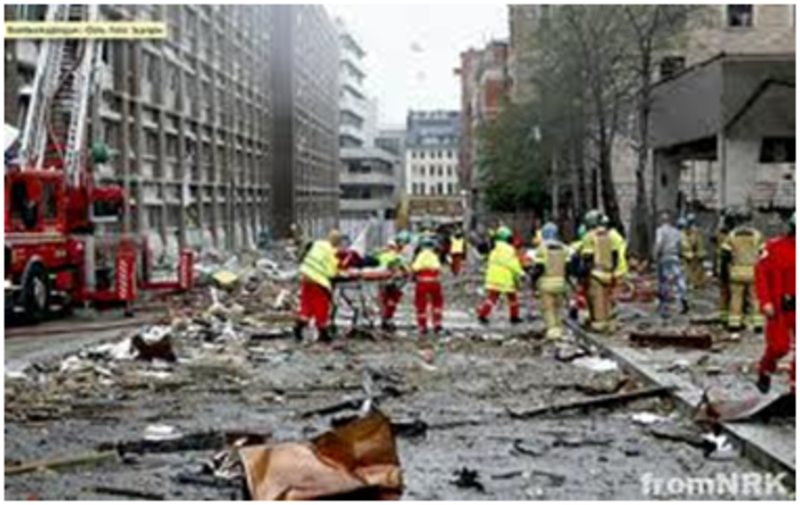
The Oslo bombing
In response, the Norwegian peace researcher Ola Tunander has observed that the Norwegian security establishment and police resources are smaller than foreigners might imagine: “Norway is a small country with a relatively unified power structure, where everyone knows each other, and there is less of a clear split between the security forces and the political elite. Close friends of the Chief of Police, for example the Deputy Foreign Minister, were among those with children on the Utøya island."14
This may not close the debate. For Norway also had a Gladio stay-behind network, ROCAMBOLE (ROC), that was partly funded and controlled by NATO, the CIA, and the British service MI6. ROC was also controversial. In the 1950s a secret controversy arose from Norway’s discovery that an American in Norway’s NATO HQ had “spied upon high-ranking Norwegian officials.” The left-wing Norwegian intelligence chief who discovered this situation and protested it to NATO, Vilhelm Evang, was later forced out of office by other Norwegian security officials, as the indirect result of a secret allegation forwarded by CIA Counterintelligence Chief James Angleton.15 So Norway’s security apparatus was not entirely homogeneous and autonomous.
Whatever the facts, 7/22 must be distinguished from a classical false-flag event by Gladio stay-behind networks. Traditionally in such cases, the designated perpetrator was associated, not with right-wingers, but the left.
The Key to 7/22 Lies in the Event, Not in the Man
Breivik the man is unique, proclaiming his affiliations with both the Unabomber’s philosophy and the right-wing counter-jihad milieu. But 7/22 the event is more familiar, and presents a number of features that are also familiar from past deep events:
1) a “legend” or documented characterization of the perpetrator;
2) “planted clues,” or what I have elsewhere referred to as a “paper trail,” often including videos suitable for post-event promotion of the legend;
3) in particular, planted autodocumentation, a genre ranging in variety from the “historic diary” of Lee Harvey Oswald to the manifesto of the Unabomber;
4) a tested modus operandi for a mass bombing.
The word “legend” is a term of art from the intelligence world meaning a myth created around a person, usually to hide their real intent or loyalties.16 I use it here without prejudging the truth or falsity of the myth, or the related question of authorship. Above all, in what follows, I do not mean to imply that the myth can be dismissed as a cynical artifact. Indeed it seems clear that the author of the manifesto/video, whether Breivik alone or someone else, was consciously creating a myth of a crusade against Islam which they sincerely believed in.
Let me digress for a moment, as someone who believes in the long-term future of democracy, open societies, and multiculturalism as it is developing in America. I see the widespread resentments of Breivik and countless others about “multi-cultis” as a serious phenomenon worthy of sympathetic understanding. Technology and globalization, as much in Russia and China as in the West, are creating problems for the survival and health of cultures everywhere, from Thailand to Tibet to the banlieu of Paris, for which it is difficult to see short-term solutions.
One response, ironically shared by Euronationalist crusaders like Breivik and also their jihadi Islamist opponents, is to be drawn to crusader-jihadi violence. (The secular anarchist Unabomber, quoted by Breivik, shows another version of this response.) Olivier Roy and others have sensitively analyzed the appeal of salafi jihad to young Muslims in Europe, with an identity-crisis caused by their alienation from the various distant cultures of their ancestors, as much as from the Western culture in which they are marginalized.17 We need also to address the identity-crises of those who see their traditional monocultures, in Norway as anywhere else, challenged by rapid cultural changes that are inadequately discussed, let alone managed.
Take the example of Switzerland, a country that has learned over centuries to live with four different languages and two versions of Christianity that once warred bitterly against each other. This cultural maturity does not equip the Swiss to deal easily with new immigrants who wish to establish not only mosques but Sharia in their midst.
A much longer essay than this one would be needed to explore the resonances of Breivik’s myth. But our topic here is 7/22, not Breivik the man.
The planted clues for Breivik’s legend
Breivik the man must be viewed as unreliable, and every statement from him viewed with the greatest suspicion. Yet his extensive autodocumentation --  by which I mean the Internet manifesto, video, and Facebook page attributed to him -- deserve to be assessed carefully regardless of authorship, especially in the light of later statements he is alleged to have made to the Norwegian police. And here we can say that, whatever the truth about Breivik, the autodocumentation shows connections leading ultimately to the shadowy underworld of arms and drug traffickers that may also have fostered al Qaeda.
It is exceedingly common for high-publicity deep events to be accompanied by such autodocumentation, After the diaries of Lee Harvey Oswald and Sirhan Sirhan, the alleged diary attributed to Arthur Bremer (the man said to have shot the 1972 presidential candidate George Wallace, stimulated Gore Vidal to wonder, in an essay for the New York Review of Books, whether the true author of the diary might not have been the CIA officer and Watergate plotter E. Howard Hunt (or in my terms, whether the Wallace shooting might not have been a systemic deep event).
Nearby in a rented car, the police found Bremer’s diary (odd that in the post-Gutenberg age Oswald, Sirhan, and Bremer should have all committed to paper their pensées). According to the diary, Bremer had tried to kill Nixon in Canada but failed to get close enough. He then decided to kill George Wallace. The absence of any logical motive is now familiar to most Americans, who are quite at home with the batty killer who acts alone in order to be on television.18
Gore’s perceptive witticism, the “killer who acts alone in order to be on television,” fits Breivik very well: his documents seem clearly designed to generate maximum publicity and speculation.
Somewhat like Breivik, Oswald left behind him a legacy of autodocumentation, some of which proved to be very suited for post-assassination television. This included, besides a diary and extensive political manuscripts, an audio-video tape involving an ex-Army psychological warfare expert, and expounding his alleged political beliefs. Yet the differences are instructive. Oswald’s autodocumentation of his alleged left-wing identity can be seen in retrospect as false, and probably part of FBI-CIA efforts to discredit the Fair Play for Cuba Committee which Oswald tried to penetrate.19 Breivik’s video appears to express his true beliefs, even though I shall argue in a moment that most of the video may have been prepared by someone else. Yet in contrast to Breivik’s, the misleading Oswald audio-video was aired extensively after the JFK assassination, as part of the propaganda campaign to describe him as a leftist.20 The Breivik video, by comparison, has been downplayed, and has indeed disappeared from many if not most of the web sites where it was originally posted.21
This suggests to me that the Breivik video was intended to capitalize on the publicity caused by his actions, but that the group behind this effort was not part of mainstream western society, and is not currently being supported by those in charge of the mainstream media. I shall suggest shortly that it was designed primarily for a different audience: the world of the resentful who find an outlet for their resentments on the Internet.
What Does Breivik’s Video Indicate? That Breivik Did Not Act Alone
Both the content and the authorship of Breivik’s video remain very mysterious. What seems relatively clear is that it was not composed and controlled by Breivik alone.
The evidence for plural authorship for the video is internal.22 Almost all of the video appears to be a speeded-up version of a text-heavy sequence of stills, possibly originally a slideshow presentation about knights templar and their fellow crusaders. It is clear both that a great deal of work has gone into the preparation and presentation of this text, and also that the text serves little or no purpose in the speeded-up Breivik version, For there are sometimes up to about twenty lines of text on a screen page, of which not more than about four or five lines can be read, even swiftly, in the time now allotted to them.
Otherwise the video is of professional quality, definitely not a home movie. One of the stylistic features unifying it is the steady predictable rhythm in the three- or four-second time-lapses allotted to each still. This rhythm is broken, jarringly, at the very end, when three photos of Breivik himself appear. The first two are presented very swiftly, completely out of sync with the rhythmic presentation in the rest of the video.
I am left with the strong impression that whoever added Breivik’s stills at the end of the video – who may possibly even have been Breivik himself – was not the original videographer or slideshow preparer. It was someone instead with a different style, sensibility, and purpose. (It would not surprise me to learn that there are other discernible and even quantifiable differences between the slideshow and Breivik parts of the video, with respect to such details as light.)
Whoever emailed out the video and manifesto just before the attacks was most likely aware of the massacres about to unfold. And if there is more than one author for the video, then Breivik was most probably not acting alone. For the release of the two documents must be considered an integral, indeed an essential, part of the 7/22 event  -- indeed the point of it. I shall argue shortly that its aim was not just slaughter but publicity: to provoke a heightened discussion of the issues and promoters of counter-jihad.
The Modus Operandi of the Bomb
It has been widely noted that Breivik in 7/22 used the same bombing modus operandi as Oklahoma City and the 1993 World Trade Center bombing – an ammonium nitrate bomb concealed in a parked vehicle. As Andrew Gumbel wrote in an op-ed for the Los Angeles Times,
Breivik appears to have been more than simply inspired by American predecessors such as Timothy McVeigh, the Oklahoma City bomber: The materials he used, the way he planned and carried out his attacks, and his own writings all suggest he was deeply familiar with the actions of some notorious political killers on this side of the Atlantic. Breivik possessed a Glock semiautomatic, the same weapon McVeigh was carrying when he was arrested by a hawk-eyed Highway Patrol officer 90 minutes after the April 1995 bombing in Oklahoma. Breivik also possessed a .223-caliber Ruger assault rifle, just like McVeigh.23
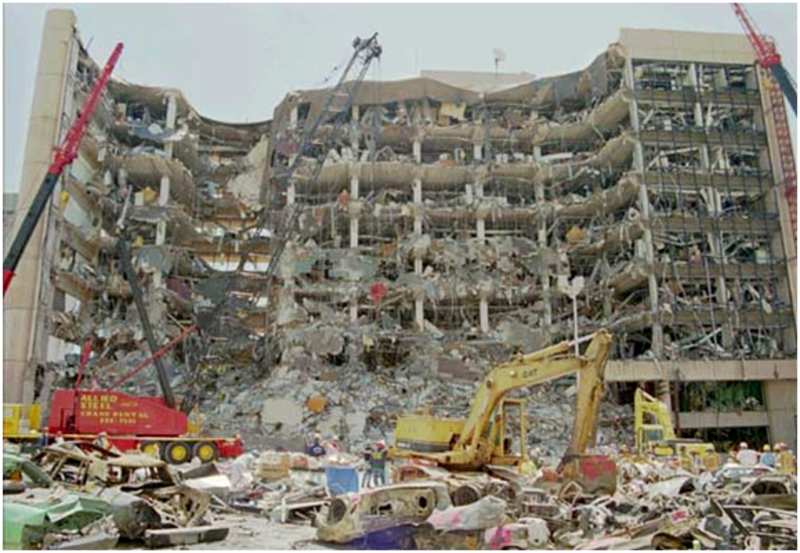
Oklahoma City bombing
The debate still continues whether Breivik himself could have developed the skills to make a successful ammonium nitrate bomb. But there are strong indications that the 1993 WTC bombers and one of the two known 1995 Oklahoma City bombers (Tim McVeigh and Terry Nichols) received training from abroad, possibly from al Qaeda.
In the words of Dana Rohrabacher, Chairman of the House International Relations Committee,
Nichols’ skill as a terrorist seems to have grown while in the Philippines.  Initially he was an unsuccessful bomb-maker.  According to Michael Fortier’s testimony, Nichols and McVeigh failed miserably when they tested an explosive device in the Arizona desert just six months before they bombed the Murrah building.  After Nichols’ final trip to the Philippines, he and McVeigh were fully capable of manufacturing the crude but deadly bomb that was used to bring down the Murrah federal building.24
Rohrabacher also explored the apparent connections in the Philippines between Nichols and Ramzi Yousef, the al-Qaeda-linked mastermind of the 1993 WTC bombing. (Yousef is a close associate and relative of Khalid Sheikh Mohammed, said to have been the mastermind of al Qaeda’s 9/11 exploit.)25 According to researcher J.M. Berger and others, “In November 1994, Terry Nichols and Ramzi Yousef both walked on the grounds of the same college campus,” Southwestern University in the Philippine city of Cebu, where an Islamist cell was active. Later, each man booked a flight on the same airline.26
It is worth recalling that in the 1993 bombing of the World Trade Center the attackers were trained by a member of al Qaeda, Ali Mohamed, who almost certainly was a double agent working also for U.S. sources. The same trainer “led” (to quote the 9/11 Commission Report” the 1998 attack on the U.S. Embassy, and may have trained the alleged 9/11 hijackers as well.27
This continuity suggests that all these American incidents of violence may have been part of an on-going strategy of tension, to destabilize society as a means to justify the ever-mounting budgets for America’s security forces. In American War Machine I devoted an entire chapter to the question whether we should see 9/11 as part of an on-going tradition of “engineered” deep events. (I took the term “engineered” from a U.S. army document stating, “The engineering of a series of provocations to justify military intervention is feasible and could be accomplished with the resources available.”)28
The fact that Breivik imitated McVeigh does not prove that they were part of the same organization. It is possible that Breivik consciously imitated McVeigh, as a way of heightening and shading the aura of mystery he cultivated around his actions – or if you will as a kind of hommage to McVeigh, along with the Unabomber and others I shall name shortly. But I shall argue that Breivik may indeed have been intimate with the arms-for-drugs milieu that can also be perceived in the background of both Oklahoma City and al Qaeda. (For al Qaeda, despite the odd denial in the 9/11 Commission Report, was almost certainly a drug-trafficking and drug-supported organization.)29
Breivik’s Finances Suggest He Did Not Act Alone
Breivik’s planted clues about his finances also point mysteriously to international connections beyond what was needed for 7/22 alone. In this case the mystery of his finances is reinforced by evidence we learn independently from the Norwegian police: namely, that in 2007, a year in which he reported little taxable income, the equivalent of $115,000 was mysteriously deposited into Breivik’s bank account.30 This important clue, not coming from Breivik himself, refers to a time when "Government records suggest that …. his early attempts at business were a failure."31
Breivik himself has reportedly heightened the mystery behind the alleged “loner.” He is said to have explained to the police that he had ten times as much money (six million kroner, about $1.1 million) to finance his terrorist attacks.32 His lawyer, Geir Lippestad, has added that his planning also involved extensive travel:
"[Breivik] has traveled in many countries in Europe, via car, ferry and plane, said Lippestad. These states correspond to some of those states mentioned in Breivik's so-called manifesto, which he repeatedly mentioned during the interrogations. According to Lippestad, [Breivik's] traveling has been directly related to the planning of the attacks, which was most intense in recent years. He has met with an unknown number of people who have helped him to obtain materials, and he also explained that most of the equipment is from abroad. In earlier questioning, Breivik explained that he had six million [kroner] to finance the terrorist attacks.33
An even more suggestive lead to this hidden financial dimension is a statement attached to the Breivik manifesto, in which “Breivik” claimed to describe his irregular commercial and banking activity:
2005-2007: Managing director of E-Commerce Group AS (part investment company – 50%, part sales/outsourcing company – 50%). I converted ABB ENK to a corporation (AS). Total of 7 employees: 3 in Norway, 1 in Russia, 1 in Indonesia, 1 in Romania, 1 in the US. Distribution of outsourcing services to foreign companies, sold software/programming solutions. Worked part time with day trading (stocks/options/currency/commodities).
In the words of this statement,
This was a front (milking cow) with the purpose of financing resistance/liberation related military operations. The company was successful although most of the funds were channelled through a Caribbean subsidiary (with base in Antigua, a location where European countries do not have access): Brentwood Solutions Limited with bank accounts in other Caribbean nations and Eastern Europe. E-Commerce Group was terminated in 2007 while most of the funds were channelled in an “unorthodox manner” to Norway available to the coming intellectual and subsequent operations phase.34
Antigua, a small island in the Caribbean, was noted for its corrupt banks with intelligence connections; it was used for example by BCCI and Israeli operatives in the 1980s for illicit arms sales to the Medellin cocaine cartel.35 Some have seen a possible implication of Israel in this allusion to Antigua by Breivik, an avowed pro-Zionist in his manifesto. The same people have pointed to an article by Barry Rubin in the July 31 Jerusalem Post, claiming that the Utoya youth camp that Breivik attacked (and which had been rehearsing ways to break the Israeli blockade of Gaza) was “engaged in what was essentially ... a pro-terrorist program.”36 Finally some have pointed to the growing links between the right-wing parties of Israel and formerly anti-Semitic right-wing parties extolled in the Breivik manifesto.37
In this article I am arguing neither for nor against the possible involvement of Israelis, along with others, in the events of 7/22. I will however argue that we should look for an ultimate source, not in the covert structures of any single state, but in a paranational dark force with the capacity to collude with or even manipulate them.
Breivik, Knights Templar, and the Order 777 of Mad Nick Greger
In short, both the Breivik autodocumentation and independent reports from the police about his bank account suggest that there is an unexplored higher dimension to Breivik’s crimes. The Breivik manifesto and video enhance this suggestion, associating Breivik with an alleged larger movement of neo-Knight Templars crusading in defense of Judeo-Christian Europe.
The manifesto describes a Knights Templar meeting Breivik is said to have attended in London, one consisting of only about five people, including a Russian and a Serbian  (“by proxy, location: Monrovia, Liberia,” apparently represented at the meeting by Breivik himself), who was now eluding punishment for his killings of Muslims in Bosnia. (“I joined the session after visiting one of the initial facilitators, a Serbian Crusader Commander and war hero, in Monrovia, Liberia.”)38
Breivik’s manifesto
There are reasons to suspect that this Serbian commander was Milorad Ulemek, also known as Milorad Lukovic (or Legija), a former commander of the Serbian paramilitary unit known as Arkan’s Tigers (and later as Red Berets) that initiated ethnic cleansing in Bosnia. The Breivik manifesto extols the Tigers and their commanders (including the late Raznatovic Arkan and Ulemek, the only survivor) as role models.39
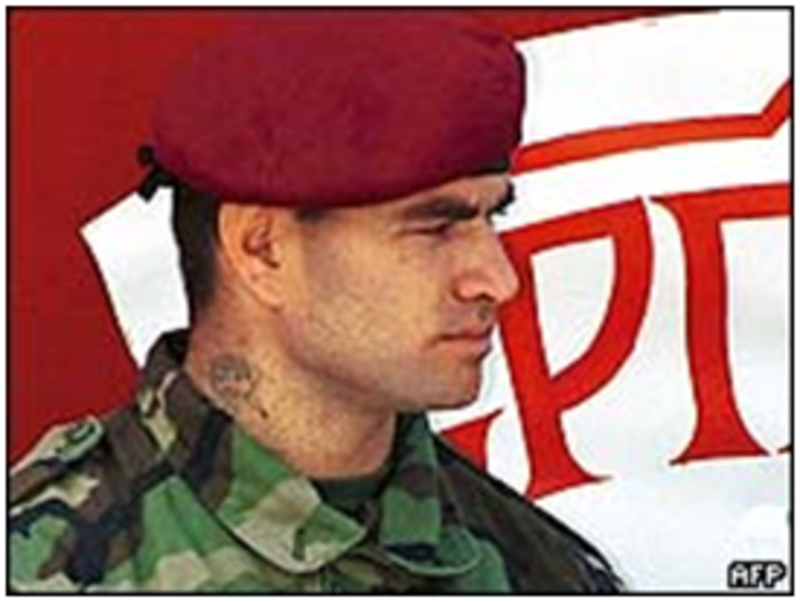
Milorad Ulemik
The video attributed to Breivik shows some remarkable similarities to another pro-Ulemek video, this one released by the leader of a self-professed Knights Templar group called Order 777. The leader, now allegedly reformed, is a former anti-Muslim terrorist and bomber from East Germany, by the name of Nick Greger (“Commander Mad Nick” or “madnick77”). Greger is a man of many talents and interests, including as an artist and author; and above all he (“madnick77”) is an obsessive poster of videos on the Internet (henceforward “Greger’s videos”). These “Order 777” videos, like Breivik’s, urge Judeo-Christian Europe to unite against the menace of Islam (“it’s not about race, it’s about religion”), and the related menace of globalist multi-culturalism as enforced by the UN and the United States.
One particular video posted by Greger, “The Order 777 -- Immortals,” is so similar to Breivik’s in its stylistic details, that it suggests a common origin may exist for both. Readers can view the two videos and judge for themselves: Breivik’s here, and Greger’s here. Note that both videos are divided into sections, and in each the final “optimistic” (i.e. counter-jihadistic) section is prefaced by the picture of a Knight Templar, with his distinctive heraldry of a red Maltese cross on a white field.
The following description of the Greger video in the London Daily Telegraph is accurate:
The group, calling itself Order 777, claims to bring together Christian resistance movements and features a depiction of a Templar Knight [the one with a red Maltese cross] with the slogan “The Order 777 Strikes Back!” alongside footage of a variety of armed gangs with the words “factions united.”
The groups include the UFF in Northern Ireland, Serbian nationalists, Liberian and Congolese fighters and members of the neo-fascist AWB in South Africa.
In one clip Mr Greger is handling a Kalashnikov and in another says: “The war of the future will be a war of the religions.”…
A number of similarities between the “compendium” [i.e. Breivik’s manifesto] and the Order 777 videos have begun to emerge.
Breivik said he had attended the founding meeting of the “Knights Templar Europe” in London “after visiting one of the initial facilitators, a Serbian Crusader Commander and war hero, in Monrovia, Liberia.”
Both the “compendium” and the Order 777 videos feature a man called Milorad Ulemek, a former commander of the Red Berets, a unit of the Serbian security Services called the JSO, who was arrested in 2004 and convicted of the assassinations of Serbian Prime Minister Zoran Djindjic and former Serbian President Ivan Stambolic and of organising the attempted murder of the Serbian opposition leader Vuk Draskovic.
The videos also feature Charles Taylor, the former Liberian dictator now facing war crimes trials, and a girl called “Black Diamond” who fought on the rebel army against Taylor in 2003.40
Nick Greger (left) and Paul Ray
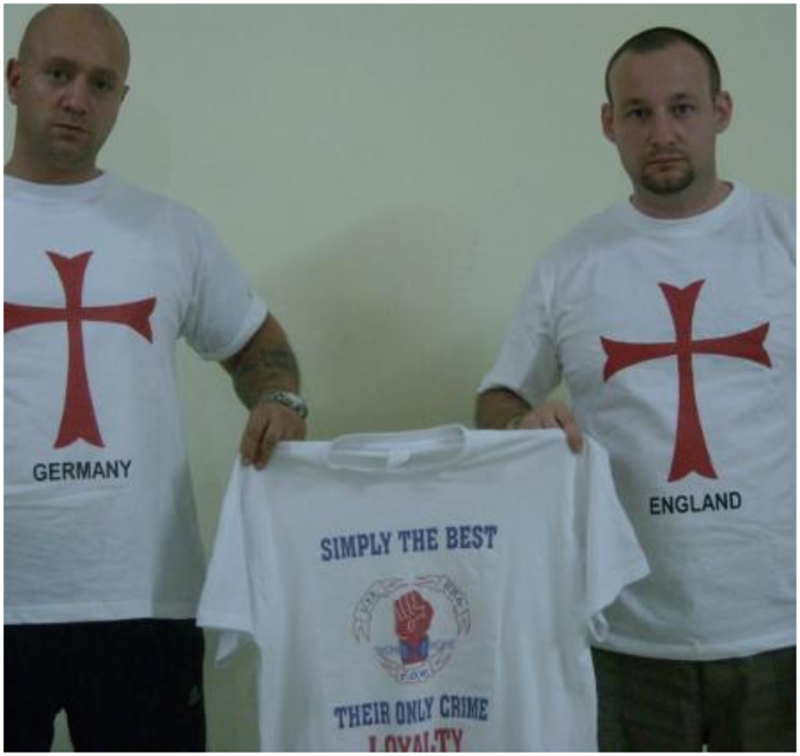
To these similarities should be added others: their division into sections, their opening with a Latin quotation, their staccato sequence of stills surrounded by heavy black borders with accompanying lettering, their background of loud ominous choral music, the scenes from Africa, their focus on heroic or would-be-heroic Christian crusaders, past and present, and their “optimistic” (i.e. counter-jihadistic) final sections, preceded by a picture of a Knight Templar with a red Maltese cross on a white field.41 There are also photos on the Internet of Nick Greger himself sporting a Knights Templar T-shirt, with the same red Maltese Cross that Breivik posted on the first page of his Internet manifesto.42
In other posts Greger presents himself as a reformed, anti-racist “Christian brother.”
But the “Christians” defended in his video are without exception murderers ready, if alive, to kill again. For example, there seems no reason to call Charles Taylor (to whom Greger dedicated another video)43 Christian, other than that he once teamed up with televangelist Pat Robertson to mine diamonds in Liberia. According to Colbert King in the Washington Post,
The U.S.-educated but Libya-trained Taylor is a menace to all that's decent….With tens of thousands of Liberians slain, hundreds of thousands displaced throughout West Africa, a generation of young Liberian boys ruined by their conversion to child soldiers, women raped and mutilated, his country is in absolute ruins and is ostracized by the world community.44
Of greater relevance to this essay, Taylor, like all but two of the nine men celebrated in Greger’s video, was implicated in the arms-for-drugs traffic.45
Knights Templar, the International Arms-for-Drugs Traffic, and Far West LLC
 A fact not mentioned in Greger’s video (or so far in the subsequent discussion of it) is that of the nine men celebrated at its outset, all but two (Eugene Terreblanche of South Africa and Laurent Nkunda of the Democratic Republic of the Congo) were united, not by ideology, but by their involvement in the lucrative arms-for-drugs traffic. These included six who have been directly identified elsewhere as drug traffickers:
Charles Taylor, self-installed president of Liberia,46
Samir Geagea, militia leader in Lebanon,47
Johnny Adair, former Protestant militia leader in Northern Ireland,48
Irish militia hitmen Gary Smith49 and (allegedly) Billy Wright,50
and, most significantly, Breivik’s and Greger’s hero Milorad Ulemek.51
Ulemek was not just a militia leader, but a Serbian Mafioso and member of
the so-called Zemun clan, a combination of a now defunct secret police unit and powerful gangsters from the Belgrade suburb of Zemun, who ran drug smuggling operations all over the Balkans and were involved in dozens of killings and abductions.52
It is not surprising that Greger’s militia leaders should become traffickers: illicit paramilitaries usually have to acquire and pay for their arms through illicit arms-for-drugs networks. The video’s line-up of Christian drug traffickers reminds us of the current symbiosis between non-state violence (whether that of revolutionaries or of militias hired to fight them) and the drug traffic: the drug traffic now thrives where there is non-state violence, and those involved in such violence (whether of the right or left) support themselves by drugs. Today the global maps of major drug-growing and of non-state violence are virtually one and the same.
But for Breivik’s heroes Raznatovic Arkan and Ulemek Legija, the drugs may have been a more serious and on-going part of their career than as a means to the arms and the ethnic cleansing in Bosnia. The Yugoslav
government embodied by Milošević at the political level and Željko Ražnatović Arkan as the executioner, represented the mafia in Serbia. Other high-profile actors were involved, including Stanko “Cane” Subotic, who became one of the richest men in Eastern Europe thanks to cigarette smuggling. “Cane” is in golden exile in Switzerland, which does not have extradition arrangements with Serbia. Arkan’s murder in 2000 marked the peak of this phase. Arkan was extorting from all other criminal groups and he was so convinced he was untouchable that he went around without bodyguards”. The Zemun clan came after him, Dojčinović [Stevan Dojčinović of CIN (the Center for Investigative Reporting] said. “Under the excuse of ‘avenging’ Arkan, the Zemun clan, in the following years, eliminated all the competition and created the most rigid monopoly. Whatever business you wanted to do, you had to do it with them.”53
Russian sources have linked Ulemek with Vladimir Filin, the Russian leader of Far West LLC, a group of former Soviet military intelligence officers accused of arms and drug trafficking.54 In fact, Ulemek was said to have been so close to Filin, that Far West was “threatened” by Ulemek’s (“Legija”’s) imprisonment.55 The connection is probable: Serbian and Russian organized crime (allegedly including Far West) were involved together not just in drug trafficking but in the protection rackets at ports on the Black Sea.56
Breivik, Destabilization, Far West, and Global Shadow Elites
Far West is not to be thought of as a localized drug mafia like the Zemun gang, but as a multinational linchpin between organized crime, including drug trafficking, and the global intelligence and corporate establishment.  From its origins as a Soviet military intelligence (GRU) group in Afghanistan, with responsibility for narcotics matters, it has expanded globally, and now enjoys connections to the intelligence networks of Israel, Turkey, Saudi Arabia, Russia, Great Britain, and the United States.”57
In particular, as I wrote six years ago,
The group's business front, Far West Ltd [now Far West LLC]. is said to have CIA-approved contractual dealings with Halliburton for geopolitical purposes in the Caucasus, as well as dealings in Iraq with Diligence LLC, a group with connections to Joe Allbaugh (the FEMA chief in 2001) and to the President's younger brother Neil Bush. The head of Far West recently told a Russian outlet that "a well-known American corporation... is a co-founder of our agency."
Because of all these connections transcending normal political and ideological differences, I described it as a “meta-group,” like the drug bank BCCI which was in some significant ways its predecessor.58
Today I would say of my essay that I did not distinguish clearly enough between the Far West meta-group itself and its “roof” or protection, the men it dealt with at a still higher level, like Boris Berezovsky’s man Alexander Voloshin in the Kremlin, or the multi-billionaires Roman Abramovich and Adnan Khashoggi. Far West consisted of a multinational connection of structures and networks in particular locations. Those using and protecting it did not constitute a structure, but a paranational milieu without any single location or organization.
These protectors qualify as part of what David Rothkopf has called the illicit “shadow elites, those whose influence stems from illicit or unconventional means.”59 Such illicit elites are not marginal: Khashoggi, for example, was once called by his American biographer “the richest man in the world.”60 The Russian arms merchant Viktor Bout, who conducted arms deals both with Charles Taylor of Liberia and with Far West in the Ukraine, has been called “the Bill Gates or Donald Trump of modern gun running.”61
In an era when the combined wealth of the 225 richest people nearly equals the annual income of the poorer half of the earth’s population,62 it can be assumed that the power and influence of the illicit wealthy is a major force to be reckoned with in world affairs. And it is clear that some in these shadow elites stand to benefit from the crimes Breivik has been charged with: specifically  “destabilizing or destroying basic functions of society,” and “creating serious fear in the population.”63
In American War Machine a year ago I characterized Far West as a component of a larger war machine, and specifically as an “ongoing destabilization machine” whose principal aim in destabilization is not ideological, but “to promote conditions that facilitate its own business prospects…and specifically the chaos that makes for future contracts.”64
This brings us back to Ulemek and Filin, whose connection must have been a matter of business rather than of ideology. Ulemek had been involved in killing Muslim minorities, whereas members of Far West (who included Muslims) were allegedly involved in backing ethnic Muslim jihads inside Russia. But Ulemek and Filin, along with Greger and indeed Breivik, had a common interest in one goal: the destabilization of existing society. Obviously, for their activities, whether paramilitary violence, arms trafficking, or drugs, destabilization is beneficial, even necessary.
Of course destabilization is not profitable to drug traffickers alone. It also generates business for the power bureaucracies and private military corporations whose practice it is to intervene in destabilized countries. And finally it is a source of income to those illicit elites who are themselves safely above drug trafficking, but have become rich through banking the proceeds.
Thus Breivik, who must be condemned both as a psychopathic mass murderer and as a threat to world order, can be seen as someone useful to those whose business it is to profit from the destabilization of that world order.
Behind Systemic Destabilization: A Deep State or a Paranational Dark Force?
The Breivik manifesto and video constitute a veritable cherry orchard of planted clues, from which it is possible to cherry-pick a number of alternative explanatory scenarios. In my own case I have been guided by the need to test a double hypothesis I put forward tentatively in the American War Machine:
1) There exists an on-going milieu that is repeatedly a source for the systemic destabilization in many of the world’s major deep events, and
2) there is a congruence between this dark quadrant of systemic destabilization (or what I once called “managed violence”) and the milieu of the international drug traffic.65
I have tried to show in this essay that the events of 7/22, studied in the context of the Breivik-Ulemek-Filin connection, provide an initial corroboration, at this stage admittedly less than definitive, of this double hypothesis.
There was a time when, citing the facts disclosed about the Piazza Fontana bombing in Italy or the Semdinli bombing in Turkey, I tended to identify the source of all such deep events with the parastatal or “deep state” structures in these countries, including the CIA in America. But in American War Machine I give reasons, not easily summarized, for suspecting that for the ultimate source of such deep events we should look beyond the parastatal structures of nations (including the CIA) to a more unstructured and paranational deep force or dark force, or forces, colluding with, and sometimes perhaps manipulating, these parastatal structures.66
In Moscow in 2010 I was invited to attend an International Forum on Afghan Drug Production. There a senior Russian counternarcotics official, in the course of a long and intense conversation, said to me, “For many years I have been trying to fight the drug traffic, and up till now I don’t really know what I’m fighting.” I replied, “You know, on page 5 of my next book, I say almost the same thing.” (In American War Machine, p. 5, I write that in choosing to refer to the CIA’s global drug connection, I was not trying to define the force precisely, but “attempting to denote and describe a deep force, or forces, that I do not fully understand.”)
The events of 7/22 do not by themselves resolve the mystery of this dark force. But they do help to underline its on-going significance.

I would like to thank those researchers who helped me with this essay, in particular Magda Hassan and Jan Klimkowski of Deep Politics Forum, and Ola Tunander.
Peter Dale Scott, a former Canadian diplomat and English Professor at the University of California, Berkeley, is the author of Drugs Oil and War, The Road to 9/11, and The War Conspiracy: JFK, 9/11, and the Deep Politics of War. His most recent book is American War Machine: Deep Politics, the CIA Global Drug Connection and the Road to Afghanistan. His website, which contains a wealth of his writings, is here.
Recommended citation: Peter Dale Scott, "Norway’s Terror as Systemic Destabilization: Breivik, the Arms-for-Drugs Milieu, and Global Shadow Elites," The Asia-Pacific Journal Vol 9, Issue 34 No 1, August 22, 2011.
Notes
1 Peter Dale Scott. “Korea (1950), the Tonkin Gulf Incident, and 9/11: Deep Events in Recent American History,” Asia-Pacific Journal: Japan Focus, June 22, 2008.
2 The unsolved mystery of Aum Shinrikyo’s motive for the mass attack is discussed by James William Jones, Blood That Cries Out from the Earth: the Psychology of Religious Terrorism, 77-79. Cf. Robert Jay Lifton, Destroying the World to Save It: Aum Shinrikyo, Apocalyptic Violence and the New Global Terrorism, 68.
3 Peter Dale Scott, American War Machine (Lanham, MD: Rowman & Littlefield, 2010), 19-21; Christopher Deliso, The coming Balkan caliphate: the threat of radical Islam to Europe and the West, 100: “Military coups in 1971 and 1980, bookended by chronic massacres of civilian demonstrators throughout the 1970s, were all led by Counter-Guerrilla/Grey Wolves elements. Immediately after the 1980 military coup that brought the Counter-Guerrillas leader, General Kenan Evren to power, American CIA station chief Paul Henze reportedly cabled Washington exulting, ‘our boys have done it.’”
4 Peter Dale Scott, The Road to 9/11 (Berkeley: University of California Press, 2007), 180-84; Anna Cento Bull, Italian neofascism: the strategy of tension and the politics of non-reconciliation, 112-20.
5 Italian Senate, Parliamentary Committee Investigating Terrorism, 2000; quoted in Daniel Ganser, Nato’s Secret Armies (London: Frank Cass, 2005), 14; cf. Guardian, June 24, 2000.
6 Ganser, Nato’s Secret Armies, 138-47, 228-30.
7 Ganser, Nato’s Secret Armies, 14; cf. 17.
8 Bjoern H. Amland and Malin Rising, “Anders Behring Breivik, Norway Attacker, Returns To Crime Scene For Reconstruction ,” Huffington Post, August 14, 2011.
9 Scott, American War Machine, 187-92; Peter Dale Scott, “A Ballad of Drugs and 9/11,” Flashpoint Magazine.
10 David Rothkopf, Superclass: the Global Power Elite and the World They Are Making (New York: Farrar, Straus and Giroux, 2009), 289; cf. xx.
11 The lethal bomb attack of November 2005 on a bookshop in the Turkish district of Şemdinli, “initially attributed to the Kurdish separatist PKK, turned out to have been committed by members of Turkey's paramilitary police intelligence service, together with a former PKK member turned informer” (Scott. “Korea [1950], the Tonkin Gulf Incident, and 9/11,” citing Nicholas Birch, Irish Times, November 26, 2005). Cf. Gareth Jones, “Bombing throws spotlight on Turkey,” Hürriyet, November 20, 2005.
12 James Petras, “The Norwegian Massacre, the State, the Media and Israel,” My Catbird Seat, July 2011.
13 Michael Schwartz, “Suspect in Norway Reconstructs Killings for Police,” New York Times, August 14, 2011.
14 Ola Tunander, personal communication, August 4, 2011.
15 Ganser, Nato’s Secret Armies, 176, 181, 183, 289.
16 The term “legend” was popularized by author Edward Jay Epstein with respect to Oswald, in a book with that title. Epstein was suggesting that Oswald’s legend had been created by the KGB for a non-assassination purpose. A CIA monograph by former CIA officer Cleveland C. Cram, “Of Moles and Molehunters: A Review of Counterintelligence Literature,” criticized Epstein’s book for creating what was in effect another legend: “Epstein, working with James Angleton, was part of a disinformation campaign. Cram writes: ‘Legend… gave Angleton and his supporters an advantage by putting their argument adroitly – if dishonestly – before the public first’” (John Simkin, “Legend: The Secret World of Lee Harvey Oswald.”).
16 Olivier Roy, Globalized Islam: The Search for a New Ummah (New York: Columbia University Press, 2004).
17 Olivier Roy, Globalized Islam: The Search for a New Ummah (New York: Columbia University Press, 2004).
18 Gore Vidal, "The Art and Arts of E. Howard Hunt," New York Review of Books, December 13, 1973, (full disclosure: I wrote most of the brief footnotes for this essay): ”Although H.H. is a self-admitted forger of state papers I do not think that he actually had a hand in writing Bremer’s diary on the ground that the journal is a brilliant if flawed job of work, and beyond H.H.’s known literary competence.”
19 Peter Dale Scott, Deep Politics and the Death of JFK (Berkeley: University of California Press, 1992), 80-92, 262-66.
20 The CIA also made plans to have the Oswald tape translated into Spanish and distributed through Latin America via one of its radio assets. See “AMCOUP-1 Possible Use of DRE Tape,” CIA Dispatch of December 13, 1963, NARA #104-10018-10074, available from Mary Ferrell Foundation website, “The President’s assassination, of course, gave this radio debate newsworthiness of the highest category.” Cf. Peter Dale Scott, "New Documents." Open Secrets, I.6/II.1 (Dec.-Jan. 1995/Feb.-Apr. 1996), 20.
21 It can still be seen on Youtube, but on condition that you first sign up and then certify that you are over 18.
22 The video refers to the manifesto, and both are said to be produced by (in the video version) De laude novae militae Productions. De laude novae militae is faulty Latin copied from an amateurish website description of “In Praise of the New Knighthood,” a letter Bernard of Clairvaux sent to Hugues de Payens in support of the Templar order (TemplarHistory.com: A History and Mythos of the Knights Templar, March 2010, link). The same words, corrected to De laude novae militiae, open the manifesto.
23 Andrew Gumbel, “Seeds of Terror in Norway,” Los Angeles Times, July 28, 2011.
24 Dana Rohrabacher, “Chairman's Report: The Oklahoma City Bombing: Was There A Foreign Connection?“ December 26, 2006.
25 “Khalid Sheikh Mohammed – Yousef’s uncle, then located in Qatar – was a fellow plotter of Yousef in the Manila air plot and had also wired him some money prior,  to the Trade Center bombing (9/11 Commission Report, 73).
26 J.M. Berger, “Did Nichols and Yousef Meet?” Intelwire.com, 2004. Peter Lance cites a sworn affidavit from a former leader of Abu Sayyaf (a Philippine group being trained by al Qaeda), claiming that at a meeting he had met Yousef together with “a man named Terry Nichols, who was introduced …as ‘a farmer’” (Peter Lance, 1000 Days, 313; cf. 317). Berger argues that this claim “comes up short.”
27 Peter Dale Scott, Road to 9/11, 146-60; Peter Dale Scott, "Bosnia, Kosovo, and Now Libya: The Human Costs of Washington's On-Going Collusion with Terrorists," Asia-Pacific Journal: Japan Focus, July 29, 2011, http://japanfocus.org/-Peter_Dale-Scott/3578.
28 Peter Dale Scott, American War Machine, 193-207; quoting from Joint Chiefs of Staff, “Courses of Action Related to Cuba (Case II),” Report of the J-5 to the Joint Chiefs of Staff, May 1, 1963, NARA #202-10002-10018, 21.
29 Scott, American War Machine, 167-68, 241-43; discussing 9/11 Commission Report, 171.
30 Justin Raimondo, “Anders Behring Breivik, Mystery Man: Following the money trail,” Antiwar.com, July 29, 2011; citing Independent (London), July 28, 2001, link: “Exactly what he lived on in the run- up to the massacre remains a mystery. But his bank details reveal that in 2007, a sum equivalent to €80,000 (£70,000) was added to his account, which would have enabled him to live without having to work.”
31 Raimondo, “Anders Behring Breivik, Mystery Man,” citing Sydney Morning Herald, July 25, 2011.
32 Aftenposten, August 3, 2011, link. Cf. Hegnar Online, 03 August 2011, link. In addition the language of the Breivik manifesto hints over and over at a larger entity behind 7/22 – e.g. "It has been decided that the operation will be effectuated in Autumn, 2011. However, I cannot go into factors concerning why, at this point. My current funds are running low, and I have less than 15 000 Euro left with a 30 000 credit backup from my 10 different credit cards. My primary funds should cover all planned expenses without spending any of the credit.
33 Stavanger Aftenblad, August 3, 2011. 
34 “Personal facts about Andrew Berwick (Anders Behring Breivik),” Aufgeweckt, July 25, 2011, link.
35 Scott, American War Machine, 163. This arms supply operation is suspected to have been the work of a network headed by a former Mossad agent in Panama, Mike Harari, who was remembered by some Norwegians. In 1973 Harari, when Chief of the Operations Branch of Mossad, had overseen the botched murder of an innocent Moroccan in Lillehammer, Norway.
36 Barry Rubin, "The Region: The Oslo Syndrome,” Jerusalem Post, July 31 2011.
37 Wayne Madsen, “Israeli Co-option of Europe's Far-right Political Parties” Rense.com, August 3, 2011: “Although various media outlets, known to bend and succumb to the pressure applied by Israel and its global sympathizers, tried to downplay the connections between Breivik and his allies in Zionist circles in Israel and Europe, no less than the Jerusalem Post, an echo chamber for Zionist and neo-conservative interests, reported that Breivik was ‘motivated by Zionism’ in carrying out his deadly attack in Norway.
In fact, Breivik had a keen interest in one such stay-behind network in Turkey, a network that transformed itself into the Israeli Mossad-linked Ergenekon network, which may still be active against the Justice and Development (AK) Party of Prime Minister Recep Tayyip Erdogan. The German magazine Spiegel has highlighted the growing relationship between heretofore anti-Semitic and neo-Nazi far-right European political parties and Israel's right-wing parties. Spiegel's report focused on particularly close ties between Israelis and the Freedom Party of Austria, the National Front of France, the Flemish Vlaams Belang, the National Democratic Party of Germany, the German Freedom Party, True Finns Party of Finland, and the Northern League of Italy.”
38 Quoted in Paul Woodward, “Did Anders Behring Breivik Act Alone? “ Eurasia Review, July 25, 2011.
39 “An illustration of several successful and decisive campaigns:  - Serb Volunteer Guard - SDG[1]  - Type: Paramilitary organisation  - Size: 10 000+  - Garrison HQ: Belgrade  - Nickname: Arkan's Tigers, The Tigers  - Commander: Zeljko Raznatovic  - Second in command: Colonel Nebojsa Djordjevic Suca and Milorad Ulemek Legija…..  The Albanian Muslims in Serbia refused deportation and convertion from Islam  (and instead started armed resistance) and as such were targeted for annihilation.” Of those named by Breivik, Ulemek is the sole survivor; Raznatovic (“Arkan”), and Suca were both murdered.
40 Duncan Gardham, “Violent Videos of Oslo Killer’s ‘Mentor,’” Daily Telegraph (London), July 29, 2011.
41 The only exceptions to this style are the stills of Breivik himself at the end of the video.
42 Richard Bartholomew, “Paul Ray Identifies with Northern Ireland Loyalist Groups,” Bartholomew’s Notes on Religion, October 23, 2009. Discussed at Richard Bartholomew, “ London Times Highlights Paul Ray,” Bartholomew’s Notes on Religion, July 29, 2011.
43 “Tribute to President Charles Taylor The Order 777,” link.
44 Colbert I. King, “Pat Robertson's Gold,” Washington Post, September 22, 2001. Similarly Laurent Nkunda, another of the video’s heroes, is characterized by Leana Wen in the New York Times (June 21, 2007) as “an actual ‘warlord’ who is accused of raping and massacring thousands.”  Wen heard from a pastor that “Nkunda’s faith at one point seemed real;” but “local churches … were finally convinced that he was the one leading the crimes and atrocities, and his own church ended up excommunicating him.” Wen describes Nkunda as sporting a pin, “Rebels for Christ” – a phrase displayed also in Greger’s video.
45 In addition a video posted by “madnick77” says that Greger himself used “drugs and prostitution” in pursuit of his political goals (“Commander Nick Greger A.k.a Mad Nick / The Order 777,” link).
46 Charles Taylor was less known for drug trafficking than for the illicit traffic in blood-diamonds. Nevertheless when Taylor, a fugitive, was finally detained in a Range Rover with Nigerian diplomatic plates, significant amounts of cash and heroin were found in the vehicle (Sunday Times [London], August 8, 2010). Cf. Mail Guardian [South Africa], December 3. 2010, link: “A leading Dutch newspaper, Parool, carried a prominent news story last Friday linking … Liberia’s current leader, Charles Taylor, to a notorious drug syndicate. “
47 For Geagea’s drug trafficking see Jonathan Marshall, Descent into Chaos: Drug Trafficking and the Failure of Lebanon’s State, 1950-1990 (Stanford: Stanford UP, forthcoming), 131; citing Le Monde, May 19, 1990; Labrousse, La droga, 136-137.
48 For Johnny Adair’s drug trafficking see “Johnny Adair: Notorious Loyalist,” BBC News, January 10, 2003, link; cf. Daily Record, February 5, 2011, link.
49 ”UDA hitman muscles in on Scots drugs racket; Adair lieutenant seeks new patch after failed deal leaves him broke,” link.
50 Billy Wright and INLA carved up drugs market,” NewsLetter.co, link. A seventh man celebrated in the Greger video, Wright’s LTV adjutant, Mark Fulton, has not been personally accused of drug trafficking. But Fulton’s brother, Jim Fulton, was arrested in California with terrorist materials and drugs for sale, and the whole LTV militia has been accused collectively of becoming drug dealers (BBC News, January 16, 2000, link).
51 “Ulemek Made Industry Out of Criminal Gang,” B92-News, December 17, 2997, link: “Ulemek and Spasojević had some 200 men under their direct control, the state said, and established a drug trafficking monopoly in the capital, as well as in Vojvodina and the town of Požarevac. This monopoly came as a result of a series of murders, starting in 2000.”
52 “Killers of Serbia's first elected PM jailed for 40 years,” Independent (London), May 24, 2007.
53 Cecilia Ferrara, “Against the Mafia,” Balcanicaucaso.org, February 26, 2010.
54 My interest in Breivik and Far West began after reading the claim from Belarus that Breivik “underwent militant-terrorist training under the guidance of 51-year-old Valery Lunev, a former colonel of Belarusian special forces, who now lives in the Netherlands but regularly visits Belarus” (Yuri Mamchur, “Norwegian Terrorist Anders Breivik Trained in Belarus Militant Camps,” Russia Blog, July 28, 2011.) Lunev was a senior officer of Far West, responsible in particular for Far West’s “strong arm operations,” including the violent coup d’etat of 1991 against Georgian Premier Zviad Gamsahurdia, in which at least 113 people died (Peter Dale Scott, “The Global Drug Meta-Group: Drugs, Managed Violence, and the Russian 9/11”; cf. Link.) The Breivik manifesto does mention travel to Belarus. But unfortunately there is no independent corroboration for the claim of a Breivik-Lunev connection, alleged by a Belarusian politician, Mikhail Reshetnikov, with an obvious motive to implicate the Belarus Government of Alexander Lukashenko. (Cf. “Filin – “El Buho” Is Getting Nervous,” Left.ru, June 24, 2006, link: Lunev “serves in the counter-terrorist department of his [Lukashenko’s] KGB.”)
55 “Filin – “El Buho” Is Getting Nervous,” Left.ru, June 24, 2006.
56 Mats R. Berdal and Mónica Serrano, Transnational organized crime and international security: business as usual? (Boulder, CO: Lynne Rienner Publishers 2002).
57 Scott, American War Machine, 188; Peter Dale Scott, “The Real Grand Chessboard and the Profiteers of War (Part Two),” Foreign Policy Journal, January 10, 2010; Scott, “The Global Drug Meta-Group.”
58 Scott, “The Global Drug Meta-Group.”
59 Rothkopf, Superclass, 289; cf. xx.
60 Ronald Kessler, The Richest Man in the World: The Story of Adnan Khashoggi (New York: Warner Books, 1988). Khashoggi was also listed in the 1992 Senate BCCI Report as one of the “principal foreign agents of the U.S.” (U.S. Congress. Senate, 102nd Cong., 2nd Sess. The BCCI Affair: A Report to the Senate Committee on Foreign Relations from Senator John Kerry, Chairman, and from Senator Hank Brown, Ranking Member, Subcommittee on Terrorism, Narcotics, and International Operations, 299; Scott, American War Machine, 160-62).
61 Moisés Naím, Illicit: how smugglers, traffickers, and copycats are hijacking the global economy (New York: Doubleday, 2005), 49; quoted in Rothkopf, Superclass, 218. An associate of Viktor Bout, Oleg Orlov of EMM Arab Systems in Cyprus, collaborated both in Bout’s arms sales to Africa and in Bout’s shipping of Ukrainian X-55 cruise missiles, illegally exported by Far West, to Iran and China (UN Final report of the Monitoring Mechanism on Angola Sanctions, paragraphs 111 – 144, link (Bout/Orlov/Africa); cf. “Filin-‘El Buho’ is getting nervous:” “[Viktor] Bout-Aminov, [Richard] Chichakli, and Oleg Orlov were ‘outed’ in Angola and later in the rest of Africa in 2002-2005.  Then Orlov was ‘outed’ in the X-55 affair, China and Iran in the beginning of 2005.  As the result, Orlov is in the Ukrainian jail, Chichakli hides somewhere in the Emirates, and Bout-Aminov keeps a low profile and shuttles between Moscow suburbs and Minsk.  As to Bout’s and Chichakli’s friend Mr. [Charles] Taylor, he has been apprehended by the Hague Tribunal.“ It is widely accepted that Bout’s arms shipments to Liberia served the purposes of Taylor. But it can also be assumed that Taylor’s coup and arms purchases served the financial interests of Bout, a much more powerful and well-connected figure.
62 Scott, Road to 9/11, 254; citing Daniel Singer, Whose Millennium: Theirs or Ours
(New York: Monthly Review Press, 1999).
63 Reuters, July 26, 2011, link.
64 Scott, American War Machine, 191-92.
65 Peter Dale Scott, “The Global Drug Meta-Group: Drugs, Managed Violence, and the Russian 9/11”; cf. Link.
66 American War Machine, 2-5, 43; cf. 20-22, 134-40, 239-41.